
Before the weekend places

“The Wide Valley” (oil on canvas), by Paul Sample, at the Art Complex Museum, in Duxbury, Mass.
Paul Sample (1896-1974) was an American artist who portrayed life in New England in the 20th Century with a style that showed elements of "Social Realism and Regionalism." The painting above is almost a Vermont scene.
Atmospheric rivers are moving north

Note the atmospheric river stretching from the Caribbean to the British Isles.
Atmospheric rivers – those long, narrow bands of water vapor in the sky that bring heavy rain and storms to the U.S. West Coast and many other regions – are shifting toward higher latitudes, and that’s changing weather patterns around the world.
The shift is worsening droughts in some regions, intensifying flooding in others, and putting water resources that many communities rely on at risk. When atmospheric rivers reach far northward into the Arctic, they can also melt sea ice, affecting the global climate.
In a new study published in Science Advances, University of California, Santa Barbara, climate scientist Qinghua Ding and I show that atmospheric rivers have shifted about 6 to 10 degrees toward the two poles over the past four decades.
Atmospheric rivers on the move
Atmospheric rivers aren’t just a U.S West Coast thing. They form in many parts of the world and provide over half of the mean annual runoff in these regions, including the U.S. Southeast coasts and West Coast, Southeast Asia, New Zealand, northern Spain, Portugal, the United Kingdom and south-central Chile.
California relies on atmospheric rivers for up to 50% of its yearly rainfall. A series of winter atmospheric rivers there can bring enough rain and snow to end a drought, as parts of the region saw in 2023.
Atmospheric rivers occur all over the world, as this animation of global satellite data from February 2017 shows. NASA/Goddard Space Flight Center Scientific Visualization Studio
While atmospheric rivers share a similar origin – moisture supply from the tropics – atmospheric instability of the jet stream allows them to curve poleward in different ways. No two atmospheric rivers are exactly alike.
What particularly interests climate scientists, including us, is the collective behavior of atmospheric rivers. Atmospheric rivers are commonly seen in the extratropics, a region between the latitudes of 30 and 50 degrees in both hemispheres that includes most of the continental U.S., southern Australia and Chile.
Our study shows that atmospheric rivers have been shifting poleward over the past four decades. In both hemispheres, activity has increased along 50 degrees north and 50 degrees south, while it has decreased along 30 degrees north and 30 degrees south since 1979. In North America, that means more atmospheric rivers drenching British Columbia and Alaska.
A global chain reaction
One main reason for this shift is changes in sea surface temperatures in the eastern tropical Pacific. Since 2000, waters in the eastern tropical Pacific have had a cooling tendency, which affects atmospheric circulation worldwide. This cooling, often associated with La Niña conditions, pushes atmospheric rivers toward the poles.
The poleward movement of atmospheric rivers can be explained as a chain of interconnected processes.
During La Niña conditions, when sea surface temperatures cool in the eastern tropical Pacific, the Walker circulation – giant loops of air that affect precipitation as they rise and fall over different parts of the tropics – strengthens over the western Pacific. This stronger circulation causes the tropical rainfall belt to expand. The expanded tropical rainfall, combined with changes in atmospheric eddy patterns, results in high-pressure anomalies and wind patterns that steer atmospheric rivers farther poleward.
La Niña, with cooler water in the eastern Pacific, fades, and El Niño, with warmer water, starts to form in the tropical Pacific Ocean in 2023. NOAA Climate.gov
Conversely, during El Niño conditions, with warmer sea surface temperatures, the mechanism operates in the opposite direction, shifting atmospheric rivers so they don’t travel as far from the equator.
The shifts raise important questions about how climate models predict future changes in atmospheric rivers. Current models might underestimate natural variability, such as changes in the tropical Pacific, which can significantly affect atmospheric rivers. Understanding this connection can help forecasters make better predictions about future rainfall patterns and water availability.
Why does this poleward shift matter?
A shift in atmospheric rivers can have big effects on local climates.
In the subtropics, where atmospheric rivers are becoming less common, the result could be longer droughts and less water. Many areas, such as California and southern Brazil, depend on atmospheric rivers for rainfall to fill reservoirs and support farming. Without this moisture, these areas could face more water shortages, putting stress on communities, farms and ecosystems.
In higher latitudes, atmospheric rivers moving poleward could lead to more extreme rainfall, flooding and landslides in places such as the U.S. Pacific Northwest, Europe, and even in polar regions.
A satellite image on Feb. 20, 2017, shows an atmospheric river stretching from Hawaii to California, where it brought drenching rain. NASA/Earth Observatory/Jesse Allen
In the Arctic, more atmospheric rivers could speed up sea ice melting, adding to global warming and affecting animals that rely on the ice. An earlier study I was involved in found that the trend in summertime atmospheric river activity may contribute 36% of the increasing trend in summer moisture over the entire Arctic since 1979.
What it means for the future
So far, the shifts we have seen still mainly reflect changes due to natural processes, but human-induced global warming also plays a role. Global warming is expected to increase the overall frequency and intensity of atmospheric rivers because a warmer atmosphere can hold more moisture.
How that might change as the planet continues to warm is less clear. Predicting future changes remains uncertain due largely to the difficulty in predicting the natural swings between El Niño and La Niña, which play an important role in atmospheric river shifts.
As the world gets warmer, atmospheric rivers – and the critical rains they bring – will keep changing course. We need to understand and adapt to these changes so communities can keep thriving in a changing climate.
Zhe Li is a postdoctoral researcher in Earth System Science, University Corporation for Atmospheric Research
Disclosure statement
Zhe Li does not work for, consult, own shares in or receive funding from any company or organization that would benefit from this article, and has disclosed no relevant affiliations beyond their academic appointment.
Low-carbon transport

“Paddling Through’’ (oil on canvas), by Peter Yesis, at Yarmouth (Maine) Frame and Gallery.

Chris Powell: Conn. voters need to mix it up; is racial discrimination okay now?

The film The Land of Steady Habits is set in suburban Connecticut.
MANCHESTER, Conn.
Connecticut got its nickname as "the land of steady habits" in part because of its resistance to political change and its inclination to keep the same people in elective office for a long time. Comments made by Thomas Jefferson about Connecticut politics in 1801 have been aphorized as "few die and none resign."
Now that Connecticut has lost most political competition, with Democrats long having held all major state and federal offices in the state, change seems more unlikely than ever. A television commercial for U.S. Sen. Chris Murphy's campaign for a third term acknowledges this resistance to change even while suggesting it's needed.
The commercial shows the senator on another campaign walk around the state. He says: "What I find on this walk is that the things people care about here in Connecticut really don't change: the cost of living, how much money are they making, how much are they paying in taxes, are their neighborhoods safe?"
Would people keep expressing such concerns if they were satisfied? Or has the cost of living been outpacing wages for many? Have taxes decreased or has inflation made them more burdensome? And when social disintegration makes news in the state every day, how can anyone believe government's claim that crime is down?
Of course, if people's major concerns never change, eventually they might figure out that re-electing officials who never change anything won't help.
But then where are the alternatives in Connecticut? Ken Dixon of the Connecticut Hearst newspapers reports that six of the 36 state Senate elections and 43 of the 151 elections in the state House of Representatives next month are essentially uncontested.
Only one of the six Republican candidates for Congress is well known and will raise enough money for a plausible campaign. It's not enough for candidates to have a message. They also need the means to publicize it.
Meanwhile, the Republican candidate for president is very unpopular in the state and will be of little help to the party's other candidates here.
But any campaign at least starts with a message, and Republican campaigns in Connecticut might do well to take Senator Murphy's inadvertent hint. That is, the cost of living is too high, as is the cost of government, and the social order is coming apart without any acknowledgement by those in charge. Something must be done. But what exactly?
The outgoing administration that the senator supports has worsened the awful trends. Will Connecticut Republicans offer voters more than the opportunity to cast protest votes?
xxx
IS SEGREGATION GOOD NOW?: U.S. Education Secretary Miguel Cardona, the former Connecticut education commissioner and Meriden school superintendent, will be remembered mainly for botching the redesign of the federal college financial aid application, causing a national scandal. Even Democratic members of Congress doubt that Cardona could be considered for reappointment if the party keeps the presidency.
Cardona also spends much time using social media to pander to the teacher unions, one of the Democratic Party's biggest constituencies.
But the other day Cardona said something on social media that might actually be good for Connecticut residents to ponder. He wrote: "The Biden-Harris administration has invested over $17 billion in historically Black colleges and universities, more than any other administration in history. Now that is investing in Black excellence."
Many state residents may remember what they were told by Cardona's colleagues in the state education bureaucracy during the years of litigation in the school integration case of Sheff v. O'Neill: that Black students learn best in a racially integrated environment and that Connecticut's de-facto segregation of Black students should be considered unconstitutional. Now the same big thinkers claim that Black students need other Black students and Black teachers.
So how does racial segregation become "excellence" when, with the federal government's encouragement and financing, Black students enter "historically Black" colleges and universities? After the billions of dollars of expense resulting from the Sheff case and the regional schools it spawned, Connecticut residents might want to know.
Chris Powell has written about Connecticut government and politics for many years (CPowell@cox.net).
Dual personality

“Mirror J” (oil on canvas) by Tigran Tsitoghdzyan, in his show “Filtered Identity, at the Armenian Museum of America, Watertown, Mass., through Feb. 23.
The museum says:
“Tigran is a New York-based artist whose photo-realistic paintings merge an interest in classical and modern art with an emphasis on his own experiences as a father and an immigrant.’’
Arthur Allen: CVS and Helene land double whammy on some patients


Parenteral nutrition bag
From Kaiser Family Foundation Health News (KFF Health News)
The CVS representative popped into Lisa Trumble’s third-floor Berkshire Medical Center hospital room in Pittsfield, Mass., to announce that everything was arranged for Trumble to return home, where she relies on IV nutrition because of severe intestinal problems that leave her unable to eat.
That was on Tuesday, Oct. 8. The next morning a social worker and a doctor woke Trumble to say her discharge was canceled. CVS would no longer provide her home nutrition, and she had to stay in the hospital. “I was dropped between Tuesday night and Wednesday morning with no care for my life or my health,” Trumble said from her hospital bed eight days later.
After this article was published, on Oct. 18, Trumble said she was being discharged, after her caregivers found a replacement service. “I’m just afraid their supplies will run out,” she said. “My backup plan is always to go back to the hospital.”
Trumble is among 25,000 U.S. patients whose survival depends on parenteral nutrition, or PN — IV bags containing life-sustaining amino acids, sugars, fats, vitamins, and electrolytes. Hurricane Helene wrecked a factory in North Carolina that produced 60% of the fluids their sustenance is mixed from. About two weeks later, CVS announced that its Coram division, a leading infusion pharmacy, was exiting the PN and IV antibiotics business.
The hurricane led Baxter International to ration its dwindling supplies. Pharmacies that supply Trumble and other patients like her were already plagued by shortages, and the rationing means the remaining infusion pharmacies can’t take on the customers cut off by CVS, said David Seres, director of medical nutrition at Columbia University Medical Center in New York.
At the Mayo Clinic, in Rochester, Minn., seven or eight patients were ready to go home Tuesday but couldn’t be discharged because no infusion company would accept them, said Manpreet Mundi, a Mayo endocrinologist. The patients would fall ill within a day or two without this nutrition, he said.
By Oct. 18, home supplies had been located for all but a few of them, Mundi said. “A lot of public pressure” on Coram was starting to have an effect, he said.
Although the FDA is allowing emergency imports of IV fluids wiped out by Helene, as well as production of some of the fluids by U.S. compounding pharmacies, it’s unclear how long it will take to replenish supplies, said Mundi, who is a board member of the American Society for Parenteral and Enteral Nutrition and medical adviser to the Oley Foundation, which advocates for PN patients. “We’re trying to raise awareness that this could get worse before it gets better,” he said.
The patients who rely on PN have a variety of conditions that render them unable to digest food. Some have congenital abnormalities or disorders like Crohn’s disease that led to surgical removal of bowel sections. Others were scarred by cancer, car accidents, or gunfire, or are preemies born with underdeveloped intestines. In most patients, the fluid is pumped through a catheter into a large vein near the heart.
A crisis hit this community two years ago when CVS Health announced that it was shutting half of the 71 Coram pharmacies.
CVS, which recently announced nearly 3,000 layoffs amid reports of a possible restructuring, on Oct. 8 began telling its remaining 800 to 1,000 PN customers that they would have to find other infusion pharmacies. A news release provided to KFF Health News suggested the phaseout would last into January, but for patients like Trumble, the impact was immediate.
Highly specialized infusion medicine is “a challenging environment” for all companies “and Coram has not been immune to these challenges,” the CVS release said. “As such, we have reevaluated our service offerings.”
When asked about Trumble’s case, CVS Health spokesperson Mike DeAngelis said the company would “try to resolve it.” The next day, a company called Optum stepped in to replace Coram, Trumble said.
Trumble has relied on IV nutrition for more than a year because of colon cancer and severe intestinal issues. While she has been held at the hospital, she says, she has missed her grandson Jordan Wood, as well as her mother and son, who have helped with her care.(Lisa Trumble)
It’s hard enough normally for such patients to find new suppliers for their materials, which can include 120 pounds of IV fluid per week.
Coram’s departure “made a big crisis that much worse,” Mundi said. “It’s become kind of a double whammy.”
The Baxter International North Cove plant produced most of the country’s high-concentration dextrose, a major source of energy for PN patients, as well as saline solution and sterile water, also vital supplies. A week after Helene hit, Hurricane Milton threatened sterile IV fluid supplier B. Braun Medical’s facility in Daytona Beach, Florida. The federal government helped truck 60 loads of the company’s inventory to a safe location, but the plant was spared the storm’s worst. It restarted production on Oct. 11.
That was a huge relief for Beth Gore, CEO of the Oley Foundation. She, her husband, and their six adopted children braved the storm’s seven hours of lashing wind in their home near Ruskin, Florida. Milton wrecked a car and part of the roof, but the family prayed through it all and somehow never lost power, though their neighbors did, Gore said. That kept the IV fluids fresh and the internet on, which calmed the kids.
Coram has supplied her youngest son, 15-year-old Manny, with PN for 13 years, and the family will need to find another supplier, she said.
“There’s been no relief” since Coram reduced its services in 2022, Gore said. “Now there’s this new twist.”
Her son gets care through Medicaid, whose reimbursement provides barely break-even margins for many infusion pharmacies, she said. Insurance limits, state licensing differences, and highly specific nutritional needs pose challenges for patients seeking new IV suppliers in the best of times, she said.
The FDA announced Oct. 9 that it would allow Baxter to import emergency supplies from Canada, China, Ireland, and the U.K. In the meantime, Baxter is prioritizing hospital patients over the home infusion companies — which lack backup supplies, Mundi said.
“We’re all on the phone 24/7,” said Kathleen Gura, president-elect of the American Society for Parenteral and Enteral Nutrition and pharmacy clinical research program manager at Boston Children’s Hospital. Her team is struggling to find new suppliers of IV nutrition at home for the 20 Coram patients among the 150 she sees.
“Some kids have a situation where they can’t absorb at all through their intestines and will die of dehydration if they can’t get IV,” Gura said.
The IV fluids lost in the Baxter disaster are key to all kinds of inpatient care. Many U.S. hospitals are conserving fluid by giving some patients oral hydration instead of IVs, or by delaying surgeries, said Soumi Saha, senior vice president of government affairs at Premier, which negotiates group hospital purchases.
President Joe Biden has invoked the Defense Production Act, which will enable the government to order companies to prioritize rebuilding the Baxter plant.
The military is flying in supplies from Baxter plants overseas, Saha said. Premier has also asked the FDA to put additional PN ingredients on its shortage list, which would allow large compounding facilities to produce the materials.
Ellie Rogers, 17, of Simpsonville, South Carolina, fears the worst if she can’t get her supplies. She suffers from a host of immunological and neurological ailments that require her to get four liters of IV fluid daily to stay alive, she said.
Her supplier, an Option Care Health pharmacy in South Carolina, informed the family Oct. 14 that instead of her weekly supply it was sending her enough bags for a day or two. “They really don’t know when they’re going to get what they need,” she said. Reducing the infusions in the past has led to dizziness, nausea, and pooling of her blood that “felt like my veins were going to explode.”
On Oct. 7, Crohn’s disease patient Hannah Hale’s infusion pharmacy called and said it couldn’t fill her standing weekly order of IV bags, urging her to find a new pharmacy.
Trumble and her grandson Jordan.(Lisa Trumble)
“I called 14 infusion pharmacies and haven’t been able to find anyone to take me,” said the Dallas 37-year-old. She suffers from weight loss and low blood sugar, and rationing her supplies raises dangers of seizures or coma, she said.
Trumble, 52, who started on PN 13 months ago because of colon cancer and severe intestinal issues, said she was grateful to the hospital and gets excellent care there, but missed her mother, son, and 8-year-old grandson, Jordan — and her cats — during her 17-day hospitalization.
What’s worse, Trumble said, her mother and son, who get Medicaid payments to care for her, weren’t paid while she was away.
But without IV nutrition at home, she said, “I’d starve.”
Arthur Allen is a KFF Health News reporter.
Arthur Allen: aallen@kff.org, @ArthurAllen202
John Adams in a bad mood
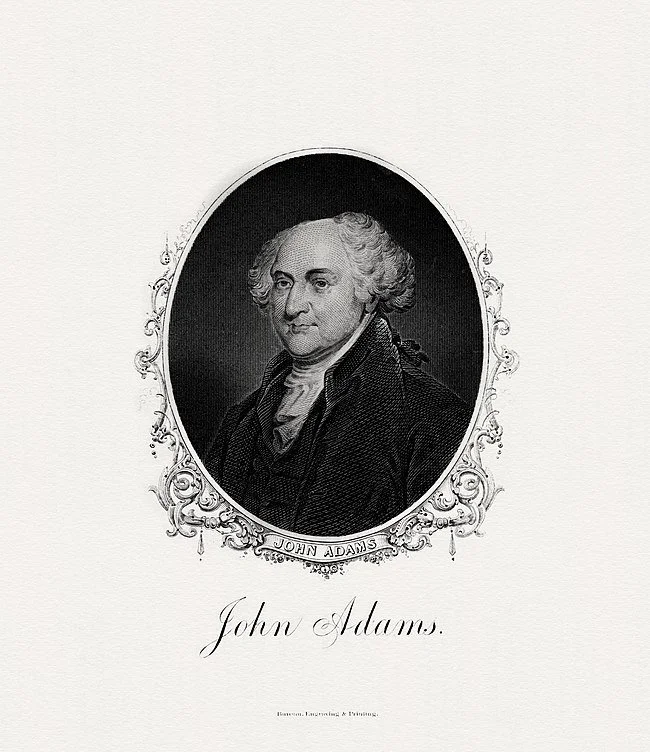
An engraved portrait of John Adams as president by the Bureau of Engraving and Printing
Letter from John Adams, founding father and second president to John Taylor on Dec. 17, 1814
Dear Sir
In your fifth page You Say “Mr. Adams calls our Attention to hundreds of wise and virtuous Patricians, mangled and bleeding Victims of popular Fury.” and gravely counts up several Victims of democratic Rage as proofs that Democracy is more pernicious than Monarchy or Aristocracy.” Is this fair, sir? Do you deny any one of my Facts? I do not say that Democracy has been more pernicious, on the whole, and in the long run, than Monarchy or Aristocracy. Democracy has never been and never can be so durable as Aristocracy or Monarchy. But while it lasts it is more bloody than either. I beseech you, Sir to recollect, the time when my three Volumes of “Defence” were written and printed, in 1786, 1787 and 1788. The History of the University, had not then furnished me with a document I have Since Seen; an Alphabetical Dictionary of the Names and Qualities of Persons “mangled and bleeding Victims of democratic rage and popular fury” in France during the Despotism of Democracy in that Country, which Napoleon ought to be immortalised for calling “Ideology.” This Work is in two printed Volumes in octavo as large as Johnson’s Dictionary and is in the Library of our late virtuous and excellent Vice President Elbridge Gerry where I hope it will be preserved with anxious care. An Edition of it ought to be printed in America. otherwise it will be forever supressed, France will never dare to look at it. The Democrats themselves could not bear the Sight of it. They prohibited it and suppressed it as far as they could. It contains an immense number of as great and good Men as France every produced. We curse the Inquisition, and the Jesuits and yet the Inquisition and the Jesuits are restored. We curse religiously the Memory of Mary for burning good Men in Smithfield, when if England had the been democratical She would have burned many more, and We murder many more by the Guilotine, in the latter Years of the Eighteenth Century. We curse Guy Faulks for thinking of blowing Up Westminster Hall, Yet Ross blows up the Capitol, the Palace and the Library at Washington and would have done it With the same sang froid had Congress and the Presidents Family been within the Walls. Oh! my soul! I am weary of these dismal Contemplations! When will Mankind listen to reason, to nature or to Revelation?
You Say I “might have exhibited millions of Plebians, sacrificed to the pride Folly and Ambition of Monarchy and Aristocracy.” This is very true. And I might hav[, Start insertion,e, End,] exhibited as many millions of Plebians sacrificed by the Pride Folly and Ambition of their fellow Plebians and their own, in proportion to the extent and duration of their power. Remember Democracy never lasts long. It soon wastes exhausts and murders itself. There never was a Democracy Yet, that did not commit suicide. It is in vain to Say that Democracy is less vain, less proud, less selfish, less ambitious or less avaricious than Aristocracy or Monarchy. It is not true in Fact and no where appears in history. Those Passions are the same in all Men under all forms of Simple Government, and when unchecked, produce the same Effects of Fraud Violence and Cruelty. When clear Prospects are opened before Vanity, Pride, Avarice or Ambition, for their easy gratification, it is hard for the most considerate Phylosophers and the most conscientious Moralists to resist the temptation. Individuals have conquered themselves, Nations and large Bodies of Men, never.
When Solons Ballanc was destroyed, by Aristides, and the Preponderance given to the Multitude for which he was rewarded with the Title of Just when he ought to have been punished with the Ostracism; the Athenians grew more and more Warlike in proportion as the Commonwealth became more democratic. I need not enumerate to you, the foolish Wars into which the People forced their wisest Men and ablest Generals against their own Judgments, by which the State was finally ruined, and Phillip and Alexander, became their Masters.
In proportion as the Ballance, imperfect and unskillfull as it was originally here as in Athens, inclined more and more to the Dominatio Plebis; the Carthaginians became more and more restless, impatient enterprising, ambitious avaricious and rash; till Hanibal swore eternal <, Start deletion,Enmity, End,> Hostility to the Romans, and the Romans were compelled to pronounce Delenda est Carthago.
What can I Say of The Democracy of France? I dare not write what I think and what I know. Were Brissot, Condorcet, Danton Robespiere and Monsiegnieur Equality less ambitious than Cæsar, Alexander or Napoleon? Were Dumourier, Pichegru, Moreau, less Generals, less Conquerors, or in the End less fortunate than he was.? What was the Ambition of this Democracy.? Nothing less than to propagate itself, it is Principles its System through the World, to decapitate all the Kings, destroy all the Nobles and Priests in Europe? And who were the Instruments employed by the Mountebanks behind the Scene, to accomplish these Sublime purposes? The Fisherwomen, the Badauds, the Stage Players, the Atheists, the Deists, the Scribblers for any cause at three Livres a day, the Jews, and, Oh! that I could erace from my memory! the learned Divines profound students in the Prophecies. Real Philosophers, and Sincere Christians in amazing Numbers over all Europe and America were hurried away by the torrent of contagious Enthusiasm. Democracy is chargeable with all the blood that has been spilled for five and twenty years. Napoleon and all his Generals were but Creatures of Democracy as really as Rienzi Theodore, Mazzianello, Jack Cade or Wat Tyler. This democratical, Hurricane, Inundation, Earthquake, Pestilence call it which you will, at last arroused and alarmed all the World and produced a Combination unexampled, to prevent its further Progress.

John Adams birthplace in Quincy, Mass,
John Adams
We do believe!
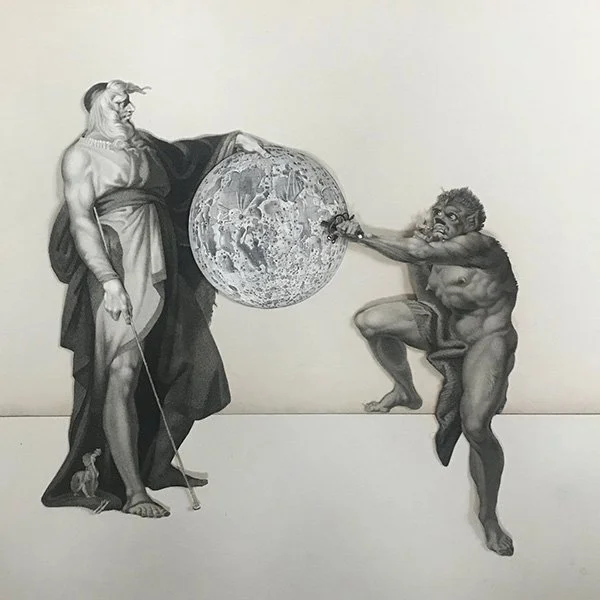
“Modern Religion (They Know Not What They Do)’’ (cut paper collage using 18th Century copper plate engraving, 19th Century bookplates, and found paperboard), by Sarah Seaver, at the Corner Gallery, Jaffrey N.H., through Nov. 16.
Stock up now for winter

Newspaper advertising insert from the 1960’s. Raymond's was a Massachusetts department store chain, with origins in the 1870s . It was closed in 1972. The main store was at Washington Street and Franklin Street in downtown Boston. It was New England’s quintessential downmarket chain. Its mascot was the parody of an old Yankee, Unkle Eph (upper left corner).
We are?

“We All Love I” (oil on wood), by Massachusetts artist Youngsheen A. Jhe, at Galatea Fine Art, Boston, Oct. 31-Nov. 30.
She says:
“We are all love. Although each person’s life seems to be following an individual trajectory, in reality they are all part of one big story. We are all connected by an invisible thread, not only those I know, but even those I am not directly connected to. At the center of that connection is the essence of love. No one is alone.’’
Lake life
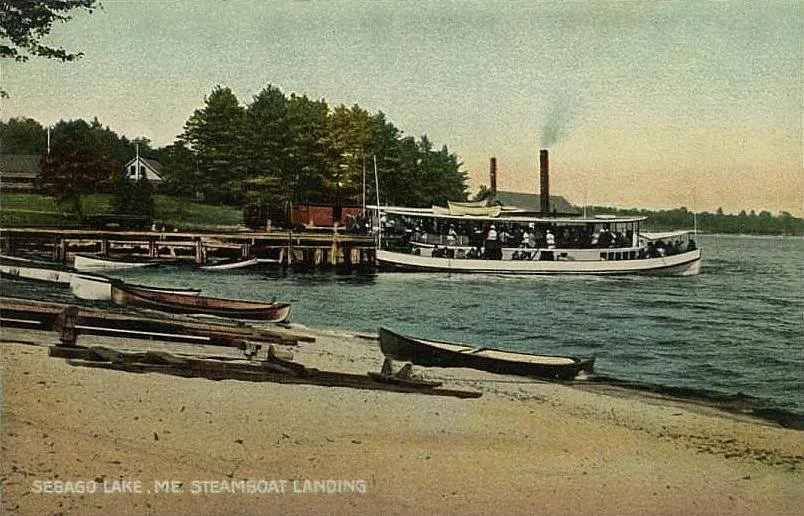
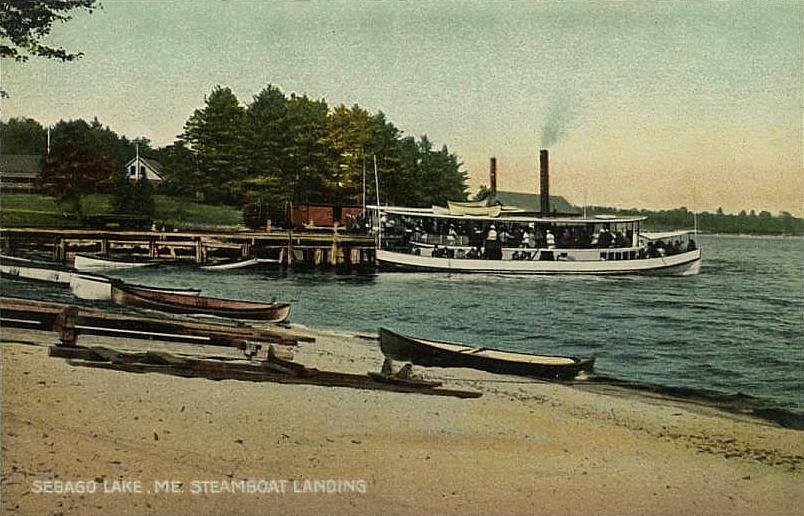
1910 postcard. Sebago has been a summer resort area since the Civil War.
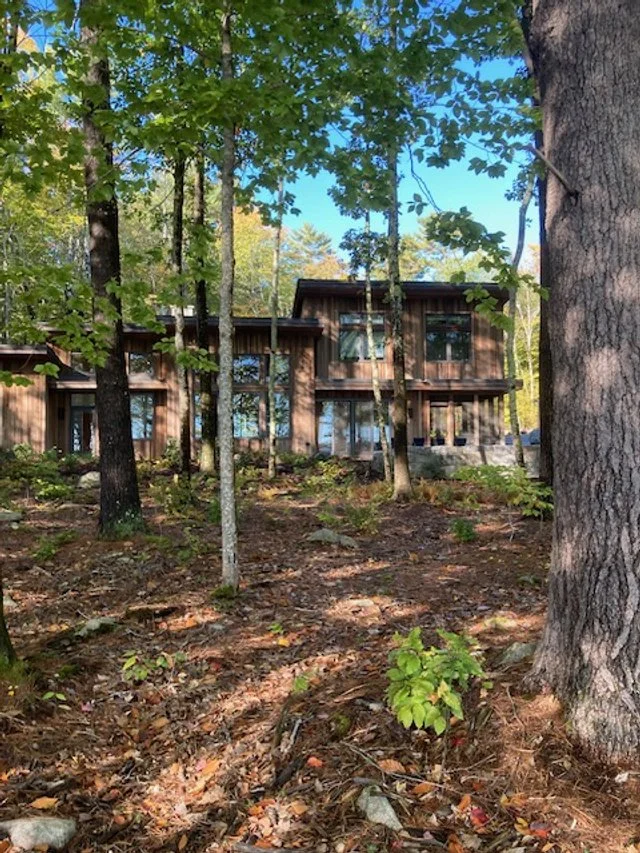
Our friends' house along part of Sebago Lake, with now lawn.
We drove up to the Sebago Lake complex, northwest of Portland, Maine, last week, to see some friends there. They’re based in Los Angeles but have built a house on Sebago. It’s mostly for summer, but they use it from time to time in other seasons, too. They love Maine, with its woods, fabled coast and lakes, in part because it’s so different from dry Southern California, whose many fires have distressed them.
The area around their Maine place is becoming increasingly eco-friendly; I suspect that may be driven in part by the wave of affluent newcomers, which got higher in the pandemic as people fled big cities. That disaster led some summer and weekend residents to move to Maine full time. But most native Mainers, including poor ones, also seek to protect The Pine Tree State’s environment. There’s plenty of poverty in Maine, and most of the wealth is along the coast from Kittery to Acadia National Park.
To protect their gorgeous setting and its resources requires taking away some freedoms. A local rule applying to our friends’ immediate area bans new lawns along the water; old ones are grandfathered in. The rule is meant to curb pollution from the fertilizers, herbicides and pesticides that many property owners dump on their lawns to keep them looking like a swatch of golf course and that end up in the lake. The rule also, of course, helps curb shoreline erosion, which is less from woods than lawns.
An important factor in rules about Sebago is that it’s the main source of Portland’s water.
Instead, people such as our friends have shrubs and other low vegetation, say two or three feet high, between their house and the water. This has a nice effect as you look at the shining water from their big windows.
As for the freedom to put a lawn next to the lake: Surely locals should also have the freedom of being able to use a clean lake. It reminds me of the MAGA battles against having to wear a face mask to reduce COVID spread in crowded places. How about the freedom to go around without fear that an infected person in a pandemic will get you very sick?
Then there’s the grossly misinterpreted (and badly written ) state-militia-promoting Second Amendment, which MAGA types wielding military-style assault rifles say is essential for their freedom to defend themselves.
How about the freedom to be in public places, including schools, without the fear of being gunned down by yet another young man with a weapon designed to mow down people by the dozens, not just a lone criminal or lunatic.
One person’s “freedom’’ is another’s captivity. There will always be battles.
xxx
Besides such joys as the beauty of the fall foliage, which was heading into its height up there, and the sun glimmering on the lake, our visit gave me a greater appreciation of the beauty of granite – the quintessential stone of the region. On our friends’ property we saw granite boulders, left by the last Ice Age and the bane of old Yankee farmers, artfully used in landscaping, and the effects achieved by the use of granite for steps, terraces and indoor work, such as countertops and even benches at the side of fireplaces.
Our friends told us about the Orland, Maine, company called Fresh Water Stone that created exquisite granite work for them, such as the terrace in this picture. (I have no commercial, or other connection with the company.)
Stonework is just one example of why the state is renown for its artisans. Consider the long tradition of its boatbuilders, furniture and tool makers, painters, sculptors, ceramists, leather-goods designers, and so on.
Meanwhile, I read about arguments in Maine, as elsewhere, about farmers selling off or leasing land for solar farms. Each local case is different, of course, but it seems to me that reducing local agricultural production can undermine the battle against global warming since it means that more food must be shipped from far away, thus burning more fossil fuel. Can’t many more roofs and abandoned lots be venues for solar panels instead of putting them on farmland or chopping down trees, those crucial carbon-dioxide absorbers?
I’ve noticed a paradox up there: Some of those who don’t like the famously long winters at the same time worry that they’re getting too short and warm, ruining such local activities as ice fishing and allowing in invasive animals and plants from the south.
Drones watching for car/bike traffic risks

Edited from a New England Council report
“Researchers from the University of Massachusetts at Amherst are using drones to investigate traffic risks between cars and bicycles in Somerville.
“In September, three UMass students and a university drone instructor released four drones from Conway Park in hopes of obtaining footage of a one-mile span of Beacon Street. This project sparked calls for improved bike safety following a fatal crash in Cambridge earlier that month.
“‘There’s a lot of bicycle traffic here compared to other places,’ said Eleni Christofa, a professor of civil and environmental engineering at UMass who is leading the research effort.’’

On Beacon Street in Somerville.
Grace McCormack/Melissa Garrido: Beware Medicare Advantage scams
BOSTON
The 67 million Americans eligible for Medicare make an important decision every October: Should they make changes in their Medicare health insurance plans for the next calendar year?
The decision is complicated. Medicare has an enormous variety of coverage options, with large and varying implications for people’s health and finances, both as beneficiaries and taxpayers. And the decision is consequential – some choices lock beneficiaries out of traditional Medicare.
Beneficiaries choose an insurance plan when they turn 65 or become eligible based on qualifying chronic conditions or disabilities. After the initial sign-up, most beneficiaries can make changes only during the open enrollment period each fall.
The 2024 open enrollment period, which runs from Oct. 15 to Dec. 7, marks an opportunity to reassess options. Given the complicated nature of Medicare and the scarcity of unbiased advisers, however, finding reliable information and understanding the options available can be challenging.
We are health care policy experts who study Medicare, and even we find it complicated. One of us recently helped a relative enroll in Medicare for the first time. She’s healthy, has access to health insurance through her employer and doesn’t regularly take prescription drugs. Even in this straightforward scenario, the number of choices were overwhelming.
The stakes of these choices are even higher for people managing multiple chronic conditions. There is help available for beneficiaries, but we have found that there is considerable room for improvement – especially in making help available for everyone who needs it.
The choice is complex, especially when you are signing up for the first time and if you are eligible for both Medicare and Medicaid. Insurers often engage in aggressive and sometimes deceptive advertising and outreach through brokers and agents. Choose unbiased resources to guide you through the process, like www.shiphelp.org. Make sure to start before your 65th birthday for initial sign-up, look out for yearly plan changes, and start well before the Dec. 7 deadline for any plan changes.
2 paths with many decisions
Within Medicare, beneficiaries have a choice between two very different programs. They can enroll in either traditional Medicare, which is administered by the government, or one of the Medicare Advantage plans offered by private insurance companies.
Within each program are dozens of further choices.
Traditional Medicare is a nationally uniform cost-sharing plan for medical services that allows people to choose their providers for most types of medical care, usually without prior authorization. Deductibles for 2024 are US$1,632 for hospital costs and $240 for outpatient and medical costs. Patients also have to chip in starting on Day 61 for a hospital stay and Day 21 for a skilled nursing facility stay. This percentage is known as coinsurance. After the yearly deductible, Medicare pays 80% of outpatient and medical costs, leaving the person with a 20% copayment. Traditional Medicare’s basic plan, known as Part A and Part B, also has no out-of-pocket maximum.
Traditional Medicare starts with Medicare parts A and B. Bill Oxford/iStock via Getty Images
People enrolled in traditional Medicare can also purchase supplemental coverage from a private insurance company, known as Part D, for drugs. And they can purchase supplemental coverage, known as Medigap, to lower or eliminate their deductibles, coinsurance and copayments, cap costs for Parts A and B, and add an emergency foreign travel benefit.
Part D plans cover prescription drug costs for about $0 to $100 a month. People with lower incomes may get extra financial help by signing up for the Medicare program Part D Extra Help or state-sponsored pharmaceutical assistance programs.
There are 10 standardized Medigap plans, also known as Medicare supplement plans. Depending on the plan, and the person’s gender, location and smoking status, Medigap typically costs from about $30 to $400 a month when a beneficiary first enrolls in Medicare.
The Medicare Advantage program allows private insurers to bundle everything together and offers many enrollment options. Compared with traditional Medicare, Medicare Advantage plans typically offer lower out-of-pocket costs. They often bundle supplemental coverage for hearing, vision and dental, which is not part of traditional Medicare.
But Medicare Advantage plans also limit provider networks, meaning that people who are enrolled in them can see only certain providers without paying extra. In comparison to traditional Medicare, Medicare Advantage enrollees on average go to lower-quality hospitals, nursing facilities, and home health agencies but see higher-quality primary care doctors.
Medicare Advantage plans also often require prior authorization – often for important services such as stays at skilled nursing facilities, home health services and dialysis.
Choice overload
Understanding the tradeoffs between premiums, health care access and out-of-pocket health care costs can be overwhelming.
Turning 65 begins the process of taking one of two major paths, which each have a thicket of health care choices. Rika Kanaoka/USC Schaeffer Center for Health Policy & Economics
Though options vary by county, the typical Medicare beneficiary can choose between as many as 10 Medigap plans and 21 standalone Part D plans, or an average of 43 Medicare Advantage plans. People who are eligible for both Medicare and Medicaid, or have certain chronic conditions, or are in a long-term care facility have additional types of Medicare Advantage plans known as Special Needs Plans to choose among.
Medicare Advantage plans can vary in terms of networks, benefits and use of prior authorization.
Different Medicare Advantage plans have varying and large impacts on enrollee health, including dramatic differences in mortality rates. Researchers found a 16% difference per year between the best and worst Medicare Advantage plans, meaning that for every 100 people in the worst plans who die within a year, they would expect only 84 people to die within that year if all had been enrolled in the best plans instead. They also found plans that cost more had lower mortality rates, but plans that had higher federal quality ratings – known as “star ratings” – did not necessarily have lower mortality rates.
The quality of different Medicare Advantage plans, however, can be difficult for potential enrollees to assess. The federal plan finder website lists available plans and publishes a quality rating of one to five stars for each plan. But in practice, these star ratings don’t necessarily correspond to better enrollee experiences or meaningful differences in quality.
Online provider networks can also contain errors or include providers who are no longer seeing new patients, making it hard for people to choose plans that give them access to the providers they prefer.
While many Medicare Advantage plans boast about their supplemental benefits , such as vision and dental coverage, it’s often difficult to understand how generous this supplemental coverage is. For instance, while most Medicare Advantage plans offer supplemental dental benefits, cost-sharing and coverage can vary. Some plans don’t cover services such as extractions and endodontics, which includes root canals. Most plans that cover these more extensive dental services require some combination of coinsurance, copayments and annual limits.
Even when information is fully available, mistakes are likely.
Part D beneficiaries often fail to accurately evaluate premiums and expected out-of-pocket costs when making their enrollment decisions. Past work suggests that many beneficiaries have difficulty processing the proliferation of options. A person’s relationship with health care providers, financial situation and preferences are key considerations. The consequences of enrolling in one plan or another can be difficult to determine.
The trap: Locked out
At 65, when most beneficiaries first enroll in Medicare, federal regulations guarantee that anyone can get Medigap coverage. During this initial sign-up, beneficiaries can’t be charged a higher premium based on their health.
Older Americans who enroll in a Medicare Advantage plan but then want to switch back to traditional Medicare after more than a year has passed lose that guarantee. This can effectively lock them out of enrolling in supplemental Medigap insurance, making the initial decision a one-way street.
For the initial sign-up, Medigap plans are “guaranteed issue,” meaning the plan must cover preexisting health conditions without a waiting period and must allow anyone to enroll, regardless of health. They also must be “community rated,” meaning that the cost of a plan can’t rise because of age or illness, although it can go up due to other factors such as inflation.
People who enroll in traditional Medicare and a supplemental Medigap plan at 65 can expect to continue paying community-rated premiums as long as they remain enrolled, regardless of what happens to their health.
In most states, however, people who switch from Medicare Advantage to traditional Medicare don’t have as many protections. Most state regulations permit plans to deny coverage, impose waiting periods or charge higher Medigap premiums based on their expected health costs. Only Connecticut, Maine, Massachusetts and New York guarantee that people can get Medigap plans after the initial sign-up period.
Deceptive advertising
Information about Medicare coverage and assistance choosing a plan is available but varies in quality and completeness. Older Americans are bombarded with ads for Medicare Advantage plans that they may not be eligible for and that include misleading statements about benefits.
A November 2022 report from the U.S. Senate Committee on Finance found deceptive and aggressive sales and marketing tactics, including mailed brochures that implied government endorsement, telemarketers who called up to 20 times a day, and salespeople who approached older adults in the grocery store to ask about their insurance coverage.
The Department of Health and Human Services tightened rules for 2024, requiring third-party marketers to include federal resources about Medicare, including the website and toll-free phone number, and limiting the number of contacts from marketers.
Although the government has the authority to review marketing materials, enforcement is partially dependent on whether complaints are filed. Complaints can be filed with the federal government’s Senior Medicare Patrol, a federally funded program that prevents and addresses unethical Medicare activities.
Meanwhile, the number of people enrolled in Medicare Advantage plans has grown rapidly, doubling since 2010 and accounting for more than half of all Medicare beneficiaries by 2023.
Nearly one-third of Medicare beneficiaries seek information from an insurance broker. Brokers sell health insurance plans from multiple companies. However, because they receive payment from plans in exchange for sales, and because they are unlikely to sell every option, a plan recommended by a broker may not meet a person’s needs.
Help is out there − but falls short
An alternative source of information is the federal government. It offers three sources of information to assist people with choosing one of these plans: 1-800-Medicare, medicare.gov and the State Health Insurance Assistance Program, also known as SHIP.
The SHIP program combats misleading Medicare advertising and deceptive brokers by connecting eligible Americans with counselors by phone or in person to help them choose plans. Many people say they prefer meeting in person with a counselor over phone or internet support. SHIP staff say they often help people understand what’s in Medicare Advantage ads and disenroll from plans they were directed to by brokers.
Telephone SHIP services are available nationally, but one of us and our colleagues have found that in-person SHIP services are not available in some areas. We tabulated areas by ZIP code in 27 states and found that although more than half of the locations had a SHIP site within the county, areas without a SHIP site included a larger proportion of people with low incomes.
Virtual services are an option that’s particularly useful in rural areas and for people with limited mobility or little access to transportation, but they require online access. Virtual and in-person services, where both a beneficiary and a counselor can look at the same computer screen, are especially useful for looking through complex coverage options.
We also interviewed SHIP counselors and coordinators from across the U.S.
As one SHIP coordinator noted, many people are not aware of all their coverage options. For instance, one beneficiary told a coordinator, “I’ve been on Medicaid and I’m aging out of Medicaid. And I don’t have a lot of money. And now I have to pay for my insurance?” As it turned out, the beneficiary was eligible for both Medicaid and Medicare because of their income, and so had to pay less than they thought.
The interviews made clear that many people are not aware that Medicare Advantage ads and insurance brokers may be biased. One counselor said, “There’s a lot of backing (beneficiaries) off the ledge, if you will, thanks to those TV commercials.”
Many SHIP staff counselors said they would benefit from additional training on coverage options, including for people who are eligible for both Medicare and Medicaid. The SHIP program relies heavily on volunteers, and there is often greater demand for services than the available volunteers can offer. Additional counselors would help meet needs for complex coverage decisions.
The key to making a good Medicare coverage decision is to use the help available and weigh your costs, access to health providers, current health and medication needs, and also consider how your health and medication needs might change as time goes on.
This article is part of an occasional series examining the U.S. Medicare system.
Grace McCormack is a postdoctoral researcher of Health Policy and Economics, at the University of Southern California
Melissa Garrido is a research professor, Health Law, Policy & Management, at Boston University.
google.com, pub-7774877255191227, DIRECT, f08c47fec0942fa0
‘The mystery of abstraction’

"Winter Tree" (mixed media on paper), by Elise Freda, in her show "Garden (Un) Variety,'' at Inner Space Fine Arts, North Reading, Mass.
The gallery explains:
“This exhibition features uncommonly exquisite new works that explore the natural calligraphy and energy found in the trees, plants and flowers surrounding Freda’s studio in New York’s Catskill Mountains. The mystery of abstraction reveals itself through nature’s glorious and unending source of line, light, color, and form.’’

An 1852 map of Greater Boston, showing Reading and its rail lines. North Reading was still part of Reading then.
Annual show-off

Western Barndoor Hill, in Granby, Conn.
“It was a radiant October day. Connecticut suggested an outrageous show-off, the low hills overflowing with autumnal brilliance, eruptions of golden leaves, friezes of crimson, the pines maintaining their sober greenness amid the blaze-like sentinels.
“All this last glory of the growing season was nevertheless contained, neat, firmly – for centuries now – under control: This was New England.’’
From the novel A Stolen Past (1985), by John Knowles (1926-2001)
Human character in glass

“Brilliant” (blown glass and anodized aluminum), by Massachusetts artist Dan Dailey, from his show “Impressions of the Human Spirit,’’ at the Currier Museum of Art, Manchester, N.H.
-- Photo by Bill Truslow
His site says:
“Dailey's drawings and the objects they inspire depict human character and the world we inhabit, with many familiar forms rendered iconic. His myriad series explore extraordinary concepts with a broad range of themes and styles. These attributes and his forty years of achievement and recognition have made Dan Dailey a prominent artist in the history of glass, and unique among American artists.’’

Manchester, N.H. along the Merrimack River, whose water power launched Manchester into becoming a major 19th and early 20th Century industrial center .
-- Photo by Graham Nadig

19th Century worker housing in Manchester. Some of the mill owners were rather paternalistic, for a while.

Crane & Co. — literally making money for a very long time

The Old Stone Mill Rag Room, built in 1844, and part of Crane & Co.'s museum, in Dalton, Mass. It was where rags were used in making high-quality paper.
Text excerpted and edited from a New England Historical Society article, “Seven Fun Facts About Crane Paper”
Crane & Co. for many years has made money making money in western Massachusetts. U.S. currency is made with Crane paper. So was fine stationery used by U.S. presidents and the crowned heads of Europe.
The enterprise started when Zenas Crane headed west from Boston looking for water in 1801. He found it along the Housatonic River in Berkshire County, and began making paper. He and his partners were the first to make paper west of the Connecticut River.
Zenas started making notes for local, then regional banks, and finally for the U.S. government. By 1842 he had full control of a paper mill in Dalton, Mass. …
Crane & Co. thrived into the early 1900s, then joined the decline of western Massachusetts’s papermaking industry. The company did prosper during the last recession because the Federal Reserve issued a lot of currency. People also used a lot more cash. But people also spent less on luxury items like fine engraved letterpress cotton stationery. Email, too, was taking the place of written correspondence.
A whale’s tale

“Breach: Logbook’’ (mixed media, acrylic and clay in canvas) by Courtney M. Leonard, in her show at the University of Massachusetts at Amherst's Museum of Contemporary Art.
The show features paintings, sculptures, and video exploring the life and kinship ties of Staccato, a North Atlantic right whale killed by a ship strike in 1999. Leonard explores marine biology, Indigenous food sovereignty, migration, and human environmental impact.
‘Raising’ butterflies

Monarch butterflies


WARWICK, R.I.
Neck surgery in 2005 put Amy Ottilige’s life on hold. She was “bored,” until she noticed a monarch butterfly fluttering outside her window. The simple observation changed her life. Instead of just briefly stopping to smell the flowers, she came to appreciate the bugs’ life on them.
Once recovered and after some self-education, Ottilige embraced the importance of native plants and the pollinators they support. Since 2014, when she began “raising” butterflies, some 1,500 of the nectar-feeding insects have completed their metamorphosis in her yard, including 161 monarchs last year and 28 swallowtails this year.
“I just started, and then I ended up having a whole width of my house as a pollinator garden,” Ottilige said. “I’ve raised all types of butterflies, but monarchs are my favorite.”