
Chris Powell: Connecticut’s public-pension racket
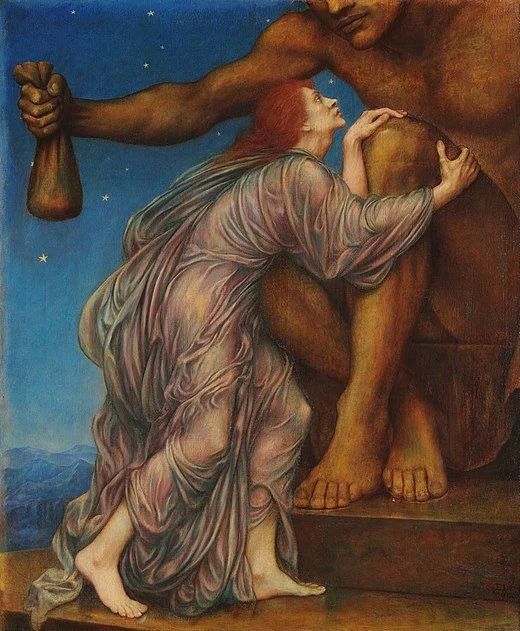
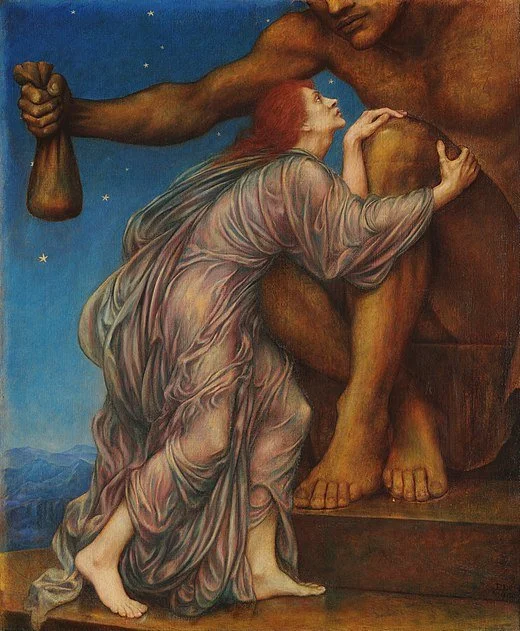
"The Worship of Mammon" (1909), by Evelyn De Morgan.
MANCHESTER, Conn.
An angry reader notes that after 24 years as a judge, the Connecticut Supreme Court’s chief justice, Richard A. Robinson, has just "retired" while joining a big national law firm, Day Pitney, which has five offices in Connecticut. "So now," the reader writes, "he will be getting a full pension from state taxpayers plus another full-time paycheck. Why should the state pay him a pension if he is still working? This is why the state is virtually bankrupt. It’s crazy. How come the press doesn’t report this part of it?"
Maybe what's left of journalism in Connecticut doesn't report the pension angle because it's an old story, not that it ever has been told very well.
Robinson's immediate predecessor as chief justice, Chase T. Rogers, retired six years ago after 20 years as a judge and then went to work at Day Pitney too. She now draws an annual state pension of more than $160,000, quite apart from her salary at the law firm. Since Robinson had four more years as a judge than Rogers, his state pension may be a bit larger. Since both retired judges are in their mid-60s, with continued good health they probably will have quite a few years earning at the law firm at least as much as their pensions.
But such opportunities are not peculiar to retired Connecticut judges. Virtually all retired state employees are eligible to do the same kind of thing -- that is, to collect an excellent retirement pension from state government even as they launch second careers.
The practice is especially popular among state troopers and municipal police officers, who typically can retire with great pensions at a young age -- in their late 40s or early 50s -- and then qualify for other good jobs to take them into their actual retirement.
Sometimes it’s a bit of a racket, as was shown in 2020 by the internationally notorious case of State Trooper Matthew Spina. The trooper was video-recorded by a motorist he stopped in New Haven and the video was posted on the Internet. It showed the trooper hysterical with rage, screaming at the motorist, ordering him out of his car and handcuffing him, bullying and threatening him, searching his backpack, and stomping on his possessions before uncuffing him and letting him go without even ticketing him, since he had done nothing wrong, or at least nothing actionable.
While inflicting this abuse Spina declared that he hated his job and the public and was eager to retire in 14 months.
Spina appeared to be middle-aged and a little journalism revealed that for five years he had been working so many extra hours that his overtime pay exceeded or nearly equaled his base annual salary of almost $100,000. That is, like many other troopers he was risking burning himself out and driving himself crazy to attain the magical threshold of the state pension system -- three extremely high-earning years from which his pension would be calculated.
State police management readily obliged his mad pursuit of a pension bonanza.
Spina indeed retired the next year and now draws an annual state pension of more than $116,000. If he has another job now, his pretend retirement may be almost as comfortable as that of the retired judges.
Of course Connecticut’s state employee pension system isn’t a racket for everyone, but it is often excessively generous. It is a fair question as to why state government should pay large pensions, or any pensions, to people earning substantial amounts in second careers.
But there is a simple explanation. It’s that Connecticut has many more politically active state and municipal government employees and retired employees than it has politically attentive and engaged citizens.
Anyone who sees extravagance here should try putting the pension question to his state legislators. Few legislators are likely to express any criticism, lest they alienate a powerful special interest. If Connecticut is ever to have a better public life, it will need a better public.
Chris Powell has written about Connecticut government and politics for many years (CPowell@cox.net).
In ‘53, Ike pays tribute to New England and talks about his view of the Republican Party

President Eisenhower's official portrait in 1959.
Video: Boston in the 1950’s
September 21, 1953
President Dwight D. Eisenhower’s speech at the “New England Forward to ‘54’’ dinner in Boston
After the embarrassing generosity of the compliments that have been paid me this evening from this platform, you can well understand that I am in some danger of thinking a little too well of myself. Thank goodness, many years ago, I had a preceptor, for whom my admiration has never died, and he had a favorite saying, one that I trust I try to live by. It was: always take your job seriously, never yourself.
Now, in spite of this embarrassment, I would like on this occasion and in front of this audience, to say just a word of my obligation to some of the political leaders that have appeared here this evening, and who do us so much honor by their presence.
I have just been introduced by Senator Saltonstall, the Chairman of the great National Defense Senate Committee, and as such a crucial and key figure in that great body. Very naturally, I am happy to be with my colleague and old friend, Chris Herter, your Governor, whom I expect again to be Governor. And then John Lodge, Governor of Connecticut, and Governor Cross of Maine--and I shall not forget it is the northeastern of our States. And Senator George Aiken, Chairman of that great Agricultural Committee; and Secretary of Commerce, my colleague in Washington, Sinclair Weeks. And of course, every day each of us has many reasons for feeling indebted to Ambassador Henry Cabot Lodge for his work in the United Nations.
Of course, I cannot possibly list all of the great individuals who are here this evening, but certainly I must mention my friend Governor Gregg of New Hampshire, and Lieutenant Governor Johnson, Senator Flanders; and finally I think there must be something unique that we can have here on the platform this evening both the present and the future Speaker of the House of Representatives in Washington, and the present and the next President Pro Tem of the Senate.
I suggest that a list of names such as I have just recited gives some idea of the brilliance of the political leadership that this great section of our country--the thumb of our country, if you please--has produced. I pay here my tribute to them.
Now, ladies and gentlemen, the Republican Party is nearing the 100th Anniversary of its founding.
Now, we would be wise, I think, to recall briefly the circumstances of that event, just a few months short of 100 years ago. It came with the meeting of a small group of rebellious Whigs and disenchanted Democrats in the little town of Ripon, Wisconsin. Other towns, understandably coveting the honors of history, dispute the particular claim of this Wisconsin community. And indeed political dissent and disillusion were seething in those years far across town limits and state borders. Everywhere the tremors of a divided nation were felt. To many, the drift toward civil war seemed fatefully sure. But there is no dispute as to the purpose inspiring the many groups who reached for a new hope and a new party which they called Republican. That purpose, everywhere plainly defined and passionately proclaimed, was to halt the extension of the institution of slavery.
We, who shall shortly be celebrating the 100th Anniversary of that party that came so to birth, find ourselves, too, living in a time dark with the shadow of dreaded war. It is a time, too, which has seen an institution of slavery--now elevated to the awful dignity of a political philosophy and inspired with the terrible ambition of world conquest--divide not a nation, but the world, against itself. And at this precise time again there has come the summons of the American people calling upon the Republican Party to redeem the hopes of the past and to save the promise of the future.
The circumstances of this anniversary, then, call for much more than the oratory of self-congratulation. They call for more than any display--however justified--of partisan pride. For even as we meet as Republicans, our minds are troubled by problems and stirred by sentiments far transcending the self-interest of a political party. Our hearts are filled with concern for the welfare and the safety of our country. Such concern instantly and inevitably involves attention to the strength and security of the whole free world. We therefore see our Party not as an end in itself but as a magnificent means--a means through which countless thousands of devoted citizens can cooperate in the conquering of problems that beset free men everywhere. I believe, therefore, you will agree that my duty as President is to address you, not as partisans, but first, and above all, as patriots of America and citizens of the world.
In this spirit, I suggest that there is one particular and indispensable way in which each one of us can take part in this Republican Centennial. This way has none of the color of a fireworks display, none of the thrill of a political convention. It is a simple matter of faith and purpose: to define clearly and honestly, in our own minds the kind of political party in which we believe and which we propose to maintain.
To do this is, of course, not simple at all. It is to define the political institution to which our energies are dedicated--and upon which can depend even the future of freedom itself.
What I presume to suggest to you, I cannot, of course, myself evade. As your guest this evening, I have accorded myself the privilege, therefore, of addressing aloud to you some of my own thoughts on the Party in which I believe.
It is logical to look for the clearest marks of a Party in its record in office. The record of the present Administration is too short to be anything like definitive. But the facts that are plain are also indicative of deeply held ideas of the widest meaning. There are, already in this record, these facts:
We have observed and practiced true bi-partisanship in international affairs, believing that no matter what domestic differences can create and animate parties at home we must present a substantially solid American front to all with whom we deal abroad.
We have seen a cessation of fighting in the Korean War, giving us relief from the pain of casualty lists and allowing us to work more effectively for the nation's security against threats originating anywhere in the world.
We have given to the world the clearest testimony to our firm allegiance to the common cause and needs of free peoples everywhere. We have sent shipments of wheat to Pakistan, medical and reconstruction supplies to Korea, food to Berlin. We have promised that our country will welcome tens of thousands of refugees from the terror of enslavement in lands of darkness. Recognizing that neither freedom nor safety can be found by any one nation alone, we have continued to build coalitions to promote, on a cooperative basis, the security of all.
We have lifted stifling artificial controls from our economy, counting upon the American genius for creative initiative to advance the frontiers of our prosperity beyond the hopes of past generations.
We have simplified customs regulations. Knowing that materials from abroad are as vital to our economy as foreign markets to receive our goods, we have initiated a review of our entire tariff policy. This looks toward the encouragement of greater and more equitable trade among all free nations. To permit time for this, the Congress extended the Reciprocal Trade Act.
We have used the legitimate and necessary authority of the Federal Government to steady farm prices, meanwhile blueprinting the extension of social security coverage to more than 10 million unprotected citizens.
Dedicated to the fullest use of the nation's resources for the welfare of all, we have redefined policy on public power to assure the maximum of local participation and decision in projects that require the partnership of national, state and local governments.
We are continuing to study and will submit to the next session of the Congress, recommendations for making more secure our industrial peace and productivity, more clear and explicit the rights of labor, its unions and its employers.
We have undertaken with determination the work of cleaning up governmental operations, and have made extraordinary progress with this job that so badly needed doing. We have reorganized more than half a dozen major departments and agencies of the Federal Government. The introduction of top business management methods into governmental activity--while it may be painful to some--is proving its worth daily in greater efficiency and lowered costs.
We have reduced government expenditures by billions of dollars--making a balanced budget something a bit nearer to realization than an accountant's dream. The many billions of dollars cut from the requests of the prior Administration have been referred to by Senator Bridges. In addition, 6½ billions have been taken from the former estimate of the current expenditures.
We have, in our respect for priceless civil and human rights, used the Federal authority, wherever it clearly extends, to erase the stain of racial discrimination and segregation. We are making certain that every government employee is a loyal American. But we have opposed the confusing of loyalty with conformity, and all misguided attempts to convert freedom into a privilege licensed by censors.
These are some of the deeds of this Administration which serve as witnesses to some of the truths we hold. They are eloquent enough, perhaps, in certain areas. But many are little more than fragments. They suggest rather than define the character and purpose of those who support or who belong to the Republican Party.
If we turn from the legislative record of one Congressional session to the Party history of a hundred years, we learn more that is indicative--and yet little that is conclusively clear and binding upon us today.
The fact is not surprising. A century of history records the changes in institutions: it does not fix their mold. And this was a century of shattering change: from before Bismarck to after Hitler, from the Third French Empire to the Fourth French Republic, from Disraeli to Churchill, from Tsar Nicolas I to Malenkov.
Over such a span of time, the only perfectly consistent institution was a dead institution. And the Republican Party was--and is--very much alive. A fact easily forgotten is that through all those years--from the first year of War Between the States in 1861 to the first year of the New Deal in 1933--the Republican Party was in office three-fourths of the time. It helped mold each age and was itself molded by each age--the extremist Party in one day, the champion of something called "normalcy" in another. With America and with the times, it restlessly changed; sometimes growing, sometimes faltering, sometimes partially divided--in short, behaving like a normal, healthy political party in a vital, thriving Republic.
The ascendancy of the Party through the great part of this great century is the clearest answer to the feeble but persistent myth that the Republican Party is simply a conspiracy against change. The century abounds with such answers. They begin with the Emancipation Proclamation. And they continue:
In the 1860's and '70's: the Thirteenth, Fourteenth and Fifteenth Amendments; the purchase of Alaska and the Midway Islands; the First Homestead Act;
In the 1880's and '90's: creation of the Civil Service Commission; the Sherman Anti-Trust Act; the declaration of the Open Door Policy in China; the first Inter-American Conferences; the beginning of a national conservation program with the establishment of the first national forests;
And from 1900 to the 1930's: establishment of a Department of Labor and a Department of Commerce; the Pure Food and Drug Act; the strengthening of the Interstate Commerce Commission; the breaking of the great trusts; the first Bureau of Housing in the Federal Government; the first gigantic multiple-purpose dam; the model Railway Labor Act; the Kellogg-Briand Pact; the creation of a Federal Power Commission.
These deeds are the record of a Party that has grown as America has grown--seeing and meeting its needs, its responsibilities, and its aspirations. It fears change no more than it fears life. It knows that the two are one and the same.
Now, my friends, from all this we learn one truth: the living definition of this Party, at this moment in our history, is not to be found in the fine print of a legislative record, nor beneath the dust of our historic archives. It can only be found in our own hearts and minds. Born of change--born to change--this Party is and it will be what we make it.
In this sense, let us speak of the Party in which we believe.
We can--I think--define this Party first by its spirit and secondly by its principles.
Its spirit has distinctive marks. It is young. It is sober. It is confident. And it is free.
Each of these marks means something quite specific.
This Party is--and must be--young in spirit and in thought. It must be young for the simplest of reasons: because it has been charged with the hopes of the youth of America. A new generation of Americans is looking toward us with a gaze--both hopeful and watchful--that can be neither ignored nor evaded. For this generation's hopes for peace, for jobs, for just wages and decent homes, depend upon our foresight, our candor, our courage. And to be worthy of this trust, we must, in the deepest sense, care more for their hopes than for their votes.
This Party is sober in spirit, for its sense of responsibility makes it so. We know of no great problem before us that can be solved by the invention of a slogan. We aspire to proving ourselves more gifted in civics than in theatrics. We are more concerned with today's cares than tomorrow's headlines. We believe that there is no cleverness of phrase that can cover shallowness of thought. We confess that if America--its government and its people--is bravely to meet the trials of this age of peril, we know of no substitutes for hard work, intensive thought, constructive criticism, and a readiness to sacrifice.
This Party is, at the same time and in the same degree, confident of the future. We believe that our thinking and our emotions are unclouded by various brands of cynicism that bear the label of political sophistication. We do not think that America is decadent--nor that free nations are incapable of achieving unity--nor that free peoples are too witless to govern themselves prudently. We are confident of the strength of our physical resources--the fullness of our harvests, the speed of our assembly lines, the skills of our scientists and the stamina of our soldiers. And we are no less confident of the resources in the hearts and minds of our people.
And this Party of ours is free. We are the political captives of no section or interest of our country--and we are the prisoners of no static political or economic dogmas ruling our decisions. As a result, it is inconceivable to us to address a single group or element as a political province or dependency. And we face and make decisions not in the light of some rigidly preconceived political axiom, but in the only light in which we can clearly discern what is just--the peace and the well-being of our whole people.
And so, if I have described, however inadequately, the spirit of this Party, this brings us logically and inevitably to the stating of its principles. These--however many they may seem to be upon analysis--I venture to summarize in this one statement of belief:
We are one nation, gifted by God with the reason and the will to govern ourselves, and returning our thanks to Him by respecting His supreme creation--the free individual.
Here we stand. Here, also--if you will--are the plain moral precepts, which define our cause and govern our conduct.
We are one nation and one people.
We--this American society--are not the product of some tentative, calculating, self-interested social contract or alliance between conflicting classes and sections. We are not some perilously balanced equation of political convenience in which labor plus farm plus capital plus management equals America.
In the American design--as we perceive it--each group in our nation has special problems. None has special rights. Each has peculiar needs. None has peculiar privileges.
We believe in people, in all the people: laborer and banker, preacher and teacher, doctor, lawyer, farmer, machinist, white collar worker, housewife, miner, artist, merchant, rancher, farm hand, switchman, clerk--all of them.
The supreme belief of our society is in the dignity and freedom of the individual. To the respect of that dignity, to the defense of that freedom, all effort is pledged.
This is no mere academic assertion. This sovereign ideal uncompromisingly decrees that, in this age of peril, the security of our whole nation--the preservation of our free system--must direct every thought and every decision. We know the enemies of freedom to be equipped with the most terrible weapons of destruction. We know, then, that we can meet them with only one answer: there is no sacrifice--no labor, no tax, no service--too hard for us to bear to support a logical and necessary defense of our freedom.
I repeat: this sovereign faith of ours in the freedom and dignity of the individual is infinitely more than a dry and lifeless philosophic doctrine. It is the nerve and the fiber of our very laws. This supreme ideal--not merely the votes of so many Congressmen or Senators--is what sends aid to drought-stricken areas, guarantees an income to farmers, banishes needless restrictions on individual enterprise, guards the free union of workers, extends the protection of social insurance to the aged and to the needy.
This sovereign ideal we believe to be the very source of the greatness and the genius of America.
In this, we proclaim nothing very new. It was seen clearly by a wise French visitor who came to America considerably more than a century ago. He patiently and persistently sought the greatness and genius of America in our fields and in our forests, in our mines and in our commerce, in our Congress and in our Constitution, and he found them not. But he sought still further and then he said:
"Not until I went into the churches of America and heard her pulpits flame with righteousness did I understand the secret of her genius and power.
"America is great because America is good--and if America ever ceases to be good--America will cease to be great."
I read those words to such an audience as this once before. It was here in Boston, 11 months ago, in this hall. The utter truth they held for me then, they hold today.
But these words contain not only a promise but a warning. And as they apply to America, so they must apply no less to the political party which is America's chosen servant in these days.
No more as a party than as a nation can we expect to find our greatness in anything but dedication to the good of America.
We can destroy our cause--even with decent intent--in a number of ways. There are as many roads to disaster.
We must shun them all.
We must, even in our patriotism, guard against that prideful nationalism which impatiently breaks the bonds binding all free peoples. For, in our age, both just principle and selfish interest conspire to impress upon us one single truth: the cause of free men is one everywhere--and the whole suffers from a wound anywhere.
We must, even in our honest political fervor, fear neither partisan criticism nor self-criticism. For the pretense of perfection is not one of the marks of good public servants.
And we must, even in our zeal to defeat the enemies of freedom, never betray ourselves into seizing their weapons to make our own defense. A people or a party that is young and sober and confident and free has no need of censors to purify its thought or stiffen its will. For the kind of America in which we believe is too strong ever to acknowledge fear--and too wise ever to fear knowledge.
This is the kind of America--and the kind of Republican Party--in which I believe.
I do not know how to define it with political labels. Such labels are, in our age, cheap and abundant. But they mean as little as they cost.
We are many things.
We are liberal for we do believe that, in judging his own daily welfare, each citizen, however humble, has greater wisdom than any government, however great.
We are progressive--for we are less impressed with the difficulties we observed yesterday than the opportunities we envision tomorrow.
And we are conservative--for we can conceive of no higher commission that history could have conferred upon us than that which we humbly bear--the preservation, in this time of tempest and of peril, of the spiritual values that alone give dignity and meaning to man's pilgrimage on this earth.
So, in spirit, we go back through this century of wild and wondrous change, to find that, after all, certain truths have changed not at all. For the first Republican President asked himself: "What constitutes the bulwark of our own liberty and independence?" And Lincoln answered his own question.
"It is not our frowning battlements," he said, "our bristling seacoasts. Our reliance is in the love of liberty which God has planted in us. Our defense is in the spirit which prizes liberty as the heritage of all men, in all lands, everywhere."
This truth the whole last century could not change.
It is our prayer and our task that, one hundred years from now, the same can be said by this people--thankful and free and at peace.
For the great honor you have done me, ladies and gentlemen, in coming here and listening so courteously to me, I thank you humbly from the bottom of my heart.\
The dinner was sponsored by Republican Committees and by members of the Republican National Committees in the six New England States.
Maybe you'll meet them later

“Study for The Hours,’’ in the Pennsylvania State Capitol (detail), ca. 1909–11 (oil on canvas), by Edwin Austin Abbey, in the show “The Dance of Life: Figure and Imagination in American Art, 1876-1917, ‘‘ at the Yale University Art Gallery, New Haven, Conn.

Llewellyn King: The agony and heroism of wonderful and awful Florida, in the hurricane expressway


The Florida National Guard cleaning up damage in Keaton Beach, Fla., following Hurricane Helene.
Cry, beloved Florida.
Florida, where the old go to rest — their reward after life’s labors — and the young go to play at its great amusement parks; where the rich live in Palm Beach and shop on Worth Avenue, and the poor harbor west of I-95; where citrus grows; where the Everglades record natural history from a time past; and where, in Key West, writers and artists find their nirvana of social misfits, drunks, addicts and creators, funky and inspiring.
Florida, where Apollo 11 took us to the Moon and where many a person from troubled lands has found refuge.
Florida, where Miami is a jewel in the crown of creativity and for all Spanish-speaking Latin Americans, their El Dorado.
On the night of Oct. 9, a night of horror and fear, Hurricane Milton delivered a cruel and malevolent blow, made the more so by its accompanying and capricious tornadoes. They were be spared nothing, the people and the animals of the Sunshine State, savaged by this terrible storm named, ironically, Milton — a name that invokes the great English poet, who said on going blind, “They also serve who only stand and wait.”
We, in our way, far from the storm, stood and waited, glued to our televisions and computers as we watched reality unfold; the threat of death arrived, buildings collapsed, metal flew, trees tumbled and first responders, the ever-ready shock troops of society got to work. Our time to serve is now with our generosity as the broken mend, having lost all they possess.
Yet, where we saw tragedy, we saw heroism.
All those heroes will never be counted to the last person, but they helped get Florida through its night of horror, just as they helped Florida and North Carolina after Hurricane Helene.
They, the first responders, are many, from the military to the police, the firefighters, the ambulance staff, the nurses and doctors, down to the assistants and porters.
One should add the electric linemen and women who seek to restore power, de-energize felled lines and start the vital work of saving lives by getting the lights on so that society can begin the journey back to normalcy in everything from bathing to cooking to making contact with those who have worried in silence — those who wonder if loved ones have survived.
This time around, the electrical workers are particularly stressed. Many have been working night and day since Helene swept through. Now they must lift the load again.
It is little known -- so little celebrated -- how the electric utilities are part of an extraordinary network of mutual assistance in which linemen and women board their trucks and drive hundreds even thousands of miles to begin the vital work of making fallen lines safe and restoring power. Sometimes they sleep in their vehicles or share what accommodation can be found.
In Florida and North Carolina, electrical workers will be laboring in dangerous conditions for weeks until the lights come back on and shattered lives again feel the balm of electrical service.
Raise a toast to the men and women who climb the poles in unfamiliar locales, sometimes warding off wild creatures, from snakes to civet cats, which have sought safety from floodwaters up electric poles.
They will be hampered, as will builders and the army of repair people who will be working for a long time because of a supply chain crisis. This will be felt in every aspect of the restoration in the storm-ravaged areas, but maybe most acutely so in the electric sector.
Much heavy electrical equipment, like large transformers and generators, is bespoke, made-to-order, often in China. This has presented an ongoing crisis for some time, which will gain attention as the rebuilding takes place. Even small transformers for poles are in short supply.
Artisans can work around materials shortages with ingenuity, but in the electric power system that is a limited option; it can’t be fixed with a compromise.
While bending knee to first responders, let us not forget the reporters, broadcast and print, who brought us the long night of Milton with disregard for personal safety. We saw the rain-soaked TV reporters bending into the wind lashed by rain, standing knee-deep in rising water, and sharing with us the potential lethality of airborne roofs and tree limbs.
But they weren’t alone. Behind every reporter is a chain of people from producers to camera operators to sound engineers to those who install and operate emergency generators. And don’t forget the writers, unseen, but on the front lines of the destruction.
The main compensation is the camaraderie of those who respond, those who march into tragedy to save lives and restore normalcy, and those from the Fourth Estate who rush there to tell us all about it.
Get well, Florida, and immeasurable thanks to those who were on hand to bind your wounds in your night of need and afterwards.
Llewellyn King is executive producer and host of White House Chronicle, on PBS. His email is llewellynking1@gmail.co and he’s based in Rhode Island.

Where rent for a parking space can cost as much as that of an apartment

Excerpted from The Boston Guardian
(New England Diary’s editor, Robert Whitcomb, is chairman of The Boston Guardian.)
Investing hundreds of thousands of dollars into your very own asphalt rectangle seems excessive, but Boston realtors are kicking themselves for not grabbing up parking spaces 20 years ago for less than $15,000. Today, the monthly mortgage on purchasing a private parking space in Back Bay, Beacon Hill or Downtown ranging from $150,000 to over $500,000 can be as much as rent on a single-bedroom apartment.
The steep price of private parking is a reflection of a city that’s broadly becoming less car-reliant while rising housing costs replace renters with condo purchasers willing or able to consider the price supplementary to the cost of home ownership. As the median cost of homes in Downtown has ballooned to around $1.5 million, parking space costs have similarly accelerated.
Year-to-year the availability of parking Downtown is in part regulated by the Air Pollution Control Commission, due to rules set by the Massachusetts Department of Environmental Protection and the U.S. Environmental Protection Agency in 1976.
Referred to as a “parking freeze,” the regulation set a cap on the number of commercially available parking spaces.
Forget the woodlot

“Solar Powered" (oil on cradled panel), by Sue Dragoo Lembo, at Alpers Fine Art, Rockport, Mass.

Keep this option alive

Boarding a Greyhound bus in downtown Salem, Ore., in 1964.
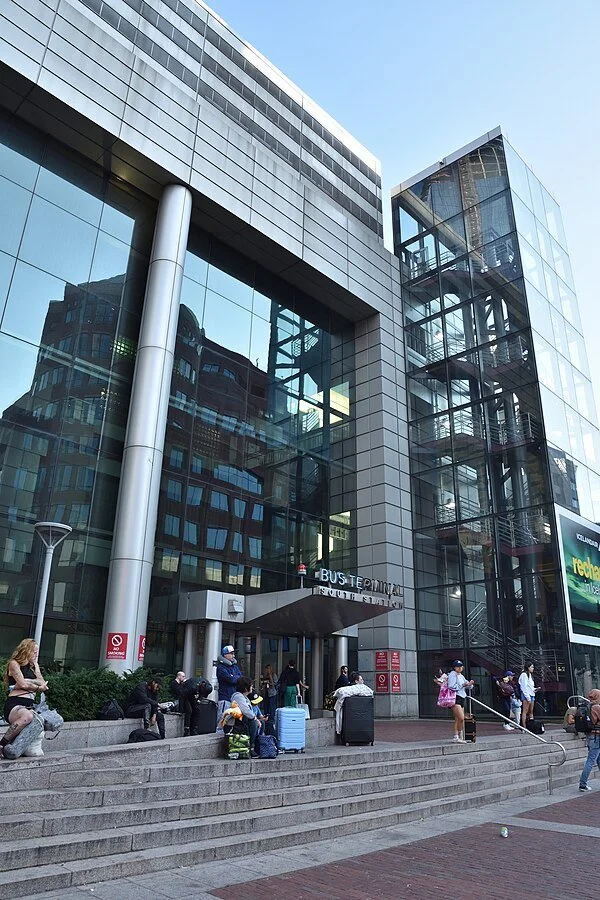
Entrance to the South Station Bus Terminal, in Boston, one of the nicest such facilities in America. That it is next to a big train station makes it even better. Sadly, many downtown bus terminals have been closed in the past few decades, with new ones, with minimal amenities, built next to windswept parking lots on the fringes of cities. Bus service is particularly important to low-and-middle-income people because bus tickets are obviously much cheaper than ones for plane and train travel.
Adapted from Robert Whitcomb “Digital Diary,’’ in GoLocal24.com
Speaking of deserts, reading a CNN report the other day about the dearth of bus terminals in America reminded me of how important bus lines are for millions of Americans, though the mass of our automobile-bound population doesn’t think about them much. Many bus passengers can’t drive because they can’t afford a car or their health doesn’t permit it. Others just don’t want to drive a car, maybe because they fear there are just too many dangerously bad drivers on the road or because they can snooze and read on a bus.
Certainly getting more people out of cars and into public transportation would be very good for our air quality.
Where the private sector is unable or unwilling to step in, the Feds, states and cities should subsidize the construction and maintenance of bus terminals because of their important social, economic and environmental roles. They remain an important, if unfashionable and old-fashioned, part of our transportation network
I used to take buses a lot, first to get to school and then commuting in and out of Boston and other cities. It wasn’t as comfortable as taking the train but was usually less stressful than driving. But being stuck in buses before smoking was banned there was nauseating.
We’re lucky in southern New England in having much more access to trains than most other Americans. And after so many years in which train lines were killed, some have even been revived in the past couple of decades. One example is the train service connecting Boston’s South Shore that was closed in 1959, forcing commuters in and out of Boston to use the new Southeast Expressway, which swiftly became a miles-long parking for hours a day. I remember from when I was a boy how much more pleasant it was to ride in those rattling old rail cars to Boston’s South Station from Cohasset than in claustrophobic buses with decayed suspensions; buses are generally much more comfortable now. Of course the buses would get stuck in traffic, too, even after the creation of bus lanes.
In any event, a version of the train service was revived in 2007, to the relief of thousands.
A household toy

“Mommy What Is This,’’ by Ileana Doble Hernandez, in her show “My Dear Americans,’’ at the Danforth Art Museum, Framingham, Mass., opening Oct. 12.
Busy despite the slump

In downtown Boston in 1933, the worst year of the Great Depression, when almost everyone wore a hat.
Narrative of grief ending in grace

“Like Everything Come Back to Me” (watercolor and gouache on paper), by Peter Bruun in his show “Each Has Their Grief,’’ at 3S Artspace, Portsmouth, N.H., through Oct. 13.
The gallery explains:
“The exhibition follows a narrative arc through Bruun’s grief following the accidental overdose of his daughter ten years ago. Bruun’s figurative abstractions depict his story of loss and love, sorrow and serenity—landing at grace. Words, color, lines, and shape come together as if watching the mind pulse with thought and feeling, trying to process emotion.”
Bruun lives in Maine and Maryland.
Downtown Boston mostly comes back from the pandemic
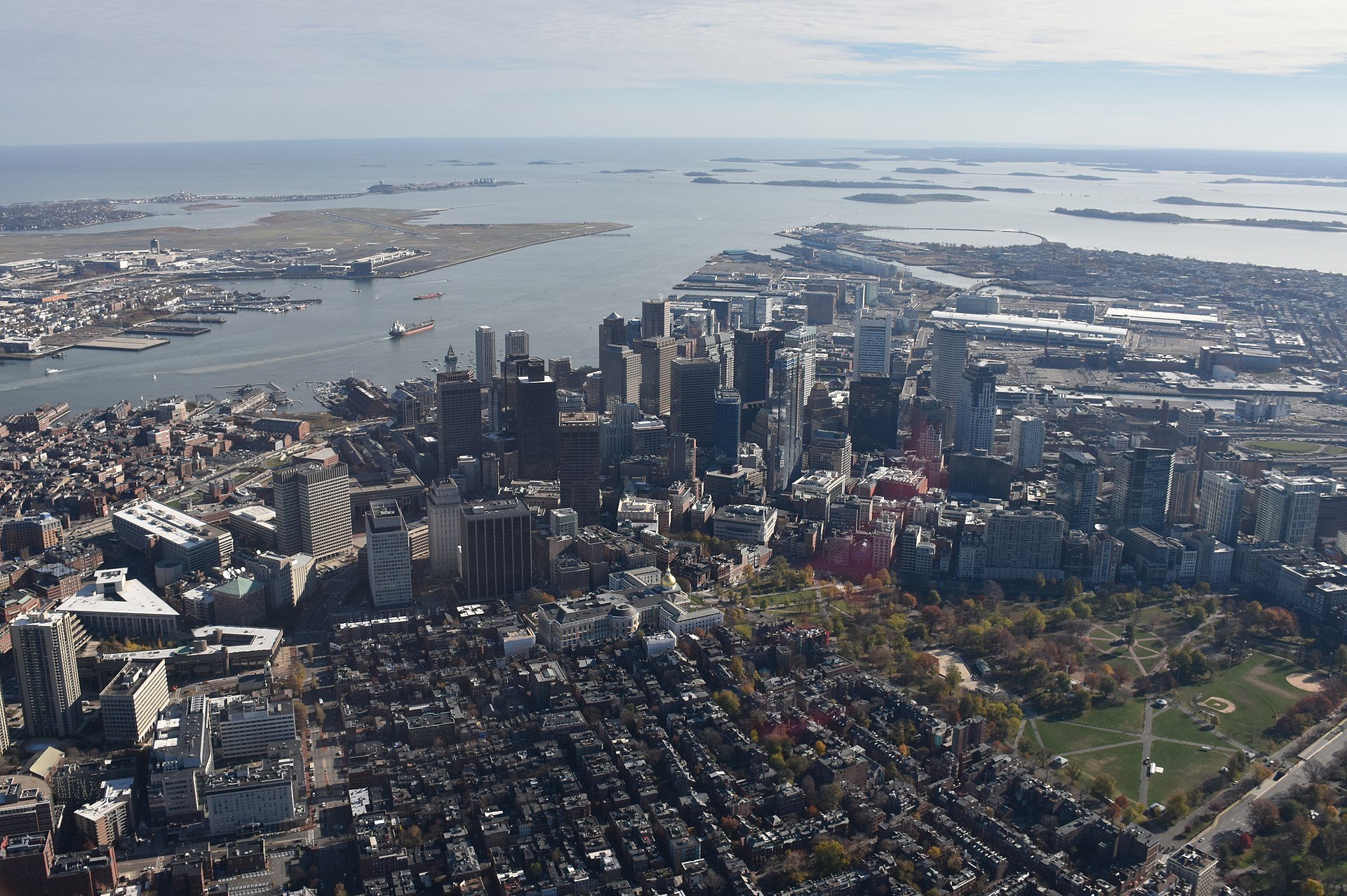
Downtown Boston
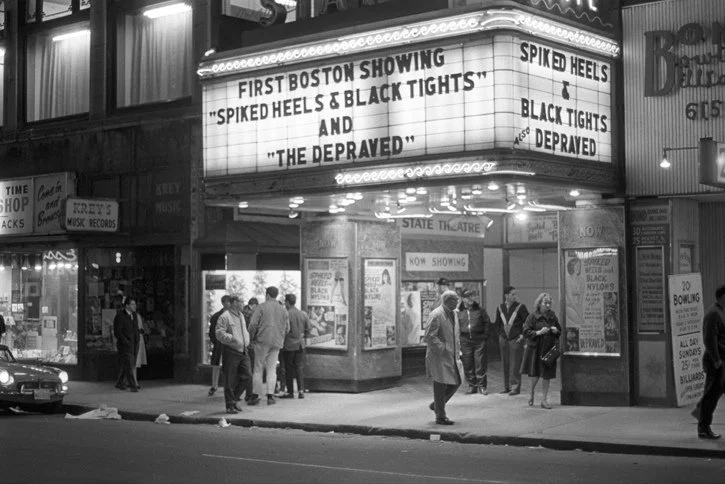
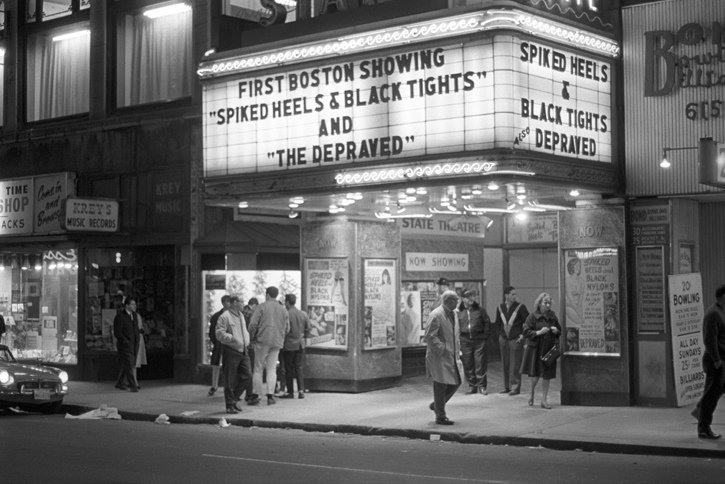
State Theatre in Boston's old "Combat Zone'' in 1967.
-- Photo by Nick DeWolf
Adapted from Robert Whitcomb’s “Digital Diary,’’ in GoLocal24.com
Hope from history? Observers, including, me, remember how more moribund than now downtown Boston seemed half a century ago. Then big department stores were closing amidst suburban flight and the sleazy “Combat Zone’’ lurked nearby, scaring away people who wanted to be considered respectable.
The downtown is gradually coming back from the pandemic disaster, with new restaurants and other attractions opening. The COVID-accelerated move to remote work has affected some of the demographics of downtown consumers and changed the days and hours of peak business, but all in all “The Hub’s’’ center is looking pretty healthy. But it would look healthier if a lot more of the high-rise office space made empty by the remote-work revolution can be turned into housing, a very expensive and complicated architectural and engineering challenge.
xxx
It seems incredible that Newport would allow the demolition of a building as old as the beautiful if battered Borden House, built in 1704, when the city was one of the leading Colonial era ports, but a story in Newport This Week suggests that could well happen soon.
Longing for Indian summer
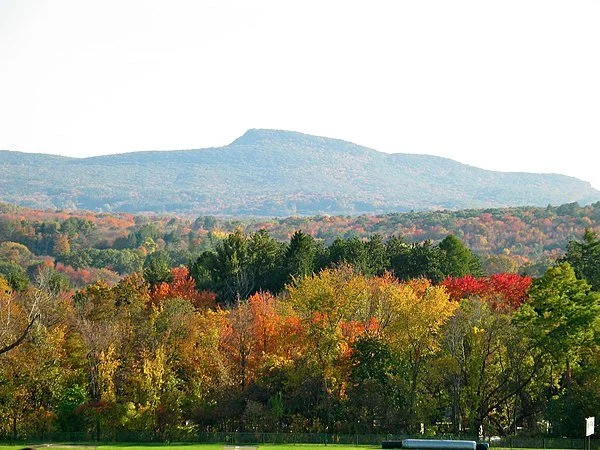
In the Berkshires
“Those grown old, who have had the youth bled from them by the jagged edged winds of winter, know sorrowfully that Indian summer is a sham to be met with hard-eyed cynicism. But the young wait anxiously, scanning the chill autumn skies for a sign of her coming.’’
— From Grace Metalious’s 1956 novel Peyton Place, set in a small New Hampshire town and considered by many at the time to be pornographic. It looks very tame now.
It's not all that bad
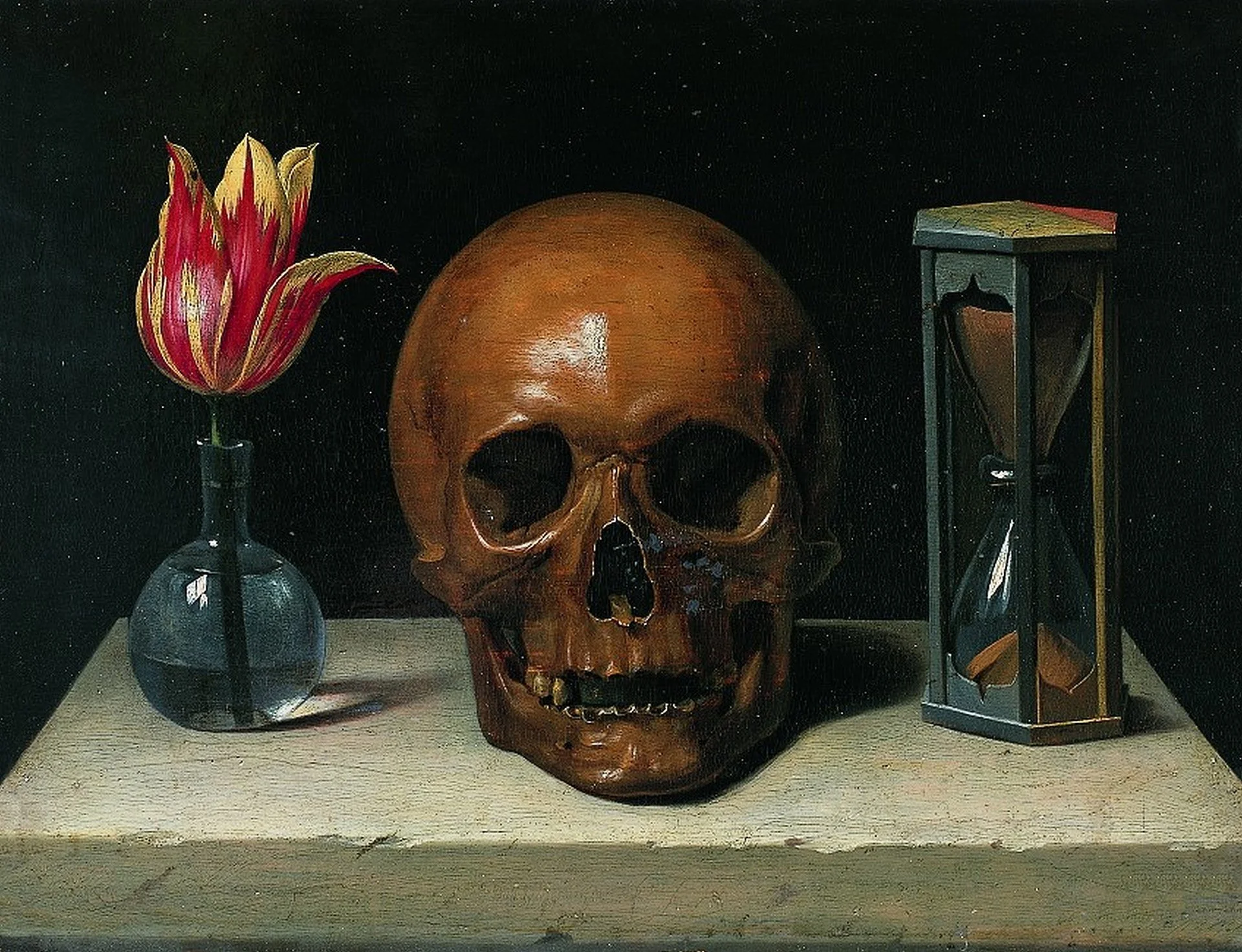
A flower, a skull, and an hourglass stand for life, death and time in this 17th-Century painting by Philippe de Champaigne.
To him who in the love of Nature holds
Communion with her visible forms, she speaks
A various language; for his gayer hours
She has a voice of gladness, and a smile
And eloquence of beauty, and she glides
Into his darker musings, with a mild
And healing sympathy, that steals away
Their sharpness, ere he is aware. When thoughts
Of the last bitter hour come like a blight
Over thy spirit, and sad images
Of the stern agony, and shroud, and pall,
And breathless darkness, and the narrow house,
Make thee to shudder, and grow sick at heart;—
Go forth, under the open sky, and list
To Nature’s teachings, while from all around
Earth and her waters, and the depths of air—
Comes a still voice—Yet a few days, and thee
The all-beholding sun shall see no more
In all his course; nor yet in the cold ground,
Where thy pale form was laid, with many tears,
Nor in the embrace of ocean, shall exist
Thy image. Earth, that nourished thee, shall claim
Thy growth, to be resolved to earth again,
And, lost each human trace, surrendering up
Thine individual being, shalt thou go
To mix for ever with the elements,
To be a brother to the insensible rock
And to the sluggish clod, which the rude swain
Turns with his share, and treads upon. The oak
Shall send his roots abroad, and pierce thy mould.
Yet not to thine eternal resting-place
Shalt thou retire alone, nor couldst thou wish
Couch more magnificent. Thou shalt lie down
With patriarchs of the infant world—with kings,
The powerful of the earth—the wise, the good,
Fair forms, and hoary seers of ages past,
All in one mighty sepulchre. The hills
Rock-ribbed and ancient as the sun,—the vales
Stretching in pensive quietness between;
The venerable woods—rivers that move
In majesty, and the complaining brooks
That make the meadows green; and, poured round all,
Old Ocean’s gray and melancholy waste,—
Are but the solemn decorations all
Of the great tomb of man. The golden sun,
The planets, all the infinite host of heaven,
Are shining on the sad abodes of death,
Through the still lapse of ages. All that tread
The globe are but a handful to the tribes
That slumber in its bosom.—Take the wings
Of morning, pierce the Barcan wilderness,
Or lose thyself in the continuous woods
Where rolls the Oregon, and hears no sound,
Save his own dashings—yet the dead are there:
And millions in those solitudes, since first
The flight of years began, have laid them down
In their last sleep—the dead reign there alone.
So shalt thou rest, and what if thou withdraw
In silence from the living, and no friend
Take note of thy departure? All that breathe
Will share thy destiny. The gay will laugh
When thou art gone, the solemn brood of care
Plod on, and each one as before will chase
His favorite phantom; yet all these shall leave
Their mirth and their employments, and shall come
And make their bed with thee. As the long train
Of ages glide away, the sons of men,
The youth in life’s green spring, and he who goes
In the full strength of years, matron and maid,
The speechless babe, and the gray-headed man—
Shall one by one be gathered to thy side,
By those, who in their turn shall follow them.
So live, that when thy summons comes to join
The innumerable caravan, which moves
To that mysterious realm, where each shall take
His chamber in the silent halls of death,
Thou go not, like the quarry-slave at night,
Scourged to his dungeon, but, sustained and soothed
By an unfaltering trust, approach thy grave,
Like one who wraps the drapery of his couch
About him, and lies down to pleasant dreams.
— “Thanatopsis,’’ by William Cullen Bryant (1794-1878), American romantic poet and famed New York-based editor. He grew up in western Massachusetts.
Transit textures

“Carscape #3,’’ by Maine painter Winslow Myers, in his show “Planes, Trains and Automobiles,’’ at Bromfield Gallery, Boston, opening Oct. 30.
The gallery says:
“In his first Boston show, modes of transport provide opportunities for the artist to play abstractly with form, space, color and light.’’

Above Logan International Airport, on Boston Harbor.
Chris Powell: Promote Connecticut’s gentle beauty and fix its government
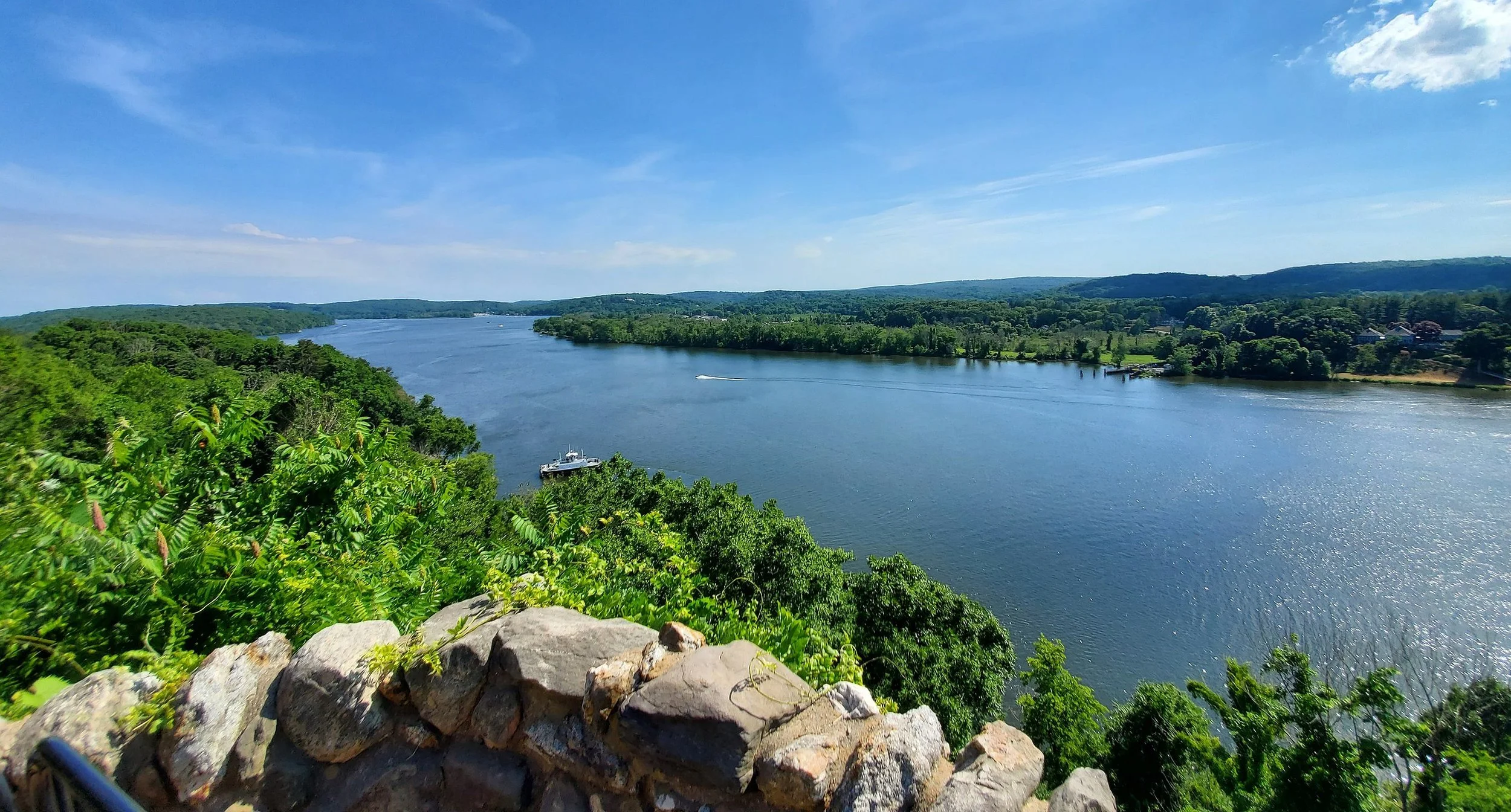
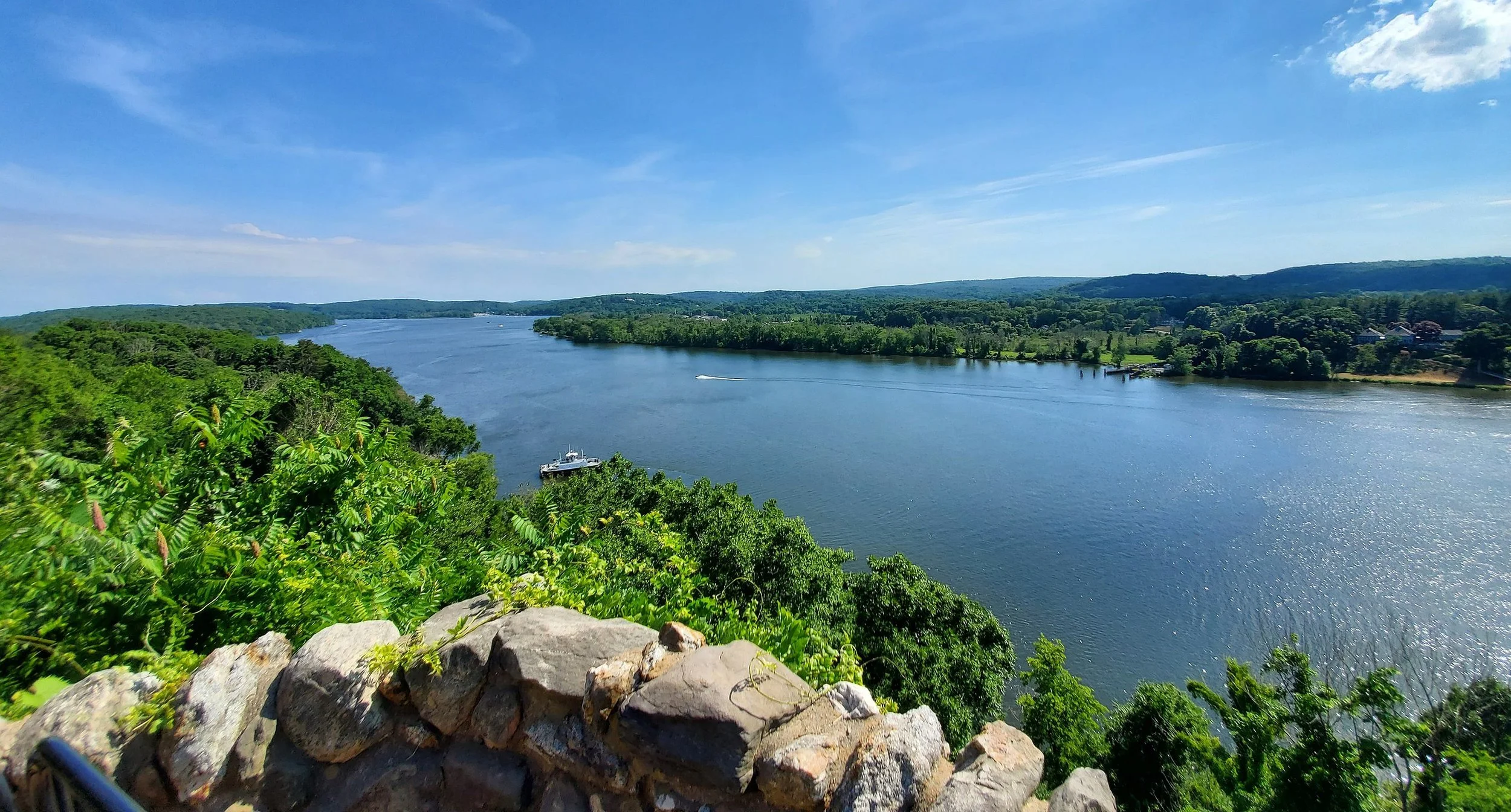
Connecticut River as seen from Gillette Castle, in East Haddam, Conn.
MANCHESTER, Conn.
One of these days Connecticut Gov. Ned Lamont may show Florida a thing or two. But probably not soon.
Without explanation, Florida's tourism Internet site recently removed a section touting destinations in the state said to be particularly attractive to members of sexual minorities. This renewed complaints that the state is hostile to those minorities because of its "Don't Say Gay" law, its refusal to let people change the sex listed on their driver's licenses, its prohibition of sex-change therapy for minors, and its requiring people to use restrooms corresponding to their biological sex.
As oppression goes, this isn't much. The "Don't Say Gay" law only forbids school class discussions of homosexuality in third grade and below, in the reasonable belief that any sex-related discussions aren't appropriate for younger children.
The prohibition on changing sex designations on driver's licenses guards against deception.
The prohibition on sex-change therapy for minors protects them against irreversible, life-changing treatment until they are fully able to make their own decisions. (All states prohibit certain things for minors, including Connecticut.)
Members of sexual minorities who live in Florida may disagree with these policies but apparently not enough to leave the state. Florida long has been and remains attractive to them, and their share of the population in Florida seems to equal or exceed their share of the country's population. An independent internet site on Florida tourism lists dozens of localities considered "gay-friendly," many with "gayborhoods," along with dozens of attractions that might appeal particularly to them.
And supposedly backward Florida has been gaining population while supposedly progressive Connecticut has been losing it.
So having already appealed to Florida businesses to relocate to Connecticut because of Florida's restrictive abortion law -- a law that probably will be liberalized by voters in a referendum in November -- Governor Lamont this month had Connecticut's tourism office undertake an internet advertising campaign aimed at sexual minorities, emphasizing the state as "a welcoming alternative."
Of course this campaign won't be any more effective than was the governor's appeal to Florida businesses to relocate to Connecticut because of abortion law. Both undertakings are just politically correct posturing by the governor, a Democrat who has been finding it harder to maintain the support of his party's extreme left. His posturing won't do much to keep the lefties in line either.
If only the governor could plausibly issue an appeal to Floridians, including the many who used to live in Connecticut (among them former Gov. Jodi Rell), that they should return here because of, say, the stunning new efficiency of state and municipal government, much-improved public education, reduction in taxes, and a rising standard of living.
After all, Florida's weather isn't that state's only attraction; it's not even all that good. Florida's winter can be lovely while Connecticut shivers, shovels, slips, and crashes. But Florida's summer can be oppressively hot, rain there can go on for days and is often torrential, hurricanes are frequent and can be catastrophic, and the state is full of mosquitoes, alligators, Burmese pythons, and cranky old people driving haphazardly to and from their doctor's office.
Florida's lack of a state income tax may be a bigger draw than its weather. While tax revenue from the state's tourism industry takes much financial pressure off state government, so does Florida's refusal to be taken over by the government class, a big difference from Connecticut. Florida's strengthening Republican Party may help in that respect, even as Connecticut's Republican Party and political competition in the state have nearly disappeared.
Connecticut's natural advantages remain what they always have been. Beautiful hills, valleys, meadows, forests, rivers, streams, lakes, a long seashore, changeable but generally moderate weather, and nearness to but comfortable distance from two metropolitan areas. It is a great but gentle beauty, crowned with convenience.
That is, Connecticut is a state to be lived in, not visited. Indeed, contrary to the governor's latest pose, the fewer tourists here, the better. Connecticut would be more wonderful still if government didn't keep making it more expensive, thus making Florida seem better.
Chris Powell has written about Connecticut government and politics for many years (CPowell@cox.net).
Aid to navigation

From the series “Another America,’’ by Philip Toledano. He’s in the group show “Artificial Intelligence: DisInformation in a Post Truth World,’’ at the Griffin Museum of Photography, Winchester, Mass. through Oct. 27.
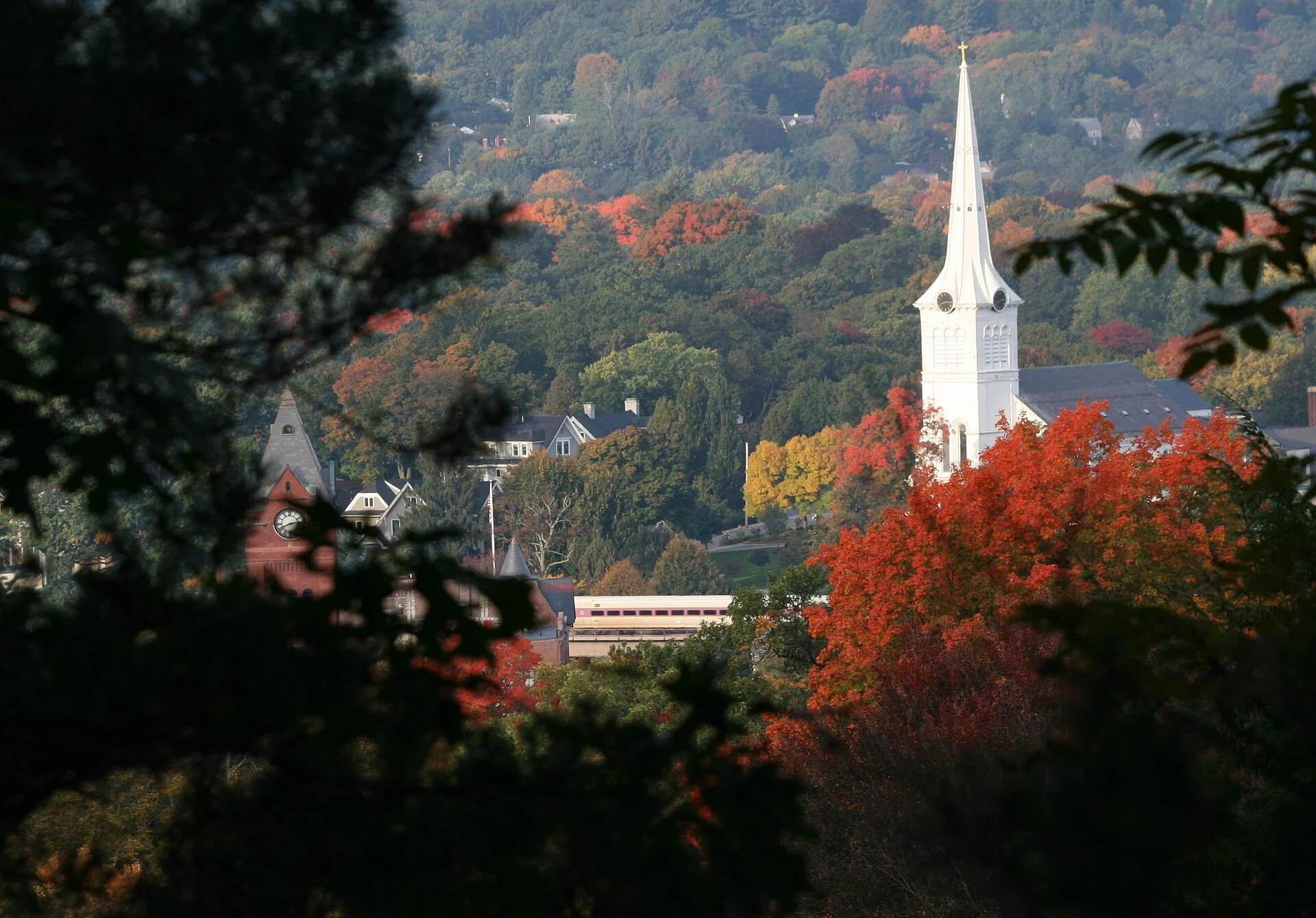
Train at the Winchester MBTA station in October 2008, between the Town Hall and the First Congregational Church. Winchester is an affluent inner suburb of Boston.
The museum says the show focuses on how images inform, persuade and drive the conversation about critical thinking.
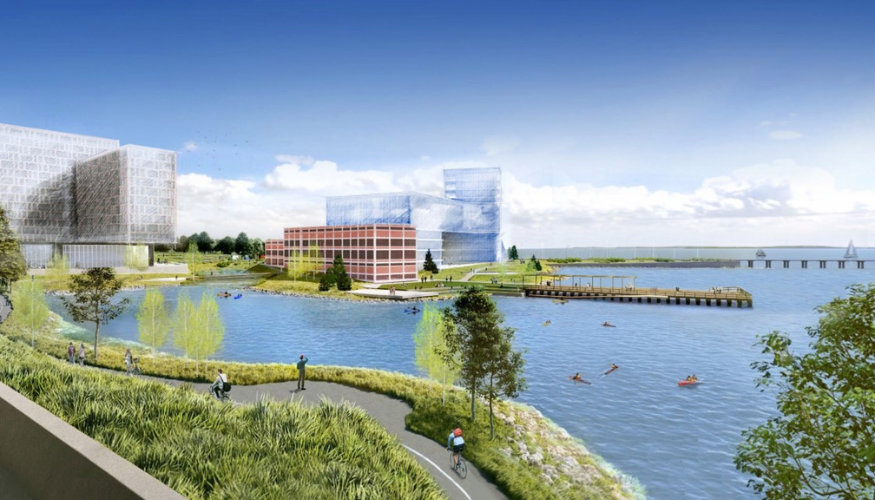
Northeastern University breaks ground on Portland campus
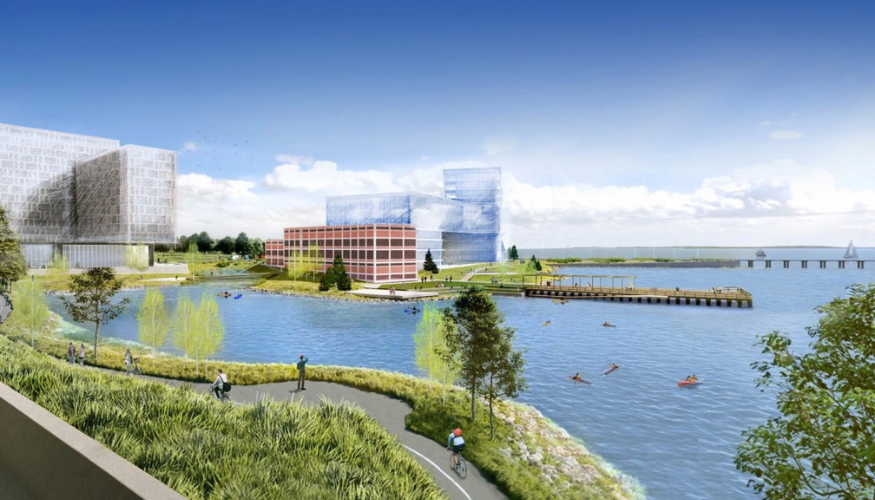
-- Northeastern University's rendition of what its Roux Institute campus on the Portland waterfront will look like.
Edited from a New England Council report
“On Friday, Sept. 13, New England Council member Northeastern University held a groundbreaking ceremony to mark construction on its new campus in Portland, Maine, that will let the university to double the student body at the location.
“The Roux Institute at Northeastern University’s new campus will mark a significant step forward for Northeastern. The institute opened in 2020, thanks to a $100 million donation from technology entrepreneur David Roux, a Maine native, as well as another $100 million gift months later. The school has 800 students today, but it expects to have room for 2,000 when the new campus is completed, in 2028. The Roux is focused on technology research and development and graduate education.
“‘Our mission is to be a driver of the future Maine economy…. A larger permanent home for the university’s efforts in Maine is essential,’ the Roux Institute’s chief administrative officer, Chris Mallett, said in an interview.’’
Maniacal in Maine

Installation view of “Alive & Kicking: Fantastic Installations by Thomas Lanigan-Schmidt, Catalina Schliebener Muñoz, and Gladys Nilsson,’’ at the Colby College Museum of Art, Waterville, Maine, through Nov. 11.
—Photography by Andrew Witte
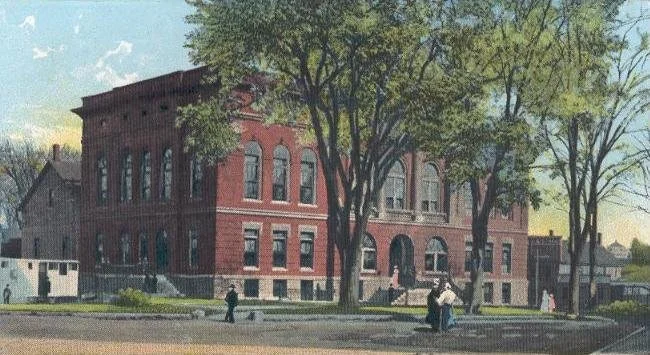
City Hall and Opera House in 1905 in Waterville, where appreciation for the arts goes way back.