

Symbols of New England

The stone wall at the farm in Derry, N.H., where Robert Frost lived with his family in 1901-1911. He described the wall in his famous and complex poem "Mending Wall".

Stone wall in Maine
From the New England Historical Society:
“New England stone walls are as distinctive a feature of the landscape as bayous in Louisiana or redwoods in California. Hundreds of thousands of miles of them criss-cross the region like so much grillwork.’
Hit this link to read the article “Seven Fun Facts About New England’s Stone Walls.
Chris Powell: Maybe they can hide Conn. car tax
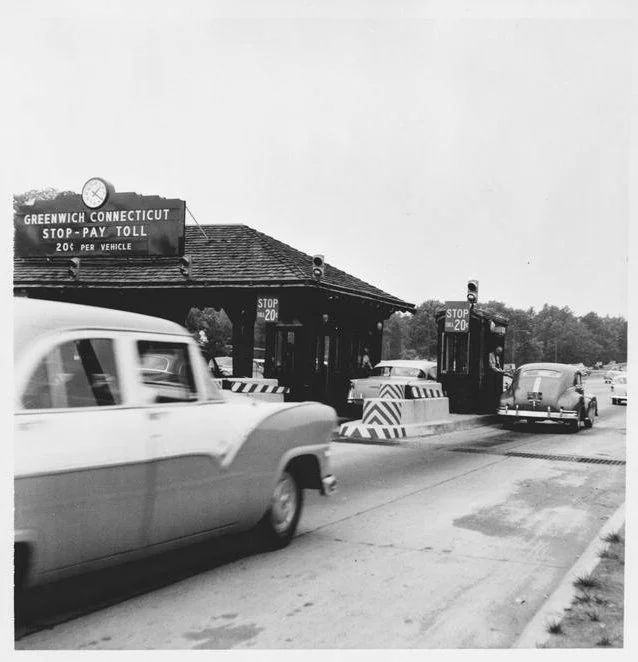
Toll booth on Connecticut’s Merritt Parkway in 1955. There are no longer toll roads in the Nutmeg State.
MANCHESTER, Conn.
Most Connecticut state legislators purport to hate the car tax -- that is, municipal property taxes on automobiles. A special committee of the General Assembly has been created to review the tax and suggest alternatives for raising the billion dollars it pays into municipal government treasuries each year.
Since cars are sold more frequently, collecting the property tax on cars is more complicated than the property tax on residential and commercial property. Since the property tax on cars is not escrowed as property taxes on mortgaged properties usually are, car taxes fall unexpectedly on many people when the bills arrive from the local tax collector. As the economy weakens, poverty worsens, and more people live from paycheck to paycheck, the car tax is resented even more.
Another complaint is that the car tax is unfair because identical cars may be taxed much differently among towns. But this isn’t peculiar to the car tax; it’s a function of differences in local tax rates. Similar residential and commercial properties are taxed differently among municipalities as well because of different tax rates, and different rates are not necessarily bad, insofar as some municipalities choose to spend and tax much more than others.
Eight years ago a state law reduced the disparities in car taxes, imposing a car tax cap of 32.46 mills. According to the Waterbury Republican-American, the car taxes of 54 municipalities are capped -- that is, their general property tax rate is higher than the car tax cap. The disparities in taxes on similar cars have been reduced but often remain sharp.
A mill equals $1 of tax for each $1,000 of a property’s assessed value. Property tax is calculated by multiplying a property’s assessed value by the mill rate and dividing by 1,000. For example, a motor vehicle with an assessed value of $25,000 located in a municipality with a mill rate of 20 would have a property tax bill of $500.(The disparities in all municipal property tax rates result mainly from the concentration of poverty in the cities, which in turn results mainly from the concentration of the least expensive housing there and from the decision of municipal officials, under political pressure and the pressure of state labor law, to pay local government employees more generously, as well as from the inefficiency encouraged by large grants of state financial aid.
Inconvenient and unfair as the car tax may be, the real problem with it is that legislators and governors don't dislike it as much as they like the revenue it raises and the ever-increasing spending they require in state and municipal government. Indeed, the most obvious remedy for the dislike of the car tax isn’t even proposed -- to reduce municipal spending or reduce state spending and redirect the savings to municipalities.
As always, cutting spending is out of the question at both levels of government, even in the face of policies and programs that don’t achieve their nominal objectives. The broadest and most expensive policies and programs, like education and welfare for the able-bodied, are never audited for their failures. To the contrary, their failures are mistaken as evidence to do still more of what hasn’t accomplished what the public imagines the objectives to be.
That is, politically the status quo is loved far more than the car tax is hated.
Since even $100 million in spending cuts can’t be found in state and municipal budgets, how could state government find the billion dollars needed to eliminate the car tax?
Of course state Senate President Martin M. Looney, Democrat of New Haven, has his usual idea -- raising taxes on the wealthy, particularly on their capital gains. Progressivity in taxation is always a fair issue and matter of judgment, but in Connecticut it is meant less as justice than as protection for inefficiency and patronage.
Another idea is an 8 percent sales tax on homeowner and auto insurance policies. That wouldn't be more popular than the car tax, if people noticed it. But they wouldn't if it was levied against insurers on a wholesale basis, like the state’s wholesale tax on fuel and the taxes on electric utilities that are passed along hidden in electricity prices. Then the sales tax would be hidden in the price of insurance, and insurers, not state government, would be blamed for the price increases while legislators congratulated themselves for eliminating the car tax at last.
Chris Powell has written about Connecticut government and politics for many years. (CPowell@cox.net).
New program addresses economic welfare of patients

Edited from a New England Council report
“Boston Medical Center (BMC) recently announced it will allocate a $3 million grant from the MassMutual Foundation toward a program to support the economic welfare of pediatric patients and their families….
“The Economic Justice Hub will consist of three branches as BMC leads other hospitals in tackling inequalities in health-care access. The first branch will expand BMC’s StreetCred program–a free-tax-filing series started in 2016 that has returned more than $14 million to families and assisted them in opening 529 college savings accounts. The second branch will create new jobs for parents as peer educators and financial navigators to help other families in pediatrics seeking financial support. The third branch will facilitate a study on the ‘cliff effect,’ which occurs when a person’s wage increase triggers a disproportionate loss of government benefits, leaving families with limited resources to allocate toward healthcare, housing, food, and childcare.
“‘We know that wealth is directly tied to health,’ said Alastair Bell, M.D., MBA, president and chief executive BMC Health System. ‘Through initiatives like the Economic Justice Hub, we are building on BMC’s quality, compassionate care with family supports that address the economic inequities at the root of many health disparities. We are grateful for partners like the MassMutual Foundation who generously invest in this work, which can truly impact the healthy futures of our community.’’’
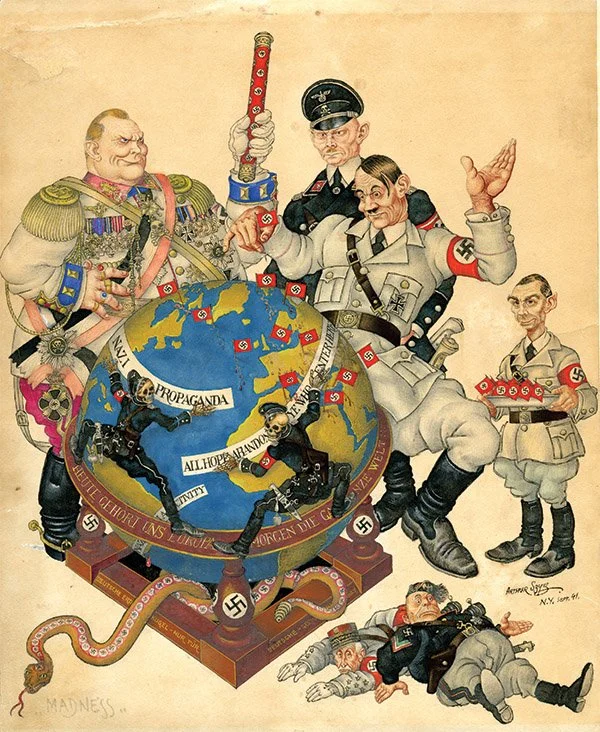
Increasingly resonates today

“Madness” (1941) (watercolor, gouache, ink and graphite on paper), by Arthur Szyk (1894-1951), in the show “In Real Times: Arthur Szyk: Artist and Soldier for Human Rights,’’ at Fairfield (Conn.) University Art Museum, through Dec. 16.
Courtesy of Taube Family. Arthur Szyk Collection, in The Magnes Collection of Jewish Art and Life, University of California at Berkeley.
Llewellyn King: Some veterans' suicides are linked to minute brain tears

Arizona Army and Air National Guard members participating in "Ruck for Life," an event promoting military suicide prevention.

World War II Memorial in the Fenway section of Boston.
WEST WARWICK, R.I.
This is a horror story.
It is a story of suffering unmitigated and of death from despair. It is the story of our veterans who are 57 percent more likely to take their own lives than those who haven’t served their country.
Every day in the United States an average 17 veterans commit suicide. Those who have served in special combat force units, such as the Navy Seals, being a little more likely to die this way than regular forces.
These veterans are suffering and dying in plain sight. Veterans, whether they have seen action or not, are ending life by their own hands — hands that willingly took up arms to serve.
There is a clear and present crisis in deaths of those who have borne the battle, heard their country’s call and who die, often alone in despair.
Around Veterans Day we remember them, but what do we know of them?
More veterans have taken their own lives in the past 10 years than died in the Vietnam War. Frank Larkin, chairman of Warrior Call, an organization that asks anyone who knows a veteran to call them from time to time and ask, “How are you doing? What do you need? Can I get help for you?” But mostly to convey the comfort of knowing that “You are not alone.”
However, the problems are beyond loneliness and the well-known precursors to suicide: drug abuse, alcoholism, joblessness and broken relationships.
New research shows that what ails these sad heroes isn’t just psychological and moral despair, but physical brain damage -- minute tears in the brain that CT scans don’t pick up.
A leading researcher into brain injury and concussion, Dr. Brian Edlow, a professor at Harvard and associate director of the Center for Neurotechnology and Neurorecovery at Massachusetts General Hospital, said these tears are only discovered in postmortems, when the brain tissue is put under a powerful microscope.
The cause of these tears, Edlow told guest host Adam Clayton Powell III in a special Veterans Day episode of the television program White House Chronicle, are blasts that troops experience on the battlefield and in training — massive concussive blasts, over and over again. Those concerned emphasize that the victim doesn’t have to see combat to suffer damage, it happens in training as well.
Sometimes the tears are the result of a head injury such as a soldier’s head hitting the inside of a tank or a blast throwing a soldier against a wall, but mostly it is the shockwave, according to Edlow.
“Just to appreciate the scope of this problem, if you look at the post-9/11 generation, those who answered the call to serve after September 11, 2001, over 30,000 active-duty and veteran military personnel have died by suicide during that time period, which is four times more than the number of active-duty personnel who died in combat,” he said, adding that the “extent of the suicide problem is humbling.”
Larkin said that as many as two-thirds of those who commit suicide have never been to a VA hospital or sought institutional help.
For Larkin, the story is very personal. His son Ryan, a decorated Navy Seal who served for 10 years with four active-duty deployments in Iraq and Afghanistan, was a suicide.
Ryan returned from active duty a changed young man, 29 years old. He was moody, didn’t smile and showed classic signs of depression. His family couldn’t get him out of it and his brain scans were negative. After a year, he took his own life.
Earlier, Ryan had asked that his body be used for medical research. Postmortem diagnosis at Walter Reed National Military Medical Center revealed substantial brain damage that wasn’t detectable during the year before his death, his father said.
“The system didn’t know what to do and it defaulted toward psychiatric diagnosis,” Larkin said.
Referring to scans and other techniques now in use to examine the brain, Edlow said, “We simply are not accurate enough to detect these sub-concussive blast-related injuries.”
Ryan’s tragedy is repeated 17 times every day — and that figure doesn't account for those who die in deliberate accidents and are otherwise not reported as suicide, Larkin said.
While medical science and the military catch up, all we can do, as Larkin said, is to check on a veteran, any veteran. You could save a life, bring a man or woman back from the precipice.
Llewellyn King is executive producer and host of White House Chronicle, on PBS. His email is llewellynking1@gmail.com, and he’s based in Rhode Island and Washington, D.C.,
Linda Gasparello
Co-host and Producer
"White House Chronicle" on PBS
Mobile: (202) 441-2703
Website: whchronicle.com
‘First they came….’

This is the "First they came..." poem attributed to German theologiian and Lutheran minister Martin Niemoeller (1892-1984) at the Holocaust memorial in Boston.

Frank Carini: The brazen and well-financed disinformation campaign of the anti-wind-farm crowd
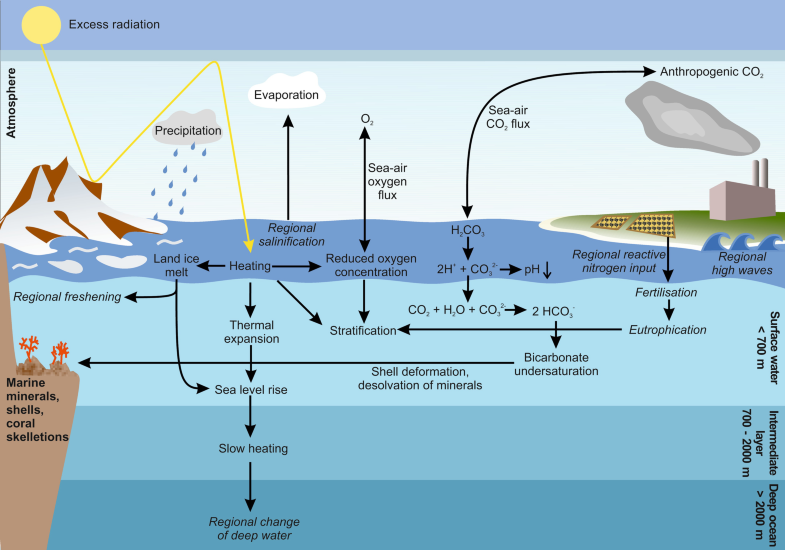
Overview of climatic changes caused by burning fossil fuel and their effects on the ocean. Regional effects are displayed in italics.
Oil spill covering kelp.
The anti-wind mob chums the waters with red herring. The conspiracy theorists continue to hide behind critically endangered North Atlantic right whales to spin tales about offshore wind. Their faux concern is nauseating.
When it comes to the real threats to the 350 or so North Atlantic right whales left on the planet — entanglements with fishing gear and strikes with ships — the mob’s ranting and raving goes largely silent, and my stomach turns.
These self-proclaimed pro-whale warriors only care about the lives of these majestic marine mammals when they fit into their manufactured hysteria about offshore wind.
Among those spreading the mob’s propaganda are southern New England firebrand Lisa Quattrocki Knight, president of Green Oceans, and Constance Gee, a Westport, Mass., resident and Green Oceans member; Lisa Linowes, executive director of the Industrial Wind Action Group Corp, also known as The WindAction Group; Protect Our Coast New Jersey; and blogger Frank Haggerty, a blowhole of offshore wind misinformation.
Their bluster is either funded by the fossil-fuel industry and/or they are wealthy coastal property owners more concerned that their ocean views will be ruined by a different type of energy infrastructure. Either way, the lives of whales, dolphins, birds, and humans living near polluting fossil-fuel operations don’t matter.
To read the whole article, please hit this link.
Beats thinking
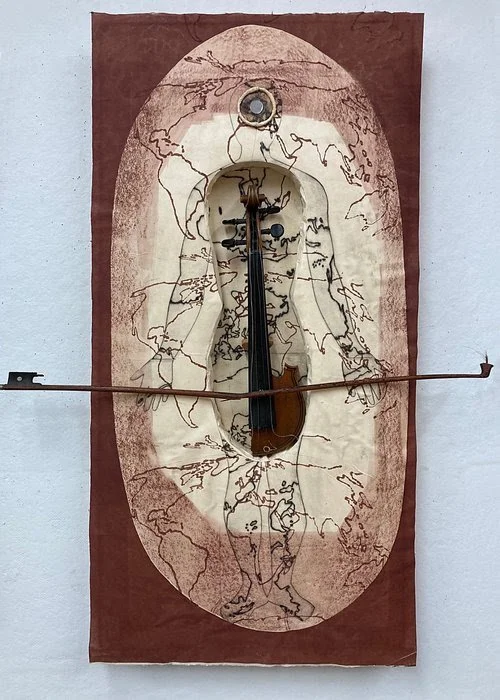
“Muscle Memory” (monoprint drypoint construction with violin and mirror), by Massachusetts artist Debra Olin, at Brickbottom Artists Association’s (Somerville, Mass.) members show, through Nov. 19.

Stuart Vyse: Looking for the light in our inner worlds

This essay first ran in New England Diary on Nov. 19, 2017
I used to dread the descent into darkness in late autumn. There comes a time when, well before you get up from your desk to go home, the world outside your window is as black as midnight. It is barely five o'clock in the afternoon, but there is no natural light left to guide you home or illuminate your evening activities. It is too early to sleep, and yet you must push against the blackness to stay alert and awake. Eventually here in the northern latitudes, the reluctant cold-weather sun manages only the briefest appearance in the middle of the day before slipping away behind a mid-afternoon sunset.
It is easy to feel depressed by the weight of light's absence -- by a life that sometimes feels subterranean and nightmarish. But I have come to welcome the change of year. Seasons mark the time. All seasons. They tell us we have been here before, and if all goes well, we will be here again. The changing light and landscape conjure memories: of jumping in piles of leaves, of a beautiful ice storm, or of a frozen lemonade drunk in the car on the way home from the beach.
Thanks to a quirk of our psychology, we tend to suppress the unpleasantness of the past, and our memories are often warm and nostalgic, no matter what the temperament of those distant times.
I have grown to appreciate the brightness hidden within the winter black. There are the familiar holidays clustered around winter solstice -- that shortest day when the darkness begins to slowly pull back its veil. These celebrations are filled with candles and lights and burning fires that show the way to the equinox and warm weather beyond.
Although there is less light around the solstice, the light there is is of a special quality. The winter sun hurls its shafts through the window at a flatter angle, crashing them against the floors and walls. During the season we are inside the most, the sun finds a way to light the room as brilliantly as possible, and then too soon it is gone.
But, for me, the great hidden light of the dark season can only be seen from outside. As you walk the sidewalks or drive through your neighborhood at night, the houses are lit from inside out, throwing great yellow beams onto the lawn. We never know what goes on in other people's homes, and sometimes it is better that way. But from a safe distance away I imagine families together -- not avoiding the darkness outside, but drawn to the light and heat inside. Making a warm world together within the wintry one beyond the walls.
Perhaps it is wishful thinking, but I like to imagine that, for those of us who live where there are seasons, this cycle serves an important purpose. I want to believe that during this time of year when the sun recedes beyond the horizon, nature compels us to go home. Like bears returning to their caves, we come inside -- not to hibernate -- but to awaken to a different source of illumination.
The spinning Earth tells us to spend a little less time outside and a little more with family and friends -- and, perhaps, a little more in the smaller spaces of our inner worlds. Ideally, when the warm weather returns, we emerge restored, with a new appreciation of the world outside.
Of course, life is not always ideal. Sometimes the sense of cold-weather fellowship is more an idea -- a memory -- than a reality. Easier seen from outside on the sidewalk than from inside the house. But even then, the blackness of winter provides the perfect backdrop for imagination and reexamination. As we are forced indoors we have a chance to look inward, too. A chance to seek a private incandescence to guide us through the dark season.
Perhaps this is part of what the winter holidays are supposed to do. Show us a different source of light; encourage us to look inward as we go inside; and give us hope that the spring will come again.
The gathering shadows of autumn are often difficult to accept. The hope of longer days seems so far away. But I have come to understand that, when darkness comes, we need not rue the absent sun. It is simply time to go inside and make our own light.
Stuart Vyse is a psychologist and writer living in Stonington, Conn., where he lives in the old Steamboat Hotel, about which he wrote an eponymous book.
The publisher explains:
“From 1837 to 1900, the tiny borough of Stonington, Connecticut, was a major transportation hub on the route between New York and Boston. Steamboats leaving Manhattan followed Long Island Sound to Stonington Harbor, where passengers boarded trains for the rest of the journey to Providence or Boston. Stonington’s Steamboat Hotel, built 1838 near the piers and railroad yard, was home to saloons, restaurants, a pool hall, a cigar shop, a tailor and a barber shop. Merchants, hotel keepers and saloon workers passed through the building, each with their own unique story. Many of them were immigrants or first-generation Americans, and they are a window on a late nineteenth-century class of merchants and service workers. Join local author Stuart Vyse as he reveals a lively portrait of remarkable harmony in a small village that was far more diverse than it is today.’’

Bright light therapy is a common treatment for seasonal affective disorder, which is associated with diminished sunlight from fall into the winter.
But it usually doesn't usually last long

“Infatuation” (acrylic, wallpaper on canvas), by Allison Bremner, at Bates College (Lewiston, Maine)) Museum of Art.
— Image courtesy of artist, who is of Alaskan Native American background.
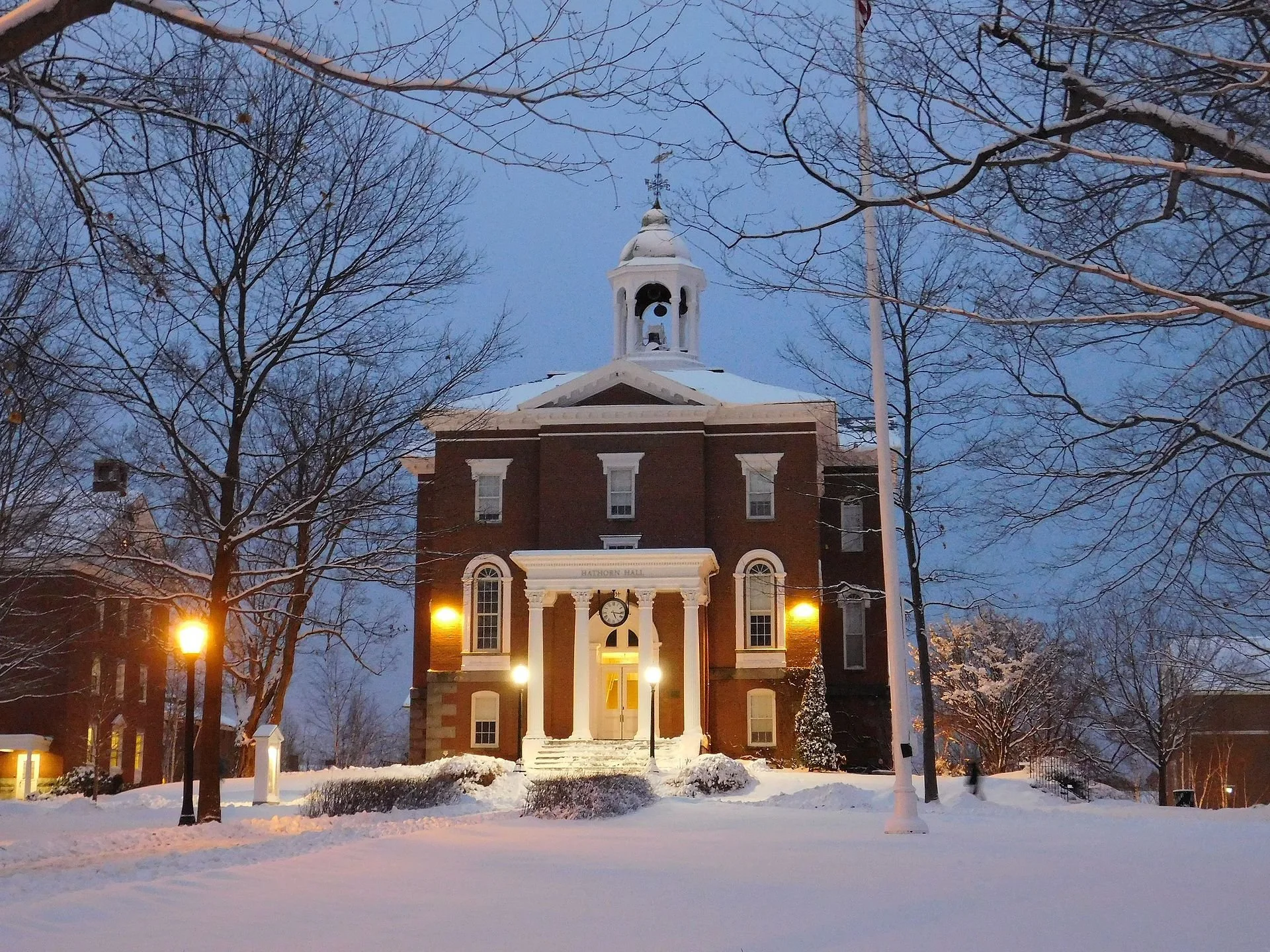
Hathorn Hall, at Bates College
— Photo by Odwallah
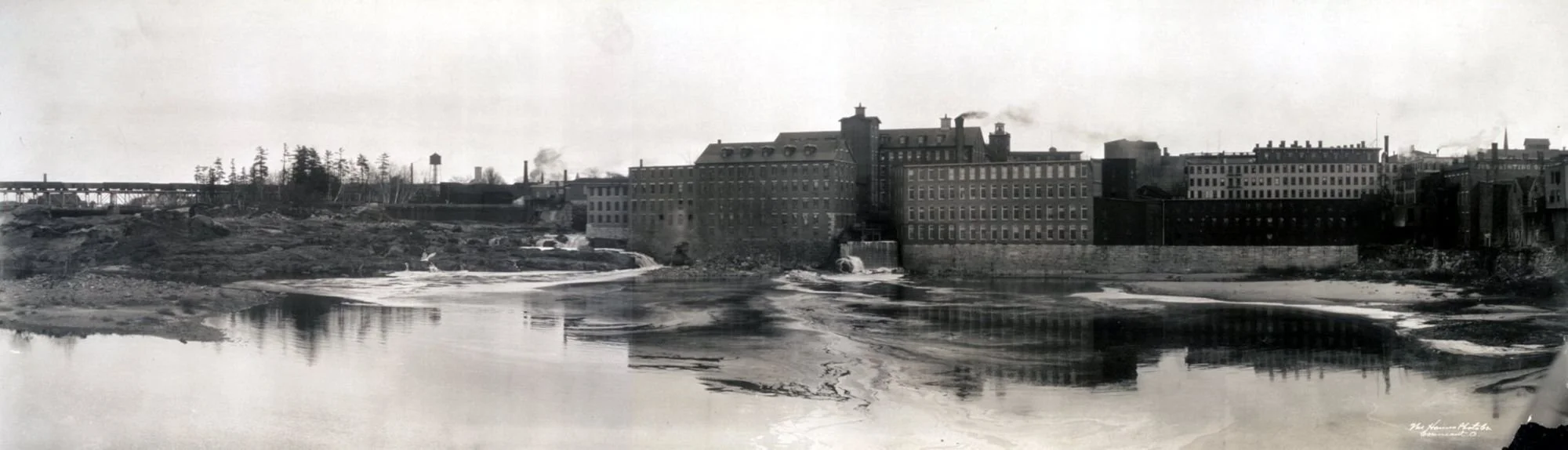
Textile mills in Lewiston along the Androscoggin River about 1910. The city became a major industrial center in the mid-19th Century, first with sawmills, then with textiles. Money from the latter helped found Bates College, in 1864. Many of the workers were of French-Canadian background, and French used to be widely spoken in the city.
Sadly, Maine’s second largest city, after Portland, became nationally know for Robert Card’s mass shooting there on Oct. 25. that killed 18 people in the normally peaceful place.
The horror, the horror
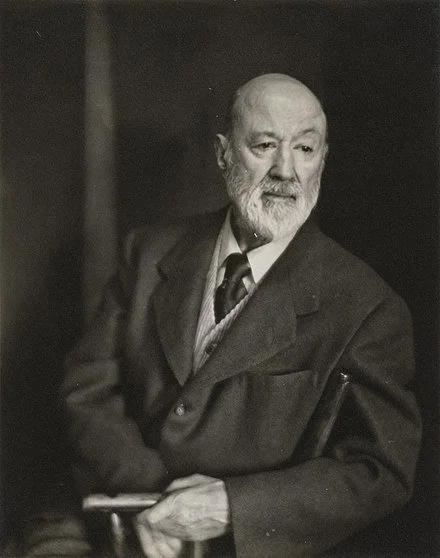
Charles Ives
“O Prejudice….You enter into the little boy of a New England town and make him stand and gape with the same horror at {the} man going into a Catholic church as the man going into a saloon.’’
— Charles Ives (1874-1954), famed American Modernist composer, insurance executive and native of Danbury, Conn. He’s a considered a father of estate planning.
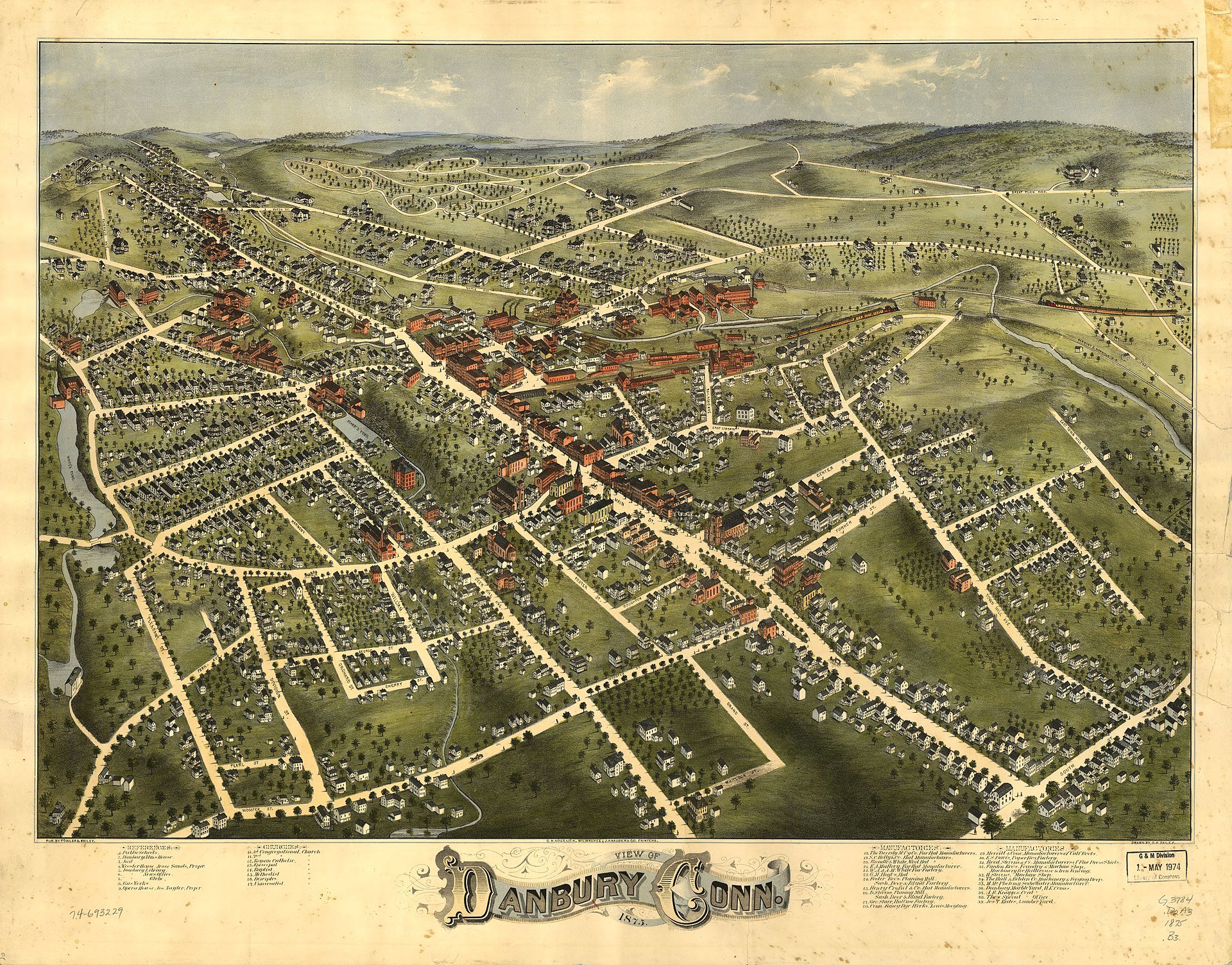
Danbury, Conn., the “Hat Capital of the World,’’ in 1879

Homeless surge into the affluent Back Bay

- Photo by Ed Yourdon
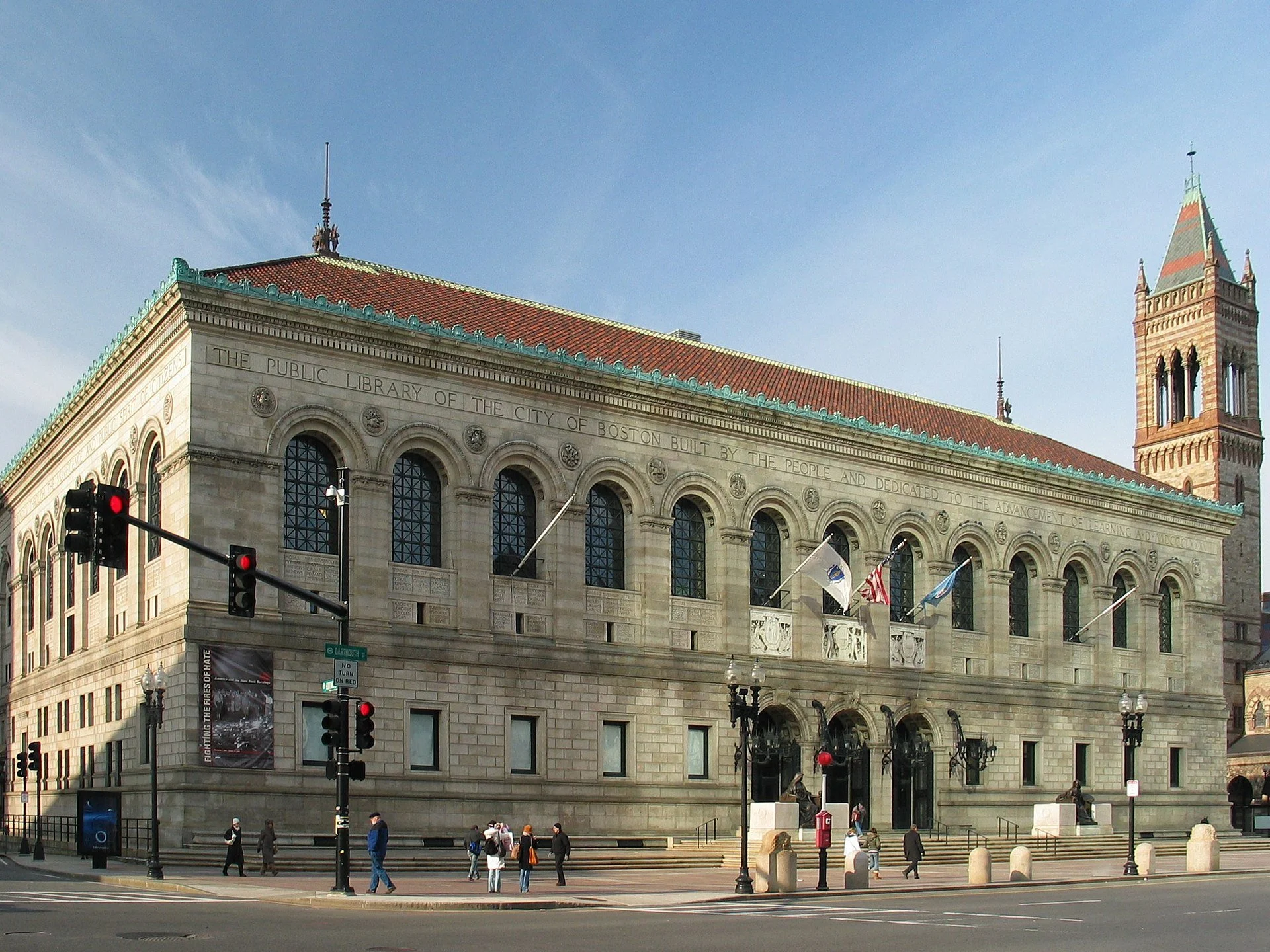
The Boston Public Library, on Copley Square. The peculiar lighting is from sunlight reflected off a high rise nearby. Homeless people have been congregating in increasing numbers on the square.
— Photo by Daniel Schwen
Excerpted from The Boston Guardian
“Back Bay landmarks were experiencing a surge in homeless occupancy even before the city cracked down this week on the South End encampment known as Mass & Cass, making stakeholders anxious about potential displacement.
“A range of factors have increased disruptions from unhoused Bostonians around heavily trafficked landmarks like the Boston Public Library (BPL), Prudential Center and Copley Square.
“With the city pledging to enforce anti-tent ordinances once and for all on the city’s largest encampment, civic and business groups in the Back Bay worry they’ll bear the brunt of the fallout.
“Meg Mainzer-Cohen, president of the Back Bay Association, says recent months have already seen a dramatic rise in homeless displacement to the Back Bay, a timeline that coincides with the spike in South End violence and the city’s warnings that it would soon disperse the encampment.
“‘In August things were very quiet, especially given the warm weather. By September, the situation had changed dramatically and we saw a major increase in people in need of services in the neighborhood,’ she said. ‘There’s a large presence in front of the library with a massive influx of people and what feels like an encampment.”’
To read the whole article, please hit this link.
Going medieval
Adapted from Robert Whitcomb’s “Digital Diary,’’ in GoLocal 24.com
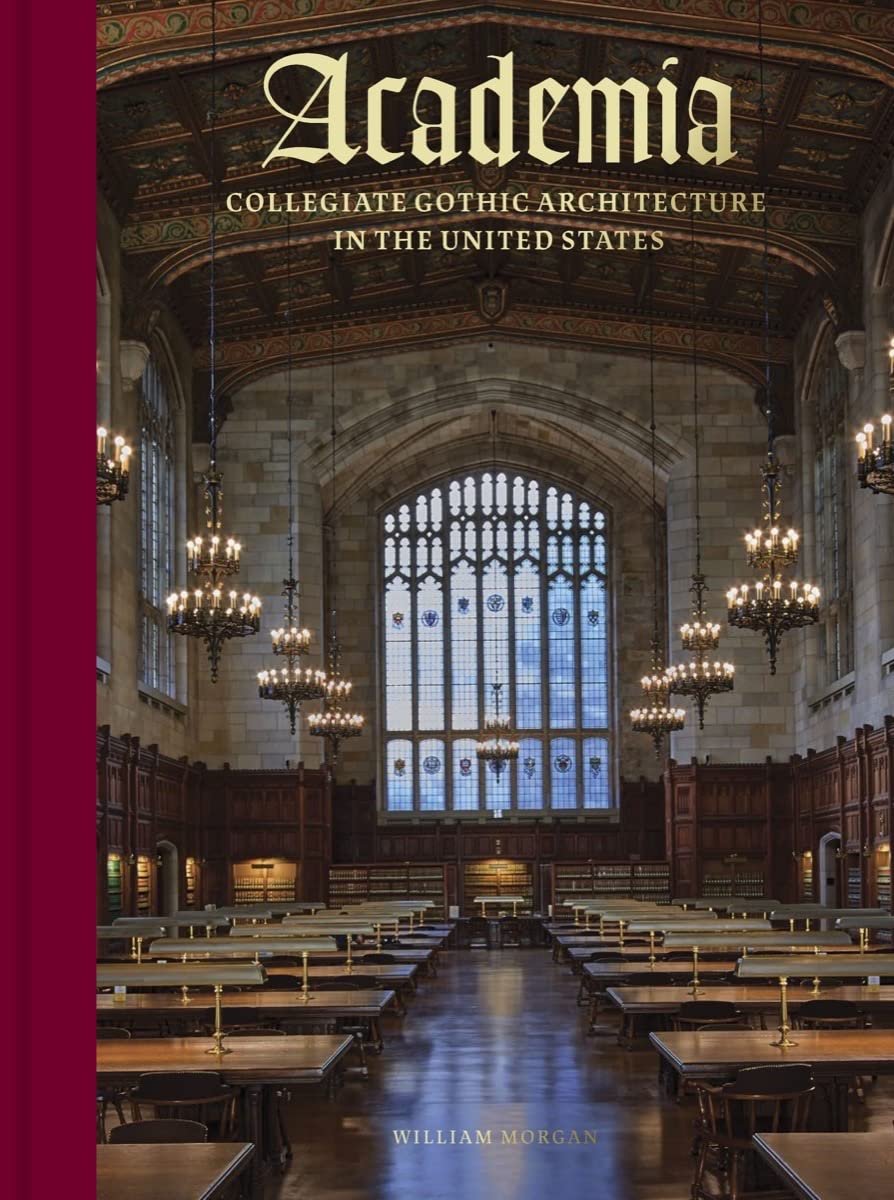
In reading William Morgan’s brilliantly written and gorgeously illustrated new book, Academia – Collegiate Gothic Architecture in the United States, you might recall Winston Churchill’s famous line: “We shape our buildings; thereafter they shape us.’’
I thought of this looking back at an institution I attended, a then-all-boys boarding school in Connecticut called The Taft School, founded by Horace Taft, the brother of President William Howard Taft. Its mostly Collegiate Gothic buildings made some of us students feel we were in a hybrid of a medieval church and a fort. This, I think, encouraged a certain personal rigor and seriousness of purpose, amidst the usual adolescent cynicism and jokiness.
The blurb from the publisher (Abbeville Press) summarizes well the book:
"Academia provides the ultimate campus tour of Collegiate Gothic architecture across the United States, from Princeton and Yale to Duke and the University of Chicago. It tells the surprising story of how the Gothic style of Oxford {whose origins go back to 1096} and Cambridge {founded in 1209} was adapted and transformed in the United States, to lend an air of history to the country’s relatively young college and prep school campuses. And it shows how Collegiate Gothic architecture, which flourished between the Gilded Age and the Roaring Twenties {into the Thirties, too}, continues to define the popular image of the college campus today—and even inspire new construction.’’
The style originally reflected a certain Anglophilia embraced by some American nouveau riche as they accumulated fortunes in a rapidly expanding economy. Rich donors, and the institutional architects they got hired, wanted to create buildings evoking kind of elite, aristocratic culture at certain old Protestant colleges and universities and private boarding schools. (Many of the latter were modeled on English boarding schools catering to the aristocracy.) There was often a lot of snobbery involved. But the style spread to other institutions, too, including businesses and government offices, around the country.
Some of this included fantastical (to the point of silliness) ornamentation and instant aging of stonework to suggest the wear of centuries on what were brand-new buildings, perhaps most flamboyantly at Yale. Get out those gargoyles!
The nearest major Collegiate Gothic campus to Providence is the Jesuits’ beautiful Boston College in Chestnut Hill, just outside of Boston.
Some institutions mostly stuck with the simpler and cheaper Georgian brick style (in New England that includes even mega-rich Harvard and merely rich Dartmouth and Brown) but Collegiate Gothic was a huge thing for decades, and much of it was beautiful. Even today, architects are designing, sometimes ingeniously, new applications of the style.
This book is about much more than architecture. It’s also about personalities, many of them colorful, class, including social climbing, Western civilization, economics, materials, politics and many other things.
One of the book’s joys is Mr. Morgan’s footnotes, which besides adding to the understanding of the main text, are often very entertaining, sometimes even hilarious.
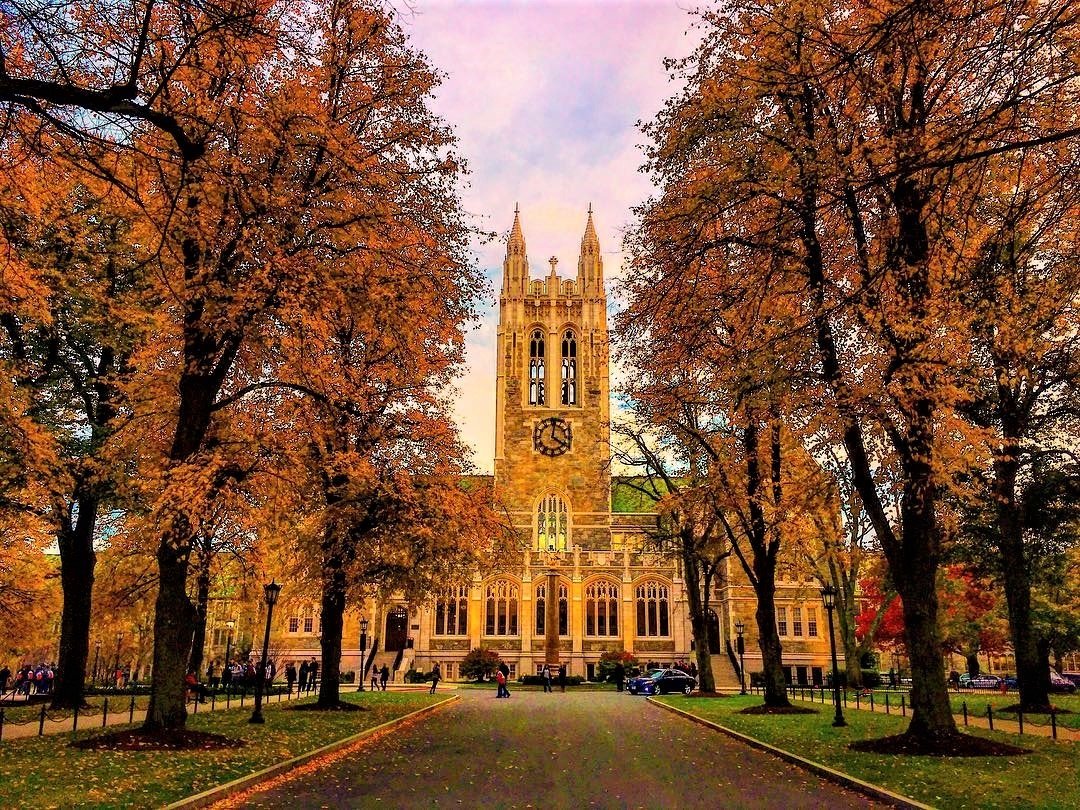
Gasson Hall, at Boston College, in the Chestnut Hill section of Newton, Mass., an example of high Collegiate Gothic architecture
— Photo by BCLicious
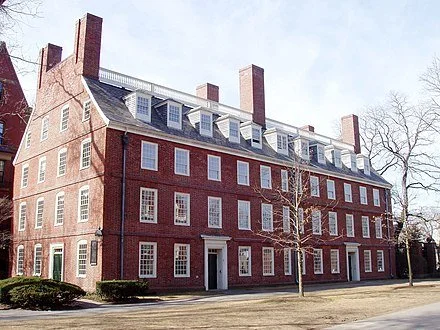
Massachusetts Hall at Harvard University, an example of the sort of Georgian Brick architecture that was the most common alternative on campuses to Collegiate Gothic.
‘Inter-species communication’

“Green Moth Observing Herself” (oil on paper, wire, clay, gouache, mirror), by western Massachusetts-based multimedia artist Ashley Eliza Williams, at MCLA Gallery 51, North Adams, Mass.
Ms. Williams writes:
“I am driven by a deep sense of wonder and curiosity about the non-human world. When I was a child I was extremely shy and I dreamed of being able to express myself with bioluminescence, or by quietly passing information through a network of fungal filaments, instead of with spoken words. These desires evolved into a fascination with alternative languages and non-human methods of connection.
“Today I study the sentience and sensory capabilities of rocks, squids, clouds, and other beings. I aim to weave stories about desire and longing. My work is a series of ‘communication attempts.’ Relationships between paintings and sculptures are inspired by interspecies communication, conversations between living and non-living things, and a desire to mitigate ecological and human loneliness. How fully can we understand a cloud, a tree, or a rock? Can we develop a vocabulary that enables us to do that?’’

Chris Powell: Regulations for social media can’t substitute for parents

—Graphic by Jason Howie
MANCHESTER, Conn.
According to a report issued the other day by Dalio Education, the Connecticut-based philanthropy, thousands of children and young adults in the state are "disconnected" -- uneducated, alienated, unemployed or even unemployable.
Meanwhile, Connecticut Atty. Gen. William Tong had the state join a national lawsuit against Meta, operator of the social-media companies Facebook and Instagram, alleging that thousands more of the state's children are too connected to social media. Instagram particularly, Tong and other attorneys general claim, has grabbed kids with "addictive platforms" that have caused a "youth mental health catastrophe."
The attorneys general assert that this attractiveness to children violates state consumer-protection laws and the federal Children's Online Privacy Protection Act.
But the essential claim of the lawsuits is just that the "platforms" are too interesting to kids. A statement from Tong's office condemns "features like infinite scroll and near-constant alerts," features that "were created with the express goal of hooking young users. These manipulative tactics continually lure children and teens back onto the platform."
But the only new element here is the technology being used in pursuit of an objective, not the objective itself, which is as old as storytelling: gaining and holding on to an audience. That was the objective of troubadors, fairs and theaters, and then newspapers, magazines, radio, and television, long before computers and the internet. Newspapers, magazines, radio and television still sensationalize to grab audiences to sell advertising, just as Facebook and Instagram do, though Facebook and Instagram may do it better because their subjects are the members of their audience themselves.
Kids spent much less time gossiping about each other before the advent of the telephone. Before television they were far less fascinated by violence and guns. Before welfare for childbearing outside marriage they were far better raised and educated and healthier mentally and physically.
Any "addiction" here is not physical, as with drugs, but psychological. People can walk away from Facebook and Instagram if they have something else to do. Indeed, most users of Facebook and Instagram do have other things to do -- like make a living.
It's just the nature of young people to be self-absorbed, neurotic, insecure and idle, more so if they live in homes with little parental supervision and in a society that demands no educational accomplishment from them.
Citing company documents obtained by The Wall Street Journal, the attorneys general cite the indifference of Facebook and Instagram to the neurosis that its "platforms" can induce in children, especially girls. Of course, children probably shouldn't be exposed to some things until they are older, if then. But if Facebook and Instagram are destroying young people, it couldn't happen if their parents didn't provide them with mobile phones and computers that allow internet access to those "platforms."
Attorney General Tong blames Facebook and Instagram for the inability of children to get enough sleep, as if children didn't lose sleep because of other obsessions long before social media. But if some children still aren't getting enough sleep, who should be called to account first? The distractions that interest the kids -- that is, themselves and their friends and acquaintances? Government? What about their parents?
Whether they are "disconnected" or too connected, children need constant attention from parents so they remain engaged with life without becoming alienated, neurotic, self-absorbed and obsessed. Is a government that increasingly throws gambling, marijuana and transgenderism at children, a government that lets just about any danger bypass immigration law and infiltrate the country, really fit to regulate children's use of social media even in their own homes, as the attorneys general suggest?
In the land of the First Amendment, is government really fit to prevent any particular mechanism of expression from reaching young people? If so, how would that be any different from the supposed "book banning" many of the attorneys general oppose?
Or might the country do better in regard to social media, "disconnection," and other troublesome issues if it stopped destroying the family with welfare policy and education with social promotion?
Chris Powell has written about Connecticut government and politics for many years (CPowell@cox.net).
In Conn., coastal beauty while moving, or stuck
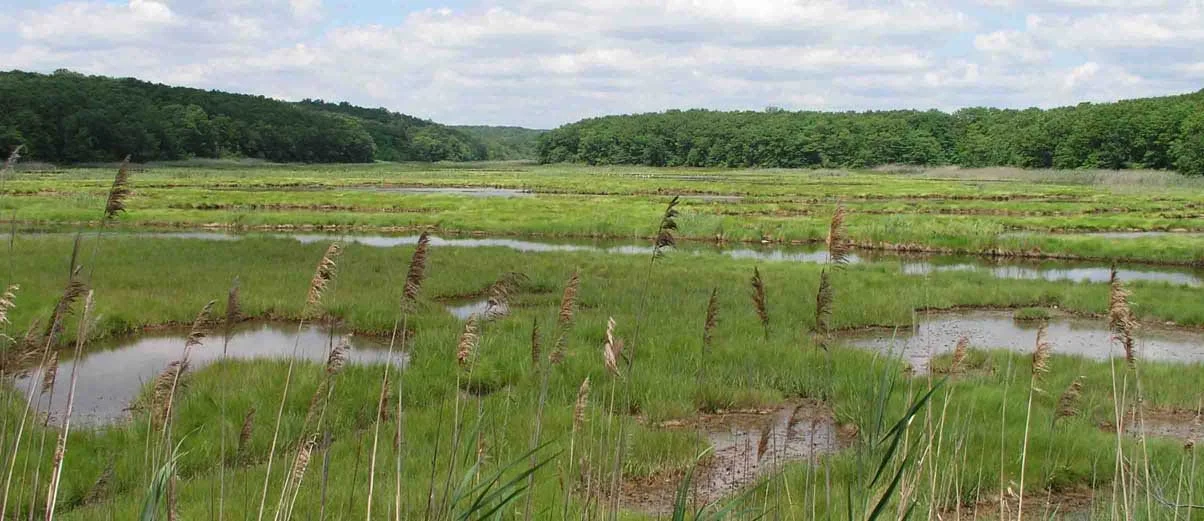
Coastal salt marsh in East Lyme, Conn., along Amtrak’s main Northeast Corridor route.
Adapted from Robert Whitcomb’s “Digital Diary,’’ in GoLocal24.com
I’ve been taking the train from Boston and Providence to New York for almost my whole life but am still mesmerized each trip by the beauty of the marshes along Connecticut’s Long Island Sound – ever changing in color, light, shadow, birds and boats. Lately, it helps offset some of the irritation from Amtrak’s endlessly terrible Internet service. Remember to sit on the Sound side of your train if you want broad water views, but sitting on the other side provides life-filled beauty, too.
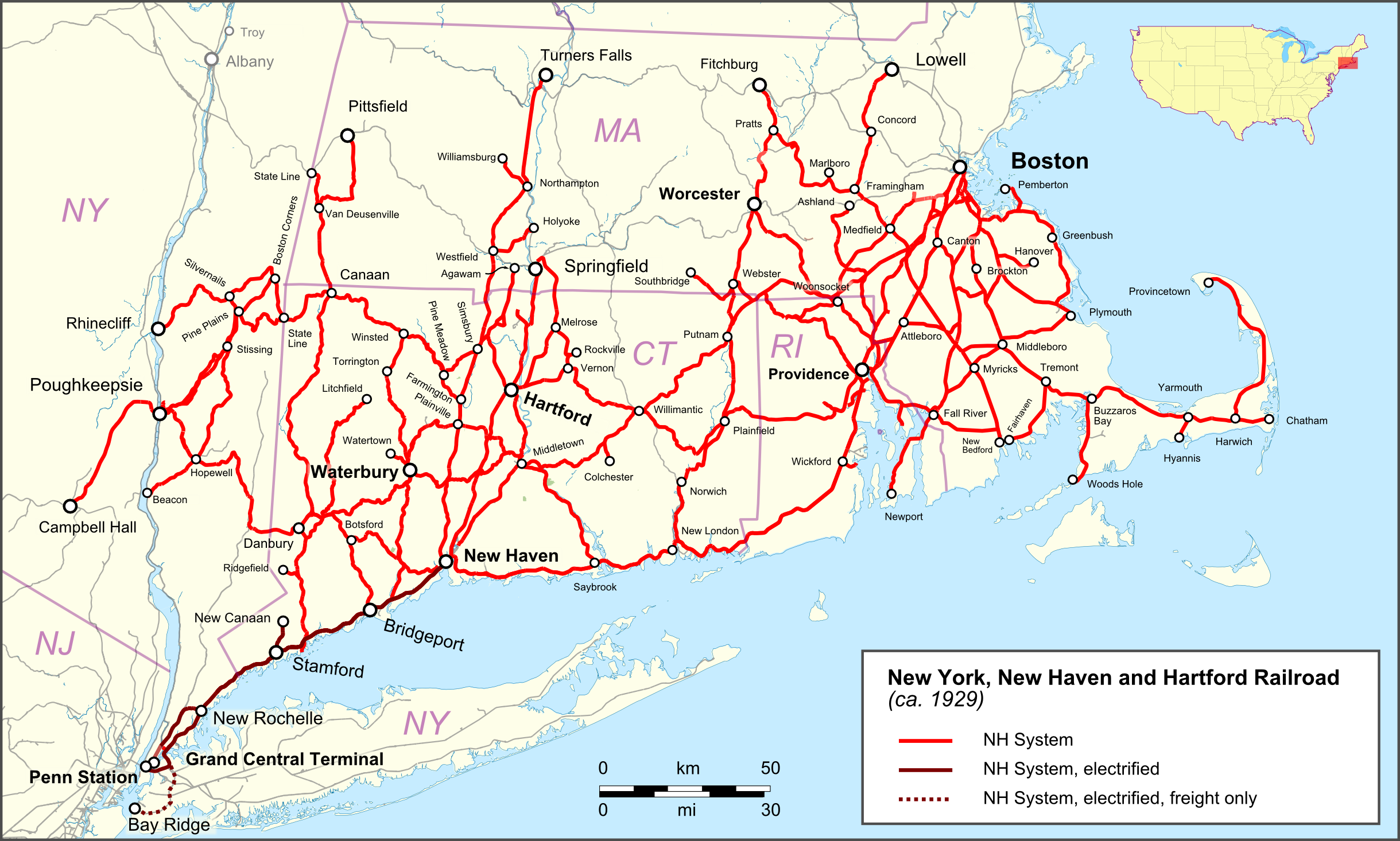
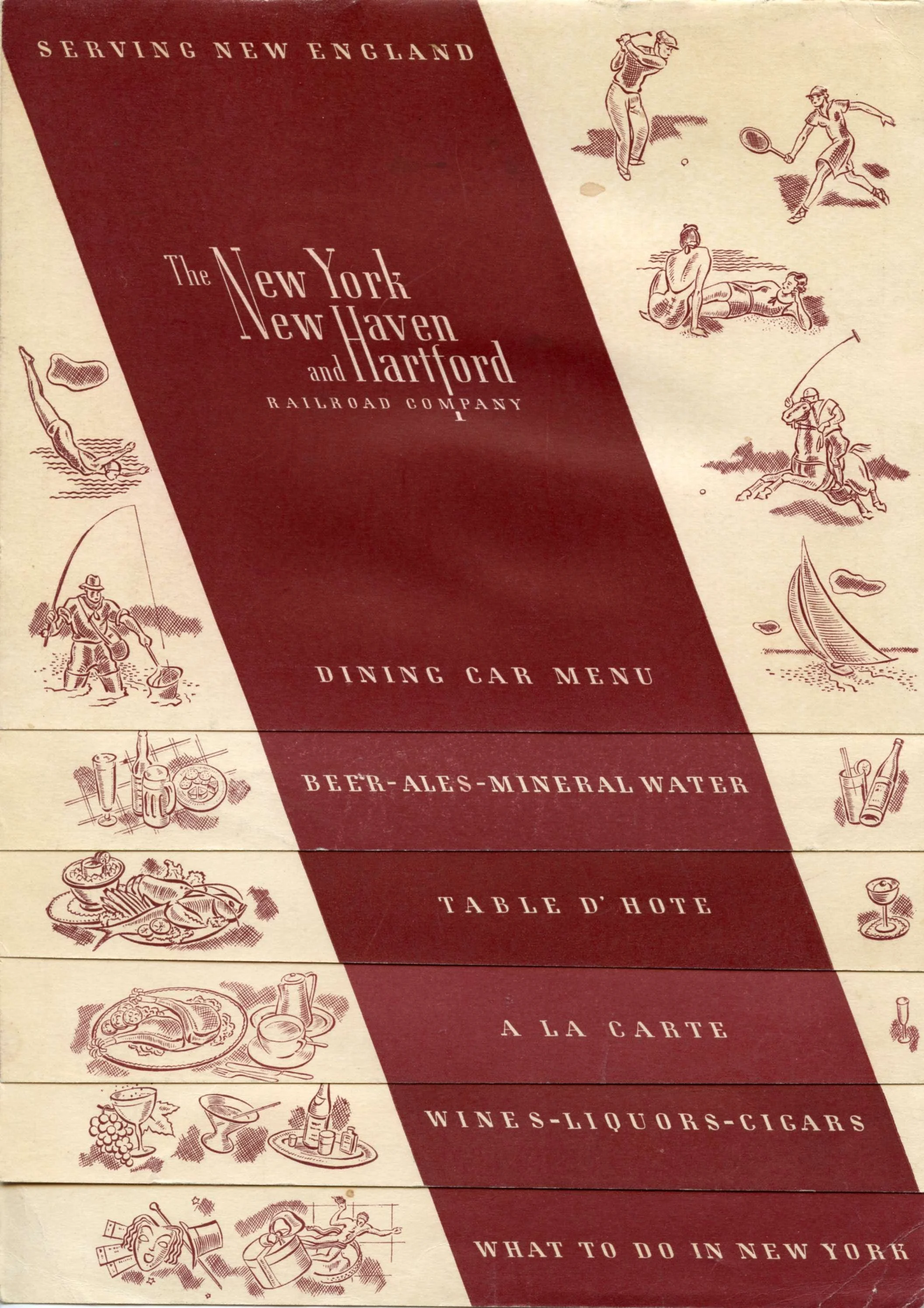
1929 map of New Haven Railroad service. New England Diary’s editor, Robert Whitcomb, frequently took the sometimes-bankrupt New Haven from Boston to New York. Its dining cars had fancier food than Amtrak has..

Llewellyn King: AI’s assault on journalism and many other jobs will intensify

AI robot at Heinz Nixdorf Museum, in Paderborn, Austria
—- Photo by Sergei Magel/HNF

Infographic published by the International Federation of Library Associations and Institutions.
This article is based on remarks the author made to the Association of European Journalists annual congress in Vlore, Albania, last month.
I am a journalist. That means, as it was once explained to me by Dan Raviv, of CBS News, that I try to find out what is going on and tell people. I know no better description than that of the work.
To my mind, there are two kinds of news stories: day-to-day stories and those that stay with us for a long time.
My long-term story has been energy. I started covering it in 1970, and, all these years later, it is still the big story.
Now, that story for me has been joined by another story of huge consequence to all of us, as energy has been since the 1970s. That story is artificial intelligence.
Leon Trotsky is believed to have said, “You may not be interested in war, but war is interested in you.” I say, “You may not be interested in AI, but AI is interested in you.”
Just as the Arab oil embargo of October 1973 upended everything, AI is set to upend everything going forward.
The first impact on journalism will be to truth. With pervasive disinformation, especially emanating from Russia, establishing the veracity of what we read — documents we review, emails we receive — will be harder. The provenance of information will become more difficult to establish.
Then, it is likely that there will be structural changes to our craft. Much of the more routine work will be done by AI — such things as recording sports results and sifting through legal documents. And, if we aren’t careful, AI will be writing stories.
One of the many professors I have interviewed while reporting the AI story is Stuart Russell, at the University of California at Berkeley, who said the first impact will be on “language in and language out.” That means journalism and writing in general, law and lawyering, and education. The written word is vulnerable to being annexed by AI.
The biggest impact on society is going to be on service jobs. The only safe place for employment may be artisan jobs — carpenters, plumbers and electricians.
Already, fast-food chains are looking to eliminate order-takers and cashiers. People not needed, alas.
The AI industry — there is one, and it is growing exponentially —likes to look to automation and say, “But automation added jobs.”
Well, all the evidence is that AI will subtract jobs almost across the board. Think of all the people around the world who work in customer service. Most of that will be done in the future by AI.
When you call the bank, the insurance agency, or the department store, a polite non-person will be helping you. Probably, the help will be more efficient, but it will represent the elimination of all those human beings, often in other countries, who took your orders, checked on your account, helped you decide between options of service, and to whom you reported your problems or, as often, voiced your anger and disappointment.
The AI bot will cluck sympathetically and say something like, “I am sorry to hear that. I will help you if I can, but I must warn you that company policy doesn’t allow for refunds.”
On the upside, research — especially medical research — will be boosted as never before. One researcher told me a baby born today can expect to live to 120 — another big story.
As journalists, we are going to have to continue to find out what is going on and tell people. But we will also have to find new ways of watermarking the truth. Leica, for instance, has come out with a camera that it says can authenticate the place and time that a photo was taken.
We are going to have to find new outlets for our work where people will know that it was written and reported by a human being, one of us, not an algorithm.
Journalists are criticized constantly for our failings, for allegedly being left or right politically, for ignoring or overstating, but when war breaks out, we become heroes.
I salute those brave colleagues reporting from Gaza and Ukraine. They are doing the vital work of finding out what is going on and telling us. Seventeen have been killed in Ukraine and 34 in Gaza. They are the noble of our trade.
On Twitter: @llewellynking2
Llewellyn King is executive producer and host of White House Chronicle, on PBS. He’s based in Rhode Island and Washington, D.C.
‘False binaries’

“Uncontrollable Drifting Inward and Outward Together (130lbs times two)” (gazed stoneware, rocks, hardware), by Brie Ruais, at the Worcester Art Museum.
— Image courtesy of the artist and Abertz Benda, New York | Los Angeles. Photo by Nash Baker.
The artist says:
“I see these as a balancing of opposites, a kind of turning of the cosmic sphere, night and day, sun and moon, dark and light; false binaries that suggest one can be had without the other, but they reaffirm each other, and coexist in balance (with effort).’’

The Star on the Sidewalk, in front of Worcester City Hall, indicates the spot of what is said to be the first reading in New England of the Declaration of Independence, in 1776.
FDR’s New Deal speech in Boston in the 1932 campaign
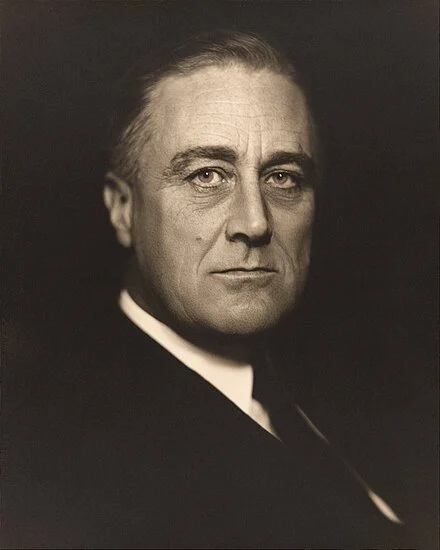
Franklin Roosevelt in the early 30’s. He had graduated from the Groton (Mass.) School and Harvard — thus his localizing remarks in the speech. He won Massachusetts in all four of his presidential campaigns.
Campaign speech by New York Governor and soon to be President Franklin Delano Roosevelt as the Great Depression deepened.
Boston, Massachusetts
October 31, 1932
Governor Ely, Mayor Curley, my friends of Massachusetts:
I am glad that a moment ago I had the privilege of standing under the flag of the Commonwealth of Massachusetts. There is a reason why I am particularly proud and happy of that. It is because, my friends, exactly one-half of me -- my mother's half -- comes from Massachusetts.
This trip to New England, I assure you, has brought back many happy memories. I have had a wonderful day from the early morning when I left the old school which I once attended and, where, I am told, I received some kind of culture, all the way up through Lawrence and Haverhill, and then on through New Hampshire and to Portland, Maine; and then this afternoon, coming back through the cities of Maine, New Hampshire and back into Massachusetts. I am more than ever convinced that those three States that I have visited today are going to be found in the Democratic column on November 8th.
I have met a multitude of old friends, with whom I have been associated in public life for more years than I care to tell you. If I were to start referring to each of them by name, I should have to call the roll of Massachusetts Democracy, and a good many of the Republicans as well. I appreciate the fact that today, a week before the election, we have a united party -- a party which, in securing a great victory on November 8th, will be supported not only by Democrats but by free-spirited Republican and independent voters. My only regret is that I could not have been here last Thursday night when Governor Smith was here. Anyway, the very day that he was here I had a good long talk with him, and I heard about the splendid and deserved welcome you gave him here in Boston.
Other memories, too, have come from far back beyond my earliest political experience. As a boy, I came to this State for education. To that education I look back with open and sincere pride and gratitude.
Then I came and lived not very far from here at a great institution for the freeing of the human mind from ignorance, from bigotry of the mind and the spirit. Knowledge -- that is, education in its true sense -- is our best protection against unreasoning prejudice and panic-making fear, whether engendered by special interests, illiberal minorities, or panic-stricken leaders who seek to perpetuate the power which they have misused.
I hope I have learned the lesson that reason and tolerance have their place in all things; and I want to say frankly that they are never so appropriate as when they prevail in a political campaign.
I say this with some feeling because I express widespread opinion when I note that the dignity of the office of President of the United States has suffered during the past week. The President began this campaign with the same attitude with which he has approached so many of the serious problems of the past three years. He sought to create the impression that there was no campaign going on at all, just as he had sought to create the impression that all was well with the United States, and that there was no depression.
But, my friends, the people of this country spoiled these plans. They demanded that the administration which they placed in power four years ago, and which has cost them so much, give an accounting. They demanded this accounting in no uncertain terms.
This demand of the people has continued until it has become an overwhelming, irresistible drift of public opinion. It is more than a drift. It is a tempest.
As that storm of approval for the Democratic policies has grown, several moods have come over the utterances of the Republican leader.
First, they were plaintively apologetic. Then the next move was indignation at the Congress of the United States. Finally, they have in desperation resorted to the breeding of panic and fear.
At first the President refused to recognize that he was in a contest. But as the people with each succeeding week have responded to our program with enthusiasm, he recognized that we were both candidates. And then, dignity died.
At Indianapolis he spoke of my arguments, misquoting them. But at Indianapolis he went further. He abandoned argument for personalities.
In the presence of a situation like this, I am tempted to reply in kind. But I shall not yield to the temptation to which the President yielded. On the contrary, I reiterate my respect for his person and for his office. But I shall not be deterred even by the President of the United States from the discussion of grave national issues and from submitting to the voters the truth about their national affairs, however unpleasant that truth may be.
The ballot is the indispensable instrument of a free people. It should be the true expression of their will; and it is intolerable that the ballot should be coerced -- whatever the form of coercion, political or economic.
The autocratic will of no man -- be he President, or general, or captain of industry -- shall ever destroy the sacred right of the people themselves to determine for themselves who shall govern them.
An hour ago, before I came to the Arena, I listened in for a few minutes to the first part of the speech of the President in New York tonight. Once more he warned the people against changing -- against a new deal -- stating that it would mean changing the fundamental principles of America, what he called the sound principles that have been so long believed in this country. My friends, my New Deal does not aim to change those principles. It does aim to bring those principles into effect.
Secure in their undying belief in their great tradition and in the sanctity of a free ballot, the people of this country -- the employed, the partially employed and the unemployed, those who are fortunate enough to retain some of the means of economic well-being, and those from whom these cruel conditions have taken everything -- have stood with patience and fortitude in the face of adversity.
There they stand. And they stand peacefully, even when they stand in the breadline. Their complaints are not mingled with threats. They are willing to listen to reason at all times. Throughout this great crisis the stricken army of the unemployed has been patient, law-abiding, orderly, because it is hopeful.
But, the party that claims as its guiding tradition the patient and generous spirit of the immortal Abraham Lincoln, when confronted by an opposition which has given to this nation an orderly and constructive campaign for the past four months, has descended to an outpouring of misstatements, threats and intimidation.
The administration attempts to undermine reason through fear by telling us that the world will come to an end on November 8th if it is not returned to power for four years more. Once more it is a leadership that is bankrupt, not only in ideals but in ideas. It sadly misconceives the good sense and the self-reliance of our people.
These leaders tell us further that, in the event of change, the present administration will be unable to hold in check the economic forces that threaten us in the period between Election Day and inauguration day. They threaten American business and American workers with dire destruction from November to March.
They crack the "whip of fear” over the backs of American voters, not only here but across the seas as well.
Ambassador Mellon, the representative of the United States at the Court of St. James's, an Ambassador who should represent the whole American people there -- every faith, the whole nation, Democrats, Republicans and Independents alike -- appeals to an English audience, on English soil, for the support of a party candidate 3000 miles away and invokes the same sinister threat and seeks to spread that threat to the rest of a civilized world.
I read somewhere in a history book about a Roman Senator who threw himself into a chasm to save his country. These gentlemen who represent us are of a new breed. They are willing to throw their country into a chasm to save themselves.
There is another means of spreading fear -- through certain Republican industrial leaders. I have said, without being controverted, that 5,000 men in effect control American industry. These men, possessed of such great power, carry likewise a great responsibility. It is their duty to use every precaution to see that this power is never used to destroy or to limit the sound public policy of the free and untrammeled exercise of the power of the ballot.
In violation of that duty, some of these 5,000 men who control industry are today invading the sacred political rights of those over whom they have economic power. They are joining in the chorus of fear initiated by the President, by the Ambassador, by the Secretary of the Treasury, and by the Republican National Committee.
They are telling their employees that if they fail to support the administration of President Hoover, such jobs as these employees have will be in danger. Such conduct is un-American and worthy of censure at the ballot box. I wonder how some of those industrial leaders would feel if somebody else's "baby had the measles.” In other words, would they agree that it would be equally reprehensible if any political leader were to seek reprisal against them -- against any coercing employer who used such means against political leaders? Let us fight our political battles with political arguments, and not prey upon men's economic necessities.
After all, their threats are empty gestures. You and I know that their industries have been sliding downhill. You know, and I know, that the whole program of the present administration has been directed only to prevent a further slipping downhill. You know, and I know, that therein lies the difference between the leaderships of the two parties.
You know, and I know, that the Democratic Party is not satisfied merely with arresting the present decline. Of course we will do that to the best of our ability; but we are equally interested in seeking to build up and improve, and to put these industries in a position where their wheels will turn once more, and where opportunity will be given to them to reemploy the millions of workers that they have laid off under the administration of President Hoover.
It is not enough merely to stabilize, to lend money! It is essential to increase purchasing power in order that goods may be sold. There must be people capable of buying goods in order that goods may be manufactured and sold. When that time comes, under our new leadership, these same gentlemen who now make their threats will be found doing business at the old stand as usual.
The American voter, the American working-man and working woman, the mill-worker of New England, the miner of the West, the railroad worker, the farmer, and the white-collar man will answer these silly, spiteful threats with their ballots on November 8th.
As I have pointed out before in this campaign, in a good many States and during many weeks, the fruits of depression, like the fruits of war, are going to be gathered in future generations. It is not the pinch of suffering, the agony of uncertainty that the grown-up people are now feeling that count the most; it is the heritage that our children must anticipate that touches a more vital spot. It is not today alone that counts. Under-nourishment, poor standards of living and inadequate medical care of today will make themselves felt among our children for fifty years to come….
It is the same for you -- workers in industry and in business. There are none of us who do not hope that our children can get a better break than we have had, that the chance for an education, for a reasonable start in life, may be passed on to our children, an opportunity for them built out of the hard work of our own hands. We want them to have opportunity for profitable character building -- decent, wholesome living -- good work, and good play. We want to know somehow that, while perfection does not come in this world, we do try to make things better for one generation to another….
Against this enemy every ounce of effort and every necessary penny of wealth must be raised as a defense. It is not that we lack the knowledge of what to do. The tragedy of the past years has been the failure of those who were responsible to translate high-sounding plans into practical action. There's the rub.
The present leadership in Washington stands convicted, not because it did not have the means to plan, but fundamentally because it did not have the will to do. That is why the American people on November 8th will register their firm conviction that this administration has utterly and entirely failed to meet the great emergency.
The American people are heart-sick people for "hope deferred maketh the heart sick.”
xxx
Now, my friends, we are considering unemployment tonight, and I am going to start by setting forth the positive policy which the President's Commission under the leadership of the Secretary of Commerce urged should be done. There is a lot of it which is still good.
It was a 5-point program. And as a program it was good.
First, it urged that government should reduce expenditures for public works during periods of prosperity, and that, during those periods, government should build up reserves with which to increase expenditures during periods of unemployment and industrial depression. But was that done? Not one penny's worth. No reserves were built up for the rainy day.
Second, the report said that the Federal Government should work with the railroads in the preparation of a long-time constructive program. Was that done? No. The Republican Administration did not give effect to this proposal. Instead of working with the railroads, to consolidate their lines and put them on a sound economical basis, the administration waited until the depression had laid them low, and then had nothing for them except to loan them more money, when they were already heavily in debt.
Third, the report proposed the setting up of safeguards against too rapid inflation, and consequently too rapid deflation of bank credit. As I have shown, the President and his Secretary of the Treasury went to the other extreme and encouraged speculation.
Fourth, the report recommended an adequate system of unemployment insurance. No one in the administration in Washington has assumed any leadership in order to bring about positive action by the States to make this unemployment insurance a reality. Someday, in our leadership, we are going to get it.
Fifth, it suggested an adequate system of public employment offices. But when Senator Wagner introduced a bill to establish Federal employment offices, President Hoover vetoed the measure that Secretary Herbert Hoover had sponsored. It seems to me, speaking in this great section of the country where there are so many business men, that business men who believe in sound planning and action, must feel that there is danger to the country in the continuance of a leadership that has shown such incapacity, such ineptitude, such heedlessness of common sense and of sound business principles. What we need in Washington is less fact finding and more thinking.
Immediate relief of the unemployed is the immediate need of the hour. No mere emergency measures of relief are adequate. We must do all we can. We have emergency measures but we know that our goal, our unremitting objective, must be to secure not temporary employment but the permanence of employment to the workers of America. Without long-range stability of employment for our workers, without a balanced economy between agriculture and industry, there can be no healthy national life.
We have two problems: first, to meet the immediate distress; second, to build up a basis of permanent employment.
As to "immediate relief,” the first principle is that this nation, this national government, if you like, owes a positive duty that no citizen shall be permitted to starve. That means that while the immediate responsibility for relief rests, or course, with local, public and private charity, in so far as these are inadequate the States must carry on the burden, and whenever the States themselves are unable adequately to do so the Federal Government owes the positive duty of stepping into the breach.
It is worth while noting that from that disastrous time of 1929 on the present Republican Administration took a definite position against the recognition of that principle. It was only because of the insistence of the Congress of the United States and the unmistakable voice of the people of the United States that the President yielded and approved the National Relief Bill this summer.
In addition to providing emergency relief, the Federal Government should and must provide temporary work wherever that is possible. You and I know that in the national forests, on flood prevention, and on the development of waterway projects that have already been authorized and planned but not yet executed, tens of thousands, and even hundreds of thousands of our unemployed citizens can be given at least temporary employment.
Third, the Federal Government should expedite the actual construction of public works already authorized. The country would be horrified if it knew how little construction work authorized by the last Congress and approved by the President has actually been undertaken on this date, the 31st of October. And I state to you the simple fact that much of the work for which congress has given authority will not be under way and giving employment to people until sometime next summer.
Finally, in that larger field that looks further ahead, we call for a coordinated system of employment exchanges, the advance planning of public works, and unemployment reserves. Who, then, is to carry on these measures and see them through? The first, employment exchanges, is clearly and inescapably a task of the Federal Government, although it will require the loyal and intelligent cooperation of State and local agencies throughout the land. To that Federal action I pledge my administration. The second, the advance planning of public works, again calls for a strong lead on the part of the government at Washington. I pledge my administration to the adoption of that principle, both as to enterprises of the Federal Government itself and as to construction within the several States which is made possible by Federal aid; and I shall urge upon State and local authorities throughout the nation that they follow this example in Washington. The third, unemployment reserves, must under our system of government be primarily the responsibility of the several States. That, the Democratic platform, on which I stand, makes entirely clear.
In addition to all this, there has been long overdue a reduction of the hours of work and a reduction of the number of working days per week. After all, the greatest justification of modern industry is the lessening of the toil of men and women. These fruits will be dead fruits unless men earn enough so that they can buy the things that are produced, so that they can have the leisure for the cultivation of body, mind and spirit, which the great inventions are supposed to make possible. That means that government itself must set an example in the case of its own employees. It means also that government must exert its persuasive leadership to induce industry to do likewise.
Here then is a program of long-range planning which requires prompt and definite action and the cooperation of Federal and State and local governments, as well as of forward-looking citizens of both parties throughout the land. The proposals are specific, they are far-reaching. To advocate a less drastic program would be to misread the lessons of the depression and to express indifference to the country's future welfare.
There is one final objective of my policy which is more vital and more basic than all else. I seek to restore the purchasing power of the American people. The return of that purchasing power, and only that, will put America back to work.
We need to restore our trade with the world. Under Republican leadership we have lost it, and the President of the United States seems to be indifferent about finding it again.
And now I am going to talk to a city audience about farming. I do not make one kind of speech to a farm audience and another kind of speech to a city audience. We need to give to fifty million people, who live directly or indirectly on agriculture, a price for their products in excess of the cost of production. You know how and why that affects us in the cities. To give them an adequate price for their products means to give them the buying power necessary to start your mills and mines to work to supply their needs. Fifty million people cannot buy your goods, because they cannot get a fair price for their products. You are poor because they are poor.
I favor -- and do not let the false statements of my opponents deceive you -- continued protection for American agriculture as well as American industry. I favor more than that. I advocate, and will continue to advocate, measures to give the farmer an added benefit, called a tariff benefit, to make the tariff effective on his products. What good does a 42-cent tariff on wheat mean to the farmer when he is getting 30 cents a bushel on his farm? That is a joke. The most enlightened of modern American businessmen likewise favor such a tariff benefit for agriculture. An excellent example is your own fellow Bostonian, Mr. Harriman, President of the Chamber of Commerce of the United States, who has recently proclaimed a plan for the restoration of agriculture not unlike my own.
The President of the United States does not favor a program of that kind, or, so far as I can make out, of any practical kind. He has closed the door of hope to American agriculture, and when he did that, he closed the door of hope to you also.
He says proudly that he has effectively restricted immigration in order to protect American labor. I favor that; but I might add that in the enforcement of the immigration laws too many abuses against individual families have been revealed time and time again.
But when the President speaks to you, he does not tell you that by permitting agriculture to fall into ruin millions of workers from the farms have crowded into our cities. These men have added to unemployment. They are here because agriculture is prostrate. A restored agriculture will check this migration from the farm. It will keep these farmers happily, successfully, at home; and it will leave more jobs for you. It will provide a market for your products, and that is the key to national economic restoration.
One word more. I have spoken of getting things done. The way we get things done under our form of government is through joint action by the President and the Congress. The two branches of government must cooperate if we are to move forward. That is necessary under our constitution, and I believe in our constitutional form of government.
But the President of the United States cannot get action from the Congress. He seems unable to cooperate. He quarreled with a Republican Congress and he quarreled with a half Republican Congress. He will quarrel with any kind of Congress, and he cannot get things done.
That is something that the voters have considered and are considering and are going to remember one week from tomorrow. You and I know, and it is certainly a fact, that the next Congress will be Democratic. I look forward to cooperating with it. I am confident that I can get things done through cooperation because for four years I have had to work with a Republican Legislature in New York.
I have been able to get things done in Albany by treating the Republican members of the Legislature like human beings and as my associates in government. I have said that I look forward to the most pleasant relations with the next Democratic Congress, but in addition to that let me make it clear that on that great majority of national problems which ought not to be handled in any partisan manner, I confidently expect to have pleasant relations with Republicans in the Senate and the House of Representatives as well as with Democrats.
After the fourth of March, we -- meaning thereby the President and the members of both parties in the Halls of Congress -- will, I am confident, work together effectively for the restoration of American economic life.
I decline to accept present conditions as inevitable or beyond control. I decline to stop at saying, "It might have been worse.” I shall do all that I can to prevent it from being worse but -- and here is the clear difference between the President and myself -- I go on to pledge action to make things better.
The United States of America has the capacity to make things better. The nation wants to make things better. The nation prays for the leadership of action that will make things better. That will be shown in every State in the Union -- all 48 of them -- a week from tomorrow. We are through with "Delay” we are through with "Despair”; we are ready, and waiting for better things.
Swimming amidst sculptures

From Caroline Bagenal’s exhibition “Swimming Sculptures’’ at Boston Sculptors Gallery, Nov. 9-Dec. 16.
The gallery says:
The show “comprises sculpture, embroidered photographs and video based on her experience of swimming in tidal rivers and lakes. With her uncanny sculptures attached to her body, Bagenal takes to the water and swims with them, activating and transforming the work as it marks the movements of her body and the water’s currents.”
“The swimming sculptures are made from recycled woven plastic, bubble wrap and other materials that float. They derive in part from the artist’s embroidered photographs, which function as part of her creative process—a kind of drawing with thread which she uses to imagine future sculptures.’’