
Vox clamantis in deserto





JFK on challenges to the New England economy in 1956
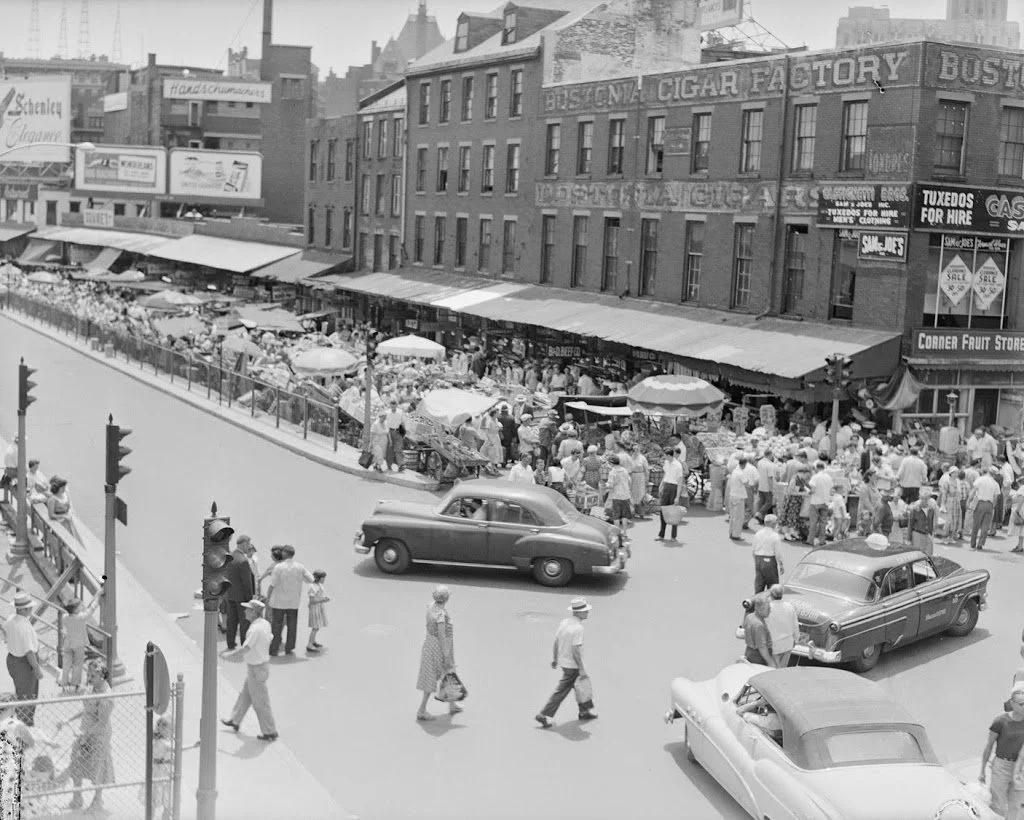
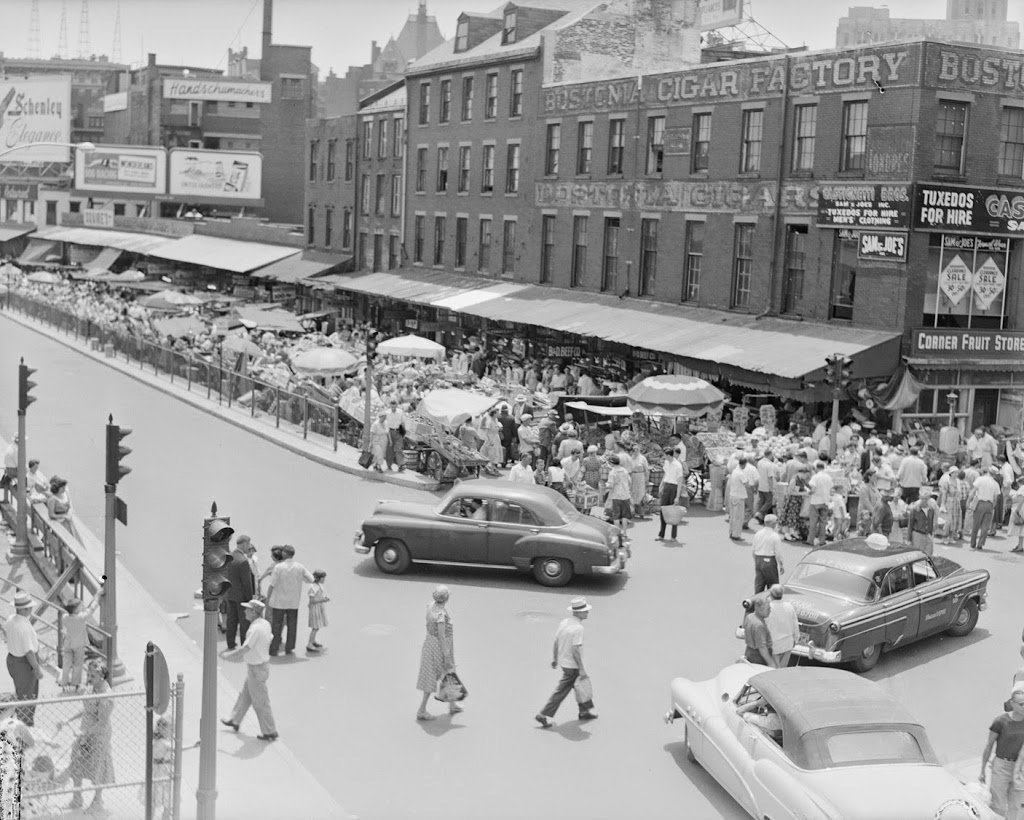
The corner of Blackstone Street and Hanover Street, Boston, in 1956.
—- From Boston Public Library, Leslie Jones Collection
Remarks by U.S. Sen. John F. Kennedy on Oct. 19, 1956
I would like to talk to you at this time about our own economic situation here at home, in this state and in this region – about some of the progress we have made and some of the problems we face. I realize that there are still some in New England who refuse to recognize that a United States Senator, or the Federal Government, has any responsibility in this area. Certainly it is true that no Federal program could ever solve all the problems of the New England economy without action on the state and local level – and particularly without assistance from private organizations, industry and individuals. No bill which you may request Senator {Leverett} Saltonstall {R.-Mass.} or myself to introduce will ever replace community leadership and community spirit as the essential ingredients for maintaining or rebuilding our economic prosperity. No set of Federal subsidies or controls can ever replace responsible attitudes by labor and management, improved educational and scientific achievements, and, above all else, the faith in New England which must be shared and practiced by New Englanders themselves.
However, the proper role of the Federal Government cannot be denied – not in the expenditure of large Federal grants, in the establishment of new bureaucracies, or in special advantages for our area which are contrary to the national interest or discriminate against the needs of other areas – but in obtaining attention on a national level to problems, industries, and communities that are essential to the well-being of the entire country. In many ways, as I have told the Senate on several occasions, the problems of New England are national problems – and we can no longer attempt to solve those problems on a local level only, pouring our tax funds into the economic development of other regions without receiving from the Congress fair consideration of our own needs.
It is not my intention today to prophesy doom and depression. I do not share the exaggerated views of those pessimists who have been talking about the decline of New England for the past thirty years. We are still, in terms of per- capita income and standard of living, one of the more prosperous areas of the country. Our financial institutions have a higher proportion of assets, our workers a higher take-home pay and our families more savings accounts, life insurance, telephones and television sets than their counterparts in any similar area on earth. We have many assets no other region can match – an energetic climate and an intelligent citizenry – world famous educational institutions and industrial research laboratories –- the nation's best record of harmonious industrial relations – and excellent access to capital investment, skilled manpower, new plant sites, and markets.
In addition, we have that all-important factor of unity – the twelve Senators from the New England region meet regularly to further their joint consideration and action on the common needs of our area; our delegations in the House of Representatives, and our Governors in their own six-state conference, provide similar cooperation. In short, New England is not a backward region, an undeveloped area or in the throes of a depression – and we have every reason to be optimistic and little reason to complain.
But at the same time, if we are to continue to move ahead, if we are to take a realistic inventory of our assets and liabilities, we must speak very frankly with respect to the real problems which threaten our prosperity, which have damaged the economic welfare of many of our citizens, and which require action on the Federal level. New England is the oldest regional civilization and economy in the United States – and we must be aware of the ills and problems of old age. We must prevent the dreaded diseases of economic arteriosclerosis and senescence from weakening our cities and industries – and we must attack them promptly and effectively whenever and wherever they occur.
These problems are aggravated by our lack of industrial raw materials – we have no oil, no coal, no huge resource of water power. Our fuel costs are high – and so are our freight and other transportation costs. What resources we do have, such as fisheries and forests, are being depleted. Along with all of the advantages of economic maturity – industrialization, leadership, and the other advantages already mentioned – we witness also the handicaps of old age: the development of markets, industries, and the center of population in other parts of the country – a failure to keep pace with other regions in terms of long-range economic growth, population, and per capita income – and a dependence in too many communities and industries upon the outmoded methods, machinery, and management of the past. The outlook, I repeat, does not call for a gloomy attitude of despair and helplessness – but it does call for action.
The New England Economy Today
Permit me to translate this general statement of our position into the specific facts that confront us today. Our great hope in recent years has been the development of new industries attracted to our state – a new diversification of our economy which it has needed for so many years – a new strength which was gained regretfully only by the loss of our so-called soft goods (such as textiles and leather) which made pools of manpower and plants available. These new industries have increased per capita income in Massachusetts, offset unemployment, and maintained a degree of economic stability we could not otherwise have expected. The dynamic, rapidly growing electronics industry, for example, has been responsible for 20% of the new manufacturing jobs in this region since 1939 and last year spent over $50 million in Massachusetts alone on new plants and equipment.
I have never supported the view that Massachusetts should favor new industry over the old – that we should forget about such old friends as textiles and regard their decline as a blessing. For new industries do not always employ the same people or move into the same locality. The encouraging statistics they present for the state as a whole are likely to conceal individual suffering in Lawrence, Lowell, Fall River, New Bedford, Gardner, Worcester, and most recently in Springfield, Pittsfield, and the western part of the state. Our efforts, in short, must be directed at retaining the old as well as attracting the new. I am happy to say that there is every indication that the movement of our industry to the South and west has passed its peak.
But many economists have been bothered by the question as to what would happen here in Massachusetts when a nationwide economic re-adjustment affected these new durable goods industries. I am very much afraid that their fears are being borne out today. New England lost nearly one hundred thousand manufacturing jobs last year. To be sure, a large part of this decline is due to our still seriously harassed textile industry, which lost more than 23,000 jobs. But employment declined by more than 51,000 workers in our New England durable goods industries – including electrical machinery, metal industries, and other types of machine shops. These are ominous trends which we must make every effort to reverse.
There is every indication that the United States faces an economic recession and that it will be felt more deeply here in Massachusetts than in some other parts of the country. Last year the average work week in this state fell below 40 hours a week. The average weekly earnings of our industrial workers actually declined. We lost some 43,000 manufacturing jobs, nearly half of them in durable goods industries.
Federal Action To Date
With this brief review of our economic situation in mind, recognizing the bright spots as well as the dark, I would like to turn again to the role of the Federal Government concerning these matters and the responsibilities which those of us whom you send to Washington must assume. Much of the progress which I have reported has stemmed directly or indirectly from action on the Federal level – and many of the problems which I have cited still require attention by Congress or the Administration.
To review for a moment our progress thus far, permit me to express my gratification at our achievements to date and my gratitude for the cooperation of our Senior Senator, our House delegation and the other members of our New England delegation – for that cooperation and teamwork, without resort to partisanship, have been largely responsible for those achievements. A new minimum wage and a reinvigoration of the Walsh-Healey Public Contracts Act have helped reduce drastically the wage differentials between New England industries and their Southern competitors. A voluntary quota on Japanese cotton textile exports, a new increase in the tariff on woolen textiles and a greater recognition of New England's higher quality product in the Geneva tariff negotiations have, I am convinced, prevented our traditionally largest industry from going completely down the drain. Meanwhile, we have safeguarded the cost to our mills of raw wool through the new Wool Act, new restrictions on speculation, and the prevention of higher tariff duties.
In our commercial fisheries, the achievements already made possible by the Saltonstall-Kennedy Fishing Research and Market Development Bill, tariff recognition of our new Fish Sticks industry, and a $10 million loan fund have all helped keep a struggling industry on its feet. Our shipbuilders have finally received more contracts and a new Congressional program; our watchmakers received at least a part of the tariff protection they needed; our electric companies received permission and help to build the new Yankee Atomic Power plant; and a new steel mill for New England, a new port pier for Boston, new air service, a new attack on gypsy moths, and new compacts on flood control and higher education have all been among our projects in Washington in recent years. And of both direct and indirect benefit to our region's economy is the record share of Federal funds for hurricane and flood control protection we have finally secured.
This is but a partial listing – all of you whose votes, support and cooperation helped make it all possible may take pride in this record - but this is no time to rest our oars. For weak spots and danger signs remain – our program of needs has not yet been completed – and complacency now could undermine all our earlier gains.
A Program for Federal Action
Many of our current problems are largely state, local, or private in nature – such as the fiscal predicament and tax rates of our municipalities, the adequacy of our rail and other transportation, and the rate of plant investment and modernization. Other problems we face are difficult to solve with a strictly New England approach – such as the aircraft and general defense cutbacks, the twin evils of tight money and inflation, and general weaknesses in our national credit-inflated economy.
But I would respectfully suggest to you at this time ten areas of Federal action on which we in New England might concentrate in this session of Congress – ten items I might review for you now in only the briefest fashion.
First, the economy of our entire state and region would receive a shot in the arm if we could eliminate the rail freight rate differentials that discriminate against Port of Boston traffic in favor of South Atlantic Ocean cargoes. After an initial setback in an earlier case involving only iron ore, we have succeeded in reopening the entire question in hearings now being conducted before the ICC. Success will bring new business to our port and railroads, new jobs and purchasing power for our state – and above all an end to an outmoded, inequitable handicap to our area's growth, a handicap that was originally imposed as a balance to our natural advantage in ocean freight rates and which continues now years after that advantage has been taken from us.
Secondly, our hopes for the future are closely tied to the development of low cost, competitive atomic power, bringing new energy to our industries, new industries to our state and new benefits to our people. Already we are seeking additional private nuclear projects, a large share of those planned for the entire nation – and our leadership in research and development in this field will someday cut our electric bills, our dependence on fossil fuels and our current disadvantage in competing with low-cost power regions of the South, Northwest, and elsewhere.
Third, the nature of our business community, more dependent upon small business than any other region, makes essential to our well-being a revision of Federal small business policies – particularly its tax structure and credit programs. Tight money, high interest and credit restriction policies have hit the smaller businessman much harder than they have his larger competitor, who has access to other sources of capital for modernization and expansion. A more selective credit policy which permits expansion of certain segments of the economy and with greater credit available from the Small Business Administration, is needed. Present tax laws also unnecessarily discriminate against small businessmen by not permitting the accumulation of earnings which normally would be plowed back into their businesses – also giving an unfair advantage to larger producers who have greater access to equity capital markets. We shall try again to secure passage of the Internal Revenue Code Amendment which recognizes the different needs and status of small business without any loss of net revenue.
Fourth, we must prevent any undue restriction on a maximum flow of oil imports into New England. Our businessmen and home-owners are dependent in large measure upon oil from Venezuela and other nations. We cannot afford to pay further price increases, to be restricted to domestic oil, or to convert to coal. Yet those are the ultimate objectives of those now pushing for further limitations on these imports – and the Administration's present program to restrict crude oil imports bears our most careful and constant attention.
Fifth and Sixth on our agenda are two related needs of our still vital textile industry – import protection and cheaper raw cotton. The new restrictions on woolen and on Japanese cotton textile imports which I previously mentioned must be watched, maintained and strengthened – and additional measures sought as needed. We must particularly concern ourselves with imports produced with our own surplus cotton sold abroad at cut-rate prices, under a farm program that at the same time artificially increases its cost to our own mills. Fortunately both cotton farmers and processors are now nearing agreement on a solution comparable to that earlier provided for wool –and I am hopeful that this issue will receive major attention in this Congress.
Seventh, we must continue to provide appropriate action on certain needs of our fishing industry which that industry cannot be expected to meet on its own – including the financing of vessel construction, loans to processing plants and the promulgation of vessel and individual insurance. We cannot imagine New England without its fishing fleet, its bustling fish piers and markets, its traditions of the sea – but they will require action, not veneration, in view of their current problems of price and import competition.
Eighth and Ninth, finally, involve problems of unemployment – a program of realistic aid to our labor surplus areas; and nation-wide standards of unemployment benefits, to eliminate any tax disadvantages suffered by a high-standard state like Massachusetts that acts on these problems with a social conscience and a heart. We are all too familiar in this state with the problems of communities suffering from a chronic labor surplus – the one-industry towns, the former textile towns, and others – but we have as yet failed to get effective action by either Congress or the Administration to help those communities, their businessmen and their workers help themselves to a better future.
There are no magic solutions in this list – no quick and easy answers – no way to avoid the hard burdens which our state and local governments, and all our citizens, must bear. But there, at any rate, is a program for action on the Federal level: action to meet the economic problems that confront us, action to secure a better life for every Massachusetts businessman, worker and his family. I know the members of this organization will join with me in seeking such action, to do more for Massachusetts, to build a better state and nation, and to enable ourselves and our children to look forward to the future with confidence and with hope.
Very low key

“Discourse” (oil on panel), by Boston-based Armenian-American artist Masha Keryan, at the Copley Society of Art, Boston.
He takes the long view

“Giraffe” (colored pencil), by Jacquelyn Glum, at the Attleboro (Mass.) Arts Museum.
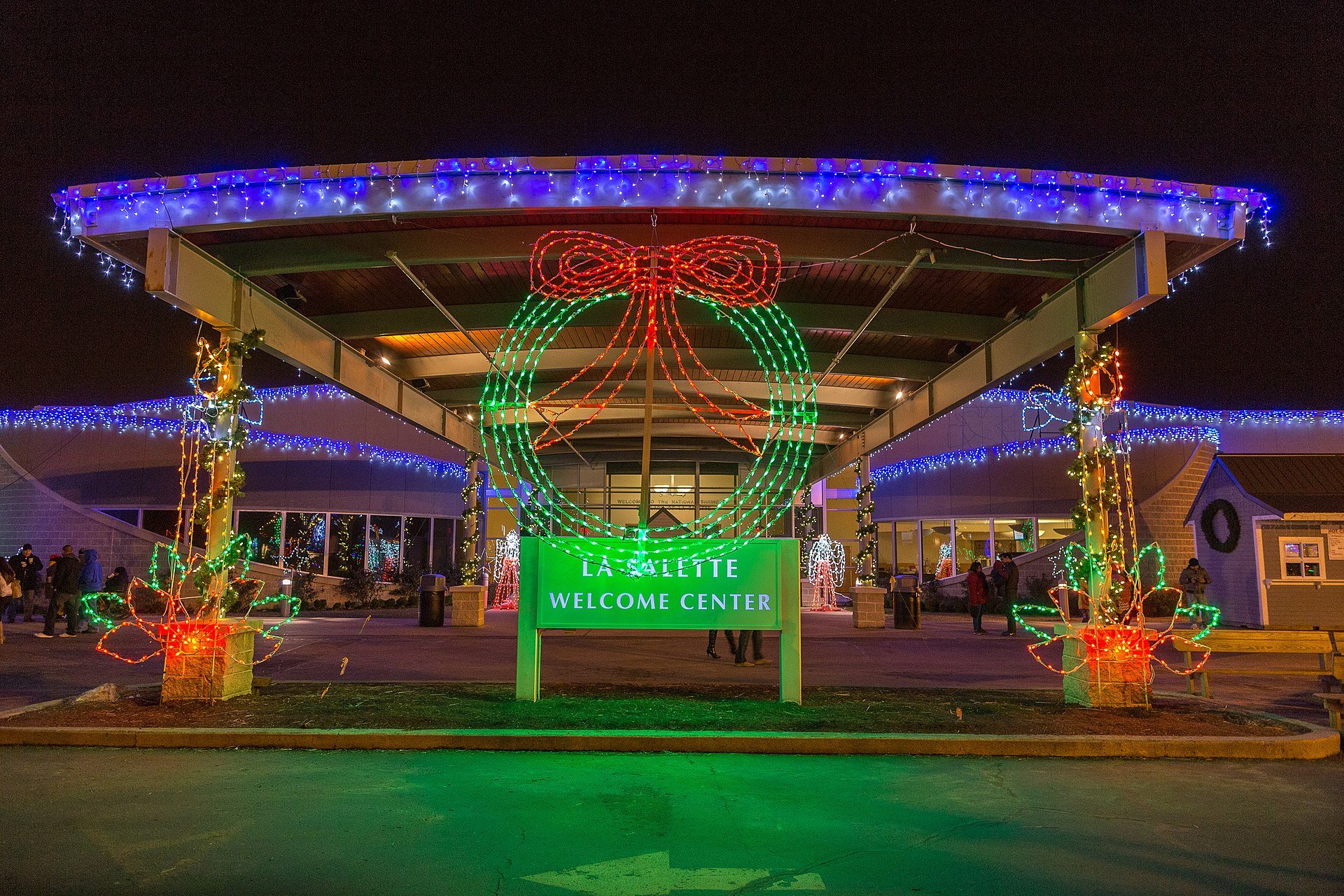
La Salette Shrine is an Attleboro tourist destination best known for its holiday light displays.
— Photo by Kenneth C. Zirkel

Mitchell Zimmerman: Next GOP/QAnon stop: Cut Social Security
From OtherWords.org
With their speaker circus over, the party now threatens to crash the economy unless they can slash your benefits.
Now that the Republican Party has suspended its internal chaos long enough to elect a speaker, Republicans face a challenge.
Leading party members are eager to use their new majority in the House of Representatives to trash two programs conservatives have long detested: Social Security and Medicare. But Republicans control only one house of Congress, and only by a slim margin, and slashing Social Security and Medicare benefits is wildly unpopular.
Even three-quarters of those who voted for Republicans for Congress last year are against cutting benefits, as well as similar majorities of Democrats and Independents. In fact, 83 percent of Americans support increasing Social Security benefits — including 84 percent of Republicans! And big, bipartisan majorities want to tax the rich to do it.
The GOP is determined to go the other way.
South Carolina Republican Sen. Lindsey Graham wants seniors to “take a little less” and “pay a little more in” for Social Security, and Republican policy makers want to increase the retirement age to 70.
Given how unpopular the idea is, a direct legislative attack on benefits is destined to go nowhere. Instead, the Republican strategy is indirect: to hold the government itself hostage.
Extremist House Republicans now say they will refuse to increase the nation’s “debt limit” this year — causing a government shutdown, a default on our debts, and a global economic calamity — unless Social Security and Medicare benefits are slashed.
The credit and debt evaluator Moody’s says a default would trigger a recession wiping out 6 million jobs and erasing $15 trillion in household wealth.
The GOP scheme spits in voters’ faces. In polling, virtually no Americans want the debt limit to be tied to cutting Social Security and Medicare. Indeed, over two-thirds of Republican voters say they favor increasing the debt limit increase without such cuts.
Republican excuses for attacking these programs are that Social Security is going bankrupt and that the country cannot afford more debt.
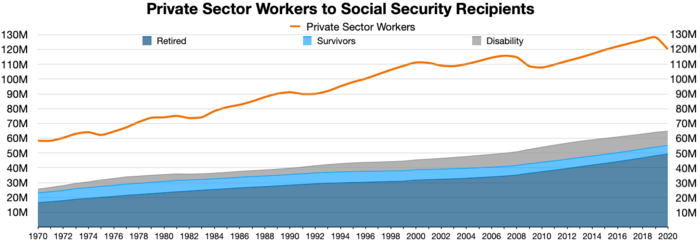
It is true there’s a shortfall in income going into the government’s Social Security trust account. But the fix doesn’t have to rely on slashing benefits.
The causes of the shortfall include the aging of America’s population and the rise in economic inequality. The distribution of income has shifted in the last 50 years, and the share of the very rich has grown. Since Social Security limits how much of a person’s income is subject to Social Security taxes to $147,000, the rich escape taxes on most of their income, limiting revenues.
Eliminating the cap would reportedly eliminate three-quarters of the Social Security funding shortfall. But since Republicans wish above all to protect the wealth of the rich, they are prepared to ignore the preference of three-quarters of Americans, including their own voters.
The second claimed excuse, the size of the national debt, is also meritless. The national debt has grown under every presidential administration since Herbert Hoover in 1928, but there’s no reason to conclude it is more than we can afford. Our debt is among the highest-rated and safest in the world — unless Republicans destroy our credit for political reasons.
Refusing to pay what is already lawfully owed because it exceeds an arbitrary “limit” is no answer. Failing to raise the debt limit means cheating those who, in good faith, bought government bonds or sold things to our government. The economic effects would be devastating.
Why would Republicans use a back-door tactic with such risks to force through cuts opposed by giant majorities of their own supporters?
Their determination to defund Social Security and Medicare appears to rest on the “principle” that the government should do nothing to benefit ordinary people — and that the wealth of the ultra-rich must be protected at all costs.
Mitchell Zimmerman is a lawyer, novelist and longtime social activist.

From P-Town, Robert Cray in a ‘lodestar’ show; looking at the Portland Gale

DJ Braintree Jim has returned to the airwaves this month on Provincetown, Mass.-based radio station WOMR with special one-hour shows. He calls these shorts "lodestar" shows or offshoots of his full-fledged Chill & Dream program.
"Most vinyl records play between 40 and 45 minutes," Braintree Jim observes. "So, they fit nicely into a 60-minute show, along with some concise commentary and station announcements." He said he enjoys these shows as they let him showcase a single artist or a notable album that otherwise "wasn't given their due."
His next show, tonight (Jan. 11) from 8 p.m. to 9 p.m., will feature the work of singer, songwriter, blues guitarist and five-time Grammy award winner Robert Cray, commemorating the 40th anniversary release of his breakthrough album "Bad Influence." (Cray's next area appearance is on Feb. 28, at the Narrows Center for the Arts, Fall River, Mass.)
Braintree Jim surmises that "Robert Cray is such an ineffably engaging singer that it is easy to forget how protean and important a musician he is to the blues. He revitalized the idiom and modernized it, especially in the 1980s with the advent of music video. Nearly 70, he hasn't lost that unique voice nor his guitar chops. 'Bad Influence' is one of his earliest albums, and you can just hear the potential in it. The album was the spark that lit the fuse to greater success. Cray is also a study of endurance. The first Robert Cray Band started playing almost 50 years ago. I think for many people in my generation he made the blues fun and accessible. That's no easy feat!"
The DJ is also putting together special shows for 2023. One show he has planned for this spring is with local author Don Wilding. His new book Cape Cod and the Portland Gale of 1898 will be published in May. The Thanksgiving weekend storm is remembered as one of the deadliest weather events in New England maritime history. The story centers on the doomed steamer S.S. Portland, and also recounts the devastation wrought by the storm along the Massachusetts shore, particularly Provincetown Harbor.
As Braintree Jim says, "I am really excited to do a show with Don. He is such a font of local history and storytelling. I'm already thinking of ideas for the appropriate soundtrack."
Speaking of storms, the east end of Provincetown on Commercial Street, where the WOMR studios are located, is still recovering from the powerful winter storm that hit the area right before Christmas. Fifty decks were destroyed and Fanizzi's Restaurant by the Sea had to be closed for repairs after waves breached the waterfront dining room near high tide on Dec. 23. The full extent of the property damage is still to be determined, according to town officials.
You can live stream programming on womr.org and now on the new WOMR app. All music shows are archived on both platforms for two weeks from airdate for music shows, and in perpetuity for spoken word shows. The broadcast signal can be reached on 91.3 - FM Orleans, Mass., and 92.1 - FM Provincetown, Mass. And to learn more about Braintree Jim, go to chillanddreamradio.com

The doomed steamer The Portland
Llewellyn King: Get ready for blackouts and brownouts in the great energy transition

Electricity-transmission line in western Connecticut — a common scene in New England’s wooded areas.
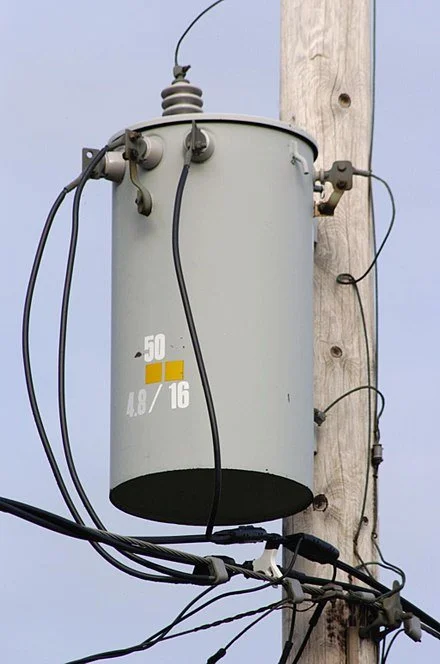
Pole transformer. There’s a shortage of these things.
A perfect storm is gathering over the electric utility industry in the United States. It may break this year, next year or the year after, but break it will.
That is the consensus from utility executives I have been talking to over the past month. Several issues together amount to a clear danger of widespread blackouts and brownouts in the coming years. They come under the rubric of “transition.”
There are, in fact, two transitions stretching the electric utility industry. One is the climate imperative to turn from fossil fuels, primarily coal and natural gas with a smidgeon of oil, to renewables, almost totally wind and solar.
The U.S. Energy Information Administration reckons that electricity from solar and wind will rise this year to 26 percent from 24 percent of national electricity, and that natural gas, the workhorse of the generation mix, will fall to 36 percent from 38 percent.The balance is dwindling coal use at 19 percent, and nuclear, hydro and geothermal generation making up the rest.
That leaves a significant need for new renewable generation: That is the first transition. It isn’t going as fast as the environmental lobby, or the Biden administration, would like, nor even as fast as the utilities would like. It has been substantially crimped by the supply chain tangle.
The American Public Power Association and the National Rural Electric Cooperative Association have been vocal about the shortage of pole transformers. The supply has dried up. Without transformers, new hookups are impossible and old ones are threatened if the transformers fail. The waiting list for something as simple as a bucket truck is three years.
Recent legislation has poured money at an unprecedented rate into the development of renewables, but none of it will help in the short term. It is a case of trying to force more of something into a bladder that is expanding too slowly and that can’t expand faster because of multiple restraints. A utility executive told me that the money is, if anything, making matters worse.
One of the things most concerning to the utilities is the fate of natural gas, both for its availability and price. Gas remains the principal go-to fuel for utilities. Many regard gas as a storage system even if they aren’t burning it to generate power daily.
Gas is special because it is relatively clean, it can be stored, and it can be installed in a short time at many locations. It doesn’t require trains, as does coal, and it works in any weather if the plants have been properly weatherized. Also, gas is very efficient to burn, so more of it can be transformed into electricity through so-called combined-cycle plants. It beats coal and nuclear hands down on the simplicity of the infrastructure it needs. Its efficiency is rated at about 64 percent versus 32 percent, or thereabouts, for coal.
Many utility executives believe that gas should be the primary way we store energy. They advocate maintaining a robust gas infrastructure so that it can come online quickly when needed and can run for as long as needed, unlike batteries.
But national gas policy is confusing. We want gas to be sent to Europe but not piped to New England, which may have an electricity deficit this winter, if not the next.
The second transition, working in tandem with the first, is electrification.
The United States is already headed toward a totally electrified transportation system, but heavy industry, like steel and cement, is also switching to electricity. Demand is showing the first signs of explosive growth. By 2050, demand will have more than doubled, according to many surveys.
While that alone is destabilizing, there is a wild card: the new unpredictable weather behavior.
This winter so far, we have had floods in California, freezing in Texas, tornadoes in the Midwest, and record snowfall in Buffalo. Add this to the other variables in electricity delivery, and you have a very troubling picture with such things as attacks on substations, cyberattacks and that pesky supply chain.
My advice: Keep spare batteries handy and a good supply of canned food. If you are sitting in the dark, you don’t want to be hungry.
On Twitter: @llewellynking2
Llewellyn King is executive producer and host of White House Chronicle, on PBS. He based in Rhode Island and Washington, D.C.
James T. Brett: Omnibus federal bill advances some key New England programs

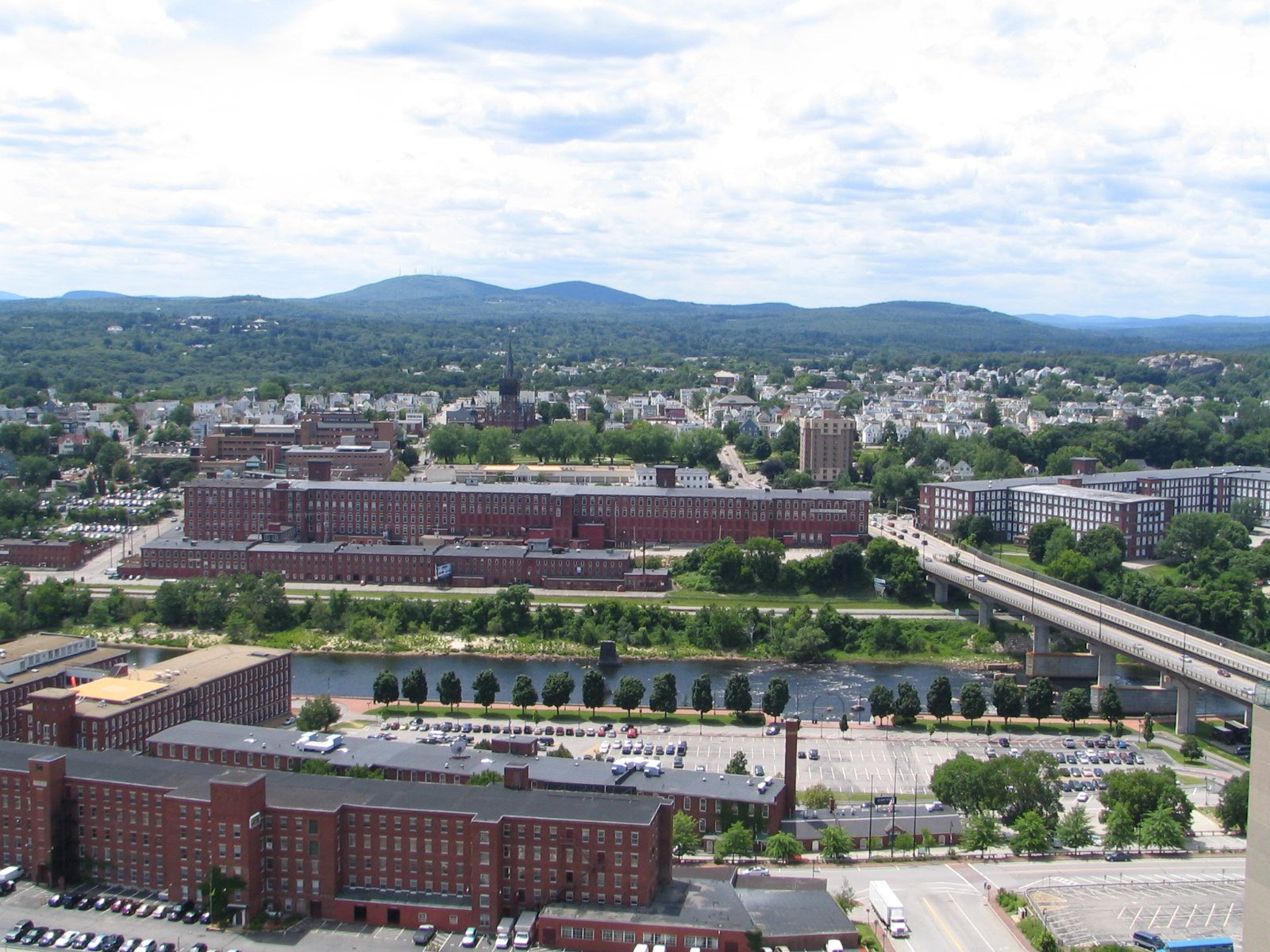
Manchester, N.H., with its old textile mills along the Merrimack River converted to other uses, such as technology and health care.
BOSTON
In the final days of the 117th Congress, just a few weeks ago, Congress passed a $1.7 trillion Omnibus Appropriations Bill for fiscal 2023, and President Biden signed it into law on Dec. 29. Included in this sweeping legislation are landmark investments in education, health care protecting our environment, supporting working families and investing in research and innovation. The New England Council – the nation’s oldest regional business association – was pleased to see many of our longtime priorities included, and we believe that this legislation will help drive our region’s continued economic growth.
Here are a few of the biggest wins for New England in the bill:
Increased Pell Grant – The Pell Grant is a key tool to expanding access to higher education, providing support for low-income students to attend college. The council has long supported increasing the maximum Pell Grant amount – in fact, we have advocated doubling the maximum grant. While the omnibus did not go so far as to double Pell, it did increase the maximum award by $500, to $7,395, for the 2023-2024 school year, marking the largest increase since the 2009-2010 school year. This boost is a step in the right direction toward making college more affordable for millions of students and preparing the workforce of the future.
Federal Research Funding – New England is home to some of the top research institutions, including world-class universities and hospitals. These facilities conduct research on some of the most pressing medical and scientific challenges facing our nation. As such, the council has long supported federal investments in research, and so we were pleased that the bill included $47.5 billion for the National Institutes of Health (NIH)—a 5.6 percent increase—as well as an historic 12 percent increase for the National Science Foundation (NSF), to $9.9 billion. These investments will undoubtedly spur medical and scientific breakthroughs in our region, while supporting thousands of jobs at our research facilities.
Mental Health & Substance Abuse – The need for increased mental-health and substance-abuse services is one of the biggest health challenges facing our region, and the nation at large. The demand for services has only surged in recent years as the pandemic has presented new challenges for those who struggle with mental health and addiction. Fortunately, the spending bill included billions of dollars for new and increased services, including $1.01 billion for Mental Health Block Grants, $385 million for Certified Community Behavioral Health Clinics, and $1.6 billion to states to address the opioid-misuse epidemic through the State Opioid Response Grant. These funds will help expand much-needed services in our communities and set millions of people on the path toward recovery.
Energy Efficiency & Renewable Energy – The New England region is a leader in efforts to decrease carbon emissions and develop renewable-energy resources. The spending bill included a number of measures that will support this effort and help create new jobs in the clean-energy sector. The $3.46 billion appropriated in the bill for Energy Efficiency and Renewable Energy—a $260 million increase over the previous fiscal year—will allow for investments in vehicle technologies, hydrogen research and development, weatherization-assistance programs and renewable-grid integration, as well as marine, wind, and solar energy.
Retirement Savings – Finally, the spending bill also includes a number of provisions aimed at bolstering retirement savings and ensuring a secure financial future for millions of American workers. The bill included a legislative package championed by the dean of the New England House delegation, U.S. Rep. Richard Neal (D.-Mass.), known as SECURE 2.0. Specifically, the bill will expand access to retirement- savings-plan enrollment, allow emergency withdrawal from plans, increase the opportunity to make catch-up contributions, and support workers paying off student-loan debt, just to name a few. Inclusion of these provisions will undoubtedly help U.S. workers better prepare for their futures.
Beyond these provisions, the spending bill also includes investments to bolster working families, expand access to affordable housing, and support our law enforcement, military and veterans. The New England Council is grateful to our region’s congressional delegation for its members’ efforts to advocate for our region’s priorities in this important piece of legislation. We have no doubt that our region’s economy will benefit from the important investments this bill makes in the year ahead.
James T. Brett is the president & CEO of The New England Council, a Boston-based regional alliance of businesses, non-profit organizations,including and health and educational institution,s dedicated to supporting economic growth and the quality of life in New England.

Flag of the New England Governors Conference.
Art from memories

Mixed media, encaustic work by Boston area artist Veronique Latimer in the group show “New Year, New Work,’’ at 6 Bridges Gallery, Maynard, Mass, through Feb. 11. Ms.. Latimer enjoys creating art out of memories of childhood and mementos from the more distant past. Maynard is an old factory town that’s now a Boston suburb.
— Photo courtesy 6 Bridges Gallery

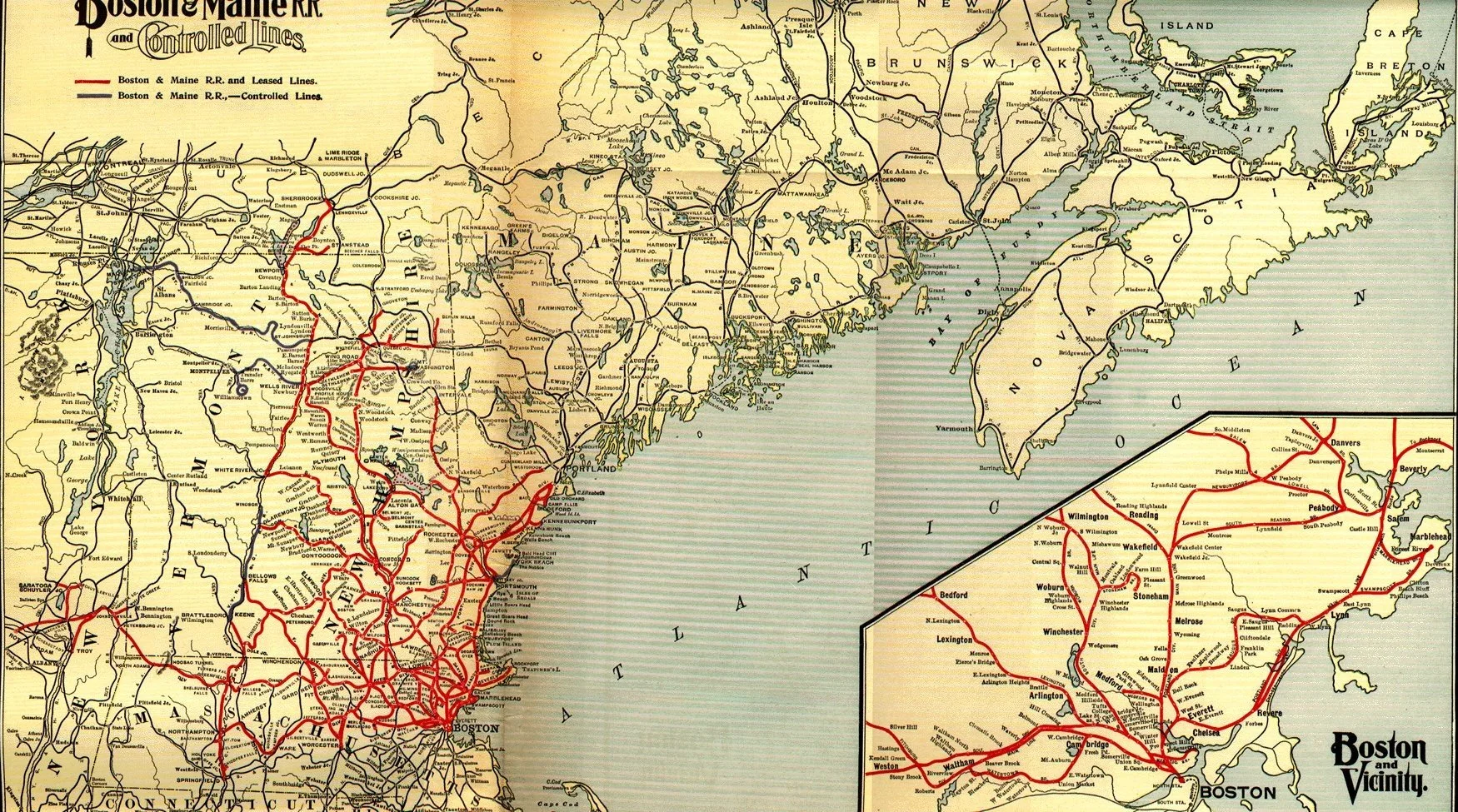
Making tracks to depravity
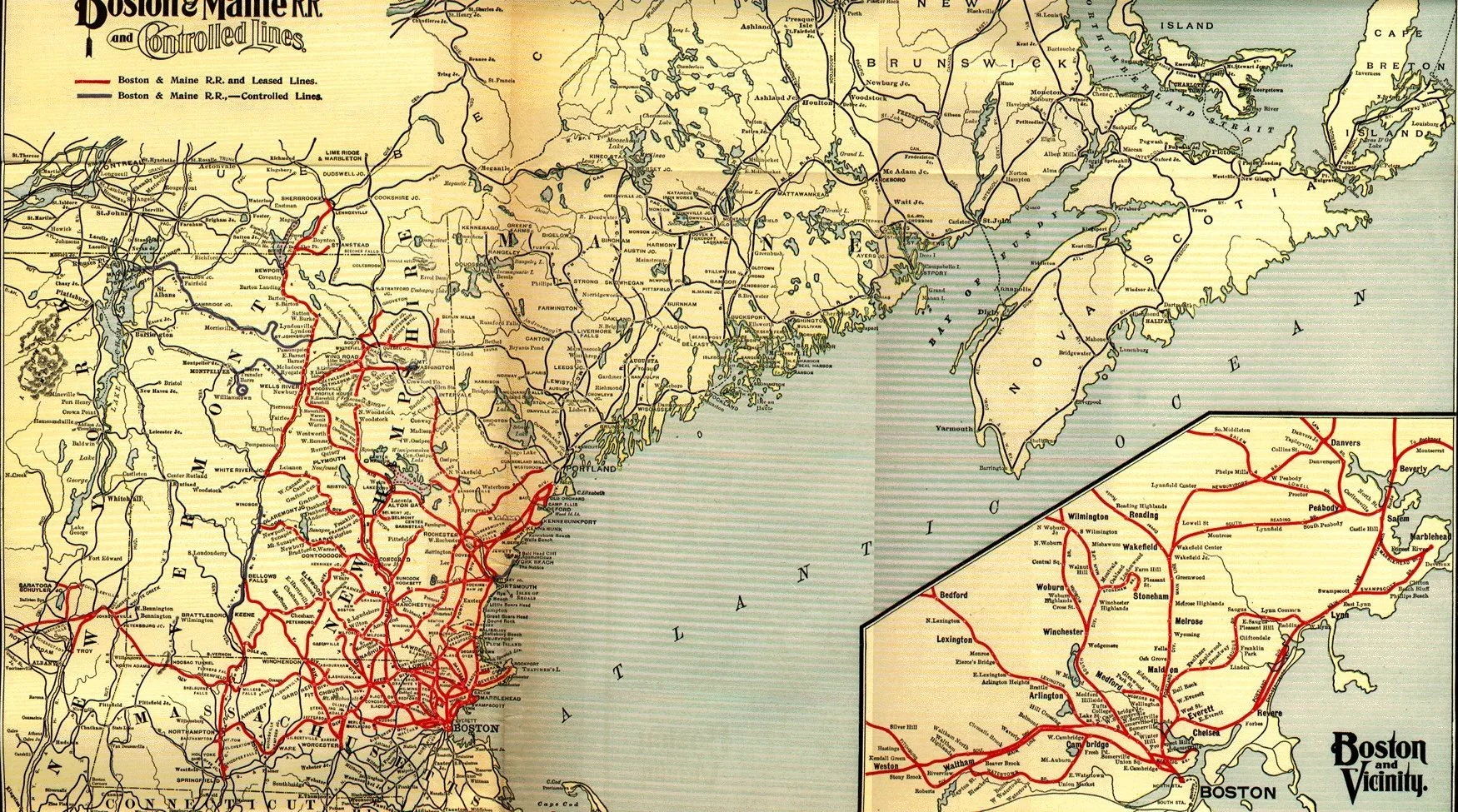
1916 map
“In my Aunt Martha’s day, to grow up in Gravesend {N.H.} was to understand that Boston was a city of sin. And even though my mother had stayed in a highly approved and chaperoned women’s residential hotel, she had managed to have ‘fling,’’ as Aunt Martha called it, with {a) man she’d met on the Boston & Maine {Railroad}.’’
— From the novel A Prayer for Owen Meany (1989), by John Irving (born in 1942 in Exeter, N.H.)
Unfriendly kingdom

Snowy owl
“How far did she fly to find
this pristine town on the edge of winter?
Crows have set up their kingdom—
a yacking flock louder than traffic
maims the morning air….
“Call the owl
sadness, the one who watches
from the other side.’’
— From “The Owl,’’ by Cleopatra Mathis (born 1947), American poet and a professor of English at Dartmouth College. She lives in Thetford, Vt.

United Church of Thetford
— Photo by Doug Kerr
‘Visionary Boston’
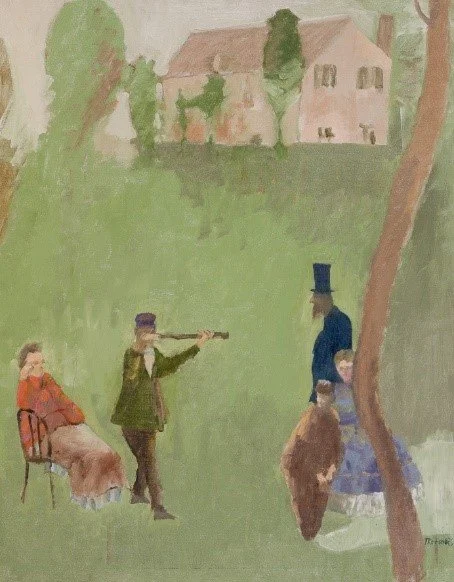
“Through a Glass Slightly” (1979), by the late Stephen Trefonides, in the show “Visionary Boston”, at the Danforth Art Museum, Framingham, Mass., Feb. 18-June 4.
The museum says:
“In the mid-twentieth century, one would not have described Boston as the center of the art world. However, despite a decades long struggle with modernism and with Abstract Expressionism gaining ground in New York, a parallel but distinct movement was stirring in New England. The relationships that flourished between painters, sculptors and photographers mid-century resulted in creative output that has shaped contemporary art in Boston into the twenty-first century.”
Useful and dangerous
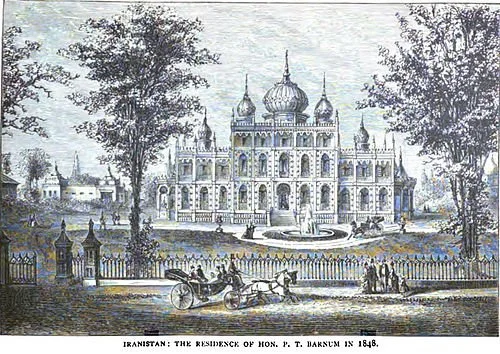
Iranistan was a Moorish Revival mansion in Bridgeport commissioned by P. T. Barnum in 1848. The grandiose structure survived only a decade before being destroyed by fire in 1857.
“Money is in some respects life's fire: It is a very excellent servant, but a terrible master.’’
— Phineas Taylor (P.T.) Barnum (1810-1891) an American showman, businessman and politician (most notably as mayor of his hometown, Bridgeport, Conn., and as a state legislator) remembered for promoting celebrated hoaxes and co-founding the Barnum & Bailey Circus (1871–2017) with James Anthony Bailey. He was also an author, publisher and philanthropist, though he said of himself: "I am a showman by profession ... and all the gilding shall make nothing else of me.’’ He is widely credited with the adage "There's a sucker born every minute,’’ although no evidence has been found confirming that he said this.
But not for exterior use

“Gloucester Linens” (acrylic on marine canvas), by Barbara Aparo, at the Cape Ann Museum, Gloucester, Mass.

The noted Shingle Style Essex Town Hall and Public Library, in Essex, Mass. (1894), designed by Frank W. Weston.
Don Pesci: Of manners, moral duties and the death penalty in Conn.
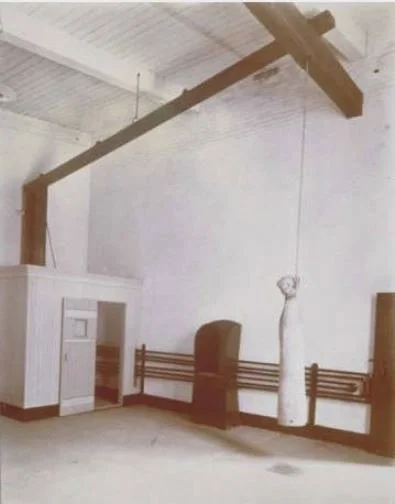
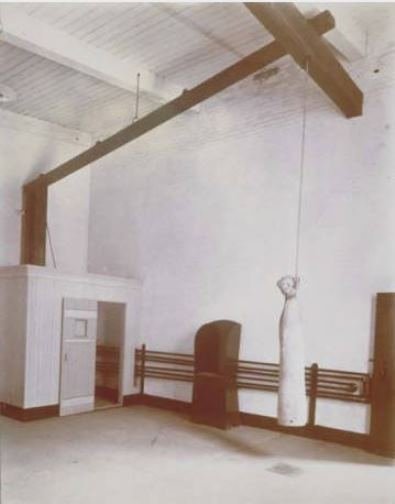
Execution room, Connecticut State Prison, Wethersfield
– Connecticut Historical Society and Connecticut History Online
VERNON, Conn.
“The problem with bad manners,” the late conservative Republican writer (and Connecticut resident) William F. Buckley Jr. told us “is that they sometimes lead to murder.”
No scholar in Connecticut has yet produced a study showing a correlation between bad manners and murderers once on Connecticut’s death row, abolished several years back by a well-mannered state Supreme Court. Scholars and prison records and even the personal testaments of prisoners have led us to believe that prisons, as a general rule, are schools of bad behavior.
One of the prisoners set free from death row by Connecticut’s overly compassionate state Supreme Court in 2015 was Frankie “The Razor” Resto, a candidate for a death penalty and an ill-mannered character.
The abolition of the death penalty in Connecticut was a three-step process. In 2012, Connecticut’s House of Representatives voted to repeal capital punishment for future cases, choosing to leave past death sentences in place. The Connecticut Senate had already voted for the bill, later found unconstitutional by the same state Supreme Court that had found the death penalty unconstitutional, and on April 25 it was signed into law by then Gov. Dannel Malloy. In the same year, the state Supreme Court, unsurprisingly, ruled that applying the death penalty only for past cases was unconstitutional, and capital punishment in Connecticut was promptly shown the door.
Resto, who burned his mattress while in prison and dealt in drugs, was called “The Razor” because he was known for shaking down drug dealers on the street with a straight edge razor. He was paroled early owing to a newly created program, separate from the usual parole process, devised by a former co-chair of the state House Judiciary Committee, Mike Lawlor, then a prison czar appointed to the newly created position by former Gov. Dannel Malloy, that awarded “get out of prison early credits” to deserving prisoners.
Immediately following his early release from prison, Resto easily acquired a gun, despite Connecticut’s stringent gun laws, and held up an Easymart store in Meriden, Conn.
When the co-owner of the store handed over the cash, Resto shot and killed him, without so much as a “thank you very much.” This is not the kind of well-mannered behavior one expects of Errol Flynn’s Robin Hood.
When I attended high school way back in the early ‘60’s, honorifics were very much in vogue. We addressed teachers as Mr., Mrs. and Miss. The fear that, caught out in some deplorable indiscretion, intelligence might be shared with our parents made us toe a straight line, at least in school. In the close-knit world of the neighborhood, eyes were everywhere and police far less necessary than they are in this post-modern period. Boys loved, respected and feared their fathers.
When my father asked me at the supper table, “How did your day go?” he knew beforehand exactly how my day had gone, particularly if it was spotted with delinquencies I had overlooked. No one in the family ever thought of lying to him, whether the lies were black or white lies.
“You know,” he told me once – and only once – “if you lie, your word will never be trustworthy.”
All manners are related to moral obligations, and all moral obligations, Immanuel Kant tells us, are related to duties – not convenient private moral codes. This whole system of Kantian morality – enforced by fathers and mothers in intact family structures and aunts and uncles and sometimes nosey and mischievous neighbors -- has collapsed in the post-modern period. Morality is now related to power and force.
My wife, Andrée, legally blind since birth, was among the first visually impaired persons to teach in public schools in Connecticut. Getting there was a fierce battle. Today, more than four decades after she had left teaching, she still receives notes from some of her grateful students, all bearing the same moral stamp – “You were the toughest teacher I ever had, but thanks to you...” and here followed a series of personal accomplishments.
Andrée’s most memorable teacher was an accomplished Jesuit priest who taught a course in aesthetics at Fairfield University, where she had gone to acquire her master’s degree in American Studies, in order to convince then Gov. John Dempsey that, having graduated at the top of her college class, and having taught with distinction for three years in two separate Catholic schools, and having appeared with special notice in Who’s Who in American Colleges and Universities, and having now acquired her master’s, with honors, in a new discipline, she was perfectly capable of teaching sighted students in public schools. Letters had gone back and forth for about two years, the governor claiming he could not overrule college administrators. But finally after much clarifying correspondence a letter appeared from Dempsey that said, “OK, Andrée, you win,” and she was certified to teach in public schools.
The priest was big man in a flowing robe, in appearance somewhat like the British writer G.K. Chesterton. We became friendly and one evening over our meager supper he said that Socrates was a moral man.
“How do you know?” I asked him.
“Socrates’s last word, after he drank the hemlock,” the priest explained, “was an instruction to one of his disciples to pay for a rooster he wished to sacrifice to Asklepios. Socrates’s last words to Crito were, “Don’t forget to sacrifice a rooster to Asklepios,” whose father was the god Apollo. Asklepios had special powers of healing; indeed, he had the power to bring the dead back to life.
The instruction, credible scholars believe, was a code to his followers. One scholar commented on “what Socrates means as he speaks his last words. When the sun goes down and you check in for sacred incubation at the precinct of Asklepios, you sacrifice a rooster to this hero who, even in death, has the power to bring you back to life. As you drift off to sleep at the place of incubation, the voice of that rooster is no longer heard. He is dead, and you are asleep. But then, as the sun comes up, you wake up to the voice of a new rooster signaling that morning is here, and this voice will be for you a sign that says: The word that died has come back to life again. Asklepios has once again shown his sacred power. The word is resurrected.”
The conversation – the splendid dialogue -- may now continue. New roosters crow eternal truths from the housetops. Though the messenger of truth had died, the truth and the means of conveying the messages were, for all practical purposes, eternal.
The post-modern world has left very little of all this intact. Manners are bad and getting worse. Courts rule, in many cases, in favor of social anarchy. Fathers, especially in major cities in Connecticut, have fled their familial obligations. Honorifics have become as numerous as they are meaningless. Teaching, once considered a calling – like the priesthood – has become a grinding chore. And college graduates, armed with degrees in Yeti Hunting or Tree Climbing or Lady Gaga or Zeitgeist Science, almost certainly do not know who Asklepios or Socrates was.
Don Pesci is a Vernon-based columnist.


But we’ve moved on

Cleveland Amory and friend.
“The New England conscience doesn't keep you from doing what you shouldn't — it just keeps you from enjoying it”.
— Cleveland Amory (1917-1998), an American author, reporter, television critic and animal-rights activist. He originally was known for writing a series of popular books poking fun at the pretensions and customs of society, starting with The Proper Bostonians, in 1947. He was a Boston Brahmin himself.
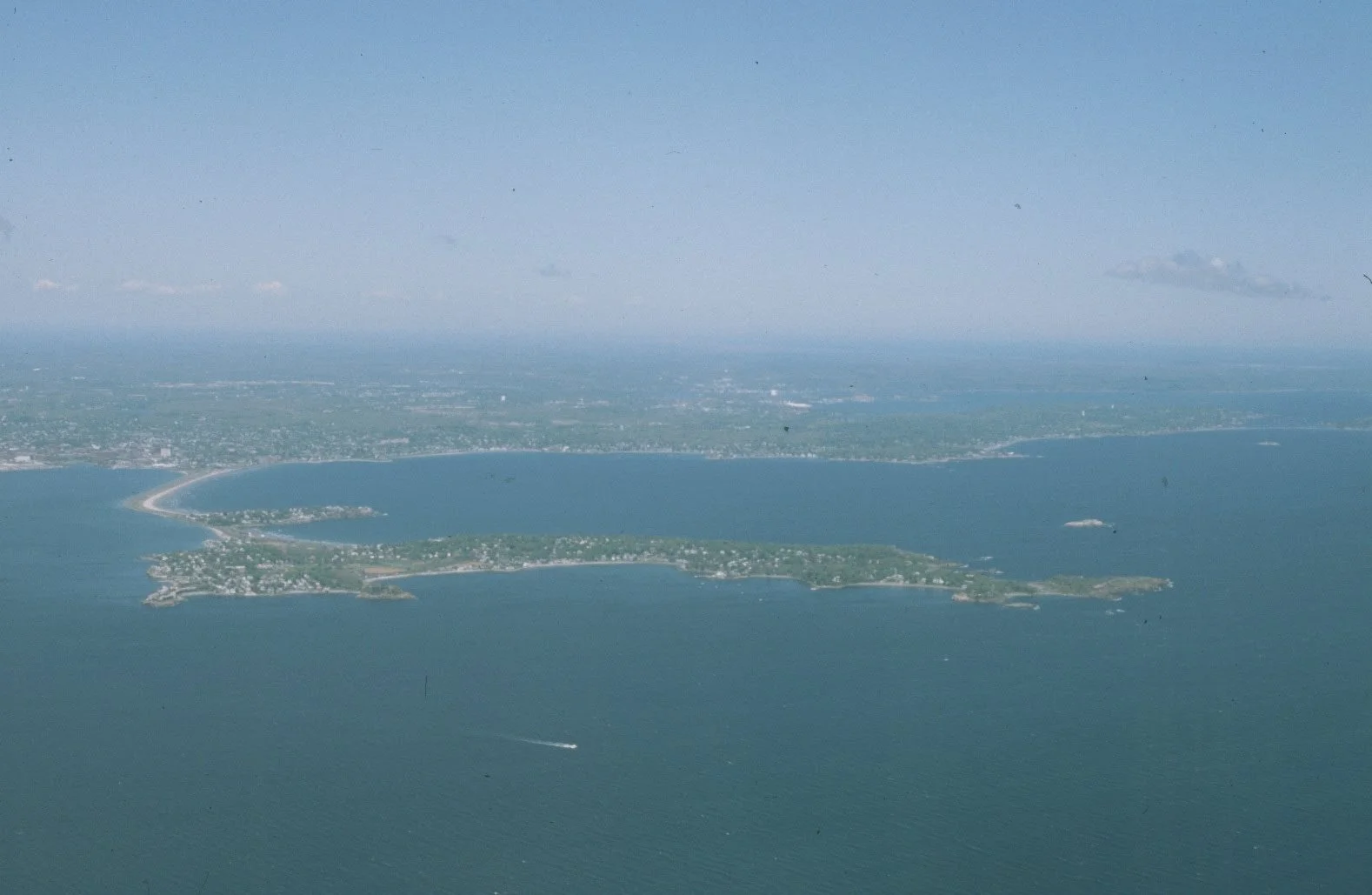
The Town of Nahant peninsula, very close to Boston and was long a favorite summer place for Boston Brahmins. Mr. Amory was born there.
— Photo by Svabo
Finally!
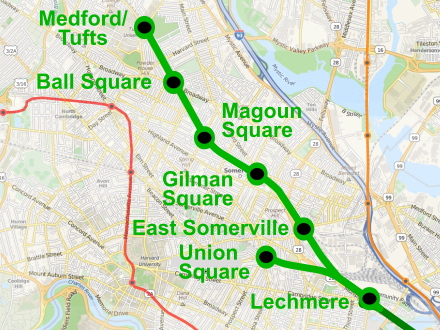
The MBTA’s Green Line extension, which opened last month.
From Robert Whitcomb’s “Digital Diary,’’ in GoLocal24.com
Consider that the MBTA’s Green Line Extension was first proposed in 1991 but only opened last week, or that extending commuter rail to Dulles International Airport from downtown Washington, D.C., was proposed in the ‘60’s but that extension only opened last week!
(Those who oppose spending tax money on creating or improving commuter rail and subway lines should look at the huge taxpaying development that occurs along them. Yes, millions of people want to get out of their cars and use mass transit if it’s close to them and provides frequent and reliable service.)
We could take many lessons from the likes of Western Europe and Japan on how to apply and maintain systems created in part or wholly because of American inventions. In the past few decades, America’s reputation as a place for completing big projects using these inventions has slipped, to no small degree because of too many layers of regulation, too many selfish and politically powerful special interests and runaway litigiousness. Let’s hope that the vast promise of fusion energy helps turn that around.
The invention of the likes of Facebook and Twitter doesn’t seem to have advanced America. But you can join the Metaverse and Cryptoworld, where nothing is real!
‘Landscapes’ in different media

Snakesound” (clay), by Liz Newell, in the group show “Earth, Sea & Sky,’’ at the Umbrella Arts Center, Concord, Mass., Jan. 8-Feb. 11.
— Photo courtesy artist.
The gallery says:
“‘Earth, Sea & Sky’ is a collection of artworks by Suzanne Hill, Liz Newell and Barbara Willis. Each artist approaches the theme of ‘landscapes’ through their own medium. Their unique interpretations of the world around us are woven in fabric or built from, clay, the very Earth itself. ‘‘
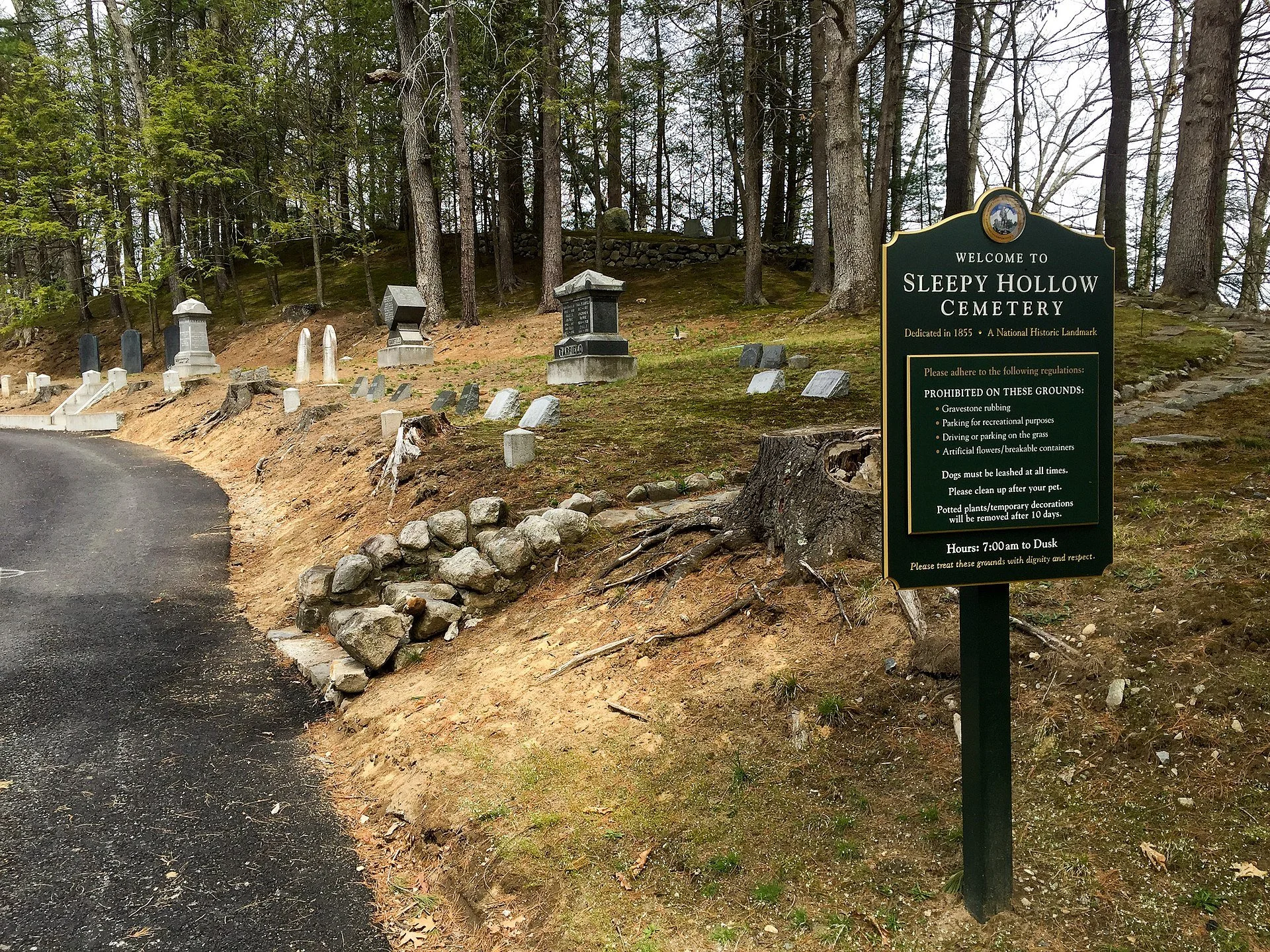
Sleepy Hollow Cemetery, in Concord, a Boston area town that was one of America’s most important cultural centers in the 19th Century. Many famous people are buried there, including Ralph Waldo Emerson, Nathaniel Hawthorne and Henry David Thoreau
— Photo by Kenneth C. Zirkel
Not for the love of war

Statue of Rufus Choate, by famed American sculptor Daniel Chester French, at the John Adams Courthouse, Boston.

John Whipple House, built in 1677, in Ipswich, Mass. It looks transplanted from England.
— Photo by Elizabeth B. Thomsen
“The courage of New England was the courage of conscience. It did not rise to that insane and awful passion, the love of war for itself.“
— Rufus Choate (1799-1859), American lawyer, orator and U.S. senator, in a 1834 address at Ipswich, Mass., of which he was a native. The town calls itself “The Birthplace of American Independence.’’ You can look up why.


A view from Castle Hill of Ipswich’s famously beautiful marshes, beloved of painters.
— Photo by John Phelan
‘Large and small visions of nature’

“Multi-cellular” (watercolor, colored pencil, ink and encaustic medium on Strathmore mixed media paper), by Cambridge, Mass.-based artist Katrina Abbott.
She says:
“Nature, color and climate change inspire my art. By representing the beauty and diversity of the natural world, I hope to inspire viewers to take a closer look at the world around us, and ultimately be more thoughtful and careful stewards of our planet. I bring my background in marine biology and environmental studies and the experience of years spent both on the ocean and in the backcountry to my art. I paint, print and work in wax to represent large and small visions of nature from the earth from space to frogs, cells and diatoms.’’
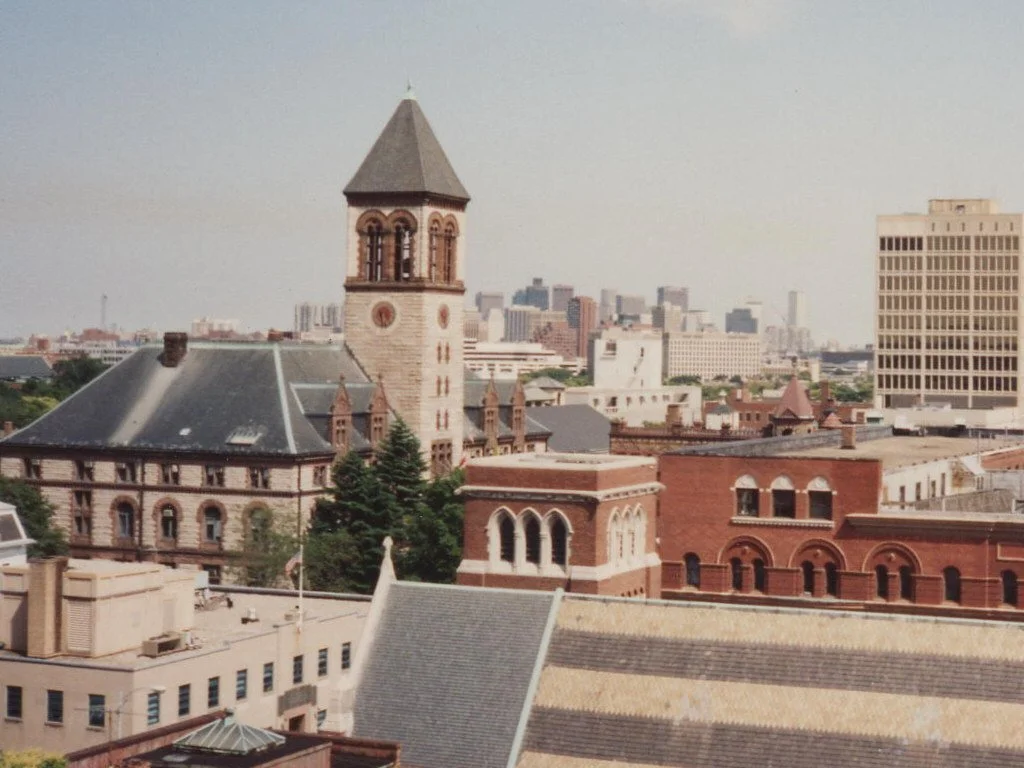
Cambridge City Hall.