
Useful fanaticism

“Good habits are worth being fanatical about.’’
— John Irving (born 1942), American-Canadian novelist raised in Exeter, N.H. Much of his work is based in New England, including the book and movie above, which is based in Maine.
Expansion of the surveillance society
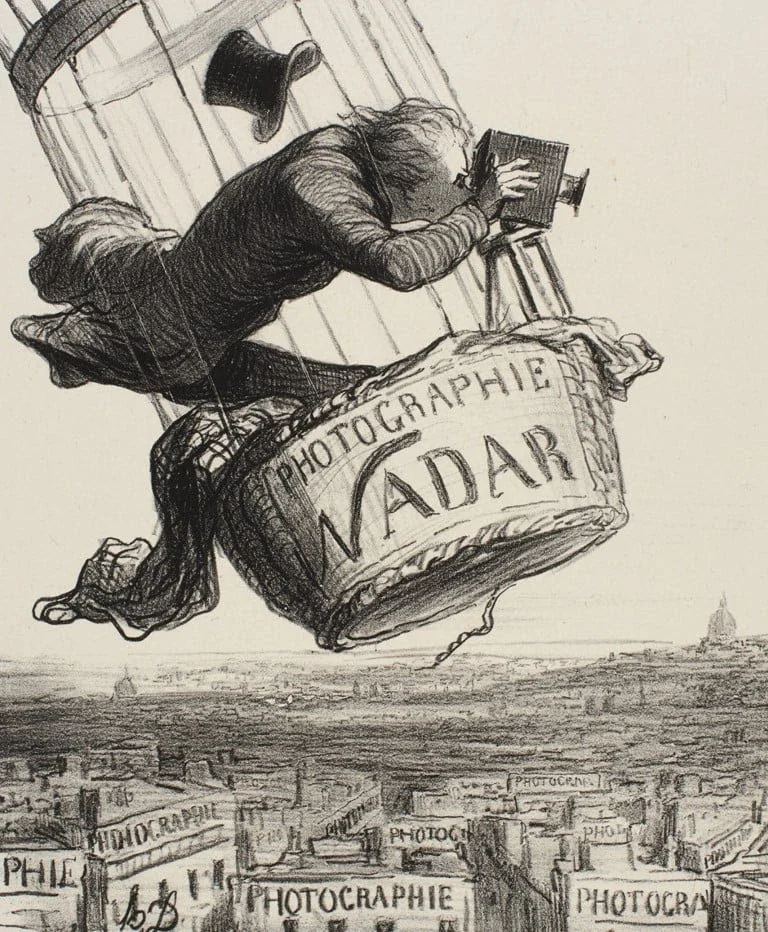
“Nadar Elevating Photography to the Level of Art” (1862 lithograph), by Honore Daumier (French, 1808-1879), in the show “On the Horizon: Art and Atmosphere in the Nineteenth Century,’’ at the Clark Art Institute, Williamstown, Mass., through Feb. 12.
— Photo by Clark Art Institute
Gaspard-Félix Tournachon (1820-1910) known by the pseudonym Nadar, was a French photographer, caricaturist, journalist, novelist and balloonist. In 1858, he became the first person to take aerial photographs.
The show analyzes how some artists incorporated new scientific and technological discoveries about the atmosphere into their work. For more information, please visit here.
Stripped down by the freeze
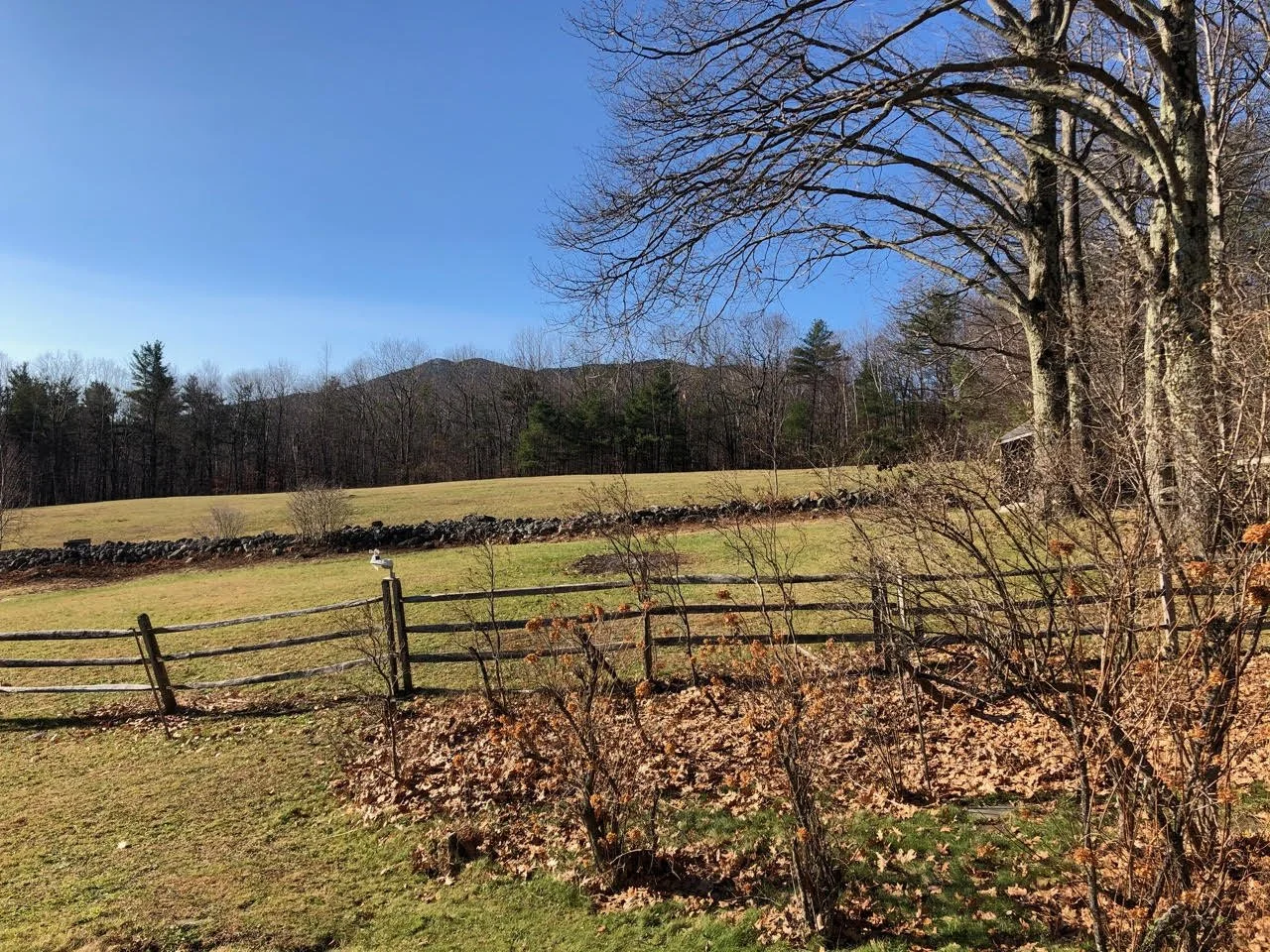
Late fall austerity in Dublin, N.H., with Mt. Monadnock in the distance.
— Photo by William Morgan
Start of the legend
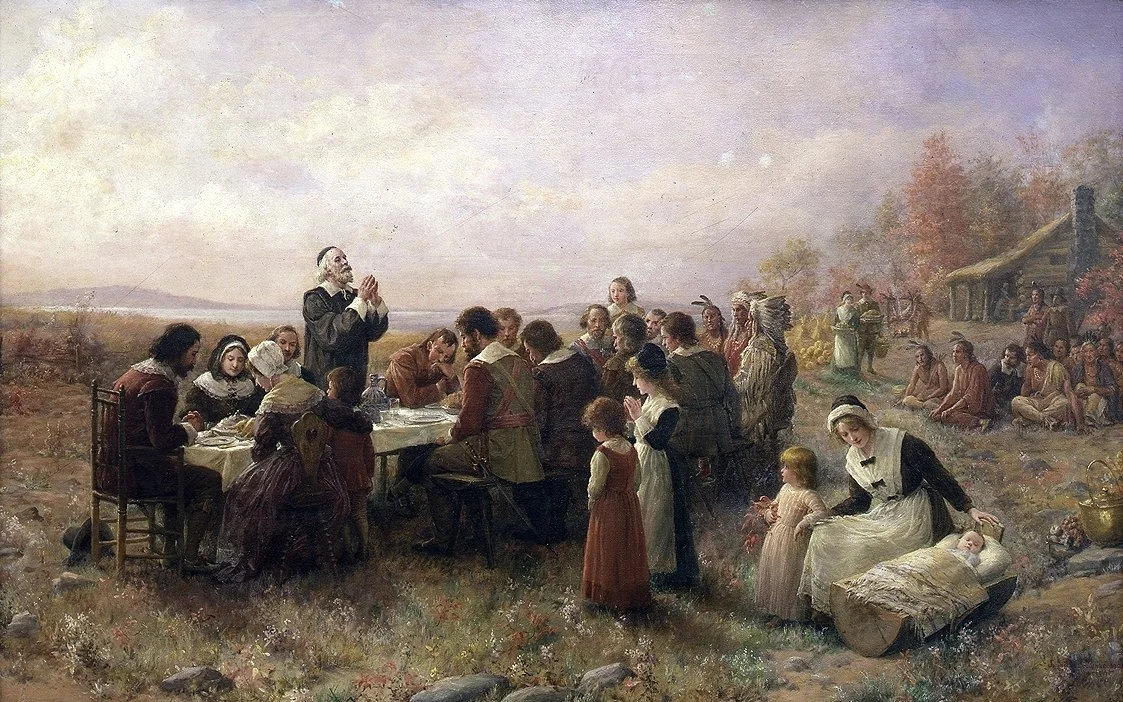
“The First Thanksgiving {in 1621} at Plymouth,’’ by Jennie Augusta Brownscombe, at Pilgrim Hall Museum, Plymouth, Mass. It’s a romanticized and simplified picture of a more complicated event.
Before eating the apple
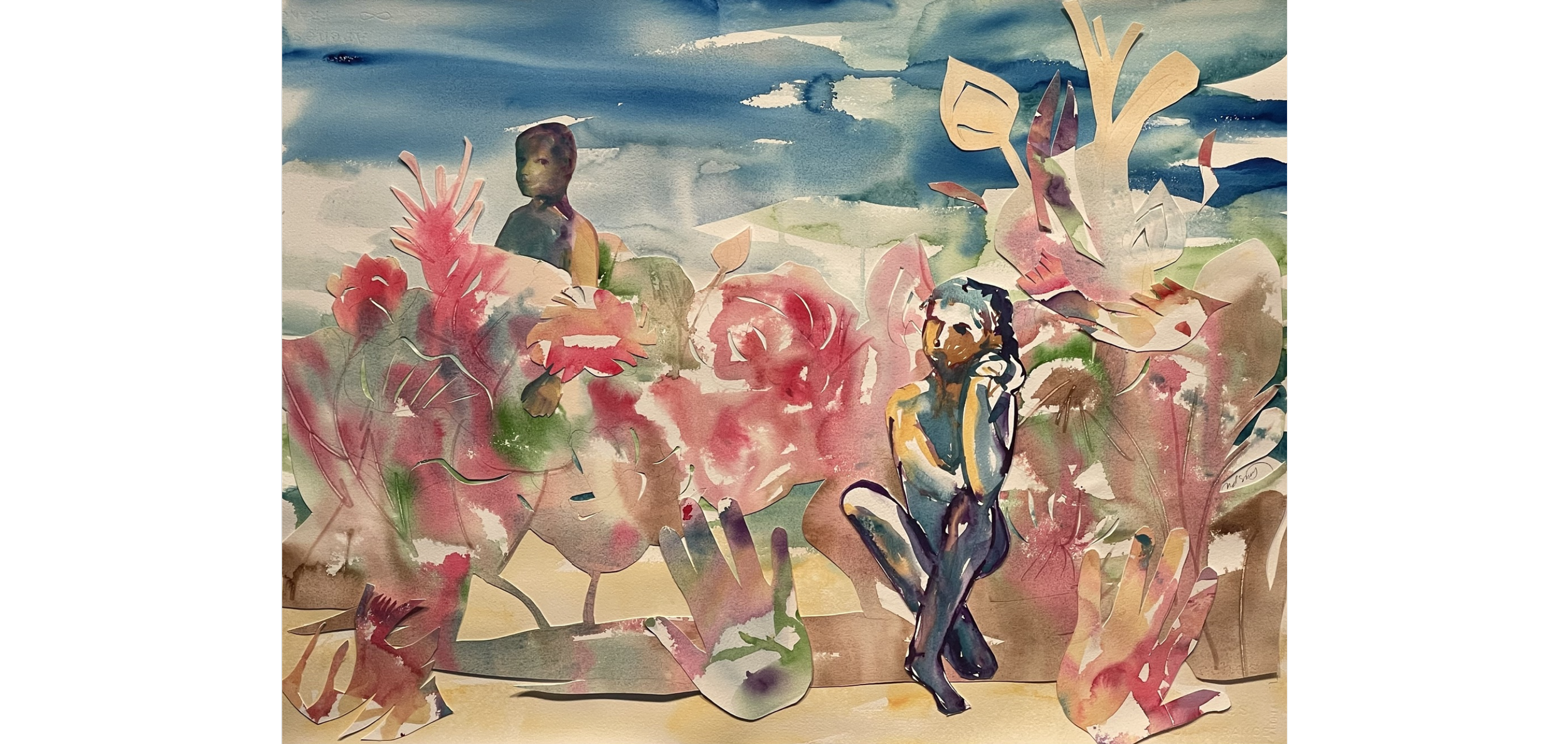
“Eden’s Color-Full Inhabitants” (watercolor) by West Newton, Mass.-based Nancy DuVergne Smith, in her show “Skins and Petals: Living Color,’’ at Galatea Fine Art, Boston, Dec. 2-Jan. 8.
She says:
“My paintings involve vibrant things—water, plants, and people—in the magic of watercolor. This medium meshes rich colors and the flow of water to create a living entity that mingles and changes as it dries. Each painting is a conversation with time and intention. Art like this invites us to return, reconsider, and refresh.’’
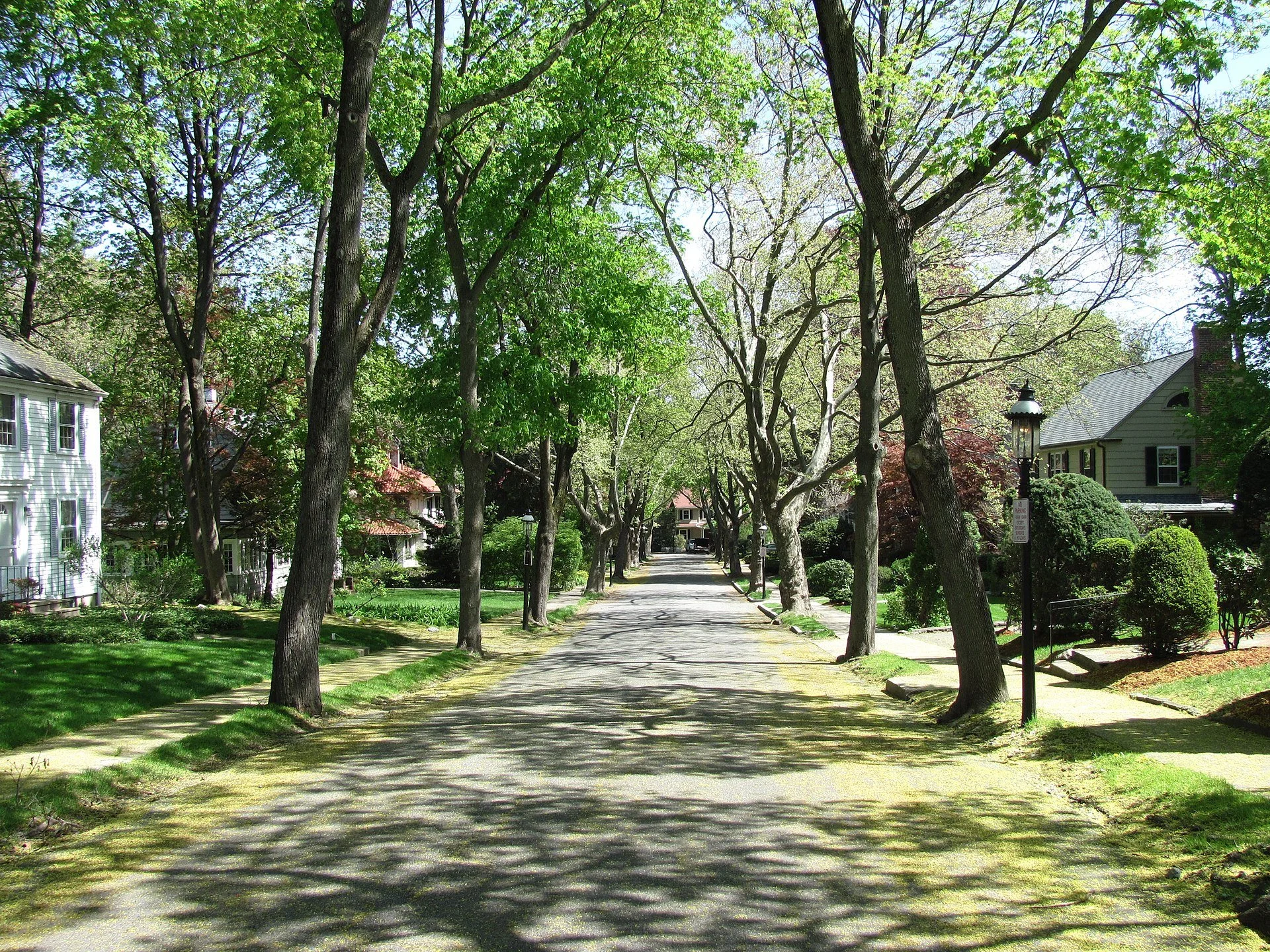
Windermere Road, in affluent West Newton, a suburban Eden.
— Photo by John Phelan
N.E. Council pushes for region to host new health-research agency

Cell culture vials
BOSTON
The New England Council (newenglandcouncil.com), the leading regional lobbying organization, has been touting Massachusetts to be the home of the new Advanced Research Projects Agency for Health (ARPA-H). And now council President James Brett is also imploring federal officials them to take a wider view and “consider the unparalleled resources” of the entire New England region.
“New England is known as one of the world’s premier life sciences hubs, and is home to many of the world’s top medical, education, and research facilities. In fact, New England centers of higher education and research institutes received over $4.5 billion in [National Institutes of Health] funding in 2021. Additionally, the region supports over 56,000 jobs directly tied to NIH funding, and supports just over $10 billion in economic activity.’’
Mr. Brett added, “In addition, the New England region boasts a dynamic workforce and innovation ecosystem. New England is home to a highly skilled talent pool to supply the quality and quantity of employees that ARPA-H will need.”
This came in a letter Mr. Brett wrote to U.S. Secretary of Health and Human Services Xavier Becerra, ARPA-H Director Dr. Renee Wegrzyn and a top White House science adviser.

Sam Pizzigati: Maybe taxpayer-subsidized Musk isn’t quite as brilliant as you think

Elon Musk
— Photo by Debbie Rowe
BOSTON
From OtherWords.org
A good day’s work for a good day’s pay. Should this age-old wisdom apply to overpaid CEOs as well as their workers? A Delaware court will soon decide, a turn of events that must have the richest man in the known universe, Elon Musk, feeling more than a little bit uneasy.
Delaware’s little-known Court of Chancery normally provides business moguls a battleground where they can slug out their big-ticket differences. But the court also gives stockholders a chance to push back against the moguls — and one modest shareholder in the Musk empire has done just that.
Shareholder Richard Tornetta, a former heavy-metal drummer, filed suit in 2018 against the company’s board for lavishing unnecessary billions upon Musk.
Tornetta’s challenge has ended up before the Chancery Court’s Kathleen McCormick, a judge who’s already demonstrated a distinct lack of patience with Muskian antics. Just this past October, McCormick ruled against Musk in another case. She might well again.
Musk’s current Tesla CEO pay plan, notes CNN Business, gives Musk “the largest compensation package for anyone on Earth from a publicly traded company.” Under the plan, the higher Tesla’s share price goes, the more new Tesla shares Musk gets.
Thanks to that connection, Musk’s personal net worth now sits at $189 billion, the world’s largest personal fortune. In 2018, the year Musk’s Tesla pay deal went into effect, some 40 billionaires worldwide topped Musk on the Bloomberg billionaire charts.
Back in 2018, major shareholder advisory firms recommended that Tesla shareholders reject the pay deal that Tesla’s corporate board — a panel that included Musk’s brother and assorted close pals — wanted to give Musk.
Musk himself, one advisory firm noted, already had plenty of incentive to work hard for Tesla’s success. He owned 22 percent of Tesla’s shares even before his new CEO pay deal.
The week-long trial on Richard Tornetta’s Delaware lawsuit against Musk and Tesla ended in mid-November. Judge McCormick’s decision in the case will likely come down sometime over the next three months.
McCormick’s previous ruling against Musk came when the billionaire tried to back out of the deal he cut last spring to buy Twitter. After that ruling, Musk had to go ahead with the purchase. Now he’s flailing about, trying to make others pay the price for his impulsive takeover bid. He’s already laid off half the Twitter workforce.
If McCormick rules against Musk once again, Musk will still walk away fantastically rich. But he won’t walk away happy. His ongoing Twitter debacle — and now the Tesla litigation — have dealt his reputation for unparalleled business “genius” a potentially fatal blow.
Under cross-examination in the Tesla case, for instance, Musk had to concede that he didn’t come up with the original vision for Tesla himself, the claim he’s been making for years.
Musk turns out to be as flawed as the rest of us. The key difference: Musk has the power and wealth to make others pay for his mistakes.
Musk has also benefited, unlike the rest of us, from billions in taxpayer subsidies. Handouts to his electric car, solar panel and spaceflight businesses — all “long-shot start-ups,” the Los Angeles Times has detailed — gave his companies their secret sauce. Those subsidies launched Musk’s unparalleled personal fortune.
So what can the rest of us do to prevent another “brilliant” entrepreneur from building a fortune off the insights, labor and tax dollars of others? We can deny subsidies to companies that pay their top execs hundreds of times more than what they pay their workers. We can tax the rich at much higher rates.
And we can put Elon Musk atop a rocket and send him off to where he has repeatedly announced he dearly wants to go — to Mars.
Sam Pizzigati, based in Boston, co-edits Inequality.org at the Institute for Policy Studies. His books include The Case for a Maximum Wage and The Rich Don’t Always Win.
Information please

Two fine writers, both physicians, seek publishing help.
The first one, who has also served as a hospital-system senior executive, is seeking to recruit an editor and an agent for an autobiographical book, now in its first draft. He lives in the Boston area.
In his words:
“The book is the emotionally honest story of a family of six wherein both the father and one son asynchronously developed and battled dissimilar early - onset advanced stage cancers. Although the life circumstances and treatment regimens and surgeries weren't the same, the experience of having cancer and the subsequent tidal changes in the levels of physical, emotional and spiritual distress, hope, worry, fear, family dynamics, perseverance, gratitude for support from family, friends and the medical community and others were shared. The son's story is a very relevant one given the currently alarming rise in cases of colorectal cancer in people under the age of 50.
“Amazing events (some miraculous) that occurred over the years are part of the story. The father is in remission. The son did not survive, so it's also a story of what it's like to lose a child as well.
“It's a story about hope and grief worth telling and meant to provide insight and inspiration for others unfortunately realizing similar circumstances.’’
His biography:
Adopted. Raised in a very blue-collar family. Identical twin brother died from AIDS at age 31. He went to medical school at age 28. Internal medicine private practice in the Boston area for 20 years, a physician executive since.
Married for 40 years. 4 children, 3 grandchildren with another 2 on the way.
xxx
The other physician writer, formerly of the U.S. but now living in New Zealand, seeks a literary agent.
A psychiatrist and psychoanalyst, he’s a published poet, playwright, novelist and story-teller.
Please respond via rwhitcomb4@cox.net
Dipped vintage pages
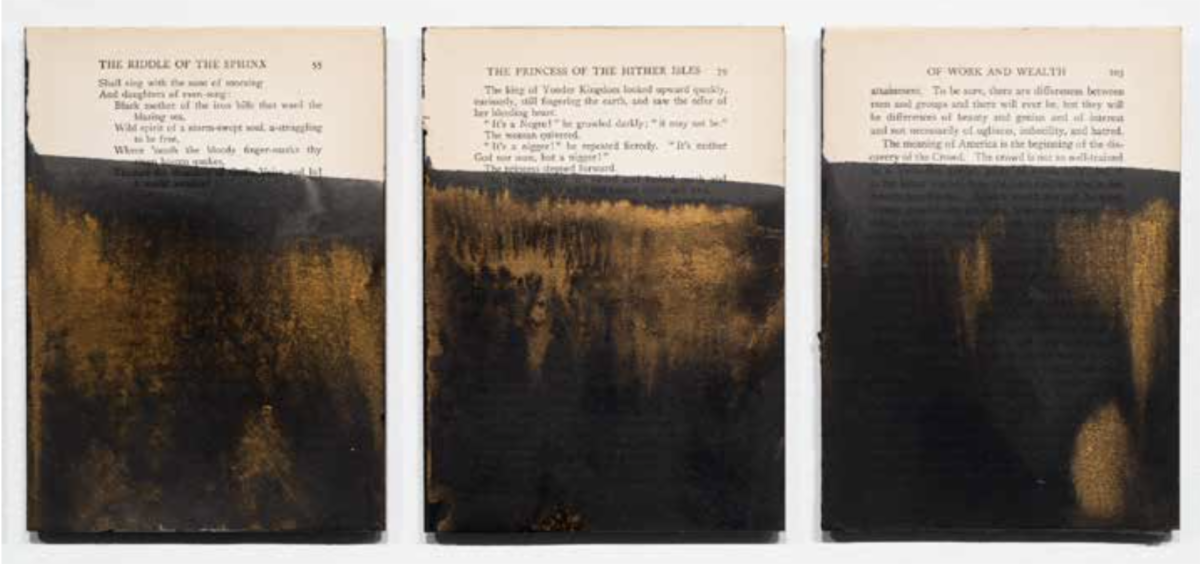
Installation of 24 vintage book pages mounted on wood panels and dipped in Furnace black watercolor and gold acrylic pigments, by Tim Rollins (1955-2017), at the University Museum of Contemporary Art, at the University of Massachusetts at Amherst.
— Photograph by Stephen Petegorsky.
Frank Carini: Turtles threatened by local poachers with global ties
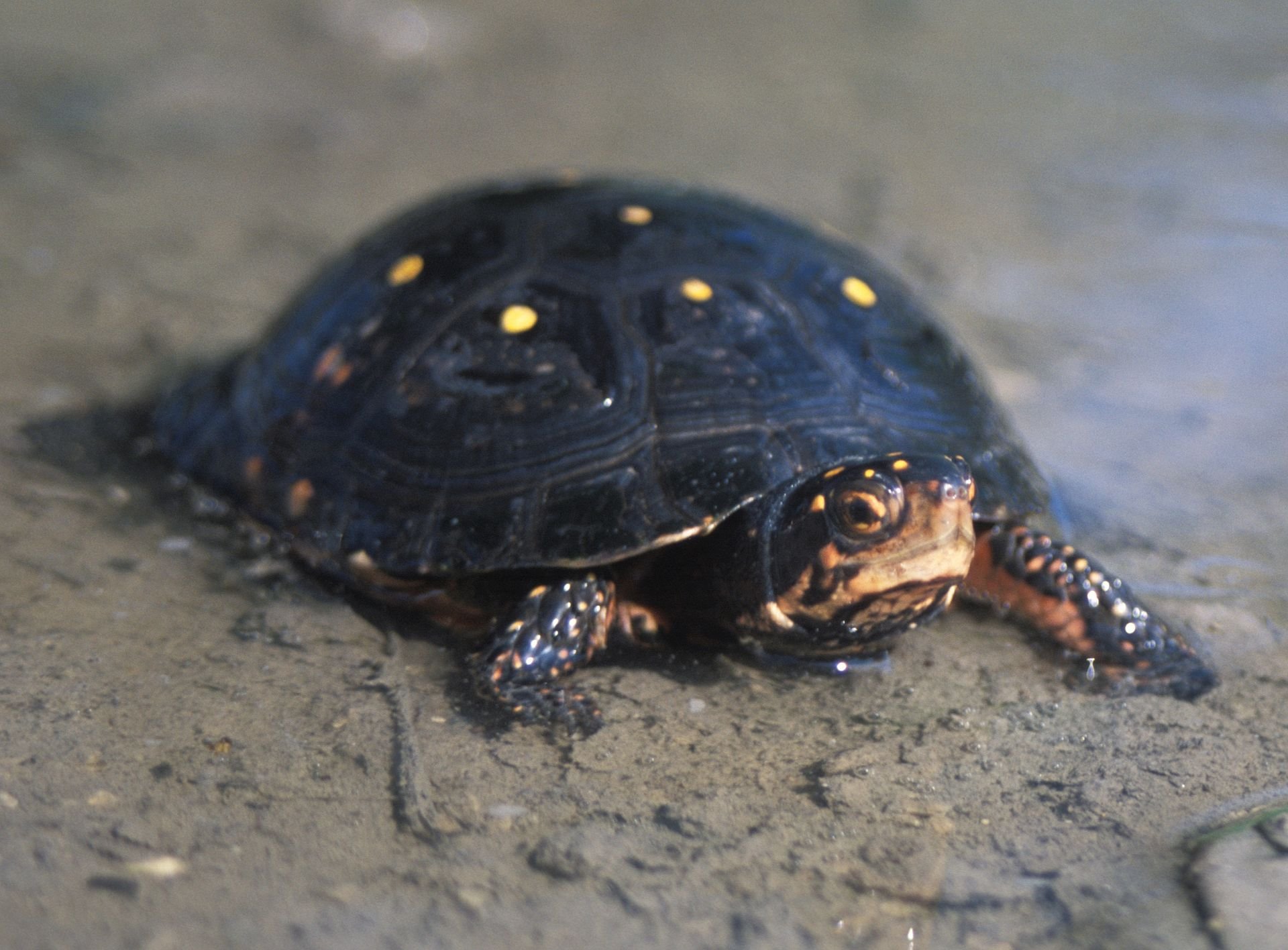
A Spotted Turtle.
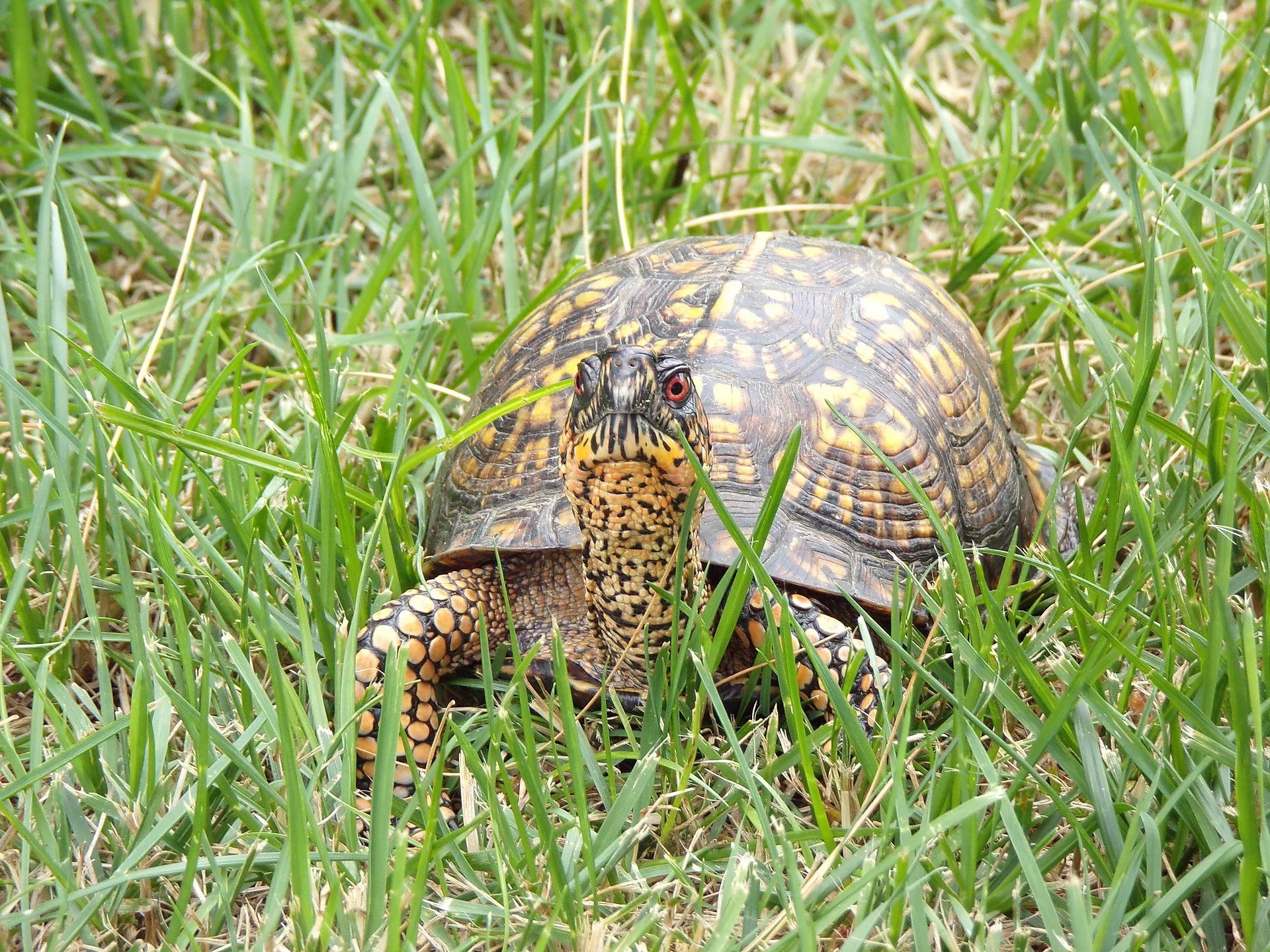
An Eastern Box Turtle.
From ecoRI News (ecori.org)
Rhode Island’s reptiles and amphibians face pressure from numerous threats, and for many species, removal of even a single adult from the wild can lead to local extinction, according to the state’s herpetologist.
Since the local and/or regional future for many of these species — eastern spadefoot toad, northern leopard frog, northern diamondback terrapin, to name just a few — is in doubt, removing them from nature to keep as a pet or to sell is against the law. It’s illegal to sell, purchase, or own/possess native species in any context, even if acquired through a pet store or online, according to Rhode Island law.
Turtles are especially vulnerable, according to Scott Buchanan, who became the state’s first full-time herpetologist in 2018, because some species must reproduce for their entire lives to ensure just one hatchling survives to adulthood. The Rhode Island Department of Environmental Management (DEM) staffer said it takes years, sometimes a decade or more, for turtles to reach reproductive age, if they make it at all.
Buchanan recently told ecoRI News that “broadly, across taxa” the illegal taking, or poaching, of wildlife is a “huge issue.”
“Globally, it’s considered one of the driving forces of population declines and even extinctions,” he said.
Wildlife trade experts and conservation biologists such as Buchanan point to poaching — driven by demand in Asia, Europe, and the Unified States — as a contributing factor in the global decline of some freshwater turtles and tortoises.
Tortoises and turtles grow slowly, mature late, and can, if given the chance, live for decades. This slow and steady lifestyle served them well for millions of years, but now, in the face of growing human pressures, it has become a liability.
Of the 360 known turtle and tortoise species, 52 percent are threatened, according to the International Union for Conservation of Nature Red List of Threatened Species.
A group of global turtle and tortoise experts published a 2020 paper that noted “more than half of the 360 living species [187] and 482 total taxa (species and subspecies combined) are threatened with extinction. This places chelonians [turtles, terrapins, and tortoises] among the groups with the highest extinction risk of any sizaeble vertebrate group.”
Turtle populations are “declining rapidly” because of habitat loss, consumption by humans for food and traditional medicines, and collection for the international pet trade, according to the paper’s authors. Many could go extinct this century.
Buchanan’s involvement in dealing with the impact of poachers is primarily around North American turtles. He noted turtle diversity is high globally and in the eastern United States — in the Southeast more than the Northeast, however.
But state and federal law enforcement officials and wildlife biologists consider the illegal collection of turtles to be a conservation crisis occurring at an international scale, according to Buchanan, who is the co-chair of the Collaborative to Combat the Illegal Trade in Turtles (CCITT), formed in 2018 within Partners in Amphibian and Reptile Conservation.
In the past four years, CCITT, an organization of mostly state, federal and tribal biologists, has documented some 30 major smuggling cases in 15 states. Some involved a few dozen turtles, and others several thousand.
In Rhode Island, Buchanan said there are four turtle species of concern: the eastern box turtle; the spotted turtle; the wood turtle; and the northern diamondback terrapin.
Eastern Box (species of greatest conservation need): This turtle spends most of its time on land rather than in the water. They favor open woodlands, but can be found in floodplains, near vernal pools, ponds, streams, marshy meadows, and pastures. They reach sexual maturity by about 10 years of age. Females nest in June and lay an average of five eggs in open areas with sandy or loamy soil. Eggs hatch in late summer.
Spotted (species of greatest conservation need): These turtles are sensitive to disturbance. They are usually found in shallow, well-vegetated wetland habitats, such as vernal pools, marshes, swamps, bogs, and fens. They reach sexual maturity at 7-10 years of age. Females lay an average of four eggs in moist Sphagnum moss, grass tussocks, hummocks, or loamy soil. Females probably do not lay eggs more than once a season, and females do not lay eggs every year.
Wood (species of greatest conservation need): For part of the year they live in streams, slow rivers, shoreline habitats, and vernal pools, but in the summer they roam widely across terrestrial landscapes. They reach sexual maturity around 10. During late spring, one clutch of 4-12 eggs is typically laid in nesting sites consisting of sandy soil or gravel. Eggs hatch in late summer and the young move to water.
Northern Diamondback (state endangered): Their population has suffered greatly due to poaching and habitat loss. They are found in estuaries, coves, barrier beaches, tidal flats, and coastal marshes. They spend the day feeding and basking in the sun and bury themselves in the mud at night. They reach sexual maturity at about six years old. Females lay a clutch consisting of 4-18 eggs. Some females will lay more than one clutch in a season and hatching usually occurs in late August. The young spend the earlier years of life under tidal wrack (seaweed) and are rarely observed.
All four are high-demand species in the pet trade, according to Buchanan.
“There’s a lot of illegal collection that takes place all throughout the eastern United States, including in New England and Rhode Island,” he said. “There’s a lot of recent cases that involve hundreds and thousands of turtles from those species illegally collected from individual populations, which is just totally unsustainable and has an immediate and lasting impact on those populations.”
Other turtle species that can be found in Rhode Island include eastern painted, common snapping turtle, and eastern musk.
“We have a lot of turtles for a small state,” Buchanan said. “They’re a conservation priority because of their life history. They’re just inherently vulnerable to population declines.”
Most turtles fall victim to predators before they mature. Rhode Island’s turtles are also threatened by habitat loss and fragmentation and by car strikes when crossing roads to breeding grounds.
Poaching is just another human-caused threat to their existence.
The 16 eastern musk turtle hatchlings confiscated by Rhode Island environmental police from a West Warwick resident in September. (DEM)
In late September environmental police officers from DEM’s Division of Law Enforcement found 16 Eastern Musk Turtle hatchlings, a species native to Rhode Island and the eastern United States, in the home of a West Warwick man suspected of illegally advertising them for sale on Craigslist and Facebook.
The case resulted from a week-long investigation, during which the suspect offered two hatchlings to undercover environmental police officers for purchase, according to DEM.
The suspect was charged with 16 counts of possession of a protected reptile or amphibian without a permit. The turtles were taken to the Roger Williams Park Zoo, which has a room and equipment dedicated to the care of turtles seized from the illegal turtle trade. The turtles will be released back into the wild after clearing health screenings and disease testing, according to DEM.
The 16 turtles are still at the zoo and “doing well,” according to Buchanan. He said only a minority of turtles rescued from poachers are returned to the wild, because of concerns about disease and, more importantly, not being able to determine the area from which they were taken.
The man has claimed the hatchlings were raised in captivity, but state officials believe the parents were likely taken from the wild and that the case also involves actions taken in another state. The case remains under investigation.
Last November, at New York City’s John F. Kennedy International Airport, about 100 eastern box turtles were found confined in socks inside an illegal shipment to Asia. A deadly ranavirus outbreak among the turtles confiscated by the U.S. Fish & Wildlife Service highlighted the risks and cruelty of the illegal wildlife trade, according to the New England Aquarium.
Smuggled turtles are often wrapped tightly in socks to keep them from moving. (USFWS)
Federal wildlife officials discovered the wildlife smugglers put multiple turtles, taken illegally from the wild, together into one box without food or water. Found hidden inside falsely labeled boxes, each turtle had been stuffed inside a tight sock to prevent it from moving.
The New England Aquarium took in many of the turtles and enlisted Zoo New England and Roger Williams Park Zoo to assist with treating the animals that were in poor health, suffering from dehydration and eye infections.
Buchanan said the global demand for box turtles has surged during the past few years.
A Chinese national was sentenced last year to 38 months in prison and fined $10,000 for money laundering after previously pleading guilty to financing a nationwide smuggling ring that sent 1,500 turtles worth nearly $2.3 million from the United States to China. The man used PayPal, credit cards, and bank transfers to buy the turtles from U.S. buyers advertising them on social media and reptile websites and sold them to Hong Kong reptile markets.
He trafficked in five turtle species, including the Eastern Box Turtle, protected by the Convention on International Trade in Endangered Species of Wild Fauna and Flora treaty.
Turtles, especially freshwater species, are among the world’s most trafficked animals, because, as Buchanan noted, reptiles can be kept in “explicitly inhumane conditions” — say, a sock inside a cardboard box — for a significant period of time.
“Enough of them survive to make it economical [for the criminal enterprise],” said Buchanan, noting most amphibians are too fragile to keep alive for that long.
Criminal networks connect with buyers who then sell the turtles as pets, to collectors, and to commercial breeders. Some species are coveted for their colorful shells or unusual appearance. In many countries, this illegal trade is either poorly regulated or unregulated.
To help protect Rhode Island’s native species, you can submit observations of amphibians and reptiles to DEM scientists online.
“Remember never to share turtle locations online,” according to DEM. “It can be exciting to see turtles in the wild, and to share your discovery. But before you take a photo of a turtle in the wild, turn off the geolocation on your phone. If you post a turtle photo on social media, don’t include information about where you found it. Poachers use location information to target sites.”
There are a few reptiles and amphibians that can hunted legally in Rhode Island: snapping turtles, bullfrogs, and green frogs. A current fishing, hunting, or trapping license is required and hunting/trapping must be conducted in compliance with season and size regulations. All animals harvested must be killed immediately following capture, as possession of live turtles or frogs is illegal.
Turtle traps must be marked with the trapper’s name and address, checked every 24 hours, and set in a manner that will allow turtles access to air, according to DEM. All bycatch must be released immediately at the location where the trap was set.
“This illegal collection of turtles … I think most people have a perception that it’s disparate or kind of small-time … it’s just some yahoos out there collecting a few turtles, when in fact it’s perfectly accurate to say the norm is international criminal syndicates that are driving the trade in turtles that leads to the illegal collection here in the U.S.,” Buchanan said. “There’s often times a local collector who’s in contact with a middleman who’s in contact with a criminal network that’s also involved in things like drug trafficking and human trafficking.”
Note: The sexual maturity and nesting habits of the four turtle species of concern in Rhode Island are based on their life and conditions here. For more information about the turtles of Rhode Island, click here. To watch a short U.S. Fish & Wildlife Service video about the importance of turtles and the threat from poaching, click here.
Frank Carini is co-founder and senior reporter for ecoRI News.
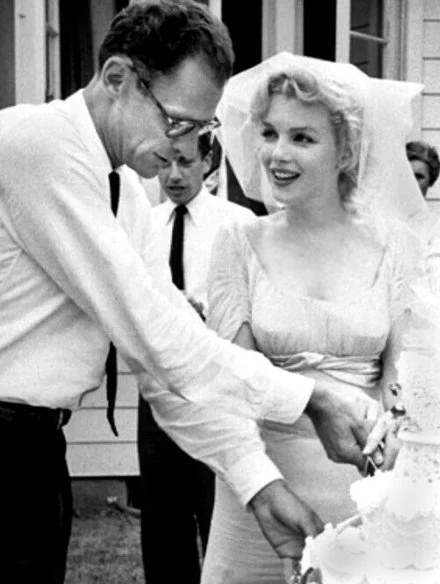
‘On four or five hooks’
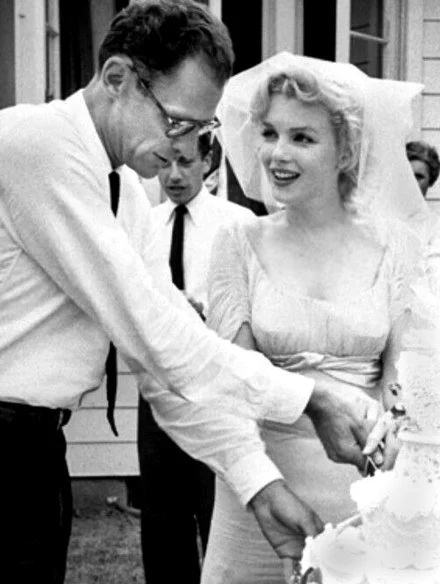
Arthur Miller and Marilyn Monroe at their wedding, in 1956
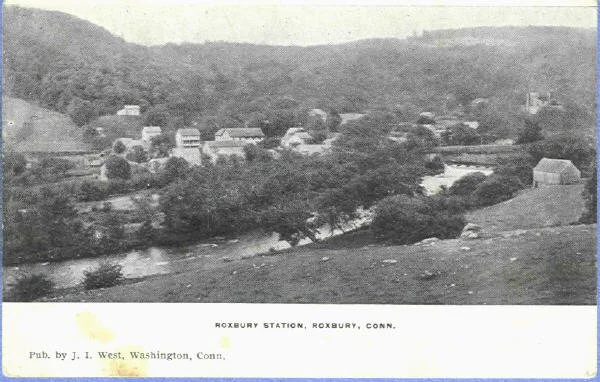
Roxbury, Conn., in 1905.
“How few the days are that hold the mind in place, like a tapestry hung on four or five hooks. Especially the day you stop becoming; the day you merely are.’’
— Playwright Arthur Miller, in After the Fall, inspired by his failed marriage to Marilyn Monroe. He lived much of his adult life in Roxbury, Conn., amidst the many other literary and visual artists who called the town, in the Litchfield Hills, their home.

Thanksgiving crisis

— From Veganbaking.net
Adapted from Robert Whitcomb’s “Digital Diary,’’ in GoLocal24.com
Like many of us, I closely associate past Thanksgivings with the places they took place.
When I was a young kid, it was mostly in our gray-shingled house on a hill near the ocean. The weather always seemed to be either drizzling and clammy or dry and brisk, with the sun slanting low on the horizon. These early-afternoon feasts, often preceded by watching the Macy’s parade in Manhattan on TV, were sometimes followed by walks, often to a rocky point, and dull headaches.
One memory from there is the Great Cranberry Scare of 1959. Arthur Flemming, President Eisenhower’s secretary of health, education and welfare, told the public on Nov. 9 that year that a little bit of the cranberry crop in the Pacific Northwest had tested positive for a herbicide called aminotriazole, which had caused abnormal growths, perhaps carcinogenic, in lab rats.
Although the major cranberry growers’ cooperative, Plymouth County, Mass.- based Ocean Spray, said accurately that you’d have to eat massive quantities of cranberry sauce (which was/is heavily sugared) to get sick from them, Flemming still advised people to avoid the fruit just as that treat’s biggest day, Thanksgiving, approached. Sales plunged, which hit the many growers in southeastern Massachusetts’s bogs hard.
In any event, the industry and the Feds worked out a deal to ensure that future lots of cranberries were clear of aminotriazole, and growers fairly quickly recovered from the economic blow of the Flemming announcement. It was the first big consumer-product crisis I remember.
My recollection is that at our Thanksgiving table we ignored the warning and helped ourselves to hearty helpings of cranberry sauce. That reminds me of the time soon after I graduated from college when my father, a smoker, cheerily offered a cigarette to a friend of mine with the words “Have some cancer!’’ He was a fatalist.
In later years, we’d be taken out by my paternal grandfather, by that point a widower, to the Daniel Webster Inn, in the Cape Cod town of Sandwich, which, happily, provided a meal lighter and brisker than what we’d get at home. He was a laconic Yankee, but he made an effort to show interest in what everybody had been up to recently.
And those of us of certain age of course won’t forget the sad Thanksgiving less than a week the assassination of President Kennedy, on Nov. 22, 1963. Whether you politically supported him or not, it cast a deep pall.
On Thanksgiving 1975, my wife and I dined virtually alone in a Philly hotel dining room near our shotgun apartment. It was quite pleasant.
In a couple of years, because of an unforgiving work schedule, I ate alone at home. King Oscar sardines are delicious out of the can!
Much later, for some years, we took an elderly, smart and rather cranky aunt and one or both of our daughters and another relative or two to the Coonamessett Inn, in Falmouth. That joint knew how to move things along! Since none of us were particularly enamored of Thanksgiving, or at least of big mid-day meals, that was fine. We’d be out of there in an hour and a half.
When we were living in Paris, we were invited to a big Thanksgiving dinner at my boss’s apartment. We invited along an American friend, a historian with a stentorian voice, who proceeded to sit at the head of the table and take over the room. Our hosts controlled their irritation.
There was the Thanksgiving at some friends’ house in Providence, where the pleasant post-prandial conversation and clean-up was brought to a sudden close by a phone call that announced the death of one of our hosts’ mother.
Thanksgiving is reported to be the second most popular holiday, after Christmas. Is that for real or do many people just say that because they want to sound people-friendly and anti-materialist? Meanwhile, one often wonders about the increasing percentage of people who live alone and how they spend highly familial holidays like Thanksgiving and Christmas. Of course, we speak more and more of creating non-family “families,” but when push comes to shove we usually have to fall back on relatives rather than friends. Maybe that will change.
As Robert Frost grimly put it in “The Death of the Hired Hand’’:
“Home is the place where, when you have to go there, they have to take you in.’’
I wonder how many people are moving to vegetarian or vegan Thanksgivings, both because of health and as a small way to address the suffering we inflict on the animals we eat. (I’ve seen stockyards and poultry-killing places.) We had some fake turkey last week; it was pretty good.
Off-season sleep
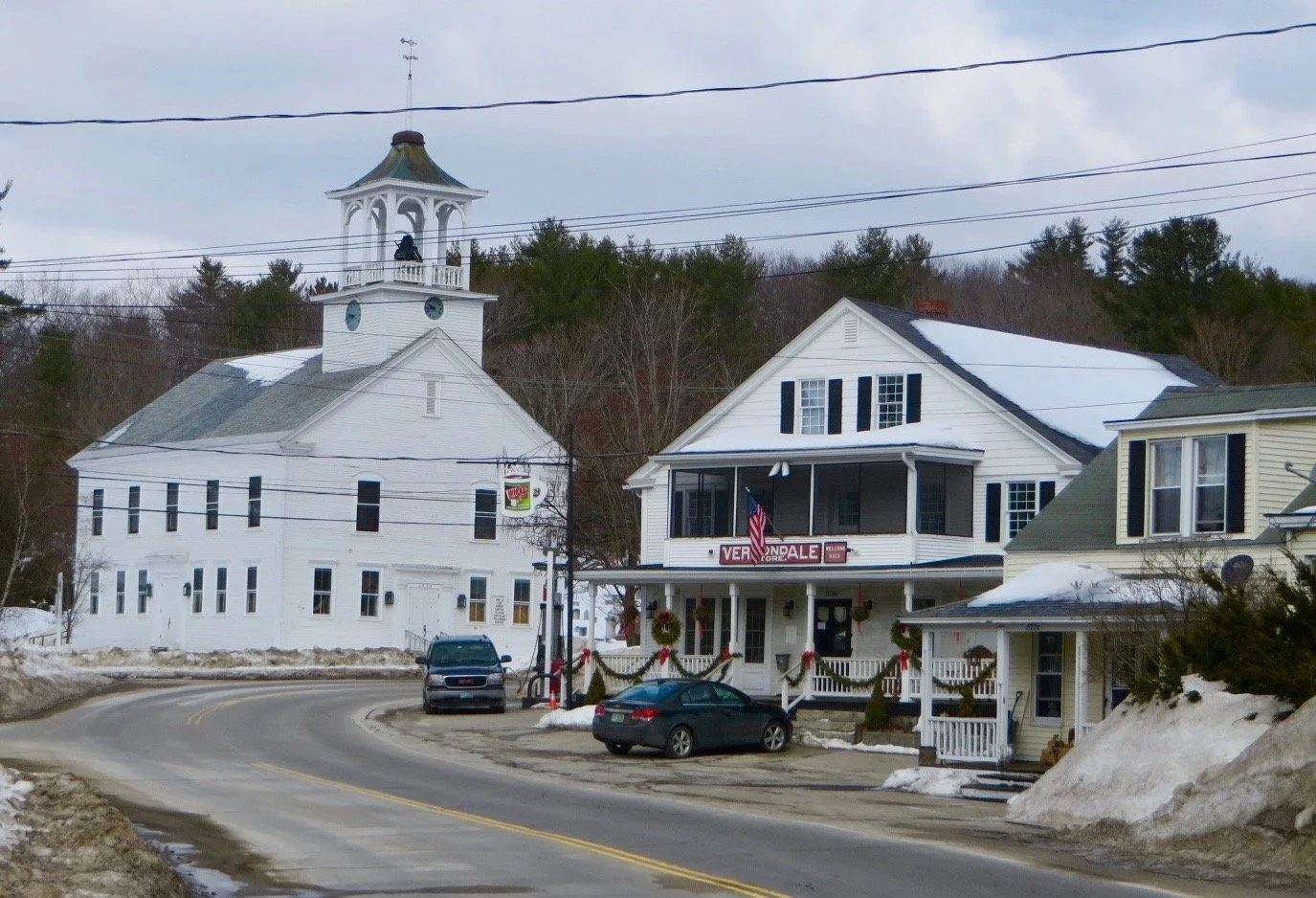
Center of North Sutton, N.H.—
— Photo by Ken Gallager
“Five thousand miles from here
North Sutton is sleeping.
Gas pumps doze
by Vernondale’s store.’’
— From “Memory of North Sutton,’’ by Wesley McNair (born 1941), New England poet

Chris Powell: College debt forgiveness and overpriced education
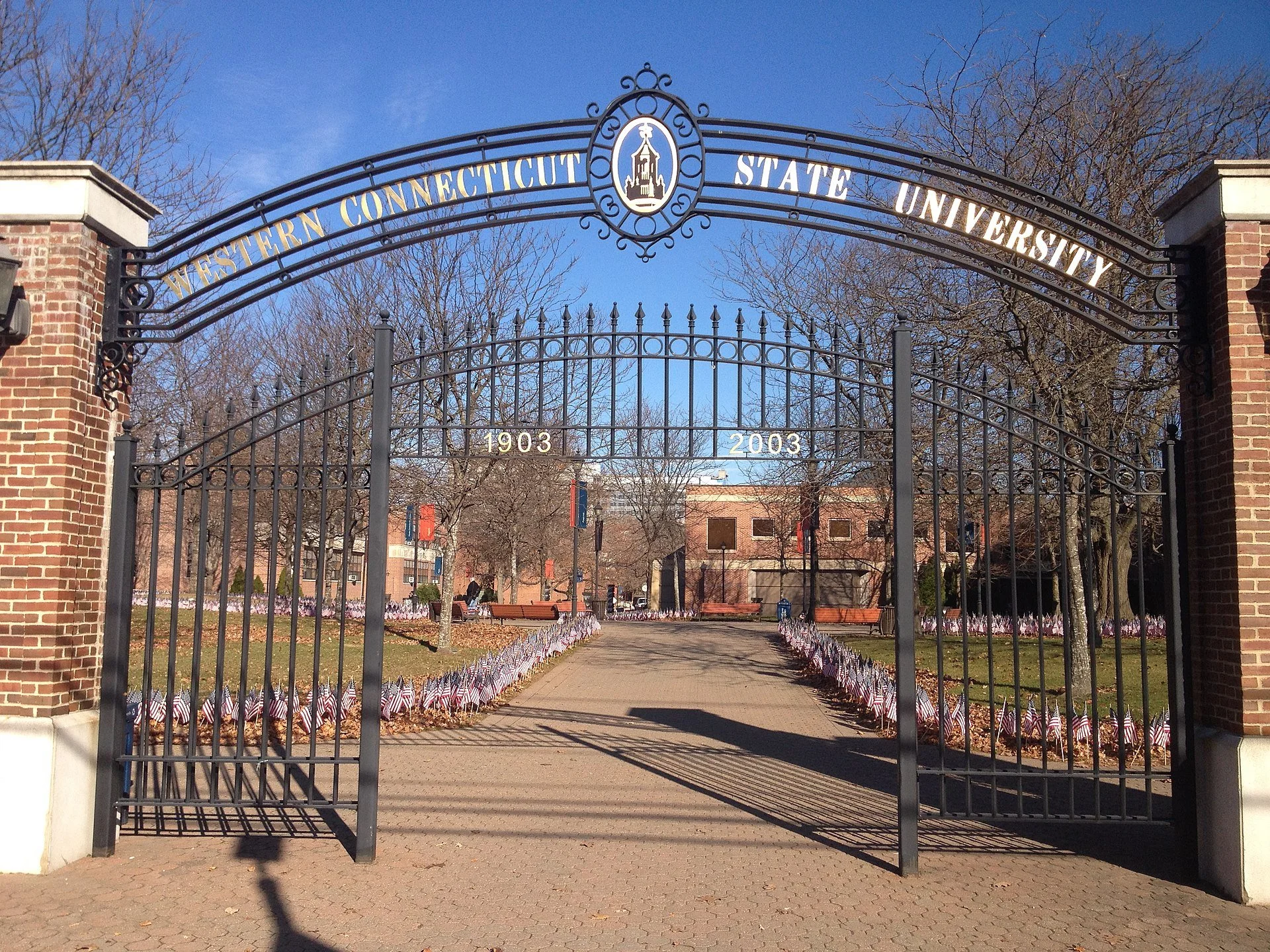
The entrance gates of Western Connecticut State University, in Danbury.
— Photo by Andrew Gusciora
MANCHESTER, Conn.
Connecticut recently saw another indication that its public higher education is overpriced. To encourage applicants, the University of Connecticut and three of the four regional state universities -- Southern, Western and Eastern -- waived application fees for a day. Central Connecticut State University waived the fees for two weeks.
Of course, the savings to applicants was small -- UConn's application fee is $80 and the fee for the regional universities is $50 -- and the universities will more than recover the loss through their tuition. The regional universities are increasing tuition by 3 percent.
Meanwhile, this week courts kept thwarting President Biden's attempt to use an executive order to bestow forgiveness of college student loans. Even the president's political ally, House Speaker Nancy Pelosi, acknowledged long ago that student loans can be forgiven only through legislation. All along the president's plan seemed to have been little more than a gimmick to build support for Democrats in the recent congressional election.
The clamor for debt relief is essentially a proclamation of the excessive cost -- the lack of value -- of higher education. For the rationale for college loans is that students will be able to repay them through the higher incomes they will earn because of their higher education. But that doesn't work for millions of college students, graduates and dropouts alike. Their income expectations are disappointed and then their loan obligations crowd out family formation, home ownership and the joy of life generally.
Along these lines, the employment agency Zip Recruiter reported this month that its survey of 1,500 job-seeking college grads found that 44 percent regret their field of college study, presumably for income reasons. The fields most regretted were in the liberal arts. Least regretted were those in science, technology, medicine, and business.
Elected officials trying to pursue the public interest rather than the special interest might respond by proposing to regulate eligibility for college loans and to restrict loan terms, thus inducing colleges to cut prices and reorder their course and degree offerings in favor of the fields in which graduates will be most able to repay their loans.
Instead the response from elected officials is mainly to have government assume college loan debt and pass it along to taxpayers, including people who paid their own way through college or skipped college because of the cost -- the suckers!
Why is there such resistance to knocking down the cost of higher education? For the same reason there is such opposition to knocking down the cost of lower education even as its performance declines.
That is, too many people draw their livelihoods from the failing systems and are comfortable with failure.
Most of these people are unionized, politically active, and connected to the Democratic Party, circumstances that especially in Connecticut preclude any acknowledgment of education's excessive cost. But even in the rest of the country few Republicans want to risk the wrath of the education lobby.
Besides, how many parents want some elected official to tell them that while they were watching television or smoking dope instead of monitoring their children's homework, elementary-school students in Asia had become more educated and capable than high school graduates in the United States?
Meanwhile, The Washington Post has scolded elite universities and particularly Yale University, in New Haven, for supposedly not being supportive enough of students who suffer mental breakdowns. The schools pressure these students to withdraw and seek readmission after medical treatment or a semester or two at another institution. Since gaining admission to an elite school once is hard enough, students fear that if they withdraw for mental-health reasons their application to return may be tainted.
But universities fairly may want to avoid potential financial liability if troubled students kill themselves, as some do. Besides, if study at an elite institution is too rigorous for some students, that's what makes it elite, and no one has to enroll -- and maybe some students shouldn't.
Yale says the demand of its students for psychological counseling has exploded, reaching 34 percent against an average of 11 percent in higher education generally. This too may be a sign of lack of rigor in lower education.
Chris Powell is a columnist for the Journal Inquirer, in Manchester. (CPowell@JournalInquirer.com)
Llewellyn King: Exit of late-night radio royalty

Graphic by Burgundavia (PNG); Ysangkok (SVG)
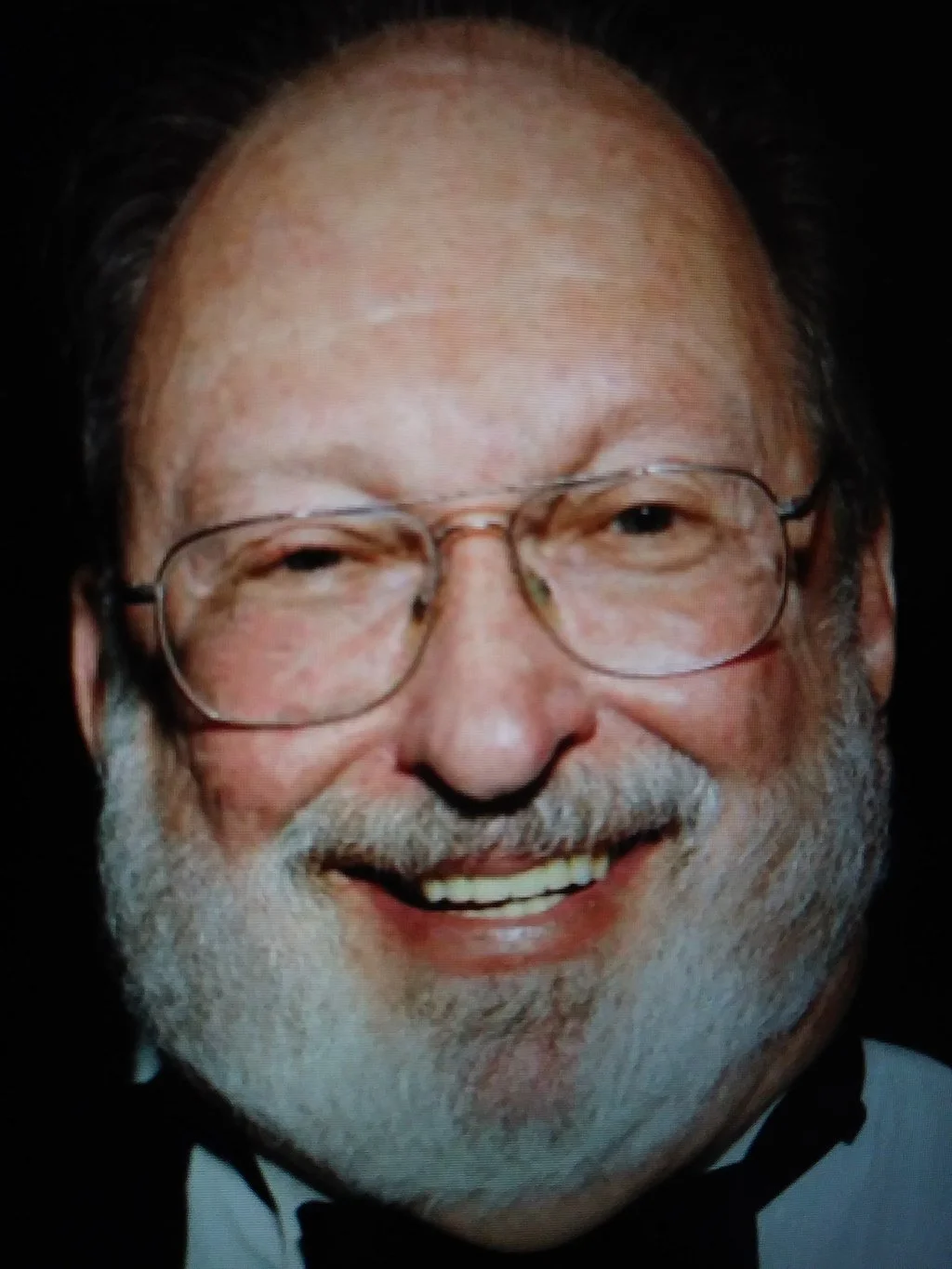
James Bohannon
—Photo by 1anthonyherrera
WEST WARWICK, R.I.
A great voice is stilled. James “Jimbo” Bohannon died of cancer of the esophagus on Nov. 12. Only weeks earlier, he had to resign from his Jim Bohannon Show, the overnight broadcast that aired on 500 radio stations, largely AM, weeknights from 11 p.m.- 2 a.m. ET.
Jim was a big man with a big voice, a big curiosity and a big heart. Over most of the 29 years his show was on the air, I had the pleasure of being a guest from time to time.
At first my wife, Linda Gasparello, a writer, broadcaster and also an occasional guest on the show, and I would journey to a studio in suburban Virginia – the building always looked forbidding in the dark of night. Later, the show moved to the CBS studios on M Street in Washington. But in recent years, Bohannon broadcasted from his home in Westminster, South Carolina.
As with most of us in the trade, I believe “in studio” trumps virtual. But one of the pleasures of radio is that it is portable and can be done with a phone anywhere.
Before Jim took over the show, it was the springboard for Larry King, who once interviewed me in a bedroom in the Algonquin Hotel in New York. That was odd, but I was used to guesting on radio from odd spots, like sitting in a parked car in a hotel lot overlooking the River Moy in Ballina, Ireland.
Jim’s show was a mixture of guests, whom he interviewed with genuine curiosity and gruff respect for views other than his own, and call-ins. He also was kind. I asked him to interview a friend of mine, Ryan Prior, who was establishing a charity to support Chronic Fatigue Syndrome research and medical education. Bohannon asked informed and perceptive questions, and elicited an interesting hour of broadcasting with his skill as an interviewer.
He was less indulgent of crazy folks. If you do call-in radio, you get crazies. When their rants began, Jim simply cut them off. No apology but no indulgence either. Some were regulars and went to lengths to circumvent the security provisions of Westwood One, the show’s syndicator.
One technique was to use a different phone for each attempt, say a wife’s phone or a neighbor’s phone. I once said, “George, in St. Louis, did you take your medicine today?” Jim chuckled, but I doubt he would have addressed a caller that way. Jim had a superficial toughness – he was a Vietnam veteran -- but his kindness always broke through.
Unlike many in a star business, Jim didn’t yearn, that I could discern, to emulate his predecessor Larry King, becoming a television star. Like many, if not most, broadcasters he loved radio. It is flexible, mobile, and not slaved to technology and big crews.
That isn’t to say that Jim didn’t enjoy doing television, but he was a radio man, having started in it, like many, when he was in high school -- in his case, in his native Missouri. He found his footing in Washington, where he did some television and a lot of radio before taking over the late-night slot which uniquely fitted him.
Jim seemed supremely happy in the wee hours. So were his listeners from coast to coast who enjoyed his camaraderie, humor, wisdom and masterful interviewing.
The one talent that great commercial broadcasters all must have is skill in “hitting time” to accommodate syndicated radio advertising. Jim seamlessly guided his interviews to a full stop without the interviewees knowing that they had been diverted to silence. It takes skill to do that. It also takes skill -- and love of craft -- to be fresh night after night; and skill to elicit gems of truth and wisdom from reluctant subjects.
Jim had those talents, but I shall remember especially his talent for friendship. He has signed off but won’t be forgotten by those who knew him and shared the time of stars in the sky with a true star of the microphone.
Llewellyn King is executive producer and host of White House Chronicle, on PBS. His email is llewellynking1@gmail.com, and he’s based in Rhode Island and Washington, D.C.
‘And our new refrigerator’
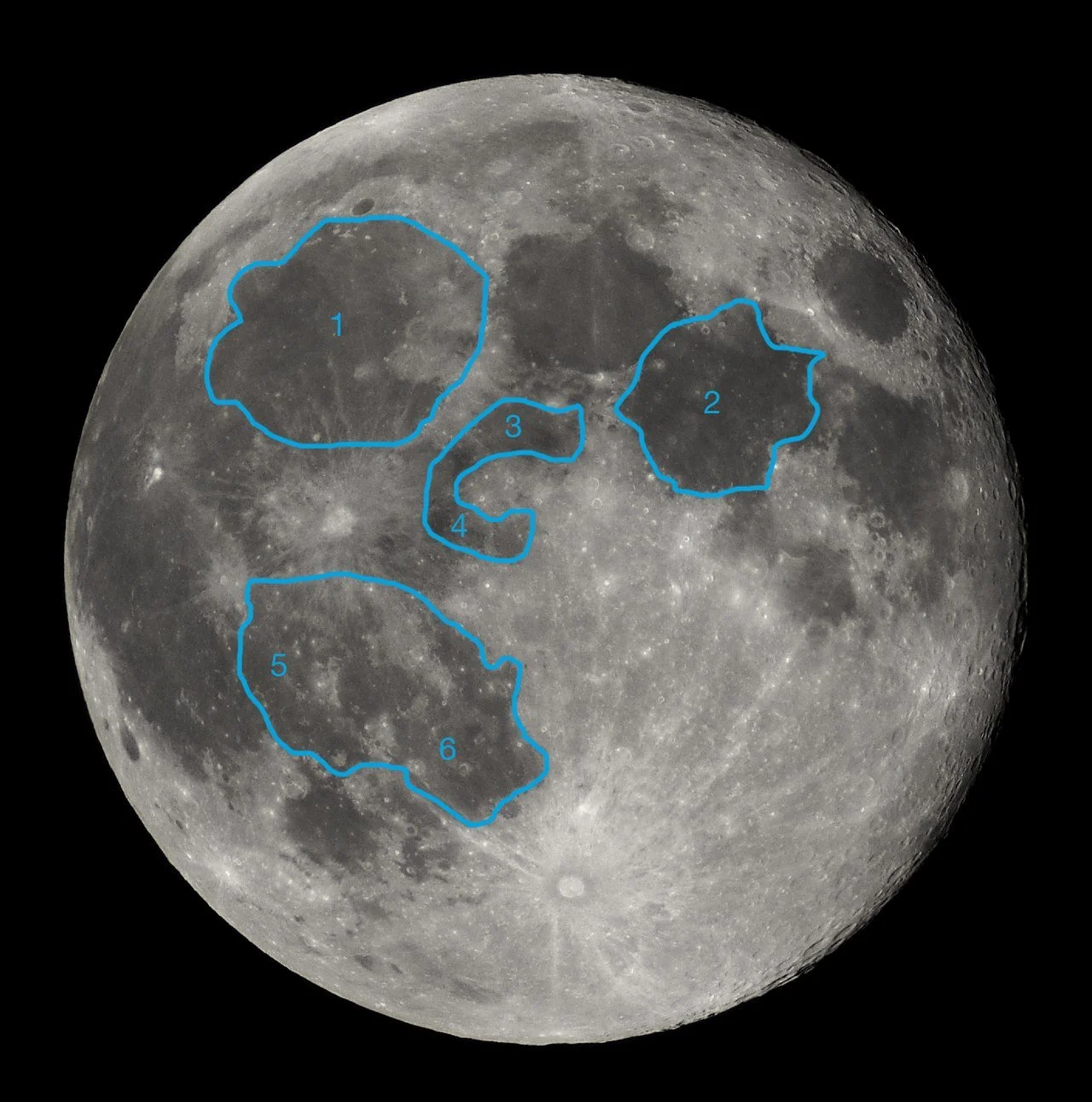
Common interpretation of the Man in the Moon as seen from the Northern Hemisphere
— Photo/graphic byLuc Viatour
“Oh, God, the full-faced moon is smiling at me
in his pink sky, and I'm alive, alive (!)
and driving home to you and our new refrigerator.
A skin of snow shines on the mountain beyond Burger King
and this garden of wires and poles and lighted signs.’’
— From “Coming Home,’’ by Hope, Maine-based poet Elizabeth Tibbetts (born 1953)

Art from Alzheimer’s

“Axial 1” (acrylic on canvas), by Lowell, Mass.-based Diana Zipeto, in her show “Resonance,’’ at Galatea Fine Art, Boston, Dec. 2-Jan. 8
She tells the gallery:
"An MRI machine creates images by sending out signals that the body's cells respond to. The map of these responses offers an impossible view, allowing doctors and scientists to see, diagnose and understand the body.
“The paintings in this exhibit are based on the MRI scans that led to my father's Alzheimer's diagnosis. This ongoing project has given me an opportunity to learn from scientists and neurologists about Alzheimer's and MRI, and provided a way for me to try to navigate this disease that profoundly affects so many families, now including my own.
“The ability of science to look inside for answers and the wish to do so is something my father, as a scientist and engineer, has always believed in. As an artist and creator, I have believed in something similar. The view you get will not provide all the answers or necessary cures, but there is a beauty in the asking."

Adam Bush: In Providence, rethinking higher education for older students

From The New England Journal of Higher Education, a service of The New England Journal of Higher Education (nebhe.org)
We all received the “good” news recently that students are gradually returning to college, slowing the loss of 1 million students in post-secondary classrooms over the past two years to a trickle. But just as COVID-19 has exposed many of the cracks in our social framework, so, too, has it laid bare what an outspoken few have known for years: Higher education isn’t working. Or, to speak more plainly, it is working—to maintain the perception of “meritocracy” that cements hierarchies based on race and inherited wealth.
Meanwhile, in just two years, the number of adults with some college but no degree has spiked by 9 percent, growing to 39 million.
The problem should not be framed, “How can we bring these folks back to college?” but instead, “How can we transform higher education to meet their needs—and what might that transformation mean for all learners seeking a college degree?”
College Unbound (CU), based in Providence, is designed for adults looking to advance in their current careers, move into new vocations or spark change that improves the quality of life for themselves and others. In 2020, we were accredited by the New England Commission of Higher Education. During the pandemic, CU more than doubled our enrollment, and became one of two designated Hispanic Serving Institutions in Rhode Island. Our retention rate for fall 2021 students was 90 percent.
Over the past 13 years, we have designed a college from the ground up, informed by the experiences of our adult learners. Students came to us, and were recruited by us, from moments of frustration in their lives—of being kept from promotions, of financial hurt from accumulating debt and from being misunderstood as lacking agency, intellect and leadership capacity because they did not possess a bachelor’s degree. Students also came to us with a wealth of professional and personal experience and a wealth of learning from both their failures and successes.
While the average age of CU students is 36, we believe that colleges serving students of all ages should think about everyone returning to the classroom as adult learners. And instead of just adding academic, financial and social support, we urge colleges to rethink how they see their learners. Here are a few ways to do so:
Honor your students’ interests.
College Unbound’s curriculum, a single major in Organizational Leadership and Change, is built around student projects that connect to professional development and personal growth. Students meet weekly in professional or place-based cohorts to advance their scholarship, building community, engagement and momentum for learning. In a 2021 survey of our alumni that received a 100 percent response rate, 87 percent report thast they have continued to work on their project after graduation. Notably, 81 percent of CU alumni reported that the project has had a demonstrable impact in their lives, workplaces, organizations, communities or for others beyond CU.
Credit their skills.
Students in their first semester are required to take a course called “Learning from Experience,’’ which introduces them to what we call The Big 10: leadership and change competencies that provide a foundation for CU’s single major of Organizational Leadership and Change. These competencies, which include Problem Solving, Intercultural Engagement, and Communication, align closely with the skills that employers value most. The Big 10 also form CU’s process for obtaining credit for prior learning (CPL). This process is detailed on our website at Building Your Big 10 Leadership & Change Portfolio. While many colleges offer CPL, only 11 percent of adult students earn credit for prior learning. We are unique in that 100 percent of our students complete at least 10 credits via prior learning, because the Big 10 are graduation requirements. By requiring Learning from Experience in the first year, CU graduates earn an average of 21 CPL credits, accelerating their time to completion by more than three semesters.
Meet students where they are already learning.
CU is exploring ways in which college can be accessed through trusted providers of lifelong learning. In partnership with Peer 2 Peer University (P2PU), CU offers free learning circles with an option for college credit, initially at the Providence Public Library and Providence Community Library. Participants who attend learning circles work and learn together at their local community library in a “study group” atmosphere, led by a facilitator. Course materials come from online course providers, universities, and nonprofit organizations from around the world—meaning the courses are both free to take and facilitate.
P2PU and CU now offer these learning circles nationwide through open trainings that will reach an additional 100+ library staff across the country. This project seeks to transform the learning that happens in libraries into a viable degree-completion pathway for radically increasing earnings, uplifting families and transforming communities. Locally, we plan to launch a cohort of BA completers at the Providence Community Library next spring. Long term, we hope this initiative can lead to a global infrastructure that enables public library staff to serve their patrons close to home by offering high-quality credit-bearing training and microcredentialing at low cost in in-demand topics.
The 39 million adults with some college, but no degree, deserve better opportunities than what our current system has to offer. It has been clear for far too long that higher education needs a radical shift in its approach to truly create the “student-centered” learning environment that so many institutions hope to foster. We must meet our students where they are, recognizing that at any age, they will bring an array of interests and prior learning—which should be lifted up, appreciated and credited. We at College Unbound will continue to push for these changes in these critical next few years.
The COVID pandemic has exposed and widened many of the cracks that have existed in higher education since its inception. But this time of recovery also represents an opportunity for all of us to rethink how we might seal up many of those cracks at their very foundation.
Adam Bush is provost and co-founder of College Unbound.
'Rhode Island doesn't compute'


Graphic by TUBS
“I know it sounds harsh, but Rhode Island is too small to be a state….
“If you have any doubts, you need only look at the map. New England, as you can see, is a top-heavy protrusion squared off at the bottom…. Maine of course takes up all the uneven, misshapen space at the top right, which is fine for Maine, because nobody pays attention to Maine anyway.
“New Hampshire and Vermont, by contrast, fit together in a perfectly tidy and orderly Yankee way, one bulging a bit in the north and the other doing the same in the south. They couldn’t be a better match. Beneath them, Massachusetts occupies a sensible, rectangular slab of territory with a somewhat untidy slop-over at Cape Cod. … Rhode Island, I’m afraid, is something else. Rhode Island does not compute.
“Look at the way it cringes there, occupying a sliver of land so inconsequential that the names of its cities and towns have to be entered vertically on the map. It is foolish for something so microscopic to go around posing as a state….’’
— Donald Dale Jackson (1935-2005), in “The Farewell State,’’ in a 2000 Smithsonian Magazine article