
Vox clamantis in deserto









Chris Powell: Conn. GOP’s ‘Parental Bill of Rights’ should be just the start

— Photo by woodleywonderworks
MANC HESTER, Conn.
Call it an opportunistic feint in the "culture war" if you want, but the "Parental Bill of Rights" proposed the other week by the Republican nominees for Connecticut governor and lieutenant governor, Bob Stefanowski and state Rep. Laura Devlin, raises important issues that Connecticut should stop evading.
Several of the Republican proposals are vague. The Republicans say that they oppose presenting sexual topics to the youngest students but don't specify an age or grade at which sex education in school becomes appropriate. Of course, this vagueness is not likely to protect the Republicans from the Democratic demagoguery that in Florida misrepresents the state's fourth-grade threshold as a "Don't Say Gay" law.
The Republicans oppose student masking and vaccination requirements that deny parents "any recourse to object," but that recourse isn't defined either. Should Connecticut reinstate a religious exemption from vaccination of students for the basic childhood diseases? The Republicans don't say.
The Republicans call for expanding school choice for students in underperforming schools and endorse vouchers in principle. Would church schools qualify for these initiatives with government money?
While the long decline in public education's performance argues strongly for making church schools eligible, especially in the cities, again the Republican candidates aren't clear. Gov. Ned Lamont contends that state government's system of magnet schools provides sufficient choice, but in a recent court settlement his administration admitted that the system is not sufficient, that it is unable to meet demand for escape from many failing schools and should expand. Meanwhile, Catholic schools have been closing even as the need for their old competence and economy has exploded.
The Republicans propose spending a lot more money on tutoring students whose education was set back the most by the closing of in-person schooling during the virus epidemic. The Republicans also propose spending more to secure schools against attack. The Republicans don't say exactly where the money should come from, but then as state government rolls in billions of dollars of free federal money, the Democrats don't care much about where money is to come from either.
At least the Republicans are specific in calling to prohibit biological males from competing in girls sports in public schools. But the Republicans frame this as a matter of safety when it is really a matter of fairness, of preserving equal opportunity for girls under Title IX of federal civil rights law.
No matter, since Democratic demagoguery here will accuse the Republicans of "transphobia" and worse, even as Governor Lamont is trying to dodge the issue by contending that policy on transgender athletes should be left to local option -- that is, that the rights of female students should vary among school systems, even as many high school sports events involve two or more towns that could have contradictory policies.
The Republicans dodge a little here too, saying that some mechanism should be developed so that boys wanting to be girls can keep competing. But of course they already can compete in events for their biological sex.
Unfortunately omitted from the Republican proposals is any reference to the policies of deception already adopted by school systems in Hartford, New Haven and some other places in regard to students with gender dysphoria. Such policies forbid schools from notifying parents if their children are getting their school's help in changing their gender identity and names, unless the children approve of informing their parents.
Such policies usurp parental custody, may prevent parents from controlling the medical treatment of their children, and may cause critical delays in treatment before irreversible harm is done.
While such policies have been adopted nominally in the open, at public meetings, they have not been widely publicized and, at least in Hartford and New Haven, not directly publicized to parents at all. That's because any school that made sure that parents fully understood that they will be kept ignorant about the health of their children might face much angry objection.
Of all the rights parents have or should have, none is greater than the right to know exactly what schools are doing with the health and very identities of their children.
Chris Powell is a columnist for the Journal Inquirer, in Manchester, Connecticut. He can be reached at CPowell@JournalInquirer.com.

The Dr. Daniel Lathrop School is a historic school building at 69 East Town St., in the Norwichtown section of Norwich, Conn. It faces the village green next to the Joseph Carpenter Silversmith Shop, another historic building. Built in 1782, the school building is one of the oldest surviving brick school buildings in the state. The building, on the National Register of Historic Places, now serves as a visitors center for the local historical society.
— Photo by CLK Hatcher
Where problems seem small

Brenda Horowitz, “High View” (acrylic on canvas), by Brenda Horowitz, at Berta Walker Gallery, Provincetown, Mass. Now 90, she’s based in New York City and North Truro, next to Provincetown.

Llewellyn King: The ‘service’ sector’s assault on its customers

WEST WARWICK, R.I.
The wreckage from COVID-19 continues to litter our lives. We work differently, play differently and are entertained differently.
For all I know, romance isn’t how it was. How can it be? So many fell in love, or just got into dating, at work. Zooming at home doesn’t quite cut it.
Customer service of all kinds has been laid waste. Excuse the bitter laughter, but what was for a while called the service economy was sent packing by COVID, as companies in droves found out that they could serve less and get the same money.
Let us start with the airlines. If you have had the misfortune to take a flight, you are as likely suffering from your own brand of PTSD. You may get counseling at the YMCA or find a support group online.
First off, booking online. This isn’t for the faint of heart. Some people aren’t computer-wise but they shouldn’t think that they can call the airlines and get help. That is so last century. You had best find one of the few independent travel agents still in business. This person, you soon learn, will book you on Expedia and charge you a fee for doing the obvious. What price hassle reduction?
The Transportation Security Administration infuriates us all. More so since COVID erupted, because many people don’t want to put on the TSA uniform when they can get work where everyone doesn’t hate them.
It didn’t have to be this way. If the airlines and their friendly regulator, the Federal Aviation Administration, had just put locks on cockpit doors after the first hijackings in the 1950s, chances are that there would have been no 9/11, no TSA, and I could keep my shoes on and TSA hands off. If you like being patted down, get a dog.
Then there is the cash conundrum. On bank notes, it says, “This note is legal tender for all debts public and private.” Not anymore. Try using cash at the airline counter. Not since COVID do they take it. I saw a sad situation when a young woman, already pulled up short for having to pay for checking her backpack, was told to convert her cash into a credit voucher at a machine, which has suddenly appeared near the check-in — for another fee, of course. Friendly skies, eh?
Once you have paid extra for luggage, extra for a marginally larger seat, extra to board early, and extra for Wi-Fi, you might think all is well, and it is time for the boarding scrum. No way. The flight is canceled. No pilot. To my mind, that would be a critical job in aviation, and if you have the temerity to run an airline, you might want to have a few extra pilots. Soon, the airlines may ask passengers to pop forward and handle the controls — for a fee, of course.
Banks responded to COVID by closing branches and putting ATM machines in parking lots.
Maybe you have tried to pay your credit-card bill when it is already in arrears because the bank-card company has stopped sending out paper bills without telling you? Next thing is that they are calling you in the middle of dinner to tell you that your credit is being damaged by your being tardy paying. “No problem,” you tell the recorded voice, which has just ruined dinner.
Don’t call them unless you have half a day to spare because you are aren’t supposed to call the bank and speak to anyone anymore. It used to be a person, but they are now “representatives” who have just crossed the border and sent to a call center by a Southern governor. They know enough English to tell you that they are trying to collect a debt, not solve your problem because you don’t have the paper bill.
You give up. You don’t care about your credit score anymore. You read this person the information from your check and ask them to take the money and do something unsanitary with their card. Over? Hell no. Later, you will get a letter from the “customer relations team” telling you impolitely that your check didn’t clear because you gave them the wrong routing number.

You may find it tough to get someone to clean up your hotel room.
— Photo by JIP
Hotels also have jumped at the opportunity to stick it to you since the COVID outbreak. You have to beg to have your room cleaned, even though you pay hundreds of dollars a night. More begging for towels. When you complain about how you are being treated, they say this is for your safety due to COVID.
The hospitality industry is reeling from COVID. Yes. Reeling it in
On Twitter: @llewellynking2
Llewellyn King is executive producer and host of White House Chronicle, on PBS. He’s based in Rhode Island and Washington, D.C.
On Twitter: @llewellynking2
White House Chronicle

— Photo by Jengod
War in Newport

The National Museum of American Illustration, in Newport, has many famous World War I posters. This is one of those it’s using in its battle against Salve Regina University’s plan to add dormitory space for more than 400 students, with accompanying parking, in the museum’s neighborhood.

Eric Berger: Hemp-derived delta-8 raises health concerns

A hemp field in Côtes-d'Armor, Brittany, France, Europe's largest hemp producer.
— Photo by Barbetorte
“You can either get in a lot of trouble buying cannabis, or you can get delta-8.”
— Peter Grinspoon, M.D., primary-care physician at Massachusetts General Hospital, in Boston.
Suzan Kennedy has smoked marijuana, and says her Wisconsin roots mean she can handle booze, so she was not concerned earlier this year when a bartender in St. Paul, Minnesota, described a cocktail with the cannabinoid delta-8 THC as “a little bit potent.”
Hours after enjoying the tasty drink and the silliness that reminded Kennedy of a high from weed, she said, she started to feel “really shaky and faint” before collapsing in her friend’s arms. Kennedy regained consciousness and recovered, but her distaste for delta-8 remains, even though the substance is legal at the federal level, unlike marijuana.
“I’m not one to really tell people what to do,” said Kennedy, 35, who lives in Milwaukee and works in software sales. But if a friend tried to order a delta-8 drink, “I would tell them, ‘Absolutely not. You’re not putting that in your body.’”
The FDA and some marijuana-industry experts share Kennedy’s concerns. At least a dozen states have banned the hemp-derived drug, including Colorado, Montana, New York, and Oregon, which have legalized marijuana. But delta-8 manufacturers call the concerns unfounded and say they’re driven by marijuana businesses trying to protect their market share.
So what is the difference? The flower of the marijuana plant, oil derived from it, and edibles made from those contain delta-9 tetrahydrocannabinol, the substance that produces the drug’s high, and can be legally sold only at dispensaries in states that have legalized marijuana. Similar products that contain delta-8 THC are sold online and at bars and retailers across much of the U.S., including some places where pot remains illegal. That’s because a 2018 federal law legalized hemp, a variety of the cannabis plant. Hemp isn’t allowed to contain more than 0.3% of the psychotropic delta-9 THC found in marijuana.
The concerns about delta-8 are largely focused on how it’s made. Delta-8 is typically produced by dissolving CBD — a compound found in cannabis plants — in solvents, such as toluene that is often found in paint thinner. Some people in the marijuana industry say that process leaves potentially harmful residue. A study published in the journal Chemical Research in Toxicology last year found lead, mercury, and silicon in delta-8 electronic cigarettes.
The FDA has issued warnings about the “serious health risks” of delta-8, citing concerns about the conversion process, and has received more than 100 reports of people hallucinating, vomiting, and losing consciousness, among other issues, after consuming it. From January 2021 through this February, national poison control centers received more than 2,300 delta-8 cases, 70% of which required the users to be evaluated at health care facilities, according to the FDA.
Delta-8 is “just the obvious solution to people who want to have access to cannabis but live in a state where it’s illegal,” said Dr. Peter Grinspoon, a primary care physician at Massachusetts General Hospital and a longtime medical cannabis provider. “You can either get in a lot of trouble buying cannabis, or you can get delta-8.”
Grinspoon described delta-8 as about half as potent as marijuana. But because of the lack of research into delta-8’s possible benefits and the absence of regulation, he would not recommend his patients use it. If it were regulated like Massachusetts’s medical and recreational marijuana programs, he said, harmful contaminants could be flagged or removed.
Christopher Hudalla, chief scientific officer at ProVerde Laboratories, a Massachusetts marijuana and hemp-testing company, said he has examined thousands of delta-8 products and all contained contaminants that could be harmful to consumers’ health.
Delta-8 has “incredible potential as a therapeutic” because it has many of the same benefits as marijuana, minus some of the intoxication, said Hudalla. “But delta-8, like unicorns, doesn’t exist. What does exist in the market is synthetic mixtures of unknown garbage.”
Justin Journay, owner of the delta-8 brand 3Chi, is skeptical of the concerns about the products. He started the company in 2018 after hemp oil provided relief for his shoulder pain. He soon started wondering what other cannabinoids in hemp could do. “‘There’s got to be some gold in those hills,’” Journay recalled thinking. He said his Indiana-based company now has more than 300 employees and sponsors a NASCAR team.
When asked about the FDA’s reports of bad reactions, Journay said: “There are risks with THC. There absolutely are. There are risks with cheeseburgers.”
He attributes the side effects to taking too much. “We say, ‘Start low.’ You can always take more,” Journay said.
Journay said that he understands concerns about contaminants in delta-8 products and that his company was conducting tests to identify the tiny portion of substances that remain unknown, which he asserts are cannabinoids from the plant.
An analysis of 3Chi delta-8 oil conducted by Hudalla’s firm last year and posted on 3Chi’s website found multiple unidentified compounds that “do not occur naturally” and thus “would not be recommended for human consumption.” Delta-8 oil is still sold on 3Chi’s site.
Journay said the analysis found that only 0.4% of the oil contained unknown compounds. “How can they then definitively say that compound isn’t natural when they don’t even know what it is?” he said in an email.
“The vast majority of negative information out there and the push to make delta-8 illegal is coming from the marijuana industries,” Journay said. “It’s cutting into their profit margins, which is funny that the marijuana guys would all of a sudden be for prohibition.”
Delta-8 products do appear to be significantly cheaper than weed. For example, Curaleaf, one of the world’s largest cannabis companies, offers packages of gummies that contain 100 milligrams of delta-9 THC for $25, plus sales tax, at a Massachusetts dispensary. At 3Chi, gummies with 400 milligrams of delta-8 cost $29.99 online, with no tax.
Journay’s criticism of the marijuana industry holds some truth, said Chris Lindsey, government relations director for the Marijuana Policy Project, which advocates for legalization of marijuana for adults. “We see this happen in every single adult-use legalization state,” said Lindsey. “Their established medical cannabis industry will sometimes be your loudest opponents, and that’s a business thing. That’s not a marijuana thing.”
Still, the bans might not be working fully. In New York, which banned delta-8 in 2021, Lindsey said, it’s available at any bodega.
In July, Minnesota implemented a law that limits the amount of THC, including delta-8, allowed in hemp products outside of its medical marijuana program. News reports said the law would wipe out delta-8. But the state cannot “control what’s being sold over the internet outside of Minnesota and shipped in,” said Maren Schroeder, policy director for Sensible Change Minnesota, which aims to legalize recreational cannabis for adults.
Max Barber, a writer and editor in Minneapolis, remains interested in delta-8 despite his state’s restrictions. Even though he could likely obtain a medical marijuana prescription because he has an anxiety disorder and chronic sleep problems, he hasn’t pursued it because pot made his anxiety worse. He used CBD oil but found the effects inconsistent. In March 2021, he tried a 10-milligram delta-8 gummy.
“It got me pretty high, which I don’t enjoy,” he said.
Then he found what he considers the right dosage for him: one-third of a gummy, which he takes in the evening. He said he now gets between six and eight hours of sleep each night, has less anxiety, and is better able to focus. “I have become kind of an evangelist for delta-8 for everyone I know who has sleep problems,” said Barber, who bought enough gummies to last for months after the new law went into effect.
To address concerns about delta-8, the federal government should regulate it and make accessing cannabis easier for consumers, said Paul Armentano, deputy director of the National Organization for the Reform of Marijuana Laws.
He pointed to a recent study in the International Journal of Drug Policy showing that the number of Google searches for delta-8 in the U.S. soared in 2021 and that interest was especially high in states that restricted cannabis use. “In an environment where whole-plant cannabis is legally available, there would be little to no demand for these alternative products,” said Armentano.
Lindsey, of the Marijuana Policy Project, isn’t so sure that would matter. When he first learned of delta-8’s growing popularity in 2021, he thought it would go the way of drugs like K2 or Spice that he said fall between the regulatory rules long enough to get on shelves before eventually getting shut down.
“That didn’t materialize,” said Lindsey. “The more that we understand about that plant, the more of these different cannabinoids are going to come out.” And that, he said, will in turn spur interest from consumers and businesses.
Eric Berger is a reporter for Kaiser Health News
On an inland sea

At Harbor Point, on Little Traverse Bay, Mich. (watercolor), by William T. Hall, a Rhode Island/Florida/Michigan-based painter.
Trying to keep kosher on Cape Ann many years ago

Photos at the Cape Ann Museum, Gloucester, Mass.
(Left) Belmont Hotel, c. 1890s. Photograph by Walter Gardner. (Right) Belmont Clothing House, 1881. Photograph by Corliss and Ryan. Both were Jewish-owned.
The museum relates:
“As early as the 1860s, Jews have been a part of Cape Ann’s diverse economy. One of the first Jewish residents of Gloucester, Samuel H. Emanuel, started the S.H. Emanuel & Co Millinery Shop in 1868 after he and his wife, Delia, immigrated from Germany. Another early resident, Solomon Hochberger, opened a dry-goods shop in Lanesville in 1875. Hochberger later started a junk business with fellow Jewish resident David Heineman in 1887. Jews from the waves of Jewish immigration … made their living as peddlers, tailors and cobblers as well as owners of dry-goods shops, junk businesses, bakeries, grocery stores, clothing stores, hotels and summer camps. Many of these businesses, such as Harry Goldman’s clothing store (est. 1896), Joseph Bloomberg’s clothing store (est. around 1900), Louis and Leah Pett’s grocery store (est. mid 1920s), Bennie Schred’s Star Remnant Store (est. 1909), Samuel Feldman’s grocery store (est. late 1920s), and Bob Kramer’s haberdashery (est. 1948) became fixtures of the Jewish community. Jewish-owned bakeries, grocery stores, and restaurants were especially important when it came to Jews trying to keep kosher on Cape Ann. Unlike larger Jewish communities on the North Shore that were closer to Boston, access to kosher meat was difficult. Feldman’s grocery store was one of the few places on Cape Ann where Jews could find kosher meat”.
‘Back to the wind’

Looking toward Mt. Katahdin from Chamberlain Lake.
“Chamberlain Lake {in Maine} is huge this year….
“Out on the deepest part
of the lake, where amethyst swells
release their hold
and turn back toward shore,
a man gives his father’s ashes
back to the wind.’’
— From “Photographing the Sunset,’’ by New Hampshire poet Sara Willingham

Future of higher education in New England prisons

Aerial view of Massachusetts Correctional Institute (MCI) at Concord.
— Photo by Nick Allen
From the New England Council (newenglandcouncil.com)
“Earlier this year, the New England Board of Higher Education (NEBHE), and The Educational Justice Institute (TEJI) at MIT launched the New England Commission on the Future of Higher Education Behind Bars. New England Council President & CEO Jim Brett has been asked to serve on this commission. Both NEBHE and MIT are New England Council members.
Research shows that there are 201,860 people who are currently incarcerated, on parole or on probation in New England. Additionally, 58 percent of all formerly incarcerated people in the New England region do not have a high-school diploma or equivalent whereas only 13 percent of non-incarcerated New Englanders have not achieved a high school diploma or equivalent. Further, incarcerated people who participate in higher education behind bars are 48 percent less likely to recidivate than those who do not.
This commission plans to formally convene about 65 individuals who represent key stakeholder groups relevant to prison education, including: key corrections and postsecondary leaders, previously incarcerated individuals, employers, policymakers and governors. In addition, it will issue a formal report that includes stakeholder-specific recommendations and a detailed action plan to make New England a leader in higher education behind bars ahead of the Pell release in 2023.
Additional information can be found here and here.
For more information on this issue please contact Sheridan Miller at smiller@nebhe.org. For information on the New England Council’s Higher Education Committee please contact Mariah Healy, director of Federal Affairs, at mhealy@newenglandcouncil.com.”
‘To the time of our ancestors’

“Djan’kawu Sisters Story” (1942) (natural pigments on eucalyptus bark), by Mawunbuy Munuŋgurr, in the show “Maḏayin: Eight Decades of Aboriginal Australian Bark Painting from Yirrkala,’’ at the Hood Museum of Art, Dartmouth College, Hanover, N.H., through Dec. 4. Credit: Donald Thomson Collection. On loan to Museums Victoria from the University of Melbourne. DT000065. Courtesy Hood Museum of Art.
The museum says the exhibit showcases over 90 paintings on eucalyptus that "chronicles the rise of a globally significant art movement as told from the perspective of the Yolŋu people." The paintings represent songlines, sung stories, through rich depictions, lovingly rendered in natural pigments.
"The stories and the songlines take you back to the time of our ancestors," writes Wanyubi Marika, a prolific artist and ambassador of the Yolŋu people. For more information, please visit here.

Ongoing war in Gilded Age neighborhood

Ochre Court, built in 1890-1895 as the summer residence of Ogden Goelet (1851-1897), an American businessman, heir and yachtsman, is now Salve Regina’s central administration building. Concerts, lectures and other special functions are held in the ballrooms on the ground floor.
Adapted from Robert Whitcomb’s “Digital Diary, in GoLocal24.com
Look for fireworks at the Newport Zoning Board’s meetings Wednesday, Sept. 21, and Thursday, Sept. 22, both at 6 p.m., over Salve Regina University’s controversial plan (hated by some) to build two dorms to house a total of 400 more students, with parking lots to go with them. The battle, over land between Bellevue, Shepard, Victoria, Ruggles and Lawrence avenues, has been going on for years.
You can’t blame some of the neighbors for being very unhappy at the idea of a big institutional expansion in the midst of a celebrated Gilded Age neighborhood. But virtually all colleges and universities want to expand.
The meetings will be held in Newport City Hall in a second-floor room. This being Newport, perhaps there will be a couple of celebrities there.
Few land-use and building disputes are as animated as those in The City by the Sea.
Beatific about Boston

“Here’s the thing about Red Sox fans, or actually just fans from that region, in general: they appreciate the effort. And if you mail it in or if you give 80 percent, even with a win, they’ll let you know that’s not how you do it. They want – if it’s comedian, if it’s a musician, bring us your best show.”
— Dane Cook (born 1972), American comedian
“For no matter how they might want to ignore it, there was an excellence about this city (Boston), an air of reason, a feeling for beauty, a memory of something very good, and perhaps a reminiscence of the vast aspiration of man which could never entirely vanish.”
-- Arona McHugh (1925-1996), American writer
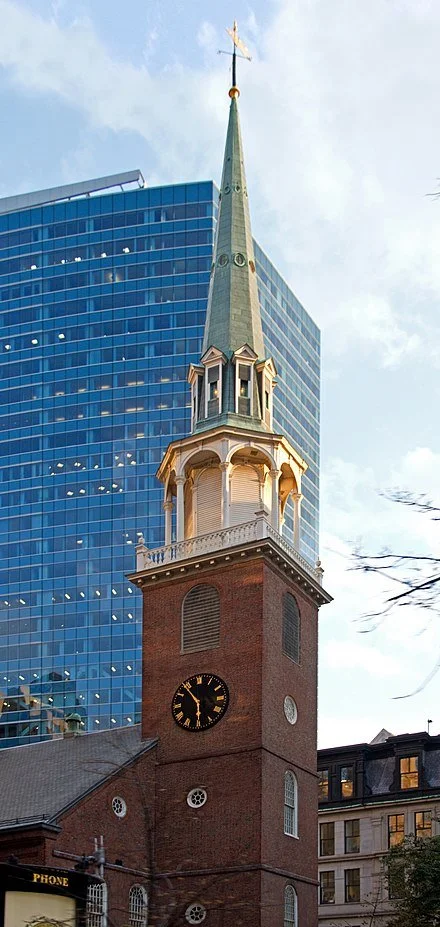
Steeple of the Old South Meeting House (built in 1729).
“Here {Boston} were held the town-meetings that ushered in the Revolution; Here Samuel Adams, James Otis and Joseph Warren exhorted; Here the men of Boston proved themselves independent, courageous freemen, worthy to raise issues which were to concern the liberty and happiness of millions yet unborn.” —sign at the entrance of the Old South Meeting House, author unknown
“Its driving energy sparked always by independence and freedom of the spirit — can this be anywhere so strong, so fascinating, so enduring as in Massachusetts?”
— Pearl S. Buck (1892-1973), Nobel Prize-winning novelist
‘Flames’

— Photo by DigbyDalton
“Cardinals at the windows see enemy
black and white newspapers turn to color
reflections or crimson hills or horses
for added effect. There’s lots of red now, flames….”
— From “Coups de Coeur (Wounds to the Heart),’’ by Pat Frisella, a Farmington, N.H.-based poet
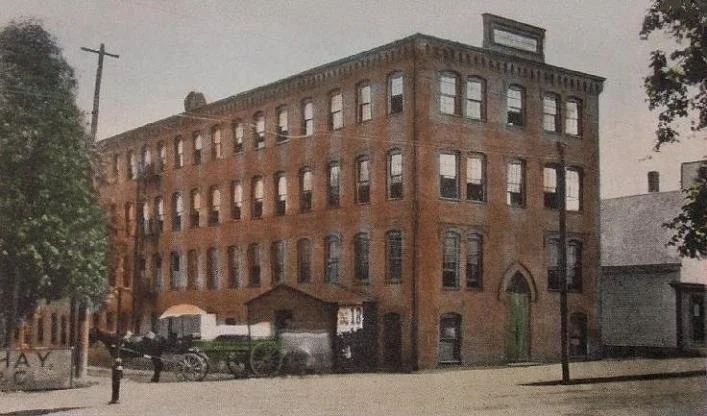
The Thayer and Osborn shoe factory in Farmington in 1915. The town was once a major shoemaking center.
Ready for a fight

“Costume Design” (1924) (graphite and gouache on paper), by Alexandra Exter, in the show “Time and Tide Flow Wide: The Collection in Context, 1959-1973,’’ at the Colby Museum of Art, Waterville, Maine. The exhibition celebrates the early years of the museum.
Llewellyn King: Adieu the Queen — We mourn together all those years as memories of empire are laid to rest

Notice at Holyrood Palace, in Edinburgh on Sept. 8. The building is the official residence of British monarchs in Scotland.
WEST WARWICK, R.I.
I have a feeling that with the burial of Britain’s Queen Elizabeth II at Windsor Castle a gallant and dutiful monarch has been laid to rest, but so has an empire. And millions have been given license to weep for her and for ourselves.
The British summoned up centuries of history in a show of pageantry that none of us will see again -- and which, in truth, may never be seen again.
It was, if you will, the spectacular to end all spectaculars.
The British buried their longest-serving monarch and, I think, they also buried memories of empire, and of a time when ceremony was part of the art of governance.
I was born into that empire in a British colony, Southern Rhodesia, now Zimbabwe, and was brought up in its traditions, and with the expectation that it would last forever. When the Queen acceded to the throne, in 1952, it was seen in the colonies as a new beginning — that somehow Britain would rise again — that there would be another grand Elizabethan period recalling the one that began in 1533.
When the Queen was crowned, India had already gained independence, in 1947, but we still clung to what Winston Churchill said in 1942, “I have not become the King’s first minister in order to preside over the liquidation of the British Empire.”
But that was coming. The forces of democracy and, more so, the forces of self-determination were at work in what Prime Minister Harold Macmillan was to describe, in his epic 1960 speech to the South African Parliament, as a “wind of change.”
That wind blew steadily until the British Empire was indeed liquidated and had been replaced by the loose, fraternal Commonwealth. The empire had dribbled away. The Union flag came down, and new flags went up from Burma to Malawi.
In Britain itself the shrinking of its global reach was hardly marked, as life changed, and other struggles occupied the nation.
The Queen’s funeral was, with its extraordinary pageantry, a reminder of the past, and a reminder that it, indeed, is past.
Most of those among the extraordinary throng that sought to enter Westminster Abbey were, at best, only subliminally aware of the farewell to much of British history.
Throughout the Queen’s lying-in-state, there has been another force at work.
I believe that when we have these occasions to weep, we weep for ourselves, for all our hurts and failures, and for all the pain of the world. When FDR died, when Churchill died, when John Lennon was shot, when Diana, Princess of Wales was killed in a car crash, when Nelson Mandela died, the world wept then as now.
Public ritual is public healing, and Queen’s state funeral -- the first one since the death of Churchill, in 1965 -- was a way for us to cry for the myriad hurts in our own lives and across the human condition.
When you can hug a stranger and shed a tear, one is connected to all of humanity in a way that transcends class and race, religion, and wealth and poverty. Briefly, we are one, seemingly in grief for a remarkable monarch, but also in grief for ourselves.
There is an expression that one used to hear in Britain, and may still do, “It does one good to have a good cry.”
The world has had a good cry, thanks to an august queen, who died at 96, after presiding over a dwindling empire and a surging affection, over a very human and often dysfunctional family, and who smiled through, carrying her nation and the world with her.
Her final act was to let the world cry for itself, as much as for her. Well played, ma’am. Now rest in peace.
Llewellyn King is executive producer and host of White House Chronicle, on PBS. His email is llewellynking1@gmail.com ,and he’s based in Rhode Island and Washington, D.C.
One can believe a five-mile backup on the Mid-Cape Highway
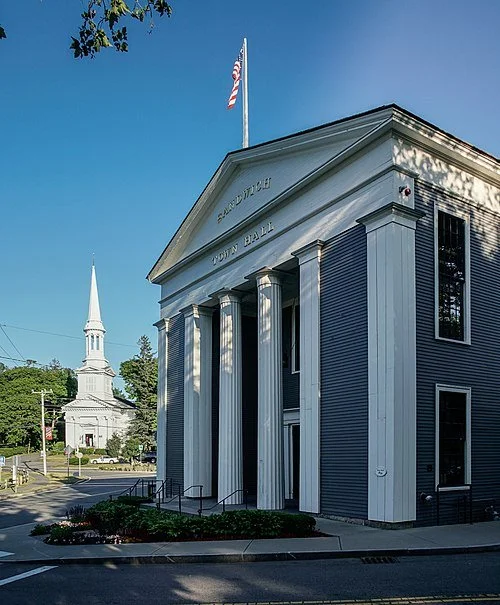
Sandwich, Mass., Town Hall (1834) and Congregational Church (1848).
“One can believe anything on the Cape, a blessed relief from the doubts and uncertainties of the present-day turmoil of the outer world.’’
— Thornton Burgess (1874-1965), American conservationist and children’s book author in Now I Remember (1960). He was a native of Sandwich, on the north side of The Cape.
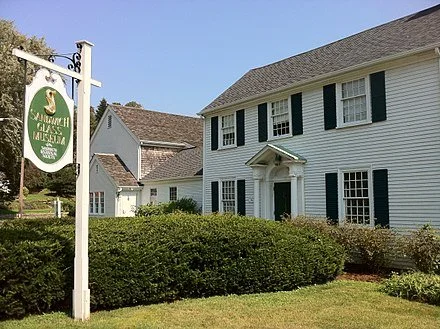
Sandwich was long famed for its glass-making industry, including the beauty of many of its products.

David Warsh: 3 cheers for Ukraine and 2 cheers for The West

SOMERVIILLE, Mass.
World opinion seems to have turned, pretty conclusively, against Russia’s invasion of Ukraine. A combination of Ukraine’s army’s success in defending its sovereignty, the Russian army’s flight from regions previously occupied, and Vladimir Putin’s reluctance to attempt to mobilize his populace for full war, have led China’s Xi Jinping and India’s Narendra Modi to publicly express reservations about his attempt to annex his neighbor.
Thus Moscow bureau chief Robyn Dixon said a couple of days ago in The Washington Post:
Putin and Xi each harbor resentments over past humiliations by the West. They dream of cutting the United States down to size, then taking what they see as their rightful places among several dominant world leaders. They are dictators, ruling “democracies” that lack any meaningful democratic features. And they both want to reshape global rules to suit themselves.
But Putin’s chaotic, tear-it-all-down approach, kicking down the territorial sovereignty of neighboring Ukraine and perpetrating the biggest land war in Europe since World War II, could not be more different from Xi’s careful, steady moves to bend global institutions to Chinese values.
The war has roiled global supply chains and set off global economic instability, impacting China, along with most of the world. It has irreparably harmed Putin’s reputation, exposed his country’s military weakness and triggered punishing sanctions, without producing a single notable benefit.
Columnist Janan Ganesh, in the Financial Times:
I don’t pretend that the average Westerner has read their Hume and Spinoza. I don’t even pretend they deal in such abstractions as “The West”. But there is a way of life – to do with personal autonomy – for which people have consistently endured hardship, up to and including a blood price. Believing otherwise is not just bad analysis. It leads to more conflict than might otherwise exist.
Kremlinologists report that Vladimir Putin saw the U.S. exit from Afghanistan last year as proof of Western dilettantism. From there, it was a short step to testing the will of the West in Ukraine. You would think that U.S. forces had rolled up to Kabul in 2001, poked around for an afternoon, deplored the lack of a Bed Bath & Beyond, and flounced off. They were there for 20 years. Whatever the mission was – technically inept, culturally uncomprehending – it wasn’t decadent.
How much carnage has this misperception of the west triggered? The [1930’s] Empire of Japan couldn’t believe the hermit republic that America then was, would send armed multitudes 5,000 miles away in response to one day of infamy. (And, remember, never leave.) The Kaiser in 1914 and Saddam Hussein in 1990 made similar assessments of the liberal temper. It is not out of vanity or machismo that The West should insist on recognition of its fighting spunk, then. It is to avert the fighting
Two cheers, then, for “The West.” The American republic is deeply divided, England a mess, Scotland on the verge of more devolution, the old British Commonwealth of Nations coming apart, NATO reduced as a moral force. Yet Ganesh is right; the global community of Western liberalism is here to stay. In its ongoing competition with Russia, China, and Iran, the Free World abides.
David Warsh, a veteran columnist and an economic historian, is proprietor of Somerville-based economicprincipals.com, where this columnist originated.
Colleen Cronin: The big potential of shellfish aquaculture

Live blue mussels on a rocky substrate
— Photo by Andreas Trepte

From ecoRI News (ecori.org)
The sound of thousands of mussels moving on conveyor belts and clanking through sorting machines almost drowned out Greg Silkes as he tried to explain how the shellfish get from the ocean, through the processing plant, to plates around North America.
Silkes is the general manager American Mussel Harvesters, one of the largest mussel producers in North America, and he helps run the business along with his father and other family members. On Wednesday, the Silkes and America’s Seafood Campaign hosted U.S. Sen. Jack Reed (D-R.I.), and other officials and seafood stakeholders at their location in North Kingstown, R.I., to discuss the shellfish-farming industry and its importance to public health, the economy, and reducing carbon emissions.
American Mussel Harvesters has been around since 1986 and has grown from a small operation with one boat and one phone to a large enterprise that ships mussels, clams, and oysters around the country.
Rather than fishing from pockets of naturally occurring shellfish on the seafloor, American Mussel Harvesters grow their product from tiny seeds in lots in the ocean. Greg Silkes said that a bag about the size of a shoe box can store millions of itty-bitty shellfish.
Overall, it takes about two to four years to get the shellfish from seed to table, but, depending on the maturity of the seeds American Mussel Harvesters buys, it usually takes six to eight months to grow and process their product and get it on the market.
As workers sorted the mussels into different grades, packed them into netted bags, and placed them in boxes filled with ice, Silkes said the shipment would be headed to a nearby Market Basket.
In the last two years the business model has shifted away from restaurants and toward retail because of the pandemic, Silkes said, and they’ve automated more of their processing plant to accommodate that change.
Still, American Mussel Harvesters does sell to local restaurants. “I love going to eat and saying this is my product,” Silkes said.
Later, on a boat specifically outfitted for shellfish harvesting, the group, which included several members of the Silkes family, Reed, and representatives from National Oceanic and Atmospheric Administration (NOAA), Rhode Island Department of Environmental Management (DEM), the Rhode Island Food Policy Council, and East Coast Shellfish Growers Association, sat down for a round table discussion about the industry.
Bill Silkes, the owner and founder of American Mussel Harvesters, started off the discussion thanking Reed for his work to promote shellfish farming in Rhode Island. “Under your watch,” Rhode Island’s gone from zero to more than 40 farms, Silkes told the senator.
Reed noted that it’s an important industry “not just to Rhode Island, but to the entire nation.”
According to the Commercial Fisheries Research Foundation, in R.I., the fisheries and seafood sector — which includes commercial fishing and shellfishing, fishing charters, processing, professional service firms, retail and wholesale seafood dealers — consists of 428 firms that generated 3,147 jobs and $538.33 million of gross sales in 2016. Including spillover effects across all sectors of the R.I. economy, the total economic impact was 4,381 jobs and an output of $419.83 million. The Port of Galilee alone hosts 240 fishermen that bring in 48 million pounds of seafood annually.
As the industry continues to grow, Bill Silkes said, a lack of dock space and growing space will impact local businesses. Indicating the vessel hosting the round-table talk, Silkes said it had already been kicked out of a slip once to accommodate a yacht.
He also noted efforts to start moving farming into federal waters, something that has made more progress in the last few months than in previous years.
“The opportunity is enormous,” he said.
Assistant administrator for NOAA National Marine Fisheries Service Janet Coit said she’s been working to get aquaculture out of state waters and that part of the challenge is that permitting will involve several different groups.
Coit, the former DEM director, said she sees the “same issues” federally in getting farms up and running as there were in Rhode Island, “just at a different scale.”
Bob Ballou, assistant to the director of DEM, talked about RI Seafood, the state-run marketing campaign designed to get more Rhode Islanders eating local catch.
Ballou said the campaign not only supports the seafood industry, it also provides economic, public health, food security, and environmental benefits in a “win-win-win-win-win” situation.
Seafood produces six times less than the carbon emissions of beef, said Diane Lynch, president of the Rhode Island Food Policy Council, so shifting protein consumption toward foods like shellfish and away from cattle could help to mitigate the effects of climate change.
“We’re just slowing [climate change] down, it’s too late to stop… but we have to do much, much more,” Reed said, adding that the seafood industry is “much kinder to the environment than some other folks.”
Linda Cornish, president of the Seafood Nutrition Partnership, added that on top of the other benefits, seafood is a valuable nutritional resource and may contribute positively to mental health.
At the end of the discussion, Mason Silkes brought out fresh oysters and showed Reed how to shuck them while the group slurped them down.
Colleen Cronin is a Report for America corps member who writes about environmental issues in rural Rhode Island for ecoRI News.
Chris Powell: Why not just take him to Rikers now?

Rikers Island from above.
MANCHESTER, Conn.
If distributing more money was the solution to the state's serious social problems, Connecticut would have solved them long ago. Instead state government now has another commission, the Commission on Community Gun Violence Intervention and Prevention, which met for the first time last month and is to advise the state Public Health Department about awarding another $2.9 million in grants to "community-based violence-intervention organizations."
Despite last month's announcement from Gov. Ned Lamont's re-election campaign that Connecticut is headed toward "four more years of gun safety," the daily shootings continue, especially in the cities. Except for the political patronage to be conferred by those grants, no one really needs "community-based violence-intervention organizations" to figure out why.
For starters, most children in the cities have little if any parenting. More than 80 percent are living without a father in their home, many having no contact with their fathers at all. Many of their mothers are badly stressed by single parenting and trying to make a living, even with welfare benefits. Some have drug problems. Some are so addled that their children are being raised by a grandparent.
Their parents having failed them, many children then fail in school, if they even reach school. The chronic absenteeism rate in Hartford's school system is 44 percent, in New Haven's 58 percent. It is high in some suburbs too. While most children in Connecticut graduate from high school without ever mastering basic math and English, the failure to meet grade-level proficiency in city schools is catastrophic at all levels.
As a result many young people -- most young people in the cities -- enter adult life without the education and job skills necessary to get out of poverty, demoralized, resentful, angry, often unhealthy mentally as well as physically, lacking respect for society and indifferent to decent behavior. These circumstances prove disastrous when they collide with the natural male aggressiveness that has never been tamed by parenting.
Many quickly get in trouble with the law, and repeatedly, and so become still more alienated, not ever understanding what hit them and why, since, after all, the underclass lifestyle has been normalized. Guns are everywhere -- and always will be, no matter what laws are enacted -- and so will always present what seem like opportunities for advancement or settling scores.
"Community-based violence-intervention organizations" and their advocates think that, most of all, these troubled young men need a good talking to, and indeed such counseling can help temporarily in critical situations. But other critical situations soon develop unless someone can escape the underclass culture.
As with so much else wrong with society, government chooses to address only the symptoms, not the causes. Especially with social problems, when government encounters the equivalent of broken pipes flooding a road or basement, it doesn't try to repair the pipes but instead calls for more buckets for bailing. The bucket manufacturers make a fortune but the problem is never solved, since mere remediation quickly becomes too profitable financially and politically.
Government refuses to learn from this though it's an old story. Many years ago an episode of the television drama Law and Order showed police detectives entering a dark and dingy city apartment where an abandoned baby was crying. A veteran detective who had seen it all remarked: "How about if I just take him to Rikers now?" {Rikers Island is New York City’s main prison complex.}
* * *
PARENTAL BILL OF RIGHTS: While the formal text of the "parental bill of rights" proposed by the Republican candidates for Connecticut governor and lieutenant governor, Bob Stefanowski and Laura Devlin, which was cited in this column last week, does not say so explicitly, Stefanowski elaborates that its provision on school choice means to make church schools eligible for state-financed student vouchers.
xxx
SOCIAL SECURITY TAX: Supporting U.S. Rep. John B. Larson's legislation to strengthen the Social Security system, this column last week misstated the annual personal income level at which the Social Security tax is lifted. It is $147,000, not $400,000. To improve the system's financing, Larson's legislation would impose a special 2 percent tax on incomes above $400,000.
Chris Powell is a columnist for the Journal Inquirer, in Manchester, Connecticut. He can be reached at CPowell@JournalInquirer.com.
Will it into order

“I'm a Mess” (mixed media on canvas), by Sonja Czekalski, in her joint show, “Body/Image,” with Tracy Wesisman, at Hera Gallery, Wakefield, R.I., through Oct 8.
For more information, hit this link.
The Gallery says:
“These two, concurrent solo exhibits explore ‘changing body and societal expectations’ and ‘womanhood and women’s bodies through the female gaze.’ Both women's work, from Weisman's fiber and mixed-media pieces to Czekalski's mixed-media and sculptural assemblages interrogate society and culture from a woman's point of view.’’
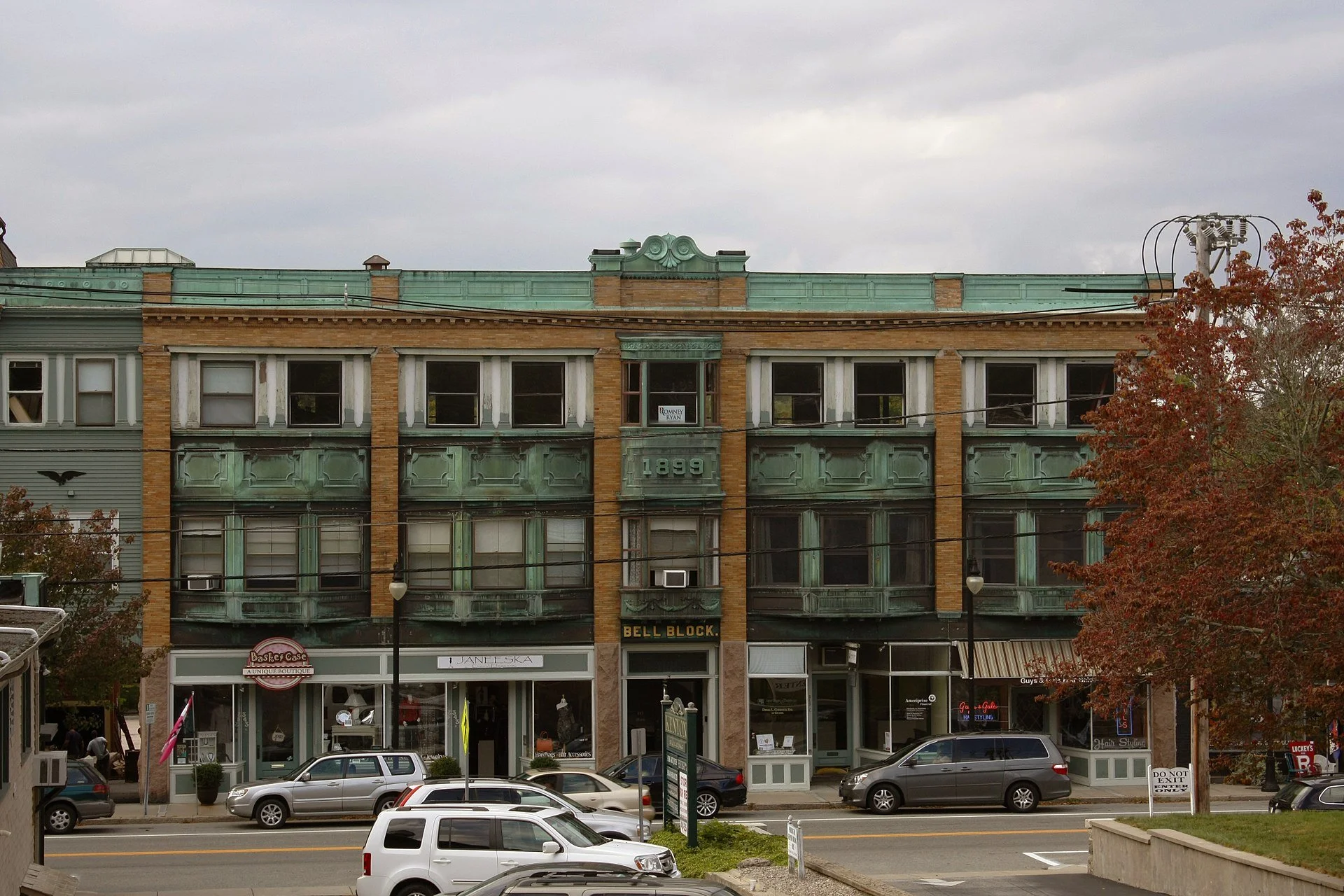
The Bell Block in Wakefield, in “South County, R.I.
— Photo JacobKlinger