
Vox clamantis in deserto




David Warsh: 'Depreciation,' 'development' and 'inflation'

SOMERVILLE, Mass.
Everyone knows that the cost of living has risen significantly in the past 75 years — recently, at rates not seen since the early ‘80s. To understand a little better why this has is happening, try this simple trick: Think of rising prices as a matter of the depreciation of the dollar against the prices of goods and services, instead of “inflation.” That won’t make the experience any less disorienting than calling it by the headline term, but it will give you a better sense of how and why the problem has arisen.
What’s the difference? With “inflation,” the answer is implied by the question. The explanation is always the same: the governors of the Federal Reserve Board have been cavalier with interest rates. Too much money is chasing too few goods. “Depreciation,” on the other hand, permits you to think about events taking place in the real world that forced the Fed’s hand – events that monetarists commonly describe as “ad hoc.”
Certainly a great deal of “ad hoc” change has occurred in the real world since 1950, when a candy bar cost a nickel and a haircut could be had for $1.25. Very little of the momentum behind that history would seem to have originated with the Fed, the stringent tightening of monetary policy in 1979-’82 being the major exception.
The current episode of rapidly rising prices is associated with the governmental response to COVID; accelerated with outbreak of all-out war in Ukraine; deglobalization of supply chains; food shortages and the threat of famine; policies designed to slow climate change, and energy disruptions now said to rival the crisis of the early and mid ‘70s.
True, in the course of regulating the nation’s system of money and banking, the Fed had to react to these various afflictions. Sometimes its governors may have overreacted. Sheer monetary incompetence can have a place in the story, too: Look no farther than the central bank of Sri Lanka for an example of that.
In the main, though, dollar depreciation occurs in response to real-world problems. Severe interest-rate policy can arrest expectations of runaway prices, as in the ‘80s. But dollar depreciation occurs in response to real forces. Never in millennia has it been reversed in a currency that endured. Repeating the mantra that “‘inflation’ is everywhere and always a monetary phenomenon” is just blowing hot air.
In The Cost of Living in America: A Political History of Economic Statistics 1880-2000 (Cambridge, 2009), Thomas Stapleford, of the University of Notre Dame, describe how we came to employ sophisticated price indices to measure rising prices. The construction of economic statistics makes a fascinating story, but Stapleford spends only two paragraphs on why the cost of living changes, accepted at face-value explanations of particular episodes advanced by economists: W. Stanley Jevons, in the 19th Century, and Irving Fisher, in the 20th. In each case, the economists asserted, when “the supply of money increased, its value would fall, leading to higher prices.” Hence the “inflation” of prices by an excess of money.
But what if it works the other way around? What if the “cost-push” argument is more often correct? What if the quantity of money increases because prices are rising? Every central banker knows it is not simply one or the other; it is both. But with “inflation,” you only see one side of the story – in most instances, the less important side.
We don’t know more because there exists no conceptual scheme of sufficient generality to organize all those various “ad hoc” explanations of rising prices under one heading. Whatever intuitive appeal has existed in the term “complexity,’’ “complexity” was already well on its way to becoming a magic word, an incantation, quite devoid of meaning.
The second mistake I made was failing to notice that economists already possessed a serviceable term of their own to describe this dimension of modern life. They called it “economic development,” words as familiar and easy to use as they were lacking in precision. To give it meaning to development, as opposed to “growth,” which is a matter of inputs and output, requires only linking back to one of the most fundamental categories in all of economic theory: the division of labor.
Easier said than done! Although the role of specialization in producing material well-being is clearly spelled out in the first three chapters of An in Inquiry into the Nature and Causes of the Wealth of Nations, Adam Smith quickly moves on to the analysis of a competitive system, and this is the tradition, taken up by David Ricardo and T.R. Malthus, that has dominated economics down to the present day. I was slow to figure this out.
There! After fifty years of writing about these topics, often clumsily, my two key mistakes are acknowledged, and I have set out here all I have learned: “depreciation” and “development” (understood as the extent of the division of labor) are better language than “inflation,” not to mention (here I blush) “complexity” and “conflation” in 1984.
For a glimpse of how things might yet be different, and probably will be before long, see “One Analogy Can Hide Another: Physics and Biology in Alchian’s ‘Economic Natural Selection’”, by Clément Levallois, which ultimately appeared in 2009 in History of Political Economy. (JSTOR access required). Or tune in to Nathan Nunn, now back at the University of British Columbia. But the biological analogy at the heart of the re-launch of evolutionary economics in the years after World Wat II is too wonky for this column.
David Warsh, a veteran columnist and an economic historian, is proprietor of Somerville-based economicprincipals.com, where this column first appeared.
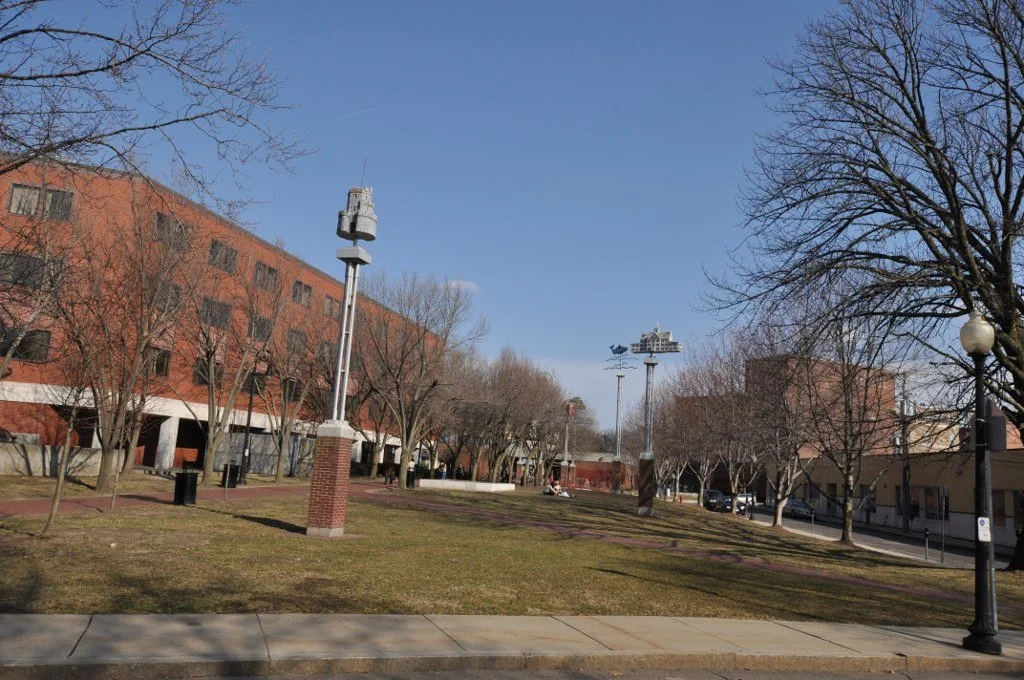
Seven Hills Park at Davis Square, Somerville. The towers in the park each represent one of the city's original hills.
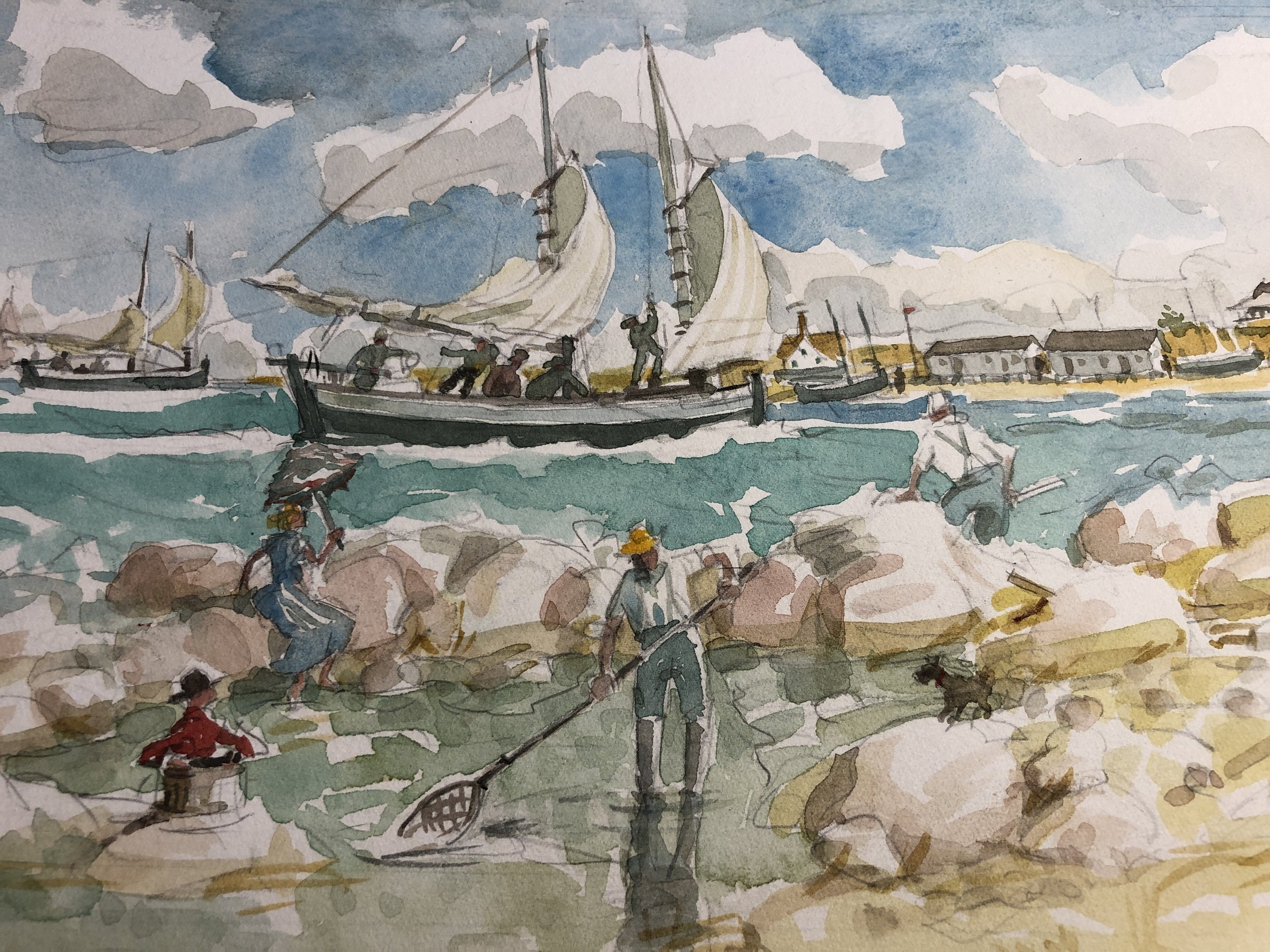
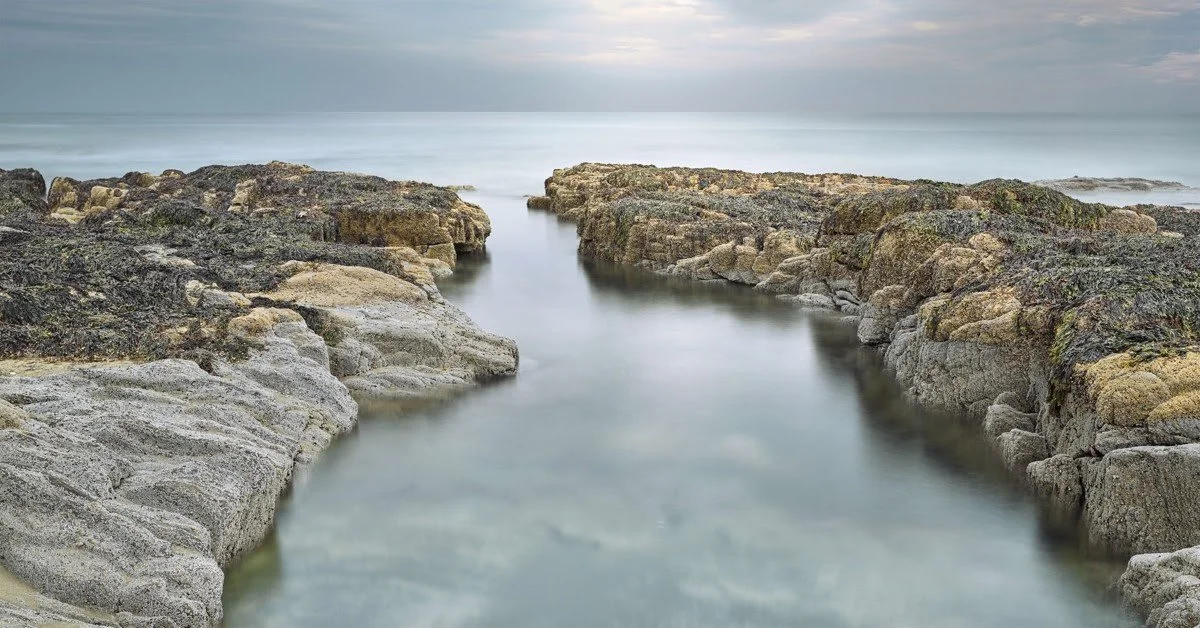
Islanders using everything they can from the sea

In this watercolor by William Hall, Block Islanders in the 19th Century are collecting fin fish, crabs and lobsters trapped in tidal pools. They also harvested large amounts of seaweed to be used for food and fertilizer. See photos below. This painting is part of an extensive series of watercolors Mr. Hall has done over the past decade of people at work.
He is represented by, among other venues, David Chatowsky Art Gallery, 47 Dodge St., Block Island, R.I. (401) 835-4623
One recipe for “seaweed pudding”:
Put a cup of dried seaweed in a pan and add a liter of whole milk.
Gently bring to boil and simmer for 10 to 15 minutes.
Strain through a fine sieve or a muslin cloth into a bowl and cool.
Put in a refrigerator to set for a couple of hours.
The harvesting of seaweed — mostly kelp — (including increasingly from aquaculture) for food and many other uses has greatly increased in the past few years. And seaweed aquaculture is more and more promoted for environmental reasons. For one thing, it absorbs some of the excess carbon dioxide put into the atmosphere by fossil-fuel burning. For another, seaweed — especially “kelp forests” — is a home for many species.
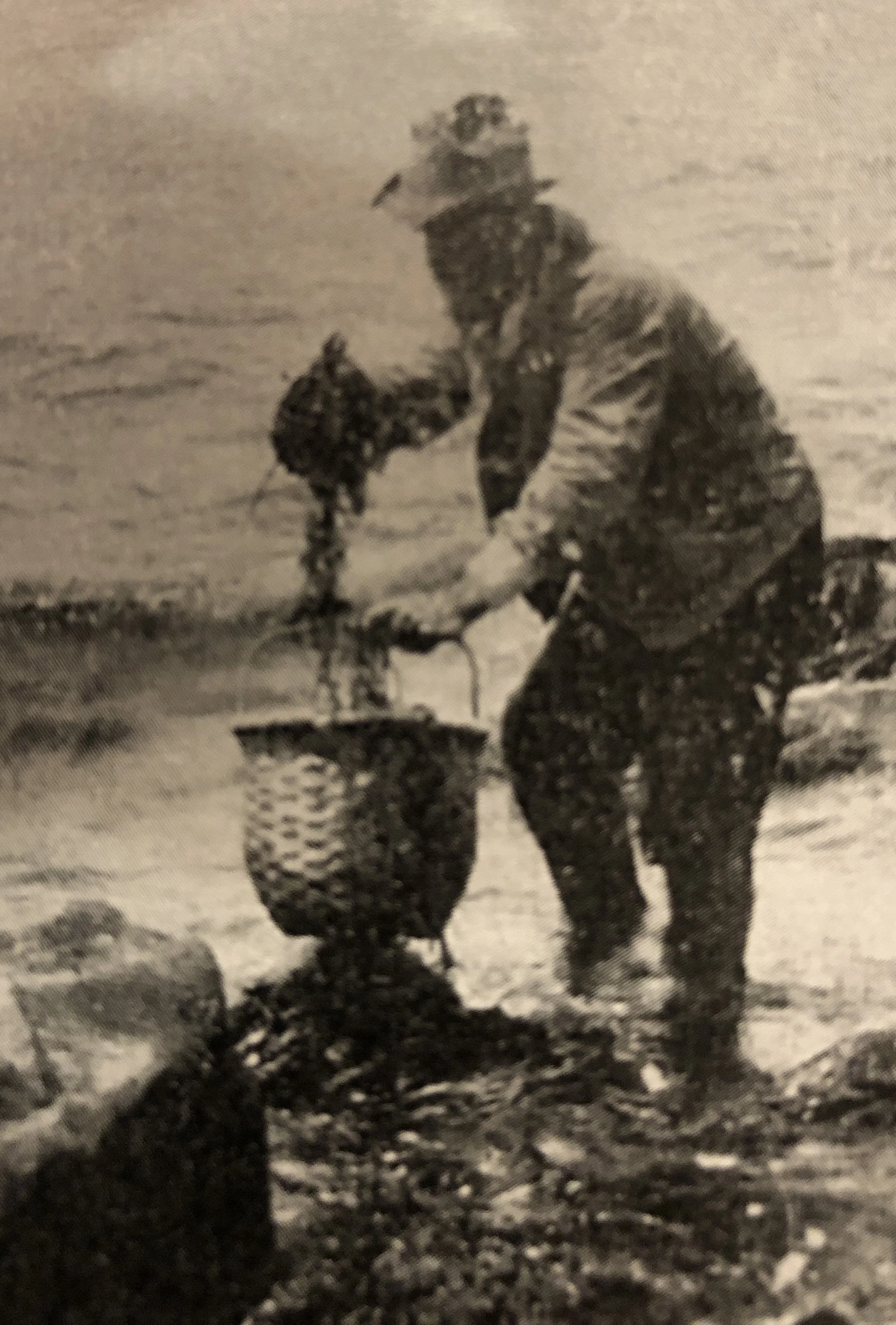
Collecting seaweed in locally made baskets.

Spreading seaweed as fertilizer on a Block Island farm.
‘Insecurity and surprise’
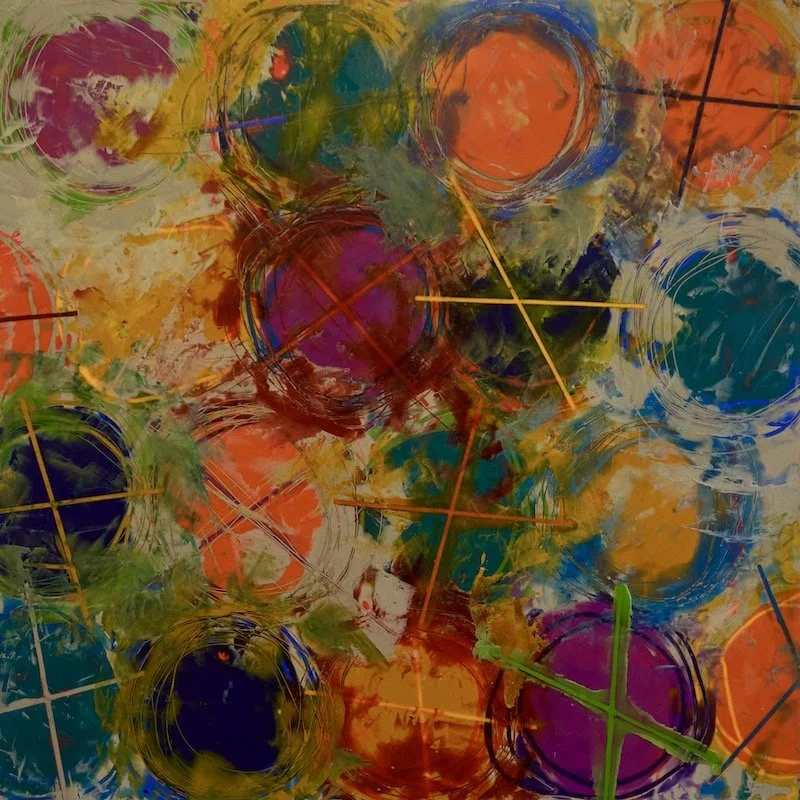
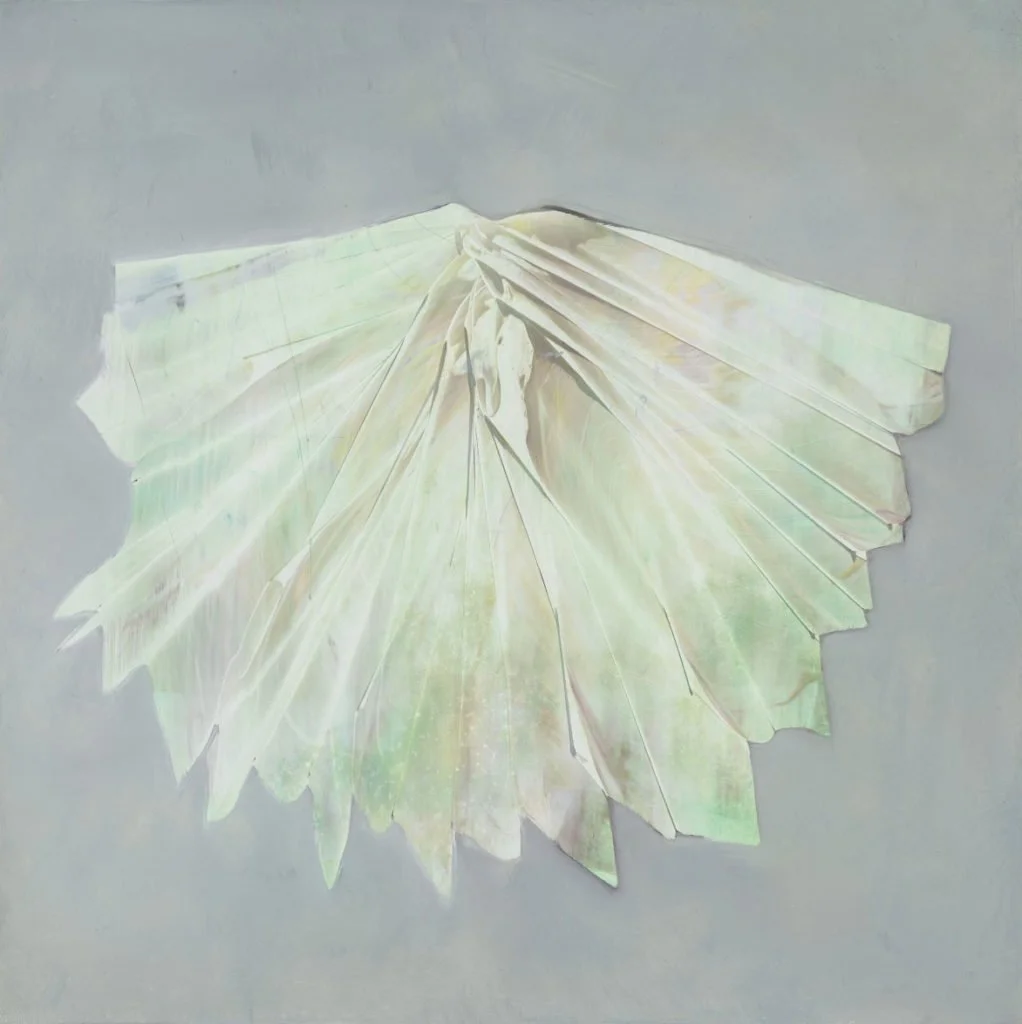
“Resonance” (encaustic painting), by Deborah Peeples, who has a studio in Somerville, Mass., and lives in neighboring Cambridge.
She writes in the New England Wax Web site:
“Painting is my sensual response to the world, a time-release recording of the sounds, smells, and intensity of a moment. Abstraction is a language that traces my inner turbulence and exuberance. The natural translucent materials of beeswax and damar contain a lush baroque beauty. Mixing pigments, playing with opacity, heating the panel, always touching, breathing the smell of the hot beeswax, brings a slowness and intimacy to the process. The work is layered, incised, inlaid, and scraped; lines cut into the surface, either sharp or blurred, feel alternately vulnerable and impenetrable. Humor and playfulness are found in the saturated, syncopated color and jostling shapes that play off an underlying grid. These juxtapositions create imbalance, insecurity, and surprise, a metaphor for the search to find my place in the world’’.
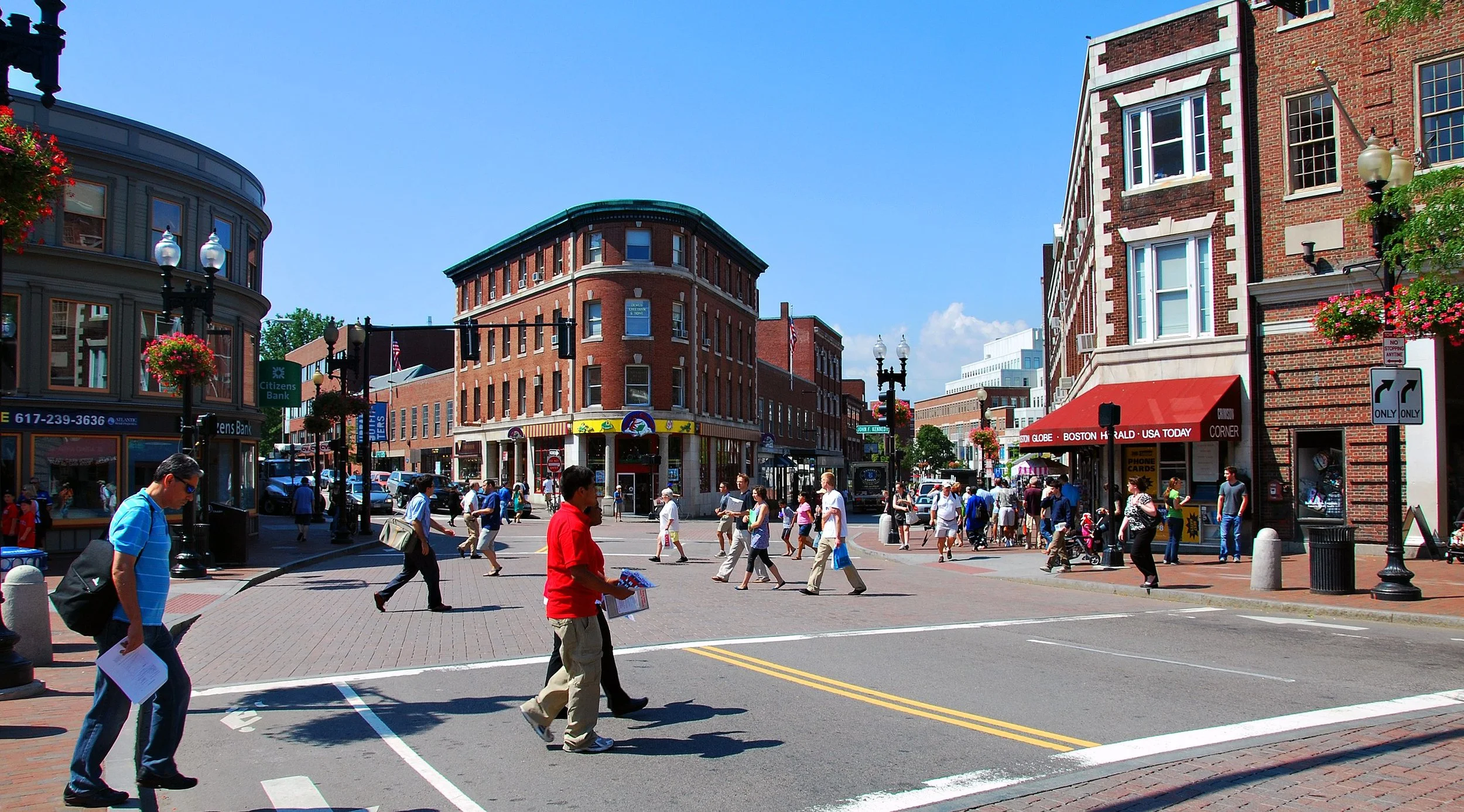
Harvard Square, in Cambridge
— Photo by chensiyuan
The stalactite coast
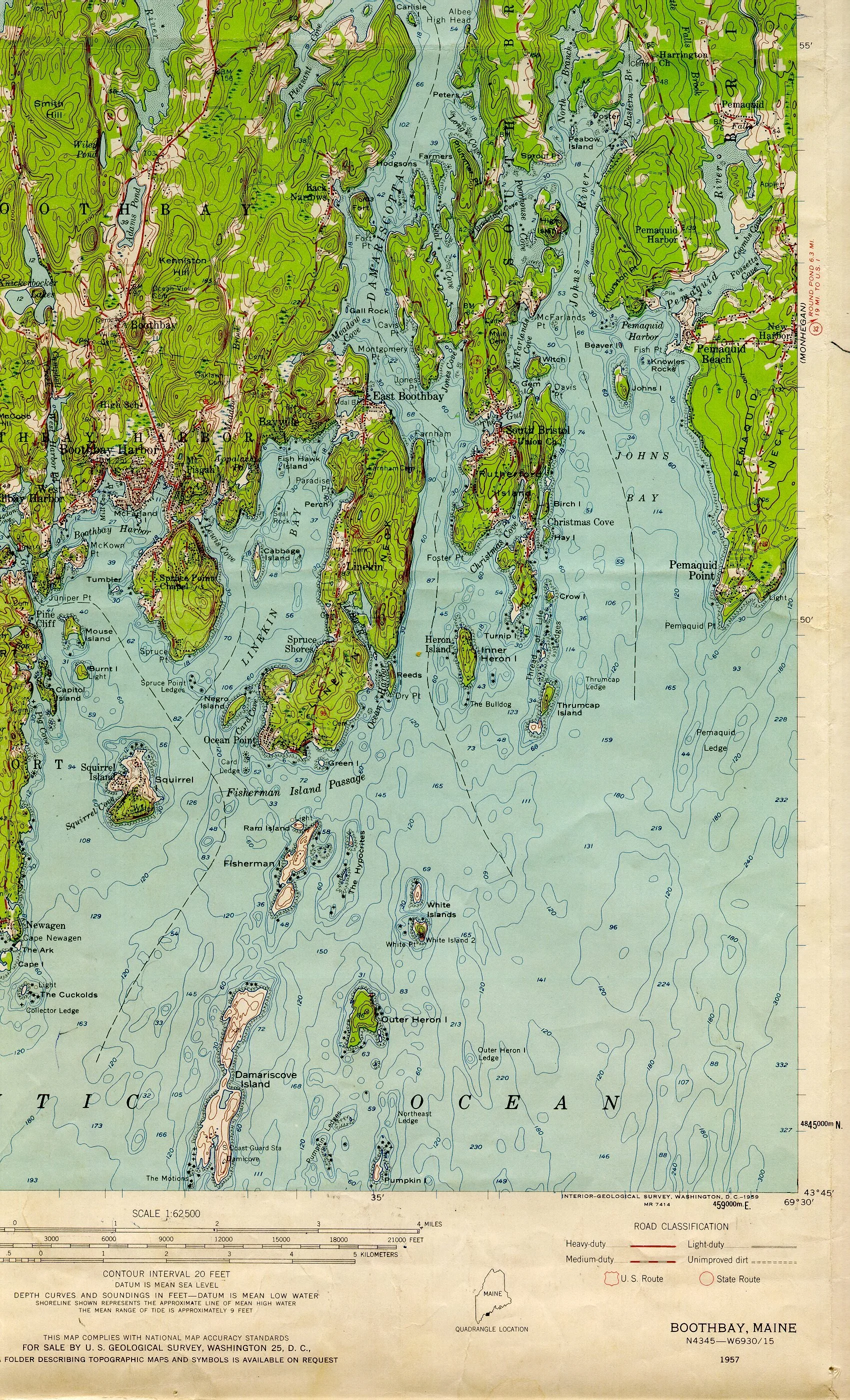
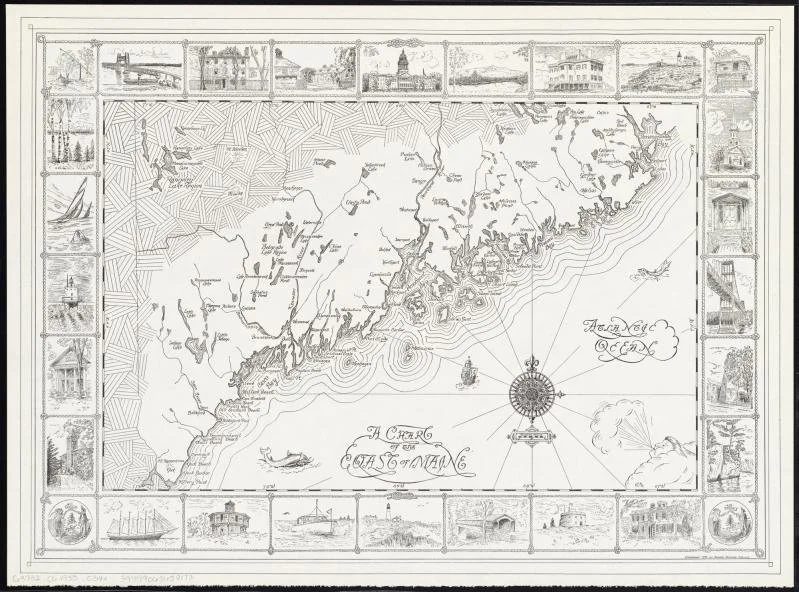
“The middle part of Maine, all the way from Bar Harbor to Portland, hangs down like stalactites that drip little islands into the Atlantic. It's divided by rivers and harbors with cozy names that sound like brands of bubble bath or places boats sink in folk songs.”
― Linda Holmes (born 1970), an American author, cultural critic and podcaster
xxx
“Portland could have been any city. Port Clyde was too uncluttered to be anything else. There is a reason Stephen King sets his stories in little Maine towns. They are too quiet to be believed wholly savory.”
―From Holidays With Bigfoot, by Thomm Quackenbush (born 1980), American author of horror, epic fantasy and contemporary fantasy.

Chris Powell: ‘These kids are so desensitized’

A 1936 poster promoting planned housing as a way to deter juvenile delinquency, showing silhouettes of a child stealing a piece of fruit and the older child involved in armed robbery.

Some muskets
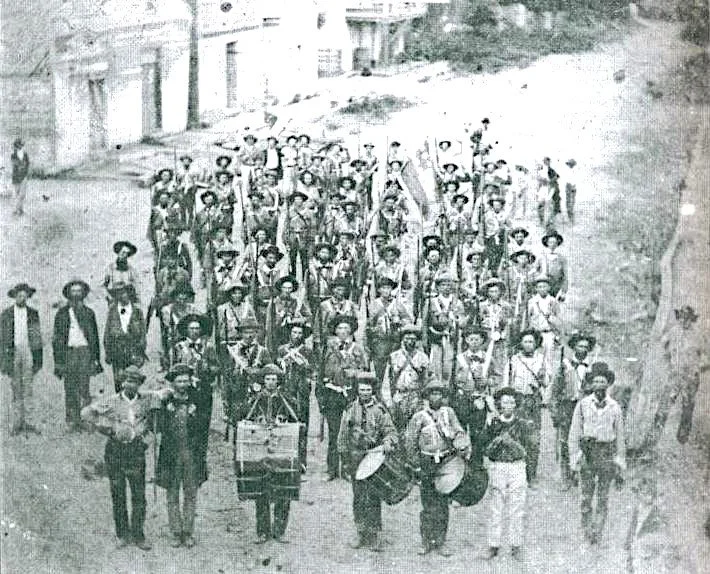
The Hempstead Rifles, a volunteer militia company from Arkadelphia, Ark. in 1861, ready to fight for the Confederacy.

AR-15-style rifles
MANCHESTER, Conn.
Ancient Rome's foremost historian, Tacitus, who often sat at the center of the empire's government, observed, "The more corrupt the state, the more numerous the laws." Today he might add that the nation with ever-more laws is probably becoming not just more corrupt but more dishonest and stupid as well.
The recent mass shooting in Highland Park, Ill., may be a case in point. That state has tough and comprehensive gun-control laws and a "red flag" law -- just like Connecticut. Yet these laws didn't stop the disturbed young man charged with the crime, whose craziness was well known to his parents and the police but prompted no intervention.
In recent days in Connecticut a 15-year-old boy was shot to death and a woman wounded in Fairfield at a birthday party for a 13-year-old that was attended by dozens of people. Then two people were shot in New Haven, for which a 17-year-old was charged, and two more were shot in downtown Norwich, for which an 18-year-old was charged.
Meanwhile a Norwalk City Hall forum on gun violence, attended by Mayor Harry Rilling and U.S. Rep. Jim Himes, produced only a glimmer of understanding. The forum heard that many young men are idle, uneducated, and unskilled and that despite Connecticut's strict laws, legal and illegal guns alike are prevalent here.
Ebony Epps, of Street Safe Bridgeport, added, "These kids are so desensitized." But like everyone else Epps advocated only more "programs," which multiply almost as fast as the laws with a similar lack of effect.
There were no calls at the forum to inquire why the young men are so "desensitized," no calls to inquire into the causes of the social disintegration that is slowly destroying the country.
There was no acknowledgment that the strictest gun laws have accomplished little more in Connecticut's cities than they have in Chicago or New York.
For the country now has a huge underclass -- disengaged, demoralized, alienated and unproductive but heavily armed, and the underclass won't be giving up its guns any faster than the rest of the country will be.
Where has this underclass come from? Is it the fault of Donald Trump and George W. Bush? Why wasn't it civilized under Barack Obama and Bill Clinton? Why are fewer people today prepared to become good citizens?
Anything short of questions like those is a waste of time, except for people aspiring to careers in "programs."
xxx
Some wise guys in Connecticut, angry at the Supreme Court's recent reiteration in the Second Amendment case from New York that individuals have the right to keep and bear arms, are arguing again that the right should be restricted to members of the militia mentioned in the amendment.
Yes, "a well-regulated militia" is the rationale offered by the Second Amendment for the right to keep and bear arms. But this rationale for the right does not establish a requirement. Back when the Bill of Rights was adopted, people didn't have to be formal members of a militia to be eligible to join it or be summoned into it. The Bill of Rights gave the people the right to keep and bear arms just in case.
That is how the Second Amendment was construed back then. People today may consider the amendment's rationale outdated, but it's still in the Constitution and it's not for the courts or state legislatures to change or invalidate it. That can be done only by repealing the amendment through the prescribed constitutional procedures.
The wise guys complain that today's semi-automatic rifles are "weapons of war," far more deadly than the muskets in use when the Bill of Rights was adopted. The wise guys argue that the country's Founders didn't imagine that the right to keep and bear arms included "weapons of war." But of course the Founders imagined it, since back then muskets were "weapons of war" too.
Connecticut's own Constitution suggests that the Supreme Court has construed the Second Amendment exactly as it was understood when it was ratified in 1791. For since 1818, 27 years after ratification of the Second Amendment, Connecticut's Constitution has declared: "Every citizen has a right to bear arms in defense of himself and the state."
It always was and remains an individual right.
Chris Powell is a columnist for the Journal Inquirer in Manchester.

Against the world

“Madonna and Child” (mixed media collage on paper, oil, ink, beeswax), by Lexington, Mass.-based artist Sirarpi Walzer, in the joint show “Efflorescence,’’ with Patricia Ganek, at Three Stones Gallery, Concord, Mass., through Aug. 27.
For more information, hit here.
The artist, who is also an engineer, writes on her site:
“My poetic abstractions spring both from meditations on nature and from memories that are distilled into single dramatic moments. The energetic surfaces imply an ongoing tension between freedom and containment, edging the viewer closer to that place where chaos can erupt into clarity. The color white suggests notions of purity and simplicity, and unifies the disparate objects. The deliberate juxtapositions of forms and exaggerations of color choices, provide clues to content and interpretation.’’
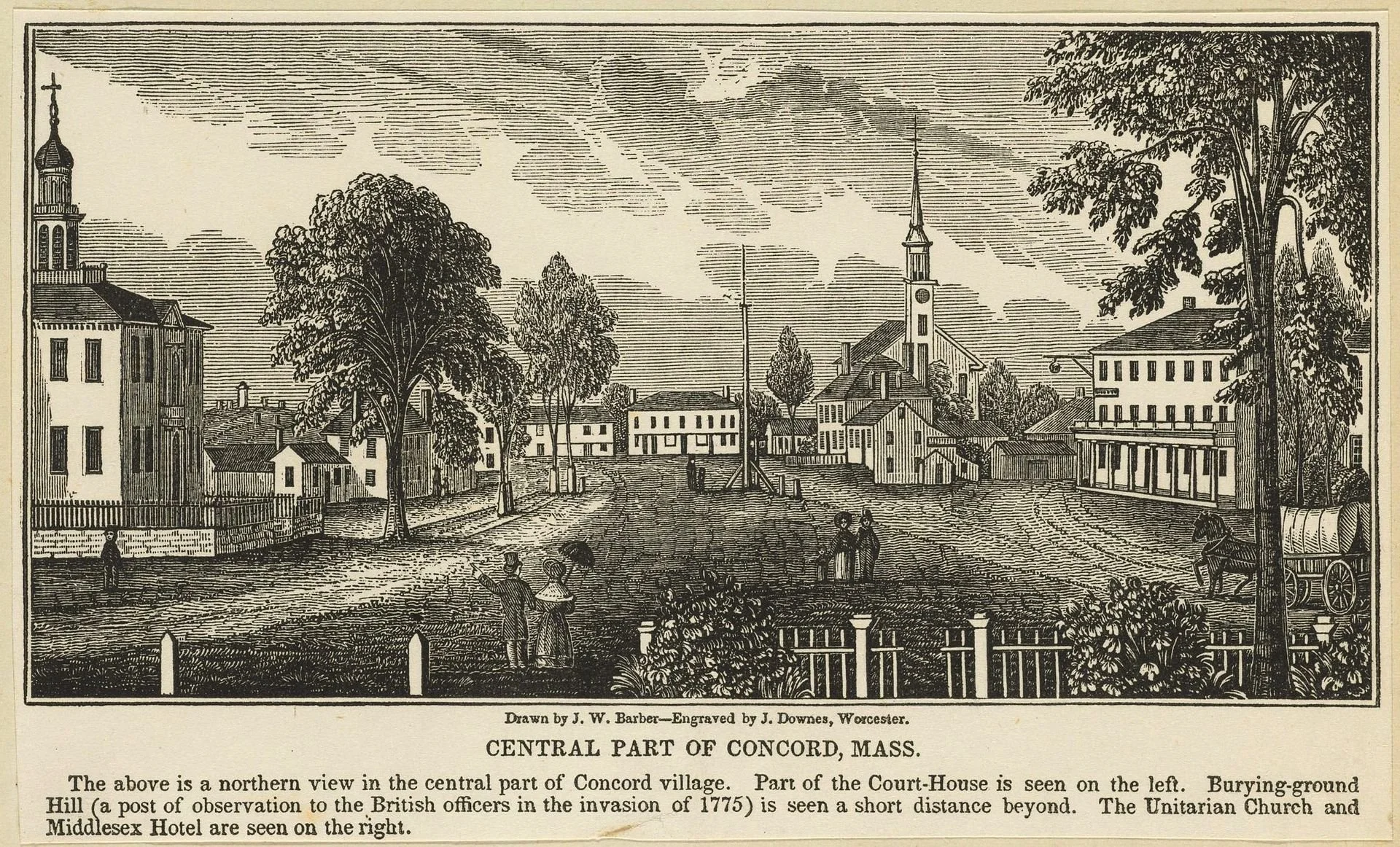
1840’s lithograph
Question time

Answer July—
Where is the Bee—
Where is the Blush—
Where is the Hay?
Ah, said July—
Where is the Seed—
Where is the Bud—
Where is the May—
Answer Thee—Me—
Nay—said the May—
Show me the Snow—
Show me the Bells—
Show me the Jay!
Quibbled the Jay—
Where be the Maize—
Where be the Haze—
Where be the Bur?
Here—said the Year—
— “Answer July,’’ by Emily Dickinson (1830-1886), a lifelong resident of Amherst, Mass., where she spent many hours gardening on her family’s capacious property.

Looking from the garden at the Dickinson House, in Amherst.
A delicate relationship; Worcester housing

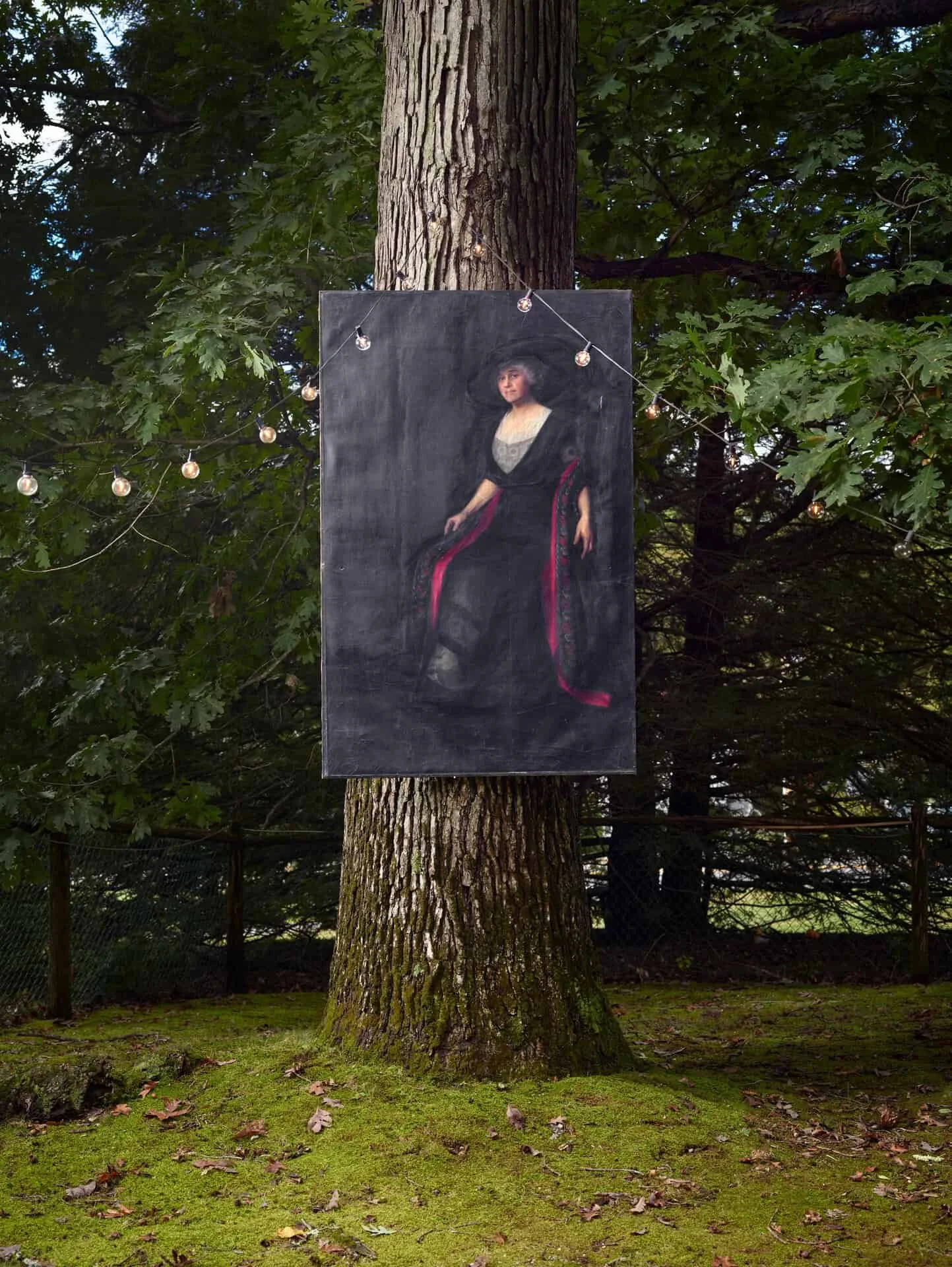
“A Woman and Her Dog” (gouache on paper), by Worcester area artist Julia Mongeon, in the show “The Tenth Annual One: A Members’ Exhibition,’’’ at ArtsWorcester, through Aug. 21.
The gallery says that these works span a very wide range of artistic expression, from photography to sculpture to painting. The painting above is a nostalgic picture that reflects on our relationship to our pets, evoking delicate pastels and folk-art motifs.

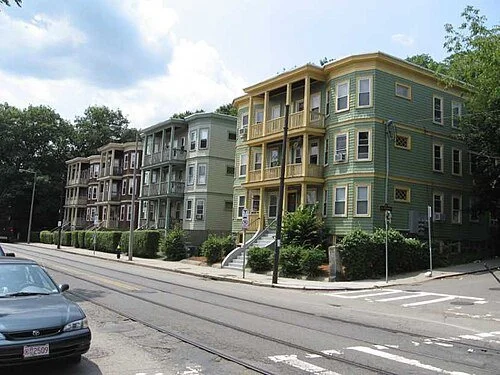
Classic urban New England three-decker houses on Houghton Street, Worcester. Dating mostly from the late 19th and early 20th centuries, three-deckers been entry-level housing for many immigrants and remain an option for people of modest means.
— Photo by John Phelan
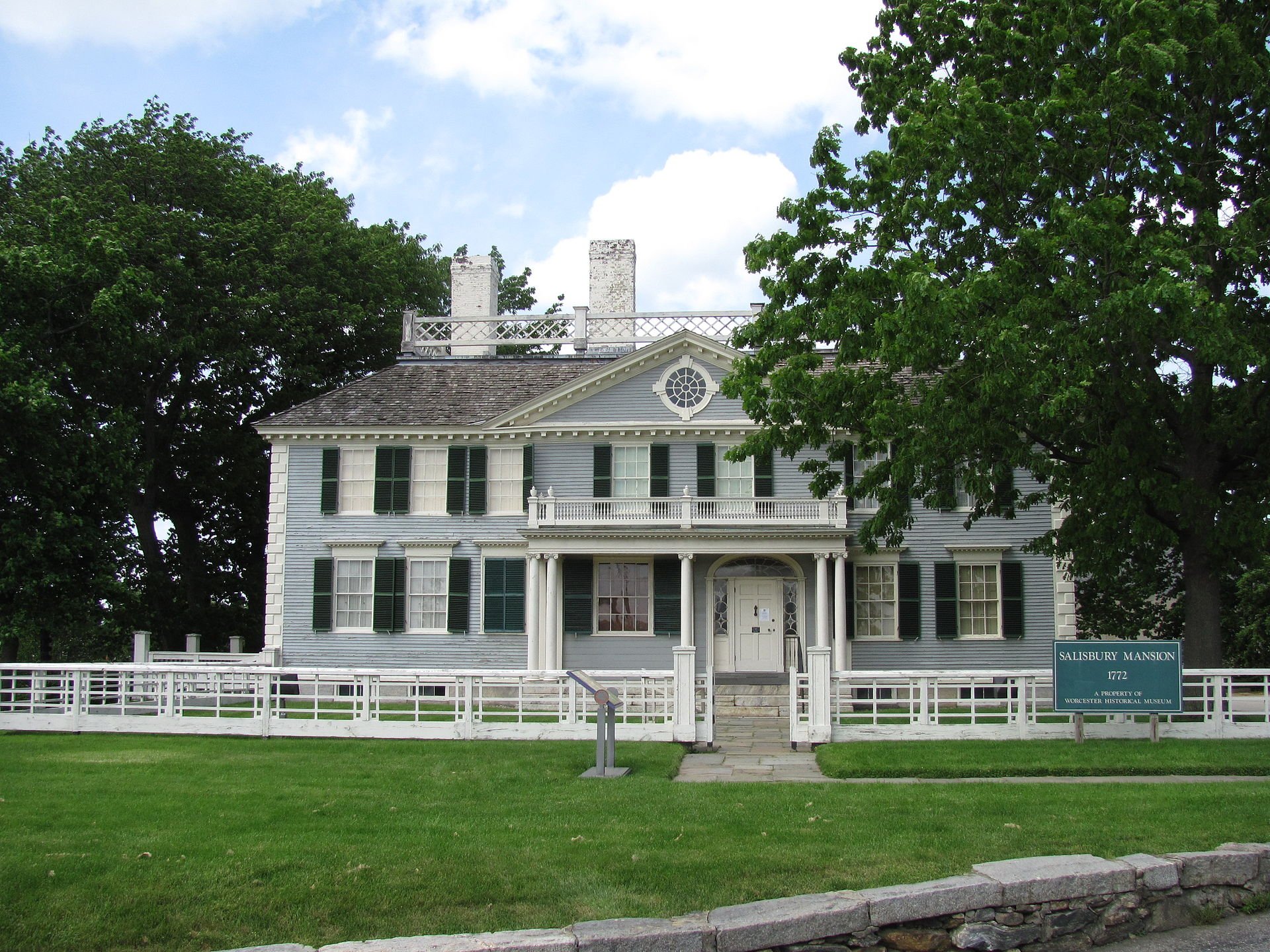
Somewhat grander: The Salisbury Mansion, in Worcester, built in 1772.
From the Worcester Historical Museum, at the Salisbury Mansion:
“Salisbury Mansion, at 40 Highland Street, is Worcester’s only historic house museum. Built in 1772 as a combination house and store, it served as the home of ‘gentleman-merchant’ Stephen Salisbury. The store closed after the Embargo of 1812, and by 1820 all of the space once used for the store had become living quarters. Salisbury Mansion has gone through many changes over the years, from a rooming-house to a gentleman’s club. Salisbury Mansion was originally at Lincoln Square. Through tireless research and documentation, Salisbury Mansion has been restored to the 1830s to reflect the time when it was home to the widow Elizabeth Tuckerman Salisbury. It is considered one of the best documented ‘historic house museums’ in New England.
App helps people with autism
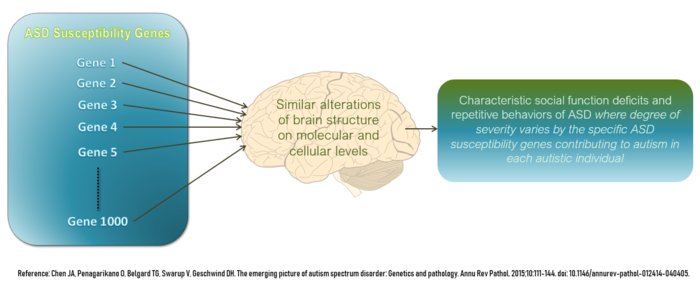
Hundreds of different genes are implicated in susceptibility to developing autism, most of which alter the brain structure in a similar way.
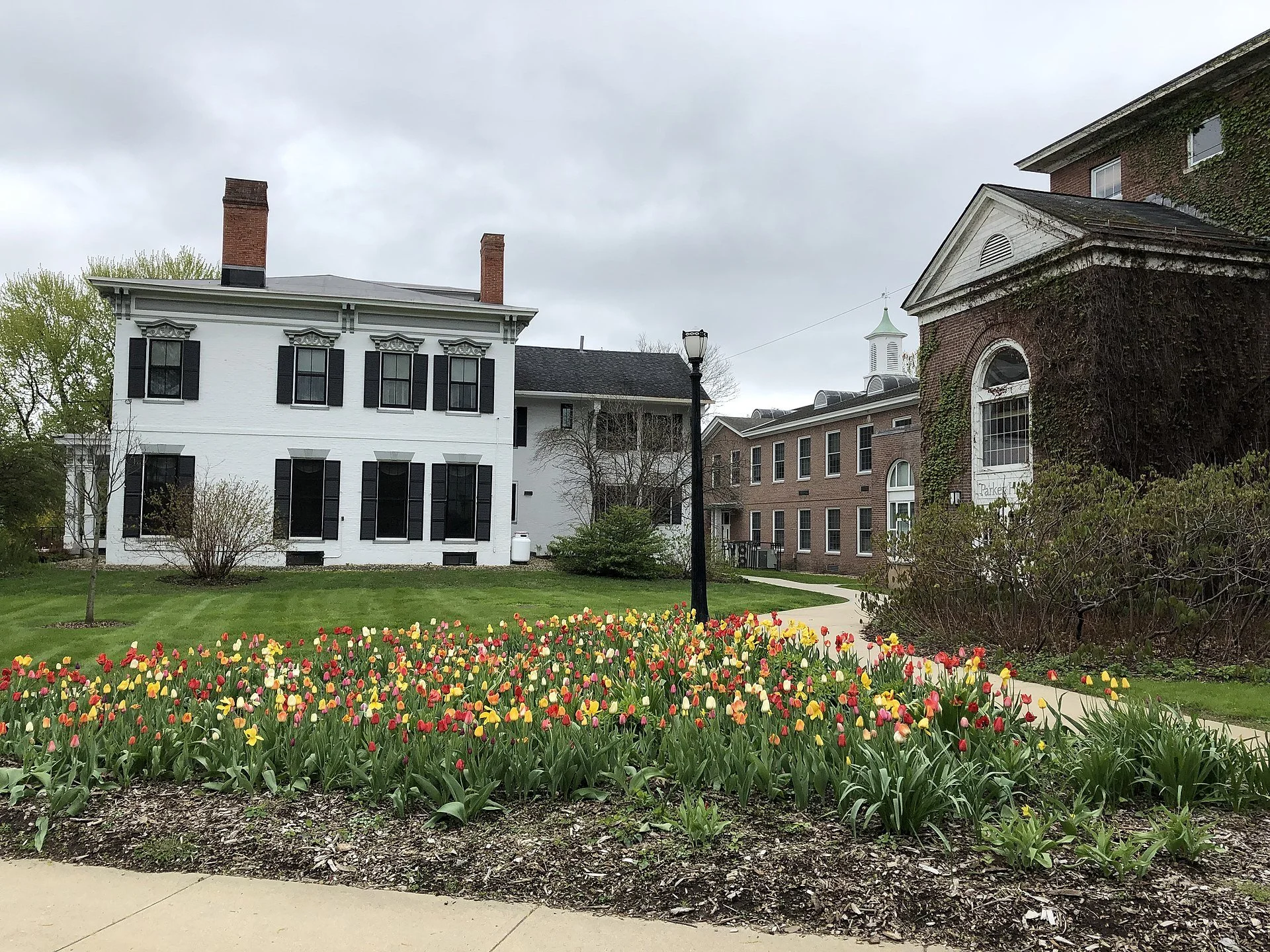
On the Keene State College campus, left to right: President's House, Morrison Hall and Parker Hall. The President's House, formerly the Catherine Fiske Seminary For Young Ladies, was built in 1805 and restyled in the late 19th Century, it is one of Keene's oldest brick residences. The house was listed on the National Register of Historic Places in 1976.
— Photo by Ken Gallager
From The New England Council (newenglandcouncil.com)
“Prof. Larry Welkowitz, of Keene State College (a New England Council member), along with world-renowned concert pianist Robert Taub received a U.S. patent for an app to help those on the autism spectrum. The new app, called SpeedMatch, allows users to load customized phrases and a library of phrases for reference for people to receive immediate visual feedback to improve social interactions and conversational skills.
“Professor Welkowitz and Mr. Taub began working together on this project 10 years ago with the intention of creating an app to teach people on the autism spectrum to match patterns of sounds in conversations. Since the app’s initial release two years ago, research has been conducted to understand the effects of the app.
“Research on SpeechMatch was administered by Dartmouth Hitchcock Medical Center and the National Institutes of Health and with funding from the Innovative Biomedical Research Excellence. It was revealed that the app improves the conversational speech of people diagnosed with autism. Welkowitz claims that what makes this effort different from other research in this field is that the study on improving functions of conversation—understanding pitch, rhythm and volume—are often neglected. Both Welkowitz and Taub stated that SpeechMatch can help people understand rhythm and sounds which could have the potential to be helpful for language learners.
'“We can really help people on the spectrum engage people, have more friends and more of a special network if we teach them these skills,’ Welkowitz said.
“SpeechMatch is available for download on the Apple App store.’’
The ripple effect
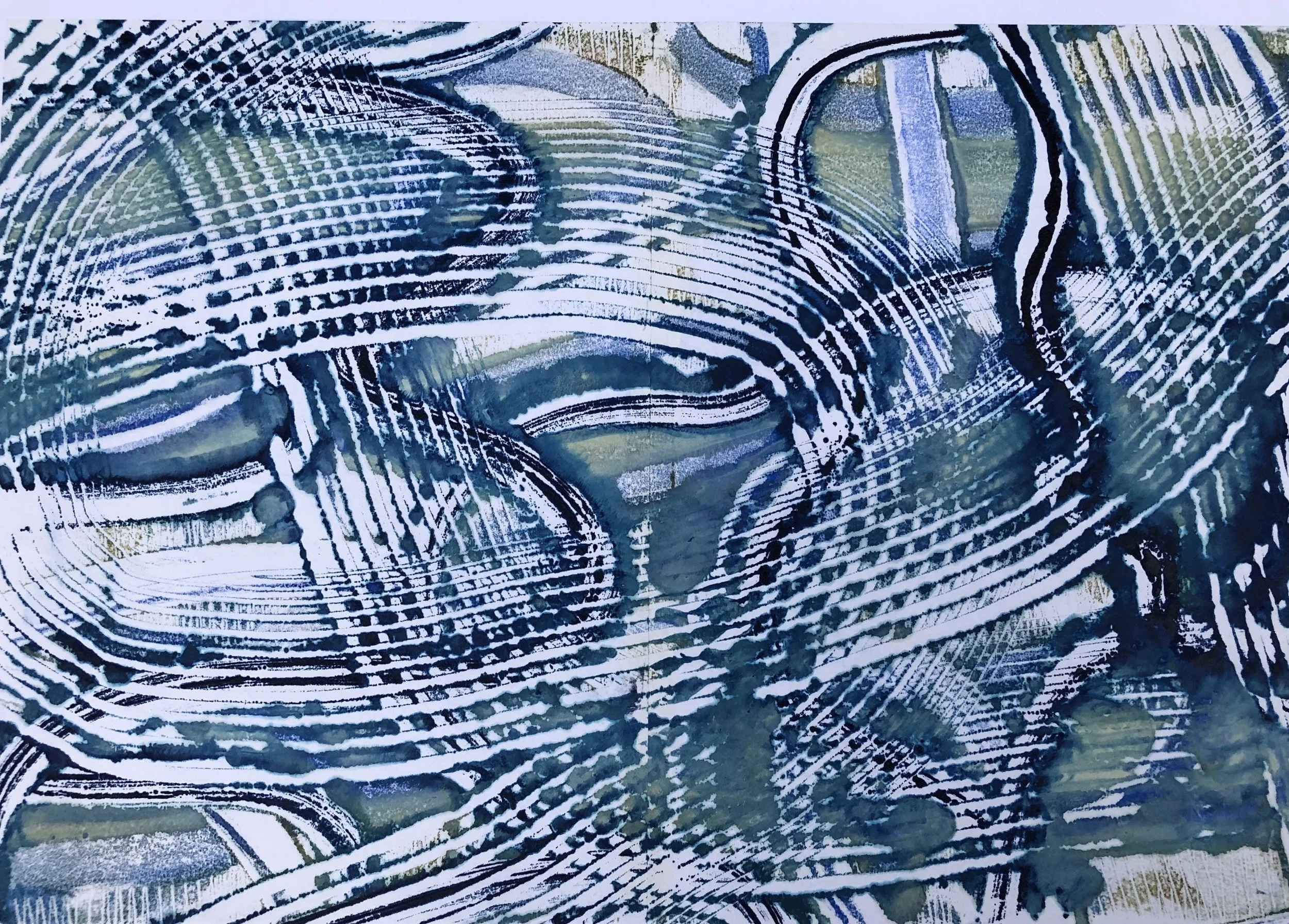
“Dreamtime-Ripples” (encaustic monotype), by Ken Eason.
Mr. Eason explains in his Web site:
“Several years ago, vacationing in Australia with family, I was introduced to Aboriginal Art and was fascinated by the technique, symbolism and variety. Aboriginal Art is centered on telling the ancient stories of the Aboriginal peoples using symbolism and metaphor. The imagery is described as symbols of the ‘Dreamtime’ that is the Aboriginal understanding of nature and the world.’’
He explores his own “personal ‘Dreamtime’ where I can be physically at home but mentally, spiritually and emotionally away. I use line as symbol of path, thought, or journey. These lines tend to overlap in many layers, each curve signifying a decision point, change in direction or choice.’’
His site says he works “primarily with oil and encaustic media and has been creating such paintings since 1992. Since his first solo show, at the York Street Gallery, Kennebunk, Maine, he has been in numerous group and solo shows from Boston to Bar Harbor, Maine. In 2005, Ken won first prize in painting in the Sculptural Pursuit, ‘Start the New Year with Peace’ Art/Literary Competition and received a several-page color photo spread of his work. Ken participated in the annual International Encaustic Conference from 2009-2012 and has taken several encaustic and professional workshops, but is mostly self taught. In 2017, he started teaching encaustic painting techniques.
“Active in the local arts, Ken is a juried member of the Art Guild of the Kennebunks and New England Wax. He was president of the Sanford Art Association in 2002 -2006. Ken’s work has been collected by the Rochester Museum of Fine Arts, Rochester, N.H.; Rand Direct, Edison, N.J.; and is held in many private collections worldwide. Ken works and lives in Acton, Maine.’’

On the Mousam River near Acton in the early 20th Century. Like many Maine streams, this one had a saw mill.
Llewellyn King: When the turmoil subsides, Americans will be living much differently
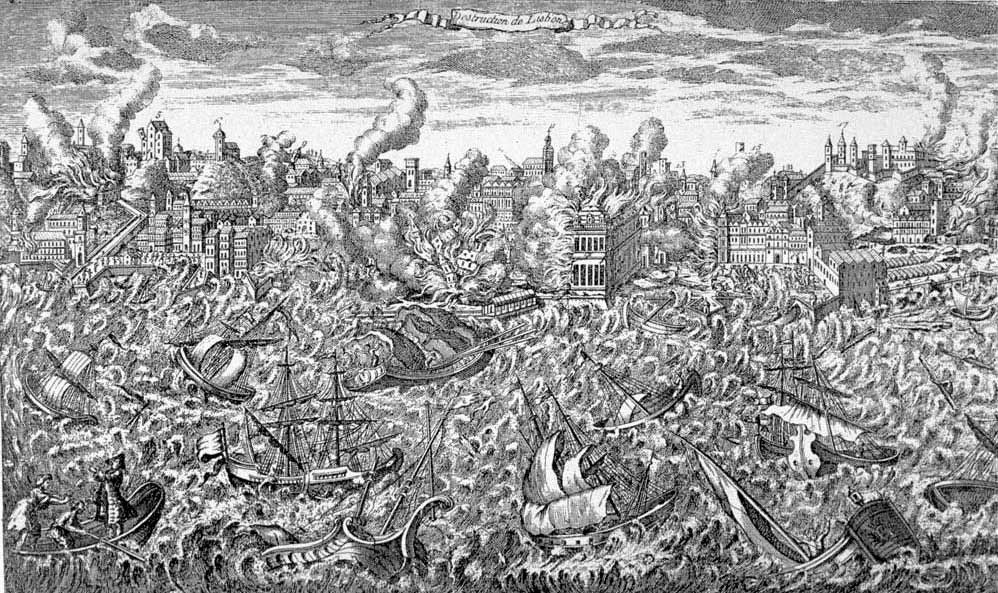
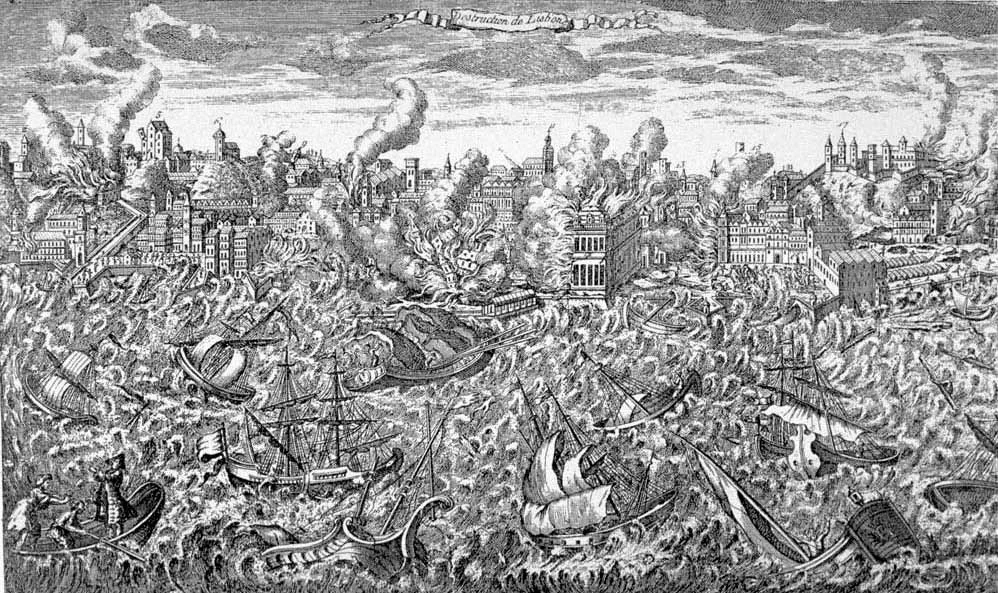
1755 copper engraving depicting Lisbon in ruins and in flames after the 1755 earthquake, which killed an estimated 60,000 people. A tsunami overwhelms the ships in the harbor.
WEST WARWICK, R.I.
I have only been in one big earthquake. It was years ago in Izmir, Turkey. As I was standing in the garden of my hotel, the ground underfoot was sloshing around like water in a waterbed.
Now I feel as though the world is experiencing a prolonged earthquake. Life, metaphorically, is shifting around us and has been since COVID-19 appeared on a pandemic scale in early 2020.
The pandemic, a major war in Europe, and the resulting shortages and inflation, are the most measurable disturbances, but others are also contributing to the shaking. They may be dismissed as aftershocks of the pandemic and Russia’s war in Ukraine, but they amount to quakes in their own right.
The very way we live is changing or being changed.
Consider these things that won’t go away, even after inflation has settled down after there is a resolution to the Ukraine war, and after supply chains are reinvigorated:
· The way we work has changed forever. There will be more remote work, virtual offices and empty office buildings.
· The same pressure to virtualize will extend to the factory floor wherever possible.
· How we shop has changed and will continue to do so. There will be more online shopping, fewer brick-and-mortar stores and many malls converted to other uses. The days are numbered for the great emporiums of yesterday.
· The way we receive medical care has changed: More than half of our physician visits will be virtual.
· Where we live is up for grabs. Virtual workers don’t need to live close to where they work. Summer homes are becoming year-round dwellings.
· What we drive will be different. If your next car isn’t electric, then the one after that will be. The same goes for practically everything that moves, from lawnmowers to buses and trucks.
· A sartorial meltdown has already begun. Fitted women’s suits and dresses are out, flowing is in. Men have abandoned neckties, and suits are on the endangered list. New reality: If it can’t go in the washing machine, it won’t go in the closet. No more dress to impress.
· Our diets are under pressure from inflation and supply-chain problems. Expect to see more “bowls.” They are both convenient and enable the use of inexpensive ingredients. Plant-based food is the new beef. Also cheaper, farm-raised fish – tilapia and catfish – will be the new halibut and grouper.
The knock-on effects of some of these changes will affect education. Already, it is partially remote and bound to the Internet, but will become more so as people move from company-location work to work from-a-nice place. If Dad and Mom are practicing law in Washington, D.C., from Maryland’s Eastern Shore, the Eastern Shore schools will have to expand and be upgraded. This will be repeated across the country.
Even our love lives will be transformed. The new realities are already closing off an old source of love mates: the office. Those voluntarily stranded at home must find new ways of meeting people if they are mate-hunting – presumably a boon to singles bars and computer dating.
We will have new special classifications. There will be the destination workers, like those who man the post office and repair things, and those who work virtually. What will they be called? Perhaps the “destinationals” and the “virtuals.”
Finally, there is the changing force of the weather. It is worth considering whether as many people want to move from the Snowbelt to the Sunbelt as they have for decades. Many of the sunny destinations, such as Florida, Arizona and Texas, have had day-after-day temperatures over 100 degrees F this month. Is that what the North-to-South migrants desired?
The 2020s are turning out to be a transformational decade, profoundly so. When the shaking stops, things will be different, life will be changed.
Llewellyn King is executive producer and host of White House Chronicle, on PBS. His email is llewellynking1@gmail.com and he’s based in Rhode Island and Washington, D.C.

Summertime, and the living is easy?

— Photo by Robert Jack
Adapted from Robert Whitcomb’s “Digital Diary,’’ in GoLocal24.com
I suspect that many year-round residents of, say, Newport and Cape Cod are already impatiently counting the days until the summer residents and vacationers leave, despite all the money they bring in (along with resort area gridlock).
Despite some brief thunderstorm-spawned downpours, much of New England is in a moderate drought. But there can be a good side to this: Fruits such as apples, grapes (ask wine makers) and peaches are a little smaller than usual but tastier in dry (but not too dry) summers.
Meanwhile, New Englanders should be thankful that its big sources of publicly owned fresh water, such as the Quabbin and Scituate reservoirs, are in no danger of drying up, unlike the water disaster Out West, which may well eventually lead to massive migration to wetter and cooler places.
And now the lilies are wilting along the roads. While global warming is extending our summers, if you’re over a certain age they still seem to go by a bit faster every year.
With New England’s hurricane season coming (mostly August and September), people in such low-lying places as Barrington and Warren, R.I. and the head of Buzzards Bay might want to consult a book I’ve mentioned here before that tells of how some of us will have to learn how to live not only along the water but over the water as seas continue to rise with global warming. The book, again, is More Water Less Land New Architecture: Sea Level Rise and the Future of Coastal Urbanism, by architect Weston Wright.
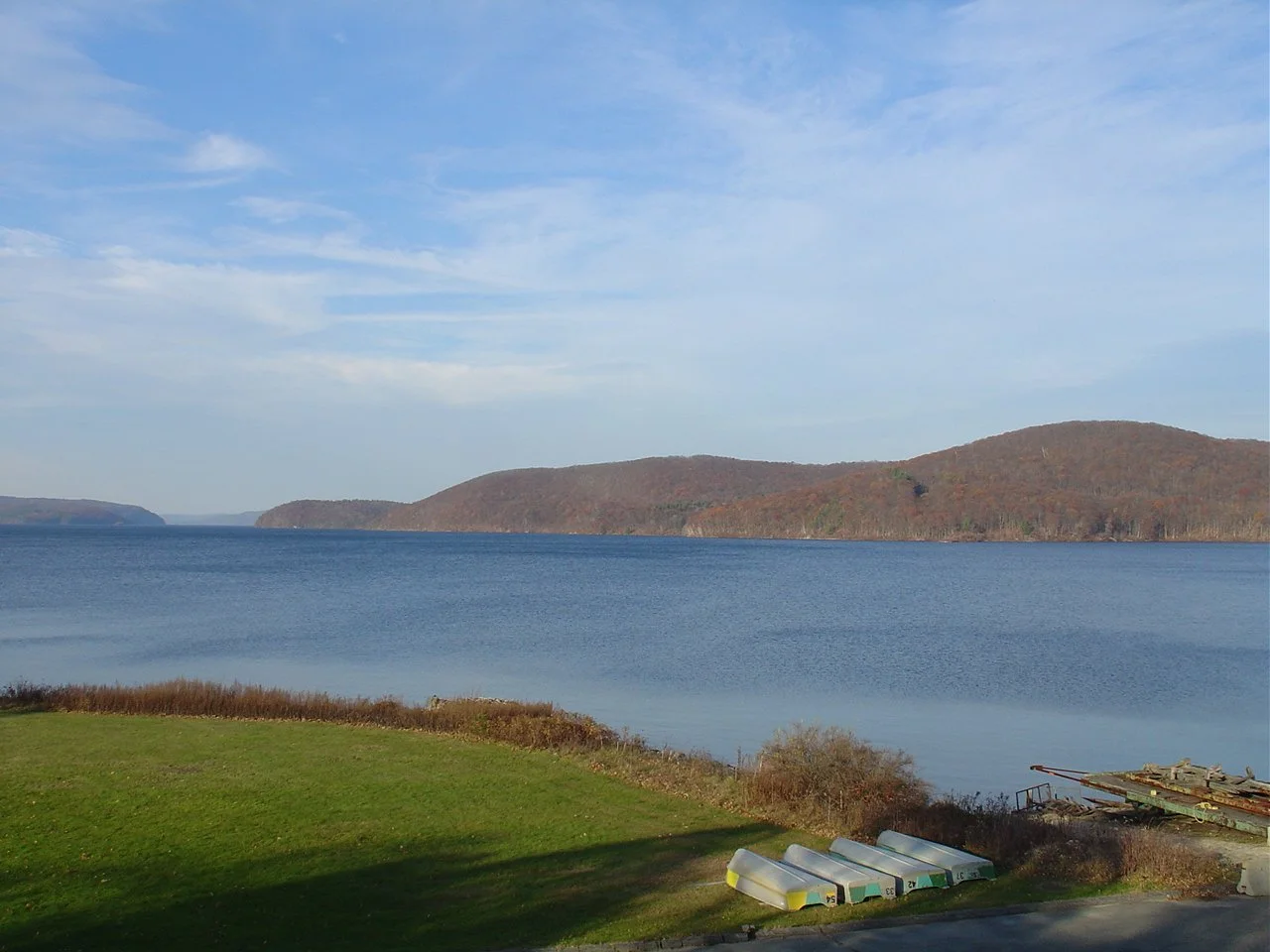
The beautiful Quabbin Reservoir, in central Massachusetts. Copious fresh water is more valuable than copious petroleum.
— Photo by Solarapex
Don Pesci: From a contrarian's journal
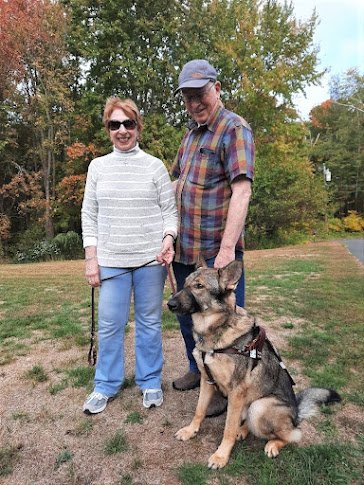
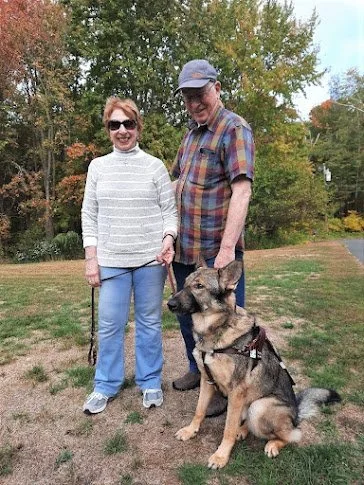
Andree, Don and Dublin
February 2022
It may be time for me to explain, if only to myself, what I think I have been about.
__________________
I woke up this morning thinking: Why should we not confess our joys as well as our sins?
Today, Feb. 6, 2022, is full of sunshine, following three or four days of gray skies. It snowed several days ago. This was followed by a light rain, followed by a freezing rain – very inconvenient. It is not the hammer blows of despair, but rather the water torture of inconvenience that, in the post-modern world, drive men to murder and mayhem.
The morning sun is burning brilliantly on what is left of the snow, Andree is snug in her bed – glad I was able to warm her, since I usually wake at about 7:30 and descend the stairs to write a column I suspect no one will print – and it seems just now, as Professor Pangloss often says in Voltaire’s Candide, “the best of all possible worlds.”
God is in his heaven and, while the world sleeps, politicians in Connecticut are plotting their campaigns. The snow and rain, unlike journalistic reports, fall indiscriminately on both the just and the unjust.
__________
Within the journalism “community”, everyone has become Candide, a victim of optimism crushed by a real-world pessimism and a kind of pretentious, wild-haired and goggle-eyed cynicism.
And hasn’t the “community” business has gone a bit too far? There is such a multiplicity of communities that it seems mankind can never gather joyfully under a common flag. We used to speak of families, of neighborhoods, of towns, of states, of nations. Now all the talk is of artificial, hastily assembled “communities.” Yesterday, someone mentioned the “academic community,” another the “felon community,” and I couldn’t help but wonder whether there is any important difference between the two.
___________
You wonder, my friend, why suddenly I have taken an interest in numbers.
Simple, “I am old, I am old; I wear the bottoms of my trousers rolled,’’ a T.S. Eliot wrote in “The Love Song of J. Alfred Prufrock’’.
On July 15, 2021 the day following Bastille Day, I turned 78. After 65, numbers become inordinately important. You begin counting down the days and realize, with something of a shock, that all our days are numbered – and always have been -- whichever community we may belong to. There is no salvation in belonging to the academic community or the journalistic community, both swollen with what Jacques Maritain used to call “practical atheists,” people we might call cultural Christians and Jews, which is to say people who do not take either Christianity or Judaism seriously but wish merely to dress up in castoff robes so that, as Mathew 23:5 has it, they may be seen of men: “And they do all their deeds in order to be seen by men. For they broaden their phylacteries and enlarge their tassels,” a nearly perfect description of the twittering class.
Years ago someone inadvertently put the biblical injunction into a Louis Prima song -- “Just a Gigolo.”
I'm just a gigolo and everywhere I go
People know the part, I'm playin'
Paid for every dance, sellin' each romance
Ooh, what they're sayin'
There will come a day, and youth will pass away
What'll they say about me?
When the end comes, I know they'll say -- just a gigolo
And life goes on without me
Incumbent politicians of long standing in Connecticut and elsewhere, political gigolos, know how to twitterize and tasselate the crowds.
We have in Connecticut two prominent Catholics in the all-Democrat U.S. congressional delegation who, in respect of their church’s position on abortion, are heterodox. U.S Representatives John Larson and Rosa DeLauro are abortion enthusiasts, like U.S. Sen. Dick Blumenthal. Blumenthal’s present position on abortion – never under any circumstances should the practice be regulated – might have scandalized then President Bill Clinton in 1993, a pro-abortion visionary who said, "Our vision should be of an America where abortion is safe and legal but rare.”
Post-modern progressives, now in charge of the Democratic Party’s ship of state, like their abortion well-done – indeed, overdone. That is the chief problem with progressives: Whatever they do, they overdo. If progressives were a majority of chefs in restaurants in Connecticut, rare steaks would become a rarity. On the question of abortion alone, progressives are culturally libertarian. Otherwise, they are far left-of-center socialists or Gramsci Marxists.
____________
My nieces and nephews will have no personal memory of grandfather Carlo The Fox. He passed, as people who sidestep the word “died” say, before their time. He has no standing in their memories.
But I remember him coming and going to the homestead at 1 Suffield St., Windsor Locks, Conn. He used to stop by during his peregrinations every so often to touch base with my mother, the only person in the Mandrola family he could not frighten.

The Rose who stole my father's heart
One day he came by with a bunch of flowers and a handful of bills, both of which he shoved at Rose Pesci the indomitable. Giving dollars away – and so many dollars – struck her as out of character for “The Old Man,” an affectionate term within the family.
She was bewildered.
“What’s this?”
Carlo told her, in his somewhat broken English, that he was giving her money to purchase some flowers when he… umm … passed on. He did not want the funeral parlor to be bare of flowers. And, really, there was no one else to see to it but her.
She once told me, “Your grandfather had a green thumb. He could make roses grown from rocks, and not roses alone, but any green thing.” She said she would see to the flowers.
Carlo moved on towards Bianchi’s restaurant for another coffee-royal and, later in the day, a light lunch. One of his stops was the A&P on Main Street, where he usually bought a steak to be prepared for him in the afternoon by Armando Bianchi, the proprietor of the restaurant. The Windsor Locks Main Street was a casualty of a “redevelopment” scheme that began during the silly 1960s and ended with an antiseptic Main Street, new and useless after all the merchants had been displaced, their places of business lost to “redevelopment.”
The redevelopment plan, still in process in year 2022, was an idea that burned hotly in the indifferent brains of the “redevelopment community.” The idea was to sweep aside the entire Main Street and rebuild it anew from the ground up. It was not buildings but histories and memories that were plowed under, never again to see the light of day. When everything had been leveled, Windsor Locks looked somewhat like Sodom on the day following its God inspired destruction.
There were lots of flowers at Carlo’s wake.
Most of my boyhood past is gone now. I am visited from time to time by pale, ghostly memories stripped of flesh and blood.
The future, naturally, has become a Thermopylae pass, narrow, pinched, but still worth defending, even at the cost of one’s life and fortune: “Go tell the Spartans, stranger passing by, that here, obedient to their laws, we lie."
_____________
March 2022
The voice of a Blumenthal suppliant -- most reporters in the state -- shouts in my ear: “You numbskull, can’t you see? Our enlightened Senator Dick Blumenthal believes he need not listen to the people to know what is best for them, the dirge of the postmodern progressive afflatus.
Blumenthal, whose approval rating in the state has unaccountably plummeted for the first time in his long political career, is rich in money and purloined knowledge. Harvard, Yale and an auspicious marriage have blessed him with an abundance of riches. He claims to know what is best for the poor, without having gone through the trouble of living cheek by jowl with the poor unfortunates. It is much safer to view the apparent cultural anarchy of urban life in Connecticut from a Greenwich, Conn., safe house. There is little doubt that alms, furnished by Blumenthal and his sort from the public treasury, a down payment on future votes, are best for him.
For the politician who knows how to help voters help himself, the solutions to poverty are best when they are other directed and permanent rather than passing. That is the beginning and end of the moral acuity of postmodern progressives.
And if God does not exist, the central belief of practical atheists, well then Blumenthal is perfectly willing to step into the absent landlord’s empty shoes. The media has not painted a halo round the senator’s head for nothing. Half the troubles in the world arise from voters inattentive to Psalm 146:4:
Praise the LORD, O My Soul… Put not your trust in princes, in mortal man, who cannot save. When his spirit departs, he returns to the ground; on that very day his plans perish. Blessed is he whose help is the God of Jacob, whose hope is in the lord his God.
This Psalm, ascribed to King David or Solomon, first entered the rich Jewish literary canon during or after the Babylonian captivity and the subsequent liberation of God’s people. If this is cynicism, it is prophetic cynicism.
The cynic’s eye is the jeweler’s eye that sees without distortion the difference between good deeds and the pretense of good deeds. What the poor really lack is independence and self-sufficiency. The poorest man is not the one who is temporarily incapable of helping himself or his family, but the man permanently incapable of helping both himself and the stranger among us.
__________
Mark Twain, certainly more quotable that the average post-modern politician, said about New England weather, “If you don’t like it, wait a minute, it will change.”
This past April, the whole of New England was caught in a violent rain and wind storm -- sleepless nights, the rude, rough wind banging on our windows.
Dublin, Andree’s guide dog, slept through most of it and was triggered only twice. When Andree took him out in the early morning, gray and forlorn, the wind was still shaving dead branches off the trees. I battened down the tarp covering our wood pile, removed a few fallen branches, and headed off to Lance – great first name! – the eye doctor, who was pleased to note that the pressure in my right eye had been satisfactorily reduced from 33 to 11.
“Exactly where we want it,” he said. “We already have a blind wife in the family. We don’t need a blind husband.”
Could I discontinue the use of the eye drops he prescribed a couple of weeks ago?
“Well… no.”
“How long must I use them?”
“Pretty much forever.”
When I arrived home with the good/bad news, I saw two pileated woodpeckers doing what woodpeckers do, debarking a tree, both bathed in early morning sunlight, a red stripe marking the male’s bridge between beak and crimson crown. Pileateds, executioners of carpenter ants, fly to New England this time of year from Florida, where at least a half dozen of my neighbors, lashed by winds, wished they were just now.
A storm last year sheared off the top of a large oak tree fronting the street. There it stands now, a pillar of oak, a mere suggestion of a tree, its top open to the elements, a haven for carpenter ants. I thought to direct the pileateds to the meal but realized that, like state contractors, they were not always open to creative suggestions.
Our grandfather clock, with us for decades, has been cleaned and fixed. It was last cleaned by an old septuagenarian clockmaker several years ago. The current clockmaker is a young man, sprightly, full of opinions he is happy to share at the drop of a hat, and just a wee bit off kilter, both Andree and I agree, a compliment rather than a criticism. Tedious people are on-kilter most of their lives. And when they come to die, they discover they had only begun to live three minutes before passing on.
The current clockmaker will not feel his life had been wasted when the devils or angels come to drag him up or down. I have no idea which way he is headed.
He seems religious – not, thank God, “spiritual” -- as some people are these days.
The “practical atheists” scorned by Jacques Maritain are spiritual wastelands. St. Francis of Assisi, who appeared naked before his bishop after he had surrendered to Christ and given up unprofitable ways, along with his substantial fortune, was religious rather than spiritual.
One cannot imagine Senator Blumenthal waving farewell to his vast stores of wealth in this way, though he seems to have had little difficulty over the years as state attorney general persuading the moral mob to despoil his neighbors.
“I have become a socialist,” Perrot cries out in Edna St. Vincent Millay’s play, Aria DeCapo. “I love mankind – but I HATE! people.”
Our clockmaker does not hate people. He is amused by them, always a sign of mental stability. The comic playwright Aristophanes, writing during the Peloponnesian War, was possibly the sanest man in all of Greece. Agents of a powerful puffball he had been lampooning in his plays, Creon, stopped him on the street and asked imperiously, “Don’t you take anything seriously?” to which he replied, “Yes, I take comedy seriously.”
I tell him the story of Jonathan Swift’s missionary in Africa whose flock thought that his watch was his God, because he consulted it so often.
The clockmaker is young – but then, everyone under 65 seems young to me – and convivial. “You’re welcome to stay here and talk to me while I clean the clock,” he said. “I like talk. It passes the time.”
Dublin, holed up in the bedroom, was barking but stopped after a while.
Andrée explained that Dublin was a Fidelco guide dog. He came into our household after her previous guide dog, the mighty Titan, died, leaving her bereft and in tears for days.
Before her first guide dog, Jake, came to us, almost on Christmas Day more than 20 years ago, she had little commerce with any domestic animals, owing to her mother’s fear that dogs and cats might sully a clean and spotless house. Her mother, Margaret Descheneaux, was all of her life pure of heart, mind and hand.
Jake was Andrée’s first encounter with nature in the rough, though he was, of course, highly trained. He was a large dog, nearly 90 pounds, regal, indifferent to me – which we both appreciated – and fiercely loyal to Andrée. He lived to be about 14, all of his years a blessing to Andrée, who is, if such a thing can be imagined, as fiercely loyal to friends and family as Jake was to her. Naturally, a stickler on such things as “thank you” notes, she expects her affections to be unselfishly recompensed.
The two, a woman and her dog, also had in common a joy of life, a healthy intolerance of profound stupidity – in the age of Google, no one any longer can lay claim to innocent ignorance – and a brilliant intellect, as well as a fully functioning, inerrant intuition. Dogs are intuitive, anticipatory animals, and Andrée is now convinced that German Shepherds are the lion-kings of dogs.

Titan is in black, Jake dusted with gray at 13.
Mark Twain, incidentally, felt the same way about dogs: “The more I learn about people, the more I like my dog.”
One wonders, did Homer have a dog? Did Dante or Milton? What of Shakespeare? Google is silent on the necessary connection between dogs and poetry, so we may assume a connection, an assumption that takes no great leap of the imagination. The mistreatment of a horse brought Nietzsche to tears. T.S. Eliot’s connection with cats is well known. Surely, some bubble-enclosed, monkish academic has researched the question, yet academia remains unaccountably silent.
Jake died more than 14 years ago, noble and valiant to the end.
When we arrived home 3:00 in the morning from a trip to Arizona, we found posted on the door a note that said, “Go to the vets immediately,” this written by friends with whom we had left Jake.
The vet led us to a metal table cushioned with a towel where Jake was stretched out breathing softly. He had been there for a dozen hours – waiting, I believe, for the touch of Andree’s hand. She leaned over him, breathed into his ear a message I could not hear, and then he left us.
Titan came to us two years before Jake died, his body a shining ebony unmarred by a single spike of grey hair when he died at 14.
Bill Buckley asked me once, “Do you suppose there are dogs in Heaven?” My answer, stupidly sophistic – maybe doggyness exists in Heaven – failed to satisfy him, because he was hoping that he might encounter on the other side of the pearly gates the dog he loved when he was a boy.
Why must love and beauty die? Do they die? Is not beauty the face of God that even Moses was not privileged to see?
“You cannot see my face, for no one may see me and live."
_____________
U.S. Senator from Connecticut Dick Blumenthal gave up thinking for himself about midway through his 20 year stretch as attorney general. He found it more convenient to let others, the 200-plus lawyers in the attorney general’s office, think and do for him. Naturally, he was always available to take credit for the wins and write off the losses, few in number, as a predictable consequence of righteous action.
The front line troops in the office all were eager to do the bidding of their boss. Perhaps they too in the future might become attorney general, at which point they too might luxuriate in the soft media glow produced by eager-to-please journalists. So all-surrounding is media adulation of Blumenthal, that he cast no shadow.
The trick in both politics and business is to get others to do your work for you, on condition that the worker retires into the woodwork and allow you to reap the glory. Months and years of this sort of thing blunts the brain and makes Jack a dull boy.
Blumenthal looks like a Harvard/Yale graduated pedant, and an unruffled multimillionaire, both of which he is. Some are born pedants, some achieve pedantry, and others have pedantry thrust upon them. This persona is one Blumenthal has chosen for himself.
Blumenthal never has had an ardent and effective political opponent. His more promising Republican Party opponents have been driven from the field by money or a media adoration approaching worship.
Blumenthal drifted into the U.S. Senate, as did Senator and stated Attorney General Joe Lieberman before him. The path to glory from the Connecticut attorney general’s office to the U.S Senate is a well-worn one. This red carpet has deep grooves in it.
If some political-psychologist were to lay Blumenthal on his couch and do a deep dive into his political persona, he would uncover a frightening vacuity, all polished surfaces but no depth -- pedantry perfected.
Less accomplished political pedants, President Joe Biden comes to mind, might well be jealous. Biden is such an unoriginal thinker that he must borrow from others to rise to the level of pedantry. He has been caught plagiarizing a few times by journalists in forgiving moods who now find his inattention to detail amusing or endearing.
Plagiarism and pedantry go hand in hand.
To give but one example: Blumenthal’s position on abortion, unoriginal and self-contradictory, has been lifted from Planned Parenthood, which is why I have referred to him several times as “the Senator from Planned Parenthood.”
His position on abortion is the same as that of any chief executive officer of a large, profitable enterprise -- no impediment should get in the way of the business we support.
With regard to their own big businesses, CEOs are libertarians, shouting from the rooftops their adulation of freedom and liberty. In respect to their competitors, they are executioners very much in need of bought politicians who, their hands having been greased with campaign donations, may assist them in reordering the free market to their advantage, for the most closely guarded secret among clever big business “free marketers” is that politicians may be called upon to help them crush their creative and inventive competitors.
I sometimes think of Hilaire Belloc’s “Advice to the Rich” in connection with Blumenthal: “Get to know something about the internal combustion engine, and remember – soon you will die.” Blumenthal, one may be certain, knows far less about the internal combustion engine than his chauffeur. As to the free market – are we not all Keynesians now?
Blumenthal’s cadaverous aspect – Is he a biker? -- fairly screams, “I will live forever!”
A Democratic Party political hack, he and Biden are pretty much on the same page politically concerning the necessity to end fossil fuel as an energy source, as soon as inconveniently possible. As attorney general of Connecticut for two decades, Blumenthal was accomplished in shutting down small businesses, easy political targets, and extorting campaign funding from large businesses. His long tenure in Connecticut politics suggests that the prospect of death and a final reckoning still lies, God willing, very far in the future.
_____________
July 2022
How is it possible that the establishment media in Connecticut so infrequently reports the obvious? During his basement campaign for the presidency, Biden, one eye cocked on pseudo-anarchists such as Alexandria Ocasio Cortez and her “Squad”, pledged to do away with fossil fuel. He abandoned a nearly completed pipeline and reduced the possibility of supply -- a surety of his pledge. It worked. In no time at all, gas at the pump being in short supply, the price of gas rose from a low during the Trump regime of $2.96 in May 2018 to its present level, a brain rattling $4.84 per gallon. In concert with high energy prices, increased costs in the price of goods and services, owing largely to exorbitant spending, a historic rise in inflation, rhetorical buffoonery some ascribe to mental deterioration, and a pending recession, Biden’s approval rating has dropped to 38 percent, and “an early June poll from Ipsos/ABC News found that only 28 percent of Americans approved of Biden’s handling of inflation; along with his handling of gas prices (27 percent approved), inflation ranked lowest of any of the issues the poll asked about.”
See Biden, Lamont, Connecticut Democrats – Meet Gresham’s Law.
_______________________
We are off today to visit my cousin Bill Mandrola, at his son’s house in Suffield, Conn. Anthony and Amy Mandrola have moved from Los Angeles. Bill and all the first-family Mandrolas – two daughters of Carlo the Fox and four sons -- lived for many years in the homestead on Center Street, Windsor Locks, before he and his wife migrated to Arizona, after he had retired from a prominent Hartford insurance company.
My brother Jim, who worked for many years at Travelers Insurance Co. – bumped, as was my father, after the company had been mismanaged for years by an inept CEO – moved to Columbia, S.C., his son, David, following in his father’s footsteps a few years later. David and his wife, Corin, moved to North Carolina.
These moves I regard as the Great Unmooring. Somewhat like a shipwrecked Ishmael, I , not quite alone, am left in Connecticut “to tell the tale.”
And what a tale it is, part of it told by Bill in a personal memoir, Dampadog, Johnny Mandrola, Storyteller. My uncle John, Bill’s father, is the storyteller of the memoir.
The Mandrolas are suburb storytellers. Family stories are, in part, factual accounts graced with what Mark Twain used to call “stretchers.” The purpose of a stretcher, not in the least a distorting conscious lie, is to emphasize the truth of an event. One cannot trust memory to preserve the integrity of important, life shaping events. The memory is refined – corrected, amended -- always in the telling. And, of course, in the case of Italian families, some things are better left unsaid. But over the supper table, nothing is left unsaid.
My mother rarely left anything unsaid. If you asked her for the truth or not, you would get it.
Bill, an inveterate traveler, wears his age well. The kitchen table at Anthony and Amy’s house was well laid with antipasto – some hard cheese, Soppressata, shaved Genoa, crackers that crunched in your mouth, wine – always wine – and company. What begins in the kitchen never stays in the kitchen of an Italian household, and this includes stories told and retold, until they are as smooth in the telling of them as stones in a brook, polished and glowing beneath the flowing water.
Stories were told about the two first families, the Mandrolas and the Pescis, the Windsor Locks Canal, a swimming hole with a dangerous undertow before my father Frank, the town’s first park commissioner, put a pool in Pesci Park, visited by all on sun-drenched summer days, the nuns of Saint Mary’s parochial school, now a refurbished apartment building, Carlo’s, as it seemed to us, irrational fear of nuns, Marconi’s soda shop on Main Street, friendly idiots, unfriendly antagonists.
My sister: The Pertusi brothers, John and Anthony, came to visit us on Christmas, and other times as well. John Pertusi cornered Carlo on the Pesci porch and began, in his usual manner, to philosophize and gush over nature. Flowers were beautiful, the skies of New England, God’s blue fingerprint, were especially beautiful… and so on and so on. Carlo listened to him patiently, smiling his usual inscrutable smile, until John struck a nerve with a question. What do you think happens to us after we die?
Carlo: The worms get you.
Anthony, Bill’s son: I like the way you talk about Nellie, his grandmother.
Me: When I was small, very small, I told my mother one day that I was dissatisfied with her treatment of me. I wanted to go and live with Nellie and John on Center Street. She never hesitated a moment. Okay. She packed a small cardboard suitcase, and I was away down the stairs, where I met Carlo, returning home from Bianchi’s restaurant.
Carlo’s habits were almost mechanical, like the works of a grandfather clock, and unvarying. He was, I thought, on his way home from Bianchi’s.
Someone else: Every day, he’d go to the A&P on Main Street, buy a slab of meat, hang out at Bianchi’s with his friends, drinking and playing cards, eat a light lunch, then return up Suffield Street on his way back home to Center Street.
Me: He found me on the sidewalk and asked in his broken English, studying my suitcase, “Where you go?”
I told him I was going to live with Nellie and John. So, he took my hand and led me to my preferred home. Nellie loved me. She had taken care of me when I was a small baby. The Mandrola homestead was for me Eden without the serpent, a paradise of roses and cherry trees, and Nellie’s meals, cooked always the way I liked them. But at that age I used to walk in my sleep. And thinking I was on my way to the bathroom, I fell down the stairs. I woke the whole house with my wailing, but I was unhurt. Nellie put me back to bed. At the touch of her hand, I fell asleep. Of course, everyone understood that nothing of this was to be mentioned to my mother. However, I suspected that she knew every detail. She and Nellie were fast friends, and there could be no secrets between friends. When I returned home, my subdued mother was, I liked to imagine, properly chastened.
Bill’s Ponzi story: “He was a bit,” hesitatingly, “fussy.”
Fussy? Ponzi was a hypochondriac.
Ponzi and Dampadog made friends with a woman, widowed, who owned a house on a fish-filled pond near Stony Brook. They wanted to use her boat to catch bullheads, the pond’s bottom feeders. Ponzi was in the front of the boat, my father in the back. And Ponzi was catching fish after fish, my father nothing – very distressing. So when Ponzi passed the line to my father to bait his hook, he clipped the line, leaving only the sinkers to tempt the bullheads. But they were not biting sinkers that day. And my father began to catch all the fish, Ponzi nothing. After the catch had evened, my father said, “I think the pond has been overfished. Let’s go.” But the wondrous thing about all my father’s stories were – they had no endings. The narrative was just left there for you, tempting, dangling, unfinished….
Like those succulent apples – “experts” now have told us they may have been pomegranates – in the Garden of Eden. God, when all is said and done, is the author of final things. We poor mortals can only aspire to be honest recorders of the beginning and middle of things.
Don Pesci is a Vernon, Conn.-based columnist.
Repurposing religious symbols

“Good Intentions’’ (mixed media), by Boston area artist Steve Sangapore, at Fountain Street Fine Art, Boston
He writes:
“While I typically work in oils, I have recently begun creating sculptures as a means to further investigate intellectual concepts that interest me. One theme that has gripped me for the past several years is appropriating, re-purposing and recontextualizing universally recognized religious symbols and imagery. In doing so, I am able to begin a dialogue using symbols which already have emotional, intellectual and spiritual significance with viewers and ask them to view the symbols and icons from different perspectives and in new contexts.
'‘When the Christian cross is viewed in its typical upright position, viewers both secular and faithful might instantly ascribe to it key Christian (and generally religious) concepts such as faithfulness, righteousness, sacrifice, primacy of the individual and, of course, God. But the Christian cross is a unique symbol in that it is one of very few supremely well-known and iconic symbols that, when inverted, has an equally strong oppositional meaning.
"‘Intentions’ was an elegant way of illustrating this moral dichotomy within the narrative of having one's seemingly righteous intentions ultimately having bad or even evil outcomes. We have seen this story played out time and again throughout history, and it remains relevant today. Too often we witness destructive and divisive results from actions and ideas masked in rosy buzzwords and catchy slogans. This sculpture prods us to reassess precisely what we believe and what we are aiming at in order to ensure that our words and actions are truly having the results we desire. The road to hell is paved with good intentions.’’
Cross-generational music from the Outer Cape

Hot summer? Check. Cool tunes? Check.
The Chill & Dream radio show returns to the airwaves on Friday, July 22, at 7-9 p.m., heard exclusively on WOMR (92.1 FM Provincetown, Mass.) and WFMR (91.3 FM Orleans, Mass.) and streaming everywhere on womr.org.
"I just saw the CEO {Chris Cocks} of Hasbro on CNBC the other day," DJ "Braintree Jim," the show's host, said. "And he was talking about this very basic idea that struck a chord with me. The company is having success with what he called 'multi-generational' play and entertainment. If you look at the games, the cars and even the music that is resonating with people today, it is rooted in nostalgia."
He senses that the CEO must have been listening to one of his shows. "The music I play also has this cross-generational appeal to it. Some of the older music is new to Millennials and Gen-Z. Conversely, some of the newer music is old to these very generations. It's fun to see that first light of discovery in music for people. A song may be an oldie but it might be new to someone just hearing it for the first time."
"I find it amusing that not long ago, kids would use their generation's music to rebel against their parents," he muses. "Now, it seems like kids are rebelling against their parents but using their parents' music. We've come full circle. That's the universal appeal with music. And the great thing about WOMR is that there is music for virtually every kind of taste. Whether you are rebelling or not."
WOMR is launching its summer pledge drive beginning July 22 and running for two weeks. It celebrated being on the air for 40 years this past spring. The majority of its operating budget comes from individual listeners and small businesses.
"We'll certainly be in a celebratory mood Friday," Braintree Jim said. "This is a sonic sanctuary. All are welcome. This is radio of the people, by the people, and for the people. And my show is multi-generational."
Mitchell Zimmerman: Don’t let America became a kind of corrupt theocracy
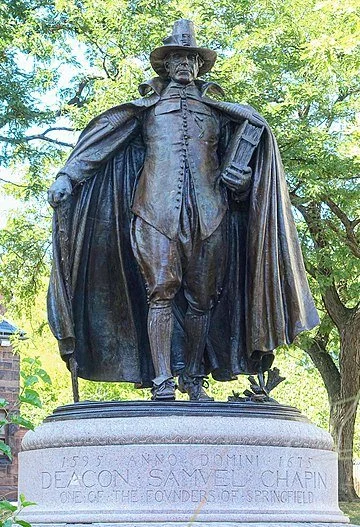
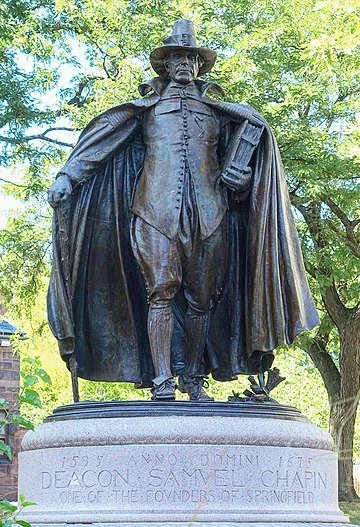
“The Puritan” (1887), a statue in Springfield, Mass., by Augustus Saint-Gaudens (1848-1907), one of America’s greatest sculptors. The term theocracy has been applied to the colonial governments established in the Massachusetts Bay and New Haven colonies in the early 17th Century. However, they were not theocracies in the traditional sense: There was a clear separation of church and state. Both colonies maintained separate systems of political and religious leadership; clergy did not hold government offices. Still, it was expected that families, the church and the magistracy—would act together to maintain a society based on Calvinist theology and religious practice.
That faded by the early 18th Century.
From OtherWords.org
Barely a month ago we lived in a world where all Americans had the right to decide for themselves whether to continue a pregnancy. For much of the country, that’s now history.
Just weeks ago, states could implement at least some common-sense limits on carrying guns. Public school employees couldn’t impose their religious practices on students. And the EPA could hold back our climate disaster by regulating planet-heating carbon emissions from coal plants.
Thanks to an appalling power grab by the Supreme Court’s conservatives, all that’s been demolished too. And they’ve hinted that the right to take contraception, marry someone regardless of your sexual orientation, and even to choose your own elected representatives could be next.
How did we get to this place? Because Republicans spent decades cheating their way to a right-wing Supreme Court majority that enacts an extremist agenda, rather than interpreting the law.
When the very close presidential election in 2000 turned on Florida, five GOP justices halted the vote count, stealing the election for the man most voters rejected, George W. Bush. In return, Bush appointed right-wing judges John Roberts and Samuel Alito.
In 2016, the Republican Senate defied the Constitution by refusing to let President Obama fill a Supreme Court vacancy. Instead, they let another voter-rejected president, Donald Trump, install right-winger Neil Gorsuch. Finally, even as voting was underway in the 2020 election, Republicans rush-approved Amy Coney Barrett’s appointment.
So we now have a hard-right Supreme Court drunk on its own power.
We need a fair balance — and we don’t have decades to set things right. We need to expand the Supreme Court to 13 justices right now, so we have judges who believe in privacy, who allow our government to protect our children from gun massacres, and who allow common sense steps to protect our future from climate change.
Republican politicians will say that changing the number of justices represents “politicizing” the Court. But it is the Republican-appointed justices who have entered politics, unleashing gun lovers to run wild, vetoing climate change regulations, canceling abortion rights, and threatening other personal freedoms.
The danger from the Republican judges is only growing.
Their latest project is destroying the power of regulatory agencies. We will be left with a government that cannot protect babies from dangerous cribs and hazardous toys, cannot prohibit unsafe drugs and contaminated food, cannot protect workers from dangerous workplaces, and cannot limit climate-ravaging carbon emissions.
If we allow this to continue, our political system will look a good deal more like Iran’s theocracy. Like the United States, Iran has elections. But reactionary, fundamentalist religious leaders there set election rules, decide who can run, and often override the decisions of the elected government.
The Supreme Court’s six conservative justices seem dead-set on playing this role here in our system. So the best way to curtail the power of our own black-robed fundamentalists is to increase the size of the Supreme Court.
Under the Constitution, it is for Congress to decide how many justices there will be. Over the years Congress has changed the number six times. It’s time to change them again.
For much of American history, there’s been one justice for each judicial circuit. Today we have 13 circuits, so we should have 13 justices. We cannot simply accept the unfairness of the Republican judicial takeover. We can and must act to restore balance to protect our rights, our lives, and our planet.
Mitchell Zimmerman is a lawyer, social activist and novelist.
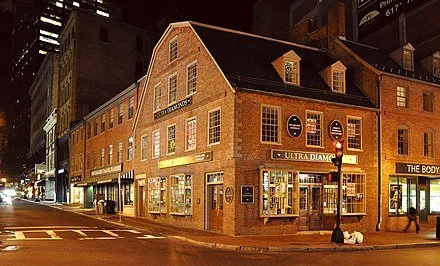
Hey, that was then!
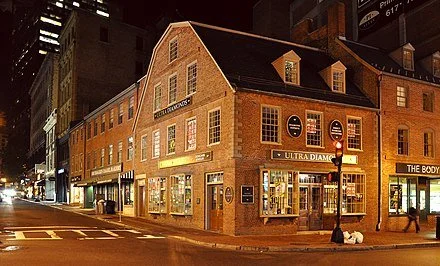
In the 19th Century, the Old Corner Bookstore, in downtown Boston, became a gathering place for writers, including Ralph Waldo Emerson, Henry David Thoreau and Margaret Fuller. Here James Russell Lowell edited the first editions of The Atlantic Monthly.
“Boston - wrinkled, spindly-legged, depleted of nearly all her spiritual and cutaneous oils, provincial, self-esteeming - has gone on spending and spending her inflated bills of pure reputation, decade after decade.”
xxx
“Harvard (across the river in Cambridge) and Boston are two ends of one mustache. ... Without the faculty, the visitors, the events that Harvard brings to the life here, Boston would be intolerable to anyone except genealogists, antique dealers, and those who find repletion in a closed local society.’’
— Elizabeth Hardwick (1916-2007), American literary critic and novelist

Gay Pride parade in Boston
Cynthia Drummond: These clingers might send you to the ER

Clinging jellyfish
From ecoRI News (ecori.org)
CHARLESTOWN, R.I. — Recent warnings about the presence of clinging jellyfish in some coastal ponds have caused a stir, because the tiny organisms sting, and they are difficult to spot.
People who use the ponds should be aware of the possibility they might encounter clinging jellyfish, or gonionemus vertens.
Katie Rodrigue, principal marine biologist with the Rhode Island Department of Environmental Management’s Division of Marine Fisheries, has been monitoring clinging jellyfish, because while their sting is an unpleasant nuisance for most people, others may experience serious allergic reactions.
“The reason it’s a cause for concern is because, for some individuals, it can cause a severe sting,” she said. “In 2019, I believe it was, we had a couple of people end up in South County Hospital after being stung, because they had a pretty severe reaction to it.”
Clinging jellyfish have two life stages — a polyp and a medusa, which is produced by the polyp. The polyps, which are only about half a millimeter in size, are found in Rhode Island throughout the year and produce medusae in mid- to late summer. A single polyp will produce multiple medusae, and it is during this medusa stage that the organisms develop tentacles, and become jellyfish that sting.
“There’s two life stages of it, and the medusa stage is what we would recognize as the jellyfish — the bell with the tentacles,” Rodrigue said.
The clinging jellyfish is an invasive species that was first recorded on Cape Cod and in Groton, Conn., in the late 1800s. That population, which originated in the Eastern Pacific, declined as eelgrass beds died.
In the 1990s, clinging jellyfish began to make a comeback and are associated with a North Pacific species that produces more toxic stings.
How did this species get all the way to New England? Rodrigue said it could have made the trip as a polyp.
“Because that polyp stage can latch onto hard surfaces, it could have latched onto a ship’s hull,” she said. “I think one theory I read about was bringing oysters in. That could have brought in some of those polyps.”
What distinguishes clinging jellyfish is a reddish-brown “x” mark on the bell, but that marking doesn’t mean they are easy to detect.
“They’re really tough to see, especially during the day, and they get their name ‘clinging jellyfish’ because they like to hold on to eelgrass and other submerged vegetation,” Rodrigue said. “They sort of hide during the day and hang on, but if they get disturbed, say, if somebody’s walking through an eelgrass bed or something, they would release off of it and swim into the water column, and that’s when somebody would be able to encounter them.”
Clinging jellyfish have sticky tentacles, armed with cells with barbed structures called nematocysts, which contain venom.
“Those tentacles can kind of stick to your skin, and those nematocysts will fire,” Rodrigue said. “It’s almost like a tiny needle that penetrates the skin and it releases that venom into your skin, and that’s what causes the stinging sensation, and the tentacles have tons of nematocysts on them. Many jellyfish have this, and anemones, and other animals like that.”
Clinging jellyfish are active at night, hunting zooplankton.
“At night is when they’ll release themselves off of the eelgrass and then they’re in the water column, feeding on zooplankton,” Rodrigue said. “And so, they’ll be a little bit more mobile at night.”
So far this summer, clinging jellyfish have been recorded in Potter Pond in South Kingstown and parts of Ninigret Pond. In previous years, they have been documented in Point Judith Pond and the Narrow River. It’s important to keep in mind, however, that they could be living in other waterbodies and just haven’t been spotted yet.
Clinging jellyfish are not the only species that people should be watching for. Salt Ponds Coalition president Arthur Ganz, a retired marine biologist, said he had not been notified of any encounters with clinging jellyfish this summer and described the stinging sea nettle jellyfish as being far more numerous.
“Sea nettles are very abundant in the ponds, more so, I’m going to say, over the last 20 years,” Ganz said. “Their numbers have very much increased. We’d see them occasionally in the real hot summer, but now, they’re everywhere. I was out on my boat and I just looked down at my mooring and there was probably 20 within a square meter. So, they are the ones that are the biggest nuisance.”
More benign, non-stinging jellyfish species such as comb and moon jellies also inhabit the Ocean State’s coastal ponds.
“They don’t have obvious tentacles and they don’t bother people,” Ganz said. “It’s essentially the sea nettles that are the biggest problem.”
On the ocean side, beachgoers should steer clear of the cyanea, or lion’s mane jellyfish, which can grow to be very large and is armed with long, stinging tentacles.
“They’ll give you a nasty sting, and what happens with the cyanea is, on the ocean side, they’ll break up in the surf, so the tentacles are floating free, so even though you don’t have one right there in your vision, you could get nailed by the broken-up tentacles,” Rodrigue said.
She suggests people who plan to spend time in the calmer areas of the salt ponds, especially near eelgrass beds, wear protective clothing.
“If you’re going to be in one of these coastal-pond environments, an area that’s very calm and protected and has a lot of submerged vegetation, I suggest just covering up,” she said. “If there’s a barrier between the jellyfish and your skin, that’s going to be the best bet to avoid getting stung; waders, wet suit, even leggings will all help with that.”
People who are stung should apply plain, white vinegar to the affected area.
“What that’ll do is at least prevent any more stinging cells from firing,” Rodrigue said, adding that the old remedy of pouring urine on a sting is definitely not recommended.
“Do not do that,” she said. “If anything, that can actually make it worse. That, or using fresh water. A lot of people, because of the irritation, they might want to dump some cool, fresh water on it, but that’ll actually cause more stinging cells to fire on your skin.”
DEM asks people who encounter clinging jellyfish to contact the agency at 401-423-1923 or by email at DEM.MarineFisheries@dem.ri.gov. Reports can also be posted on Facebook or Instagram.
Cynthia Drummond is an ecoRI News contributor.
Provincetown patroness of art

“Mary Heaton Vorse” (maquette, mixed media), by Penelope Jencks, in the show “Mary’s Friends: An Artists Renunion,’’ at Berta Walker Gallery, Provincetown, Mass., through Aug. 7
The gallery explains:
“Mary Heaton Vorse (1874-1966) was a journalist, labor organizer, war correspondent and arts patron, co-founding the Provincetown Players, and donating her old fishermen’s tackle house on Cape Cod Bay in 1915 as a home for their plays. Penelope Jencks is an internationally renowned sculptor, commissioned over the years to create numerous portraits, including those of Eleanor Roosevelt, Serge Koussevitsky, Leonard Bernstein, Aaron Copeland, and Seiji Ozawa.
“In her book Time and the Town Mary Heaton Vorse writes about the fascinating and very different schools of art in Provincetown in the early 20th Century — Traditionalists and Modernists She notes: ‘The profound gulf between the two schools in Provincetown is so deep that the respective members fight freely together, pound tables, and even heads...The old school shouts the loudest, but the new school flies its nose highest.”
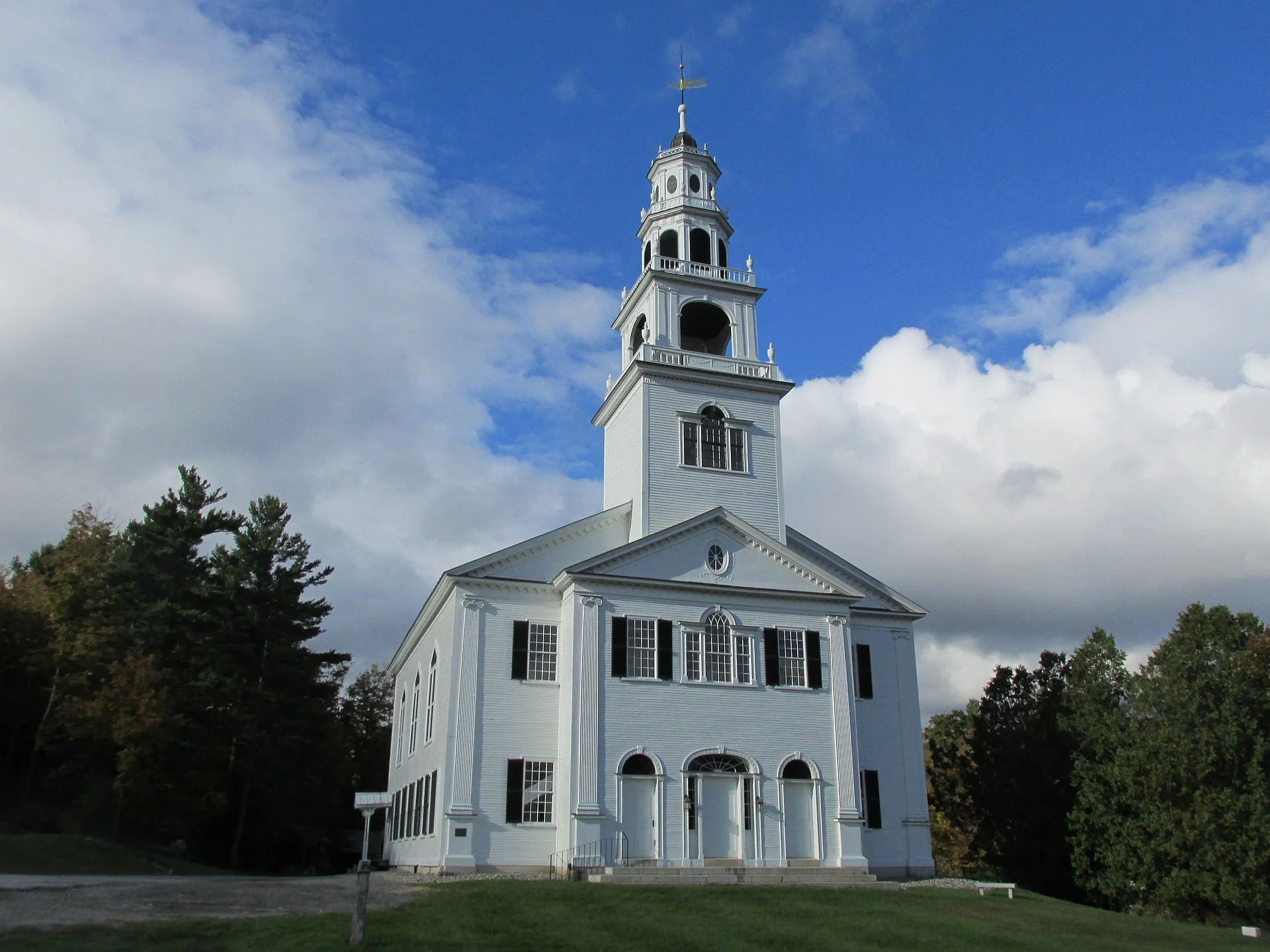
And well worth staring at
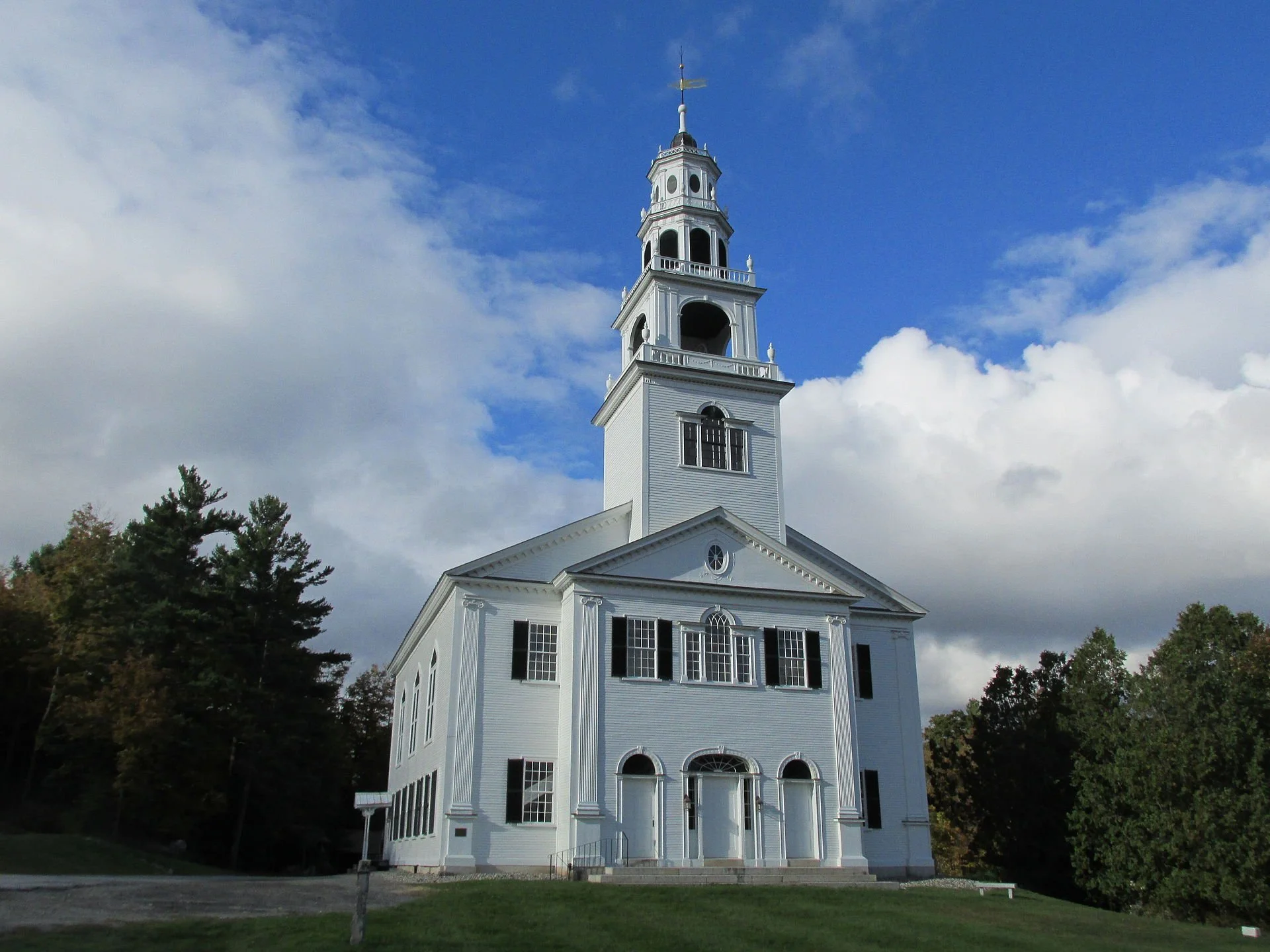
Acworth (N.H.) Congregational Church
— Photo by John Phelan
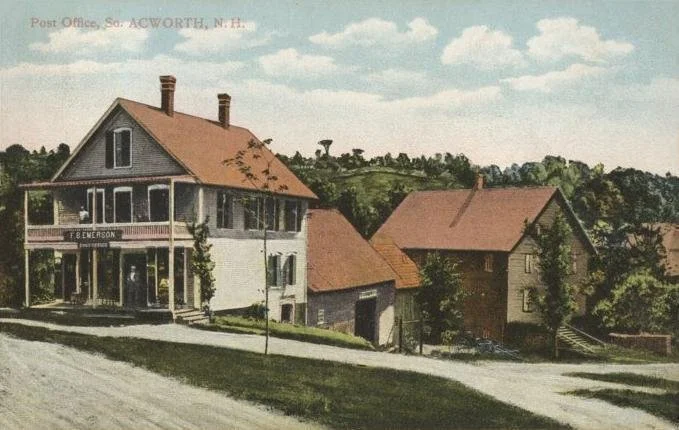
Acworth Post Office in 1907
“Tables of books line the walk by the library.
He remembers their wedding day.
Children play next to the clapboard school.
The old man stares at the steeple.’’
— From “Old Home Week in Acworth, 2008,’’ by Betsy Snider, a New Hampshire-based poet and retired lawyer.
Old Home Week or Old Home Day originated in New England and is rather similar to a harvest holiday or festival. In its beginning, in the late 19th and early 20th centuries, it involved a municipal effort to invite former residents of a village, town or city—usually individuals who grew up in the municipality and moved elsewhere in adulthood—to visit the "Old Home", the parental household and hometown. Some municipalities celebrate the holiday annually, while others celebrate it every few years.