
Vox clamantis in deserto







Mass. Blue Cross to help health-care startups of people of color

From The New England Council (newenglandcouncil.com)
“New England Council member, Blue Cross Blue Shield of Massachusetts, recently announced their Health Equity Business Accelerator program. This program provides financial support and mentors to founders of color who are focused on creating equitable health care.
“Startups in the accelerator receive a $150,000 investment and participate in nine months of programming from Blue Cross, The Capital Network and Healthbox. This program serves to support founders who are people of color, who have historically been excluded from funding and networking opportunities. For example, in 2021 only 0.4 percent of venture capital in Massachusetts went to Black-founded startups. This accelerator is looking to increase this number through recruiting cohorts. The first round included five companies, Bloomer Tech, MedHaul, Quality Interactions, SoHookd and TQIntelligence, respectively. The second round is looking to increase this number accepting up to seven companies from around the U.S.
“‘Each company was assigned an executive mentor who gave them access to demystifying how health plans make decisions and gave them access to our supplier diversity program leads, our marketing and sales leaders and our other business leaders,’ said Courton Brown, the vice president for business development at Blue Cross Blue Shield of Massachusetts.
“The New England Council would like to commend Blue Cross Blue Shield of Massachusetts for their work to increase equity in health care.
“Read more from the Boston Business Journal.’’
Finding quiet peace in the pandemic

“Move and Flow” (oil and graphite on panel), by Rose Umerlik, in her show “Repose,’’ at Atelier Newport, July 30-Aug. 31.
The gallery says:
“Rose Umerlik is an internationally recognized artist, who maintains a full-time studio practice in Vermont. Her work has always been based on strong ideals she has long held, such as the importance of being able to self-evaluate in a spirit of honesty and having a strong work ethic that helps her be fully present to life. These core values are always reflected in her work.
“During the worldwide pandemic, Rose spent much of the early months of lockdown with her family in quiet peace on their mountainside homestead, raising their firstborn into a world in disrepair. And while in isolation, Rose and her husband only had one task to fulfill: Revel and marinate in their love for their daughter as they watch her grow. Happiness and repose entered the home and established roots there. Their daughter is now almost two years old.
“One of the most trying times in history prevailed yet, through it all, as a new mother with her cherished blossoming family, Rose was able to find an unwavering peace and calm repose.”
And in our next Civil War?
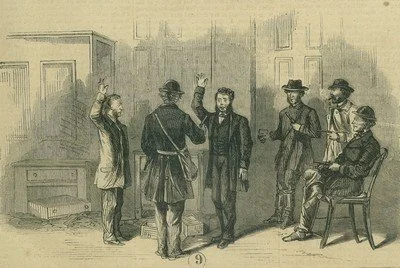
St. Albans , Vt., bank tellers being forced to pledge allegiance to the Confederacy on Oct. 19, 1864.
The St. Albans Raid, the northernmost land action of the American Civil War, was a raid from Canada by 21 Confederate soldiers. Their mission was to rob banks to raise money, and to trick the Union Army into diverting troops to defend their northern border against further raids. They got the money, killed a local and escaped back to Canada.
It’s not all about us
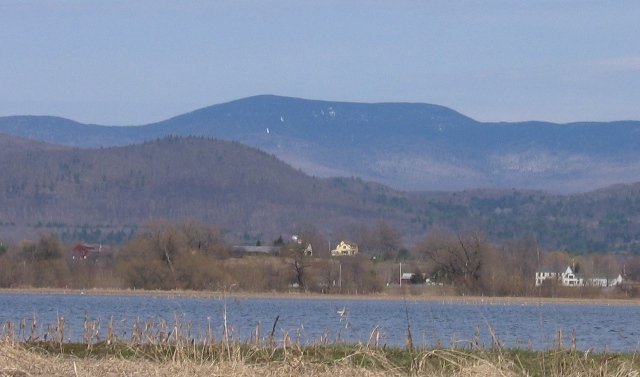
Bread Loaf Mountain, in Ripton, Vt. Middlebury College’s Broad Loaf School of English is named for the mountain.
— Photo by Aiken1986
“Human beings—any one of us, and our species as a whole—are not all-important, not at the center of the world. That is the one essential piece of information, the one great secret, offered by any encounter with the woods or the mountains or the ocean or any wilderness or chunk of nature or patch of night sky.”
— Bill McKibben (born 1960), in his book The Age of Missing Information, is an environmentalist and writer and a scholar at Middlebury (Vt.) College, where he also directs the Middlebury Fellowships in Environmental Journalism.
He lives in Ripton, Vt., where Robert Frost (1874-1963) lived during summers and falls in 1939-1963.

Robert Frost’s writing cabin in Ripton.
— Photo by Aiken1986
Chris Powell: New Haven’s silly attempt at foreign policy; hysteria about alleged ‘white-supremacist’ threat

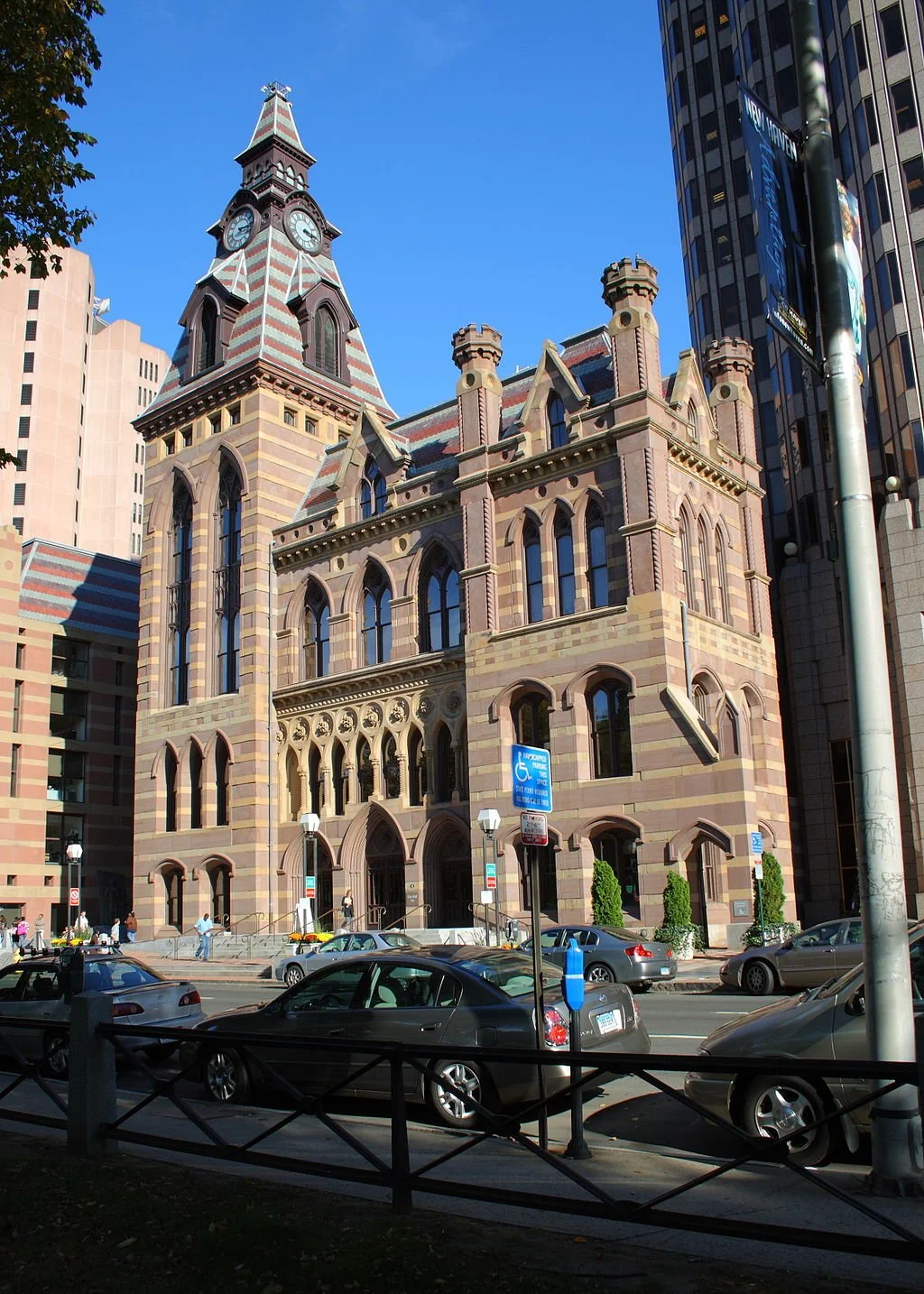
New Haven’s very unusual City Hall, designed by Henry Austin in a Victorian Gothic style, was built in 1861.
— Photo by Sage Ross
MANCHESTER, Conn.
Recently New Haven's big news has included the usual shootings, the continued inability of the city's students to read at anything close to grade level despite their school system's ever-increasing budgets, controversy over the selection of a new police chief, and, of course, the paralyzing injury suffered by a man in police custody because the city never got around to installing seat belts in a van used to convey prisoners. (Elsewhere in the United States seat belts have been standard equipment in motor vehicles for more than 50 years.)
But last week New Haven's Board of Alders -- what less pretentious jurisdictions would call the city council -- took another break from hard local reality. The board accepted the recommendation of the city's Peace Commission and approved a resolution urging President Biden to end the U.S. economic embargo of Cuba.
There were no signs that the State Department, the United Nations and the Cuban government were hanging on the resolution's fate. There were signs that city residents were concerned about the shootings, education failure and the police department.
The objective of New Haven's Peace Commission is -- really -- to protect the city against nuclear war. In that respect maybe the commission can claim to be doing a great job.
Peace on the city's own streets has been much more difficult to achieve, and despite the political correctness and self-righteousness that characterize the city's intelligentsia, even a few city residents might be wondering why these days anyone in city government has time to worry about Cuba.
The P.C. distractions in New Haven city government go well beyond Cuba. Two years ago the city established a Climate Emergency Mobilization Task Force. The emergency was so urgent that the task force wasn't appointed for more than a year after the Board of Alders authorized it. The task force's objective is "to end community-wide greenhouse gas emissions" by 2031 and figure out how "to safely draw down carbon from the atmosphere."
And why not? Those problems, challenging as they seem, may be easier to solve than making city streets safe, the schools effective, and city government more competent generally. Since the latter problems are so difficult, addressing them usually fails, so addressing them won't make the intelligentsia feel as good about itself as devotion to Cuba, climate change, and facilitating illegal immigration, New Haven having declared itself a "sanctuary city."
Indeed, New Haven's political correctness may be a big part of what makes the city's problems so intractable, shielding city government against the possibility of criticism from local news organizations, which embrace city government's leftward tilt despite its chronic deficiencies.
Really, how fair is it to criticize city government over the basics when it's trying so hard with Cuba, climate change, and nullifying immigration law?
But if its news organizations won't do the job, who will help New Haven residents understand that political correctness is no substitute for public administration?
xxx
Connecticut's news organizations outside New Haven aren't always much help either. Despite the constant mayhem in New Haven and the state's other cities, news organizations lately are paying more attention to what is being called a sharp rise in distribution of "white supremacist" flyers, which recently have been found in 15 towns.
But the flyers don't accomplish anything beyond stoking more leftist hysteria about the "right wing," which, without evidence, is accused of being the source of the flyers, though the flyers are distributed anonymously and don't provide accurate attribution. Police are investigating but even if a source is discovered, nothing could be done unless the flyers directly threaten people. So far they don't.
Connecticut has had some bloody crimes while the flyers have been distributed but the flyers weren't the perpetrators. Thanks to news organizations, the flyers have just distracted from the worsening mayhem.
For all anybody knows, the flyers could be distributed by some left-wing group as a false-flag operation. In any case they might not be distributed as much if news organizations weren't so eager to publicize them.
Chris Powell is a columnist for the Journal Inquirer, in Manchester.
Not your typical beach day
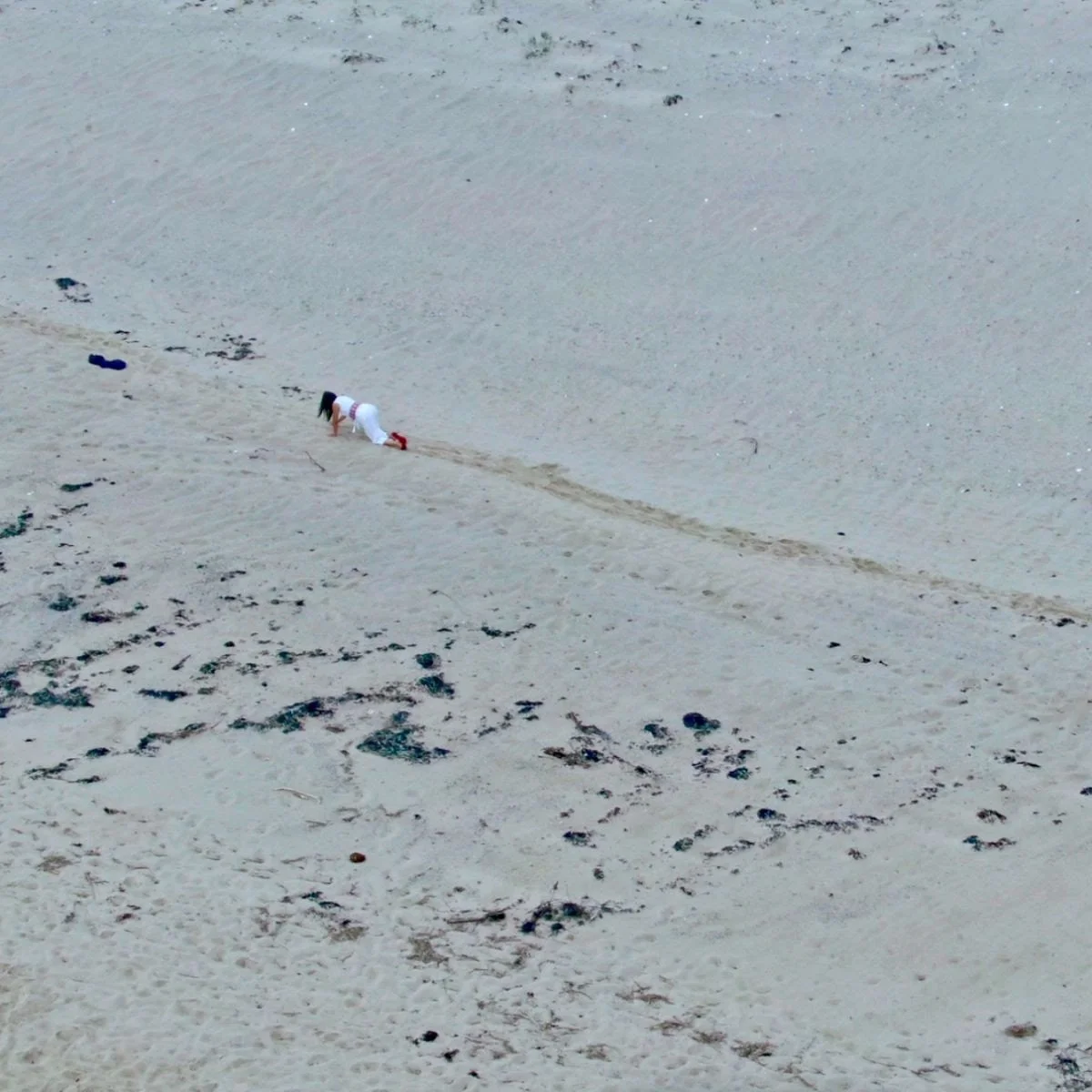
Video still from Kledio Spiro’s show “Which Way, “ at Kingston Gallery, Boston, Oct. 5-Nov. 5.
The gallery says:
“Kledia Spiro creates videos, performances, installations and multimedia experiences. In ‘Which Way,’ Spiro tackles the need to ‘mark your territory’ to survive in a changing landscape as both an immigrant {from Albania} and a woman. For immigrants, home is a constantly changing territory. The video installation depicts Spiro crawling through sand with stilettos and a weightlifting belt, trying to make it to an undetermined side. Spiro wants to confront her viewers with a new path — one that might be more difficult to walk but by the end of it they will gain a new perspective and appreciation.’’

Species of the battle for liberty

“The Stamp Act was to go into operation on the first day of November. On the previous morning, the 'New Hampshire Gazette' appeared with a deep black border and all the typographical emblems of affliction, for was not Liberty dead?’’
— Thomas Bailey Aldrich (1836-1907), American writer, including as poet and critic, and editor. The Portsmouth, N.H., native is notable, among other achievements, for his editorship of the Boston-based The Atlantic Monthly magazine.
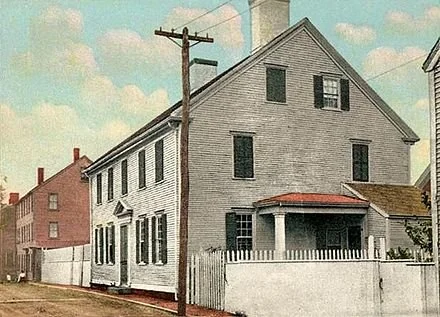
Thomas Bailey Aldrich House, part of Strawberry Banke Museum, Portsmouth, N.H.
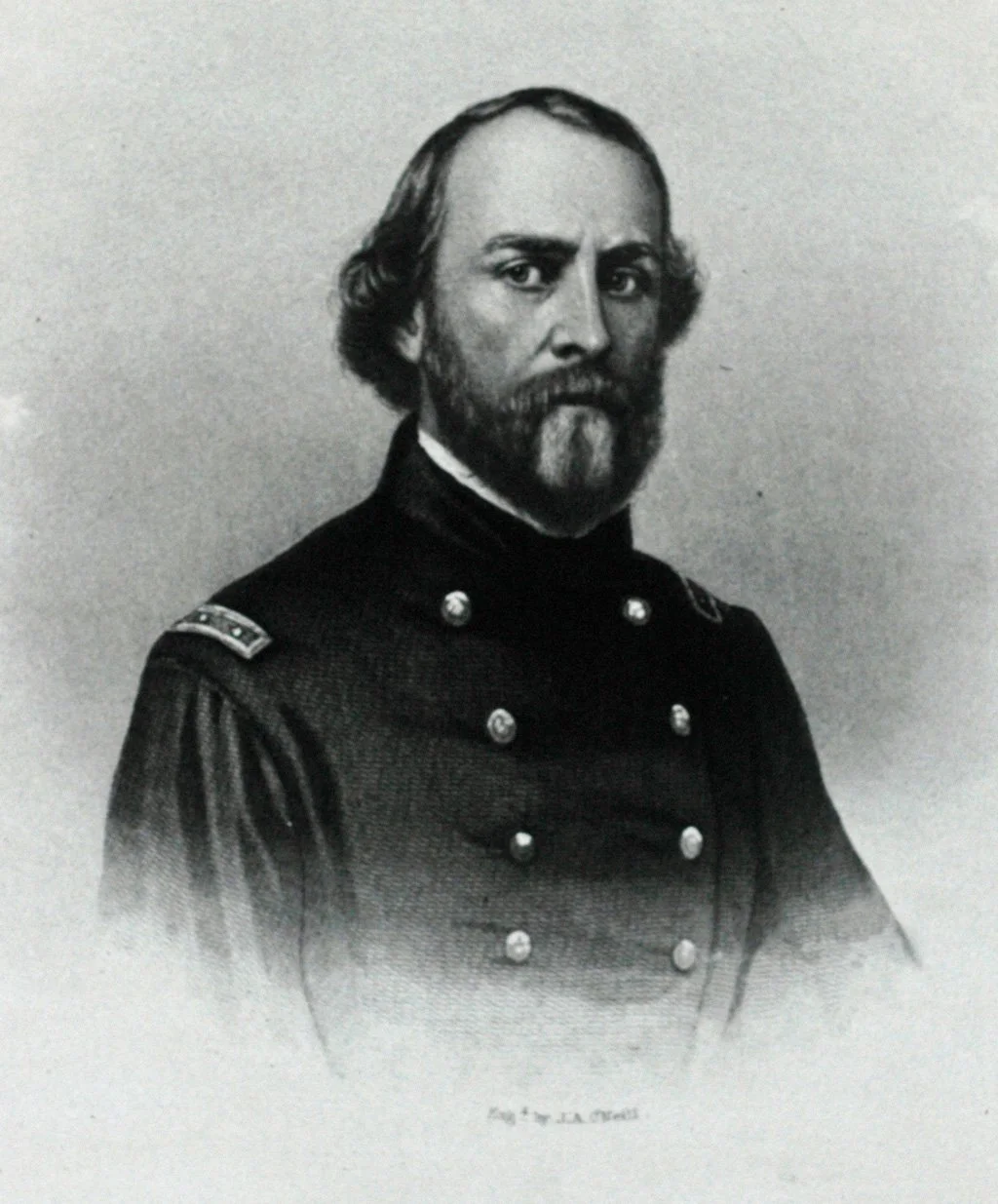
Sullivan Ballou
“I have no misgivings about, or lack of confidence in the cause in which I am engaged, and my courage does not halt or falter. I know how strongly American Civilization now leans on the triumph of the Government and how great a debt we owe to those who went before us through the blood and sufferings of the Revolution. And I am willing—perfectly willing—to lay down all my joys in this life, to help maintain this Government, and to pay that debt.’’
—Sullivan Ballou (1829-1861), Rhode Island lawyer, politician and major in the Union Army in a letter to his wife, Sarah, shortly before he died of wounds suffered in the First Battle of Bull Run.
Lunar and life

“Rush to the Sea” (encaustic), by Boston-based artist Deniz Ozan-George, in her show “Wax and Wane…Ebb and Flow,’’ at Galatea Fine Art, Boston, through July 31.
She says:
“‘Wax and Wane...Ebb and Flow’ is a personal exploration of the magical and enduring presence of the Moon through its many phases, its pull on the ocean tides and its effect on the life cycles of all living things. These mysteries are expressed through the medium of encaustic wax.’’
From Suicide to Saskadena

Adapted/updated from Robert Whitcomb’s “Digital Diary,’’ in GoLocal24.com
It’s a sensitive time indeed.
The small South Pomfret, Vt., ski area Suicide Six, one of America’s oldest ski areas, has changed its “insensitive” name to Saskadena Six.
“Much time, care and thought has been invested in the process to choose a name more representative of our values, one that celebrates its 86-year history, honors the Abenaki tradition, and will welcome future generations,” Courtney Lowe, president of the Woodstock Inn & Resort, which owns the ski area, said. “While the name might be changing, the experiences offered on this beloved mountain are not.”
According to a statement on the ski area’s Web site, “In the Abenaki language, “saskadena” (sahs-kah-deena) means “standing mountain.” (As opposed to a sitting or falling one?)
“Our resort team embraces the increasing awareness surrounding mental health and shares the growing concerns about the insensitive nature of the historical name,” says the Web site. “The feelings that the word ‘suicide’ evokes can have a significant impact on many in our community.” Especially these days? Of course, some will snarl that this is “politically correct.’’
The first rope tow, at the start powered by a Ford Model T engine, was installed at the former Suicide Six in 1936 on “Hill No. 6,” from which the area derived its name. Its founder, Wallace “Bunny” Bertram, a Rhode Island native, had joked that to ski down Hill No. 6 would be suicide. Bertram had been captain of the ski team at Dartmouth College, just up the road in Hanover, N.H.

Llewellyn King: To be serious about global warming be serious about the need for nuclear energy

The Seabrook Nuclear Power Station, behind the Blackwater River, as seen from Route 1A in Seabrook, N.H. The two remaining nuclear plants in New England — the 2,073-megawatt Millstone plant, in Waterford, Conn., (see below) and the 1,251.4-megawatt Seabrook plant, together provide about 26 percent of the region’s electricity.
— Photo by ThePessimus
WEST WARWICK, R.I.
If you have gasped in Dallas, sweltered in London, or baked in Tokyo this summer, you are likely to believe that global warming is real.
You are also likely to believe that governments -- at least the caring ones -- are desperate to cut the amount of carbon released into the atmosphere from power plants and vehicles.
More electricity is needed to cut the greenhouse-gas emissions from cars, trucks, buses, trains, and, eventually, aircraft. The government figures that U.S. electricity demand will double by 2050, even as the fuels producing it change.
There are three technologies for producing new large quantities of electricity without producing greenhouse gases: wind, solar and nuclear.
Leading global energy institutions, including the International Energy Agency, are adamant that nuclear must be part of the future energy mix.
Nuclear is desirable in many ways:
· It isn’t dependent on foreign supply except for some heavy components, like the castings for large pressure vessels. These, if needed in newer reactors, can be acquired from reliable allies, including South Korea and Japan. Alternatively, we could reinvigorate our large component industry.
· When it comes to supply chains, nuclear component manufacture can be brought to America. It doesn’t have a Chinese component. Wind power is dependent on rare earths -- they are a multiplier in wind turbines, increasing output up to five times. Over 90 percent of rare earths are processed in China, even if they are mined elsewhere. It will take precious decades to replicate the Chinese rare earths infrastructure. Also, China dominates the manufacture of cheap solar cells.
· Nuclear offers long-term planning: The design life of a plant can be as long as 100 years. These plants are clean, safe -- and getting safer. They have a high energy density and low land use, both of which contrast with solar and wind.
Incredibly, the world, outside of China and Russia, seems to have lost the ability to build nuclear plants. It is as though talent and institutional knowledge have disappeared. Those under construction are running many times over their projected costs, and a decade or more behind schedule. They represent a systemic industrial failure, whether it is Plant Vogtle in Georgia, Flamanville-3 in France (a nation that gets 70 percent of its electricity from nuclear; we get 19 percent), or Olkiluoto 3, in Finland.
At the heart of these failures -- and they are complex and far-reaching -- is a failure of welds, and a shortage of welders.
As a first step, the United States, in conjunction with the nuclear manufacturing industry, needs to find out what it is that we have lost in expertise and how to recapture it. We built more than 100 reactors in the 1960s and 1970s. There were some delays back then, but they were nothing like the catastrophic ones of today.
Particularly, the examination of what has gone wrong with nuclear building needs to concentrate on welding. Is this an old trade that needs updating? Can we fix some of the human error that has plagued big industrial welding, from nuclear plants to new ships, through automation and AI?
Not since the 1960s, I am told by nuclear lobbyists, has the public policy apparatus been so aligned to favor nuclear. One of these lobbyists said, “Both houses of Congress are on board, the administration is on board, the regulatory agencies are on board, and public acceptance is greater than it has been in years. But the industry is on its back.”
The issue, to my mind, is not whether we can relearn how do what we used to do, but that there is no mechanism for the utilities to buy and build new nuclear plants, whether they are the new generation of small modular reactors now under development or updated, large (about 1,000 megawatts), more traditional light water reactors. No utility can take the risk in the deregulated world. It is too much to ask.
The nation needs a coherent plan whereby a new generation of nuclear power can be built quickly. It has been done in the past, and it can be done again.
I would suggest -- as I have suggested over many years -- that as nuclear needs government safety oversight, proliferation safeguards, and approval that a tranche of reactors be built on government sites, financed by the government, and sold to commercial consortia to operate. These needn’t necessarily be utility companies. Wind and solar are being developed by merchant companies in many cases.
There is a national climate crisis, and a national electricity crisis is building. Utilities are having to produce more electricity while giving up coal and gas to do it. Nuclear is the strong third leg of the future electricity stool.
Llewellyn King is executive producer and host of White House Chronicle, on PBS. His email is llewellynking1@gmail.com and he’s based in Rhode Island and Washington, D.C.

The Millstone Nuclear Power Station, in Waterford, Conn., on Long Island Sound.
‘Patterns of occupation’

”Salt Marsh Skiff’’ (archival pigment print), by Shelburne, Vt.-based Jim Westphalen, in his show “Land & Tide: Scenes From New England,’’ at Edgewater Gallery, Middlebury, Vt., through Aug. 9.
His Web site says:
“Jim Westphalen has always had an affinity for the built landscape — those features and patterns reflecting human occupation within the natural surroundings. His current body of work, entitled “Vanish,’’ is an ongoing narrative that speaks to the decay of iconic structures across rural America. Inspired by such painters as Andrew Wyeth, Edward Hopper and A. Hale Johnson, Jim’s photographs open like windows to a world that is rapidly disappearing before our eyes. He captures his dynamic images using a vintage 4x5 view camera adapted for digital capture and then creates his large-scale archival prints using a variety of acid-free rag papers.
Largely self-taught, Westphalen has been a professional photographer for over 30 years. Born and raised on Long Island, in 1996 he moved to Vermont to be closer to the rural landscape that he loves.’’

At Shelburne Farms, a nonprofit education center for sustainability, a 1,400-acre working farm and National Historic Landmark on the shores of Lake Champlain in Shelburne. The property is nationally significant as a well-preserved example of a Gilded Age "ornamental farm", developed in the late 19th Century with architecture by Robert Henderson Robertson and landscaping by Frederick Law Olmsted.

Stick with Maine chowder

A bowl of fish chowder
— Photo by Nate Steiner
“Poems have been written about bouillabaise; but I have tried it again and again in the world’s leading bouillabaise centers, and, on the words of a dispassionate reporter, it’s not to be compared with a Maine cunner, cod, or haddock chowder made with salt pork and common crackers.’’
— Kenneth Roberts (1885-1957), novelist and journalist, in Trending into Maine (1938)
From fishing to etchings
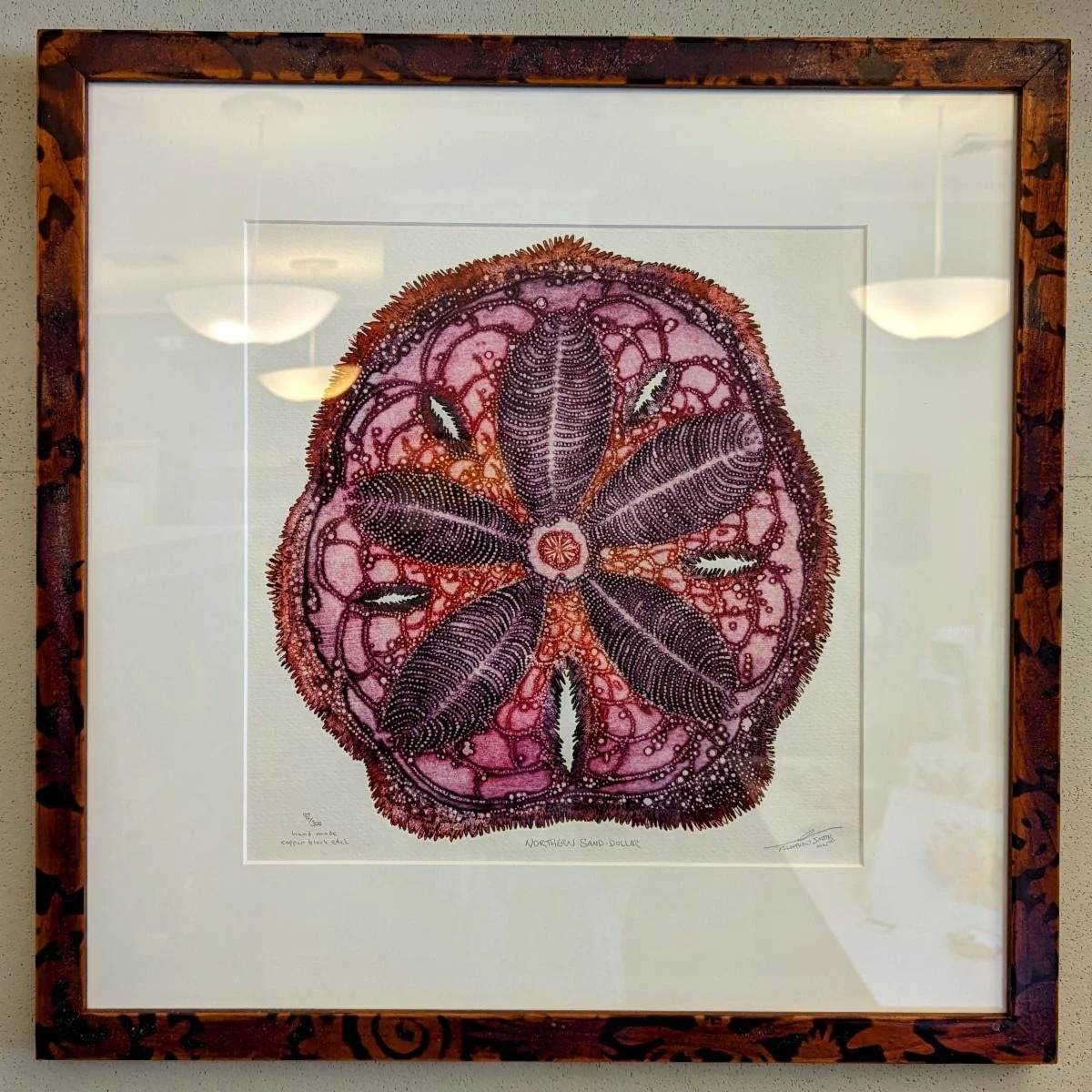
“Northern Sand Dollar” (etching) by Matthew Smith, in the New Hampshire group show “The Artist Next Door,’’ at Two Villages Art Society, Contookook, N.H., through July 30.
Sand dollars are species of flat, burrowing sea urchins belonging to the order Clypeasteroida.
His Web site says:
“Matthew Smith is an inventor, a creator, a maker of things. Born and raised in Brooklyn, N.Y. Matthew became a commercial fishing captain and made innovative nets to catch haddock and halibut in the North Atlantic. He put together the best fishing-boat crews to deploy the gear he made. He followed his instincts to go to places on the Georges Bank where the fish were, but the other fishermen were not.
After leaving the fishing industry, Matthew built, by hand, a self-sustained log cabin on the shore of Quincy Pond in Nottingham, N.H. Here he started a small company -- Quincy Pond Print Works -- to help him create his prints, frame them to museum standards, and make them available to collectors in New England and across the country, shipped in packages he designed himself.
As an artist, he created a new way to make prints — copper block etching -- that combines the top features of intaglio etching and relief printing to best portray the incredible color, depth, and texture found in his work. And he ships each piece of art with a custom-made museum-quality frame.’’
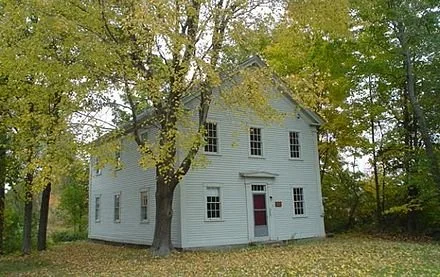
The Nottingham Square Schoolhouse museum is one of the best-preserved mid-19th Century schoolhouses in New Hampshire.

John O. Harney: Marketing abortion ruling; armed youth; ‘don’t say gay’ in Greenwich; not the ‘Flutie Effect’

Map by Tpwissaa

Greenwich, Conn., High School
From The New England Journal of Higher Education, a service of The New England Board of Higher Education (nebhe.org)
BOSTON
Could the anti-choice, forced-birth culture of the U.S. Supreme Court and many U.S. states present an advantage for New England economic boosters?
Massachusetts Gov. Charlie Baker told reporters that he had heard from a lot of companies that the recent Supreme Court decision removing the federal protection of the right to abortion may offer a big opportunity for Massachusetts to attract some employers whose employees would want access to reproductive-health services. Connecticut Gov. Ned Lamont called on businesses in states that limit abortion access to consider relocating to Connecticut.
In the context of choosing where to start or expand a business, big employers have occasionally written off New England as “old and cold” compared with economically and meteorologically sunnier spots. However, a 1999 poll by the University of Connecticut’s Center for Survey Research and Analysis, while admittedly dated, found an interesting niche for New England. International site-selection consultants, accustomed to Europe’s pricey, regulated environments, were less concerned with New England’s notoriously high costs than domestic site-selection pros. Key issues for the international consultants were access to higher education, an educated workforce and good infrastructure.
Peter Denious, chief executive of Advance CT, a business-development organization, recently told the Connecticut Mirror that such issues as diversity, equity and inclusion—and the state’s commitment to clean energy—could all help Connecticut align with the corporate goals of certain companies.
Our culture of active government, unionization and especially our human- resource development, could bode well once again in relatively enlightened New England.
Anti-semitism rising: The Anti-Defamation League (ADL) reported 2,717 anti-semitic incidents of assault, harassment and vandalism in 2021 in the U.S., the highest number since the ADL began tracking anti-semitic incidents in 1979, according to the group’s annual Audit of Antisemitic Incidents. These included more than 180 anti-semitic incidents in New England. And nationally, 155 anti-semitic incidents were reported at more than 100 college campuses. Meanwhile, tension between anti-semitism and anti-zionism, including the boycott, divestment and sanctions (BDS) movement, is challenging on campuses and beyond
Packing heat. More than 1 million U.S. adolescents (ages 12 to 17) said they had carried a handgun in 2019-20, up 41% from about 865,000 in 2002-03, according to a study by researchers at Boston College’s Lynch School of Education and Human Development, using data from the National Survey on Drug Use & Health. The socio-demographic profile of the gun carriers also changed. Carrying rates grew from 3.1% to 5.3% among white adolescents, from 2.6% to 5.1% among higher-income adolescents, and from 4.3% to 6.9% among rural adolescents between, while rates among Black, American Indian/Alaskan Native and lower-income adolescents decreased.
“Don’t Say Gay” here? In April, Mount Holyoke College President Sonya Stephens wrote here that Florida legislation dubbed by opponents the “Don’t Say Gay” bill, was part of a nationwide wave of proposal laws linking divisive issues of race, sexual orientation and gender identity to parents’ concerns about what their children are being taught in public schools. These bills not only undermine the real progress that LGBTQ+ people have made in society over the past 50 years, Stephens wrote, but they also further erode trust in some of our most under-compensated public servants: school teachers and administrators.
On July 1, U.S. Secretary of Education Miguel Cardona noted that the Florida parents and families he’d spoken with said the legislation doesn’t represent them and that it put students in danger of bullying and worse mental health outcomes.
In Cardona’s home state of Connecticut, meanwhile, the Greenwich School Board adopted a new Title IX policy unanimously, but not without controversy. Edson Rivas and Colin Hosten of the Fairfield County-based Triangle Community Center Board of Directors wrote in Connecticut Viewpoints that the policy adopted by the Greenwich School Board “conspicuously removes any language referring to gender identity and sexual orientation” which was part of the original version of the policy introduced last fall. The board replied that “this policy covers all students, whether or not certain language is included.” But Rivas and Hosten aren’t buying it. “If the substance of the policy remains the same, as they say, then the only effect of removing the language about gender identity and sexual orientation is the linguistic pseudo-erasure of the LGBTQ+ community in Greenwich Public Schools.”
Truth to tell: Recently, the American Association of Colleges and Universities (AAC&U) named 75 higher-education institutions to participate in the 2022 Institute on Truth, Racial Healing & Transformation (TRHT) Campus Centers as part of an effort to dismantle racial hierarchies.
As we at NEBHE and others have wrestled with a “reckoning” on race, gender and so many other wrongs, the “truth and reconciliation” concept has always made sense to me. Check out, for example, the thoughtful book Honest Patriots exploring how true patriots in post-World War II Germany, post-apartheid South Africa and the U.S. in the the aftermath of slavery and the genocide of Native Americans loved their country enough to acknowledge and repent for its misdeeds.
Under the AAC&U initiative, campus teams develop action plans to advance the parts of the TRHT framework: narrative change, racial healing and relationship building, separation, law and economy. The institute helps campus teams to prepare to facilitate racial-healing activities on their campus and in their communities; examine current realities of race relations in their communities and the local history that has led to them; identify evidence-based strategies that support their vision of what their communities will look, feel and be like when the belief in the hierarchy of human value no longer exists, and learn to pinpoint critical levers for change and to engage key stakeholders.
Among participating New England institutions: Landmark College, Middlesex Community College, Mount Holyoke College, Suffolk University, the University of Connecticut and Westfield State University.
Another problem with over-incarceration. NEBHE has published a policy brief about the effects of higher education on incarcerated people in New England prisons and jails—and increasingly broached conversations about the dilemmas created by the world’s biggest incarcerator — America. Now, another byproduct surfaces: Children with an incarcerated parent have exceedingly low levels of education. The most common education level for respondents from a low-income family who had an incarcerated parent was elementary school, according to research by a group of Wake Forest University students who put together an article for the Nation Fund for Independent Journalism. The students set out to understand how the academic achievement, mental health and future income of children of incarcerated parents compare to those with deceased parents. Just under 60% as many respondents with an incarcerated parent completed a university education compared to the baseline of respondents with neither an incarcerated nor deceased parent.
Acquisition of Maguire: I first heard the term “Flutie Effect” in the context of former Boston College Admissions Director Jack Maguire. The term refers to the admissions deluge after the BC quarterback Doug Flutie threw the famed Hail Mary pass (caught by the less-famous Gerald Phelan) in 1984. Flutie won the Heisman Trophy, then pursued a pro career, first with Donald Trump’s New Jersey Generals in the USFL and then in the Canadian Football League, with a few bumpy stops in the NFL.
But Maguire attributed BC’s good fortune not to the diminutive quarterback but to the college’s “investments in residence halls, academic facilities, and financial aid.” In 1983, Maguire, a theoretical physicist by training, founded Maguire Associates and introduced the concept of “enrollment management,” combining sophisticated analytical techniques, customized research and deep experience in education leadership with a genuine enthusiasm for client partnerships. Maguire became a sort of admissions guru whose insights we have been pleased to feature.
Now, higher-education marketing and enrollment strategy firm Carnegie has announced it is buying Maguire Associates. Not to be confused with the foundation that administered the Carnegie Classification of Institutions of Higher Education, which recently moved to the American Council on Education, nor the Carnegie Endowment for International Peace, which has encouraged disarmament, this Carnegie, also founded in the 1980s and based in Westford, Mass., is formally known as Carnegie Dartlet LLC. Its pitch: “We are right definers. We are your intelligence. We are truth revealers. We are your clarity. We are obstacle breakers. We are your partners. We are audience shapers. We are your connection. We are brand illuminators. We are your insight. We are story forgers. We are your voice. We are connection creators. …”
John O. Harney is executive editor of The New England Journal of Higher Education.
Big show at Vermont art museum features exciting ancient medium; see video

See this very unusual and exciting show at the Southern Vermont Art Center's Wilson Museum, Manchester, Vt., through Aug. 14: Hit this link for a video about the show.
It's titled "RELATIONSHIPS: hot, cold, intricate'' and features New England Wax, a regional association of 31 artists who work in encaustic and other wax mediums. The museum notes that encaustic, in Greek, means “to burn in”.
"It is an exciting art medium with a rich history that offers many creative options. Composed of beeswax, tree resin, and pigment applied with a brush or other tools while molten, each layer is fused to the previous one using a heat gun, torch, or other heated implement. Cold wax is a more contemporary medium combined with oil paint or other pigmenting methods. Each of these wax mediums offers many possibilities for translucency, layering, incising, and other techniques in both 2D and 3D work. The exhibiting artists, from the six New England states, use creative interpretations of the RELATIONSHIPS theme to demonstrate the many expressive and unique possibilities of working with wax-based materials.''
Oh, what a beautiful morning

A beautiful morning at the Chatham (Mass.) Bars Inn.
Photo by James P. Freeman

In the time of textile mills

Massachusetts National Guardsmen with fixed bayonets surround a parade of strikers during 1912 Lawrence textile strike
“It is a long time since I flapped mv wings,
a long time since I stood on the roof of my house
in Lawrence, Mass., or Michael's in No. Andover,
a little whiskey in one hand, the past slipping
through the other, a little closer to the heaven of
dreams ….
“From where we stood I could see the steeple of the French
church. Further back, it was 1912, and I could almost
see the tenements of the French women who worked
the fabric mills …
weaving the deadly dust into their lungs….’’
— From “The Angels of 1912 and 1972,’’ by Richard Jackson
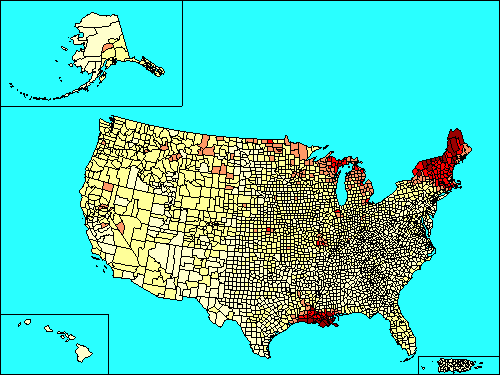
Distribution of French Canadians in the U.S. Census
Charlie Baker on post-governorship

Charlie Baker
From The Berkshire Eagle: Outgoing Massachusetts Gov. Charlie Baker says:
“‘I’m not going to go away quietly, and I’m certainly not going to — I am not going to retire,’ he said. ‘My wife would never let me. That would cause all kinds of issues. I think I’ll end up doing a bunch of different things. Some of them will be related to government, some will be related to traditional private sector-type stuff.’
“Baker, 65, did not shed any more light on his plans, but he made clear that he is not publicly gearing up to campaign for another position after opting against seeking a third term.’’
Brett Kelman: A simple way to stop hospital-acquired pneumonia

Four years ago, when Karen Giuliano went to a Boston hospital for hip- replacement surgery, she was given a pale-pink bucket of toiletries issued to patients in many hospitals. Inside were tissues, bar soap, deodorant, toothpaste, and, without a doubt, the worst toothbrush she’d ever seen.
“I couldn’t believe it. I got a toothbrush with no bristles,” she said. “It must have not gone through the bristle machine. It was just a stick.”
To most patients, a useless hospital toothbrush would be a mild inconvenience. But to Giuliano, a nursing professor at the University of Massachusetts at Amherst, it was a reminder of a pervasive “blind spot” in U.S. hospitals: the stunning consequences of unbrushed teeth.
Hospital patients not getting their teeth brushed, or not brushing their teeth themselves, is believed to be a leading cause of hundreds of thousands of cases of pneumonia a year in patients who have not been put on a ventilator. Pneumonia is among the most common infections that occur in health care facilities, and a majority of cases are non-ventilator hospital-acquired pneumonia, or NVHAP, which kills up to 30 percent of those infected, Giuliano and other experts said.
But unlike many infections that strike within hospitals, the federal government doesn’t require hospitals to report cases of NVHAP. As a result, few hospitals understand the origin of the illness, track its occurrence, or actively work to prevent it, the experts said.
Many cases of NVHAP could be avoided if hospital staffers more dutifully brushed the teeth of bedridden patients, according to a growing body of peer-reviewed research papers. Instead, many hospitals often skip teeth brushing to prioritize other tasks and provide only cheap, ineffective toothbrushes, often unaware of the consequences, said Dian Baker, a Sacramento State University nursing professor who has spent more than a decade studying NVHAP.
“I’ll tell you that today the vast majority of the tens of thousands of nurses in hospitals have no idea that pneumonia comes from germs in the mouth,” Baker said.
Pneumonia occurs when germs trigger an infection in the lungs. Although NVHAP accounts for most of the cases that occur in hospitals, it historically has not received the same attention as pneumonia tied to ventilators, which is easier to identify and study because it occurs among a narrow subset of patients.
NVHAP, a risk for virtually all hospital patients, is often caused by bacteria from the mouth that gathers in the scummy biofilm on unbrushed teeth and is aspirated into the lungs. Patients face a higher risk if they lie flat or remain immobile for long periods, so NVHAP can also be prevented by elevating their heads and getting them out of bed more often.
According to the National Organization for NVHAP Prevention, which was founded in 2020, this pneumonia infects about 1 in every 100 hospital patients and kills 15-30 percent of them. For those who survive, the illness often extends their hospital stay by up to 15 days and makes it much more likely they will be readmitted within a month or transferred to an intensive care unit.
John McCleary, 83, of Millinocket, Maine, contracted a likely case of NVHAP in 2008 after he fractured his ankle in a fall and spent 12 days in rehabilitation at a hospital, said his daughter, Kathy Day, a retired nurse and advocate with the Patient Safety Action Network.
McCleary recovered from the fracture but not from pneumonia. Two days after he returned home, the infection in his lungs caused him to be rushed back to the hospital, where he went into sepsis and spent weeks in treatment before moving to an isolation unit in a nursing home.
He died weeks later, emaciated, largely deaf, unable to eat and often “too weak to get water through a straw,” his daughter said. After contracting pneumonia, he never walked again.
“It was an astounding assault on his body, from him being here visiting me the week before his fall, to his death just a few months later,” Day said. “And the whole thing was avoidable.”
While experts describe NVHAP as a largely ignored threat, that appears to be changing.
Last year, a group of researchers — including Giuliano and Baker, plus officials from the Centers for Disease Control and Prevention, the Veterans Health Administration, and the Joint Commission — published a “call-to-action” research paper hoping to launch “a national healthcare conversation about NVHAP prevention.”
The Joint Commission, a nonprofit organization whose accreditation can make or break hospitals, is considering broadening the infection control standards to include more ailments, including NVHAP, said Sylvia Garcia-Houchins, its director of infection prevention and control.
Separately, ECRI, a nonprofit focused on health care safety, this year pinpointed NVHAP as one of its top patient safety concerns.
James Davis, an ECRI infection expert, said the prevalence of NVHAP, while already alarming, is likely “underestimated” and probably worsened as hospitals swelled with patients during the coronavirus pandemic.
“We only know what’s reported,” Davis said. “Could this be the tip of the iceberg? I would say, in my opinion, probably.”
To better measure the condition, some researchers call for a standardized surveillance definition of NVHAP, which could in time open the door for the federal government to mandate reporting of cases or incentivize prevention. With increasing urgency, researchers are pushing for hospitals not to wait for the federal government to act against NVHAP.
Baker said she has spoken with hundreds of hospitals about how to prevent NVHAP, but thousands more have yet to take up the cause.
“We are not asking for some big, $300,000 piece of equipment,” Baker said. “The two things that show the best evidence of preventing this harm are things that should be happening in standard care anyway ― brushing teeth and getting patients mobilized.”
That evidence comes from a smattering of studies that show those two strategies can lead to sharp reductions in infection rates.
In California, a study at 21 Kaiser Permanente hospitals used a reprioritization of oral care and getting patients out of bed to reduce rates of hospital-acquired pneumonia by around 70 percent. At Sutter Medical Center in Sacramento, better oral care reduced NVHAP cases by a yearly average of 35 percent.
At Orlando (Fla.) Regional Medical Center, a medical unit and a surgical unit where patients received enhanced oral care reduced NVHAP rates by 85 percent to 56 percent, respectively, when compared with similar units that received normal care. A similar study is underway at two hospitals in Illinois.
And the most compelling results come from a veterans’ hospital in Salem, Virginia, where a 2016 oral-care pilot program reduced rates of NVHAP by 92 percent — saving an estimated 13 lives in just 19 months. The program, the HAPPEN Initiative, has been expanded across the Veterans Health Administration, and experts say it could serve as a model for all U.S. hospitals.
Michelle Lucatorto, a nursing official who leads HAPPEN, said the program trains nurses to most effectively brush patients’ teeth and educates patients and families on the link between oral care and preventing NVHAP. While teeth brushing may not seem to require training, Lucatorto made comparisons to how the coronavirus revealed many Americans were doing a lackluster job of another routine hygienic practice: washing their hands.
“Sometimes we are searching for the most complicated intervention,” she said. “We are always looking for that new bypass surgery, or some new technical equipment. And sometimes I think we fail to look at the simple things we can do in our practice to save people’s lives.”
Brett Kelman is a Kaiser Health News reporter.