
Vox clamantis in deserto







Dangerous game

“Playing Games with Goya,’’ by Alexandra Rozenman, at Brickbottom Artists Association, Somerville, Mass., July 14-Aug. 20.
Her Web site says:
“Alexandra (Alya) Rozenman was born in 1971 in Moscow. She was classically trained at the Soviet Academy of Arts for two years and later studied with dissident artists, well-known today, from Moscow’s underground movement. While still a teenager, she became part of Moscow’s alternative scene of the 1980s. After immigrating to the U.S., she spent the early 1990s in New York, becoming a part of what later became the International Art Alliance on the Lower East Side and earning her BFA from SUNY in 1993. She later relocated to Boston, earning an MFA from the School of the Museum of Fine Arts at Tufts in 1998, and studying with Gerry Bergstein and Robert Ferrandini. Her paintings and drawings blend the styles and symbols of folk art, Russian Underground Conceptualism, illustration, and Jewish art.
“She was the recipient of the MacDowell Foundation Fellowship in 2006.’’
Chris Powell: Is abortion really that popular?
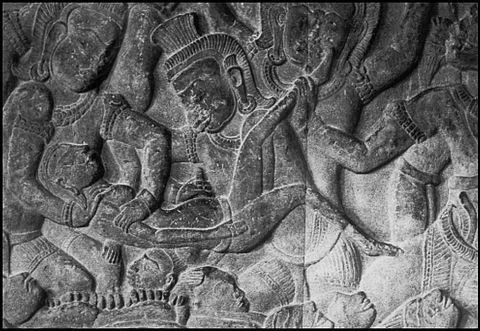
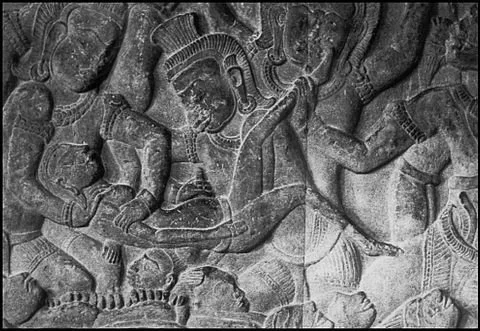
Bas relief at Angkor Wat, c. 1150, in what is now Cambodia, depicting a demon performing an abortion upon a woman who has been sent to the underworld
MANCHESTER, Conn.
Connecticut Gov. Ned Lamont has sent an open letter to businesses in states that prohibit or sharply restrict abortion, encouraging them to relocate to Connecticut so that their employees can get abortions more easily. He also made the appeal in an Internet video.
Business observers laughed it off, since abortion rights don't figure at all in business calculations while Connecticut's high taxes and excessive regulation figure heavily, making the state lag in economic development.
But then it was wrong to construe the governor's appeal as having anything to do with economic development. It was really aimed at Connecticut's own voters as part of his campaign for re-election. The governor sought to persuade them that abortion rights in other states are more important than the deficiencies of government in their own state.
Despite the enormous clamor about abortion, opinion polls rank it low among national issues, even as the bigger national issues are working strongly against Democrats. The governor and Democrats elsewhere hope that abortion will distract from those issues.
But the governor and Democrats in other states seem to think not only that abortion ranks high as an issue but also that most voters are as enthusiastic about abortion as the Democrats themselves are. This belief is signified by the Democrats' marquee congressional legislation, the Women's Health Protection Act, which would legalize post-viability abortion, even abortion at the moment of birth, throughout the country, going far beyond and thus nullifying Connecticut's own law, which restricts post-viability abortion.
Connecticut's intelligentsia, overwhelmingly Democratic and enthusiastic about abortion, cannot fathom contrary opinion and fails to recognize that other states have restrictive abortion laws not because of any oppression of women but because many if not most women there, benighted as they may be, are not enthusiastic about abortion.
Instead of pretending that Connecticut's liberal abortion law might draw businesses from abortion-restricting states, Connecticut's abortion enthusiasts would become much more relevant by moving to the abortion-restricting states and trying to persuade the women there of just how backward they are.
xxx
Last week Connecticut Atty. Gen. William Tong affected outrage at the request made to the Public Utilities Regulatory Authority by water company Aquarion for a rate increase of 27 percent to be implemented over three years. "The last thing Connecticut families and small businesses need now is a double-digit water bill hike on top of steadily mounting surcharges," Tong said.
But inflation is raging and the company said it had not sought a rate increase in more than nine years. The attorney general took no note of this. Worse, Tong took no note of something else. On the very day when Aquarion's rate request was reported, state government imposed a 23 percent tax increase on diesel fuel, which will raise prices on everything shipped in the state.
The tax increase took full effect immediately -- it wasn't staggered over three years like the water company's rate request -- and the attorney general was silent about it. For price increases in the private sector are bad while price increases in government are OK.
After all, Tong, a Democrat, had struck his latest empty pose and achieved his uncritical publicity amid an election campaign, while sincerity in protecting the public against government's own price increase would have gotten him in trouble with his party, whose governor and legislative majority insisted on raising the diesel tax.
xxx
The degree to which the Lamont administration has raised taxes is being disputed in the gubernatorial campaign. Republicans want to count as increases the tax cuts that were legislated by recent Democratic administrations and then repealed once an election was over and before the cuts were to take effect.
However these prematurely repealed tax cuts are classified, the practice is grossly dishonest. Additionally misleading is that the controversy is somehow failing to count the biggest tax increase of the current administration -- the half-percent increase in the state income tax to finance a family and medical leave program most people will never be able to use for their emergencies, a program whose benefits are distributed as discretionary patronage.
Chris Powell is a columnist for the Journal Inquirer, in Manchester.
Frank Carini: Will federal reprieve be enough to save these very fast sharks?

An Atlantic shortfin mako shark
From ecoRI News (ecori.org)
The world’s fastest-swimming shark is about to get a reprieve from overfishing.
Beginning July 5, the landing or possession of Atlantic shortfin mako sharks in the United States has been prohibited. This rule applies to commercial fishermen, recreational anglers and any dealers who buy or sell shark products. These sharks frequent southern New England waters.
The ban includes sharks that are dead or alive when captured, according to the National Oceanic and Atmospheric Administration’s National Marine Fisheries Service (NOAA Fisheries).
The recent decision has long been supported by shark-research organizations concerned about the significant issues that this species faces. Defenders of Wildlife and the Center for Biological Diversity sent a notice June 28 to Gina Raimondo, U.S. secretary of commerce, and Janet Coit, assistant administrator for NOAA Fisheries, of their intent to sue for failing to protect the shortfin mako shark under the Endangered Species Act.
“The shortfin mako shark is the world’s fastest-swimming shark, but it can’t outrace the threat of extinction,” Jane Davenport, a senior attorney at Defenders of Wildlife, is quoted in a press release about the organizations’ intent. “The government must follow the science and provide much-needed federal protections as quickly as possible. This will demonstrate America’s leadership in fisheries and ocean wildlife conservation both at home and on the world stage.”
The shortfin mako is a highly migratory species whose geographic range extends throughout the world’s tropical and temperate oceans. They can reach a top speed of 45 mph, and, like tunas and the white shark, shortfin mako sharks have a specialized blood vessel structure — called a countercurrent exchanger — that allows them to maintain a body temperature that is higher than the surrounding water. This adaptation provides them with a major advantage when hunting in cold water. As an apex predator, the species is an integral part of the marine food web.
The species, however, faces a barrage of threats, especially overfishing from targeted catch and bycatch. The species’ highly valued fins and meat incentivize this overexploitation.
“The shortfin mako shark has long been a target of commercial fisheries and consumers due to its excellent taste, and to sport fishermen for its spectacular strength and leaping ability,” said Jon Dodd, executive director of the Wakefield, R.I.-based Atlantic Shark Institute. “Unfortunately, those are the same issues that have resulted in the significant population decline of this iconic shark that required this complete and unprecedented closure.”
Dodd noted female mako sharks don’t reproduce until they are about 20 years old and weigh some 600 pounds.
“I’ve seen hundreds of mako sharks and exactly one that size in all my years researching this spectacular shark,” he said. “It’s amazing that they can even reach that age and size with all the fishing pressure and risks they face.”
Since mako sharks have few young, and they take time off between giving birth, Dodd said the numbers don’t favor their long-term survival without significant management changes.
Three years ago the International Union for Conservation of Nature classified the shortfin mako as “endangered” on its Red List of Threatened Species.
“The Fisheries Service failed to protect the shortfin mako despite an international scientific consensus that conservation action is urgently needed,” Alex Olivera, a senior scientist at the Center for Biological Diversity, said in the June 28 press release that quoted Davenport. “Even as the rest of the world scrambles to save these sharks from extinction, they have no protections under the U.S. Endangered Species Act. That needs to change.”
On NOAA Fisheries’ species directory Web page for the shortfin mako shark, it reads: “U.S. wild-caught Atlantic shortfin mako shark is a smart seafood choice because it is sustainably managed and responsibly harvested under U.S. regulations.”
On the same page the federal agency notes that, according to the 2017 stock assessment, shortfin mako sharks are “overfished and subject to overfishing.”
In a 2019 assessment, the International Commission for the Conservation of Atlantic Tunas (ICCAT) estimated that as much as 4,750 metric tons of mako shark were being taken on an annual basis.
“It was time to give the mako shark a break, but even so, we are still looking at a recovery that will take until 2070,” Dodd said. “This is not a quick fix by any means, and the mako still faces significant challenges.”
If ICCAT provides for U.S. harvest in the future, NOAA Fisheries could increase the shortfin mako shark retention limit, based on regulatory criteria and the amount of retention allowed by ICCAT. Until that happens, the retention limit will remain at zero, according to the agency.
Frank Carini is senior reporter and co-founder of ecoRI News.
We could all use some

“An Intervention” (acrylic and oil on canvas), by Deborah Dancy, in a group show at the Truro (Mass.) Center for the Arts, July 12-July 22.
The center says that Deborah Dancy's multimedia artwork walks between abstract and figurative work. “Her paintings, photos and drawings capture everyday moments through a unique lens.”
She explains in her Web site:
"My work is an investigation of abstraction’s capacity to engage beauty and tension without justification or narrative. In my paintings and works on paper, I do not specify references; meaning is organic since images mingle, shift, and position themselves within a field of agitated or flat color. Within these works, inspiration springs from diverse sources sponsored, in part, from the views of gnarled and jagged trees and bark from the woodlands surrounding my home, discarded shards of construction debris, and constant encounters with the internal and external world. In this odd combination of elements, the initial mark prompts the starting point. Hesitation and agitation of brush strokes within the gesture reveals content. Incompleteness- the unfinished fragment of what - ‘almost was’ and ‘might become’ amplifies meaning. In this orbit, painting explores what I consider as embracing the unpredictable and accidental. Accepting this means I suspend assumptions and allow discoveries to emerge. This edge of conflict and sequence of processes, including scraping and repainting, fresh forms, and constructed imagery, becomes the elemental act of painting.’’

Highland Light, in Truro. The famous lighthouse’s original site is marked by the boulder in the foreground. It was in danger of falling down the cliff that it was perched near the edge of because of erosion, and so the structure was moved 450 feet to the west, in 1996.
It all started in 1797, when a wooden lighthouse was authorized by George Washington to be built to help warn ships about the dangerous coastline between Cape Ann and Nantucket. It was the first lighthouse on Cape Cod. In 1833, the wood structure was replaced by a brick tower. In 1857 the lighthouse was declared dangerous and demolished and the current 66-foot brick tower was constructed.
Will it have to be moved again as seas continue to rise and erosion accelerates on the Outer Cape?
David Warsh: Cambridge will be even more of a capital of economics than usual this month

MIT’s main campus, in Cambridge
SOMERVILLE, Mass.
For the first time in three years the Summer Institute of the National Bureau of Economic Research is meeting in-person in Cambridge, Mass., at least for the most part, with some on-line components as well. (In the days before Zoom, venture capitalists used to describe more expensive face-to-face gatherings as “flesh-meets,” to distinguish them from conference calls.) A parallel, pan-European policy research institution, the Centre for Economic Policy Research, now headquartered in Paris, was founded in 1983.
A substantial fraction of the NBER’s 1,700+ research affiliates, who are drawn from colleges and universities mostly in North America, and a few others scattered around the world, will troop through the Sonesta Hotel in East Cambridge over the next three weeks, along with enough colleagues and students to add up to an attendance of some 2,400 persons in all. It is the forty-fifth annual meeting of what has become, in essence, a highly decentralized Wimbledon-style tournament of applied economists, staged as a science fair, and conducted in a series of high-level seminars.
Wimbledon, in that NBER players are professionally ranked; affiliates are selected by peer-review. Decentralized, in that 49 different projects are on the docket, many of them overlapping. Science fair, in that investigators choose their own problems, and rely on agreed-upon methods to study them, while new methods themselves are the subject of a separate annual lecture. Seminars, in that presenters don’t simply read their papers they have written; they briefly describe them and then respond to discussants and badinage.
An overall program is here. A detailed day-by-day listing of sessions is here. First Deputy Managing Director of the International Monetary Fund Gita Gopinath, of Harvard University, is slated to deliver the Martin Feldstein Lecture July 19 at 5:15p.m. EDT. It’s titled “Managing a Turn in the Global Financial Cycle’’.
Meanwhile, a mile down the Charles River, the Russell Sage Foundation Summer Camp in Behavioral Economies has been underway in the Marriott Hotel, some twenty-five or thirty Ph.D. candidates and post-docs studying with leading researchers, under the direction of David Laibson and Matthew Rabin, both of Harvard University.
The Summer Institute is where economic policy approaches are argued among experts. Nobel Prizes emerge mostly from summer camps. I look forward to a lot of (virtual) running-around.
David Warsh, a veteran columnist and an economic historian, is proprietor of Somerville-based economicsprincipals.com. where this essay first ran.
Bathos at the beach
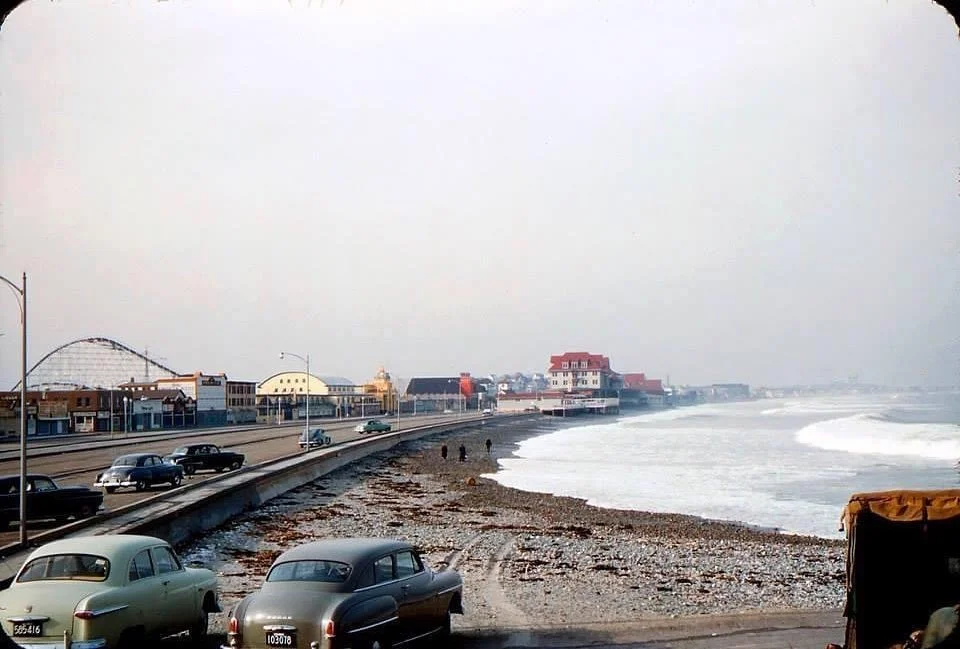
Artfully depressing photo of Nantasket Beach, in Hull, Mass., about 1950. Long-gone Paragon Park amusement park on the left.

Sometimes fun, if unhealthy
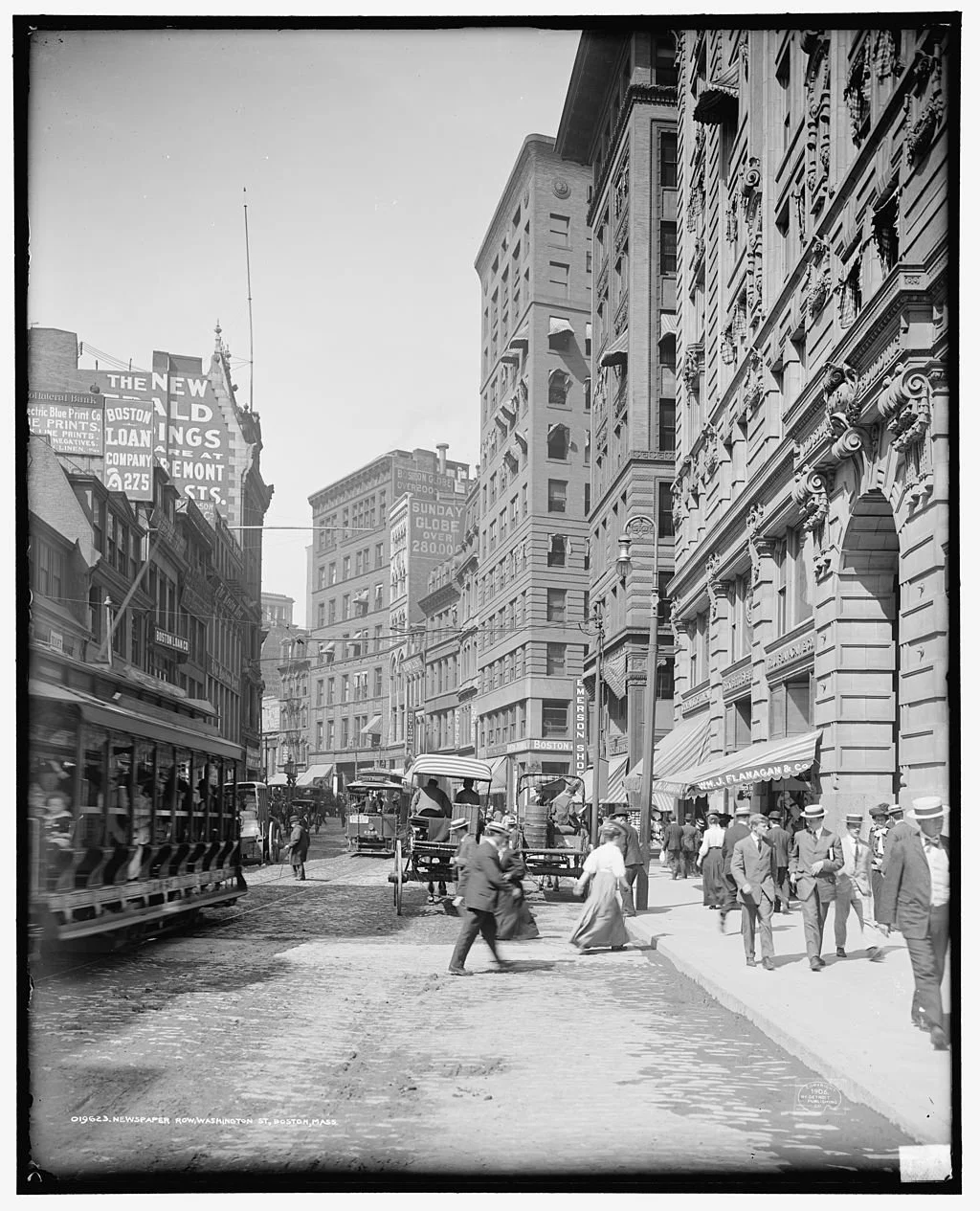
Boston’s “Newspaper Row,’’ in ca. 1906, showing the locations of the Boston Post (left), the Boston Globe (center-left) and the Boston Journal (center-right)
Adapted from Robert Whitcomb’s “Digital Diary,’’ in GoLocal24.com
I’ve been reading Carl Bernstein’s new memoir, Chasing History: A Kid in the Newsroom, which is mostly about his days as an erratic high school and college student in Maryland and as a devoted copyboy, dictationist and reporter at the old Washington Star in the early and mid ‘60s. It’s a terrific tale of the sometimes inspiring, sometimes exasperating world of journalism back then. It recalled to me some of the similar stuff I saw a few years later as a news assistant at the old Boston Record American, a rather tacky tabloid, and as a reporter at the Boston Herald Traveler (RIP), a somewhat stodgy broadsheet.
Ah, the unpredictable, open-ended hours, the tense, looming deadlines, the smoking, the bad coffee, the immediate post-deadline drinking at nearby watering holes, the interviewees you thought you’d hate but ended up becoming friends with, or enemies, the speeding in cars with fins to story scenes and speeding back to write the stories before deadline and the sudden, exciting assignments to far-away places. Meanwhile, you’d gradually put together a sort of mental Geiger counter to determine with increasing, in fits and starts, acuity if sources were lying to you.
Then there were the printers in the intensely unionized composing rooms who would stage a wildcat strike and/or tip over a page of the lead type spat out from clanking Linotype machines if someone from the newsroom so much as lightly touched the type.
One of Bernstein’s recollections particularly caught my eye: Reporters were sometimes called upon to get a picture of a recently deceased person – killed usually in a car accident or crime -- from his or her survivors to run with a story about the death. We called these assignments “takeouts.’’
I did a few myself, with trepidation. You’d knock on their door, looking mortified, make the request for the picture, which you’d promise to return as soon as it was in the paper, and ask if you could chat with them a bit about their loved one for the article to run with the picture. Rather than being enraged by my bothering them at such a sad, traumatic time, I found that they usually wanted to talk about the victim’s life. Thus I sat at kitchen tables hearing their stories. That I looked younger than my years probably made them more sympathetic about my invasion. Still, it was often tense and of course tearful.
Then there was the editor, who, after a too-long liquid lunch, lit his tie on fire after his cigarette fell from his lips as he nodded off.
Ah, newspaper days: Bad for your health but good for a lifetime supply of anecdotes.
xxx
Bernstein and his Watergate scandal reporting partner at The Washington Post, Bob Woodward, agree that Trump has been more dangerous to democracy and more corrupt than Nixon, as bad as he was.
In an earlier time, Trump, a cancer on the body politic, would be facing the gallows, and rightly so.
Then there’s the low life working for him, and the millions of suckers who voted for him. Some would have voted for Hitler, too.

At work in Linotype machines in 1935
Newport, ‘even in November’
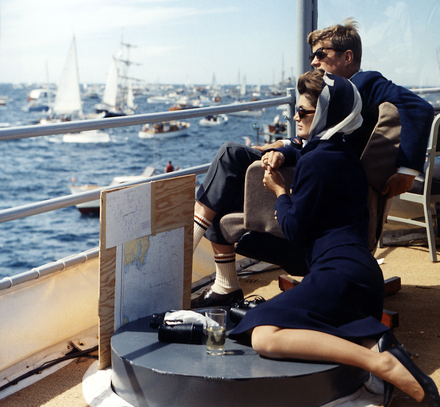
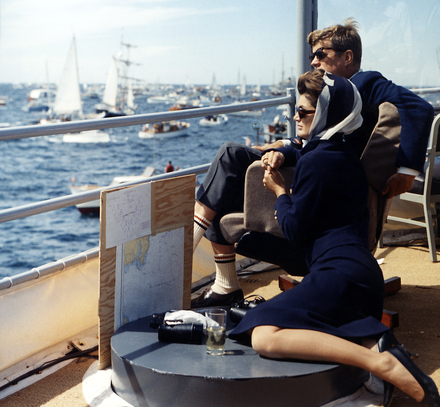
President John. F. Kennedy and First Lady Jacqueline Kennedy Onassis watch the 1962 America's Cup races off Newport.
“Some say Newport’s loveliest months are September and October, others are loyal to May and June before the high-summer crowds invade. But even in November when the bay turns gray black and the chill wind hustles off the the Atlantic, Newport keeps its spell — of a kind that has made lively entrepreneurs and tired wanderers alike exclaim on coming to it, ‘This is the place. Let’s stay here.’’’
— Joseph Brennan, in Arthur Griffin’s New England: The Four Seasons
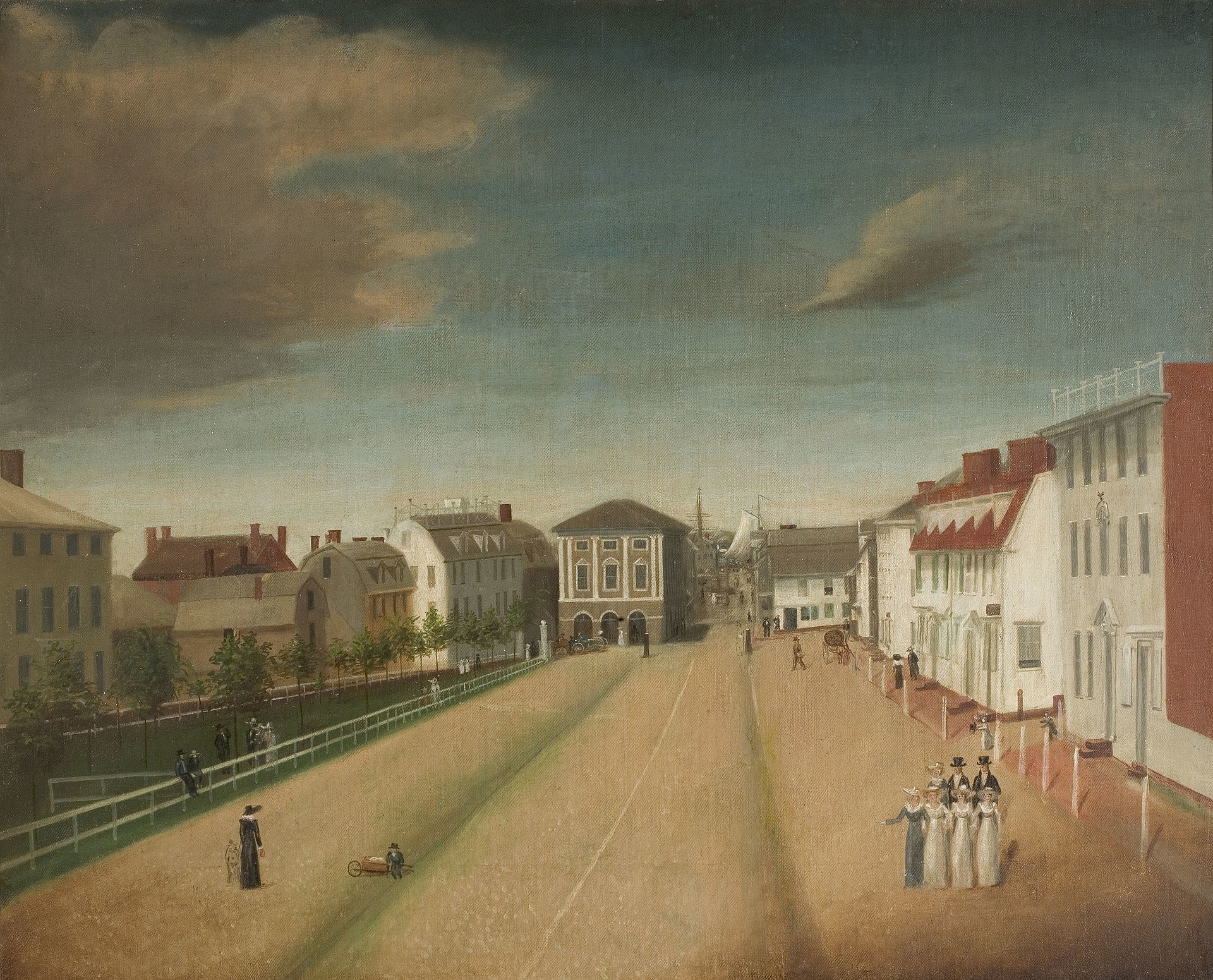
Washington Square, Newport, in 1818, by an unknown painter
Handing down their boats and their livings
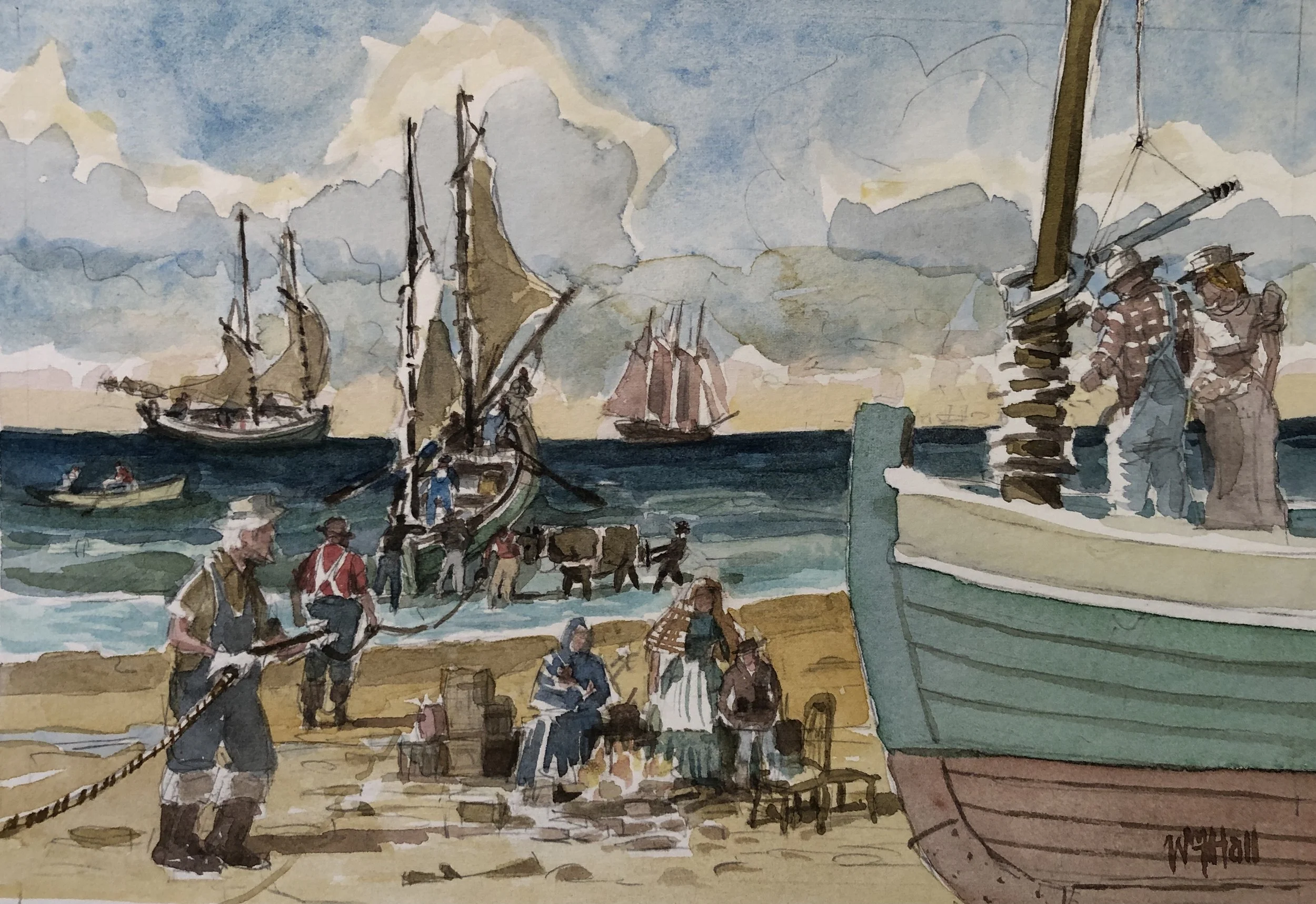
“Wedding Dowry” (watercolor on Arches Paper), by William Talmadge Hall, at David Chatowsky Art Gallery, 47 Dodge St., Block Island, R.I. (401) 835-4623
Hit this link for Mr. Hall’s Web site.
He explains:
“In this picture I show a Block Island Double-Ender fishing boat being brought up on the beach at the end of a day around 1840, with the help of oxen and block and tackle. The boats, a mainstay of the island’s fishing and transportation in the 18th and 19th centuries, were built by islanders to circumvent the problem of not having particularly safe harbors, necessitating that boats be drawn up into the dunes at night to wait for a favorable tide and reasonable weather.
This required the islanders to help each other daily, building a tight communal bond.
Fishing from the family-owned boats was so successful in harvesting the plentiful fish stocks around the island that the Block Island Double-Ender fleet grew large and the boats become famous for seaworthiness.
In this picture, the newlyweds on the boat to the right prepare to forge ahead in their new boat. Two generations of Block Islanders watch this ceremony as they sit on the beach at day’s end in front of a small fire.
Over the years, fathers handed down their boats to sons, and if there were no sons then a boat might be a dowry gift to a daughter and son-in-law.
The new husband brought the potential of a bigger extended fishing family once he had proven himself a worthy fisherman and become the the ascending key figure in the future.
Either way, the prize was the boat and the legacy it represented to a self-sufficient fishing community bolstered by shared beliefs.
xxx
I’m a 74-year-old artist. My family has been a part of Block Island's history for five generations. My father was the first male Hall on the island not to pursue fishing as a career, although he harpooned swordfish until he was drafted into the Army, in World War II.
I’m a watcher, and many of my paintings are about people working — the simple grace of people doing what they do each day to make a living. These folks don’t dwell much on the meaning or the ultimate results of what they do. They go with the flow of a continuum of work.

Llewellyn King: Boris Johnson — the fall of an articulate incompetent

Britain’s soon to be former prime minister, with the famous wild hair
WEST WARWICK, R.I.
The best piece of business advice I have ever read was, “Beware the articulate incompetent.” It is important to business decisions but far more so to political ones.
Boris Johnson has always been a poster boy for the articulate incompetent, and yet he rose with wit, bravado and connections to the highest elective office in Britain, prime minister. Now his luck has run out.
Born in New York to British parents, he didn’t renounce his dual citizenship until 2016, when it became a liability politically. He won a scholarship to Eton, the boys-only boarding school where many prime ministers studied, went on to Oxford, and was elected president of the Oxford Union. This is the equivalent of privilege on steroids.
Johnson’s weaknesses, including sloth, disorganization, lack of preparedness, showing off and a disinclination to let the facts stand in the way of a good story, were well known. He was fired from his first journalistic job on The Times of London for fabricating a quote -- from his godfather, of all people. Later Michael Howard, the distinguished Tory leader, fired him from the ranks of the shadow cabinet, also for lying.
After The Times, Johnson worked for the conservative daily, The Telegraph. In Brussels, where he was assigned, he was regarded by his peers as good company but an unreliable reporter. One of them told me that he was often asked to chase up some fabricated concoction of Johnson’s like the banana regulation, allegedly defining the length and curve of bananas allowed into the European Union. The only curve was that of the truth.
Johnson’s editors back in London wanted to hear only bad news about Europe. Johnson obliged: He was playing his part in the movement to take Britain out of Europe, which matured as Brexit.
Johnson went on to become a member of Parliament and editor of The Spectator, an admired British weekly magazine of politics, culture and current affairs, published continuously since 1828. His colleagues at the magazine found him sloppy, often absent and often leaving his work to others. His management was, it is reported, incoherent, a charge repeated about his leadership of Britain.
The Spectator, under Johnson’s editorship, was engulfed in a sex scandal of rare portions. The publisher was cavorting with a British cabinet member, Johnson with the star columnist and an editor with a secretary. It was a literary “Animal House.”
Johnson has been married three times and has six children from those marriages. He acknowledges one love child.
Next step for Johnson was to become mayor of London. His humor papered over the cracks, and he did a good job in defending London’s image -- especially in insisting that the double-decker red buses be retained.
The campaign for the United Kingdom to leave Europe gave Johnson his chance. He went against his old parliamentary friend and Eton and Oxford companion, Prime Minister David Cameron, and campaigned vigorously and with aid of some wild and untrue claims about how Britain would prosper out of Europe. Brexit carried the day.
Cameron was replaced with the dull, dutiful Theresa May. She had the task of trying to make Brexit work without breaking Britain. After three years, she was out, and a shaken party installed Johnson as its leader.
In a landslide, the Conservatives won the first election with Johnson at the helm, and he was expected to be a transformational prime minister. Instead, he has been involved in scandals: He has been caught lying about parties in his official home and office, No. 10 Downing Street, during the Covid-19 lockdown, and recently about the allegations of sexual impropriety of a member of his party, whom he had been warned about but nonetheless promoted. The truth might have saved Johnson; he eschewed it.
Johnson isn’t a fool, but he does foolish, often roguish things. He is a scholar of the ancient world, a biographer, a linguist and a wordsmith. He likes to make comparisons to antiquity: He equated London to Athens and himself to Pericles.
He wrote a biography of Churchill, which I enjoyed but found nothing groundbreaking. It seems to have been written to signal similarities between himself and Churchill.
Johnson will be heard from again as a commentator and author. He excels at the pithy phrase and joking in adversity, as when, as London mayor, he was left hanging on a zipline during a 2012 Olympics event.
His legacy may be that he was the most quotable prime minister of his generation and beyond. Here is a classic: “My friends, I have discovered myself, there are no disasters, only opportunities. And, indeed, opportunities for fresh disasters.”
On resigning, Johnson said tamely, “Them’s the breaks.”
Llewellyn King is executive producer and host of White House Chronicle, on PBS. His email is llewellynking1@gmail.com and he’s based in Rhode Island and Washington, D.C.
‘Nail to the mast’
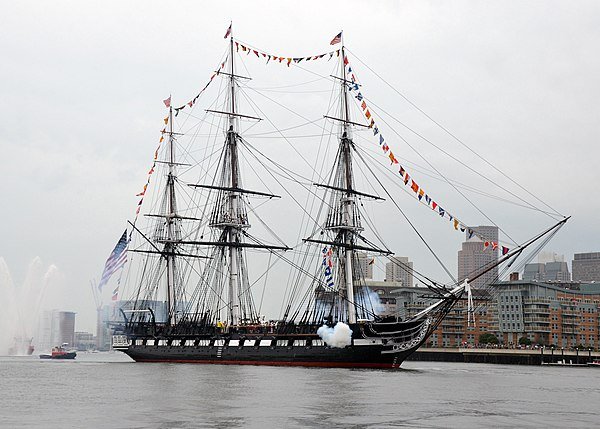
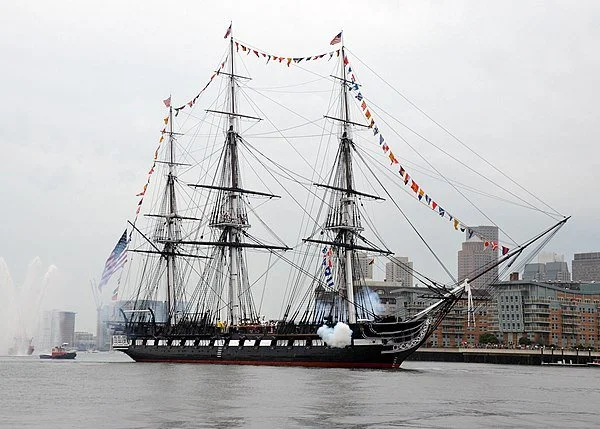
The USS Constitution fires a 17-gun salute in Boston Harbor, on July 4 2014. The Constitution, also known as “Old Ironsides,’’ is the world's oldest ship still afloat. She was launched in 1797, one of six original frigates authorized for construction by the Naval Act of 1794 and the third constructed.
The ship is most noted for its effectiveness against the British during the War of 1812.
She is now a museum ship, albeit fully commissioned by the Navy. Her crew of 75 officers and sailors participate in ceremonies, educational programs and special events while keeping her open to visitors year round and providing free tours.. She is usually berthed at Pier 1 of the former Charlestown Navy Yard at one end of Boston's Freedom Trail. Go see her.
Ay, tear her tattered ensign down!
Long has it waved on high,
And many an eye has danced to see
That banner in the sky;
Beneath it rung the battle shout,
And burst the cannon’s roar;—
The meteor of the ocean air
Shall sweep the clouds no more!
Her deck, once red with heroes’ blood
Where knelt the vanquished foe,
When winds were hurrying o’er the flood
And waves were white below,
No more shall feel the victor’s tread,
Or know the conquered knee;—
The harpies of the shore shall pluck
The eagle of the sea!
O, better that her shattered hulk
Should sink beneath the wave;
Her thunders shook the mighty deep,
And there should be her grave;
Nail to the mast her holy flag,
Set every thread-bare sail,
And give her to the god of storms,—
The lightning and the gale!
— “Old Ironsides,’’ by Boston physician, poet and essayist Oliver Wendell Holmes Sr. (1809-1894)
Don Pesci: Chatting with Aristophanes about comedy
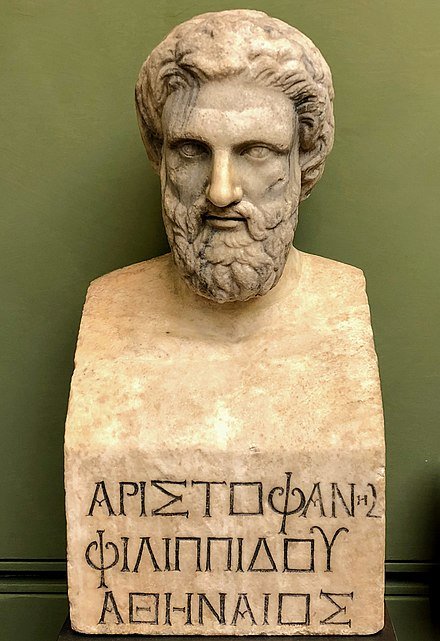
Bust of Aristophanes (First Century A.D.)

The Theater of Dionysus, Athens . In the time of comic playwright and poet Aristophanes (446-386, B.C.) the audience probably sat on wooden benches with earth foundations.
VERNON, Conn.
Q: It’s so good to meet you (chuckles) in person, so to speak.
Aristophanes: Funny. Would you mind if I use that in the future?
Q: I wasn’t aware there was a future for the dead.
A: That is what I might call an example of the arrogance of the living. You are forgetting William Faulkner, who said, "The past is never dead. It's not even past." He wrote most persuasively about the past by resurrecting the dead in his novels. We all do that, in one way or another. You must remember that the only advantage those who are alive at present have over the dead is that they are alive and the dead are dead. That’s it.
Q: I wonder if you can confirm a story about you, not that it has anything to do with the subject of our discussion, the role of comedy in culture. It is said that you died from a falling roof tile that struck you on the head. One of our commentators said your manner of death was ironically appropriate, for a comic writer.
A: (nonplussed, a vacant look)
Q: He was making a joke.
A: Ah, yes, I get it. And you want to know if the joke is true?
Q: Yes.
A: Well, jokes are always true. But how can I tell you that the incident happened if I had been struck dead by a falling roof tile? Besides, if you have done even minimal research on me – a quick glance at what I call Wickedpedia – you will know that little is known of me? I managed to keep myself well hidden in the plays. Your age is obsessed with facts, but it is important to understand that facts, provided they are all accounted for, are vehicles that may lead to truth. But, in some instances, fiction serves the same purpose, which is why we do not dismiss Shakespeare and Faulkner as unimportant.
Q: It’s Wikipedia, by the way.
A: Not when you are punning.
Q: One of the purposes of this interview is to gather comments from the real Aristophanes about the real world.
A: From what I know of your time and world, I’m not sure (very condescendingly) you people understand either reality or your time in it. And being introduced to your world is a frightening prospect for anyone but a comic writer, provided he is allowed to ventilate his opinions. All comedy is what the moderns call transgressive, and all comedians are at bottom contrarians. Think of “the fool” in Shakespeare’s plays. A real take on your real world would reduce Euripides to tears and make Socrates blush -- and, believe me, Socrates was not given to blushing or Euripides to weeping.
Q: I should ask you, since you and other dramatists were the journalists of your day, do you think, as a general rule, that journalists also should be contrarians?
A: I do. So did Joseph Pulitzer and H.L. Mencken.
Q: I’m guessing the tyrant Creon was cool to your plays in which he was, some say, mercilessly caricatured.
A: In the Athenian republic of my day, it was understood that comics, the Shakespearian “fools” of Greece, should be permitted to dress down world saviors. After Sparta defeated Athens at the close of the Peloponnesian War, comic writers became considerably more cautious – for obvious reasons. As you may have guessed from a close reading of Lysistrata, I was in favor of what Henry Kissinger might have called an Athenian “diplomatic entente,” rather than a 26-year war with Sparta. Actually, Sparta’s peace terms were far less draconian than the terms imposed by World War I’s victors on a humiliated Germany. Sparta won the war, but Athens won the peace, nothing short of a miracle. Old Comedy became a more politically genteel New Comedy after the war, and the New Comedy was less wearing on the nerves of tyrants the world over. Your situation is similar. You have in your country the same fixation with world saviors – naturally, all of them Americans. In a regime of authoritarians -- or, worse, experts -- comedy is rarely tolerated, because comedy is an attempt to readjust proper proportions. When things are out of shape, the comic is the person who whacks them, by means of his comedy, back into shape. It is impossible to imagine in Russia, for instance, a roast of Putin. When I was approached on the street by one of Creon’s lackeys who demanded, “Don’t you take anything seriously?” I responded, as any good comic should, “Of course, I take comedy seriously.” After Athens’s defeat by Sparta at the decisive Battle of Aegospotami, such responses became less advisable and comic wit suffered grievous indignities. Fortunately, I lived to see the revival of Athens after its crushing defeat by the Spartan General Lysander in 405 B.C. Creon wanted a war to the finish with Sparta – and he got one.
Q: Naturally we care more about our present than your past, despite what has been said by Faulkner. But what riches can you bring to our reality?
A: The French, who can be amusing if you catch them in a nonpolitical mood, say – a poor translation – “the more things change, the more they remain the same.” You are now in the process of scourging your comedians. It will not be long before you hoist them on a cross. Here is some advice worth something: comedy is the canary in the cultural mineshaft. And a poisonous culture will repress comedy first, and everyone else later, simply bury them under mounds of humorless, pretentious group-think. Just before the Hungarian revolt, a worker slated by Karl Marx as the future owner of the means of production was asked to comment on his condition under the Marxist-Leninist dispensation. “They pretend to pay us,” he said, “and we pretend to work.” That man understood the proper use of comedy.
Don Pesci is a Vernon-based columnist.

The Tower on Fox Hill in Henry Park, Vernon
Disinfecting corrupt stuff
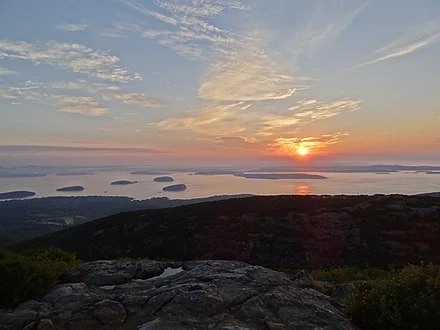
Sunrise from the top of Cadillac Mountain, in Acadia National Park, Maine. For part of the year it’s the site of America’s earliest sunrise.
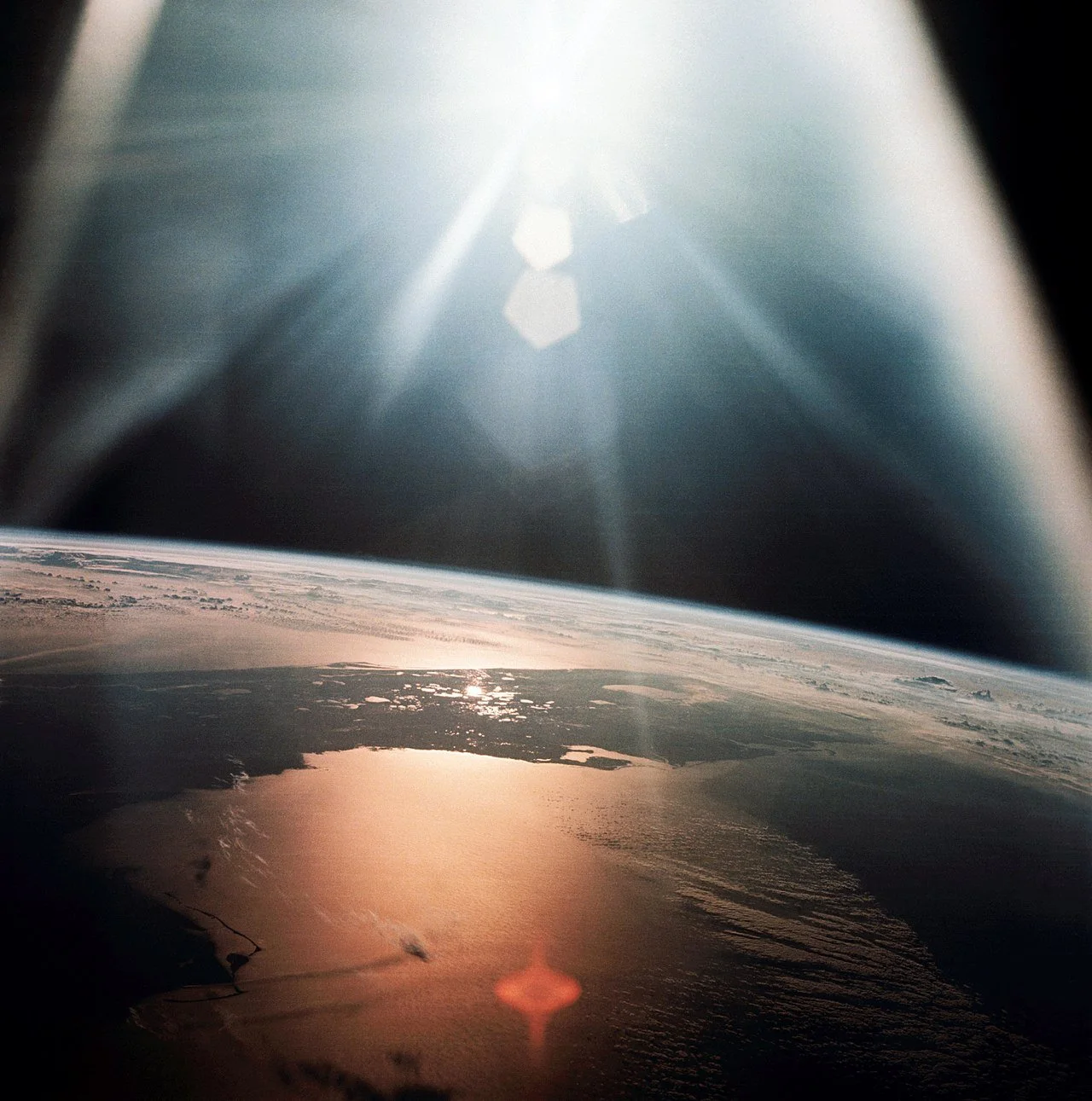
“Publicity is justly commended as a remedy for social and industrial diseases. Sunlight is said to be the best of disinfectants; electric light the most efficient policeman.’’
“And publicity has already played an important part in the struggle against the Money Trust.’’
— Louis D. Brandeis (1856-1941), in a Harper’s Magazine article in 1913. A government and civic reformer through much of his life, Brandeis was a U.S. Supreme Court justice from 1916-1939. Before then he was a co-founder, in 1879, with Samuel Warren, and long-time partner of the Boston law that today is called Nutter, McClennen & Fish.
Self-defense training

“Lando as a Boy” (oil on board), by Alexander Bostic, at the Norman Rockwell Museum, Stockbridge, Mass.
David Warsh: Three to watch in the mid-term elections
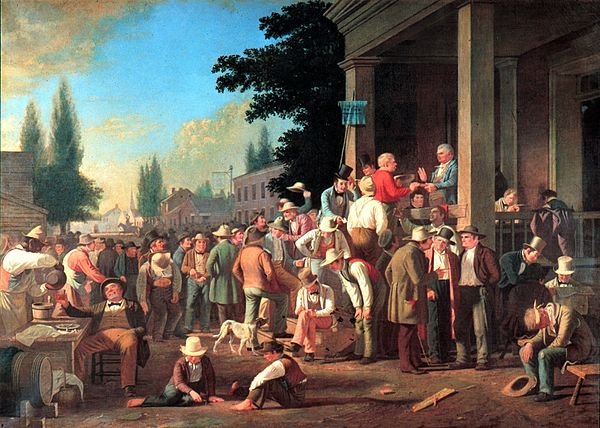
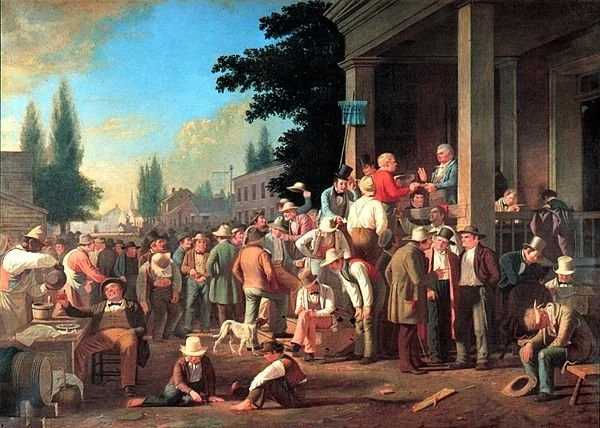
An 1846 painting by George Caleb Bingham showing a polling judge administering an oath to a voter

SOMERVILLE, Mass.
My Fourth of July resolution was to tune out stories about the possible 2024 presidential ambitions of Donald Trump and Hillary Clinton, and pay attention instead, at least until Nov. 8, to the Senate campaign in Ohio. Author-turned-venture capitalist J.D. Vance and Congressman Tim Ryan are running there to succeed retiring Republican Sen. Rob Portman.
Vance, 37, gained fame as author of Hillbilly Elegy: A Memoir of a Family and Culture in Crisis (2016). After high school, he enlisted in the U.S. Marine Corps and served as a public-affairs specialist in an air wing during the Iraq War. He then graduated from from Ohio State University, went on to Yale Law School and then left a corporate-law practice for a venture-capital firm in San Francisco. He returned to Ohio in 2016 to form, with partners, a venture fund of his own. Formerly an evangelical Protestant, he converted to Roman Catholicism in 2019. He opposes abortion rights.
Ryan. 49, is a 10-term congressman whose present district includes much of northeast Ohio, from Youngstown to Akron. In 2015, he explained to readers of the Akron Beacon Journal “Why I changed my thinking on abortion’’. The next year, he led an ultimately unsuccessful effort to unseat Nancy Pelosi as party leader of the House Democrats.
Might Ryan, if he wins, find a seat on that otherwise still all-but-empty bench of potential 2024 Democratic presidential candidates, at whose opposite end sits Clinton? It is plausible, if not likely. After all, former Ohio Gov. John Kasich had a shot at derailing Trump as Republican nominee in 2016. In any event, lie Vance, Ryan seems likely to remain in public life for years to come.
Jane Coaston, a journalist, is a third star rising in the mid-term elections, and probably well beyond. The New York Times hired her away from Vox last autumn to run a weekly discussion show, The Argument. Coaston grew up in suburban Cincinnati, according to Graham Vyse, of The Washington Post, the daughter of union Democrats who were “giant hippies,” before she learned to distinguish among varieties of conservative thought as editor of The Michigan Review at the University of Michigan. She gained prominence with a National Review article in 2017, “What if there is no such thing as Trumpism?” Her talk-show discussion with two leading Republican theorists after Vance’s Trump-endorsed primary victory in May was especially illuminating.
Control of the Senate will almost certainly become the dominant story of the mid-term elections. The Pennsylvania Senate race is interesting, too. To me, at least, it seems likely, that the Supreme Court’s decision to overturn Roe v. Wade will cost Minority Leader Mitch McConnell (R-Kentucky) his leadership of the Senate. This column is mostly about economics, but the investigation of preferences change is gradually becoming an important part of economics
Immigration, foreign wars, globalization and climate change: All these national issues will take a back seat in November elections, which are about leadership in particular states. They will resurface, along with women’s rights, in 2024. Harvard Historian Jill Lepore wrote a couple years ago that America, like any other nation-state, requires a “national story.” She was right. Voters write it, election by election.
David Warsh, a veteran columnist, is proprietor of Somerville-based economicprincipals.com, where this essay originated.
The scariest animal, drunk or sober
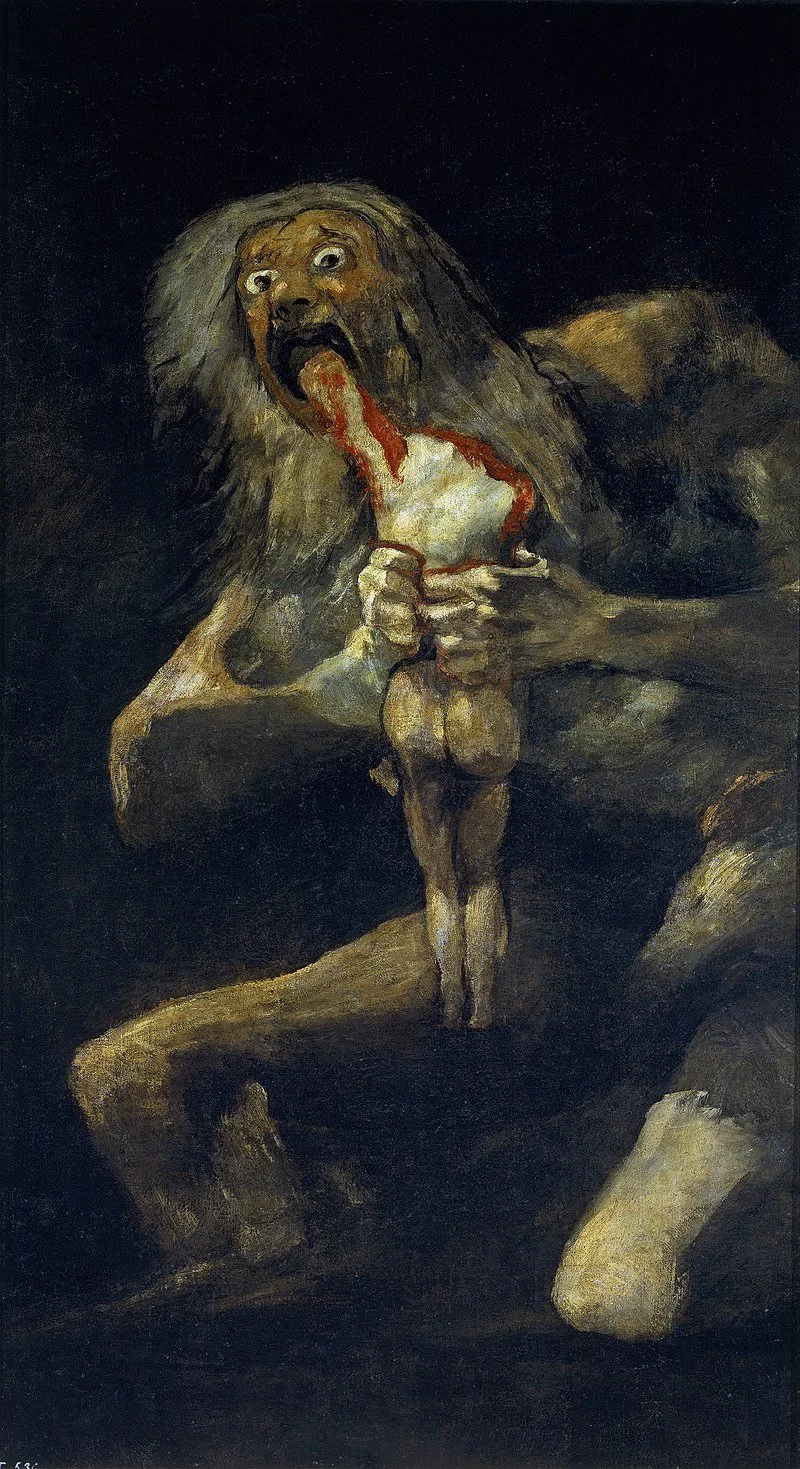
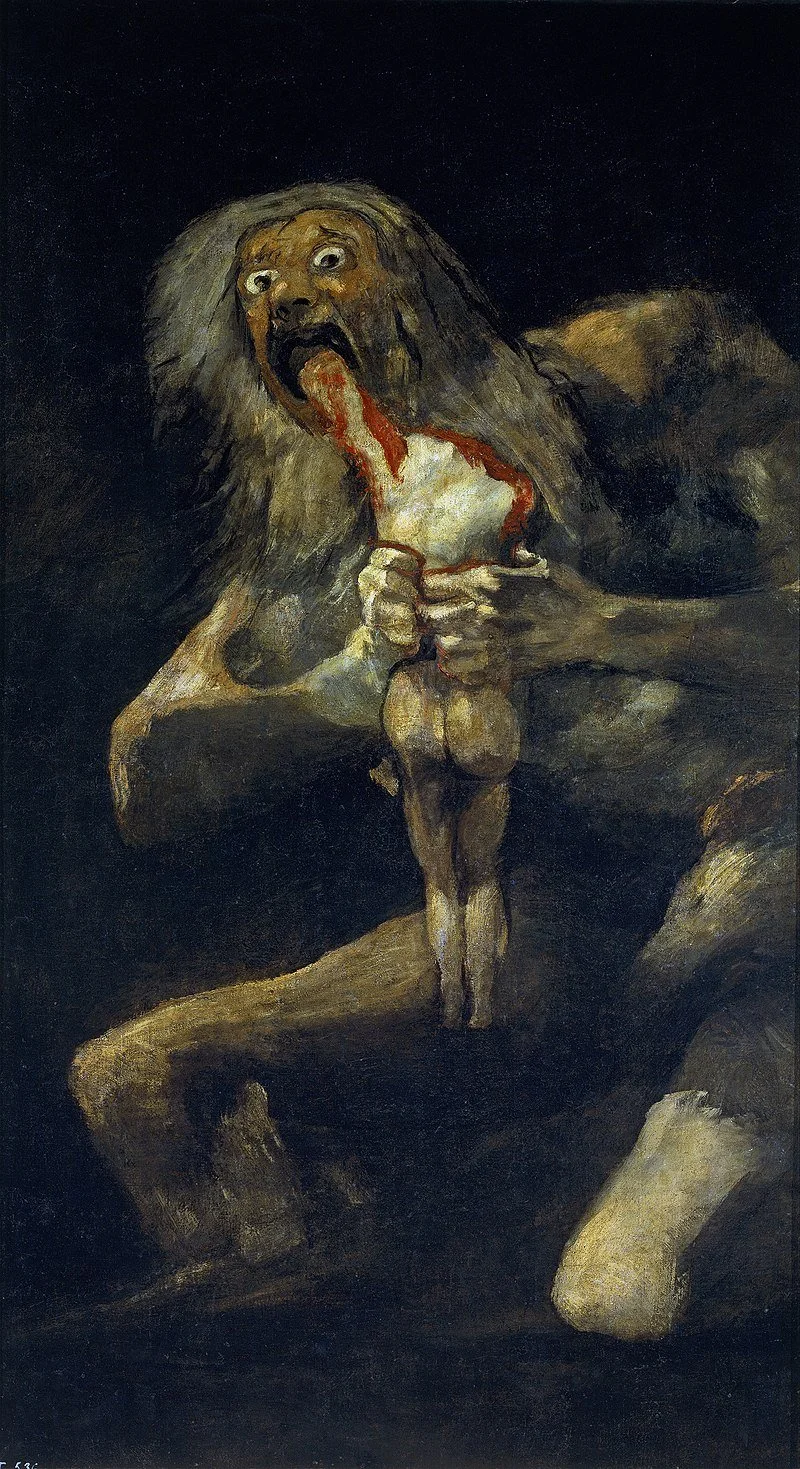
“Saturn Devouring His Son,’’ from the Black Paintings series, by Francisco de Goya, 1746-1828
“I think a human animal is far more wild and unpredictable and dangerous and destructive than any other animal.’’
—Jeff Corwin (born 1967), biologist, wildlife conservationist and animal-show host. He was raised in Norwell, Mass., and now lives in neighboring Marshfield.

Jacobs Farmhouse, in Norwell, Mass., built in early 19th Century

“Humanity I love you because when you’re hard up you pawn your intelligence to buy a drink.’’
— e.e. cummings (1894-1962), American poet, painter, essayist, author and playwright. He was born in Cambridge, Mass., and died in North Conway, Mass.
Through the haze of longing

“Still Life 8” (watercolor, 1990), by celebrated Providence-based painter and art professor Thomas Sgouros (1927-2012), in a show of his work at Cade Tompkins Projects, Providence, through July 22.
The sad decline of the newsstand

South Station

A newsstand in New York City before the print implosion.
— Photo by Neutrality, Talk
Adapted from Robert Whitcomb’s “Digital Diary,’’ in GoLocal24.com
To my dismay, there was no newsstand in Boston’s South Station, New England’s biggest train station, when I walked through it the other week. Maybe they’ll bring one back: They’re doing a lot of construction there.
I’ve spent a lot of time over the years browsing the now-disappeared stand and many others at home and abroad.
Big newsstands are a joy, with lots of serendipity, but they’re disappearing. Too bad. You see all sorts of magazines you wouldn’t usually have access to. And buying and leafing through a paper publication is more enjoyable than reading on a screen. Further, your retention of what you read is better, say neurologists. Big newsstands make waiting at a train or bus station or airport less onerous.
Porn or semi-porn magazines used to be widely available on newsstands, amongst the more dignified materials, but wrapped in camouflage. Now, with the World Wide Web drenched in porn, the paper version of it is disappearing. Can’t compete! An advance for public order and morality?

The staying power of ‘70s and ‘80s popular music

"Everything new is old again," says Provincetown, Mass., DJ Braintree Jim.
“So much of today's new music longs for nostalgia, this quest to regain or relive some semblance of what is believed to be better times from a bygone era. It's quite remarkable. You can hear it in the tunes, a steadfast reverential pastiche for ‘70s and ‘80s music. I think many of today's younger artists realize the staying power of music from that period. The evidence is all around us.
"If you look at the big streaming services it is the back catalog music that is getting all the attention. So it makes sense, therefore, that a lot of the new music I am listening to has this derivative aesthetic attached to it. I suppose each generation has pinched ideas from previous generations. Still, it's fun hearing new material infused with some of the old effects or instruments or even production techniques that were present back then. It's a hybrid mash-up for sure."
He believes that the recent resurgence and renaissance of English musician Kate Bush, now 63, and popular in the 1980s, is further proof.
Her song, "Running Up That Hill," released in 1985 on the “Hounds of Love’’ album, was recently featured on season 4 of the massively watched Netflix series Stranger Things. Ever since the song was featured it has rocketed back to the charts, both in the U.S. and U.K. It reached the top five in a recent Billboard Hot 100 chart in America, and hit no. 1 in the U.K. The recent chart success has broken all sorts of records. And a three-week period in June saw the song streamed a staggering 137 million times on Spotify.
Braintree Jim's radio show Chill & Dream returns to the airwaves on Wednesday, July 6, from 1 p.m. to 4 p.m. on WOMR (92.1 FM) the community radio station in Provincetown that recently celebrated 40 years on the air. It’s simulcast on sister station WMFR (91.3 FM) in Orleans.
Perhaps tellingly, the new show will showcase music from the 1980s. "It's very much a roots show," he says. "You can't escape the roots. And yes, I will be playing Kate Bush." The show can be streamed live on womr.org.
The building that houses WOMR, at 492-494 Commercial St., has a fascinating history. Hit this link to read about it and see photos from its history.
After awakening from a trance

“Free Association” (Encaustiflex, wax, silver pigment), by Bristol, R.I.- based Leila Stokes Weinstein
She explains:
“My process is a combination of working on an idea that I want to express or just playing with materials, allowing my subconscious to make the decisions.The later is fun because suddenly I ‘awaken’ from a sort of trance or meditation, a place of no thought, to find something pleasing has been created.
''The three-dimensional capability of wax calls to me, whether it is a buildup of layers on a panel or embedded objects in a sculptural piece.
"Like most of the world, I am very concerned about the degradation of our planet and the rapid extinction of wild plants and animals, so my work often reflects on that and the beauty of nature around us.
"My work usually incorporates visual movement. The flow of water, the lapping of waves and the blur between land, water and air call to me.’’
Her bio:
Lelia Stokes Weinstein was raised as a Quaker. She was taught that there was good in everyone. In her art she explores joy, hope and peace. As a small child she loved to do art and was allowed to go to art classes in Cambridge at the age of 9. The experience of commuting for 2 hours by herself from the World’s End section of Hingham, Mass., helped further develop an independent and adventurous spirit.
She went to Friends World College, which required study abroad in at least two countries. Living in India and traveling overland to England through Afghanistan, Iran and Turkey she discovered the vibrancy of these cultures and how they embraced color and texture.

A misty morning in the Hingham, Mass., peninsula called World’s End

The front of the 231st Bristol, R.I., Fourth of July Parade in 2016.
— Photo by Kenneth C. Zirkel