

Stick with Maine chowder

A bowl of fish chowder
— Photo by Nate Steiner
“Poems have been written about bouillabaise; but I have tried it again and again in the world’s leading bouillabaise centers, and, on the words of a dispassionate reporter, it’s not to be compared with a Maine cunner, cod, or haddock chowder made with salt pork and common crackers.’’
— Kenneth Roberts (1885-1957), novelist and journalist, in Trending into Maine (1938)
From fishing to etchings
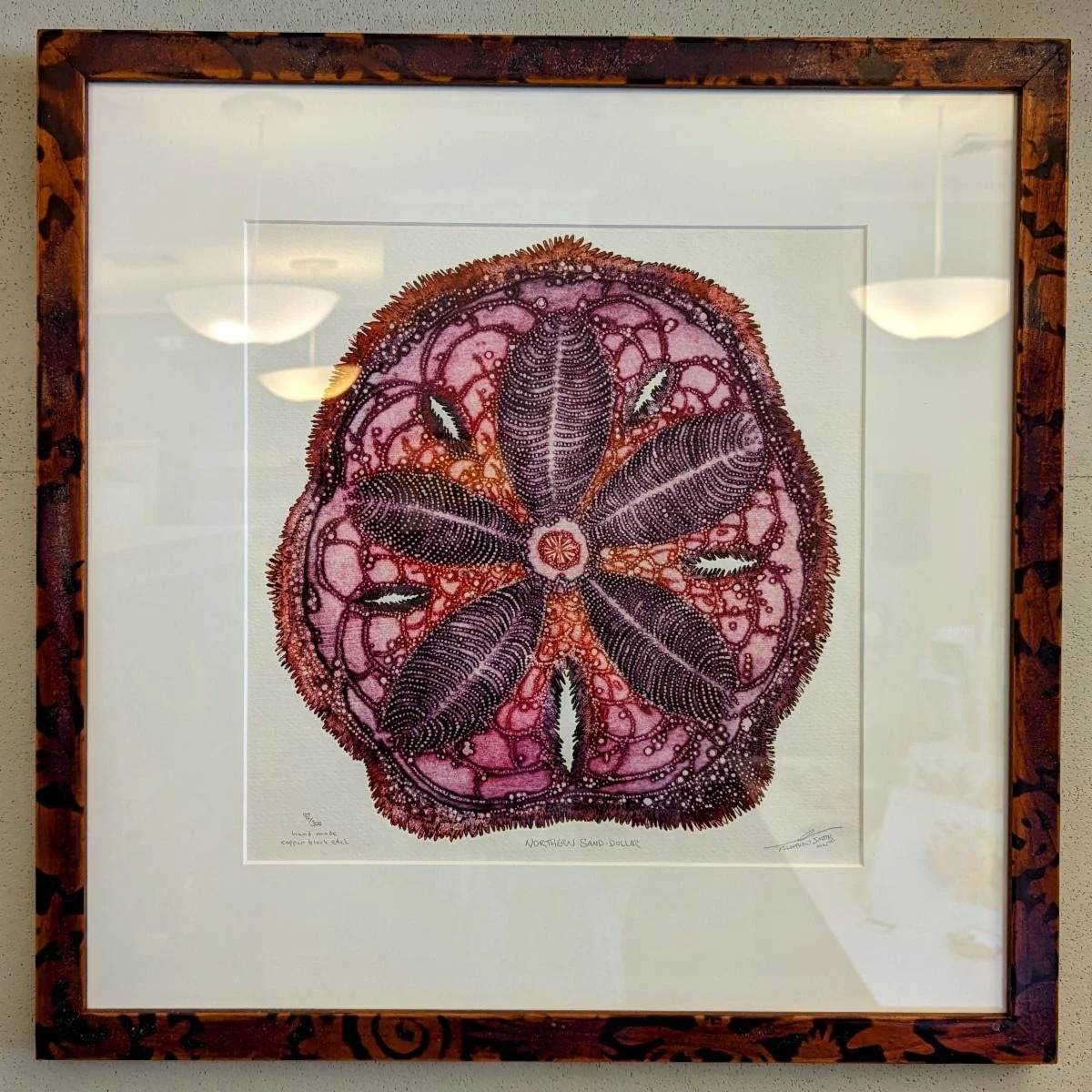
“Northern Sand Dollar” (etching) by Matthew Smith, in the New Hampshire group show “The Artist Next Door,’’ at Two Villages Art Society, Contookook, N.H., through July 30.
Sand dollars are species of flat, burrowing sea urchins belonging to the order Clypeasteroida.
His Web site says:
“Matthew Smith is an inventor, a creator, a maker of things. Born and raised in Brooklyn, N.Y. Matthew became a commercial fishing captain and made innovative nets to catch haddock and halibut in the North Atlantic. He put together the best fishing-boat crews to deploy the gear he made. He followed his instincts to go to places on the Georges Bank where the fish were, but the other fishermen were not.
After leaving the fishing industry, Matthew built, by hand, a self-sustained log cabin on the shore of Quincy Pond in Nottingham, N.H. Here he started a small company -- Quincy Pond Print Works -- to help him create his prints, frame them to museum standards, and make them available to collectors in New England and across the country, shipped in packages he designed himself.
As an artist, he created a new way to make prints — copper block etching -- that combines the top features of intaglio etching and relief printing to best portray the incredible color, depth, and texture found in his work. And he ships each piece of art with a custom-made museum-quality frame.’’

The Nottingham Square Schoolhouse museum is one of the best-preserved mid-19th Century schoolhouses in New Hampshire.

John O. Harney: Marketing abortion ruling; armed youth; ‘don’t say gay’ in Greenwich; not the ‘Flutie Effect’

Map by Tpwissaa

Greenwich, Conn., High School
From The New England Journal of Higher Education, a service of The New England Board of Higher Education (nebhe.org)
BOSTON
Could the anti-choice, forced-birth culture of the U.S. Supreme Court and many U.S. states present an advantage for New England economic boosters?
Massachusetts Gov. Charlie Baker told reporters that he had heard from a lot of companies that the recent Supreme Court decision removing the federal protection of the right to abortion may offer a big opportunity for Massachusetts to attract some employers whose employees would want access to reproductive-health services. Connecticut Gov. Ned Lamont called on businesses in states that limit abortion access to consider relocating to Connecticut.
In the context of choosing where to start or expand a business, big employers have occasionally written off New England as “old and cold” compared with economically and meteorologically sunnier spots. However, a 1999 poll by the University of Connecticut’s Center for Survey Research and Analysis, while admittedly dated, found an interesting niche for New England. International site-selection consultants, accustomed to Europe’s pricey, regulated environments, were less concerned with New England’s notoriously high costs than domestic site-selection pros. Key issues for the international consultants were access to higher education, an educated workforce and good infrastructure.
Peter Denious, chief executive of Advance CT, a business-development organization, recently told the Connecticut Mirror that such issues as diversity, equity and inclusion—and the state’s commitment to clean energy—could all help Connecticut align with the corporate goals of certain companies.
Our culture of active government, unionization and especially our human- resource development, could bode well once again in relatively enlightened New England.
Anti-semitism rising: The Anti-Defamation League (ADL) reported 2,717 anti-semitic incidents of assault, harassment and vandalism in 2021 in the U.S., the highest number since the ADL began tracking anti-semitic incidents in 1979, according to the group’s annual Audit of Antisemitic Incidents. These included more than 180 anti-semitic incidents in New England. And nationally, 155 anti-semitic incidents were reported at more than 100 college campuses. Meanwhile, tension between anti-semitism and anti-zionism, including the boycott, divestment and sanctions (BDS) movement, is challenging on campuses and beyond
Packing heat. More than 1 million U.S. adolescents (ages 12 to 17) said they had carried a handgun in 2019-20, up 41% from about 865,000 in 2002-03, according to a study by researchers at Boston College’s Lynch School of Education and Human Development, using data from the National Survey on Drug Use & Health. The socio-demographic profile of the gun carriers also changed. Carrying rates grew from 3.1% to 5.3% among white adolescents, from 2.6% to 5.1% among higher-income adolescents, and from 4.3% to 6.9% among rural adolescents between, while rates among Black, American Indian/Alaskan Native and lower-income adolescents decreased.
“Don’t Say Gay” here? In April, Mount Holyoke College President Sonya Stephens wrote here that Florida legislation dubbed by opponents the “Don’t Say Gay” bill, was part of a nationwide wave of proposal laws linking divisive issues of race, sexual orientation and gender identity to parents’ concerns about what their children are being taught in public schools. These bills not only undermine the real progress that LGBTQ+ people have made in society over the past 50 years, Stephens wrote, but they also further erode trust in some of our most under-compensated public servants: school teachers and administrators.
On July 1, U.S. Secretary of Education Miguel Cardona noted that the Florida parents and families he’d spoken with said the legislation doesn’t represent them and that it put students in danger of bullying and worse mental health outcomes.
In Cardona’s home state of Connecticut, meanwhile, the Greenwich School Board adopted a new Title IX policy unanimously, but not without controversy. Edson Rivas and Colin Hosten of the Fairfield County-based Triangle Community Center Board of Directors wrote in Connecticut Viewpoints that the policy adopted by the Greenwich School Board “conspicuously removes any language referring to gender identity and sexual orientation” which was part of the original version of the policy introduced last fall. The board replied that “this policy covers all students, whether or not certain language is included.” But Rivas and Hosten aren’t buying it. “If the substance of the policy remains the same, as they say, then the only effect of removing the language about gender identity and sexual orientation is the linguistic pseudo-erasure of the LGBTQ+ community in Greenwich Public Schools.”
Truth to tell: Recently, the American Association of Colleges and Universities (AAC&U) named 75 higher-education institutions to participate in the 2022 Institute on Truth, Racial Healing & Transformation (TRHT) Campus Centers as part of an effort to dismantle racial hierarchies.
As we at NEBHE and others have wrestled with a “reckoning” on race, gender and so many other wrongs, the “truth and reconciliation” concept has always made sense to me. Check out, for example, the thoughtful book Honest Patriots exploring how true patriots in post-World War II Germany, post-apartheid South Africa and the U.S. in the the aftermath of slavery and the genocide of Native Americans loved their country enough to acknowledge and repent for its misdeeds.
Under the AAC&U initiative, campus teams develop action plans to advance the parts of the TRHT framework: narrative change, racial healing and relationship building, separation, law and economy. The institute helps campus teams to prepare to facilitate racial-healing activities on their campus and in their communities; examine current realities of race relations in their communities and the local history that has led to them; identify evidence-based strategies that support their vision of what their communities will look, feel and be like when the belief in the hierarchy of human value no longer exists, and learn to pinpoint critical levers for change and to engage key stakeholders.
Among participating New England institutions: Landmark College, Middlesex Community College, Mount Holyoke College, Suffolk University, the University of Connecticut and Westfield State University.
Another problem with over-incarceration. NEBHE has published a policy brief about the effects of higher education on incarcerated people in New England prisons and jails—and increasingly broached conversations about the dilemmas created by the world’s biggest incarcerator — America. Now, another byproduct surfaces: Children with an incarcerated parent have exceedingly low levels of education. The most common education level for respondents from a low-income family who had an incarcerated parent was elementary school, according to research by a group of Wake Forest University students who put together an article for the Nation Fund for Independent Journalism. The students set out to understand how the academic achievement, mental health and future income of children of incarcerated parents compare to those with deceased parents. Just under 60% as many respondents with an incarcerated parent completed a university education compared to the baseline of respondents with neither an incarcerated nor deceased parent.
Acquisition of Maguire: I first heard the term “Flutie Effect” in the context of former Boston College Admissions Director Jack Maguire. The term refers to the admissions deluge after the BC quarterback Doug Flutie threw the famed Hail Mary pass (caught by the less-famous Gerald Phelan) in 1984. Flutie won the Heisman Trophy, then pursued a pro career, first with Donald Trump’s New Jersey Generals in the USFL and then in the Canadian Football League, with a few bumpy stops in the NFL.
But Maguire attributed BC’s good fortune not to the diminutive quarterback but to the college’s “investments in residence halls, academic facilities, and financial aid.” In 1983, Maguire, a theoretical physicist by training, founded Maguire Associates and introduced the concept of “enrollment management,” combining sophisticated analytical techniques, customized research and deep experience in education leadership with a genuine enthusiasm for client partnerships. Maguire became a sort of admissions guru whose insights we have been pleased to feature.
Now, higher-education marketing and enrollment strategy firm Carnegie has announced it is buying Maguire Associates. Not to be confused with the foundation that administered the Carnegie Classification of Institutions of Higher Education, which recently moved to the American Council on Education, nor the Carnegie Endowment for International Peace, which has encouraged disarmament, this Carnegie, also founded in the 1980s and based in Westford, Mass., is formally known as Carnegie Dartlet LLC. Its pitch: “We are right definers. We are your intelligence. We are truth revealers. We are your clarity. We are obstacle breakers. We are your partners. We are audience shapers. We are your connection. We are brand illuminators. We are your insight. We are story forgers. We are your voice. We are connection creators. …”
John O. Harney is executive editor of The New England Journal of Higher Education.
Big show at Vermont art museum features exciting ancient medium; see video

See this very unusual and exciting show at the Southern Vermont Art Center's Wilson Museum, Manchester, Vt., through Aug. 14: Hit this link for a video about the show.
It's titled "RELATIONSHIPS: hot, cold, intricate'' and features New England Wax, a regional association of 31 artists who work in encaustic and other wax mediums. The museum notes that encaustic, in Greek, means “to burn in”.
"It is an exciting art medium with a rich history that offers many creative options. Composed of beeswax, tree resin, and pigment applied with a brush or other tools while molten, each layer is fused to the previous one using a heat gun, torch, or other heated implement. Cold wax is a more contemporary medium combined with oil paint or other pigmenting methods. Each of these wax mediums offers many possibilities for translucency, layering, incising, and other techniques in both 2D and 3D work. The exhibiting artists, from the six New England states, use creative interpretations of the RELATIONSHIPS theme to demonstrate the many expressive and unique possibilities of working with wax-based materials.''
Oh, what a beautiful morning

A beautiful morning at the Chatham (Mass.) Bars Inn.
Photo by James P. Freeman

In the time of textile mills

Massachusetts National Guardsmen with fixed bayonets surround a parade of strikers during 1912 Lawrence textile strike
“It is a long time since I flapped mv wings,
a long time since I stood on the roof of my house
in Lawrence, Mass., or Michael's in No. Andover,
a little whiskey in one hand, the past slipping
through the other, a little closer to the heaven of
dreams ….
“From where we stood I could see the steeple of the French
church. Further back, it was 1912, and I could almost
see the tenements of the French women who worked
the fabric mills …
weaving the deadly dust into their lungs….’’
— From “The Angels of 1912 and 1972,’’ by Richard Jackson
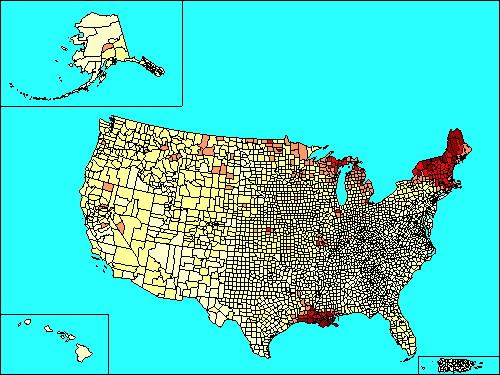
Distribution of French Canadians in the U.S. Census
Charlie Baker on post-governorship

Charlie Baker
From The Berkshire Eagle: Outgoing Massachusetts Gov. Charlie Baker says:
“‘I’m not going to go away quietly, and I’m certainly not going to — I am not going to retire,’ he said. ‘My wife would never let me. That would cause all kinds of issues. I think I’ll end up doing a bunch of different things. Some of them will be related to government, some will be related to traditional private sector-type stuff.’
“Baker, 65, did not shed any more light on his plans, but he made clear that he is not publicly gearing up to campaign for another position after opting against seeking a third term.’’
Brett Kelman: A simple way to stop hospital-acquired pneumonia
Four years ago, when Karen Giuliano went to a Boston hospital for hip- replacement surgery, she was given a pale-pink bucket of toiletries issued to patients in many hospitals. Inside were tissues, bar soap, deodorant, toothpaste, and, without a doubt, the worst toothbrush she’d ever seen.
“I couldn’t believe it. I got a toothbrush with no bristles,” she said. “It must have not gone through the bristle machine. It was just a stick.”
To most patients, a useless hospital toothbrush would be a mild inconvenience. But to Giuliano, a nursing professor at the University of Massachusetts at Amherst, it was a reminder of a pervasive “blind spot” in U.S. hospitals: the stunning consequences of unbrushed teeth.
Hospital patients not getting their teeth brushed, or not brushing their teeth themselves, is believed to be a leading cause of hundreds of thousands of cases of pneumonia a year in patients who have not been put on a ventilator. Pneumonia is among the most common infections that occur in health care facilities, and a majority of cases are non-ventilator hospital-acquired pneumonia, or NVHAP, which kills up to 30 percent of those infected, Giuliano and other experts said.
But unlike many infections that strike within hospitals, the federal government doesn’t require hospitals to report cases of NVHAP. As a result, few hospitals understand the origin of the illness, track its occurrence, or actively work to prevent it, the experts said.
Many cases of NVHAP could be avoided if hospital staffers more dutifully brushed the teeth of bedridden patients, according to a growing body of peer-reviewed research papers. Instead, many hospitals often skip teeth brushing to prioritize other tasks and provide only cheap, ineffective toothbrushes, often unaware of the consequences, said Dian Baker, a Sacramento State University nursing professor who has spent more than a decade studying NVHAP.
“I’ll tell you that today the vast majority of the tens of thousands of nurses in hospitals have no idea that pneumonia comes from germs in the mouth,” Baker said.
Pneumonia occurs when germs trigger an infection in the lungs. Although NVHAP accounts for most of the cases that occur in hospitals, it historically has not received the same attention as pneumonia tied to ventilators, which is easier to identify and study because it occurs among a narrow subset of patients.
NVHAP, a risk for virtually all hospital patients, is often caused by bacteria from the mouth that gathers in the scummy biofilm on unbrushed teeth and is aspirated into the lungs. Patients face a higher risk if they lie flat or remain immobile for long periods, so NVHAP can also be prevented by elevating their heads and getting them out of bed more often.
According to the National Organization for NVHAP Prevention, which was founded in 2020, this pneumonia infects about 1 in every 100 hospital patients and kills 15-30 percent of them. For those who survive, the illness often extends their hospital stay by up to 15 days and makes it much more likely they will be readmitted within a month or transferred to an intensive care unit.
John McCleary, 83, of Millinocket, Maine, contracted a likely case of NVHAP in 2008 after he fractured his ankle in a fall and spent 12 days in rehabilitation at a hospital, said his daughter, Kathy Day, a retired nurse and advocate with the Patient Safety Action Network.
McCleary recovered from the fracture but not from pneumonia. Two days after he returned home, the infection in his lungs caused him to be rushed back to the hospital, where he went into sepsis and spent weeks in treatment before moving to an isolation unit in a nursing home.
He died weeks later, emaciated, largely deaf, unable to eat and often “too weak to get water through a straw,” his daughter said. After contracting pneumonia, he never walked again.
“It was an astounding assault on his body, from him being here visiting me the week before his fall, to his death just a few months later,” Day said. “And the whole thing was avoidable.”
While experts describe NVHAP as a largely ignored threat, that appears to be changing.
Last year, a group of researchers — including Giuliano and Baker, plus officials from the Centers for Disease Control and Prevention, the Veterans Health Administration, and the Joint Commission — published a “call-to-action” research paper hoping to launch “a national healthcare conversation about NVHAP prevention.”
The Joint Commission, a nonprofit organization whose accreditation can make or break hospitals, is considering broadening the infection control standards to include more ailments, including NVHAP, said Sylvia Garcia-Houchins, its director of infection prevention and control.
Separately, ECRI, a nonprofit focused on health care safety, this year pinpointed NVHAP as one of its top patient safety concerns.
James Davis, an ECRI infection expert, said the prevalence of NVHAP, while already alarming, is likely “underestimated” and probably worsened as hospitals swelled with patients during the coronavirus pandemic.
“We only know what’s reported,” Davis said. “Could this be the tip of the iceberg? I would say, in my opinion, probably.”
To better measure the condition, some researchers call for a standardized surveillance definition of NVHAP, which could in time open the door for the federal government to mandate reporting of cases or incentivize prevention. With increasing urgency, researchers are pushing for hospitals not to wait for the federal government to act against NVHAP.
Baker said she has spoken with hundreds of hospitals about how to prevent NVHAP, but thousands more have yet to take up the cause.
“We are not asking for some big, $300,000 piece of equipment,” Baker said. “The two things that show the best evidence of preventing this harm are things that should be happening in standard care anyway ― brushing teeth and getting patients mobilized.”
That evidence comes from a smattering of studies that show those two strategies can lead to sharp reductions in infection rates.
In California, a study at 21 Kaiser Permanente hospitals used a reprioritization of oral care and getting patients out of bed to reduce rates of hospital-acquired pneumonia by around 70 percent. At Sutter Medical Center in Sacramento, better oral care reduced NVHAP cases by a yearly average of 35 percent.
At Orlando (Fla.) Regional Medical Center, a medical unit and a surgical unit where patients received enhanced oral care reduced NVHAP rates by 85 percent to 56 percent, respectively, when compared with similar units that received normal care. A similar study is underway at two hospitals in Illinois.
And the most compelling results come from a veterans’ hospital in Salem, Virginia, where a 2016 oral-care pilot program reduced rates of NVHAP by 92 percent — saving an estimated 13 lives in just 19 months. The program, the HAPPEN Initiative, has been expanded across the Veterans Health Administration, and experts say it could serve as a model for all U.S. hospitals.
Michelle Lucatorto, a nursing official who leads HAPPEN, said the program trains nurses to most effectively brush patients’ teeth and educates patients and families on the link between oral care and preventing NVHAP. While teeth brushing may not seem to require training, Lucatorto made comparisons to how the coronavirus revealed many Americans were doing a lackluster job of another routine hygienic practice: washing their hands.
“Sometimes we are searching for the most complicated intervention,” she said. “We are always looking for that new bypass surgery, or some new technical equipment. And sometimes I think we fail to look at the simple things we can do in our practice to save people’s lives.”
Brett Kelman is a Kaiser Health News reporter.
Dangerous game

“Playing Games with Goya,’’ by Alexandra Rozenman, at Brickbottom Artists Association, Somerville, Mass., July 14-Aug. 20.
Her Web site says:
“Alexandra (Alya) Rozenman was born in 1971 in Moscow. She was classically trained at the Soviet Academy of Arts for two years and later studied with dissident artists, well-known today, from Moscow’s underground movement. While still a teenager, she became part of Moscow’s alternative scene of the 1980s. After immigrating to the U.S., she spent the early 1990s in New York, becoming a part of what later became the International Art Alliance on the Lower East Side and earning her BFA from SUNY in 1993. She later relocated to Boston, earning an MFA from the School of the Museum of Fine Arts at Tufts in 1998, and studying with Gerry Bergstein and Robert Ferrandini. Her paintings and drawings blend the styles and symbols of folk art, Russian Underground Conceptualism, illustration, and Jewish art.
“She was the recipient of the MacDowell Foundation Fellowship in 2006.’’

Chris Powell: Is abortion really that popular?

Bas relief at Angkor Wat, c. 1150, in what is now Cambodia, depicting a demon performing an abortion upon a woman who has been sent to the underworld
MANCHESTER, Conn.
Connecticut Gov. Ned Lamont has sent an open letter to businesses in states that prohibit or sharply restrict abortion, encouraging them to relocate to Connecticut so that their employees can get abortions more easily. He also made the appeal in an Internet video.
Business observers laughed it off, since abortion rights don't figure at all in business calculations while Connecticut's high taxes and excessive regulation figure heavily, making the state lag in economic development.
But then it was wrong to construe the governor's appeal as having anything to do with economic development. It was really aimed at Connecticut's own voters as part of his campaign for re-election. The governor sought to persuade them that abortion rights in other states are more important than the deficiencies of government in their own state.
Despite the enormous clamor about abortion, opinion polls rank it low among national issues, even as the bigger national issues are working strongly against Democrats. The governor and Democrats elsewhere hope that abortion will distract from those issues.
But the governor and Democrats in other states seem to think not only that abortion ranks high as an issue but also that most voters are as enthusiastic about abortion as the Democrats themselves are. This belief is signified by the Democrats' marquee congressional legislation, the Women's Health Protection Act, which would legalize post-viability abortion, even abortion at the moment of birth, throughout the country, going far beyond and thus nullifying Connecticut's own law, which restricts post-viability abortion.
Connecticut's intelligentsia, overwhelmingly Democratic and enthusiastic about abortion, cannot fathom contrary opinion and fails to recognize that other states have restrictive abortion laws not because of any oppression of women but because many if not most women there, benighted as they may be, are not enthusiastic about abortion.
Instead of pretending that Connecticut's liberal abortion law might draw businesses from abortion-restricting states, Connecticut's abortion enthusiasts would become much more relevant by moving to the abortion-restricting states and trying to persuade the women there of just how backward they are.
xxx
Last week Connecticut Atty. Gen. William Tong affected outrage at the request made to the Public Utilities Regulatory Authority by water company Aquarion for a rate increase of 27 percent to be implemented over three years. "The last thing Connecticut families and small businesses need now is a double-digit water bill hike on top of steadily mounting surcharges," Tong said.
But inflation is raging and the company said it had not sought a rate increase in more than nine years. The attorney general took no note of this. Worse, Tong took no note of something else. On the very day when Aquarion's rate request was reported, state government imposed a 23 percent tax increase on diesel fuel, which will raise prices on everything shipped in the state.
The tax increase took full effect immediately -- it wasn't staggered over three years like the water company's rate request -- and the attorney general was silent about it. For price increases in the private sector are bad while price increases in government are OK.
After all, Tong, a Democrat, had struck his latest empty pose and achieved his uncritical publicity amid an election campaign, while sincerity in protecting the public against government's own price increase would have gotten him in trouble with his party, whose governor and legislative majority insisted on raising the diesel tax.
xxx
The degree to which the Lamont administration has raised taxes is being disputed in the gubernatorial campaign. Republicans want to count as increases the tax cuts that were legislated by recent Democratic administrations and then repealed once an election was over and before the cuts were to take effect.
However these prematurely repealed tax cuts are classified, the practice is grossly dishonest. Additionally misleading is that the controversy is somehow failing to count the biggest tax increase of the current administration -- the half-percent increase in the state income tax to finance a family and medical leave program most people will never be able to use for their emergencies, a program whose benefits are distributed as discretionary patronage.
Chris Powell is a columnist for the Journal Inquirer, in Manchester.
Frank Carini: Will federal reprieve be enough to save these very fast sharks?

An Atlantic shortfin mako shark
From ecoRI News (ecori.org)
The world’s fastest-swimming shark is about to get a reprieve from overfishing.
Beginning July 5, the landing or possession of Atlantic shortfin mako sharks in the United States has been prohibited. This rule applies to commercial fishermen, recreational anglers and any dealers who buy or sell shark products. These sharks frequent southern New England waters.
The ban includes sharks that are dead or alive when captured, according to the National Oceanic and Atmospheric Administration’s National Marine Fisheries Service (NOAA Fisheries).
The recent decision has long been supported by shark-research organizations concerned about the significant issues that this species faces. Defenders of Wildlife and the Center for Biological Diversity sent a notice June 28 to Gina Raimondo, U.S. secretary of commerce, and Janet Coit, assistant administrator for NOAA Fisheries, of their intent to sue for failing to protect the shortfin mako shark under the Endangered Species Act.
“The shortfin mako shark is the world’s fastest-swimming shark, but it can’t outrace the threat of extinction,” Jane Davenport, a senior attorney at Defenders of Wildlife, is quoted in a press release about the organizations’ intent. “The government must follow the science and provide much-needed federal protections as quickly as possible. This will demonstrate America’s leadership in fisheries and ocean wildlife conservation both at home and on the world stage.”
The shortfin mako is a highly migratory species whose geographic range extends throughout the world’s tropical and temperate oceans. They can reach a top speed of 45 mph, and, like tunas and the white shark, shortfin mako sharks have a specialized blood vessel structure — called a countercurrent exchanger — that allows them to maintain a body temperature that is higher than the surrounding water. This adaptation provides them with a major advantage when hunting in cold water. As an apex predator, the species is an integral part of the marine food web.
The species, however, faces a barrage of threats, especially overfishing from targeted catch and bycatch. The species’ highly valued fins and meat incentivize this overexploitation.
“The shortfin mako shark has long been a target of commercial fisheries and consumers due to its excellent taste, and to sport fishermen for its spectacular strength and leaping ability,” said Jon Dodd, executive director of the Wakefield, R.I.-based Atlantic Shark Institute. “Unfortunately, those are the same issues that have resulted in the significant population decline of this iconic shark that required this complete and unprecedented closure.”
Dodd noted female mako sharks don’t reproduce until they are about 20 years old and weigh some 600 pounds.
“I’ve seen hundreds of mako sharks and exactly one that size in all my years researching this spectacular shark,” he said. “It’s amazing that they can even reach that age and size with all the fishing pressure and risks they face.”
Since mako sharks have few young, and they take time off between giving birth, Dodd said the numbers don’t favor their long-term survival without significant management changes.
Three years ago the International Union for Conservation of Nature classified the shortfin mako as “endangered” on its Red List of Threatened Species.
“The Fisheries Service failed to protect the shortfin mako despite an international scientific consensus that conservation action is urgently needed,” Alex Olivera, a senior scientist at the Center for Biological Diversity, said in the June 28 press release that quoted Davenport. “Even as the rest of the world scrambles to save these sharks from extinction, they have no protections under the U.S. Endangered Species Act. That needs to change.”
On NOAA Fisheries’ species directory Web page for the shortfin mako shark, it reads: “U.S. wild-caught Atlantic shortfin mako shark is a smart seafood choice because it is sustainably managed and responsibly harvested under U.S. regulations.”
On the same page the federal agency notes that, according to the 2017 stock assessment, shortfin mako sharks are “overfished and subject to overfishing.”
In a 2019 assessment, the International Commission for the Conservation of Atlantic Tunas (ICCAT) estimated that as much as 4,750 metric tons of mako shark were being taken on an annual basis.
“It was time to give the mako shark a break, but even so, we are still looking at a recovery that will take until 2070,” Dodd said. “This is not a quick fix by any means, and the mako still faces significant challenges.”
If ICCAT provides for U.S. harvest in the future, NOAA Fisheries could increase the shortfin mako shark retention limit, based on regulatory criteria and the amount of retention allowed by ICCAT. Until that happens, the retention limit will remain at zero, according to the agency.
Frank Carini is senior reporter and co-founder of ecoRI News.
We could all use some

“An Intervention” (acrylic and oil on canvas), by Deborah Dancy, in a group show at the Truro (Mass.) Center for the Arts, July 12-July 22.
The center says that Deborah Dancy's multimedia artwork walks between abstract and figurative work. “Her paintings, photos and drawings capture everyday moments through a unique lens.”
She explains in her Web site:
"My work is an investigation of abstraction’s capacity to engage beauty and tension without justification or narrative. In my paintings and works on paper, I do not specify references; meaning is organic since images mingle, shift, and position themselves within a field of agitated or flat color. Within these works, inspiration springs from diverse sources sponsored, in part, from the views of gnarled and jagged trees and bark from the woodlands surrounding my home, discarded shards of construction debris, and constant encounters with the internal and external world. In this odd combination of elements, the initial mark prompts the starting point. Hesitation and agitation of brush strokes within the gesture reveals content. Incompleteness- the unfinished fragment of what - ‘almost was’ and ‘might become’ amplifies meaning. In this orbit, painting explores what I consider as embracing the unpredictable and accidental. Accepting this means I suspend assumptions and allow discoveries to emerge. This edge of conflict and sequence of processes, including scraping and repainting, fresh forms, and constructed imagery, becomes the elemental act of painting.’’

Highland Light, in Truro. The famous lighthouse’s original site is marked by the boulder in the foreground. It was in danger of falling down the cliff that it was perched near the edge of because of erosion, and so the structure was moved 450 feet to the west, in 1996.
It all started in 1797, when a wooden lighthouse was authorized by George Washington to be built to help warn ships about the dangerous coastline between Cape Ann and Nantucket. It was the first lighthouse on Cape Cod. In 1833, the wood structure was replaced by a brick tower. In 1857 the lighthouse was declared dangerous and demolished and the current 66-foot brick tower was constructed.
Will it have to be moved again as seas continue to rise and erosion accelerates on the Outer Cape?
David Warsh: Cambridge will be even more of a capital of economics than usual this month

MIT’s main campus, in Cambridge
SOMERVILLE, Mass.
For the first time in three years the Summer Institute of the National Bureau of Economic Research is meeting in-person in Cambridge, Mass., at least for the most part, with some on-line components as well. (In the days before Zoom, venture capitalists used to describe more expensive face-to-face gatherings as “flesh-meets,” to distinguish them from conference calls.) A parallel, pan-European policy research institution, the Centre for Economic Policy Research, now headquartered in Paris, was founded in 1983.
A substantial fraction of the NBER’s 1,700+ research affiliates, who are drawn from colleges and universities mostly in North America, and a few others scattered around the world, will troop through the Sonesta Hotel in East Cambridge over the next three weeks, along with enough colleagues and students to add up to an attendance of some 2,400 persons in all. It is the forty-fifth annual meeting of what has become, in essence, a highly decentralized Wimbledon-style tournament of applied economists, staged as a science fair, and conducted in a series of high-level seminars.
Wimbledon, in that NBER players are professionally ranked; affiliates are selected by peer-review. Decentralized, in that 49 different projects are on the docket, many of them overlapping. Science fair, in that investigators choose their own problems, and rely on agreed-upon methods to study them, while new methods themselves are the subject of a separate annual lecture. Seminars, in that presenters don’t simply read their papers they have written; they briefly describe them and then respond to discussants and badinage.
An overall program is here. A detailed day-by-day listing of sessions is here. First Deputy Managing Director of the International Monetary Fund Gita Gopinath, of Harvard University, is slated to deliver the Martin Feldstein Lecture July 19 at 5:15p.m. EDT. It’s titled “Managing a Turn in the Global Financial Cycle’’.
Meanwhile, a mile down the Charles River, the Russell Sage Foundation Summer Camp in Behavioral Economies has been underway in the Marriott Hotel, some twenty-five or thirty Ph.D. candidates and post-docs studying with leading researchers, under the direction of David Laibson and Matthew Rabin, both of Harvard University.
The Summer Institute is where economic policy approaches are argued among experts. Nobel Prizes emerge mostly from summer camps. I look forward to a lot of (virtual) running-around.
David Warsh, a veteran columnist and an economic historian, is proprietor of Somerville-based economicsprincipals.com. where this essay first ran.
Bathos at the beach
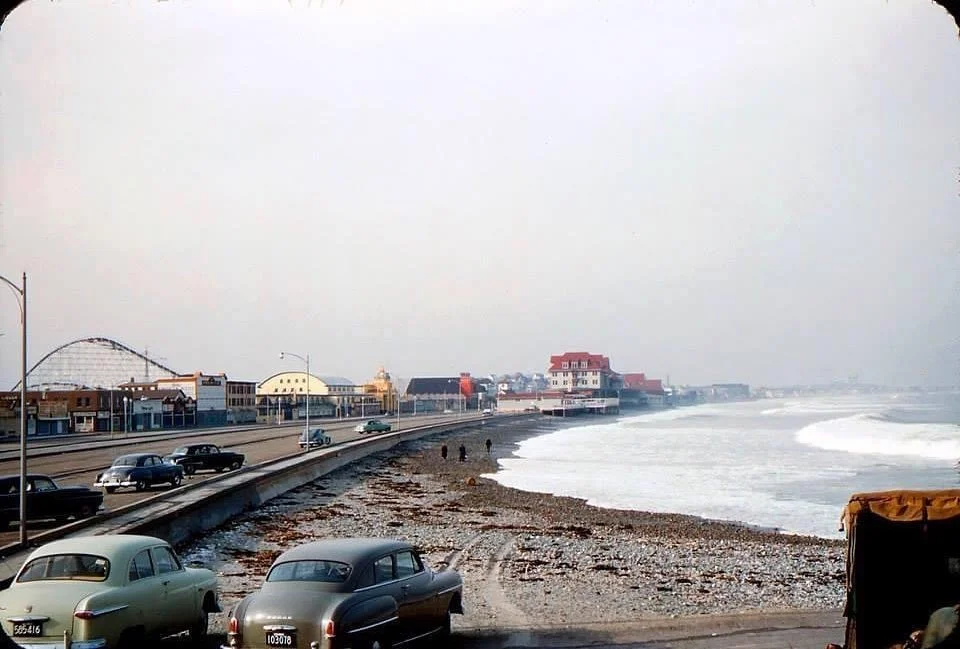
Artfully depressing photo of Nantasket Beach, in Hull, Mass., about 1950. Long-gone Paragon Park amusement park on the left.

Sometimes fun, if unhealthy
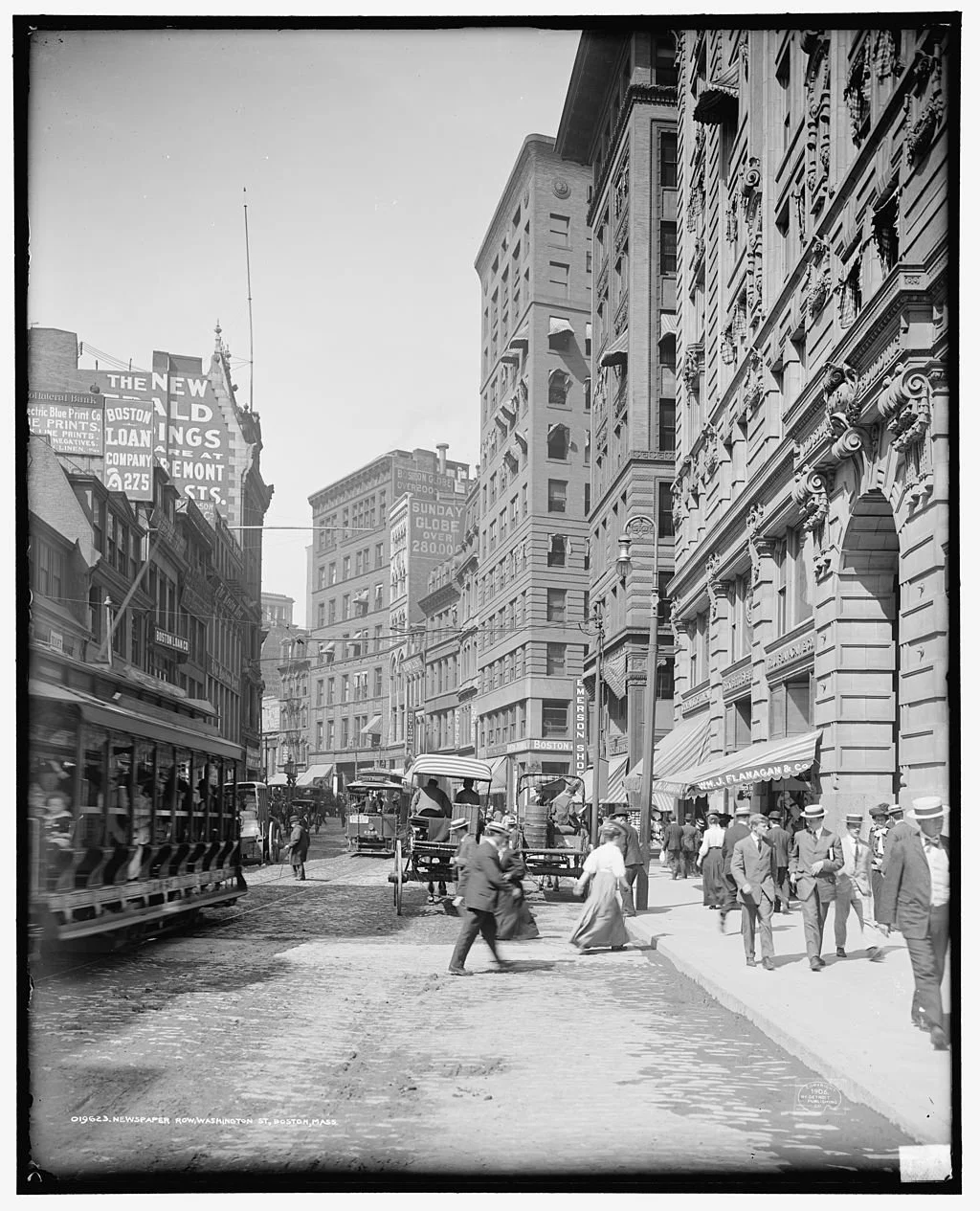
Boston’s “Newspaper Row,’’ in ca. 1906, showing the locations of the Boston Post (left), the Boston Globe (center-left) and the Boston Journal (center-right)
Adapted from Robert Whitcomb’s “Digital Diary,’’ in GoLocal24.com
I’ve been reading Carl Bernstein’s new memoir, Chasing History: A Kid in the Newsroom, which is mostly about his days as an erratic high school and college student in Maryland and as a devoted copyboy, dictationist and reporter at the old Washington Star in the early and mid ‘60s. It’s a terrific tale of the sometimes inspiring, sometimes exasperating world of journalism back then. It recalled to me some of the similar stuff I saw a few years later as a news assistant at the old Boston Record American, a rather tacky tabloid, and as a reporter at the Boston Herald Traveler (RIP), a somewhat stodgy broadsheet.
Ah, the unpredictable, open-ended hours, the tense, looming deadlines, the smoking, the bad coffee, the immediate post-deadline drinking at nearby watering holes, the interviewees you thought you’d hate but ended up becoming friends with, or enemies, the speeding in cars with fins to story scenes and speeding back to write the stories before deadline and the sudden, exciting assignments to far-away places. Meanwhile, you’d gradually put together a sort of mental Geiger counter to determine with increasing, in fits and starts, acuity if sources were lying to you.
Then there were the printers in the intensely unionized composing rooms who would stage a wildcat strike and/or tip over a page of the lead type spat out from clanking Linotype machines if someone from the newsroom so much as lightly touched the type.
One of Bernstein’s recollections particularly caught my eye: Reporters were sometimes called upon to get a picture of a recently deceased person – killed usually in a car accident or crime -- from his or her survivors to run with a story about the death. We called these assignments “takeouts.’’
I did a few myself, with trepidation. You’d knock on their door, looking mortified, make the request for the picture, which you’d promise to return as soon as it was in the paper, and ask if you could chat with them a bit about their loved one for the article to run with the picture. Rather than being enraged by my bothering them at such a sad, traumatic time, I found that they usually wanted to talk about the victim’s life. Thus I sat at kitchen tables hearing their stories. That I looked younger than my years probably made them more sympathetic about my invasion. Still, it was often tense and of course tearful.
Then there was the editor, who, after a too-long liquid lunch, lit his tie on fire after his cigarette fell from his lips as he nodded off.
Ah, newspaper days: Bad for your health but good for a lifetime supply of anecdotes.
xxx
Bernstein and his Watergate scandal reporting partner at The Washington Post, Bob Woodward, agree that Trump has been more dangerous to democracy and more corrupt than Nixon, as bad as he was.
In an earlier time, Trump, a cancer on the body politic, would be facing the gallows, and rightly so.
Then there’s the low life working for him, and the millions of suckers who voted for him. Some would have voted for Hitler, too.

At work in Linotype machines in 1935

Newport, ‘even in November’

President John. F. Kennedy and First Lady Jacqueline Kennedy Onassis watch the 1962 America's Cup races off Newport.
“Some say Newport’s loveliest months are September and October, others are loyal to May and June before the high-summer crowds invade. But even in November when the bay turns gray black and the chill wind hustles off the the Atlantic, Newport keeps its spell — of a kind that has made lively entrepreneurs and tired wanderers alike exclaim on coming to it, ‘This is the place. Let’s stay here.’’’
— Joseph Brennan, in Arthur Griffin’s New England: The Four Seasons
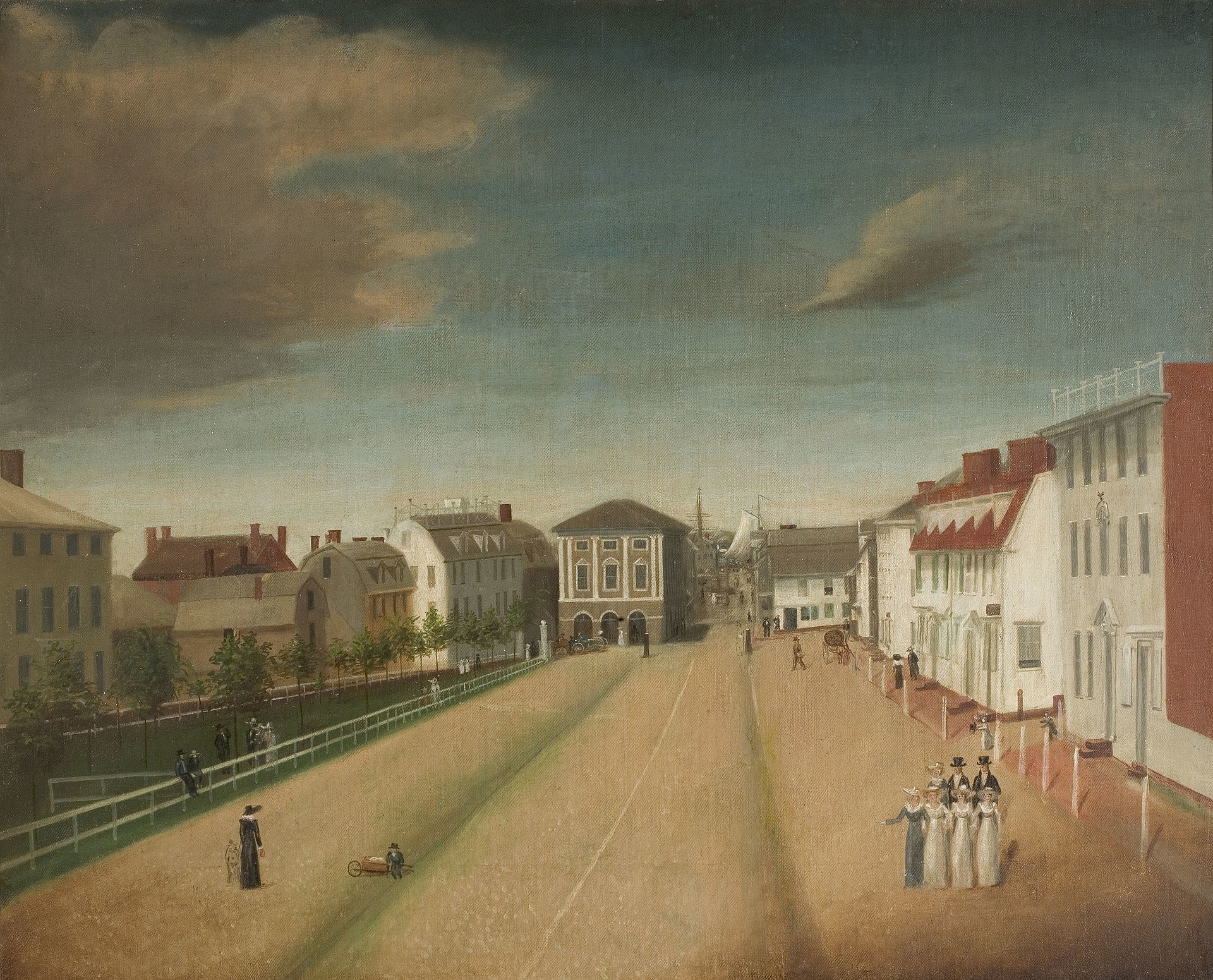
Washington Square, Newport, in 1818, by an unknown painter
Handing down their boats and their livings
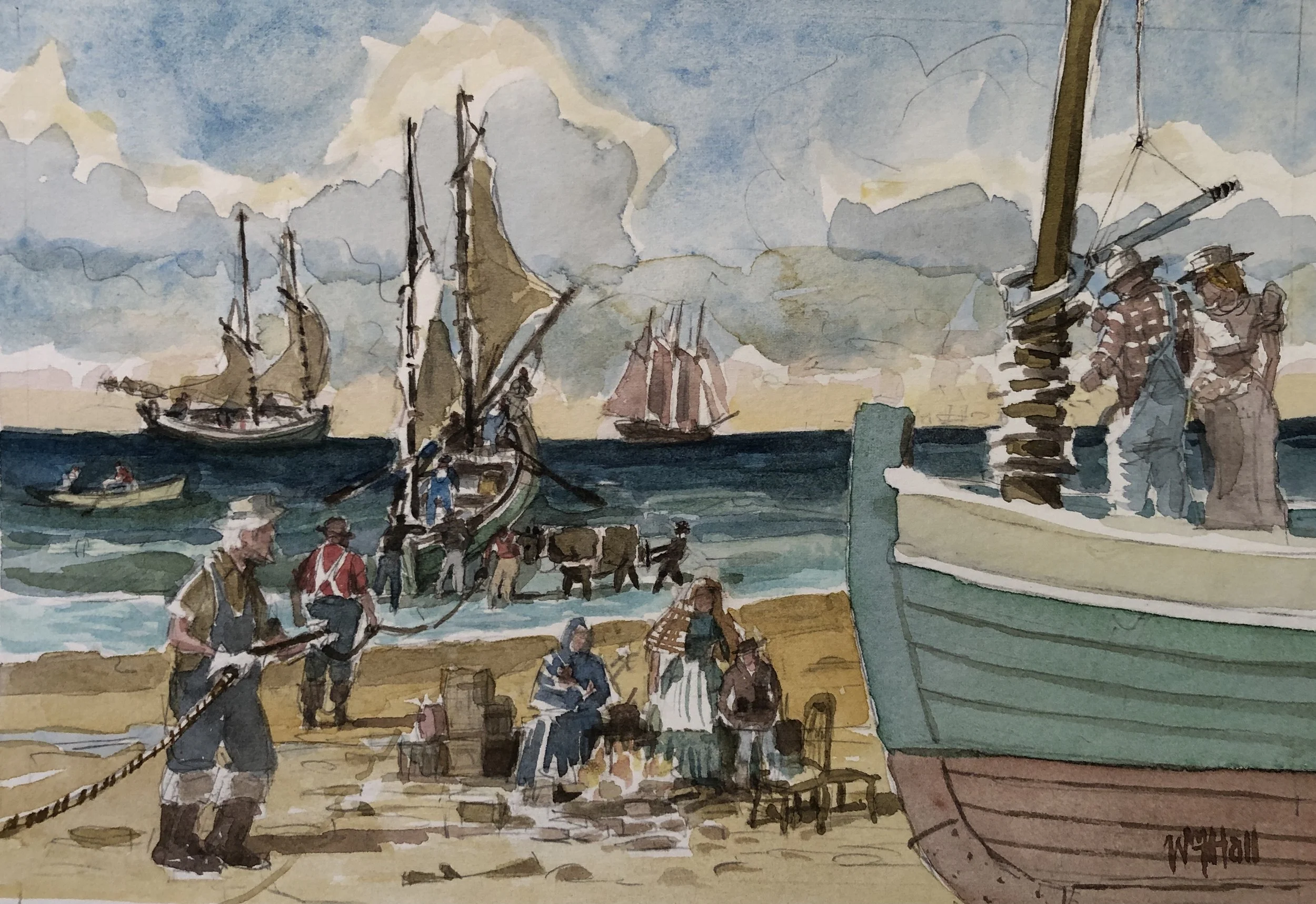
“Wedding Dowry” (watercolor on Arches Paper), by William Talmadge Hall, at David Chatowsky Art Gallery, 47 Dodge St., Block Island, R.I. (401) 835-4623
Hit this link for Mr. Hall’s Web site.
He explains:
“In this picture I show a Block Island Double-Ender fishing boat being brought up on the beach at the end of a day around 1840, with the help of oxen and block and tackle. The boats, a mainstay of the island’s fishing and transportation in the 18th and 19th centuries, were built by islanders to circumvent the problem of not having particularly safe harbors, necessitating that boats be drawn up into the dunes at night to wait for a favorable tide and reasonable weather.
This required the islanders to help each other daily, building a tight communal bond.
Fishing from the family-owned boats was so successful in harvesting the plentiful fish stocks around the island that the Block Island Double-Ender fleet grew large and the boats become famous for seaworthiness.
In this picture, the newlyweds on the boat to the right prepare to forge ahead in their new boat. Two generations of Block Islanders watch this ceremony as they sit on the beach at day’s end in front of a small fire.
Over the years, fathers handed down their boats to sons, and if there were no sons then a boat might be a dowry gift to a daughter and son-in-law.
The new husband brought the potential of a bigger extended fishing family once he had proven himself a worthy fisherman and become the the ascending key figure in the future.
Either way, the prize was the boat and the legacy it represented to a self-sufficient fishing community bolstered by shared beliefs.
xxx
I’m a 74-year-old artist. My family has been a part of Block Island's history for five generations. My father was the first male Hall on the island not to pursue fishing as a career, although he harpooned swordfish until he was drafted into the Army, in World War II.
I’m a watcher, and many of my paintings are about people working — the simple grace of people doing what they do each day to make a living. These folks don’t dwell much on the meaning or the ultimate results of what they do. They go with the flow of a continuum of work.

Llewellyn King: Boris Johnson — the fall of an articulate incompetent

Britain’s soon to be former prime minister, with the famous wild hair
WEST WARWICK, R.I.
The best piece of business advice I have ever read was, “Beware the articulate incompetent.” It is important to business decisions but far more so to political ones.
Boris Johnson has always been a poster boy for the articulate incompetent, and yet he rose with wit, bravado and connections to the highest elective office in Britain, prime minister. Now his luck has run out.
Born in New York to British parents, he didn’t renounce his dual citizenship until 2016, when it became a liability politically. He won a scholarship to Eton, the boys-only boarding school where many prime ministers studied, went on to Oxford, and was elected president of the Oxford Union. This is the equivalent of privilege on steroids.
Johnson’s weaknesses, including sloth, disorganization, lack of preparedness, showing off and a disinclination to let the facts stand in the way of a good story, were well known. He was fired from his first journalistic job on The Times of London for fabricating a quote -- from his godfather, of all people. Later Michael Howard, the distinguished Tory leader, fired him from the ranks of the shadow cabinet, also for lying.
After The Times, Johnson worked for the conservative daily, The Telegraph. In Brussels, where he was assigned, he was regarded by his peers as good company but an unreliable reporter. One of them told me that he was often asked to chase up some fabricated concoction of Johnson’s like the banana regulation, allegedly defining the length and curve of bananas allowed into the European Union. The only curve was that of the truth.
Johnson’s editors back in London wanted to hear only bad news about Europe. Johnson obliged: He was playing his part in the movement to take Britain out of Europe, which matured as Brexit.
Johnson went on to become a member of Parliament and editor of The Spectator, an admired British weekly magazine of politics, culture and current affairs, published continuously since 1828. His colleagues at the magazine found him sloppy, often absent and often leaving his work to others. His management was, it is reported, incoherent, a charge repeated about his leadership of Britain.
The Spectator, under Johnson’s editorship, was engulfed in a sex scandal of rare portions. The publisher was cavorting with a British cabinet member, Johnson with the star columnist and an editor with a secretary. It was a literary “Animal House.”
Johnson has been married three times and has six children from those marriages. He acknowledges one love child.
Next step for Johnson was to become mayor of London. His humor papered over the cracks, and he did a good job in defending London’s image -- especially in insisting that the double-decker red buses be retained.
The campaign for the United Kingdom to leave Europe gave Johnson his chance. He went against his old parliamentary friend and Eton and Oxford companion, Prime Minister David Cameron, and campaigned vigorously and with aid of some wild and untrue claims about how Britain would prosper out of Europe. Brexit carried the day.
Cameron was replaced with the dull, dutiful Theresa May. She had the task of trying to make Brexit work without breaking Britain. After three years, she was out, and a shaken party installed Johnson as its leader.
In a landslide, the Conservatives won the first election with Johnson at the helm, and he was expected to be a transformational prime minister. Instead, he has been involved in scandals: He has been caught lying about parties in his official home and office, No. 10 Downing Street, during the Covid-19 lockdown, and recently about the allegations of sexual impropriety of a member of his party, whom he had been warned about but nonetheless promoted. The truth might have saved Johnson; he eschewed it.
Johnson isn’t a fool, but he does foolish, often roguish things. He is a scholar of the ancient world, a biographer, a linguist and a wordsmith. He likes to make comparisons to antiquity: He equated London to Athens and himself to Pericles.
He wrote a biography of Churchill, which I enjoyed but found nothing groundbreaking. It seems to have been written to signal similarities between himself and Churchill.
Johnson will be heard from again as a commentator and author. He excels at the pithy phrase and joking in adversity, as when, as London mayor, he was left hanging on a zipline during a 2012 Olympics event.
His legacy may be that he was the most quotable prime minister of his generation and beyond. Here is a classic: “My friends, I have discovered myself, there are no disasters, only opportunities. And, indeed, opportunities for fresh disasters.”
On resigning, Johnson said tamely, “Them’s the breaks.”
Llewellyn King is executive producer and host of White House Chronicle, on PBS. His email is llewellynking1@gmail.com and he’s based in Rhode Island and Washington, D.C.

‘Nail to the mast’

The USS Constitution fires a 17-gun salute in Boston Harbor, on July 4 2014. The Constitution, also known as “Old Ironsides,’’ is the world's oldest ship still afloat. She was launched in 1797, one of six original frigates authorized for construction by the Naval Act of 1794 and the third constructed.
The ship is most noted for its effectiveness against the British during the War of 1812.
She is now a museum ship, albeit fully commissioned by the Navy. Her crew of 75 officers and sailors participate in ceremonies, educational programs and special events while keeping her open to visitors year round and providing free tours.. She is usually berthed at Pier 1 of the former Charlestown Navy Yard at one end of Boston's Freedom Trail. Go see her.
Ay, tear her tattered ensign down!
Long has it waved on high,
And many an eye has danced to see
That banner in the sky;
Beneath it rung the battle shout,
And burst the cannon’s roar;—
The meteor of the ocean air
Shall sweep the clouds no more!
Her deck, once red with heroes’ blood
Where knelt the vanquished foe,
When winds were hurrying o’er the flood
And waves were white below,
No more shall feel the victor’s tread,
Or know the conquered knee;—
The harpies of the shore shall pluck
The eagle of the sea!
O, better that her shattered hulk
Should sink beneath the wave;
Her thunders shook the mighty deep,
And there should be her grave;
Nail to the mast her holy flag,
Set every thread-bare sail,
And give her to the god of storms,—
The lightning and the gale!
— “Old Ironsides,’’ by Boston physician, poet and essayist Oliver Wendell Holmes Sr. (1809-1894)