
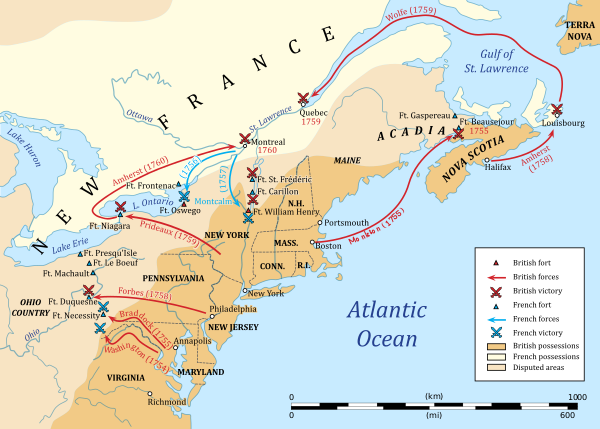
When French did empire the wrong way
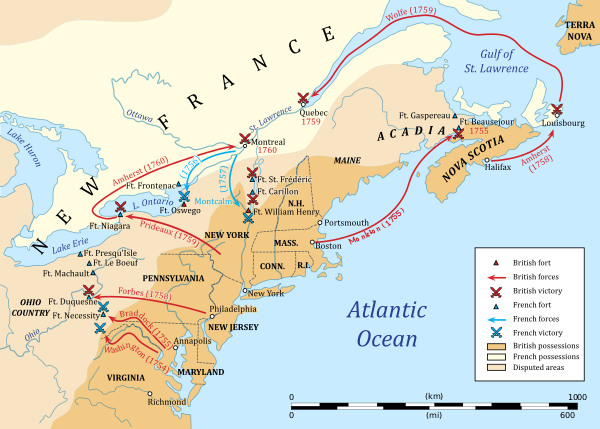
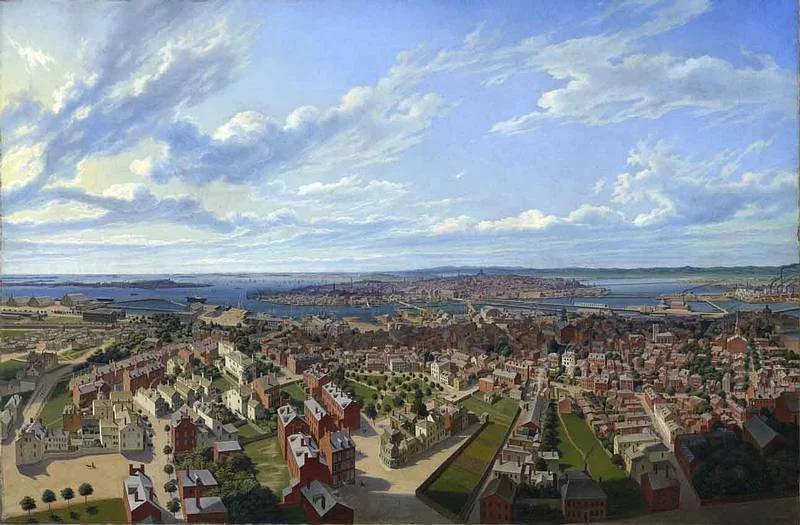
The theater of the French and Indian War, 1754-1763
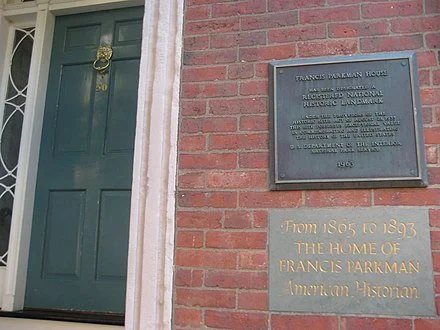
Francis Parkman House, a National Historic Landmark on Boston’s Beacon Hill
— Photo by John Stephen Dwyer
‘‘The growth of New England was a result of the aggregate efforts of a busy multitude, each in his narrow circle toiling for himself, to gather competence or wealth. The expansion of New France was the achievement of a gigantic ambition striving to grasp a continent. It was a vain attempt.’’
— Francis Parkman (1823-1893) is considered by many to be the first great American historian. Parkman was also a noted a horticulturist. His book France and England in North America is considered a masterpiece.
Holy Cross gets $2.5 million for race, gender, social-justice programs with Shakespeare thrown in

At Holy Cross; Fenwick Lawn, with Commencement Porch of Fenwick Hall in the foreground and the chapel beyond.
Edited from a New England Council (newenglandcouncil.com) report.
“The College of the Holy Cross, in Worcester, recently received a $2.5 million gift to be used to establish an endowed chair and lecture series focused on race, gender and social justice.
“The gift comes from Eric Galloway, who graduated from Holy Cross in 1984, and named this lecture series, the Helen M. Whall Lecture Series, an endowed chair position to honor Helen M. Whall, who served as Galloway’s adviser. Whall taught at the college as an English professor from 1976 to her retirement in 2017. History Prof. Rosa Carrasquillo has been selected as the inaugural Helen M. Whall Chair in Race, Gender and Social Justice. The bi-annual lecture series in Whall’s honor will host Shakespearean scholars to come on campus and speak on issues of diversity and equity.
“‘I am honored to acknowledge Helen Whall as an inspiring professor, mentor, and friend to me and other minorities during a sometimes challenging and, ultimately, rewarding time at Holy Cross,’ said Eric Galloway.”
Confident and vulnerable in Trumpian orange

“Self” (mixed media), by Laura Harper Lake, in her show “Vivid and Vulnerable Vessels,’’ at Foundation Art Space, , N.H., June 3 through June 25.
She says: “The human form can receive varying reactions when a person views themselves with a self-assessing mind. At times we may be confident, much like the bold, vivid colors on my canvases, which are all wood. In other moments, we may feel like the thin layer of iridescent paint I use; vulnerable, exposing the natural grain beneath, and hesitant. I am a pendulum, swinging between these two radically different states of being.”

Exeter’s Squamscott Falls in 1907. The town has long hosted manufacturing enterprises, much of them originally powered by water power, but it’s best known as the home of Phillips Exeter Academy, the prep school.
Better than violence
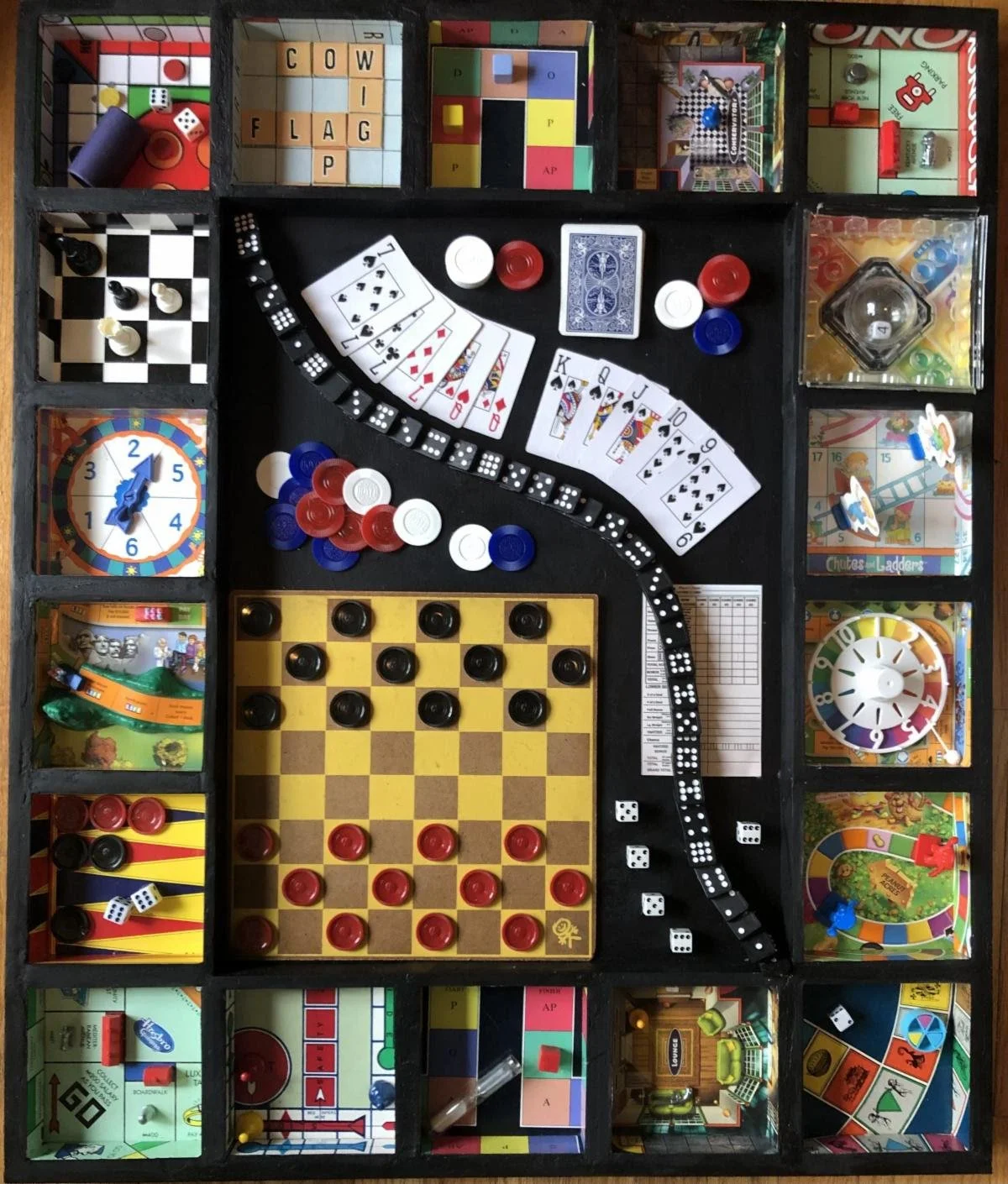
“Family Game Night” (mixed media: game boards and pieces, cards, dice, acrylic paint), by Kristi DiSalle, in the show “Playing Games,’’ through June 19 at ArtsWorcester, whose members were invited to “submit works of art that dive into games, play and interaction.’’ Ms. DiSalle lives in the affluent rural/exurban town of Princeton, Mass.
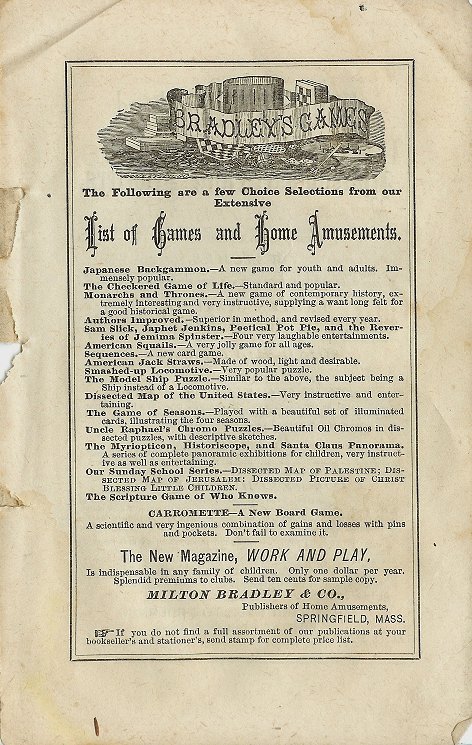
1872 ad for games created by the Milton Bradley Co., based in Springfield, Mass.

The Princeton., Mass., Public Library, built in 1883 in the heyday of stone-based Romanesque architecture made famous by the Boston-based architect Henry Hobson Richardson.

Straddling Princeton and Westminster, Mt. Wachusett, at 2,006 feet, is the highest mountain in Massachusetts east of the Connecticut and the largest ski area.
Don Pesci: 'Tax relief' and 'tax cuts' on shifting sand
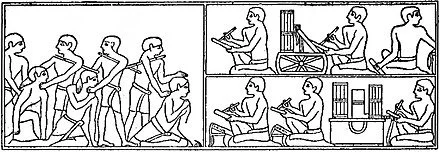
Egyptian peasants seized for non-payment of taxes several thousand years ago.
VERNON, Conn.
“The future ain’t what it used to be”
– Yogi Berra
The headline in a CTMirror story, “CT budget deal includes $600M in tax cuts, extends gas tax holiday”, includes a telling subtitle: “But more than half the tax relief is guaranteed for just one year.
There’s always a “but” in good journalism raining on someone’s parade.
The thrust of the story raises an interesting question: In what sense is “tax relief” a “tax cut”?
Many of the “tax cuts” referenced in this and other stories in Connecticut’s media are either temporary tax cuts or tax credits.
A temporary tax cut is only a “tax cut” until it elapses, after which it becomes once again a tax increase. And a “tax credit” is not, properly speaking, a tax cut. A tax, almost always permanent, moves money from a taxpayer’s budget to a state or federal treasury. A “tax cut” terminates the movement and leaves disposable assets in the account of the taxpayer.
A tax credit retains in public treasuries money moved from private to public accounts and surrenders a small part of the tax money collected to favored taxpayers.
From the point of view of the tax collector -- the state or federal government -- the beauty of a tax credit lies in the generally false appearance that those extending the credit are surrendering to preferred groups money that has been earned by state or federal government.
In moments of extreme clarity, everyone knows that a state government does not “earn” money of its own, as do private enterprises by producing and selling goods and services. States are tax collectors only, and the money they apportion belongs to tax payers who, through their own labor, earned their assets. Naturally, those surrendering money to state or federal government would like to believe political claims that the money collected would be used by government to increase the “public good.”
That is why the headline writer for CTMirror felt compelled to add to the story that clearly identifies what state Democrats and some media adepts consistently call “tax cuts” a subtitle that identifies the so called “tax cuts” as “tax relief.” A true tax cut eschews collection and leaves assets to be disposed of by a creative, enterprising and profit-seeking private marketplace. A tax credit reduces all three elements – minus a small bit of tax relief, usually temporary, apportioned for political purposes to groups favored by a reigning political party.
During election times, epistemological confusion – calling a tax credit or temporary suspension of a tax a “tax cut” – is everywhere, because give-backs and tax relief, however temporary, purchase votes, and the party in power is always interested in purchasing votes so that they may retain office and eventually raise the level of taxation to purchase vote and retain political power.
Connecticut’s temporary tax cuts and credits are built on shifting sand.
“The tax cuts,” a Hartford paper noted, “are possible because of a quickly growing state budget surplus and more than $2 billion in federal stimulus funds over 2 years that have helped fund numerous programs across the state.” The state’s budget surplus – i.e., the amount of money the state has overtaxed its citizens – is projected to reach $4 billion. And the federal stimulus funds aggravate inflation and possibly a pending recession. It takes Connecticut about 10 years to recover from a national recession.
It gets worse: The money that will finance more excessive spending is finite, and temporary, but the spending it purchases is mostly permanent and more costly than Connecticut taxpayers can afford in an era of mounting inflation, which reduces the purchasing power of the dollar, and a diminishing population.
The Yankee Institute devoted a carefully researched paper, CT’s Growing Problem: Population Trends in the Constitution State, to Connecticut’s dangerous population issues over the past few decades. The 2020 U.S. Census shows Connecticut as a negative outlier: “In a decade when the nation’s population grew by 7.4 percent, Connecticut’s population grew barely at all – less than 1 percentage point. Only 3 states ranked below Connecticut: West Virginia, Illinois and Mississippi, all of which lost population.”
If the future in Connecticut “ain’t what it used to be,” perhaps true reformers who wish to advance the public good should focus on the palpable effects ruinous policy has on the future. It is at least worth discussing whether state policy makers spend money like drunken sailors because, so long as the state can pass on to future generations the disastrous, but quite predictable consequences of hedonistic spending, politicians now serving in the General Assembly needn’t worry overmuch about their own immediate job prospects.
Don Pesci is a Vernon-based columnist.


Llewellyn King: For society’s sake, newspapers, whose work is looted by tech firms, deserve a reprieve


WEST WARWICK, R.I.
Newspapers are on death row. The once great provincial newspapers of this country, indeed of many countries, often look like pamphlets. Others have already been executed by the market.
The cause is simple enough: Disrupting technology in the form of the Internet has lured away most of their advertising revenue. To make up the shortfall, publishers have been forced to push up the cover price to astronomical highs, driving away readers.
One city newspaper used to sell 200,000 copies, but now sells less than 30,000 copies. I just bought said paper’s Sunday edition for $5. Newspapering is my lifelong trade and I might be expected to shell out that much for a single copy, but I wouldn’t expect it of the public to pay that — especially for a product that is a sliver of what it once was.
New media are taking on some of the role of the newspapers, but it isn’t the same. Traditionally, newspapers have had the time and other resources to do the job properly; to detach reporters to dig into the murky, or to demystify the complicated; to operate foreign bureaus; and to send writers to the ends of the earth. Also, they have had the space to publish the result.
More, newspapers have had something that radio, television and the Internet outlets haven’t had: durability.
I have a stake in radio and television, yet I still marvel at how newspaper stories endure; how long-lived newspaper coverage is compared with the other forms of media.
I get inquiries about what I wrote years ago. Someone will ask, for example, “Do you remember what you wrote in 1980 about oil supply?”
Newspaper coverage lasts. Nobody has ever asked me about something I said on radio or television more than a few weeks after the broadcast.
I was taken aback when, while I was testifying before the Senate Foreign Relations Committee decades ago, a senator asked me about an article I had written years earlier and forgotten. But he hadn’t and had a copy handy.
There is authority in the written word thay doesn’t extend to the broadcast word, and maybe not to the virtual word on the Internet in promising new forms of media like Axios.
If publishing were just another business – and it is a business — and it had reached the end of the line, like the telegram, I would say, “Out with the old and in with the new.” But when it comes to newspapers, it has yet to be proven that the new is doing the job once done by the old or if it can; if it can achieve durability and write the first page of history.
Since the first broadcasts, newspapers have been the feedstock of radio and television, whether in a small town or in a great metropolis. Television and radio have fed off the work of newspapers. Only occasionally is the flow reversed.
The Economist magazine asks whether Russians would have supported President Vladimir Putin’s invasion of Ukraine if they had had a free media and could have known what was going on; or whether the spread of COVID in China would have been so complete if free media had reported on it early, in the first throes of the pandemic?
The plight of the newspapers should be especially concerning at a time when we see democracy wobbling in many countries, and there are those who would shove it off-kilter even in the United States.
There are no easy ways to subsidize newspapers without taking away their independence and turning them into captive organs. Only one springs to mind, and that is the subsidy that the British press and wire services enjoyed for decades. It was a special, reduced cable rate for transmitting news, known as Commonwealth Cable Rate. It was a subsidy but a hands-off one.
Commonwealth Cable Rate was so effective that all American publications found ways to use it and enjoy the subsidy.
United Press International created a subsidiary, British United Press, which flowed huge volumes of cable traffic through London.
Time Inc. had a system in which their cable traffic was channeled through Montreal to take advantage of the exceptionally low, special rates in the British Commonwealth.
That is the kind of subsidy that newspapers might need. Of course, best of all, would be for the mighty tech companies to pay for the news they purloin and distribute; for the aggregators to respect the copyrights of the creators of the material they flash around the globe. That alone might save the newspapers, our endangered guardians.
Llewellyn King is executive producer and host of White House Chronicle, on PBS. His email is llewellynking1@gmail.com and he’s based in Rhode Island and Washington, D.C.
'Into the moonlit woods'

“We climb into the cellar hole
of the old Bailey place
that caught fire in the middle
of the night, the seven children
who raced into the moonlit woods
in weightless clothes gowns and bedclothes’’
— From “Into the Forest,’’ by Anna Birch (1970), reflecting her experiences as a child in Hollis, N.H.
Nantucket to go topless
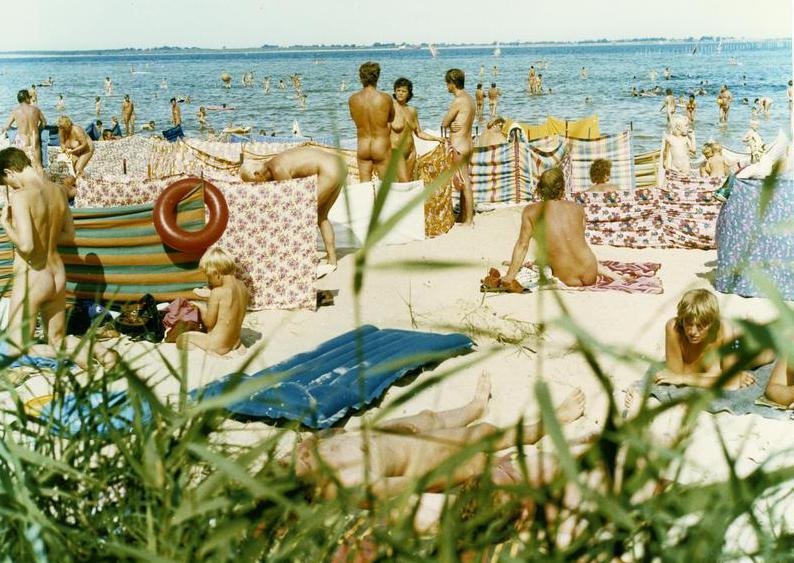
And after topless?
— Photo by Bundesarchiv, Bild 183-1984-0828-411A / Settnik, Bernd / CC-BY-SA
Adapted from Robert Whitcomb’s “Digital Diary, in GoLocal 24.com
Nantucket residents have voted 327-242 for the town to allow anyone – that means women! -- to be topless on the island town’s beaches.
The official language of the bylaw amendment called “Gender Equality on Beaches’’ (politically correct!) says:
“In order to promote equality for all persons, any person shall be allowed to be topless {even men!} on any public or private beach within the Town of Nantucket.”
Given that in the summer Nantucket hosts many rich and well-traveled people who have seen lots of topless beachgoers on, say, the Riviera or in the Hamptons, this may not be that much of a step. But the measure may lure some day trippers to engage in a little perfectly legal voyeurism.
We stay away from Nantucket, Martha’s Vineyard and Block Island in the summer. Too damn many people, too expensive and too much reliance on unreliable and crowded ferries. Of course, for the fat cats (mostly in finance) who increasingly dominate these luxury islands, there are their own planes.

The town on Nantucket Island when it was still called Sherburne, in 1775
‘Strange ancient memories’
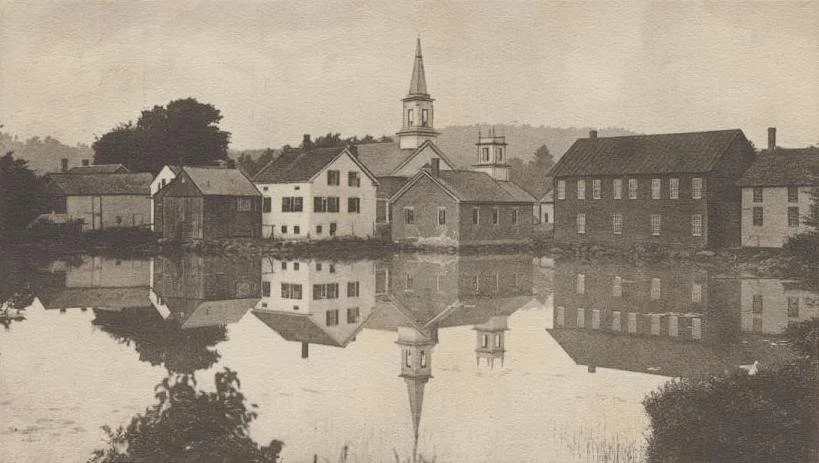
Harrisville, N.H. in 1905
— From H.P. Lovecraft (1890-1937), writer and a Providence native who’s known for his horror and science-fiction stories.
David Warsh: The expansion of women’s economic freedom that helped lead to Roe v. Wade


SOMERVILLE, Mass.
The circumstances that gave rise to the Supreme Court’s 1973 decision in Roe v. Wade, to establish physicians’ right to counsel the possibility of medical abortion, are not easy to recall. There was so much turmoil on the surface of things fifty years ago – Vietnam, Watergate, Richard Nixon’s landslide re-election. In retrospect, one skein of developments stands out as more momentous than the rest: the rapidly changing opportunities available to American women.
For that reason, there is no better place to start than with Harvard economist Claudia Goldin’s Career and Family: Women’s Century-long Journey toward Equity (Princeton, 2021). A distinguished economic historian, Goldin organized her account around the experiences of five roughly defined generations of college-educated American women since the beginning of the 20th Century. Each cohort merits a chapter.
The revolution, Goldin finds, was a technological one: the advent in the Sixties of dependable methods of birth control – the Pill, the IUD and the diaphragm. Women began re-entering the workforce on new terms. After explicating the traditional logic of early marriage – perhaps timeless, evolutionarily speaking – Goldin writes:
Armed with the new secret ingredient, the recipe for success became, “Put marriage aside for now. Add gobs of higher education. Blend with career. Let rise for a decade, and live tour life fully. Fold family in later.” Once this happiness formula was adopted by large numbers of women, the age at first marriage increased, even for college women who did not take the Pill. That reduced the potential cost of long-run cost of marriage delay for any one woman.
With that, the 7-2 majority decision in Roe v. Wade was almost an afterthought. The Supreme Court doesn’t just follow the election returns; they have families, and read the newspapers as well. .
Since 1982, the Federalist Society, conservative legal representatives of that year’s “Silent Majority,” have been working to reverse the decision by fundamentally transforming the judicial interpretation of the U.S. Constitution. You can read historian David Garrow’s triumphant summary of these “originalist” and “textualist” movements here.
Meanwhile, a May 7 Boston Globe story (subscription required) about Sir Matthew Hale, the 17th Century jurist whom Associate Justice Samuel Alito cited more than a dozen times in his 98-page draft opinion, makes equally interesting reading. Reporter Deanna Pan may have surfaced another plausible reason that the draft was leaked.
If experience is any guide, the next twenty-five years will see an avalanche of work on the other side of the argument, produced by legal scholars, historians, economists and other social scientists. Quite apart from whatever the election returns in the coming years might be, a movement to explain changing values and preferences has been underway in economics for years. New views on the joint evolution of institutions and cultures are entering the mainstream.
The Supreme Court is one of those institutions – central banks are another – to which democratic societies have delegated decision-making powers in the hope that in difficult times they will make more far-sighted policy choices than those of the current majority.
The court decided Roe v, Wade correctly in 1973. In all likelihood, it will sooner or later rise to the occasion again, In the meantime, stay calm; plan ahead, and cope with consequences if the expected reversal eventuates. Don’t throw the Supreme Court baby out with the bathwater.
David Warsh a veteran reporter, columnist and economic historian, is proprietor of Somerville-based economicprincipals.com, where this essay first ran.
Transatlantic show

Encaustic diptych on wood panel, by Susan Liddle/Donna Talman, in the show “Transatlantic Fusion 21: A Diptych Project,’’ June 1-11 at The Commons, Provincetown, Mass. It’s a joint exhibition of New England Wax (newenglandwax.com) and European Encaustic Artists.

Jim Hightower: Blame greedy corporate execs for surge in U.S. inflation
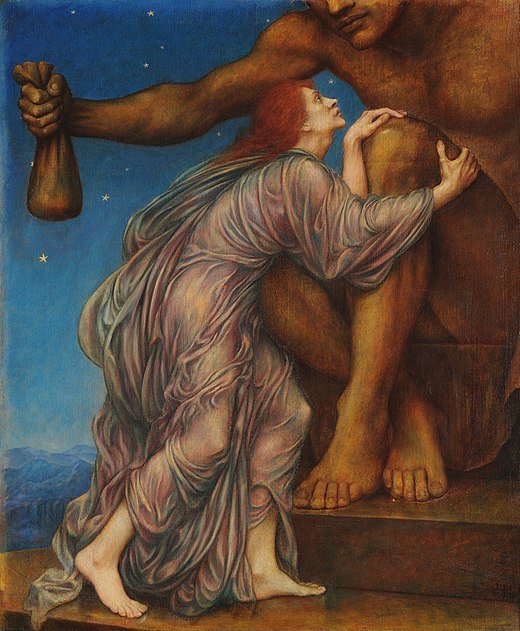
“The Worship of Mammon” (1909), by Evelyn De Morgan
Via OtherWords.org
Today, CEOs of big corporations are playing the tricky “Inflation Blame Game.”
Publicly, they moan that the pandemic is slamming their poor corporations with factory shutdowns, supply chain delays, wage hikes, and other increased costs. But inside their board rooms, executives are high fiving each other and pocketing bonuses.
What’s going on?
The trick is that these giants are in non-competitive markets operating as monopolies, so they can set prices, mug you and me, and scamper away with record profits. In 2019 for example, before the pandemic, corporate behemoths hauled in roughly a trillion dollars in profit. In 2021, during the pandemic, they grabbed more than $1.7 trillion.
This huge profit jump accounts for 60 percent of the inflation now slapping U.S. families!
Take supermarket goliath Kroger. Its CEO gloated last summer that “a little bit of inflation is always good in our business,” adding that “we’ve been very comfortable with our ability to pass on [price] increases” to consumers.
“Comfortable” indeed. Last year, Kroger used its monopoly pricing power to reap record profits. Then it spent $1.5 billion of those gains not to benefit consumers or workers, but to buy back its own stock — a scam that siphons profits to top executives and big shareholders.
Or take the fast-food purveyor McDonald’s. Executives bragged to their shareholders that despite the supply disruptions of the pandemic and higher costs for meat and labor, its top executives had used the chain’s monopoly power in 2021 to up prices, thus increasing corporate profits by a stunning 59 percent over the previous year.
And the game goes on: “We’re going to have the best growth we’ve ever had this year,” Wall Street banking titan Jamie Dimon exalted at the start of 2022.
Hocus Pocus — this is how the rich get richer and inequality “happens.”
OtherWords columnist Jim Hightower is a radio commentator, writer and public speaker.
'Faint music in the woods'

Mayflower
— Jack Kerouac (1922-1969), novelist and luminary of the Beat Generation. From Lowell, Mass., he was of French-Canadian background.
Where he worked
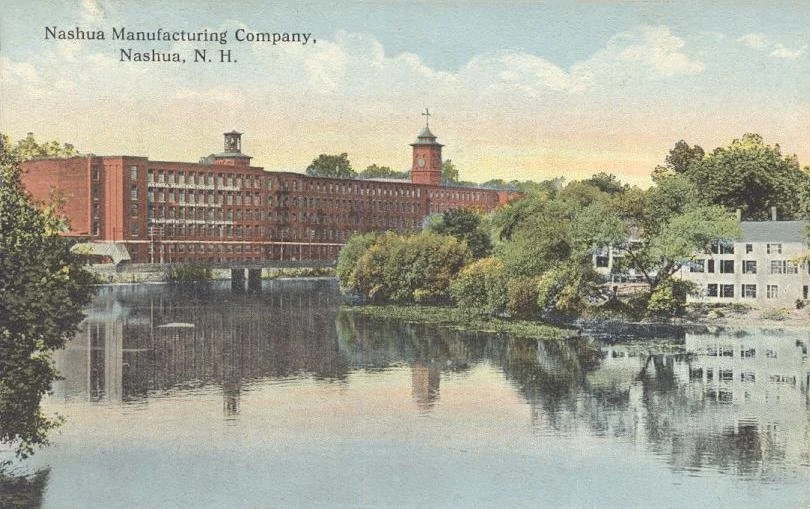
A long-closed textile factory on the Merrimack River in 1909, during its heyday.

“Here are the instruments of the makers,
their testaments of gears and wheels.
This is where men and women are called
To the daily stations of common task,
And so I stand with my father
In a child’s reverent silence.’’
-- From “Sunday Factory,’’ by W.E. Butts (1944-2013), a New Hampshire poet laureate, about a father showing his very young son his place of work

Chris Powell: Teachers politick on the job; ‘The Ukrainian lady’

A gay pride flag
MANCHESTER, Conn.
Connecticut schools deny that they propagandize students, but the other week the state's teachers gloried in their propagandizing on the job. Members of the state's largest teacher union, the Connecticut Education Association, dressed in red to participate in the union's "Red for Ed Day of Action," demonstrating and soliciting support for several school-related bills pending in the General Assembly and endorsed by the union.
The bills weren't controversial but the union's directing its members to campaign for the bills on the job could not have been more political. Students, other school staff members, and parents were to notice the uniformity of color worn by the teachers, to ask about it, and heed the union's appeal. The teachers exploited their jobs for a political purpose and it's unlikely that any school administrators scolded them about it and told them to do their politicking on their own time.
Meanwhile in some towns around Connecticut the political left is trying to propagandize government flagpoles on municipal property, seeking to fly non-government flags on them to endorse various causes. This propagandizing was an issue in Southington, where the Republican majority on the Town Council voted to limit town government flagpoles to government's own flags.
Some people had wanted to put a rainbow "Pride" flag on a pole at Southington Town Hall, celebrating sexual minorities, and they construed opposition as signifying hate and oppression.
Though Connecticut long has been almost completely libertarian about sexual orientation, maybe some opposition to the "Pride" flag was badly motivated. But the argument for the restrictive policy was sound -- that if non-government flags are to be flown on government poles, some agency will always have to deliberate on their suitability and to take sides on their causes. After all, if a "Pride" flag can be flown at town hall, what about a Trump campaign flag or the red and black flag of the fascists who call themselves anti-fascists?
This is the sort of thing that easily turns into civil liberties lawsuits. Better to keep symbols of the state politically neutral and out of the culture war.
Besides, if, as the political left suggests, sexual orientation and even gender itself are entirely matters of the feelings that people are born with, what is there to be proud of? It's not as if sexual orientation and gender are somehow earned. Some people in Connecticut may deplore homosexuality or transgenderism anyway but no one proposes to deny the right of people to live their personal lives as they choose.
Indeed, these days to fly a "Pride" flag on a government flagpole or to parade with one is mostly to be looking for someone to give offense to, as if Connecticut's cordial indifference isn't good enough and, as in totalitarian countries, demonstrations of approval must be compelled.
xxx
Even as the General Assembly, nearing adjournment, whirred furiously under the Capitol dome last week, it couldn't produce Connecticut's publicity stunt of the month. That was achieved a few blocks away, where a downtown Hartford bar changed its name from ‘The Russian Lady’ to “The Ukrainian Lady’’ in support of Ukraine's heroic resistance to Russian aggression.
The name change is to be only temporary. The stolid old lettering on the bar building's frontpiece remains under the blue and yellow banner that has been tied above the door. But for a few weeks patrons may be inclined to toast "Slava Ukraini!" and "Heroiam slava!" before stumbling home.
Unfortunately the war well may continue even after the blue and yellow banner comes down and the bar becomes The Russian Lady again, or maybe, as aggression continues, becomes The Moldovan Lady or The Polish Lady.
But even now bar patrons and everyone else should remember that many Russians are victims of the war, too, and not just the thousands of Russian soldiers killed, wounded or captured in a war few of them wanted. For the war has brought a comprehensive tyranny down on Russia and has cost all Russians what was left of the political liberty they gained with the dissolution of the Soviet Union 30 years ago.
So toast to Ukrainian liberty, but to Russian liberty. too.
Chris Powell is a columnist for the Journal Inquirer, in Manchester.
The real one seems pretty fantastical, too

“Fantasy Worlds 25,’’ by Louisa Chase (1951-2116), in her show “Fantasy Worlds,’’ at the Brattleboro (Vt.) Museum and Arts Center
— Photo by Erin Jenkins.

Llewellyn King: Fighting wildfires with fires

Prescribed burn at the Tall Timbers research site, in Thomasville, Ga.
— Photo by Linda Gasparello
(See New England note below.)
Did the fire at the end of Walt Disney’s iconic animated movie Bambi prejudice the country against forest management with controlled burning? Maybe so.
The United States Energy Association in February presented a virtual media briefing on the fire threat in the West and the Southwest this year. The prognosis, especially from the weather forecasting company AccuWeather, was grim.
Now that prognosis is being borne out as terrible fires again scorch those regions. Fire is now a year-round danger.
Enter forest scientists, who believe the solution to rampant wildfires is scientifically managed, preemptive burning.
But this fire-management practice isn’t without controversy. The memory of Bambi and his father, trapped by a raging forest fire, can spill into politics, with fierce advocates for prescribed burning often at odds with activists who believe fire should be suppressed.
The epicenter of the science of forest management with fire isn’t in the West but in the East – in the Red Hills, stretching from Tallahassee, Fla., to Thomasville, Ga. This is the home to the research stations of the Tall Timbers Institute, which studies and practices prescribed burning to save the long-leaf pine forests and their abundant populations of game birds and other wildlife.
It can be argued that a small game bird, the Northern bobwhite quail, has been responsible for preserving a huge acreage of forest land in the Red Hills. The name Red Hills is more poetic than accurate as the land is undulating rather than hilly. However, the name is enshrined in Martin Luther King Jr.’s “I Have a Dream” speech.
The area is home to some of the largest private estates -- still called plantations -- in the nation. They have been preserved and lovingly tended for hunting since the 19th Century.
Conservation began in the 1920s to preserve the habitat of the quail, fell off in the 1930s, and came roaring back in the 1950s when philanthropist Henry Beadel gave 2,200 acres to establish five ecological-research stations. This has grown to 4,000 acres.
The theory of deliberate burning is that it keeps down the forest-floor “fuel” that makes wildfires so deadly and unmanageable. The prescribed burns are carefully organized, considering the weather, the vegetation and the escape routes for the fauna.
During these burns, the fires sweep through without damaging the soil. The trees are left standing -- because the fires are fast and very hot -- but the forest floor is cleared.
Tall Timbers researchers showed me and a small group of visitors the product of a new burn on the previous day, where there was lingering smoke, and the revived, flourishing areas that were burned one, two, and three years earlier.
These researchers have a passion for their work and their conservation with fire.
The institute is active on more than 500,000 acres in Georgia and Florida and leads the country in remedial burning. California is now tentatively trying to burn on a limited scale, learning from Tall Timbers.
But Tall Timers conservation extends well beyond fire.
They explained the real threat to forests is urban sprawl and they are active, vigorously so, in persuading Red Hills area landowners to write easements into their deeds to preserve what the Nature Conservancy has called one of America’s “Last Great Places.”
And the movement is growing. “We have been working with nonprofits in the West,'' said Morgan Varner, fire research director at Tall Timbers.
Varner said Florida leads the country in preservation of great tracts of untrammeled forest and savannah managed with prescribed burning.
As we toured through Tall Timbers, one could marvel at the resiliency of both the flora and fauna. Animals and birds, which naturally flee fire, also enthusiastically return after the fires have done their work. Bambi went back.
Llewellyn King is executive producer and host of White House Chronicle, on PBS. His email is llewellynking1@gmail.com and he’s based in Rhode Island and Washington, D.C.
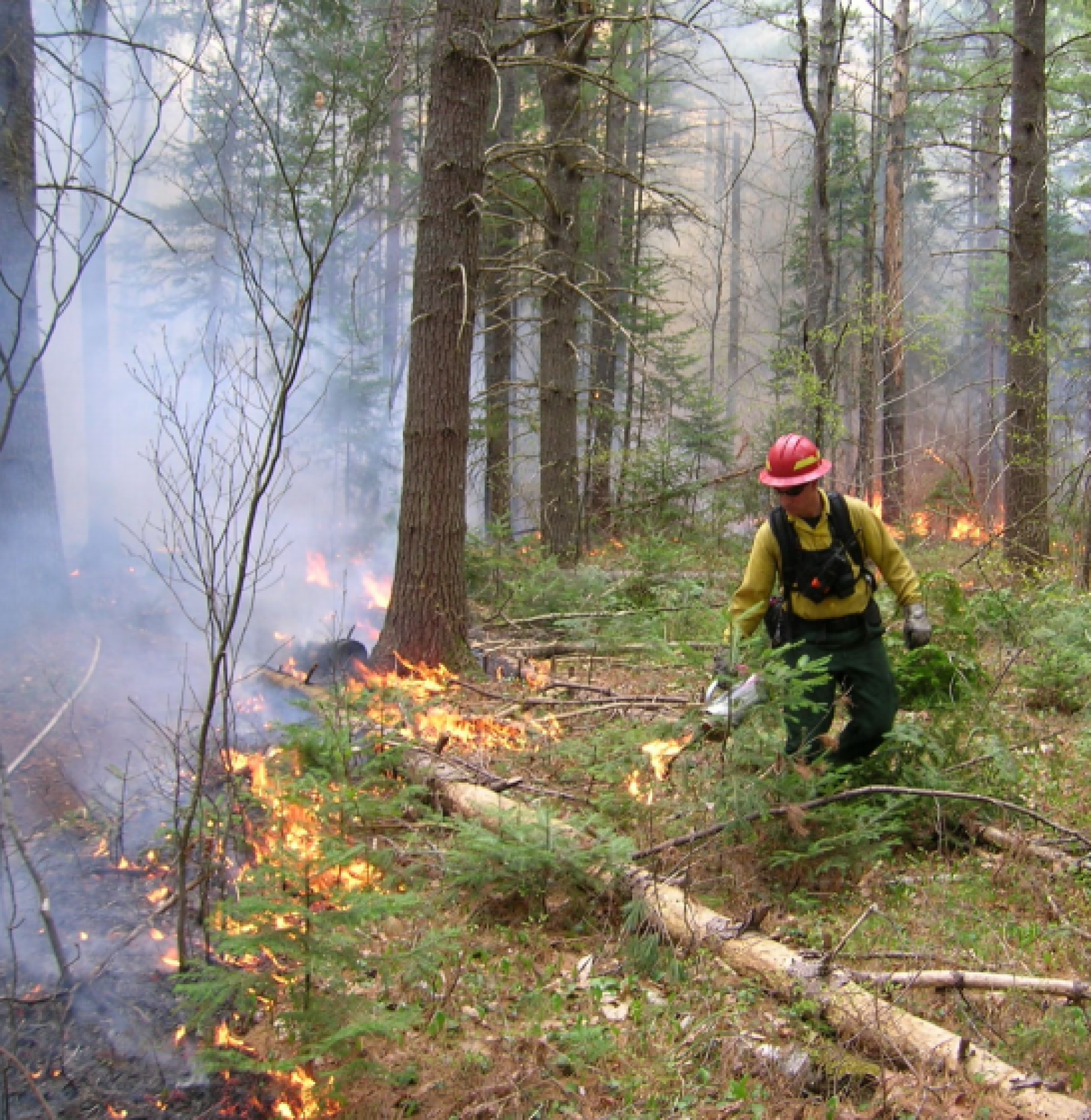
Prescribed burning in the White Mountain National Forest.
But fat fieldmice are tasty

“More die in the United States of too much food than too little’’
— John Kenneth Galbraith (1908-2006) economist, author and Harvard professor in The Affluent Society (1958)

“Fieldmouse Pie
5 fat fieldmice
1 cup macaroni
1/2 onion, thinly sliced
1 medium-size can tomatoes
1 cup cracker crumbs
Boil the macaroni 10 minutes. While it is cooking, fry fieldmice long enough to try out excess fat. Grease casserole with some of the fat and put a layer of macaroni on it. Add onion and tomato, then salt and pepper it well. Add fieldmice and cover with the remaining macaroni. Sprinkle the top with cracker crumbs seasoned with salt, pepper, and butter. Bake at 325 for 20 minutes or until mice are well done. (Note: if insufficient mice are available, substitute sausages.)”
— From a 19th Century cookbook created by some Vermont women, who used a lot of unusual sources to keep the wolf from the door.
‘Construct an ending’

“An Interesting Light’’ (oil on canvas), by Julia Purinton, of Warren, Vt., (see below) at Edgewater Gallery, Middlebury Vt.
The gallery says:
Ms. Purinton “blends the distinguishable with the imagined, creating dreamlike landscapes in oil. The context of time and place for each work is gracefully ambiguous allowing the viewer to interpret the composition in a personal way.
“Setting a mood with her soft, subtle palette, Purinton begins a story and leaves the ending for us to construct.’’
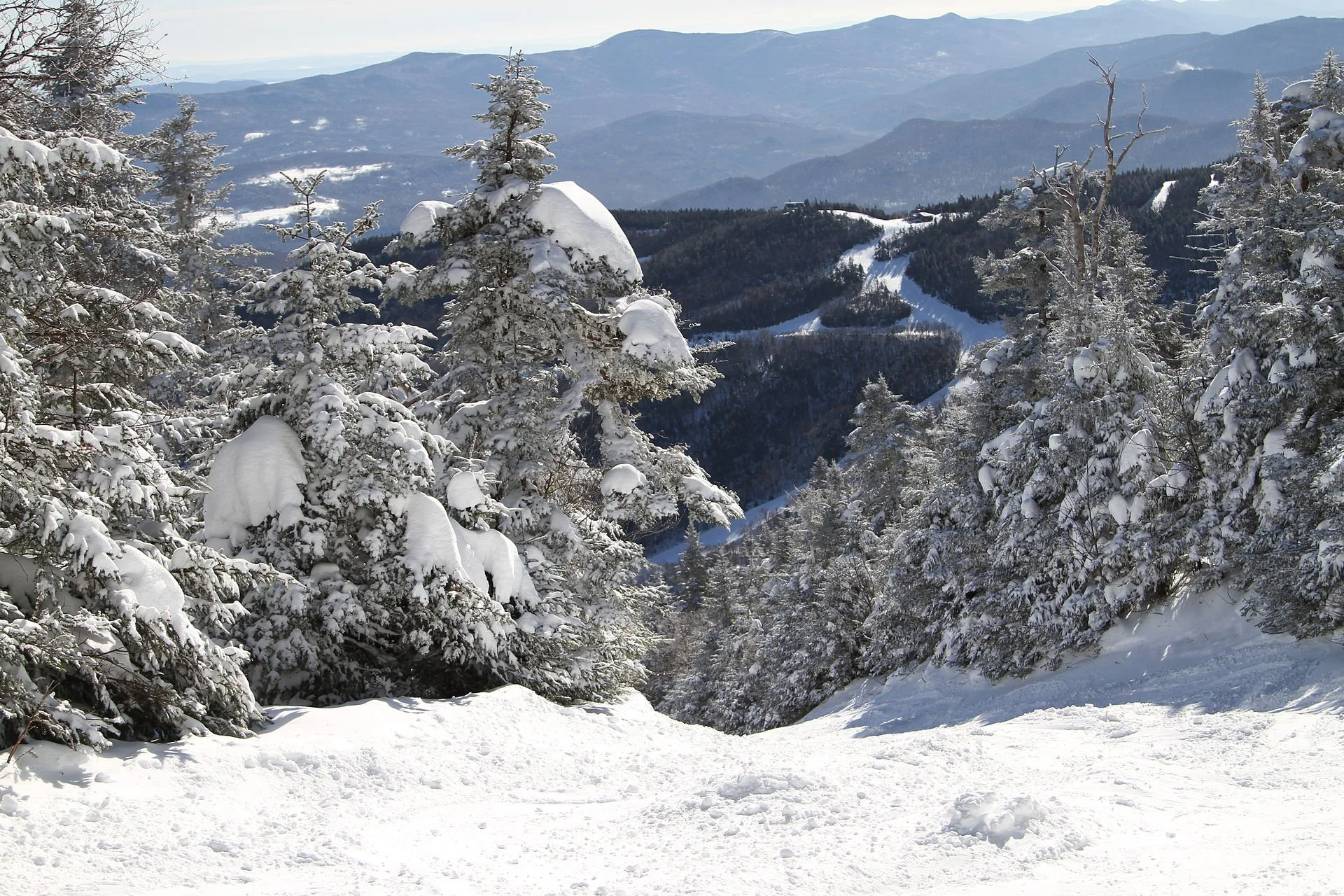
At the Sugarbush ski area, in Warren, in February. The Warren area is a major recreational and second-home area, anchored by Sugarbush. It also has many artists.
— Photo by TaraMGordon -
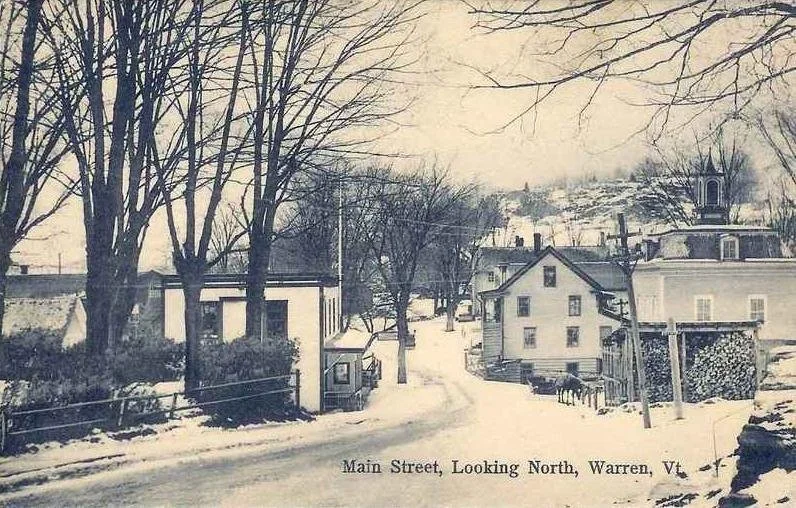
In 1910, way before the ski boom.