
Vox clamantis in deserto










Some ‘courageous immigrants’ who ate well
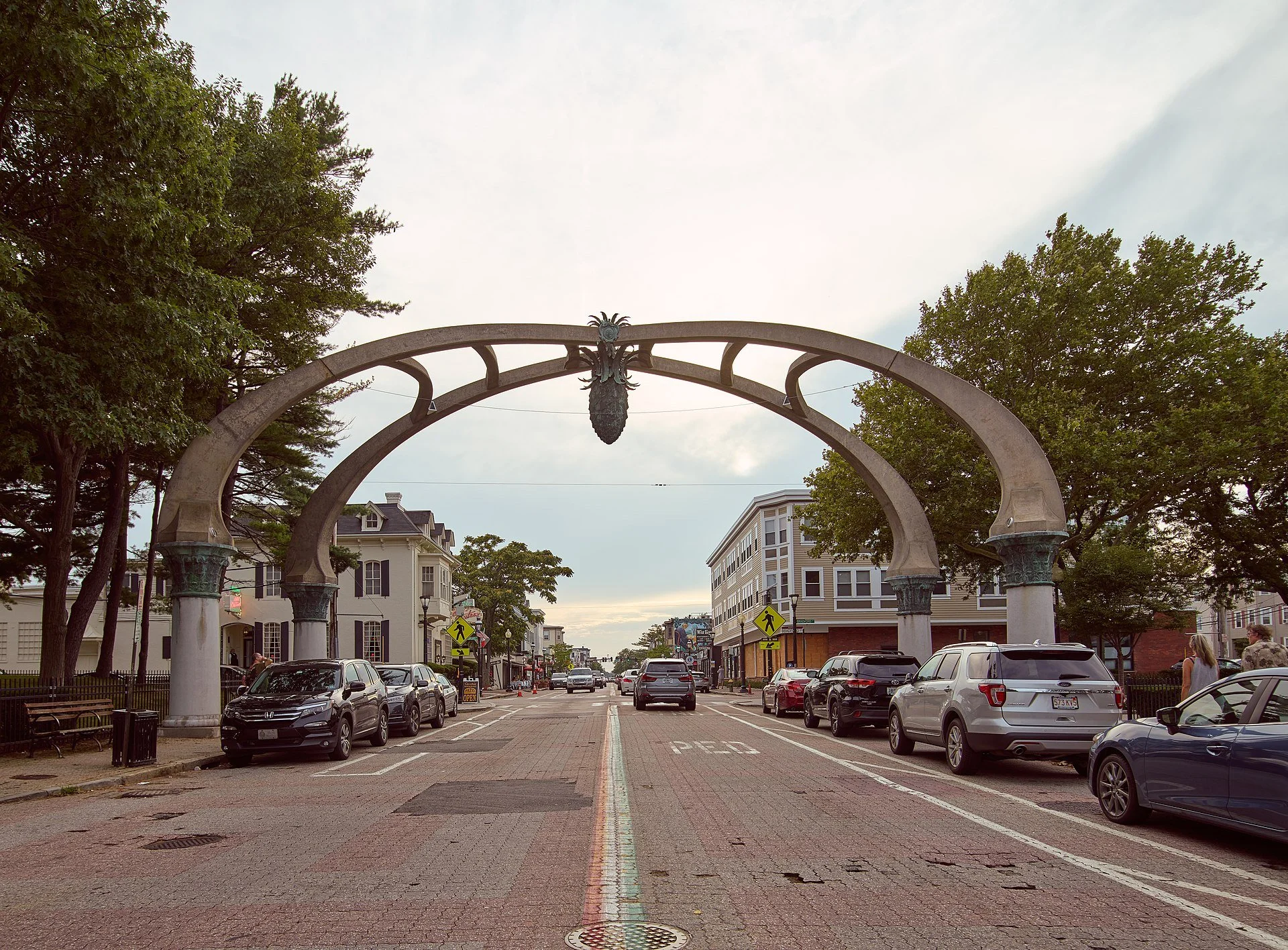
The entrance to the Federal Hill neighborhood of Providence, traditionally the heartland of southeastern New England’s Italian-American community.
From Robert Whitcomb’s “Digital Diary,’’ in GoLocal24.com
I was leafing through a copy of Dr. Edward Iannuccilli’s book What Ever Happened to Sunday Dinner? … and Other Stories the other day and enjoyed yet again these memoirs, which I first read some years ago. The tales of growing up in a tight-knit Italo-American family in Rhode Island are sometimes very funny, occasionally sad and filled with finely constructed dialogue, strong narrative drive and an understanding of the social history that everyone in the book (and most everyone else in those decades) was living through. They show how immigrant traditions were diluted and sometimes even evaporated in an always churning America. But this charming book is for everybody who has followed life in the mid-20th Century. It certainly brought back a lot of memories to me and many friends and relatives.
I liked his dedication, to his wife, Diane, and “To the courageous immigrants who made it possible.’’ Of course the old cliché is that we’re “a nation of immigrants’’ – true, including the Siberian-Americans we call Native Americans or Indians.
Where is it?

“Hadley Range,’’ by Oscar Andrew Hammerstein (grandson of the Broadway lyricist), at Miller Fine Arts, South Dennis, Mass.
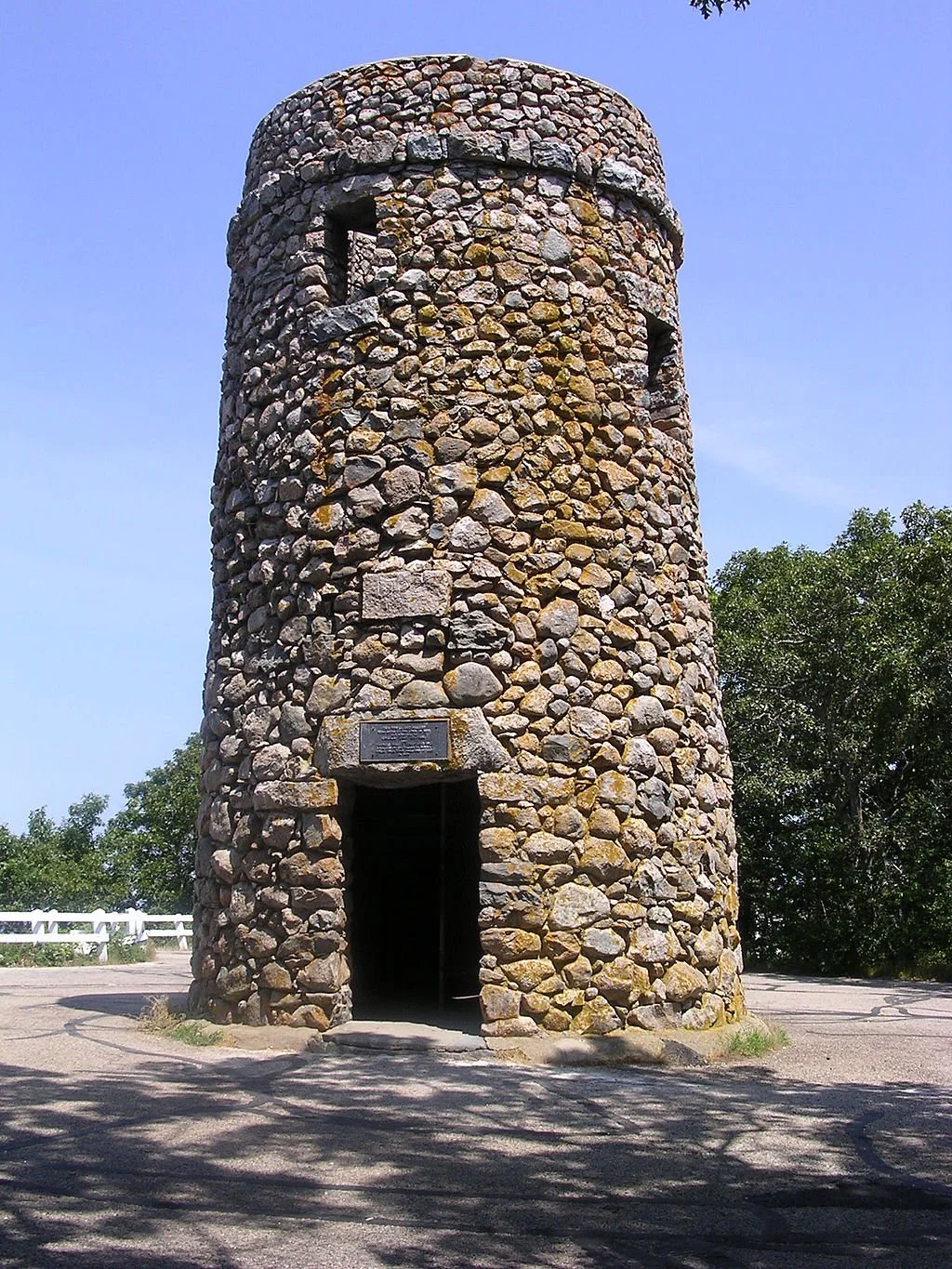
The Scargo Tower, on top of Scargo Hill, in Dennis. The tower offers wide views of Cape Cod.
Cynthia Drummond:New England lawns are changing with the times
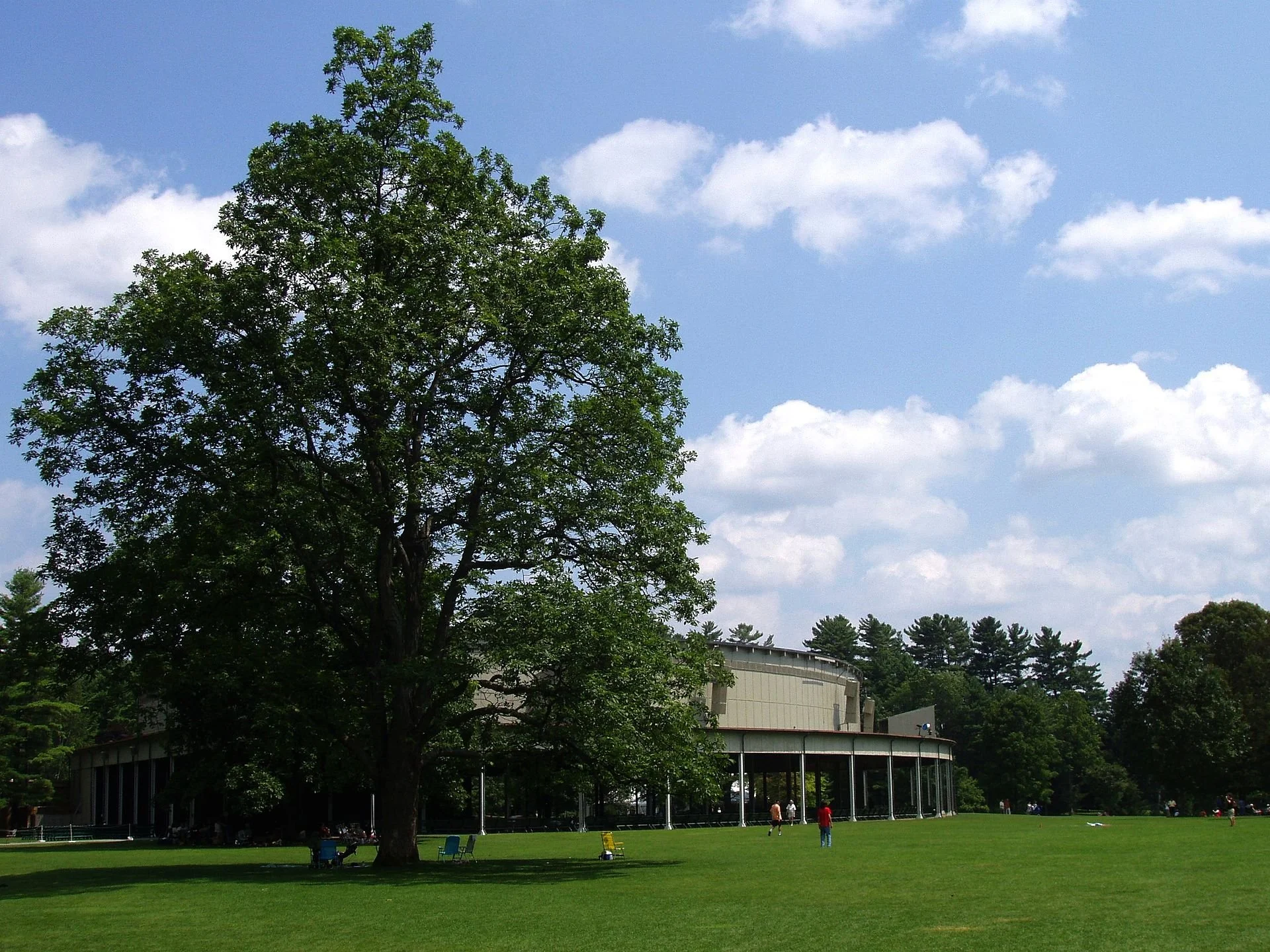
Tanglewood Music Shed and lawn, in Lenox, Mass. Music lovers sit and recline on this famous lawn while listening to summer concerts of the Boston Symphony Orchestra
— Photo by Daderot
From ecoRI News (ecori.org)
RICHMOND, R.I. — Love them or hate them, lawns aren’t going to disappear from the New England landscape anytime soon. Caring for those islands of green can be as casual as an occasional mowing, or as involved as season-long programs that include watering, adding nutrients and eliminating weeds and insect pests.
University of Rhode Island Professor Bridget Ruemmele teaches several turf grass courses, including management and irrigation technology. Her research focus is turf grass improvement.
In drought-prone states such as Texas, where Ruemmele worked before coming to Rhode Island, many municipalities require homeowners to use xeriscaping, landscapes composed of plants that need much less water than traditional lawns.
Ruemmele said lawns remain popular in Rhode Island because they provide areas for recreation, and they are less likely to harbor ticks.
“One of the advantages, of course, of having at least some lawn near your buildings is, you don’t have to worry as much about deer ticks [which spread Lyme disease]. That’s the big issue,” she said.
Recent hot, dry summers have resulted in watering restrictions in many towns, leaving lawns brown and stressed and prompting calls to URI from homeowners asking what they can do to counteract the effects of drought.
“We tend to have fairly regular rainfalls, but when there are droughts, the years we have droughts are when people all of a sudden go ‘Oh, maybe I should be concerned about it,’ and that’s when we get more calls and requests for information,” Ruemmele said.
Some homeowners are taking a more radical approach and reducing the sizes of their lawns. Young people may not be as interested in lawn maintenance and older couples who no longer have children at home don’t need the recreation space.
“As people seem to be aging, they’re more interested in not having as big of a lawn area,” Ruemmele said. “Some of these people who are reducing their lawn are spending hours and hours every week maintaining the alternative plants they put in, so it very much depends upon what kind of plants you decide to put in whether or not you’re going to be saving time, because if you’ve got a lawn, essentially, mow it once a week.”
The most widely used turf grass species, Kentucky blue grass, is not considered to be drought-tolerant, although Ruemmele said the original blue grasses were much tougher than the varieties sold today.
“For years, people associated it with high maintenance and that’s because, back when we were less concerned about the environment, breeders developed grasses that responded to increased irrigation and increased fertility, whereas the more common types of Kentucky blue grasses…they are the ones that were adapted to whatever the environment threw at them, so they were able to tolerate periods of stress and that’s a major emphasis that turf breeders have gone back to.”
With nutrient runoff, much of it from fertilizers, polluting coastal waters, Ruemmele said municipalities are beginning to restrict outdoor water use as well as the types of fertilizers that homeowners can apply to their lawns.
“The emphasis is on, especially, not automatically applying a fertilizer, emphasizing that you’re going to be getting a test of your [turf] fertility every couple of years and then only applying the fertilizer that’s recommended,” she said.
As an example, Ruemmele cited the intensively marketed “four step” program, in which most of the steps are usually unnecessary.
“What I think about the four-step program, is that if you don’t have grubs, you don’t need that stuff, and if you keep a nice, healthy, dense turf, that’s going to be eliminating most of any perceived weed problems that you might have, and you can eliminate that step. And so basically, the step that has fertilizer only is about the only one you really need,” she said.
Dana Millar, of West Kingston, is known for his organic lawn care service, although his company, Dana Designs, also provides conventional services to homeowners who request them. Most of Millar’s clients still ask for conventional services, but an increasing number of customers, about 65 at last count, prefer organic methods.
Organic lawn care is based on the premise that healthy turf grass requires healthy soil, so rather than applying chemicals to the grass, Millar uses a bottom-up approach, building nutrients in the soil that support the grass.
“Top down, you’re applying materials and products over the top,” he said. “Organically, you are encouraging the health of the soil, so the soil feeds the plant.”
Millar believes that organically grown grass is not only stronger, but also more resistant to environmental stressors.
“Over the period of the last two years, we’ve had greater drought than anybody had in memory and in this past year, there was more rain than anybody had in memory,” he said. “Each one of those climate-driven events stressed lawns in different ways. My organic lawns were more resilient, so in the drought, they went into drought stress later and came out of drought stress more quickly, and lots of times, didn’t need much repair, whereas lawns that may have been conventional had a harder time and they weren’t able to fend off insects. They weren’t able to fend off diseases and their recovery, in some cases, wasn’t complete. The turf was damaged and had to be completely restored.”
One of Millar’s early mentors was Earth Care Farm founder Mike Merner, a believer in the benefits of compost and the importance of nurturing the microorganisms that live in soil and make it productive.
Millar always begins an organic program with testing and amending the soil, which can be a complicated process.
“We need to know what the state of the soil is, so every organic program begins with a soil test, and we ask more from a soil test than the conventional test, because we want to know organic matter, we want to know cation exchange capacity, we want to know not only the soil pH, but its resistance to change. …This determines the type and amount of amendments that we might need to improve soil and gives us a baseline for expectations and a budget over a period of time,” he said.
While lawn care products have traditionally been marketed to men, Millar said many of the clients of his organic service are women who have taken over the responsibility of lawn maintenance from their male partners.
“I have lots of women clients who are at a point in their lives where they have the discretionary income and the authority in their households to make decisions which are usually the males,’ ” he said. “‘How are we going to treat our lawn? Why are we going to do this? I want a garden, I want to feel safe and I want my grandchildren to have the freedom to enjoy our lawn.’”
Cynthia Drummond is an ecoRI News contributor.

Timothy grass, probably named after Timothy Hanson, an American farmer and agriculturalist said to have introduced it from New England to the South in the early 18th Century. European settlers introduced it into New England in the late 1600s and by 1711 it had become known as Herd’s grass, after John Herd, a Maine farmer who began to cultivate it.

CSX buying N.E. rail network

Pan Am Railways, under a different name, bought the logo of the late lamented Pan American World Airways in 1998.
Edited from a New England Council (newenglandcouncil.com) report:
BOSTON
“The federal Surface Transportation Board has approved CSX Corp.’s application to acquire Pan Am Railways, Inc. (Pan Am). This will let CSX to move forward with their acquisition with a current closing date of June 1.
‘‘This acquisition will allow for an extended reach of CSX’s services to a wider customer base over an expanded territory. CSX says it will operate Pan Am with an increased environmental performance, including a more reliable and more fuel-efficient fleet, significantly reducing fuel consumption and improving rail’s environmental footprint in the region. Pan Am is based in North Billerica, Mass., and owns and operates a nearly 1,200-mile rail network. Its network across New England includes access to multiple ports and large-scale commodity producers. The acquisition will let CSX to expand into Vermont, New Hampshire and Maine.
“‘CSX is pleased that the STB approved the proposed acquisition of Pan Am and has recognized the significant benefits this transaction will bring to shippers and other New England stakeholders,’ said CSX president and chief executive officer James M. Foote. ‘We look forward to integrating Pan Am, their employees and the rail-served industries of the Northeast into CSX and to working in partnership with connecting railroads to provide exceptional supply-chain solutions to New England and beyond.”’
Read more in the Massachusetts Transit Magazine.
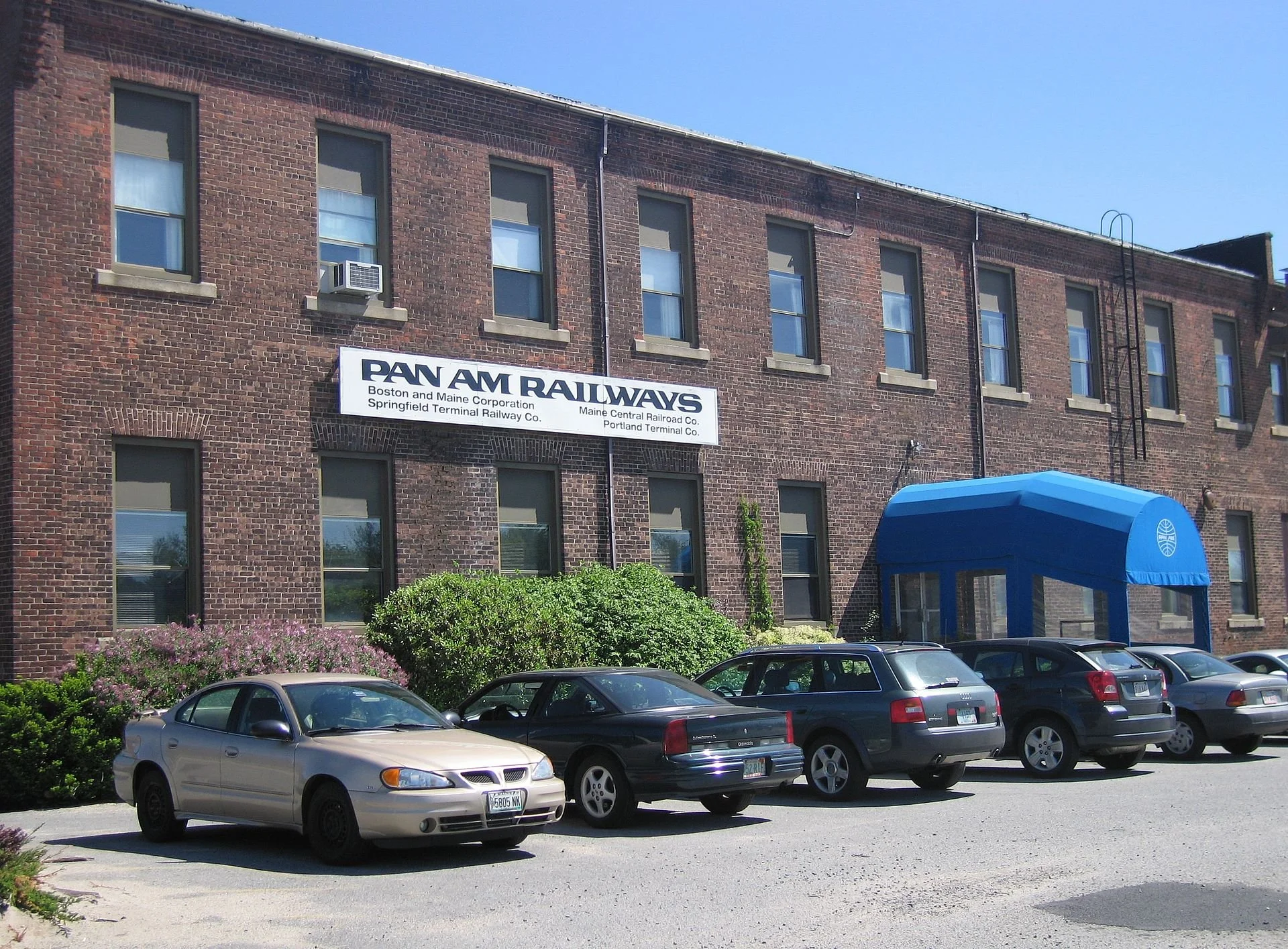
Pan Am Railways headquarters in the delightfully named Iron Horse Park, in North Billerica, Mass.
— Photo by David Maze
As shadows lengthen

“Venus’’ (oil and acrylic paint, acrylic ink, markers, fabric, photo transfer and rhinestones on canvas), by Bob Dilworth, in his show ‘‘Another Place,’’ at Cade Tompkins Projects, Providence, May 7-Sept. 7.
He says:
“My paintings employ an aesthetic gesture towards moments in history that run parallel to current times, often intersecting and exploring hidden and deeper meanings of my experience as an African-American male.’’
Partly fleeing Maine

‘In the kind of New England I'm from, you are expected to stay and marry somebody from New England - well, Maine, actually - so I think it was seen as a betrayal when I left for New York, which has been my refuge.’’
— Elizabeth Strout (born 1956), novelist. She grew up in Harpswell, Maine, and now divides her time between Brunswick, Maine, and New York
Just try to change it

‘‘Fate’’ (handmade paper, thread, Coloraid, encaustic paint, oil stick on braced panel) by Portland, Maine-based artist Kimberly Curry, who says she finds inspiration in the everyday things around her and in landscape.

A Casco Bay Lines ferry returning to Portland after its journey out into the bay
— Photo by Dudesleeper
Basav Sen: Biden administration needs to get tougher in climate battle
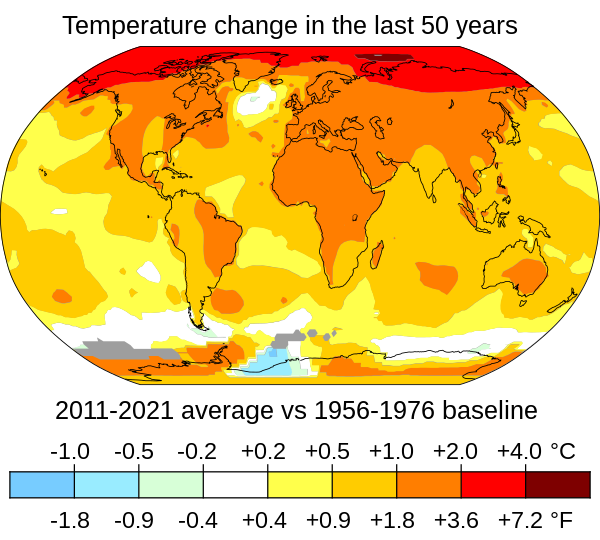
Average surface air temperatures from 2011 to 2021 compared to the 1956–1976 average

—Graphic by Adam Peterson
From OtherWords.org
In early April, the Intergovernmental Panel on Climate Change (IPCC), a global scientific body, issued yet another dire report. They warned that we have barely three years to start cutting greenhouse emissions as rapidly as we need to avoid the worst effects of climate disruption.
These scientists put the largest share of the blame on fossil fuels. But they also show that renewable energy is already cost-competitive. “Systems in some countries and regions are already predominantly powered by renewables,” they note.
The report makes clear that the technology to transition from fossil fuels already exists — all that’s lacking is political will. And that’s a particularly big problem in our country, the world’s largest producer of both oil and natural gas.
It’s a problem even for an administration that says it accepts the science of climate change and wants to take action.
For example, on the eve of the IPCC report, the White House announced a plan to deal with high gas prices. Undoubtedly, high gas prices are causing hardship. But the White House plan makes the long-term problem of climate change worse without even solving the short-term problem of gas prices.
The plan centers around “doing everything we can to encourage domestic production” of oil. This is unlikely to bring down prices in the short term, since new drilling sites can take years to become operational. But it will almost certainly make emissions harder to reduce down the line.
This is part of a pattern. So far, the Biden administration has tried to sell its Bipartisan Infrastructure Law as a measure against climate change. That law does some good things, but on balance it may do more harm than good for the climate.
The legislation offers no funding at all for renewable electricity generation. But it sets aside billions in new fossil fuel subsidies dressed up as green technologies.
For instance, it pushes both carbon capture and hydrogen production from fracked gas. There’s no evidence that carbon capture works at scale — it may even cause more emissions than it removes, since it allows fossil fuel companies to continue polluting. And hydrogen from fracked gas has a worse climate impact than coal.
The bill also continues the harmful American tradition of overfunding highways and underfunding public transportation. Incentivizing more car travel but not cleaner mass transit is a recipe for more transportation emissions, not fewer.
Then there was the notorious incident last year, when President Biden gave a speech at the Glasgow climate talks proclaiming U.S. leadership on the issue. But within days of his return, the administration announced the results of the largest U.S. offshore oil drilling lease sale ever.
Fortunately, a federal district court invalidated the lease sale, and the Interior Department decided not to appeal the decision, bowing to grassroots pressure from affected communities and their allies. But if the sale had gone through, it would have produced as much greenhouse gas as 130 coal-burning power plants.
The Biden administration claims it believes in climate science, but its record shows a gap between these beliefs and the administration’s actions — what you might call a “soft denial” of climate science.
Fortunately, grassroots community members from Los Angeles to the Gulf Coast to West Virginia have won important fights to protect their communities, and our planet, from pollution.
As the planet warms and midterms approach, the administration needs to listen to communities like these — and take real action before it’s too late.
Basav Sen joined the Institute for Policy Studies as the Climate Justice Project Director in February 2017. His work focuses on climate solutions at the national, state, and local level that address racial, economic, gender and other forms of inequality.
OtherWords contributor Basav Sen has experience working on World Bank, International Monetary Fund (IMF) and global finance and trade issues.
Liz Szabo: More attention, please, to improving building ventilation to fight COVID

The central tower of the Palace of Westminster, in London. The palace is home of the British Parliament. The octagonal spire was for ventilation purposes, aimed at drawing air out the building, with the design aimed at a highly aesthetic disguise of its function.
Americans are abandoning their masks. They’re done with physical distancing. And, let’s face it, some people are just never going to get vaccinated.
Yet a lot can still be done to prevent covid infections and curb the pandemic.
A growing coalition of epidemiologists and aerosol scientists say that improved ventilation could be a powerful tool against the coronavirus — if businesses are willing to invest the money.
“The science is airtight,” said Joseph Allen, director of the Healthy Buildings program at Harvard University’s T.H. Chan School of Public Health, in Boston. “The evidence is overwhelming.”
Although scientists have known for years that good ventilation can reduce the spread of respiratory diseases such as influenza and measles, the notion of improved ventilation as a front-line weapon in stemming the spread of covid-19 received little attention until March. That’s when the White House launched a voluntary initiative encouraging schools and work sites to assess and improve their ventilation.
The federal American Rescue Plan Act provides $122 billion for ventilation inspections and upgrades in schools, as well as $350 billion to state and local governments for a range of community-level pandemic recovery efforts, including ventilation and filtration. The White House is also encouraging private employers to voluntarily improve their indoor air quality and has provided guidelines on best practices.
The White House initiative comes as many employees are returning to the office after two years of remote work and while the highly contagious BA.2 omicron subvariant gains ground. If broadly embraced, experts say, the attention to indoor air quality will provide gains against covid and beyond, quelling the spread of other diseases and cutting incidents of asthma and allergy attacks.
The pandemic has revealed the dangerous consequences of poor ventilation, as well as the potential for improvement. Dutch researchers, for example, linked a 2020 COVID outbreak at a nursing home to inadequate ventilation. A choir rehearsal in Skagit Valley, Wash., early in the pandemic became a superspreader event after a sick person infected 52 of the 60 other singers.
Ventilation upgrades have been associated with lower infection rates in Georgia elementary schools, among other sites. A simulation by the Centers for Disease Control and Prevention found that combining mask-wearing and the use of portable air cleaners with high-efficiency particulate air filters, or HEPA filters, could reduce coronavirus transmission by 90 percent.
Scientists stress that ventilation should be viewed as one strategy in a three-pronged assault on covid, along with vaccination, which provides the best protection against infection, and high-quality, well-fitted masks, which can reduce a person’s exposure to viral particles by 95 percent. Improved airflow provides an additional layer of protection — and can be a vital tool for people who have not been fully vaccinated, people with weakened immune systems, and children too young to be immunized.
One of the most effective ways to curb disease transmission indoors is to swap out most of the air in a room — replacing the stale, potentially germy air with fresh air from outside or running it through high-efficiency filters — as often as possible. Without that exchange, “if you have someone in the room who’s sick, the viral particles are going to build up,” said Linsey Marr, a professor of civil and environmental engineering at Virginia Tech.
Exchanging the air five times an hour cuts the risk of coronavirus transmission in half, according to research cited by the White House Office of Science and Technology Policy. Yet most buildings today exchange the air only once or twice an hour.
That’s partly because industry ventilation standards, written by a professional group called the American Society of Heating, Refrigerating and Air-Conditioning Engineers, or ASHRAE, are voluntary. Ventilation standards have generally been written to limit odors and dust, not control viruses, though the society in 2020 released new ventilation guidelines for reducing exposure to the coronavirus.
But that doesn’t mean building managers will adopt them. ASHRAE has no power to enforce its standards. And although many cities and states incorporate them into local building codes for new construction, older structures are usually not held to the same standards.
Federal agencies have little authority over indoor ventilation. The Environmental Protection Agency regulates standards for outdoor air quality, while the Occupational Safety and Health Administration enforces indoor-air-quality requirements only in health care facilities.
David Michaels, an epidemiologist and a professor at the George Washington University Milken Institute School of Public Health, said that he’d like to see a strong federal standard for indoor air quality but that such calls inevitably raise objections from the business community.
Two years into the pandemic, it’s unclear how many office buildings, warehouses, and other places of work have been retooled to meet ASHRAE’s recommended upgrades. No official body has conducted a national survey. But as facilities managers grapple with ways to bring employees back safely, advocates say ventilation is increasingly part of the conversation.
“In the first year of the pandemic, it felt like we were the only ones talking about ventilation, and it was falling on deaf ears,” said Allen, with Harvard’s Healthy Buildings program. “But there are definitely, without a doubt, many companies that have taken airborne spread seriously. It’s no longer just a handful of people.”
A group of Head Start centers in Vancouver, Wash., offers an example of the kinds of upgrades that can have impact. Ventilation systems now pump only outdoor air into buildings, rather than mixing fresh and recirculated air together, said R. Brent Ward, the facilities and maintenance operations manager for 33 of the federally funded early-childhood education programs. Ward said the upgrades cost $30,000, which he funded using the centers’ regular federal Head Start operating grant.
Circulating fresh air helps flush viruses out of vents so they don’t build up indoors. But there’s a downside: higher cost and energy use, which increases the greenhouse gases fueling climate change. “You spend more because your heat is coming on more often in order to warm up the outdoor air,” Ward said.
Ward said his program can afford the higher heating bills, at least for now, because of past savings from reduced energy use. Still, cost is an impediment to a more extensive revamp: Ward would like to install more efficient air filters, but the buildings — some of which are 30 years old — would have to be retrofitted to accommodate them.
Simply hiring a consultant to assess a building’s ventilation needs can cost from hundreds to thousands of dollars. And high-efficiency air filters can cost twice as much as standard ones.
Businesses also must be wary of companies that market pricey but unproven cleaning systems. A 2021 KHN investigation found that more than 2,000 schools across the country had used pandemic relief funds to purchase air-purifying devices that use technology that’s been shown to be ineffective or a potential source of dangerous byproducts.
Meghan McNulty, an Atlanta mechanical engineer focused on indoor air quality, said building managers often can provide cleaner air without expensive renovations. For example, they should ensure they are piping in as much outdoor air as required by local codes and should program their daytime ventilation systems to run continuously, rather than only when heating or cooling the air. She also recommends that building managers leave ventilation systems running into the evening if people are using the building, rather than routinely turning them down.
Some local governments have given businesses and residents a boost. Agencies in Montana and the San Francisco Bay area last year gave away free portable air cleaners to vulnerable residents, including people living in homeless shelters. All the devices use HEPA filters, which have been shown to remove coronavirus particles from the air.
In Washington state, the public health department for Seattle and King County has drawn on $3.9 million in federal pandemic funding to create an indoor air program. The agency hired staff members to provide free ventilation assessments to businesses and community organizations and has distributed nearly 7,800 portable air cleaners. Recipients included homeless shelters, child care centers, churches, restaurants, and other businesses.
Although the department has run out of filters, staff members still provide free technical assistance, and the agency’s website offers extensive guidance on improving indoor air quality, including instructions for turning box fans into low-cost air cleaners.
“We did not have an indoor air program before covid began,” said Shirlee Tan, a toxicologist for Public Health-Seattle & King County. “It’s been a huge gap, but we didn’t have any funding or capacity.”
Allen, who has long championed “healthy buildings,” said he welcomes the new emphasis on indoor air, even as he and others are frustrated it took a pandemic to jolt the conversation. Well before covid brought the issue to the fore, he said, research was clear that improved ventilation correlated with myriad benefits, including higher test scores for kids, fewer missed school days, and better productivity among office workers.
“This is a massive shift that is, quite honestly, 30 years overdue,” Allen said. “It is an incredible moment to hear the White House say that the indoor environment matters for your health.”
Liz Szabo is a Kaiser Health News reporter.

The courtyard entrance to the Harvard School of Public Health from the Harvard Medical School, in Boston. It doesn’t look well ventilated.
— Photo by MaynardClark

‘Tolling, gonging, calling’

Monson, Maine, in 1905
“The rolling, winding roads away from Bangor [Maine] took us through towns with names like Charleston, Dover-Foxcroft, Monson, and Shirley, all with their own quaint, beautifully cinematic set dressing. It was like each was curated from grange hall flea markets and movie sets rife with small-town Americana. Stoic stone war memorials. American flags. Whitewashed, chipping town hall buildings from other centuries. Church bell towers in the actual process of tolling, gonging, calling. To me, the sound was ominous in a remote sort of way, unnamable.”
― Katie Lattari, in her thriller novel Dark Things I Adore

In Charleston, Maine: buildings of the former Higgins Classical Institute, a college-preparatory boarding school that existed from 1837 to 1975.
Improving hybrid learning
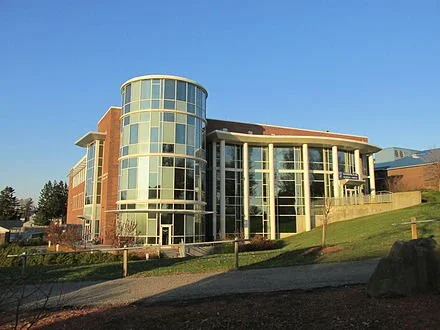
The Harrington Learning Center on the campus of Quinsigamond Community College, in Worcester.
Edited from a report by The New England Council (newenglandcouncil.com)
“Quinsigamond Community College (QCC) received a $975,000 federal grant to purchase new technology that will improve the hybrid learning experience for its students. This technology, called the HyFlex (hybrid flex) Technology System, will enable instructors to ‘teach students who are taking a course in-person at the same time as students who are taking the course in a remote format,’ and serves to ‘bridge the gap between in-person and online education,’ according to a press release from QCC. The grant provides enough funding to offer HyFlex technology in 25 classrooms.
“Luis Pedraja, president of QCC, said: ‘This technology will be a game-changer for so many students who otherwise would be unable to attend in-person classes.’ She stated that this funding will ‘help facilitate more students to realize a better future through higher education.’’’
Don’t believe it

Dante and Beatrice gaze upon the highest heavens, from Gustave Doré's illustrations to the Divine Comedy.


Chris Powell: ‘Local option’ to do ‘stupid stuff’ in schools is a dodge

Engraving after Pieter Breughel the Elder, 1556. Caption translated from German "Even if the ass travels to school to learn, as a horse he will not return’’.
MANCHESTER, Conn.
Beautiful as Connecticut is in spring, the state will remain a target-rich environment for the political action committee whose formation was reported by the Connecticut Mirror last week: Parents Against Stupid Stuff.
After all, even as Parents Against Stupid Stuff was being announced, the state Senate voted to qualify strikers for unemployment benefits, and Senate President Pro Tem Martin M. Looney, D-New Haven, leader of the extreme left majority in the Senate, thought it was wonderful. "Workers and employers are hardly ever equal in bargaining power," Looney said. "The scales always tilt on the side of the employer, who has greater resources."
But somehow it doesn't work that way when state government is the employer. Even now Mooney and his extreme-left colleagues in the General Assembly are preparing to approve another master contract with the state employee unions that will give the store away, with bonuses on top of raises totaling as much as 15 percent. The state law authorizing state employee union contracts to nullify freedom-of-information law will remain in force, signifying again that the power in state government's labor relations does not rest with management -- that there is no management at all because the government employee unions constitute the Democratic Party's political army.
Parents Against Stupid Stuff has been started by an investment-fund manager from Stamford, Sean Fieler, who says it will focus on issues arising from what is called the "culture war," particularly sexually explicit curriculum material in public schools, participation of transgender athletes in female sports, and critical race theory.
Exactly how much sexually explicit material is being used in the schools and with what age groups isn't clear, in large part because school administrations refuse to come clean about it, as they have refused in recent incidents in Enfield and Hartford.
Transgender interference in Connecticut high-school girls cross-country competition was recently a national scandal, but most people, scared of being called some kind of a "phobe," won't summon the courage to protest it until it hampers the University of Connecticut's women's basketball team.
As for critical race theory, while there is no evidence that it is being taught outside of colleges, lower education in the state is insinuating racial issues into what it calls "social-emotional learning," which is displacing ordinary academic teaching.
So these are fair issues, especially in regard to what is age-appropriate for sexual topics in school. Should kindergarteners and other very young students be getting briefings on transgenderism, as has been alleged and not denied in Hartford? The controversy about Florida's new law restricting sexual topics to Grades 4 and above -- misrepresented as the "Don't Say Gay" law -- arises from leftist demagoguery.
Fieler hopes to raise a million dollars for Parents Against Stupid Stuff to spend criticizing Gov. Ned Lamont for his position on these issues as the governor campaigns for re-election. But Lamont is not really a champion of transgenderism, critical race theory or "social-emotional learning." Rather, he is evasive, wanting to leave those issues to local school boards.
Lamont's likely Republican challenger, Bob Stefanowski, seems not to want to talk about those issues any more than the governor does, though in a radio interview last week, without taking a position on policy, Stefanowski acknowledged transgenderism's unfairness in women's sports.
"Local option" as a policy on human rights is a dodge, and local education in Connecticut is already so full of state mandates that one more won't violate any sacred principle.
For many decades slavery and then racial segregation were "local option" policies. Title IX of the 1972 civil rights act has been construed as prohibiting "local option" in institutional sports and requiring equal opportunity for women. The presumption has been that women must have their own sports programs because men generally are stronger and bigger and most women cannot fully compete with them.
Denying gender differences in physique and letting biological males compete against females in institutional sports, as Connecticut law requires, effectively repeals Title IX. Maybe Parents Against Stupid Stuff can give candidates the courage to acknowledge and do something about this stupidity.
Chris Powell is a columnist for the Journal Inquirer, in Manchester.
‘Mystical places’

Sarah Giannobile, now showing at Lanoue Gallery, Boston, says;
"The linear forms in my paintings and drawings are symbols that translate into invented narratives. Lyrical abstract compositions are intuitive by nature and inspired by my dreams and memories of my past experiences. Impressions of invented symbolism are repeated through layers of intuitive mark making that resemble aerial views, and mystical places.’’
The Unexamined Life May Be Well Worth Living

First appeared in Daily Nous
Lloyd always acts without thinking.
Reflection is hardly for him.
Lillian’s mind has been shrinking.
Dementia is making her dim.
Both find enjoyment in living.
So don’t be so ready to scoff.
Why are y.ou so unforgiving?
How harsh to be writing them off.
—Felicia Nimue Ackerman
But don’t look down

‘‘Climb to the Rise’’ (oil on canvas), by Judith Brassard Brown, at Kingston Gallery, Boston.
Her artist statement:
‘The acts of making and viewing are opportunities to heal. While paintings may appear traditional at first glance, they do not recreate a specific location or event. Rather, each provides connections across boundaries of time or a captured moment, contrasts what we see with what we sense below the surface. Their qualities may activate our capacity to connect with others and with our own buried emotions. In recognizing what is compressed, that recognition may activate a corresponding release of psychic burden and an increase in joy.’’
She’s based in Boston’s Dorchester section.

Neponset River at Lower Mills (2009). Dorchester on the left, Milton on the right (south) side of the river.

Baker's Cocoa Advertisement in Overland Monthly, in January 1919. The manufacture of chocolate had been introduced in the United States in 1765 by John Hannon and Dr. James Baker in Dorchester, then a separate town from Boston. The long-gone Walter Baker & Co. was based in Dorchester.
‘Help us’ indeed!

“The original settlers of Massachusetts Bay Colony, founded in 1630, adopted an official seal (above) designed in England before their journey. The central image depicts a near-naked native holding a harmless, flimsy-looking bow and arrow and inscribed with the plea, ‘Come over and help us.’ Nearly three hundred years later, the official seal of the U.S. military veterans of the ‘Spanish-American War; (the invasion and occupation of [Spanish colonies of] Puerto Rico, Cuba, and the Philippines) showed a naked woman kneeling before an armed U.S. soldier and a sailor, with a US battleship in the background. One may trace this recurrent altruistic theme into the early twenty-first century, when the United States still invades countries under the guise of rescue.”
― Roxanne Dunbar-Ortiz, in An Indigenous Peoples' History of the United States
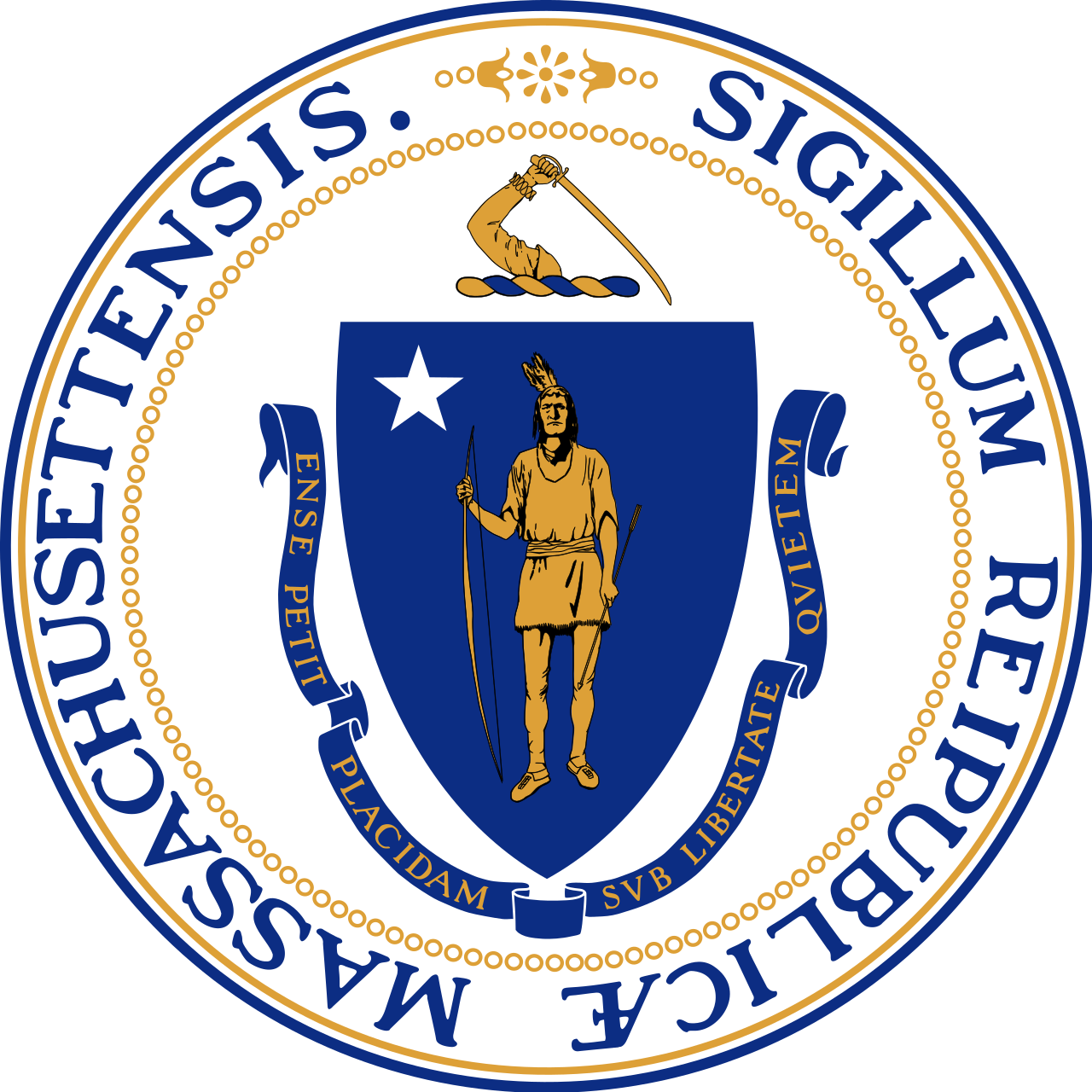
The seal of the Commonwealth of Massachusetts

Llewellyn King: The threat of nuclear war and the license it has given Russia’s dictator

WEST WARWICK, R.I.
History isn’t short of people to blame. You could say of the present world crisis that it was former President Obama’s fault for not getting tougher with Russian President Putin in Syria. You could blame former President Trump for giving Putin a sense of entitlement and for undermining NATO, seeing it as a financial play. You could blame former German Chancellor Angela Merkel for encouraging Russian gas imports, shutting out the nuclear- energy option.
You could, of course, blame President Biden for explicitly telling Putin, and the world, what the United States wouldn’t do if he invaded Ukraine. And you could blame Biden and NATO for dribbling vital military aid to Ukraine over the first devastating weeks of the Russian invasion.
If you want to continue, you could blame the world’s military strategists for believing that Russia, after the fall of communism, had changed. You could, perhaps, blame NATO itself, for expanding its reach to the former Soviet republics of Estonia, Lithuania and Latvia.
But Putin is unequivocally the one to blame. The dictator is the one who wants to remake Russia in the image of the imperial tsars. It is a flawed scheme but a real one.
As the world grapples with the reality of Putin, the past informs but it doesn’t instruct.
If NATO were to engage Russia with conventional forces, it would triumph. That is one lesson of Ukraine. Russian military forces are woefully inefficient, even incompetent.
Would it were that simple.
The beast in the room, the feared monster, the threat that hangs over the whole world is nuclear war. It is the clear-and-present danger. It shapes our handling of Russia and will shape our response to China, if and when it invades Taiwan.
Nuclear-war avoidance is again dominating the world in ways we had nearly forgotten.
Will Russia, a caged, fierce bear, resort to nuclear, and how much nuclear to what effect against which targets?
The United States and the Soviet Union reached a modus vivendi: mutual assured destruction (MAD), which kept the peace even as nuclear armaments proliferated and stockpiles grew exponentially. Is that still the option? Is MAD -- so long after the collapse of the Soviet Union -- still the underlying realpolitik, the restraining factor between nuclear powers?
Does that mean that anyone with nuclear weapons can wage conventional warfare in the belief that they won’t face NATO or any other serious restraining military action because they can unleash terrifying global destruction?
Or is there, as some believe, the prospect of limited nuclear engagement, using area tactical nuclear weapons? This has never been tested.
There hasn’t been a limited nuclear ground war. Could it be contained? Should it be contemplated outside the deeper reaches of the defense establishment?
But it is what keeps the leaders of Europe, the United States and Canada awake nights. If you favor limited nuclear war, just look to the effects of a nuclear disaster, Chernobyl, and start multiplying.
It is the unthinkable scenario that must be thought about. It is the reality which holds back NATO and makes the West a spectator to the carnage in Ukraine.
Russia isn’t a rich country except in some natural resources. It has a large but poorly trained and equipped military. But it bristles with nuclear weapons aimed at North American and European cities. Its ability to threaten us with nuclear horror changes the balance between nations: an indelible change to future foreign policy.
In the short term, when contemplating the return of MAD in international relations, the question is: How mad – as in insane -- is Putin, and how ready is Biden?
The pieces on the world chess board have moved and they won’t be moved back. The intelligentsia has yet to grasp the extent to which Ukraine has changed the world – and made it a more dangerous place. They need to catch up fast.
Llewellyn King is executive producer and host of White House Chronicle, on PBS. His email is llewellynking1@gmail.com and he’s based in Rhode Island and Washington, D.C
Two sides of oyster farming

Excerpted from from an ecoRI News (ecori.org) article. To read the full article, please hit this link.
Oysters provide food, clean the water, generate jobs and create fish habitat, but shellfish farms have encountered opposition from residents who say they mar the appearance of their views and interfere with their use of the water.
Two recent public presentations on aquaculture focused on restorative aquaculture and how it is used to improve marine ecosystems in the United States and the different ways people perceive aquaculture facilities that grow shellfish. The talks — on March 21 and April 6 — were part of a series of educational webinars organized by the Narragansett Bay Special Area Management Plan (SAMP) of the Rhode Island Coastal Resources Management Council (CRMC).
War-time energy news

Outdoor part of house heat pump
Adapted from Robert Whitcomb’s “Digital Diary,’’ in GoLocal24.com
The United Kingdom will nationalize part of London-based National Grid to better secure the country’s electricity system in light of Russian aggression and to accelerate the move to non-fossil-fuel-based electricity generation.
National Grid runs the electricity and natural-gas system in Rhode Island, though it’s been trying to sell it to PPL.
In this wartime, look for more moves like Britain’s.
xxx
Every little bit helps. There’s a campaign to make and deliver to Europe by the fall millions of U.S. heat pumps – those air conditioners that also take ambient heat from outside to heat homes and offices. This would help reduce the use of Russian natural gas for heating as winter comes on. Revenue from that gas has been used to murder many thousands of men, women and children since Putin began his assault on Ukraine.
President Biden could use the Defense Production Act to get American factories to greatly increase its production of heat pumps.
xxx
It’s irritating that so many people leave their car and truck engines running and polluting while they’re away shopping, etc., because they want the heater or air conditioner to keep their vehicles at exactly the temperature they had while driving. What a waste. There is such massive energy waste in this country!