
Similar worlds, actually
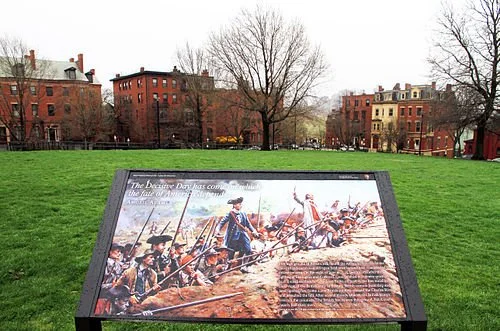
In Monument Square Historic District, a city park and its surrounding buildings at the top of Breed's Hill in the Charlestown neighborhood of Boston. The location is the site of the 1775 Battle of Bunker Hill. Monument Square was laid out in the 19th Century, when the Bunker Hill Monument (a National Historic Landmark) was erected there. The neighborhood has in recent decades been intensely gentrified.
“I grew up, as I joke around, in the 'People's Republic of Charlestown' in the city of Boston. And I was blessed to be raised right there on Monument Square in Charlestown, and every morning I'd hop on the bus and go on a 45-minute ride out to the suburbs in Brookline for elementary school. And I got to have my seat, really, in both worlds.’’
— Jonathan Tucker (born 1982), American actor
Frozen food indeed

“Ready for work on the Trawler Saturn” (January 1928). Collection of the Cape Ann Museum Library & Archives, Gloucester, Mass.
Chris Powell: On whom will pandemic resentments fall?
Representation of resentment
MANCHESTER, Conn.
Teachers and nurses in Connecticut who are government employees, along with employees of nursing homes, whose industry is mostly funded by government, are feeling so overworked because of the virus epidemic that their allegiance to Gov. Ned Lamont and the Democratic Party is coming into question.
Surveying leaders of the teachers and nurses unions last week, the Connecticut Post's Ken Dixon found no rebellion but little enthusiasm. Some union leaders acknowledged that state government had made special efforts for their members but insisted that more was owed to them. Prison workers weren't surveyed but might have expressed the greatest bitterness, since the prisons are full of virus cases.
But beyond government's employees and quasi-employees, parents of schoolchildren and relatives of people ailing with something other than the virus have resentments too. For the more safety measures are demanded by teachers and nurses, the less schooling will be delivered and the less medical care will be available to people afflicted with something other than the virus. Some people whose treatment was delayed have died.
While teachers and nurses think of themselves as workplace martyrs to the epidemic, they are hardly alone.
Restaurants, bars, and the rest of the hospitality industry have been devastated. Even when restaurants and bars have been allowed to reopen, many customers have stayed away.
Retailers have been devastated too, as personal incomes were cut throughout the nation by a decline in working hours. Even when hours were restored, wages were overtaken by inflation, which in part is a result of the government's distributing so much free money even as millions of people have stopped working and producing things to buy.
Amid the hysteria of the government and news organizations, which treat even asymptomatic virus cases as the plague, workers in all sectors of the economy increasingly call out sick. This hobbles far more than schools, as society discovers that school bus drivers and trash haulers are really "essential workers" too.

Are those electrons over the state capitol dome?
There may be only one set of workers who are neither overworked nor forced to sacrifice income and benefits: employees of the government bureaucracy, many of whom, in Connecticut, are allowed to work from home most of the time, pushing electrons when they are not pushing paper.
In the name of "solidarity forever" could these employees sacrifice a little income or time on the job in favor of the government employees and quasi-employees who are overwhelmed in schools, hospitals, and nursing homes? Of course not; the paper and electron pushers will insist on every last cent of their wages and every last restriction on their working conditions as promised by their union contract. And since the paper and electron pushers are represented by unions affiliated with the unions of the teachers and nurses, the teachers and nurses will give them a pass anyway -- in the name of "solidarity forever."
So now that the epidemic in Connecticut is suddenly worsening after fading for many months, on whom should the state's political resentments fall?
The Communist government of China might be the place to start, since the virus may have originated from bio-weapons research at the Wuhan Institute of Virology. But Americans can't vote for the Chinese government; even the Chinese themselves can't.
Dr. Anthony S. Fauci, director of the U.S. National Institute of Allergy and Infectious Diseases, has gotten off easy for funding research at the Wuhan laboratory. Americans might be tired of Fauci, but he's not elected either.
President Biden ordinarily would be a prime target of resentment, but as he dodders ineffectually from day to day -- spending a quarter of his time away from the office, apparently to regain his senses -- what would be the point of bashing him?
That leaves Governor Lamont, who got all the credit when the epidemic was fading and who is up for re-election this year and thus the most available target. At least Lamont didn't constantly make a mess of things as New York Gov. Andrew Cuomo and New York City Mayor Bill de Blasio did, but how much enthusiasm will be sparked by a campaign slogan like "It Could Have Been Worse"?
Chris Powell is a columnist for the Journal Inquirer, in Manchester.
Welcome wintry wakeup

“I like waking up by the lake
frozen over, the frosty meadow
where a white horse still huffs and chafes
by the fence post and a few fog clouds
cling to the tree line of the Sugar Loaf range.’’
— From “I Like Waking Up,’’ by Ira Sadoff (born 1945), an American poet and professor of literature at Colby College, in Waterville, Maine.

David Warsh: Meet the Putin-run CSTO; The Monitor's Fred Weir explains Russia well

Emblem of the Russia-led Collective Security Treaty Organization
SOMERVILLE, Mass.
I started writing about Russia in July, 2002, with “The Thing’s a Mess,” a glimpse of a story from the kleptomaniacal decade that followed the collapse of the USSR: how a prominent Harvard economist, his wife and two sidekicks, working in Russia on behalf of the U.S. State Department, covered by high-level friends in the Clinton administration, had been caught seeking to cut to the head of the queue to enter the country’s new mutual- fund business with a firm of their own.
This column followed the saga through the U.S. invasion of Iraq; Vladimir Putin’s objections; his brief 2008 war in former-Soviet Georgia to caution against further NATO expansion; Ukraine’s Maidan protest of 2014 and its aftermath; and the 2016 election of Donald Trump. Its little book, Because They Could: The Harvard Russia Scandal (and NATO Expansion) after Twenty-Five Years, appeared in 2018.
I still scan four daily newspapers to see what government sources are saying about Russia. I look regularly at Johnson’s Russia List, a Web-based compendium with a good eye for non-standard views. But mostly I form my views from dispatches of Fred Weir, Moscow correspondent for the Boston-based Christian Science Monitor. They are thoughtful, well-informed, and empathetic.
Last week I read three Weir articles to which I am entitled for the month (you can do the same). Why Russia’s troop surge near Ukraine may really be a message for the West made clear that the aim of large troop deployments – for the second time in a year – was to concentrate minds on Russian demands in Kyiv and the West. Russia want guarantees that Ukraine and other former Soviet states won’t join NATO as a basis for regional stability.
How the Kazakhstan crisis reveals a bigger post-Soviet problem explains the Collective Security Treaty Organization (CSTO), the six-member post-Soviet, Russian-led military alliance that intervened briefly in Kazakhstan to restore order and preserve the current poo-Moscow government. Weir wrote, “The swift and efficient injection of 2,600 troops [mostly Russian paratroopers, but contingents from Armenia, Belarus, Tajikistan, and Kyrgyzstan as well] demonstrated an unprecedented level of elite solidarity among emerging post-Soviet states, which are often depicted as allergic to Russian leadership.”
What’s in a name? For Russia’s “Putin Generation,” not as much as you’d think contrasted the experiences of Russians born in the 21st Century with those of those of their grandparents and parents. Russians born after World War II lived lives of enforced conformity and struggled to satisfy basic consumer needs, Weir writes, before the disintegration of Soviet economic life in the ‘80’s gave way to the desperate 90’s, when people reinvented themselves while struggling to survive.
Instead, this [Putin] generation, at least among those young people that the Monitor interviewed, seems to have a sense of optimism about life and a desire to reach beyond simple material security and do something to improve the world around them. That’s something relatively new in Russia.
Despite his ubiquity in their lives, Mr. Putin is not a symbol or icon to his namesake generation, many experts say, but merely a flashy pop-sociology way to demarcate them without taking into account social class, education, gender, and other critical markers.
When I was finished reading my three stories, I subscribed to The Monitor and read a fourth: Russian human rights group under threat: What soured the Kremlin? It was written before Russia’s Supreme Court shut down Memorial, a human-rights organization formed in the buoyant days of perestroika to document Soviet-era abuse, for having violated the country’s intricate “foreign agent” laws.
Weir wrote, “[M]ost experts see [the decision] as part of an accelerating campaign to close down any space for independent political action or criticism amid deepening antagonism with the West, a stagnating economy, and uncertainties about the continuing stability of Mr. Putin’s regime.”
In other words, there is still plenty of room for improvement in Russian civil society. I doubt, however, there will be war in Ukraine. Putin has made his point more forcefully than ever about the cavalier disrespect that America has shown since 1992. My sense is that he has been doing a pretty good job of putting his country back on its feet, after a surpassingly difficult century. I don’t have that feeling about Xi Jinping and China. But the situation that concerns me most is that of my own country. Bring on those mid-term elections! There is a great deal of rebuilding to begin.
xxx
Here are complementary links to a handful of especially interesting sessions at the American Economic Association meetings on Zoom earlier this month. Eight of the discussions deal with important meat-and-potatoes issues, while the ninth link connects to the hour-long lecture on preference formation, by Nathan Nunn, of Harvard University, that I found so interesting and mentioned last week.
David Warsh, a veteran columnist and an economic historian, is proprietor of Somerville-based economicprincipals.com, where this column originated.

The First Church of Christ, Scientist in Boston, with the mother church and administrative headquarters of the denomination
Use boarding houses to reduce housing problem
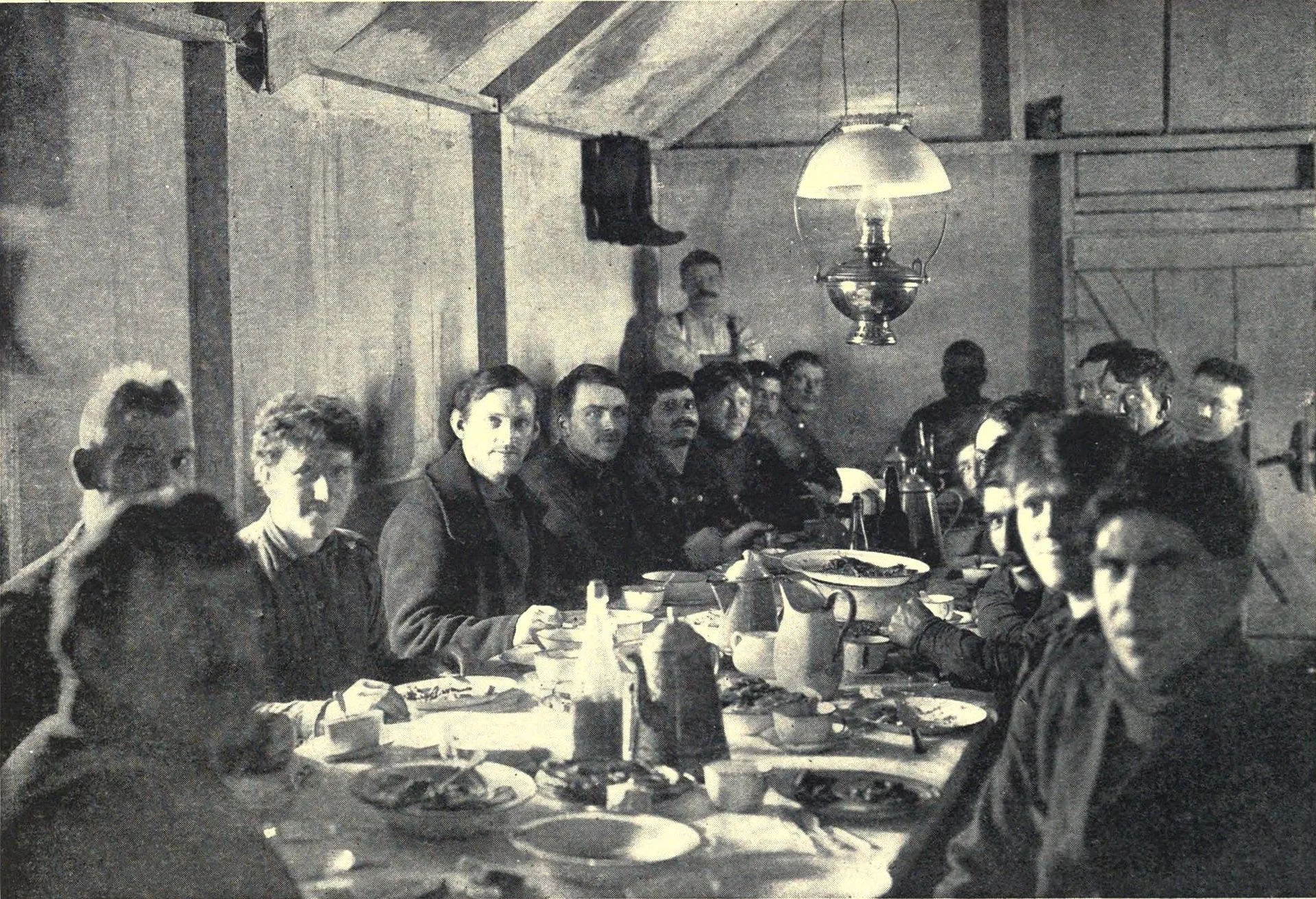
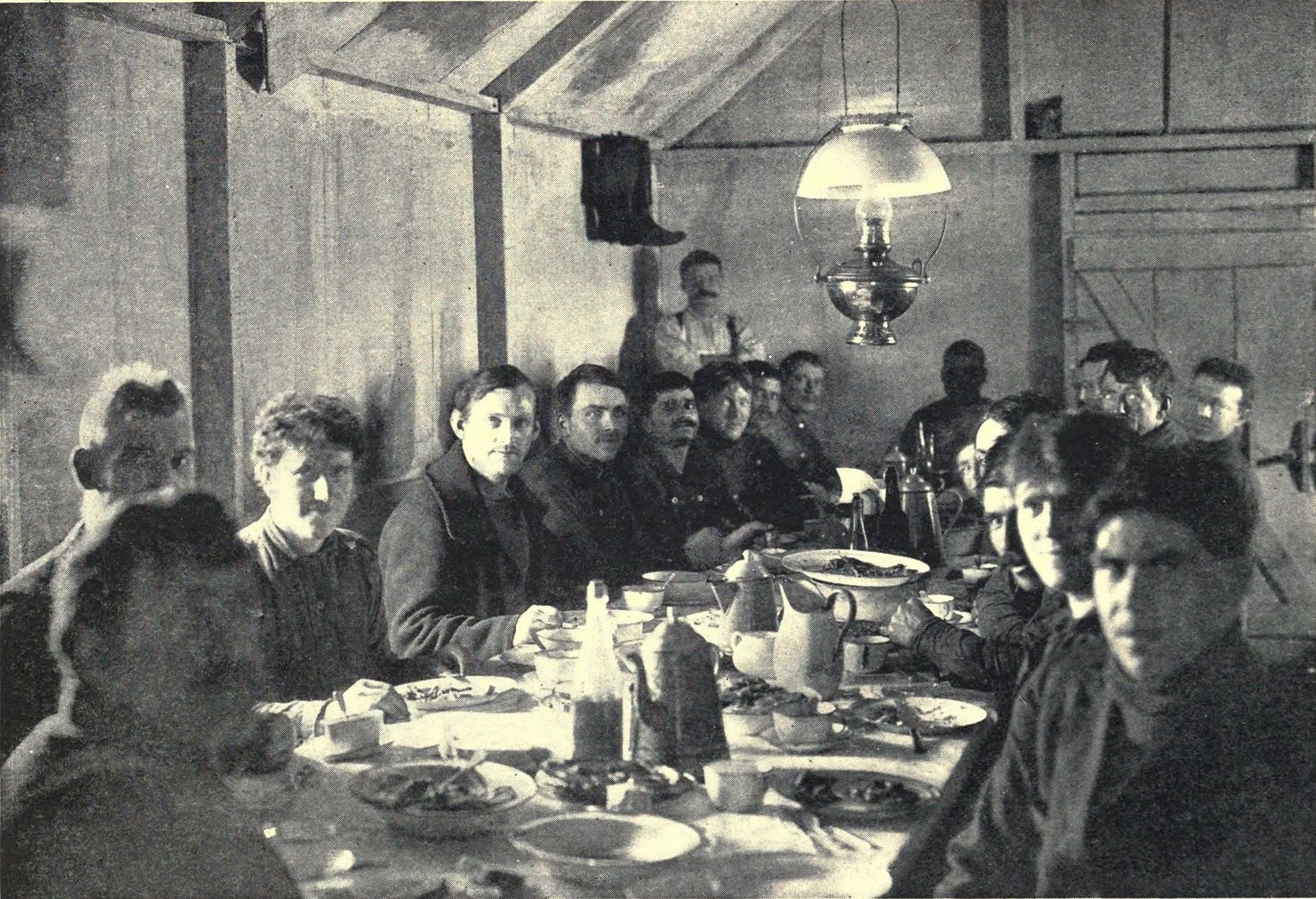
Early-20th-Century dinner in a miners' boarding house in northern Canada.
Adapted from Robert Whitcomb’s “Digital Diary,’’ in GoLocal24.com
Housing, its lack thereof and its expense, continues to be a big issue in Rhode Island. One way to alleviate the crisis in “affordable housing,’’ at least for single people, would be to encourage a revival of that old standby, the boarding house.
Or maybe call them dorms.
Put up buildings, subsidized or not, with one-bedroom units, each with a bathroom, bed, table, chair and utilities, including Internet. Obviously, you could provide far more units than with a conventional apartment house, which would attract developers.
There could be a central kitchen, maybe on each floor, with food lockers for each tenant and maybe some central lounge/living room.
Such housing would be particularly handy for young or other single people, retirees, people in transitory service jobs, and those between long-term housing. Building them near public transit would make them even more useful.
It might even reduce, a little, the pressure for sprawl development that the pandemic has depressingly accelerated, especially with the rapid increase in remote work, while helping to moderate housing-cost inflation. This sprawling is chewing up yet more countryside, increasing air and water pollution and stressing municipalities trying to serve a population that’s becoming even more spread out and car-dependent.
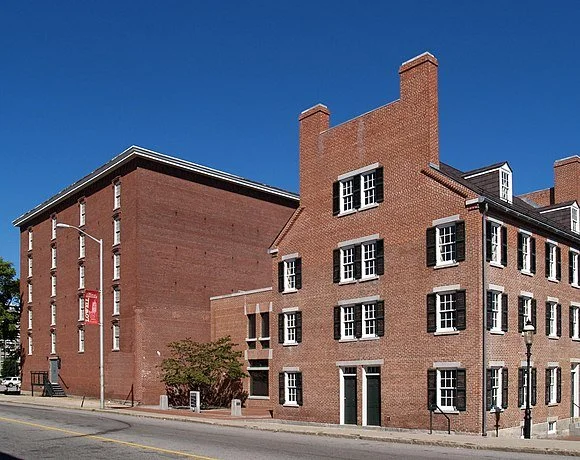
At right, one of the last remaining structures built as a boarding house for 19th Century textile workers in Lowell, Mass.. It’s now part of the Lowell National Historical Park.
Nothing good about being a good loser?
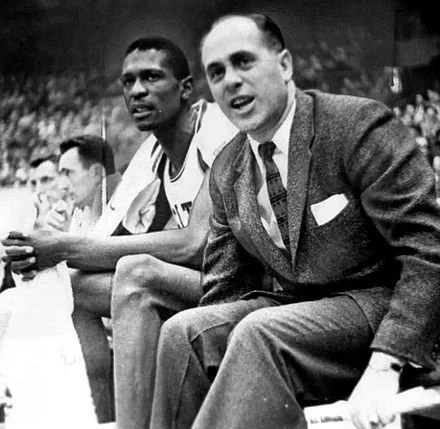
Red Auerbach on the bench next to rookie Bill Russell during a game at the old Boston Garden, Dec. 26, 1956. Bob Cousy can be seen in the background.
“Show me a good loser, and I’ll show you a loser.’’
— Arnold “Red’’ Auerbach (1917-2006), legendary and highly successful head coach (1950-1966), and then general manager, of the Boston Celtics.
xxx
“Part-time information and full-time opinions can be very dangerous.’’
{Even in sports?}
— Chris Berman (born 1955), a sportscaster for ESPN (originally short for Entertainment and Sports Programming Network) virtually since ESPN was launched, in 1979, as one of the first major cable-TV networks. It has been based since its founding in Bristol, Conn.

ESPN’s palatial headquarters, in Bristol, Conn.
— Photo by Jkinsocal
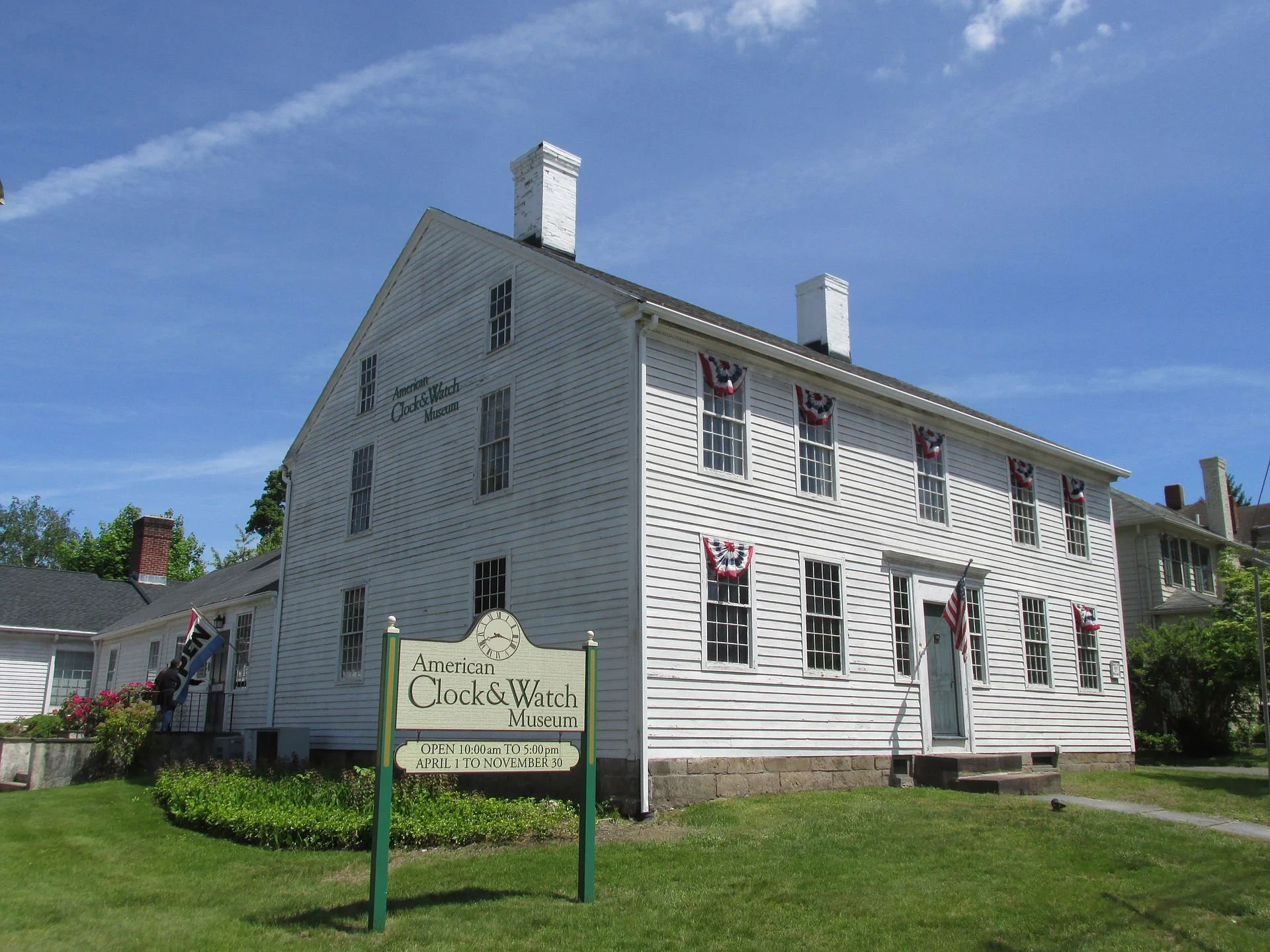
American Clock and Watch Museum, in Bristol, which, like Waterbury, Conn., was a major maker of clocks.
Wood for paper and WPA in New Hampshire

“Pulpwood Logging” (oil on canvas, 1941), by Philip Guston (Canadian-American, 1913-1980), in the show “WPA in NH: Philip Guston and Musa McKim,’’ through Jan. 30 at the Currier Museum of Art, Manchester, N.H. Pulpwood was used to make paper — a once-large, and heavily polluting (of air and water), industry in the Granite State.
The museum explains:
“In 1941, the famed artist Philip Guston and the {American} poet/painter Musa McKim painted a pair of monumental murals for what at the time was the Federal (aka Forestry) Building in Laconia, N.H. Each measuring 14 feet, the expansive paintings depict sustainable logging and the restoration of New Hampshire forests around the White Mountains. The images were commissioned by the Works Progress Administration to carry out public projects and support artists under the New Deal.
“Although these magnificent murals are of great artistic significance, they have long been forgotten as the original building in Laconia was repurposed. The paintings have been carefully restored by the federal General Services Administration and are back in New Hampshire, where they can now be seen at the Currier Museum of Art….
“The paintings mark important points in the careers of the two artists, who were married to each other. Shortly after completing this mural, Philip Guston gave up realistic painting to focus on Abstract Expressionism; he became a leader of the New York School. Musa McKim focused her career on poetry and writing; her collection Alone with the Moon was published in 1994.”

"Wildlife in the White Mountains” (1941, oil on canvas), by Musa McKim (1908-1992)
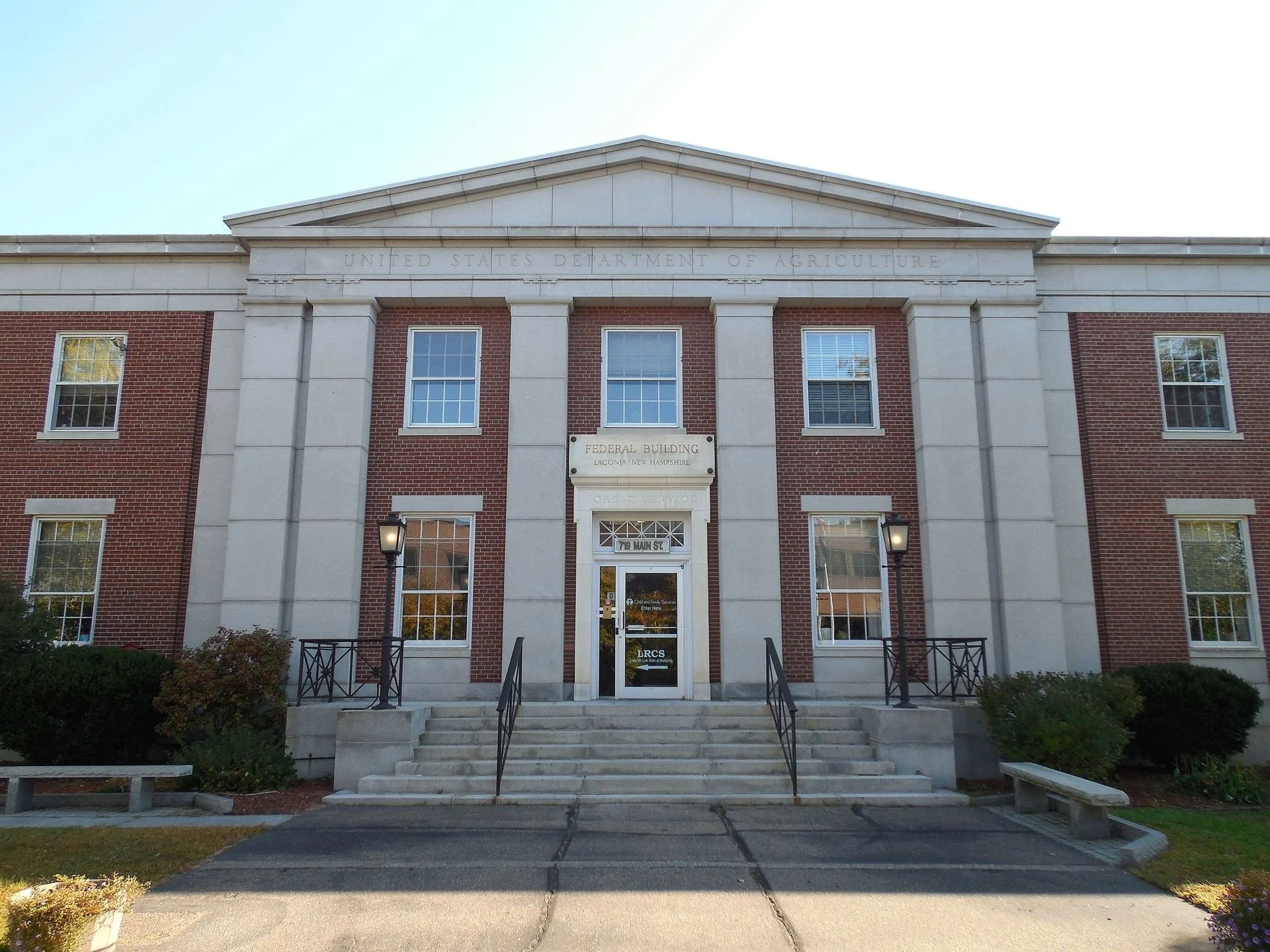
Former Federal Building in Laconia, N.H. It now houses a local social-service agency.
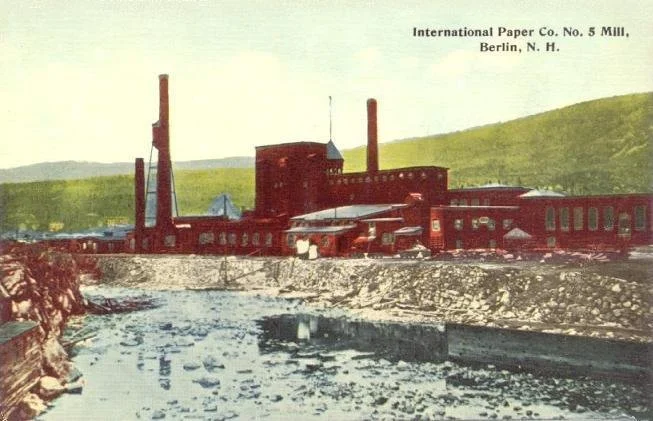
Circa 1912

Cynthia Hammond: Does Conn.-R.I. Amtrak bypass plan still live?

Amtrak Acela train near Old Saybrook, Conn.
From ecoRI News (ecori.org)
CHARLESTOWN, R.I.
A U.S. Department of Transportation “Providence to New Haven Capacity Planning Study” has some local officials wondering whether the original plan to run train tracks through sections of their town, and other Rhode Island and Connecticut towns, might not be dead after all.
The study is part of the Northeast Corridor 2035 Plan, or “C35,” a 15-year plan to guide investment in rail service in the Northeast.
The C35 describes the plan, which has an estimated cost of $130 billion, as the first phase of the long-term vision for the corridor described in the Federal Railroad Administration’s 2017 NEC Future plan, which includes “making significant improvements to NEC rail service for both existing and new riders, on both commuter rail systems and Amtrak.”
In 2016, Charlestown officials learned, by chance, that the Federal Railroad Administration (FRA) had released its Tier 1 environmental impact statement (EIS) on a plan to straighten train tracks in the Northeast to accommodate high-speed rail service. The plan wasn’t met with broad enthusiasm.
The FRA had sent letters to affected towns and the Narragansett Indian Tribe in 2015, soliciting comments on the draft EIS, but according to a blog post on the plan by the Charlestown Citizens Alliance political action committee, there was no specific mention of new tracks going through Charlestown or other neighboring towns.
"Most of these governments have no recollection of receiving communication from the FRA,” the post read. “The letter does not say that new rails and a new rail route are proposed in your community. When no comments came from one of the most impacted towns, this should have suggested to the FRA that the local community and local stakeholders were not aware and engaged in the review process.”
The unpleasant surprise included in the plan was the Old Saybrook to Kenyon Bypass, which would have moved rail traffic directly through Old Saybrook, Conn., Westerly and Charlestown, bisecting neighborhoods, nature preserves and historic farms. The towns and Narragansett Indian Tribal officials fought the plan, and the Record of Decision, released in 2017, omitted the bypass.
But the omission didn’t mean that the bypass had simply gone away, and the Charlestown Citizens Alliance warned that the decision left the door open to a study which could resurrect the bypass.
The alliance’s blog post published after the decision reads: “The July 12, 2017 ROD calls for a study that could possibly bring back the Bypass. We will remain vigilant throughout this study process to work to stop the Bypass from being resurrected.”
In an effort to learn more about the FRA’s intentions, Town Council President Deborah Carney spoke last August with Amtrak’s chief executive officer, William J. Flynn, who said the most likely route for a New Haven to Providence high-speed rail track would be along the Interstate 95 corridor.
Carney, who said she had been put in contact with Flynn by a mutual acquaintance in Charlestown, acknowledged that while there is no guarantee that plans for the original bypass that would have bisected the town would not be revived, she felt reassured that the I-95 route would be preferred.
“They’re doing the feasibility study and analysis, so there’s no concrete plan at all, but [Flynn] said if they were to go forward with something, it would most likely either to parallel Route 95, like the northern part of the state, or it would involve improving the existing line that goes along the southern coast - where it is now.”
Rhode Island Department of Transportation (DOT) director Peter Alviti represents the state on the 18-member FRA Northeast Corridor Commission (NECC), which is studying rail demand and capacity in the Northeast New Haven to Providence rail corridor.
Alviti, and DOT intermodal programs chief Stephen Devine, met in November with Charlestown officials, Rhode Island state Rep. Blake Filippi, R-New Shoreham, and state Sen. Elaine Morgan, R-Hopkinton.
Alviti told the group the NECC would require a study of future ridership demand on the New Haven to Providence route before any decision was made. (DOT did not support the originally proposed Old Saybrook to Kenyon bypass.)
DOT spokesperson Charles St. Martin said in a recent emailed statement that his agency was counting on more public consultation this time around.
“Yes, RIDOT met recently with Charlestown officials regarding this proposal,” he said. “We told them we are aware that Amtrak is retaining a consultant to do an initial market study only to first determine the demand for higher speed services. This effort will be starting soon and will include a robust public participation component.”
St. Martin also noted, “Rhode Island’s position remains the same as in 2017, when the state indicated opposition of the bypass route in Charlestown.”
What still vexes some Charlestown officials, however, is the continued lack of any FRA response to the town’s inquiries.
In August 2021, at the request of the Town Council, town administrator Mark Stankiewicz wrote a letter to FRA interim administrator Amit Bose, asking for more information regarding the New Haven to Providence study.
After receiving no response to the first letter, Stankiewicz sent a second letter on Dec. 10, which read, in part, “Given the limited available information and the absence of any communication from the FRA, we are in a quandary as to how to ensure Charlestown receives timely information and is able to relay our input and concerns about the New Haven to Providence Capacity Planning Study.”
Charlestown Planning Commission chair Ruth Platner, who was not mollified by Flynn’s statements, said she had not expected the FRA to respond.
“I’m not surprised that they’re not answering, but I think it’s important that the town is asking,” she said. “The thing is, they took the [Old Saybrook to Kenyon] bypass out of the decision, but they didn’t replace it with anything, and the whole rail plan is based on the assumption that there’s going to be huge job growth in the big cities — in Washington, Philadelphia New York and Boston, but that’s not Rhode Island and that’s not Connecticut. The high-speed rail is to connect those big cities, and they want to do it, one way or another.”
Platner said she believed that pandemic-related changes which have made it possible for many Americans to move out of large cities and work from home will impact the study.
“I think what’s happened now, because of the pandemic, there’s kind of a wait and see, to see what this means for growth. Are the cities not going to grow?” she said.
Another factor to consider, Platner said, is the proximity of the I-95 corridor to the coast, and therefore, its vulnerability to rising sea levels.
“It’s a beautiful ride, and it’s right along the coast, and the water is right there. The tracks are going to be under water, so they have to do something, and the problem has to be solved, and it’s going to be solved with some sort of realignment away from the coast,” she said.
Carney said her concerns had been largely put to rest after her conversation with Flynn and the meeting with Alviti.
“In our conversations with Peter Alviti, and also William Flynn, it doesn’t seem as though that Old Saybrook to Kenyon is going to be revived, but I understand where people are coming from,” she said. “You know, if it’s their property that’s impacted, obviously they’re concerned about it, but I will say that Director Alviti kind of put our minds at ease, you know, in saying ‘This is not in the 10-year plan.’”
Platner, however, warned the affected towns to remain vigilant.
“The town of Charlestown needs to be involved, so that we can protect the people and the environment here,” she said. “What we don’t want is to have a plan be created that we don’t know about.”
The FRA did not respond to several requests for comment.
Cynthia Hammond is an ecoRI News contributor
Boston too ‘refined’?
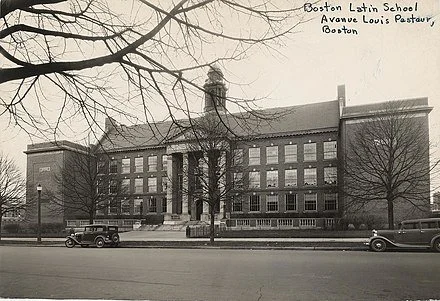
Boston Latin {High} School was established in 1635 and is the oldest public school in the U.S.
“For no matter how they might want to ignore it, there was an air of excellence about this city (Boston), an air of reason, a feeling for beauty, a memory of something very good, and perhaps a reminiscence of the vast aspiration of man which could never entirely vanish.’’
— Arona McHugh (1924-1996), American novelist who set two of her novels in her native Boston
xxx
“The society of Boston was and is quite uncivilized but refined beyond the point of civilization.’’
— T.S. Eliot (1888-1965), Nobel Prize-winning Anglo-American poet, critic, essayist and playwright who came from an old Boston Brahmin family.
As the sea rises

“Crane Beach Gloucester MA’’ (archival pigment print), by Newton, Mass.-based photographer Vicki McKenna, at Fountain Street Fine Art Gallery, Boston.
The gallery says:
“Capturing photos of simplicity, subtlety, and serenity, Vicki McKenna’s work transmits a genuine sense of place. Her curiosity about natural landscapes stems from her background in geology, and her interest in architecture leads her to photograph the built environment. Working in both color and black and white she uses techniques that range from modern archival inks to traditional platinum/palladium prints
“In her current project McKenna creates images that are meant as harbingers from the future. They present the intertwining of ocean and shore environments as sea level rises. Her selection of locations to photograph is informed by, but not limited by, maps of projected sea level rise of 6 feet, a possibility by 2100. The mapping is visualized online by the National Oceanic and Atmospheric Administration. …
“After earning a PhD in Geological Sciences from Brown University and ALB in Natural Sciences from Harvard University, McKenna studied photography at the New England School of Photography and the Photography Atelier at the Griffin Museum. She has had juried solo shows at the Firehouse Center for the Arts, Newburyport and the Newton Free Library, and has exhibited extensively throughout New England and along the East Coast….’’
‘Fragment of an ancient land’

Moraines and heads of outwash plains on Martha's Vineyard, Nantucket and Cape Cod mark positions of the ice front during retreat. The also define lobes of the Laurentide ice sheet. The relationship between the deposits and lobes can be seen in this figure. Native Americans thousands of years ago lived on some of the land now underwater east and south of the Cape.
“East and ahead of the coast of North America, some thirty miles and more from the inner shores of Massachusetts, there stands in the open Atlantic the last fragment of an ancient and vanished land.’’
— From Henry Beston’s (1888-1968) The Outermost House (1928), about his time living in a beach shack on Cape Cod’s Nauset Beach.
‘Connectedness of all creation’

“Nest” (acrylic, netting, colored sand, papier-mache, wire) by Rhonda Smith, in her show “Say I am You,’’ at Kingston Gallery, Boston, through January.
The gallery says:
“Inspired by the work of 12th-century Sufi mystic and poet Rumi, Rhonda Smith seeks to repair humanity and the broken environment. ‘Say I Am You’ draws from the connectedness of all creation to question the truth of society’s predominant model of colonialism, enslavement, and self-serving capitalism that ultimately destroys the natural world. Smith believes that repair lies in referring to mystics and poets like Rumi, who understood that separating ourselves from the universe is the un-making of all that exists.’’
Ms. Smith is based in Boston and in the southern Maine Coast village of Biddeford Pool, which has long attracted artists and summer people.

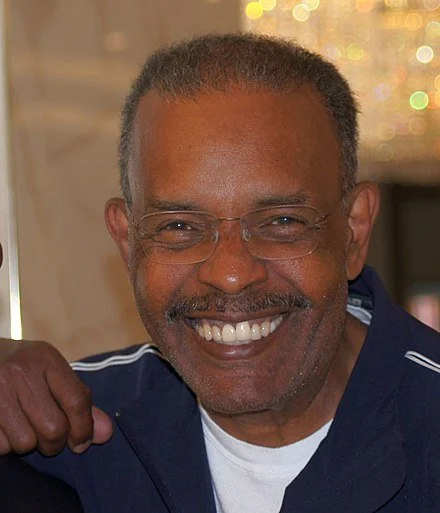
Llewellyn King: Joe Madison thinks that U.S. voting rights are worth risking his life
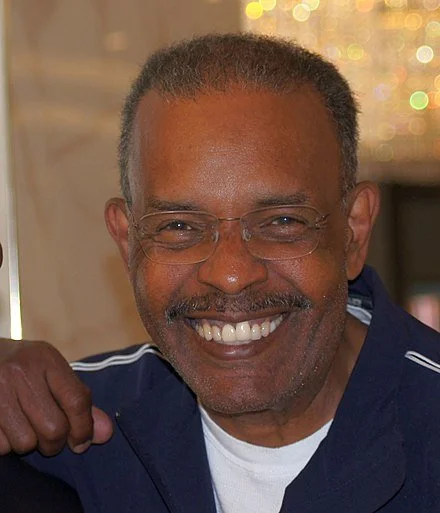
Joe Madison
WEST WARWICK, R.I.
Election Day isn’t celebrated as a national holiday, and for most of us voting is inconvenient. So much so that only presidential elections draw a decent turnout. In 2020, a record year, 66.8 percent of the electorate voted.
The ballot box towers in significance in its consequence, but it seems banal when you traipse to a church hall, an armory, or a high school to do the deed.
Also, people in line to vote act strangely, suspecting each other of being a supporter of the rascals who have either made a mess of things or the rascals who will make a mess of things.
Given these things, and without regard to the present standoff in Congress over the For the People Act, it would seem to me that voting by mail, or even electronic voting, makes sense. We do most things of consequence electronically. The failsafe ID for voting in most states is a driver’s license. The Republicans are against voting by mail and electronic voting, but in most states, you can renew a driver’s license by either means. Kafkaesque?
For Joe Madison, the legendary Black broadcaster and human and civil- rights activist, voting is vital, and the ability to cast your vote easily and without duress is sacred. Further, He believes that contrived exclusion from the polls is a major felony against people of color.
Madison is prepared to put his life where his mouth is: He began a hunger strike for voting rights on Nov. 8, 2021.
During his college days, Madison was an all-conference running back on the football team, but now he is emaciated. He is following a liquid diet like one his friend Dick Gregory, the late comedian and civil rights activist, developed for his hunger strikes.
Madison told me he falls asleep at odd times and wakes up during the night. There is physical discomfort. Although he is getting to the point where the stress is showing, he plans to continue his hunger strike.
I have known Madison for over 20 years. I can hear the weakness in his voice. He is still doing his live radio talk show on SiriusXM Radio daily from 6 a.m. until 10 a.m. Eastern Time. As someone who has done four hours straight on radio, I can attest that in the best of health, it is a workout.
Madison sees the current battle over voting rights in the Senate and the Republican-controlled state legislatures’ push to restrict voting rights as reminiscent of the end of Reconstruction, when the South began to push back against Black voting rights granted at the end of the Civil War. “It included poll taxes, literacy qualifications, and property ownership, and led to lynching and the emergence of the Ku Klux Klan,” Madison said.
He told me he is worried for the future of his children and grandchildren if voting rights should be abridged again. He has three daughters, a son, five grandchildren and one great grandchild. He wants the vote to be free and fair for them and their children. That is why he is staring death in the face and hoping that the Democrats will prevail, and good sense will triumph, he told me.
Madison studied sociology at Washington University in St. Louis where, in addition to being a football player, he sang solo baritone in the college chorus. On graduating, Madison went into civil-rights work. At age 24, he became the youngest director of the National Association for the Advancement of Colored People in Detroit.
Madison began his broadcasting career in Detroit in 1980 and moved to Washington in the 1990s, where he mixed broadcasting with activism in a slew of causes.
I met Madison when he was protesting slavery in Africa and went to Sudan to free slaves. He wants the world to know how critical the voting-rights legislation is to the African-American community. “If we don’t get that bill, it could cost the Democrats both houses and the White House. African Americans may just be so fed up that they stay home and don’t vote,” he said.
Madison supports moves to modify the filibuster to bring about Senate passage. He is very hopeful the legislation will pass, and recalcitrant Democratic Senators Joe Manchin (W. Va.) and Krysten Sinema (Ariz.) will vote for changes to the filibuster. {Editor’s note: As of late last week, they opposed such changes.}
You don’t have to agree with Madison to admire him: a man with the courage of his convictions, measured by the endangerment of his health.
Llewellyn King is executive producer and host of White House Chronicle, on PBS. His email is llewellynking1@gmail.com and he’s based in Rhode Island and Washington, DC.
Web site: whchronicle.com
Loco in loco
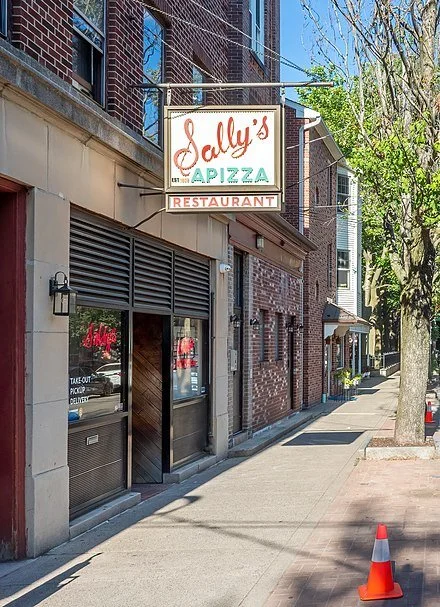
Storefront on Wooster Street in New Haven. New Haven is well known for its pizza but Yale students have been ordered not to eat in the city’s restaurants at least until Feb. 7 in an example of stringent medical theater.
Adapted from Robert Whitcomb’s “Digital Diary,’’ in GoLocal24.com
This note from a Connecticut boarding school is a display of that fragmenting thing, for a multiethnic semi-democracy, of excessive identity politics:
“As we continue the important dialogue
among Taft's BIPOC {Black and Indigenous People of Color} alumni and students,
we hope you will join us virtually
Thursday, January 13, 7pm EST
This event includes
Taft's Pan-Asian Affinity Group,
Mosaics (Black/LatinX Female Affinity Group),
Shades (Black/LatinX Male Affinity Group),
and Somos (LatX Affinity Group)’’
Education should be almost entirely focused on people as individuals, not as members of groups.
In other academic craziness, Yale has told students, whom they have placed under a quarantine until Feb. 7, that they:
“{M}ay not visit New Haven businesses or eat at local restaurants (even outdoors) except for curbside pickup.”
Does the university plan to send the campus cops around the city to arrest resisters at their tables?\
Then we have Princeton University’s order:
“Beginning January 8 through mid-February, all undergraduate students who have returned to campus will not be permitted to travel outside of Mercer County or Plainsboro Township for personal reasons, except in extraordinary circumstances. … We’ll revisit and, if possible, revise this travel restriction by February 15.”
Will there be roadblocks at the county line?
This is ridiculous medical theater and lunatic in loco parentis that will have little or no effect on the spread of COVID, which is pretty much everywhere now anyway.
But it’s certainly a good way to create right-wingers.
‘Business-like cold’

Photo by Stephen Hudson
“There has been more talk about the weather around here this year than common, but there has been more weather to talk about. For about a month now we have had solid cold—firm, business-like cold that stalked in and took charge of the countryside as a brisk housewife might take charge of someone else’s kitchen in an emergency.”
— E.B. White, in 1944, writing in his Harper’s Magazine “One Man’s Meat’’ column on life at his coastal Brooklin, Maine, farm.

Life at his “salt-water farm’’ inspired E.B. White to write this classic.

Victoria Knight: No, your cotton face mask isn’t all that effective

This N95 mask is highly effective.
— Photo by Banej
From Kaiser Health News in cooperation with PolitiFact
“From the perspective of knowing how covid is transmitted, and what we know about omicron, wearing a higher-quality mask is really critical to stopping the spread of omicron.’’
— Dr. Megan Ranney, academic dean for the School of Public Health at Brown University.
The highly transmissible omicron variant is sweeping the U.S., causing a huge spike in COVID-19 cases and overwhelming many hospital systems. Besides urging Americans to get vaccinated and boosted, public health officials are recommending that people upgrade from their cloth masks to higher-quality medical-grade masks.
But what does this even mean?
At a recent Senate Health, Education, Labor and Pensions Committee hearing, top public health officials displayed different types of masking. Dr. Rochelle Walensky, director of the Centers for Disease Control and Prevention, wore what appeared to be a surgical mask layered under a cloth mask, while Dr. Anthony Fauci, chief medical adviser to the president, wore what looked like a KN95 respirator.
(Dr. Wakensky was formerly chief of the Division of Infectious Diseases at Massachusetts General Hospital and a professor of medicine at Harvard Medical School.)
Some local governments and other organizations are offering their own policies. Los Angeles County, for instance, will require as of Jan. 17 that employers provide N95 or KN95 masks to employees. In late December, the Mayo Clinic began requiring all visitors and patients to wear surgical masks instead of cloth versions. The University of Arizona has banned cloth masks and asked everyone on campus to wear higher-quality masks.
Questions about the level of protection against COVID that masks provide — whether cloth, surgical or higher-end medical grade — have been a subject of debate and discussion since the earliest days of the pandemic. We looked into the question last summer. And as science changes and variants emerge with higher transmissibility, so do opinions.
The Centers for Disease Control and Prevention has not updated its mask guidance since October, before the omicron variant emerged. That guidance doesn’t recommend the use of an N95 respirator but states only that masks should be at least two layers, well-fitting and contain a nose wire.
Multiple experts we consulted said that the current CDC guidance does not go far enough. They also agreed on another point: Wearing a cloth mask is better than not wearing a mask at all, but if you can upgrade — or layer cloth with surgical — now is the time.
Although cloth masks may appear to be more substantial than the paper surgical mask option, surgical masks as well as KN95 and N95 masks are infused with an electrostatic charge that helps filter out particles.
“From the perspective of knowing how COVID is transmitted, and what we know about omicron, wearing a higher-quality mask is really critical to stopping the spread of omicron,” said Dr. Megan Ranney, academic dean for the School of Public Health at Brown University.
A large-scale real-world study conducted in Bangladesh and published in December showed that surgical masks are more effective at preventing covid transmission than cloth masks.
So, one easy strategy to improve protection is to layer a surgical mask underneath cloth. Surgical masks can be bought relatively cheaply online and reused for about a week.
Ranney said she advises people who opt for layering to put the better-quality mask, such as the surgical mask, closest to your face, and put the lesser-quality mask on the outside.
If you’re really pressed for resources, Dr. Stephen Luby, a professor specializing in infectious diseases at Stanford University and one of the authors of the Bangladesh mask study, said surgical masks can be washed and reused, if finances are an issue. Nearly two years into the pandemic, such masks are cheap and plentiful in the U.S. and many retailers make them available free of charge to customers as they enter businesses.
“During the study, we told the participants they could wash the surgical masks with laundry detergent and water and reuse them,” Luby said. “You lose some effect of the electrostatic charge, but they still outperformed cloth masks.”
Still, experts maintain that wearing either a KN95 or an N95 respirator is the best protection against omicron, since these masks are highly effective at filtering out viral particles. The “95” in the names refers to the masks’ 95% filtration efficacy against certain-sized particles. N95 masks are regulated by the National Institute for Occupational Safety and Health, while KN95s are regulated by the Chinese government and KF94s by the South Korean government.
Americans were initially urged not to buy either surgical or N95 masks early in the pandemic to ensure there would be a sufficient supply for health care workers. But now there are enough to go around.
So, if you have the resources to upgrade to an N95, a KN95 or a KF94 mask, you should absolutely do so, said Dr. Leana Wen, a professor of health policy and management at George Washington University. Although these models are more expensive and can be more uncomfortable, they are worth the investment for the safety they provide, she said.
“[Omicron is] a much more contagious virus, so there is a much lower margin of error in regards to the activities you were once able to do without getting infected,” Wen said. “We have to increase our protection in every way, because everything is riskier now.”
Wen also said that though these masks are characterized as one-use, unless you are in a health care setting, KN95s and N95s can be worn more than once. She uses one of her personal KN95s for more than a week at a time.
Another important thing to note is there are many counterfeit N95 and KN95 masks being sold online, so consumers must be careful when ordering them and be sure to get them only from a legitimate, trusted vendor.
The CDC maintains a list of NIOSH-approved N95 respirators. Wirecutter and The Strategist have both published guides to purchasing approved KN95 and KF94 masks. Ranney also recommends consulting the website Project N95 or engineer Aaron Collins’s “Mask Nerd” YouTube channel.
And remember, the risk of transmission depends not just on the mask you wear but also the masking practices of others in the room — so going into a meeting or restaurant where others are unmasked or wearing only cloth masks increases the odds of getting infected, no matter how careful you are. This chart demonstrates the huge differences.
Even with a mask upgrade, if you are still worried about omicron and, in particular, a serious case of , the No. 1 thing you can do to protect yourself is get vaccinated and boosted, said Dr. Neal Chaisson, an assistant professor of medicine at the Cleveland Clinic.
“There’s been a lot of talk about people who have been vaccinated getting omicron,” said Chaisson. “But I’ve been working in the ICU and probably 95% of the patients that we’re taking care of right now did not take the advice to get vaccinated.”
Victoria Knight is a Kaiser Health News reporter
vknight@kff.org, @victoriaregisk

George McCully: Can academics build safe partnership between humans and now-running-out-of-control artificial intelligence?
— Graphic by GDJ
From The New England Journal of Higher Education, a service of The New England Board of Higher Education (nebhe.org), based in Boston
Review
The Age of AI and our Human Future, by Henry A. Kissinger, Eric Schmidt and Daniel Huttenlocher, with Schuyler Schouten, New York, Little, Brown and Co., 2021.
Artificial intelligence (AI) is engaged in overtaking and surpassing our long-traditional world of natural and human intelligence. In higher education, AI apps and their uses are multiplying—in financial and fiscal management, fundraising, faculty development, course and facilities scheduling, student recruitment campaigns, student success management and many other operations.
The AI market is estimated to have an average annual growth rate of 34% over the next few years—to reach $170 billion by 2025, more than doubling to $360 billion by 2028, reports Inside Higher Education.
Congress is only beginning to take notice, but we are told that 2022 will be a “year of regulation” for high tech in general. U.S. Sen. Kristen Gillibrand (D-N.Y.) is introducing a bill to establish a national defense “Cyber Academy” on the model of our other military academies, to make up for lost time by recruiting and training a globally competitive national high-tech defense and public service corps. Many private and public entities are issuing reports declaring “principles” that they say should be instituted as human-controlled guardrails on AI’s inexorable development.
But at this point, we see an extremely powerful and rapidly advancing new technology that is outrunning human control, with no clear resolution in sight. To inform the public of this crisis, and ring alarm bells on the urgent need for our concerted response, this book has been co-produced by three prominent leaders—historian and former U.S. Secretary of State Henry Kissinger; former CEO and Google Chairman Eric Schmidt; and MacArthur Foundation Chairman Daniel Huttenlocher, who is the inaugural dean of MIT’s new College of Computer Science, responsible for thoroughly transforming MIT with AI.
I approach the book as a historian, not a technologist. I have contended for several years that we are living in a rare “Age of Paradigm Shifts,” in which all fields are simultaneously being transformed, in this case, by the IT revolution of computers and the internet. Since 2019, I have suggested that there have been only three comparably transformative periods in the roughly 5,000 years of Western history; the first was the rise of Classical civilization in ancient Greece, the second was the emergence of medieval Christianity after the fall of Rome, and the third was the secularizing early-modern period from the Renaissance to the Enlightenment, driven by Gutenberg’s IT revolution of printing on paper with movable type, which laid the foundations of modern Western culture. The point of these comparisons is to illuminate the depth, spread and power of such epochs, to help us navigate them successfully.
The Age of AI proposes a more specific hypothesis, independently confirming that ours is indeed an age of paradigm shifts in every field, driven by the IT revolution, and further declaring that this next period will be driven and defined by the new technology of “artificial intelligence” or “machine learning”—rapidly superseding “modernity” and currently outrunning human control, with unforeseeable results.
The argument
For those not yet familiar with it, an elegant example of AI at work is described in the book’s first chapter, summarizing “Where We Are.” AlphaZero is an AI chess player. Computers (Deep Blue, Stockfish) had already defeated human grandmasters, programmed by inputting centuries of championship games, which the machines then rapidly scan for previously successful plays. AlphaZero was given only the rules of chess—which pieces move which ways, with the object of capturing the opposing king. It then taught itself in four hours how to play the game and has since defeated all computer and human players. Its style and strategies of play are, needless to say, unconventional; it makes moves no human has ever tried—for example, more sacrificing of valuable pieces—and turns those into successes that humans could neither foresee nor resist. Grandmasters are now studying AlphaZero’s games to learn from them. Garry Kasparov, former world champion, says that after a thousand years of human play, “chess has been shaken to its roots by AlphaZero.”
A humbler example that may be closer to home is Google’s mapped travel instructions. This past month I had to drive from one turnpike to another in rural New York; three routes were proposed, and the one I chose twisted and turned through un-numbered, un-signed, often very brief passages, on country roads that no humans on their own could possibly identify as useful. AI had spontaneously found them by reading road maps. The revolution is already embedded in our cellphones, and the book says “AI promises to transform all realms of human experience. … The result will be a new epoch,” which it cannot yet define.
Their argument is systematic. From “Where We Are,” the next two chapters—”How We Got Here” and “From Turing to Today”—take us from the Greeks to the geeks, with a tipping point when the material realm in which humans have always lived and reasoned was augmented by electronic digitization—the creation of the new and separate realm we now call “cyberspace.” There, where physical distance and time are eliminated as constraints, communication and operation are instantaneous, opening radically new possibilities.
One of those with profound strategic significance is the inherent proclivity of AI, freed from material bonds, to grow its operating arenas into “global network platforms”—such as Google, Amazon, Facebook, Apple, Microsoft, et al. Because these transcend geographic, linguistic, temporal and related traditional boundaries, questions arise: Whose laws can regulate them? How might any regulations be imposed, maintained and enforced? We have no answers yet.
Perhaps the most acute illustration of the danger here is with the field of geopolitics—national and international security, “the minimum objective of … organized society.” A beautifully lucid chapter concisely summarizes the history of these fields, and how they were successfully managed to deal with the most recent development of unprecedented weapons of mass destruction through arms control treaties between antagonists. But in the new world of cyberspace, “the previously sharp lines drawn by geography and language will continue to dissolve.”
Furthermore, the creation of global network platforms requires massive computing power only achievable by the wealthiest and most advanced governments and corporations, but their proliferation and operation are possible for individuals with handheld devices using software stored in thumb drives. This makes it currently impossible to monitor, much less regulate, power relationships and strategies. Nation-states may become obsolete. National security is in chaos.
The book goes on to explore how AI will influence human nature and values. Westerners have traditionally believed that humans are uniquely endowed with superior intelligence, rationality and creative self-development in education and culture; AI challenges all that with its own alternative and in some ways demonstrably superior intelligence. Thus, “the role of human reason will change.”
That looks especially at us higher educators. AI is producing paradigm shifts not only in our various separate disciplines but in the practice of research and science itself, in which models are derived not from theories but from previous practical results. Scholars and scientists can be told the most likely outcomes of their research at the conception stage, before it has practically begun. “This portends a shift in human experience more significant than any that has occurred for nearly six centuries …,” that is, since Gutenberg and the Scientific Revolution.
Moreover, a crucial difference today is the rapidity of transition to an “age of AI.” Whereas it took three centuries to modernize Europe from the Renaissance to the Enlightenment, today’s radically transformative period began in the late 20th Century and has spread globally in just decades, owing to the vastly greater power of our IT revolution. Now whole subfields can be transformed in months—as in the cases of cryptocurrencies, blockchains, the cloud and NFTs (non-fungible tokens). With robotics and the “metaverse” of virtual reality now capable of affecting so many aspects of life beginning with childhood, the relation of humans to machines is being transformed.
The final chapter addresses AI and the future. “If humanity is to shape the future, it needs to agree on common principles that guide each choice.” There is a critical need for “explaining to non-technologists what AI is doing, as well as what it ‘knows’ and how.” That is why this book was written. The chapter closes with a proposal for a national commission to ensure our competitiveness in the future of the field, which is by no means guaranteed.
Evaluation
The Age of AI makes a persuasive case that AI is a transformative break from the past and sufficiently powerful to be carrying the world into a new “epoch” in history, comparable to that which produced modern Western secular culture. It advances the age-of-paradigm-shifts-analysis by specifying that the driver is not just the IT revolution in general, but its particular expression in machine learning, or artificial intelligence. I have called our current period the “Transformation” to contrast it with the comparable but retrospective “Renaissance” (rebirth of Classical civilization) and “Reformation” (reviving Christianity’s original purity and power). Now we are looking not to the past but to a dramatically new and indefinite future.
The book is also right to focus on our current lack of controls over this transformation as posing an urgent priority for concerted public attention. The authors are prudent to describe our current transformation by reference to its means, its driving technology, rather than to its ends or any results it will produce, since those are unforeseeable. My calling it a “Transformation” does the same, stopping short of specifying our next, post-modern, period of history.
That said, the book would have been strengthened by giving due credit to the numerous initiatives already attempting to define guiding principles as a necessary prerequisite to asserting human control. Though it says we “have yet to define its organizing principles, moral concepts, or aspirations and limitations,” it is nonetheless true that the extreme speed and global reach of today’s transformations have already awakened leading entrepreneurs, scholars and scientists to its dangers.
A 2020 Report from Harvard and MIT provides a comparison of 35 such projects. One of the most interesting is “The One-Hundred-Year Study on Artificial Intelligence (AI100),” an endowed international multidisciplinary and multisector project launched in 2014 to publish reports every five years on AI’s influences on people, their communities and societies; two lengthy and detailed reports have already been issued, in 2016 and 2021. Our own government’s Department of Defense in 2019 published a discussion of guidelines for national security, and the Office of Technology and Science Policy is gathering information to create an “AI Bill of Rights.”
But while various public and private entities pledge their adherence to these principles in their own operations, voluntary enforcement is a weakness, so the assertion of the book that AI is running out of control is probably justified.
Principles and values must qualify and inform the algorithms shaping what kind of world we want ourselves and our descendants to live in. There is no consensus yet on those, and it is not likely that there will be soon given the deep divisions in cultures of public and private AI development, so intense negotiation is urgently needed for implementation, which will be far more difficult than conception.
This is where the role of academics becomes clear. We need to beware that when all fields are in paradigm shifts simultaneously, adaptation and improvisation become top priorities. Formulating future directions must be fundamental and comprehensive, holistic with inclusive specialization, the opposite of the multiversity’s characteristically fragmented exclusive specialization to which we have been accustomed.
Traditional academic disciplines are now fast becoming obsolete as our major problems—climate control, bigotries, disparities of wealth, pandemics, political polarization—are not structured along academic disciplinary lines. Conditions must be created that will be conducive to integrated paradigms. Education (that is, self-development of who we shall be) and training (that is, knowledge and skills development for what we shall be) must be mutual and complementary, not separated as is now often the case. Only if the matrix of future AI is humanistic will we be secure.
In that same inclusive spirit, perhaps another book is needed to explore the relations between the positive and negative directions in all this. Our need to harness artificial intelligence for constructive purposes presents an unprecedented opportunity to make our own great leap forward. If each of our fields is inevitably going to be transformed, a priority for each of us is to climb aboard—to pitch in by helping to conceive what artificial intelligence might ideally accomplish. What might be its most likely results when our fields are “shaken to their roots” by machines that have with lightning speed taught themselves how to play our games, building not on our conventions but on innovations they have invented for themselves?
I’d very much like to know, for example, what will be learned in “synthetic biology” and from a new, comprehensive cosmology describing the world as a coherent whole, ordered by natural laws. We haven’t been able to make these discoveries yet on our own, but AI will certainly help. As these authors say, “Technology, strategy, and philosophy need to be brought into some alignment” requiring a partnership between humans and AI. That can only be achieved if academics rise above their usual restraints to play a crucial role.
George McCully is a historian, former professor and faculty dean at higher education institutions in the Northeast, professional philanthropist and founder and CEO of the Catalogue for Philanthropy.

The Infinite Corridor is the primary passageway through the campus, in Cambridge, of MIT, a world center of artificial intelligence research and development.

Don Pesci: The great dividing Connecticut River

VERNON, Conn.
Every so often a random piece in Quora, a site devoted to answering questions, will hit the eyeball like a hockey puck. Such is Patrick Reading’s short piece, “Why do New Englanders dislike Connecticut and feel it's not part of New England?”
Those of us who live east of the Connecticut River will appreciate his discussion and his tone, a blend of sturdy New England cynicism mixed with melted, buttery humor – very New England.
Reading’s working premise is that those with fortunes enough to live west of the river are imprinted with few characteristics normally associated with New England.
“East of the River,” he writes, “is classic New England. It's blue collar working class people, who root for the Patriots and the Red Sox, the Bruins and the Celtics. It's quiet old mill towns that saw better days a hundred years ago, and are still grinding along. It's rustic, with greasy old garages, motor heads with 3 cars in the front yard, corn and cow farms, and forests with stone walls running through them from farms long gone.
“West of the River is a suburb of New York City. It's money, old and new, manicured rural estates, stone walls meticulously maintained, full of Yankees ball caps and Giants bumper stickers. It's run down brick cities that lasted a little longer than the mills, but are packed with people that never moved on. It's traffic and congestion and poverty a stone's throw from elite private schools and country clubs.”
Having lived many years west of the river in southern Connecticut, I can confirm Reading’s reading of the state's East-West divide. In Redding, Danbury and Stamford, Connecticut’s West of the River capital, Hartford, often seemed to us as far off and fictional as Oz. Nearly all the television stations in Danbury and Bethel get their broadcasts from New York, not a part of New England, and denizens of southeast Connecticut infrequently thought seriously about state politics under the gold dome.
Then, too, the smell of old money was pungent. Greenwich, where my wife Andree taught in Catholic schools for many years, is what those unused to New England ways think that Connecticut represents.
“Western Connecticut is New York’s backyard,” Reading writes, “a Hollywood version of ‘New England’. They sell maple syrup to tourists, usually with Vermont’s label on it. They have someone trim their trees and sell it to the country inn that burns wood in a 300-year-old fireplace for ambiance. Other people ‘summer’ there, Their antiques stores are meticulous and curated for Manhattan interior designers, with someone in a suit making sure you don’t touch the merchandise without hearing an in depth story about its history. They have seafood dining experiences all year round, because where else are New Yorkers going to go for the ‘Christmas in Connecticut’ experience? They sell New York style pizza masquerading as ‘New Haven’ style. They talk like New Yorkers so it’s comfortable for outsiders.”
Overdone? A smidgen overdone, yes – but on the whole, Reading has Connecticut’s wealthy West of the river's number. It is impossible to imagine millionaire U.S. Sen. Dick Blumenthal or millionaire Gov. Ned Lamont living in Pomfret, although Lamont maintains an immodest summer cottage in North Haven, Maine, where his wealthy forbearers bought up much of the island. Blumenthal’s wife has deep roots in New York City, where her family owns the Empire State Building and other lush properties.
To demonstrate the bifurcation, Reading throws up a map showing the distribution of Red Sox and New York Yankee fans in the state, which conforms almost exactly to an East of the River, West of the River division, with Red Sox fans populating the eastern portion of the state.
Western and eastern Connecticut just feel different. Perhaps the best way of putting it might be to say that eastern Connecticut is Jeffersonian, full of virtuous farmers, while western Connecticut is Hamiltonian, full of Blumenthals and Lamonts, more politically inclined, with an unquenchable hankering for earning easy money and liberally spending other people’s money.
There is also a north-south divide and, as always, socialist Michael Harrington’s sundering division into poor and the very rich, who really seem to be, as F. Scott Fitzgerald many times told us, “different than you and me.”
How different are the very rich? Well, as politicians, they drag their log cabins with them wherever they go on the campaign trail, even in Connecticut’s larger cities, where the dependent and imprisoned poor wait for deliverance from political saviors who just now are promising them crumbs from rich tables in exchange for votes, the wealthiest of the politicians convinced that the quickest way to get a vote is to buy one with other people’s money.
Don Pesci is a Vernon-based columnist.
Brown study in a nightclub

“Jill at Ralph’s Diner” {restaurant and nightclub in Worcester}, photo by Milford, Mass.-based Anne D. McNevin at the current Attleboro Arts Museum’s members show.
First settled by English colonists in 1662 and incorporated in 1780, Milford became a booming industrial and mining community in the 19th Century, in large part because of a location that includes several rivers for waterpower and other uses, and large quantities of Milford pink granite.

Milford Pink Granite
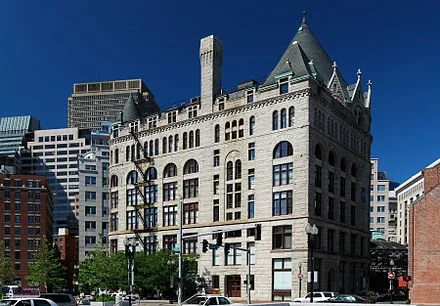
The Flour and Grain Exchange Building, Boston (1892), built, as were many other large, impressive buildings in the Northeast, with Milford Pink Granite.