
Llewellyn King: Nuclear power, a victim of an ignorant left-wing assault, urgently needs to be expanded to fight global warming
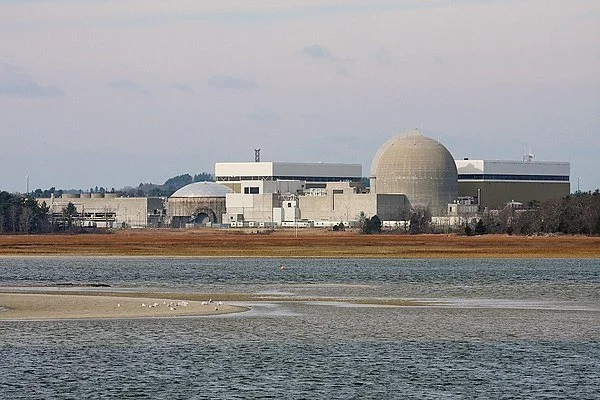
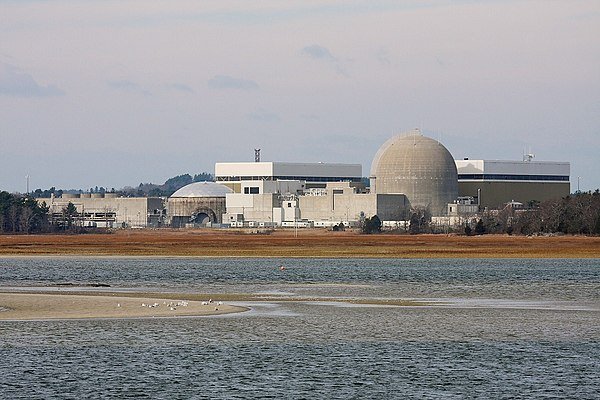
The Seabrook Nuclear Power Plant, in Seabrook, N.H.
WEST WARWICK, R.I.
If the Biden administration genuinely wanted to get serious about weaning the electric-power sector from fossil fuels, it would get serious about nuclear — not just patting it on the head, as it is doing with the government equivalent of “There, there, baby.”
Nuclear was an early victim of the culture wars that started in the late 1960s, and it remains so to this day.
It is incredible that a source of power, a cutting-edge technology, should have been sidelined for more than 50 years because of fear, suspicion, ignorance and politics.
In the late 1960s, nuclear power became the target of an environmental and political left lash-up. It became part of the environmentalist catechism that nuclear was an evil source of power and must be expunged from the national list of options. The political left didn’t so much as embrace environmentalism as environmentalism embraced the left.
Some environmentalists have had an epiphany, such as the Union of Concerned Scientists, which was founded by Henry Kendall, an activist whom I knew well. We were friends who didn’t agree about nuclear. Now the Union of Concerned Scientists is pro-nuclear, but it was at the barricades against nuclear for decades.
It isn’t that the environmental movement doesn’t want to do the right thing. It does. But it has thought that it alone should decide what was right and good for the environment, and often it has been totally wrong.
The environmental movement turned the nation from nuclear to coal. In the 1970s and 1980s, environmental groups advocated for fluidized bed combustion coal plants. I remember them saying that coal eliminated the need for “dangerous nuclear.” I sat through innumerable meetings and had sparing friendships with such anti-nuclear activists as Ralph Nader and Amory Lovins.
All presidents have said they favor nuclear power, even Jimmy Carter, who was the most reluctant and did huge damage to the United States’ position as the world leader in nuclear energy and technology. Carter wouldn’t say he was opposed to nuclear, but he did talk about it as a last resort and stopped the plans to build a fast-breeder reactor. He also ended nuclear reprocessing, necessitating the disposal of whole nuclear cores, instead of capturing the mass of unburned fuel — thus creating a much larger waste disposal challenge, as well as the need to mine more uranium.
If you believe — and I do — what was said at the COP26 summit in Glasgow, Scotland, now is the time to fix the electric-power industry. It can be fixed by building up nuclear capacity so that electricity can be the go-to, clean fuel of the future. It could replace fossil fuels in everything from cement making to steel production to heating buildings. That potential, that future, is awesome and possible.
Energy Secretary Jennifer Granholm should ask her national laboratories to make recommendations on a nuclear-power future, not to the detriment of wind and solar power, but embracing them.
Wind power is valuable. But depending on it is a little like having a trick knee: You never know when it is going to go out on you.
Europe has just learned that lesson the hard way. It is in the grip of a major energy crisis with electricity prices quadrupling and natural gas prices headed into the stratosphere as winter approaches. One of the causes of this crisis is that wind speeds through the summer fell to their lowest recorded levels in 60 years, with a total wind drought in the normally gale-wracked North Sea.
We won’t get to a carbon-free future unless we have a robust, committed plan to deploy state-of-the-art nuclear plants across the country. We built them in the 1960s and into the 1970s – 100 of them.
Granholm needs to declare a purpose and to pick the proven winner. It is nuclear, and it has been gravely wounded in the culture wars. She needs to rescue it – with word and deed.
Llewellyn King is executive producer and host of White House Chronicle, on PBS. He’s based in Rhode Island and Washington, D.C.
On Twitter: @llewellynking2

Old cheap thrills for kids

Bayberries
From Robert Whitcomb’s “Digital Diary,’’ in GoLocal24.com
With staring at screens taking up much of the waking hours of young people, how many still engage in the seasonal activities we used to enjoy in New England? In my family and those of our neighbors the seasonal cycles included smelt fishing (fried smelt are delicious!) in the early fall and making bayberry candles later in the fall.
You’d strip as many bayberries as you could off the bushes (of which we had many) and boil ‘em in water, in which the wax would rise to the surface, which we then skimmed off. Cheap and aromatic thrills, though it was a lot of time for only a little wax. Five pounds of berries could yield only about a pound of wax.
Because of this small, and from season to season, unpredictable yield, these candles were only for special occasions or as gifts. Pre-moneyed small children would happily give them as Christmas presents.
Indoor sport

Collection of basketball players, by Walker Hancock (1901-1998), 1960s, bronze. in the Cape Ann Museum, Gloucester, Mass.

Here’s James Naismith, who invented basketball in 1891 at the International YMCA Training School, in Springfield, Mass.

Jim Hightower: Because they ARE far-right-wing hacks
From OtherWords.org
Ralph Waldo Emerson once told about a guest who came to dinner and spent the entire evening prattling about his own integrity: “The louder he talked of his honor,” Emerson wrote: “the faster we counted our spoons.”
Today, America has not one, but six guests in our national home babbling about their integrity.
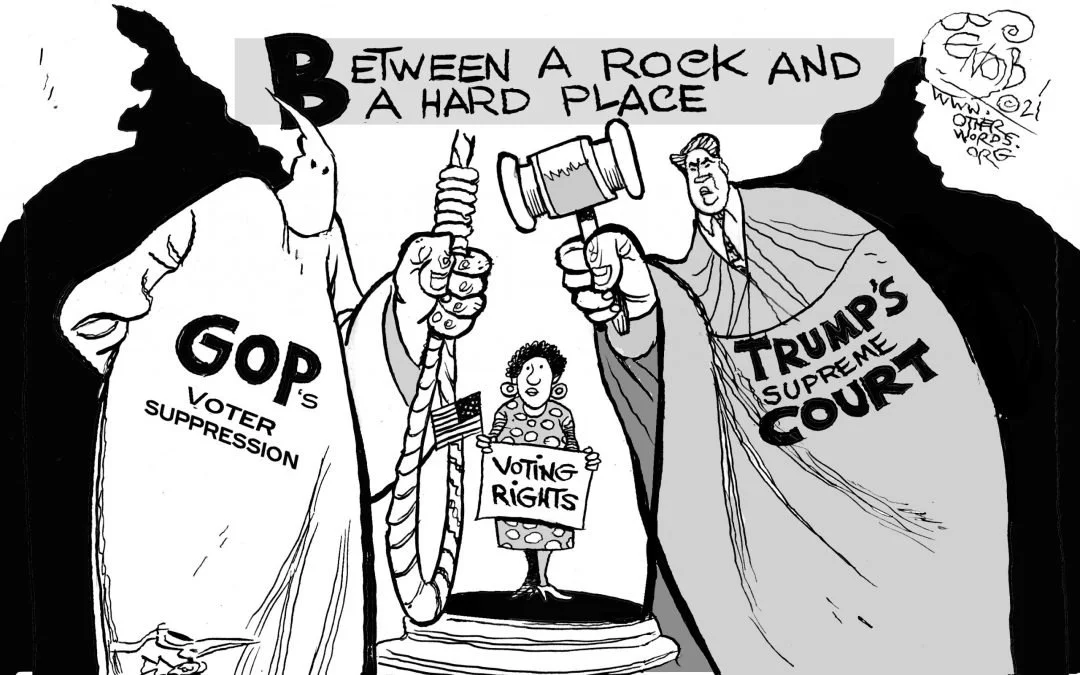
They are the six extremist Republican judges who now control our Supreme Court, and it’s a bit unsettling to hear them go on and on, almost frantically pleading with us to believe in their judicial impartiality.
For example, the court’s newest member, Amy Coney Barrett, suddenly blurted out at a public forum in September that “this court is not comprised of a bunch of partisan hacks.”
Better count our spoons! In fact, each of the six were installed on the court by right-wing Republicans specifically because they had proven to be devout partisan hacks.
Interestingly, Barrett made her unprompted and strained assertion of judicial integrity at the McConnell Center — named for Mitch McConnell, the rabidly partisan GOP Senate leader who pulled a fast one last year, rushing Barrett onto the bench on a party-line vote just before Republicans lost control of the Senate and White House.
Indeed, old Mitch himself introduced Barrett at the forum where she gave her “we-are-not-partisan-hacks” speech. He grinned proudly at the pure hackery of his partisan protégé.
Another hard-core partisan on the court, Sam Alito, whined in October that critics accuse the court’s GOP majority of being “a dangerous cabal that resorts to sneaky and improper methods to get its way.”
Well golly, Sam, yes, we do think that. Because again and again, the court’s conservatives have pulled the court down into the mire of crass Republican politics.
They’ve corrupted the system and jiggered the law to decree that corporate campaign cash is “free speech,” that the state can take over women’s bodies, and that the Republican Party can unilaterally shut millions of voters out of America’s voting booths.
If you don’t want to be considered political hacks, stop being political hacks.
OtherWords columnist Jim Hightower is a radio commentator, writer and public speaker.
'Shortcuts when they pay'

—Photo by Malene Thyssen
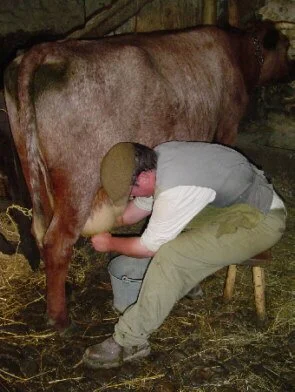
“{Lee Totman} is more than just a good farmer….He doesn’t waste moves. He is always set up for the job he needs to do. He plans only as much as his equipment and help permit. He takes shortcuts where they pay and lavishes attention where that pays better. His manure truck is an old unregistered jalopy; his equipment shed is made of old telephone poles and sheer tin.’’
-- Mark Kramer, in Three Farms (1980). Mr. Totman was a dairy farmer in Conway, Mass.

— Photo by DrunkDriver
Gathering around light

“Right Whale Lantern”, by Vermont-based artist and scientist Kristian Brevik in the group exhibition “Light Show.’’ at Dedee Shattuck Gallery, Westport, Mass. through Dec. 21. (North Atlantic Right Whales are in danger of extinction.)
The gallery (which is also a diversified arts center), explains:
“Light Show” is a multimedia group show with work by Adam Frelin, Kristian Brevik, Linda Schmidt, Megan Mosholder and Steven Pestana. Each of these artists utilizes light—either artificial or natural light—as a key component of their work. This exhibition, beginning after Daylight Savings Time and leading up to the winter solstice, celebrates how we create light in darkness, how we gather together and around light sources as the ever-fascinating visual medium of people across time.’’
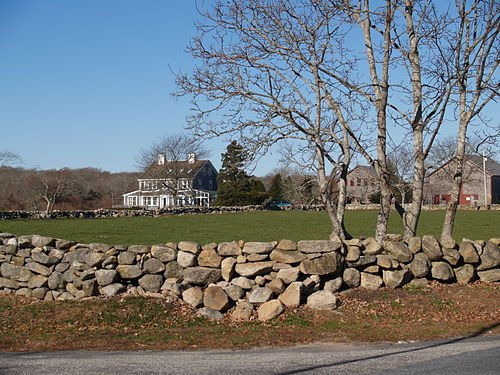
In a rural, or at least exurban, part of Westport, which has become increasingly attractive to affluent people from Greater New York City and Greater Boston for weekend and summer places. They’re drawn by its countryside, which includes farms and vineyards, its relatively mild climate and Buzzards Bay, which is among the warmest bodies of water in New England in the summer.
Chris Powell: Out-of-state marching band plays dirge for Connecticut
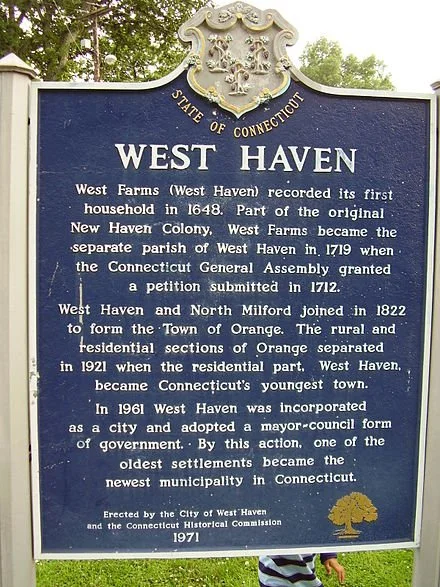
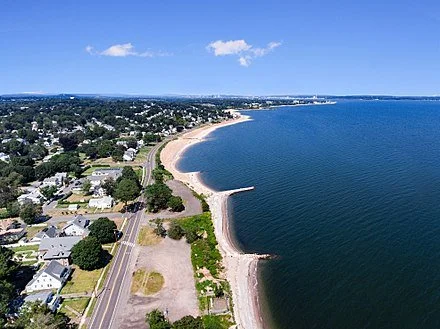
Ocean Avenue in West Haven
MANCHESTER, Conn.
West Haven may be providing the perfect metaphor for government and politics in Connecticut.
The small city has been suffering from financial excess so long that since 2017 it has been operating under the supervision of the state's Municipal Accountability Review Board. Because of a federal criminal indictment announced a few weeks ago, the city discovered that it had been looted of $636,000 of its emergency federal epidemic assistance money, allegedly embezzled by its state representative, who had been double-dipping as a salaried assistant to the City Council.
Nevertheless, Mayor Nancy Rossi's defense against the scandal right under her nose -- her obliviousness -- was accepted by the voters, who narrowly re-elected her Nov. 2.
Then enterprising journalism by the Connecticut Mirror found that apart from being embezzled, some of West Haven's emergency federal money was also spent to hire a marching band for the city's Memorial Day parade, to buy Christmas decorations, and to buy services from a City Council member's company. The New Haven Register already had reported that some of the federal money was spent to pay town officials for "compensatory time."
While the state accountability board had placed an agent at City Hall, he missed the fraud as well. So maybe the board needs to be investigated as much as city government does.
In another state such a scandal might prompt the legislature to hold hearings to investigate. But Connecticut's state legislators have left the corruption issue to federal prosecutors, just as the state's own prosecutors have.
Nevertheless, an estimated $4 billion more in federal money will be sent to Connecticut for highway and bridge improvements under the "infrastructure" legislation recently approved by Congress. Connecticut Rep. Rosa L. DeLauro, chairwoman of the House Appropriations Committee, says the money is all about "jobs, jobs, jobs."
But thousands of jobs, including many highly paid jobs in manufacturing, are already open in the state and can't be filled. Indeed, that marching band for the West Haven parade had to be imported from New York.
At least the federal infrastructure money may demolish the long-running argument for reimposing tolls on Connecticut highways. The money also may demolish the argument for joining what is called the Transportation Climate Initiative, an increase in the wholesale tax on gasoline in the name of raising money for less-polluting modes of transportation.
And if, as many members of Congress hope, their next spending bill includes a national program of paid family and medical leave, Connecticut will be able to repeal its own recently enacted program, for which the state income tax was raised by a half percent.
Federal money is considered better than state money because it can be created without taxation and thus can seem free -- as long as people don't start wondering why their fast-food hamburger and fries now cost more than $10 and gasoline more than $3 per gallon.
Whatever happens, government in Connecticut already has far more emergency federal money than it knows what to do with. That's why some has been spent on a marching band.

Tweed New Haven Airport
Gov. Ned Lamont and other dignitaries gathered Nov. 3 to celebrate the revival of Tweed New Haven Airport, which is the new East Coast hub for startup Avelo Airlines. There are great plans for Tweed -- lengthening its runway to handle larger jetliners and construction of a terminal accommodating more traffic.
But Avelo is not what Connecticut really needs at Tweed. For the airline plans only flights to six cities in Florida, to which thousands of state residents relocate in the winter, often for tax purposes, the Sunshine State not taxing personal income.
Instead of more ways of sending people to Florida, Tweed and the New Haven area need flights to hub airports, such as the American Airlines flights to Philadelphia and Charlotte that Tweed had until the virus epidemic devastated the travel industry.
If Tweed could recover those flights and gain flights to Chicago or Dallas, the airport would put New Haven on the national map for business development. Suddenly more people might have reason to come to Connecticut than to leave it.
Chris Powell is a columnist for the Journal Inquirer, in Manchester.
David Warsh: Perhaps we're in the Third Reconstruction
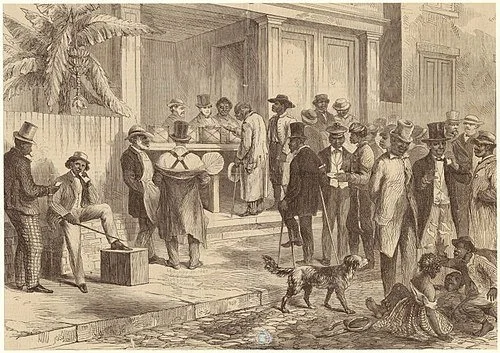
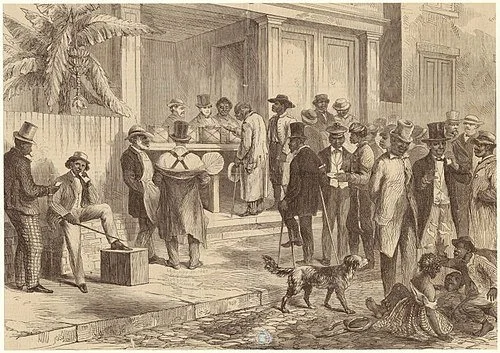
Former slaves voting in New Orleans in 1867. After Reconstruction ended, in 1977, most Black people in much of the South lost the right to vote and didn’t regain it until the 1960s.
SOMERVILLE, Mass.
“Reconstruction” (1865–1877), as high school students encounter it, is the period of a dozen years following the American Civil War. Emancipation and abolition were carried through; attempts were made to redress the inequities of slavery; and problems were resolved involving the full re-admission to the Union of the 11 states that had seceded.
The latter measures were more successful than the former, but the process had a beginning and an end. After the back-room deals that followed the disputed election of 1876, the political system settled in a new equilibrium.
I’ve become intrigued by the possibility that one reconstruction wasn’t enough. Perhaps the American republic must periodically renegotiate the terms of the agreement that its founders reached in the summer of 1787 – the so-called “miracle in Philadelphia,” in which the Constitution of the United States was agreed upon, with all its striking imperfections.
Is it possible that we are now embroiled in a third such reconstruction?
The drama of Reconstruction is well documented and thoroughly understood. It started with Lincoln’s Gettysburg Address, continued with his Second Inaugural address, the surrender of the Confederate Army at Appomattox Courthouse; emerged from the political battles Andrew Johnson’s administration and the two terms of President U.S. Grant; and climaxed with the passage of the Thirteenth, Fourteenth and Fifteenth Amendments to the Constitution – the “Reconstruction Amendments.” It ended with the disputed election of 1876, when Southern senators supported the election of Rutherford B. Hayes, a Republican, in exchange for a promise to formally end Reconstruction and Federal occupation he following year.
The shameful truce that followed came to be known as the Jim Crow era. It last 75 years. The subjugation of African-Americans and depredations of the Ku Klux Klan were eclipsed by the maudlin drama of reconciliation among of white veterans – a story brilliantly related in Race and Reunion: The Civil War in American Memory, by David Blight, of Yale University. For an up-to-date account, see The Second Founding: How the Civil War and Reconstruction Remade the Constitution, by Eric Foner, of Columbia University.
The second reconstruction, if that is what it was, was presaged in 1942 by Swedish economist Gunnar Myrdal’s book, An American Dilemma: The Negro Problem and American Democracy, commissioned by the Carnegie Corporation. The political movement commenced in 1948 with the desegregation of the U.S. armed forces. The civil rights movement lasted from Rosa Parks’s arrest, in 1955, through the March on Washington, in 1963, at which Martin Luther King Jr. made delivered his “I Have a Dream” speech, and culminated in the passage of the 1965 Voting Rights Act. Repression was far less violent than on the way to the Jim Crow era. There were murders in the civil rights era, but mostly they made newspaper front pages.
And while the second reconstruction entered on race, many other barriers were breached in those rears as well: ethnicity, gender and sexual preference. In Roe v Wade the Supreme Court established a constitutional right to abortion a decade after the invention of the Pill made pregnancy a fundamentally deliberate decision.
How do reconstructions end? In the aftermath of decisive elections, it would seem – in the case of the second reconstruction, with the 1968 election of Richard Nixon, based on a Southern strategy devised originally by Barry Goldwater. Nixon was in many ways the last in a line of liberal presidents who followed Franklin Roosevelt. He had promised to “end the {Vietnam} war” the war and he did. An armistice of sorts – Norman Lear’s All in the Family television sit-com – preceded his Watergate-inspired resignation. Peace lasted until the election of President Barack Obama.
So what can be said about this third reconstruction, if that is what it is? Certainly it is still more diffuse – not just Black Lives Matter, but #MeToo, transgender rights, immigration policy and climate change, all of it aggravated by the election of Donald Trump. This latest reconstruction is often described as a culture war, by those who have never seen an armed conflict. How might this episode end? In the usual way, with a decisive election. Armistice may takes longer to achieve.
For a slightly different view of the history, see Bret Stephens’s Why Wokeness Will Fail. We journalists are free to voice opinions, but we must ultimately leave these questions to political leaders, legal scholars, philosophers, historians and the passage of time. I was heartened, though, at the thought expressed by economic philosopher John Roemer, of Yale University, who knows much more than I do about these matters, when he wrote the other day to say “I think the formulation of the first, second, third…. Reconstructions is incisive. It reminds me of the way we measure the lifetime of a radioactive mineral. We celebrate its half-life, three-quarters life, etc….. but the radioactivity never completely disappears. Racism, like radioactivity, dissipates over time but never vanishes.”
David Warsh is a veteran columnist and an economic historian He’s proprietor of Somerville-based economicprincipals.com, where this essay first ran.
‘I’m not all gray’

Witch hazel can bloom in November.
— Photo by Keichwa
I come, a sad November day,
Gray clad from foot to head;
A few late leaves of yellow birch,
A few of maple red.
And, should you look, you might descry
Some wee ferns, hiding low,
Or late Fall dandelions shy,
Where cold winds cannot blow.
And then, you see, I'm not all gray;
A little golden light
Shines on a sad November day,
A promise for the night.
For though gray-clad, in soft gray mist,
Floating on gray-cloud wing,
I know that I the way prepare
For brightest days of Spring.
And though witch-hazel's golden flowers
Are all the blooms I know,
They promise—so do I—the hours
When sweetest Mayflowers grow.
— “November Day,’’ by Mary B.C. Slade (1826-1882), a poet and hymnist who was born in Somerset, Mass., and spent most of her life in Fall River.

Broad Cove, an inlet of the Taunton River, is at the northern end of Somerset.
Amazon to hire 1,500 workers in Mass. to deal with holiday crush
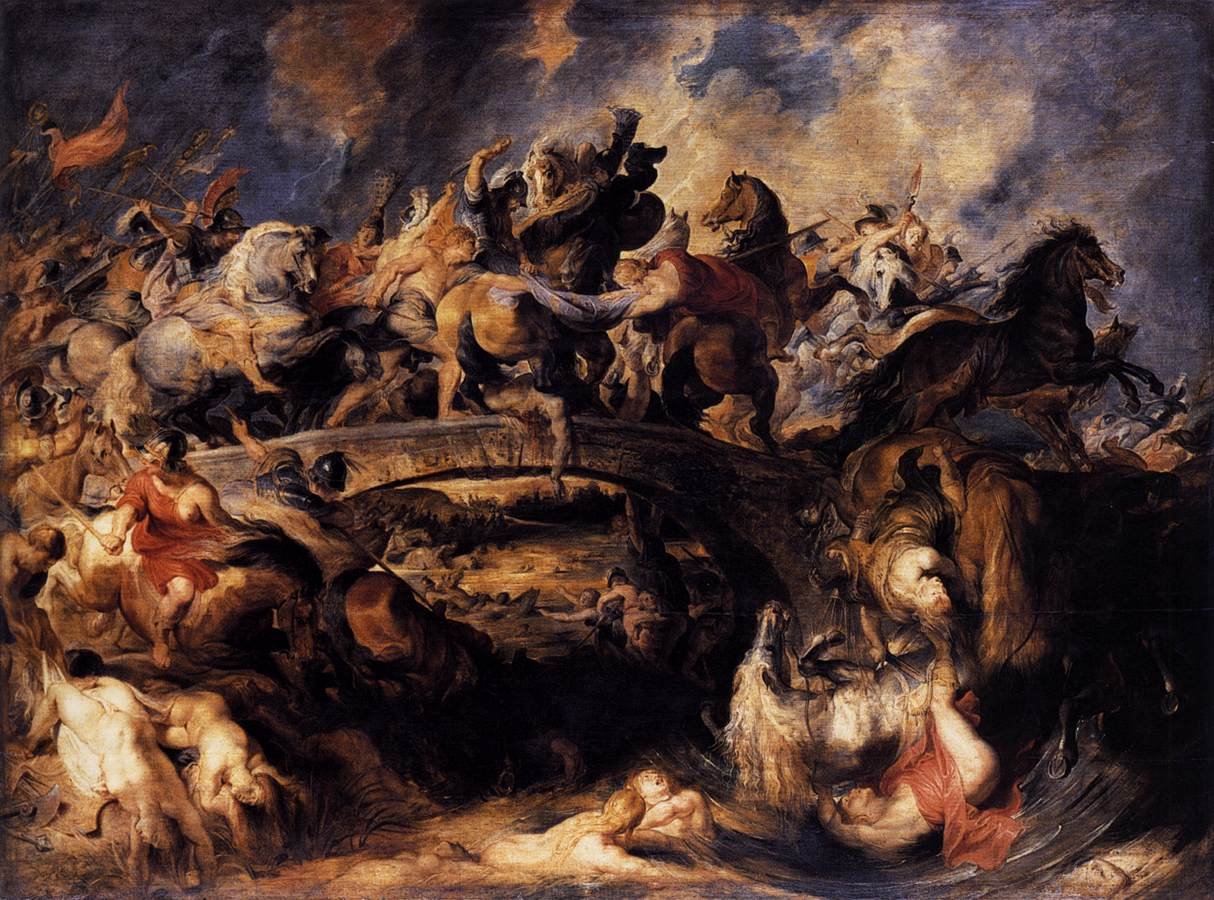
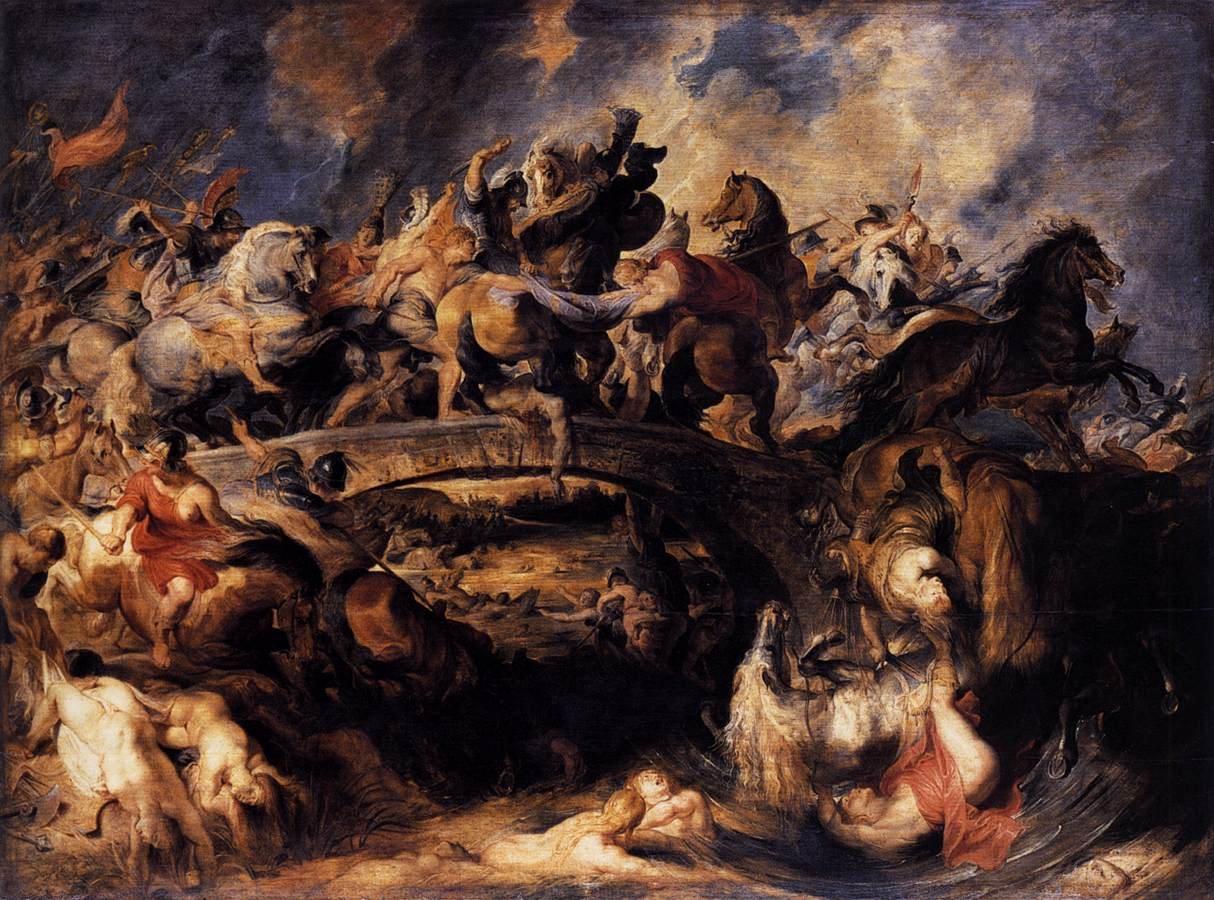
“Battle of the Amazons (1618), ‘‘by Peter Paul Rubens
From The New England Council (newenglandcouncil.com)
“Amazon recently announced that it plans to hire 1,500 seasonal workers in Massachusetts to help meet the holiday demands. This is a part of an effort to hire 150,000 seasonal workers around the country.
“Caitlyn McLaughlin, a spokesperson for Amazon, confirmed the announcement while reiterating that the supply-chain challenges that are being experienced will affect consumers around the world. ‘Everyone at Amazon is working to anticipate and prepare for various scenarios to ensure positive delivery experiences this holiday season, for instance, by launching promotions to encourage earlier shopping,’ said McLaughlin.
“Amazon is one of Massachusetts five largest employers, according to the Business Journal, and covers both the tech industry and the retail industry. Over this past summer the company had 20,000 positions available in the state for both part time and full-time positions in both industries.’’
‘A Wintry Mix’

“Would you like to swing on a star?” (collage), by Rich Fedorchak, of Thetford, Vt., in the show “Wintry Mix’,’ at AVA Gallery and Art Center, Lebanon, N.H., Nov. 19-Dec. 30.
The gallery says: "The holiday exhibition will feature the work of member artists from Vermont and New Hampshire. Works in a variety of media—oil, watercolor, drawing, printmaking, mixed media, photography, ceramics, textiles, sculpture, jewelry, and glasswork—will be on display and available for sale in a wide range of prices."
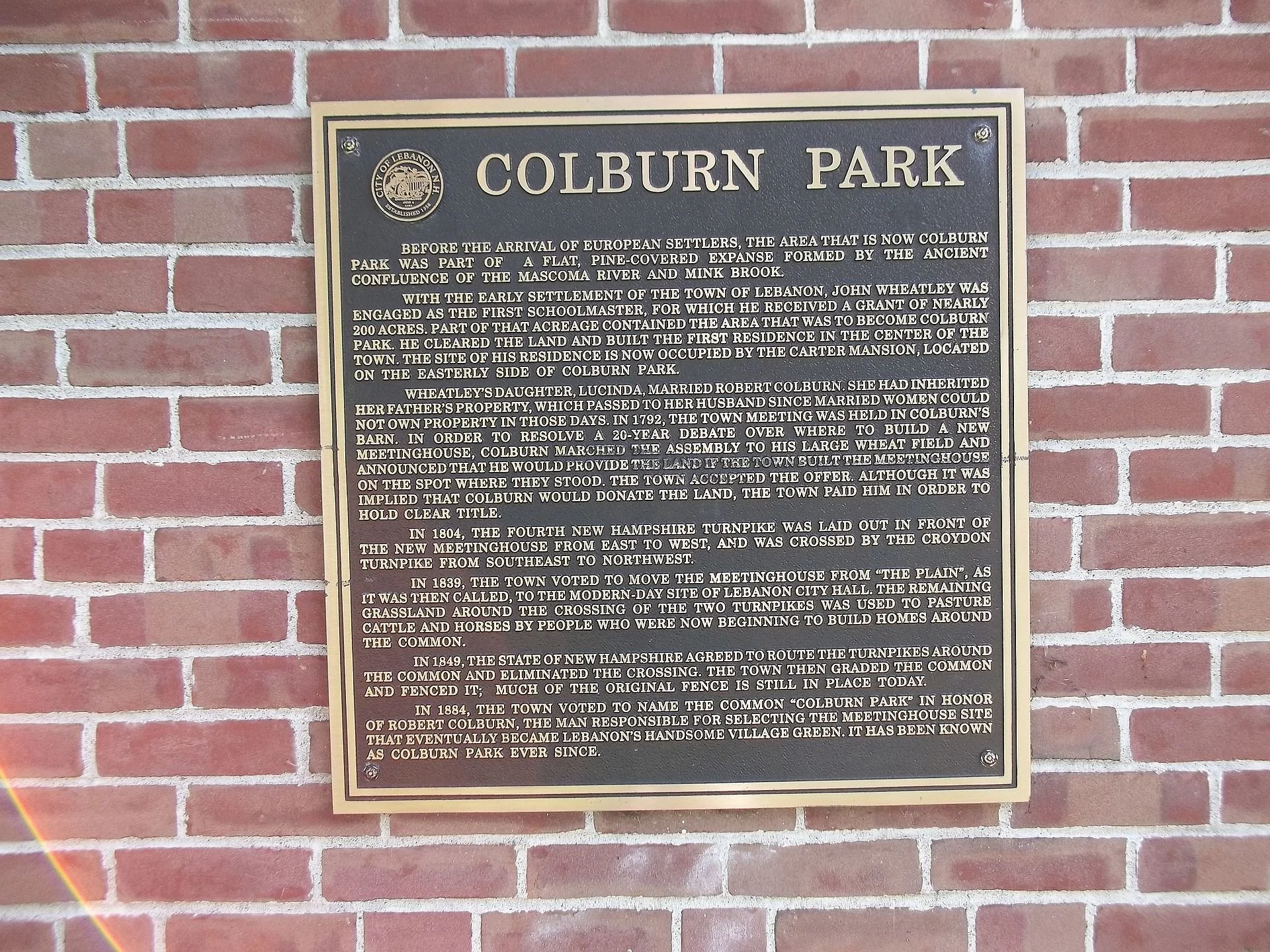
A little local history
— Photo by Artaxerxes
What colleges owe our democracy

The Seeley G. Mudd Building at Amherst College, the elite small liberal-arts college in the Massachusetts town of the same name that has abolished legacy admissions. The striking building, for math and computer science, was designed by Edward Larrabee Barnes and John MY Lee and Partners with Funds donated by the Seeley G. Mudd Foundation, named for a physician and philanthropist who lived from 1895 to 1968 and didn’t attend Amherst.
From The New England Journal of Higher Education, a service of The New England Board of Higher Education (nebhe.org)
WATERTOWN, Mass.
What Universities Owe Democracy; Ronald J. Daniels with Grant Shreve and Phillip Spector; Johns Hopkins University Press; Baltimore; 2021.
When the president of a major university publishes a deeply researched, closely reasoned, strongly argued powerful idea and call to the profession to respond to an urgent crisis in our national history, it is highly likely to become a classic in the literature of higher education. Ronald Daniels, president of Johns Hopkins University (co-authoring with colleagues Grant Shreve and Phillip Spector), has accomplished that with this new book, appropriately entitled What Universities Owe Democracy.
The New England Journal of Higher Education has responded to the widely recognized “epistemic crisis” in our democracy in two previous articles this year. The first, in April, unpacked the economic, technological, psychological and moral aspects of the problem, to focus on higher education’s purview of epistemology, and contended that it is incumbent upon all public educators—including journalists and jurists—from secondary schools onward, to insist that “thinking on the basis of evidence” is the only reliable way to establish and use the power of knowledge in any field. The second, in September, was a critical review of the journalist Jonathan Rauch’s recent book, The Constitution of Knowledge, asserting that he offered not a solution but part of the problem—that the epistemic crisis in public (or popular) knowledge, Rauch’s actual subject, is exacerbated by journalism’s misconceived habit of promoting as criteria of truth broad public acceptance and trust, rather than thinking on the basis of evidence.
The fundamental issue underlying both those articles—that scholars and scientists have civic responsibility—has now been addressed by Daniels, who has been previously known as a leading advocate for eliminating legacy admissions at prestigious institutions, which he did at Hopkins in 2014. His example was followed by a few others, most recently Amherst College.
The excellence of his book derives from his extraordinary idealism for higher education and the essential, indispensable role of colleges and universities in what he carefully defines as “liberal democracy.” His basic argument is that the welfare of American universities and of democracy have historically been and are strongly interdependent, so it is now necessarily in the academy’s interest to defend democracy from subversion. He poses as the “relevant question,” “How does the university best foster democracy in our society?”
His answer is painstakingly developed. Each of the book’s four chapters features careful definition of terms, a highly informative history of the chapter’s specific issue in American higher education, an analysis of its current challenges, and the author’s policy recommendations. The discussion is lucid, intellectually rigorous, and considerate of the complexities involved. This brief review cannot do justice to his detailed arguments, so I shall highlight a few points of broad interest.
A leitmotif throughout the book is what Daniels calls “liberal democracy,” which he defines in detail as an Enlightenment ideal: “liberal” in favoring individual freedom, “democracy” in promoting political equality and popular sovereignty. Whereas the two can occasionally conflict, society’s common good depends on their equitable balance. On these ideals, he writes, the United States is predicated.
The first chapter focuses on the “American Dream” of social mobility for this (in JFK’s phrase) “nation of immigrants.” Daniels elucidates the pre-eminent role universities have played in promoting it; no other institution, he says, has been throughout our history and still today more influential in that essential function. “Universities are one of the few remaining places where Americans of different backgrounds are guaranteed to encounter one another.” Therefore, colleges and universities must ensure that everything they do contributes to social mobility. This is where the issue of legacy admissions arises—about which, see more to follow.
The next chapter, “Free Minds” concerns civic education. Citizenship must be cultivated; it is not an innate trait. This used to be done by civics courses required at the high school level but in recent decades, that has languished, yielding ground to the rise of science and separate specialized disciplines. Today, only 25% of secondary schools require civic education, but because 70% of students go on to some form of postsecondary education or training, that is where, by default, civic education must be revived. Daniels advocates a “renaissance in civic learning” to reaffirm how the Founders envisioned higher education in our democracy. Noting that robust civics education is unlikely to be recovered by high schools in today’s polarized political environment, he presents a strong historical case for the inclusion of promoting democratic citizenship in higher education. Acknowledging the wide diversity of institutional types and cultures in postsecondary education today, he encourages every institution to develop its own approach.
Daniels then turns to the central role of universities in the creation, promotion and defense of knowledge, upon which liberal democracy is necessarily based. American universities have uniquely combined within single institutions their own undergraduate colleges, professional graduate schools, research facilities and scholarly publishing, protected by academic freedom and tenure. This powerful and mutually reinforcing combination has produced intellectual leadership in our liberal democracy. All this has been potently challenged, however, by developments in modern philosophy (linguistic analysis and epistemology) and more recently information technology (computers, the internet, social networks and artificial intelligence). Daniels courageously addresses these extremely complex and subtle issues (e.g., post-structuralism) in detail. His discussion is enlightening and supports his thesis that universities have a crucial role to play in intellectual leadership, “building a new knowledge ecosystem” that will protect and strengthen liberal democracy.
The next chapter “Purposeful Pluralism” discusses how colleges and universities may promote both greater diversity in their student bodies and genuine mixing of their constituencies by cultivating more inclusive communications and mutual understanding. But while greater diversification has been increased by deliberate admissions strategies, there needs to be sustained follow-through in the infrastructures of student life—in housing and rooming arrangements, dining, socializing, curricular and extracurricular settings, including faculty-student interactions and intellectual life in general. “Our universities should be at the forefront of modeling a healthy, multiethnic democracy.”
He concludes then by reviewing the overall argument, its urgency, and “avenues for reform,” which include: 1) End legacy admissions and restore federal financial aid, 2) Institute a democracy requirement for graduation, 3) Embrace “open” science’ with guardrails and 4) Reimagine student encounters on campus and infuse debate into campus programming. “The university cannot, as an institution, afford to be agnostic about, or indifferent to, its opposition to authoritarianism, its support for human dignity and freedom, its commitment to a tolerant multiracial society, or its insistence on truth and fact as the foundation for collective decision-making,” Daniels writes. “It is hardly hyperbole to say that nothing less than the protection of our basic liberties is at stake.”
While I may not completely agree with all the positions Daniels takes, I strongly believe that every academic reader will find this book highly illuminating, practically useful, and I hope, compelling. One relatively minor point of difference I have is where today’s vexed issue of legacy admissions is directly addressed. Daniels acknowledges that though the numbers of admissions decisions involved is relatively small, their symbolic significance is large, especially owing to the prominence of the institutions involved. The practice is followed by 70 of the top 100 colleges in the U.S. News rankings and, though it affects only 10% to 12% of their comparatively small numbers of students, it sends a message that is widely interpreted as elitist and undemocratic. Daniels focuses more on opposing the message than upon analyzing the practice in detail, and he provides no hard data on the process or results of the elimination of the policy anywhere.
This stood out for me as an odd departure from his usual data-intensive analytical habit. One reason for its exception is that he considers the message more important than the practical details, but another might be that data have not yet shown the abolition of legacy admissions to have significant practical impact on social mobility. Still another might be that, as I understand it, the reasons for which legacies were created are not the reasons for which they should now be abolished. They were instituted and are maintained primarily for internal institutional purposes—i.e., to encourage alumni engagement and fundraising—and not for any public message.
Here we may connect a few separate dots, not presented together in the book. Daniels abolished the practice at Hopkins in 2014 but did not announce it publicly until 2019. In that interval, he also sought and secured in 2018 a sensational gift from Hopkins alumnus Michael Bloomberg, of $1.8 billion for student financial aid. While it is understandable that Daniels would be reluctant to discuss this historical process in detail, or whether it was planned from the start and enabled by a unique advantage Hopkins had with Bloomberg as an alumnus, it is also conceivable that the Hopkins decision was not problem-free, and that the extremely generous grant was invoked as a solution.
In any case, avoiding the practical issue in the book also avoids considering a possible (though admittedly unforeseeable) solution for other institutions now—i.e., taking advantage of the unprecedentedly high multibillion-dollar gains in 2020 endowment yields and personal capital to use them separately or together to make major investments in student financial aid. This may, in other words, be an opportune time to modify legacy policies—perhaps to retain them in some refined or reduced form as an instrument supporting both student diversity and strengthening alumni relations and fundraising, while heading off the public impression of elitism.
The world is changing fast, and it is essential that universities keep up the pace. Political reform is slow and now especially cumbersome, whereas the only impediment to universities adapting and leading is the will to do so. That is where a book such as this can exert palpable influence, and considering how rare it is for such a book to be written, are we not in turn professionally obliged at least to read and think about it?
George McCully is a historian, former professor and faculty dean at higher education institutions in the Northeast, professional philanthropist and founder and CEO of the Catalogue for Philanthropy, based in Watertown, Mass.
Michelle Andrews: In pandemic, many employers have expanded mental-health coverage
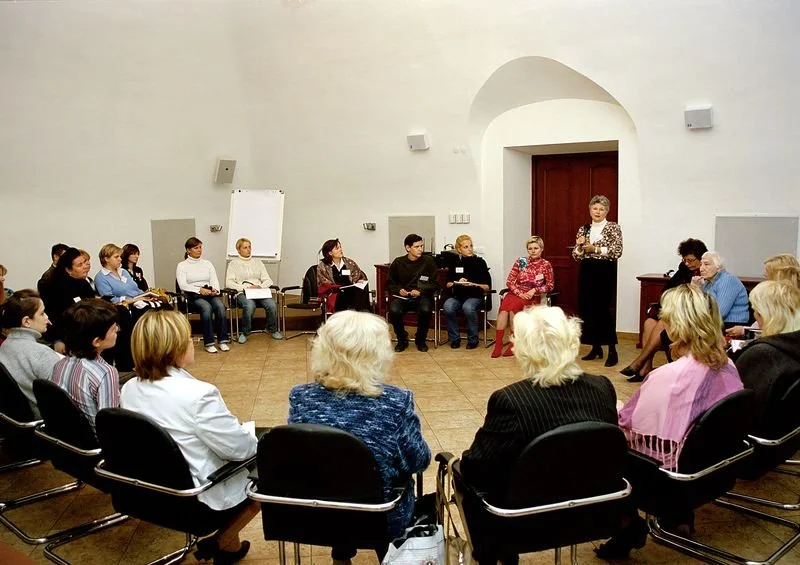
In group therapy
As the COVID-19 pandemic burns through its second year, the path forward for American workers remains unsettled, with many continuing to work from home while policies for maintaining a safe workplace evolve. In its 2021 Employer Health Benefits Survey, released Nov. 20, KFF found that many employers have ramped up mental health and other benefits to provide support for their workers during uncertain times.
See Rhode Island organization’s role below.
Meanwhile, the proportion of employers offering health insurance to their workers remained steady, and increases for health-insurance premiums and out-of-pocket health expenses were moderate, in line with the rise in pay. Deductibles were largely unchanged from the previous two years.
“With the pandemic, I’m not sure that employers wanted to make big changes in their plans, because so many other things were disrupted,” said Gary Claxton, a senior vice president at KFF and director of the Health Care Marketplace Project. (KHN is an editorially independent program of the foundation.)
Reaching out to a dispersed workforce is also a challenge, with on-site activities like employee benefits fairs curtailed or eliminated.
“It’s hard to even communicate changes right now,” Claxton said.
Many employers reported that since the pandemic started they’ve made changes to their mental-health and substance-use benefits. Nearly 1,700 nonfederal public and private companies completed the full survey.
At companies with at least 50 workers, 39% have made such changes, including:
31% that increased the ways employees can tap into mental-health services, such as telemedicine.
16% that offered employee assistance programs or other new resources for mental health.
6% that expanded access to in-network mental health providers.
4% that reduced cost sharing for such visits.
3% that increased coverage for out-of-network services.
Workers are taking advantage of the services. Thirty-eight percent of the largest companies with 1,000 or more workers reported that their workers used more mental health services in 2021 than the year before, while 12% of companies with at least 50 workers said their workers upped their use of mental health services.
Thundermist Health Center is a federally qualified health center that serves much of Rhode Island. (It’s based in Woonsocket.) The center’s health plan offers employees an HMO and a preferred provider organization, and 227 workers are enrolled.
When the pandemic hit, the health plan reduced the co-payments for behavioral health visits to zero from $30.
“We wanted to encourage people to get help who were feeling any stress or concerns,” said Cynthia Farrell, associate vice president for human resources at Thundermist.
Once the pandemic ends, if the health center adds a co-payment again, it won’t be more than $15, she said.
The pandemic also changed the way many companies handled their wellness programs. More than half of those with at least 50 workers expanded these programs during the pandemic. The most common change? Expanding online counseling services, reported by 38% of companies with 50 to 199 workers and 58% of companies with 200 or more workers. Another popular change was expanding or changing existing wellness programs to meet the needs of people who are working from home, reported by 17% of the smaller companies and 34% of the larger companies that made changes.
Beefing up telemedicine services was a popular way for employers to make services easier to access for workers, who may have been working remotely or whose clinicians, including mental-health professionals, may not have been seeing patients in person.
In 2021, 95% of employers offered at least some health care services through telemedicine, compared with 85% last year. These were often video appointments, but a growing number of companies allowed telemedicine visits by telephone or other communication modes, as well as expanded the number of services offered this way and the types of providers that can use them.
About 155 million people in the U.S. have employer-sponsored health care. The pandemic didn’t change the proportion of employers that offered coverage to their workers: It has remained mostly steady at 59% for the past decade. Size matters, however, and while 99% of companies with at least 200 workers offers health benefits, only 56% of those with fewer than 50 workers do so.
In 2021, average premiums for both family and single coverage rose 4%, to $22,221 for families and $7,739 for single coverage. Workers with family coverage contribute $5,969 toward their coverage, on average, while those with single coverage pay an average of $1,299.
The annual premium change was in line with workers’ wage growth of 5% and inflation of 1.9%. But during the past 10 years, average premium increases have substantially exceeded increases in wages and inflation.
Workers pay 17% of the premium for single coverage and 28% of that for family coverage, on average. The employer pays the rest.
Deductibles have remained steady in 2021. The average deductible for single coverage was $1,669, up 68% over the decade but not much different from the previous two years, when the deductible was $1,644 in 2020 and $1,655 in 2019.
Eighty-five percent of workers have a deductible now; 10 years ago, the figure was 74%.
Health-care spending has slowed during the pandemic, as people delay or avoid care that isn’t essential. Half of large employers with at least 200 workers reported that health-care use by workers was about what they expected in the most recent quarter. But nearly a third said that utilization has been below expectations, and 18% said it was above it, the survey found.
At Thundermist Health Center, fewer people sought out health care last year, so the self-funded health plan, which pays employee claims directly rather than using insurance for that purpose, fell below its expected spending, Farrell said.
That turned out to be good news for employees, whose contribution to their plan didn’t change.
“This year was the first year in a very long time that we didn’t have to change our rates,” Farrell said.
The survey was conducted between January and July 2021. It was published in the journal Health Affairs and KFF also released additional details in its full report.
Michelle Andrews is a Kaiser Health News reporter.
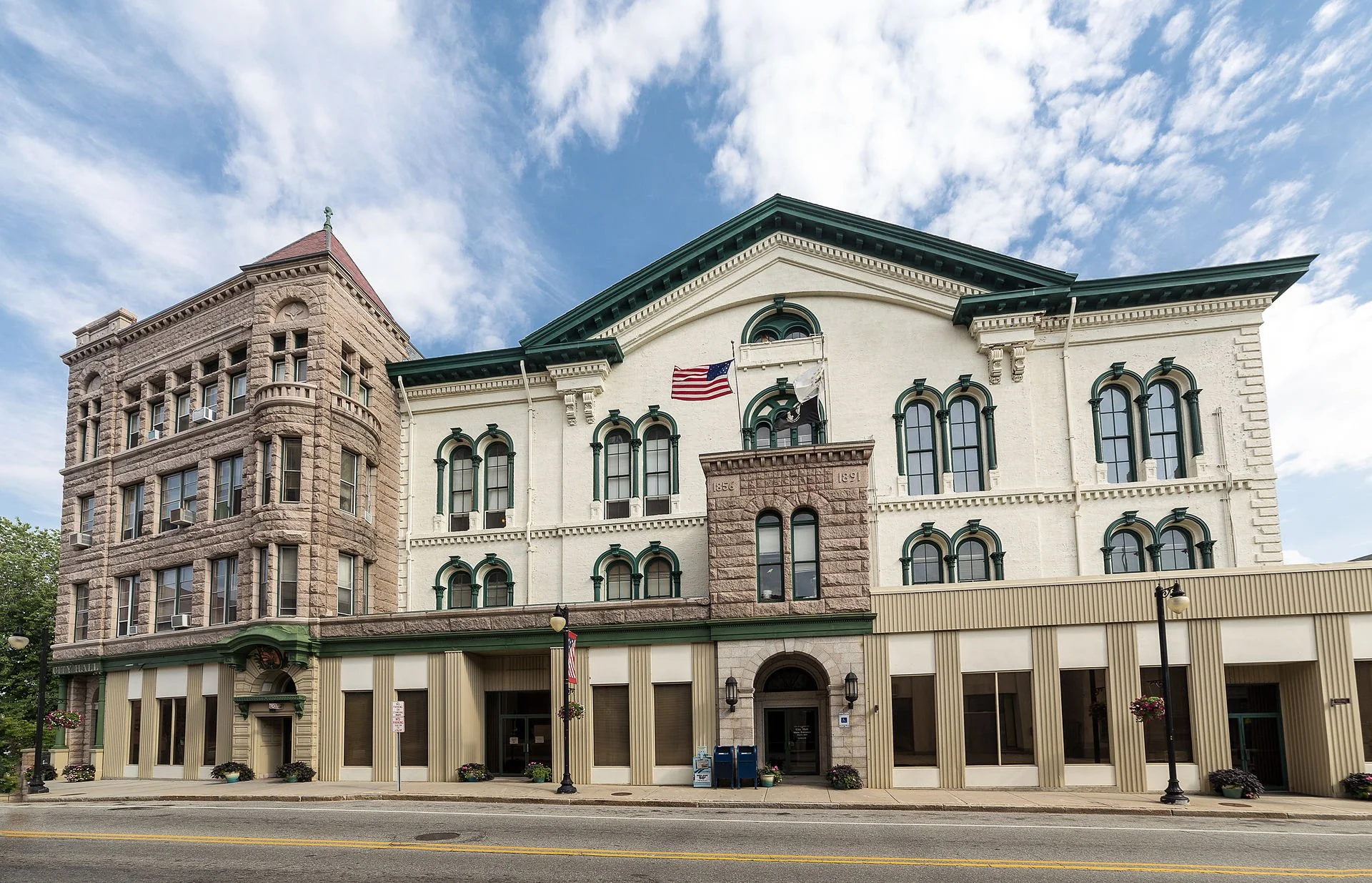
Woonsocket's city hall
—Photo by Kenneth C. Zirkel

The art of avoidance

“Conspiracy Shape” (graphite and colored pencil on paper), by John O’Connor, in his show "John O’Connor: Self Avoiding Walks’’, at Bannister Gallery at Rhode Island College, Providence, through Dec. 10.
The gallery explains that Mr. O’Connor “combines text, sketch, and musings reminiscent of field journals with influence and undertones that show what ultimately cannot be avoided. His drawings evolve incrementally over long spans of time, as O’Connor absorbs, plots, and transforms information into vibrantly colored pieces that straddle an aesthetic line between diagrams and fully articulated structures, forms, and spaces.”
Based in the New York City area, he’s originally from Westfield, Mass.
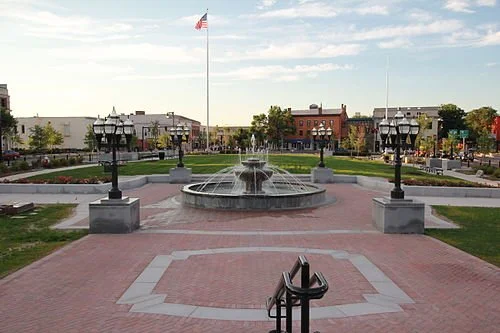
Downtown Westfield and Park Square
External and internal landscapes

“Connecticut River Valley at Claremont, N.H.,’’ by Albert Bierstadt (1830-1902)
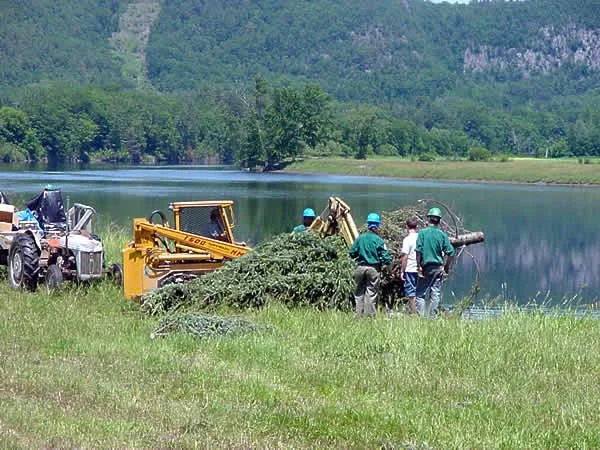
Along the Connecticut: Riverbank reconstruction project in Fairlee, Vt.
“There are few things as involuntary as a person’s identification with a landscape.’’
— Terry Osborne, writer and teacher, in his book Sightlines: The View of a Valley Through the Voice of Depression. He died of cancer in 2020 at the age of 60.
From the official summary of the book:
“For twelve years, writer Terry Osborne devoted himself to an intense exploration of the physical environment near his home in the {Upper} Connecticut River Valley {where he lived first in Thetford, Vt., and then in Etna, N.H.} The more he walked the land, the more deeply he came to know its hills and wetlands. But his growing intimacy with the area inspired something unexpected. The valley, formed by colliding and dividing continents, scoured by massive glaciers, and cut by rivers and streams, began to reveal and resonate with Osborne's internal landscape, long shaped from within by an unyielding depressive voice.’’

Llewellyn King: Using school buses, etc., to store energy in the new electricity revolution

WEST WARWICK, R.I.
Carbon-free electricity isn’t a final destination – it is merely a stop along the road to a time when electricity becomes the clean fuel of choice and reduces pollution in buildings, cement and steel production, transportation and other places and industries.
That is the glorious future that Arshad Mansoor, president and CEO of the Electric Power Research Institute, sees. He revealed his vision on White House Chronicle, the weekly news and public-affairs program on PBS, which I host, on his way to the COP26 summit in Glasgow, Scotland.
Mansoor, who talks about the future with an infectious fervor, was joined on the broadcast by Clinton Vince, chairman of the U.S. Energy Practice at Dentons, the globe-circling law firm, and Robert Schwartz, president of Anterix, a Woodland Park, N.J.-based firm that is helping utilities move into the digital future with private broadband networks.
Mansoor outlined a trajectory in which electric utilities must invest substantially in the near future to deal with severe weather and decarbonization. For example, he said, some power lines must be put underground and many must be tested for much higher wind speeds than were envisaged when they were installed. Some coastal power lines must be raised, he said.
While driving toward a carbon-free future, Mansoor cautioned against utilities going so fast into renewables the nation ignores the ongoing carbon-reduction programs of other industries. Further, if utilities can’t meet the electricity demands of transportation or manufacturing, these industries will turn away from the electric solution.
“Overall, we looked at the numbers and they showed a huge national role in decarbonization for the electric utility industry,” Mansoor said. However, the transition is fraught. It must be managed, sometimes using more gas until the system can be totally weaned from fossil fuels, he said. An orderly transition is vital.
Clinton Vince said the electric utility world has experienced a lot of volatility from severe weather, due to climate change, to the Covid-19 pandemic, and cyber-intrusions. “If I were to boil down to one word what is vital for utilities, it would be ‘resilience.’ ”
Resilience is an ongoing utility goal: It is the ability of a single utility or a group of utilities to bounce back from adversity, often by restoring power quickly. Anterix’s Robert Schwartz said that with his company’s private broadband networks and the deployment of enough sensors, a utility could identify a power line break in 1.4 seconds, before it hits the ground.
One of the most exciting and revolutionary aspects of Mansoor’s thinking is that the consumer will become a partner in the electric utility future. They will join the ecosystem by providing load-management assistance through smart meters, now installed in 60 percent of homes.
Mansoor thinks that the nation’s 480,000 school buses, if electrified, along with private electric vehicles, can be used to store energy. This answers the concern many utility executives have about storage and the concern that a tsunami of electric vehicles will overpower electric supply in the coming decade.
I think the utilities should plan right now for the integration of electric vehicles into their systems. They should offer electric vehicle owners financial incentives for plugging in and sending their stored power to the grid.
Likewise, the utilities should provide rate incentives for off-peak electric vehicle charging. They could do worse than look at the algorithms that have made Uber and Lyft possible, unlocking value in the personal car.
The utilities could devise a flexible system whereby they pay for power when needed and give a price break for charging during off-peak hours, or when there is a surfeit of renewable energy. That is the kind of data flow that will mark the utilities going forward and stimulate demand for private broadband networks.
We, the consumers, will be partners in the electric future, managing our own uses and supporting the grid with our electric cars and trucks. That is Mansoor’s achievable vision.
Llewellyn King is executive producer and host of White House Chronicle, on PBS. He’s based in Rhode Island and Washington, D.C.
On Twitter: @llewellynking2
White House Chronicle
'The return of hope'?

“Parades and Popsicles” (acrylic on canvas), by Amantha Tsaros, in her show “Feral Joy,’’ at Bromfield Gallery, Boston, through Nov. 28.
The gallery describes her show as “lively forms in paintings that celebrate the return of hope.’’
She’s based in Lexington, Mass.
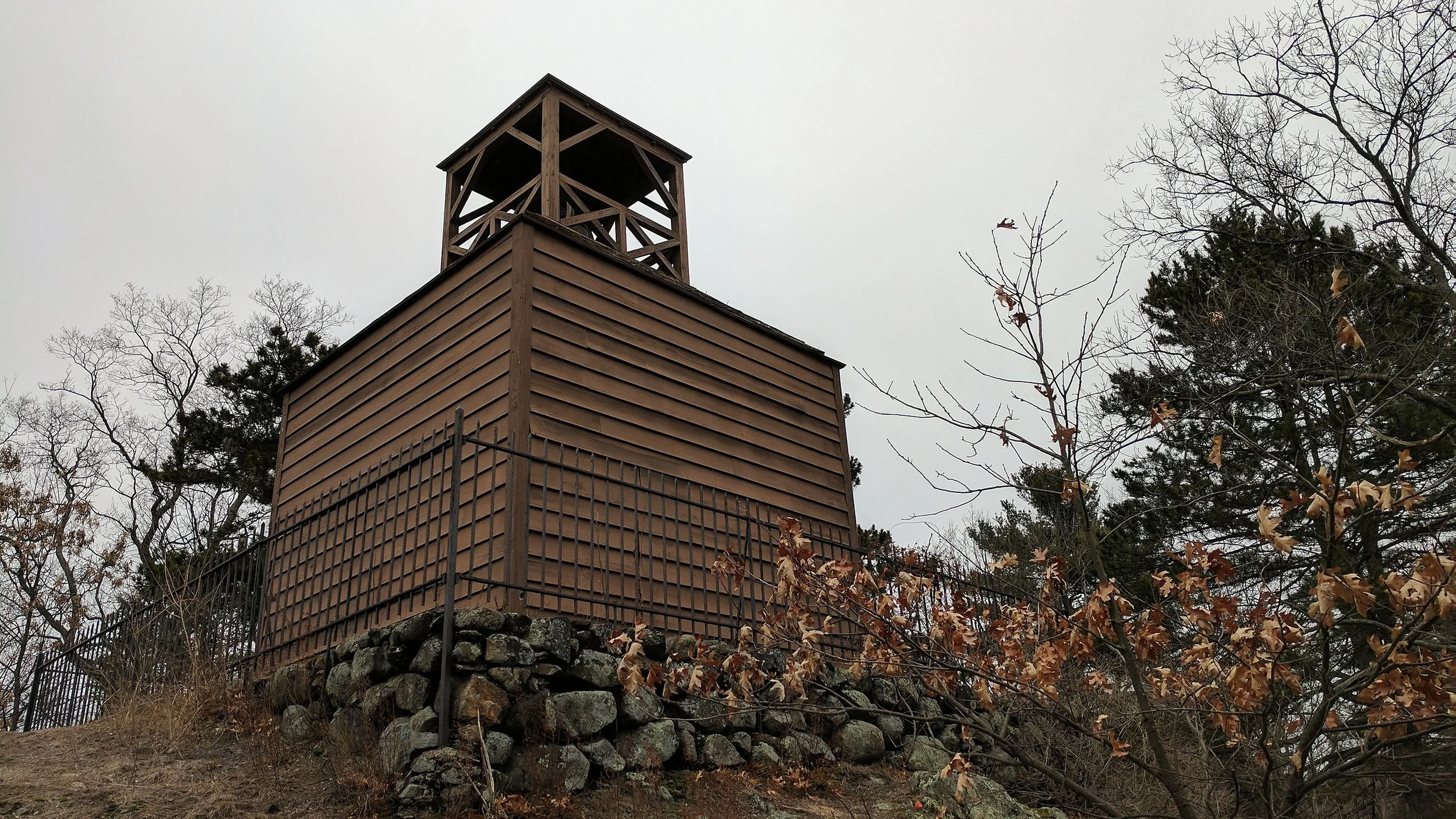
“The Old Belfry’’ in Lexington. From the original version of this structure a bell was rung to warn townspeople of advancing British troops before the battles of Lexington and Concord, on April 19, 1775, the first major battles of the American Revolution. It’s rung every April 19 at 5:30 a.m. in celebration of that day.
— Photo by Oeoi
‘As far I can manage’

Roger Tory Peterson at work
“Why do I live in Connecticut? As an artist and a writer I need New York for the American Museum of Natural History and Boston for Houghton Mifflin, my publisher. But as a naturalist I prefer to live as far from either as I can manage.’’
— Roger Tory Peterson (1908-1996), writer, naturalist and environmentalist, in All Things Reconsidered. He became famous for his field guides to nature and especially for his bird guides, which he wrote and illustrated. He spent the last 42 years of his life living in Old Lyme, Conn., where the Connecticut River flows into Long Island Sound.

Railroad Bridge connecting Old Lyme and East Lyme
— Photo by Morrowlong