
Narrow days
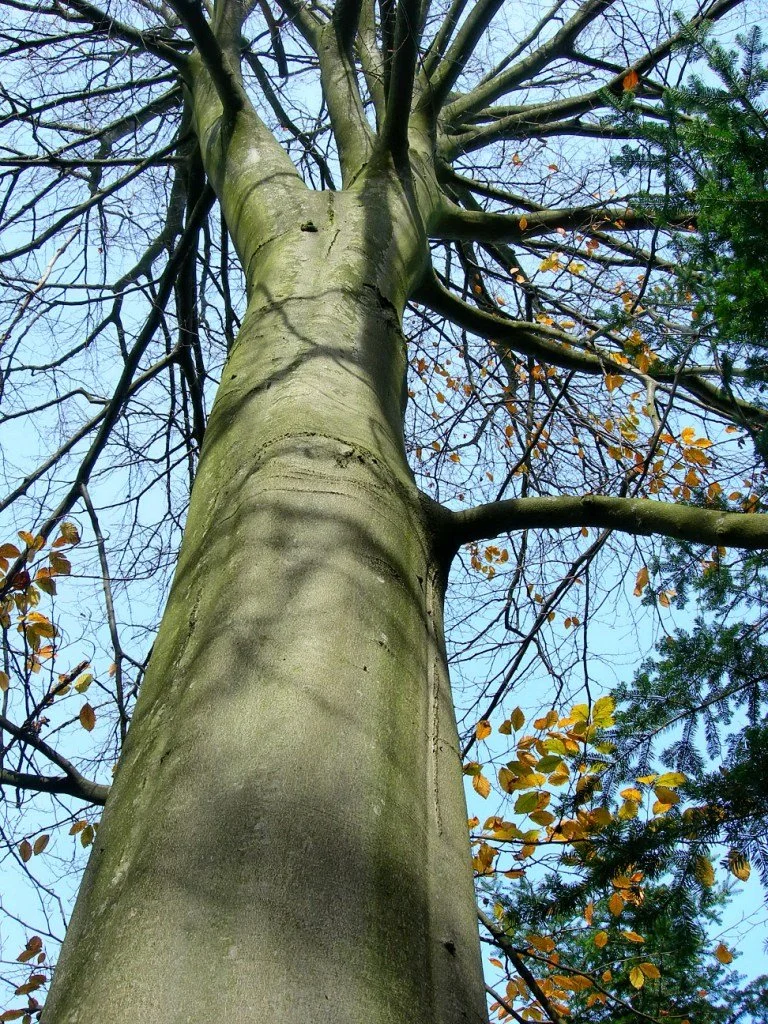
Northern beech in autumn
— Photo by Łukasz Smolarczyk
“My days show narrow
As the gray clouds layered behind
Branches laid bare
Who look beyond November skies.’’
— From “November Skies,’’ by Rachel Maher, a writer and painter who lives in southern Maine.
Bring back this urban starter housing
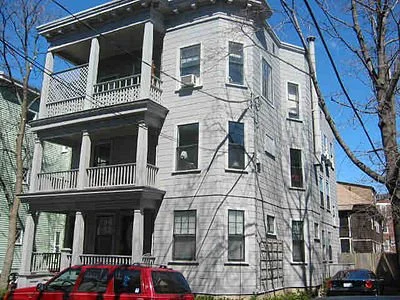
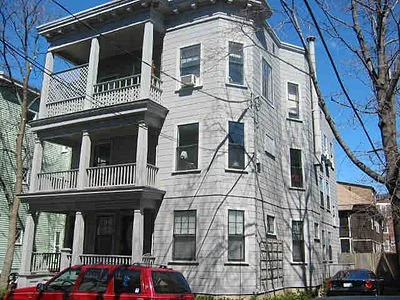
A three-decker in Cambridge, Mass.
From Robert Whitcomb’s “Digital Diary,’’ in GoLocal24.com
There’s a very useful article by Aaron Renn in Governing Magazine about how “poor neighborhoods” with lots of owner-occupied dwellings provided a springboard for people to enter the middle class. It sure beats massive, impersonal and often crime-ridden public-housing projects. An example would be those New England neighborhoods of “three-deckers” in places like South Boston. The owners often live on just one floor and rent out the rest of the building – a way to start gaining middle-class wealth.
But, as I’ve noticed in the U.S. cities where I’ve lived – Boston, New York, Philadelphia and Providence – public policies and changing social attitudes have eroded the benefits of this “starter housing’’ for years. Among Mr. Renn’s observations:
“The rise of zoning and ever-stricter building codes … played a role, especially in recent years, preventing the construction of traditional starter neighborhoods.”
“Changing zoning regulations to create more affordable neighborhoods in some of America’s most expensive cities would help establish platforms for upward mobility. …{But} other factors played into making these old neighborhoods what they were. They were high in social capital, characterized by intact married families, and populated with people who possessed the skills needed for building maintenance. These exist today in some immigrant communities, but less so in society at large.’’
(Ah yes, the collapse of marriage and the stability that went with it.)
Policy makers take note, particularly considering a housing-cost crisis that shows few signs of abating.
To read Mr. Renn’s article, please hit this link.
'Inner landscapes'
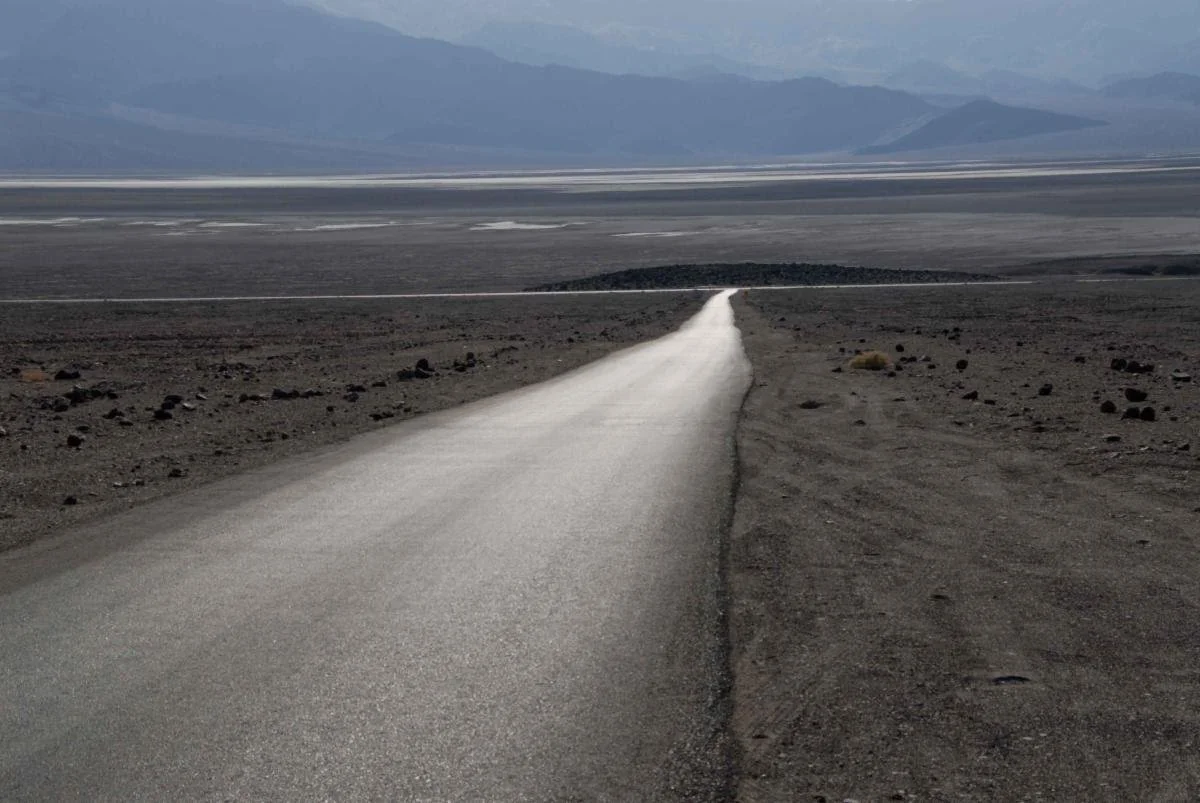
“Death Valley” (archival pigment print), by Jane Paradise, in her joint show with Alan Strassman, “American Landscape: Two Views,’’ at Galatea Fine Art, Boston, through Nov. 28.
She writes:
“My photographs represent several road trips across the East and West coasts over the past 13 years. Before my husband came down with Alzheimer’s, these road trips were an integral part of our lives. During one road trip up the California coast, we carved our initials into the side of a bullet-ridden abandoned car, shown in the image ‘Vichy Springs.’
“Looking over the photographs of our travels, I selected images that reflect the vast variations of the quirky American experience. Underlying the images of our culture are themes of its humanity. Sometimes it is turning away from one's surroundings to survey inner landscapes, catching a moment in time."
She lives in Provincetown.
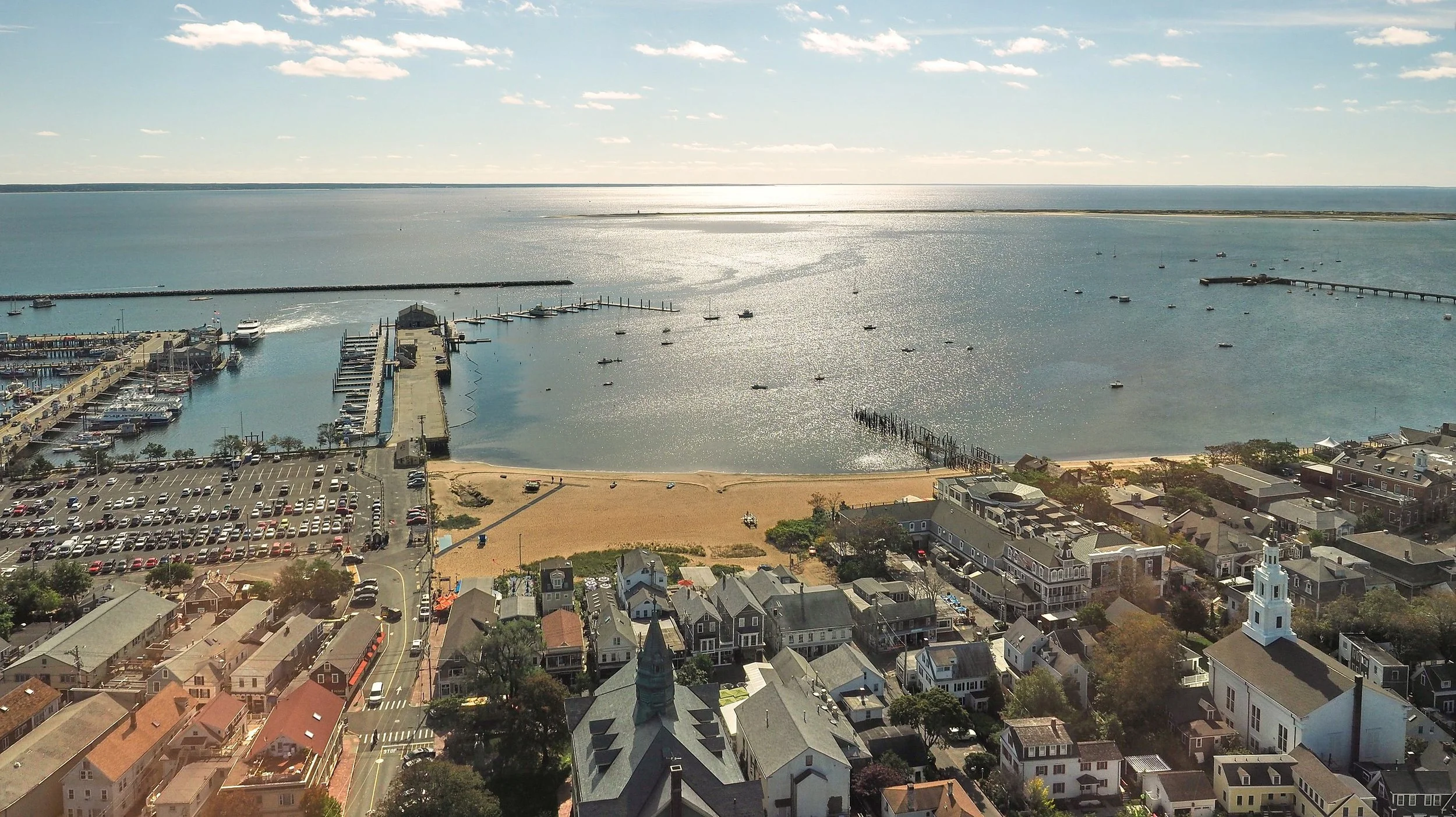
Over Provincetown: Looking south east from the top of Pilgrim Monument. Macmillan Wharf, far left. Fishermen's Wharf, left-center. Coast Guard Pier, far right. Long Point, right and center, just below the horizon, with Long Point Light near the tip (just left of center).
— Photo by RoySmith
Chris Powell: Biggest barrier to GOP in Conn. in ‘22 and ‘24 is Trump redux
MANCHESTER, Conn.
Republicans did fairly well in Connecticut's municipal elections last week, picking up many suburbs and smaller towns, holding the mayoralties in some smaller cities -- New Britain, Danbury, and Norwich -- gaining the mayoralty in Bristol, and nearly gaining the mayoralty in heavily Democratic and poorly managed West Haven, which was being looted right under the mayor's nose by one of her confidants.
Bristol hosts the studios of ESPN, and Lake Compounce, founded in 1846 and the United States's oldest continuously operating theme park. Bristol was well known as a clock-making city in the 19th Century. The American Clock & Watch Museum is there, as well as the site of the former American Silver Company and its predecessor companies.
"The map is setting up beautifully for 2022 for Republicans," their state chairman, Ben Proto, crowed.
But not so fast.
First, municipal elections are the least determined by party principles and the most by local personalities. Indeed, municipal government in Connecticut has little to do with public policy. Most of its finances are on automatic pilot, a matter of just signing off on government employee union contracts devised under the pressure of binding arbitration and causing the great majority of municipal expense.
Second, Connecticut remains a solidly Democratic state. Nobody last week paid much attention to the usual huge Democratic pluralities in the big cities, since the election results there were pre-ordained. But those pluralities will reappear next year in the statewide election, where they are usually decisive no matter how well Republicans do elsewhere.
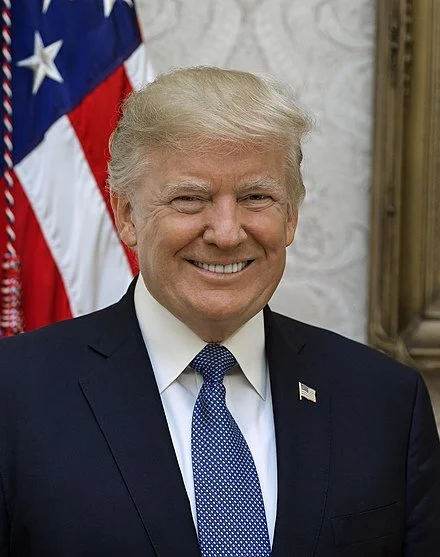
And third, Donald Trump didn't haunt Connecticut Republican campaigns this year. Since next year's election is a congressional election and Trump seems to be planning to run for president again in 2024, Connecticut voters soon may be reminded of him a lot more. The Biden administration is so incompetent and extreme leftist that it may be possible to imagine Trump winning in 2024, but it is not possible to imagine him carrying Connecticut. It is easy to imagine him destroying the Republican Party here next year and in 2024 just as he destroyed it last year, wiping out the gains that Republicans had been making in the General Assembly.
Escaping Trump remains the great challenge of any Republican who wants to win in Connecticut. It shouldn't be impossible, since many Republican policies could win a referendum in Connecticut and can be advocated without reference to Trump, while the Trump problem is mainly a matter of his hateful character and demeanor. But many Connecticut Republicans -- maybe a majority of the most active ones, primary voters -- are devoted to that character and demeanor and rather than give them up might prefer to lose on policy forever.
Using specific state issues against his Democratic opponent, Virginia's new Republican governor-elect, Glenn Youngkin, held Trump at bay without alienating Trump supporters. So the more Connecticut's Republican candidates press specific issues next year, the more they may cause people to put policy ahead of Trump. As the village rabbi in Fiddler on the Roof replied when asked if there was a blessing for the czar: "May God bless and keep the czar -- far away from us."
xxx
In any case going into next year's state election Connecticut Republicans are likely to get help from the craziness of the leftists who dominate the state's Democratic Party and make it hard for Gov. Ned Lamont to maintain a moderate stance.
City administrations, including Hartford's, are sure to provide Republicans with plenty of campaign fodder if the Republicans have the nerve to risk controversy. For example, according to The Hartford Courant, last week a city government committee drafted plans for the city's experiment with a program of "universal basic income."
The idea is to give $500 a month, unconditionally, to 25 single parents or guardians. But the committee thinks that it needs a mechanism for determining whether the money really reduces stress in the lives of the recipients. So the committee may propose making recipients undergo invasive tests to measure their stress hormones.
Of course winning a lottery's grand prize or inheriting a great amount of money may cause the stress of figuring out what to do with it. But since when is any special research needed to determine whether $500 more per month will make someone's life easier?
The movie Animal House famously depicted the statue of college founder Emil Faber inscribed with the moronic motto "Knowledge is good." Hartford could add, so scientifically: "Money too."
Chris Powell is a columnist for the Journal Inquirer, in Manchester.
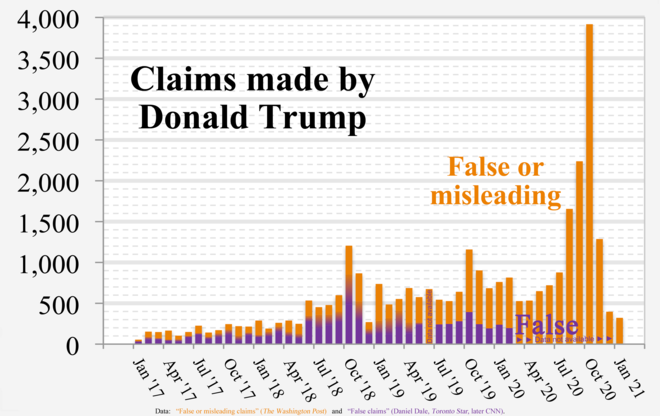
Fact-checkers from The Washington Post, the Toronto Star, and CNN compiled data on "false or misleading claims" (orange background), and "false claims" (violet foreground), respectively.
Kitchen art

“Home Brew” (oil on panel), by Rachel Wilcox, in the group show “Small Works, Big Impacts,’’ at Edgewater Gallery, Middlebury, Vt., starting Nov. 15.
The gallery says the five pieces she has delivered to the show “further explore her restaurant kitchen theme but also include vignettes from her own kitchen. Each painting gives the viewer an intimate, and compositionally intriguing snapshot of parts of working kitchens.’’
She lives and works in Amesbury, Mass., on the north side of the Merrimack River.

From The Boston Cooking School magazine of culinary science and domestic economics in 1896
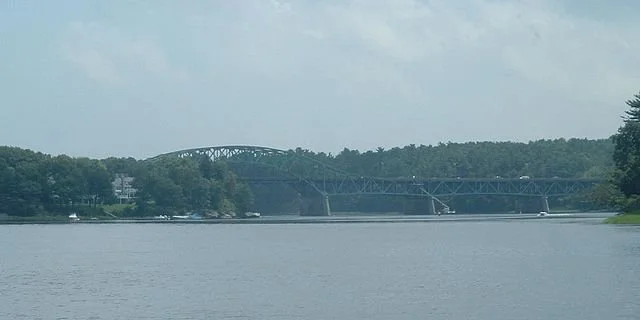
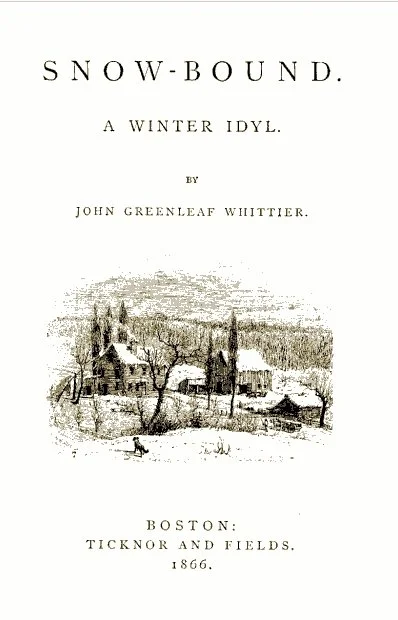
The Whittier Memorial Bridge over the Merrimack River. The bridge, named for the once famous Massachusetts poet and abolitionist John Greenleaf Whittier (1807-1892), who grew up on a farm in nearby Haverhill, connects Amesbury and Newburyport.
Bill Minter: The United States of places to hide corrupt foreigners' piles of money
For foreign crooks, The Granite State is a place to live free and thrive.
Via OtherWords.org
{Editor’s note: New Hampshire is also a major place to hide ill-gotten gains. Hit this link.}
There are many ways in which the United States is not one country.
I’m not referring to red states versus blue states, or racial or ethnic divisions. What I mean is that the United States, where countless corrupt billionaires and dictators have stashed their loot, is not a single tax haven, but many separate tax havens.

The Pandora Papers, released in October, show that the United States is second only to the Cayman Islands in facilitating illicit financial flows. But it’s not a simple picture.
Each state and territory has its own laws and regulations about financial transactions used for tax evasion or money laundering. And both red states and blue states are destinations for those who seek to hide their money from tax collectors and public scrutiny.
President Biden’s home state of Delaware has long been renowned for its use as a tax haven, beginning in the late 19th Century. Reliably Democratic in national politics, Delaware still ranks at the top among U.S. states providing secrecy for corporations and ultra-high-wealth individuals, both domestic and foreign.
But the Pandora Papers cite ruby-red South Dakota as an attractive destination for billionaires and others seeking to avoid estate taxes.
The International Consortium of Investigative Journalists (ICIJ), which led the Pandora Papers investigation, obtained access to the records of the Sioux Falls office of Trident Trust. Among its clients were the family of Carlos Morales Troncoso, former president of Central Romana, the largest sugar plantation in the Dominican Republic — which is notorious for its exploitation of Haitian workers.
South Dakota led the way in providing such trusts, as reported in detail even before the current revelations. But other states, including Alaska, Florida, Delaware, Texas, and Nevada, have followed suit.
The Pandora Papers also document the luxury real estate holdings of Jordan’s King Abdullah. Like many other politicians and oligarchs around the world, King Abdullah owns real estate in many places outside his country. The ICIJ found records of his purchases in London and Washington, D.C., among other cities, as well as three side-by-side mansions in a luxury enclave in Malibu, California.
Bottom line: those seeking to track down the hidden wealth that dictators, criminals, or jet-setting billionaires have lodged in the United States must not limit their efforts to supporting changes in national legislation in Washington, D.C. They must also turn the spotlight on state and local communities around the country.
In February 2017, for example, The Washington Post called attention to the fact that U.S. relations with Gambia and Equatorial Guinea were not just “foreign policy” but also a local story in Potomac, Md.
Ousted Gambian dictator Yahya Jammeh lived at 9908 Bentcross Drive in the D.C. suburb. His counterpart Teodoro Obiang Nguema, who has ruled Equatorial Guinea since his successful coup in 1979, still owns the house at nearby 9909 Bentcross Drive.
The effects of these mechanisms to hide assets from taxation and siphon money to the rich are felt at all levels — from the failure to address global crises such as climate change and the pandemic to gross inequality in housing and other essential needs.
Exposing those mechanisms and building the political will to curb illicit financial flows requires action not only in national capitals and global institutions, but also in all the jurisdictions where wealth is hidden. Nowhere is this more true than for the United States.
In Washington, this message from the Panama Papers is beginning to be heard if not yet followed.
A recent Washington Post editorial read “States must stop letting the ultrawealthy dodge taxes — and the law.” Despite the limited progress on national legislation, that fight can begin in states across the country — probably including yours.
William Minter is the editor of AfricaFocus Bulletin and an advisor to the U.S.-Africa Bridge Building Project. This op-ed was adapted from Africa Is a Country.
Horror in the Hub
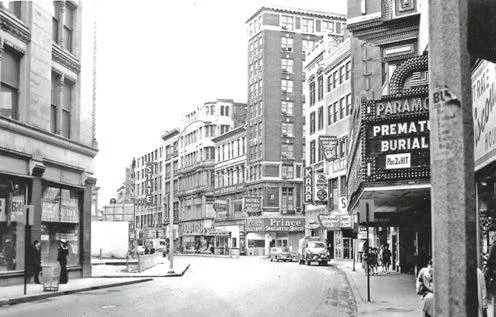
On downtown Boston’s then weekend-gloomy Washington Street in 1962. Note that the Paramount is playing a typical horror movie of that era — Premature Burial. Looks like the sailor at the left is conducting some business with a professional lady or man of the streets. And note the outlet of that quintessential Boston company Prince Spaghetti.
Easier to hike than to say
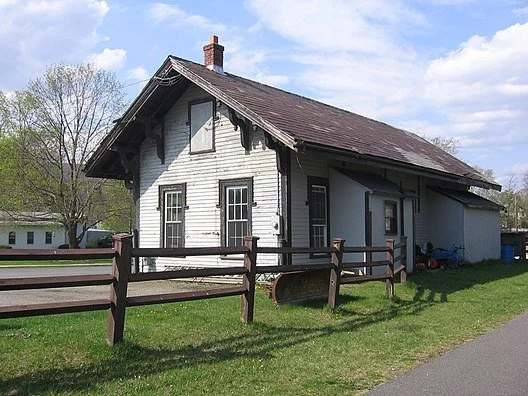
Old train station along the Ashuwillticook Rail Trail
Hit this link to see where text immediately below comes from.
“One particular attraction enjoyed by locals and visitors alike is the Ashuwillticook Rail Trail, which runs parallel to Route 8 and runs through the towns of Adams, Cheshire and Lanesborough with an extension under construction leading to Pittsfield projected to be completed next May. …Walking, biking, jogging, and rollerblading are popular trail activities on this Sometimes I grabbed my headphones and did my daily walk on the trail. It’s a great way to get some exercise while getting a beautiful view of what the Berkshires has to offer, particularly the views of Cheshire {Reservoir} as you pass through Cheshire town.’’
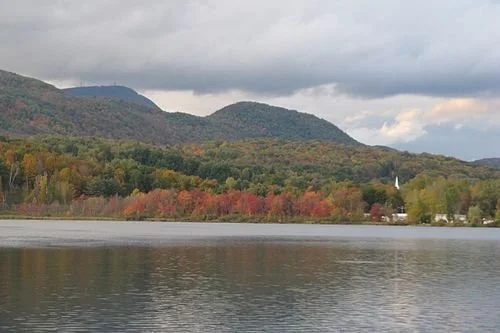
Cheshire Reservoir
A little history:
The Ashuwillticook Rail Trail is built on a former railroad corridor that runs parallel to Route 8 through Cheshire, Lanesborough and Adams, Mass.
The trail passes through the Hoosac River Valley, between Mount Greylock and the Hoosac Mountains. Cheshire Reservoir, the Hoosic River and associated wetlands flank much of the trail. The word Ashuwillticook (ash-oo-will-ti-cook) is from the Native American name for the south branch of the Hoosic River and means “at the in-between pleasant river,” or in common tongue, “the pleasant river in between the hills.”
Built during the 1800s industrial boom, the railway was a vital commercial link from the Atlantic Seaboard to communities that would have otherwise been isolated in the Berkshires.
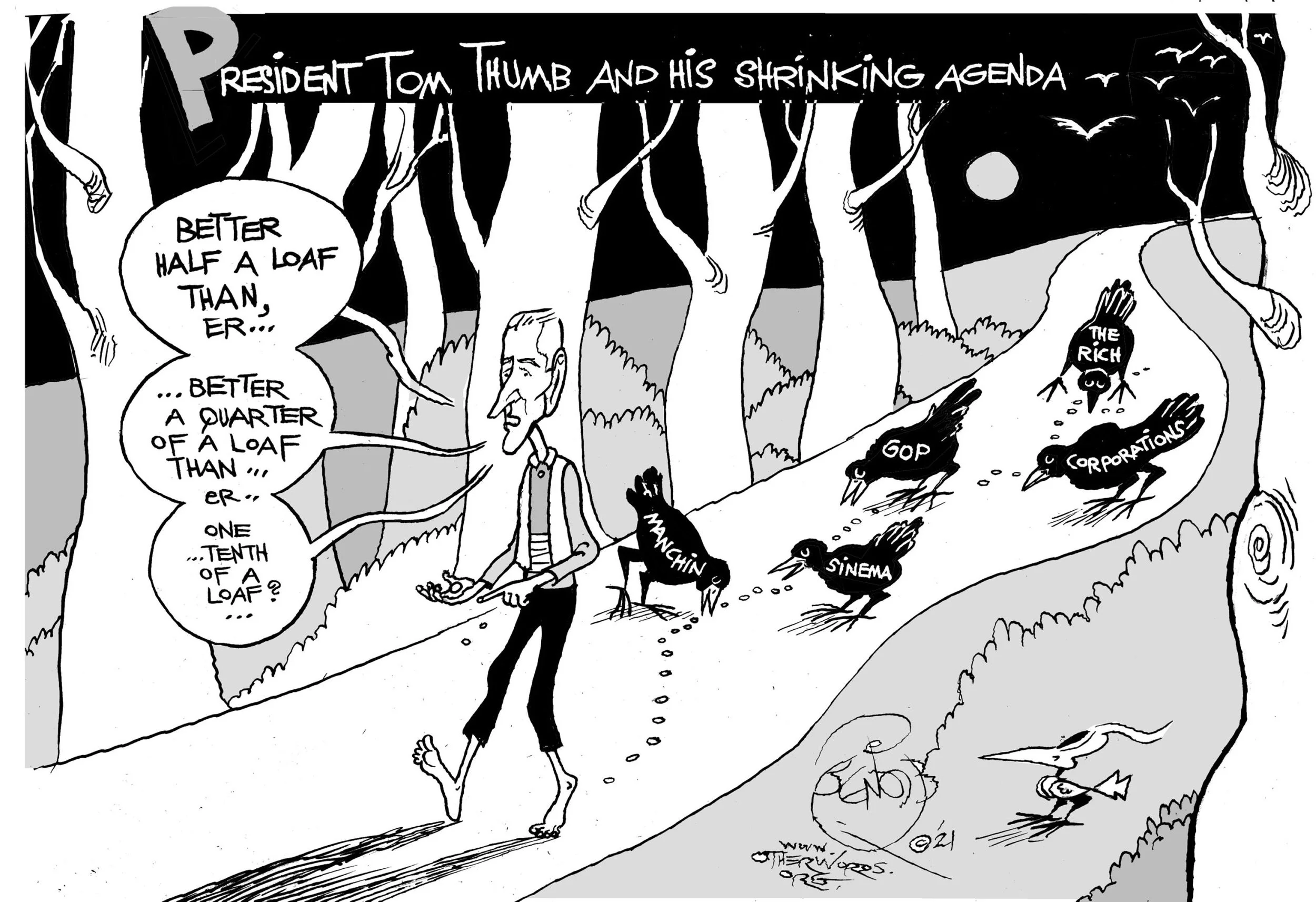

‘Dreams of Boston’
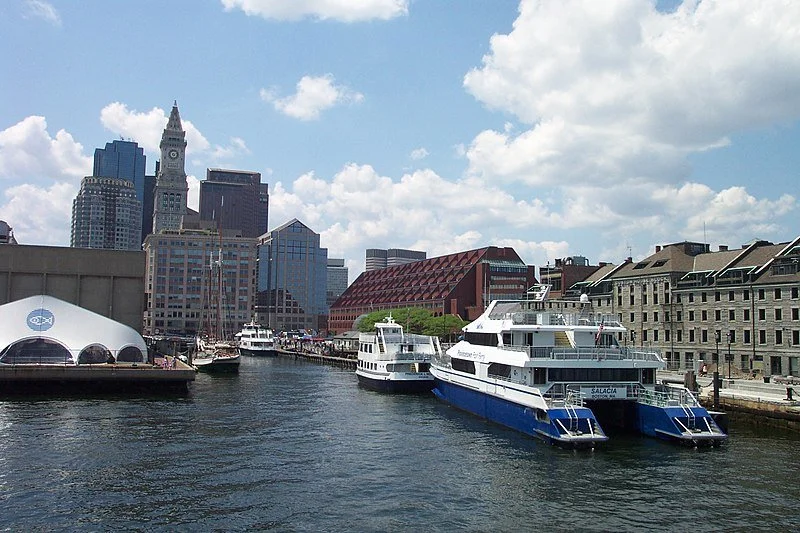
Ferries and other boats at Long Wharf, Boston
“She comes from Boston
Works at the Jewelry Store
Down in the harbor
Where the ferries come to shore.’’
– From song “Boston, by Kenny Chesney

The Paifang Gate, the best-known entrance to Boston’s Chinatown. It’s the only real Chinatown left in New England, after the gradual disappearance of those in Providence and Portland.
“I’ve had dreams of Boston all of my life
Chinatown between the sound of the night.’’
—From “Ladies of Cambridge,’’ by the rock band Vampire Weekend
Easier to bike than to say
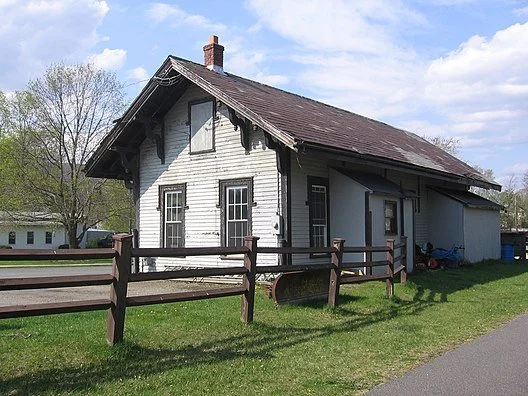
Old train station in Cheshire, Mass.
Hit this link to see where the text below comes from.
https://6park.news/massachusetts/10-quotes-will-make-you-explore-the-ashuwillticook-rail-trail.html
“One particular attraction enjoyed by locals and visitors alike is the Ashuwillticook Rail Trail, which runs parallel to Route 8 and runs through the towns of Adams, Cheshire and Lanesborough with an extension under construction leading to Pittsfield projected to be completed next May. …Walking, biking, jogging, and rollerblading are popular trail activities on this Sometimes I grabbed my headphones and did my daily walk on the trail. It’s a great way to get some exercise while getting a beautiful view of what the Berkshires has to offer, particularly the views of Cheshire {Reservoir} as you pass through Cheshire town.’’
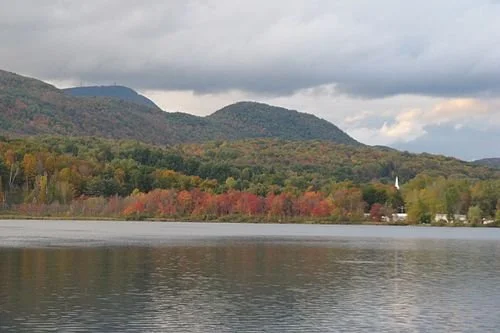
Cheshire Reservoir
A little history:
The Ashuwillticook Rail Trail is built on a former railroad corridor that runs parallel to Route 8 through Cheshire, Lanesborough and Adams, Mass.
The trail passes through the Hoosac River Valley, between Mount Greylock and the Hoosac Mountains. Cheshire Reservoir, the Hoosic River and associated wetlands flank much of the trail. The word Ashuwillticook (ash-oo-will-ti-cook) is from the Native American name for the south branch of the Hoosic River and means “at the in-between pleasant river,” or in common tongue, “the pleasant river in between the hills.”
Built during the 1800s industrial boom, the railway was a vital commercial link from the Atlantic Seaboard to communities that would have otherwise been isolated in the Berkshires.
You have 5 minutes to untangle
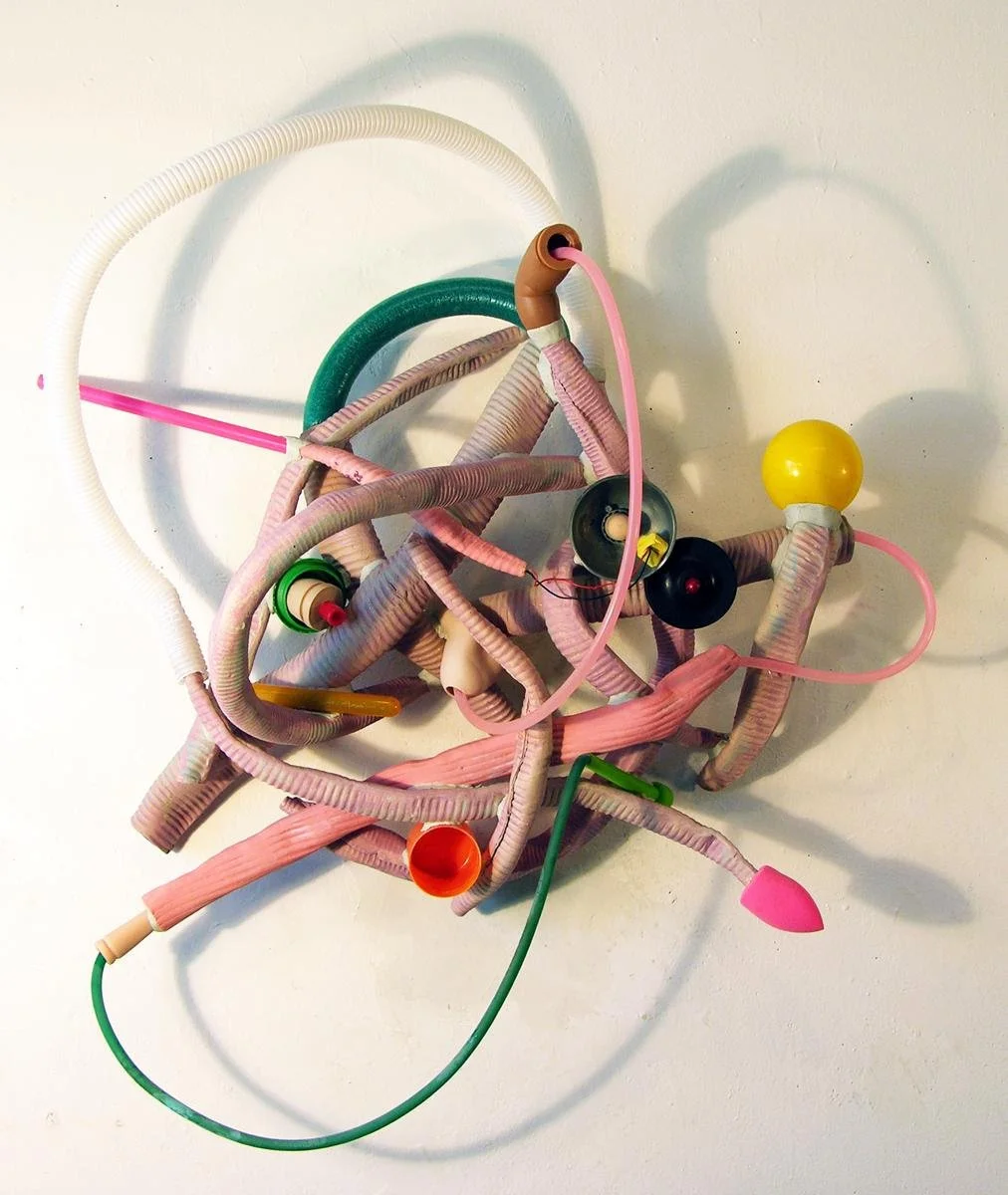
“Aerial Lavender” (ceramic and mixed media), by Linda Leslie Brown, in her show “Entangled,’’ at Kingston Gallery, Boston, through Nov. 28.
Ms. Brown, who lives in Boston, says of her recent work:
“My recent sculptural work draws upon the transformative exchanges between nature, objects and viewers’ creative perception. These works are rife with allusions to the body. At the same time they suggest the plastic, provisional, and uncertain world of a new and transgenic nature, where corporeal and mechanical entities recombine. And because they are small — no larger than a human head — they invite viewers to engage in an intimate examination that is both delightful and disturbing.’’
Paintings from two revered coastal art centers

“Under Dark Sky” (oil on canvas), by Eric Hudson (1864-1932), owned by the Monhegan Museum of Art & History, Monhegan Island, Maine.
The Cape Ann Museum, in Gloucester, Mass., is hosting a special exhibition, “Cape Ann & Monhegan Island Vistas: Contrasted New England Art Colonies,’’ through Feb. 13. It’s in collaboration with the Monhegan Museum of Art & History. The exhibition shows the growth of two of New England’s oldest and most revered summer art colonies. It features works by artists who visited and were inspired by both places, including Theresa Bernstein, Walter Farndon, Eric Hudson, Margaret Patterson, and Charles Movalli.
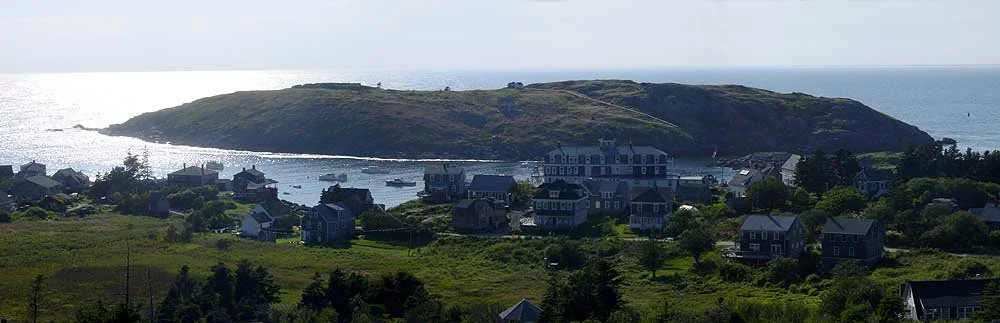
The village of Monhegan on Monhegan Island, with uninhabited Manana Island in the background. Monhegan has fewer than 100 year-round residents.
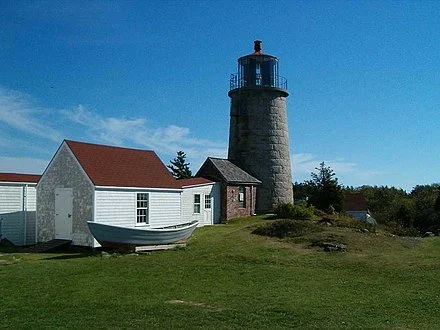
The Monhegan Island Light complex is now run as the Monhegan Museum, with exhibits of the island's natural, social, industrial, cultural and artistic history. The lighthouse tower's light mechanism is still operated by the Coast Guard, but the Monhegan Museum owns the tower and opens it to the public on occasion each summer season.
David Warsh: Competing with expansionist China while managing internal threats to our democracy
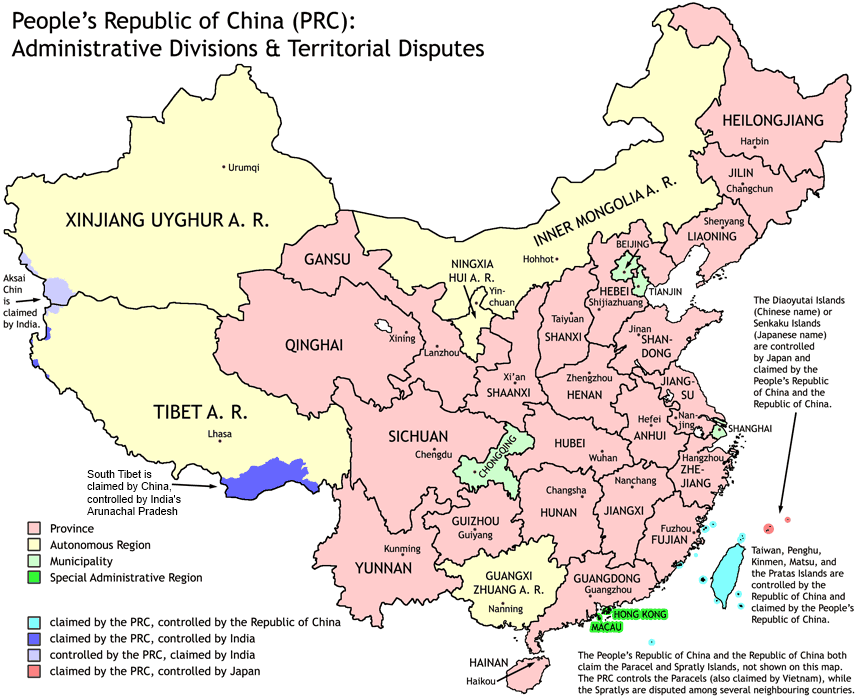
SOMERVILLE, Mass.
I have, at least since 1989, been a believer that competition between the West and China is likely to dominate global history for the foreseeable future. By that I mean at least the next hundred years or so.
I am a reluctant convert to the view that the contest has arrived at a new and more dangerous phase. The increasing belligerence of Chinese foreign policy in the last few years has overcome my doubts.
It was a quarter century ago that I read World Economic Primacy: 1500-1990, by Charles P. Kindleberger. I held no economic historian in higher regard than CPK, but I raised an eyebrow at his penultimate chapter, “Japan in the Queue?” His last chapter, “The National Life Cycle,” made more sense to me, but even then wasn’t convinced that he had got the units of account or the time-scales right.
The Damascene moment in my case came last week after I subscribed to Foreign Affairs, an influential six-times-a-year journal of opinion published by the Council on Foreign Relations. Out of the corner of my eye, I had been following a behind-the-scenes controversy, engendered by an article in the magazine about what successive Republican and Democratic administrations thought they were doing as they engaged with China, starting with the surprise “opening” engineered by Richard Nixon and Henry Kissinger in 1971. I subscribed to Foreign Affairs to see what I had been missing.
In 2018, in “The China Reckoning,’’ the piece that started the row, foreign- policy specialists Kurt Campbell and Ely Ratner had asserted that, for over fifty years, Washington had “put too much faith in its power to shape China’s trajectory.” The stance had been previously identified mainly with then-President Donald Trump. Both Campbell and Ely wound up in senior positions in the Biden administration, at the White House and the Pentagon.
In fact the proximate cause of my subscription was the most recent installment in this fracas. To read “The Inevitable Rivalry,’’ by John Mearsheimer, of the University of Chicago, an article in the November/December issue of the magazine, I had to pay the entry rate. His essay turned out to be a dud.
Had U.S. policymakers during the unipolar moment thought in terms of balance-of-power politics, they would have tried to slow Chinese growth and maximize the power gap between Beijing and Washington. But once China grew wealthy, a U.S.-Chinese cold war was inevitable. Engagement may have been the worst strategic blunder any country has made in recent history: there is no comparable example of a great power actively fostering the rise of a peer competitor. And it is now too late to do much about it.
Mearsheimer’s article completely failed to persuade me. Devotion to the religion he calls “realism” leads him to ignore two hundred years of Chinese history and the great foreign-policy lesson of the 20th Century: the disastrous realism of the 1919 Versailles Treaty that ended World War I and led to World War II, vs. the pragmatism of the Marshall Plan of 1947, which helped prevent World War III. There is no room for moral conduct is his version of realism. It is hardball all the way.
My new subscription led me to the archives, and soon to “Short of War,’’ by Kevin Rudd, which convinced me that China’s designs on Taiwan were likely to escalate, given President Xi Jinping’s intention to remain in power indefinitely. (Term limits were abolished on his behalf in 2018.) By 2035 he will be 82, the age at which Mao Zedong died. Mao had once mused that repossession of the breakaway island nation of Taiwan might take as long as a hundred years.
Beijing now intends to complete its military modernization program by 2027 (seven years ahead of the previous schedule), with the main goal of giving China a decisive edge in all conceivable scenarios for a conflict with the United States over Taiwan. A victory in such a conflict would allow President Xi to carry out a forced reunification with Taiwan before leaving power—an achievement that would put him on the same level within the CCP pantheon as Mao Zedong.
That led me in turn to “The World China Wants,’’ by Rana Mitter, a professor of Chinese politics and history at Oxford University. He notes that, at least since the global financial crisis of 2008, China’s leaders have increasingly presented their authoritarian style of governance as an end in and of itself, not a steppingstone to a liberal democratic system. That could change in time, she says.
To legitimize its approach, China often turns to history, invoking its premodern past, for example, or reinterpreting the events of World War II. China’s increasingly authoritarian direction under Xi offers only one possible future for the country. To understand where China could be headed, observers must pay attention to the major elements of Chinese power and the frameworks through which that power is both expressed and imagined.
The ultimate prize of my Foreign Affairs reading day was “The New Cold War,’’ a long and intricately reasoned article in the latest issue by Hal Brands, of Johns Hopkins University, and John Lewis Gaddis, of Yale University, about the lessons they had drawn from a hundred and fifty years of competition among great powers. I especially agreed with their conclusion:
As [George] Kennan pointed out in the most quoted article ever published in these pages, “Exhibitions of indecision, disunity and internal disintegration within this country” can “have an exhilarating effect” on external enemies. To defend its external interests, then, “the United States need only measure up to its own best traditions and prove itself worthy of preservation as a great nation.”
Easily said, not easily done, and therein lies the ultimate test for the United States in its contest with China: the patient management of internal threats to our democracy, as well as tolerance of the moral and geopolitical contradictions through which global diversity can most feasibly be defended. The study of history is the best compass we have in navigating this future—even if it turns out to be not what we’d expected and not in most respects what we’ve experienced before.
That sounded right to me. Worries exist in a hierarchy: leadership of the Federal Reserve Board; the U.S. presidential election in 2024; the stability of the international monetary system; arms races of various sorts; climate change. Subordinating all these to the China problem will take time.
David Warsh, a veteran columnist and an economic historian, is proprietor of Somerville-based economicprincipals.com, where this essay originated.

UMass at Lowell engineer working on new ways to track Alzheimer’s
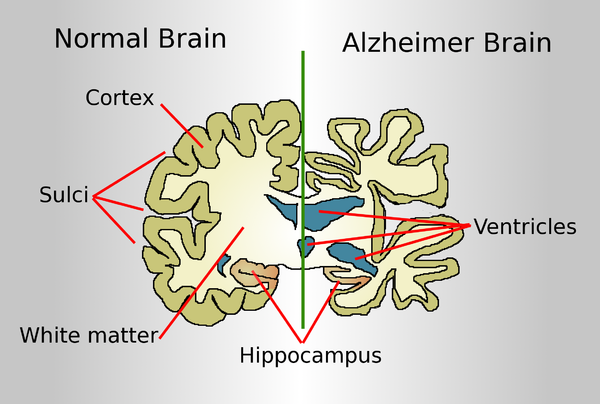
BOSTON
“Joyita Dutta, an electrical engineer from the University of Massachusetts at Lowell, has devoted much of her time to aiding in the fight against Alzheimer’s Disease over the past decade. Her expertise, specifically in image processing and artificial intelligence, has been crucial to this important fight since 2013. With a new funding award, Dutta now has the opportunity to expand her research.
“This funding award, a five-year $2.7 million grant from the National Institutes of Health, will allow Dutta to develop new models of brain imaging to track the progression of Alzheimer’s. The award was originally awarded to Massachusetts General Hospital, which in turn selected her for the project. The computer models Dutta intends to develop with the new funding will be able to predict the buildup of ‘tau tangles,’ proteins that can cluster into tangles in the brain and are associated with the cognitive decline found in Alzheimer’s patients. According to Dutta, UMass Lowell is an ideal place for both her teaching and this type of complex research.
“‘On a campus you are around an enthusiastic bunch of young minds and that is very energizing,’ Dutta said, adding that the university leaders ‘have provided incredible support in helping make all [her] research happen.’
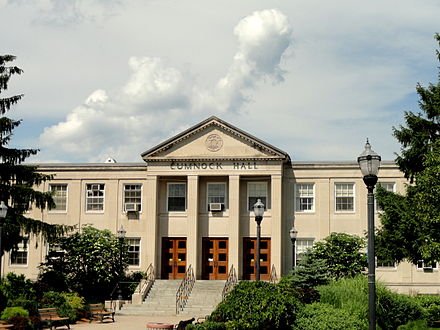
Cumnock Hall at the University of Massachusetts at Lowell

Chris Powell: Yes, married people are healthier and more prosperous than unmarried folks

—Graphic by Samuel James

A black tie wedding reception held at the Society Room in Hartford, Conn. It needn’t be this fancy!
MANCHESTER, Conn.
You’d never know it from the constant clamor by Connecticut’s news organizations and politicians about “domestic violence,” but the wisdom of the ages may still apply insofar as two people can keep living as cheaply as one — at least if they can stand each other. Not all married people in Connecticut or throughout the country are trying to kill their spouses.
For a study published Oct. 5 by the Pew Research Center confirmed the old saying. The study reported that married and romantically partnered couples in the United States are more prosperous and healthier than single people.
The study’s bad news is that the married share of the population has been declining for 30 years and a larger share of the population now remains single well into adulthood.
Of course in theory single life may leave people with more options. Unfortunately their greater chance of getting stuck in poverty or illness may curtail their options. While in some respects people curtail their options by marrying, in other respects their greater prosperity increases their options.
The growth in the single adult population implies the disaster that the country long has been facing with childrearing. Children can’t have too many people to love, protect, and encourage them, but these days millions of children are lucky to have even one parent or guardian and so they start life at a disadvantage, compounded by government’s failure to draw policy conclusions from studies like this new one.
xxx
What has the Republican Party done this year to earn the resounding approval it has gotten in the most recent national poll by the Gallup organization?
Nothing. The Republicans have just sat around like everyone else watching as the incompetence of President Biden and his administration makes the country miss Donald Trump.
According to Gallup, more people now consider the Republicans superior to the Democrats on both economic issues and international affairs. Some polls even show Trump leading Biden in a hypothetical presidential rematch in 2024, though it is hard to imagine Biden maintaining the necessary stamina for even another year.
Of course 2024 is a long way off. But campaigns are already starting for next year’s elections for Congress, and the Democratic majorities there are paper thin. A switch to Republican majorities seems likely.
More than dissatisfaction with the Biden administration would be required to make next year’s Republican nominations for governor and Congress desirable in overwhelmingly Democratic Connecticut. But in addition to crime, Connecticut is full of serious issues that state government long has overlooked. Maybe the national polls will encourage Connecticut Republicans to try getting more relevant.
xxx
Now that the supply of dollars has been cut off with the fall of the U.S. puppet regime in Afghanistan, Reuters reports that officials of Western governments and the United Nations are working to turn the spigot back on to prevent the country’s economic collapse. The new theocratic fascist Taliban government is no more capable of running the country than the puppet regime was. Indeed, Afghanistan is hardly a country at all, more like a grouping of medieval tribes.
The plan, Reuters says, is to get money to the Afghan people without also underwriting the Taliban. This is a silly delusion.
For a gangster regime like the Taliban easily can confiscate whatever it wants from the people, and any money sent to and kept by the Afghans will make them more content to be ruled by the gangsters. But hunger and general privation may encourage Afghans to overthrow the regime.
The Biden administration’s abrupt withdrawal from Afghanistan forfeited to the Taliban military equipment worth hundreds of millions of dollars. The Taliban can sell that equipment to Iran or China and already may have begun to do so. In any case under U.S. occupation the Afghans had their chance to build and sustain a decent government. Being so primitive, most Afghans couldn’t have cared less, and the United States was stupid for thinking they ever might have cared.
If the Afghans are hungry or need medicine, their country has great mineral wealth and can sell the mining rights to China, which, having a gangster regime itself, will have no problem underwriting gangsters elsewhere.
Chris Powell is a columnist for the Journal Inquirer in Manchester.
‘Sorrows of injustice’

Harriet Beecher Stowe House, in Brunswick, Maine, where, between 1850 and 1852, Stowe wrote Uncle Tom's Cabin. Her husband taught at Bowdoin College in the town.
“I wrote what I did because as a woman, as a mother, I was oppressed and broken-hearted with the sorrows of injustice I saw.’’
Harriet Beecher Stowe (1811-1896), New England writer and abolitionist, on her momentous 1862 book Uncle Tom’s Cabin
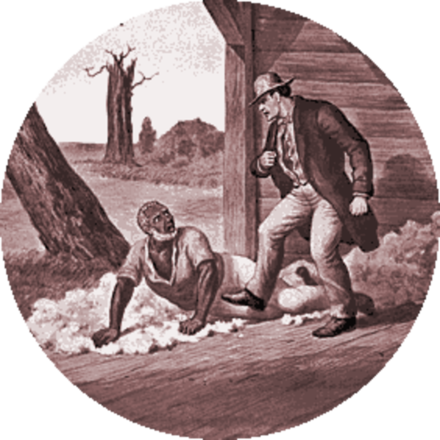
Cruel slaveowner Simon Legree assaults Uncle Tom in the novel.
‘Passing ghosts’

Listen. .
With faint dry sound,
Like steps of passing ghosts,
The leaves, frost-crisp'd, break from the trees
And fall.
— “November Night,’’ by Adelaide Crapsey (1878-2014), an American poet. Originally from Rochester, N.Y., she taught at Miss Lowe's School, in Stamford, Conn., from 1906 to 1908, after which she taught at Smith College, in Northampton, Mass., for two years.
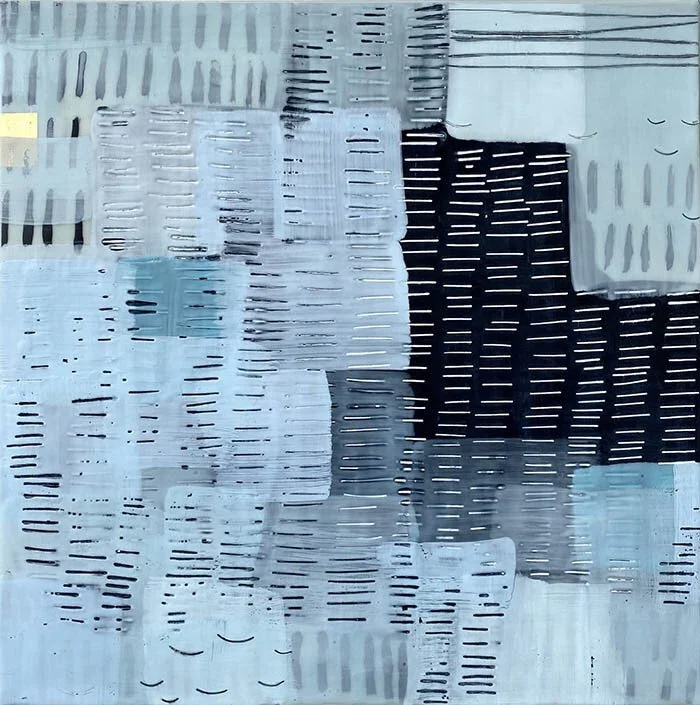
Filing away calm moments
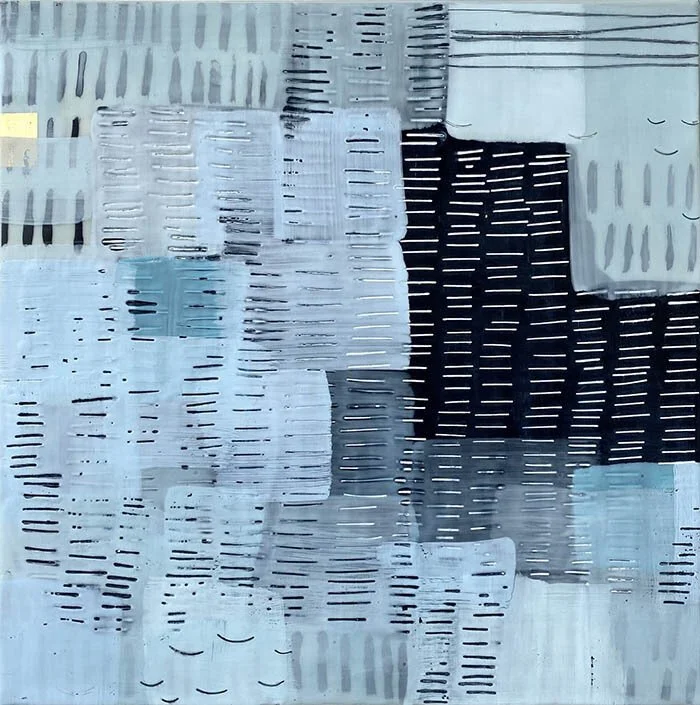
“Dusk III (detail)” (encaustic, oil and 23-karat gold leaf on panel), by Dietlind Vander Schaaf, in her show “We Are Poems,’’ at Bromfield Gallery, Boston, Nov. 3-28. The gallery says that her paintings evoke brief moments of balance and stillness.
She lives in Portland, Maine.
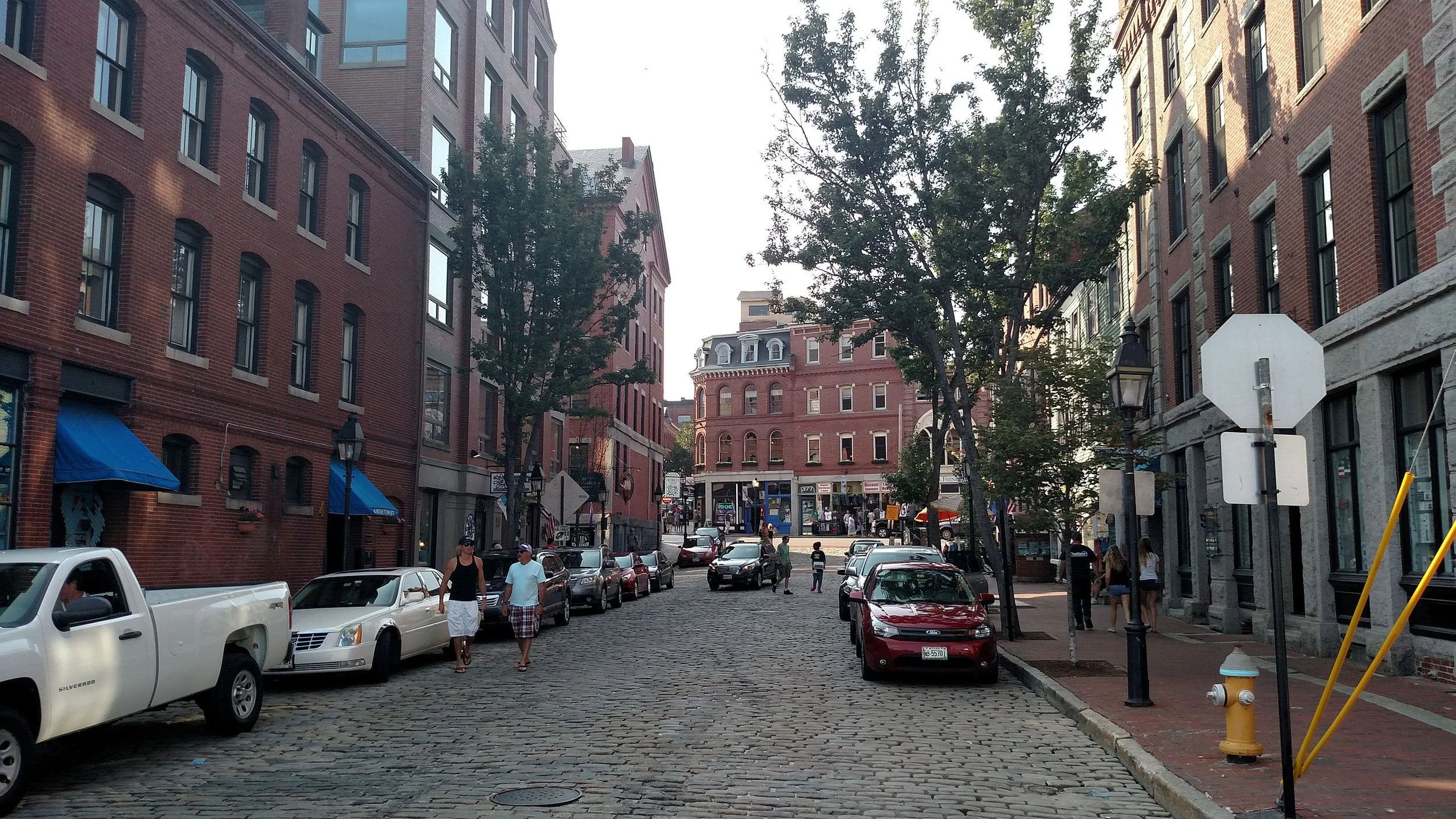
Moulton Street in Portland’s Old Port section. The city is a major arts center.
— Photo by Bd2media
Todd McLeish: Some photographers are dangerously disturbing birds

From ecoRI News (ecori.org)
The increasing popularity of bird photography and the desire of photographers to showcase their images on social media is raising concerns that birds are being harassed and disturbed, leading to potentially harmful effects on their health.
Bird-conservation organizations around the globe, from the National Audubon Society to Britain’s Royal Society for the Preservation of Birds, are asking bird photographers to avoid getting too close and reminding the photographers of the codes of ethics that many wildlife photography organizations have established.
Local wildlife advocates have noted that it’s also an increasing problem in Rhode Island.
“It’s definitely a problem here, and it’s getting worse,” said one longtime birder who wished to remain anonymous for fear of reprisals. “There are more photographers, and there are more forums that photographers can post their photos on. It’s an ego trip for them. They want to post their photos and get likes, and that leads them to harass the birds.”
Laura Carberry, refuge manager at the Audubon Society of Rhode Island’s Fisherville Brook Wildlife Refuge, and Rachel Farrell, a member of the Rhode Island Avian Records Committee, said getting too close to wild birds can pose serious dangers to them. Birds see people as predators, and when people approach, the birds must stop feeding and instead exert extra energy they may not have to escape the area. They also may be forced to leave their nests unattended, making their eggs and chicks vulnerable to predation, thermal stress, or trampling.
When a rare European bird was discovered at Snake Den State Park, in Johnston, R.I., last year and birders and photographers flocked to the site to observe the visitor, some photographers chased the bird across a farmer’s fields to get better photographs. Birders say that is a common occurrence whenever rarities are discovered.
Owls are particularly sensitive to disturbance, Farrell said, and the managers of Swan Point Cemetery, in Providence, have resorted to putting yellow caution tape from tree to tree around an area where great horned owls have nested in recent years to keep photographers from going too close.
“I remember seeing a photographer banging a stick against the bottom of a tree to get an owl to come out of its hole,” Farrell said.
Other birders recalled when a photographer played a recording of a screech owl for so long that one of the nestlings almost fell out of the nest because it was so distressed by the recording.
According to Carberry, Audubon has occasionally had to close parts of its refuges when owl nests have been discovered because photographers go off trail and disturb habitats to approach the nest. The organization has asked birders not to report where owls are nesting until after the breeding season to reduce the problem.
“We often tell people that if the bird is looking at you, you’re too close,” she said.
It’s not just a problem with photographers, however. Some birdwatchers are also at fault for similar behaviors. Some will play audio recordings of bird songs to attract the birds out into the open, for example, a practice condemned by ornithologist Charles Clarkson, the director of avian research at the Audubon Society of Rhode Island.
“The daily energetic demands of birds are extremely high, even when they are not actively nesting,” he said. “Distracting birds from essential tasks — foraging, preening, defending territory — can leave them in an energy deficit, which is difficult to make up,” he said. “To lure birds in using taped calls can have serious negative consequences for individual birds and even local bird populations where taped calls are used regularly. It’s best to leave birds be and use your own power of observation to find as many as possible.”
How to resolve the problem is unclear. Enforcing codes of ethics is difficult, and speaking up sometimes results in abusive responses. The Atlantic Flyway Shorebird Initiative is surveying birders and bird photographers to assess the scale of the problem and to see if educational messaging and communication tools could be developed to address the issue.
“I think folks lose sight of what they may be doing to the species they are trying to get a glimpse of or take a photo of,” Carberry said. “They should always think of the bird first and think if they are impacting it in any way. I think that if they put the birds’ needs first, they would be more careful about approaching a nest or getting a little too close.”
Rhode Island resident and author Todd McLeish runs a wildlife blog.