
Vox clamantis in deserto







Worried about water

Still video image from Amy Kaczur’s video series “Messages From the Marsh,’’ at Kingston Gallery, Boston, for July.
The Boston-based artist’s Web site says:
“Amy’s work is grounded in environmental concerns, community and language. Her latest projects are fueled by a sense of urgency related to water issues, specifically coastal flood zones and rising sea levels. Her work resides within the natural world; along with sensory stimulation and deep wonderment, following closely is the sense of perilous climate change and ecological grief. Amy grew up outside Cleveland, with family ties working in farming, food industry, mills, and coal mines in rural Southern Ohio to the edges of Appalachia. Those roots impacted her experience of landscape and environmental issues such as pollution and climate change, and the multilayered struggles between land use and conservation. Along with examining these issues in her art practice, she works at Massachusetts Institute of Technology as the group administrator for two research labs focused on air and water pollution, climate change, and clean energy development and storage. She continuously develops her art practice, supported by relentless research, discovery by experiment, and the pleasure of inquisitive searching.’’

Common reed (Phragmites australis), an invasive species in degraded marshes in New England.
— Wikipedia photp
Oh, for a plate of steamers!
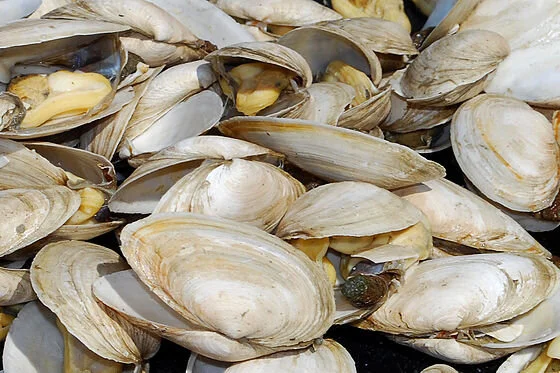
“Today, no summer is really perfect for the New Englander until, napkin under china, he has eaten his fill of fresh steamed clams, dipped in broth and then in melted butter.’’
— From Secrets of New England Cooking (1947), by Ella Shannon Bowles and Dorothy S. Towler.
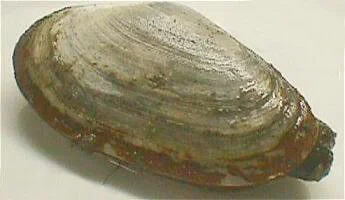
Alas, it’s much harder these days to find restaurants that serve the disappearing (because of environmental changes) soft-shelled clams that we called “steamers.’’
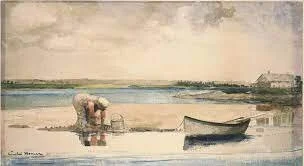
“Clamming” {in Maine} (1887), by Winslow Homer.
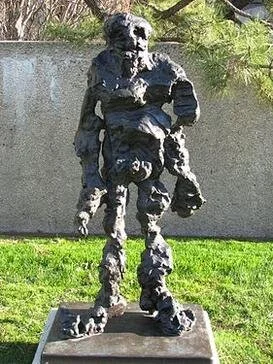
“Clamdigger” (bronze), by Willem de Kooning.

Phil Galewitz: In Maine (and elsewhere) a crisis in finding and keeping home-health-care workers

CASTINE, Maine
For years, Louise Shackett has had trouble walking or standing for long periods, making it difficult for her to clean her house in southeastern Maine or do laundry. Shackett, 80, no longer drives, which makes it hard to get to the grocery store or doctor.
Her low income, though, qualifies her for a state program that pays for a personal aide 10 hours a week to help with chores and errands.
“It helps to keep me independent,” she said.
But the visits have been inconsistent because of the high turnover and shortage of aides, sometimes leaving her without assistance for months at a time, although a cousin does help look after her. “I should be getting the help that I need and am eligible for,” said Shackett, who has not had an aide since late March.
The Maine home-based care program, which helps Shackett and more than 800 others in the state, has a waitlist 925 people long; those applicants sometimes lack help for months or years, according to officials in Maine, which has the country’s oldest population. This leaves many people at an increased risk of falls or not getting medical care and other dangers.
The problem is simple: Here and in much of the rest of the country there are too few workers. Yet, the solution is anything but easy.
Katie Smith Sloan , CEO of Leading Age, which represents nonprofit aging- services providers, says the workforce shortage is a nationwide dilemma. “Millions of older adults are unable to access the affordable care and services that they so desperately need,” she said at a recent press event. State and federal reimbursement rates to elder care agencies are inadequate to cover the cost of quality care and services or to pay a living wage to caregivers, she added.
President Biden allotted $400 billion in his infrastructure plan to expand home and community-based long-term-care services to help people remain in their homes and out of nursing homes. Republicans pushed back, noting that elder care didn’t fit the traditional definition of infrastructure, which generally refers to physical projects such as bridges, roads and such, and the bipartisan deal reached last week among centrist senators dealt only with those traditional projects. But Democrats say they will insist on funding some of Biden’s “human infrastructure” programs in another bill.
As lawmakers tussle over the proposal, many elder care advocates worry that this $400 billion will be greatly reduced or eliminated.
But the need is undeniable, underlined by the math, especially in places like Maine, where 21 percent of residents are 65 and older.
Betsy Sawyer-Manter, CEO of SeniorsPlus in Maine, one of two companies that operate that assistance program, said, “We are looking all the time for workers because we have over 10,000 hours a week of personal care we can’t find workers to cover.”
Caring for an Aging Nation
The number of Americans 65 and older is expected to nearly double in the next 40 years. Finding a way to provide and pay for the long-term health services they need won’t be easy.
For at least 20 years, national experts have warned about the dire consequences of a shortage of nursing assistants and home aides as tens of millions of baby boomers hit their senior years. “Low wages and benefits, hard working conditions, heavy workloads, and a job that has been stigmatized by society make worker recruitment and retention difficult,” concluded a 2001 report from the Urban Institute and Robert Wood Johnson Foundation.
Robyn Stone , a co-author of that report and senior vice president of Leading Age, says many of the worker shortage problems identified in 2001 have only worsened. The risks and obstacles that seniors faced during the pandemic highlighted some of these problems. “COVID uncovered the challenges of older adults and how vulnerable they were in this pandemic and the importance of front-line care professionals who are being paid low wages,” she says.
Michael Stair, CEO of Care & Comfort, a Waterville, Maine-based agency, said the worker shortage is the worst he’s seen in 20 years in the business.
“The bottom line is it all comes down to dollars — dollars for the home care benefit, dollars to pay people competitively,” he said. Agencies like his are in a tough position competing for workers who can take other jobs that don’t require a background check, special training or driving to people’s homes in bad weather.
“Workers in Maine can get paid more to do other jobs that are less challenging and more appealing,” he added.
His company, which provides services to 1,500 clients — most of whom are enrolled in Medicaid, the federal-state health program for people with low incomes — has about 300 staffers but could use 100 more. He said it’s most difficult to find workers in urban areas such as Portland and Bangor, where there are more employment opportunities. Most of his jobs pay between $13 and $15 an hour, about what McDonald’s restaurants in Maine advertise for entry-level workers.
The state’s minimum wage is $12.15 an hour.
Stair said half his workers quit within the first year, a little better than the industry’s average 60% turnover rate. To help retain employees, he allows them to set their own schedules, offers paid training and provides vacation pay.
“I worry there are folks going without care and folks whose conditions are declining because they are not getting the care they need,” Stair said.
Medicare does not cover long-term home care.
Medicaid requires states to cover nursing home care for those who qualify, but it has limited entitlement for home-based services, and eligibility and benefits vary by state. Still, in the past decade, states including Maine have increased funding to groups providing Medicaid home and community services — anything from medical assistance to housekeeping help — because people prefer those services and they cost much less than a nursing home.
The states also are funding home-care programs like Maine’s for those same services for people who don’t qualify for Medicaid in hopes of preventing seniors from needing Medicaid coverage later.
But elder care advocates say the demand for home care far outweighs supply.
Bills in the Maine legislature would increase reimbursement rates for thousands of home care workers to ensure they are being paid more than the state’s minimum wage.
The state does not set worker pay, only reimbursement rates.
It’s not just low pay and lack of benefits that hobbles the hiring of workers, according to experts who study the issue. In addition, home care providers struggle to recruit and retain workers who don’t want the stress of caring for people with physical disabilities and, often, mental health issues, such as dementia and depression, said Sawyer-Manter of SeniorsPlus.
“It’s backbreaking work,” said Kathleen McAuliffe, a home-care worker in Biddeford, Maine, who formerly worked as a Navy medic and served in the Peace Corps. She provides homemaker services for a state-funded program run by Catholic Charities. She usually visits two clients a day to help them with chores like cleaning and scrubbing floors, wiping down bathrooms, vacuuming, preparing meals, food shopping, organizing medicines and getting them to the doctor.
Her clients range in age from 45 to 85. “When I walk in, the laundry is piled up, the dishes are piled up, and everything needs to be put in order. It’s hard work and very taxing,” said McAuliffe, 68.
She makes about $14 an hour. Though the job of taking care of the frail elderly requires broad skills — and training in things like safe bathing — it is generally classified as “unskilled” labor. Working part time, she gets no vacation benefits. “Calling us homemakers sounds like we are coming in to bake brownies,” she said.
The homemaker program serves 2,100 Maine residents and has more than 1,100 on a waitlist, according to Catholic Charities Maine. “We can’t find the labor,” said Donald Harden, a spokesperson for the organization.
The federal government is giving states more dollars for home care — at least temporarily.
The American Rescue Plan, approved by Congress in March, provides a 10 percentage point increase in federal Medicaid funding to states, or nearly $13 billion, for home and community-based services.
The money, which must be spent by March 2024, can be used to provide personal protective equipment to home care workers, train workers or help states reduce waiting lists for people to receive services.
For Maine, the bump in funding from the American Rescue Plan will provide a $75 million increase in funding. But Paul Saucier, aging and disability director at the Maine Department of Health and Human Services, said the money will not make the waitlists disappear, because it will not solve the problem of too few workers.
Joanne Spetz, director of the Health Workforce Research Center on Long-Term Care at the University of California-San Francisco, said throwing more money into home care will work only if the money is targeted for recruiting, training and retaining workers, as well as providing benefits and opportunities for career growth. She doubts significant improvements will occur “if we just put money out there to hire more workers.”
“The problem is the people who are in these jobs always get the same amount of pay and the same low level of respect no matter how many years they are in the job,” Spetz said.
Phil Galewitz is a Kaiser Health News reporter.
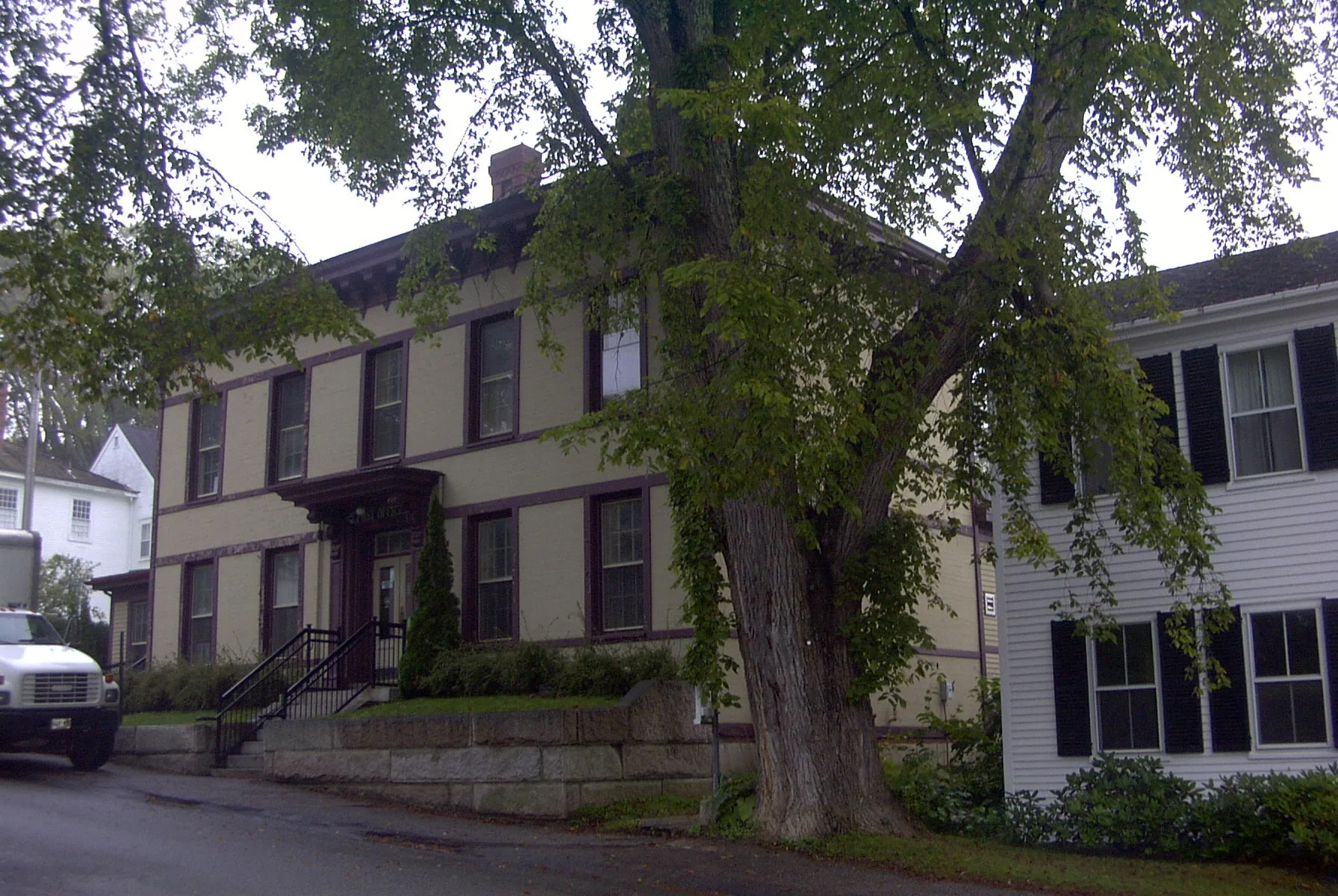
Established in 1794 and in the same building (at left) since 1833, the Castine Post Office is one of the United States's oldest post offices in continuous operation.
It's a complicated love affair

“Lovers,’’ by Daniel Ludwig, in his show at Dedee Shattuck Gallery, Westport, Mass., though Aug. 1.
The gallery says: “Daniel Ludwig is an artist who works in oil paint, charcoal and, more recently, acrylic paint on printed digital backgrounds. In his work, dreamlike figurative elements are embedded in a complex web of biomorphic shapes, patterns, and colors. Classically rendered figurative elements interact with echoed silhouettes and textures in a way that portray the ambiguity of a world both deeply tangible and alluringly ephemeral.’’
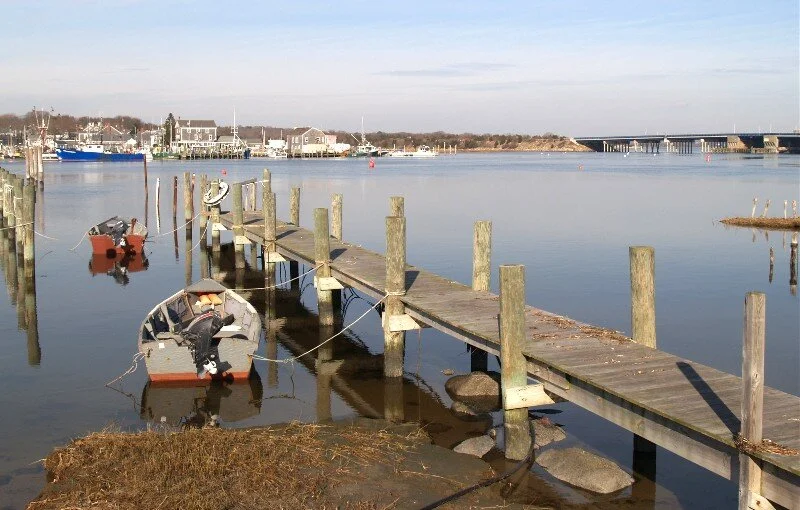
The Westport River in the winter.
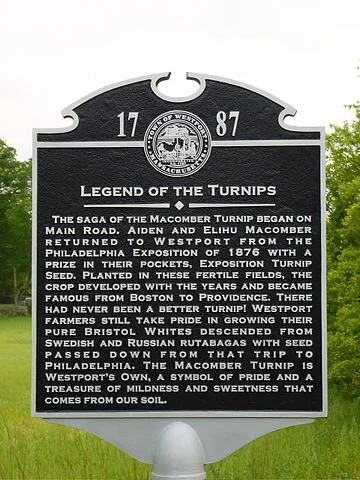
Westport still has a substantial farming sector, including vineyards.
Is elite club crisis silly?
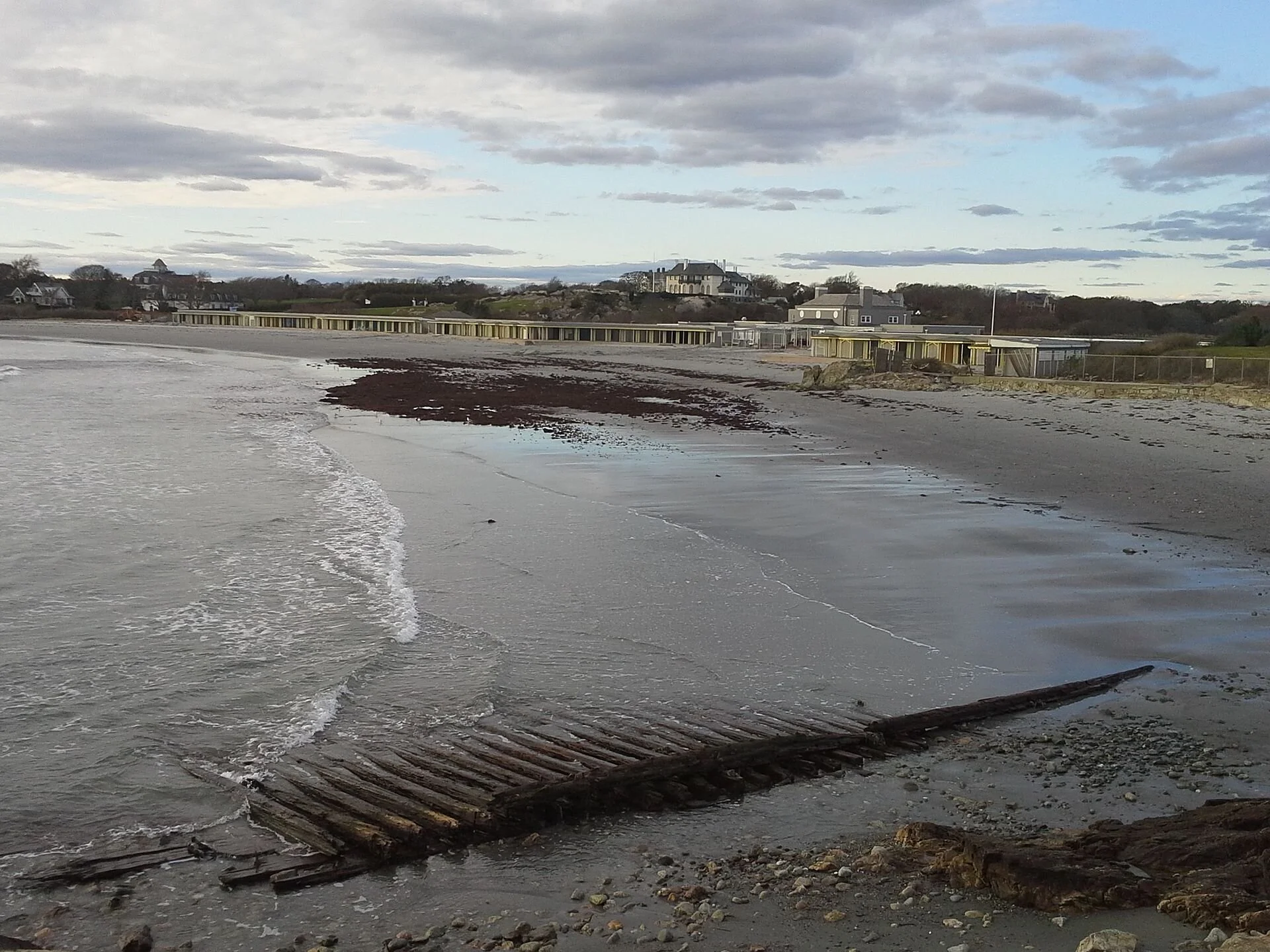
Bailey’s Beach Club in 2012, with “Rejects’ Beach’’ in the foreground, soon after Superstorm Sandy. You can safely predict that a major hurricane will destroy the club’s facilities.
— Photo by Swampyank
From Robert Whitcomb’s “Digital Diary,’’ in GoLocal24.com
The latest controversy over U.S. Sen. Sheldon Whitehouse’s association with the elite, WASPy Bailey’s Beach Club, in Newport, has gone viral after being launched by GoLocal. (I prefer the silly-sounding real name of the club – the Spouting Rock Beach Association.) His wife is a member.
I don’t care much about politicians’ associations in their private life; it’s their public-policy positions that primarily interest me. But I suppose that any story about Newport’s summer creatures, blue-blooded or otherwise, has its allure. Many folks consider Newport an exotic place.
Jack Nolan, Bailey Beach’s general manager, told The Boston Globe that the club’s members and their families have included people of “many racial, religious, and ethnic backgrounds from around the world who come to Newport every summer.” Remarkable, if true…. In any event, for decades the club had reputation of being all white as well as anti-Semitic. Since it’s a private social and recreational organization it presumably doesn’t have to identify its members.
I have no idea what the club’s current diversity is or how it might change. It’s not in my solar system.
The first of a couple of times I went there was as a guest of the late Rhode Island Gov. Bruce Sundlun, who was Jewish. I also remember a couple of kids of color playing on the beach – a member’s grandchildren?
The beach itself is not very attractive – gray sand and, when I was there, ridges of seaweed with bugs flying over them. And the current clubhouse was uninteresting. It will probably be destroyed by the next big hurricane. But all was quiet and low key.
As with most membership clubs, the members clearly like being in a place where they know most everybody, including the staff, which treats them in a way recalling domestic servants. Very cozy and soothing. And for public servants such as Senator Whitehouse it must be pleasant to be in a place whose genteel tradition discourages harassing fellow members over politics or indeed anything else
Back when I was a newspaper editor I noticed that when I had a business lunch with a politician or other public figure, we were less likely to be bothered at a club than at a restaurant. And many people enjoy being taken to a meal at clubs, away from the clatter and crowds of restaurants.
No wonder such institutions are a refuge for the privileged
There are now far fewer clubs around that are overtly discriminatory than a few decades ago. Back then the bias at the old WASP clubs, many of which were founded in the late 19th Century with money made in the Industrial Revolution, led to creation of golf, yacht and other clubs that catered to America’s newer groups. So there were “Jewish country clubs,” “Italian country clubs,” “Irish country clubs,’’ and so on. Of course, racism generally kept Black people out of fancy clubs.
I can remember when Roman Catholics were excluded from many old golf clubs and yacht clubs in New England towns, in one of which I grew up in. The election of John F. Kennedy to the presidency helped open them up. In the end, the old clubs needed the initiation fees and dues money from “new” groups that were rising socio-economically.
Around here, I’ve only been a member of one club – the Providence Art Club, whose 16 co-founders (in 1880) included 10 men, including the distinguished African-American painter Edward Bannister, and six women. I’m no longer a member, though my wife, a painter, is. The club has a public educational and cultural mission, by the way.
Folks will always tend to coalesce into groups with whom they share certain background elements, attitudes and social behaviors. So clubs like Bailey’s Beach won’t go away, though they’ll change their memberships as America’s demographics change. They’ll need the dues money.
Meanwhile, given that the U.S. Senate is mostly a white male millionaires’ club, I’m sure that others besides Sheldon Whitehouse have some connections with exclusive (ethnically or otherwise) institutions. The GoLocal stories might lead media around the country to check into them. The voters can decide how important or trivial these associations are in the broad scheme of things.
‘Life is earnest!’

An 1891 illustration to go with poem
What the heart of the young man said to the Psalmist
Tell me not, in mournful numbers,
Life is but an empty dream!
For the soul is dead that slumbers,
And things are not what they seem.
Life is real! Life is earnest!
And the grave is not its goal;
Dust thou art, to dust returnest,
Was not spoken of the soul.
Not enjoyment, and not sorrow,
Is our destined end or way;
But to act, that each tomorrow
Find us farther than today.
Art is long, and Time is fleeting,
And our hearts, though stout and brave,
Still, like muffled drums, are beating
Funeral marches to the grave.
In the world’s broad field of battle,
In the bivouac of Life,
Be not like dumb, driven cattle!
Be a hero in the strife!
Trust no Future, howe’er pleasant!
Let the dead Past bury its dead!
Act —act in the living Present!
Heart within, and God o’erhead!
Lives of great men all remind us
We can make our lives sublime,
And, departing, leave behind us
Footprints on the sands of time;—
Footprints, that perhaps another,
Sailing o’er life’s solemn main,
A forlorn and shipwrecked brother,
Seeing, shall take heart again.
Let us, then, be up and doing,
With a heart for any fate;
Still achieving, still pursuing,
Learn to labor and to wait.
“A Psalm of Life,’’ by Henry Wadsworth Longfellow (1807-1882). He remains one of the most famous New England poets.

Longfellow’s grave in Mt. Auburn Cemetery, in Cambridge, where many other famous New Englanders are buried.

Llewellyn King: About the border wall: U.S. immigration policy must be ad hoc

Trump stands in front of a section of border wall near Yuma, Ariz., in June 2020
WEST WARWICK, R.I.
Going to the border and harrumphing won’t solve the very real immigration problem, which pits our humanity against our sovereign entitlement to say what kind of people we are.
We are not alone in this struggle.
The world is on the move. Untold millions of people who live south of our border with Mexico want to move north. Equally untold millions who live in Africa would like to move to Europe; and millions in eastern Europe want to live in western Europe.
From the Indian subcontinent, millions would like to move to Europe, especially to Britain. Millions of East Asians have their eyes set on Australia.
Within these areas, people also are on the move. Millions from Venezuela have flooded their neighboring countries. Likewise in Africa, where war and famine are ever present, people try and walk to a marginally better future in another country. In the Middle East, Jordan and Lebanon are flooded with refugees first from Palestine, then from Iraq and Syria.
As The Economist pointed out recently, a slum in Spain is incalculably superior to a slum in Kenya.
The drivers for migration are poverty, violence, crop failure and political collapse. And persecution, ethnic and religious; for example, the Rohingya in Myanmar have sought refuge in Bangladesh.
The goal of the migrant is the same worldwide: a better, safer life.
The political price paid by the stable democracies continues to be huge. It played a role in Donald Trump’s election and will play a role in the next presidential election, whether Trump runs or not. It was the great driver for Brexit and Britain’s seeming self-harming. It has driven the move of Hungary, under Viktor Orban, to autocracy.
It is hard to stop people who have nothing to lose from crossing a frontier if they can. But they aren’t the only migrants. Some, a small number, are opportunists. These are the migrants who overstay student visas, manipulate qualifications for residence, and willfully circumvent the law or contract so called green card marriages.
But they aren’t what the border crisis is about -- any more than it is what the overloaded boats crossing the Mediterranean Sea is about. It is the physical manifestation of desperation.
Because the migration problem is so complex – human problems are almost by definition complex— it isn’t a matter of resolution so much as management. We want, for example, immigrants with high-tech skills, but we are worried about the impact of millions of desperate peasants walking across the deserts.
Now a new driver of migration has opened: global warming. The heat and drought hitting the U.S. West Coast are also hitting Central America and will affect livability.
Adding to the complexity of the immigration conundrum is the labor shortage. Construction depends on immigrant labor, farming on contract labor, and slaughterhouses and chicken processors can’t stay open without immigrants to do the unappealing work.
One small step forward would be a sensible work permit.
It seems to me that the wall -- Trump’s wall – isn’t a bad thing. It is a declaration, a symbol. It won’t deter desperate people and it won’t end smuggling. The latter is going to get worse with drones and even autonomous aircraft that can bring their lethal cargoes deep into the United States.
While there is an insatiable market for drugs here, smuggling will continue and even increase. And while that is so, lawlessness south of the border will accelerate.
Sadly, despite Vice President Kamala Harris’s statements, we aren’t going to repair the countries to our south overnight. But we might look to repairing our drug policy, seeing if that can be adjusted to take the profit out of the trade. Except for the gradual, local legalization of marijuana, we haven’t contemplated drug management, short of prohibition, in a century. A new look is due.
There is no single policy that is going to solve the human misery south of the border which drives so many to risk their lives or, through love, to send their children north.
Therefore immigration policy will never be a total, sweeping thing, but rather an ad hoc affair: We need some immigrants, we don’t want others; we have big hearts, but we fear immigration that is unchecked.
We fear the political, cultural and social change that immigrants will bring, especially if they are of a common language and background. Pain in Central America is political torture in the United States.
Llewellyn King is executive producer and host of White House Chronicle, on PBS. His email is llewellynking1@gmail.com. He’s based in Rhode Island and Washington, D.C.
Web site: whchronicle.com
Loaded for tall tales

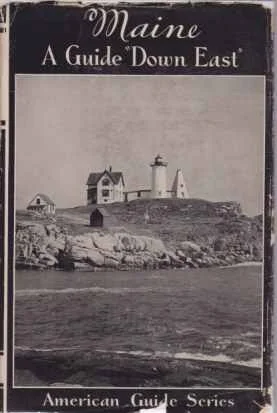
“And tall tales they are! There was the man who shot five bears with one bullet, the man who shot one bear for each day of the year, the man who invented the slow bullet, and the man who fashioned a curved rifle barrel so efficient that when he shot from his door he had to pull in his head to escape the bullet coming around the house.’’
— From the WPA’s 1937 book Maine: A Guide ‘‘Down East’’
Hope in the abstract

“Hope Dreams” (mixed media on canvas), by Francois Bonnel, in the French painter and photographer’s show at Lanoue Gallery, Boston, through Aug. 2
Caitlin Faulds: Ammonia from agriculture threatens bays
— Photo by Ben Salter
From ecoRI News (ecori.org)
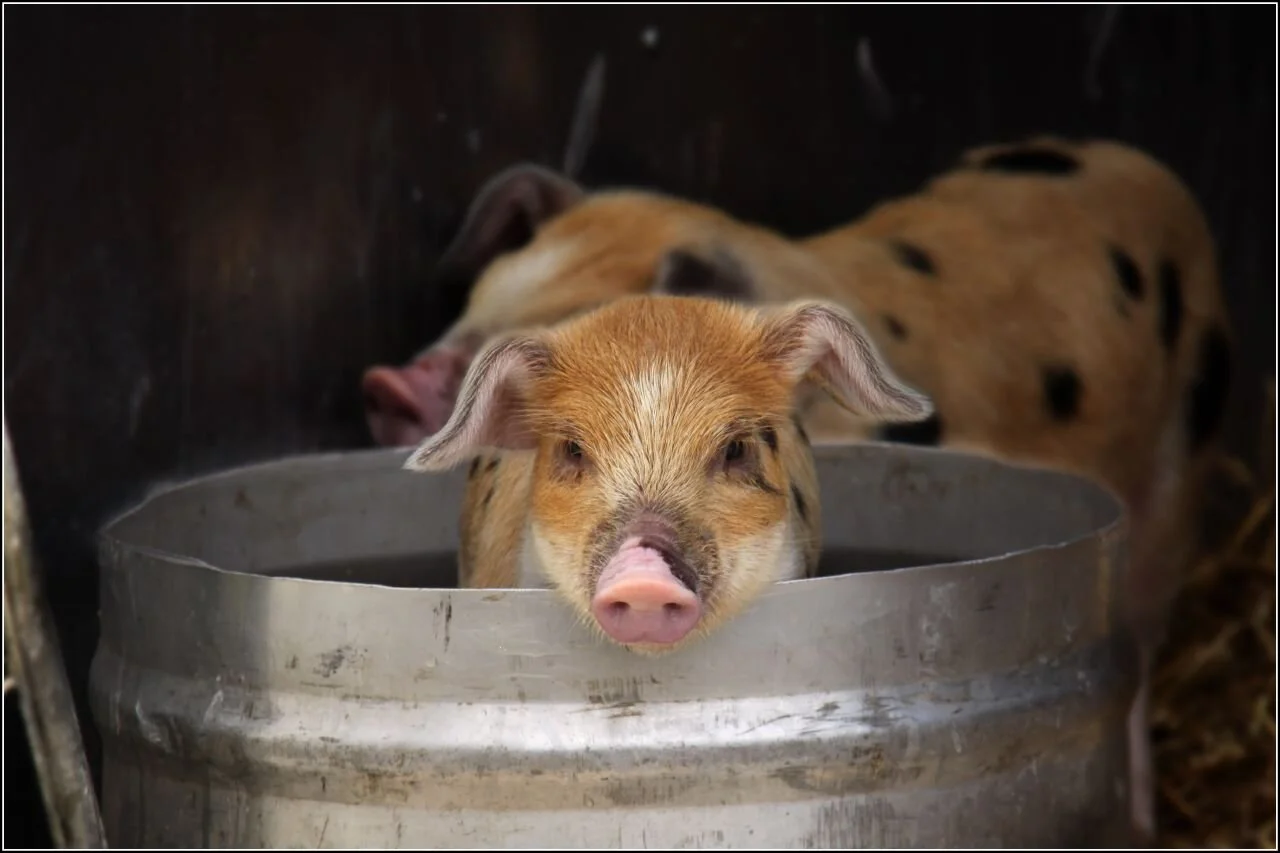
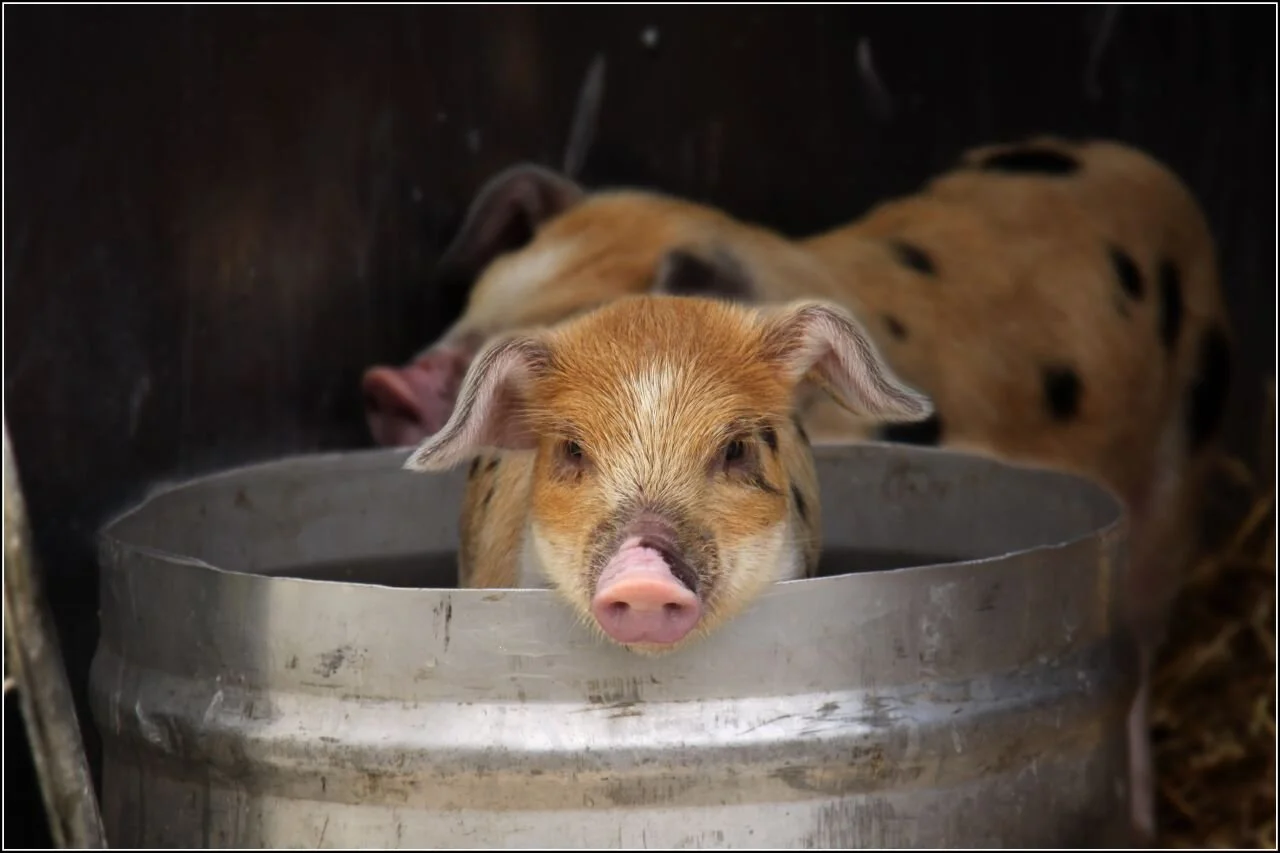
National regulations are needed to limit harmful ammonia emissions from agricultural sources and prevent knock-on soil and water degradation in sensitive estuary ecosystems, such as Narragansett Bay, according to a study recently published in Atmospheric Environment.
The study, completed by a team at Brown University’s Institute at Brown for Environment and Society, analyzed wet-deposited ammonium, or ammonium incorporated into rainfall, in Providence in 2018 to find that agricultural rather than city-based sources are most likely to blame for recent increases in urban ammonium levels.
“The ammonium we measured in precipitation has a significant non-local contribution, which does seem to be transported from what we believe to be agricultural regions,” said lead author Emmie Le Roy, who conducted research as a Brown University undergraduate and will begin a Ph.D. at the Massachusetts Institute of Technology this fall.
The levels of nitrate deposition, which come from nitroge-oxide emissions, in the Narragansett Bay area have decreased substantially in the past decades because of the federal Clean Air Act and other regulatory changes, according to co-author Emily Joyce, who published another paper on the topic last year.
Improvements in wastewater-treatment systems, too, have reduced nitrogen input to Narragansett Bay by nearly 60 percent, Joyce said. “That was definitely what they needed to focus on” to get a handle on the problem then, she said, but there’s been “nothing done to atmospheric deposition.”
Joyce’s atmospheric measurements, the first done in 30 years, showed ammonium deposition had risen to six times the amount in 1990.
“If there’s more ammonium, then there’s going to be more algae blooms and fish kills,” Joyce said. “And so from a water quality standpoint … you really want to figure out where that’s coming from and try to mitigate that.”
But to mitigate ammonium, regulators need to know where to focus their efforts — and this is what Le Roy’s research sought to address.
Her team studied the stable isotopes, or chemical signatures, of ammonium in more than 200 precipitation samples collected at Brown University from January to November 2018 to determine where the emissions came from.
“You can think of them as being sort of like a fingerprint that is distinct for different source types,” Le Roy said of the isotopic signatures.
Ammonium from close-range, urban sources, namely vehicle emissions and fossil-fuel combustion, would typically have a higher isotopic composition, according to Wendell Walters, Brown University associate professor and a co-author of the study. While ammonium from agricultural sources, including animal waste and fertilizer, would have a lower isotopic composition.
By scouring weather station databases, the team also found storm systems that developed over land carried significantly more ammonium than those originating over marine or coastal areas. This data supported long-range agricultural sources as the origin of ammonium deposits.
During the past seven decades global emissions of ammonia have more than doubled from 23 to 60 teragrams annually — one teragram is a billion kilograms or 2.2 billion pounds. Researchers say the increase is tied to rising ammonia emissions from industrial agriculture. The ability to grow crops depends on nitrogen, a critical plant nutrient. However, an overabundance of nitrogen, in animal waste and in excess fertilizer, can turn into gaseous ammonia.
When ammonia enters the atmosphere, it combines with pollutants — mainly nitrogen and sulfuric-oxide compounds produced by the burning of fossil fuels — to form fine-particle air pollution that can travel long distances.
Though the exact location is hard to pinpoint, Le Roy said wind patterns indicate that ammonium emissions are showering down onto Providence from states as far away as California, or even across the Pacific Ocean.
The wet deposition of ammonium is a global-scale problem, Walters said, and one that needs regulatory attention to prevent further acidification and eutrophication of sensitive ecosystems.
“It’s not something that the city of Providence could tackle on their own since there’s this large intrastate transport phenomenon occurring with the deposition,” Walters said. “But we may need to address the importance of incorporating ammonia regulations in the future — and that would have to be more at the national scale.”...
Caitlin Faulds is an ecoRI News journalist.
A green but dry Vermont
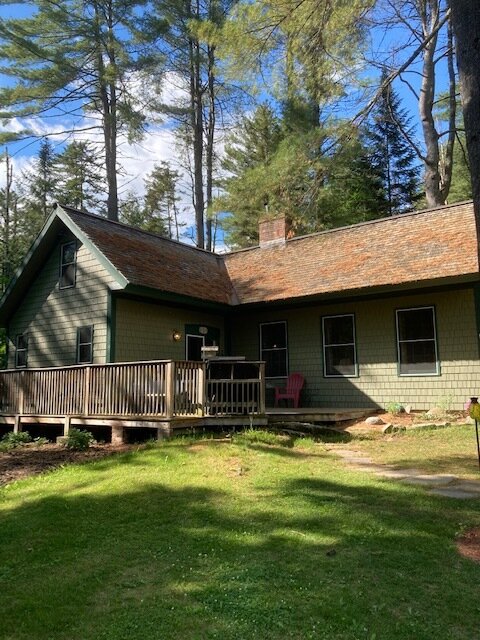
“Rock Bottom” cabin
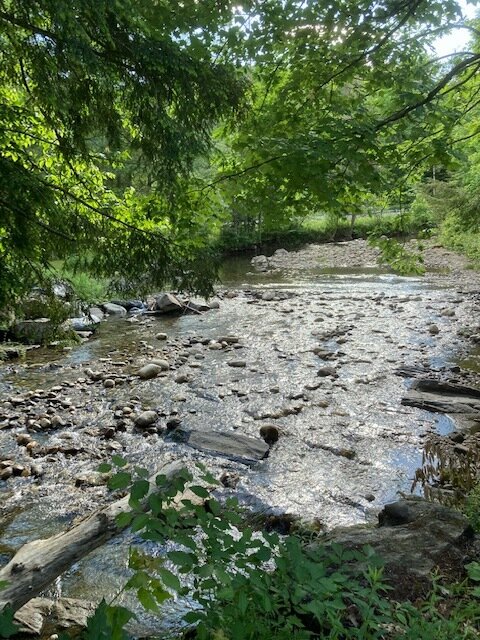
Low water
From Robert Whitcomb’s “Digital Diary,’’ in GoLocal24.com
I spent much of the week before last mostly alone in a cabin (called “Rock Bottom”) by a trout stream in Vermont. It was sometimes a bit lonely but I did a lot of reading for pleasure, with delightfully little of it any use in work.
The owners of the cabin lived in a house in the woods up the rocky hill from the cabin. They are Mormons and so, as usually the case (at least in my experience) were very nice – available to chat but otherwise busying themselves with grass cutting and other chores on their spread, mostly out of my sight lines. I’d sometimes spot them in the distance reading on a bench by the little river, a scene that reminded me of an Impressionist painting.
The founder of the Church of Latter Day Saints (the Mormons), Joseph Smith, was born and spent some of his boyhood in nearby Sharon, Vt., where his parents were farmers. Many of the first Mormons hailed from rural New England before heading west.
Sadly, there were no trout in the stream, at least so far as I could see. While Vermont (as befits the French origin of its name – Green Mountain) looked verdant, the rivers and lakes were very low, as they are in most of northern New England now, and locals fear a bad forest-fire season. Climate change or natural variability (i.e., “weather’’)?
'Lake Wrong'
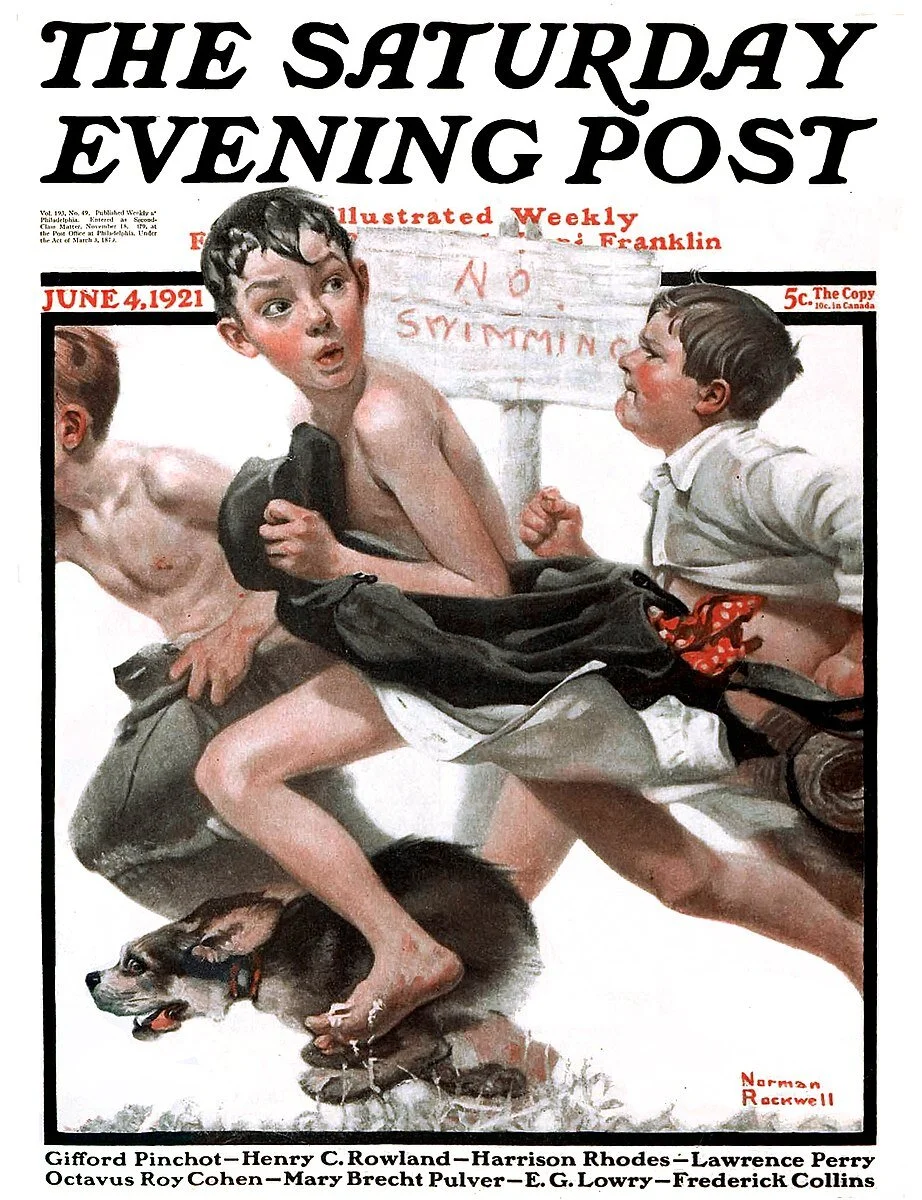
“Wrong is nothing and nowhere and takes
Its name from a great black bottomless lake,
The heart of which pranksters once marked with lipstick
On old newspaper nailed to a cane: “No Swimming.
Hunting or Fishing, Lake Wrong, Ha Ha Ha!’’
— From “Right and Wrong,’’ by Kenneth Rosen, a Portland, Maine, area poet and teacher
Something to do
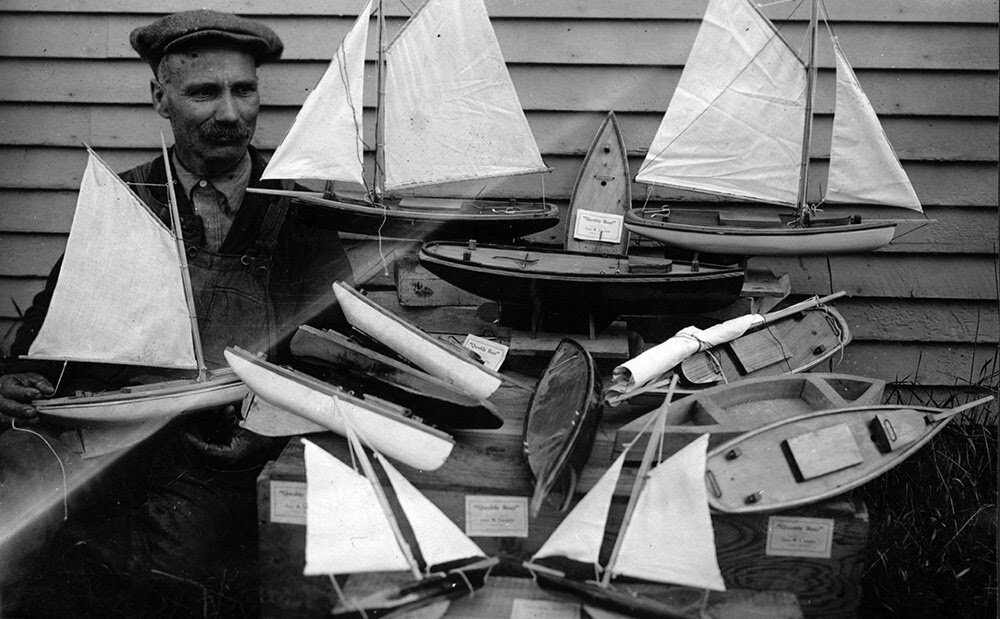
A ship modeler with his Quoddy boat models, c. 1920s. Photograph by F.G. Milliken. Collection of the Cape Ann Museum Library & Archives, Gloucester, Mass.
Chris Powell: Nimbyism around New Haven airport vs. the public interest; anti-ID insanity

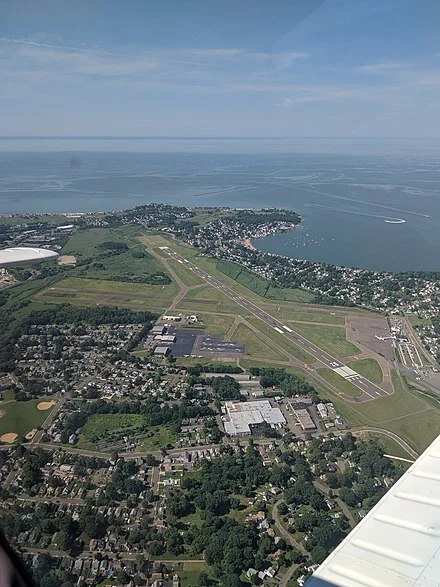
Tweed-New Haven Airport, alongside Long Island Sound
MANCHESTER, Conn.
Municipal zoning that controversially excludes inexpensive housing in the suburbs isn't the only area where Connecticut long has allowed the local interest to thwart the broader public interest. That is also the story of Tweed-New Haven Airport.
The governor, business leaders and most residents in the New Haven area who pay any attention favor improving Tweed so that people in the southern part of the state don't have to drive an hour or two to catch a flight that might not take even that long. The New Haven area, with plenty of commerce, industry and universities, including Yale, almost surely could support a real airport of its own, and such an airport would support the area's economic growth.
But since 2009 Connecticut actually has made it illegal to improve Tweed. That's when state legislators representing neighborhoods near the airport persuaded the General Assembly and then-Gov. Jodi Rell to enact a law forbidding the extension of the airport's runway beyond the current 5,600 feet even as a 7,000-foot runway is necessary to accommodate modern jetliners with enough seating to make serving the airport profitable.
Two years ago a federal appeals court found this state law contrary to federal law and invalidated it. But no matter how obvious the benefit of improving Tweed was, Connecticut still didn't repeal the law. At least now state government, New Haven city government, and town government in East Haven, where some airport property is situated, are working together not just to extend the runway but also to build a better terminal building and relocate airport access to the East Haven side.
The details of the plan may be arguable. Airport operator Avports will get a 43-year lease on Tweed and commit to spending millions of dollars improving it. The Tweed-New Haven Airport Authority, which is run by a board consisting of local residents, will lose control of the airport, but New Haven won't have to subsidize it anymore. Avports will solicit more flights to serve Tweed, for which the prospects are good, and a new budget airline is already planning to come in, though of course it may not survive long.
There may be stumbles and a "temporary" subsidy eventually might be sought from state government. Someday Tweed might even be taken over by the Connecticut Airport Authority. But state government already subsidizes the state's major airport, Bradley International, in Windsor Locks, and nobody complains about that, given the airport's huge contribution to Connecticut's economy and quality of life.
Tweed has been operating for 90 years, so no one living nearby can be surprised by the desire to improve it to keep up with population and economic growth. What might be surprising to people unfamiliar with Connecticut is that it has taken the state so long to get around to making Tweed really useful.
But then if a referendum on the state motto was ever called, no one in Connecticut could be surprised if the Nutmeg State’s official motto, Qui Transtulit Sustinet (“He Who Transplanted Still Sustains’’) is replaced by Non in me postica -- "Not in my backyard."
xxx
Just think of how comprehensively racist the country must be if, as the incessant racial prattle complains, requiring people to present photo identification when voting is racist.
For people routinely may be required to produce photo identification when, among other things, buying alcoholic beverages and tobacco products; when applying for a job, a bank account, a car loan, or home mortgage; and when boarding an airplane or entering a casino.
The purpose of requiring photo identification in those circumstances is simple: compliance with the law and prevention of fraud. Those are the same purposes for which presentation of photo identification when voting should be required.
Yes, some poor souls don't have photo identification, but most jurisdictions will provide general all-purpose photo IDs to people who can produce at least their birth certificates and evidence of an address.
Indeed, to facilitate violation of federal immigration law, Connecticut will provide driver's licenses and New Haven city government will provide city identification cards even to immigration lawbreakers.
Having to prove one's identification isn't racist at all. It's a small duty of modern citizenship.
Chris Powell is a columnist for the Journal Inquirer, in Manchester.
And keep it that way

“Secrets Never Told” (acrylic and ink on paper), by Deb Mell, in a group show through July 17 at the Berta Walker Gallery, Provincetown, Mass.
The gallery says:
“Deb Mell’s paintings and sculpture surprise at every turn, incorporating fantastic creatures, imaginative figures, beads, snake skins, feathers secured from hunters, metals and recycled material. ‘There is
nothing I won’t use. I think of the stuff I use as ‘my palette’’.
"Mell’s art defies easy categorization, much as did the now-famous ‘Chicago Hairy Who’ artists”.
David Warsh: Through the decades with my brilliant friend and occasional rescuer The Copy Editor
SOMERVILLE, Mass.
Economic Principals has been preparing for months to move to Substack’s publishing platform next week, figuring out what to bring and what to leave behind. A critical feature also will make the move: EP’s conscience, teacher and fellow-traveler, The Copy Editor.
We met mornings some forty years ago, walking to the paper {The Boston Globe} from the train. He was working in the library at the time, having turned down an offer from The Atlantic Monthly. I was a newly hired economics reporter. We’d attended the same college, Harvard, 15 years apart, and read some of the same books. We had undertaken similar undergraduate theses: his on historian Henry Adams and critic Edmund Wilson, in History and Literature; mine on Henry Adams and newspaper columnist Joseph Alsop, a China hand, in Social Studies. The Copy Editor finished his thesis with great distinction and graduated with high honors; I abandoned mine and graduated with no distinction.
Clear from the beginning was that he was unusually acute – more acute than I about many things; faster, too. One day without thinking I exaggerated the barriers I had run into as a quarter-miler in high school, claiming 51-second laps, perhaps, instead of 53-s? He had been an alternate in the mile relay for a team that had won the state championship. He forgave and remembered.
Before long he had moved to the book department. The Globe had some 550 editorial employees in those days. I keep a photo on the office wall of a house ad, “Every One’s a Critic:” fifteen lively souls arrayed on stools, The Copy Editor among them. By then it was clear that he was a prodigy; what was unusual was that he served as cook and bottle-washer as well. He displayed deeply ingrained habits: helping others, performing introductions, giving parties, constructing networks. We lived near one another, knew each other’s families and friends.
Certain things stand out, none more than “Wing Tips on the Beach,” a Sunday feature story that became one of three finalists in that category for a Pulitzer Prize in 1994. To this day, I have never read a more revealing interpretation of Richard Nixon than that meditation on a famous photograph of the former president. It did not win, but the author persevered, devising a more capacious framework for his story. When Nixon at the Movies: A Book about Belief appeared in 2004, it quickly gained a place on the relatively short shelf of indispensable second-generation receptions of the Nixon story. And when the Pulitzer finally came, in 2008, it was for criticism, specifically “For his penetrating and versatile command of the visual arts, from film and photography to painting.”
At some point The Copy Editor had begun to read what I wrote before I turned it over to the editor’s desk, to “save you from yourself,” he regularly explained. The tumult of the sale of the paper to The New York Times cost us much. He remained at The Globe and become ever more one of its foremost citizens, knowledgeably recalling in print the long-ago saga of the Bulger clan one week; visiting a museum or reviewing the latest edition of the Fast and Furious movies the next; educating the stream of talented newcomers to the paper all the while. He stayed with me, too, after I left the paper, in 2002.
Almost certainly I would not have kept at EP if he had not. We have had our occasional, sometimes major, differences of opinion. His relatively humble title is designed to emphasize that he is not responsible for opinions published here. But never have I had a friend as loyal, generous and shrewd as The Copy Editor.
David Warsh, a veteran columnist and an economic historian, is proprietor of Somerville-based economicprincipals.com, where this column originated.
Newport's entrepreneurial energy

“‘By 1760 Newport was humming with industry. As one old history states, “Newport was not the headquarters for piracy, sugar, smuggling, rum, molasses and slaves.’’’. But time had worked wonders. There is very little molasses or sugar used there now.’’
— Will M. Cressey, in The History of Rhode Island, published in the 1920’s
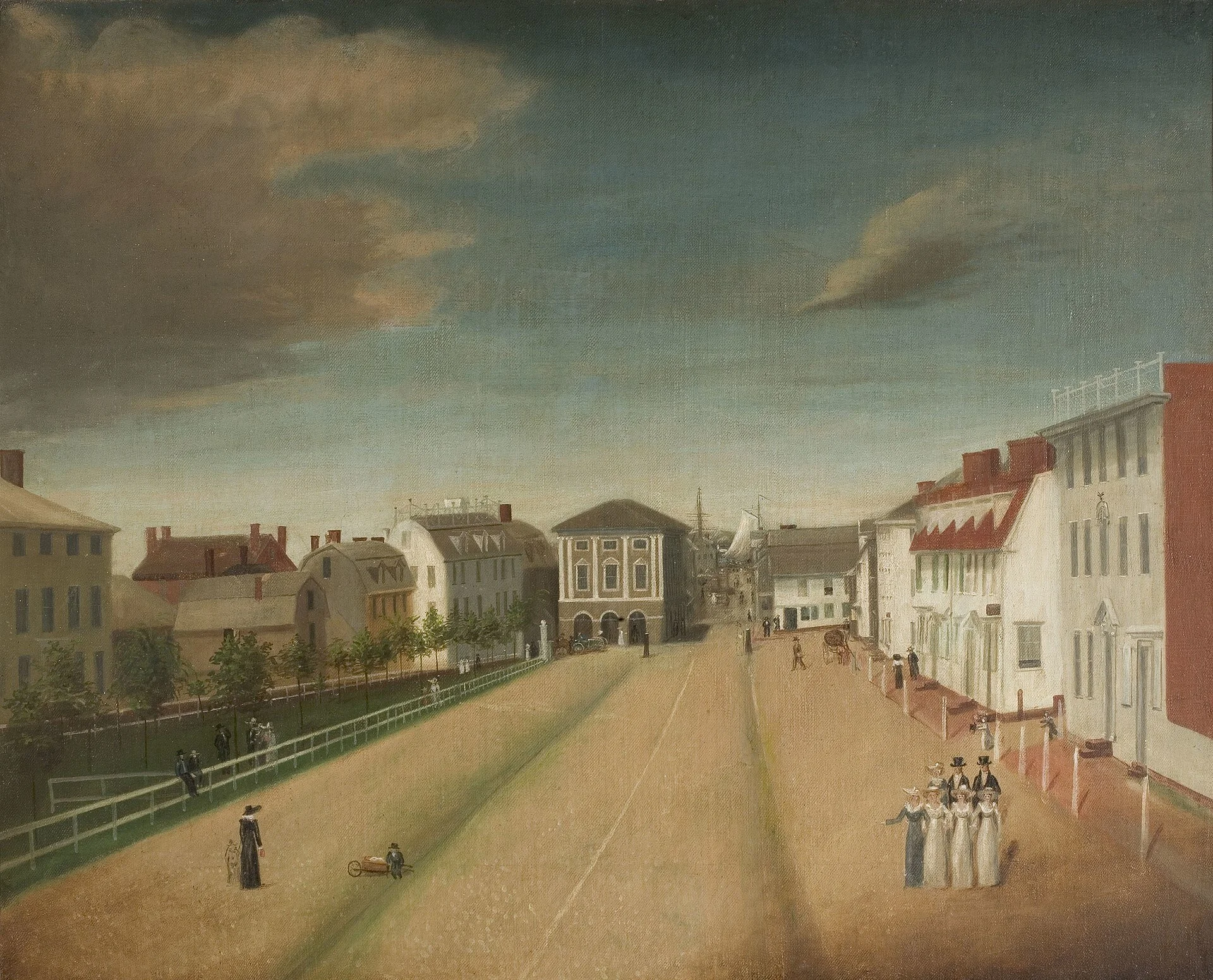
Newport in 1818
'Dupes to every factious rogue'
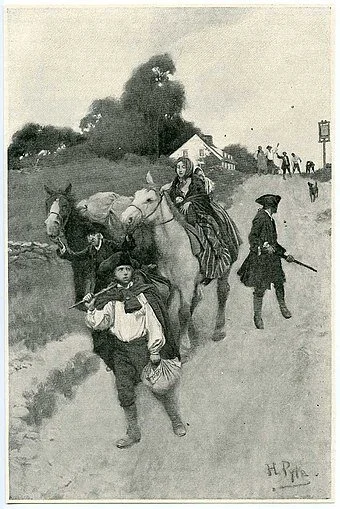
“Tory Refugees on their way to Canada,’’ by Howard Pyle
“MFingal - Canto II” (Connecticut-based John Trumbull’s (1750-1831) mock epic of the American Revolution.
Now warm with ministerial ire,
Fierce sallied forth our loyal 'Squire,
And on his striding steps attends
His desperate clan of Tory friends.
When sudden met his wrathful eye
A pole ascending through the sky,
Which numerous throngs of whiggish race
Were raising in the market-place.
Not higher school-boy's kites aspire,
Or royal mast, or country spire;
Like spears at Brobdignagian tilting,
Or Satan's walking-staff in Milton.
And on its top, the flag unfurl'd
Waved triumph o'er the gazing world,
Inscribed with inconsistent types
Of Liberty and thirteen stripes.
Beneath, the crowd without delay
The dedication-rites essay,
And gladly pay, in antient fashion,
The ceremonies of libation;
While briskly to each patriot lip
Walks eager round the inspiring flip:
Delicious draught! whose powers inherit
The quintessence of public spirit;
Which whoso tastes, perceives his mind
To nobler politics refined;
Or roused to martial controversy,
As from transforming cups of Circe;
Or warm'd with Homer's nectar'd liquor,
That fill'd the veins of gods with ichor.
At hand for new supplies in store,
The tavern opes its friendly door,
Whence to and fro the waiters run,
Like bucket-men at fires in town.
Then with three shouts that tore the sky,
'Tis consecrate to Liberty.
To guard it from th' attacks of Tories,
A grand Committee cull'd of four is;
Who foremost on the patriot spot,
Had brought the flip, and paid the shot.
By this, M'Fingal with his train
Advanced upon th' adjacent plain,
And full with loyalty possest,
Pour'd forth the zeal, that fired his breast.
"What mad-brain'd rebel gave commission,
To raise this May-pole of sedition?
Like Babel, rear'd by bawling throngs,
With like confusion too of tongues,
To point at heaven and summon down
The thunders of the British crown?
Say, will this paltry Pole secure
Your forfeit heads from Gage's power?
Attack'd by heroes brave and crafty,
Is this to stand your ark of safety;
Or driven by Scottish laird and laddie,
Think ye to rest beneath its shadow?
When bombs, like fiery serpents, fly,
And balls rush hissing through the sky,
Will this vile Pole, devote to freedom,
Save like the Jewish pole in Edom;
Or like the brazen snake of Moses,
Cure your crackt skulls and batter'd noses?
"Ye dupes to every factious rogue
And tavern-prating demagogue,
Whose tongue but rings, with sound more full,
On th' empty drumhead of his scull;
Behold you not what noisy fools
Use you, worse simpletons, for tools?
For Liberty, in your own by-sense,
Is but for crimes a patent license,
To break of law th' Egyptian yoke,
And throw the world in common stock;
Reduce all grievances and ills
To Magna Charta of your wills;
Establish cheats and frauds and nonsense,
Framed to the model of your conscience;
Cry justice down, as out of fashion,
And fix its scale of depreciation;
Defy all creditors to trouble ye,
And keep new years of Jewish jubilee;
Drive judges out, like Aaron's calves,
By jurisdiction of white staves,
And make the bar and bench and steeple
Submit t' our Sovereign Lord, The People;
By plunder rise to power and glory,
And brand all property, as Tory;
Expose all wares to lawful seizures
By mobbers or monopolizers;
Break heads and windows and the peace,
For your own interest and increase;
Dispute and pray and fight and groan
For public good, and mean your own;
Prevent the law by fierce attacks
From quitting scores upon your backs;
Lay your old dread, the gallows, low,
And seize the stocks, your ancient foe,
And turn them to convenient engines
To wreak your patriotic vengeance;
While all, your rights who understand,
Confess them in their owner's hand;
And when by clamours and confusions,
Your freedom's grown a public nuisance,
Cry "Liberty," with powerful yearning,
As he does "Fire!" whose house is burning;
Though he already has much more
Than he can find occasion for.
While every clown, that tills the plains,
Though bankrupt in estate and brains,
By this new light transform'd to traitor,
Forsakes his plough to turn dictator,
Starts an haranguing chief of Whigs,
And drags you by the ears, like pigs.
All bluster, arm'd with factious licence,
New-born at once to politicians.
Each leather-apron'd dunce, grown wise,
Presents his forward face t' advise,
And tatter'd legislators meet,
From every workshop through the street.
His goose the tailor finds new use in,
To patch and turn the Constitution;
The blacksmith comes with sledge and grate
To iron-bind the wheels of state;
The quack forbears his patients' souse,
To purge the Council and the House;
The tinker quits his moulds and doxies,
To cast assembly-men and proxies.
From dunghills deep of blackest hue,
Your dirt-bred patriots spring to view,
To wealth and power and honors rise,
Like new-wing'd maggots changed to flies,
And fluttering round in high parade,
Strut in the robe, or gay cockade.
See Arnold quits, for ways more certain,
His bankrupt-perj'ries for his fortune,
Brews rum no longer in his store,
Jockey and skipper now no more,
Forsakes his warehouses and docks,
And writs of slander for the pox;
And cleansed by patriotism from shame,
Grows General of the foremost name.
For in this ferment of the stream
The dregs have work'd up to the brim,
And by the rule of topsy-turvies,
The scum stands foaming on the surface.
You've caused your pyramid t' ascend,
And set it on the little end.
Like Hudibras, your empire's made,
Whose crupper had o'ertopp'd his head.
You've push'd and turn'd the whole world up-
Side down, and got yourselves at top,
While all the great ones of your state
Are crush'd beneath the popular weight;
Nor can you boast, this present hour,
The shadow of the form of power.
For what's your Congress or its end?
A power, t' advise and recommend;
To call forth troops, adjust your quotas--
And yet no soul is bound to notice;
To pawn your faith to th' utmost limit,
But cannot bind you to redeem it;
And when in want no more in them lies,
Than begging from your State-Assemblies;
Can utter oracles of dread,
Like friar Bacon's brazen head,
But when a faction dares dispute 'em,
Has ne'er an arm to execute 'em:
As tho' you chose supreme dictators,
And put them under conservators.
You've but pursued the self-same way
With Shakespeare's Trinc'lo in the play;
"You shall be Viceroys here, 'tis true,
"But we'll be Viceroys over you.’’
What wild confusion hence must ensue?
Tho' common danger yet cements you:
So some wreck'd vessel, all in shatters,
Is held up by surrounding waters,
But stranded, when the pressure ceases,
Falls by its rottenness to pieces.
And fall it must! if wars were ended,
You'll ne'er have sense enough to mend it:
But creeping on, by low intrigues,
Like vermin of a thousand legs,
'Twill find as short a life assign'd,
As all things else of reptile kind.
Your Commonwealth's a common harlot,
The property of every varlet;
Which now in taste, and full employ,
All sorts admire, as all enjoy:
But soon a batter'd strumpet grown,
You'll curse and drum her out of town.
Such is the government you chose;
For this you bade the world be foes;
For this, so mark'd for dissolution,
You scorn the British Constitution,
That constitution form'd by sages,
The wonder of all modern ages;
Which owns no failure in reality,
Except corruption and venality;
And merely proves the adage just,
That best things spoil'd corrupt to worst:
So man supreme in earthly station,
And mighty lord of this creation,
When once his corse is dead as herring,
Becomes the most offensive carrion,
And sooner breeds the plague, 'tis found,
Than all beasts rotting on the ground.
Yet with republics to dismay us,
You've call'd up Anarchy from chaos,
With all the followers of her school,
Uproar and Rage and wild Misrule:
For whom this rout of Whigs distracted,
And ravings dire of every crack'd head;
These new-cast legislative engines
Of County-meetings and Conventions;
Committees vile of correspondence,
And mobs, whose tricks have almost undone 's:
While reason fails to check your course,
And Loyalty's kick'd out of doors,
And Folly, like inviting landlord,
Hoists on your poles her royal standard;
While the king's friends, in doleful dumps,
Have worn their courage to the stumps,
And leaving George in sad disaster,
Most sinfully deny their master.
What furies raged when you, in sea,
In shape of Indians, drown'd the tea;
When your gay sparks, fatigued to watch it,
Assumed the moggison and hatchet,
With wampum'd blankets hid their laces,
And like their sweethearts, primed their faces:
While not a red-coat dared oppose,
And scarce a Tory show'd his nose;
While Hutchinson, for sure retreat,
Manoeuvred to his country seat,
And thence affrighted, in the suds,
Stole off bareheaded through the woods.
"Have you not roused your mobs to join,
And make Mandamus-men resign,
Call'd forth each dufill-drest curmudgeon,
With dirty trowsers and white bludgeon,
Forced all our Councils through the land,
To yield their necks at your command;
While paleness marks their late disgraces,
Through all their rueful length of faces?
"Have you not caused as woeful work
In our good city of New-York,
When all the rabble, well cockaded,
In triumph through the streets paraded,
And mobb'd the Tories, scared their spouses,
And ransack'd all the custom-houses;
Made such a tumult, bluster, jarring,
That mid the clash of tempests warring,
Smith's weather-cock, in veers forlorn,
Could hardly tell which way to turn?
Burn'd effigies of higher powers,
Contrived in planetary hours;
As witches with clay-images
Destroy or torture whom they please:
Till fired with rage, th' ungrateful club
Spared not your best friend, Beelzebub,
O'erlook'd his favors, and forgot
The reverence due his cloven foot,
And in the selfsame furnace frying,
Stew'd him, and North and Bute and Tryon?
Did you not, in as vile and shallow way,
Fright our poor Philadelphian, Galloway,
Your Congress, when the loyal ribald
Belied, berated and bescribbled?
What ropes and halters did you send,
Terrific emblems of his end,
Till, least he'd hang in more than effigy,
Fled in a fog the trembling refugee?
Now rising in progression fatal,
Have you not ventured to give battle?
When Treason chaced our heroes troubled,
With rusty gun, and leathern doublet;
Turn'd all stone-walls and groves and bushes,
To batteries arm'd with blunderbusses;
And with deep wounds, that fate portend,
Gaul'd many a Briton's latter end;
Drove them to Boston, as in jail,
Confined without mainprize or bail.
Were not these deeds enough betimes,
To heap the measure of your crimes:
But in this loyal town and dwelling,
You raise these ensigns of rebellion?
'Tis done! fair Mercy shuts her door;
And Vengeance now shall sleep no more.
Rise then, my friends, in terror rise,
And sweep this scandal from the skies.
You'll see their Dagon, though well jointed,
Will shrink before the Lord's anointed;
And like old Jericho's proud wall,
Before our ram's horns prostrate fall.’’
This said, our 'Squire, yet undismay'd,
Call'd forth the Constable to aid,
And bade him read, in nearer station,
The Riot-act and Proclamation.
He swift, advancing to the ring,
Began, "Our Sovereign Lord, the King"--
When thousand clam'rous tongues he hears,
And clubs and stones assail his ears.
To fly was vain; to fight was idle;
By foes encompass'd in the middle,
His hope, in stratagems, he found,
And fell right craftily to ground;
Then crept to seek an hiding place,
'Twas all he could, beneath a brace;
Where soon the conq'ring crew espied him,
And where he lurk'd, they caught and tied him.
At once with resolution fatal,
Both Whigs and Tories rush'd to battle.
Instead of weapons, either band
Seized on such arms as came to hand.
And as famed Ovid paints th' adventures
Of wrangling Lapithæ and Centaurs,
Who at their feast, by Bacchus led,
Threw bottles at each other's head;
And these arms failing in their scuffles,
Attack'd with andirons, tongs and shovels:
So clubs and billets, staves and stones
Met fierce, encountering every sconce,
And cover'd o'er with knobs and pains
Each void receptacle for brains;
Their clamours rend the skies around,
The hills rebellow to the sound;
And many a groan increas'd the din
From batter'd nose and broken shin.
M'Fingal, rising at the word,
Drew forth his old militia-sword;
Thrice cried "King George," as erst in distress,
Knights of romance invoked a mistress;
And brandishing the blade in air,
Struck terror through th' opposing war.
The Whigs, unsafe within the wind
Of such commotion, shrunk behind.
With whirling steel around address'd,
Fierce through their thickest throng he press'd,
(Who roll'd on either side in arch,
Like Red Sea waves in Israel's march)
And like a meteor rushing through,
Struck on their Pole a vengeful blow.
Around, the Whigs, of clubs and stones
Discharged whole vollies, in platoons,
That o'er in whistling fury fly;
But not a foe dares venture nigh.
And now perhaps with glory crown'd
Our 'Squire had fell'd the pole to ground,
Had not some Pow'r, a whig at heart,
Descended down and took their part;
(Whether 'twere Pallas, Mars or Iris,
'Tis scarce worth while to make inquiries)
Who at the nick of time alarming,
Assumed the solemn form of Chairman,
Address'd a Whig, in every scene
The stoutest wrestler on the green,
And pointed where the spade was found,
Late used to set their pole in ground,
And urged, with equal arms and might,
To dare our 'Squire to single fight.
The Whig thus arm'd, untaught to yield,
Advanced tremendous to the field:
Nor did M'Fingal shun the foe,
But stood to brave the desp'rate blow;
While all the party gazed, suspended
To see the deadly combat ended;
And Jove in equal balance weigh'd
The sword against the brandish'd spade,
He weigh'd; but lighter than a dream,
The sword flew up, and kick'd the beam.
Our 'Squire on tiptoe rising fair
Lifts high a noble stroke in air,
Which hung not, but like dreadful engines,
Descended on his foe in vengeance.
But ah! in danger, with dishonor
The sword perfidious fails its owner;
That sword, which oft had stood its ground,
By huge trainbands encircled round;
And on the bench, with blade right loyal,
Had won the day at many a trial,
Of stones and clubs had braved th' alarms,
Shrunk from these new Vulcanian arms.
The spade so temper'd from the sledge,
Nor keen nor solid harm'd its edge,
Now met it, from his arm of might,
Descending with steep force to smite;
The blade snapp'd short--and from his hand,
With rust embrown'd the glittering sand.
Swift turn'd M'Fingal at the view,
And call'd to aid th' attendant crew,
In vain; the Tories all had run,
When scarce the fight was well begun;
Their setting wigs he saw decreas'd
Far in th' horizon tow'rd the west.
Amazed he view'd the shameful sight,
And saw no refuge, but in flight:
But age unwieldy check'd his pace,
Though fear had wing'd his flying race;
For not a trifling prize at stake;
No less than great M'Fingal's back.
With legs and arms he work'd his course,
Like rider that outgoes his horse,
And labor'd hard to get away, as
Old Satan struggling on through chaos;
Till looking back, he spied in rear
The spade-arm'd chief advanced too near:
Then stopp'd and seized a stone, that lay
An ancient landmark near the way;
Nor shall we as old bards have done,
Affirm it weigh'd an hundred ton;
But such a stone, as at a shift
A modern might suffice to lift,
Since men, to credit their enigmas,
Are dwindled down to dwarfs and pigmies,
And giants exiled with their cronies
To Brobdignags and Patagonias.
But while our Hero turn'd him round,
And tugg'd to raise it from the ground,
The fatal spade discharged a blow
Tremendous on his rear below:
His bent knee fail'd, and void of strength
Stretch'd on the ground his manly length.
Like ancient oak o'erturn'd, he lay,
Or tower to tempests fall'n a prey,
Or mountain sunk with all his pines,
Or flow'r the plow to dust consigns,
And more things else--but all men know 'em,
If slightly versed in epic poem.
At once the crew, at this dread crisis,
Fall on, and bind him, ere he rises;
And with loud shouts and joyful soul,
Conduct him prisoner to the pole.
When now the mob in lucky hour
Had got their en'mies in their power,
They first proceed, by grave command,
To take the Constable in hand.
Then from the pole's sublimest top
The active crew let down the rope,
At once its other end in haste bind,
And make it fast upon his waistband;
Till like the earth, as stretch'd on tenter,
He hung self-balanced on his centre.
Then upwards, all hands hoisting sail,
They swung him, like a keg of ale,
Till to the pinnacle in height
He vaulted, like balloon or kite.
As Socrates of old at first did
To aid philosophy get hoisted,
And found his thoughts flow strangely clear,
Swung in a basket in mid air:
Our culprit thus, in purer sky,
With like advantage raised his eye,
And looking forth in prospect wide,
His Tory errors clearly spied,
And from his elevated station,
With bawling voice began addressing.
"Good Gentlemen and friends and kin,
For heaven's sake hear, if not for mine!
I here renounce the Pope, the Turks,
The King, the Devil and all their works;
And will, set me but once at ease,
Turn Whig or Christian, what you please;
And always mind your rules so justly,
Should I live long as old Methus'lah,
I'll never join in British rage,
Nor help Lord North, nor Gen'ral Gage;
Nor lift my gun in future fights,
Nor take away your Charter-rights;
Nor overcome your new-raised levies,
Destroy your towns, nor burn your navies;
Nor cut your poles down while I've breath,
Though raised more thick than hatchel-teeth:
But leave King George and all his elves
To do their conq'ring work themselves.’’
This said, they lower'd him down in state,
Spread at all points, like falling cat;
But took a vote first on the question,
That they'd accept this full confession,
And to their fellowship and favor,
Restore him on his good behaviour.
Not so our 'Squire submits to rule,
But stood, heroic as a mule.
"You'll find it all in vain, quoth he,
To play your rebel tricks on me.
All punishments, the world can render,
Serve only to provoke th' offender;
The will gains strength from treatment horrid,
As hides grow harder when they're curried.
No man e'er felt the halter draw,
With good opinion of the law;
Or held in method orthodox
His love of justice, in the stocks;
Or fail'd to lose by sheriff's shears
At once his loyalty and ears.
Have you made Murray look less big,
Or smoked old Williams to a Whig?
Did our mobb'd Ol'ver quit his station,
Or heed his vows of resignation?
Has Rivington, in dread of stripes,
Ceased lying since you stole his types?
And can you think my faith will alter,
By tarring, whipping or the halter?
I'll stand the worst; for recompense
I trust King George and Providence.
And when with conquest gain'd I come,
Array'd in law and terror home,
Ye'll rue this inauspicious morn,
And curse the day, when ye were born,
In Job's high style of imprecations,
With all his plagues, without his patience.’’
Meanwhile beside the pole, the guard
A Bench of Justice had prepared,
Where sitting round in awful sort
The grand Committee hold their Court;
While all the crew, in silent awe,
Wait from their lips the lore of law.
Few moments with deliberation
They hold the solemn consultation;
When soon in judgment all agree,
And Clerk proclaims the dread decree;
"That 'Squire M'Fingal having grown
The vilest Tory in the town,
And now in full examination
Convicted by his own confession,
Finding no tokens of repentance,
This Court proceeds to render sentence:
That first the Mob a slip-knot single
Tie round the neck of said M'Fingal,
And in due form do tar him next,
And feather, as the law directs;
Then through the town attendant ride him
In cart with Constable beside him,
And having held him up to shame,
Bring to the pole, from whence he came.’’
Forthwith the crowd proceed to deck
With halter'd noose M'Fingal's neck,
While he in peril of his soul
Stood tied half-hanging to the pole;
Then lifting high the ponderous jar,
Pour'd o'er his head the smoking tar.
With less profusion once was spread
Oil on the Jewish monarch's head,
That down his beard and vestments ran,
And cover'd all his outward man.
As when (so Claudian sings) the Gods
And earth-born Giants fell at odds,
The stout Enceladus in malice
Tore mountains up to throw at Pallas;
And while he held them o'er his head,
The river, from their fountains fed,
Pour'd down his back its copious tide,
And wore its channels in his hide:
So from the high-raised urn the torrents
Spread down his side their various currents;
His flowing wig, as next the brim,
First met and drank the sable stream;
Adown his visage stern and grave
Roll'd and adhered the viscid wave;
With arms depending as he stood,
Each cuff capacious holds the flood;
From nose and chin's remotest end,
The tarry icicles descend;
Till all o'erspread, with colors gay,
He glitter'd to the western ray,
Like sleet-bound trees in wintry skies,
Or Lapland idol carved in ice.
And now the feather-bag display'd
Is waved in triumph o'er his head,
And clouds him o'er with feathers missive,
And down, upon the tar, adhesive:
Not Maia's son, with wings for ears,
Such plumage round his visage wears;
Nor Milton's six-wing'd angel gathers
Such superfluity of feathers.
Now all complete appears our 'Squire,
Like Gorgon or Chimæra dire;
Nor more could boast on Plato's plan
To rank among the race of man,
Or prove his claim to human nature,
As a two-legg'd, unfeather'd creature.
Then on the fatal cart, in state
They raised our grand Duumvirate.
And as at Rome a like committee,
Who found an owl within their city,
With solemn rites and grave processions
At every shrine perform'd lustrations;
And least infection might take place
From such grim fowl with feather'd face,
All Rome attends him through the street
In triumph to his country seat:
With like devotion all the choir
Paraded round our awful 'Squire;
In front the martial music comes
Of horns and fiddles, fifes and drums,
With jingling sound of carriage bells,
And treble creak of rusted wheels.
Behind, the croud, in lengthen'd row
With proud procession, closed the show.
And at fit periods every throat
Combined in universal shout;
And hail'd great Liberty in chorus,
Or bawl'd 'confusion to the Tories.
Not louder storm the welkin braves
From clamors of conflicting waves;
Less dire in Lybian wilds the noise
When rav'ning lions lift their voice;
Or triumphs at town-meetings made,
On passing votes to regulate trade.
Thus having borne them round the town,
Last at the pole they set them down;
And to the tavern take their way
To end in mirth the festal day.
And now the Mob, dispersed and gone,
Left 'Squire and Constable alone.
The constable with rueful face
Lean'd sad and solemn o'er a brace;
And fast beside him, cheek by jowl,
Stuck 'Squire M'Fingal 'gainst the pole,
Glued by the tar t' his rear applied,
Like barnacle on vessel's side.
But though his body lack'd physician,
His spirit was in worse condition.
He found his fears of whips and ropes
By many a drachm outweigh'd his hopes.
As men in jail without mainprize
View every thing with other eyes,
And all goes wrong in church and state,
Seen through perspective of the grate:
So now M'Fingal's Second-sight
Beheld all things in gloomier light;
His visual nerve, well purged with tar,
Saw all the coming scenes of war.
As his prophetic soul grew stronger,
He found he could hold in no longer.
First from the pole, as fierce he shook,
His wig from pitchy durance broke,
His mouth unglued, his feathers flutter'd,
His tarr'd skirts crack'd, and thus he utter'd.
"Ah, Mr.
Constable, in vain
We strive 'gainst wind and tide and rain!
Behold my doom! this feathery omen
Portends what dismal times are coming.
Now future scenes, before my eyes,
And second-sighted forms arise.
I hear a voice, that calls away,
And cries 'The Whigs will win the day’.
My beck'ning Genius gives command,
And bids me fly the fatal land;
Where changing name and constitution,
Rebellion turns to Revolution,
While Loyalty, oppress'd, in tears,
Stands trembling for its neck and ears.
"Go, summon all our brethren, greeting,
To muster at our usual meeting;
There my prophetic voice shall warn 'em
Of all things future that concern 'em,
And scenes disclose on which, my friend,
Their conduct and their lives depend.
There I--but first 'tis more of use,
From this vile pole to set me loose;
Then go with cautious steps and steady,
While I steer home and make all ready.

‘Are melted into air’

From Jennifer Day’s show “Vapors,’ June 30-Aug. 1, at Bromfield Gallery, Boston. The show consists of black-and-white paintings that explore how liquids, mist and light interact. Ms. Day is based in Newburyport.
Prospero’s soliloquy in Shakespeare’s The Tempest:
Our revels now are ended. These our actors,
As I foretold you, were all spirits, and
Are melted into air, into thin air:
And like the baseless fabric of this vision,
The cloud-capp'd tow'rs, the gorgeous palaces,
The solemn temples, the great globe itself,
Yea, all which it inherit, shall dissolve,
And, like this insubstantial pageant faded,
Leave not a rack behind. We are such stuff
As dreams are made on; and our little life
Is rounded with a sleep.
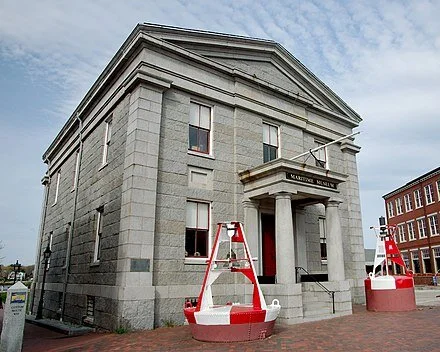
The Custom House Maritime Museum, in Newburyport
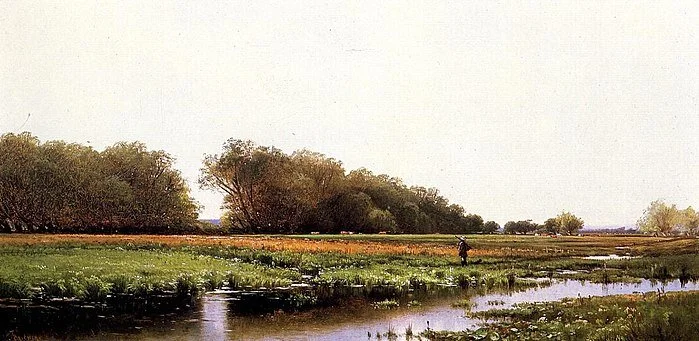
“Hunter in the Meadows of Old Newburyport, Massachusetts” (c. 1873), by Alfred Thompson Bricher. The scene seems to be near the Little River. Route 1 (aka Boston Post Road) had an overlook easily accessible to artists. In the far right can be seen the ridge along the Merrimack River over which High Street runs. Cattle have been turned into the marsh for pasture, a practice still allowed on some marsh farms of the area in the late 19th Century.
The Hub from heaven

Downtown Boston in 1860, before urban renewal and presumably from a hot-air balloon