
Vox clamantis in deserto







‘Stormbags’ over the mountains

The Presidential Range of the White Mountains
“Thunderheads were pouring toward them through the ragged teeth of the White Mountains, and Lisey counted seven dark spots where the high slopes had been smudged away by cauls of rain. Brilliant lightnings flashed inside those stormbags and between those two of them, connecting them like some fantastic fairy bridge, was a double rainbow that arched over Mount Cranmore in a frayed loophole of blue.”
— From Lisey’s Story, by the Maine-based novelist Stephen King

“Crawford Notch’’ (1872), in the White Mountains, by Thomas Hill (1829-1908)
‘Deeper inside domestic objects’

“Purple & Yellow” (accordion book with photographs), by Laura Holland, in the show “Inward & Outward’’ at Gallery A3, in Amherst, Mass., for July.
The gallery says that for Holland “home {during the pandemic} became my world, I discovered small-scale intimate still lives in eggshells on the counter, carrot peels in the sink, and pans of soapy water...I peered deeper inside domestic objects and pushed images further toward abstraction, which turned into the books of photographs.’’

Don Pesci: A reunion at the end of the plague time

“Diogenes Searching for an Honest Man:”(c. 1780) attributed to J. H. W. Tischbein. Diogenes (about 412 to 323 B.C.), a Greek, was a one of the founders of Cynic philosophy.
VERNON, Conn.
The Country Mouse looked his friend over carefully. He hadn’t so much as spoken word to him in nearly a half century. The Cynic was much the same.
The timeless features of humans – the sound of the voice, the color of eye, the general bone structure of the face, a smile in motion – remain steadfastly constant. And, of course, though The Cynic was still tall, he had put on some pounds and his muscles were in retreat. He still had a full head of hair, tinged with white. Genetics are decisive, thought The Country Mouse.
“Do you remember.…” The Cynic a week earlier had begun their phone call.
For The Country Mouse, this was an incantation that had always opened the mercifully locked doors of memory that connected him immediately with a specific painful or joyous moment.
Before The Cynic had finished the sentence, a scene flashed like lightening through The Country Mouse’s mind. He saw them both traveling in an old rowboat ladened with cement bags towards a small island a half mile off the mainland.
The two were to build a wall around the island, owned by a dentist who would, at some distant point in the future, build his retirement house there. Walls make good neighbors, but lakes, particularly when one is on an island surrounded by water, make better ones.
That was why Orwell, said The Cynic, retreated to the remote Scottish Island of Jura to stretch his mind around Nineteen Eighty-Four. It was why the monks of the dessert took to the dessert, to better commune with the molten God burning in their souls. And it was why Antisthenes, thought to be the father of Greek Cynicism, established his school in a famous gymnasium built to service the nothoi, the bastard children of Athens.
The Cynic, nearly always a solitary, had asked The Country Mouse to help him build the wall, a self-terminating endeavor, thought The Cynic, because the unpredictable effects on water disturbed by wind, rain and the pull of moon will overturn even the best laid plans of mice and men. But the pay was a bonus for the two student roommates who needed pocket money from time to time.
It was summer; the lake was blue ice, its quiet surface hiding the clamor and rough motion below the surface. What if the old boat sank? Would any attempt be made to save the cement? Would one, or both the project managers, drown, pushed under the quiet surface of the lake by a weight of weakness and ungovernable laughter?
“Who could forget that wall?” The Country Mouse had replied, before making arrangements to meet at a local diner.
Not he, not ever. The job amused The Cynic. His unappeasable κυνικός burst forth not in frowns but in what he called therapeutic laughter. Laughter, he had once told The Country Mouse are tears turned, like socks, inside out.
“Comedy,” he said, “is the tragedy that happens to your worst enemy.”
And now here was his old friend in the flesh. There was no “catching up” between these two. Heart spoke to heart. Time was foreshortened, and the two picked up pretty much where they had left off. Friendship, The Country Mouse thought, is rooted in requited expectation.
The Cynic, like The Country Mouse, was no stranger to politics. Both had written about Connecticut’s political absurdities for more than 30 years, and each had followed the other’s occasional writings, though neither had felt the need to reestablish contact, perhaps from fear that re-contact would abort a cherished friendship. Why spoil the past by resurrecting it, dripping with mold and moss, from its comfortable grave?
The Cynic had proposed a project that would allow both of them to create a semi-perishable narrative that might be of interest to people not too far gone in partisanship, as is the case, The Cynic pointed out, “with nearly 90 percent of the state’s highly compromised media. Searching for dispassionate reportage from this group was like searching in a whore house for glints of modesty and shards of morality, not,” he hastened to add, “that immorality was a bar to honest truth seeking.”
“Your figure might be low,” The Country Mouse replied, though he instantly had accepted the proposal.
Both had for the past three decades been “writing on water,” The Cynic’s formulation, for a slumberous audience that could not, or perversely would not, recall what had happened yesterday. Then too, the windy horror stirring on Connecticut’s horizon hardly ruffled these bouts of self-enforced somnolence. Working in the moment had unfitted them for unabashed journalism. So, why not disturb some restless ghosts?
“We should,” said The Cynic, bestowing a smile upon his omelet, “draw up an enemies' list.”
“A friend’s list,” said The Country Mouse, “would be shorter and more manageable. I can think of two reliables.”
“None for me,” said The Cynic.
Now, whenever The Cynic’s temperament was aroused, his voice, rose as well, and he pronounced every syllable of every word as a Shakespearian actor might. Naturally, this captured the attention of nearby diners who began leaning into the conversation.
Responding to The Country Mouse’s remark that beaten people in Connecticut seemed emotionally exhausted by measures that had been taken to shut down the state, The Cynic launched the following philippic:
“At some point, someone – and if not the media, then who? – must scream loudly enough to pierce waxen ears -- ‘THE EMPEROR IS NAKED!”’
This produced a stir at a nearby table.
“Too few in the state’s media do it,” The Cynic continued. “Politics is the only profession on earth that professes nonsense without media reproval. We’ve just recovered from a Coronavirus ‘pandemic.’ The entire state was shut down – and NOT BY THE PANDEMIC – for a year.
“Just take one instance, and try to remember that the state’s political hegemon, the Democratic Party, has controlled politics, without the least interference from Republicans, in all three of the state’s larger cities for nearly half a century, plenty of time to set things right.
“Whatever is wrong with Connecticut’s cities, the solution to urban social disintegration and lawlessness cannot be a bill to provide previously illegal pot in every urban pot.”
This produced some suppressed laughter from a couple sitting in a nearby booth.”
“Urban problems cannot be solved,” The Cynic continued in a lower voice, “or even addressed, by a state that asserts the elimination of zoning restrictions in suburbs will magically solve problems in cities related to causes untouched by the proposed solution.”
This produced slight applause and appreciative nods and smiles from a different booth.
Quieter still, The Cynic continued, “Removing partial immunity from prosecution within urban police departments will not reduce criminal activity in the state’s cities. Still less will early release from prison and the decriminalization of crimes reduce criminal activity in cities, though it may improve the kinds of statistics politicians cite in the heat of a campaign. The elimination of partial immunity celebrated by Connecticut’s progressive Democrats will reduce the number of police in urban police departments. In fact, a little noticed migration of police officers from urban to suburban departments has already begun. And it cannot be good sense to reduce police presence at a time when crime in urban areas is “MOVING FORWARD,” a favorite expression of blind progressive mice, at warp speed. Any politician unwilling to attack the rot at the root of a problem cannot be said to care for the plant.”
A lady to the left of the two reunited friends waved her fork in their direction. All the Coronavirus protective masks in the diner had been discarded. For the first time in a year, both The Country Mouse and The Cynic, who regarded the masks as emblems of subservience to autocratic governors, could once again read faces. And this one was smiling, the Country Mouse thought, sardonically.
“Excuse me,” she said, “who ARE you?”
“He’s The Cynic,” answered The Country Mouse.
Don Pesci is a Vernon-based columnist.

Sara Jean-Francois: Attacks on Critical Race Theory suppress racial liberation and free speech

Rally on the Boston Common on May 31, 2020 after the murder of George Floyd
From The New England Journal of Higher Education, a service of The New England Board of Higher Education (nebhe.org)
BOSTON
When I was in elementary school, history happened like this: The world was fighting, the Civil War happened, Abraham Lincoln freed the slaves and then everything was happy and free, and the U.S. was the place to be. Now obviously that is a gross exaggeration of the facts. But it’s not untrue about what we as role models, educators, parents and guardians chose to disclose to children about the historical legacy of race and, thus racism, in the U.S.
As a Black girl growing up in a wide variety of neighborhoods, but almost always attending a predominantly Black and ethnically diverse school, it strikes me as inherently odd that even as K-12 schools and higher education begin to educate an increasingly diverse set of students, we can simultaneously remain complicit in the concealment of history as it is, not as we have decided to rewrite it.
Last year, shortly after the murder of George Floyd, Ahmaud Arbery and so many others, it seemed as if the world had finally opened their eyes to the everyday reality and fears of Black America. And yet, just after the anniversary of these murders, we see state legislation in the headlines of various news sites attacking Critical Race Theory (CRT) and actually proposing legislation that would ban teaching history, as it is commonly accepted to be true. We cannot deny that woven into the narrative of U.S history is the history of systemic racism and other oppressions.
“Divisive” concepts?
Many have coined the term “divisive teaching” to describe teaching from what would be considered a culturally relevant and historically accurate account of race and racism in the U.S.
In Iowa, legislation has been passed that would explicitly forbid teaching of systemic racism or sexism. And Iowa is not alone. Earlier this year, Oklahoma banned CRT, causing a chain reaction of lost course offerings for students who want to learn about the true history of race in the U.S. In New England, the New Hampshire legislators approved a bill that would ban the teaching of “divisive concepts,” including topics of inherent racism, sexism or oppression, whether consciously or unconsciously. (Similar bills have been introduced in Maine and Rhode Island.)
The Iowa, New Hampshire and Oklahoma legislation attack the discussion of systemic racism head-on, leaving the potential for an entire generation of young people to grow up with the same implicit bias, bigotry and stereotypes that have led to the death of so many Black Bodies already, including George Floyd. They are just three examples of how legislative attacks on Critical Race Theory are directly trying to use politics to attack racial progression. It raises the question, will there ever be a post-racial society?
For the past year, as so much of the world shouted “Black Lives Matter,” whether at protests, through statements of solidarity, posting little black boxes on Instagram, T-shirts, or supporting Black-owned businesses, we all felt the weight of racism in the air. We saw how racism breeds real-life consequences, and for Black people, that can mean death.
Yet here we are, concerned with the state of academic freedom, rather than about what it means for the future generation of Black bodies in the U.S. Somewhat ironically, news reports about these pieces of legislation follow the official national recognition of Juneteenth as a federal holiday. This irony begs the question: Is America moving forward toward a more racially equitable society or is performative politics the new norm as we face yet another inflection point in history?
What about antiracism?
If states are allowed to ban an entire body of research, theories and the models and pedagogy that come from this work (already left out of everyday teachings) how can the U.S. claim we learned anything about “antiracism” in the past year?
How can higher claim to care about Black life, when academic freedom is considered far more sacred? The anti-CRT legislation undoubtedly will uphold the inherently white-centric teachings that have been established as our common educational standard. The historical and present relationship that the U.S has with racism, and other oppressions within and outside higher education, seems to be more protected and guarded than the Black lives that are constantly being attacked and killed.
Bell hooks posits that “education is a practice of freedom” and yet education and, thus the freedom it gives everyone, not just Black people, is also being attacked. Who will suffer the most? And so I ask, Why did George Floyd become martyr to a cause nobody is listening to anymore?
If you ask me, the aforementioned anti-CRT legislation is not only an attack on academia and free speech, but also a direct suppression of racial liberation and consequently any racial progression moving forward. It is time that politicians, activists and educators alike take a divisive and definitive stance and decide whether the academy, and whether this democracy, will follow a path of antiracism or continue to be passively racist.
Sara Jean-Francois is assistant director of NEBHE’s Regional Student Program, Tuition Break. She recently earned her master’s degree in public policy from Brandeis University’s Heller School for Social Policy and Management, where she conducted significant research on race-conscious campuses and issues of equity and inclusion within higher-education policy.
It only looks painful

“Unholy 75” (paper), by Matthew Shlian, in his show “Matthew Shlian: Light Years,’’ at Heather Gaudio Fine Art, New Canaan, Conn., June 26-Aug. 7.
The gallery says:
“Shlian’s work straddles the world of paper engineering and the fine arts, a place where two-dimensional paper becomes intricately sculpted into precise and stunning three-dimensional forms. His work is rooted in printed media, book arts and commercial design, where paper gets folded, tessellated, compressed and arranged in unexpected ways. Modular aggregation and the way in which shapes repeat, morph and reconnect with each other have been the artist’s preoccupation for the past several years. Adopting an intuitive approach, Shlian begins with hand-drawn patterns in a notebook and then uses digital mapping on an industrial plotter to work out his ideas. His curiosity with the process continues when he returns to working with paper using his hands, constructing forms out of the everyday material. Color, light, patterns and planar shifts come together in geometric assemblages that reveal themselves as he works. An important part of the artist’s process is the element of surprise: if he can completely visualize a final result, he doesn’t have a reason to create it. Shlian has to start his work and make changes along the way in order to fully understand it. In the same way, the titles of his works, intriguing and serendipitous to be sure, are related to phrases, conversations or musings he has had with his daughters and others.’’==

The late architect Philip Johnson’s famous “Glass House,’’ in New Canaan. It’s now a museum.

Martha Bebinger: Mass. case highlights lengthy ER boarding of mental patients

Beth Israel Lahey Health, in Burlington, Mass., where the patient in this article was boarded in the emergency room.
and WBUR
BOSTON
One evening in late March, a mom called 911. Her daughter, she said, was threatening to kill herself. EMTs arrived at the home north of Boston, helped calm the 13-year-old, and took her to an emergency room.
Melinda, like a growing number of children during the COVID-19 pandemic, had become increasingly anxious and depressed as she spent more time away from in-person contact at school, church and her singing lessons.
We have agreed to use only the first names of this teenager and her mother, Pam, to avoid having this story trail the family online. Right now in Massachusetts and in many parts of the U.S. and the world, demand for mental health care overwhelms supply, creating bottlenecks like Melinda’s 17-day saga.
Emergency rooms are not typically places you check in for the night. If you break an arm, it gets set, and you leave. If you have a heart attack, you won’t wait long for a hospital bed. But sometimes if your brain is not well, and you end up in an ER, there’s a good chance you will get stuck there. Parents and advocates for kids’ mental health say that the ER can’t provide appropriate care and that the warehousing of kids in crisis can become an emergency itself.
What’s known as emergency room boarding of psychiatric patients has risen between 200% and 400% monthly in Massachusetts during the pandemic. The CDC says emergency room visits after suicide attempts among teen girls were up 51% earlier this year as compared with 2019. There are no current nationwide mental health boarding numbers.
“This is really unlike anything we’ve ever seen before, and it doesn’t show any signs of abating,” said Lisa Lambert, executive director of Parent/Professional Advocacy League, which pushes for more mental health care for children.
Melinda spent her first 10 days in a hospital lecture hall with a dozen other children, on gurneys, separated by curtains because the emergency room had run out of space. At one point, Melinda, who was overwhelmed, tried to escape, was restrained, injected with drugs to calm her and moved to a small, windowless room.
Day 12: Cameras Track Her Movements
I met Melinda in early April, on her 12th day in the ER. Doctors were keeping her there because they were concernedtgshe would harm herself if she left. Many parents report spending weeks with their children in hospital hallways or overflow rooms, in various states of distress, because hospital psychiatric units are full. While demand is up, supply is down. Covid precautions turned double rooms into singles or psych units into covid units. While those precautions are beginning to ease, demand for beds is not.
Inside her small room, Melinda was disturbed by cameras that tracked her movement, and security guards in the hallways who were there, in part, for her safety.
“It’s kinda like prison,” she said. “It feels like I’m desperate for help.”
“Desperate” is a word both Melinda and Pam use often to describe the prolonged wait for care in a place that feels alien.
“We occasionally hear screaming, yelling, monitors beeping,” said Pam. “Even as the parent — it’s very scary.”
But this experience is not new. This was Melinda’s fourth trip to a hospital emergency room since late November. Pam said Melinda spiraled downward after a falling out with a close family member last summer. She has therapists, but some of them changed during the pandemic, the visits were virtual, and she hasn’t made good connections between crises.
“Each time, it’s the same routine,” Pam said. Melinda is rushed to an ER, where she waits. She’s admitted to a psych hospital for a week to 10 days and goes home. “It’s not enough time.”
Pam said each facility has suggested a different diagnosis and adjusted Melinda’s medication.
“We’ve never really gotten a good, true diagnosis as to what’s going on with her,” Pam said. “She’s out of control; she feels out of control in her own skin.”
Melinda waited six months for a neuropsychiatric exam to help clarify what she needs. She finally had the exam in May, after being discharged from the psychiatric hospital, but still doesn’t have the results. Some psychiatrists say observing a patient’s behavior is often a better way to reach a diagnosis.
Lambert, the mental health advocate, said there are delays for every type of psychiatric care — both residential and outpatient.
“We’ve heard of waits as long as five weeks or more for outpatient therapy,” Lambert said. “If your child is saying they don’t want to live or don’t want to ever get out of bed again, you don’t want to wait five weeks.”
Day 13: ‘The Longer She’s Here, the More She’s Going to Decline’
As her stay dragged on, Melinda bounced from manic highs to deep emotional lows. The emergency room is a holding area; it isn’t set up to offer treatment or psychiatric therapy.
On this day Melinda was agitated.
“I just really want to get out of here,” she said in an audio diary she was keeping at the time for this story. “I feel kind of helpless. I miss my pets and my bed and real food.” She’d had a panic attack the night before and had to be sedated. Her mom, Pam, wasn’t there.
“The longer she’s here, the more she’s going to decline,” Pam recorded in her own audio diary. “She has self-harmed three times since she’s been here.”
The hospital and its parent network, Beth Israel Lahey Health, declined requests to speak about Melinda’s care. But Dr. Nalan Ward, the network’s chief medical officer for behavioral health services, hosts a daily call to discuss the best place for inpatient psychiatric treatment for each patient. Some may have unique medical or insurance constraints, she said. Many insurers require prior approval before they’ll agree to pay for a placement, and that, too, can add delays.
“It takes a case-by-case approach,” said Ward. “It’s really hands-on.”
Day 14: Increasingly Isolated From School and Friends
For Melinda, the issue keeping her from moving out of the ER and into an effective treatment program could have been her behavior. Pam was told her daughter may be harder to place than children who don’t act out. Hospitals equipped to provide inpatient mental health care say they look for patients who will be a good fit for their programs and participants. Melinda’s chart included the attempted escape as well as some fights while she was housed in the lecture hall.
“She’s having behaviors because she has a mental illness, which they’re supposed to help her with,” Pam said, “but yet they’re saying no to her because she’s having behaviors.”
Secluding Melinda in the ER didn’t help, Pam said. “She’s, at times, unrecognizable to me. She just is so sure that she’s never going to get better.”
Melinda described feeling increasingly isolated. She lost touch with friends and most family members. She’d stopped doing schoolwork weeks earlier. The noise and commotion of a 24/7 ER was getting to Melinda.
“I’m not sleeping well,” she noted in her diary. “It’s tough here. I keep waking up in the middle of the night.”
Day 15: Mom Retreats to Her Car to Cry
Boarding is difficult for parents as well. Pam works two jobs, but she visited Melinda every day, bringing a change of clothes, a new book or something special to eat.
“Some days I sit and cry before I get out of the car, just to get it out of my system, so I don’t cry in front of her,” Pam said in her diary entry that day.
Some hospitals say they can’t afford to care for patients with acute mental health problems because insurance reimbursements don’t cover costs. Massachusetts is spending $40 million this year on financial incentives to create more inpatient psychiatric care. But emergency rooms are still flooded with psychiatric patients who are in limbo, boarding there.
Day 16: ‘I Wish Someone Would Just Understand Me’
“I never thought we’d be here this long,” said Pam.
At the nurses’ station, Pam was told it could be two more weeks before there would be an opening at an appropriate hospital.
In Massachusetts, Gov. Charlie Baker’s administration says it has a plan that will keep children out of ERs and reduce the need for inpatient care by providing more preventive and community-based services. Parents and providers say they are hopeful but question whether there are enough counselors and psychiatrists to staff proposed community clinics, therapy programs and more psychiatric hospital beds.
Meanwhile, in the ER, Melinda was growing listless.
“Life is really hard because things that should be easy for everyone are just hard for me,” she said. “When I ask for help, sometimes I picture going to the hospital. Other times I wish someone would just understand me.”
Then, in the late evening on Day 16, the family got word that Melinda’s wait would soon end.
Day 17: Limbo Ends and Real Treatment Begins
On Day 17, Melinda was taken by ambulance to a Boston-area hospital that had added child psychiatric beds during the pandemic. She was lucky to get a spot. The day she arrived, there were 50 to 60 children on the waiting list.
“That’s dramatically higher” than before the pandemic, said Dr. Linsey Koruthu, one of Melinda’s doctors and a pediatric psychiatrist at Cambridge Health Alliance. “About double what we would have seen in 2019.”
Doctors there adjusted Melinda’s medications. She met with a psychiatrist and social worker daily and had group therapy and time for schoolwork, yoga and pet therapy. Hospital staff members met with Melinda and her family. She stayed two weeks, a bit longer than the average stay.
Doctors recommended that Melinda move from inpatient care to a community-based residential treatment program — a bridge between being in the hospital and returning home. But those programs were full and had weeks-long delays. So, Melinda went straight home.
She now has three therapists helping her make the transition and use what she’s learned. And as covid restrictions have begun to ease, some sessions are in person — which Koruthu said should be more effective for Melinda.
Pam said the transition has been rough. Police came to the house once and suggested Melinda go to an ER, but she was able to calm down before it came to that. Melinda has developed an eating disorder.
The first available appointment with a specialist is in August. But, by mid-June, Melinda was able to graduate from middle school, after finishing a backlog of schoolwork.
“If you had asked me two months ago, I would have said I don’t think she’ll make it,” Pam said. “We’re getting there.”
Martha Bebinger covers health care and other topics at WBUR, an NPR affiliate in Boston.
Sweating it out before A/C

From Robert Whitcomb’s “Digital Diary,’’ in GoLocal 24.com
Do some readers remember those salt tablets in big jars in un-air-conditioned buildings (except the executive offices) in the summer? I do, mostly from summer jobs in downtown Boston. I’m not sure how effective they were in staving off heat stroke but they, along with those big fans at the top of poles, were summer symbols. Things got more humane after the creation of the Occupational Safety and Health Administration, in 1971, one of several admirable “liberal’’ administrative creations of the Nixon administration; far more companies installed air conditioning as a result.
Before then, many of us simply moved more slowly in the summer, inside and out. A certain level of lassitude was acceptable.
Llewellyn King: The disappointing Kamala Harris

WEST WARWICK, R.I.
Kamala Harris shone in the Senate when she was asking questions in hearings. That is where the idea that she might have presidential possibilities flourished. Democrats, observing her surefootedness, were led to think, “Here is the next Barack Obama.”
But the shine is off Harris and the tarnish is setting in.
When Harris ran for president, the only evidence of that hearing-room confidence was when she attacked front-runner Joe Biden in the Democratic debates. She implied that he was the proprietor of old ideas and hinted that he wasn’t up to date on matters of race.
So, it was extraordinary that Biden chose Harris to be his running mate. There were other strong contenders among those who had sought the Democratic nomination, and many more who hadn’t run for president. Sen. Amy Klobuchar (D.-Minn.) should have been chosen: a tough, well-qualified woman of her times.
Biden, in choosing Harris, heard the music of diversity, which has been turned up of late. He felt the need to make history and to show that he was in accord with the values of today.
But he must have had some dealings with Harris when he was vice president; observed her in action in the Senate and heard about the difficulty she had organizing her small Senate staff. He must have done the political equivalent of due diligence. And he must have been cognizant of the damage that Sarah Palin did to John McCain’s candidacy in 2008.
Whereas Obama appeared not to think of himself as being of color, Harris clings to it. Her journey intrigues her; Obama’s didn’t intrigue him. He travelled it with purpose and dignity.
Now it must worry the president to learn, as the rest of us have, that Harris seems to have no ideas. Her public remarks are flip at worst and off-the-shelf liberal at best.
What does she see as the future for America? This isn’t laid out or even discernible. We need to know her vision because she is vice president to an old man – the metaphorical heartbeat away.
Harris and Biden have chosen to believe that solidarity at the top is an important message, hence the frequent references in White House announcements to the “Biden-Harris Administration.” In public, Harris is often at Biden’s side. But she often seems to be standing there as his girl Friday, not as the second-in-command.
In his well-reported piece in The Atlantic, Edward-Isaac Dovere hunted for the real Harris and didn’t appear to find her. He notes that she asks good, hard questions, like a good prosecutor, but as she dodges reporters, they aren’t able to ask good, hard questions of her.
It isn’t a given Democrats will back Harris if Biden turns out to be a one-term president, which given his age, 78, is a reasonable supposition. But ditching her would be hard because it might cost the party its progressive wing and keeping her might cost them as dearly in the center.
Republicans are salivating at the thought of running against Harris. She is the bright sun in their darkening sky.
The immigration assignment seems to have been thrust on Harris. It is unlikely she sought it. She doesn’t appear to have grasped it with relish. Save for brief visits to Guatemala and Mexico, she has done and said little.
Harris is finally looking at the chaos on the border herself. She needs to present a better idea than championing what amounts to nation-building in Central America. That has been tried and tried again and failed.
She isn’t going to solve the pain inherent in the immigration challenge, but it is a wonderful opportunity for her to give us her view of America, and what we might expect from a President Harris. Another assignment that could be thrust upon her.
Llewellyn King is executive producer and host of White House Chronicle, on PBS. His email is llewellynking1@gmail.com and he’s based in Rhode Island and Washington, D.C.
'An ideal pursuit'
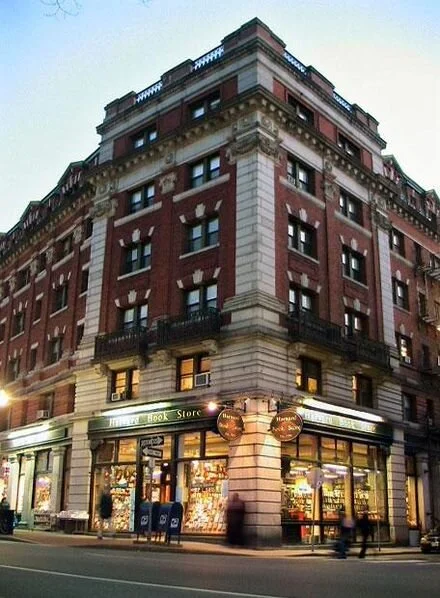
The Harvard Book Store, in Cambridge
“History ... with its long, leisurely, gentlemanly labors, the books arriving by post, the cards to be kept and filed, the sections to be copied, the documents to be checked, is the ideal pursuit for the New England mind.‘‘
—- Elizabeth Hardwick ( 1916-2007), American literary critic, novelist, and short story writer
In the South Shore breeze

“Wind Sculpture” (stainless steel and gold-plated stainless steel), by Michio Ihara, at the Art Complex Museum, Duxbury, Mass.

Peter Certo: Filibustering away democracy

From OtherWords.org
The American political system is complicated, but fixing it doesn’t have to be.
Voters of all stripes broadly agree on the kinds of changes they’d like to see. We need less money in politics. It should be easier to vote — early, in person, or by mail. And voters should be able to pick their own representatives, not the other way around.
The For the People Act, which passed the House earlier this year, would do all of these things. It includes new ethics rules for members, protects and expands the right to vote, and would restrict the extreme partisan gerrymandering that’s become commonplace. No wonder it’s popular — around two-thirds of Americans tell pollsters they support it.
It’s also, for now, doomed. And with a wave of voter-suppression laws, new gerrymandering schemes, and ongoing efforts to discredit the 2020 election results still underway, that’s a very dangerous development for our democracy.
Explaining why reveals some truly absurd things about our system. For one thing, the law just “failed” by a party-line Senate vote of 50-50 — 50 Democrats for, 50 Republicans against.
Ordinarily, 50 votes should be enough to pass something in the Senate when the vice president supports it, as Kamala Harris does. But thanks to an arcane Senate tactic called the filibuster, opponents of legislation can force supporters to come up with 60 votes, instead of a simple majority.
It gets even more absurd when you realize that those 50 Democrats represent over 40 million more Americans than those 50 Republicans. And with the filibuster, Republicans representing just 20 percent of us can easily stop legislation that overwhelming majorities support.
The filibuster is how Republicans are holding up everything from universal background checks on gun purchases to popular laws that would protect the environment, the right to form unions, or now voting rights.
Republicans are champions of the filibuster now, but it was only a few years ago that they weakened it so they could pack the Supreme Court with unpopular nominees like Brett Kavanaugh, who was credibly accused of sexual assault.
Meanwhile, in states across the country, filibuster-free Republican legislatures are pushing hundreds of laws that will make it much harder to vote — or even, in some cases, let those same lawmakers overrule decisions made by voters.
Now that they’re in power, the Democrats could get rid of the filibuster. Hundreds of historians and political scientists, alarmed by the state-level onslaught against democracy, have warned that they’ll need to do just that. So too have hundreds of faith, labor, voting rights, and environmental groups.
Kill the filibuster and pass the For the People Act, they urge, or our democracy may not survive.
But a small number of Democrats — notably Senators Kyrsten Sinema (D-Ariz.) and Joe Manchin (D-W.V.) — have steadfastly refused. In high-profile op-eds, they’ve called the filibuster essential to democracy and bipartisanship.
These claims are absurd. Plainly, the filibuster is enabling an extremely partisan assault on our democracy. If you commit to bipartisanship with a party that’s waging an all-out war on democracy, the only bipartisan thing you’ll win is its demise.
For now, pro-democracy groups are stepping up their pressure campaigns.
The Poor People’s campaign is marching on Manchin and Senate GOP leader Mitch McConnell. Others are targeting the Senate’s Democratic leaders, who are only in power because an extraordinary mobilization last year helped them win the Senate despite the map being tilted toward Republicans by over 40 million people.
But the truth is, the movements and the voters have done their part to protect our democracy. If senators don’t do theirs, they may well deserve to lose — but not if they take our democracy with them. Tell your senators: End the filibuster, pass the For the People Act.
Peter Certo is the editorial manager of the Institute for Policy Studies and editor of OtherWords.org
Good start without you

“Summer,’’ by Giuseppe Arcimboldo, 1573
“This could be a good day. It starts
without you, as usual; you haven’t seen
dawn for years. By noon it hits half-
boiling & the air breaks down….’’
—From “Whatever You Want,’’ by Kevin Young (born 1970), a New England-educated poet and director of the Smithsonian Institution’s National Museum of African American History and Culture.
Impressionist

Pin oak leaves
“In New England, the pin oak thrives, its leaves tipping to a thorny point in a good-natured impression of its evergreen neighbor, the holly bush.’’
— Hope Jahren, American geo-biologist

But this gold can't stay

“Carl’s Path” (oil on canvas), by Joel Babb, at the Bates College Museum of Art, Lewiston, Maine.

Chris Powell: Of old massacres and current mayhem

Statue of Major John Mason at the Connecticut Capitol
MANCHESTER, Conn.
While bullets flew and people fell all around Hartford, some within sight of the state Capitol dome, the General Assembly deliberated its state budget legislation and then, as part of the budget, voted to remove from the Capitol's façade the statue of Major John Mason, without whom Connecticut and the rest of New England might not have survived and developed into a prosperous English colony.
The idea is to relocate the statue to the grounds of the Old State House, a few blocks away, and attach a plaque that will note, among other things, Mason's involvement in the battle that ended in the massacre of much of the Pequot tribe in Mystic in 1637.
Since many noncombatants were killed, that massacre is probably the worst thing ever to have happened in Connecticut. But relations between the English and some Indian tribes already had become genocidal on both sides. Indeed, the English in the Boston area were invited to settle in Connecticut by tribes looking for allies against the Pequots, who were oppressing them and whose very name meant "destroyers." To a great extent the Pequots brought destruction on themselves.

Bas relief at the Connecticut Capitol of fighting in the Pequot War of 1636-1638
But political correctness wants to magnify the offenses of the prevailing culture's antecedents, taking them out of the context of their time. So Mason's statue must be relocated, just as another statue of him is to be relocated from the town green to the historical society in Windsor, the town he helped found.
There might be a fair discussion here, but the affectation of morality about statues at the Capitol when the adjacent city and Connecticut's other two major cities, New Haven and Bridgeport, are exploding in mayhem is too exquisite. The legislature's recent session seems not even once to have taken note of this mayhem. While the legislature rushed toward its midnight adjournment on June 16 two people were murdered in separate incidents in Hartford, one of them a beloved grandmother killed by bullets tearing through the walls of her apartment as she was making dinner inside.
To distract from the city's social disintegration, Hartford Mayor Luke Bronin blamed the latest atrocity on the "assault weapon" from which the fatal shots were fired. But the city's social disintegration is not so easily concealed. Lately it also has included raucous and unauthorized street parties disrupting the city's south side and overwhelming the police, as well as the Police Department's difficulty in keeping up with the turnover caused by the demoralization of its officers.
The shots also keep flying and people keep falling in New Haven and Bridgeport, which nevertheless are deliberating how to replace their own recently removed statues of Columbus.
Meanwhile Democratic leaders at the Capitol are calling the new state budget "transformational." Relocating a statue while ignoring the mayhem, the budget might better be called oblivious.
xxx
On balance the recent legislative session seems to have gone well for Connecticut Gov. Ned Lamont, but advocates of freedom of information and the rights of crime victims may not be favorably impressed by his handling of the legislation that will erase thousands of criminal records, including some serious felonies.
The governor signed the bill but then sent a letter to the legislature urging it to amend the new law to prevent some of those felonies from being erased. Of course the normal procedure for a governor who has objections to legislation is to negotiate them before a bill is passed or to veto the bill and explain his objections, thereby preserving his leverage.
With other issues Lamont has not hesitated to suggest he would use his veto. His expressing his objections to the conviction-erasure bill after he signed it into law rather than before is not likely to persuade legislators to make changes, nor provide much consolation to those who rights are erased along with the convictions.
xxx
Just as the governor admits that he has enjoyed ruling by emergency decree for 15 months during the virus epidemic, most members of the General Assembly seem to have enjoyed excluding the public from the legislative halls during their recent session.
With the epidemic fading fast, the Capitol should be reopened to the public. If concern continues, the unvaccinated can be asked to wear masks.
Chris Powell is a columnist for the Journal Inquirer, in Manchester.
A busy and early summer place
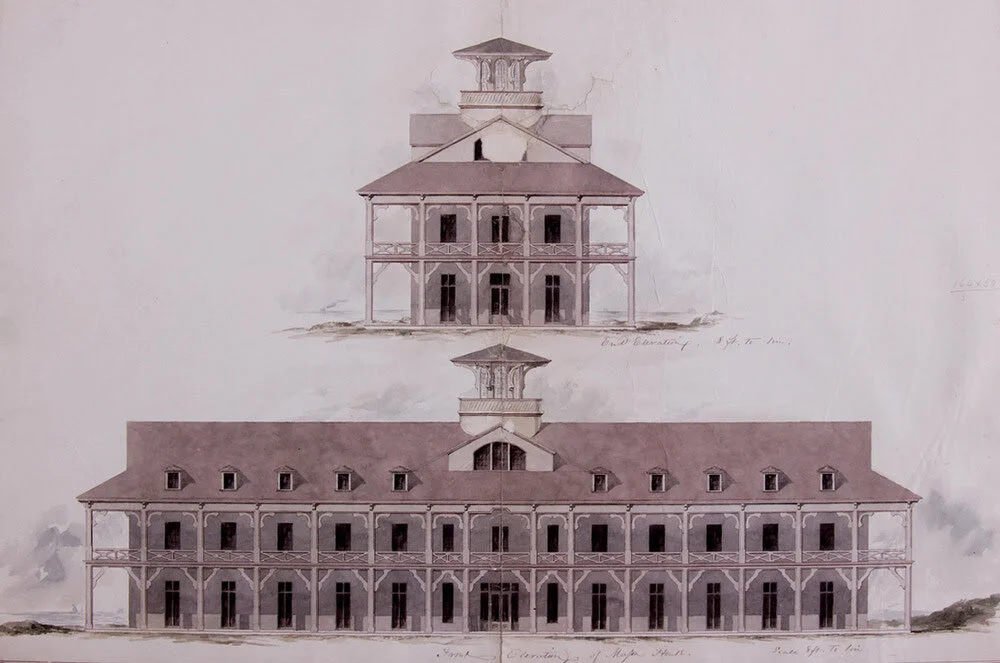
Architectural drawing of the Pavilion Hotel, in Gloucester, Mass., designed by S.C. Bugbee, for Sidney Mason, and built in 1849. The drawing is at the Cape Ann Museum, Gloucester. The long-gone hotel was the first big summer resort hotel on Cape Ann, serving the era’s growing bourgeoisie as New England’s economy boomed. Finished version below.

William Morgan: Joy and sadness with an old knife

My wife, Carolyn, is a potter and a gourmet cook. She depends upon and thus respects her tools, but they are to be used, not objects to be displayed. The tarnished copper pots hanging in a row from a beam above the stove are not there to impress; once in a while I might polish one to a shine, but the pots are there to be worked. The knives on Carolyn's wall rack are beautiful to her. She recalls every country auction where she acquired each pitted and stained Sabatier, and knows how each knick was earned. But these blades still need to be used to slice and chop; they are there to serve.
There is one tool, however, that does not get used. Framed, it occupies a place of honor on our kitchen wall. When we first found this in an antique shop on Wickenden Street in Providence we thought that it was a super-realist still life of a knife. The dealer had no recollection of where he picked this up, but it has a framer's sticker from Springfield, Mass.
A faded typewritten note in Hebrew taped to the back revealed something of its history. Two Hebrew-literate friends gave us this translation:
With G-d's Help.
Tuesday - 8th of the Hebrew Month of Av 1948.
To my esteemed and dearest Avraham May Your Light Shine
Shalom & Blessings
This knife is a gift from your father, of Blessed Memory, that I received from him at the time of my completion of Rabbinic Ordination.
Your father, of Blessed Memory, used this knife to slaughter poultry at the office of slaughter on 19 Franziskaner Street that he inherited from your grandfather Reb Gershon (of Blessed Memory).
And at the opportunity of this pleasant visit it seemed fitting to give this present to one with a delicate and appreciative palate - that it should be your inheritance from your father of Blessed Memory, and that this knife is a symbol of a bygone and disappeared era.
With a warm handshake of appreciation and to your refined wife regards and all the best
Missing you and your family

Where was Franziskaner Street? There may have been hundreds of streets by that name in Germany and parts of Poland and the Ukraine. (Franziskaner is a German word referring to Franciscan monks.) Did Avraham's father escape and did he grab the poultry knife as storm troopers pounded on his father's door? Three years after the concentration camps were liberated, and in the year of the creation of the State of Israel, the knife came to the grandson, now safely in America.
There is both joy and sadness in the knife's coming into our house. How could this tool be anything other than a treasure to be venerated? What descendant could not hold on to this link to past? Yet families can fade into oblivion, while the artifacts of their lives end up in auctions and yard sales. So often the excitement of discovering a discarded gem is tempered by the knowledge that it may well mark the end of a family line.
Reb Gershon's blade for butchering poultry has a special place just above our kitchen table, where we will remember him. Growing up in in rural North Carolina, my wife vividly recalls her mother dispatching chickens with a similar tool. So the knife is a special bond between the butcher shop on Franziskaner Street and our kitchen.

William Morgan, based in Providence, writes on architecture and other topics, mostly design-related.
Twain on cats and summering in Dublin, N.H.

Dublin town center in 1906
Twain summered in Dublin in 1905 and 1906. He loved the area.
From a letter he wrote on Oct. 9, 1905.
“Last January, when we were beginning to inquire about a home for this summer, I remembered that Abbot Thayer had said, three years before, that the New Hampshire highlands was a good place. He was right - it was a good place. Any place that is good for an artist in paint is good for an artist in morals and ink.
“Paint, literature, science, statesmanship, history, professorship, law, morals - these are all represented here, yet crime is substantially unknown.
“The summer houses for these refugees are sprinkled a mile apart among the forest-clad hills, with access to each other by firm smooth country roads which are so embowered in dense foliage that it is always twilight in there and comfortable. The forests are spiderwebbed with these good roads, they go everywhere. But for the help of guide boards, the stranger would not arrive anywhere.
“The village — Dublin — is bunched together in its own place but a good telephone service makes it markets handy to all those outliars. I have spelt it that way to be witty. The village executes orders on the Boston plan — promptness and courtesy.
“The summer homes are high perched, as a rule, and have contenting outlooks. The house we occupy has one. {Mt.} Monadnock, a soaring double hump, rises into the sky at its left elbow - that is to say, it is close at hand. From the base of the long slant of the mountain the valley spreads away to the circling frame of the hills, and beyond the frame the billowy sweep of remote great ranges rises to view and flows, fold upon fold, wave upon wave, soft and blue and unworldy, to the horizon fifty miles away.
“In these October days Monadnock and the valley and its framing hills make an inspiring picture to look at, for they are sumptuously splashed and mottled and betorched from skyline to skyline with the richest dyes the autumn can furnish. And when they lie flaming in the full drench of the midafternoon sun, the sight affects the spectator physically, it stirs his blood like military music. ...
It is claimed that the New Hampshire highlands is exceptionally bracing and stimulating, and a fine aid to hard and continuous work. It is a just claim, I think. I came in May and wrought 35 successive days without a break. It is possible that I could have done it elsewhere. I do not know. I have not had any disposition to try it before. I think I got the disposition out of the atmosphere this time. I feel quite sure, in fact, that this is where it came from.’’
Tweet
Pin
Share

Don Pesci: ‘Equity’ and legal equality in Conn. pot bill

— Photo by Biswarup Ganguly
VERNON, Conn.
Connecticut Democrats, who dominate the state’s General Assembly, have passed a nearly 300-page pot bill.
Some Republicans thought that the bill might easily have been reduced to a single sentence, something of this sort: “All laws in the state illegalizing the sale and use of pot in small quantities are now repealed.” The repeal of such laws would improve crime statistics in the state and reduce incarceration rates as well. If you decriminalize the use of pot, you may no longer arrest and incarcerate those who cannot then break a repealed law.
Here is Bridgeport Rep. Steven Stafstrom, who helped to shepherd the preference-laden bill through the state House, celebrating the imminent demise of the war on drugs: “Connecticut’s time has finally come. We take the next step in recognizing the war on drugs has failed us, and the criminalization of cannabis was the wrong course of action for our state and for our nation.”
Actually, Stafstrom may not favor ending the war on some drug dealers – those who deal in heroine, opium, cocaine, methamphetamine, LSD, phencyclidine, Psilocybin, ketamine, MDMA, Rohypnol (date rape drug), fentanyl, opioids and, of course, flavored cigarettes aimed at school kids. But why quibble with one so passionately convinced that the future holds promise for former criminals who wish to turn their lives around as soon as they can procure from the state a license to sell pot.
New Haven Democrat Juan Candelaria also celebrated the passage of the pot bill, which contained, Candelaria said, one of the nation’s strongest “social equity provisions.”
That provision became a bone of contention in the state House among progressive Democrats. Initially the House pot bill gave licensing preferences to those living in cities, including former felons who managed to stay on the right side of the law years after the completion of their sentences. In giving licensing preference to former felons who resided in cities, the initial bill was inequitable by design.
In its course through the legislative sausage machine, some pixie broadened the licensing preference to include any former felon who met the strictures of the new pot bill – even a millionaire’s son or daughter in Greenwich who once had been nabbed for drug possession.
This, said other Democratic legislators, as well as Gov. Ned Lamont, violated the spirit of the bill backed by the governor and majority of Democrats in the General Assembly who could be relied upon to push the bill forward over the objections of minority party Republicans in the legislature. The extension of the equity provision beyond city limits was destroying a prearranged legislative deal among majority House Democrats.
Lamont then announced that he would not sign a bill that awarded preference in licensing to non-urban geographic areas. Any expansion of equity to the children of millionaires, or even middle-class drudges who had been nabbed under the now discarded “war on drugs” regimen, Lamont’s chief of staff, Paul Mounds, huffed, would result in “equity in name only” and open “the floodgates for tens of thousands of previously ineligible [petitioning] applicants to enter the adult-use cannabis industry.”
By adding an amendment that had expanded equity provisions to non-city dwellers, the amenders had thoughtlessly destroyed an inequitable provision designed to give licensing preferences to former urban lawbreakers. By enlarging equity, Lamont’s mouthpiece said, the amenders might have opened the door for a person from a wealthy community who was once caught with a single joint to become an “equity applicant.”
“Equity,” we should all understand going forward, is not “equality under the law.” Equality under the law means that no one is above or below the law, that the protections provided by law should apply equally to all. Equity is a political attempt that should be resisted by any court in the nation that has built its house on the firm foundational principle of law itself as enshrined in both statutory and constitutional law. To put it in other words, equality under the law is non-discriminatory; and equity is discriminatory, usually in an arbitrary manner. The drug law that had in the past treated both the millionaire’s son and the non-millionaire’s son in an equal manner assured both that the law would apply equally to everyone.
Now that pot laws in Connecticut are being effectively repealed, a licensing law that applies equally to a millionaire’s son and to the son of a non-millionaire in an urban area, architects of equity tell us, is no assurance of equity. And indeed, since equity relies in this instance upon invidious discrimination, equality under the law must be given the boot.
The pot bill is nearly 300 pages long because the bill attempts to enforce equity rather than legal equality. And in so doing the new pot bill must turn the law, the market place, sociological structures and the human conscience upside down. That the General Assembly may with impunity turn the world on its head in this fashion means – if it means anything at all – that we have bid goodbye to liberty, justice, democratic government, and equality under the law.
Don Pesci is a Vernon-based columnist.
SHARE
SHARE