
Vox clamantis in deserto






Todd McLeish: Strengthening plant and animal diversity by planting native plants

Purple coneflowers, a native plant, on a ‘‘pollinator pathway’’ that helps boost populations of wide range of wildlife.
—Photo by Frank Carini/ecoRI News)
From ecoRI News (ecori.org)
Rhode Island gardeners in Cranston and Barrington are joining a national effort to install native plants in their gardens. The idea behind the effort is to link their yards with native habitat on protected lands and create what organizers are calling “pollinator pathways” to boost populations of bees, butterflies, birds and other wildlife.
In the Edgewood section of Cranston, Suzanne Borstein is leading the effort to get her neighbors and friends to plant native plants in what she calls the “tree lawn” — the area between the sidewalk and the road. Since last November, she has hosted a series of online meetings to discuss the initiative, and nearly three dozen Cranston households had agreed to participate by the beginning of May, with more signing on every week.
“The connectability of the garden spaces is what’s especially important,” Borstein said. “If you have a great yard but nobody else in the neighborhood does, then the pollinators won’t be attracted or sustained.”
Planting native plants and restoring native habitat is vital to preserving biodiversity, according to the National Audubon Society. The habitat created by native plant gardens helps to nurture and sustain insects, birds and other creatures.
The idea for the Pollinator Pathways program emerged from a popular book written by University of Delaware entomologist Doug Tallamy called Bringing Nature Home. According to Borstein, Tallamy’s idea was to get people to replace half of their lawns with native plants that would support native insect populations, which in turn support bird populations. If enough people participated, the pollinator pathways would link properties that, when combined, would total more acreage than all of the country’s national parks.
Borstein, a clinical psychologist, said the goal of her effort is to “raise awareness of the importance of choosing native plants. I’m making it as local as I can so we can build community, neighbor to neighbor. I want to increase the availability and use of native plants.”
But where to buy native plants for local use is a considerable problem.
“There’s a new awakening that we should plant natives, but native plants are hard to find,” said Sally Johnson, vice president of the Rhode Island Wild Plant Society board of directors. “I don’t think the commercial market has responded yet to the need.”
The Rhody Native program, launched by the Rhode Island Natural History Survey in 2009, was initially successful at growing native plants from seeds collected locally, but it couldn’t be sustained by a nonprofit with limited staff and funding.
When Borstein contacted Johnson for help in sourcing native plants for her Edgewood gardeners, Johnson eventually identified about 10 native plant species that could be acquired from a commercial nursery in New Jersey.
“It’s called the Garden State for a reason,” Johnson said.
The Barrington Land Conservation Trust is also finding it difficult to find native plants for participants in its pollinator effort.
“Many local nurseries carry plants listed as native, but native to where? New England? The Midwest? Are they true natives or cultivars?” asked Cindy Pierce, one of the organizers of the Barrington project. “It can be daunting for a new gardener or even an experienced gardener new to natives.”
Pierce noted Blue Moon Farm Perennials, in South Kingstown, R.I., specializes in native plants, but the Barrington group is also working with the Rhode Island Wild Plant Society to acquire native plants. The Land Conservation Trust is also asking local nurseries to stock natives, and it plans to hold its own native plant sale in the fall.
The Barrington gardeners aren’t just focusing their efforts on planting natives in the tree lawn, however. They are instead encouraging their neighbors to take whatever steps they can to diversify their gardens with native plants.
“Whether it’s adding a few container plants, adding native plants to an existing garden, or creating a meadow,” Pierce said. “Eliminating the use of fertilizers and lawn chemicals is another important step everyone can take, along with reducing the size of your lawn, mowing less often and leaving the leaves in your garden. Every little bit helps.”
Assuming that interest in native plants and the Pollinator Pathways program continues to build, organizers in Barrington and Cranston hope additional communities will join and extend the corridors being built for pollinators. Those that add native plants to their gardens can add their properties to an online map of native plant gardens called Homegrown National Parks that author Tallamy has established.
“Even if you only have three feet of natives, you can get on the map and it hooks you up to a lot of resources,” Borstein said.
After the planting season, Borstein hopes to organize a neighborhood walk so residents can “see what’s possible.” She hopes such an event will lead to additional participants and further discussions about expanding the project.
“I don’t have anything formal planned, but I’d like to create some way that all of the other organizations in Rhode Island could communicate to share information,” Borstein said. “And I’d like to see it grow beyond pollinators and help people to understand the role of shrubs and trees as well. It will help gardeners understand more about the issues from a holistic point of view.”
Todd McLeish is a nature writer and ecoRI News contributor.

Phil Galewitz: Biden seems in no hurry to allow import of Canadian drugs

U.S. and Canadian customs officers
The Biden administration said Friday it has no timeline on whether it will allow states to import drugs from Canada, an effort that was approved under former President Trump as a key strategy to control costs. {Many New Englanders, especially those in Maine, New Hampshire and Vermont, have long sought to be able to easily get pharmaceuticals from Canada for obvious reasons of price and proximity.}
Six states have passed laws to start such programs, and Florida, Colorado and New Mexico are the furthest along in plans to get federal approval.
The Biden administration said states still have several hurdles to get through, including a review by the Food and Drug Administration, and such efforts may face pressures from the Canadian government, which has warned its drug industry not to do anything that could cause drug shortages in that country.
The Biden administration said the lawsuit was moot because it’s unclear when or if any states would get an importation plan approved.
Drug importation has been hotly debated for decades, with many states and advocates believing it would help lower the prices Americans pay while the drug industry contends it would undercut the safety of the U.S. drug supply. Critics note most brand-name drugs sold in the U.S. are manufactured abroad.
Friday’s court filing had been eagerly anticipated, as it was the first time the Biden administration weighed in on the issue. Promises to curb high drug prices have been a standard sound bite of political campaigns, and importation enjoys broad public support. Supporters of importation range the political spectrum from progressive Sen. Bernie Sanders (I-Vt.) to Florida’s conservative Republican governor, Ron DeSantis. They argue Americans should not pay more for drugs than consumers in other countries.
Rachel Sachs, a health law expert at Washington University, in St. Louis, said the rhetoric in the court filing is probably “disheartening” to DeSantis and other supporters hoping that states’ importation programs would be approved soon. “They are laying out that there is no time limit on the FDA and there are many steps that states have to undergo before approval,” she said.
Supporters of drug importation say they still have hope, especially if the court agrees to the administration’s effort to throw out the suit.
“While articulating possible hurdles that may prevent state drug importation programs from moving forward, the Biden administration’s motion to dismiss PhRMA’s lawsuit keeps alive opportunities for more Americans to benefit from drug importation,” said Gabriel Levitt, president of Pharmacychecker.com, which verifies online foreign pharmacies for customers.
Importing drugs from Canada, where government controls keep prices lower, has been debated for decades in the U.S. A 2003 federal law gave the executive branch permission to do it, but only if certified as safe and cost-effective by the HHS secretary. Then-HHS Secretary Alex Azar announced in September that he would become the first to do that, and the department issued its rule in October.
Florida, Colorado, Maine, New Hampshire, New Mexico and Vermont are pursuing efforts to import drugs.
PhRMA filed its suit in November in the U.S. District Court for the District of Columbia. In the court filing late Friday, the Biden administration said the FDA could reject state importation plans for many reasons, including safety concerns and lack of significant savings for consumers.
In an e-mailed statement, PhRMa spokesperson Nicole Longo said: “We continue to believe the Trump Administration violated federal law when it finalized its rule permitting state-sponsored drug importation from Canada without proper certification and, in doing so, putting the health and safety of Americans in jeopardy.”
Canada has opposed efforts to send its drugs to the United States, fearing that it could exacerbate shortages there. Last year, Canadian health regulators warned companies against exporting any drugs that could lead to shortages.
During the presidential campaign, Joe Biden supported drug importation. His HHS secretary, Xavier Becerra, voted for the 2003 Canadian drug importation law as a member of Congress.
In most circumstances, the FDA says it’s illegal for individuals to import drugs for personal use.
Yet, for nearly 20 years, storefronts in Florida have helped people buy drugs online from pharmacies in Canada and other nations at typically half the U.S. price. The FDA has periodically cracked down on the operators but has allowed the stores to stay open.
The Florida legislature in 2019 approved the state drug importation program, and the state submitted its proposal to the federal government last year. While DeSantis has boasted of the strategy at news conferences in the retiree-heavy community of The Villages, the state program would have little direct effect on most Floridians.
That’s because the state effort is geared to getting lower-cost drugs to state agencies for prison health programs and other needs and for Medicaid, the state-federal health program for the poor. Medicaid enrollees already pay little or nothing for medications.
Florida has identified about 150 drugs — many of them expensive HIV/AIDS, diabetes and mental health medicines — that it plans to import. Insulin, one of the most expensive widely used drugs, is not included in the program.
DeSantis said the importation plan would save the state between $80 million and $150 million. The state has a $96 billion budget, he said.
“It’s been under review enough,” DeSantis said Friday, hours before the Biden administration’s court filing. “We have followed every regulation. We’ve met every requirement that we were asked to meet, and we want now to be able to get this final approval so that we can finally move forward.”
Christina Pushaw, a spokesperson for DeSantis, said the governor was disappointed by the Biden court filing.
“Governor DeSantis calls on the Biden Administration to step out of the way of innovation and act immediately to approve Florida’s plan that provides safe and effective drugs to drive down prescription costs,” she said in an email to KHN.
The governor appeared at LifeScience Logistics in Lakeland, Florida, where state regulators worked with the company to construct an FDA-compliant warehouse to process pharmaceuticals from Canada.
“We’re ready, willing and able, and I think that this could be really, really significant,” DeSantis said.
He said the warehouse could begin receiving drugs from Canada within 90 days if the state were to get approval from Washington.
LifeScience Logistics officials said they are working with Methapharm Specialty Pharmaceuticals, which has offices near Toronto and Fort Lauderdale, Florida, to act as its Canadian wholesaler. Quality checks would be done on the drugs in Canada and again in Florida, said Richard Beeny, CEO of LifeScience Logistics.
LifeScience has begun early talks on negotiating prices with drug manufacturers that would deliver medications to Methapharm, which in turn would send drugs to the Lakeland warehouse. “There is broad interest in the program,” Beeny said about drug companies wanting to participate. “But the pending suit is a bit of a roadblock, so we have to wait and see how that pans out.”
Unlike Florida’s plan, Colorado’s Canadian importation program would help individuals buy the medicines at their local pharmacy. Colorado also would give health insurance plans the option to include imported drugs in their benefit designs.
Mara Baer, a health consultant who has worked with Colorado on its proposal, said the Biden decision leaves open the question of whether state importation plans might eventually be approved. “HHS could have let the rule fall and they did not, which is important given the challenges facing Congress in moving major drug pricing reform in the short term,” she said.
Phil Galewitz is a journalist for Kaiser Health News

Campobello Island is an exclave of Canada’s Province of New Brunswick , but with land access to the mainland being only to Maine.

Useful then artistic

The Connecticut River Walk in Forest Park, in Springfield, Mass., one of many parks designed by Frederick Law Olmsted, who’s considered the father of American landscape architecture. His most famous work is New York’s Central Park. Forest Park, at 735 acres, is one the largest urban parks in American and dates from the late 19th Century, when Springfield was a major manufacturing center.
“Service must precede art. So long as considerations of utility are neglected or overridden by considerations of ornament, there will not be true art.’’
— Frederick Law Olmsted (1822-1903), landscape architect

Elegant order

“Amaryllis” (archival photograph) by Carol Wontkowski, in her show “Blooming,’’ at Galatea Fine Art, Boston, June 4-27.
Ms. Wontkowski comments:
“‘The camera is an instrument that teaches people how to see without a camera.’
— Dorothea Lange
"My work reflects the beauty in common things. Though we live in a world marred by human influence, there is still order, design and beauty around us. It is my desire to capture the more tranquil and serene images of this world, mirroring their Designer.
“This is an amaryllis bud beginning to open. The process is both elegant and exciting to see. I captured this image just before it began to fully emerge to show its unusual process."
That one face
When all the world is young, lad,
And all the trees are green;
And every goose a swan, lad,
And every lass a queen;
Then hey for boot and horse, lad,
And round the world away;
Young blood must have its course, lad,
And every dog his day.
When all the world is old, lad,
And all the trees are brown;
And all the sport is stale, lad,
And all the wheels run down;
Creep home, and take your place there,
The spent and maimed among:
God grant you find one face there,
You loved when all was young.
“Young and Old,’’ by Charles Kingsley (1819-1875), English writer and Anglican priest

Sam Pizzigati: Treating workers as disposable is bad for business

— Photo by Ramon F. Velasquez
Via OtherWords.org
BOSTON
McDonald’s workers in 15 U.S. cities recently staged a weeklong strike demanding a $15 hourly wage for every McDonald’s worker. McDonald’s resisted, pledging only to raise average wages to $13 an hour.
In the meantime, the profits keep rolling in. The fast-food giant registered $4.7 billion in 2020 earnings. CEO Chris Kempczinski personally pocketed $10.8 million last year, 1,189 times more than the $9,124 that went to the company’s median worker.
Executives at McDonald’s seem to think they can outlast the Fight for $15 campaign. More to the point, they think they know everything. Nothing happens at Mickey D’s without incredibly intensive market research: “Plan, test, feedback, tweak, repeat.” More hours may go into planning the launch of a new McDonald’s menu item than Ike marshaled planning the D-Day invasion.
All this planning has McDonald’s executives supremely confident about their business know-how. But, in fact, these execs do not know their business inside-out. They don’t know their workers.
Workers remain, for McDonald’s executive class, a disposable item. Why pay them decently? If some workers feel underpaid and overstressed, the McDonald’s corporate attitude has historically been “good riddance to them.” Turnover at McDonald’s was running at an annual rate of 150 percent before the pandemic.
The entire fast-food industry rests on a low-wage, high-turnover foundation. And at those rare moments — such as this spring — when new workers seem harder to find, the industry starts expecting its politician pals to cut away at jobless benefits and force workers to take positions that don’t pay a living wage.
But if leaders were really doing their research, they’d learn very quickly that this makes no sense. Instead of treating workers as disposable and replaceable, businesses ought to be treating them as partners.
Who says? The Harvard Business Review, hardly a haven for anti-corporate sloganeering. Employee ownership, the journal concluded recently, “can reduce inequality and improve productivity.”
Thomas Dudley and Ethan Rouen reviewed a host of studies on enterprises where employees hold at least 30 percent of their company’s shares. These companies are more productive and grow faster than their counterparts, Dudley and Rouen found. Cooperatives are also less likely to go out of business.
Enterprises with at least a 30-percent employee ownership share currently employ about 1.5 million U.S. workers, just under 1 percent of the nation’s total workforce. If we raise that number to 30 percent, Dudley and Rouen calculate, the bottom half of Americans would see their share of national wealth more than quadruple.
Elsewhere, enterprises with 100-percent employee ownership already exist. Spain’s Mondragon cooperatives, The New York Times noted earlier this year, have flourished since the 1950s. They aim “not to lavish dividends on shareholders or shower stock options on executives, but to preserve paychecks.”
At each of Mondragón’s 96 cooperative enterprises, executives make no more than six times what workers in the network’s Spanish co-ops make. In the United States, the typical rate runs well over 300 to 1.
We’re not talking artsy-crafty boutiques here. Mondragón co-ops, including one of Spain’s largest grocery chains, currently employ 70,000 people in the country.
Mondragón has had a particularly powerful impact on the Basque region in Spain, the network’s home base. By one standard measure, the Basque region currently ranks as one of the most egalitarian political areas on Earth.
“We want to transform our society,” Mondragón International president Josu Ugarte told me in a 2016 interview. “We want to have a more equal society.”
So do workers at McDonald’s.
Sam Pizzigati, based in Boston, is a co-editor of Inequality.org and author of The Case for a Maximum Wage and The Rich Don’t Always Win.
And I learned to sail there

The Community Boating clubhouse on the Charles River in Boston
“Boston was a great city to grow up in, and it probably still is. We were surrounded by two very important elements: academia and the arts. I was surrounded by theater, music, dance, museums. And I learned how to sail on the Charles River. So I had a great childhood in Boston. It was wonderful.” –
Leonard Nimoy ( 1931-2015), American actor, filmmaker photographer, author, singer and songwriter best known for playing Spock in the Star Trek franchise
And the lichens keep eating

Stone wall at what had been Robert Frost's farm in Derry, N.H., which he describes in his famous poem "Mending Wall"
"Many New England stone fences built between 1700 and 1875 were laid by gangs of workers who piled stone at the rate of so much a rod. Edwin Way Teale says that in the latter years of the 19th Century, before economic and social developments began obliterating some of the walls, there were a hundred thousand miles of stone fences in New England. Even today, for many of them, the only change has been the size of the lichens, those delicate rock-eating algae that can live nine hundred years."
William Least Heat Moon, in Blue Highways
Fear and wonder at the Fuller
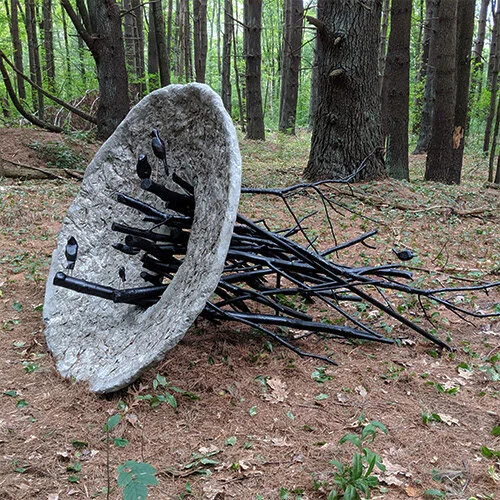
“Nesting’’ (concrete, wood, bronze, steel and ashes), by Elizabeth Helfer, in the group show “Beyond the Walls: Sculptures from the New England Sculptors Association,’’ at the Fuller Craft Museum, Brockton, Mass., through Sept. 12.
This exhibit uses the museum's 22-acre outdoor space, with sculptures throughout the property.
The museum says:
"Nesting’’ uses “a muted color palette and a combination of natural and manmade materials to convey an admiration for nature that is equal parts fear and wonder.
Don Pesci: Of husbandry, debt, 'investing' and politics
VERNON, Conn.
Neither a borrower nor a lender be,
For loan oft loses both itself and friend,
And borrowing dulls the edge of husbandry”
– Shakespeare, in Hamlet
Most people in the United States – indeed, in the world – are either 1) buyers or 2) sellers, or 3) people who facilitate buying and selling.
Politicians consider themselves service providers. Their opening, invariably, is “We’re here to help.” As a general rule, politicians collect money from some people, launder it through bewildering, little understood administrative ganglions, and give it to those who, they determine, need help. A sizable chunk of the gift is devoted to the labor costs of the administrative apparatus, and other parts are parceled out to grease the political machine.
Politicians call this “investing.” They imagine that they are doing what millionaires do effectively in what is still laughingly called, here in the un-United States, a “free market.” A free market may be defined correctly as an unregulated selling floor, where people who want goods and services are free to purchase them from sellers without undue interference from third parties not directly involved in buying and selling.
In our Coronavirus cancel-everything era, we have seen autocratic governors swollen with plenary powers shut down the whole economy -- schools, restaurants, businesses, even the legislative and judicial branches of government.
The political universe, in which politicians invest additionally in their own continuance in office, is not at all like a public marketplace where goods and services are freely exchanged. In fact, in many ways, the political trade is just the opposite of a free market. It is where regulations are made that encumber the free flow of goods and services, sometimes in the interests of the general public.
The Shakespearian line quoted above is spoken by Polonius, who is giving fatherly advice to his son Laertes before his trip to Paris. Do not borrow or lend, the father advises, “for loan oft loses both itself and friend.”
Modern banking has solved the problem of lost friendship owing to imprudent borrowing because, as we all know, bankers are not friends. One who refuses to pay a loan from a bank quickly loses his credit, but never a true friend.
We know, either from bitter experience or hearsay, the dangers of imprudent getting and spending – assuming we are not profligate spenders like the majority of politicians in the so called “land of steady habits.” It is the special mission of progressives to unsteady habits. Here in Connecticut, governmental debt is $67 billion as of September 2020. Nationally, the debt is much larger, about $26.70 trillion as of August 2020, but one cannot expect a small state to keep up with so large a spendthrift neighbor.
Polonius tells his son that imprudent borrowing “dulls the edge of husbandry.”
Whatever can Shakespeare mean by that? What was husbandry in the Elizabethan era, and how is the sharp edge of it dulled by borrowing and imprudent spending?
When Banquo says in Macbeth, “There’s husbandry in heaven; Their candles are all out,” he means that the angels are illuminating fewer stars in order to economize.
It turns out that Shakespeare was a notorious borrower of the literary labor of others and, at some point, Thomas Tusser's Five Hundred Points of Good Husbandry may have fallen under his eyes. The book was very popular in its day.
“Husbandry,” we learn from Tusser and others, was a term that had developed from the word “husband.” It was used to refer to the ordering and management of the household. The term, used more broadly, applied as well to animal and agrarian management. The farmer who excelled at husbandry was, in a word, thrifty, which was why women in Shakespeare’s day were attracted to good husbands. Nowadays, a different alchemy, occasionally involving cosmetics and minor surgery, is used by non-farm women to catch wanted “partners”, not necessarily husbands, in their subtle nets. A good Hollywood husband, a gym rat and buff as a new penny, is one who leaves you in material comfort after the divorce.
Divorce and household management aside, the question of good husbandry –thriftiness and economizing -- is conspicuously absent in both Tinseltown and politics, because husbandry in the Shakespearian sense and marriage in the post-modern period are both regarded as steps backwards and a lamentable indication that one has failed to “move forward,” whatever horrors the future may hold for us, some of which may be glimpsed in urban fatherless families and politicians who little care what sprouts from their spendthrift progressive soil.
Don Pesci is a Vernon-based columnist.

The math of Vermont
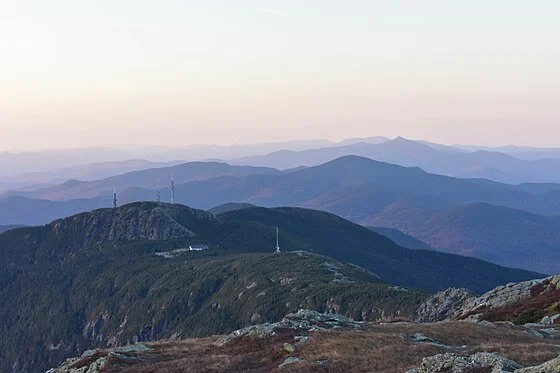
Looking south from the summit of Mt. Mansfield, at 4,396 feet the highest point in the Green Mountain State
“It takes trigonometry, solid geography, and calculus to get at Vermont.’’
— Charles Edward Crane (1884-1960) in Let Me Show You Vermont
Art on the Greenway

“Summer Still Life with Lobsters and Fern,’’ by Daniel Gordon, in the Rose Fitzgerald Kennedy Greenway, Boston
The Greenway, in downtown Boston, has several art installations along its walking path. The newest is “Daniel Gordon on The Greenway,’’ which marks the first time in the park's history that a single artist is featured in various works along The Greenway. These include a mural, tapestries, large-scale sculpture and many photographic still-lifes.
Llewellyn King: Welcome to summer -- the American season
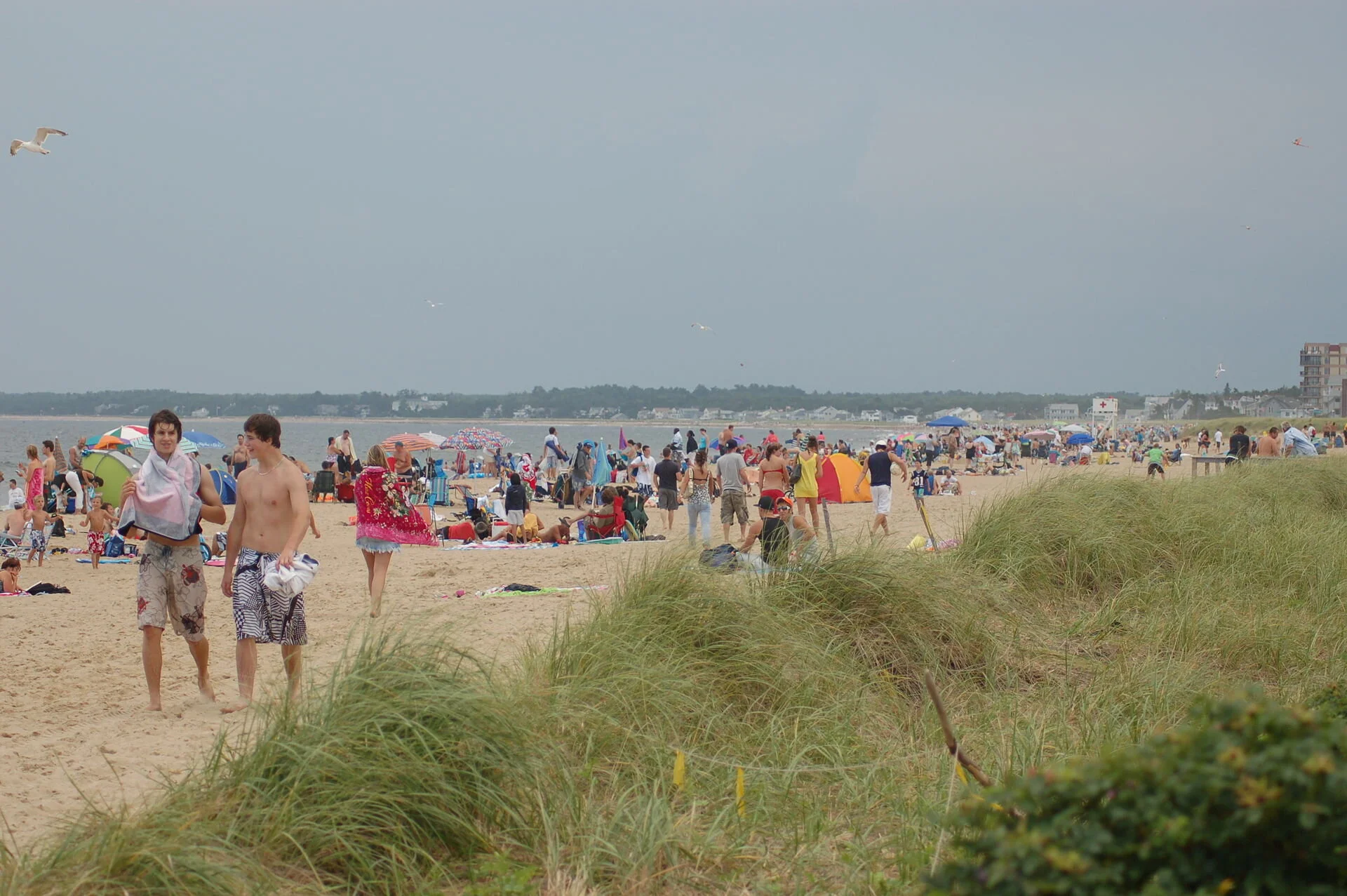
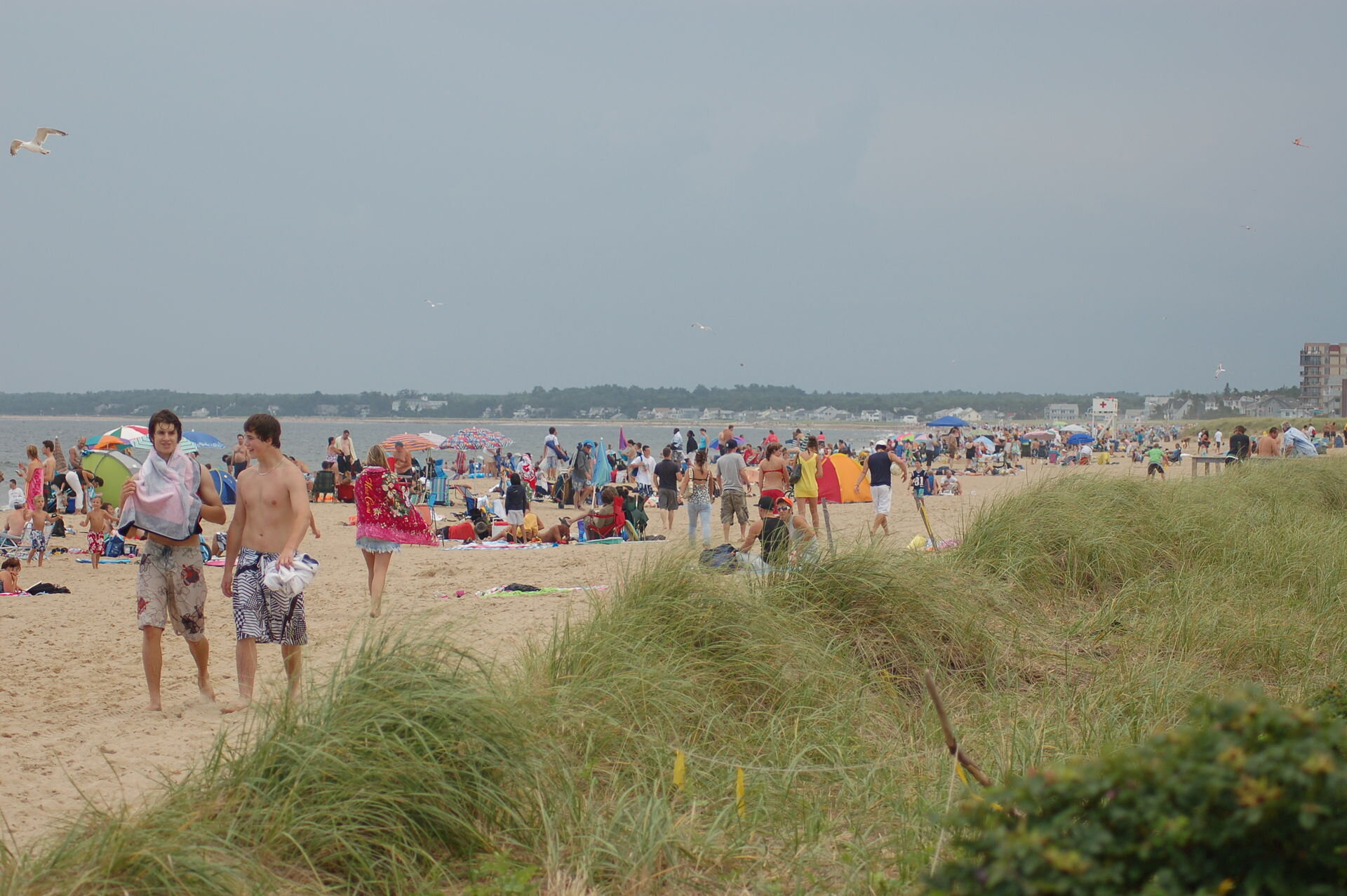
Old Orchard Beach, in Maine
WEST WARWICK, R.I.
The calendar opines that summer starts on June 20, but we know better. Metaphorically, it starts on Memorial Day, when we give thanks to those we honor, those who gave their lives for their country. Then it is, “Beach, ahoy!”
Memorial Day weekend signals the beginning of summer as if a flaming taper were applied to black powder and a cannon fired, joyously marking the sun’s reascendance to its throne.
Summer is important everywhere: to the British who try to catch a few elusive rays under their perfidious sun; to the French who shut their country down in August, and claim their spots on the crowded Mediterranean and Atlantic beaches; or to the Germans who take the summer break as a time to earn bragging rights on how far away and in which unlikely places they took their generous six weeks of vacation.
It isn’t that we Americans don’t travel. But it is here, at home, that we worship summer with the adulation of the sun. It is here we celebrate warmth, sand, water and barbecues. It is here that summer is most adored, most longed for, and most remembered for everything from young love to wraparound family togetherness.
All the world celebrates summer, but Americans exalt in it; treasure it as no others around the world.
Summer is woven into our culture, from those beach movies of the 1950s to its endless evocation in popular songs.
Growing up in Africa, I was bemused and confused by all of this summer worship coming out of the radio. We took summer for granted. It incorporated our rainy season and was a little less lovely than winter -- when the weather was so fair that the radio station (there was but one, and no television station ) didn’t announce the weather for six months. How many ways can a weather forecaster, even the most creative, say “perfect”?
Yes, on the Zimbabwe plateau (highveld), close to the equator, the weather is perfect and, if I might say so, perfectly boring.
No, give me the change of season. Let me join other Americans in celebrating the euphoria that breaks out every June when we say goodbye to dull care and embrace the bounty of summer, of cookouts and hikes, of shorts and tank tops and of going sockless.
From the beaches to the lakes, summer draws us to the water; some just want to bake their winter-ravaged bodies in the hot sand, others want to take to the water in or on everything from canoes to paddle boards, and from dinghies to great schooners.
The call of the water is loud in summer for many Americans but so, too, is the call of the mountains, and the glory of the National Parks beckons with a seductive finger.
The American summer is inextricably tied up with coming of age, of first love – indeed, the first of many first things. But it also enchants the oldsters. It is the time for family integration, when grandchildren and even great-grandchildren can be indulged from Portland, Maine, to Myrtle Beach, South Carolina, and from the Upper Michigan Peninsula to San Diego.
Summer thrills, stocks the memory bank, as even Alaska turns from the epitome of winter to a lush and tempting land where the outdoors offer a cornucopia of joys.
I have been lucky enough to spend summers around the world, so I can report that nowhere is summer embraced with such near-religious fervor as it is here in the United States; nowhere is the sun’s return to full raiment of majesty so celebrated and adored.
Remember this Memorial Day those who fell so that we might be free to fire up the grill and soak up the sun. It shines so lovingly on America.
Llewellyn King is executive producer and host of White House Chronicle, on PBS. His email is llewellynking1@gmail.com and he’s based in Rhode Island and Washington, D.C.
Linda Gasparello
Co-host and Producer
"White House Chronicle" on PBS
Mobile: (202) 441-2703
Website: whchronicle.com
How about a weather museum with water view?
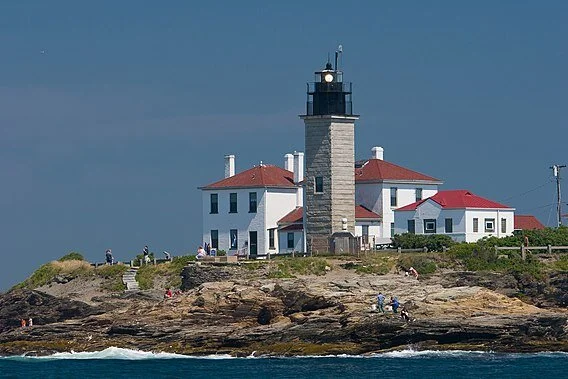
Beavertail Lighthouse
From Robert Whitcomb’s “Digital Diary,’’ at GoLocal24.com
The Coast Guard has decided that it no longer needs famous Beavertail Lighthouse, on a dramatic headland in Jamestown. So the government is offering the site for free to other federal, state and local government agencies and to nonprofit agencies.
How about turning it into a museum of coastal weather and ecology with lots of scientific and historical information, especially what can be illustrated? One thinks of hurricanes and other big storms and of the animals that frequent the New England coast as well as plants, such as kelp forests. Perhaps the University of Rhode Island’s famed Graduate School of Oceanography could be brought into the project.
But dignified

“Nonetheless II” (oil on canvas), by Youngsheen A. Jhe, in her show “Nonetheless.’’ at Galatea Fine Art.
The South Korea-born, Boston-based artist says:
"What kind of world do we live in? As the COVID-19 pandemic pushes us to a disconnected life, every one of us are seemingly stuck in our own world, although humans are social animals. We are forced to walk this path alone and with our masks covering our faces. An invisible glass film (and sometimes visible) blocks us from another. Solitude and loneliness were forced upon our lives and all we can do is to walk this lonely road without a companion.
“My starting desire was to depict the reality of the human beings through the inanimate mannequins, helplessly stuck in their own solitary world.
“From this series, I started to describe living fashion models instead of mannequins. They walk away from other models with expressionless and inanimate faces, but nonetheless their steps are always confident and they walk on a bright path full of light, not bleak hopelessness. It seems to be the image of us living in a pandemic. We have to walk with social distancing, but there is always a bright light for us."
Always looking for work

Newly plowed field in Bethel. Vt., in the spring
“Hard work was not only necessary, but it was also noble; and to avoid it would lead to disgrace, dishonor, and probably, eventually, to Hell itself. If a true Yankee ran out of work, he was expected to look for more.’’
Lewis Hill, in Fetched-Up Yankee: A New England Boyhood Remembered, a memoir of the author’s growing up on a Vermont farm in the 1930s


Tim Faulkner: Offshore wind and energy justice
![Global cumulative offshore wind-power capacity in megawatts Sources: GWEC (2011–2020)[9][10][11][12][13][14] and EWEA (1998–2010)](https://images.squarespace-cdn.com/content/v1/561446cce4b094b629347f8d/1621954289021-8M16XNJJJ9688ERQOKVS/power.png)
From ecoRI News (ecori.org)
The recent announcement by Ørsted and Eversource to invest $24 million in an assembly facility at the Port of Providence is a shot in the arm for local jobs and sign of the financial tidal wave flowing into the offshore wind industry.
The infrastructure pledge is part of $40 million the energy companies plan to spend on ProvPort and the Quonset Business Park in North Kingstown, R.I. The facilities will create at least 40 jobs and support construction for the Revolution Wind and South Fork Wind offshore facilities. Quonset, with a federally funded pier expansion, will host a boat building company with plans to make two crew-transport vessels, and serve as the transmission cable landing for at least two offshore wind projects.
A third facility, at the State Pier in New London, Conn., will receive an additional $77.5 million from Ørsted and Eversource to build a deep-water cargo port. The pier project creates 460 construction jobs and offers faster access to the Revolution and South Fork wind facilities and a third Ørsted/Eversource project, Sunrise Wind.
Lured by generous subsidies and billions from power-purchase contracts, international utilities and even major fossil-fuel extractors are surging into the region to embrace the advancing renewable-energy boom. The United States currently has more than 29,000 megawatts of offshore wind procurement targets.
In the next five years alone, offshore wind developers plan to bring online 9,100 megawatts from 13 offshore wind projects.
A pro-wind administration and new federal incentives are stoking the growth. The December 2020 federal stimulus package included a new 30 percent tax credit for offshore wind projects. In March, the Biden administration sweetened investments for offshore wind development by opening a new lease area off New York and New Jersey. There’s $3 billion for new loans, and funds for more port construction, and research and development.
Developers such as Ørsted and Vineyard Wind aren’t spending for free. Fueled by long-term contacts and sales of renewable-energy credits, both paid by ratepayers, developers and financial institutions like JPMorgan Chase and Goldman Sachs stand to make many times what is being spent on port development and infrastructure investments.
Ørsted, the world’s largest offshore wind developer, is looking at an estimated $3.2 billion in revenue from the power-purchase agreement for Revolution Wind alone.
While they fight for the right to continue to belch out greenhouse-gas emissions, fossil-fuel behemoths are also becoming interested in renewable energy. Big banks are financing projects on both sides. (istock)
Fossil-fuel fingerprints on renewables
Drawn by lucrative fixed-pricing contracts that guarantee a revenue stream, oil and gas developers and bankers are profiting from the response to a problem they had a hand in creating. Fossil-fuel giants such as Chevron and Royal Dutch Shell are embracing offshore wind as new players in the growing sector.
“Every barrel of oil and every watt of electricity that the women and men of the U.S. offshore sector produce is energy that our nation does [not] have to import from state-backed producers in pollution havens such as Russia or China,” according to Erik Milito, president of the lobbying firm National Ocean Industries Association, whose members in the convoluted energy sector include ExxonMobil, Halliburton, ocean rare earth mineral miners, and Ørsted.
Many of the big banks financing these projects, such as JPMorgan Chase, Citi, and Bank of America, are still funding fossil-fuel development. Chase, the top lender, has financed $317 billion for fossil-fuel ventures since the Paris Agreement was signed in 2016. Some like ExxonMobil and Shell are facing legal battles for climate denial and for failing to protect their behemoth waterfront oil and gas terminals from the climate crisis.
But Ørsted, previously named Danish Oil and Natural Gas, was a full-fledged fossil-fuel extraction and distribution company that owned oil, gas, and coal power plants. In 2009, the company publicly pledged to transition to offshore wind and is now leading the offshore “green revolution.”
Although Copenhagen was the site of the United Nations’ climate conference that year, public pressure had little to do with the multinational’s transition to renewable energy. According to the online magazine Corporate Knights, Ørsted’s shift to wind was mostly made in reaction to declining revenue, as fossil-fuel profits dropped and the costs to build renewables declined. Ørsted’s stock price and growing earnings reflect the fiscal gains of that decision, serving as a nautical map to offshore wind for other utilities to follow.
While 90 percent of public testimony delivered in Massachusetts legislative committees on energy and climate change favor climate and renewable-energy bills, special interests push back hard. (Climate Social Science Network)
Financial gains flow away
Like most privately owned U.S. utilities, National Grid and Eversource are keeping stakes in fossil fuels. The companies still own natural-gas infrastructure and distribution networks. Eversource, however, appears to be following in Ørsted’s footsteps by branching out into offshore wind generation.
In 2019, the Hartford-based utility bought a 50 percent stake in Revolution Wind and South Fork Wind, plus joint ownership of a lease of a 300-square-mile ocean wind area.
National Grid isn’t staying on the renewable-energy sideline. The United Kingdom-based utility is building and profiting from undersea transmission cables for the Revolution Wind project. The utility is writing the request for proposal (RFP) for another 600 megawatts of offshore wind power for Rhode Island, a project the utility stands to profit from.
Meanwhile, at statehouses across the country, private utilities lobby against environmental legislation, especially solar bills that benefit decentralized ownership.
According to a recent report by the Brown University-based Climate Social Science Network, the two primary utilities in Massachusetts, National Grid and Eversource, often sided with real-estate and fossil-fuel organizations by opposing legislation that addresses the climate crisis, while supporting bills that promote imported, large-scale hydropower and local offshore wind energy.
“These projects would result in substantial contracts for the state’s largest utilities,” according to the 36-page report. “Conversely, solar electricity is often decentralized on residential and commercial rooftops and therefore ‘behind the meter,’ meaning it cuts into electric utilities’ revenues.”
In recent years, National Grid has resisted moratoriums on natural-gas connections and locked out union workers over contract disputes.
In a new scandal, Rhode Island’s main gas and electric utility is being accused of reaping millions from an excessive surcharge related to its undersea cable for the Block Island Wind Farm. The discovery prompted Rhode Island Public Utilities Commission (PUC) chairman Ronald Gerwatowski, during a recent PUC meeting, to declare, “they’re making so much money on this that it’s ridiculous. … The company should be ashamed of itself.” (His comments start at about the 1:54 mark.)
While benefits like port development, fisheries research, and engineering and construction jobs are significant to Rhode Island and the region, they pale compared to the billions heading to investors.
The revenue streams are complicated, but a major slice of the financial gains are flowing out of state to foreign-owned banks and energy institutions such as National Grid, Ørsted, and their shareholders. Vineyard Wind is co-owned by a Danish investment firm and Iberdrola, a Spanish multinational utility that also owns coal power plants.
The 804-megawatt Mayflower Wind offshore project slated for be built south of Martha’s Vineyard is owned by Shell and EDP Renewables, a subsidiary of Lisbon-based Energias de Portugal.
Energy democracy is a political, economic, social, and cultural concept that merges energy transition with democracy and public participation.
Push for energy democracy
The hypocrisy, conflicts of interest, profiteering, and equity concerns have prompted a simmering debate about the role of energy in society. Questions are being raised about how electricity is produced and delivered, owned, and funded.
Some see access to renewable, affordable energy as a right and are pushing for decentralizing and socializing the system to advance environmental-justice issues and create a low-carbon transition that is influenced by energy democracy or energy justice rather than shareholder earnings.
Since ratepayers and taxpayers are funding the transition to offshore wind, why can’t those profits and decisions about what they fund stay local?
Christian Roselund, a Providence-based energy writer and activist, sees the winter power outage in Texas as another example of the flaws of a deregulated system that treats electricity as a commodity and fails to act in the interest of ratepayers.
“We’ve created a monster here,” Roselund said of private utilities. “We’ve given them all this power, and when we realize it needs to be tweaked they stop that from happening because it’s a good deal for their shareholders. The utility and the shareholders don’t want this to change, and we’ve failed as a society to address that.”
Roselund, who is a member of the Providence DSA (Democratic Socialists of America) National Grid working group, and other progressive thinkers are making the case for a different model — one that approaches electricity as a human right and offers access while keeping a stable supply. Proponents of such a system suggest the revenue be redirected from out-of-state investors and multinational corporations to local organizations by using publicly owned power authorities and financial institutions.
The concept isn’t new. Public utilities created though the Rural Electrification Administration in the 1930s were used to bring power to areas deemed unprofitable by private power companies.
Government-owned utilities such as the Tennessee Valley Authority (TVA) became potent tools for energy democracy by offering affordable electricity to poverty-stricken rural regions.
This model is being revisited as a federal, regional, or state entity with resources to expand development into large-scale renewable projects and usher in the electrification of the transportation and heating sectors. A Green TVA concept operates as a federally owned corporation or group of organizations that prioritize equity while having the fiscal backing to raise substantial sums of money to finance large energy projects such as offshore wind facilities.
The TVA is currently restricted to Tennessee and parts of six neighboring states. But one proposal suggests allowing TVA to expand its reach and install solar, wind, hydro, and even nuclear generators across the country. Power could then be sold wholesale to local power companies outside of the TVA’s jurisdiction.
As public utilities, ratepayers own the projects and as shareholders they benefit from the savings and influence policymaking. Public utilities are far from perfect and are often criticized for failing to acknowledge public demands.
Roselund said there needs to be structural changes so that public utilities are truly responsive to the public and committed to transparent democracy.
But the vision of large, centralized public utilities producing and distributing low-carbon power is gaining support for matching the scale needed to develop offshore wind.
“Because it is a federally owned corporation, it can be used directly by the government to achieve energy transition goals,” according to the People’s Policy Project. “This differs from other approaches that rely upon subsidies and mandates to indirectly modify private sector behavior.”
While some municipal and state utilities have mixed results, other models are being proposed. Maine, for instance, is considering starting a nonprofit, consumer-owned utility.
Federal utilities have also been operating for decades in Germany and Denmark. In fact, the Danish government is Ørsted’s majority owner.
Cooperatives, community choice aggregation, and shared distributed generation are flourishing in states that allow them, especially for solar electricity. (istock)
Cooperative models embraced
While the United States and England have shifted to the private-ownership model, public and cooperative entities are being embraced in some regions to democratize renewable energy, especially for land-based projects such as solar.
Cooperatives, community choice aggregation (CCA), and shared distributed generation are flourishing in states that allow them, especially for solar projects. These projects include a consumer-owned power co-ops in New York City, Massachusetts, and Vermont. The Cape Light Compact on Cape Cod is a joint power collective that aggregates municipal electricity purchases for 21 municipalities. It offers discounted rates, consumer protections, and aid for low-income residents.
Public banks, such as the state-owned Bank of North Dakota, are popular institutions. The much-maligned and misrepresented Green New Deal promotes the creation of public banks, because these member-focused institutions could be asked to finance all or portions of large renewable-energy projects while offering other benefits to taxpayers. As consumer-owned entities, they can direct the social benefits to frontline communities, unlike private companies that must balance equity initiatives with maintaining profits.
Former Rhode Island secretary of state Matt Brown offered a pubic energy plan with a focus on a public bank during his 2018 campaign for governor.
The current offshore wind model, he said, follows the same system of financing that requires residents to spend some $3.6 billion, or about $3,400 per person, to buy imported fossil fuels each year.
“We have to make sure all of the profits for this new energy don’t go to hedge funds and big banks and Wall Street investors,” Brown said. “It ought to be shared by the public. The sun and the water and the wind shouldn’t be owned by any corporations. The people should benefit from the use of these resources.”
He proposed that Rhode Island run its own energy system that meets state energy needs by 2035. As a state energy system, each resident would have a say in decision-making and receive an annual rebate check, much like the Alaska Permanent Fund Corporation, which shares royalties from fossil-fuel extraction with residents.
“My plan gives the state and all Rhode Islanders an actual financial stake in this new energy system,“ Brown said.
As a public bank, public utility, or cooperative, Brown noted that the entity would offer greater transparency, accountability, and participation in decisions about energy use and equity.
John Farrell, director of the Energy Democracy Initiative, has also suggested expanding a publicly owned bank or utility to participate in the ownership of a project.
“The license of fossil-fuel companies and utilities to pollute without consequences caused the climate threat,” he said.
The solution, he said, is to reduce the power of monopoly corporations. In the energy sector, that means prioritizing distributed power.
Multiple cooperatives or even a number of publicly owned utilities could combine their financial clout to buy into offshore wind, perhaps through ownership of turbines or joining into power-purchase agreements. Financial risk can be reduced through federal backing.
Farrell suggested that a group of 20 or so cooperatively owned or publicly owned utilities could band together to take ownership and invest in an offshore wind facility.
The federal government could also build offshore wind facilities, much as they did with large dams between the 1930s and ’60s through the Western Area Power Administration, a federal entity that operates hydroelectric dams and delivers electricity to more then 40 million customers. A power administrator like this could sell energy to utilities with a preference given to municipal and energy cooperatives.
Farrell said these projects would help the United States catch up with Europe’s more developed offshore industry by growing an offshore wind workforce and building local expertise. He also noted that a public system could set standards for hiring U.S. firms and set procurement rules for hiring women and minorities to ensure equitable access to the workforce.
“In some ways it would make a lot of sense because the technology and the know-how are out there internationally,” Farrell said. “But we need to build up our domestic capabilities, especially in terms of construction experience. The federal government could also drive a lot of useful domestic economic agenda with that by saying we’re going to hire American firms to do the work, we’re going to hire American workers and make sure there is equitable access to the workforce.
“I think that’s an intriguing approach in terms of the offshore wind resources given that we have so much of it that’s untapped at this point.”
Community choice gathers momentum
Germany has had success with its procurement compensation rules that encourage the development of community ownership and cooperatives. As a result, nearly half of 70 gigawatts of solar development are owned by solar cooperatives.
Legal structures and tax incentives would need to be changed to encourage the expansion of cooperatives in the United States.
Farrell advocates for CCAs, which allow cities and towns to buy power on behalf of their residents, businesses, and municipal customers from an alternative supplier. Rhode Island and Massachusetts are two of nine states that allow community choice aggregation.
The CCA concept could be expand to allow offshore wind developers to sell a portion of a facility to a cooperative or a collective of CCAs. Or much like the auto bailout in 2008, the government could take an equity stake in an offshore wind project and have an increased say in the procurement. Or a federal entity could use its purchasing power to buy offshore wind power at a price premium and direct revenue to address issues of public interest.
Farrell supports a plan that democratizes the energy system by bringing solar to 30 million households. Such a program would create millions of jobs, reduce energy bills, grow wealth, and lessen reliance on monopolistic utilities for essential electricity services.
The goal of such a proposal, he said, is to “shrink the economic and political power of investor-owned utility companies, so that people and the planet come before shareholder returns.”
There isn’t much appetite for public ownership among state energy officials.
The Rhode Island Office of Energy Resources (OER) balked at engaging the notion of public energy ownership. The agency is reluctant to discuss social-justice strategy and quickly slams the door when it comes to tilting the model toward citizen ownership.
“We have no further comment at this time,” OER spokesperson Robert Beadle said when asked about the concepts of keeping revenue and decision-making local through public ownership of offshore wind.
In a subsequent email, Beadle noted that project financing is a critical component of advancing a proposed renewable-energy project, particularly those at scale. He said current practices leave equity decisions to the developer.
“We note that the broader issue you raise is indeed a very important one,” Beadle wrote. “Through the EC4 [Executive Climate Change Coordinating Council], OER and other state agencies are working to advance a coordinated climate justice approach to our shared work, emphasizing equity and access for all Rhode Islanders.”
The Massachusetts Clean Energy Center (MassCEC), a quasi-public economic development agency focused on renewable energy, shunned repeated requests for comment on energy democracy.
In an Earth Day opinion piece, MassCEC CEO Stephen Pike praised the Mayflower Wind and Vineyard Wind projects for funding job-training programs and called for greater direct spending for environmental-justice communities. But there is no mention of making the existing energy structure, and offshore wind, more democratic.
Corporate-funded advocacy groups such as Boston-based Ceres call for modest changes to the existing structures, such as asking established financial firms to disclose climate-impact risks, broaden racial discussions, and “strengthen financial regulator coordination globally.”
Offshore wind expert Willett Kempton, a professor at the University of Delaware, has said local banks aren’t equipped to manage the kind of sophisticated financial instruments used to fund billion-dollar energy projects. These mechanisms regularly include structured financing bond deals that are unlike traditional lending.
Kempton has suggested that social issues such as equity and environmental justice be addressed by states through RFPs for offshore wind power-purchase contracts.
Other energy experts note this concept in a recent RFP in Massachusetts that requires bidders to address hiring and training minority groups, women, veterans, LGBT, and persons with disabilities. The RFP says projects must create a supply chain that gives preference to underserved communities. Developers also are mandated to track the environmental and socioeconomic impacts on environmental-justice communities.
Local opportunities are here
Michael Goodman, professor of public policy and acting provost at the University of Massachusetts at Dartmouth, said southeastern New England should position itself as a hub for operation and maintenance that serves as a center in the global supply chain for offshore wind.
Danish developers and the offshore extraction industry already have the financial partners and experience to build large energy projects, while states and utilities are lining up to buy the power.
“So I think the real way to democratize the impacts of this industry is to do what we need to do to attract as much of that supply chain investment and business location as we can,” Goodman said. “That will allow us to have an inside track on what’s expected to be a very significant and new industry in the United States.”
He noted that the region is market-ready for the wind industry, and Massachusetts and Rhode Island are “well positioned to capture their disproportionate fair share of those benefits if we play our cards right.”
Playing the right cards includes building a trained workforce and offering incentives for developers to partner with local businesses. Goodman said there’s also an opportunity for cross-boarder collaboration between states in New England.
“I think there is much more bang for the public buck focusing on capturing the benefits of the emergence of the industry than there is trying to develop alternative sources of financing,” Goodman said.
But there may be some middle ground.
Brown said energy transition is not an all-or-none, public-private paradigm.
“There can be private investment,” Brown said. “All I’m saying is the public should get something, not nothing.”
“There’s an opportunity here,” Roselund said. “We’re going to have this energy transition once. It’s a more-just political economy of energy where people benefit not just big corporations.”
Creating a new utility, power cooperatives, and/or banking entity will require legislation and plenty of political will and public support.
“We just don’t have that culture of many of these European nations but we have a lot to learn from them,” Roselund said. “I think there is more interest in doing this, and it’s just a matter of taking the next step.”
Both sides of the public-private divide say now is the time to act.
“This is the moment,” Brown said. “Will people get some of it, or will corporations and hedge funds and banks get all of it? It’s the least we can do, we just need different politicians.”
Jobs and economic and environmental benefits seem assured, and overtures to environmental-justice communities are underway. But with a major energy transformation in motion and vast public resource at stake, the concept of energy justice appears to be an afterthought.
“Government should find a way so that the public finds a stake in the renewable-energy economy,” Brown said. “It’s absolutely possible. It’s just a question of political will and standing up to corporate power and corporate money.”
Visual hors d'oeuvres

“Neveruses à Table,” by J. (aka Josh) Stoner Blackwell, at the Bennington (Vt.) Museum. Neveruses are hybrid painting-objects composed of recovered plastic bags and colored fibers, such as wool yarn, silk thread, and patterned cloth. Mr. Blackwell is an artist originally from Louisiana who now lives and works in Vermont.

Chris Powell: Public unions subvert government; the faces of socialism -- good and bad
MANCHESTER, Conn.
What is the public interest in unionizing government employees as they now are unionized in Connecticut?
The public interest in allowing private-sector workers to unionize is obvious. Without organized labor's countervailing force, big private business interests can gain control over communities, states and sometimes the whole country.
But the government is not a private interest. It represents everybody, so organizing against it -- rather than organizing against a particular administration -- is against the public interest.
Liberals used to agree. Even during the Great Depression, President Franklin D. Roosevelt opposed government employee unionism. So did New York Mayor Fiorello LaGuardia. They understood that coercion of the government by its own employees would subvert democracy itself.
But now liberals make common cause with government employee unions against the government. Even as Connecticut Democrats keep carping about the January "insurrection" in Washington by the crowd summoned by President Trump to protest the election results, Democratic state legislators are advancing a bill in the General Assembly to subvert state and municipal government. Their legislation would compel government agencies to stop being merely neutral about employee unionization and instead to coerce employees to join.
The legislation would direct state and municipal government agencies to sic unions on their new hires, notifying the unions of new hires, giving the unions the home contact information of new hires, inviting union representatives to orientation meetings, and providing work time for unions to propagandize new hires. All this would undermine a new employee's loyalty to his employer from the start.
There is no public interest in this. There is only a political interest -- the interest of Connecticut's Democratic Party in mobilizing government workers in support of the party's candidates.
There is already little management in government in Connecticut. Performance standards are low and the little discipline that is imposed is often weakened or nullified by the state Board of Mediation and Arbitration. This is not government of, by, and for the people, but government of, by, and for the unions -- and unlike the insurrection in Washington, this one, infinitely more subversive, is likely to be enacted while hardly being noticed.
xxx
Complaints of socialism are being hurled at the Biden administration by Republicans who think the label itself is enough, just as Republicans did back in the 1930s, '40s, and early '50s. But the label is not enough, and President Harry Truman, a Democrat, answered the Republicans well in October 1952 not long before he left office.
"'Socialism,'" Truman said, "is a scare word they have hurled at every advance the people have made in the last 20 years. Socialism is what they called public power. Socialism is what they called Social Security.
"Socialism is what they called farm price supports. Socialism is what they called bank deposit insurance. Socialism is what they called the growth of free and independent labor organizations.
“Socialism is their name for almost anything that helps all the people.”
But socialism isn't always progress, for Truman's list was incomplete.
Socialism is also perpetual stupid imperial wars. Socialism is government bailouts for crooked investment banks. Socialism is excessive salaries and unaccountability for government employees. Socialism is government's award of privilege to racial and ethnic groups.
Socialism is government's pretense that men can be women and its requiring women's sports to admit men. Socialism is the government's paying people not to grow crops and now even paying them not to work.
That is, socialism is anything the government does in the name of progress, and since some of it is good and some isn't, the word is meaningless as an epithet.
The serious issue here is something else. According to the U.S. Commerce Department's Bureau of Economic Analysis, government now is the direct source of more than a third of the country's personal income.
So does the country still want a free-market economy with a dominant private sector, or does it want government to control more than it already does?
Chris Powell is a columnist for the Journal Inquirer, in Manchester.