

'This brave little state'

Mt. Mansfield

“I have had an opportunity of visiting again the scenes of my childhood. I want to express to you, and through the press to the other cities of Vermont, my sincere appreciation for the general hospitality bestowed upon me and my associates on the occasion of this journey.
“It is gratifying to note the splendid recovery from the great catastrophe which overtook the state nearly a year ago. Transportation has been restored. The railroads are in a better condition than before. The highways are open to traffic for those who wish to travel by automobile.
” Vermont is a state I love. I could not look upon the peaks of Ascutney, Killington, Mansfield and Equinox, without being moved in a way that no other scene could move me. It was here that I first saw the light of day; here I received my bride, here my dead lie pillowed on the loving breast of our everlasting hills.
“I love Vermont because of her hills and valleys, her scenery and invigorating climate, but most of all because of her indomitable people. They are a race of pioneers who have almost beggared themselves to serve others. If the spirit of liberty should vanish in other parts of the Union, and support of our institutions should languish, it could all be replenished from the generous store held by the people of this brave little state of Vermont.’’
President Calvin Coolidge’s speech at Bennington, Vt., on Sept. 21, 1928. Coolidge (1872-1933) was touring his home state by train to assess progress of recovery following a disastrous flood in 1927. Considered taciturn and nicknamed "Silent Cal," Coolidge demonstrated unusual emotion in delivering his response to the suffering and loss he had witnessed.
David Warsh: Mundell, the enigmatic guru of 'supply-side economics'

Robert Mundell
SOMERVILLLE, Mass.
Email last week brought a copy of The Gypsy Economist: The Life and Times of Colin Clark, by Alex Millmow. Starting in the 1930s, Clark (1905-1989) was an important student of global economic development who, though born in London, spent most of his career in Australia. The same mail brought news, too, of the death of international macro-economist Robert Mundell. He was 88, a Canadian who spent 45 years at Columbia University.
Another decade or two will pass before an even-handed biography of Mundell arrives, but it will be worth the wait. Mundell was a brilliant student of the rapid evolution of the international monetary system in the years after 1960 and was sometimes described as “father of the Euro.” He became the enigmatic guru of “supply side economics,” and plumped for a return to the gold standard as well. As a new Nobel laureate, in 1999, Mundell entertained guests by concluding his banquet speech by singing a few lines of My Way.
While waiting for a thorough, absorbing, and graceful appraisal of a remarkable life (I have in mind, as an example, David Ricardo: A Biography, by David Weatherall, though Mundell was no Ricardo), we have the Nobel Committee’s own explanation. We have as well the testimony of the economist who did more than any other person to make Mundell’s Nobel Prize come about, Rüdiger Dornbusch, of the Massachusetts Institute of Technology. A year after Mundell was recognized, Dornbusch described his contributions in the Scandinavian Journal of Economics
“Mundell’s central claim to fame is to have recast entirely the way we think about the functioning of an economy with an open capital account, including the stark implications for policy. That is the purely intellectual part. But there is also the marketing department: the wonderful skill to capture the story in a few equations, a simple diagram. Just as [Nobel laureate] John Hicks… brilliantly summarized [in 1937] the essence of Keynesian economics in the IS-LM diagram, Mundell’s models likewise reduce to the textbook level a dramatically new view of the open economy.”
Mundell had come to economics at the right time, Dornbusch wrote. He graduated from MIT in 1956, “after two decades of formalization had clarified the distinction between goods and asset markets.” Post-war capital controls were giving way to convertibility under the Bretton Woods system. It helped, too, that Mundell was Canadian. Canada had shifted from fixed to floating rates in the 1950s, offering him a wealth of practical problems to ponder.
Mainly, Mundell entered with alacrity into the policy debates in international trade and finance that heated up as global growth surged in the early 1960s. A two-year stint in the research department of the International Monetary Fund, 1961-63, served him especially well. Two papers in 1963 – “Capital Mobility and Stabilization Policy under Fixed and Flexible Exchange Rates” and “”Inflation and Real Interest Rates” – made his reputation. Mundell arrived at the University of Chicago in 1965, and for the next several years, as the international system of convertibility to gold via dollars under Bretton Woods Agreement gave way to flexible exchange rates, he was, as the saying goes, the straw that stirred the drink. “He did not shy away from the difficult task of setting out a framework for policy thinking,” wrote Dornbusch. “There was no international monetary issue of the 1960s and 1970s in which he was not prominently and decisively involved.”
Departmental friction, probably mainly with Milton Friedman, led Mundell to quit Chicago and accept a position at the up-and-coming University of Waterloo, in southwestern Ontario, starting in 1971. Ricard Caves, of Harvard University, who had recently edited a volume of Readings in International Economics for the American Economic Association, memorably cracked wise: “At last Waterloo has met its Napoleon!”
In 1974, Mundell accepted an offer from Columbia University. Once in New York, he struck up a conversation with the editorial page of The Wall Street Journal. A 1970 lecture to a full house at the University of Chicago – “The Dollar and the Policy Mix” – had “failed to convince,” Dornbusch wrote; there had been no model, no carefully spelled-out assumptions, just assertions – tax cuts would foster growth on the supply side, tight money would diminish inflationary expectations.
But after Princeton’s economic department published the lecture as a pamphlet in 1971, its argument gathered force, especially after WSJ editorial writer Jude Wanniski anointed it as the “Mundell-Laffer hypothesis” in an article in The Public Interest in 1975. (Arthur Laffer had been a Chicago colleague). Mundell had become “guru for a movement that may not have much intellectual appeal,” Dornbusch wrote in 2000, “but it certainly has changed the world.” As for Mundell’s advocacy of gold, Dornbusch added, it was hard to tell if he was serious. But, he continued, Mundell always had an undeniable streak of the enfant terrible.”
Left behind in Chicago in 1972 were Mundell’s students, Dornbusch, Jacob Frenkel and Michael Mussa; his faculty colleagues, Harry Johnson, a fellow Canadian 10 years his senior; Stanley Fischer, Arnold Harberger, and the deeper theorists whose work had influenced Mundell’s conversion from classical Keynesian view to those of a global monetarist. Dornbusch and Fischer moved the next year to MIT and taught two luminaries of the next generation of international economists, Kenneth Rogoff and Maurice Obstfeld, who in turn wrote the text for the generation after that. Frenkel went to the International Monetary Fund and prepared the way for future policymakers at the Bretton Woods institutions, including Fischer, Mussa, Rogoff, Obstfeld, and, in the present day, Gita Gopinath at the IMF and Carmen Reinhart, at the World Bank.
Might the Swedes somehow have diluted Mundell’s contribution? Or turned a blind eye to it altogether? Marcus Fleming, IMF deputy research director, who shared credit for “the Mundell-Fleming model,” died in 1976; Harry Johnson in 1977; Robert Triffin in 1993. Dornbusch argued that the epochal transition to the open-economy world could not be overlooked. With Obsfeld, and Guillermo Calvo, of Columbia University, he organized a 1997 Festschrift conference (published as Money, Capital, Mobility, and Trade); and a campaign among those who had been invited to submit nominations
It worked. Mundell was recognized and went on to 20 years of enhanced celebrity, generating ample material for the later chapters of that future biography.
Dornbusch died of cancer, in 2002, at 60, after a courageous struggle. Interesting as was his life, significant as were his contributions to international economics (his work on exchange rate “overshooting,” as well as that of his student Pentti Kouri, was mentioned in the background information that accompanied Mundell’s prize), he is unlikely to get a biography of his own. He was, however, one of the best-loved economists of his generation. And the story of his service to economics is a reminder of how the profession works.
David Warsh, an economic historian and a veteran columnist, is proprietor of Somerville-based economicprincipals.com, where this column originated.
To be rearranged by global warming

“A Chatham {Mass.) View” (archival pigment print), by Bobby Baker.
© Bobby Baker Fine Art
Don Pesci: Avoid 'cheap grace': Bring migrant kids to Conn.

U.S. Border Patrol officers processing migrant children in Texas

Central American migrants charging their phones in Mexico City on their way to the U.S. border.
VERNON, Conn.
The crisis at the border has now officially become “a border crisis.” A story in The Hartford Courant boldly labels it as such: “Lamont was personally asked by Vice President Kamala Harris recently if Connecticut could provide space for some of the thousands of children who are being kept in detention centers along the Texas border after fleeing from their Central American countries. Their numbers have increased as the federal government is facing a border crisis (emphasis mine).”
“Crisis” is not a term often found waltzing around with the new administration of President Joe Biden. But it has become impossible in recent days for Friends Of Biden (FOBs) to overlook the massive numbers of illegal – shall we, for once, call things by their right names? -- immigrants that have poured over the US border after Biden, a few weeks into his presidency, opened the door to illegal immigration while telling the huddled masses yearning to breathe free in Honduras, Guatemala and Mexico, “Don’t come in just yet. We’re not ready for you.”
They came, in numbers impossible to ignore.
Biden honeymooners scattered throughout the United States have managed thus far to obscure the predictable consequences of Democratic attempts to rid the nation of any trace of Trumpism. Slathering such failed attempts with political slant-ointment has not worked to obliterate the failed results of Biden’s thoughtless border policies. George Orwell taught us that the most difficult thing that writers must do is to notice what is lying right under their noses, and some people in the news business have taken his admonition to heart.
The unmanageable influx of illegal immigrants quickly became a crisis after the Biden administration disassembled Trump’s effective, though imperfect, multiple solutions to illegal border crossings. The Trump protocols included a wall, much derided by anti-Trump Democrats; an arrangement with south-of-the-border states that illegal immigrants passing through other countries on their way to the United States must apply for asylum in the pass-through countries, and tighter border security. All this was washed away, mostly by executive fiats, following Biden’s elevation to the presidency.
The came the deluge. Suddenly everyone was woke.
Now that the immigration horses have escaped the barn, the Biden administration is reconsidering patching breaches in the border wall and bribing – shall we call things by their right names for once? -- South American countries plagued for decades by failed socialist policies, so that the governments of said countries might consider giving the Biden administration a hands-up concerning illegal border crossings.
Answering a plea from Vice President Kamala Harris, Connecticut Gov. Ned Lamont has agreed to lend a hand as well. After all, why should a border crisis that affects the entire nation be borne solely by California, Arizona, New Mexico and Texas, states lying on our country’s mystical borders?
Good question. Is it not a form of cheap grace for progressives in Connecticut to refuse to put their muscle where their mouths have been? This time, Connecticut progressives are not marching in lockstep with their brother progressives in the Biden-Harris administration.
Connecticut progressives are wiggling on the point. Middletown Mayor Ben Florsheim, perhaps the most progressive politician in the history of Middletown {home of Wesleyan University}, expressed reservations. “Taking kids out of cages in the Southwest and moving them into cages in the Northeast, Florsheim said, “is not an immigration policy. This is a literal decommissioned child prison. It’s a detention facility.” Actually, was a detention facility; no one has been detained in the closed Connecticut Juvenile Training School since April 12, 2018. Then too, Harris was not whispering policy prescriptions into Lamont’s ear during her visit to Connecticut. She was begging Lamont to let down a much needed political life line and, really, doesn’t the temporary housing in Connecticut of distressed children merit a soupcon of compassion from the progressive Mayor of Middletown? We are, after all, a nation of immigrants.
The Connecticut Justice Alliance’s executive director Christina Quaranta, said that the former juvenile-detention center “was not built to care for, support, or heal youth — especially youth already going through such significant trauma. Even if all evidence that [the training school] is a maximum security, hardware secure facility is removed, it still remains a large, cinderblock building, with inadequate living space for young people.”
Nope, Lamont said, “I visited there last week. I had no idea what to expect: cafeterias, classrooms, big outdoor recreation, indoor rec areas. I think the federal government would come in and make sure that when it came to where people actually sleep, they can do that in a way that the kids feel safe and feel like they’re at home. It’s secure, but it’s also welcoming.”
And that is the point, isn’t it? Lamont and Harris are right on this one: Connecticut should share the burden of national problems – the sooner the better. Welcoming illegal immigrant children to a facility that easily can be adjusted to meet their needs is no different than welcoming illegal immigrants into Connecticut’s sanctuary cities, and progressives who lodge flimsy objections to this mission of mercy are practitioners of cheap grace.
The crisis elsewhere should come home to roost, if only to show that Connecticut is better than those who pray in the church of cheap grace. Jesus, incidentally, called the practitioners of cheap grace “the tombs of the prophets.”
Don Pesci is a columnist based in Vernon.
Babbling like an idiot

In Southbury, Conn.
— Photo by Karlfonza
To what purpose, April, do you return again?
Beauty is not enough.
You can no longer quiet me with the redness
Of little leaves opening stickily.
I know what I know.
The sun is hot on my neck as I observe
The spikes of crocus.
The smell of the earth is good.
It is apparent that there is no death.
But what does that signify?
Not only under ground are the brains of men
Eaten by maggots.
Life in itself
Is nothing,
An empty cup, a flight of uncarpeted stairs.
It is not enough that yearly, down this hill,
April
Comes like an idiot, babbling and strewing flowers.
— Edna St. Vincent Millay (1892-1950), a native of Rockland, Maine, she was one of America’s most famous poets for decades.


Linden tree bud
— Photo by El Grafo

Judith Graham: Biden pushes 8-year, $400 billion program to strengthen long-term care

“{I}t is not a good thing to be stuck in long-term care institutions”
— Ari Ne’eman, senior research associate at Harvard Law School’s Project on Disability
There’s widespread agreement that it’s important to help older adults and people with disabilities remain independent as long as possible. But are we prepared to do what’s necessary, as a nation, to make this possible?
That’s the challenge President Biden has put forward with his bold proposal to spend $400 billion over eight years on home and community-based services, a major part of his $2 trillion infrastructure plan.
It’s a “historic and profound” opportunity to build a stronger framework of services surrounding vulnerable people who need considerable ongoing assistance, said Ai-jen Poo, director of Caring Across Generations, a national group advocating for older adults, individuals with disabilities, families and caregivers.
It comes as the coronavirus pandemic has wreaked havoc in nursing homes, assisted living facilities and group homes, killing more than 174,000 people and triggering awareness of the need for more long-term care options.
“There’s a much greater understanding now that it is not a good thing to be stuck in long-term care institutions” and that community-based care is an “essential alternative, which the vast majority of people would prefer,” said Ari Ne’eman, senior research associate at Harvard Law School’s Project on Disability.
“The systems we do have are crumbling” due to underfunding and understaffing, and “there has never been a greater opportunity for change than now,” said Katie Smith Sloan, president of LeadingAge, at a recent press conference where the president’s proposal was discussed. LeadingAge is a national association of more than 5,000 nonprofit nursing homes, assisted living centers, senior living communities and home care providers.
But prospects for the president’s proposal are uncertain. Republicans decry its cost and argue that much of what the proposed American Jobs Plan contains, including the emphasis on home-based care, doesn’t count as real infrastructure.
“Though this [proposal] is a necessary step to strengthen our long-term care system, politically it will be a challenge,” suggested Joseph Gaugler, a professor at the University of Minnesota’s School of Public Health, who studies long-term care.
Even advocates acknowledge the proposal doesn’t address the full extent of care needed by the nation’s rapidly growing older population. In particular, middle-income seniors won’t qualify directly for programs that would be expanded. They would, however, benefit from a larger, better paid, better trained workforce of aides that help people in their homes — one of the plan’s objectives.
“This [plan] isn’t everything that’s needed, not by any step of the imagination,” Poo said. “What we really want to get to is universal access to long-term care. But that will be a multistep process.”
Understanding what’s at stake is essential as communities across the country and Congress begin discussing Biden’s proposal.
The services in question. Home and community-based services help people who need significant assistance live at home as opposed to nursing homes or group homes.
Services can include home visits from nurses or occupational therapists; assistance with personal care such as eating or bathing; help from case managers; attendance at adult day centers; help with cooking, cleaning and other chores; transportation; and home repairs and modifications. It can also help pay for durable medical equipment such as wheelchairs or oxygen tanks.
The need. At some point, 70 percent of older adults will require help with dressing, hygiene, moving around, managing finances, taking medications, cooking, housekeeping and other daily needs, usually for two to four years. As the nation’s aging population expands to 74 million in 2030 (the year all Baby Boomers will have entered older age), that need will expand exponentially.
Younger adults and children with conditions such as cerebral palsy, blindness or intellectual disabilities can similarly require significant assistance.
The burden on families. Currently, 53 million family members provide most of the care that vulnerable seniors and people with disabilities require — without being paid and often at significant financial and emotional cost. According to AARP, family caregivers on average devote about 24 hours a week, to helping loved ones and spend around $7,000 out-of-pocket.
This reflects a sobering reality: Long-term care services are simply too expensive for most individuals and families. According to a survey last year by Genworth, a financial services firm, the hourly cost for a home health aide averages $24. Annually, assisted-living centers charge an average $51,600, while a semiprivate room in a nursing home goes for $93,075.
Medicare limitations. Many people assume that Medicare — the nation’s health program for 61 million older adults and people with severe disabilities — will pay for long-term care, including home-based services. But Medicare coverage is extremely limited.
In the community, Medicare covers home health only for older adults and people with severe disabilities who are homebound and need skilled services from nurses and therapists. It does not pay for 24-hour care or care for personal aides or homemakers. In 2018, about 3.4 million Medicare members received home health services.
In nursing homes, Medicare pays only for rehabilitation services for a maximum of 100 days. It does not provide support for long-term stays in nursing homes or assisted living facilities.
Medicaid options. Medicaid — the federal-state health program for 72 million children and adults in low-income households — can be an alternative, but financial eligibility standards are strict and only people with meager incomes and assets qualify.
Medicaid supports two types of long-term care: home and community-based services and those provided in institutions such as nursing homes. But only care in institutions is mandated by the federal government. Home and community-based services are provided at the discretion of the states.
Although all states offer home and community-based services of some kind, there’s enormous variation in the types of services offered, who is served (states can set caps on enrollment) and state spending. Generally, people need to be frail enough to need nursing home care to qualify.
Nationally, 57 percent of Medicaid’s long-term care budget goes to home and community-based services — $92 billion in the 2018 federal budget year. But half of states still spend twice as much on institutional care as they do on community-based care. And 41 states have waiting lists, totaling nearly 820,000 people, with an average wait of 39 months.
Based on the best information available, between 4 million and 5 million people receive Medicaid-funded home and community-based services — a fraction of those who need care.
Workforce issues. Biden’s proposal doesn’t specify how $400 billion in additional funding would be spent, beyond stating that access to home and community-based care would be expanded and caregivers would receive “a long-overdue raise, stronger benefits, and an opportunity to organize or join a union.”
Caregivers, including nursing assistants and home health and personal care aides, earn $12 an hour, on average. Most are women of color; about one-third of those working for agencies don’t receive health insurance from their employers.
By the end of this decade, an extra 1 million workers will be needed for home-based care — a number of experts believe will be difficult, if not impossible, to reach given poor pay and working conditions.
“We have a choice to keep these poverty-wage jobs or make them good jobs that allow people to take pride in their work while taking care of their families,” said Poo of Caring Across Generations.
Next steps. Biden’s plan leaves out many details. For example: What portion of funding should go to strengthening the workforce? What portion should be devoted to eliminating waiting lists? What amount should be spent on expanding services?
How will inequities of the current system — for instance, the lack of accessible services in rural counties or for people with dementia — be addressed? “We want to see funding to states tied to addressing those inequities,” said Amber Christ, directing attorney of the health team at Justice in Aging, an advocacy organization.
Meanwhile, supporters of the plan suggest it could be just the opening of a major effort to shore up other parts of the safety net. “There are huge gaps in the system for middle-income families that need to be addressed,” said David Certner, AARP’s legislative counsel.
Reforms that should be considered include tax credits for caregivers, expanding Medicare’s home health benefit and removing the requirement that people receiving Medicare home health be homebound, said Christ of Justice in Aging.
”We should be looking more broadly at potential solutions that reach people who have some resources but not enough to pay for these services as well,” she said.
Judith Graham is a Kaiser Health News journalist.
It's about time

“Momento “ (mixed media), by Cambridge, Mass.-based George Shaw, in his show “Ad Tempus,’’ at Galatea Fine Art, Boston, May 7-30
He says:
"Time and its measure appears to be central to our understanding of ourselves and existence itself. It all comes down to ticking away the moments to living in the moment and owning it.
“Ultimately our search comes down to attempting to grasp this floating nonexisting thing, this moment. Once it's in hand it slips away in an instant to the past, growing further away and less true by the moment.
“We walk through the forest of our life trying to name and understand everything and in the end miss being present.
“It's been said that the artist functions to among other things to stop time, to commit moments to eternity that human nature made tangible, which on its face seems improbable.’’
“{My} work is an continuing attempt to stop time and explore the idea of the moment.
“{I} continue to use various mediums, combined with various materials including wood, metal and glass, to create my paintings and sculpture.’’

Chris Powell: The 'thin blue line' flag controversy; 3 unconstitutional bills

MANCHESTER, Conn.
Despite the criminal prosecution underway in Minneapolis for the wrongful death of George Floyd, police officers are far more sinned against than sinning and are crucial to decent society. So claims that a flag displayed to support them is racist are ridiculous.
The flag in question, the "thin blue line" flag, is a replica of the U.S. flag with a blue stripe superimposed across its middle. It is no more inherently racist than Black Lives Matter flags and posters. Yes, there are racist cops just as there are racists in the Black Lives Matter movement, and racists may use those flags and posters to solicit support. But the flags and posters have legitimate meaning and are not contaminated by occasional misuse.
These days making an accusation of racism is the quickest way to intimidate one's adversaries. Those who accuse the "thin blue line" flag of racism want to undermine support for all police officers. That must be rejected.
Nevertheless, it is just as well that South Windsor's (Conn.)Town Council failed other other week, on a tie vote, to pass a resolution authorizing the "thin blue line" flag to be flown on a town government flagpole in the center of town, as organizational and commemorative flags are authorized to fly there.
For there is a serious problem with the "thin blue line" flag: the Flag Code of the United States. The code is federal law and it says: "The flag should never have placed on it, or attached to it, any mark, insignia, letter, word, number, figure, or drawing of any kind."
That is, the flag always should be displayed exactly as it is.
While the code establishes protocol for the flag, no penalties can be imposed for violating it. It is trumped by the right of free expression guaranteed by the First Amendment to the Constitution. Indeed, the Supreme Court has courageously ruled that people have a First Amendment right to burn or deface their own U.S. flags.
But people who love their country should treat the flag, the country's symbol, with respect. They might do well to note a part of the code that is routinely violated:
“The flag should never be used for advertising purposes in any manner whatsoever. It should not be embroidered on such articles as cushions or handkerchiefs and the like, or printed or otherwise impressed on paper napkins or boxes or anything that is designed for temporary use and discard.”
While people have a right to disobey the flag code, a government flagpole should not be party to it. Surely South Windsor can find another way to show its appreciation for police officers and defend them against the anarchistic smears of racism.
xxx
THREE UNCONSTITUTIONAL BILLS: The First Amendment is not getting the respect it deserves from the Connecticut General Assembly. Several bills that violate the First Amendment have been introduced and are being taken too seriously.
One would prohibit the publication or broadcast of the identities of the victims of fatal accidents, as well as photos of fatal accidents, before a victim's family is notified. Such circumstances can be shocking, but then word of any untimely death is shocking, whether it comes from police or news organizations. The right to publish and broadcast public events can't be curtailed, and delays in police work can't be allowed to obstruct freedom of expression.
Another bill would block public access to housing court records while letting journalists see them. But journalism is first a constitutional right, not a profession, and anyone can be a journalist at any time. If a journalist has the right of access to public records, equal protection of the law requires that everyone have access.
A third bill would give state government the power to interfere with the ownership and finances of The Hartford Courant because the newspaper holds an antique state charter. But the charter did not give state government the authority to run the paper.
The pending acquisition of the newspaper chain that owns The Courant by a rapacious investment house may be a disaster for journalism nationally and in Connecticut, but then anyone else can make a better offer for the paper.
Legislators might do far more for journalism if they ever made sure that Connecticut students could read at a high school level and had some understanding of citizenship when they are given their diplomas.
Chris Powell is a columnist for the Journal Inquirer, in Manchester.
Don't shy from it

Bust of an elderly Roman man (marble) 40 B.C.
“Wrinkles on a beloved’s face, the body after death, are mortal lessons. He who shrinks from their contemplation is like a dandy sniffing a vinegar-soaked hanky lest he catch the rank whiff of the poor.’’
— Richard Selzer (1928-2016) a Yale Medical School professor of surgery and celebrated writer, especially for his essays and memoirs

Richard Selzer
Get out of town

“Dreaming (detail) (acrylic and collage), by Carla Munsat, in her show “Escape,’’ through May 2 at Bromfield Gallery, Boston
The nine cities of Newport -- from 'beautiful' to 'nearly squalid'

The private Redwood Library and Athenaeum, in Newport
“I found— or thought I found — that Newport, Rhode Island, presented nine cities, some superimposed, some having very little relation with the others — variously beautiful, impressive, absurd, commonplace, and one very nearly squalid.’’
__ Thornton Wilder (1897-1975), American playwright and novelist, in his last novel, Theophilus North (1973), based on his time in “The City by the Sea’’ as a tutor in 1926
Lining it up

Digital image from 4” x 5” film negative by Shantell Martin (photo by Theo Coulumbe) in the show “NEW/NOW: Shantell Martin’’, at the New Britain (Conn.) Museum of American Art through April 18.
The museum says:
“One of the most versatile young artists working today, Shantell Martin is known for her exploration into the vast potential of the drawn line.’’

Llewellyn King: Alternative energy is disrupting world order

WEST WARWICK, R.I.
Glance up and around and you’ll know the horizon is changing. From Canada to South Africa, Brazil to China, windmills and solar panels are telling a story of change.
In the United States, the landscape is collecting a kind of 21st-Century raiment. Wind farms, solar farms, and just stray windmills and solar panels on roofs are signaling something big and different.
When they were making Tom Jones in 1963, the very funny film based on Henry Fielding’s classic novel, the big problem was finding English villages that dated from the 18th Century and still looked it. The filmmakers found plenty of appropriate villages, but all the skylines were despoiled with television aerials. No filmmaker today can avoid windmills and solar panels, and computer graphics will have to come to the rescue for period dramas.
Alexander Mirtchev, a respected member of the Washington foreign-policy establishment and vice chairman of the Atlantic Council, in a new book based on a study he conducted for the Wilson Center, names this changed horizon for what it is: a megatrend. In doing this Mirtchev joins other megatrend energy spotters of the past, including environmentalist Amory Lovins and economist Daniel Yergin. Mirtchev’s book is titled The Prologue: The Alternative Energy Megatrend in the Age of Great Power Competition.
Energy has been shaping society and the relationship between nations since humans switched from burning wood to coal. The next step after that was the Industrial Revolution, ushering in what might be called “the first megatrend.”
Mirtchev builds on how energy supply changes relationships and looks to a future where the balance of power could be upended, and energy production could affect neighbors in new ways. For example, I have noted, the Irish are unhappy about British nuclear activity across the Irish Sea. There also is tension along the border between Austria and Slovakia: The Slovaks favor a nuclear future, and the Austrians are into wind and opposed to any nuclear power. As a result, windmills line the Austrian side of this central European border.
Mirtchev’s book is a serious work by a serious scholar that pulls together the impact of alternative energy on national security, the interplay between great powers, and the changing landscape between great powers and a few lesser ones. It is wonderfully free of the idealistic tropes about alternative energy as a morally superior force.
There also are changes within countries. Recently, I wrote about how Houston — the holy of holies of the oil industry — is seeking to rebrand the oil capital as a tech mecca as well as holding onto its oil and gas status as those decline.
If you look at the world, you can see how President Biden can stand up to Saudi Arabia in a way that other presidents couldn’t do. Saudi oil reserves don’t mean what they once did. They aren’t as essential to the future of the world as they once were. There is more oil around and the trend is away from oil. Historic coal exporters, such as Poland, Australia, South Africa and the United States, are losing their markets.
Other losses, including U.S. technological dominance in energy technology, are more subtle. For example, although jubilation over solar and wind is widely felt in the United States by environmentalists, it should be tempered by the fact that solar cells and wind turbines are being provided by China. China has seized manufacturing dominance in alternative energy, endangering national security for dependent countries.
Mirtchev’s arguments have found powerful endorsements. A number of big-name, international security thinkers have come forward to endorse the concept of a realignment caused by the megatrend of alternative energy. These range from Henry Kissinger to a who’s who of foreign-policy stalwarts here and in Europe.
James L. Jones, retired Marine general and President Obama’s national-security adviser, said, summing up thoughts expressed by a full panoply of experts, “ ‘The Prologue’ offers a valuable new framework for international strategic action.”
Retired Adm. James G. Stavridis, an executive of the Carlyle Group and other enterprises, said the book is “a masterpiece of original thought, and it should be must-reading in universities and war colleges.”
Who would have thought of the wind and sun as players in the rivalry between nations or that they would spearhead a megatrend?
On Twitter: @llewellynking2
Llewellyn King is executive producer and host of White House Chronicle, on PBS. He based in Rhode Island and Washington, D.C.

Wind turbines at Lempster Mountain, New Hampshire
Historic shots

“I now live in the town of Concord, Massachusetts, not far from the Old North Bridge, where the American Revolution began. Whenever I take visitors to see the monument, and stand before the marble shaft (above) reading that lovely inscription which commemorates ‘the shot heard round the world,’ I think privately of Bobby Thomson’s (below) home run.’’
From Doris Kearns Goodwin’s (born 1943) Wait Till Next Year: A Memoir

Bobby Thomson (1923-2010) in 1951. The "Shot Heard 'Round the World" was a game-winning home run by New York Giants outfielder and third baseman Bobby Thomson off Brooklyn Dodgers pitcher Ralph Branca at the Polo Grounds in New York City on Oct. 3, 1951, to win the National League pennant. Thomson's three-run homer came in the ninth inning of the third game of a three-game playoff for the pennant in which the Giants trailed, 4–1 entering the ninth, and 4–2 with two runners on base at the time of Thomson's at-bat.

'Ever-evolving landscapes'

From Jeesoo Lee’s show “Moving Scenery’’ at Kingston Gallery, Boston June 2-June 27.
The gallery says:
“Through the process of layering, cutting, and reattaching materials, Lee combines passing moments in time and the physical spaces in which they have occurred. Her solo exhibition captures the fleetingness of memory. Lee weaves poignant recollections such as ‘the sound of a young son’s laughter when he opens his eyes in the morning’ or ‘the anguish of a friend who has unexpectedly lost a loved one’. The work portrays these moments, both the intense and the mundane, to combine and form ever-evolving landscapes. Her work is based on psychological states of being which are then redefined through the physicality of her material.’’
'In the horizon of my mind'

Packed in my mind lie all the clothes
Which outward nature wears,
And in its fashion's hourly change
It all things else repairs.
In vain I look for change abroad,
And can no difference find,
Till some new ray of peace uncalled
Illumes my inmost mind.
What is it gilds the trees and clouds,
And paints the heavens so gay,
But yonder fast-abiding light
With its unchanging ray?
Lo, when the sun streams through the wood,
Upon a winter's morn,
Where'er his silent beams intrude
The murky night is gone.
How could the patient pine have known
The morning breeze would come,
Or humble flowers anticipate
The insect's noonday hum,—
Till the new light with morning cheer
From far streamed through the aisles,
And nimbly told the forest trees
For many stretching miles?
I've heard within my inmost soul
Such cheerful morning news,
In the horizon of my mind
Have seen such orient hues,
As in the twilight of the dawn,
When the first birds awake,
Are heard within some silent wood,
Where they the small twigs break,
Or in the eastern skies are seen,
Before the sun appears,
The harbingers of summer heats
Which from afar he bears.
— “The Inward Morning,’’ by Henry David Thoreau (1817-1862)
Robert P. Alvarez: Ga. voter law is an attack on my Catholic faith.

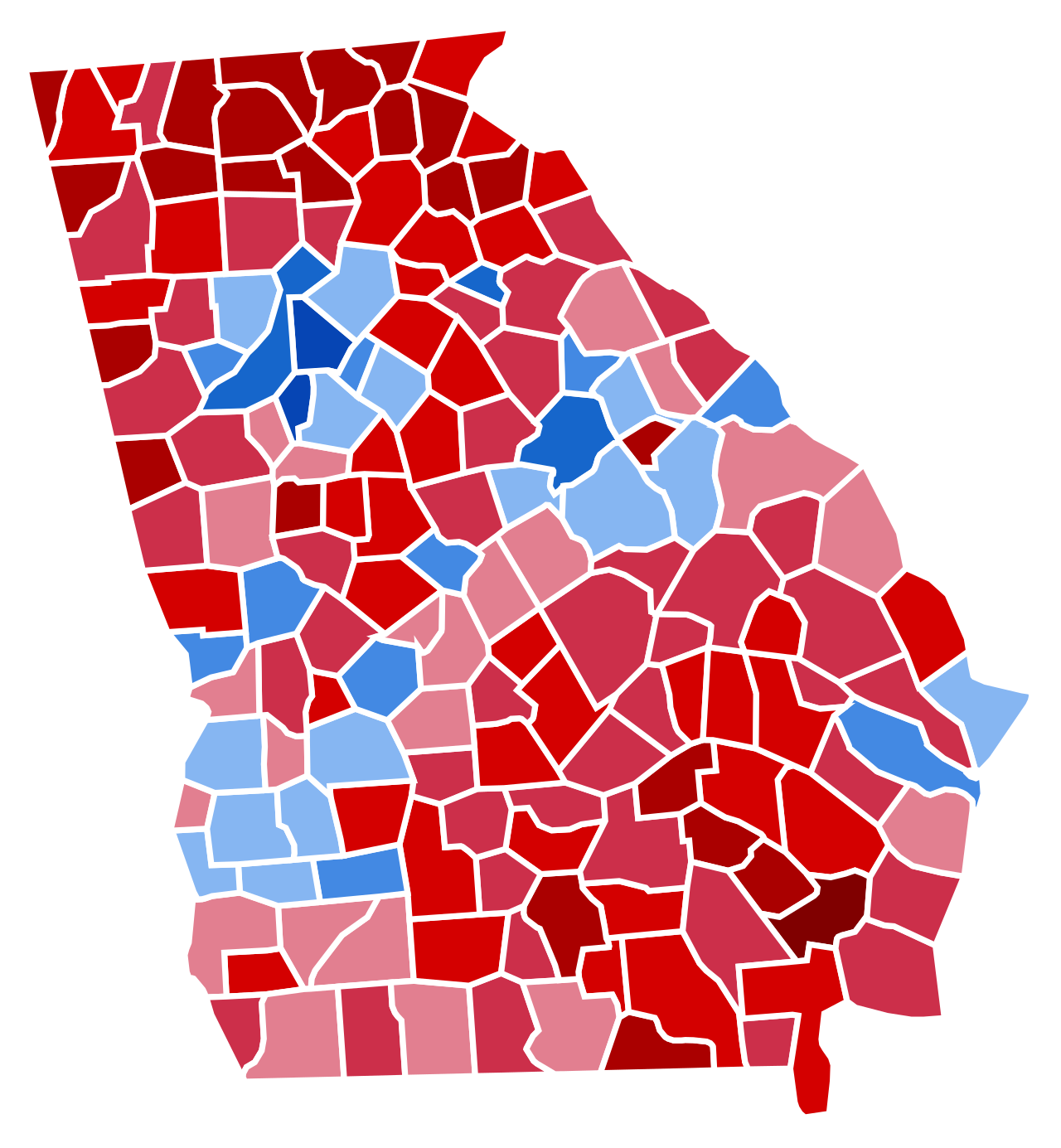
Outcome of the 2020 presidential election in Georgia, with blue signifying areas (especially cities) that voted for Biden and red for Trump
—Graphic by AdamG2016
Via OtherWords.org
I believe in God and in the right to vote. Georgia’s recent election bill doesn’t just feel like an attack on democracy — it feels like an attack on my faith.
The bill, formally SB 202, infamously makes it illegal to give people food or water while they’re waiting in line to cast their ballot. Providing food for the hungry and water for the thirsty are tenets of my Catholic faith.
So is standing with the marginalized. People don’t like to bring race into the conversation, but we have to be honest about how this bill harms people of color.
In Georgia neighborhoods that were 90 percent or more white, the average wait time to vote was around five minutes in last year’s elections. For neighborhoods that were 90 percent or more people of color, the wait time was about an hour. Some voters waited up to 11 hours.
Georgia’s new law seems designed to make these lines longer — and to punish anyone who tries to make them more comfortable. This disproportionate impact on Black, Latino, Native, and Asian communities isn’t an accident. It’s the result of public policy.
Long lines make people less likely to vote in future elections. Republicans know this. That’s why these long lines are concentrated in areas where voters are more likely to cast their ballots for Democrats.
For many voters of color, the ballot box is how we advocate for our needs — and how we defend ourselves against legislation that might harm us. Make no mistake, this bill is about silencing voters of color and chipping away at our political power.
The new law also chops the period of time when voters can request an absentee ballot in half, imposes stricter voter ID requirements for mail-in voting, and slashes the number of locations where voters can cast a ballot.
More worryingly still, it strips control of the state’s election board from Georgia’s secretary of state — and gifts it instead to the Republican-controlled state legislature.
Last year, Georgia’s Republican Secretary of State Brad Raffensperger refused President Trump’s calls to “find” 11,000 more votes for the president, who lost the state. Now, by giving themselves power over the board, Georgia Republicans are plainly laying the groundwork to decertify any future election results they don’t like.
The GOP used to shout their commitment to religious freedom, the rights of businesses, and freedom of speech from rooftops. Now, with their wide net of voter suppression drawing the condemnation of faith groups as well as businesses, they’re stumbling over their own hypocrisy. When Georgia-based businesses like Coca-Cola and Delta spoke out against these new laws, Republicans tried to raise their taxes.
To top it all off, Republicans, including Senate Minority Leader Mitch McConnell, are now telling businesses to “stay out of politics.”
That’s rich coming from McConnell, a lifelong defender of corporate “speech” whose super PAC took in an unbelievable $475 million from corporations last year alone. It’s like if businesses do anything other than write checks, Republicans cry “cancel culture.” Give me a break.
GOP lawmakers are pushing hundreds of bills like Georgia’s in nearly every state in the country. These coordinated attacks on voting rights will inevitably leave poor people and people of color vulnerable to harmful public policy.
As a Catholic, I’m deeply offended by this assault on our democracy. No matter what your faith is, you should be, too.
Robert P. Alvarez is a media relations associate at the Institute for Policy Studies.
'Equal to the sky'

Post Office Square in Boston’s Financial District
“To paint one rose equals a life in that place
and on the thorny path outside
one cathedral is equal to the sky.’’
— “Goodbye Post Office Square,’’ by Boston-based poet Fanny Howe
Time servers and devoted teachers

Providence’s Classical High School
From Robert Whitcomb’s “Digital Diary,’’ in GoLocal24.com
The endless standoff between the Providence Teachers Union and would-be reformers in state government reminds me again of why I don’t like public-employee unions. They become political organizations and rigid economic- interest groups, rife with conflicts of interest involving elected officials (to whom they can give or withhold campaign cash). That isn’t to say that teachers shouldn’t have rigorous Civil Service-style protections.
For some reason, the latest standoff reminds me of when I sat right behind two Providence teachers on a train coming back from New York 30 years ago. All that the duo, who looked about 40 years old, talked about were their pensions. Of course, there are many devoted teachers in the Providence public schools (which my kids attended) but also too many time servers like my fellow passengers that day.
Early Boston art

A silver porringer created by Boston silversmith John Coney, c. 1710
“Some want to rob the Puritans of art….There were ten silversmiths in Boston before there was a single lawyer. People forget all those things.’’
— Robert Frost in his commencement address “What Became of New England’’ at Oberlin College in 1937.