
Vox clamantis in deserto







Llewellyn King: Electrification and the Great American reset

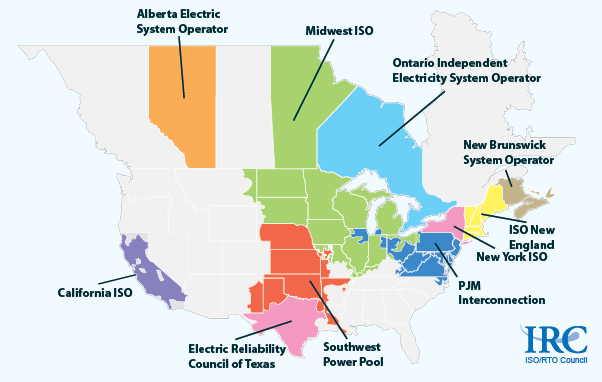
Independent (electric grid) system operators and regional transmission operators
WEST WARWICK, R.I.
It is underway. It has huge momentum, and it will change everything we do — work, leisure, health care, education, use of resources — and, as a bonus, how the world sees us.
It is the Great American Reset, where things will be irreversibly changed. It is a seminal reset that will shape the decades to come, just as the New Deal and World War II shoved the clock forward.
The reset is being driven in part by COVID-19, but in larger part by technology and the digitization of America. Technology is at the gates, no, through the gates, and it is beginning to upend the old in the way that the steam engine in its day began innovations that would change life completely.
Driving this overhaul of human endeavor will be the digitization of everything from the kitchen broom to the electric utilities and the delivery of their vital product. Knitting them together will be communications from 5G to exclusive private networks.
President Biden’s infrastructure proposals could speed and smooth the innovation revolution, facilitate the digital revolution, and make it fairer and more balanced. Biden’s plan will fix the legacy world of infrastructure: roads, bridges, canals, ports, airports, and railroads. It will beef up the movement of goods and services, supply chains, and their security, even as those goods and services are changing profoundly.
But if Biden’s plan fails, the Great American Reset will still happen. It will just be less fair and more uneven — as in not providing broadband quickly to all.
Technology has an imperative, and there is so much technology coming to market that the market will embrace it, nonetheless.
Think driverless cars, but also think telemedicine, carbon capture and utilization, aerial taxis, drone deliveries, and 3D-printed body parts. Add new materials like graphene and nano-manufacturing and an awesome future awaits.
We have seen just the tip of digitization and have been reminded of how pervasive it is by the current chip shortage, which is slowing automobile production lines and thousands of manufactures. But you might say, “You ain’t seen nothing yet.” The future belongs to chips and sensors: small soldiers in mighty armies.
Accompanying digitization is electrification. Our cars, trucks, trains, and even aircraft and ships are headed that way. Better storage is the one frontier that must be conquered before the army of change pours through the breach in a great reshaping of everything.
Central to the future — to the smart city, the smart railroad, the smart highway, and the smart airport — is the electric supply.
The whole reset future of digitization and sensor-facilitated mobility depends on electricity — and not just the availability of electricity going forward, but also the resilience of supply. It also needs to be carbon-free and have low environmental impact.
An overhaul of the electric industry’s infrastructure, increasing its resilience, is an imperative underpinning the reset.
The Texas blackouts were a brutal wake-up call. Job one is to look into hardening the entire electric supply system from informational technology to operational technology, from storm resistance to solar flare resistance (see Carrington Event), from catastrophic physical failure to failure induced by hostile players.
The electric grid needs survivability, but so do the data flows which will dominate the virtual utility of the future. It also needs a failsafe ability to isolate trouble in nanoseconds and, essentially, break itself into less vulnerable, defensive mini-grids.
Securing the grid is akin to national security. Indeed, it is national security.
Electricity is the one indispensable in the future: The future of the great reset.
Klaus Schwab, the genius behind the World Economic Forum, called this year from his virtual Davos conference for a global reset to tackle poverty and apply technology and business acumen to the human problems of the world. We are on the cusp of going it alone.
In the end, the route to social mobilization is jobs. The Great American Reset will throw these off in an unimaginable profusion, as did the arrival of the steam engine a little over 300 years ago.
On Twitter: @llewellynking2
Llewellyn King is executive producer and host of White House Chronicle, on PBS. He’s based in Rhode Island and Washington, D.C.
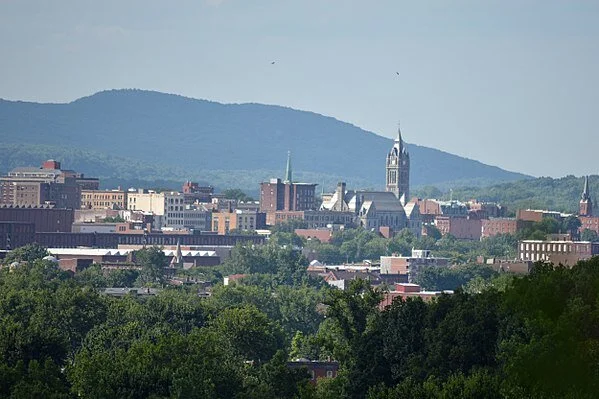
The New England electric grid is managed by ISO New England from Holyoke, Mass., whose skyline is seen here. Note the clock tower of City Hall and the Mount Tom Range in the background,
In search of fast transit

“Boxcar Getaway” (oil on panel), by Bruce Ackerson, in his show “Birds-Eye Views,’’ at the University of Massachusetts at Amherst’s Hampden Gallery, through May 14.
The gallery says:
“From a birds-eye view, the artist presents narrative scenes which are an imaginative take on popular culture, modern life and the hidden world of the human psyche.’’
Mr. Ackerson is based in Northampton, Mass.
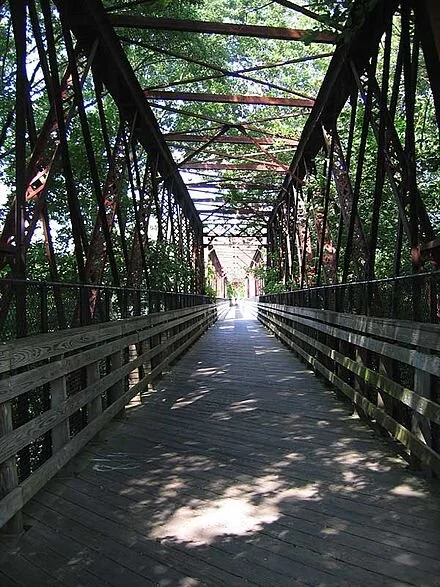
The Norwottuck Rail Trail Bridge across the Connecticut River at Northampton. The Norwottuck Branch Rail Trail, formerly the Norwottuck Rail Trail, is an 11-mile-long bicycle/pedestrian paved right-of-way running from Northampton through Hadley and Amherst, to Belchertown, all in Massachusetts. It opened in 1992, and is part of the longer Mass Central Rail Trail.
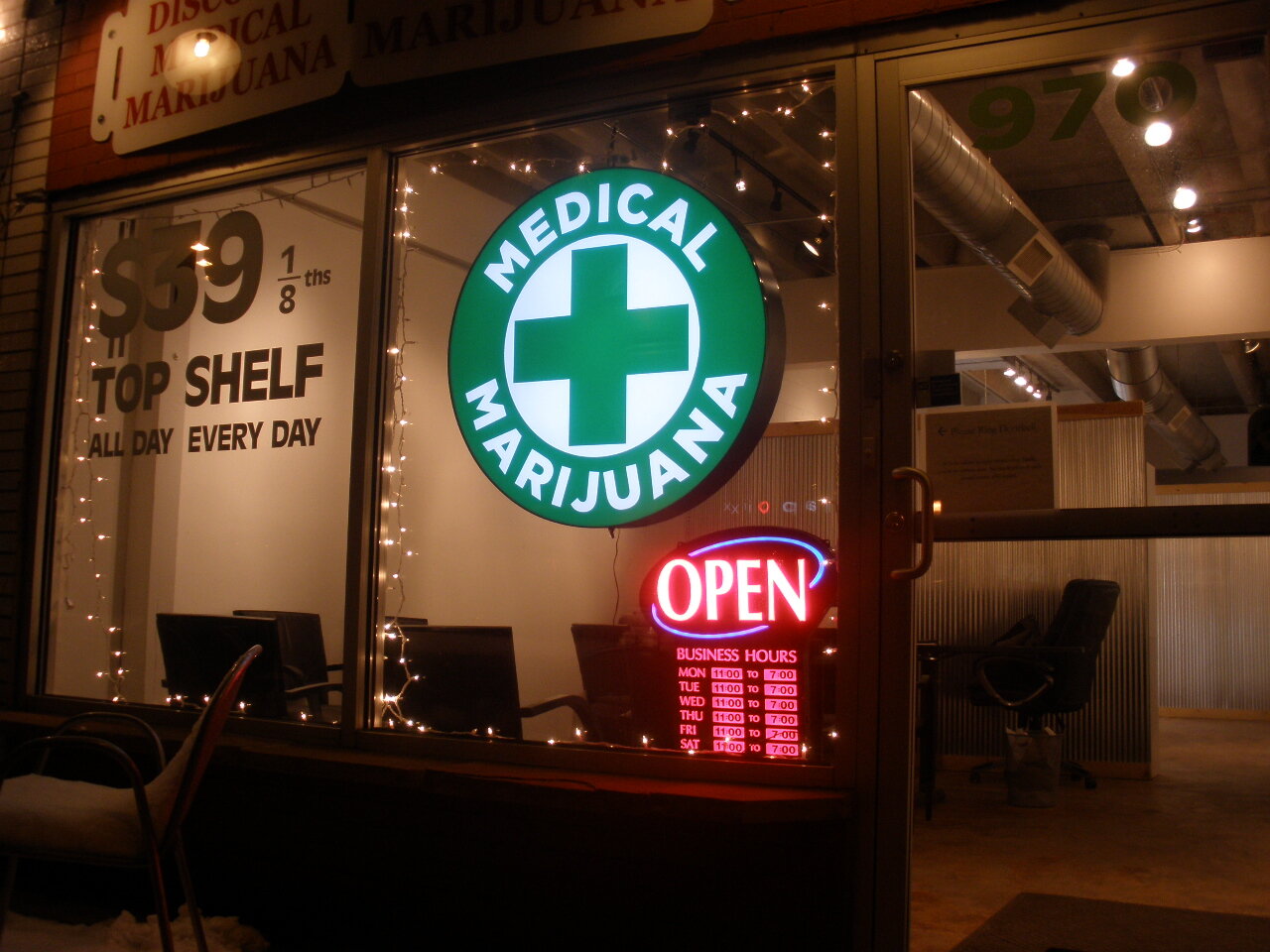
N.E. Council lobbies for financial services for pot firms
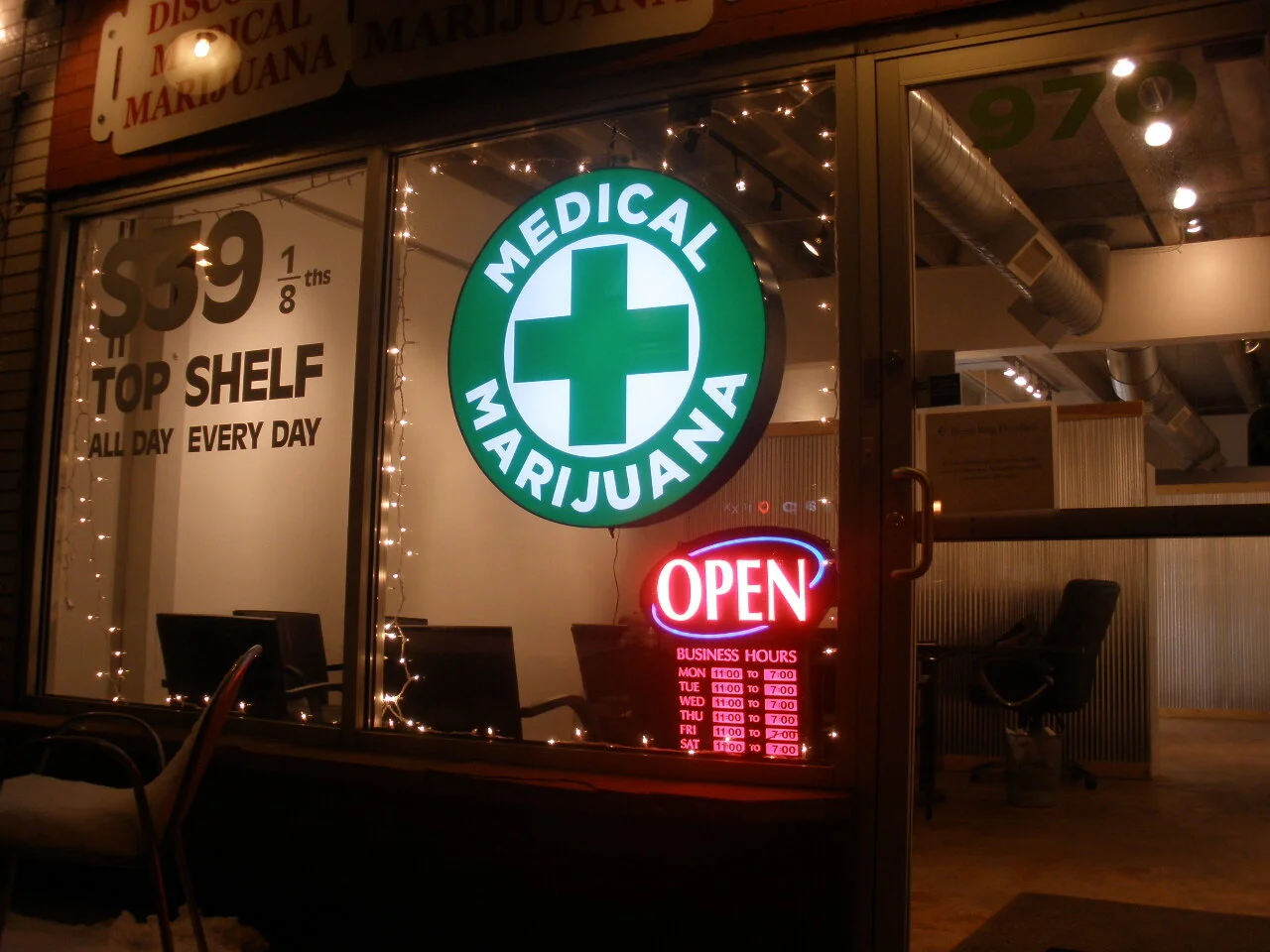
— Photo by O’Dea
BOSTON
The New England Council (newenglandcouncil.com) has sent this letter to New England’s congressional delegation, signed by president and CEO James T. Brett:
Dear New England Delegation,
On behalf of The New England Council, I write to express our members’ support for the Secure and Fair Enforcement (SAFE) Banking Act of 2021. This bipartisan legislation creates protections for depository and insurance institutions that provide financial-related services to legal cannabis-related businesses and their service providers. As every state in New England now allows medicinal cannabis {marijuana}, and three states have legalized adult recreational use, the discrepancy between state and federal law is a concern across the region.
Currently, providing banking and insurance services to legitimate, state-licensed marijuana businesses is a challenge for financial institutions. Because marijuana is illegal under federal law, funds generated by cannabis-related businesses are subject to extraordinary reporting requirements under federal anti-money laundering regulations. Therefore, institutions face significant legal and regulatory risks for serving these local businesses. The result has been that legal cannabis businesses and their employees operate primarily on a cash-only basis, creating opportunities for tax evasion, money laundering, robbery and other crimes that could negatively impact the region. The discrepancy between state and federal law also poses a challenge for those who seek to purchase cannabis products for medical purposes.
Medical marijuana has been found an effective treatment for a variety of medical conditions, including cancer, Alzheimer’s disease, ALS, epilepsy, and chronic pain, just to name a few. However, access to these products is significantly limited by the inability to use alternative payment options.
The SAFE Banking Act, which was reintroduced in both the House of Representatives and the Senate earlier this month, would help address these challenges. If passed, this legislation will give those operating legitimate marijuana businesses access to banking services available to other industries. By no longer restricting the industry to cash, the law will make the cannabis industry more safe, transparent, accountable, and accessible by ensuring compliance with current regulations and norms. The New England Council’s mission is to identify and support federal public policies and articulate the voice of its membership regionally and nationally on important issues facing New England. Given that cannabis-related businesses have been legalized and are an expanding segment of the economy in many communities across the region, we feel that if this legislation is passed it would protect the businesses and communities in which they operate. It is our hope that with your support in the House/Senate, Congress will work diligently to advance the SAFE Banking Act in the coming weeks.
‘‘The New England states have each enacted policies that allow for the legal sale of cannabis products, and as a result we are seeing significant growth in this new sector in our region’s economy,” said Council President & CEO James T. Brett. “However, due to the discrepancy between state and federal law, these businesses are unable to access banking and insurance services, and their customers are limited in payment options. We urge Congress to take action to address this discrepancy and make the cannabis industry more safe, transparent, accountable, and accessible.”
The bill was originally introduced during the 116th Congress, and was passed by the House of Representatives in September 2019, but was never taken up in the Senate. The legislation was reintroduced in the House (H.R. 1996) on March 18, 2021, and in the Senate (S. 910) on March 23, 2021. Already, 11 New England Senators and six New England Representatives have signed on as co-sponsors, and the Council’s goal in sending letters is to increase support for the bill among the region’s delegation.

Don Pesci: What Biden may have learned from Connecticut, a progressive Petri dish

Petri dish
VERNON, Conn.
In mid-August 2020, relying largely on then presidential nominee Joe Biden’s Democratic Party platform, I noted that the Biden Administration, in both foreign and domestic policy, would be a repeat of the Obama administration, in which Biden, of course, served as vice president.
This prediction was a bit off-point. The policy prescriptions adopted by the Biden administration indicate that he has bypassed Obama and now postulates Obama prescriptions raised to the third power. Socialist Bernie Sanders, it may be recalled, was more than satisfied with the Democratic Party platform he helped construct.
Biden was sworn in as president on Jan 20. During an unusually long honeymoon, U.S. House Speaker Nancy Pelosi, Senate Majority Leader Chuck Schumer and Biden have used a narrowed split in the House and a fifty-fifty split in the Senate to consolidate their triumph over former President Trump and Republicans both moderate and conservative.
Just as Roman emperors used to debase their predecessors by a form of cultural evacuation, so the Biden administration has sought to deprive Trump of any lingering accomplishment by reversing his policies, however efficacious and popular. Some inexpungible policies were retained by the Biden administration; there are no signs at present that Biden-Pelosi-Schumer intend to scotch Trump’s successful effort to bring Coronavirus vaccines on line as quickly as possible by throwing overboard some time-consuming federal regulations. But successful policies of much resented predecessors may be allowed to die on the media vine through benign neglect. You lightly touch your predecessors virtues, if at all, and pound like a madman on the vices.
To mention one notable instance, Biden has reversed Trump’s border policies. And the reversal has reignited a huge onrush of border jumpers seeking to avoid a cumbersome legal-immigration process. Once again, the U.S. border with Mexico has become little more than a demarcation line on a map. The bums-rush of the U.S. southern border by Hondurans, Guatemalans and Salvadorans following Biden’s Trump purgation means, minimally, two things: One, Trump border policies were successful in stemming illegal immigration; and two, unintended consequences often attend the spiteful reversals of prior policies the new regime considers useful for election purposes.
There is, Americans will have noticed during the past few decades, a profound difference between electing battalions of Democrats to Congress and proper governing.
Then too, no one, friend or foe of Democrats, can have failed to notice that the media honeymoon period enjoyed by Biden has been far more prolonged than that of his predecessor Trump, whose honeymoon with a hostile media was as short as the flickering of a firefly’s light at midnight.
Pelosi’s daughter sized up her mother well when she said, “She’ll cut your throat, and you won’t even know you’re bleeding,” a sentiment that might have applied equally to Lucretia Borgia. Years spent in the House seeking to upend Republican majorities have focused Pelosi’s mind wonderfully. Eliminating the filibuster at a time when the House is split almost evenly between Democrats and Republicans and a faltering attempt to halt federal aid to states that persist in cutting taxes is the political equivalent of the Borgia bad habit of spiking the drinks of political opponents with arsenic, strychnine, cantharidin and aconite, poisons used effectively by the millionaire, politically well-placed Borgias.
If you can silence the opposition – regularly done in Connecticut by marginalizing the Republican minority – you need not argue the fine points of constitutional law or the untoward consequences of ruinous policies. What used to be known in healthy, vigorous and necessary media as contrarian opposition simply disappears, both in the General Assembly and in the pages of an increasingly partisan media. Opposition that has no tongue cannot seed the political ground with inconvenient truths. Such truths are strangled in their cribs, or aborted early enough so that an unborn opposition may cause no problems to the ruling class, a potpourri of progressive Democrats allied with a permanent administrative apparatus untouched by moderation and serving always as a permanent fortification against a disappearing “loyal opposition.”
Connecticut, for the last three decades, has been a Petri dish in which progressive policies have flourished. Progressives, programmatically different from liberals, have been most successful in the state’s larger cities, controlled by Democrats, former Republican gubernatorial challenger Bob Stefanowski never tires of pointing out. Stefanowski has incurred the wrath of Democratic-mayors-for-life in the state’s larger cities because the majority party knows that retaining votes in cities is important to all Connecticut Democratic officeholders. With three of the most populist cities in their clutches, Democrats know they have an insuperable advantage over Republicans in a state in which Democrat voters outnumber Republicans by a two to one margin.
The Biden-Pelosi-Schumer triumvirate seeks to repeat on a national stage the “victory” of sorts won by Democrats in Connecticut’s petri dish.
Don Pesci is a Vernon-based columnist.
'Ready to be freed'


An Eastern Bluebird
It snowed in spring on earth so dry and warm
The flakes could find no landing place to form.
Hordes spent themselves to make it wet and cold,
And still they failed of any lasting hold.
They made no white impression on the black.
They disappeared as if earth sent them back.
Not till from separate flakes they changed at night
To almost strips and tapes of ragged white
Did grass and garden ground confess it snowed,
And all go back to winter but the road.
Next day the scene was piled and puffed and dead.
The grass lay flattened under one great tread.
Borne down until the end almost took root,
The rangey bough anticipated fruit
With snowballs cupped in every opening bud.
The road alone maintained itself in mud,
Whatever its secret was of greater heat
From inward fires or brush of passing feet.
In spring more mortal singers than belong
To any one place cover us with song.
Thrush, bluebird, blackbird, sparrow, and robin throng;
Some to go further north to Hudson’s Bay,
Some that have come too far north back away,
Really a very few to build and stay.
Now was seen how these liked belated snow.
The fields had nowhere left for them to go;
They’d soon exhausted all there was in flying;
The trees they’d had enough of with once trying
And setting off their heavy powder load.
They could find nothing open but the road.
So there they let their lives be narrowed in
By thousands the bad weather made akin.
The road became a channel running flocks
Of glossy birds like ripples over rocks.
I drove them under foot in bits of flight
That kept the ground, almost disputing right
Of way with me from apathy of wing,
A talking twitter all they had to sing.
A few I must have driven to despair
Made quick asides, but having done in air
A whir among white branches great and small
As in some too much carven marble hall
Where one false wing beat would have brought down all,
Came tamely back in front of me, the Drover,
To suffer the same driven nightmare over.
One such storm in a lifetime couldn’t teach them
That back behind pursuit it couldn’t reach them;
None flew behind me to be left alone.
Well, something for a snowstorm to have shown
The country’s singing strength thus brought together,
That though repressed and moody with the weather
Was none the less there ready to be freed
And sing the wildflowers up from root and seed.
“Our Singing Strength,’’ by Robert Frost (1874-1963)
Walk into 'collective memory'

“Memory Gates,’’ by Syrian-born Kevork Mourad, at the Cantor Art Gallery of the College of the Holy Cross, Worcester, through April 11.
The gallery says:
“Using his signature style of spontaneous drawing and printmaking techniques, artist Kevork Mourad created the site-specific immersive installation ‘‘Memory Gates ‘‘ during a residency at the Cantor Art Gallery in February. The work, a series of doors and passageways that visitors can pass through, explores themes of cultural plurality and collective memory. Co-sponsored by the Cantor Art Gallery and Arts Transcending Borders.’’
Jim Hightower: Are you a 'low-quality voter'?
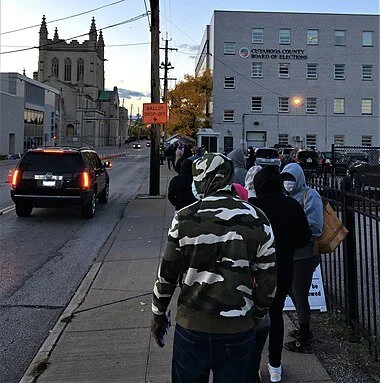
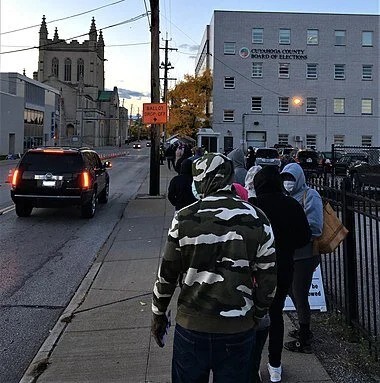
People lining for early voting last October in Cleveland
— Photo by THD3
Via OtherWords.org
Hey, you, get away from those polling places! We don’t want your kind here! Scram!
That’s a stupid, shameful, and ultimately self-defeating political message, yet it’s being pushed as the official anti-voter electoral strategy of Republicans. Admitting that they can’t get majorities to vote for their collection of corporate lackeys, conspiracy theorists, and bigoted old white guys, the GOP hierarchy’s great hope is to shove as many Democratic voters as possible out of our elections.
They’re banking on a blitz of bureaucratic bills they’re now trying to ram through nearly every state legislature to intimidate, divert, and otherwise deny eligible voters their most fundamental democratic right. Their main targets are people of color, but they’re also pushing to keep students, senior citizens, union households, and poor communities of any color from voting.
Unable to come up with any actual need for these autocratic restraints, the GOP vote thieves are fraudulently exclaiming in mock horror that millions of illegal immigrants, dead people, Chinese, and even pets are voting! “Lock down the polls!” they cry.
Again and again, these absurd claims have been thoroughly investigated — even by Republican judges, committees, and media — and repeatedly they’ve proven to be, well, absurd.
Let’s be blunt: You’re more likely to find Bigfoot than you are to find a case of mass vote fraud in America.
Even some GOP politicos have quit pretending that they’re searching for The Big Cheat, instead bluntly making an overt, right-wing ideological argument for subverting democracy: “Everybody shouldn’t be voting,” explained Rep. John Kavanaugh, the Republican chair of Arizona’s election committee.
Slipping deeper into doctrinaire doo-doo, he asserts that it’s not just the number of votes that should matter in an election — “we have to look at the quality of votes,” too.
Call me cynical, but I’m guessing that most Democratic voters would fall into his “low-quality” category. The ugly truth is that Republican officials no longer support democracy.
OtherWords columnist Jim Hightower is a radio commentator, writer and public speaker.
Find safer places for homeless
From Robert Whitcomb’s “Digital Diary,’’ in GoLocal24.com
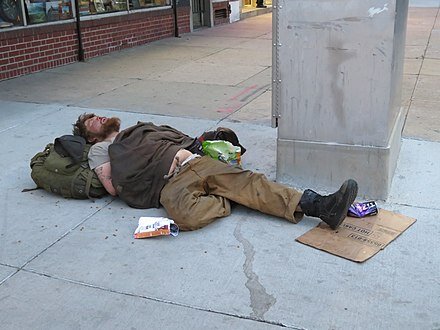
“Tent cities” of homeless people are all over the place. A particularly noticeable one was the camp just closed down in Pawtucket on the west bank of the Seekonk River to make way for a soccer-stadium project, which might actually get built.
Many, probably most, of the people at this camp are mentally ill. In these places they might find kindred spirits but they also face such dangers as exposure to the elements, assaults and thefts. And the atmosphere is conducive to alcohol and drug abuse.
These tent cities have been common since the de-institutionalization movement that got going in the late ‘60s, when officials hoped that new psychotropic medications would allow many of the mentally ill to be released from state mental hospitals, saving taxpayers money. But for many mentally ill people this didn’t work out because they didn’t like the side-effects of these meds for such illnesses as schizophrenia and manic-depression (aka bi-polar disease). For that matter, some of these people like feeling “crazy.’’
Or some have not been given adequate guidance on how to use the meds or don’t have a way to pay for them or can’t get to pharmacies to get them.
I think that we need more mental hospitals for long-term care. As for those people, mentally ill or not, who actually prefer to live in settings like tent cities, the states and localities should consider setting aside permanent places for them on public land, or rent space from private landowners, where the “campers’’ could be better monitored by police, social workers and public-health agencies. Moveable tent cities pose too many dangers. And be they temporary or permanent, they should not be near regular residential or commercial areas; they are too disruptive.
Folks seeking help with serious mental-health and/or substance-abuse problems might want to look at this Rhode Island state Web site to find available spaces at institutions.
Contradiction in terms

A faculty member takes a shot in the 2006 Maimonides School faculty vs. senior class basketball game — an annual tradition proceeds from which are donated to charity.
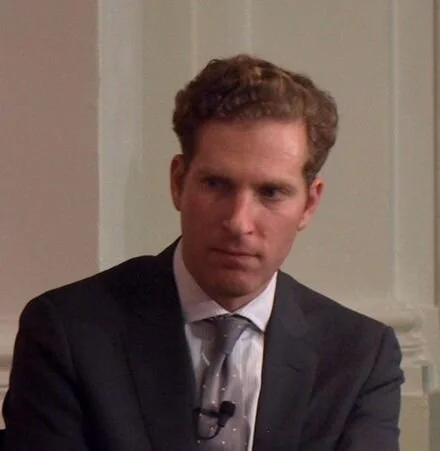
“To try to be at once a Lithuanian yeshiva and a New England prep school: that was the unspoken motto of the Maimonides School of Brookline, Mass., where I studied for 12 years.’’
— Noah Feldman (born 1970), constitutional-law expert, columnist and all-around public intellectual
Noah Feldman
'We’re more insular' but more aware of 'interconnectedness'

“My Letterman Yantra’’ by James Bassler, in the show “Adaptation: Artists Respond to Change,’’ at browngrotta Arts, Wilton, Conn., May 8-16.
(Yantra — a geometric diagram, or any object, used as an aid to meditation in tantric worship)
— Photo by Tom Grotta
The gallery, which specializes in textile art, says: “The exhibition looks at the myriad ways artists change direction or their practice in response to changed circumstances like a move, a health issue, a shift in personal circumstances, or, more recently, a global pandemic.
"‘Over the last year, by necessity, we’ve grown more introspective, more insular and more aware of our interconnectedness,’ note the exhibition’s curators, Tom Grotta and Rhonda Brown. ‘We’ve had to acknowledge our permeable national boundaries, shared air, the limits of personal space.’
“The artists who work with browngrotta arts have coped with the changes the pandemic has wrought in various ways — moving locations, taking up art photography, taking new inspiration from nature. Their responses were the impetus for the theme the gallery will explore in the exhibition but these recent adaptations reflect just some of the many reasons artists make changes in their art practice.’’

Even the police headquarters is well landscaped in the very affluent Fairfield County, Conn., town of Wilton.
Of time, immigration and home

Photo composition by Kledia Spiro in her solo exhibition “Too (un)Familiar? ‘‘ through May 2 at Kingston Gallery, Boston. The gallery says she “creates a multimedia experience combining photography, video performance, augmented reality, and installation that challenges ideas surrounding immigration, the sense of home, and the passage of time. Using the Wachusett Reservoir in Sterling, Mass., as her home ground and starting point, Spiro has photographed this same location over the last 12 months. She contrasts this to her life as an immigrant {she is a native of Albania}, stating: ‘Nature seems to have a self-cleaning mechanism, its own method of repurposing and recycling. When you’re an immigrant, you only know repurposing and recycling. There is no self-cleaning mechanism in immigrant homes. Everything is precious because you don't know when you may lose it again, even if just subconsciously.…Over time, every memory becomes fragmented, like a distant dream.”’
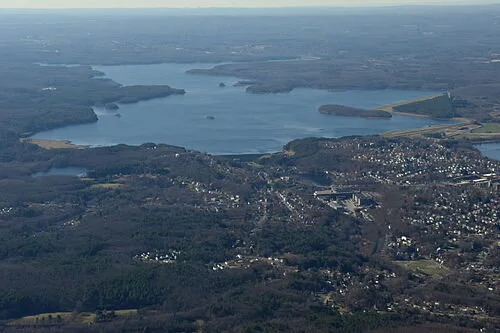
Wachusett Reservoir, after the Quabbin Reservoir, the second-largest body of fresh water in Massachusetts
He preferred to dig

Louis Agassiz's grave in the famous-dead-person-rich Mount Auburn Cemetery, which straddles Cambridge and Watertown, Mass. It’s a boulder from the moraine of the Aar Glaciers, near where he once lived in Switzerland.
“I cannot afford to waste my time making money.’’
— Louis Agassiz (1807-1873), Swiss-born geologist and biologist recognized as an innovative and prodigious scholar of Earth's natural history.
He emigrated to the United States in 1847 after he visited Harvard University, where he went on to become professor of zoology and geology, to head its Lawrence Scientific School and to found its Museum of Comparative Zoology.
He made vast institutional and scientific contributions to zoology, geology, and related areas, including writing multivolume research books. He is particularly known for his contributions to ichthyological classification, including of extinct species such as megalodon, and to the study of geological history, including the founding of glaciology.
But unfortunately, a Creationist, he resisted the Darwinian theory of evolution and shared in the racism of his times.

Louis Agassiz
Grace Kelly: Floating turbines may be part of New England offshore-wind network
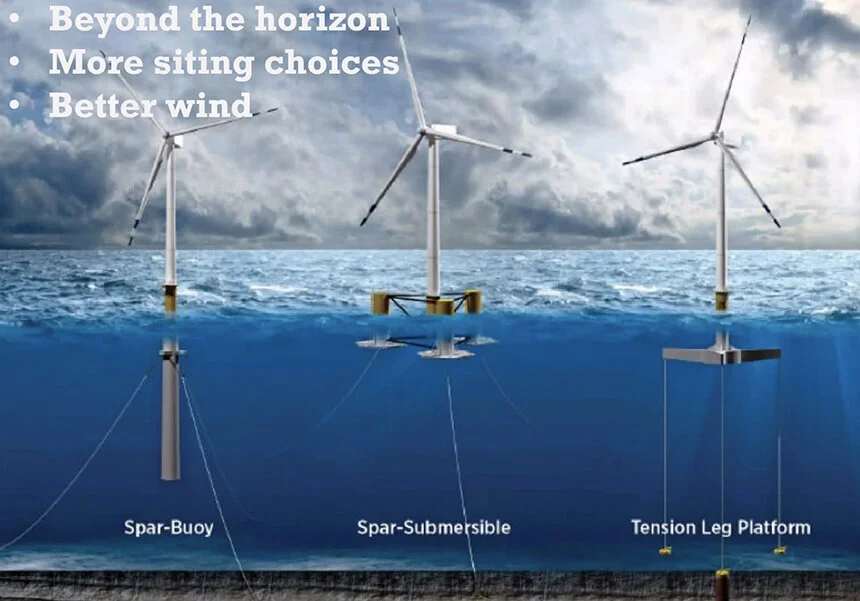
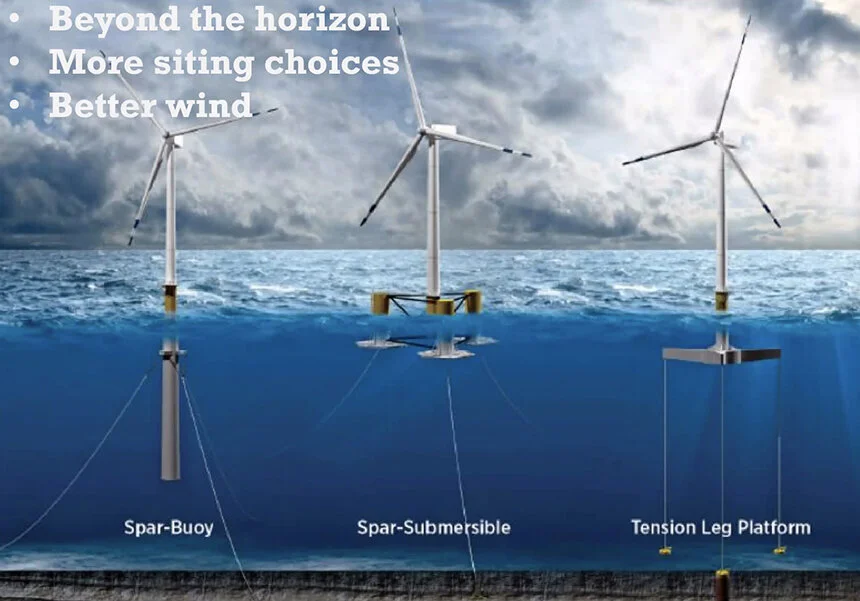
Floating turbines come in various styles.
— Joshua Bauer/U.S. Department of Energy
From ecoRI News (ecori.org)
The winds and airs currents swirling around the oceans of this blue marble have the potential to power our cities and towns. And locally in coastal New England, the race to harness the power of coastal wind has been accelerating.
Last year then-Rhode Island Gov. Gina Raimondo signed an executive order that called for an ambitious, yet somewhat vague, “100 percent renewable energy future for Rhode Island by 2030” — a good portion of which would be from offshore wind.
“There is no offshore wind industry in America except right here in Rhode Island,” Raimondo said at the time. She was referring to the groundbreaking five-turbine Block Island Wind Farm, a 30-megawatt project that was the first commercial offshore wind facility in the United States.
Today, there is a slightly different picture forming, and other New England states, notably Massachusetts and Maine, are looking into becoming a part of a regional offshore wind network.
During a March 18 online presentation, Environment America discussed a recently released report detailing the overall potential that offshore wind has, specifically in New England. The discussion also included presentations from experts in the field of offshore wind.
“We found that the U.S. has a technical potential to produce more than 7,200 terawatt-hours of electricity in offshore wind,” said Hannah Read of Environment America, a federation of state-based environmental advocacy organizations. “What we did was we compared that to both our electricity used in 2019 and the potential electricity used in 2050, assuming that we transition society to run mostly on electric rather than fossil fuels, and what we found is that offshore wind could power our 2019 electricity almost two times over, and in 2050 could power 9 percent of our electricity needs.”
On a more granular level, Read said Massachusetts has the highest potential for offshore-wind-generation capacity, and Maine has the highest ratio of potential-generation capacity relative to the amount of electricity that it uses.
Massachusetts is entering the final stages of the federal permitting process for the 800-megawatt Vineyard Wind project, which is slated to start construction next year and go online in 2023.
“We have some real frontrunners here in New England and we have a huge opportunity to take advantage of this resource,” Read said. “When you look at the New England as a region, it could generate more than five times its projected 2050 electricity demand.”
While Rhode Island and Massachusetts are looking to more traditional fixed-bottom turbines, in coastal Maine, where coastal waters are deeper, researchers at the University of Maine are testing prototypes for floating wind turbines.
“The state of Maine has deep waters off its coasts. If you go three nautical miles off the coast … you’re in about 300 feet of water,” said Habib Dagher, founding executive director of the Advanced Structures & Composites Center at the University of Maine. “Therefore, you can’t really use fixed-bottom turbines.”
To mitigate this, Dagher and his team have been building and testing floating turbines for the past 13 years, using technology from an unlikely source.
“There are three different categories of floating turbines and ironically enough we have the oil and gas industry to thank for developing floating structures,” Dagher said. “We borrowed these designs … and adapted them to floating turbines.”
Many of these floating turbines rely on mooring lines and drag anchors to keep them from floating away, and they come in various styles.
Dagher noted that while other states are able to pile-drive turbines, they should consider floating turbines as another way to fit more wind power into select offshore areas that could become crammed full.
“We’re going to run out of space to put fixed-bottom turbines. We have to start looking at floating … on the Massachusetts coast and beyond, in the rest of the Northeast,” he said.
Shilo Felton, a field manager for the Audubon Society’s Clean Energy Initiative, addressed another issue facing offshore wind: bird migration patterns. Focusing on the northern gannet, a large seabird, she explained that while climate change itself is negatively affecting bird populations, it is important to take care that offshore wind doesn’t make the situation worse.
She noted that Northern Gannets experience both direct and indirect risks from offshore wind. “Direct risks are things like collision, indirect risks are things like habitat loss,” Felton said.
But Felton also acknowledged that since we don’t really have lots of large-scale wind projects in the United States currently, it’s hard to really say how much those risks will impact bird populations.
“We don’t have any utility-scale projects yet, so we don’t really know how the build out in the United States is going to impact species,” she said. “So that requires us to take this adaptive management approach where we monitor impacts as we build out so that we can understand what those impacts are.”
Overall, the potential that offshore wind holds as a viable mitigation tactic in the fight to curb and eventually eradicate greenhouse-gas emissions is great. But, as speakers noted, implementation has to be done thoughtfully and thoroughly.
Referring specifically to Maine, Dagher said, “The state is moving on to do a smaller project of 10 to 12 turbines, and that would help us crawl before we walk, walk before we run. Start with one, then put in 10 to 12 and learn the ecological impacts, learn how to work with fisheries, learn how to better site these things before we go out and do bigger projects in the future.”
Grace Kelly is an ecoRI News journalist.
Bristol Myers Squibb plans big expansion in Devens

A Bristol Myers product in 1909
From The New England Council (newenglandcouncil.com)
“Bristol Myers Squibb, a New York-based biopharmaceutical company, recently added a 244,000-square-foot expansion to its Devens, Mass., facility to further the company’s efforts to battle cancer. The new addition is expected to begin operations by the end of the year and will be at the forefront of cancer technology for producing Breyanzi, a CAR-T cell therapy designed to treat lymphoma in patients.
“CAR-T cell therapy is a highly specialized process involving genetically modified cells that are personalized to attack a patient’s cancer cells. It generally takes weeks to isolate, freeze, dilute, and monitor the modified cells before the patient can receive an infusion. Though Breyanzi only recently won FDA approval in February 2021 and is a relatively new technology, the Devens expansion seeks to enhance CAR-T cell manufacturing capability for Bristol Myers-Squibb. The site is also expected to add hundreds of jobs.
“Krishnan Viswanadhan, a senior vice president for the company’s global cell therapy franchise, stated, ‘I’m really excited about what cell therapy has to offer.’’’
Read more from the Worcester Business Journal.
Devens is a regional enterprise zone and Census-designated place in the towns of Ayer and Shirley, in Middlesex County, and Harvard, in Worcester County, Massachusetts. It is the successor to Fort Devens, a military post that operated from 1917 to 1996. The population was 1,840 at the 2010 census.

Street scene at Fort Devens in the early 20th Century

Fort Devens Military Cemetery

Promote what you're good at
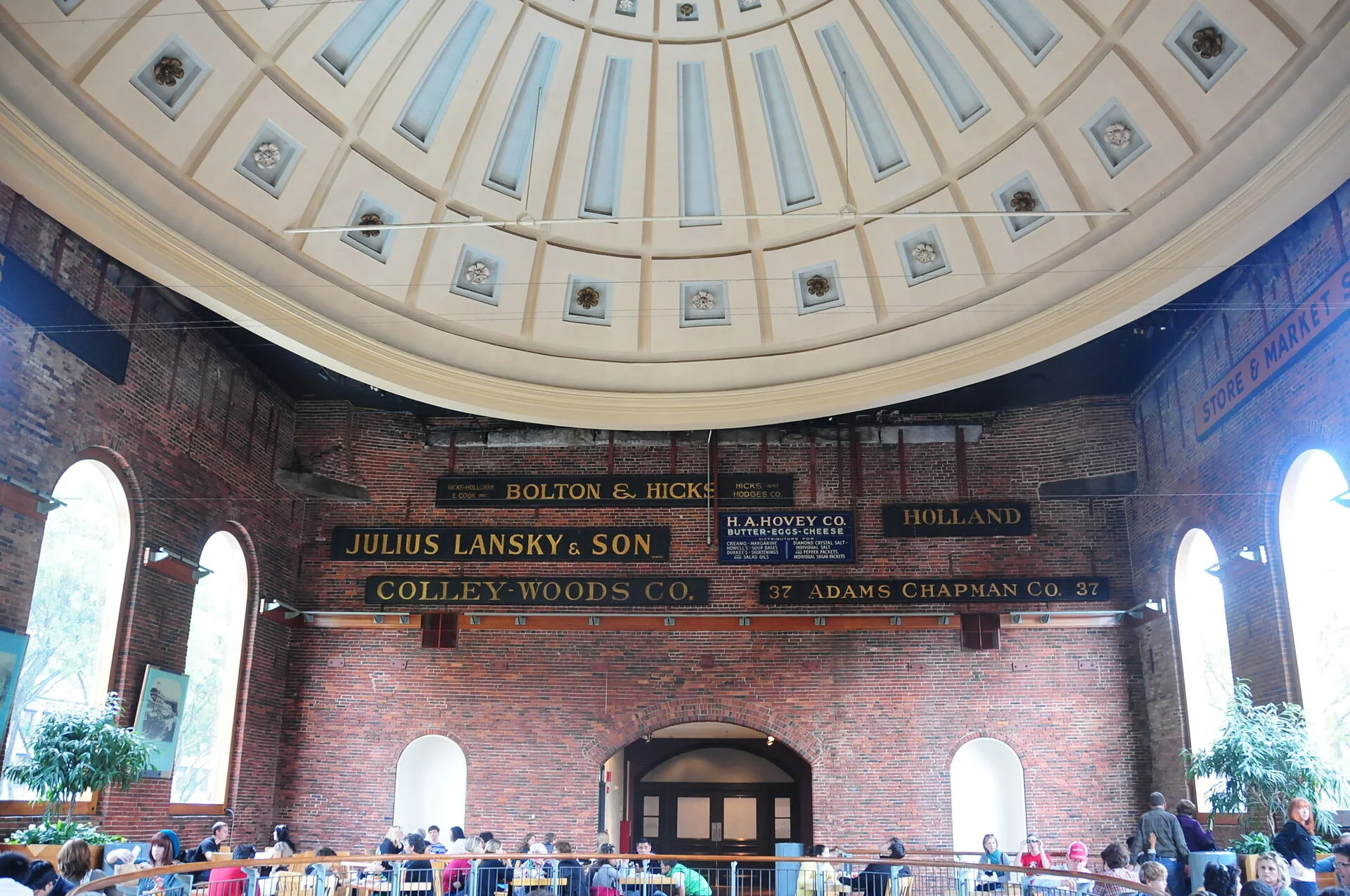
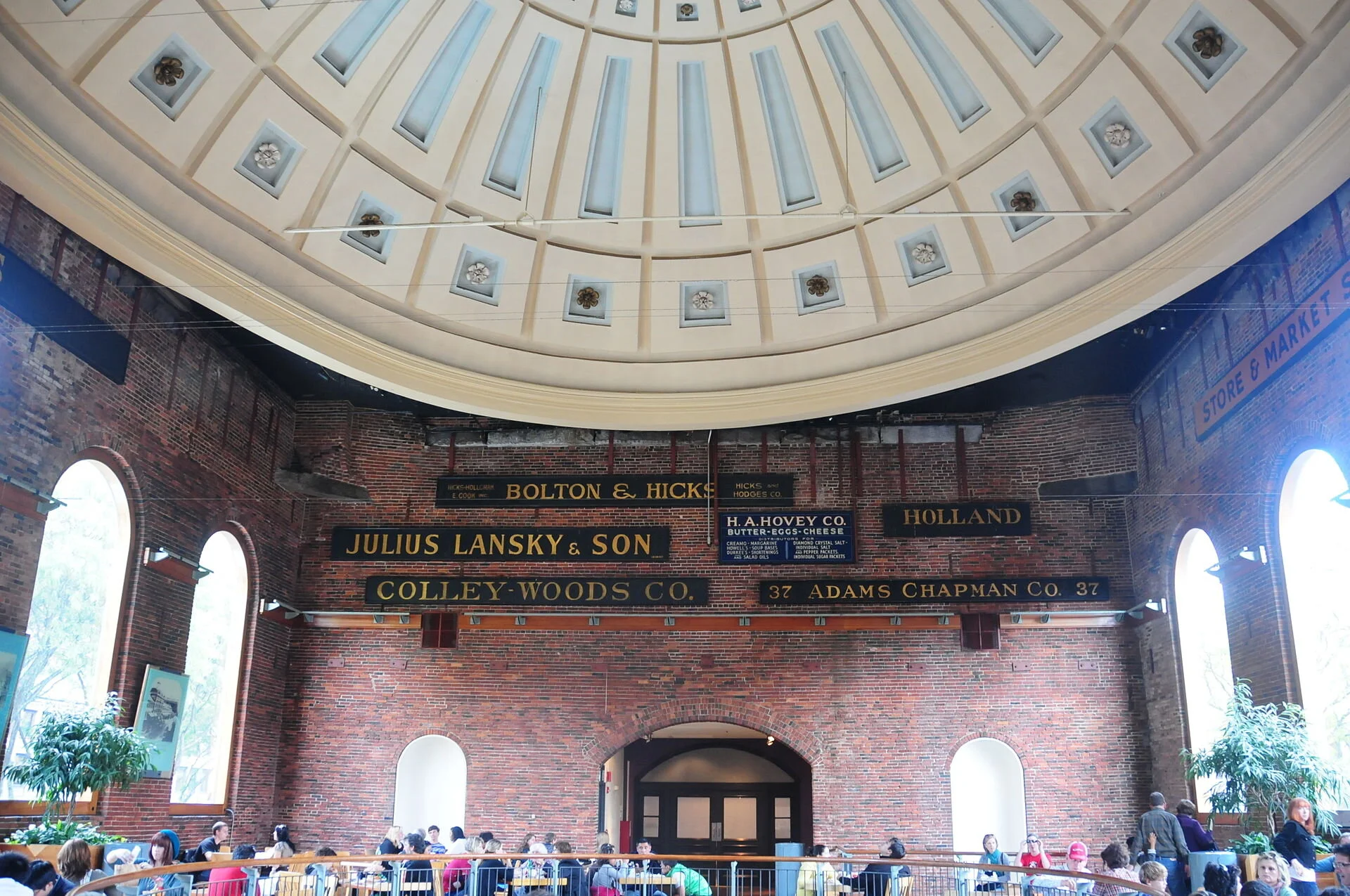
Dome Inside Boston’s Quincy Market on a pre-pandemic day, serving as as the seating area for the food court at the complex. The sign boards of old businesses decorate the walls.
— Photo by Jyothis
Adapted from Robert Whitcomb’s “Digital Diary,’’ in GoLocal24.com
It’s happy news that Marsella Development Corp. wants to establish a (Boston’s) Quincy Market/Faneuil Hall complex-style food hall on the ground floor of One Union Station in Providence, in the space that, pre-pandemic, housed the high-end Capital Grille and Bar Louie. With COVID-19 having probably permanently reduced the number of people, often armed with expense accounts, who work in downtowns, or in offices in general, the outlook for establishments like the Capital Grille doesn’t look all that good.
But the plan to put in that space a dozen restaurants of varying cuisines and price ranges makes a lot of sense for a state with such a rich food culture. It could become a destination for many people, including tourists, especially in synergy with Waterplace Park and WaterFire. The food hall would presumably feature a lot of local food, such as produce from local farms and fish. It could become quite a destination.
Heaven on earth?
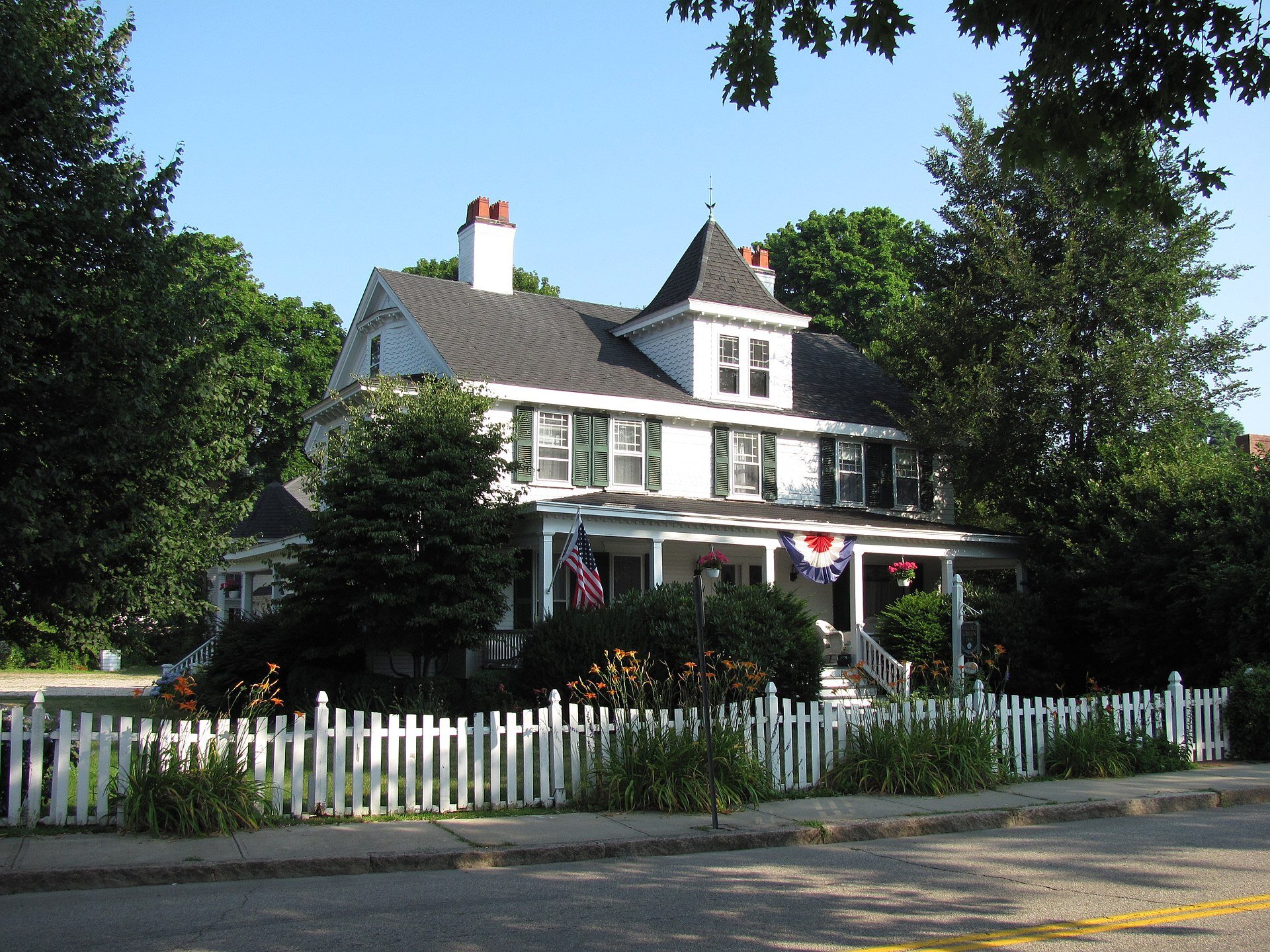
Village Green Inn, on the town green in Falmouth Mass. It’s on the National Register of Historic Places.
— Photo by John Phelan

Statue of Katherine Lee Bates outside the Falmouth Public Library.
Never was there lovelier town
Than our Falmouth by the sea.
Tender curves of sky look down
On her grace of knoll and lea.
Sweet her nestled Mayflower blows
Ere from prouder haunts the spring
Yet has brushed the lingering snows
With a violet-colored wing.
Bright the autumn gleams pervade
Cranberry marsh and bushy wold,
Till the children's mirth has made
Millionaires in leaves of gold;
And upon her pleasant ways,
Set with many a gardened home,
Flash through fret of drooping sprar
Visions far of ocean foam.
Happy bell of Paul Revere,
Sounding o'er such blest demesne
While a hundred times a year
Weaves the round from green to green.
Never were there friendlier folk
Than in Falmouth by the sea,
Neighbor-households that invoke
Pride of sailor-pedigree.
Here is princely interchange
Of the gifts of shore and field,
Starred with treasures rare and strange
That the liberal sea-chests yield.
Culture here burns breezy torch
Where gray captains, bronzed of neck
Tread their little length of porch
With a memory of the deck.
Ah, and here the tenderest hearts,
Here where sorrows sorest wring
And the widows shift their parts
Comforted and comforting.
Holy bell of Paul Revere
Calling such to prayer and praise.
While a hundred times the year
Herds her flock of faithful days!
Greetings to thee, ancient bell
Of our Falmouth by the sea!
Answered by the ocean swell,
Ring thy centuried Jubilee!
Like the white sails of the Sound,
Hast thou seen the years drift by,
From the dreamful, dim profound
To a goal beyond the eye.
Long thy maker lieth mute,
Hero of a faded strife;
Thou hast tolled from seed to fruit
Generations three of life.
Still thy mellow voice and clear
Floats o'er land and listening deep,
And we deem our fathers hear
From their shadowy hill of sleep.
Ring thy peals for centuries yet,
Living voice of Paul Revere!
Let the future not forget
That the past accounted dear!
”The Falmouth Bell,’’ by Falmouth, Mass., native Katherine Lee Bates (1859-1929), poet, professor and social reformer best known as the author of the lyrics of “America the Beautiful’’. She’s buried in Falmouth’s Oak Hill Cemetery (close to the graves of many relatives of New England Diary editor Robert Whitcomb).
The reference to Paul Revere is that the bell in Falmouth’s First Congregational Church (built 1796), where Ms. Bates’s father was briefly the minister, was cast by Revere’s shop.


Along Vineyard Sound in the Falmouth Village of Woods Hole
— Photo by ToddC4176
And takeout doesn't work

“If they want you to cook the dinner, at least they ought to let you shop for some of the groceries.’’
— Bill Parcells (born 1941), coach of the New England Patriots in 1993-1996, on not being given enough money to recruit and retain star players.
Beyond dermatology
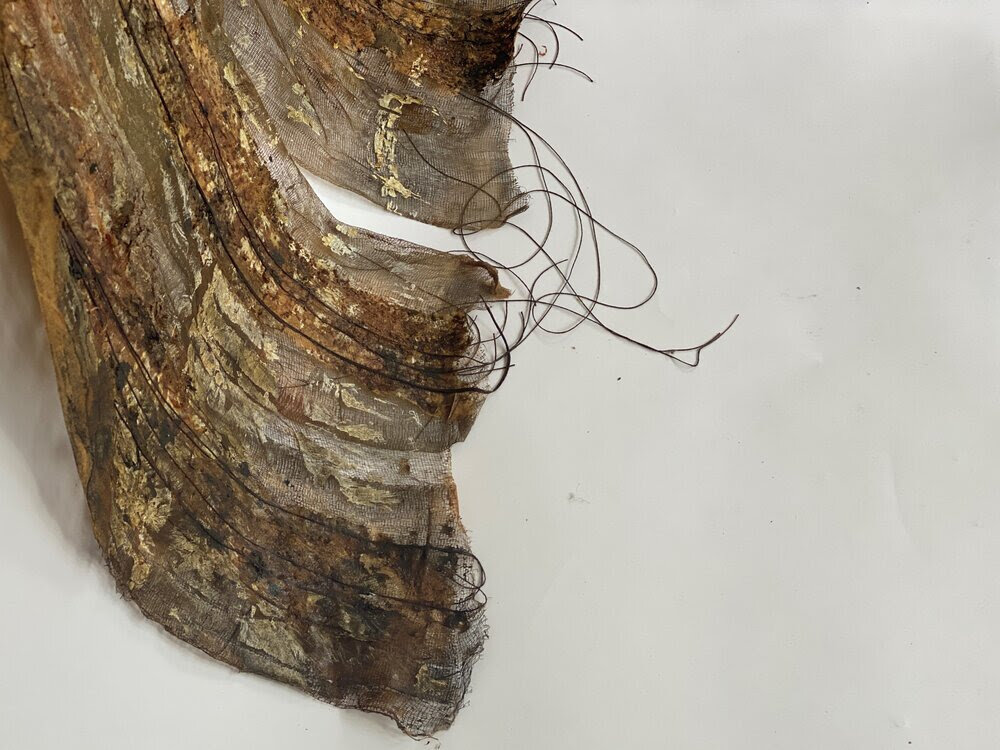
“Somber Skin” (detail), (cheesecloth, acrylic, sawdust, string), by Sylvia Vander Sluis, in her joint “Material Witness’ show with Virginia (Ginny) Mahoney, opening in June at Fountain Street Fine Art, Boston. Ms. Sluis’s studio is in Lancaster, Mass.
The gallery says of her work:
“Sylvia Vander Sluis unites contradictory materials in visceral forms that reflect the human condition. Industrial and domestic media are combined in raw, emotional constructions. Inspired by the folds of rosin paper, the transparency of cheesecloth, and the grit of gravel, Vander Sluis creates metaphors for the dualities of life. In one sculpture, plaster gauze holds Styrofoam precariously on structures of willow branches. Her work honors both the fragility and strength of the human spirit.”
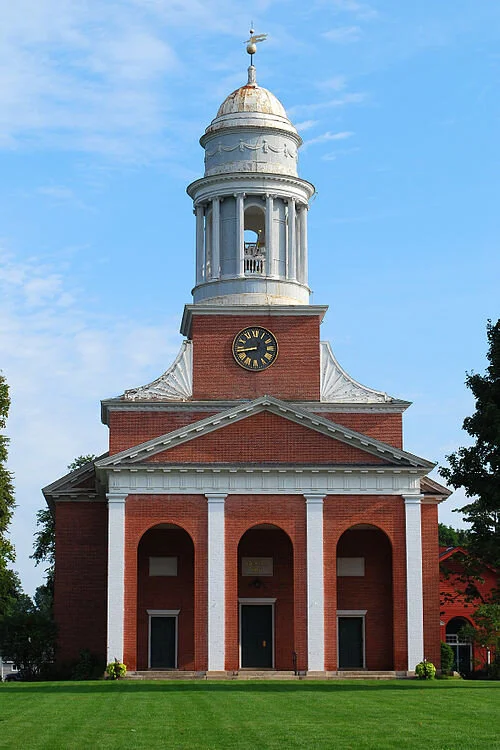
First Church of Christ in Lancaster. It was designed by famed architect Charles Bulfinch and built in 1815–1817.
A little decorum, please

Not exactly asking for this
From Robert Whitcomb’s “Digital Diary,’’ in GoLocal24.com
Rhode Island state Sen. Jonathon Acosta calls a proposed Senate dress code mandating that such traditional business clothing as jackets and collared shirts for men and blouses for women be worn in the chamber is somehow ‘’oppression’’ by white culture. In fact, such clothing, whatever its origins in Western culture, has long since become near-universal as a sign of seriousness, decorum and respect for the organizations that people work for. Just look at what people wear in international organizations.
Consider that officials of China, the ultimate non-Western power, all wear “Western” business clothes. I don’t think that they feel oppressed by this.