

Intended for loss

Elizabeth Bishop in 1964
“The art of losing isn’t hard to master;
so many things seem filled with the intent
to be lost that their loss is no disaster.’’
— From “One Art,’’ by Elizabeth Bishop (1911-1979), considered one of the greatest American poets. She was born in Worcester and died in Boston and lived in many places in-between.
After seeing all that in Boston....

Mark Wahlberg
“It’s weird: I’ve been to prison, I’ve seen the worst sort of violence and negative shit on the streets, but when it comes to putting my heart on the line and letting somebody get to know me in a relationship, it’s very difficult.’’
— Mark Wahlberg (born 1971), movie and TV actor, producer and former rapper, was brought up on the then mean streets of Boston’s Dorchester section, where he got into drugs and crime.

Classic Boston area three-decker
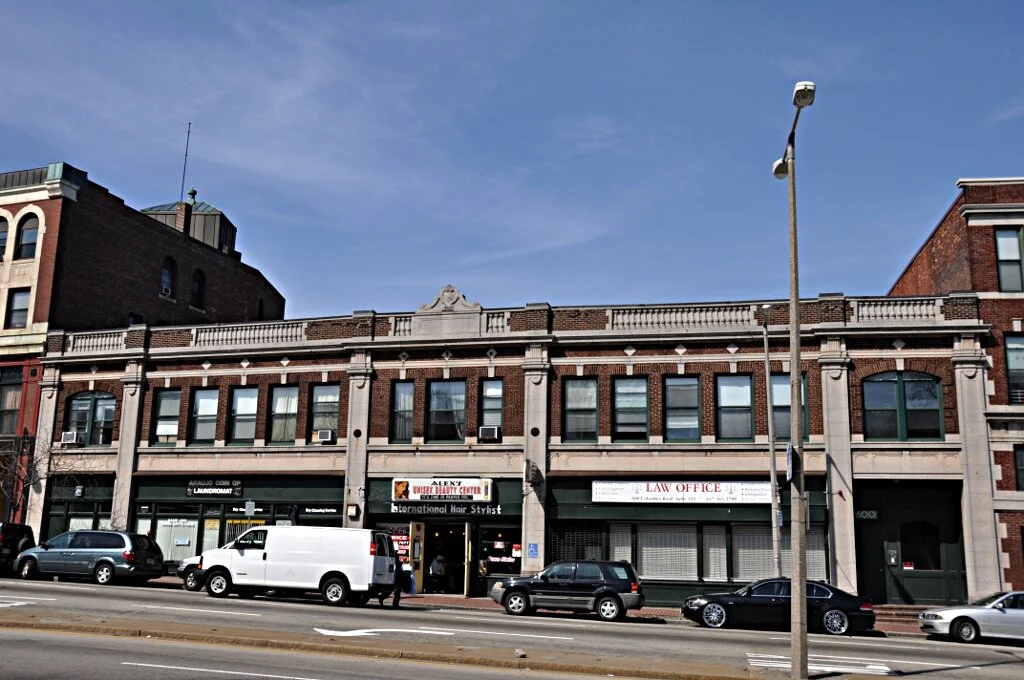
In the Uphams Corner section of Dorchester showing a typical streetscape in the neighborhood (2010)
More efficient and more expensive?
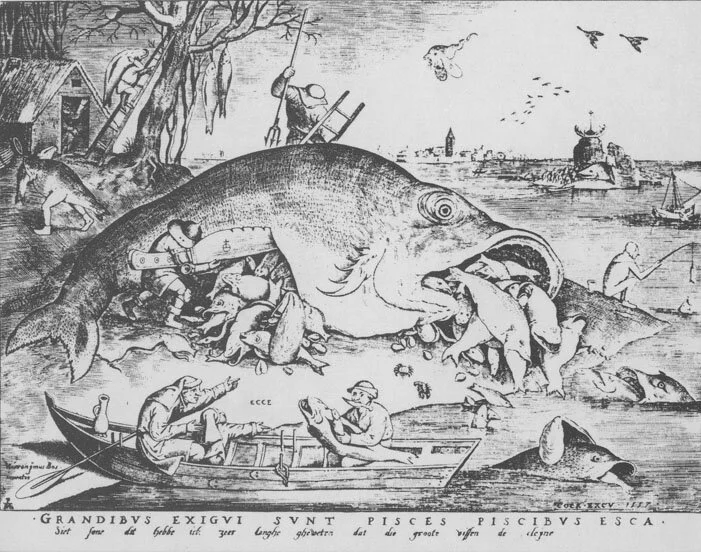
“The Big Fish Eat the Small Ones,’’ by Peter Brueghel the Elder (1556).
From Robert Whitcomb’s “Digital Diary,’’ in GoLocal24.com
“The sooner patients can be removed from the depressing influence of general hospital life the more rapid their convalescence.’’
-- Charles H. Mayo, M.D. (1865-1939), American physician and a co-founder of the Mayo Clinic, in Rochester, Minn.
The plan for Lifespan and Care New England (CNE) to merge, if regulators approve it, would probably make Rhode Island health care more efficient. It would do this through integrating their hospitals and other units. That would do such things as speeding the sharing of patient information among health-care professionals and streamlining billing. Further, it would probably strengthen medical research and education in the state, much of it through the new enterprise’s very close links with the Alpert Medical School at Brown University, which, indeed, has pledged to provide at least $125 million over five years to help develop an “academic health system’’ as part of the merger.
The deal, by reducing some red tape (with the state having just one big system instead of two), might make health care in our region more user-friendly for patients, dissuading more of them from going to Boston’s world-renowned medical institutions, thus keeping more of their money here.
The best example of where the merger could improve health care would be in better connecting Lifespan’s Hasbro Children’s Hospital with Care New England’s Bradley Hospital, a psychiatric institution for children, and Women & Infants Hospital.
But would the huge (especially for such a tiny state) new institution have such power that it would impose much higher prices? Studies have shown that hospital mergers almost inevitably mean higher prices. So insurance companies, as well as poorly insured patients, may eye a Lifespan-CNE merger with trepidation.
And expect job losses, at least for a while, given the need to eliminate the administrative redundancies created by mergers. Meanwhile, senior- executive salaries in the new entity would probably be even more stratospheric than they are now at the separate “nonprofit” companies, and I imagine the golden parachutes for departing excess senior execs would blot out the sun.
Meanwhile, Boston will remain a magnet for health care, and so it’s conceivable that the behemoth and very prestigious Mass General Brigham hospital group would end up absorbing the Lifespan-CNE giant in the end anyway.
'Wonderscapes' in Framingham

“Hide and Seek” (full-room installation), by Adria Arch, in the Danforth Art Museum's (Framingham, Mass.) group exhibit, “Wonderscapes,’’ March 20-June 12
— Photo by Will Howcroft
The museum’s director, Jessica Roscio, says of the show:
“Using circles, organic forms, and undefined borders, five multi-media artists working across media create their own wonderscapes. They use the tactile nature of their materials to convey hazy, stream-of-consciousness, otherworldly dreamscapes based in reality but largely products of the mind. In focusing on elemental forms, each of these artists crafts their own narratives about time and space and the ways in which we visualize, cope, and move through our own ‘wonderscapes.’’’
When they want their nanny.

An old wet nurse symbolizing France as nanny-state and public-health provider (color photomechanical reproduction of a lithograph editorial cartoon by N. Dorville, 1901)
“When faced with economic uncertainty, people don’t want freedom. When they can’t see their economic future, they want the nanny state.’’
— John McLaughlin (1927-2016) a Providence native and one-time Jesuit priest who became a well-known conservative writer and public-affairs talk show host, best known for running The McLaughlin Group. His forceful and abrupt style was much parodied.

John McLaughlin with President Richard Nixon on May 3, 1974. Mr. McLaughlin wrote speeches for Nixon, who resigned in the Watergate scandal on Aug. 8, 1974.
Arthur Allen/Liz Szabo: Don't be picky about a COVID-19 vaccine

Boston’s Beth Israel Deaconess Medical Center, where the Johnson & Johnson COVID-19 vaccine was developed. Other vaccines are being offered by Pfizer and Cambridge-based Moderna, which is making most of its vaccines in Massachusetts. Pfizer also has major operations, like Moderna, in Cambridge’s Kendall Square area.
Meanwhile, the Novavax vaccine should be available within the next couple of months.
When getting vaccinated against COVID-19, there’s no sense being picky. You should take the first authorized vaccine that’s offered, experts say.
The newest COVID vaccine on the horizon, from Johnson & Johnson, is probably a little less effective at preventing sickness than the two shots already being administered around the U.S., from Pfizer-BioNTech and Moderna. On Saturday, the Food and Drug Administration authorized the Johnson & Johnson vaccine after reporting it showed about 66% effectiveness at preventing covid illness in a 45,000-person trial. No one who received the vaccine was hospitalized with or died of the disease, according to the data released by the company and FDA. As many as 4 million doses could be shipped out of J&J’s warehouses beginning this week.
The J&J vaccine is similar to the shots from Moderna and Pfizer-BioNTech but uses a different strategy for transporting genetic code into human cells to stimulate immunity to the disease. The Moderna and Pfizer-BioNTech vaccines were found in trials last fall to be 94% effective in preventing illness caused by covid. They also prevented nearly all severe cases.
But the difference in those efficacy numbers may be deceptive. The vaccines were tested in different locations and at different phases of the pandemic. And J&J gave subjects in its trial only one dose of the vaccine, while Moderna and Pfizer have two-dose schedules, separated by 28 and 21 days, respectively. The bottom line, however, is that all three do a good job at preventing serious COVID.
“It’s a bit like, do you want a Lamborghini or a Chevy to get to work?” said Dr. Gregory Poland, director of the Mayo Clinic’s Vaccine Research Group, who was a paid consultant in the J&J study. “Ultimately, I just need to get to work. If a Chevy is available, sign me up.”
So while expert panels may debate in the future about which vaccine is best for whom, “from a personal and public health perspective, the best advice for now is to get whatever you can as soon as you can get it, because the sooner we all get vaccinated the better off we all are,” said Dr. Norman Hearst, a family doctor and epidemiologist at the University of California-San Francisco.
Here are five reasons you should take the J&J shot if it’s the one that’s offered to you first:
1. All three vaccines protect against hospitalization and death.
Of the 10 people who got severe disease in the Pfizer trial, nine had received a placebo, or fake vaccine; none of the 30 severe cases in the Moderna trial occurred in people who got the true vaccine. A month after receiving the Johnson & Johnson shot there were no deaths or hospitalizations in those who had been vaccinated. “The real goal is to keep people out of the hospital and the ICU and the morgue,” said Dr. Paul Offit, director of the Vaccine Education Center at Children’s Hospital of Philadelphia. “This vaccine will do that well.”
2. The efficacy levels could be a case of apples and oranges.
The data that Moderna and Pfizer-BioNTech presented to the FDA for their vaccines came from large clinical trials that took place over the summer and early fall in the United States. At the time, none of the new variants of covid — some of which may be better at evading the immune responses produced by vaccines — were circulating here. In contrast, the J&J trial began in September and was put into the arms of people in South America, South Africa and the United States.
Newly widespread variants in Brazil and South Africa appear somewhat better at evading the vaccine’s defenses, and it’s possible a new variant in California — where many J&J volunteers were enrolled — may also have that trait. The J&J vaccine was 72% effective against moderate to severe covid in the U.S. part of the trial, compared with 57% in South Africa, where a more contagious mutant virus is the dominant strain. Another vaccine, made by the Maryland company Novavax, had 90% efficacy in a large British trial, but only about 50% in South Africa. The Moderna and Pfizer-BioNTech vaccines might not have gotten the same sparkling results had they been tested more recently — or in South Africa.
“This vaccine was tested in the pandemic here and now,” said Dr. Dan Barouch, a Harvard Medical School professor whose lab at the Center for Virology and Vaccine Research at Beth Israel Deaconess Medical Center, in Boston, developed the J&J vaccine. “The pandemic is a much more complex pandemic than it was several months ago.”
Some of that difference in performance also could be attributable to different patient populations or disease conditions, and not just the mutant virus. A large percentage of South Africans carry the human immunodeficiency virus, or HIV. Chinese vaccines have performed wildly differently in countries where they were tested in recent months.
“We don’t know which vaccines are the Lamborghinis,” Poland said, “because these aren’t true head-to-head comparisons.”
3. Speed is of the essence.
To stop the spread of COVID, the mutation of the virus that causes it and the continued pummeling of the economy, we all need to be vaccinated as quickly as possible. The inadequate supply of vaccines has been felt acutely.
Dr. Virginia Banks’ s 103-year-old mother is one of the few living Americans who were around for the country’s last great pandemic — the 1918 influenza — yet she’s been unable to get a covid vaccination, said Banks, a physician with Northeast Ohio Infectious Disease Associates in Youngstown.
Patients can’t be picky about which vaccine they accept, Banks said. People “need to get vaccinated with the vaccines out today so we can get closer to herd immunity” to slow the spread of the virus.
Banks has worked hard to promote covid vaccines to skeptical minority communities, frequently appearing on local TV news and making at least two presentations by Zoom each week. Blacks to date have been vaccinated against covid at much lower rates than whites.
“There’s a downside to waiting,” said Dr. William Schaffner, a professor of preventive medicine and health policy at Vanderbilt University Medical Center. Delaying vaccination carries serious risks, given that, as of Saturday, some 2,000 Americans were still dying each day of covid.
4. The J&J vaccine appears to have some real advantages.
First, it seems to cause fewer serious side effects like the fever and malaise suffered by some Pfizer-BioNTech and Moderna vaccine recipients. High fever and dehydration are particular concerns in fragile elderly people who “have one foot on the banana peel,” said Dr. Kathryn Edwards, scientific director of the Vanderbilt Vaccine Research Program. The J&J vaccine “may be a better vaccine for the infirm.”
Many people may also prefer the J&J shot because “it’s one and done,” Schaffner said. Easier for administrators too: just one appointment to schedule.
5. The J&J vaccine is much easier to ship, store and administer.
While the Johnson & Johnson vaccine can be stored in regular refrigerators, the Pfizer-BioNTech vaccine must be kept long-term in “ultra-cold” freezers at temperatures between minus 112 degrees and minus 76 degrees Fahrenheit, according to the Centers for Disease Control and Prevention.
Both the Moderna and Pfizer-BioNTech vaccines must be used or discarded within six hours after the vial is opened. Vials of the J&J vaccine can be stored in a refrigerator and restored for later use if doses remain. “Right now we have mass immunization clinics that are open but have no vaccine,” said Offit. “Here you have a single-dose regime with easy storage and handling.”
A person’s address — not their personal preference — may determine which vaccine they receive, said E. John Wherry, director of the Institute for Immunology at the University of Pennsylvania’s Perelman School of Medicine. He pointed out that the Johnson & Johnson vaccine is a simpler choice for rural areas.
“A vaccine doesn’t have to be 95% effective to be an incredible leap forward,” said Wherry. “When we get to the point where we have choices about which vaccine to give, it will be a luxury to have to struggle with that question.”
Liz Szabo and Arthur Allen are Kaiser Health News reporters.
Arthur Allen: ArthurA@kff.org, @ArthurAllen202
Liz Szabo: lszabo@kff.org, @LizSzabo
Grey on grey

—By Knulclunk

‘‘half-past nine and warm enough
to nudge a crocus out of its benumbing
winter sleep, grey swales of greysplotched
grey on grey, erratic windswept drizzle,
the swish swash of milk- and oil trucks slashed
across my trenchsliht vision when….’’
— From “A Break in the Weather,’’ by Paul Mariani (born 1940), poet and long-time literature professor at Boston College. He lives in western Massachusetts.
'Solace' in clippervillle

Promotional image from the show called “Solace’,’ featuring works by the East Boston artist-run cooperative Atlantic Works through April 24 at the neighboring Clippership Wharf’s ClipArt Gallery, East Boston. That’s the community where many of the most famous clipper ships were built in the mid-19th Century.

Painting by James E. Buttersworth done in 1859-60 of the clipper ship Flying Cloud, built in 1850-51 at famed naval architect Donald McKay’s shipyard in East Boston.

Chris Powell: Abolish government pensions
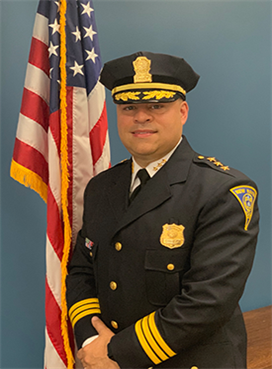
New Haven Police Chief Otoniel Reyes is “retiring” at age 49 with a $117,000-a-year pension to move to nearby Quinnipiac University, where he’ll run the campus police at a salary that will probably be around $170,000.
MANCHESTER, Conn.
Connecticut should prohibit pensions for state and municipal government employees, not because they are bad people or especially undeserving but for several solid policy reasons.
First, most of the taxpayers who pay for those pensions don't enjoy anything like them.
Second, state and municipal government can't be trusted to fund the pensions adequately.
And third, the pension system for state and municipal employees separates a huge and politically influential group from Social Security, the federal pension system on which nearly everyone else relies, and thus weakens political and financial support for it.
Connecticut state government has an estimated $60 billion in unfunded liabilities in its state-employee and municipal-teacher pension funds. But after attending the recent meeting of the state General Assembly's finance committee, Yankee Institute investigative reporter Marc Fitch wrote that another $900 million in unfunded liabilities are sitting in New Haven's pension funds.
According to Fitch, New Haven Mayor Justin Elicker testified about the city's pension-fund disaster, noting that city government faces a projected $66 million deficit in its next budget and that pension obligations are a major cause of it.
Of course the mayor attended the hearing to beg more money from state government for the city. Unfortunately no legislator seems to have asked Elicker about the $117,000 annual pension that the city is about to start paying its police chief, Otoniel Reyes, so that he can "retire" at age 49 to take a job with Quinnipiac University, in nearby Hamden, Conn., probably at a salary around $170,000, and begin earning credit toward a second luxurious pension. Indeed, no news organization in New Haven seems to have even reported the chief's premature pension yet.
Maybe legislators didn't ask about the "retiring" chief's pension because state government has been just as incompetent and corrupt with pensions as New Haven city government. These enormous and incapacitating unfunded liabilities are proof of political corruption and incompetence at both the state and city levels -- the promising of unaffordable benefits to a politically influential special interest.
Connecticut's tax system may be unfair, but it's not why New Haven is insolvent. Like state government, the city is insolvent because it has given too much away.
Government in Connecticut is good at clearing snow from the streets and highways because failure there is immediately visible. But beyond snowplowing government, in Connecticut is not much more than a pension and benefit society whose operation powerfully distracts from serving the public.
This distraction should be eliminated, phased out as soon as government recognizes that it has higher purposes than the contentment of its own employees.
xxx
Proposing his new state budget this month, Governor Lamont announced plans to close three of Connecticut's 14 prisons in response to the decline of nearly 50 percent in the state's prison population over the last decade.
A few days later New Haven's Board of Alders asked Assistant Police Chief Karl Jacobson to explain the recent explosion of violent crime in the city.
According to the New Haven Register, the assistant chief said there were 73 gang-related shootings in the city in 2020 against only 41 in 2019 and 32 in 2018. Murders in the city so far this year total seven, against none in the same period last year. So far this year there have been 12 shootings in the city, up from five at this time last year, and 36 shooting incidents this year compared to 20 at this time last year.
As usual, the assistant chief said, a big part of the violence in the city involves men recently released from prison who resume feuds and otherwise are prone to get into trouble. The police plan to hold preventive meetings with such men, and the city has just opened a "re-entry center" for new parolees.
The explosion of crime in New Haven, Hartford, Bridgeport and other cities does not sound like cause to close prisons. It sounds like cause to investigate prison releases and the failure of criminal rehabilitation.
Maybe the General Assembly would undertake such investigation if the former and likely future offenders were delivered to suburbs instead of cities. Then saving money by closing prisons might not be considered such a boast.
xxx
Chris Powell is a columnist for the Journal Inquirer, in Manchester.
Good show for a stony region

“Water and Rocks” (print on aluminum), by Robin MacDonald-Foley, in her show “Seeing Stone,’’ at Galatea Fine Art, Boston, March 5-28.
She tells the gallery:
"Seeing Stone is a journey of exploration represented as a body of work inspired by forms and shapes found in nature. Uniting stone and stone’s relationships within the natural environment is my focus. Pairing sculpture and photography, these stone carvings and images play upon spatial relationships, intending to draw the viewer in. This work is a personal narrative, depicting the power, calm and permanence of stone.
“In my recent work, visualizing places becomes part of my sculpture. A carving of a vessel takes me on an inward journey navigating oceans and eroded facades etched in lichen stories noting the passage of time. Studying stone as an object, thoughts are captured as photographic impressions of rocks against a blue sky. Bound together by fate, they stand on their own, each central to my theme.
“My work is carved by hand in a steady rhythm of tool to stone, a challenging technique that enables me to bond with a piece over long periods of time. When its form emerges, history begins anew. Working with multiple pieces, I imagine how they connect in color and texture, allowing the placement of objects to redefine permanent qualities. Sometimes a polished finish brings the coloration of an alabaster carving to life, or a self-portrait becomes part of my setting. Sitting by the ocean, or sheltering in cave-like stone structures, my feet intuitively absorb Earth's undulating destinations. I sit quietly sharing time and space with the stone."
She lives in the town of Stoughton, south of Boston.
‘
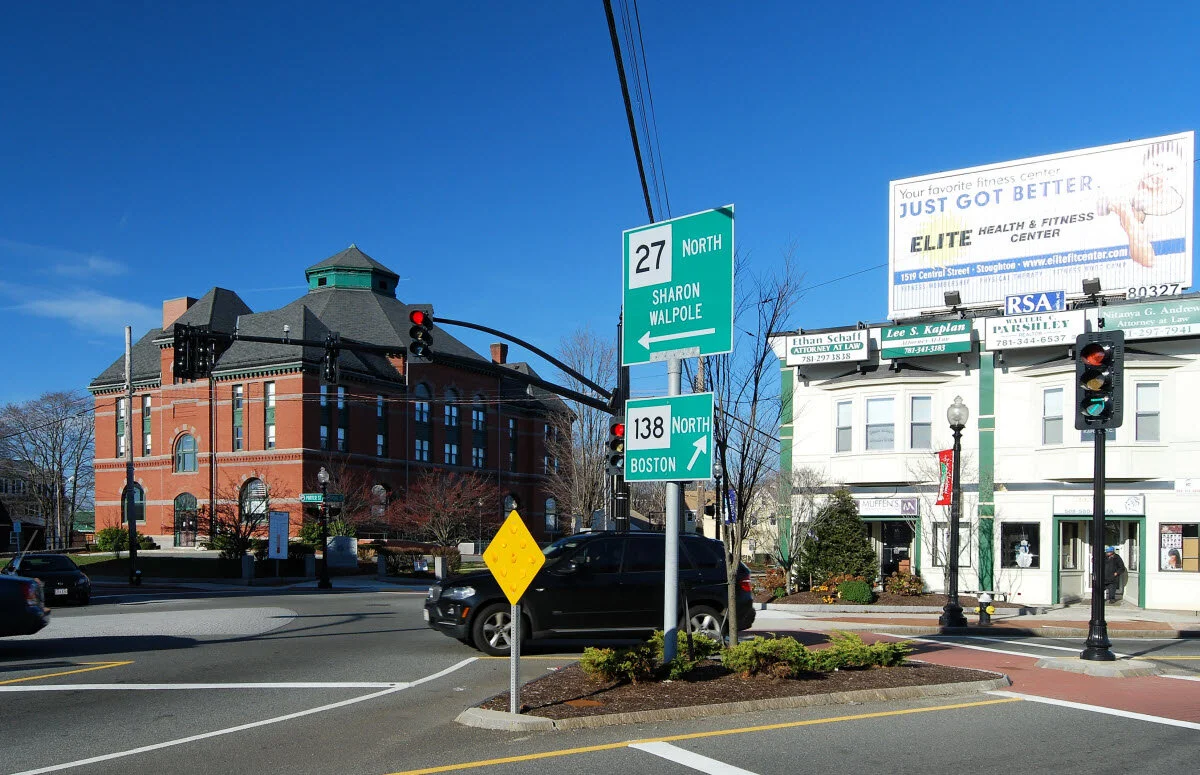
Downtown Stoughton.
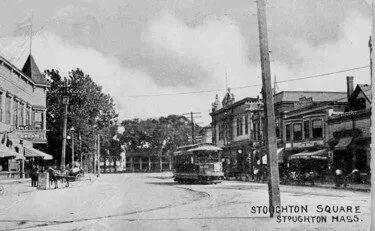
Downtown Stoughton in 1912. Even many small towns had streetcars then.
Why not leave them all on the beach?

“One cannot collect all the beautiful shells on the beach,’’ in Gift From the Sea (1955)
— Anne Morrow Lindbergh (1906-2001), best-selling essayist/author, some of whose writings presaged the Green Movement, and aviator. She was wife of aviator, inventor, military officer, Nazi sympathizer (like her for a time) and womanizing (and with simultaneous-multiple families) Charles Lindbergh. She spent her final years living near her daughter Reeve, an author herself, in the northern Vermont village of Passumpsic, part of the town of Barnet. Before then she and her husband lived off and on in Darien, Conn. (“Aryans from Darien’’), in a rich section on Long Island Sound.

The Barnet, Vt., post office

1914 postcard. But the Lindberghs were not contented.

Carey Goldberg: Boston physician named to run CDC uses data to save lives

Dr. Rochelle Walensky
BOSTON
In early December, Dr. Katy Stephenson was watching TV with her family and scrolling through Twitter when she saw a tweet that made her shout.
“I said ‘Oh, my God!'” she recalled. “Super loud. My kids jumped up. My husband looked over. He said, ‘What’s wrong, what’s wrong, is everything OK?’ I was like, ‘No, no, it’s the opposite. It’s amazing. This is amazing!'”
Dr. Rochelle Walensky had just been tapped to lead the Centers for Disease Control and Prevention.
Stephenson is an infectious-diseases specialist and vaccine scientist at Beth Israel Deaconess Medical Center, in Boston. So the news had special meaning for her and the many jubilant colleagues tweeting their joy. They’d been helping one another through the brutal pandemic year, she said, while feeling they had little to no help from the federal government.
“It was so baffling,” she said. “It wasn’t even just that we didn’t know what the government was doing. It was that sometimes it felt like sabotage. Like the federal government was actively trying to mess things up.”
But through it all, as the long months became a year, Walensky had been out front, Stephenson said, sticking to the science and telling the truth.
When Walensky stepped up to lead the CDC, she promised to keep telling the truth — even when it’s bad news. She told a JAMA Network podcast last month that she’ll welcome straight talk from the scientists at the CDC as well.
“They have been diminished,” she said. “I think they’ve been muzzled — that science hasn’t been heard. This top-tier agency, world-renowned, hasn’t really been appreciated over the last four years and really markedly over the last year, so I have to fix that.
Walensky, 51, has long been a doctor on a mission — first, to fight AIDS around the world, and now, to shore up the CDC and get the United States through the pandemic. Beyond unmuzzling her agency’s staff, she vows to tackle many other challenges, pushing particularly hard on vaccine distribution and rebuilding the public health system.
Walensky’s family has a tradition of service, including a grandfather who served in World War II and rose to be a brigadier general. And she likens the call she got from the Biden administration to a hospital alarm that goes off when a patient is in cardiac arrest.
“I got called during a code,” she told JAMA. “And when you get called during a code, your job is to be there to help.”
At Massachusetts General Hospital, where Walensky was the chief of infectious diseases, some of her many admirers now have T-shirts that read “Answer the Code” with her initials, RPW, beneath.
The shirts are part of an outpouring of affection in Boston biomedical circles and far beyond that greeted Walensky’s appointment — including a flood of floral bouquets that her husband and three sons helped accept after word of her new job got out.
“At one point, one of my sons said, ‘You know, Dad, we should just open a florist shop at this point,” said Dr. Loren Walensky, the CDC director’s husband.
He studies and treats children’s blood cancers at Boston Children’s Hospital and the Dana-Farber Cancer Institute. And now he could be called the “first gentleman” of the CDC.
He calls Rochelle his “Wonder Woman” and still remembers when he first saw her 30 years ago, in the cafeteria of the Johns Hopkins University School of Medicine, where they were both students.
“She stood out,” he said. “And one of the reasons why she stood out is because she stands tall. Rochelle is 6 feet tall.”
She also had extraordinary energy and discipline, even then, he remembered: “Most of us would roll out of bed and stumble into the lecture hall as our first activity of the day and, for Rochelle, she was already up and running and bright-eyed and bushy-tailed for hours before any of us ever saw the light of day.”
After medical school, Rochelle Walensky trained in a hospital medical unit so tough it was compared to the Marines. It was the mid-’90s, and the AIDS epidemic was raging. She saw many people die. And then, a few years later, she saw the advent of HIV treatments that could save patients — if those patients could get access to testing and care.
Loren Walensky recalls coming home one day to find her sitting at the kitchen table working on extremely complex math. She was starting to broaden her focus from patient care to bigger-picture questions about the increased equity in health care that more funding and optimal treatment choices could bring.
“And it was like a switch went off,” he said, “and she just had this natural gift for this style of testing — whether if you did X, would Y happen, and if you did X with a little more money, then how would that affect Y? And all of these if-thens.”
She started doing more research, including studies of ways to get more patients tested and treated for AIDS, even in the poorest countries. One of her most prominent papers calculated that HIV drugs had given American patients at least 3 million more years of life.
She worked with Dr. Ken Freedberg, a leading expert on how money is best spent in medicine.
“You can’t do everything,” Freedberg said, “and even if you could, you can’t do everything at once. So what Rochelle is particularly good at is understanding data about treatments and public health and costs, and putting those three sets of data together to understand, ‘Well, what do we do? And what do we do now?'”
So, if Walensky had a Wonder Woman superpower, it was using data to inform decisions and save lives. That analytic skill has come in handy over the past year, as she has helped lead the pandemic response for her Boston hospital and for the state of Massachusetts.
She has weighed in often — and publicly — about coronavirus policy and medicine, speaking to journalists with a seemingly natural candor that has contrasted with the stiffer style of some federal officials. In April, when a huge surge of covid cases hit, she acknowledged the pain.
“We are experiencing incredibly sad days,” she said in a spring interview. “But we sort of face every day with the hope and the vision that what we will be faced with, we can tackle.”
And in November, she offered a sobering reality check from the front lines about current covid medical treatments: “When I think about the armamentarium of true drugs that we have that benefit people with this disease, it’s pretty sparse,” she said.
Walensky published research on key pandemic topics, such as college testing and antibody treatments. And she weighed in often publicly — on Twitter, in newspapers and on radio and TV. Asked on CNN whether the President Joe Biden’s plan to get 100 million Americans vaccinated in 100 days could restore a sense of normalcy, she responded with characteristic bluntness — a quality that could cause trouble in these polarized times.
“I told you I’d tell you the truth,” she said. “I don’t think we’re going to feel it then. I think we’re still going to have, after we vaccinate 100 million Americans, we’re going to have 200 million more that we’re going to need to vaccinate.”
Walensky is facing a historic challenge and leading an agency for which she’s never worked.
Already, she’s fielded blowback for the new CDC guidance on when and how schools should reopen, and she’s openly worried about new, more transmissible variants spreading nationwide.
Still, Boston colleagues said they have no doubt that she’ll succeed in making the transition from leading an infectious diseases division of 300 staffers to a public health agency of about 13,000.
“I would lie down in traffic for her,” said Elizabeth Barks, the infectious diseases division’s administrative director at Mass General. “And I think our entire division would lie down in traffic for her.”
Leading and rebuilding the CDC in the midst of a pandemic will be difficult. But Barks and others who know Walensky well said she’s clear-eyed and ready to dig in to meet the challenge; she’ll try a new approach if first attempts fall short.
Walensky brought a plaque from her desk in Boston to CDC headquarters in Atlanta. It reads: “Hard things are hard.”
Cory Goldberg is a Kaiser Health News journalist.
This story is part of a partnership that includes WBUR, NPR and KHN.
'Forms a furry sphere'

Palomides
Purrless my cat can stroll away
Rejecting human cheer.
To the same corner wends its way
And forms a furry sphere.
How cordial is the mystery
Of feline solitude.
Until I beckon spaciously
And he returns for food.
— Felicia Nimue Ackerman.
This poem first appeared in the Emily Dickinson International Society Bulletin.

Kayla Soren: Small towns need public transit, too

A bus of the Berkshire Regional Transit Authority, which serves Berkshire County, Mass., much of which is rural.

— Photo by Cogiati
Via OtherWords.org
With the pandemic taking a devastating toll on local budgets, the U.S. public transit system is battling to survive. For much of the country, this funding crisis jeopardizes an already withering lifeline.
For many Americans, public transit is the only option to get to work, school, the grocery store, or doctor’s appointments. But nearly half of us have no access to public transit. And those that do are now confronting limited routes, slashed service times, and limited disability accommodations.
This isn’t just a worry for people who live in cities — over a million households in rural America don’t have a vehicle. In rural communities like Wolfe County, Ky., Bullock County, Ala., and Allendale County, S.C., fully 20 percent of households don’t have a car.
Recently, dozens of transit riders and workers joined together for a two-day national community hearing to testify about their needs for public transit.
“My bus pass is the key to my independence,” testified Kathi Zoern, a rider from Wausau, Wis., with a vision impairment. But limited routes prevent her from performing basic tasks. “I can’t get to the Department of Motor Vehicles to get my voter ID,” she said, “because it’s outside the city limits.”
Unfortunately, situations like this are typical. Over 80 percent of young adults with disabilities are prevented from doing daily activities due to a lack of transportation. And there aren’t enough resources to properly train transit workers for accommodating people with disabilities.
Nancy Jackman, a transit-mobility instructor from Duluth, Minn., helps people with visual or hearing impairments ride transit. But she feels exhausted from the uphill battle. “Transit workers seem very overworked and under-appreciated for the types of problem solving that is demanded,” she reflected.
Public transit is also crucial for essential workers during the pandemic.
Sister Barbara Pfarr, a Catholic nun in Elm Grove, Wis., helps operate a Mother House where sick and elderly sisters reside. But at least half of her food and health-care workers don’t have a driver’s license, she said, and they’re missing shifts due to a lack of transit. As a result, residents in facilities like hers “don’t get their services because their workers can’t get to work, through no fault of their own.”
Barbara is also considering that as she ages, she may also become transit-dependent. “When I’m older and can’t drive anymore, I want to be able to get around.” Many smaller towns and rural areas tend to have disproportionate numbers of older people, and seniors are now outliving their ability to drive safely by an average of 7 to 10 years. Without transit options, many of these seniors will lose their independence.
The hearings also emphasized that survivors of domestic abuse disproportionately rely on transit.
Shivani Parikh, outreach coordinator at the New York State Coalition Against Domestic Violence, testified that a lack of public transit makes it harder for survivors to get help. Service cuts can “greatly influence their sense of isolation, their experience of abuse, and their perceived ability to leave,” she warned.
Throughout America, millions are forced to depend on transit that doesn’t fully meet their needs, while millions more have no access at all. This is unacceptable.
Congress can help. Public transit needs at least $39 billion in emergency relief to avoid service cuts and layoffs through 2023. But more broadly, we need to revise the “80-20” split that’s plagued federal transit funding since the Reagan era — with 80 percent going to highways and less than 20 percent to public transit.
Part of the justification for this disparity is that only people in dense, urban areas use transit. This is upside-down logic. The hearings reveal that when people don’t use transit, it’s because it is nonexistent, unreliable, or inaccessible.
The funding to meet everyone’s transit needs exists — it’s just not being allocated correctly. It’s time we invest in public transit for all of America.
Kayla Soren is a Next Leader at the Institute for Policy Studies.
‘Two harlots screaming’

For what I ate
I feel bad.
My soul aches,
my heart is sad.
In hindsight I whispered,
“Eat neither now,”
but each one I defiled.
I don’t know how,
but alas I did
break my vow.
One was tender,
not hardly ready,
the other laid firm
like a solemn jetty
to buttress the tempest
and craving that be
in the dark depths
at the bottom of me.
Although young then
I was no stranger to fate
I could have left them alone to wait
for their honey to gather slowly within
to forever be as they had been,
but instead they heckled loudly
for “Original Sin”.
They are gone now,
but no virgins were they!
My vulnerabilities
their vexing inflated
I’m worse for that
which I have wasted.
And yet no better satiation
was felt with others I’ve tasted.
How will I tell
my one True-Blue
who keeps our flower
of love in bloom.
Shall I explain how I saw
splayed open like confections
full with lust for my direction,
two harlots screaming
in torrid syncopation
threatening doom
with my least hesitation.
Worse, they warned –
once my passion was unleashed
they would only accept
something “complete.”
It would not be hailed as “True”
until the final consumption
of not one, but two.
These bewitching dollops
would no longer wait.
They settled together
to enjoy their fate.
I savored them each
completely, and slowly,
my glee was immense, my
behavior unholy.
Yes, these flaws I sadly declare.
We mortals are no match
for Sirens in pairs.
Gods can repeat this rule
due to their station,
“Any goddess can adapt
to fit her vexation”.
So now I suffer
throughout my life
with guilt, misgivings
and marital strife
because I was tempted
away from my sacred oath
by two heavenly crumpets,
— and I ate them.
“Confession of a Serial Eater,’’ by William T. Hall, a New England- and Florida-based painter and writer
Maple sugaring means…

Boiling the maple sap in March to make syrup
“Maple sugaring exemplifies the classic New England values of connectness to land and community. Yankee ingenuity, observation of the natural world, heritage pride, entrepreneurship, homespun hospitality, make-do, and can-do, and simplicity.’’
— David K. Leff in Maple Sugaring: Keeping It Real in New England.
Mr. Leff (born 1955), of the Collinsville village in Canton, Conn., is a poet, essayist, lecturer and former deputy commissioner of the Connecticut Department of Environmental Protection.

Some of the Collins Company factory buildings in Collinsville on the Farmington River, viewed from Connecticut Route 179. The company, which closed in 1966, was once the world’s biggest maker of axes. It made other cutting tools, too. The river was the original source of the factory’s power.

A very Vegas vehicle

“Untitled (Las Vegas)” (ink jet print, color xerox, scotch tape), by Matt Williams, in the group show of Mad Oyster Studios at Brickbottom Artists Association, Somerville, Mass., March 11-April 3.
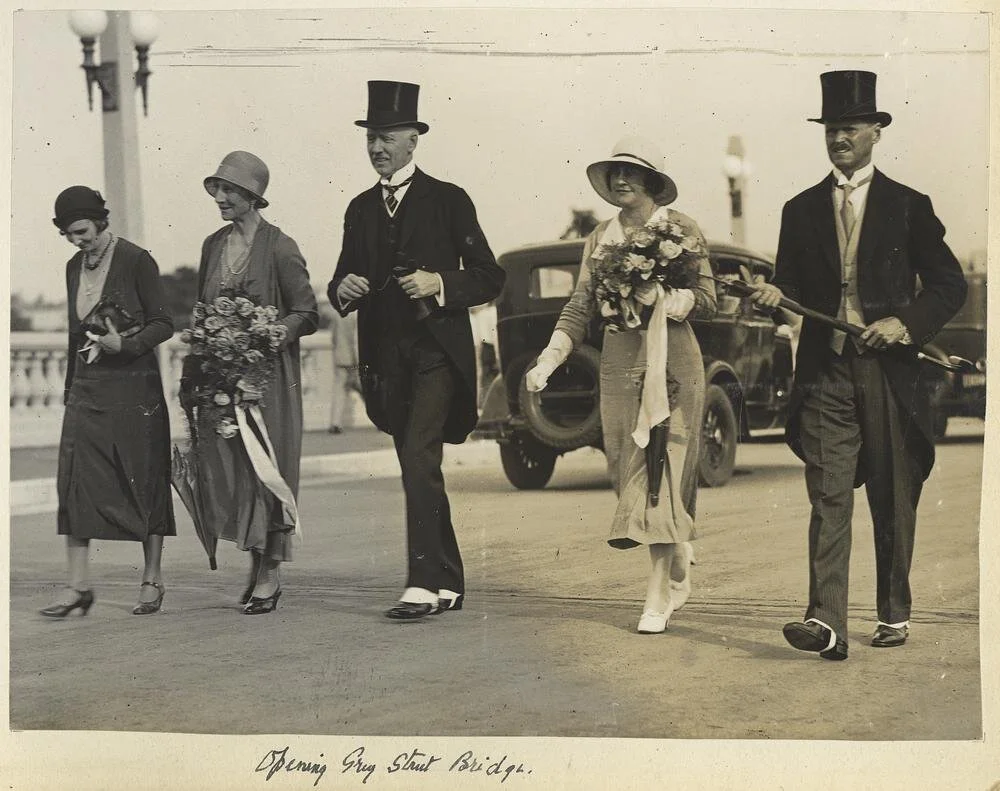
Llewellyn King: Will classy clothes return after the pandemic?
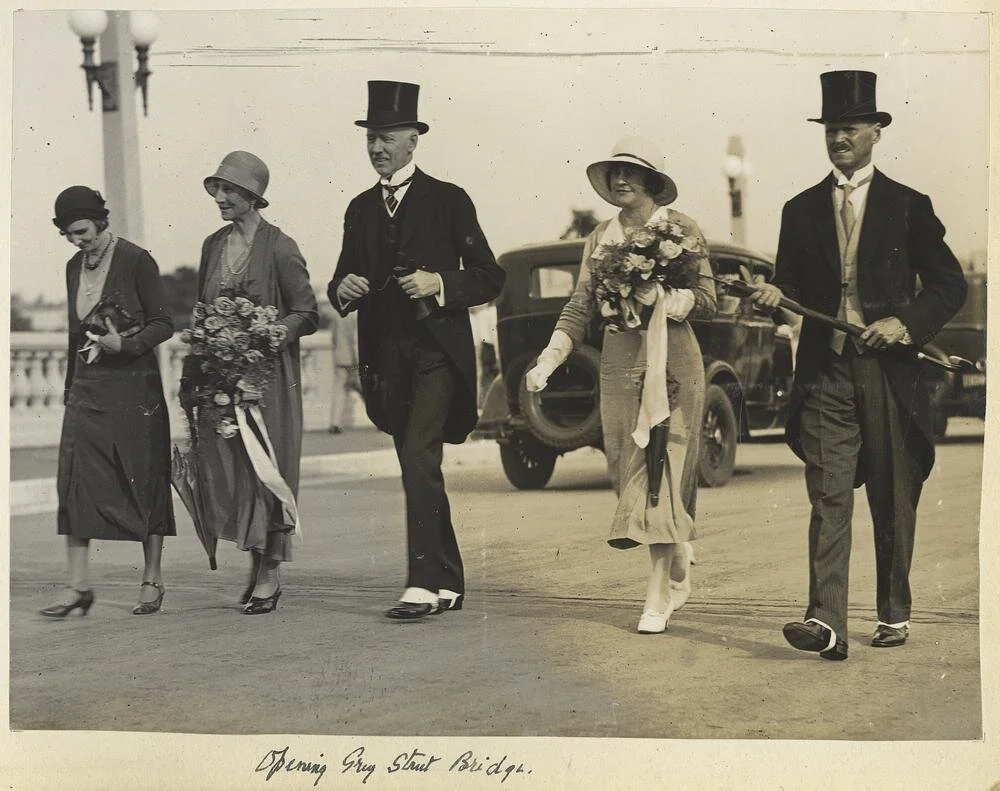
WEST WARWICK, R.I.
There is a lot of chat about the future of work: Will we do it at home, or will we revert to commuting to the old workplace?
But there is an additional, different question: What will we wear?
Go to the mirror and look at yourself. Except for the odd Zoom meeting you might have tried to dress for, you are a different person.
The fact is that even a traditionalist like me, who has worn a jacket and tie since his first days of school, is, well, letting down.
Worse, after a year of sweats and other baggy, comfortable clothing, I feel constricted and ill at ease when I put on a suit – which is mainly when I record television programs on Zoom or some other video hook-up.
I suspect that you are like me for these Zoom, or the like, formals; you wear a jacket and jeans or exercise pants, hiding your lower half under a table. Notice how cramped you feel above the waist.
Women, do you remember, putting on full makeup -- known in the cosmetic trade as “war paint” – now that you’ve grown accustomed to the au naturel look? Maybe for morale, you wear just a slash of lipstick now and again. Those nice suits in the closet, or flattering dresses, do you remember how confining they were? How hard it was managing that dangling bling?
On that Hallelujah Day when the pandemic is over, will men and women be prepared to get out of those oh-so-comfortable sneakers for Oxfords and pumps?
Was it worth it, yesterday’s clothing? After COVID-19, the way we were isn’t going to be the way it will be. Anyone for going back clotheswise? Or have we been emancipated from wardrobe tyranny and shoe slavery?
There have been various attempts in recent years to dress us down, like Casual Friday. I remember giving a speech at the prestige law firm Skadden, Arps, Slate, Meagher & Flom when they were trying to dress casually all week. The women partners looked miserable; they had made partner, bought Chanel suits, but now they were expected to wear their law school rags. And, oh, the misery of the middle-aged men partners, who had looked to bespoke suits to cover up the expansion of their waists, which had accompanied the collection of fat fees with the advance of age.
The only assault on male fashion before the change agent that is COVID-19 was the abandonment, for reasons unknown, of the poor necktie. What did it do wrong? Let me tell you, no one looks better without them. The naked male throat in a shirt designed for a tie isn’t lovely. Compensation is at hand in a revived interest in the pocket handkerchief or pocket square (which was used for drying the tears of distressed damsels but is used for cleaning one’s eyeglasses in the time of Me Too).
Formality in dress has been under attack for a long time. The tech titans, such as Steve Jobs, and rock musicians were the shock troops. No longer do smart restaurants enforce coats and ties for men and look askance at women in pants. Wearing sweats, shorts, sneakers? “Your table is ready, sir or madam.” Ugh!
Going forward, we may be so casualized in dress that we go to church in pajamas and work in anything that covers the body and is comfortable. The god of comfort has conquered the heavens.
I hope that for the sake of everyone, the fashion mavens, goaded on by the magazines like Vogue and GQ, devise a new era of clothes as comfortable as sweats and as flattering as, well, what we used to wear. Meanwhile, if you know anyone who would like to buy some suits (portly), sport coats (Scottish tweed), and shoes (leather lace-up), have them call me. I’m going to get with the new fashion, where comfort is the only criterion.
Llewellyn King is executive producer and host of White House Chronicle, on PBS. His email is llewellynking1@gmail.com and he’s based in Rhode Island and Washington, D.C.
Web site: whchronicle.com

The GOP's un-'well regulated' gun fixation

First muster of the Massachusetts Bay Colonial Militia, spring of 1637

A couple of AR-15s
From Robert Whitcomb’s “Digital Diary,’’ in GoLocal24.com
It says something about the current state of the gun-obsessed Republican/QAnon Party that Rhode Island’s Republican Conservative Caucus is raffling off firearms, including an AR-15 semi-automatic rifle, to raise money to elect more alleged “conservatives’’ (translation: far-right “populists’’) to the state’s General Assembly.
The quote below is from the then-retired U.S. Chief Justice Warren Burger (1907-1995) in 1990. The Second Amendment interpretation by this true conservative judge was generally the one held by the Supreme Court until far-right appointees of Republican presidents, in league with the gun lobby, began to take over the court. He was chief justice in 1969-1986.
“The Gun Lobby’s interpretation of the Second Amendment is one of the greatest pieces of fraud, I repeat the word fraud, on the American People by special interest groups that I have ever seen in my lifetime. The real purpose of the Second Amendment was to ensure that state armies – the militia – would be maintained for the defense of the state. The very language of the Second Amendment refutes any argument that it was intended to guarantee every citizen an unfettered right to any kind of weapon he or she desires.’’
The Second Amendment:
“A well regulated Militia, being necessary to the security of a free State, the right of the people to keep and bear Arms, shall not be infringed.’’
Note that the Founders wrote not only “Militia” but also “well regulated,” in those days before assault rifles….