
Vox clamantis in deserto






NEC to host program on outlook for environmental policy

Solar panels on house in Greater Boston
From The New England Council (newenglandcouncil.com)
BOSTON
“On Feb. 2, 2021, from 11:00 a.m. – 12:00 p.m., The New England Council’s Energy & Environment Committee will host a special program, ‘2021 Environmental Policy Outlook.’ The virtual event will feature a panel of environmental policy experts who will share their insights on what to expect from the Biden administration and the 117th Congress as it relates to environmental regulation and legislation. Our panelists are:
Jim Jones, former EPA Assistant Administrator of the Office of Chemical Safety and Pollution Prevention, and President, JJones Environmental
Renee Martin-Nagle, Ph.D., Special Counsel, Eckert Seamans
David Rockman, Chair, Environmental Practice Group, Eckert Seamans
Tiernan Sittenfeld, Senior Vice President of Government Affairs at the League of Conservation Voters
Mark Kalpin, a Partner at Holland & Knight and the Chair of the NEC Energy & Environment Committee, will serve as moderator.
The program is open to all interested New England Council members. For more information on this program or the Council’s Energy & Environment Committee, please contact Sean Malone.’’
In Boston, labor and business together

Aerial view of Downtown Boston, 2015
— Photo by Nick Allen
Adapted from Robert Whitcomb’s “Digital Diary,’’ in GoLocal24.com
Kim Janey, the president of the Boston City Council, will become The Hub’s acting mayor as Mayor Marty Walsh heads off to become Joe Biden’s labor secretary. It’s unclear whether she’ll actually run for the job.
I hope not, since Ms. Janey seems more interested in ethnic identity and appealing to certain neighborhood politics than with the overall state of the city. She also seems to have little knowledge of, or respect for, business. That Marty Walsh and his predecessor, Tom Menino, both standard liberal Democrats, understood that nurturing a vibrant business climate was essential in paying for municipal programs explains some of Boston’s stunning prosperity in recent decades.
As Jon Chesto wrote in The Boston Globe, “Walsh knew what every big-city mayor understands: Success depends heavily on a thriving business community. Boston’s budget is particularly reliant on a strong haul of commercial property taxes, a steady stream that has continued to earn the city high marks from two bond-rating agencies during the COVID-19 pandemic.’’ When a city’s bond rating falls, its interest costs – and often its taxes -- go up. Mr. Chesto noted: “progressivism often gives way to pragmatism when you have to run a city as large and as dynamic as Boston.’’
To read Mr. Chesto’s article, please hit this link.
Whoa, a U.S. labor secretary who will be pro-labor instead of pro-plutocrat (the case under the gangster who left the Oval Office Jan. 20)!
Mr. Walsh used to run the Boston Building Trades, among other union positions, before he became mayor. He understands the needs of working people. But he also understands business. Yes, you can be pro-labor and pro-business. Indeed, such a mating is the best for the long-term health of the economy.

Some safe in memory


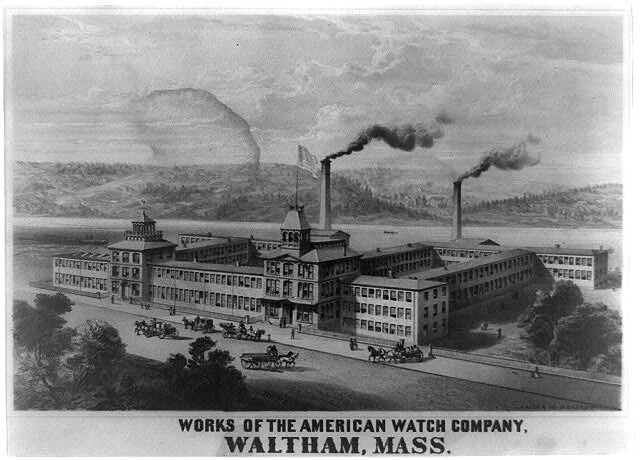
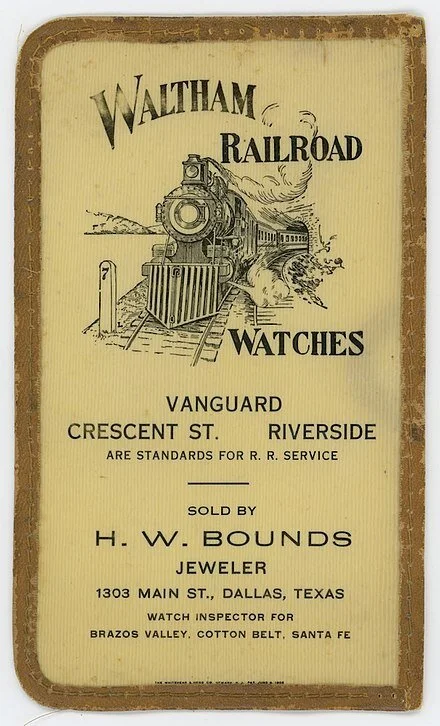
The inside and outside of the pocket watch I inherited from my father. The watch seems to have been a gift in honor of his graduation from high school, in 1935. It was made by the late-lamented Waltham (Mass.) Watch Co. (1850-1957). Waltham Watch, also known as the American Waltham Watch Co. and the American Watch Co., made about 40 million watches, clocks, speedometers, compasses, time fuses and other precision instruments in its long life. The company's 19th-Century manufacturing facilities in Waltham have been preserved as the American Waltham Watch Company Historic District.
— Robert Whitcomb
“Some things you get back,
but they’re not the same.
Some, though lost,
remain in memory that cannot be shorn.
and some
are just gone.’’
— From “Memories of an Antique Pocket Watch,’’ by Chris LaMay-West, a Burlington, Vt.-based poet and former editor of Mud Season Review
Yankees believed in multiple uses of gear

“A Snowy Monday, The Cooperage, Hancock, New Hampshire,’’ by Lilla Cabot Perry
In the Hancock, New Hampshire, historical society…is the town coffin, once used to bury the poor. {Thrifty Yankees, using the same coffin, and thriftier still — for years it was used as a chicken feeder on a farm.)
— Howard Mansfield (born 1957) historian, from In the Memory House. He lives in Hancock.
Hancock Historical Society

David Warsh: Toward a third Reconstruction

The March on Washington, D.C., on Aug. 28, 1963, during the Civil Rights Movement — what might be called the “Second Reconstruction.’’
SOMERVILLE, Mass.
Until recently, Reconstruction was a topic in American history of interest chiefly to high school juniors preparing to take the college Advanced Placement exam. During the 13 years after the Civil War, the United States reintegrated the states that had seceded from the Union and struggled to define the legal status in them of African-Americans under the 13th, 14th and 15th Amendments to the Constitution. By 1916, when President Woodrow Wilson reintroduced segregation to the federal workforce, the hard-fought gains of the episode had faded from living memory.
Then again, every America born before, say, 1960, has a first-hand experience of the Civil Rights Movement. It is often dated from President Harry Truman’s 1948 decision to integrate U.S. armed forces after the contradictions of segregation re-emerged and became untenable during World War II. There was Jackie Robinson and the integration of Major League Baseball, and then the marches with their dramatic confrontations. Martin Luther King Jr. was assassinated in 1968; George Wallace was roundly defeated as a third-party presidential candidate (though he did better than any third-party candidate between Theodore Roosevelt and H, Ross Perot). After 1970, most people turned their attention to other concerns. Ill-feelings were cosmetically treated away on television: Archie Bunker and the Cosby show.
Events of the last several years, often summed up by the assertion that Black lives matter, have often been portrayed as the beginnings of a Third Reconstruction. The implication is that the Civil Rights Movement was the second: historian C. Vann Woodward said as much. There may one day be a fourth. The Rev. William Barber II, pastor of Greenleaf Christian Church, in Goldsboro, N.C., anticipated as much in 2016 with The Third Reconstruction: Moral Mondays, Fusion Politics, and the Rise of a New Justice Movement.
The view that the history of the Unites States is essentially inseparable from the history of slavery was forcefully voiced by The New York Times, in 2019, in its 1619 Project. “Our democracy’s founding ideals were false when they were written,” asserted Nikole Hanna-Jones, in an opening essay. “Black Americans have fought to make them true.” Not everyone was convinced. But the Trump administration’s rejoinder, the “1776 Project” of its 1776 Commission, released last week, has been quickly dismissed. The inauguration ceremonies brought all this to mind. Three books, more than any others in the last 30 years, have done more to open my eyes:
The Promised Land: The Great Black Migration and How It Changed America (1991), by Nicholas Lemann, then of The Atlantic Monthly, decisively put on the map the enormous changes wrought after 1944 by the introduction of the mechanical cotton picker, replacing workers whose numbers had soared after 1794, when the invention of the cotton gin made the crop newly much more profitable. The subsequent migration of unemployed farm workers from the rural South to the metropolitan North brought a cascade of changes in the lives of the migrants, and the cities in which they sought homes and jobs. Ghettoes, unemployment, single-parent families, drugs and crime were among the unintended effects. So was newfound political power and, for many, greater affluence.
Race and Reunion: The Civil War in American Memory (2002), by David Blight, of Yale University, demonstrated that of the three quite different stories that emerged from the Civil War, it was the vision of reconciliation between the mostly white armies of the North and the South that came to dominate, permitting the White supremacist vision of continuing racial segregation and reasserted white privilege to eclipse an emancipationist vision of constitutional equality for African-Americans citizens. Blight followed up with a Pulitzer-Prize-winning biography, Frederick Douglass: Prophet of Freedom (2018).
The Color of Law: A Forgotten History of How Our Government Segregated America (2017), by Richard Rothstein, of the Economic Policy Institute, recovered a lost history of how bankers and real-estate agents successfully enlisted federal, state and local policies to create and maintain racially homogenous neighborhoods in cities and suburbs nationwide. The patterns of segregation that resulted violate constitutional rights, he argued, and now require remediation. His memorable account of how such policies loomed in the background of the 2014 killing of Michael Brown, in Ferguson, Mo., is here.
Last week I read Revisiting Time on the Cross after 45 Years: The Slavery Debate and the New Economic History, by Eric Hilt, of Wellesley College and the National Bureau of Economic Research. Hilt noted that a wave of celebrated books that have appeared in recent years evaluating the role of slavery in the development of the American economy, among them Walter Johnson’s River of Dark Dreams; Edward Baptist’s The Half that Has Never Been Told; Sven Beckert’s Empire of Cotton; and Beckert and Seth Rockman’s Slavery’s Capitalism.
Yet some of the arguments resemble those that appeared first in Time on the Cross: The Economics of American Negro Slavery, by Robert Fogel and Stanley Engerman, published in 1974. Time on the Cross was a work of enormous novelty, undertaken in the service of the much- ballyhooed variety of economic history calling itself “cliometrics” (or “econometric history’’). Its fundamental assertions were, as Hilt puts them, that slavery was “profitable, productive and humane.” A storm of controversy followed.
The debate over measurement issues has moved on since then, Hilt notes; the technical literature has become hard for layfolk to follow. Time on the Cross’s assertions of the fundamental benevolence of slaveholders have been thoroughly disproved. Yet Fogel and Engerman’s purely economic conclusions about the profitability and productivity of slavery stand up pretty well. Fogel later shared a Nobel Prize with economic historian Douglass North.
The slave economies of the South were thriving before the Civil War. Secessionist politicians and their business backers knew it. The North undertook the Civil War for the best of reasons. Its leaders knew that slavery was wrong. A hundred and fifty years later, Americans of all sorts are still working to mitigate its ill-effects.
David Warsh, a veteran columnist and an economic historian, is proprietor of Somerville-based economicprincipals.com, where this essay first appeared.
The wind and my words
Again I reply to the triple winds
running chromatic fifths of derision
outside my window:
Play louder.
You will not succeed. I am
bound more to my sentences
the more you batter at me
to follow you.
And the wind,
as before, fingers perfectly
its derisive music.
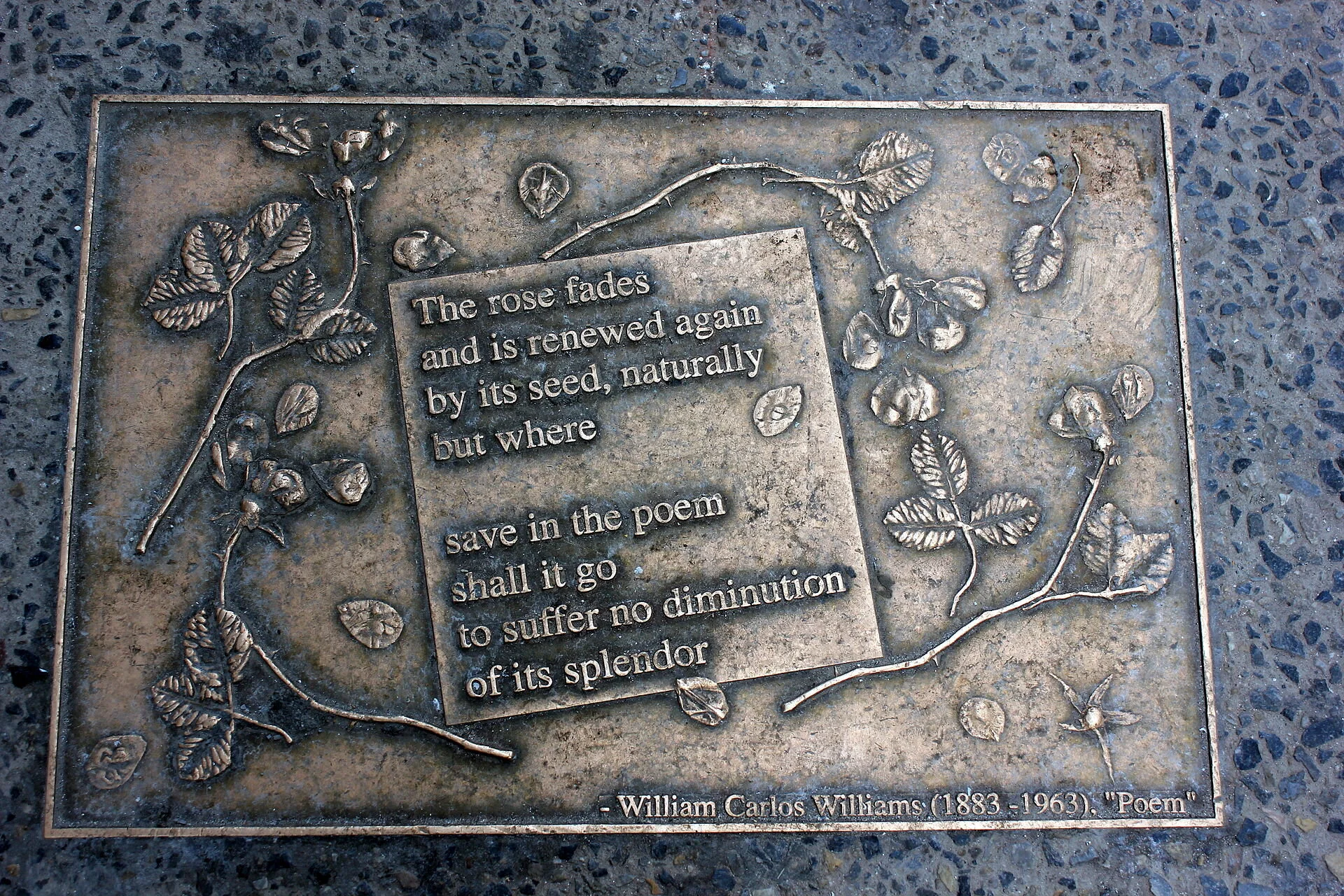
“January,’’ by William Carlos Williams, M.D. (1883-1963), American poet, essayist and physician
Quarantine explosion
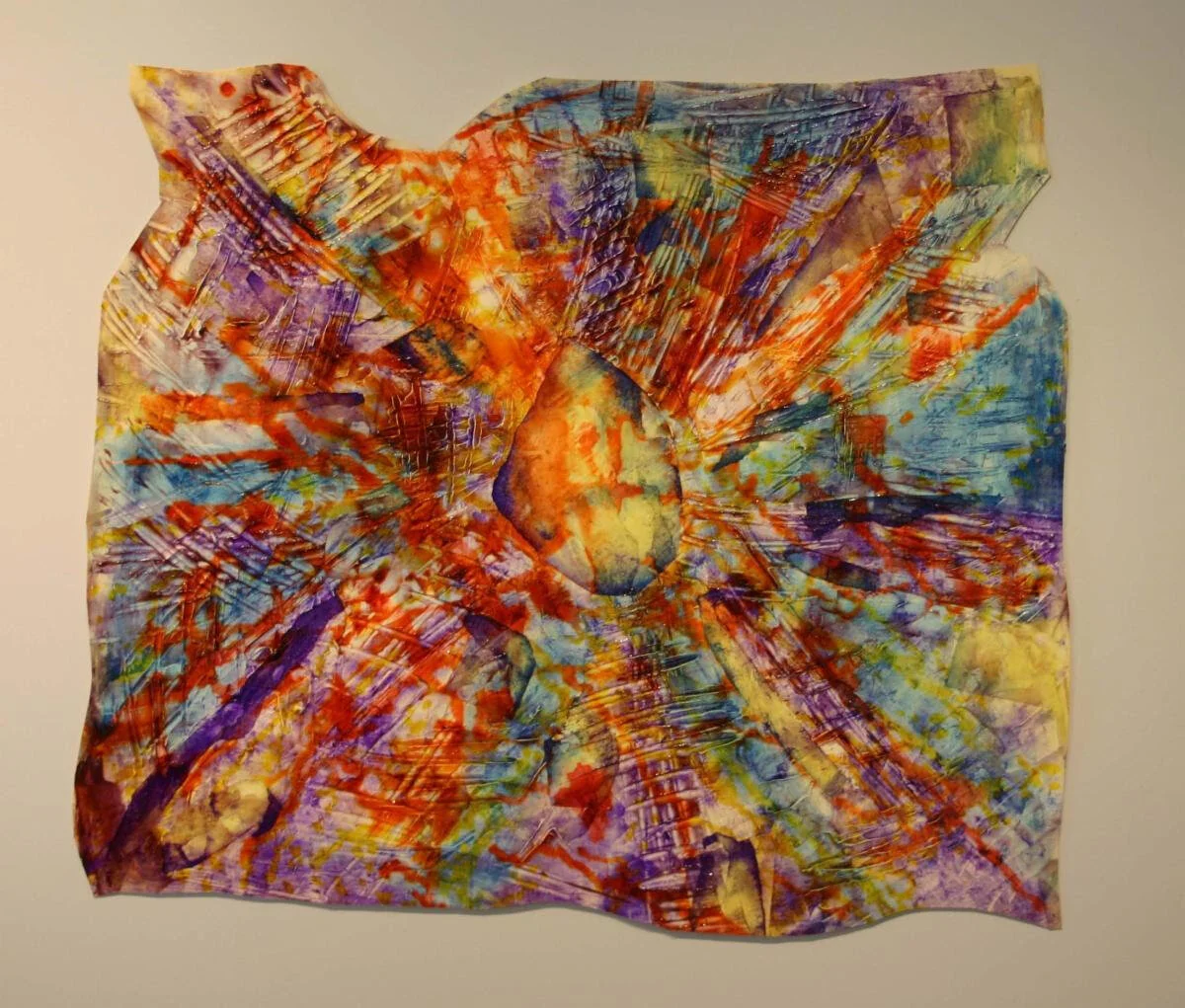
“Sunburst Energy (Force of Energy Series)’’ (mixed media), by Jeannine Hunter Lazzaro in her show “Colors, Shapes and Thoughts on Paper,’’ at Galatea Fine Art, Boston, Feb. 5-28. She lives in North Attleboro, Mass.
She says:
"This show contains works on paper done during the quarantine and focusing on – colors, shapes, energy, and time. After working on canvas for a while, I began to create work on paper. I have often vacillated among a variety of surfaces in my work. The truth here though is that I ran out of canvas during this quarantine. The way that various materials I use, react on paper is entirely different than they do on canvas.
“Long ago, in trying to characterize my work in a very brief description, I found myself say-the lines belong to everyone, but the colors are all mine. In some ways my work has its own spirit. What I mean is that the paintings get done with my intervention and manipulation, which is derived from the experiences I have had. Colors mix or simply bump into one another creating a drama all their own.
“I would say the same thing about the shapes that arise in my work. I employ several methods to allow them to create themselves and I embellish or diminish where I feel I need to. I like to say that I have come to know life through my art. Time, for instance is a construct. We often think about time as a concrete thing, a dimension. However, like a shape in one of my paintings it is just there because we say it is. I have heard it said -there is no such thing as time, only words.
“Energy can be good or bad. But what if we think of it as only good? The idea that something good happens out of everything compels me to feel positive at times when it may be hard to maintain a positive outlook. The recent Covid19 quarantine for instance, forced people inside to find ways to cope and be with each other. This was happening at a time when a lot of people were existing in an ‘outside’ media-related existence. We are also learning how important the sense of touch is.’’
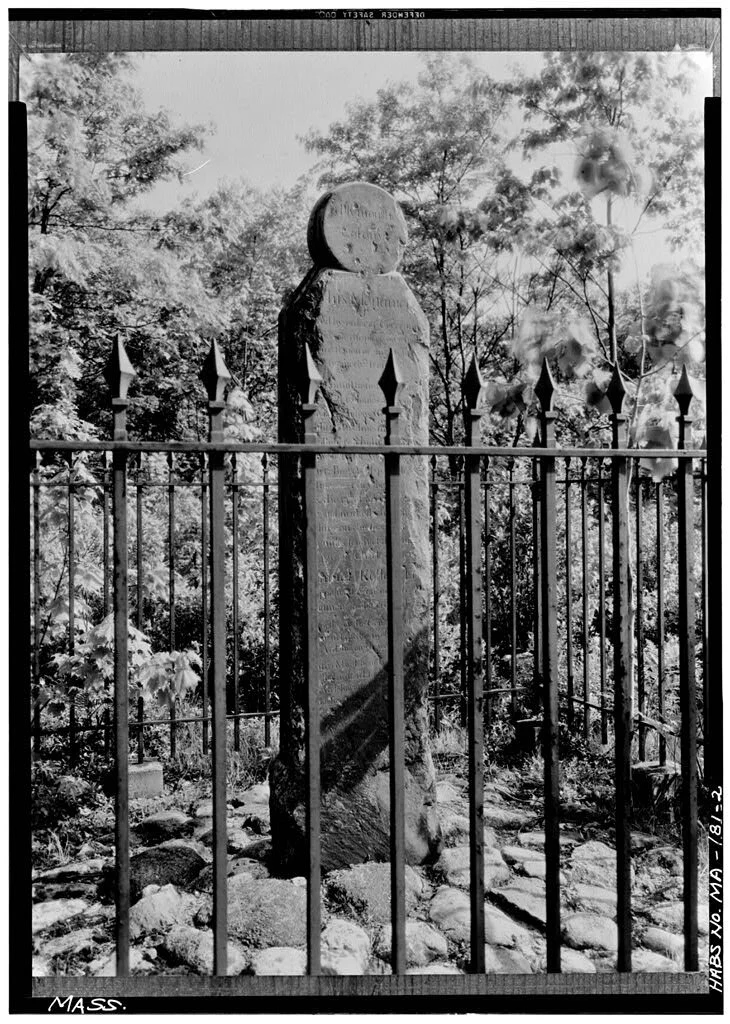
This is the weird Angle Tree Stone, an historic boundary marker astride the border of North Attleboro and Plainville, Mass.
The slate marker was built in 1790 by a father-and-son team of gravestone makers. The stone was added to the National Historic Register in 1976. The stone replaced the "Angle Tree" from the 17th Century, which was a surveying landmark for the boundary between Bristol and Norfolk counties. The county border is a straight east-west line coming from Cumberland, R.I., to the site of the tree (now the stone) and then turning at an angle (hence the "angle tree" designation) and running in a straight line from there almost to Massachusetts Bay near Cohasset.

The unexpectedly modern North Attleboro Town Hall

Chris Powell: Military-industrial complex is fine with Conn. delegation

This building in the affluent Hartford suburb of Farmington, Conn., was United Technologies’ headquarters in 2015-2020.
— Photo by Daniel Pennfield
MANCHESTER, Conn
In his farewell address 60 years ago President Dwight D. Eisenhower warned against what he called "unwarranted influence, whether sought or unsought, by the military-industrial complex." Since he was a military hero, perhaps only Eisenhower could give such a warning during the Cold War without risking denunciation as a Communist.
But Eisenhower's warning has never been heeded, and President Biden, with his defense secretary, is essentially proclaiming the victory of the military-industrial complex. The new secretary is retired Army Gen. Lloyd Austin, who upon leaving the Army a few years ago joined the board of directors of military contractor and Waltham, Mass.-based Raytheon Technologies Corp., which recently acquired Connecticut-based United Technologies Corp. Austin will have to sell Raytheon stock he received for serving on the board. It may net him as much as $1.7 million.
Acknowledging what will be his continuing potential for conflict of interest, Austin pledges to avoid decisions involving Raytheon for a year. But this can't worry Raytheon much about its investment in the general, since the corporation plans to be doing government business a lot longer than that.
With Austin at Defense and former Federal Reserve Chair Janet Yellen becoming Treasury secretary after receiving at least $7 million in speaking fees from big banks and investment houses in the last three years, the federal government's two most lucrative agencies will have been securely captured by their primary beneficiaries.
With the exception of Sen. Richard Blumenthal, the members of Connecticut's congressional delegation -- all supposed liberals -- are fine with this exploitation. After all, the state is full of investment bankers and military contractors and what's good for them may be considered good for the state. As for the country, that's something else.
Even Blumenthal's concern about Austin probably became a mere quibble. Federal law prohibits military officers from becoming defense secretary until they have been out of uniform for seven years, so Austin needed a waiver from Congress. Such waivers have been granted twice before. Blumenthal said that to uphold the principle of civilian control of the military, he opposed another waiver. But few other members of Congress objected to it, and Blumenthal and those others still had it both ways, voting against the waiver and then voting to appoint Austin once the waiver is granted.
Besides, with the Democrats in full control of the federal government, conflicts of interest and civilian control will barely register against the party's new highest objective in Cabinet appointments -- racial, ethnic and gender diversity. Austin is Black and so meets the decisive qualification.
xxx
PAY AS YOU THROW?: The administration of Connecticut Gov. Ned Lamont seems to have determined that state government no longer can make any money by burning trash to generate electricity at the state Materials Innovation and Recycling Authority's facility in the South Meadows section of Hartford. Such generation apparently is now much more expensive than electricity generated from natural gas, and the facility's equipment already needs renovation estimated to cost more than $300 million.
So the authority plans to close the facility by July 2022, turning it into a trash-transfer depot and shipping to out-of-state dumps the trash now being burned. This is not only retrograde environmental policy; it likely will raise costs for the authority's 70 client towns. As a result the authority and the towns are discussing how to reduce their "waste streams" -- possibly by charging residents a fee for every bag of trash collected, a system called "pay as you throw."
There would be some sense to this, since it would cause people to take more responsibility for their trash, the packaging of what they buy, and recycling. But this also would increase the risk of illegal dumping, even as Connecticut's roadsides and city streets are already strewn with trash.
It might be best for state or federal sales taxes or fees to recover in advance the disposal costs of everything sure to wear out, as the state already does with beverage containers and mattresses and used to do with tires.
Government needs to teach people more about the trash issue. But all that roadside litter suggests that many people are unteachable slobs.
Chris Powell is a columnist for the Journal Inquirer, in Manchester, Conn.
‘Compulsory cannibalism’ needed

Abbie Hoffman in 1989
“I believe in compulsory cannibalism. If people were forced to eat what they killed, there would be no more wars.’’
— Abbot Howard Hoffman, better known as Abbie Hoffman, a famous/infamous American political and social activist/agitator who co-founded the Youth International Party ("Yippies") and was a member of the Chicago Seven. He was also a leading proponent of the Flower Power movement. You could also call him transitional figure between the Beat Generation and the Hippies.
He grew up in Worcester, where as a student, he was a troublemaker who started fights, played pranks, vandalized school property and called teachers by their first names. In his second year, Hoffman was expelled from Classical High School, a now-closed public high school in Worcester where, as an atheist, he wrote a paper declaring that, "God could not possibly exist, for if he did, there wouldn't be any suffering in the world." The teacher ripped up the paper and called him "a Communist punk." Hoffman then assaulted the teacher until he was restrained and then was thrown out of the school. On June 3, 1954, 17-year-old Hoffman was arrested, for the first of many times, in this case for for driving without a license. After his expulsion from the public high school, he attended Worcester Academy (the alma mater of, of all people, Cole Porter). He graduated in 1955, and then went on to Brandeis University, In Waltham, Mass.
He died of an apparently accidental drug overdose, leaving an FBI file on him totaling 13,262 pages
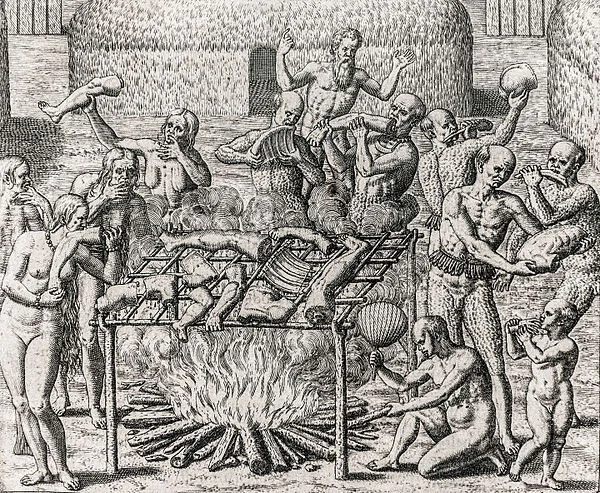
Cannibalism in Brazil engraving by Theodor de Bry to illustrate Hans Staden's account of his captivity in 1557
Todd McLeish: A proposal for 'freedom lawns'


From ecoRI News (ecori.org)
Few people put much thought into the soil beneath their feet, but Loren Byrne does. A professor at Roger Williams University, in Bristol, R.I., Byrne is an expert on urban soil ecology, and he worries that humans are changing the structural integrity of soils in urban environments and limiting the ability of plants and animals to live in and nourish the earth.
“Soil is easily overlooked and taken for granted because it’s everywhere,” he said. “We walk all over it and think of it as dirt that we can manipulate at our will. But the secret of soil is what’s happening with soil organisms and what’s happening with their interactions below ground that help regulate our earth’s ecosystems.”
Byrne contributed a chapter about urban soils to a report, State of Knowledge of Soil Biodiversity, issued last year by the U.N.’s Food and Agriculture Organization. He discussed how the ecology of the soil changes as it is compacted during construction, paved over, chemically treated for lawns, and dug up and carried away.
“The main takeaway is that urbanization can potentially harm biodiversity, but our biggest current threat is ignorance,” he said. “We don’t understand enough about soil biodiversity in urban environments, so we may not be able to manage it in ways to provide the benefits that are possible.”
Soil is the foundation for terrestrial life, according to Byrne. It’s the medium in which plants are grown and it regulates the nitrogen cycle, sequesters carbon, and manages the flow of water. He said soils are fascinating because they contain the full range of life, from single-celled bacteria and fungi to animals of all varieties.
“If you’re patient enough to get down on your hands and knees and pull up some soil, you’ll see mites, springtails, isopods, millipedes, centipedes, spiders, ants, beetles,” Byrne said. “Some of them have negative popular connotations, but ecologically, if we can see them as having value, then that will help us maintain more sustainable landscapes.
“Changing our perspectives of what these organisms are doing in the ecosystem is important. They perform beneficial functions, like decomposition. I tell my students that if it wasn’t for this whole suite of biodiversity in our soils, we’d literally be up to our necks in dead stuff.”
Although it may seem counterintuitive, Byrne said urban soils contain the full range of biodiversity that is found in natural soils, and some research shows that they contain more organisms and a greater diversity than agricultural soils.
“A lot of urban habitat types, like lawns and little forest patches, are perennial, so they don’t face the same level of annual disturbance as agricultural fields,” he said. “And they have more organic matter in them, so that allows the food web to become more complex. Urban soils are home to a lot of organisms.”
He noted, however, that there is also a massive volume of degraded soil in urban areas that is compacted, trampled, over-fertilized, and removed and replaced with lower quality soil.
“It’s a very interesting dichotomy,” Byrne said. “There are some high-quality soils and other locations that have been severely negatively impacted where we would want to somehow improve them.”
How to improve degraded soils is the topic of Byrne’s latest research. Decompacting the soil and remediating pollution are important steps, but the key is the addition of organic matter.
“There’s been a wide diversity of organic matter sources that have been investigated, from basic garden compost to sewage sludge to bio-char, which is a burned organic matter that, when added to soil, provides good surfaces for microbes to live on,” he said. “But you have to be very careful about what you’re using and in what contexts and the source, because not all organic matter is the same.
“A lot of research has shown that adding organic matter will help remediate the soils in various ways. Organic matter holds onto water, so it helps with water issues, for instance. But in locations that are already prone to water-logging, adding organic matter could be a bad thing. So context matters. You need to be familiar with site specific issues to come up with a good management plan.”
Byrne focuses a great deal of his research attention on lawns, which he calls a “human-created ecosystem.” While he noted that a lawn provides a nice place for a picnic and is better than pavement, he said installing a lawn is the least biodiverse way of improving urban landscapes.
“The goal with a lawn is often one grass species that’s bright green and isn’t growing or reproducing, which is the exact opposite of what life wants to do,” he said. “In the grand scheme of all life, a place becomes more diverse over time, it grows and reproduces, and humans are trying to stop all of that in a lawn.
“The problem isn’t so much the lawn itself as the monoculture, pesticide-managed lawn. A lot of what ecologists advocate is a more biodiverse lawn where we let the so-called weeds grow and let the grass grow a little taller. That’s good for the soil ecosystem because a higher variety of plants and no chemical pesticides will allow more soil organisms to thrive.”
To create a more sustainable urban landscape, Byrne advocates for what some have called “freedom lawns” — a mowed lawn that maintains a high diversity of grasses and weeds and good soils.
“If we can convince people that it’s more patriotic to shift to freedom lawns, it will be more sustainable,” he said. “And if we can shrink the area of lawn by creating more biodiverse habitat through shrubs and wildflowers, that’s another step toward sustainability and biodiversity.”
Rhode Island resident and author Todd McLeish runs a wildlife blog.

While awaiting the seed catalogs

“Garden Tulips Northumberland Strait” (archival pigment print), by Cambridge-based Vaughn Sills, in her show “Inside Outside,’’ at the Kingston Gallery, Boston, through Feb. 28
The gallery says the show “is a series of evocative still lifes of flowers juxtaposed with land and seascapes, meditations on grieving and loss. Sills’s studio process includes pairing a chosen set of flowers with one of her landscape prints from another ongoing series about grieving for her mother. ‘Inside Outside’ considers the highly cultivated world of flowers in contrast with the natural, untamed world surrounding us. Domesticity is represented by the garden-grown flowers in vases, alluding to women’s creative work, while the natural world is represented by images of the sea and land, often shown with a foreboding sky. Thus, the work refers to the ephemeral nature of life; cut flowers are short-lived, and their beauty reminds us of life precariously balanced on the verge of death. Sadness, love, memory and grief for Sills’s mother are given form in images of the sea and misty fields, amplified now in combination with the flowers.
Don’t laugh at Rhode Island

Exchange Place, ca. 1890. City Hall at center; to its right is the First Union Station, where Burnside park currently exists. The area is now called Kennedy Plaza.
“I know not whether anyone, even in New York, is so hardy as to laugh at Rhode Island, where the spirit of Roger Williams still abides in the very dogs….The small commonwealth, with its stronger and fuller flow of life, is more native, more typical, and therefore richer in real instructions, than the large state can ever be.’’
—E.A. Freeman, in Some Impressions of the United States (1883)

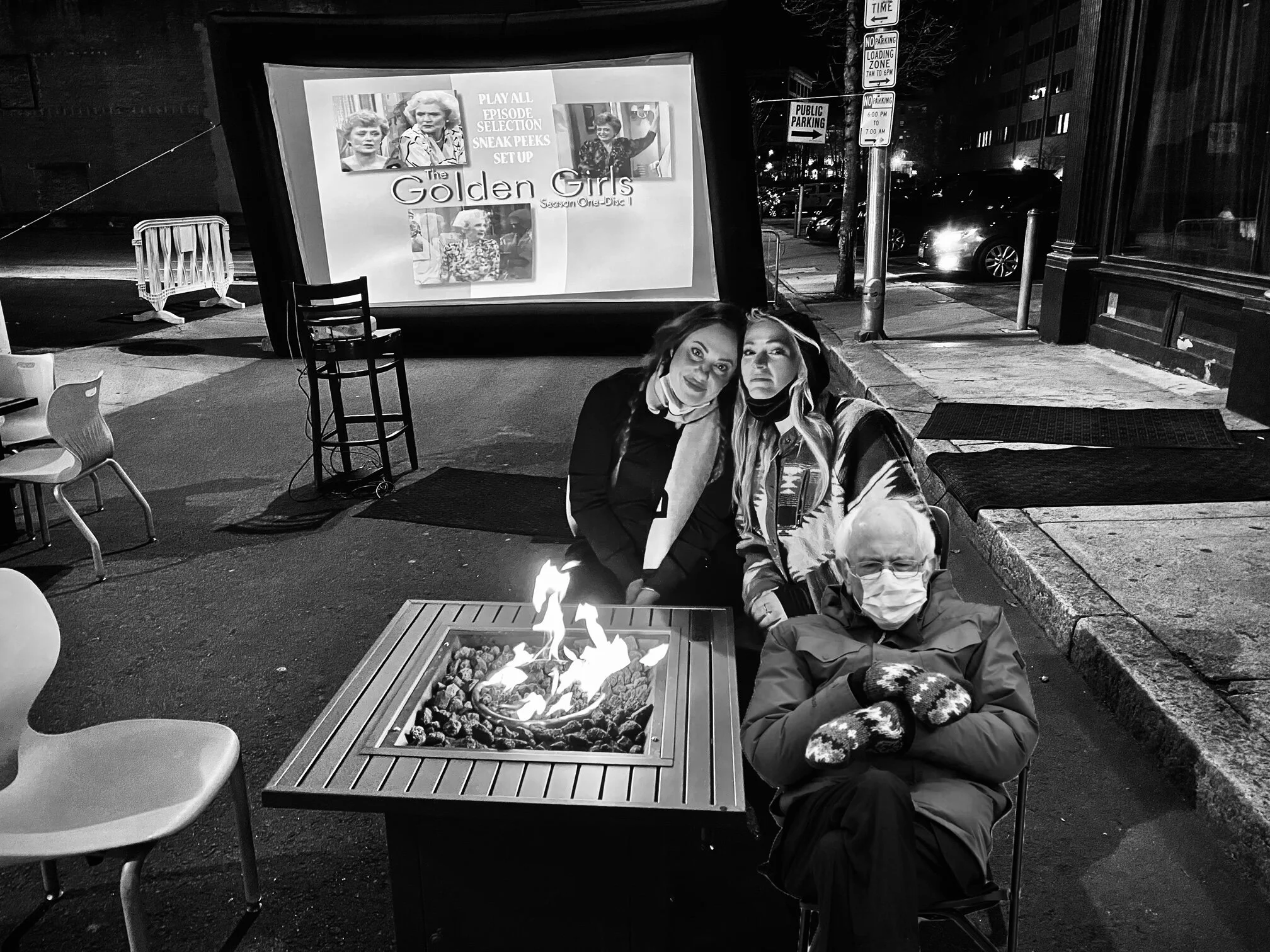
Mitten mania
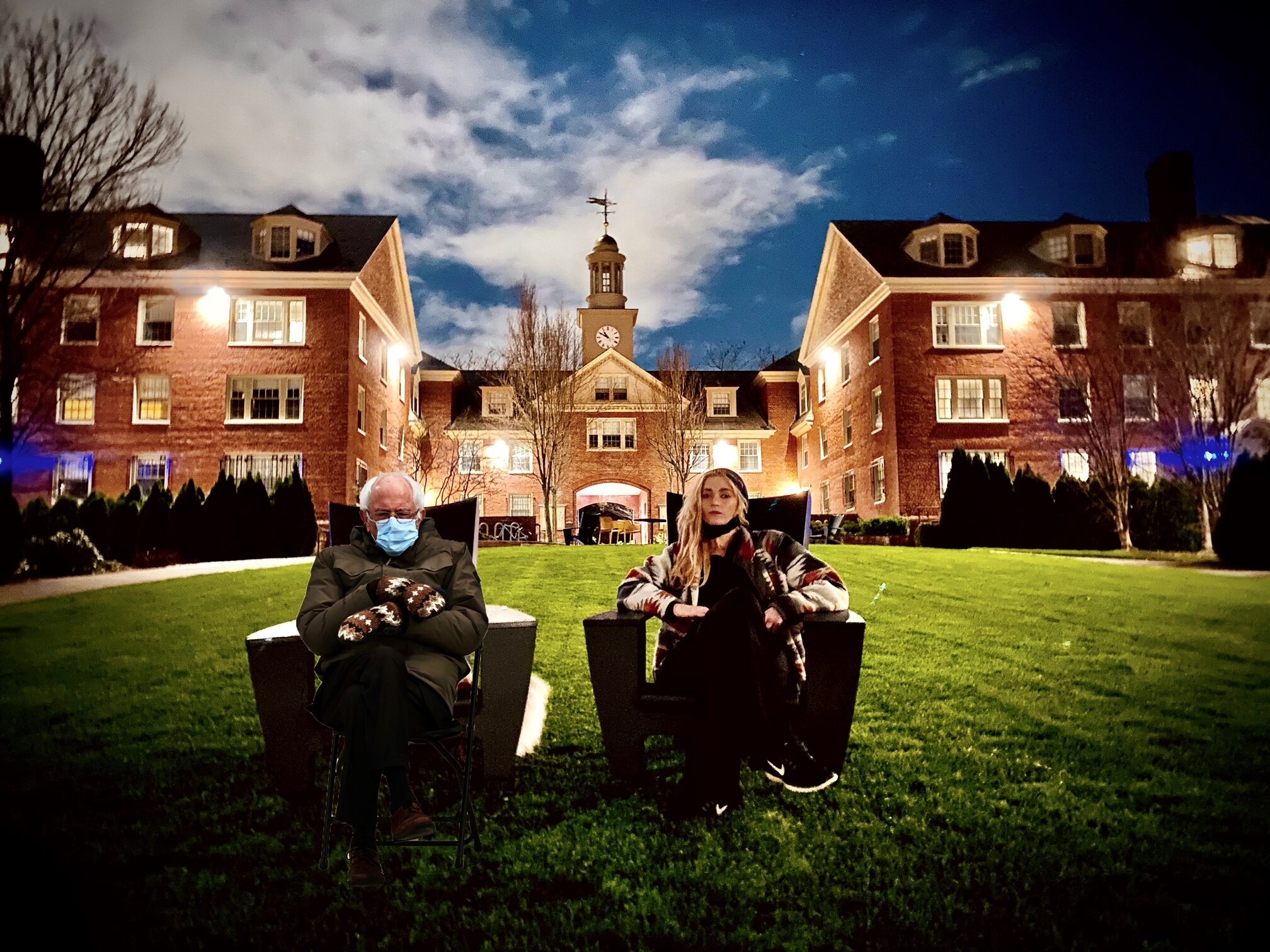
The Bernie mitten meme craze will not last much longer but savor its varieties while you can.
— (Manipulated) photos by Fiona Gerety
Absence makes the heart grow fonder

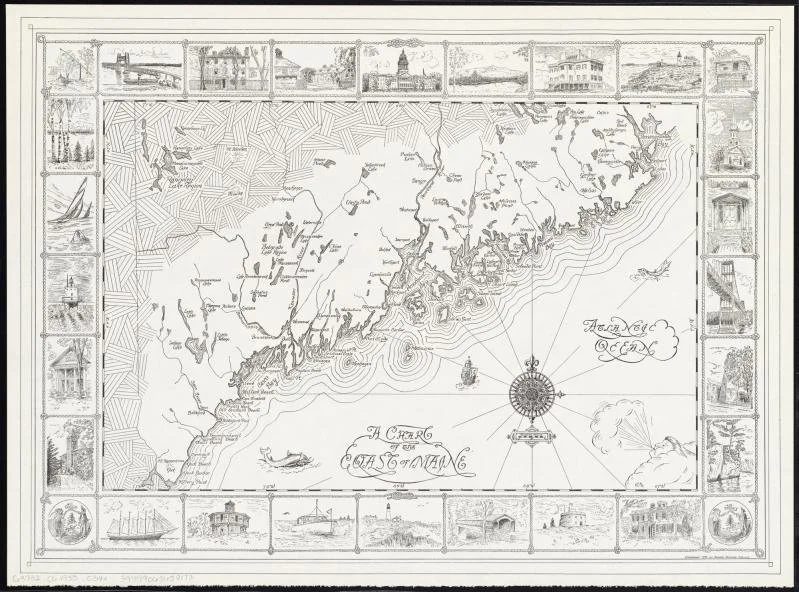
The downtown of Bath, on the Maine Coast and home of the big Bath Irons Works shipyard.
“All I know is that history repeats itself and people are going to want to experience the world. But I know then they are going to have a better appreciation for what is here in Maine.’’
— John Baldacci (born 1955), governor of the Pine Tree State in 2003-2011

Richard Pattenaude: How colleges can make the most of COVID-19 relief

From The New England Journal of Higher Education, a service of The New England Board of Higher Education (nebhe.org)
BOSTON
In the final days of 2020, Congress gave the country a long-overdue Christmas present with the passage of a new COVID-19 relief bill. Known as the Coronavirus Response and Relief Supplemental Appropriations Act (CRRSAA), the bill is a whopping 5,500 pages long. But for higher education institutions, the real action starts on Page 1872 with the Higher Education Emergency Relief Fund (known as HEERF II).
How should institutions use this funding? Providing immediate financial support to students is critical, of course—but so is strengthening the institution they attend. Beyond simply replacing lost tuition or room and board funds, some institutions are exploring creative ways to use the funds in ways that increase the effectiveness of their online programs—and provide better support for students in the process.
Included in the CRRSAA is $82 billion for schools, just over one-quarter of which ($22.7 billion) is earmarked for higher education through HEERF II. That represents a 50 percent increase over the amount allocated to higher ed by the original CARES Act last spring. As with the last relief bill, the vast majority of this money ($20.2 billion) will be distributed directly to public and nonprofit institutions, using a complex formula that takes into account factors like student headcount, full-time enrollment and Pell eligibility. In this new bill, institutions will actually be receiving more money than they did in the first stimulus—but they are required to spend the same amount of money on student aid as they spent last time. That translates to a far greater percentage of funds available for other institutional priorities.
With that in mind, once institutions have received their latest relief, what can they do with it? Here’s a rundown of the actual requirements of the bill, as well as some perhaps surprising examples of how institutions have put their relief funding to effective use.
This time around, it appears that there’s more flexibility in the way that institutions can spend these dollars. Specifically, the bill states that institutions may use the funds to:
1) defray expenses associated with coronavirus (including lost revenue, reimbursement for expenses already incurred, technology costs associated with a transition to distance education, faculty and staff trainings, and payroll);
2) carry out student support activities authorized by the HEA that address needs related to coronavirus (for example, institutions have used these funds to purchase laptops for low-income students, provide hot spot or internet service funds, cover costs for computer set up and reimburse PPE expenditures for nursing students); or
3) provide financial-aid grants to students (including students exclusively enrolled in distance education), which may be used for any component of the student’s cost of attendance or for emergency costs that arise due to coronavirus, such as tuition, food, housing, healthcare (including mental-health care) or child care. In making financial aid grants to students, an institution of higher education shall prioritize grants to students with exceptional need, such as students who receive Pell Grants.
In the wake of the bill’s passage, the U.S. Education Department has also released initial guidance outlining how to apply for the funds and how they can be used. In short, this round of financial support provides even more flexibility than the CARES Act did—allowing for not only costs related to the delivery of instruction, but also defraying expenses associated with coronavirus, carrying out student support activities, and making additional financial aid grants to students. What can institutions’ experience with the CARES Act teach us about how best to use these new funds?
Some uses of stimulus funding are, of course, intuitive: providing the immediate support that students, faculty and staff need to keep the lights on and keep learning going. But now with more flexibility, it’s critical for institutions to think creatively and consider how their stimulus dollars can support new approaches to teaching and learning—many of which may last even after COVID-19 someday subsides. In HEERF II as in the previous round of funding, the Education Department allows spending on a broad range of technology tools, stipulating that institutions could “purchase equipment or software, pay for online licensing fees, or pay for internet service to enable students to transition to distance learning.”
Among examples of how institutions put that into practice … When the pandemic forced its library to quarantine textbooks for three days before lending them back out, Santa Fe Community College, in New Mexico, tapped a digital content provider, BibliU, to help expand access to course materials.
Grossmont College, a community college in California, partnered with the video platform GoReact to ensure that their students are still able to demonstrate their skills in a remote setting.
Michigan State University tapped CARES Act funding to partner with Packback, bringing inquiry-based discussion to more classes, even in the age of remote learning.
Institutions that explore these more creative uses of stimulus funding have seen powerful results—not just providing the emergency relief students need, but also building the architecture to ensure a more effective remote learning experience. And with the timeline still uncertain for a return to normalcy, that approach will help colleges and universities set themselves up for success in a tumultuous and ever-changing time for higher education.
What does your institution need to build a more resilient infrastructure for online learning, and how can this new funding help?
Richard Pattenaude is chancellor emeritus at the University of Maine System. Packback is a NEBHE sponsor.
Is Watch Hill in Rhode Island?

Watch Hill Harbor
A colleague in a business ZOOM meeting I was in last Friday suggested that Rhode Island Gov. and former venture capitalist Gina Raimondo will not return to Rhode Island after she serves as Joe Biden’s commerce secretary. — that she’ll join the swells and move to some fancy out-of-state place.
No, I suggested, only half-jokingly, she’ll move to hyper-rich Watch Hill. Then another colleague quipped: “Is that in Rhode Island?” I had had a sleepless night and so too quickly and stupidly answered what everyone in the meeting well knew: “Watch Hill is in Rhode Island; it’s part of Westerly.’’
But in a psycho-sociological way, it’s not in Rhode Island. Like some other fancy places in New England — say Nantucket, Mass., and Northeast Harbor, Maine, it transcends its state; above all, it’s part of the Federated Principalities of the Plutocracy.
— Robert Whitcomb
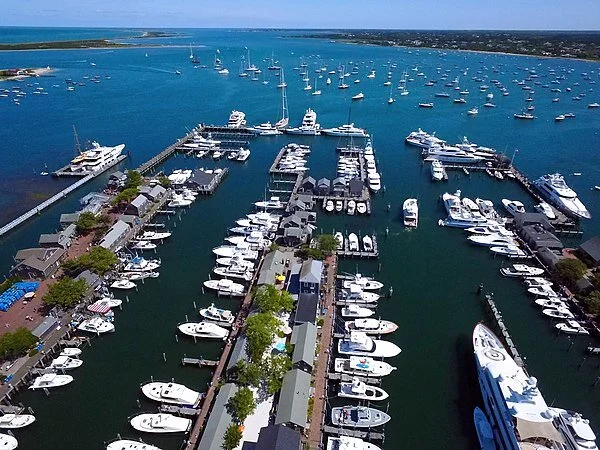
Yachts in Nantucket
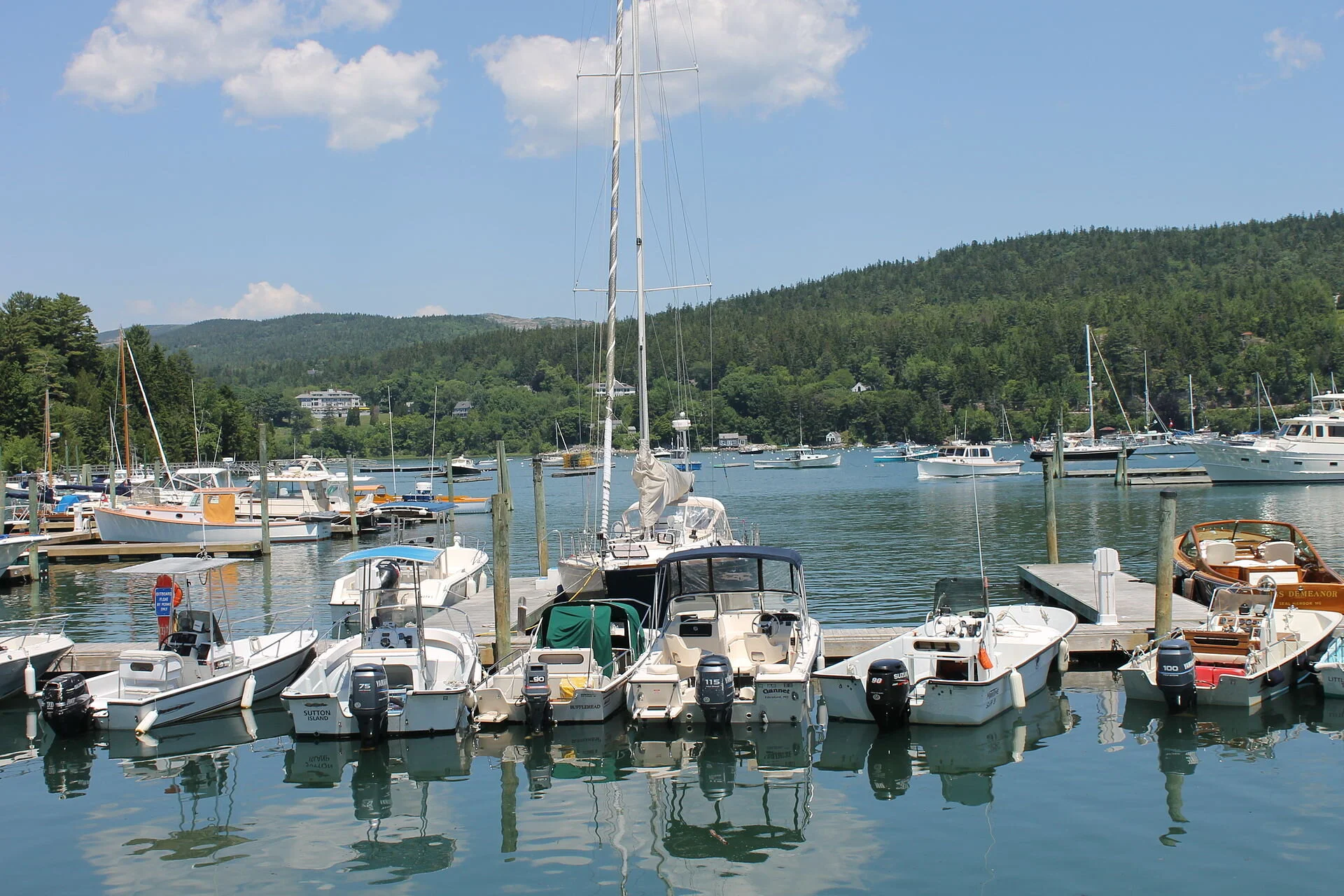
In Northeast Harbor. See mansions on the hillside.
— Photo by Billy Hathorn

‘Upon a winter’s morn’

Packed in my mind lie all the clothes
Which outward nature wears,
And in its fashion's hourly change
It all things else repairs.
In vain I look for change abroad,
And can no difference find,
Till some new ray of peace uncalled
Illumes my inmost mind.
What is it gilds the trees and clouds,
And paints the heavens so gay,
But yonder fast-abiding light
With its unchanging ray?
Lo, when the sun streams through the wood,
Upon a winter's morn,
Where'er his silent beams intrude
The murky night is gone.
How could the patient pine have known
The morning breeze would come,
Or humble flowers anticipate
The insect's noonday hum,—
Till the new light with morning cheer
From far streamed through the aisles,
And nimbly told the forest trees
For many stretching miles?
I've heard within my inmost soul
Such cheerful morning news,
In the horizon of my mind
Have seen such orient hues,
As in the twilight of the dawn,
When the first birds awake,
Are heard within some silent wood,
Where they the small twigs break,
Or in the eastern skies are seen,
Before the sun appears,
The harbingers of summer heats
Which from afar he bears.
“The Inward Morning,’’ by Henry David Thoreau (1817-1862), of Concord, Mass.

Replica of Thoreau’s cabin at Walden Pond, with statue of the writer

Memories in watercolors

Detail from “Vida Vieja” (watercolor), in her show until Feb. 7 at the Hess Gallery of Pine Manor College, in Chestnut Hill, Mass.
This multimedia exhibit displays the artist's watercolor paintings in a video slideshow along with a voice-over from Correá. “Vida Vieja” is Spanish for "old life.’’ So her paintings depict her childhood in Colombia. Each painting is associated with a memory, which she discusses in her video slideshow. She describes going to church, grinding corn, playing outside and other nostalgic experiences. She admits, however, that her memory isn't perfect, represented by the use of watercolor. She explains, "Memory is not 100 percent accurate; with watercolor, I can portray my memories in an abstracted reality."