
Vox clamantis in deserto







Our wondrously wasteful American health-care ‘system’

On the bathetic Bald Hill Road in Warwick, R.I.
From Robert Whitcomb’s “Digital Diary,’’ in GoLocal24.com
A medical appointment forced me to drive to the hideous Bald Hill Road in Warwick the other day. I try to avoid large parts of Warwick because its sprawl reminds me of Los Angeles or Route 1 in New Jersey. That, in turn, reminds me of former Public’s Radio and Providence Journal journalist Scott MacKay’s quip that “Florida is Bald Hill Road with palmettos.’’
I’ve had a lot of medical appointments lately (sorry, FB Trumpsters at the bottom of this column, nothing lethal yet) and noticed yet again the extreme inefficiencies in American health care. For example, one has to fill out form after form after form asking the identical information that was asked before by the same organization. The information integration and record keeping are abysmal. This, of course, raises the cost and crashes the efficiency.
The American health-care system is by far the costliest and least efficient in the Developed World. You’d think that the land that brought the world hyper-computerization could do better!

America tied up with red tape
— Photo by Jarek Tuszyński
In the shadow of....

“No Bed of Feathers” (polyester fabrics and feathers), by Warwick,R.I.-based Saberah Malik, in the group show “Lights in the Tunnel: Creating Art in the Shadow of COVID-19,’’ at the Newport Art Museum through Feb. 7.
Senior curator Francine Weiss says. "In the era of COVID-19, we can’t predict—or see—the proverbial 'light at the end of the tunnel,' but we do have glimmers of light inside it. ‘‘

Llewellyn King: It was a nice inauguration but is Biden wading in too far, too fast?


At the American College of the Building Arts, in Charleston, S.C. It would be good if President Biden addresses income inequality by touting the benefits of education in the trades as opposed to, say, getting degrees in sociology. The trades offer more secure and higher-paying jobs than do the liberal arts.
The college's model is unique in the United States, with its focus on total integration of a liberal arts and science education and the traditional building arts skills. Students choose from among six craft specializations: timber framing, architectural carpentry, plaster, classical architecture, blacksmithing and stone carving.
ACBA's mission is to educate and train artisans in the traditional building arts to foster high craftsmanship and encourage the preservation, enrichment and understanding of the world's architectural heritage through a liberal arts and science education.
WEST WARWICK, R.I.
It was a good day. Warm in its content. Soft in its delivery. Kindly in its message. Generous in its intentions. Healing in its purpose.
Trying to implement the soaring hopes of President Joe Biden’s inauguration began immediately. Maybe too immediately, too fast, and with actions that were too sweeping. Biden signed 17 executive orders that suggested an underlying philosophy of “bring it on.”
Biden doesn’t need to open hostilities on all possible fronts at once. He needs to pick his wars and shun some battles. I have a feeling that 17 battles are too many to initiate simultaneously and, possibly, some are going to be lost at a cost.
In his inaugural address, Biden did well in laying out six theaters where his administration will prosecute its wars. But some of those wars will go on for decades – maybe forever.
Big ships take a long time to turn around no matter how many tugboats are engaged. Actions have consequences and so do intentions.
The Biden wars:
The pandemic: This is the war that Biden must win. It is the one into which he needs to pour all his efforts, his own time and talent, and to focus the national mind.
Americans are dying at a horrendous pace. He has promised 100 million vaccine doses in the first 100 days. If that effort falters, for whatever reason, it will stain the Biden presidency. It is job one and transcends everything else.
The environment: It will remain a work in progress. Rejoining the Paris Agreement on Climate Change is a diplomatic and political move, not an environmental one. It will help with the Biden goal of better international standing. It will make many in the environmental movement feel better, but it won’t pull carbon out of the air.
There have been dramatic reductions in the amount of carbon the United States puts into the air since 2005. Biden is in danger of picking up too much of the environmentalists’ old narrative.
The environmental movement can get it very wrong and maybe has again in pushing the world too fast toward wind and solar. These aren’t perfect solutions.
The amount of carbon put into the air by electric generation in the United States is partly due to the hostility toward new dams and particularly toward nuclear power. These were features of the environmental narrative in the 1970s and 1980s.
Simple solutions seldom resolve complex problems. I have a feeling that we are going breakneck with solar and wind; making windmills and solar panels is environmentally challenging, as will be disposing of them after their useful life is over.
Canceling the Keystone XL Pipeline -- after nearly two decades of litigation, diplomatic and environmental review in Canada and the United States -- would seem to be a concession to a constituency rather than sound policy with virtuous effect.
Biden has identified three other theaters where he plans to wage war: growing income inequality, racism, and the attack on truth and democracy.
Income inequality is escalating because new technologies are concentrating wealth, workers have lost their union voice, and our broken schools are turning out broken people, who will start at the bottom and stay there. Racial inequality ditto. Many inner-city schools are that in name more than function.
If there was one big omission from Biden’s agenda of things he is prepared to go to war for, it was education. Most of the social inequalities he listed have an educational aspect. Primary and secondary schools are not turning out students ready for the world of work. Too many universities are social-promoting students who should have been held back in high school.
More are going to college when they should get a practical education in a marketable skill. People with such skills as carpentry, stone cutting, plastering, electrical and iron work are more likely to start their own businesses than those with, say, journalism or sociology degrees.
Biden’s continuing challenge is going to be how to handle the left wing of his party, stirred up by the followers of Vermont Sen. Bernie Sanders and New York Rep. Alexandria Ocasio-Cortez. They haven’t gone away and are expecting their spoils from the election.
The president’s battle for truth is going to be how we accommodate the new carrier technologies of social media with the need for veracity; how to identify lies without giving into universal censorship. That battle can’t be won until the new dynamics of a technological society are understood.
Go slow and carry a big purpose.
Llewellyn King is executive producer and host of White House Chronicle, on PBS. His email is llewellynking1@gmail.com and he’s based in Rhode Island and Washington, D.C.
How January is a winner

“Later on the way to the town where
We worked while the heater
Wheezed fitfully and the windshield
Showed indifference to the defroster
He'd turn to me and say that
The two best things in this world
Were hot coffee and winter sunrises.’’
— From “January,’’ by Baron Wormser (born 1948), a former poet laureate of Maine

Unfair advantage
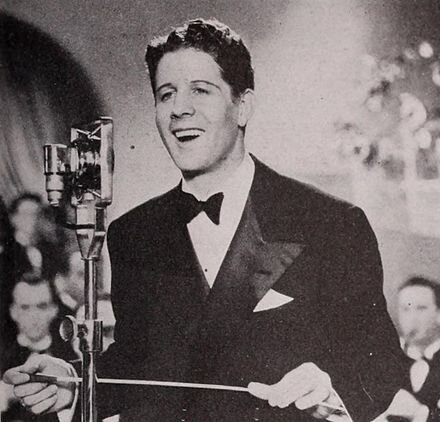
Vallée as bandleader Skip Houston the movie Sweet Music
“That’s one of the tragedies of this life — that the men who are most in need of a beating up are always enormous.’’
— Hubert Prior Vallée (July 28, 1901 – July 3, 1986), known professionally as Rudy Vallée, was an American singer, musician, movie actor and radio host. He was one of the first modern pop stars of the teen idol type, but was known to be in private a nasty, egomaniacal man, with a violent temper.
He was born in Island Pond, Vt., near the Canadian border, the son of Catherine Lynch and Charles Alphonse Vallée. His maternal grandparents were Irish, while his paternal grandparents were French-Canadians from Quebec. He grew up in Westbrook, Maine.
After graduating from Yale, he formed Rudy Vallée and the Connecticut Yankees, having partly named himself after saxophonist Rudy Wiedoeft.
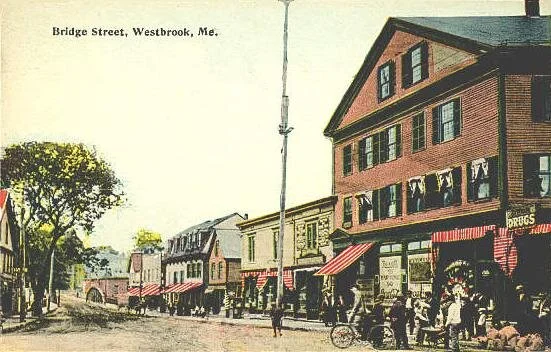
Bridge Street in downtown Westbrook, Maine, in 1912, when Vallee was living in the town as a boy.

Island Pond, Maine, where Vallee was born. (The) Island (in the) Pond from which the village takes its name
Marsh magic

“Behind Little Pamet (Truro)” (Outer Cape Cod), (oil on panel), by Cammie Watson, at Alpers Fine Art, Andover, Mass. The Little Pamet River is a 1.5-mile-long stream that river arises in wetlands, flows west for about a mile, and drains into Cape Cod Bay. The nearby Pamet River lies a few miles to the south. It’s named for a Native American tribe.
Basav Sen: Fossil-fueled fascism

Via OtherWords.org
The year 2020 will be remembered in history for a deadly pandemic and a deep economic crisis that touched almost every country. . Hopes for a brighter 2021 were one of the few things most people could agree on.
But just six days into the new year, these hopes were rudely shattered by images of far-right white supremacists, incited by an aspiring autocrat refusing to admit his electoral defeat, storming the Capitol in an attempt to overthrow the election.
This fascist putsch was implicitly supported by some elected leaders, including GOP members of Congress who continued to promote the thoroughly debunked falsehood that the 2020 elections were “stolen.” Worse still, there are early indications that some elected officials may have aided the violent mob more directly as well.
But this attempted coup wouldn’t have progressed to this point without large amounts of funding, too. And playing a disproportionately large role among business backers of fascism are fossil fuel companies and their owners and top executives.
My Institute for Policy Studies colleagues Chuck Collins and Omar Ocampo recently documented the top billionaire donors to the Trump campaign. In first place is Kelcy Warren, co-founder and board chair (and until last October, CEO) of Energy Transfer — the company behind the controversial Dakota Access Pipeline.
Trump’s wealthy backers over the years have also included the notorious (and now deceased) coal billionaire Robert Murray, who effectively bribed Trump and his former Energy Secretary Rick Perry to implement a policy agenda that would benefit Murray.
This isn’t a case of a few isolated billionaires backing one extremist politician. It’s a case of an entire industry filling the campaign coffers of politicians who’ve waged war on our democracy. In the 2020 election cycle alone, the oil and gas industries gave some $9.3 million to lawmakers who refused to certify the 2020 election results.
The fourth largest Political Action Committee (PAC) making campaign donations to these coup-supporting politicians is the Koch Industries PAC.
Koch Industries is widely known as a major right-wing political donor. It’s also a vast conglomerate that’s deeply intertwined with fossil fuels, with interests in refineries, equipment, engineering, and construction services for petrochemical facilities, gas transportation and storage, and more.
The industry has also funded far-right hate groups directly.
DonorsTrust, a donor-advised fund that allows wealthy people to make anonymous contributions, has made large donations to multiple hate groups, totaling $5 million in 2019. The Koch Charitable Foundation is a contributor to DonorsTrust and has other organizational ties with them as well.
Unsurprisingly, Donors Trust also donated $5 million in 2019 to climate denial and misinformation groups, such as the Heartland Institute and the Competitive Enterprise Institute. Climate denial and far-right extremism are two heads of the same monster.
The Koch network, American Petroleum Institute, Chevron, and other fossil fuel organizations all made public statements condemning the violence at the Capitol and supporting certification of the 2020 elections. These were fine as far as they went, but they sound rather like Dr. Frankenstein condemning the monster of his own creation.
Slaying this monster once and for all has to start with ending the culture of legalized bribery and corruption, in which wealthy individuals and corporations can fund far-right extremism inside and outside government, often anonymously.
And just to make sure the monster doesn’t rise again, we need to break the political clout of the fossil fuel industry once and for all.
Basav Sen directs the Climate Policy Program at the Institute for Policy Studies.
Thomas G. Mortenson: How to address America's crisis in higher education
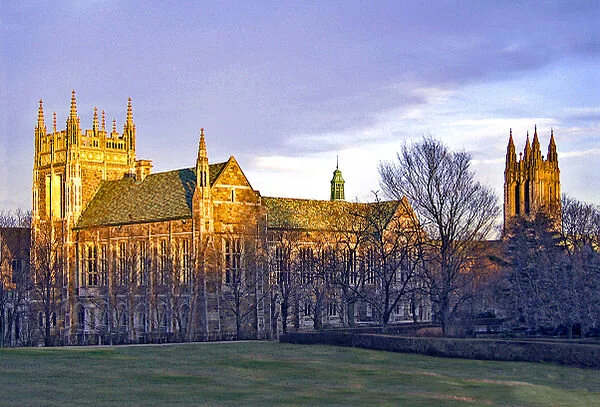
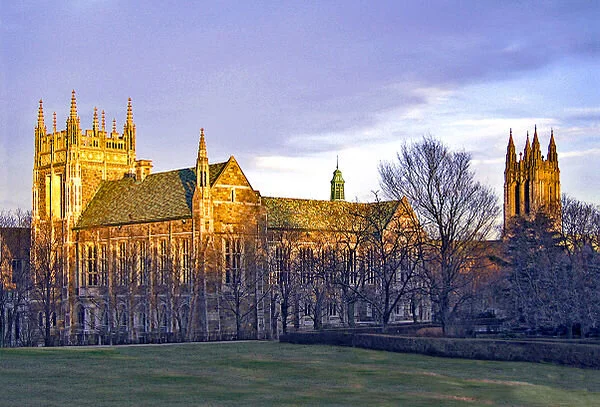
Boston College, which is not in Boston but in Chestnut Hill, Mass., and is, like Dartmouth College, a university
From The New England Journal of Higher Education, a service of The New England Board of Higher Education (nebhe.org)
Something inside me keeps saying: I told you something like this would happen. After 50 years studying opportunity for higher education, I am somewhat comfortable (and very uncomfortable too) saying the issues I have sought to address and warned about underlie the current political chaos. Our failures to address them (and I include higher education centrally in “our”) have boiled over:
1) Income inequality has been surging unchecked for decades. Among the 36 countries that are members of Organization of Economic Cooperation, the U.S. ranks third highest in income inequality. Income is being increasingly concentrated, which means that a growing share of the nation’s prosperity is being concentrated in a shrinking share of the population. With a growing share of the population left out, they have turned to Mr. Trump who had promised to turn the clock back and make America great again. Whatever you and I may think of him, we should remember that 74 million angry people voted for him in the last election.
2) Men’s lives have been falling apart for many decades. We celebrate the success of women and ignore the plight of men. Men have been disengaging from the labor force, from family life, from civic engagement. Our incarceration rates are the highest in the world. And suicide rates among younger males have been exploding. The central problem for men is the shift in employment from goods production to service provision. Men dominated goods production, and women have taken advantage of the growth in service provision employment, particularly through higher education. For every 100 women who earn a bachelor’s degree, 74 men do.
3) Higher education is the engine of division, enriching the rich and leaving everyone else out. From my most recent update, about 13% of children born into the bottom quartile of family income will complete a bachelor’s degree by age 24. About 62% of children born into the top quartile will complete a bachelor’s degree by the same age. This gap has grown substantially since 1970 when I started this data analysis. The bachelor’s degree has become the dividing line between people who are moving forward and people who are moving backward in the economy.
4) As a matter of public policy, I believe that selective college admissions should be replaced with a random draw lottery for admissions. The whole selective college admissions system is outright class warfare. Colleges should remain free to practice selective admissions—but at the price of losing eligibility for Title IV program participation and eligibility for tax-exempt status. These institutions should be treated as the greedy for-profit businesses that they are.
5) Education used to be thought of as an investment in the future. A generation of adults would tax themselves to provide free education for the next generation. The education-loan business reverses this view–let financially needy young people borrow from their own future incomes to be higher educated today. I hate education loans! My proposal to eliminate them would be to increase the Pell Grant maximum award to cost-of-attendance, and then expect states to match the federal effort to fund them. This Pell max should be set to some good quality higher education level, perhaps around $40,000. Colleges that had a higher cost of attendance (COA) would have to fund that from their own resources. My goal is to eliminate the damn loans for higher education, and fully meet demonstrated financial need for students from the bottom half of the family income distribution that are so poorly funded today. Also, I want to force states back into their historic roles funding higher education.
After a half century studying higher-education opportunity, my patience with the current dysfunctional and destructive system was exhausted long ago. Frankly, I am ashamed of the mess my generation has left for the next generation to live with. Again, I say I feel comfortable saying I told you this would happen, but it certainly did not have to happen if we had addressed the issues I tried to raise during my 50 year career.
Thomas G. Mortenson is a higher-education policy analyst, now living in Florida and Minnesota.
Have a seat, or maybe not

“Comfort Taken,’’ by Leslie Lyman, at Boston Sculptors Gallery, Jan. 27-Feb. 21. This was installed in the White-Ellery House, built 1710, in Gloucester
“Comfort Taken’’ presents the chair as a symbol of home and family—imperfect, used, repaired, held together with effort, work and continued perseverance.

White-Ellery House. It’s so old that its design looks late medieval English.
Diner breakfast, then ski

“When I go skiing in New England, I usually wake up early and drive up to Vermont, New Hampshire, or Maine to make it in time for chairlift opening. That means leaving early and getting breakfast at one of the little quaint diners up in the mountains.’’
Sunita Williams (born 1965), American astronaut and U.S. Navy officer who grew up in the Boston area.
She graduated from Needham High School, in Needham, Mass.

On the Upper Wildcat Trail, at the Wildcat Mountain Ski Area, in New Hampshire. The Presidential Range of the White Mountains looms to the west.

'Where the corn flowers were'

“Boston Common at Twilight” (1885–86) (oil on canvas), by Childe Hassam, at the Museum of Fine Arts, Boston
A silence slipping around like death,
Yet chased by a whisper, a sigh,
a breath; One group of trees, lean,
naked and cold,
Inking their cress 'gainst a
sky green-gold;
One path that knows where the
corn flowers were;
Lonely, apart, unyielding, one fir;
And over it softly leaning down,
One star that I loved ere the
fields went brown.
— “A Winter Twilight,’’ by Angelina Weld Grimke (1880-1958), a Boston poet
Chris Powell: New Haven police chief retires at 49 to pension bonanza; vaping vs. marijuana

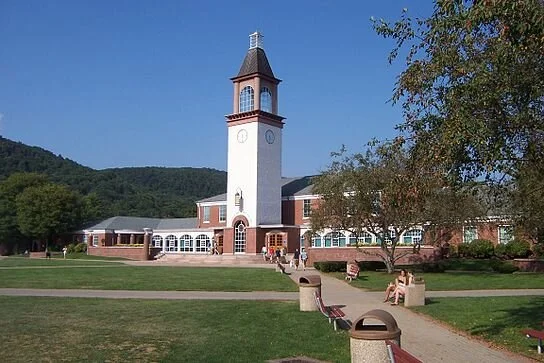
Tony Reyes to go from the mean streets of New Haven to the relatively bucolic precincts of Hamden, Conn. Here we see Quinnipiac University’s Arnold Bernhard Library and clock tower, focus of main campus quadrangle.
MANCHESTER, Conn.
Everyone agrees that Tony Reyes has been a great police chief in New Haven, having been appointed in March 2019 after nearly two decades of rising through the ranks of the police department. But the city will lose him in a few weeks as he becomes police chief at Quinnipiac University next door, in Hamden. This is being called a retirement, but it is that only technically. In fact it is part of an old racket in Connecticut's government employee pension system, an abuse of taxpayers.
Typically police personnel qualify to collect full state government and municipal pensions after 20 years, no matter their age. Reyes is only 49, so he easily has another 15 years of working life ahead of him even as he collects a hefty pension from New Haven.
The chief's salary is $170,000 and so his city pension well may be half of that each year. After a week of requests City Hall was unable to provide an estimate of the pension, but then maybe city officials were too busy helping their Climate Emergency Mobilization Task Force figure out how to remove carbon from the atmosphere. In the meantime maybe the U.S. Environmental Protection Agency can handle New Haven's pensions.
Nor would Quinnipiac disclose what it will pay Reyes, though the university is a nonprofit institution of higher education whose tax exemption comes at the expense of federal, state and Hamden property taxpayers. But since a Quinnipiac vice president is paid nearly $600,000 a year, Reyes probably won't starve there.
In the absence of accountability from city government or the university, here's a guess: Reyes will draw an annual pension from New Haven of $80,000 a year while Quinnipiac pays him $150,000 a year. After 15 years at Quinnipiac, Reyes may get another annual pension of $80,000, plus $30,000 a year in ordinary Social Security, for total retirement income at age 65 of close to $200,000 annually -- as if half that wouldn't be lovely.
Pensions are ordinarily understood to be to support people whose working capacity is ended or substantially diminished. But pensions in state and municipal government in Connecticut often provide luxury lifestyles during second careers and after. Meanwhile mere private-sector workers are lucky to conclude their careers with enough Social Security and savings to scrape by on their way to the hereafter.
This scandal could be remedied easily, with enormous savings and greater retention of the best personnel. State and municipal legislation and contracts could restrict government pension eligibility to the customary retirement age of 65 or to the onset of disability before that. But that would require elected officials who had the wit to alert the public to how it is being exploited and the courage to stand up to the government employee unions.
It also would require news organizations to report the scandal in the first place. But it seems that not even New Haven's own news organizations have inquired about the police chief's pension bonanza.
xxx
The new session of the General Assembly will be intriguing for many reasons, maybe most of all for plans to legalize and tax marijuana while outlawing flavored "vaping" products and prohibiting the sale of tobacco products in stores within five miles of schools, which might limit tobacco sales to kiosks in the middle of a few state forests.
Both campaigns seem to be originating with liberal Democratic legislators. The House chairman of the Public Health Committee, Rep. Jonathan Steinberg, D.-Westport, an advocate of outlawing flavored vaping products, says, "There's plenty of documentation about how exposure to addictive products at a young age makes it hard for people to extricate themselves."
Of course, marijuana also can lead to addiction to other drugs. Some people deal with and outgrow dope smoking, but some don't.
Drug criminalization long has failed and probably has done more damage than illegal drugs themselves. But it is silly to pretend that outlawing "vaping" products will protect kids any more than outlawing marijuana has done.
Contraband laws just create black markets that make the law futile. If Connecticut opts for legal marijuana while prohibiting "vaping" products, it will be only because legislators believe that there's much more tax revenue in the former than the latter.
Chris Powell is a columnist for the Journal Inquirer, in Manchester, Conn.

Sarah Anderson: The inglorious return of the three-martini lunch

Via OtherWords.org
While the world is reeling from the pandemic and American democracy faces a profound crisis, corporate lobbyists have been focused on making taxpayers subsidize lavish lunches for wealthy executives.
Their work paid off in the 11th-hour COVID-19 relief deal Congress passed late last year. Buried in the details of this modest aid plan is a provision to give executives unlimited tax deductions for their business meals for two years.
That’s how it worked back in the 1970s, when presidential candidate George McGovern had this to say about it: “There’s something fundamentally wrong with the tax system,” he said, “when it allows a corporate executive to deduct his $20 martini lunch while a working man cannot deduct the price of his bologna sandwich.”
President Reagan, of all people, actually agreed with McGovern. His 1986 tax overhaul, best remembered today for lowering overall rates, reduced the deductibility of business meals from 100 to 80 percent. In 1993, the Clinton administration pushed that deductibility rate down to 50 percent, where it has stayed ever since.
Now corporate lobbyists have managed to restore that 1970s-era perk — claiming, of course, that bigger tax write-offs for business meals would help struggling restaurants and the people they employ.
That’s the same argument they used in their opposition to the Clinton-era reform. It was flawed then and it’s even more preposterous now.
Back in 1993, the National Restaurant Association predicted that if businesses were able to write off only half the cost of their business meals (instead of 80 percent), restaurant industry sales would plummet by $3.8 billion and 165,000 jobs would be lost in just the first year.
The opposite occurred. In the year after the reform went into effect on Jan. 1, 1994, sales at full-service restaurants grew by 3.5 percent, outstripping overall U.S. economic growth, according to Census and Labor Department data. And instead of the NRA’s predicted loss of 165,000 jobs, full-service restaurant payrolls grew by 132,300. That was a 4-percent increase, compared to only 3.5 percent growth in national employment.
Today, when the real problem is a public-health crisis that’s keeping people at home, it’s even more laughable that lowering taxes on business meals will do anything to help struggling restaurant owners and employees.
In this time of crisis, any taxpayer support for corporations should require executives to treat their workers well, trim their own fat paychecks — and pay for their own lunch.
Sarah Anderson directs the Global Economy Project at the Institute for Policy Studies.
What a drip!

"Ayeka," by Leslie Zelamsky, in the group show “Space and Surface Together,’’ at Fountain Street Fine Art, Boston, through Feb. 4.
The gallery says:
“Since Impressionism many of the best landscape painters have combined illusions of depth with the purpose to elaborate the surface of the support; in other words, the goal has been to make works that are compelling two dimensional structures as well as convincing three dimensional illusions. The landscapes in this exhibition succeed in both of these ambitions. While nature is described or evoked with real success by space, color, light, atmosphere and marks that suggest natural growth, the artists also employ gesture, composition, and sometimes the purity of flat forms to make the surfaces of their paintings fresh with impulse and spontaneity or impressively orchestrated by pattern or design. The result of course is imagery that is doubly rich and attractive.’’
Regional characteristics

“If someone in a Home Depot store offers you assistance and they don't work there, you live in New England. If you've worn shorts and a parka at the same time, you live in New England. …If vacation means going anywhere south of New York City for the weekend, you live in New England. If you measure distance in hours, you live in New England…. If you know several people who have hit a deer more than once, you live in New England. If you have switched from 'heat' to 'A/C' in the same day and back again, you live in New England . … . ... If the speed limit on the highway is 55 mph you're going 80 and everybody is passing you, you live in New England . … If you know all four seasons: almost winter, winter, still winter and road construction, you live in New England … If there's a Dunkin’ Donuts on every corner, you live in New England.’’
— Jeff Foxworthy (born 1948), comedian, actor, writer and producer from the State of Georgia

‘Tonight I will bark’

The great Overdog
That heavenly beast
With a star in one eye
Gives a leap in the east.
He dances upright
All the way to the west
And never once drops
On his forefeet to rest.
I'm a poor underdog,
But to-night I will bark
With the great Overdog
That romps through the dark.
‘‘Canis Major,’’ by Robert Frost

Canis Major as depicted in Urania's Mirror, a set of constellation cards published in London, c.1825. Next to it are Lepus and Columba (partly cut off).
David Warsh: Aaron Burr, the Gunpowder Plot and our current scoundrel-in-chief

Vice President Aaron Burr in 1802
SOMERVILLE, Mass.
Donald Trump has begun appearing in the rear-view mirror. I have compared Trump to Aaron Burr, the scoundrel who sought to overturn the 1800 presidential election in the early days of the Republic. Hit this link for an explanation of what he did.
Later, starting in 1804, Burr sought to invent around U.S. elections altogether, hoping to foment a breakaway-nation that he could govern in the Spanish Southwest.
No other episode in American history comes close. But after following news about the Jan. 6 assault on the Capitol, I’m inclined to believe that the history of England offers a more illuminating comparison. I’ve been thinking about Guy Fawkes and the 17th Century Gunpowder Plot.
The background was the Protestant Reformation, which had begun in Germany, in 1517, with Martin Luther. Starting in 1533, King Henry VIII withdrew Britain its allegiance to the Roman Catholic Church. Catholics, especially Jesuit priests, had a hard time of it under Henry’s daughter Queen Elizabeth I. Elizabeth’s Catholic cousin, Mary, Queen of Scots, was executed for treason in 1587.
Elizabeth died childless, in 1603, without having named an heir. Queen Mary’s son, Elizabeth’s nephew, peacefully acceded to the throne as James I of England and James VI of Scotland. But repression of Catholics continued, and in 1605 a group of English Catholics plotted to blow up the House of Lords during the opening of Parliament, on Nov. 5. Betrayed by a letter of seemingly mysterious provenance, one of the plotters, Guy Fawkes, was discovered guarding 36 barrels of gunpowder in the basement the night before, quite enough to demolish the building. The plotters were captured and, one way or another, put to death, including some Catholic clergy linked to the plot.
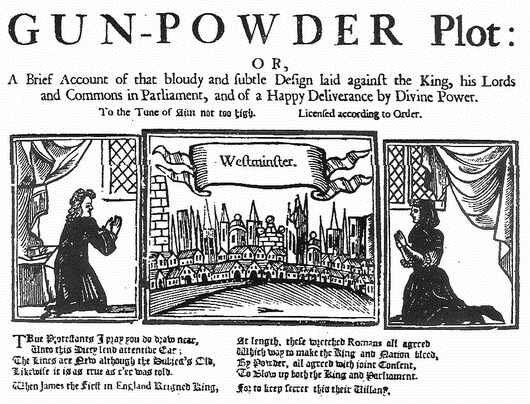
The world was smaller then. Passions ran deeper. Globalization had only just begun. But it is hard to think of any other episode in Anglo-American history whose rhetorical aim resembled more closely that of the mob that descended on the U.S. Capitol on Jan. 6, having been dispatched on their mission by President Trump.
One group of skirmishers came within seconds of sighting Vice President Pence as he, along with his wife and daughter, was spirited out of the Senate chamber and into a hideaway, according to a Jan. 16 story in The Washington Post. The gunpowder plotters intended to kill King James and install his nine-year-old daughter on the throne as Catholic monarch. The Capitol Hill mob vigorously denounced Pence as a traitor for his failure to overturn the presidential-election results. A mock gallows was installed on the western approach to the Capitol.
Persecution of Catholics continued but was mild relative to the century before for the remainder of the reign of James I – he died in 1625 – but anti-Catholic sentiment persisted in England for two centuries, through a not-unrelated civil war and a very-related “Glorious Revolution.”
No one knows what might be the long-term effects of the assault on the Capitol. My hunch is that it will be remembered as thoroughly repugnant and rejected and condemned until it is forgotten. For a higher-resolution characterological account of the Trump story, see “What TV Can Tell Us about How the Trump Show Ends,” by Joanna Weiss. The Trump presidency resembled an antihero drama, Weiss says, more closely than reality TV, the saga of Tony Soprano her chief case in point.
With this emergency behind, I am returning this weekly to my main concern, economics, meanwhile finishing a book on the last hundred years of its textbook versions. As for my plans to shift to the Substack publishing platform, they are postponed; Economic Principals will move at the end of the year, by which time the book will have begun wending its way its way to the press. Luck be a lady this year!
David Warsh, a veteran columnist and an economic historian, is proprietor of Somerville, Mass.-based economicprincipals.com, where this column originated.

Rachel Bluth: CVS comes under fire for low nursing-home vaccination rates

CVS store in Coventry, Conn.
— Photo by JJBers
The effort to vaccinate some of the country’s most vulnerable residents against COVID-19 has been slowed by a federal program that sends retail pharmacists into nursing homes — accompanied by layers of bureaucracy and logistical snafus.
As of Jan. 14, more than 4.7 million doses of the Pfizer-BioNTech and Moderna covid vaccines had been allocated to the federal pharmacy partnership, which has deputized pharmacy teams from Deerfield, Ill.-based Walgreens and Woonsocket, R.I.-based CVS to vaccinate nursing home residents and workers. Since the program started in some states on Dec. 21, however, they have administered about a quarter of the doses, according to the Centers for Disease Control and Prevention.
Across America, some nursing-home directors and health-care officials say the partnership is actually hampering the vaccination process by imposing paperwork and cumbersome corporate policies on facilities that are thinly staffed and reeling from the devastating effects of the coronavirus. They argue that nursing homes are unique medical facilities that would be better served by medical workers who already understand how they operate.
Mississippi’s state health officer, Dr. Thomas Dobbs, said the partnership “has been a fiasco.”
The state has committed 90,000 vaccine doses to the effort, but the pharmacies had administered only 5 percent of those shots as of Jan. 14, Dobbs said. Pharmacy officials told him they’re having trouble finding enough people to staff the program.
Dobbs pointed to neighboring Alabama and Louisiana, which he says are vaccinating long-term care residents at four times the rate of Mississippi.
“We’re getting a lot of angry people because it’s going so slowly, and we’re unhappy too,” he said.
Many of the nursing homes that have successfully vaccinated willing residents and staff members are doing so without federal help.
For instance, Los Angeles Jewish Home, with roughly 1,650 staff members and 1,100 residents on four campuses, started vaccinating Dec. 30. By Jan. 11, the home’s medical staff had administered its 1,640th dose. Even the facility’s chief medical director, Noah Marco, helped vaccinate.
The home is in Los Angeles County, which declined to participate in the CVS/Walgreens program. Instead, it has tasked nursing homes with administering vaccines themselves, and is using only Moderna’s easier-to-handle product, which doesn’t need to be stored at ultracold temperatures, like the Pfizer vaccine. (Both vaccines require two doses to offer full protection, spaced 21 to 28 days apart.)
By contrast, Mariner Health Central, which operates 20 nursing homes in California, is relying on the federal partnership for its homes outside of L.A. County. One of them won’t be getting its first doses until next week.
“It’s been so much worse than anybody expected,” said the chain’s chief medical officer, Dr. Karl Steinberg. “That light at the end of the tunnel is dim.”
Nursing homes have experienced some of the worst outbreaks of the pandemic. Though they house less than 1 percent of the nation’s population, nursing homes have accounted for 37 percent of deaths, according to the COVID Tracking Project.
Facilities participating in the federal partnership typically schedule three vaccine clinics over the course of nine to 12 weeks. Ideally, those who are eligible and want a vaccine will get the first dose at the first clinic and the second dose three to four weeks later. The third clinic is considered a makeup day for anyone who missed the others. Before administering the vaccines, the pharmacies require the nursing homes to obtain consent from residents and staffers.
Despite the complaints of a slow rollout, CVS and Walgreens said that they’re on track to finish giving the first doses by Jan. 25, as promised.
“Everything has gone as planned, save for a few instances where we’ve been challenged or had difficulties making contact with long-term care facilities to schedule clinics,” said Joe Goode, a spokesperson for CVS Health.
Dr. Marcus Plescia, chief medical officer at the Association of State and Territorial Health Officials, acknowledged some delays through the partnership, but said that’s to be expected because this kind of effort has never before been attempted.
“There’s a feeling they’ll get up to speed with it and it will be helpful, as health departments are pretty overstretched,” Plescia said.
But any delay puts lives at risk, said Dr. Michael Wasserman, the immediate past president of the California Association of Long Term Care Medicine.
“I’m about to go nuclear on this,” he said. “There should never be an excuse about people not getting vaccinated. There’s no excuse for delays.”
Bringing in Vaccinators
Nursing homes are equipped with resources that could have helped the vaccination effort — but often aren’t being used.
Most already work with specialized pharmacists who understand the needs of nursing homes and administer medications and yearly vaccinations. These pharmacists know the patients and their medical histories, and are familiar with the apparatus of nursing homes, said Linda Taetz, chief compliance officer for Mariner Health Central.
“It’s not that they aren’t capable,” Taetz said of the retail pharmacists. “They just aren’t embedded in our buildings.”
If a facility participates in the federal program, it can’t use these or any other pharmacists or staffers to vaccinate, said Nicole Howell, executive director for Ombudsman Services of Contra Costa, Solano and Alameda counties.
But many nursing homes would like the flexibility to do so because they believe it would speed the process, help build trust and get more people to say yes to the vaccine, she said.
Howell pointed to West Virginia, which relied primarily on local, independent pharmacies instead of the federal program to vaccinate its nursing home residents.
The state opted against the partnership largely because CVS/Walgreens would have taken weeks to begin shots and Republican Gov. Jim Justice wanted them to start immediately, said Marty Wright, CEO of the West Virginia Health Care Association, which represents the state’s long-term care facilities.
The bulk of the work is being done by more than 60 pharmacies, giving the state greater control over how the doses were distributed, Wright said. The pharmacies were joined by Walgreens in the second week, he said, though not as part of the federal partnership.
“We had more interest from local pharmacies than facilities we could partner them up with,” Wright said. Preliminary estimates show that more than 80% of residents and 60% of staffers in more than 200 homes got a first dose by the end of December, he said.
Goode from CVS said his company’s participation in the program is being led by its long-term-care division, which has deep experience with nursing homes. He noted that tens of thousands of nursing homes — about 85 percent nationally, according to the CDC — have found that reassuring enough to participate.
“That underscores the trust the long-term care community has in CVS and Walgreens,” he said.
Vaccine recipients don’t pay anything out-of-pocket for the shots. The costs of purchasing and administering them are covered by the federal government and health insurance, which means CVS and Walgreens stand to make a lot of money: Medicare is reimbursing $16.94 for the first shot and $28.39 for the second.
Bureaucratic Delays
Technically, federal law doesn’t require nursing homes to obtain written consent for vaccinations.
But CVS and Walgreens require them to get verbal or written consent from residents or family members, which must be documented on forms supplied by the pharmacies.
Goode said consent hasn’t been an impediment so far, but many people on the ground disagree. The requirements have slowed the process as nursing homes collect paper forms and Medicare numbers from residents, said Tracy Greene Mintz, a social worker who owns Senior Care Training, which trains and deploys social workers in more than 100 facilities around California.
In some cases, social workers have mailed paper consent forms to families and waited to get them back, she said.
“The facilities are busy trying to keep residents alive,” Greene Mintz said. “If you want to get paid from Medicare, do your own paperwork,” she suggested to CVS and Walgreens.
Scheduling has also been a challenge for some nursing homes, partly because people who are actively sick with covid shouldn’t be vaccinated, the CDC advises.
“If something comes up — say, an entire building becomes covid-positive — you don’t want the pharmacists coming because nobody is going to get the vaccine,” said Taetz of Mariner Health.
Both pharmacy companies say they work with facilities to reschedule when necessary. That happened at Windsor Chico Creek Care and Rehabilitation in Chico, Calif., where a clinic was pushed back a day because the facility was awaiting covid test results for residents. Melissa Cabrera, who manages the facility’s infection control, described the process as streamlined and professional.
In Illinois, about 12,000 of the state’s roughly 55,000 nursing home residents had received their first dose by Sunday, mostly through the CVS/Walgreens partnership, said Matt Hartman, executive director of the Illinois Health Care Association.
While Hartman hopes the pharmacies will finish administering the first round by the end of the month, he noted that there’s a lot of “headache” around scheduling the clinics, especially when homes have outbreaks.
“Are we happy that we haven’t gotten through round one and West Virginia is done?” he asked. “Absolutely not.”
Rachel Bluth is a Kaiser Health News correspondent.
Rachel Bluth: rbluth@kff.org, @RachelHBluth
KHN correspondent Rachana Pradhan contributed to this report.
From 'Fantasy to Reality': The Florentine effect

”A Rising Up” (acrylic on sculptured board), by Norman Finn, in his show “Virtue Voyage From Fantasy to Reality … With a Possible Return,’’ at Galatea Fine Art, Boston, Feb. 5-28.
He says:
"Somehow or other through a quirk of fate, I became involved in the footwear industry, triggering a career fusing the shoe business with my artistic ability. The end result was a successful women’s fashion designer, a creative designer for my own company, and my own footwear firm working on three continents.
My art world was shaped when as a family we lived in Florence, Italy where I worked as a designer and was exposed to the wonders of the Renaissance. Italian paintings and a collection of Buddhas became an integral part of my life.
My painting style is evolving daily as the experience of my fashion background appears on every canvas.
The pandemic brought me confusion and peace at the same time. The world was upside down but I found solace in my studio painting fantasy and reality.’’
Philip K. Howard: The administrative state is paralyzing American society


VERNON, Conn.
Philip K. Howard’s powers of concision are remarkable. In a very readable Yale Law Journal piece, “From Progressivism to Paralysis,” Howard, founder of the nonprofit and nonpartisan reform group Common Good (commongood.org), writes:
"The Progressive Movement succeeded in replacing laissez-faire with public oversight of safety and markets. But its vision of neutral administration, in which officials in lab coats mechanically applied law, never reflected the realities and political tradeoffs in most public choices. The crisis of public trust in the 1960s spawned a radical transformation of government operating systems to finally achieve a neutral public administration, without official bias or error. Laws and regulations would not only set public goals but also dictate precisely how to implement them. The constitutional protections of due process were expanded to allow disappointed citizens, employees, and students to challenge official decisions, even managerial choices, and put officials to the proof. The result, after fifty years, is public paralysis. In an effort to avoid bad public choices, the operating system precludes good public choices. It must be rebuilt to honor human agency and reinvigorate democratic choices.”
The gravamen of the article is that progressive precisionism causes paralysis because laws and regulations must be general and non-specific enough to allow administrative creativity. And, a correlative point, administrators should not be permitted to arrogate to themselves legislative or judicial functions that belong constitutionally to elected representatives.
Why not? Because in doing so the underlying sub-structure of democratic governance is subtly, and sometimes not so subtly, fatally undermined. The authority of governors rests uneasily upon the ability of the governed to vote administrators and representatives in and out of office, a necessary democratic safeguard that is subverted by a permanent, unelected administrative state that, like a meandering stream, has wandered unimpeded over its definitional banks.
Detecting a beneficial change in the fetid political air, Howard warns, “Change is in the air. Americans are starting to take to the streets. But the unquestioned assumption of protesters is that someone is actually in charge and refusing to pull the right levers. While there are certainly forces opposing change, it is more accurate to say that our system of government is organized to prevent fixing anything. At every level of responsibility, from the schoolhouse to the White House, public officials are disempowered from making sensible choices by a bureaucratic and legal apparatus that is beyond their control.”
And then he unleashes this thunderbolt:
“The modern bureaucratic state, too, aims to be protective. But it does this by reaching into the field of freedom and dictating how to do things correctly. Instead of protecting an open field of freedom, modern law replaces freedom.
“The logic is to protect against human fallibility. But the effect, as discussed, is a version of central planning. People no longer have the ability to draw on ‘the knowledge of the particular circumstances of time and place,’ which Nobel economics laureate Friedrich Hayek thought was essential for most human accomplishment. Instead of getting the job done, people focus on compliance with the rules.
“At this point, the complexity of the bureaucratic state far exceeds the human capacity to deal with it. Cognitive scientists have found that an effect of extensive bureaucracy is to overload the conscious brain so that people can no longer draw on their instincts and experience. The modern bureaucratic state not only fails to meet its goals sensibly, but also makes people fail in their own endeavors. That is why it engenders alienation and anger, by removing an individual’s sense of control of daily choices.”
Indeed, as a lawyer (sorry to bring the matter up), Howard probably knows at first hand that complexity, which provides jobs aplenty for lawyers and accountants, is the enemy of creative governance. The way to a just ordered liberty is not by mindlessly following ever more confusing and complex rules – written mostly by those who intend to preserve an iron-fisted status quo – but by leaving open a wide door of liberty in society for those who are best able to provide workable solutions to social and political problems.
Howard, I am told by those who know him well, is not a “conservative’’ in terms of the current American political parlance. For that matter, besieged conservative faculty at highbrow institutions such as Yale are simply exceptions that prove the progressive rule; such has been the case before and since the publication of Yalie William F. Buckley Jr.’s book, God and Man at Yale.
But I am also assured that Howard is an honest and brave man.
In an era in which democracy is being throttled by a weedy and complex series of paralytic regulations produced by the administrative state, any man or woman who can write this – “It is better to take the risk of occasional injustice from passion and prejudice, which no law or regulation can control, than to seal up incompetency, negligence, insubordination, insolence, and every other mischief in the service, by requiring a virtual trial at law before an unfit or incapable clerk can be removed” -- is worth his or her weight in diamonds.
Don Pesci is a Vernon-based columnist.