
Vox clamantis in deserto



All wet in the Whaling City
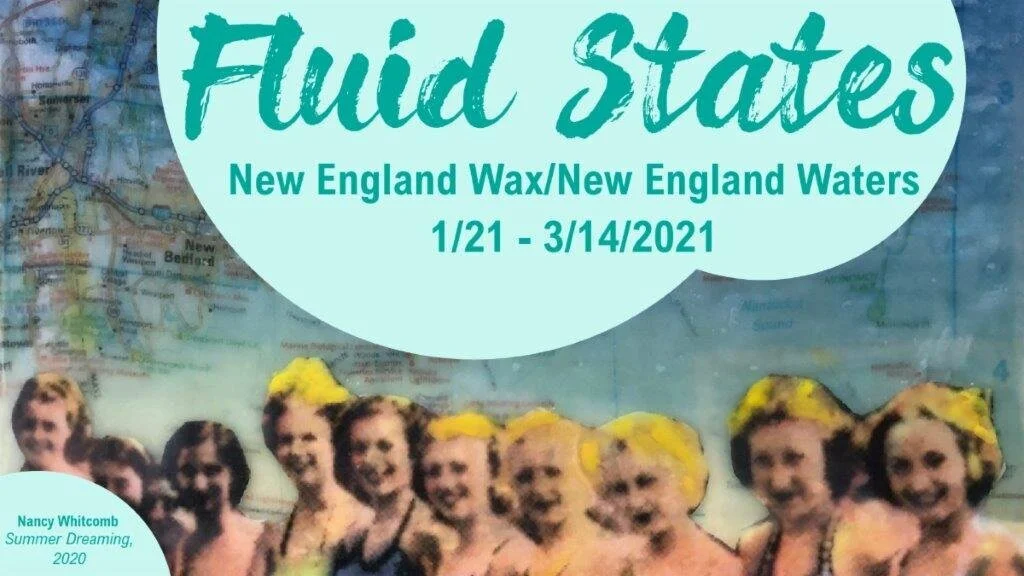
Fluid States: New England Wax/New England Waters exhibition at the New Bedford Art Museum
CONTACT: Julia Zimmerman, jzimmerman@newbedfordart.org
The New Bedford Art Museum will be showing the work of members from the New England Wax (N.E.W.) organization in an exhibition titled Fluid States: New England Wax/New England Waters from January 21 through March 14, 2021. Fluid States will look at the importance of water, both salt and fresh, and its essential contributions to life in New England; its coast and ports, fishing grounds, and leisure areas. Fluid States will also explore the ecological richness – and fragility – of New England’s watery ecosystem.
Jurors Jamie Uretsky, Curator at New Bedford Art Museum, and Julia Zimmerman, Curatorial Assistant, will be choosing artwork for this exhibit from the work of N.E.W. members who reside throughout New England. New England Wax is a professional organization founded in 2006 and dedicated to promoting excellence in fine art made with encaustic and cold wax mediums, to raising awareness of the wax mediums for artistic expression, and to challenging its members to continue to grow as artists. Wax, utilized as an art material with a long history, shares many properties with water itself: fluidity, translucency, malleability, delicacy and fragility, all themes that will be explored in depth in the exhibition.
The New Bedford Museum of Art is dedicated to engaging a diverse audience in relevant exhibitions and exemplary education and creative experiences as a vital and innovative center for the arts. The museum is located at 608 Pleasant Street, New Bedford, MA 02740. For additional information about the Fluid States exhibition or current information about visiting the museum, please check the museum’s website www.newbedfordart.org, email info@newbedfordart.org, or call 508.961.3072.
For additional information about New England Wax, visit their website www.newenglandwax.com, or contact Nancy Whitcomb at nswhitcomb5@gmail.com.
More land bordering S.E. Mass. BioReserve to be protected
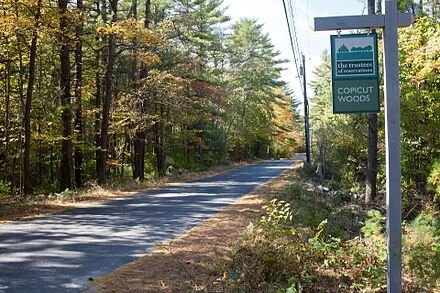
In the Southeastern Massachusetts BioReserve
By ecoRI News staff
More than 50 acres of woods and wetlands that border the massive Southeastern Massachusetts BioReserve and drain toward the East Branch of the Westport River will be permanently protected from development through a partnership between the City of Fall River and the Buzzards Bay Coalition.
The land, now owned by the city and on which the Buzzards Bay Coalition will hold the conservation restriction, sits in the northwestern edge of the Buzzards Bay’s watershed — the area in which streams and groundwater flow toward the bay — and it feeds Copicut Reservoir and North Watuppa Pond, the source of Fall River’s drinking-water supply.
The woodlands also provide habitat for several threatened species, including the eastern box turtle and the marbled salamander, and offer public access to the extensive trail network that runs throughout the Bioreserve and its associated properties.
“The Bioreserve is one of the largest tracts of contiguous forest in eastern Massachusetts, and much of it drains toward Buzzards Bay and the Westport River,” said Mark Rasmussen, president of the Buzzards Bay Coalition. “Keeping it natural helps to preserve water quality for Fall River’s residents and for the people, plants, and animals who live around the bay.”
The newly protected lands comprise two properties — the 38-acre former Costa-Mello farm off Yellow Hill Road and the 16-acre Desmarais property off Indian Town Road — both of which connect to The Trustees of Reservations’ 516-acre Copicut Woods property and the city of Fall River’s massive Watuppa Reservation, which covers 4,800 acres.
The two properties were originally identified for future preservation during the city of Fall River’s first Open Space and Recreation Plan, which was completed in 1997. More recently, the city used Community Preservation Act money to buy the land, which had been placed on the market for sale and development.
Michael Labossiere, the watershed forester for the city of Fall River, said the extension of the 13,600-acre expanse of the Bioreserve to these new properties is good news for the environment, for wildlife, and for people who live in the region.
“More and more people are beginning to find the Southeastern Massachusetts Bioreserve and visiting to discover it for themselves,” he said. “And their reaction is always the same: ‘it’s beautiful, it’s peaceful, it’s quiet. It’s a place where I can get my exercise; I can bring my family.’ Adding these new properties to the Bioreserve is good for our residents, it’s good for the environment and it protects our water supply.”
Recent improvements to existing paths on the two properties already connect to the trail systems at Watuppa Reservation and at Copicut Woods. Additional improvements, such as the addition of small parking areas, may be made in the future as usage of the area grows.

Overview of American madness metastasizing with crazed conspiracy theories; see disturbing video here

Logo of QAnon, the crazed far-right conspiracy theory, which has many followers and has become part of the Republican Party coalition.

Engraving of the eighth print of A Rake's Progress, depicting inmates at Bedlam Asylum, by William Hogarth
This piece includes two fervent Rhode Island Trumpists, Anne Armstrong (whose AKAs include Anna Winograd Vrankar) and Alan Gordon, who were in Washington on Jan. 6 to demand the overturning of the free and fair 2020 election so that their leader could stay in office. She asserted to me (Robert Whitcomb) that they were not in the riot at the Capitol itself.
Ms. Armstrong was ordained a minister by a mail-order and Internet operation called World Christianship Ministries. She and Mr. Gordon operate “The Healing Church of Rhode Island’’ in rural gun-and-Trump-besotted West Greenwich, R.I. (at 99 Hudson Pond Road, to be exact). They are both QAnon fans. Given the incendiary nature of QAnon lies, it’s easy to see how some adherents could become violent. We hope that federal and state officials can keep track of the more crazed QAnon believers.
QAnon is an easily disproven far-right conspiracy theory alleging that a cabal of Satan-worshipping cannibalistic pedophiles is running a global child sex-trafficking ring and has been plotting against Donald Trump, who has been fighting the cabal.
All Americans should look at this video to see what fellow cultists of Armstrong and Gordon did at the Capitol that day. They won’t forget it. And this.
Below can be found some entertaining but also disturbing stuff in the links provided. It gives some local sense of the madness that has overtaken so much of America.
First, for some context, use these links:
https://harpers.org/archive/1964/11/the-paranoid-style-in-american-politics/
and:
https://www.nytimes.com/2021/01/14/opinion/facebook-far-right.html
and:
https://www.nytimes.com/2021/01/09/magazine/trump-coup.html
and:
https://theconversation.com/how-to-spot-a-conspiracy-theory-expert-guide-to-conspiracy-theories-part-one-133802
And:
https://www.washingtonpost.com/investigations/2021/01/16/video-timeline-capitol-siege/?arc404=true
https://www.bbc.com/future/article/20161026-how-liars-create-the-illusion-of-truth
https://www.scientificamerican.com/article/the-shared-psychosis-of-donald-trump-and-his-loyalists/?fbclid=IwAR1THagB-MzvOpEBPc4zdMItlxeo
https://www.cnn.com/2021/01/20/tech/qanon-believers-inauguration-reaction/index.html?
https://www.theatlantic.com/ideas/archive/2021/01/conservatism-reaches-dead-end/617629/?surface=meter_limit_reached&article_url=https%3A%2F%2Fwww.theatlantic.com%2Fideas%2Farchive%2F2021%2F01%2Fconservatism-reaches-dead-end%2F617629%2F&fbclid=IwAR03wWVJSXHbzhmROsW6ZgH0_AbsIJdcSKXQ79vOHxIkKKlCm1uBV4B8_Yk
Contrary to a couple of news reports, such as The Daily Mail report here, Alan Gordon and Anne Armstrong are not married to each other but live on the same spread as their church business in West Greenwich, R.I. Ms. Armstrong says she has a husband and seven children.
Also, extremists (including Ms. Armstrong) make references to the alleged (and bogus) conspiracy of the “Illuminati”.
Hit this link for background on that conspiracy trope, often used by anti-Semites.
https://www.ucl.ac.uk/european-institute/news/2019/sep/jacob-rees-moggs-alarming-cry-illuminati
And these links, some of which have entertaining pictures:
https://www.eastbayexpress.com/oakland/cult-of-cannabis/Content?oid=31505241https://turtleboysports.com/totally-sane-wizards-accuse-rhode-island-pd-of-sex-trafficking-special-needs-kids-are-begging-to-be-infecte
https://www.academia.edu/38062539/Clergyman_to_jail_self_CIA_plot_alleged
https://www.facebook.com/AnneArmstrongRI/posts/2672468839689031
https://www.youtube.com/watch?v=U8vvE0g-dxg
http://thehealingchurchri.com/
https://www.bostonherald.com/2020/02/10/pro-pot-christian-sect-boards-trump-train/
https://www.tmz.com/2018/10/24/rhode-island-candidate-alan-gordon-n-word-marijuana/
https://ecf.rid.uscourts.gov/cgi-bin/show_public_doc?2015cv0215-23
https://ballotpedia.org/Anne_Armstrong
https://www.facebook.com/AnneArmstrongRI/
https://twitter.com/AvengingAnnieRI/status/1350288973181181952
https://www.washingtonpost.com/news/volokh-conspiracy/wp/2016/01/08/and-here-you-thought-you-knew-what-i-n-r-i-meant/
https://patch.com/rhode-island/coventry/boy-could-one-thing-have-gone-right-alan-gordon
https://merryjane.com/news/marijuana-church-our-lady-guadalupe
https://www.facebook.com/AnneArmstrongRI/posts/hey-qanon-obama-got-fakenewsd-too-the-video-that-got-qd-out-today-was-edited-to-/2125350864400834/
https://www.washingtonpost.com/politics/fbi-warning-inauguration-qanon/2021/01/18/293284b6-59c8-11eb-b8bd-ee36b1cd18bf_story.html
https://www.facebook.com/AnneArmstrongRI/posts/hey-qanon-obama-got-fakenewsd-too-the-video-that-got-qd-out-today-was-edited-to-/2125350864400834/https://independent.academia.edu/AlanGordon3
https://www.facebook.com/AnneArmstrongRI/

Bridgewater (Mass.) State Hospital for the Criminally Insane
Jill Richardson: To battle Trumpism, address country’s long economic stagnation
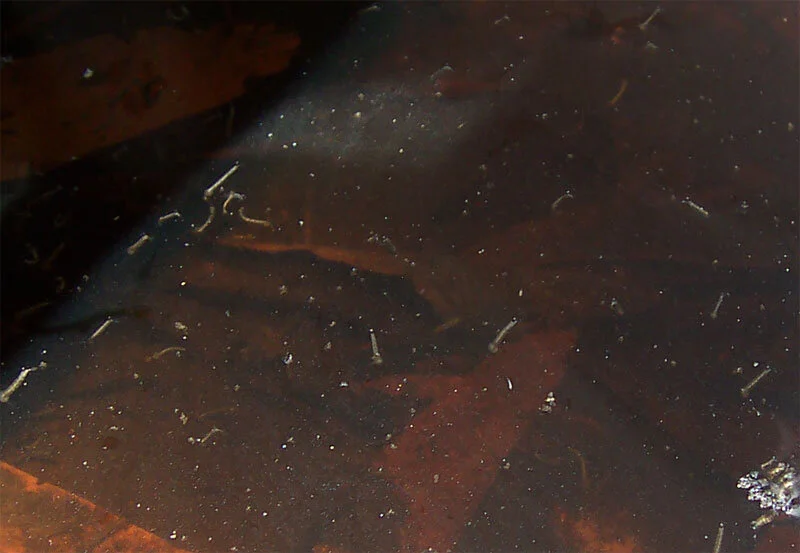
Mosquitoes — and neo-Fascists? — breed in stagnant water.
Via OtherWords.org
Donald Trump won’t be around forever. But the political crises his attacks on democracy have caused will outlive his one-term presidency.
For one thing, the nearly 150 congressional Republicans who supported his attempted coup will probably remain in office, even though the 14th Amendment bans anyone “engaged in insurrection or rebellion against the [the United States]” from office.
For another, Trump’s attempts to discredit the results of the election — which began before the 2016 election and have continued ever since — have convinced a significant portion of Republicans to doubt President-elect Biden’s legitimacy. Sixty court rulings to the contrary, including many by Trump-appointed judges, have done little to change their minds.
The irony is that, if anything, our election system is rigged against Democrats. Gerrymandering, the Electoral College and voter suppression all enable Republicans to win power far above their actual popular support. Still, Joe Biden and Kamala Harris pulled off a large enough victory to win anyway.
But, given that some Republicans are so committed to denial that they are willing to throw away our democracy, what do we do now? How do we make sure the threat to our democracy — and many lives — stops here?
Clearly, there needs to be accountability for the perpetrators of the coup attempt itself. But we also need to take a hard look at some of the social conditions that foster the far-right radicalization that sustained it.
According to sociologists Rory McVeigh and Kevin Estep, Trump originally found his strongest support in communities with a low percentage of college graduates. And within these communities, support for Trump went up even more when the community had high unemployment and low median income.
That doesn’t mean that Trump supporters are all working-class or low-income. As other studies have pointed out, many of Trump’s earliest supporters were quite well-to-do. And many other wealthy Republicans simply went along to preserve their power (or tax cuts). Shame on them. They can’t say nobody saw it coming.
Still, there’s no question that some struggling communities proved fertile ground for Trumpism.
President Obama came into office on the heels of an economic collapse that hurt people who never went to college the most, but he presided over a recovery that helped them the least. And even before the crash, these communities had lost jobs due to a host of establishment-friendly economic policies — sometimes called “neoliberal globalization” — like free trade and financial deregulation.
Neoliberal globalization was mostly supported by both parties — with a few exceptions.
On the left, critics like Bernie Sanders promised a progressive vision for reform. But on the right, Donald Trump scapegoated immigrants and promised to bring back manufacturing jobs.
In this, Trump was following a tried-and-true playbook for right-wing populist demagogues. As social scientist Ruth Wodak explains, he appealed to his base as the “true” Americans and gave them scapegoats to blame with simple solutions to complex problems. He told them not to trust the establishment — and he offered himself as the savior who would fix their problems.
McVeigh and Estep point out that historically, white nationalist movements have gained traction in the U.S. when certain white Americans felt they were losing political and economic power and social status all at once.
The second rise of the KKK — in the 1920s — bears the most similarity to the present day. Then as now, a changing economy and political climate had disadvantaged a group of white Christians who were previously better off. In both cases, they turned their animosity to immigrants.
Of course, this is no cure at all. In the end, Trump did plenty to hurt immigrants but failed completely to bring back manufacturing jobs. Instead, he mismanaged a pandemic that’s killed hundreds of thousands and only deepened pre-existing inequalities in our country.
The question now is how to put the genie back in the bottle. The Biden administration has its work cut out for it — from ending the pandemic to promoting racial justice and strengthening our democratic institutions following this four-year assault on them.
But we should add to that pile: addressing the economic stagnation that paved the way for Trumpism. Better jobs and opportunities won’t cure racism — that’s a whole other task — but they make it more difficult to weaponize.
White nationalism has always been a part of our history. It just goes dormant and rears its head again when conditions allow it. It’s threatened our democracy before, during the Civil War and many times since.
We must not allow it to do so again.
Jill Richardson is a sociologist.
pursuing a PhD in sociology at the University of Wisconsin-Madison. This op-ed was distributed by OtherWords.org.

Happy memories of way back in Washington, long before the neo-Fascist invasion
From Robert Whitcomb’s “Digital Diary,’’ in GoLocal24.com
“This is what you’ve gotten, guys.”
-- Utah Sen. Mitt Romney, during the Jan. 6 assault on the Capitol, yelling at Sen. Ted Cruz and some other neo-Fascist GOP colleagues in the Capitol who were leading the lie-and-demagoguery-filled attempt to overturn Biden’s election.
Trump's acting defense secretary, Christopher Miller, presumably at the order of Trump, had refused until it was too late to authorize the use of National Guard to defend the Capitol, making its storming easier. And the Capitol Police acted (intentionally?) hapless. Were Russia-connected agents involved? How much of this attack was closely coordinated with Trump and his henchmen? Questions, questions….
Watching the ignoramuses, Nazis, gun fetishists, KKK-style white racists, QAnons and simply suckers, and all of them traitors, crashing into the Capitol at their fuhrer’s command on Jan. 6 in Washington took me back to a quieter, easier time in that city, in the late ‘50s and early ‘60s, when I’d visit friends there. The District then still often had the air of a sometimes sleepy Southern town, and there was far, far less security. The assassinations, riots and terrorist attacks, especially, of course, 9/11, that would come in future years would lead to much tighter restrictions in public buildings, including those hideous barriers in front of the White House on Pennsylvania Avenue.
But back then you could wander around with considerable freedom. I remember one in particular, in 1961, with my friend Al d’Ossche, a native of New Orleans (where he learned to become a terrific performer of jazz and other music) who had moved to Washington and quickly learned its byways. We’d wander the Capitol building and nip into the offices of senators and congresspeople, often chatting with them and their staffers.
I particularly remember meeting in the hall with Arizona Sen. Barry Goldwater, the libertarian/conservative from Arizona (where he took many beautiful photos) and New York Sen. Jacob Javits, who was a member of that now mostly extinct species (Nelson) “Rockefeller Republican’’. Javits grew increasing grouchy by being held up by a couple of kids as Goldwater continued to talk with us, maybe because I told him I had read his book The Conscience of a Conservative. I wonder if they missed an (unimportant) vote on the Senate floor as a result.
On another trip in those years, I dropped by the office of my old-fashioned Yankee Republican congressman from southeastern Massachusetts, Hastings Keith. He asked me: “What do you actually know about how Congress really works?’’ Then, without waiting, he explained how it did. And, God knows, in those days Congress often worked pretty well because Democrats and Republicans were frequently more than happy to work together. For that matter, unlike now, they also often socialized together, including with their families.
On that and other trips, I found it easy to wander through assorted grand buildings housing federal departments with virtually no security apparent. One was the White House, where the man in the guard house (a Marine, I think) waved us through. We explained to a guide in the public part of the mansion that we wanted to look at the official – and large -- official portrait of Harry Truman, which Al’s maternal grandmother, Greta Walker, had painted. The guide led us there and showed us some parts of the White House that were then off-limits to the general public.
Truman is my favorite Democratic president. My least favorite are the genocidal Andrew Jackson – crook, slaveowner and mass murderer of Native Americans, whose portrait Trump appropriately hung in the Oval Office -- and the extreme racist prig Woodrow Wilson, whose ignorance of Europe and rigidity in dealing with the Senate about the League of Nations killed American participation in it. That was a factor in creating the conditions that led to World War II.
Al also showed me such exotic (for back then in America) private-sector sights as the mosque at the Islamic Center of Washington and the National Press Club, with its always crowded bar, which, sadly, we were a tad too young to patronize. Mid-day drinking by journalists, politicians, lobbyists, PR people and other very-Washingtonian groups was far more common then. D.C.’s boozing culture started to go into sharp decline in the ‘80s. It was great unhealthy fun while it lasted.
Inspired by old maps

“Stretched Marker” (woven silk yardage), by Liz Collins, in the “current “Stretching Boundaries’,’ show at the Addison Museum of American at Phillips Academy, Andover, Mass.
The gallery says:
“An extraordinary collection of antique maps at Phillips Academy, dating from the Age of Discovery, has brought together six diverse artists who were invited to view, study and interact with the documents and create works in response to them. The artists — Sonny Assu, Andrea Chung, Liz Collins, Spencer Finch, Josh T. Franco and Heidi Whitman — produced installations that reflect each artist’s unique perspectives on the historical documents.’’
'The Old England of New England'
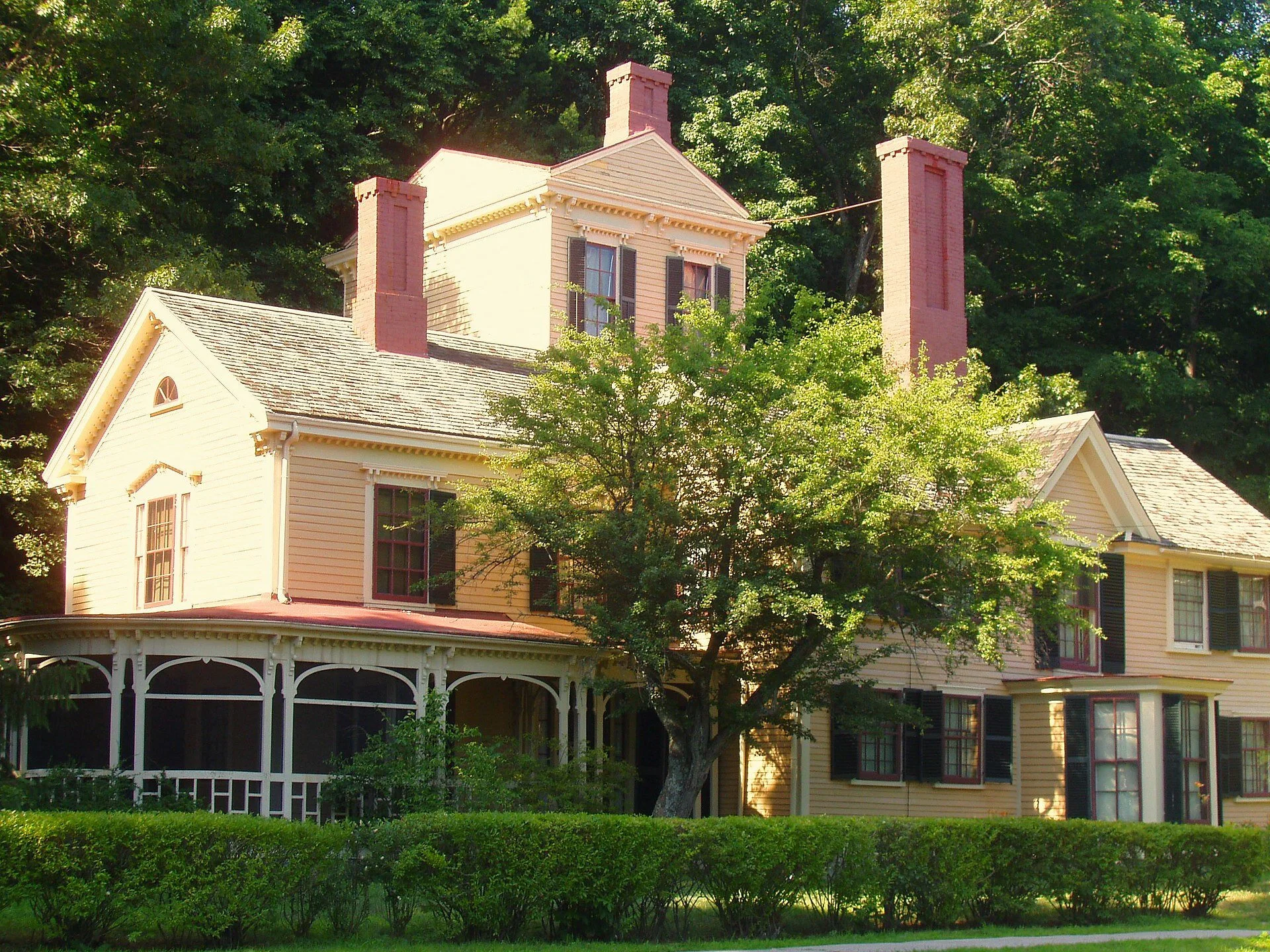
The Wayside, in Concord, Mass., home in turn to the Alcott family, novelist Nathaniel Hawthorne and writer and publisher “Margaret Sidney’’ (a nom de plume )— real name was Harriett Lothrop.
—- Photo by Dadero
“I perceive that I am neither a planter of the backwoods, pioneer, nor settler there, but an inhabitant of the Mind, and given to friendship and ideas. The ancient society, the Old England of New England, Massachusetts for me.”
— Amos Bronson Alcott (1799-1888), an American teacher, writer, philosopher and reformer, father of writer Louisa May Alcott (Little Women, etc.) and member of the famous literary community of Concord, Mass.
'Eccentrics sanctuary'
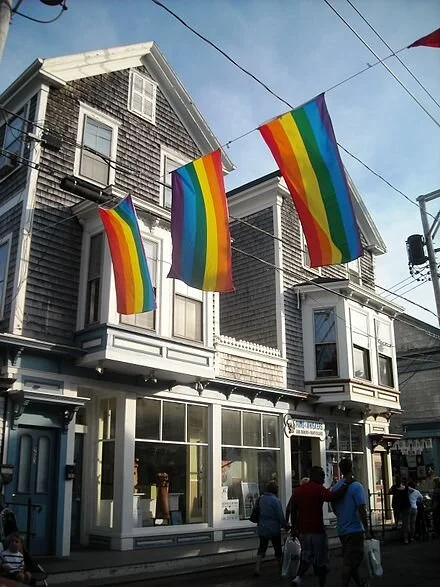
On Commercial Street in Provincetown
“Provincetown is, has always been, an eccentrics’ sanctuary, more or less the way other places are bird sanctuaries or wild game preserves. It is the only small town I know of where those who live unconventionally seem to outnumber those who live within the prescribed boundaries of home and licensed marriage, respectable jobs and biological children. It is where people who were the outcasts and untouchables in other towns can become prominent members of society.’’
-- Michael Cunningham (born 1952) is a novelist and screenwriter.
Needed over Washington
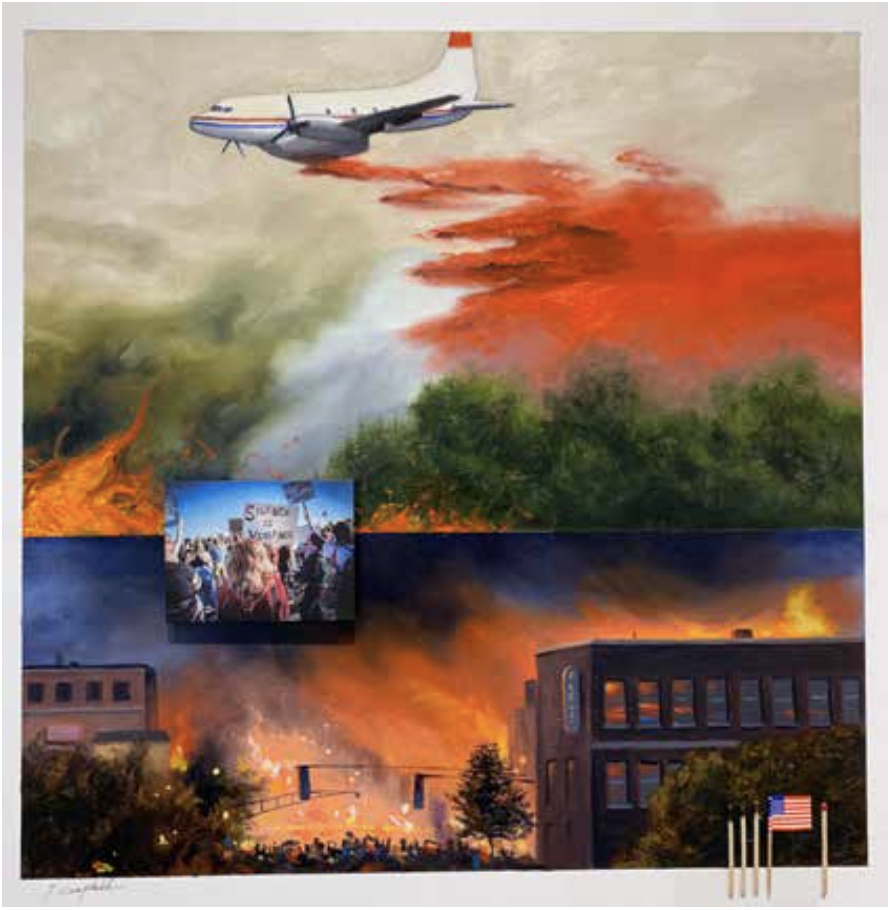
“On Fire” ( mixed media) by Peter Campbell, in the Attleboro Art Museum members show
'Like a sound'

— Photo by User:Fir0002
Dark hills at evening in the west,
Where sunset hovers like a sound
Of golden horns that sang to rest
Old bones of warriors under ground,
Far now from all the bannered ways
Where flash the legions of the sun,
You fade—as if the last of days
Were fading, and all wars were done.
“Dark Hills,’’ by Edward Arlington Robinson (1869-1935), a Maine native and one of the most celebrated New England poets

Edward Arlington House, in Gardiner, Maine, where he spent his unhappy childhood
Coming soon: Applied Science Zoom Summits hosted by UMass
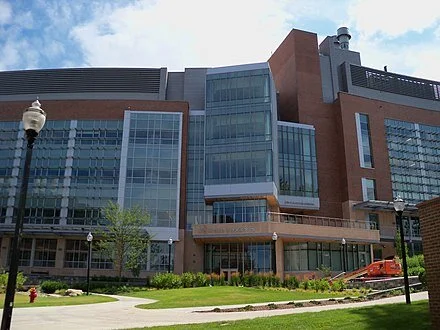
Life sciences laboratory building at UMasss Amherst
From The New England Council (newenglandcouncil.com)
The University of Massachusetts will host a series of Applied Science Zoom Summits in late January – early February 2021. Through these virtual programs, UMass aims to engage the business community in the broad range of research conducted by the university system that is relevant to innovation across many industries in throughout New England and beyond. The mission is to start a conversation about translational research they have underway on their five campuses and the “next frontiers” ripe for exploration in the academy and in industry.
Interested New England Council members are invited to participate in the following Applied Science Zoom Summits:
Advanced Manufacturing – Monday, January 25, 2021
Aerospace, Defense, Undersea Technology and Remote Sensing – Tuesday, January 26, 2021
Sustainability and Climate Resilience: Coastal Communities, Energy, and Transportation—Friday, January 29, 2021
Artificial Intelligence, Robotics, Data Science—Monday, Feb 8, 2021
Data-Driven and Technology-Informed Precision Health – Wednesday, Feb 10, 2021
Applied Life Sciences – Thursday, Feb 11, 2021
At these 90-minute summits, each held from 3:30-5:00 p.m., UMass scientists will explore the most advanced research underway in these fields with an emphasis on the problems they solve and the applications they have to industry. After a plenary session, the audience will be able to join break out sessions to discuss the “grand challenges” in each field that will occupy science and industry in next 5-10 years.
Please use the links above for more information on each session, and to register. The New England Council is grateful to UMass for extending the invitation to our members and encourage you to take advantage of the opportunity to participate in these important discussions.

Llewellyn King: Internet companies and freedom of speech
Google headquarters, in Mountain View, Calif.
WEST WARWICK, R.I.
H.L. Mencken, journalist and essayist, wrote in 1940, “Freedom of the press is limited to those who own one.”
Twenty years later, the same thought was reprised by A.J. Liebling, of The New Yorker.
Today, these thoughts can be revived to apply, on a scale inconceivable in 1940 or 1960, to Big Tech, and to the small number of men who control it.
These men -- Jack Dorsey, of Twitter, Mark Zuckerberg, of Facebook, and Sundar Pichai, of Alphabet Inc., and its subsidiary Google -- operate what, in another time, would be known as “common carriers.” Common carriers are, as the term implies, companies that distribute anything from news to parcels to gasoline. They are a means of distributing ideas, news, goods, and services.
Think of the old Western Union, the railroads, the pipeline companies or the telephone companies. Their business was carriage, and they were recognized and regulated in law as such: common carriers.
The controversial Section 230 of the Communications Decency Act recognizes the common carrier nature of Big Tech internet companies by exempting them from libel responsibility. It specifically stated that they shouldn’t be treated as publishers. Conservatives want 230 repealed, but that would only make the companies reluctant to carry anything controversial, hurting free speech.
I think that the possible repeal of 230 should be part of a large examination of the inadvertently acquired but vast power of the Internet-based social-media companies. It should be part of a large discussion embracing all the issues of free speech on social media which could include beefed-up libel statutes -- possibly some form of the equal-time rule which kept network owners from exploiting their power for political purposes in days when there were only three networks.
President Trump deserves censure, which he has gotten: He has been impeached for incitement to insurrection. I take second place to no one in my towering dislike of him, but I am shaken at the ability of Silicon Valley to censor a political figure, let alone a president.
That Silicon Valley should shut out the voice of the president isn’t the issue. It is that a common carrier can dictate the content, even if it is content from a rogue president.
This exercise of censor authority should alarm all free-speech advocates. It is power that exceeds anything ever seen in media.
The heads of Twitter, Facebook and Alphabet are more powerful by incalculable multiples than were Joseph Pulitzer, William Randolph Hearst and Henry Luce, or is Rupert Murdoch. They can subtract any voice from any debate if they so choose. That is a bell that tolls for all. They have the power to silence any voice by closing an account.
When Edward R. Murrow talked about the awesome power of television, he was right for that time. But now technology has added a multiplier of atomic proportions via the Internet.
The internet-based social media giants didn’t seek power. They are, in that sense, blameless. They pursued technology, then money, and these led them to their awesome power. What they have done, though, is to use their wealth to buy startups which offer competition.
Big Tech has used its financial clout to maintain its de facto monopolies. Yet unlike the newspaper proprietors of old or Murdoch’s multimedia, international endeavors today, they didn’t pursue their dreams to get political power. They were carried along on the wave of new technologies.
It may not be wrong that Twitter, Facebook and others have shut down Trump’s account when they did, at a time of crisis, but what if these companies get politically activated in the future?
We already live in the age of the cancellation culture with its attempt to edit history. If that is extended to free speech on the Internet, even with good intentions, everything begins to wobble.
The tech giants are simply too big for comfort. They have already weakened the general media by scooping up most of the advertising dollars. Will the freedom of speech belong to those who own the algorithms?
Llewellyn King is executive producer and host of White House Chronicle, on PBS. His email is llewellynking1@gmail.com. He’s based in Rhode Island and Washington, D.C.
Linda Gasparello
Co-host and Producer
"White House Chronicle" on PBS
Mobile: (202) 441-2703
Website: whchronicle.com
Thanks!1940, “Freedom of the press is limited to those who own one.”
Twenty years later, the same thought was reprised by A.J. Liebling of The New Yorker.
Today, these thoughts can be revived to apply, on a scale inconceivable in 1940 or 1960, to Big Tech, and to the small number of men who control it.
These men -- Jack Dorsey of Twitter, Mark Zuckerberg of Facebook, and Sundar Pichai of Alphabet Inc., and its subsidiary Google -- operate what, in another time, would be known as “common carriers.” Common carriers are, as the term implies, companies which distribute anything from news to parcels to gasoline. They are a means of distributing ideas, news, goods, and services.
Think of the old Western Union, the railroads, the pipeline companies, or the telephone companies. Their business was carriage, and they were recognized and regulated in law as such: common carriers.
The controversial Section 230 of the Communications Decency Act recognizes the common carrier nature of Big Tech internet companies by exempting them from libel responsibility. It specifically stated that they shouldn’t be treated as publishers. Conservatives want 230 repealed, but that would only make the companies reluctant to carry anything controversial, hurting free speech.
I think the possible repeal of 230 should be part of a large examination of the inadvertently acquired but vast power of the internet-based social media companies. It should be part of a large discussion embracing all the issues of free speech on social media which could include beefed-up libel statutes -- possibly some form of the equal-time rule which kept network owners from exploiting their power for political purposes in days when there were only three networks.
President Donald Trump deserves censure, which he has gotten: He has been impeached for incitement to insurrection. I take second place to no one in my towering dislike of him, but I am shaken at the ability of Silicon Valley to censor a political figure, let alone a president.
That Silicon Valley should shut out the voice of the president isn’t the issue. It is that a common carrier can dictate the content, even if it is content from a rogue president.
This exercise of censor authority should alarm all free-speech advocates. It is power that exceeds anything ever seen in media.
The heads of Twitter, Facebook and Alphabet are more powerful by incalculable multiples than were Joseph Pulitzer, William Randolph Hearst and Henry Luce, or is Rupert Murdoch. They can subtract any voice from any debate if they so choose. That is a bell that tolls for all. They have the power to silence any voice by closing an account.
When Edward Murrow talked about the awesome power of television, he was right for that time. But now technology has added a multiplier of atomic proportions via the internet.
The internet-based social media giants didn’t seek power. They are, in that sense, blameless. They pursued technology, then money, and these led them to their awesome power. What they have done, though, is to use their wealth to buy startups which offer competition.
Big Tech has used its financial clout to maintain its de facto monopolies. Yet unlike the newspaper proprietors of old or Murdoch’s multimedia, international endeavors today, they didn’t pursue their dreams to get political power. They were carried along on the wave of new technologies.
It may not be wrong that Twitter, Facebook, and others have shut down Trump’s account when they did, at a time of crisis, but what if these companies get politically activated in the future?
We already live in the age of the cancellation culture with its attempt to edit history. If that is extended to free speech on the internet, even with good intentions, everything begins to wobble.
The tech giants are simply too big for comfort. They have already weakened the general media by scooping up most of the advertising dollars. Will the freedom of speech belong to those who own the algorithms?
Llewellyn King is executive producer and host of “White House Chronicle” on PBS. His email is llewellynking1@gmail.com.
Linda Gasparello
Co-host and Producer
"White House Chronicle" on PBS
Mobile: (202) 441-2703
Website: whchronicle.com
Thanks!
Coast painting

“Metal Scape Navy 1’ (encaustic painting), by Charyl Weissbach, in the show at The New Bedford Art Museum, Jan. 21-March 14. Her studio is in Boston’s SoWa arts district.
(Timed-Ticket Reception: 3/13/2021, 12-2 PM)
Featuring: Willa Vennema, Stephanie Roberts-Camello, Pamela Dorris DeJong, Lola Baltzell, Nancy Whitcomb, Lia Rothstein, Deborah Peeples, Kay Hartung, Marina Thompson, Angel Dean, Lelia Stokes Weinstein, Ruth Sack, Sarah Springer, Charyl Weissbach and Camille Davidson
“Fluid States: New England Wax/New England Waters’’ highlights encaustic artworks inspired by New England’s historic and awe-inspiring coasts. Themed around the fluidity seen in both wax and water, “Fluid States’’ explores New England’s ecological richness and fragility. Protecting our water and the life that depends on it is an urgent necessity. In this exhibition, the artists address this urgency as they work to express water’s sheer beauty through innovative approaches to an ancient medium.
The blessings of January

The Mt. Hope Bridge, connecting the Rhode Island mainland with Aquidneck Island
From Robert Whitcomb’s “Digital Diary,’’ in GoLocal24.com
It’s good that in January in these parts you see the underlying structures of many things, the skeletons of them, so to speak, with the leaves off the deciduous trees and other vegetation reduced, too. More architecture than painting. Another nice thing is that the colors of birds, e.g., cardinals, stand out more vividly against the brown, gray and white of January than they do in greener times.

Marshes in Sandwich, Mass.
— Photo by Andrewrabbott
I love the sere of coastal marshes at this time of year, especially at sunrise and sunset.
Of course, it’s also good to know that winter will end in a few weeks.
January always seemed to me a quiet time in which you can catch your breath, before obligations start piling up again later in the winter – tax returns, etc. It’s a good time to catch up on sleep.
We send out a lot of New Year’s cards well into this month. They arrive more reliably at their destinations than Christmas cards, especially this past holiday season, what with the pandemic and damage to the U.S. Postal Service by the Trump regime under its corrupt postmaster general, Louis DeJoy. (Being corrupt and slavishly, even criminally, loyal have often seemed to be the main requirements for high-level employment in this destructive regime.)
Driving to Newport on a bright winter’s day, with shimmering views from the bridges of the Ocean State’s archipelago, is exhilarating, as is sitting with an old friend at the all-weather patio of a mostly empty restaurant on the Newport waterfront with the light pouring in. But let’s hope that the eatery is crowded come spring.
'Foundation of all free government'
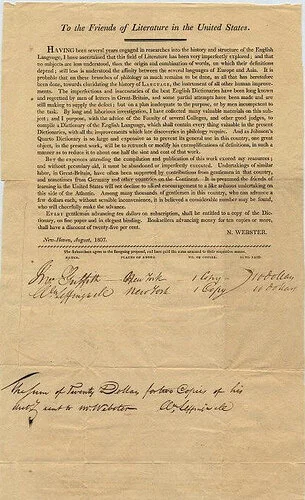
“To the Friends of Literature in the United States,’’ Webster's prospectus for his first dictionary of the English language, 1807–1808
“The foundation of all free government and all social order must be laid in families and in the discipline of youth. Young persons must not only be furnished with knowledge, but they must be accustomed to subordination and subjected to the authority and influence of good principles. It will avail little that youths are made to understand truth and correct principles, unless they are accustomed to submit to be governed by them.”
― Noah Webster. (1758-1843) an American lexicographer, textbook pioneer, English-language spelling reformer, political writer, editor and prolific author. Webster's name has become synonymous with "dictionary" in the United States, especially the modern Merriam-Webster dictionary that was first published in 1828 as A Dictionary of the English Language. He was born in Hartford and died in New Haven. He’s an example of the New England enthusiasm for education that goes back to Puritan times.
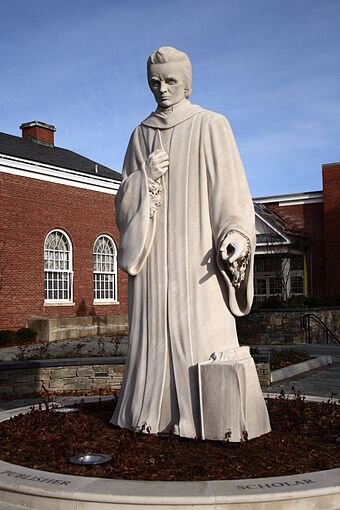
A 1932 statue of Webster by Korczak Ziółkowski stands in front of the public library of West Hartford, Conn.
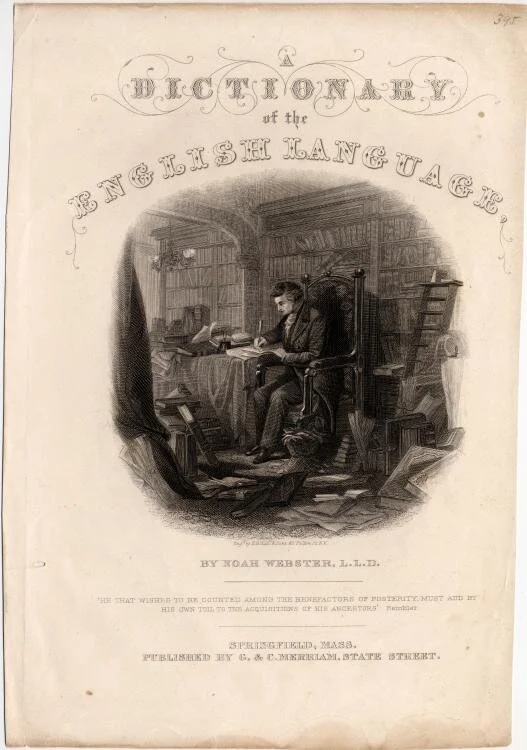
Title page of Webster's Dictionary of the English Language, c. 1830–1840
Get out your flood insurance
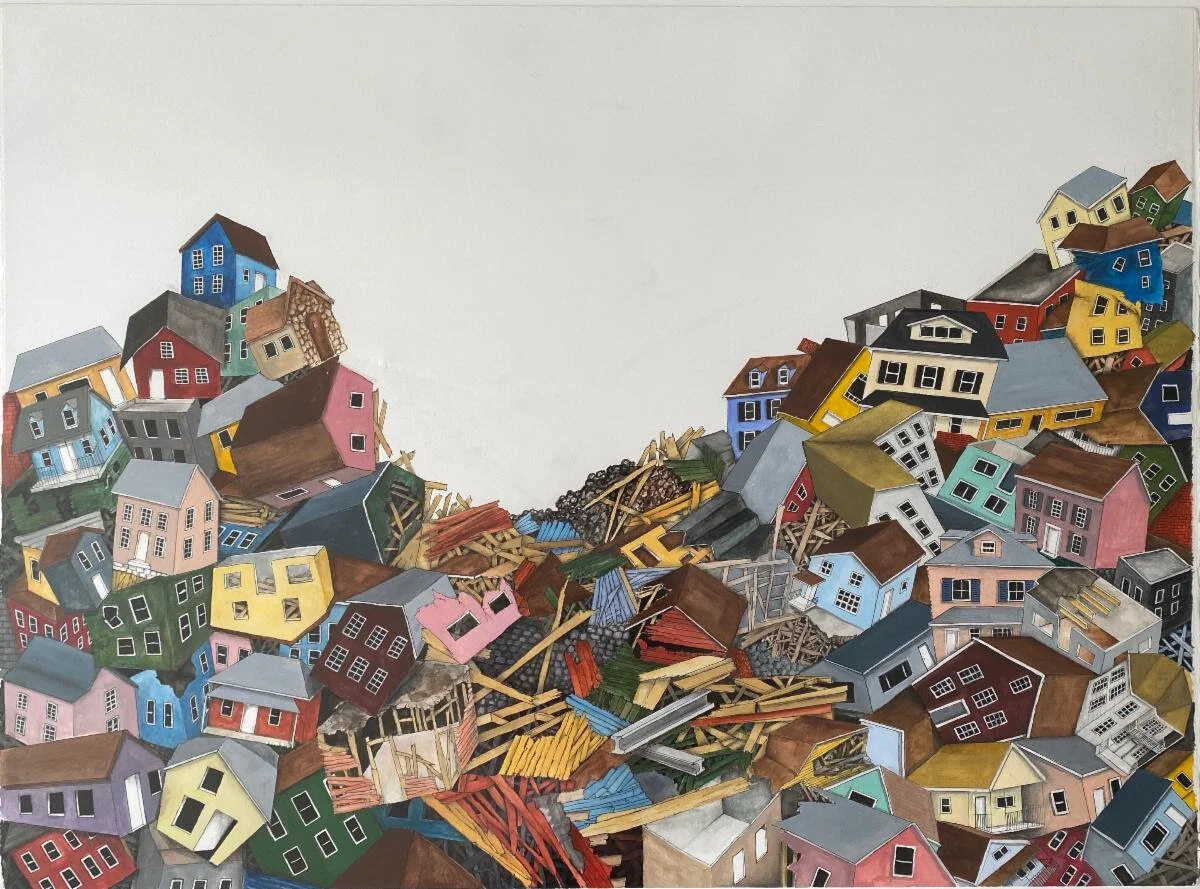
“Hireath 1 ‘‘ (ink, charcoal, and gouache on paper) by Vermont-based artist Susan Greer Emmerson, in her show “Unraveling,’’ at Kingston Gallery, Boston, March 3-28.
The gallery says:
“The home, as a physical and metaphorical space, seemingly exists as a constant. It is a place of return, respite, and stability even when the outside world is in chaotic flux. Emmerson (a former surgeon), however, sees the safety of home as an illusion. In her solo exhibition, paintings on paper of brightly colored houses are violently crushed together in torrential waves, evoking the physical destruction of man-made climate disasters. Other structures are in piles of debris, still retaining their original form, but gone from their foundation and neighborhoods. “
Says Emmerson, “This past year has changed the relationship many have with home. For some, it has been a site of confinement, of forced isolation and loneliness. It has been a place to grieve normalcy and human lives.” It has also been a space that has been stable one month and gone the next, either by destruction or mass evictions. Emmerson’s work evokes the Welsh word “hiraeth”, the profound homesickness and nostalgia for a home you cannot return to, or one that may never have existed.
View select high-resolution images here.
Image credit: Susan Greer Emmerson, Hireath 1 (2020) ink, charcoal, and gouache on paper, 22” x 30”, 2020, courtesy of the artist.
Grace Kelly: Book author touts easy, healing walks
Marjorie Hollman Turner
From ecoRI News (ecori.org)
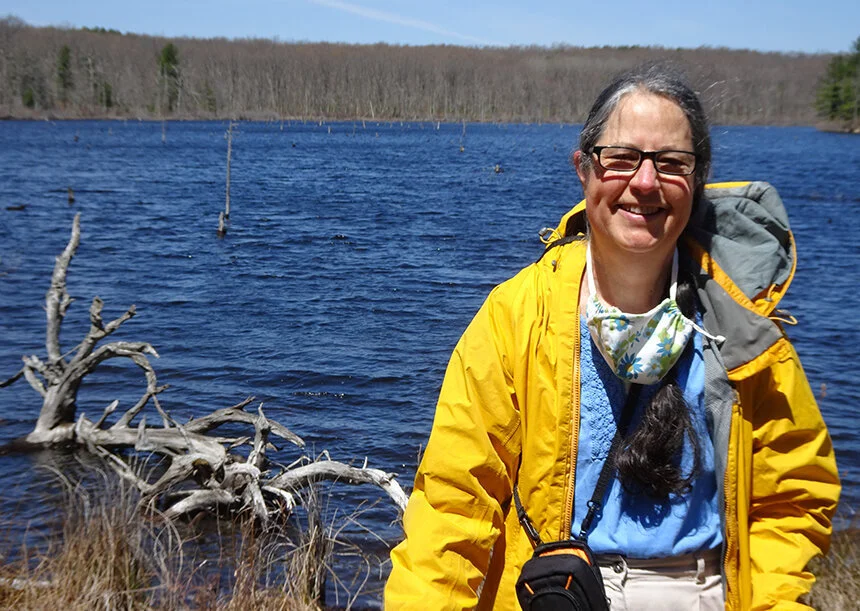
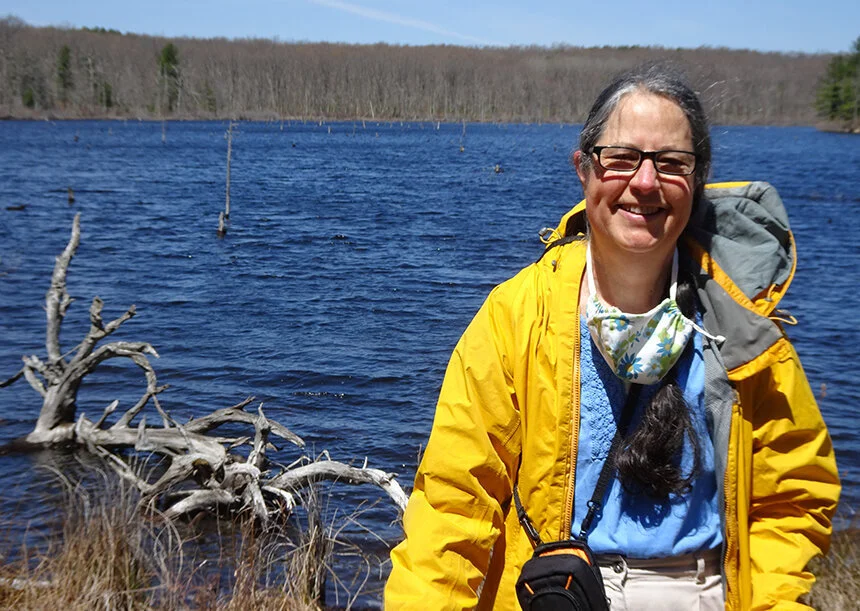
Thirty years ago Marjorie Turner Hollman found her right side paralyzed after brain surgery. She was unable to drive in the seven years of recovery that followed and turned to writing and taking walks down her dead-end road for solace.
When she met her second husband, an avid outdoorsman, she slowly began to move beyond handicap-accessible walks to what she now calls “easy walks.”
“If I had not found myself on a hospital bed paralyzed after brain surgery, I wouldn’t be doing easy walks,” said Turner Hollman, who lives in Bellingham, Mass., which is just over the Rhode Island border near Cumberland. “I have healed to the extent that I am able to walk with support, meaning hiking poles, and I’m very selective of where I choose to walk. I’m not your Appalachian Mountain Club material.”
Over the years, Turner Hollman sought out more of these easy walks, which she defines as “walks that don’t have too many roots, don’t have too many rocks, are relatively level … with something of interest along the way.”
In essence, walks that children, people with mobility issues, and those new to the outdoors can enjoy. Anyone, really.
And as Turner Hollman started her easy walks, she began to chronicle them — and the natural world around her — first for her local newspaper and later on her blog. Then, the questions came pouring in.
“I started having people find my Web site and they kept asking the question, Where’s Joe’s Rock?’” Turner Hollman said. “Well, it’s in Wrentham [Mass.] on Route 121 right near the Cumberland line, and after about the 500th time somebody came to that article, I said, ‘Well I think there’s a need here.’”
Turner Hollman wrote her first book, Easy Walks in Massachusetts, in 2014 to provide a one-stop-shop resource for anyone else in the state looking for easy walks. But the process was far from easy, since a lot of the walks she enjoyed weren’t in any guidebooks.
“At the time, they didn’t have any guides for outdoor things here. We’re not the Cape, we’re not in the White Mountains, we don’t have that cache,” she said. “Today, a lot of town offices have put up maps of their conservation areas, but when I started writing these in 2013, there were next to none. I visited town halls and said, ‘Help me!’ or called and said, ‘Do you have properties that kind of fit this?’ I did a lot of legwork.”
Since then, she’s written another three “easy walks” books, one of which was done in conjunction with the Ten Mile River Watershed Council, an organization with offices in Rumford, R.I., and Attleboro, Mass. This two-state watershed contains one of her favorite easy walks, Hunts Mills, which has a man-made dam and waterfall and trails that loop through the woods.
“It’s stunning and incredibly accessible,” Turner Hollman said. “You can even just sit in your car and watch the falls … it’s this hidden away little spot. It’s just a gem.”
In her most recent book, Finding Easy Walks Wherever You Are, Turner Hollman takes the principles of seeking out and enjoying easy walks to a broader level, providing tips and perspectives that anyone can use to seek out a special place to walk anywhere.
“There are plenty of places, but people don’t know how to find them because a lot of the time they’re off the beaten track,” she said. “I encourage people to consider places like, for example, your local cemetery to visit respectfully, understanding its first purpose is not a walking place … but they’re wonderful places to walk and often have paved roadways through them.
“So that’s a lot of what I talk about in finding easy walks wherever you are. It’s providing ideas that people maybe don’t think about.”
The book is also a culmination of Turner Hollman’s personal experience and belief that anyone, regardless of ability, can go on a walk.
“What I’ve learned in sharing Easy Walks is that many people can enjoy these outings, regardless of ability,” she wrote in a blog post from 2015. “Rather than my disability creating a barrier, I’ve found that working with, in spite of, and because of my disability has enriched my life, and the lives of many others. … These days I’m even more determined to search out and point others to places they can enjoy together.”
Grace Kelly is a journalist with ecoRI News.
Mitchell Zimmerman: Of the Nazis and Trump's Fascist mob

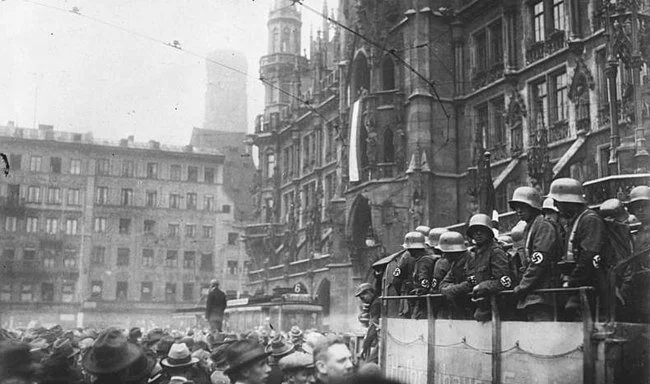
Nazis during the Beer Hall Putsch

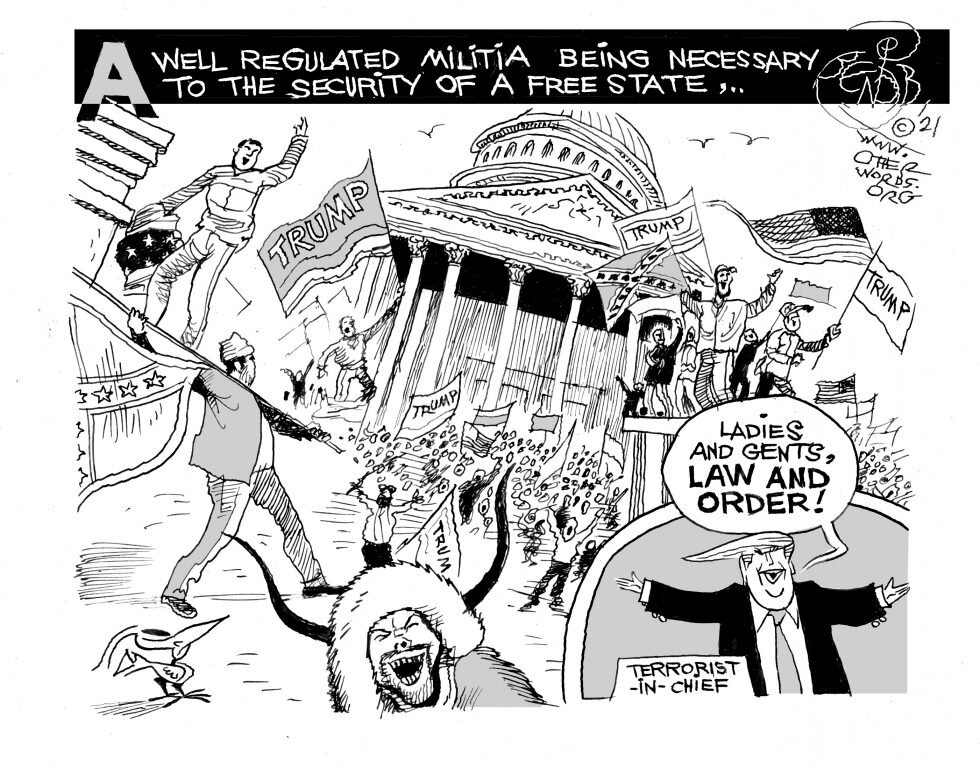
Trump’s fascist mobs, inspired by nonstop lies, invade the Capitol
From OtherWords.org
In 1923, Hitler and the Nazis stormed a beer hall in Munich, Germany, whence they planned to overthrow German democracy. The putsch failed ignominiously, and Hitler was briefly jailed.
That, of course, was not the end of Adolf Hitler. America needs to remember that history if we want to preserve our democracy from the right-wing forces rallied by Donald Trump today.
As Congress gathered to formalize Trump’s election defeat, he and his extremist followers launched their own beer hall putsch. “We will not take it anymore,” Trump told them. “You’ll never take back our country with weakness, you have to show strength.”
With these words, Trump unleashed the frenzied horde.
They breached the barriers around the Capitol and fought their way in, brutally killing a police officer and assaulting many others. They broke into offices, smashed windows, looted, and forced Congress to cease its operations. Outside, they built a gallows.
Many rioters carried weapons and some had plastic handcuffs. Their obvious goal: to take hostages and force Congress to award Trump a second term. A total (so far) of five deaths.
Trump is responsible, but not him alone. The mob he sent had accomplices: a second mob of Republican officials who laid the groundwork by enabling Trump’s lies.
The second mob includes the eight Republican senators and 139 House Republicans who voted against certifying Joe Biden’s election, as well as the 17 Republican attorneys general who supported a bogus lawsuit to throw out the election.
Finally, it includes the Republican office holders who refused to tell their voters the truth: Trump lost. There was no “steal,” as 60 court rulings — including many by Trump-appointed judges — unanimously concluded.
These Republican politicians knew this, but they still insisted that Trump be installed as president, confirming their opposition to elections and hostility to constitutional democracy.
The second mob misled Republican voters so well that 45 percent of them actually support the criminal attack on the Capitol. Those tens of millions of people represent a potential mass base for fascism.
So, what should we do?
First, Trump should be impeached, removed, and charged with inciting a riot and other crimes. And criminal charges are obviously in order for the terrorist violence committed by the first mob. Experts also suggest expelling members of the second mob from Congress or boycotting them from public life.
Accountability is vital. But the Democrats who will now control Congress and the White House must also double down on efforts to restore and strengthen American democracy.
They should act swiftly to limit the power of money in politics, restore the Voting Rights Act, and eliminate needless obstacles to voting. And Washington, D.C., should be admitted as a state, so its citizens have full voting rights and powers.
Finally, the Democratic Party must fight to enact bold programs to deal with the massive problems Americans face — from climate change to the pandemic to the declining living standards of working Americans.
Half-hearted steps will only leave ordinary Americans feeling that that government does not work, priming the pump for more right-wing radicalization. But a full-throated campaign for real, understandable change — even against Republican obstruction — can help voters understand that democracy can work for them when it isn’t hijacked by the super-rich and their servants.
The assault on the Capitol has uncovered the true nature of right-wing Republican politics in America: a thinly veiled war on constitutional democracy and majority rule. The way to prevent the next authoritarian coup attempt is to build a robust democracy that demonstrates it is responsive to the needs and interests of real people.
A slap on the wrist for the coup plotters and a swift return to the status quo isn’t enough, as the beer hall putsch should have taught us. We need a real commitment to reverse the erosion of our democracy.
Mitchell Zimmerman is a lawyer, social activism and author of the thriller Mississippi Reckoning.

Don't burn it for electricity!

In Beartown State Forest, in The Berkshires

The Sandwich Range, in the White Mountain National Forest
From Robert Whitcomb’s “Digital Diary,’’ in GoLocal24.com
I like to sit by a crackling log fire as much as the next person. Indeed, we recently bought a backyard fire pit as a way to expand our winter living space in these times of pandemic claustrophobia. Even a lot of people burning logs in fire pits or fireplaces produce relatively minor pollution. It’s a compact, sensual, aesthetic experience.
Of course, with most fireplaces, having a fire loses your house more warmth than it gains, as it draws heat from the house up the chimney. Still, it’s very pleasant, if you can sit close enough to it.
In any event, Massachusetts Gov. Charlie Baker’s administration is wrong to let wood-burning electric-power plants that now don’t meet state environmental standards get subsidies from rate payers. Yes, New England has lots of wood, but burning it in large quantities to generate electricity would mean much higher carbon emissions in the region, worsening global warning. Cutting down a lot more trees would obviously reduce forests’ ability to absorb carbon dioxide and emit oxygen, as well as harm wildlife and increase erosion by water.
Such clean-energy sources as solar, wind and geothermal are becoming cheaper and more efficient by the year. They’re the way to go. Burning wood to generate electricity is a terrible idea.
By the way, I remember that back in the days before Jiffy Pop and microwave stoves, how much fun it was to pop corn by putting the seeds in a screened frame over the fire and constantly shaking and flipping it. It took close attention but the popcorn you got seemed tastier than what you get now, or maybe that’s just misleading nostalgia. Of course, we soaked the product in butter and sprinkled on lots of salt: a slow-motion heart-disease developer.
xxx
Another sign that Massachusetts will continue to be a very rich state: Despite the pandemic and the national recession, it caused state tax revenues rose 8.8 percent in December from the year-earlier, pre-COVID month!