
It might go up after all
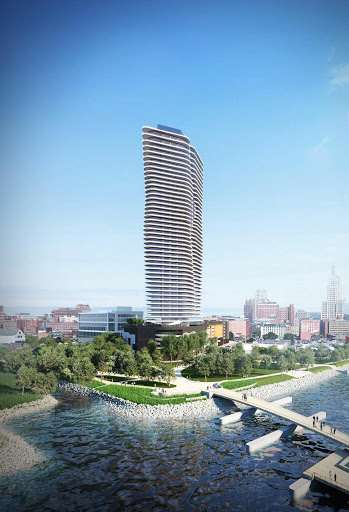
The controversial Hope Point Tower
From Robert Whitcomb’s “Digital Diary,’’ in GoLocal24.com
I’m surprised to be saying this, but at this writing, it looks likely that a development group run by Jason Fane will build a $300 million, 46-story luxury residential lower, to be named Hope Point Tower, in Providence’s Route 195 relocation district. I’m surprised because I didn’t think that Mr. Fane would get the financing, especially when the pandemic makes downtown developments look like bad bets and Mr. Fane continues to face loud and well-organized opposition from some establishment groups.
Rhode Island Superior Court Judge Brian Stern recently okayed the project, ruling that the City Council was within its rights in approving it. Foes, including Mayor Jorge Elorza, will appeal to the state Supreme Court, but that seems very unlikely to succeed.
So what’s the economic rationale for continuing with this project in a time of pandemic and the deep recession it’s causing? I think it’s that even now, mid-size cities such as Providence with prestigious colleges and rich cities nearby -- in Providence’s case New York and Boston -- and in scenic areas, can look alluring. There would be stirring views from the upper stories of the Fane Tower, though, of course, its great height is what its foes would most hate about it – until, that is, they got used to it, if they ever do….
And COVID-19 has made big cities scary for many people, leading many affluent folks to seek to set up homes in less crowded places, even if they, too, are cities and even if some, like Providence, now have high COVID rates, too. And some of the units in the Fane tower would be bought or rented by the many very rich parents of students at Brown University and the Rhode Island School of Design. And the pandemic will end, sometime in 2021.
Then there’s the prospect of hundreds of construction jobs at the Fane Tower – a great allure for the state’s politically powerful construction unions.
So this huge project remains very much alive, as Mr. Fane looks to what Providence might look like after the pandemic.
Perhaps not a bad thing
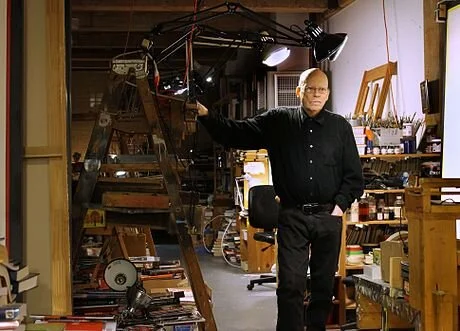
Laffoley in his studio
“Boston is not an avant-garde place. It stays literally 15 to 20 years behind New York at all times.’’
— Paul Laffoley (1935- 2015), Boston architect and visionary artist
Work goes on after the storm
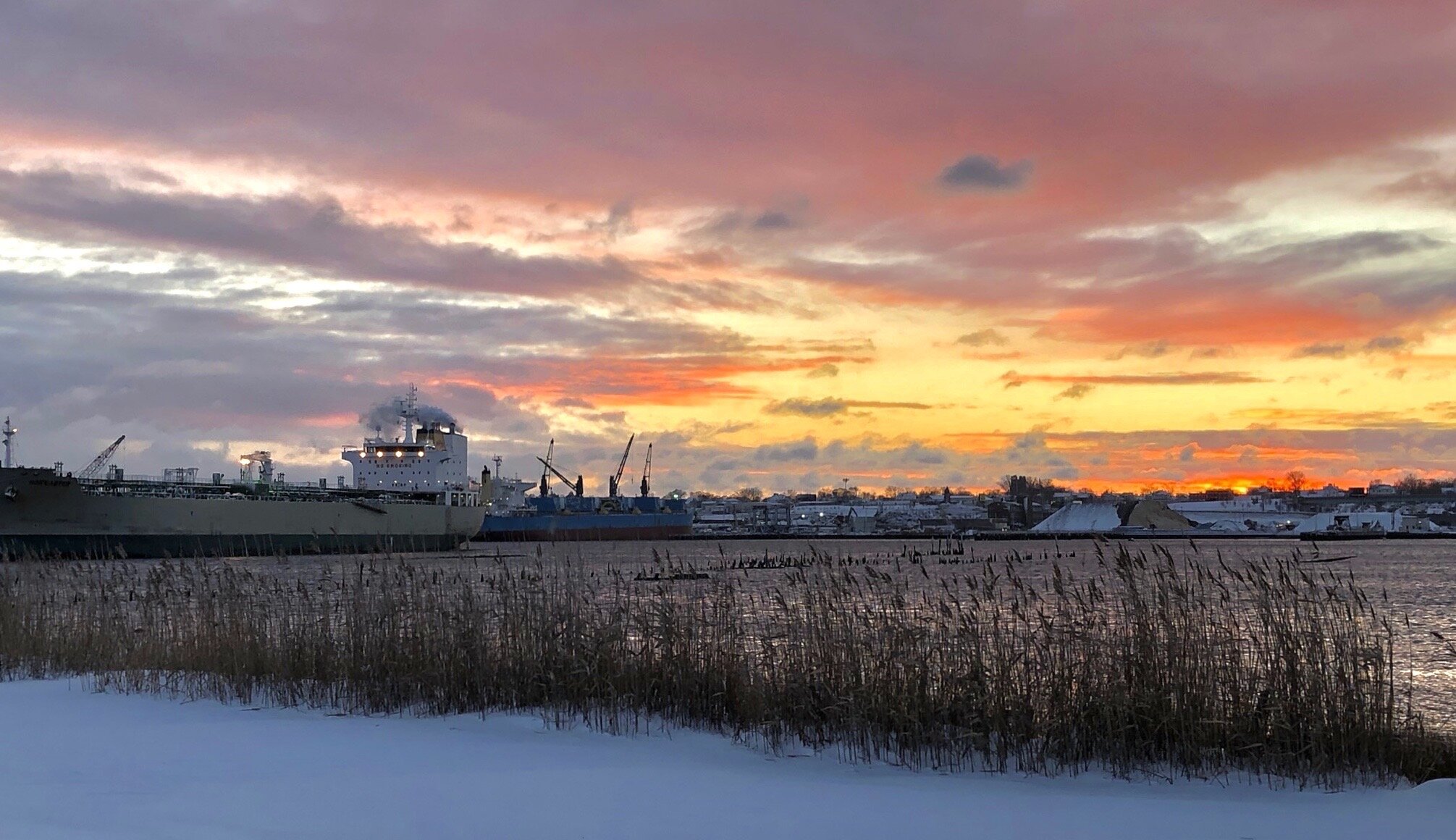
Southeastern New England’s first snowstorm of the month ended late in the day on Dec. 17, when the dramatic skies – looking like a 19th-Century Romantic landscape painting –announced a change in the weather. Life went on, as it always has during a New England winter. Two large ships were in Providence’s harbor: a tanker unloading oil to East Providence and the cranes on the other vessel being used to load something, perhaps scrap metal.
Photo and caption by William Morgan, a Providence-based writer and photographer. His latest book is Snowbound: Dwelling in Winter.
Chris Powell: America’s vacuous higher-ed credentialism steams on as we neglect lower ed
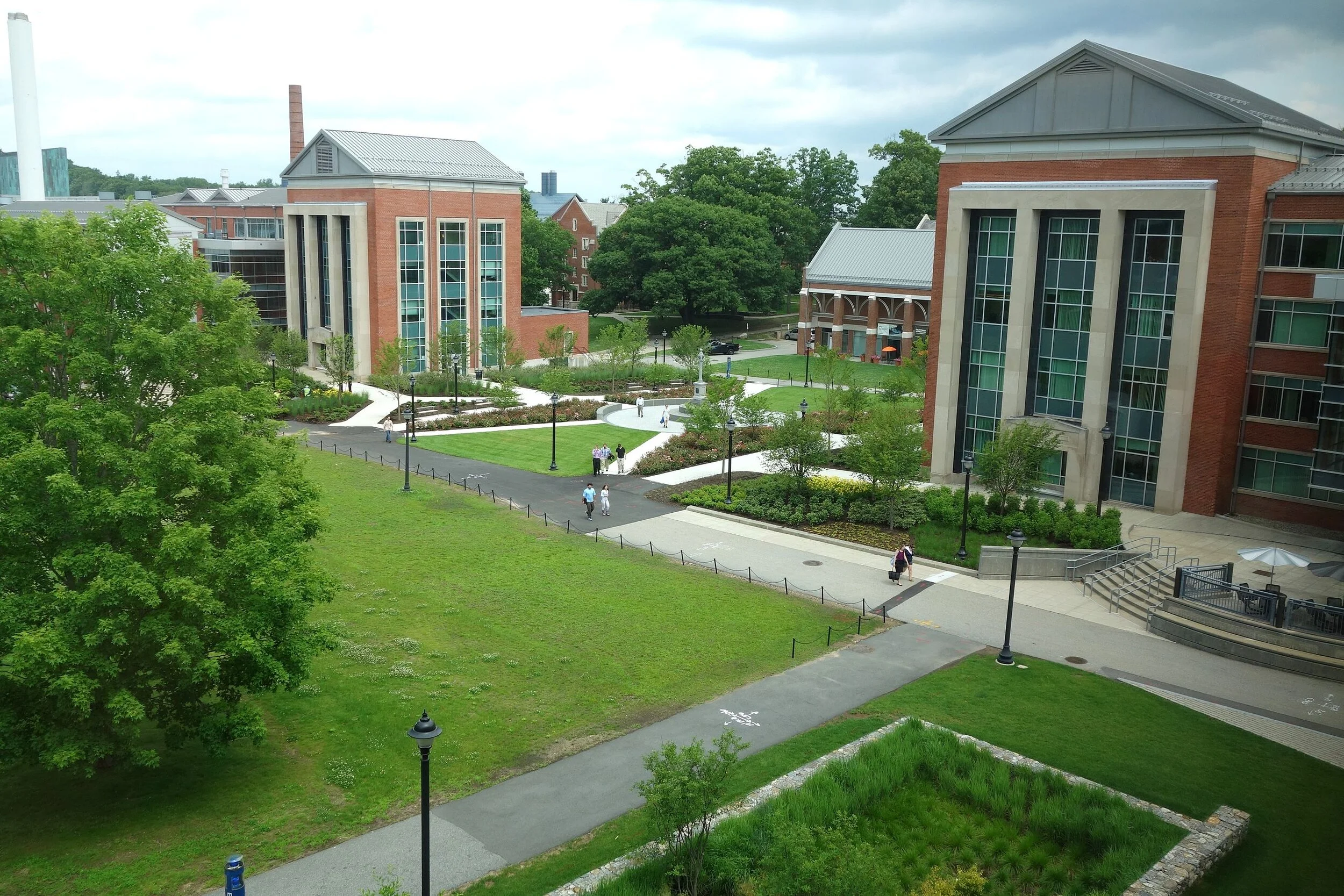
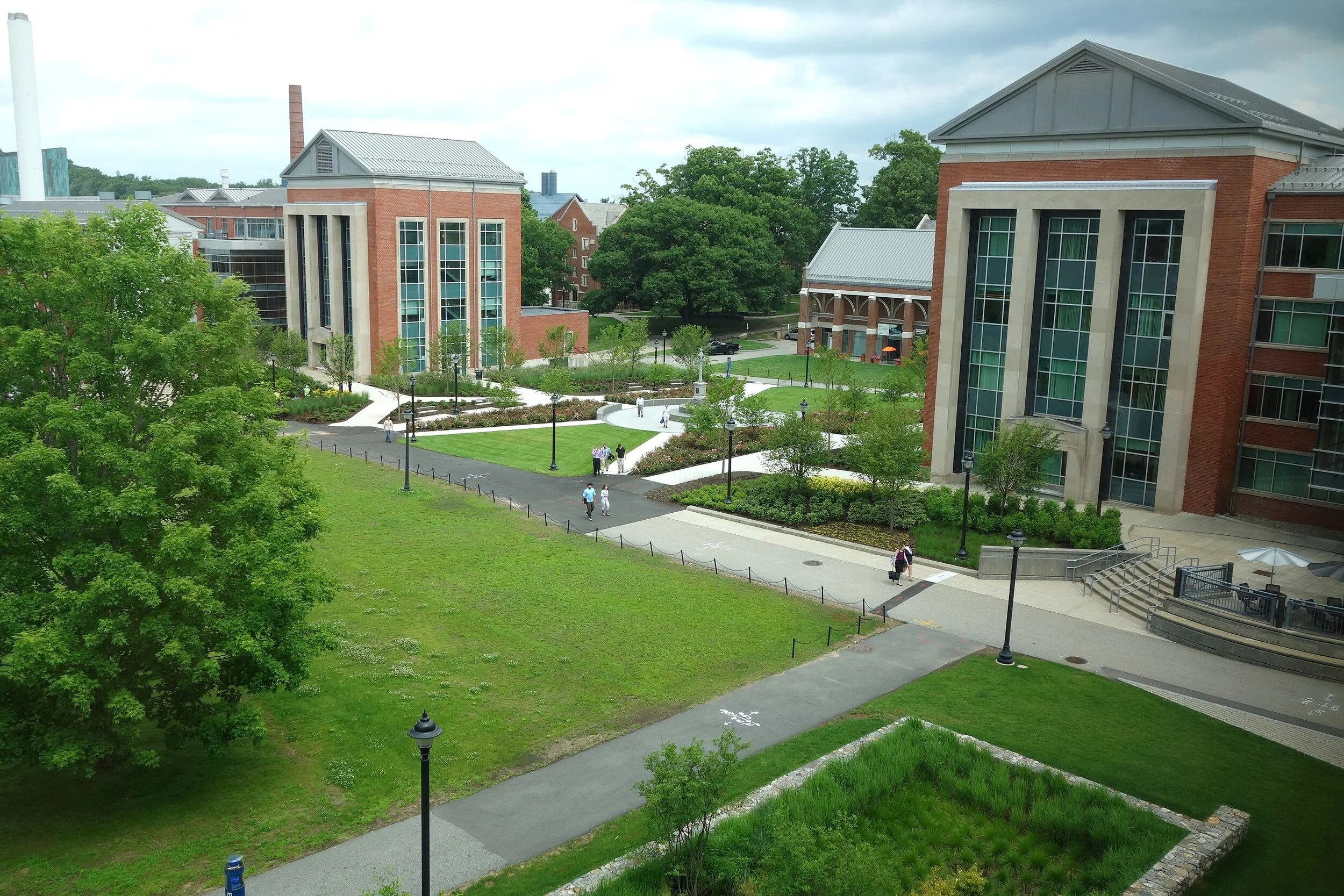
The main quad on the flagship campus of the University of Connecticut, in Storrs
MANCHESTER, Conn.
As was inscribed on the pedestal of the statue of college founder Emil Faber in the movie Animal House, "Knowledge is good." But knowledge can be overpriced, as the growing clamor about college student loan forgiveness soon may demonstrate.
President-elect Joe Biden and Democrats in the new Congress will propose various forms of forgiveness, and this will have the support of Connecticut's congressional delegation, all of whose members are Democrats.
Student-loan debt is huge, estimated at $1.6 trillion, and five Connecticut colleges were cited last week by the U.S. Education Department for leaving the parents of their students with especially high debt. There are many horror stories about borrowers who will never be able to pay what they owe.
But those horror stories are not typical. Most student-loan debt is owed by people who can afford to pay and are from families with higher incomes. Relief for certain debtors may be in order, but then what of the students who sacrificed along with their parents to pay their own way through college? What will they get for their conscientiousness? Only higher taxes and a devaluing currency.
Student-loan debt relief should not be resolved without an investigation of what the country has gotten for its explosion of spending on higher education. Has all the expense been worthwhile?
Probably not even close. A 2014 study by the Federal Reserve Bank of New York found that many college graduates end up in jobs that don't require college education. A similar study a year earlier by the Center for College Affordability and Productivity reported that there were 46 percent more college graduates in the U.S. workforce than there were jobs requiring a college degree and that degrees were held by 25 percent of sales clerks, 22 percent of customer-service representatives, 16 percent of telemarketers, 15 percent of taxi drivers and 14 percent of mail carriers.
Of course, that doesn't mean that college grads who went into less sophisticated jobs didn't enjoy college, learn useful things and increase their appreciation of life. But those who accrued burdensome debt only to find themselves in jobs that can't easily carry it may feel cheated.
Some consolation is that college grads tend to earn more over their lifetimes than other people. But is this because of increased knowledge and skills, or because of the credentialism that higher education has infected society with? If it is mere credentialism, college is a heavy tax on society.
Public education in Connecticut may be more credentialism than learning, since, on account of social promotion, one can get a high-school diploma here without having learned anything since kindergarten and can earn a degree from a public college without having learned much more, public college being to a great extent just remedial high school.
Some people in Connecticut advocate making public-college attendance free, at least for students from poor families. But even for those students would free public college be an incentive to perform well in high school once they discover that they need no academic qualification to get into a public college and that they can take remedial high-school courses there?
Even the student loans and government grants to higher education that underwrite important research and learning are largely subsidies to college educators and administrators, whose salary growth correlates closely with those loans and grants. Many college educators show their appreciation by resenting having to teach mere undergraduates instead of being left alone to do obscure research that has no relevance to curing cancer or averting the next asteroid strike. They prefer to strut around calling each other "Doctor" and "Professor" until the cows come home reciting Shakespeare.
Connecticut's critical neglect, and the country's, is lower education, not higher education, especially now that government is abdicating to the ever-grasping teacher unions by closing schools, where the threat of the virus epidemic is small. This suspends education, socialization, exercise and general growth for the young without protecting those most vulnerable to the virus, the frail elderly. Forgiving college loans won't be much more relevant to education than that crazy policy.
Chris Powell is a columnist for the Journal Inquirer, in Manchester.
Llewellyn King: Electric cars would be a very minor matter for secretary running ‘the Little Pentagon’

The Brutalist Forrestal Building, headquarters of the U.S. Department of Energy, which has a very heavy portfolio of functions.
WEST WARWICK, R.I.
President-elect Joe Biden’s decision to nominate Jennifer Granholm, former governor of Michigan, lawyer, politician and television host, to be the next secretary of energy is curious.
The idea circulating is that her primary assignment, in Biden’s mind, will be to speed Detroit’s development of electric vehicles.
That is hardly the job that Granholm will find confronting her when she heads to the 7th floor of the Forrestal Building, a bare-and-square, concrete structure across from the romantic Smithsonian Castle on Independence Avenue in Washington.
Secretary of energy is one of the most demanding assignments in the government. The Department of Energy is a vast archipelago of scientific, defense, diplomatic and cybersecurity responsibilities. Granholm’s biggest concern, in fact, won’t be energy but defense.
The DOE, nicknamed the Little Pentagon, is responsible for maintaining, upgrading and ensuring the working order of the nation’s nuclear weapons. A critical launch telephone will go with her everywhere. That is where much of the department’s $30 billion or so budget goes.
The energy secretary is responsible for the largest scientific organization on Earth: the 17 national laboratories operated by the department. They aren’t only responsible for the nuclear-weapons program, but also for a huge, disparate portfolio of scientific inquiry, from better materials to fill potholes to carbon capture, storage and utilization; and from small modular reactors for electricity to nuclear power for space exploration.
The national labs are vital in cybersecurity, particularly to assure the integrity of the electric grid and the security of things like Chinese-made transformers and other heavy equipment.
The DOE has the responsibility for detecting nuclear explosions abroad, measuring carbon in the atmosphere, making wind turbines more efficient, and developing the nuclear power plants that drive aircraft carriers and submarines. The department makes weapons materials, like tritium, and supervises the enrichment of uranium.
DOE scientists are looking into very nature of physical matter. They have worked on mapping the human genome and aided nano-engineering development.
Wise secretaries of energy have realized that not only are the national laboratories a tremendous national asset, but they can also be the secretary’s shock troops, ready to do what they are asked -- not always the way with career bureaucrats. Their directors are wired into congressional delegations, including California with Lawrence Livermore, Illinois with Argonne, New Mexico with Los Alamos and Sandia, Tennessee with Oak Ridge, South Carolina with Savannah River.
Verifying compliance with the START nuclear-weapons treaty with Russia falls to the DOE as will, possibly, renegotiating it. Another job would be being part of any future negotiations with Iran over their nuclear materials. Likewise, the energy secretary would be involved if serious negotiations are started with North Korea.
An ever-present headache for Granholm will be the long-term management of nuclear waste from the civilian program as public opposition to the Yucca Mountain site in Nevada is adamant. Also, she will be responsible for vast quantities of weapons-grade plutonium in various sites, but notably at the Pantex site, in Texas, and the Savannah River site in, South Carolina, before it is mixed with an inert substance for burial in Carlsbad, N.M.
Then there are such little things as the strategic petroleum reserve, the future of fracking, reducing methane emissions throughout the natural-gas system, and bringing on hydrogen as a utility and transportation fuel.
DOE has been charged with facilitating natural-gas and oil exports. Now those are subject to the objections of environmentalists.
Smart secretaries have built good relationships early with various Senate and House committees which have oversight of DOE.
James Schlesinger, the first secretary of energy, led the new department with a knowledge of energy from his time as chairman of the Atomic Energy Commission, a knowledge of diplomatic nuclear strategy from his time as director of the CIA, and a knowledge of defense from his time as secretary of defense.
The only other star that has shone as brightly from the 7th floor of the Forrestal Building was President Obama’s energy secretary, Ernie Moniz, a nuclear scientist from MIT who essentially took over the nuclear negotiations with Iran: He and Iranian negotiator Ali Akbar Salehi, a fellow MIT graduate, hammered out the agreement, which was a work of art, a pas de deux, by two truly informed nuclear aficionados.
Compared to the awesome reach of the DOE in other vital areas, electric cars seem of little consequence, especially as Elon Musk with Tesla already has scaled that mountain, and all the car companies are scrambling up behind him.
Llewellyn King is executive producer and host of White House Chronicle, on PBS. His email is llewellynking1@gmail.com and he’s based in Rhode Island and Washington, D.C.
Web site: whchronicle.com
'I'm a g-nu, how d'you do?'
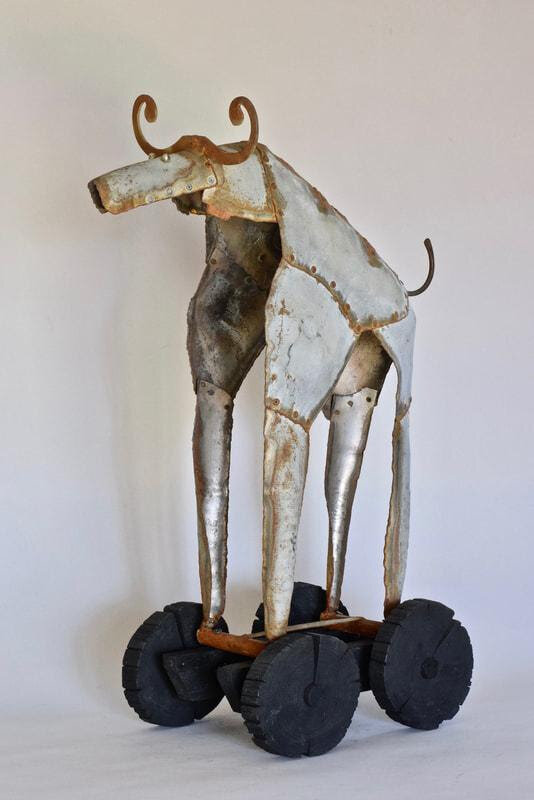
“The Trojan Gnu” (steel, wood, acrylic paint and classical myth, reinterpreted), by Charles Gibbs at Alpers Fine Art, Andover, Mass.
“I'm a g-nu, I'm a g-nu,
The g-nicest work of g-nature in the zoo.
I'm a g-nu, how d'you do?
You really ought to k-now W-ho's W-ho!’’
— From “The Gnu Song,’’ by Flanders and Swann.
Maine mazes
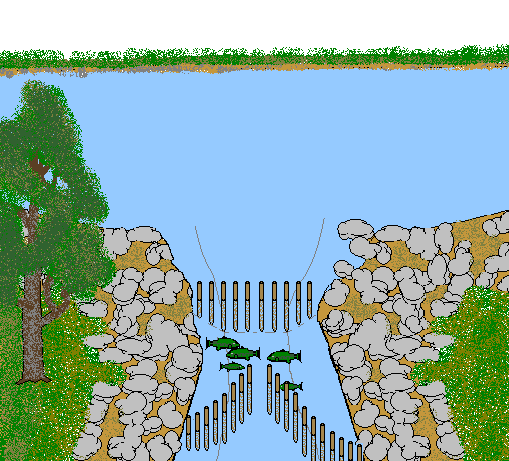
— Picture by Gossman75
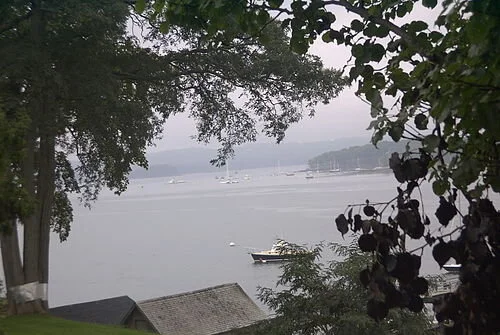
View of the harbor in Castine, Maine, where Robert Lowell spent much time in the summer
“It was a Maine lobster town….
and below us the sea lapped
the raw little match-stick
mazes of a weir…
— From “Water,’’ by Robert Lowell (1917-1977)
Beware adulation of wealth

Portrait of John Hancock by the famed painter John Singleton Copley, c. 1770–1772
“Despise the glare of wealth. {P}eople who pay greater respect to a wealthy villain than to an honest, upright man in poverty almost deserve to be enslaved; they plainly show that wealth, however it may be acquired, is, in their esteem, to be preferred to virtue.’’
— John Hancock (1737-1793) was a very wealthy Boston merchant (mostly from maritime trade) and prominent patriot before, during and after the American Revolution. He was president of the Second Continental Congress and was the first and third governor of the Commonwealth of Massachusetts. He is remembered for his large and stylish signature on the United States Declaration of Independence, so much so that the term "John Hancock" has become a synonym in the United States for one's signature.
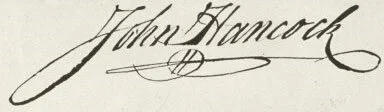
Hancock's signature as it appears on the final copy of the Declaration of Independence

Hancock's memorial in Boston's Granary Burying Ground, dedicated in 1896.

URI creating computer models to assess how environmental change affects the ecosystem of Narragansett Bay

The Charles Blaskowitz Chart of Narragansett Bay published July 22, 1777 at Charing Cross, London
From ecoRI News
A team of scientists at the University of Rhode Island is creating a series of computer models of the food web of Narragansett Bay to simulate how the ecosystem will respond to changes in environmental conditions and human uses. The models will be used to predict how fish abundance will change as water temperatures rise, nutrient inputs vary, and fishing pressure fluctuates.
“A model like this allows you to test things and anticipate changes before they happen in the real ecosystem,” said Maggie Heinichen, a graduate student at the URI Graduate School of Oceanography. “You want to be able to prepare for changes that are likely to happen, so the model provides a starting point to ask questions and see what might happen if different actions are taken.”
Heinichen and fellow graduate student Annie Innes-Gold collaborated on the project with Jeremy Collie, a professor of oceanography, and Austin Humphries, an associate professor of fisheries. They used a wide variety of data collected about the abundance of marine organisms in Narragansett Bay, including life history information on nearly every species of fish that visits the area, and data about environmental conditions.
Their research was published in November in the journal Marine Ecology Progress Series. Additional co-authors on the paper are Corinne Truesdale at the Rhode Island Department of Environmental Management (DEM) and former URI postdoctoral researcher Kelvin Gorospe.
“We built one model to represent the bay in the mid-1990s, the beginning point of the project,” Innes-Gold said, “and another one that represents the current state of the bay. That allowed us to predict how the biomass of fish in the bay would change from a historical point to the present day and see how accurate the model was in its predictions.”
The model correctly predicted whether each group of fish or fished invertebrates would increase or decrease.
The students are now expanding the model using various fishery management scenarios and expected temperature changes to assess its outcomes.
“What if there was no more fishing of a particular species, for instance, or double the fishing? How would that affect the rest of the ecosystem?” Innes-Gold asked. “I’m also incorporating a human behavior model to represent the recreational fishery in Narragansett Bay. I’ve run trials on whether unsuccessful fishing trips affect whether fishermen will come back to fish later, and how that affects the biomass of fish in the bay.”
Heinichen is incorporating the temperature tolerance of various fish species into the model, as well as other data related to how fish behave in warmer water.
“Metabolism rates and consumption rates increase as temperatures go up, and this affects the efficiency of energy transfer through the food web,” she said. “If a fish eats more because it’s warmer, that affects the total predation that another species is subjected to. And if metabolism increases as waters warm, more energy is used by the fish just existing rather than being available to turn it into growth or reproduction.”
In addition, an undergraduate at Brown University, Orly Mansbach, is using the model to see how fish biomass changes as aquaculture activity varies. If twice as many oysters are farmed, for example, how might that impact the rest of the ecosystem?
The URI graduate students said that the models are designed so they can be tweaked slightly with the addition of new data to enable users to answer almost any question posed about the Narragansett Bay food web. They have already met with DEM fisheries managers to discuss how the state agency might apply the model to questions it is investigating.
“We’re making the model open access, so if someone wants to use it for some question yet to be determined, they will have the model framework to use in their own way,” Heinichen said. “We don’t know all the questions everyone has, so we’ve made sure anyone who comes across the model can apply it to their own questions.”
The Narragansett Bay food web model is a project of the Rhode Island Consortium for Coastal Ecology, Assessment, Innovation and Modeling, which is funded by the National Science Foundation.
Thom Hartmann: Mitch McConnell wants to let companies kill you

Meat packing plants have had among the highest workplace infections from COVID-19.
Via OtherWords. org
Probably the most under-reported story of the year has been how Senate Majority Leader Mitch McConnell (R.-Ky.) is holding Americans hostage in exchange for letting big corporations kill Americans without any consequence.
Mitch took you and me hostage back in May, when the House passed the HEROES act that would have funded state and local governments and provided unemployed workers with an ongoing weekly payment.
Mitch refused to even allow the Senate to discuss the HEROES Act until or unless the legislation also legalized corporations killing their workers and customers. That is, McConnell wants to make it impossible to hold corporations legally accountable for COVID-19 infections caused by poor safety practices.
To this day, McConnell refuses to let the HEROES Act even be discussed in the Senate.
Meanwhile we’ve seen companies firing people for refusing to take their lives in their hands, executives organizing real-life betting pools on which employees are going to die first, and companies lying openly to their workers and customers about the dangers of COVID-19.
Mitch McConnell wants to protect them all. Even worse, his immunity can extend well beyond the pandemic and sets up a process that could put corporations above the law permanently, across every community in America, in ways that state and local governments can never defy.
While Republicans have fought against raising the minimum wage or letting workers unionize for over 100 years, what McConnell is doing now is giving corporations the ultimate right: the right to kill their employees and customers with impunity.
And McConnell’s holding your local police and fire departments, public schoolsand state health-care programs hostage in exchange for his corporate immunity.
This is beyond immoral. This is ghastly, and should have been at the top of every news story in America for the past six months. But many of the corporations that are looking forward to complete supremacy over their workers include the giant corporations that own our media.
America has suffered for over 40 years under Reaganism’s mantra, picked up from Milton Friedman, that when corporations focus exclusively on profit an “invisible hand” will guide them to do what’s best for people and communities. It’s a lie.
This is an assault on workers’ rights. But even greater, it’s a corporate assault on human rights. McConnell is saying that a corporation’s right to kill its workers and customers is more important than the lives of human beings.
As unemployment benefits are running out, evictions loom, small businesses are dying left and right, millions of families have been thrown into crisis, and more than 10 million Americans have lost their health insurance, McConnell continues to hold us all hostage.
It’s time to fight back. If corporate media continues to refuse to discuss McConnell’s blackmail, we must individually speak up among friends and communities, and also let our lawmakers know what we think. It’s time to raise some hell.
Thom Hartmann is a talk-show host and the author of The Hidden History of Monopolies: How Big Business Destroyed the American Dream. This op-ed was adapted from CommonDreams.org. He and his wife founded the New England Salem Children’s Village for abused children, in Rumney, N.H.
Related Posts:
OtherWords commentaries are free to re-publish in print and online — all it takes is a simple attribution to OtherWords.org. To get a roundup of our work each Wednesday, sign up for our free weekly newsletter here.
Thom Hartmann is a talk-show host and the author of The Hidden History of Monopolies: How Big Business Destroyed the American Dream. This op-ed was adapted from CommonDreams.org and distributed by OtherWords.org.
Except where otherwise noted, content on this site is licensed under a Creative Commons Attribution-No Derivative 3.0 License.
Using waste to warn of waste

In Danielle O’Malley’s show “Sink or Swim,’’ at Boston Sculptors Gallery through Jan. 10.
The gallery says (here in slightly edited form) that the show “addresses the role of humans in the environmental crisis through a installation composed of hand-built earthenware and up-cycled waste materials collected throughout New England. Nautical buoys, traditionally used as warning beacons or navigational tools, become anthropomorphized industrial objects, warning the viewer about the perils of abuse of the natural world, as well as forcing awareness of their movements as they navigate through the installation. The marriage of these materials is a metaphor for the complexity of humanity’s role in the climate emergency, as well as the potential for society and nature to successfully collaborate and cohabitate. While acknowledging the gravity of the current situation, ‘Sink or Swim’ also offers hope. It is not too late for us to turn to sustainable lifestyles and let the earth to regain its health.’’
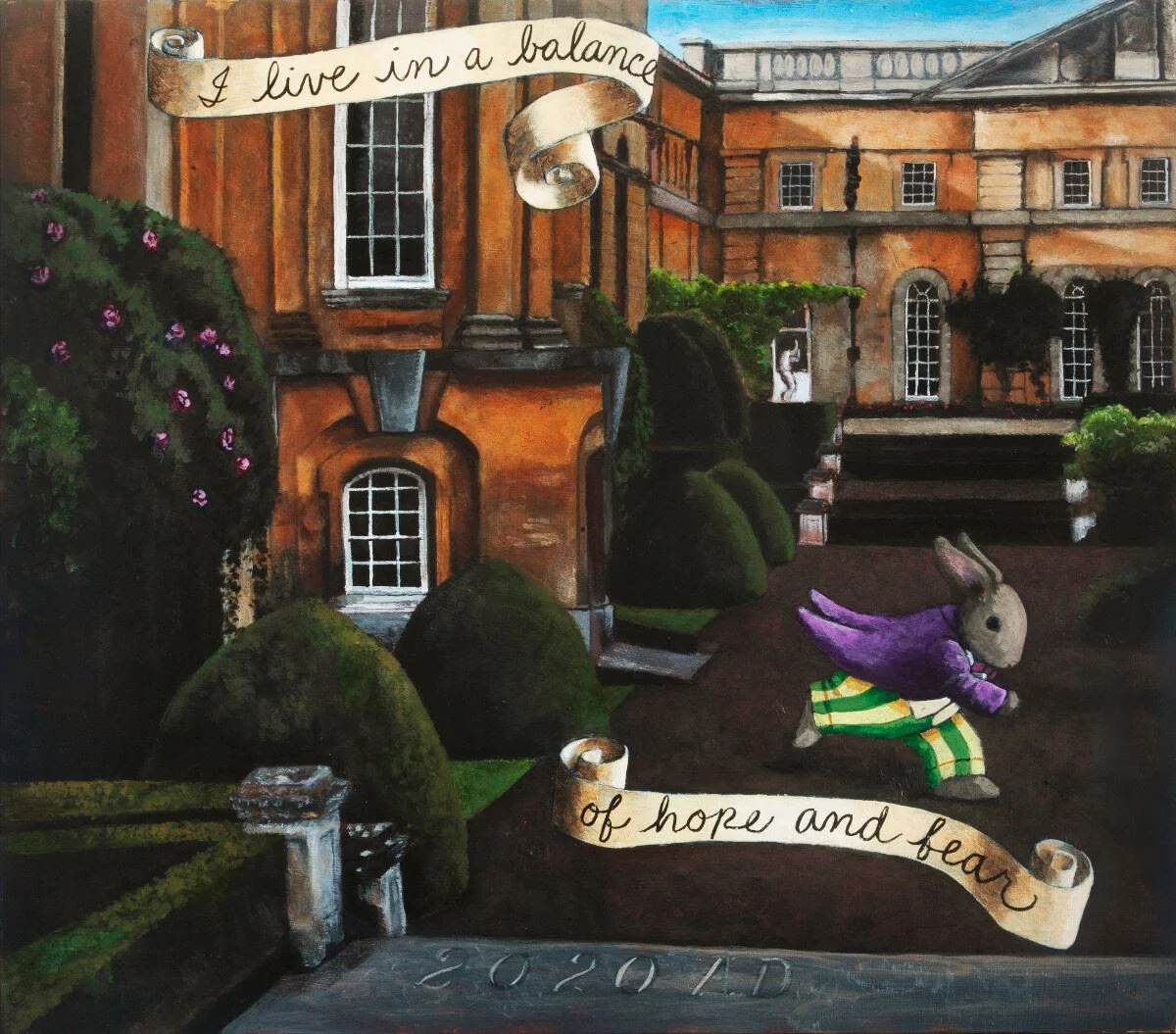
We can't to seem to find her balance

“I Live in a Balance of Hope & Fear,’’ by Pauline Lim, at the Brickbottom Artists Association, Somerville, Mass., through Jan. 16. She’s a painter and musician who lives in the Brickbottom facility.
The organization, named after the Somerville section whose clay deposits were used for brick making in the 19th Century, has become a well-known model for other artists' live/work developments around America.
‘‘I Live in a Balance of Hope & Fear,’’ by Pauline Lim, at the Brickbottom Art Association, Somerville, Mass.
Need small houses, too; address sense-of-place deficits
Adapted from Robert Whitcomb’s “Digital Diary,’’ in GoLocal24.com
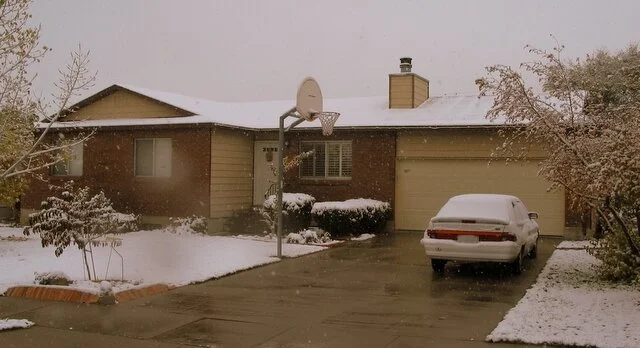
Housing in America, especially in and around the richest cities, such as Boston, has become too expensive for many workers, which can make it difficult for some employers to get the employees they need. In Massachusetts this led to launching the new Starter Home Zoning District, in 2016. The idea was to encourage suburbs to loosen restrictive development rules to encourage the building of the sort of small, affordable and close-together houses on small lots that went up like mushrooms in the ‘50s and ‘60s.
But four years later, reports Commonwealth Magazine, not one house has been built in the program.
It seems that a killer is that the law requires that any new starter home be close to a train station and/or other amenities. The admirable idea is to encourage walkability and discourage sprawl and its environmental damage. But the laws in Massachusetts and some other states have advocated the construction of condos and apartments near train and other transportation hubs to encourage the sort of anti-sprawl density you don’t get with single-family houses; there’s little room for single-family houses in or near many of these hubs. And at the same time, “snob zoning” in many communities has set big space minimums for land for houses away from these hubs. This has encouraged the construction of many McMansions on parcels of at least an acre, keeping out the peasantry.
To read the Commonwealth piece, please hit this link.
In practical terms, all this means that there’s not much space available for the old American dream of a house affordable for people of modest means.
Obviously, a lot of people would prefer to live in a detached house, however small, than in an apartment they rent or own. Healthy communities and regional economies need a mix. Owning and living in a house gives a certain kind of resident a strong sense of place, with the local civic-mindedness and stability that goes with it, that they don’t feel in a condo or apartment.
Dispersed and often solitary Americans, who live so much of their lives online and many of whom don’t even shop together in person anymore, as Amazon, etc., continue to ravage in-person retailing, makes it all the more important that as many people as possible feel anchored to a physical place and so feel some commitment to participating in the community there.
Civic disengagement and social disintegration (starting at the family level) continue to undermine America. Fixing some of our housing problems would help mitigate this.
Perhaps the sort of places where small houses could be built without hurting the environment would include on the land at the ever-growing number of closed malls, with their vast parking lots.
Increasingly, America has become what Gertrude Stein complained about Oakland, Calif.: “There’s no there, there.’’ This leads to a sense of loss and to anomie, that, among other things, leads to the success of demagogues. The pandemic has only increased Americans’ growing solitariness.

For sale
Chris Powell, the excellent columnist for the Journal Inquirer, in Manchester, Conn., noted that The Hartford Courant, for many decades the nearest thing that the Nutmeg State had to a state paper, is selling its big headquarters in downtown Hartford. Its few remaining journalists will work from home, and its printing is already done in Springfield, Mass. Can they really call it The Hartford Courant anymore? It’s another example of how we’re losing the sense of place provided by institutions. Local newspapers, with their big downtown offices, used to be an important part of the public square, along with local government, schools, locally based stores, churches, etc.
Maybe a Connecticut sugar daddy, perhaps a hedge funder from the Fairfield County Gold Coast, will come along to save The Courant, now owned by Tribune Publishing, which is apparently about to try to sell it.
To read the Powell column, please hit this link.
A beautiful book to tour with during next summer
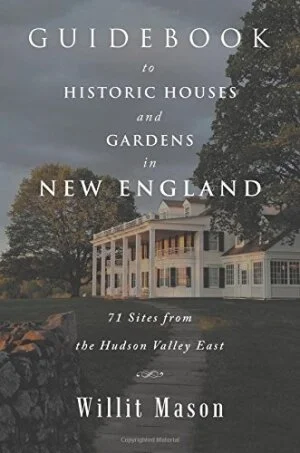
William (“Willit’’ ) Mason, M.D., has written has a delightful – and very handy -- book rich with photos and colorful anecdotes, called Guidebook to Historic Houses and Gardens in New England: 71 Sites from the Hudson Valley East (iUniverse, 240 pages. Paperback. $22.95). Oddly, given the cultural and historical richness of New England and the Hudson Valley, no one else has done a book quite like this before.
The blurb on the back of the book neatly summarizes his story.
“When Willit Mason retired in the summer of 2015, he and his wife decided to celebrate with a grand tour of the Berkshires and the Hudson Valley of New York.
While they intended to enjoy the area’s natural beauty, they also wanted to visit the numerous historic estates and gardens that lie along the Hudson River and the hills of the Berkshires.
But Mason could not find a guidebook highlighting the region’s houses and gardens, including their geographic context, strengths, and weaknesses. He had no way of knowing if one location offered a terrific horticultural experience with less historical value or vice versa.
Mason wrote this comprehensive guide of 71 historic New England houses and gardens to provide an overview of each site. Organized by region, it makes it easy to see as many historic houses and gardens in a limited time.
Filled with family histories, information on the architectural development of properties and overviews of gardens and their surroundings, this is a must-have guide for any New England traveler.’’
Dr. Mason noted of his tours: “Each visit has captured me in different ways, whether it be the scenic views, architecture of the houses, gardens and landscape architecture or collections of art. As we have learned from Downton Abbey, every house has its own personal story. And most of the original owners of the houses I visited in preparing the book have made significant contributions to American history.’’
To order a book, please go to www.willitmason.com
What science can't handle
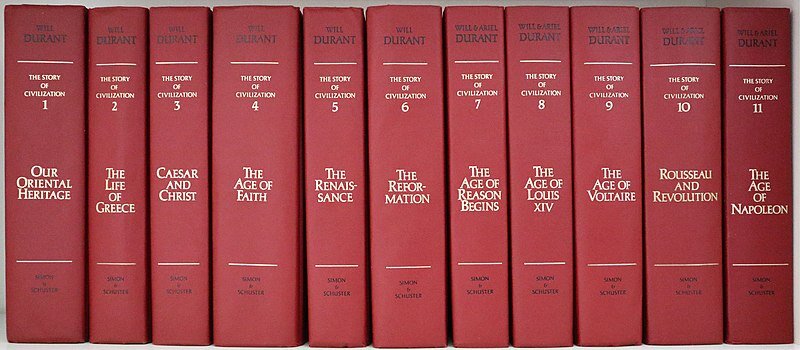
The 11 volumes of The Durants’ Story of Civilization
“Philosophy accepts the hard and hazardous task of dealing with problems not yet open to the methods of science — problems like good and evil, beauty and ugliness, order and freedom, life and death.’’
— Will Durant (1885-1981), historian, in The Story of Philosophy. Born in North Adams, Mass., of French-Canadian parents, the once-famous Durant was best known for the work The Story of Civilization, 11 volumes written in collaboration with his wife, Ariel Durant, and published between 1935 and 1975.
So don't stand underneath when I angrily fly over

“Everybody's Talking At Me’’ (oil on copper), by Brookline-based Nora Charney Rosenbaum, at Galatea Fine Art, Boston, Jan. 8-31.

Official seal of Brookline. The Muddy River is a series of brooks and ponds that runs through sections of Boston's Emerald Necklace, including along the southern boundary of Brookline, a town that went by the name of Muddy River Hamlet before it was incorporated, in 1705.
David Warsh: Eating Instagram; McKinsey and OxyContin scandal
SOMERVILLE, Mass.
I was as surprised as anyone when a panel of prominent judges earlier this month chose No Filter: The Inside Story of Instagram, by Sara Frier, of Bloomberg News, as the Financial Times and McKinsey Business Book of the Year, so I ordered it. The publisher, Simon & Shuster, was surprised, too: the book has not yet arrived. So I re-read FT staffer Hannah Murphy’s review from last April.
The book sounds absorbing enough: how Instagram co-founder Kevin Systrom agreed to sell his start-up for $1 billion over a backyard barbecue at Mark Zuckerberg’s house and then watched in distress as Facebook bent the inventive photography app to purposes of its own. He finally walked away from the company he started, an enterprise that Frier called “a modern cultural phenomenon in an age of perpetual self-broadcasting” brought low by Facebook’s quest for global domination.
FT editor Roula Khalaf praised the book for tackling “two vital issues of our age: how Big Tech treats smaller rivals and how social-media companies are shaping the lives of a new generation.” In a beguiling online profile last summer, Frier explained how “everything changed” for technology reporters covering social media after the 2016 presidential election. Remembering the embrace-extend-extinguish tactics pioneered by Microsoft, antitrust authorities will also want to take a look.
There is, however, a larger issue about the contest itself. Given the temper of the times, I had thought either Deaths of Despair and the Future of Capitalism, by Anne Case and Angus Deaton, both of Princeton University, or Reimagining Capitalism in a World on Fire, by Rebecca Henderson, of the Harvard Business School, powerful books of unusual gravity, might capture the blue ribbon. Both specifically criticize a major McKinsey client, Purdue Pharma, and both vigorously reject the market fundamentalism that often has been imputed to the values of the secretive firm in recent decades – “shareholder value” as the only legitimate compass of corporate conduct and all that.
Granted, the prize is said by its sponsors to reward “the most compelling and enjoyable insight into modern business issues” of a given year. Previous panels have interpreted their instructions in a wide variety of ways. A McKinsey executive last year joined the judging panel. I wondered if the other members, none of them strangers to McKinsey’s lofty circles, had successfully argued to include the two critical books on the short list, before selecting a title more narrowly about “modern business issues” to avoid embarrassment to the sponsor. The awarding of literary prizes as it actually works on the inside is sometimes said to be very different from how it may look from the outside.

An OxyContin pill
Whatever the case, the judges could not have known about the news that broke the day before their decision was announced. The New York Times reported that documents released in a federal bankruptcy court had revealed that McKinsey & Co. was the previously unidentified-management consulting firm that has played a key role in driving sales of Purdue’s OxyContin “even as public outrage grew over widespread overdoses” that had already killed hundreds of thousands of Americans.
In 2017, McKinsey partners proposed several options to “turbocharge” sales of Purdue’s addictive painkiller. One was to give distributors rebates of $14,810 for every OxyContin overdose attributed to pills they had sold. Purdue executives embraced the plan, though some expresses reservations. (Read The New York Times story: the McKinsey team’s conduct was abhorrent.) Spokesmen for CVS and Anthem, themselves two of McKinsey’s biggest clients, have denied receiving overdose rebates from Purdue, according to reporters Walt Bogdanich and Michael Forsythe.
Moreover, after Massachusetts’s attorney general sued Purdue, Martin Elling, a senior partner in McKinsey’s North American pharmaceutical practice, wrote to another senior partner, “It probably makes sense to have a quick conversation with the risk committee to see if we should be doing anything” other than “eliminating all our documents and emails. Suspect not but as things get tougher there someone might turn to us.” Came the reply: “Thanks for the heads-up. Will do.” Elling has apparently relocated his practice from New Jersey to McKinsey’s Bangkok office, The Times’s reporters write.
Last week The Times reported that McKinsey & Co. issued an unusual apology for its role in OxyContin sales and vowed a full internal review. Sen. Josh Hawley (R.- Mo.) wrote the firm asking if documents had been destroyed. “You should not expect this to be the last time McKinsey’s work is referenced,” the firm wrote in an internal memo to employees. “While we can’t change the past we can learn from it.”
Another rethink is for the FT. The newspaper started its award in 2005, with Goldman Sachs as its co-sponsor. Tarnished by the 2008 financial crisis and the aftermath, the financial-services giant bowed out after 2013 and McKinsey took over. The enormous consulting firm is famous mainly for the anonymity on which it insists, but the Purdue Pharma scandal isn’t the first time that McKinsey has been in the news recently, especially for its engagements abroad, in Puerto Rico and Saudi Arabia. A thorough audit of its practices, reinforced by outside institutions, is overdue. In an age of mixed economies and transparency, McKinsey’s business model of mutually-contracted secrecy between the firm and the client seems outdated
Why the need for sponsorship? It would seem to be mainly a form of cooperative advertising. The cash awards to authors are lavish: £30,000 to the winner, £10,000 to each of five finalists, undisclosed sums to the judges, publicists and for advertising. That makes McKinsey’s investment a spectacular bargain, but it is something of a poisoned chalice for the FT.
The prize’s reputation as recognizing entertaining writing about important business topics is well established. Why not dispense with the money and influence? Who knows what McKinsey does and for whom? Isn’t trustworthy filtering of information the very essence of the newspaper’s business?
David Warsh, an economic historian and a veteran columnist, is proprietor of Somerville-based economicprincipals.com, where this piece first ran.
Home for good
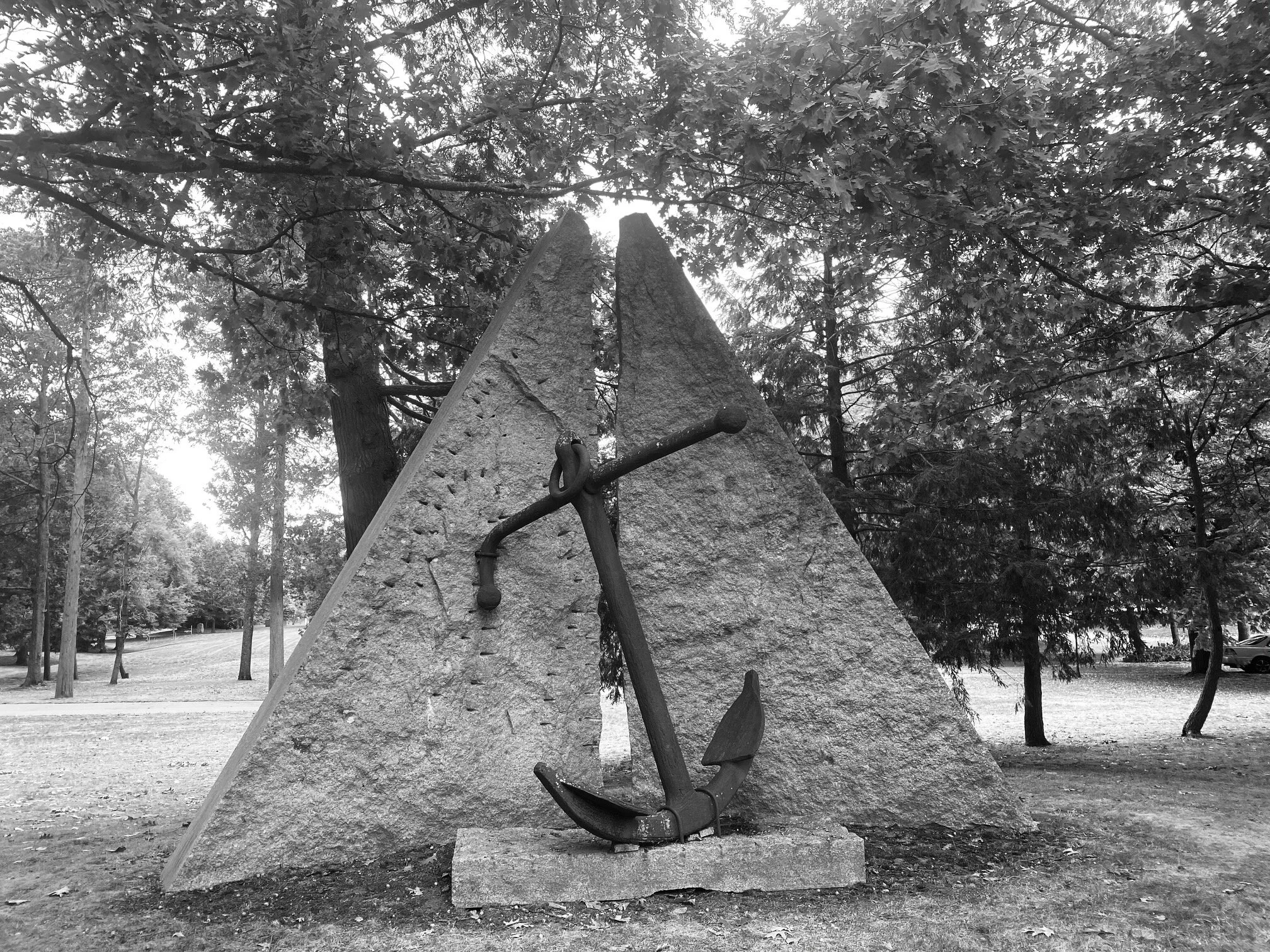
— Photos by Lydia Whitcomb
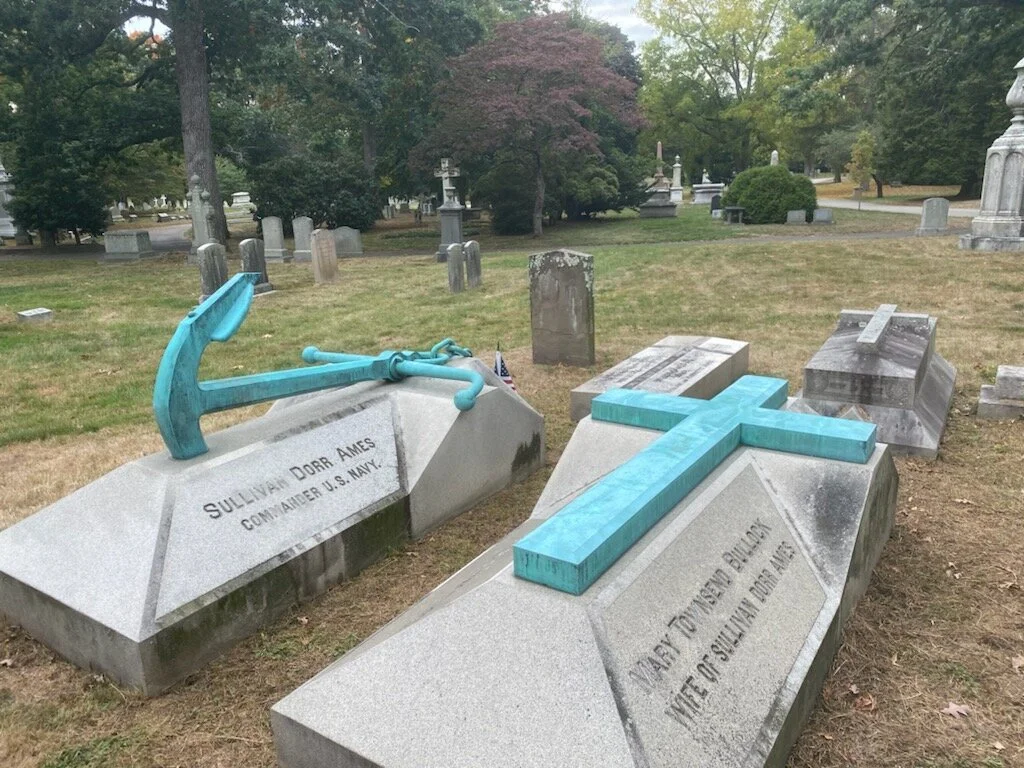
In the Hope Memorial Garden, in Swan Point Cemetery, Providence. The focal point of the garden is this sculpture of granite monoliths as a backdrop for an 18th Century anchor recovered from Narragansett Bay. It was designed by Brown University art professor Richard Fishman.
The 18th and early 19th centuries were the heyday of Rhode Island’s maritime trade.
The sculpture was originally installed at an outdoor chapel on Providence’s Killingly Street in 1972 and was moved to Swan Point in 1976.
The anchor is a symbol of homecoming in many places and especially in coastal New England, with its historic connections to the sea. The anchor is a symbol of hope and of Rhode Island, whose flag and seal it graces. But you see a lot of anchors in many New England cemeteries, some positioned in rather strange ways, as below, also at Swan Point.
New study says mask-wearing most important factor in cutting chance of getting COVID-19 during air travel

A Delta Airlines plane being disinfected between flights
From The New England Council (newenglandcouncil.com)
BOSTON
“Researchers at the Harvard T.H. Chan School of Public Health have completed a comprehensive, gate-to-gate study on how to greatly reduce the chances of COVID-19 transmission during air travel.
“The study concludes that universal mask-wearing, rigorous cleaning protocols and high-end air filtration systems lower the risk of COVID-19 transmission to minimal levels. The study found that mask-wearing among passengers and crew is the most important factor in reducing risk during air travel. The researchers also found that the use of high-efficiency particulate air (HEPA) filters is extremely effective in removing harmful airborne particles. Ultimately, diligently engaging in this multi-layered approach results in a substantially lowered risk of COVID-19 transmission during air travel in comparison to other activities.
“‘The risk of COVID-19 transmission onboard aircraft [is] below that of other routine activities during the pandemic, such as grocery shopping or eating out,’ the Harvard researchers concluded. 'Implementing these layered risk mitigation strategies…requires passenger and airline compliance [but] will help to ensure that air travel is as safe or substantially safer than the routine activities people undertake during these times.’
“Read more from the National Preparedness Initiative report.’’
'Regain a shelter'
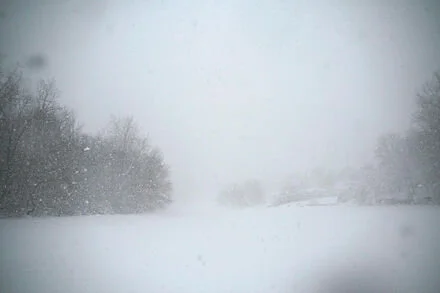
When feeble suns scarce light the wintry sky,
And clouds are drifting in the doubtful air,
The pensive man, with expectation high,
Forth to the window moves his easy chair.
Observant there, in pleased security,
Regaling, as he may, both eye and ear,
He marks the frozen brook, the withered tree,
And loves, at frequent intervals, to hear
The howling of the blast, that winds its summons drear.
II.
The pensive man, to thought and feeling prone,
Inclined to sadness, but averse from sorrow,
In silence sits, and loves to be alone,
And joy from inward contemplations borrow.
Thus let me muse, nor do thou deem it strange,
That it is given the sense of joy to find
From varying thoughts that unrestricted range,
Light and unfixed, as is the stayless wind,
Pleased with the present scene, and to the future blind.
III.
'Tis Winter, in its wild and angry mood!
And as I look, behold, the clamorous crows,
Scared by the uproar vast, in yonder wood,
Regain a shelter from the blast and snows,
Where pines and firs their thick protection yield.
There nestle they retired, nor heed the cry
From muffled owl, in hollow trunk concealed.
Hid in the twisted roots, with fearful eye,
The wary fox beholds the tempest hurrying by.
IV.
Forth from the wood the wood-cutter comes back;
Upon his frosty beard the snow stands thick;
He looks with peering eye to find the track,
Then struggles on with panting breath and quick,
Seeking his home. Anon, a traveler's sleigh
Goes swift, with bells, that chime their stifled din.
But he, who rides on such a stormy day,
With aid of whip and voice, shall scarcely win,
Seen dimly in the drifts, the distant village Inn.
V.
A refuge seeking from the surly winter,
The red-breast comes, unto the window flying;
Well pleased, I haste to let the stranger enter,
And strive to keep the little thing from dying.
See, how he hops abroad and picks the bread,
The hospitable hand of childhood brings;
Then pausing, as in thought, erects his head,
And glances quick, and trims his little wings,
And with a sudden voice breaks gladly forth and sings.
VI.
Unmindful of the storm, the noisy cur
Shakes his well powdered sides, and barks, and now,
A sharer in the elemental stir,
With plunging head into the drift doth plough,
And upward throws around the 'feathery snow.'
But Dobbin! such an hour's no sport for him.
With ruminating head, depending low,
And half-shut eye, with gathered snow-flakes dim,
Close to the sheltering barn, he draws his quivering limb.
VII.
The weary thresher lays aside his flail,
And shuts, like one amazed, his granary door;
Nor else can do: the winds his heaps assail,
And wheat and chaff fly wildly round the floor.
The shades still darker wrap the rolling cloud,
And hurtling snows come rushing still more fast;
Low to the earth the groaning trees are bowed,
From rock and hill in headlong ruin cast.
The village steeple waves and trembles in the blast.
VIII.
At such an hour let none adventurous roam.
Dear to the heart, at such a time as this,
Is the security and peace of home,
The blazing hearth and the domestic bliss.
See, how the traveler scarce resists the storm!
Mark, how he strives along with fainting feet!
And doomed, without the friendly welcome warm,
To perish in its freezing winding-sheet!
Then heap the favoring blaze, his weary steps to greet!
IX.
Yes, turn and rest thee, tir'd and suffering one!
Haste, at the blazing hearth-stone take thy stand!
Fear not, that any here thy woes will shun,
And hold from sorrow's aid the helping hand.
It is for this the stormy tempests blow,
To show how small the boasted strength of man,
And when a suffering brother comes in woe,
That 'tis a part of heaven's benignant plan,
To ope the friendly door, and help him as we can.
X.
The sun sets now; and yet no sun doth rest
Upon the mount its golden orb of light.
Dark clouds usurp his place; and shades unblest
And moaning sounds the startled air affright.
In yon lone cot the mother trims the blaze
That through the window sends its nightly beam.
Unmoved by fears, that older hearts amaze,
Though fierce the snows invade each gaping seam,
The children, gathering round, enclose its cheerful gleam.
XI.
The winds are rude, but they regard it not,
And laugh, as they were wont, and prattle loud;
Prone on the floor, unconscious he of aught,
The shaggy dog with closing eye is bowed.
The cat doth in its corner sit demure;
And as the crackling fire lights up the room,
The housewife spreads the table of the poor,
Or plies with careful hand the busy broom,
Or doth her task once more, her wonted wheel resume.
XII.
Snug in the corner doth her good man sit,
Nor ever from his lazy settle moves;
The howling blast frights not his quiet wit,
But stormy sounds and piping winds he loves.
He, philosophic, chides at needless sorrow,
Nor will he add to real, fancied ills.
But looks in storms to-day for calms to-morrow.
Thus fearful thoughts and low complaints he stills,
And ever and anon, his patient pipe he fills.
XIII.
Happy the man, in winter's stormy hour,
When woods and plains with angry snows are strown,
Who is not doomed to feel their hostile power,
But hath a shelter he can call his own,
The cheerful hearth, the amicable chair.
He, with his gossip neighbors side by side,
Spreads cheerfully the peasant's homely fare.
They deal the mutual jest. Then venturing wide,
With patriot zeal elate, the nation's fate decide.
XIV.
How keen the glances of their generous strife!
Emphatic on the table strikes the hand!
Each holding firm, as if 'twere death or life,
The favorite text, that sinks or saves the land;--
Lesson sublime for patriotic ear.
Old Rover, stretched at ease upon the floor,
Erects his shaggy head the din to hear;--
Unusual now, though often heard before;
Meanwhile the outward storm still thunders at the door.
XV.
Ah me! On such a fearful time as this,
While we around the peaceful hearth are safe,
And in the warmth and glow of social bliss,
Forget the winds against the house that chafe,
And at the door and windows threat in vain,
The seamen on the overwhelming deep,
The tenants of the loud and doubtful main,
Can scarce their stations on the vessel keep;
See, how they mount on high, then plunging down they sweep.
XVI.
Anon, a wave, impatient of delay,
Bears suddenly some sailor from the deck.
Poor man! In the illimitable way,
That foaming spreads around, he seems a speck.
Now sunk, now seen, now borne on high, now low,
He smites the wave, like one that strikes for life;
But all in vain; far downward doth he go;
And as he yields at length the fearful strife,
He dying thinks once more of children, home, and wife.
“The Snow Storm,’’ by Thomas Cogswell Upham (1799-1872). Born in Deerfield, N.H., he became a major American philosopher, psychologist, poet and teacher. For many years, he was a professor of philosophy at Bowdoin College, in Brunswick, Maine.
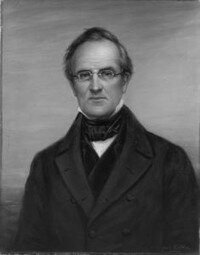
Thomas Cogswell Upham
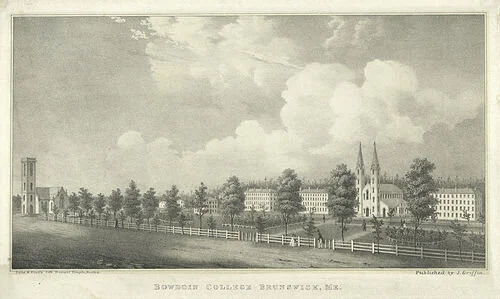
Bowdoin College, circa 1845. Upham taught there in 1825-1868.
— Lithograph by Fitz Hugh Lane
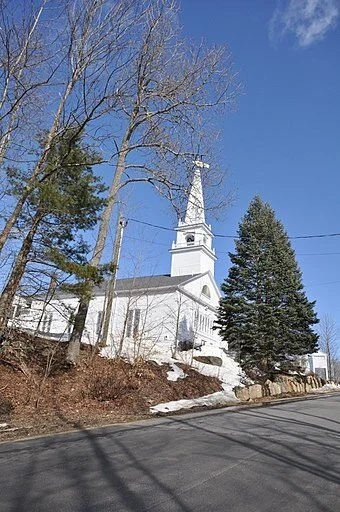
Deerfield, N.H., Congregational Church
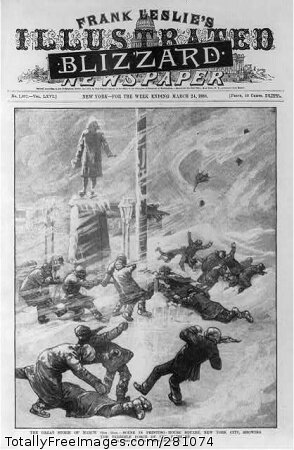
Illustration of the Great Blizzard of 1888