Vox clamantis in deserto




Ross E. O'Hara: Online-learning advice for college students
From The New England Journal of Higher Education, a service of The New England Board of Higher Education (nebhe.org)
BOSTON
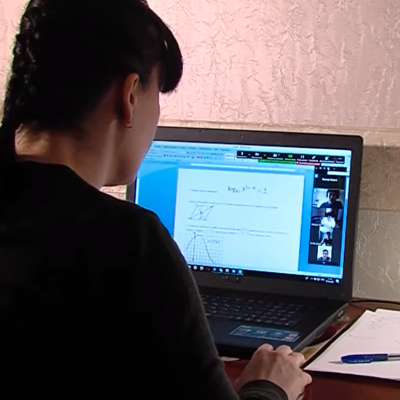
The majority of college students were largely disappointed by remote learning this past spring, with many reporting a strong preference for in-person instruction. Bearing in mind the low expectations that many students carried into online courses this fall, what advice can we give to help them succeed in this final month? As colleges across New England and the country continue to announce spring plans that include online courses, what can we share to prepare students for success in 2021?
While the internet is saturated with “hacks” for online learning, I want to connect you with the best experts I know: Students.
Since March, the Persistence Plus mobile nudging support platform has asked more than 25,000 students from both two- and four-year institutions about their experiences with remote learning. Specifically, we gathered their advice about how to excel in this format, and I saw four key themes emerge. I have also paired their insights with science-based exercises that can be shared with students to bolster their motivation and improve their performance in online courses.
1. Set a schedule. The most frequently offered advice was the need to set a regular schedule—especially in asynchronous courses—and stick to it. Several students mentioned examining the syllabus for major assignments and noting due dates in advance, working ahead on those assignments to the extent possible and regularly checking email and the course website. Here’s some of what they said:
“Make a schedule for classes, study time, completion of assignments, breaks, etc., and build enough discipline to stick to the schedule.”
“Make a schedule for time to study. Prioritize due dates on assignments and exams. It is not as difficult as you may think. Discipline and focus is key.”
“Work as far ahead as possible, get assignments done as soon as you get them so you don’t have to worry about it, and set a scheduled time each day to work on school.”
“Write everything down and log into your classes and email to check for new reminders and announcements every day.”
One way that students can go beyond just setting a schedule is with “if-then” plans. We all naturally underestimate how long it takes to complete projects (known as the planning fallacy). To counteract this optimism, students can make very specific plans for when and where they will work on assignments (for example, “I will read Chapter 1 at the dining room table after my daughter goes to sleep on Wednesday night.”) The more specific they are, the more likely they are to follow through.
Yet the best-laid schemes of mice and men oft go awry. Students should also develop contingency plans for common obstacles (such as “If my daughter doesn’t fall asleep by 9 p.m., then I will read Chapter 1 before she wakes up the next morning.”) No one can foresee the future, but anticipating the most likely problems and pre-designing solutions will help students stay on track. You can facilitate students’ if-then plans by prompting them to complete the exercise via an email, a poll within your institution’s learning management system, or even providing space in the syllabus to craft if-then plans for each big assignment.
2. Create a study space. Students noted how important it is to have a quiet, peaceful (but not too relaxing!) area for schoolwork. The goal of such a space is to create focus without inducing grogginess. They suggested:
“Find a place where you can be composed and stay focused with your priorities.”
“If you can, set aside someplace that is specially for school work so that you can focus when doing work and then relax when you go to bed (if you only have space in your bedroom then just make sure not to do work on your bed, work only on your desk).”
“Find a place in your home to go that is designated to your studies.”
“Don’t attend virtual classes in bed! Try working at a table or desk for effective productivity. Working in your bed allows you to be too comfortable and can cause you to fall asleep or lose focus.”
Given the COVID-19 pandemic, this area is most likely within students’ homes. But as we all know, our homes are often crowded with partners, children, parents and roommates. One advantage of a dedicated space is that it sends a signal that this person is studying and shouldn’t be interrupted. Moreover, a regular study space takes advantage of state-dependent memory. When you learn something, cues from the environment become associated with it: the feel of your chair, the smell of the room, the taste of your coffee, even your mood at that moment. If students put themselves into those same circumstances when they need to recall that information (i.e. for the exam), they’ll be more likely to remember.
3. Ask for help. We heard over and over that students must reach out for help, especially from their professors, if they get stuck. If you’re a professor but you might be difficult to reach (you’re dealing with plenty of crises too!) build a system that makes it easy for students to connect with other faculty, former students, campus tutors, tech support and each other. Students advised:
“Don’t be afraid to email professors and/or classmates/peers for understanding of the coursework and/or additional assistance.”
“Professors make it very easy, they work with you and they provide all the resources you need to be successful. Don’t forget to ask questions.”
“Make group messages with your peers so you can keep each other on track, and ask each other questions.”
“Don’t be afraid to reach out to classmates and ask for help. Everyone is going through it together and supporting each other through it is what makes it work.”
Asking for help makes some students feel nervous or embarrassed. One way to circumvent those feelings is to use simple role reversal. Instead of asking someone else for advice, students can imagine that one of their classmates came to them with the same issue. Students can then consider what they would advise their peer to do, or whom they would point them to for help. This role-playing can make students less anxious by approaching their own problem from a neutral perspective, make them feel more empowered, and help them generate potential solutions that they may not otherwise see.
4. Be accountable. Finally, students noted that success in online courses requires a lot of self-discipline and accountability. The physical and emotional distance between students and their professors can make it all the easier to skip assignments or not participate in class. They noted:
“It’s all about being on top of your work and holding yourself accountable. If you can handle online college classes, you can handle college.”
“Don’t put off projects and homework just because the deadline isn’t for a little while, you will forget and have to rush to finish it so just do it or start it (and do a good amount of the work) as soon as it is assigned.”
“Study just like you would if you were taking the class in a classroom. No matter where you are learning from, the same level of effort and focus is expected.”
It is challenging to maintain focus on learning online, while also working (or looking for work), raising children and dealing with life’s other responsibilities. One practice that may help students concentrate is to engage in 5-10 minutes of expressive writing before working on school. Ask students to privately jot down everything in their life that is worrying or stressing them out, and write specifically about how each one makes them feel. Rather than suppressing or ignoring their emotions, releasing them on paper lessens their impact and will allow students to better focus on learning or performing. They can even crumple up that piece of paper and toss it in a recycling bin, symbolically discarding those intrusive thoughts so they can get down to business.
Despite our general comfort level with technology, most of us are still unacquainted with experiencing most of our lives online, and things won’t be that much better as we continue remote learning into 2021. While students study algebra, or 20th Century European history or computer coding, remember that they’re still adapting to a whole new way of learning, and that’s not easy. So please pass along advice from our college experts to your students and their instructors so they may be better prepared for any eventual roadblock.
Ross E. O’Hara is director of behavioral science and education at Persistence Plus LLC, which is based in Boston.
Share This Page
Share this...
Filed under College Readiness, Commentary, Demography, Economy, Financing, Journal Type, Schools, Students, Technology, The Journal, Topic, Trends.
Salt water is contaminating wells in Rhode Island as sea level rises
From ecoRI News
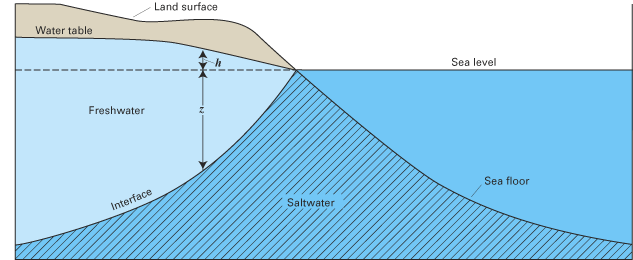
Drinking water wells at homes along the Rhode Island coastline are being contaminated by an intrusion of salt water, and as sea levels rise and storm surge increases as a result of the changing climate, many more wells are likely to be at risk.
To address this situation, a team of University of Rhode Island researchers is conducting a series of geophysical tests to determine the extent of the problem.
“Salt water cannot be used for crop irrigation, it can’t be consumed by people, so this is a serious problem for people in communities that depend on freshwater groundwater,” said Soni Pradhanang, associate professor in the URI Department of Geosciences and the leader of the project. “We know there are many wells in close proximity to the coast that have saline water, and many others are vulnerable. Our goal is to document how far inland the salt water may travel and how long it stays saline.”
Salt water can find its way into well water in several ways, according to Pradhanang. It can flow into the well from above after running along the surface of the land, for instance, or it could be pushed into the aquifer from below. Sometimes it recedes on its own at the conclusion of a storm, while other times it remains a permanent problem.
Pradhanang and graduate student Jeeban Panthi are focusing their efforts along the edge of the salt ponds in Charlestown and South Kingstown, where the problem appears to be the most severe.
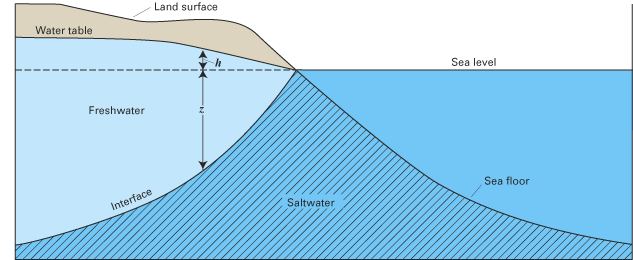
Since salt water is denser than fresh water, it typically settles below. So the scientists are using ground-penetrating radar and electrical resistivity tests — equipment loaned from the U.S. Geological Survey and U.S. Department of Agriculture — to map the depth of the saltwater/freshwater interface.
“In coastal areas, there is always salt water beneath the fresh water in the aquifer, but the question is, how deep is the freshwater lens sitting on top of the salt water,” said Panthi, who also collaborates with URI professor Thomas Boving. “We want to know the dynamics of that interface.”
The URI researchers plan to drill two deep wells this month to study the geology of the area and the chemistry of the groundwater to verify the data collected in their geophysical tests.
The first tests were conducted in the summer of 2019, and a second series was completed this fall after being delayed by the pandemic. Final tests will be conducted this spring when groundwater levels should be at their peak.
“The groundwater level was at its lowest point in 10 years this summer because of the drought,” said Panthi, a native of Nepal who studied mountain hydrology before coming to URI. “That will be a good comparison against what we expect will be high levels in April and May.”
Panthi has collected well-water samples from nearly two dozen residences for analysis. One of the contaminated wells is a mile inland from Ninigret Pond, in Charlestown.

Ninigret Pond, in Charlestown, R.I.
“A homeowner had a deep well drilled for a new house and it ended up with extremely saline water,” Pradhanang said. “Deep wells close to the salt ponds or the coast are more likely to have saltwater intrusion than shallow wells, though shallow wells can also have problems if they become inundated with salt water.”
Another URI graduate student, Mamoon Ismail, is developing a model to simulate saltwater intrusion into drinking water wells based on the changing pattern of precipitation and the potential for extreme storms. They hope to be able to predict how far inland salt water will intrude following a Category 1 hurricane compared to a Category 2 storm, for instance.
This research is being funded by the Rhode Island office of the U.S. Department of Housing and Urban Development.
While there’s still snow

This long poem, by Whittier (1807-1892) a poet based in northeast Massachusetts, a Quaker and an abolitionist, once was required reading for kids.
Adapted from Robert Whitcomb’s “Digital Diary,’’ in GoLocal24.com
Providence-based architectural writer and historian William Morgan’s latest – and beautifully illustrated -- book, Snowbound: Dwelling in Winter (Princeton Architectural Press), looks at 20 houses in various cold parts of the world, including Europe, Asia and North and South America.
A New Hampshire house and a Connecticut house are featured in the book.
As the press release notes:
“From the ski slopes of Utah to the frigid tundra of northwestern Russia, Snowbound celebrates contemporary design in cold climates with a focus on sustainability. Tailor-made for architects, designers, snowbirds, and aspiring second-home owners, this tour of twenty dwellings is equal parts escapist photo essay and practical sourcebook, with immersive photography, architectural plans, and location, climate, and building-systems data.’’
That some of these houses were put up in preposterously harsh and remote places adds to the entertainment.
But global warming rears its head. Mr. Morgan writes:
“Candidates for Snowbound in Canada, Australia, and Vermont had to be eliminated as recent winters came with less-than-usual snowfall. In the middle of the winter in the Southern Hemisphere, there was insufficient snow in the Andes, more than a thousand miles south of Buenos Aires, to photograph a house as it would have looked only less than a decade ago.’’
But what about summers at these buildings?
Protected by the Second Amendment?
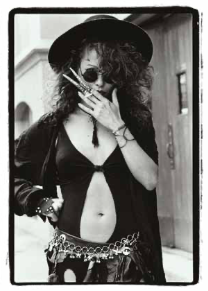
“Fingernail Extensions” (silver gelatin print), by Amy Arbus, at Mitchell-Giddings Fine Arts, Brattleboro, Vt.
See:
https://mitchellgiddingsfinearts.com/index.php

Julie Rovner: A GOP Senate likely to block many Biden health proposals

Former Vice President Joe Biden secured the 270 electoral votes needed to capture the White House on Saturday, major news organizations projected, after election officials in a handful of swing states spent days in round-the-clock counting of millions of mail-in ballots and early votes.
The Democrat’s victory came after the latest tallies showed him taking an insurmountable lead in Pennsylvania, a state that both Biden and President Trump had long identified as vital to their election efforts. Trump has signaled he will fight the election results in several states, filing a number of lawsuits and seeking recounts.
“America, I’m honored that you have chosen me to lead our great country,” Biden tweeted shortly after the news organizations called the race. “The work ahead of us will be hard, but I promise you this: I will be a President for all Americans — whether you voted for me or not.”
The Democratic celebration was tempered because it appeared the party would have a hard time taking back the Senate majority it lost in 2014. If that bears out, it will likely keep Biden and Democratic lawmakers from enacting many of the plans they campaigned on, including major changes in health care.
Party control of the Senate may not be determined until January — thanks to what preliminary returns suggest will be runoffs for both Senate seats in Georgia. No candidate for either seat reached the required 50% threshold.
Without a Democratic majority in the Senate, Biden will likely face strong Republican opposition to many of his top health agenda items — including lowering the eligibility age for Medicare to 60, expanding financial assistance for health insurance under the Affordable Care Act, and creating a “public option” government health plan.
However, his administration would be a bulwark to defend the ACA against Republican attacks, although the Supreme Court case challenging the health law — which will be heard next week — presents a major wild card for its future.
Health care was a key element of Biden’s campaign, especially improving the federal response to the coronavirus pandemic. He championed the use of face masks and blasted the Trump administration for shifting to states much of the responsibility for fighting the virus and helping hospitals. He was regularly mocked by the president for wearing a mask, working and campaigning from home, and not having an in-person Democratic convention.
Even before the latest vote tallies were released late Saturday morning, Biden had begun moving toward setting up his administration. On Thursday his transition team unveiled a website, BuildBackBetter.com, although it was only one page. And the former vice president held a meeting Thursday with health and economic advisers on the pandemic.
In a brief television statement Friday night, Biden reiterated his commitment to fight the pandemic, which he said “is getting more worrisome across the country.”
“We want everyone to know on day one we are going to put our plan to control this virus into action. We can’t save any of the lives that have been lost, but we can save a lot of lives in the months ahead,” Biden said.
The electoral outcome is not the one Democrats were hoping for — or, to some extent, expecting, based on preelection polling. Andy Slavitt, who ran the Centers for Medicare & Medicaid Services during the Obama administration, noted that frustration in a tweet Wednesday. “A large disappointment is that many hoped for a significant repudiation of Trump & his indifference to human life, human suffering, his corruption, and goal of getting rid of the ACA. No matter the final total it will be hard to make that claim,” Slavitt said.
Still up in the air is how willing a Republican-led Senate will be to provide further relief to individuals, businesses and states hit hard by the pandemic, and whether they will participate in previously bipartisan efforts to curtail “surprise” out-of-network medical bills and get a handle on prescription drug prices.
Julie Rovner is a Kaiser Health News reporter
Julie Rovner: jrovner@kff.org, @jrovner
'In praise and dissent'

The Old South Meeting House steeple.

The church’s interior.
“We, the people—the tourists
and townies—one nation under
this vaulted roof, exalted voices
speaking poetry out loud,
in praise and dissent.
We draw breath from brick. Ignite the fire in us.’’
From “Old South Meeting House,’’ by January Gill O’Neil. The church was built in 1729 and then rebuilt after the Great Boston Fire of 1972. The church was the organizing point for the Boston Tea Party, in 1773.
If you’re not partly a coward you’re not brave
— Photo by Makemake
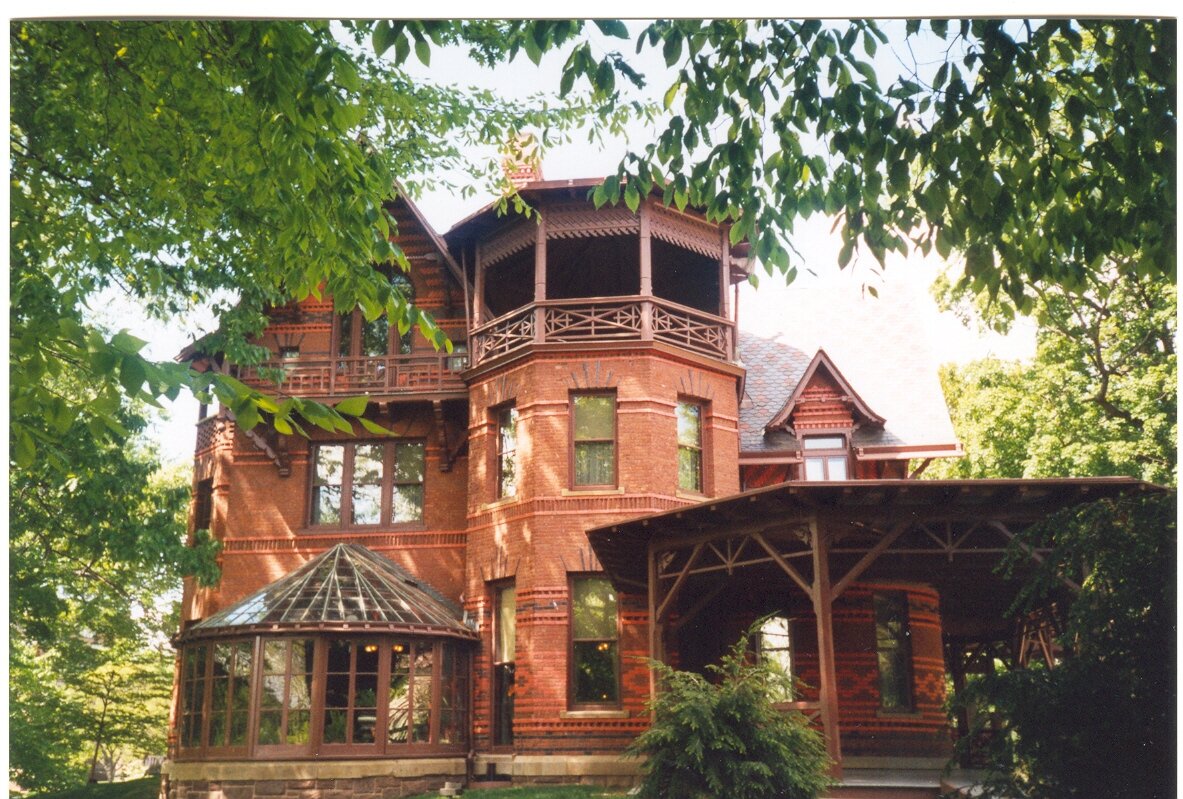
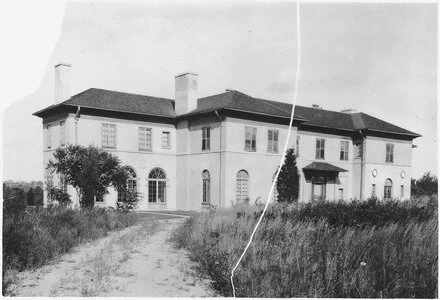
The Mark Twain House, now a museum, in Hartford, Conn., where he lived in 1874-1891. He then lived abroad and in New York City before spending his last years in Redding, Conn., in the grand house below, which burned down in 1923.
“Courage is resistance to fear, mastery of fear-not absence of fear. Except a creature be part coward it is not a compliment to say it is brave; it is merely a loose misapplication of the word. Consider the flea! - -Incomparably the bravest of all the creatures of God, if ignorance of fear were courage. Whether you are asleep or awake he will attack you, caring nothing for the fact that in bulk and strength you are to him as are the massed armies of the earth to a sucking child; he lives both day and night and all days and nights in the very lap of peril and the immediate presence of death, and yet is no more afraid than is the man who walks the streets of a city that was threatened by an earthquake ten centuries before. When we speak of Clive, Nelson, and Putnam as men who ‘didn't know what fear was,’ we ought always to add the flea-and put him at the head of the procession.”
— Mark Twain, in Pudd’nhead Wilson (1893)
Fine folding

Work by Peter Monaghan in his show “Peter Monaghan: Fold,’’ at Heather Gaudio Fine Art, New Canaan, Conn., Nov. 21-Jan. 9. He uses his folds as sculptures to evoke emotion and energy through color. Not surprisingly, he’s a former graphic designer.
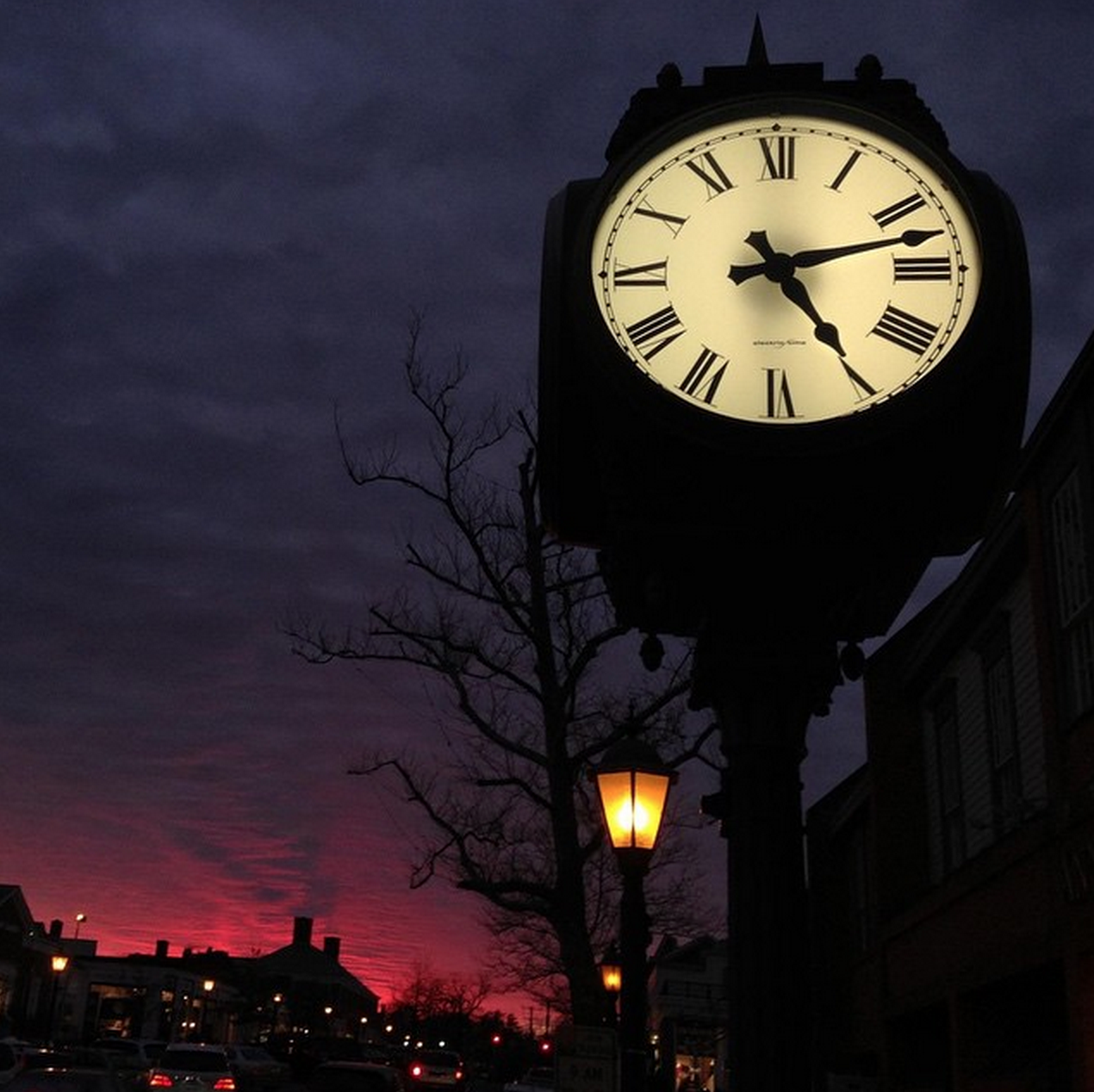
The Moreno Clock, on Elm Street in New Canaan.
— Photo by Jasonacurry
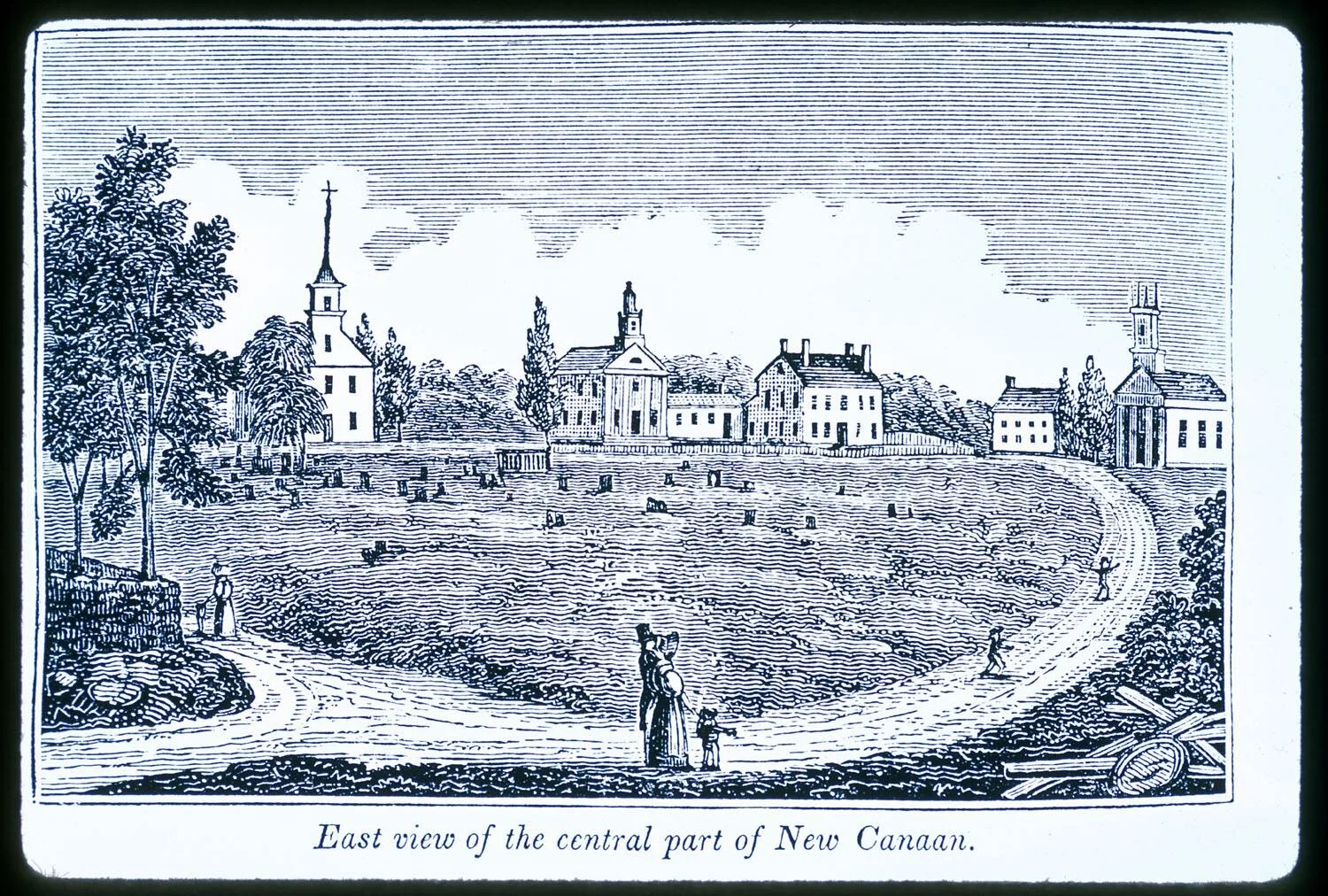
1836 view by John Warner Barber
Get a grip

— Photo by W. Carter
Much have I spoken of the faded leaf;
Long have I listened to the wailing wind,
And watched it ploughing through the heavy clouds,
For autumn charms my melancholy mind.
When autumn comes, the poets sing a dirge:
The year must perish; all the flowers are dead;
The sheaves are gathered; and the mottled quail
Runs in the stubble, but the lark has fled!
Still, autumn ushers in the Christmas cheer,
The holly-berries and the ivy-tree:
They weave a chaplet for the Old Year’s bier,
These waiting mourners do not sing for me!
I find sweet peace in depths of autumn woods,
Where grow the ragged ferns and roughened moss;
The naked, silent trees have taught me this,—
The loss of beauty is not always loss!
— “November,’’ by Elizabeth Drew Stoddard (1823-1902), a native of Mattapoisett, Mass.
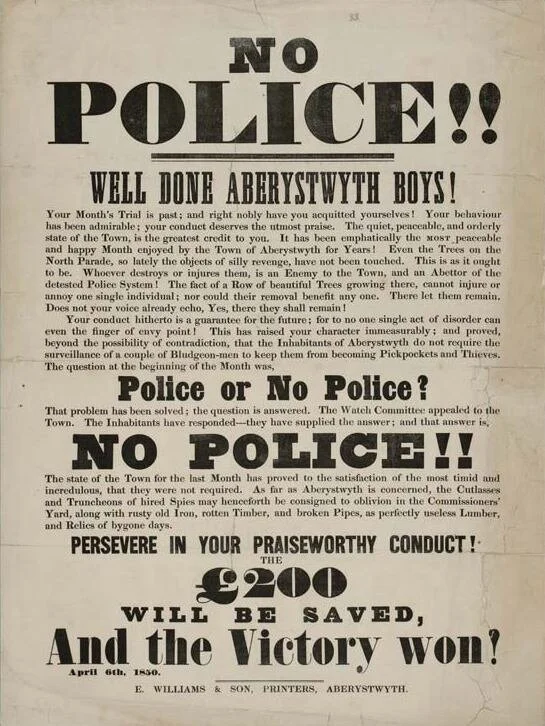
Chris Powell: Weakening police immunity needs review

Poster against "detested" Police at the town of Aberystwyth, Wales, in April 1850.
MANCHESTER, Conn
Sailing against a heavy political wind, Republican candidates for the Connecticut General Assembly were heartened by the vigorous endorsements they got from police unions for the Nov. 3 election. The police this year broke away from the government employee union apparatus in the Democratic Party.
The endorsements encouraged Republicans not because police officers are so numerous but because the public fears increasing disorder and crime amid the virus epidemic and political hatefulness and violence, and the police are the public's main defense.
Since some of the recent disorder and crime arises from protests against both the real and imagined use of excessive force by police against racial minorities, some people suspect that the Republican eagerness for police endorsements is anti-minority. After all, the unions are mad at Democratic legislators and Gov. Ned Lamont for enacting the recent police-reform legislation that was advocated by minority legislators. The new law purports to diminish the "qualified immunity" officers enjoy against personal lawsuits for their conduct on the job.
Police unions do have a lot to answer for. Like all government employee unions, they strive for more than due process of law for their members. They strive to defeat accountability altogether, as with the current state police union contract, which supersedes Connecticut's freedom-of-information law by forbidding disclosure of misconduct complaints that have been dismissed by police management. Of course without disclosure of all complaints, management itself cannot be evaluated and cover-ups can always prevail.
But critics of the police have a lot to answer for as well, like their silly calls to "defund" police precisely when disorder is worsening, as if any mistake or misconduct in police work eliminates the need for all police work.
Connecticut's new police law has several excellent provisions, like its requirement for regular recertification of state troopers and its nullification of the state police contract's secrecy clause. But the law's provision on immunity is questionable because its meaning and likely effect are not clear.
The Democratic legislators from minority groups who advocated the provision called it revolutionary. But white Democratic legislators supporting the provision insisted that it wouldn't change much at all.
It's no wonder police officers are resentful, and everyone should be concerned that once again the General Assembly didn't know what it was doing except rushing to oblige the special-interest politics of the moment -- just as the legislature did with the now-infamous law requiring Eversource Energy to buy the expensive electricity of the Millstone nuclear power station, causing a spike in electric rates.
There is misconduct in all occupations. It is most important to expose and stop it in police work. But police officers are far more sinned against than sinning. If it condemns all for the mistakes or misconduct of a few, society will only imperil itself.
While the "qualified immunity" provision is demoralizing officers, it won't take effect until July next year. It should be reconsidered authoritatively as soon as the legislature reconvenes.
xxx
COLLEGE SOLUTION: Students and teachers in the Connecticut State Universities and Colleges system are complaining about spending cuts to reduce the system's huge deficit. Some say there is too much administration, but eliminating all administration won't close the deficit, which has been caused largely by declining enrollment. With personal contact sharply curtailed during the virus epidemic, college on the internet is not much fun.
Fortunately there is a solution. Connecticut could handle higher education just as it handles lower education -- with social promotion. Everyone in high school can graduate just by showing up, without having to learn anything, and while most students never master high school work, everyone gets a diploma and is happy. So why not give bachelor's degrees to every high school graduate who wants one -- waiting, of course, for a few years to elapse so the degrees look more real?
Some specialized courses still could be offered for students who really want to learn something in college, but most students probably would settle for the degree alone. The savings would be enormous, and education's main objective would continue to be achieved: mere credentialism.
Chris Powell is a columnist for the Journal Inquirer, in Manchester, Conn.
Latest wrap-up of region's COVID-19 response

The front entrance of MGH, in Boston
Here is the most recent wrap-up the region’s COVID-19 developments from The New England Council (newenglandcouncil.com):
“Harvard Medical School Researchers Publish COVID-19 Rehabilitation Study – Researchers at Harvard Medical School have published a study detailing rehabilitation plans crafted for patients in Boston and New York-based hospitals. The team has treated over 100 patients and points to continued studies to address persistent COVID-19 symptoms. Read more here.
“Mass General Releases Guidance on Weaning Patients Off Ventilators – Clinicians at Massachusetts General Hospital have released an article with an accompanying video to demonstrate effective ways to wean patients with serious COVID-19 infections off of ventilators. The materials offer step-by-step instructions and were published in The New England Journal of Medicine. Read more here.
“Health Leads Releases Joint Statement on Ensuring Racial Equity in the Creation and Distribution of a COVID-19 Vaccine – Health Leads has released a statement, in conjunction with a number of other organizations and individuals, emphasizing the importance of supporting underserved communities in recovering from COVID-19. The statement includes strategies for ensuring equity in vaccine distribution. Read more here.’’

Mellow day on Cape Ann

“Head of Goose Cove, Annisquam” (oil on canvas, circa 1910), by George L. Noyes (1864-1954), at the Cape Ann Museum, Gloucester.
They’re happy they’re wild
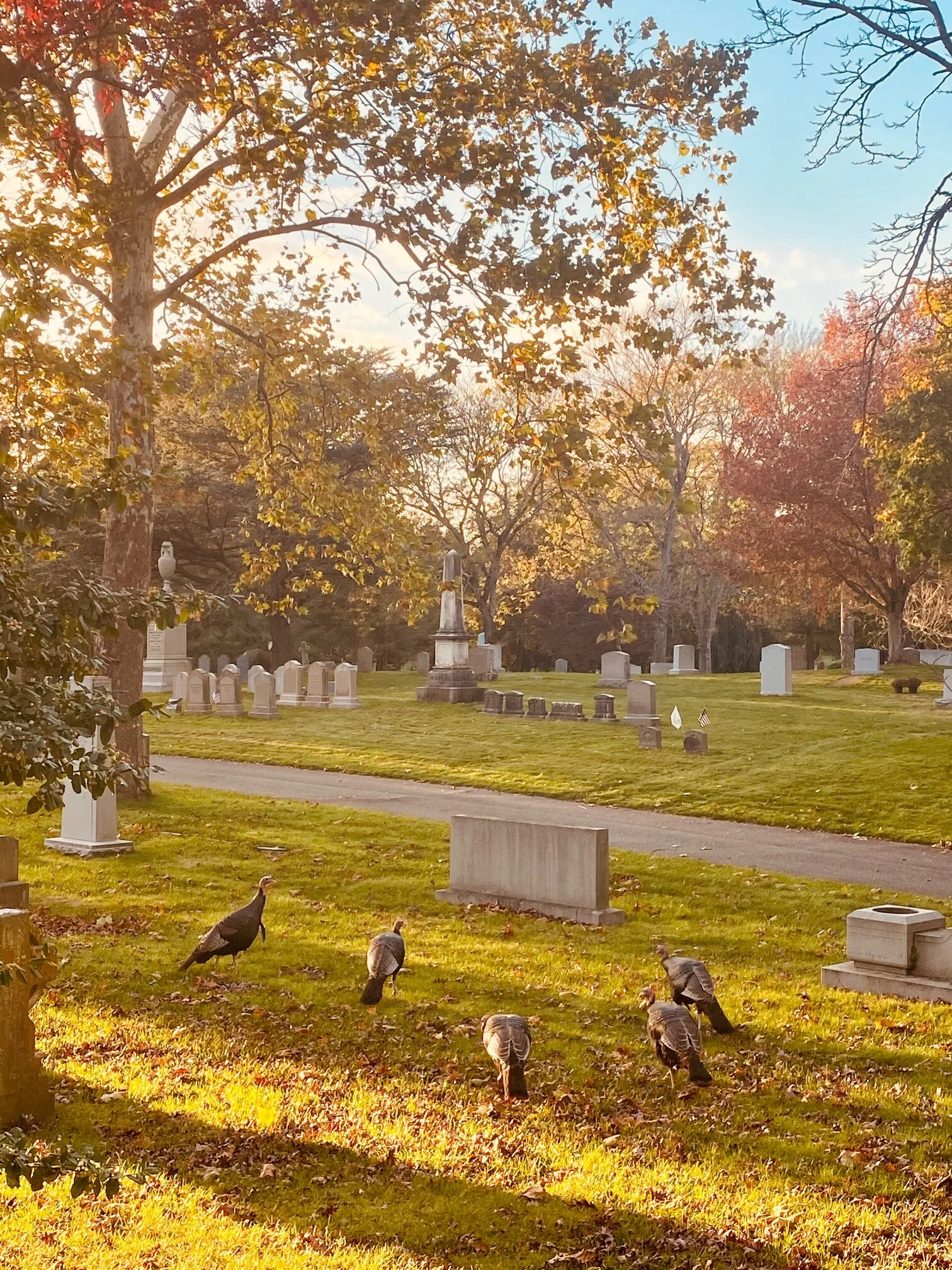
Wild turkeys gather to discuss Indian Summer at Swan Point Cemetery, in Providence. No shooting allowed.
— NED photo
Hear some of the resilient folks in the oyster-aquaculture biz on the Maine Coast

Oysters growing in baskets.
— Photo by Saoysters
Listen to these podcasts with the plucky and ingenious oyster farmers on the Pine Tree State’s storied coast. Just hit this link.
Economy looking wetter in Rhode Island

The tiny, five-turbine wind farm off Block Island. It’s still the only offshore wind farm in the U.S. even as there are huge offshore wind farms in Europe.
From Robert Whitcomb’s “Digital Diary,’’ in GoLocal24.com
It’s always good to see the Ocean State taking more advantage of, well, the ocean. There are two developments worthy of note. One is Gov. Gina Raimondo’s plan, working with National Grid, for Rhode Island to get 600 more megawatts of offshore wind power, as part of her hope to get all of Rhode Island’s electricity from renewable sources by 2030. That’s probably unrealistic but a worthy goal nonetheless. Certainly it would be a boon for the state’s economy to have that regionally generated power. Ultimately, with the development of new advanced batteries to store electricity, it would lower our power costs while making our electricity more reliable, helping to clean the air, slowing global warming and providing many well-paying jobs.
There is, however, the danger that if the Trump regime stays in power, it will slow or even sabotage offshore-wind development because it’s in bed with the fossil-fuel sector.
Then there’s the happy news that the Rhode Island Commerce Corporation plans to buy more land for the Port of Providence. This would come from a $70 million port-improvement bond issue that voters approved in 2016. $20 million of that is for expanding the Port of Providence. Considering its geography and location, Rhode Island for more than a century has used far too little of its potential to host major ports, with of course Providence and Quonset being the main sites.
Observers see considerable synergies between those ports and big offshore-wind operations off southeastern New England, much of which could be served from Rhode Island, as well as from New Bedford.
Please hit these links to learn more:
https://www.utilitydive.com/news/national-grid-to-develop-600-mw-offshore-wind-rfp-for-rhode-island/587866/
https://www.usnews.com/news/best-states/rhode-island/articles/2020-10-27/after-4-years-state-moves-to-buy-land-near-providence-port
Leadership as moral act
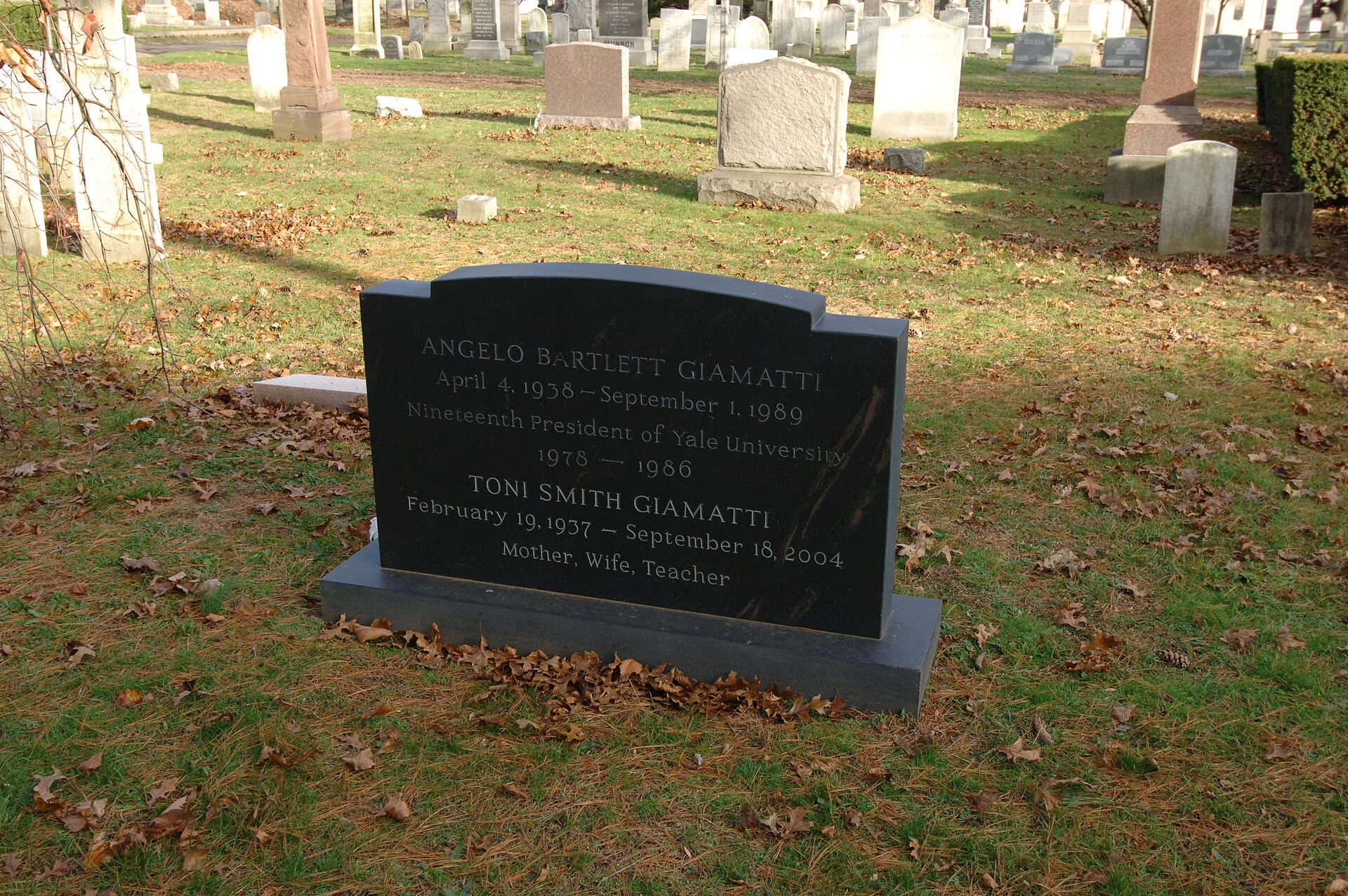
Gravestone for “Bart’’ Giamatti and his wife in New Haven
“Management is the capacity to handle multiple problems, neutralize various constituencies, motivate personnel….Leadership, on the other hand, is an essential moral act, not — as in most management — an essentially protective act. It is the assertion of a vision, not simply the exercise of a style.’’
— A. Bartlett Giamatti (1938-1989) in “An Address to School Administrators’’ . Born in Boston and a Renaissance literature scholar, he served as president of Yale University in 1978-86, as National {baseball} League president in 1986-89, and for only five months as baseball commissioner in 1989, before suffering a fatal heart attack at his summer home, in Edgartown, Mass., on Martha’s Vineyard. He was a lifelong Red Sox fan.
Olivia Ouellette: How safely can coyotes co-exist with humans?

A coyote pouncing on prey in the winter
-Photo by Yifei He
From ecoRI News (ecori.org)
University of Rhode Island graduate student Kimberly Rivera has been conducting a survey since the beginning of October on the coyote population in Rhode Island.
Rivera, who graduated in 2016 with a bachelor’s degree in environmental science from the University of Delaware, hopes to promote better co-existence between coyotes and Rhode Islanders.
Since the beginning of her work, Rivera has received about 425 completed responses. With a minimum goal of 500 completed surveys, Rivera plans to keep the survey open until at least December.
The survey takes about 5-10 minutes to complete and asks respondents about demographics — age, location, are you a full-time Rhode Island resident — and goes on to ask about any experiences with coyotes.
“Ultimately, what I really want to do is understand how people’s knowledge, belief and feelings tie back to these independent variables that were measured,” Rivera said.
Along with the survey, Rivera is also conducting more hands-on research using camera-trap technology. Initially intended for a bobcat study, these cameras are placed around Rhode Island, and when something walks by, it triggers the motion-sensor camera to take a series of photographs. These cameras then store the photographs, as well as save the date and time, letting Rivera look back and see when and where coyotes are most active.
Through her work, Rivera is trying to promote the acceptance and a better understanding of coyotes.
“I think co-existence is key moving into the future,” she said. “I want people to think about how they co-exist with coyotes and what that means to them.”
Rivera’s original plan was to travel to Madagascar to study seven native carnivore species there and see how the locals interact with those species. She was interested in seeing how people’s attitudes and knowledge about those species affected their interactions with them. The coronavirus pandemic required her to change her research plans.
Although her initial plans fell through, Rivera was still enthusiastic about reconstructing her project into a human-wildlife conflict study on coyotes, similar to what she would have researched in Madagascar.
“I’ve always had an interest in coyotes because on the East Coast they’re one of the only apex predators,” she said.
At the end of the survey there are a series of questions about how negatively people view coyotes in regards to certain issues, such as pets, livestock and property damage.
“I think it really depends on who you ask,” Rivera said. “I think there is potential for coyotes to be dangerous.”
One of the top concerns people have in Rhode Island in connection with coyotes is the safety of their pets.
“If you have small dogs that you are leaving out in the yard without fences or you have outdoor cats that are wandering around, there's always going to be a risk,” Rivera said. “And that could be coyotes or it could be a car hitting them, so it's just one of many risks.”
Olivia Ouellette is a University of Rhode Island journalism student.

Llewellyn King: Polls are setup shots and a plague for democracies
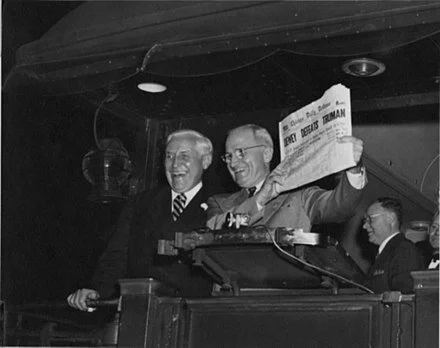
Nov. 3, 1948: President Harry S. Truman, shortly after being elected as president, smiles as he holds up a copy of the Chicago Daily Tribune issue prematurely announcing his electoral defeat. This image has become iconic about the consequences of bad polling data.
WEST WARWICK, R.I.
Damn, damn, damn the polls.
My irritation has nothing to do with how they botched this election, or how they botched the last two British elections or the Brexit vote.
It is not a matter, to my mind, of whether the polls get it wrong. It is a matter simply that they are taken at all. I have been railing against them for years.
I have found pollsters on the whole – I have interviewed quite a few -- to be decent, honest people who believe that they are taking the voters’ temperature scientifically; that their work is helpful, contributing to the national or regional understanding.
But polls are far from the benign things they purport to be. They are a setup shot that becomes the movie; a snapshot that changes the course of events, a contrived intrusion into the public discourse that then monopolizes it.
Polls sideline good people, bring into favor the known over the unknown, and promote a kind of national continuation. They begin to write the narrative, not to reveal it. They terrify timid leaders and office aspirants.
These same arguments can be made against a lot of market research. Ask people what they like, and they will tell you they like what they know.
Imagine if Harold Ross, the genius who was founding editor of The New Yorker magazine, had polled the public about the magazine he was about to start in 1925, and had asked, “Do you want a magazine in which the articles are long, the bylines are at the end of the articles, the headlines are in squiggly type, and there is no table of contents?” Do you think that there would be The New Yorker (it still has long articles, but the bylines are at the beginning, and it has a table of contents) today?
The most blame in the plague of polls that now distorts our elections belongs with the news media.
They commission polls relentlessly and then publicize the results, as though they have been allowed to see the face of God. This synthetic news.
Polls are not the revealed truth. They are an imperfect peek into the national thought portfolio. But once they become part of that portfolio, they corrupt the momentum of events.
Worse, polls sway the politicians. They turn the Pied Piper into one of the rats, getting in line with the rest.
In his Sept. 30, 1941 review of the war to the House of Commons, Prime Minister Winston Churchill chose to address the subject of opinion and leadership. He said, “Nothing is more dangerous in wartime than to live in the temperamental atmosphere of a Gallup Poll, always feeling one’s pulse and taking one’s temperature. I see that a speaker at the weekend said that this was a time when leaders should keep their ears to the ground. All I can say is that the British nation will find it very hard to look up to leaders who are detected in that somewhat ungainly posture.”
Quite right.
The damage is that polls have proliferated in recent years, and they perform various functions for various people. Universities and colleges have found, as in the case of the Quinnipiac University Poll, that polls are a branding asset. The Quinnipiac poll is run by a small college in the rolling hills of Hamden, Conn., with great professionalism and objectivity, which has given it considerable standing in the world of polling. It also has enhanced the standing of the college which runs it.
My quarrel with the polls will be partly assuaged if they continue to get it wrong. That way they will take their place in the background clutter, not the breathtaking political snapshots that undermine elections.
Llewellyn King is executive producer and host of White House Chronicle, on PBS. His email is llewellynking1@gmail.com and he’s based in Rhode Island and Washington, D.C
Web site: whchronicle.com
Uncertain how much but definitely rising

“Uncertain Waters,’’ by Robin Levandov, in her show “Unreal Estates,’’ Nov. 6-27 at Bromfield Gallery, Boston. The paintings are of imaginary landscapes.