

Leave fallen leaves

From Robert Whitcomb’s “Digital Diary,’’ in GoLocal24.com
It’s been good to read lately a pushback against the American obsession with lawns, which has been a slow-motion environmental disaster, however pretty they can be. To maintain lawns, as opposed to other ground covers, vast quantities of pesticides and toxic fertilizers are used, polluting bodies of water (and ground water) and killing all sorts of creatures. And the erosion from lawns can be severe.
I particularly think of this now, what with leaves covering lawns and homeowners tempted to get the blowers or rakes going and remove all traces of leaves from their lawns. But in fact, decomposing leaves are good for the soil, including the dirt that grass grows in. They add nitrogen and other important nutrients, keep down weeds and harbor microbes and insects that are good for plants and birds.
Mulch the fallen leaves with a lawn mower if you think that they’re getting too thick. If you have a composter put the excise leaves there or let it decompose in a pile in the corner of your yard.
One very unpleasant aspect of autumn life in areas like ours with lots of falling leaves is when homeowners and/or hard-working yard crews (often illegal immigrants), wield shrieking and heavily polluting leaf blowers to clear their lawns. They often blow the leaves into the street, where they clog drains. Many are blown into piles and then trucked to landfills to take up space at those overloaded sites.
Boston high schools sent lab kits for distance learning
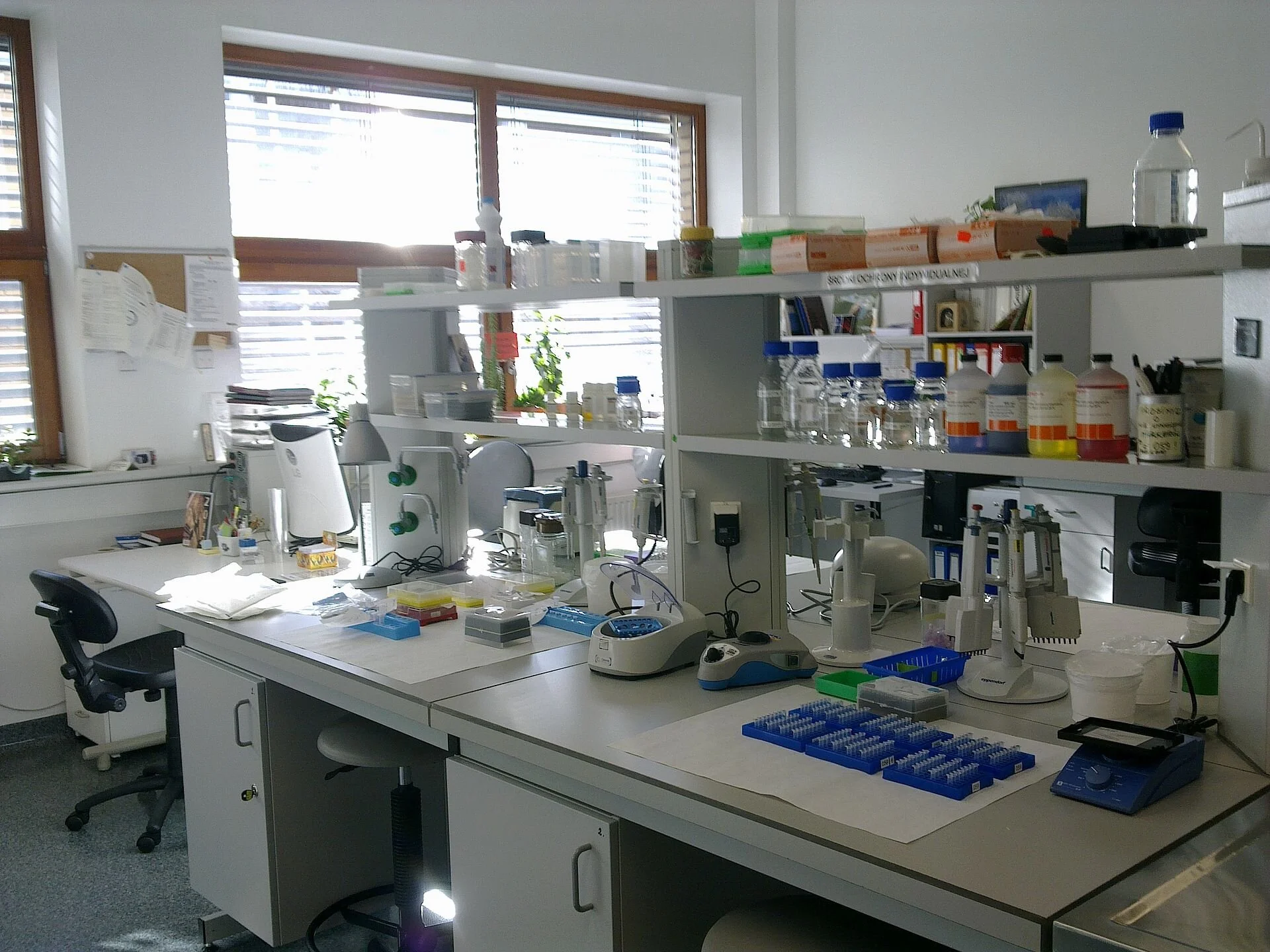
— Photo by Zuzanna K. Filutowska
From The New England Council (newenglandcouncil.com)
BOSTON
“Mass Insight Education and Research has partnered with manufacturer miniPCR bio to deliver 225 individual lab kits to high schools across Boston. The ‘Science from Home: Lab Kits for Distance Learning’ program is being piloted in by Advanced Placement (AP) biology classes in eight Boston high schools this fall.
“The Mass Insight program is partially supported by the Massachusetts Life Sciences Center (MLSC) and seeks to support AP biology students with the ability to complete lab assignments from home. The labs are designed to give students a safe, grade-level appropriate lab experience, and will allow students to investigate vital biological processes with minimal equipment.
“Leslie Prudhomme, Mass Insight’s senior content director for AP Sciences and a former AP biology teacher, has spearheaded the effort to get lab kits into students’ hands. ‘The kids are our top priority,’ Ms. Prudhomme said. ‘The question wasn’t are we going to be able to help them get the quality science education they need in the fall semester, it was how are we going to get this done?’’’
'Three aspects of time'

“Under the Juniper Tree’’ (encaustic) by Boston-based painter Lola Baltzell, in the “Brilliance and Celebration” show at Galatea Fine Art, Boston, through Oct. 31. She is a member of New England Wax (newenglandwax.com).
She says:
"This piece represents the past, the present and the future. Three panels, three aspects of time. Mostly I try to stay in the present. I feel like a refugee who has fled the homeland. I now live in a world that feels so foreign. The past — does it exist? It feels like ‘the old world’: The future? I'm trying to hold a sense of possibility."
The gallery says: “Lola Baltzell's works are uninhibited, yet carefully structured. It is not imposed, but appears as a reflection of natural order. Microbes, cells, direction of energy all serve to inform the surface of her works.’’
See:
galateafineart.com
Todd McLeish: Looking for a rare salamander

Marbled salamander
From ecoRI News (ecori.org)
RICHMOND, R.I.
After dark at a well-hidden vernal pool, Peter Paton shined his flashlight back and forth at the moss-covered ground around the nearly-dry pond basin. He was searching for marbled salamanders, the only autumn-breeding salamander in New England, and one that is seldom seen except on rainy fall evenings. It didn’t take him long to spot one.
“I got one,” he called out. “Over here.”
Marbled salamanders, which grow to about 3.5-4.25 inches, are the second-largest salamander in the region — after only the spotted salamander — and their attractive black-and-white patterning makes them unmistakable. The one Paton found, a male, was on his way out of the pond basin, indicating that the animal had completed his mating duties and was headed to the forest to spend the winter underground.
Female salamanders were likely hidden in the sphagnum moss around the pond, where they remain for a month or more to guard their eggs until rain fills the pond and the eggs are protected from predators and the elements. The eggs hatch within days after being covered in water, and the larvae overwinter in the pond.
Paton, a professor of natural resources science at the University of Rhode Island, was confident of finding marbled salamanders at the Richmond site, since it was a place he studied and monitored in 2000 and 2001, when he and colleagues conducted an amphibian survey of 137 vernal pools around the state. Marbled salamanders were found in just four of the pools, however, making it one of the rarest pond-breeding amphibians in the region.
Previous efforts in the 1980s and ’90s by Chris Raithel, a wildlife biologist at the Rhode Island Department of Environmental Management, documented as many as 50 marbled salamander breeding sites in the state, mostly in Kent and Washington counties. There are no records from Bristol County or from areas adjacent to Narragansett Bay and few from the Blackstone Valley.
“The present localized distribution of marbled salamanders in Rhode Island may be related to habitat fragmentation and patch isolation,” Raithel wrote in his 2019 book Amphibians of Rhode Island. “If this effect is real, the species is secure only in the larger contiguous habitats of southern and western Rhode Island, and additional range retraction should be evident to future generations.”
Marbled salamanders require a very specific habitat for breeding: ponds that are surrounded by sphagnum moss and dry up in the summer, keeping fish and large dragonfly larvae from inhabiting the pond and preying on the salamander larvae.
“They tend to like relatively small ponds, and there aren’t many sites available that fill their habitat requirements,” Paton said.
In addition to habitat fragmentation, road mortality is also a significant concern for the species, because they are often crushed by vehicles as the adults cross roads to reach their breeding ponds or as juveniles disperse to find territories.
On the other hand, Paton said it’s possible that the changing environmental conditions associated with the warming climate may make southern New England more favorable to marbled salamanders in the future. Their current range extends as far south as northern Florida and eastern Texas, and populations in warmer climates tend to be considerably larger than those in Rhode Island.
“They aren’t very tolerant of the cold, so we’re at the northern limits of their range,” Paton said. “The larvae don’t grow much in the winter because it’s too cold, but once wood frogs arrive to breed in early spring, the salamander larvae feed on the frog tadpoles as their main fuel source to undergo metamorphosis.”
After metamorphosis, the salamanders leave their ponds and spend the rest of their lives in the forest, except for brief breeding periods each fall.
Marbled salamanders require a very specific habitat for breeding and they are not very tolerant of the cold.
Despite how few marbled salamander breeding sites were found during the last amphibian survey, a recent graduate student at the University of Massachusetts at Boston thinks a new survey method may detect the salamanders more effectively than traditional sampling methods.
Jack He, who graduated in May, used eDNA — environmental DNA collected from water or soil — to detect the presence of marbled salamanders even when the animals could not be seen.
“Everything sheds DNA in one form or another, like from skin cells or blood, and they release it into the environment,” He said. “Ideally, we can collect water or soil samples containing those cells and extract that DNA and sequence it to determine what species are present.”
He detected marbled salamander DNA in a number of water and soil samples from vernal pools in western Massachusetts. He calls it a less labor-intensive method of determining if the salamanders are present at a site than using dipnets to capture larvae in the spring, which is how Paton conducted his survey.
“I’ve done dipnet studies and compared them to eDNA, and I found that eDNA was a bit more effective,” He said.
Paton, however, isn’t convinced.
“My impression is that larvae are relatively easy to find, but I could be biased,” he said. “Maybe they’re in there and I missed them a lot. But however you do it, I suspect that marbled salamanders are still fairly rare in Rhode Island.”
Rhode Island resident and author Todd McLeish runs a wildlife blog. He’s a frequent EcoRI News contributor.
Chen Shih-chung: COVID-19 shows importance of Taiwan being admitted to WHO
WHO emblem
Our friends in the Taiwan representative office in Boston forwarded this to us.
— Robert Whitcomb
Since the COVID-19 pandemic began, there have more than 40 million cases and more than one million deaths around the world. The virus has had an enormous impact on global politics, employment, economics, trade and financial systems, and significantly impacted the global efforts to achieve the United Nations Sustainable Development Goals (UN SDGs).
Thanks to the united efforts of its entire people, Taiwan has responded to the threats posed by this pandemic through four principles: prudent action, rapid response, advance deployment and openness and transparency. Adopting such strategies as the operation of specialized command systems, the implementation of meticulous border-control measures, the production and distribution of adequate supplies of medical resources, the employment of home quarantine and isolation measures and related care services, the application of IT systems, the publishing of transparent and open information, and the execution of precise screening and testing, we have been fortunate enough to contain the virus. As of Oct. 7, Taiwan had had just 523 confirmed cases and seven deaths; meanwhile, life and work have continued much as normal for the majority of its people.
The global outbreak of COVID-19 has reminded the world that infectious diseases know no borders and do not discriminate along political, ethnic, religious or cultural lines. Nations should work together to address the threat of emerging diseases. For this reason, once Taiwan had stabilized its containment of the virus and ensured that people had sufficient access to medical resources, we began to share our experience and exchange information on containing COVID-19 with global public-health professionals and scholars through COVID-19-related forums, the Asia-Pacific Economic Cooperation group’s (APEC) High-Level Meeting on Health and the Economy, the Global Cooperation Training Framework, and other virtual bilateral meetings. As of June 2020, Taiwan had held nearly 80 online conferences, sharing the Taiwan Model with experts from governments, hospitals, universities and think tanks in 32 countries.
Taiwan’s donations of medical equipment and anti-pandemic supplies to countries in need also continue. By June, we had donated 51 million surgical masks, 1.16 million N95 masks, 600,000 isolation gowns, and 35,000 forehead thermometers to more than 80 countries.
To ensure access to vaccines, Taiwan has joined the COVID-19 Vaccines Global Access Facility (COVAX) co-led by GAVI — the Vaccine Alliance — and the Coalition for Epidemic Preparedness Innovations. And our government is actively assisting domestic manufacturers in hopes of accelerating the development and production of successful vaccines, bringing them to market as quickly as possible and putting an end to this pandemic.
To prepare for a possible next wave of the pandemic as well as the approaching flu season, Taiwan is maintaining its strategies of encouraging citizens to wear face masks and maintain social distancing, and strengthening border quarantine measures, community-based prevention and medical preparedness. Furthermore, we are actively collaborating with domestic and international partners to obtain vaccines and develop optimal treatments and accurate diagnostic tools, jointly safeguarding global public-health security.
The COVID-19 pandemic has proven that Taiwan is an integral part of the global public-health network and that Taiwan Model can help other countries combat the pandemic. To recover better, WHO needs Taiwan. We urge WHO and related parties to acknowledge Taiwan’s longstanding contributions to global public health, disease prevention, and the human right to health, and to firmly support Taiwan’s inclusion in WHO. Taiwan’s comprehensive participation in WHO meetings, mechanisms and activities would allow us to work with the rest of the world in realizing the fundamental human right to health as stipulated in the WHO Constitution and the vision of leaving no one behind enshrined in the UN SDGs.
Chen Shih-chung is minister for health and welfare for Taiwan (Republic of China)
Flaming near the frost

Swamp maples
“It takes adversity or coming close
To trouble and hard times to make them glow,
Then they really flower as swamp maples
Flower on the edge of frost and snow.’’
— From “New Englanders Are Maples,’’ by Robert P.T. Coffin (1892-1955), a native and long-time resident of Brunswick, Maine, and a Pulitzer Prize-winning poet

The long-gone Merrymeeting Park Casino and amusement park in Brunswick, circa 1905

Chris Powell: Census issue hypocrisies, theocratic fascism and Hunter Biden

MANCHESTER, Conn.
When it comes to the country's decennial census, the U.S. Constitution could not be any clearer. The census must count "the whole number of persons in each state, excluding Indians not taxed."
It's not fair that this credits people who have entered the country illegally toward representation in the U.S. House and state legislatures, rewarding those states and cities -- mainly jurisdictions run by Democrats, including Connecticut -- that obstruct enforcement of federal immigration law and encourage illegal immigration, but that's what the text requires.
So the Trump administration, a Republican one, is trying to violate the Constitution by removing people who have entered the country illegally from the count, and the issue has gone to the Supreme Court. Connecticut and other immigration law nullifiers have sued, and last week the Supreme Court agreed to hear the case.
The spectacular irony here is that while Democrats are scorning President Trump's Supreme Court nominee, Amy Coney Barrett, for being an "originalist" -- someone who claims to construe the Constitution according to its text and what it meant when it was enacted -- in the census case the Democrats are the originalists and the Republicans are the ones who want to rewrite the Constitution by executive fiat.
Of course, no constitution can specifically address all circumstances that may become legal disputes over time. At most a constitution can establish mechanisms and principles for government, and applying those principles to new circumstances may induce courts to make some assumptions, even as taking assumptions too far becomes legislating, which courts are supposed to leave to legislatures.
But if constitutions don't mean what they say and what they meant when adopted, they aren't really constitutions at all. The political hypocrisy in the census case suggests that neither side is terribly sincere about its supposed constitutional principles.
xxx
Last week's atrocity in France, the beheading of a teacher by an immigrant religious fanatic, is a reminder of why the United States should get serious about controlling immigration. The teacher had just taught a lesson about freedom of expression under secular government and some of his students and their parents, themselves religious fanatics, took offense and alerted the perpetrator.
This kind of thing has been happening for years throughout Europe because of its failure to control immigration, especially immigration from areas afflicted by theocratic fascism. While the United States enjoys greater distance from those areas, it still has admitted many people who want to overthrow democratic and secular culture.
President Trump has often demagogued the issue, but because their party gains political representation from illegal immigration, most Democrats oppose immigration law enforcement. If the choice is between immigration enforcement with some demagoguery and no enforcement at all, even Trump should prevail.
xxx
It doesn't matter too much whether the laptop computer supposedly abandoned at the repair shop in Delaware was Hunter Biden's and whether the emails supposedly found on it are genuine. While some national news organizations seem unable to put aside their propagandizing and covering up for Hunter's father so they can investigate the matter, the essential point about the Bidens already has been established for anyone who reads closely enough.
That is, when Joe Biden was vice president he helped his dissolute son enrich himself through a business deal in Ukraine, and perhaps in China, deals for which the son had no qualifications except for peddling influence with his father. The vice president took his son with him on official trips for that purpose. While President Trump's business empire posed many conflicts of interest that should have disqualified him before he was nominated and elected, it turns out that Biden was corrupt while in office.
People may find Trump's demeanor, instability and megalomania so outrageous and dangerous, quite apart from his administration's policies, as to excuse the corruption at the top of the Democratic ticket. Indeed, national politics now is so corrupt and demagogic that the public's only defense may be the fastest possible rotation in office between the parties. But whoever wins this election, journalistic fairness and integrity will have been fatal casualties of the campaign.
Chris Powell is a columnist for the Journal Inquirer, in Manchester.
Turtle kingdom
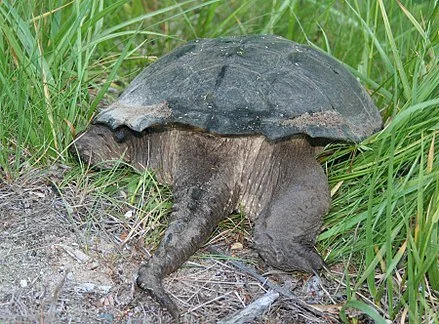
Back end of a snapping turtle
“I have very fond memories of swimming in Walden Pond (in Concord, Mass.) when we lived in Boston. You'd swim past a log and see all these turtles sunning themselves. Slightly disturbing if you thought about how many more were swimming around your toes, but also rather wonderful.’’
— Mark Haddon, English novelist
The romance of Quincy
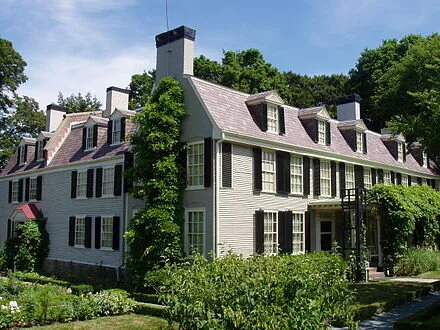
“Peacefield,’’ the main house at the Adams National Historical Park, in Quincy, Mass., which was the Adams family homestead. The preserves the home of Presidents John Adams and John Quincy Adams, of U.S. Ambassador to Britain Charles Francis Adams, and of writers and historians Henry Adams and Brooks Adams.
“My father and my mother have departed. The charm which has always made this house to me an abode of enchantment is dissolved; and yet my attachment to it, and to the whole region, is stronger than I ever felt before.’’
John Quincy Adams (1767-1848) in his diary entry for July 13, 1826, during his presidency. He was the sixth president; his father, John Adams, the second.

Sam Pizzigati: Biden tax plan would reduce inequality

“The tax collector's office,’’ by Pieter Brueghel the Younger (1640)
Via OtherWords.org
BOSTON
Want to know where the 2020 presidential election is heading? Don’t obsess about the polls. Pay attention to tax lawyers and accountants.
These experts in reducing rich people’s tax bills understand what many Americans still haven’t quite fathomed: The nation’s wealthiest will likely pay significantly more in taxes if Joe Biden becomes president.
Why? Because the massive tax cuts for corporations and the rich that Trump and the GOP passed in 2017 may soon be shredded.
If these rich don’t take immediate steps to “protect their fortunes,” their law firms are advising, they could lose out big-time. “We’ve been telling people: ‘Use it or lose it,’” says Jere Doyle, a strategist at BNY Mellon Wealth Management.
At first, these concerns may appear overblown. Under Biden’s plan, the tax rate on America’s top income tax bracket would only rise from 37 percent back up to 39.6 percent, the Obama-era rate.
But the real “backbreakers” for the rich come elsewhere.
Among the biggest: a new tax treatment for “investment income,” the money that rich people make buying and selling assets.
Most of this income currently enjoys a super-discounted tax rate — just 20 percent, far lower than what most working people pay on their paycheck income. The Biden tax plan ends this favorable treatment of income from “capital gains” for taxpayers making over $1 million. It would also close the loophole where wealthy people simply pass appreciated assets to their heirs.
Biden is also proposing an overhaul of Social Security taxes. The current 12.4 percent Social Security payroll tax — half paid by employers, half by employees — applies this year to only the first $137,700 in paycheck earnings, a figure that gets annually adjusted to inflation.
That means that a corporate exec who makes $1 million this year will pay the same amount into Social Security as a person who makes $137,700.
Biden’s plan would apply the Social Security tax to all paycheck income over $400,000, so America’s deepest pockets would pay substantially more to support Social Security. Meanwhile Americans making under $400,000 would continue to pay at current levels.
Corporations would also pay more in taxes. Biden would raise the standard corporate income tax rate from 21 to 28 percent, set a 15 percent minimum tax on corporate profits, and double the current minimum tax foreign subsidiaries of U.S. companies have to pay from 10.5 to 21 percent.
Among other changes: Big Pharma companies would no longer get tax deductions for what they spend on advertising. Real estate moguls would no longer be able to depreciate the rental housing they own on an accelerated schedule, and fossil-fuel companies would lose a variety of lucrative tax preferences.
Together, these ideas could measurably reduce inequality.
The Institute on Taxation and Economic Policy has crunched the numbers: In 2022, under Biden’s plan, the nation’s top 1 percent would bear 97 percent of the direct tax increases Biden is proposing. The next most affluent 4 percent would bear the remaining 3 percent.
Despite some misleading Republican talking points to the contrary, no households making under $400,000 — the vast majority of Americans — would see their direct taxes rise.
Even if Democrats win the Senate, actually passing this plan will take grassroots pressure — the only force that has ever significantly raised taxes on the rich.
Wealth inequality remains an even greater challenge, and the Biden plan includes no wealth tax along the lines of what Senators Bernie Sanders and Elizabeth Warren, two of Biden’s primary rivals, advocated. But more pressure could also shove that wealth tax onto the table.
If that happens, we might finally begin to reverse the staggering levels of inequality that Ronald Reagan’s 1980 election ushered in.
Sam Pizzigati, based in Boston, is the co-editor of Inequality.org and author of The Case for a Maximum Wage and The Rich Don’t Always Win.
John O. Harney: Pressing on through the pandemic

BOSTON
From The New England Journal of Higher Education, a service of The New England Board of Higher Education (nebhe.org)
A little of what we’ve been following …
Counting heads. New enrollment figures show higher education reeling under the weight of COVID-19 and a faltering economy on top of pre-existing challenges such as worries that college may not be worth the price. A month into the fall 2020 semester, undergraduate enrollment nationally was down 4 percent from last year, thanks in large part to a 16 percent drop in first-year students attending college this pandemic fall, according to “First Look” data from the National Student Clearinghouse Research Center. In New England, the early data suggest New Hampshire and Vermont were among the handful of U.S. states enrolling more undergraduates than last fall, while Rhode Island reported a nearly 16 percent drop.
At community colleges, freshman enrollment sunk by nearly 23 percent nationally, the clearinghouse reports.
Interestingly, before COVID hit and when so-called “Promise” programs were in full stride, 33 public community college Promise programs across the U.S. showed big enrollment success with their free-college models, according to a study released recently in the Educational Evaluation and Policy Analysis, a peer-reviewed journal of the American Educational Research Association. Such programs were “associated with large enrollment increases of first-time, full-time students—with the biggest boost in enrollment among Black, Hispanic and female students,” the study found, adding, “The results come as the economic impact of the Covid-19 pandemic is leading states to tighten higher education budgets, as low-income students are forgoing their postsecondary plans at higher rates this fall than their wealthier peers, and as community colleges are experiencing larger enrollment declines than four-year universities.”
On the other hand, a report from our friends at the Hildreth Institute examines 22 statewide, free-tuition programs established in the past decade, and finds that most do not address the real barriers that prevent many students from getting a higher education credential. The report notes that tuition and fees represent just 24 percent of the cost of attending a community college and 40 percent of the cost of attending a public four-year university. Beyond tuition, students struggle with necessities like textbooks, computers, software, internet access, housing, food and transportation. Moreover, “the lower the income of a student, the less likely they are to benefit from existing tuition-free programs, known as ‘last-dollar’ scholarships, which cover only the portion of tuition and fees that are not covered by existing financial aid,” the Hildreth report notes.
Digital futures. The ECMC Foundation awarded the Business-Higher Education Forum (BHEF) $341,000 to fund the Connecticut Digital Credential Ecosystem Initiative, in partnership with NEBHE. A network of companies, community colleges, government agencies and other stakeholders, led by BHEF, will develop new pathways to digital careers, particularly for individuals unemployed due to COVID-19. BHEF will help community colleges issue industry-validated credentials to support transparent career pathways across Connecticut and the surrounding region. Participating employers will approve the knowledge, skills and abilities for these credentials, thus building recruitment and hiring links for students who complete the credential. The idea owes much to the work and recommendations of NEBHE’s Commission on Higher Education & Employability.
Organizing. I was happy to attend the virtual annual conference of the Hunter College National Center for the Study of Collective Bargaining in Higher Education and the Professions, its 47th annual conference, this time held virtually due to COVID. The topic was “Inequality, Collective Bargaining and Higher Education.” It was a goldmine of perspectives on equity, antiracism and labor rights.
Among bright spots, talk of a possible student loan debt jubilee and increasing moves by campus CEOs to resist pay raises. Bill Fletcher, former president of the advocacy group TransAfrica and senior scholar with the Institute for Policy Studies, recounted the formation of labor organizing in the U.S. from America’s original sins of annihilating Native Americans and enslaving Africans through the birth of trade unionism and social justice efforts like Occupy and the National Education Association’s Red for Ed. We don’t need white allies, he added, but rather white comrades like John Brown on the frontlines.
Touting Joe Biden’s higher-education platform, Tom Harnish, vice president for government relations at the State Higher Education Executive Officers Association and a faculty member at George Washington University, offered basic advice: If you want better higher-education policy, get out and vote and put better people in office.
In a session on the evolution of labor studies, speakers noted that many labor-education programs have been folded into management schools or sometimes taught under the guise of the history of capitalism so as to attract students. We have to warn students that this is not the place if you’re aspiring to an HR position, one said.
Purdue dropping program in Lewiston, Maine. No higher-education models seem immune to COVID-19. Recently, Purdue University Global announced it is dropping its physical presence in Lewiston, Maine, when its lease expires in March. In spring 2017, Purdue University acquired most of the credential-granting side of the then-for-profit Kaplan University, as part of the Indiana-based public research university’s effort to engage the fast-growing adult student market. Kaplan had about 32,000 students taking courses online or at one of more than a dozen physical campus locations, including Lewiston and Augusta, Maine. The Lewiston building had been empty due to COVID. The Augusta building reportedly will continue to house the nursing program. Kaplan University, by the way, converted to nonprofit status as part of the deal.
See you in better times …
John O. Harney is executive editor of The New England Journal of Higher Education.
Repel the roadblockers

From Robert Whitcomb’s “Digital Diary,’’ in GoLocal224.com
“As Columbus announced when he knew he was bounced
It was swell, Isabelle, swell.’’
\
--- From Cole Porter’s 1935 song “Just One of Those Things’’
I’m with Rhode Island Democratic state Sen. Leonidas Raptakis, who wants to make it a felony to block a highway, which is what seven activists promoting “Indigenous Peoples Day’’ and denouncing Christopher Columbus did Oct. 13 in Providence on the north-bound side of Route 95, the main street of the East Coast.
This outrageous act, which might have gained the lawless Trump’s “law and order” campaign some voters, could have caused fatal accidents and have blocked such emergency vehicles as fire trucks and ambulances. These idiots belong in the slammer for a good long time. Nobody has a First Amendment right to block essential public infrastructure.
Also, let’s not romanticize Native Americans. Like the hemisphere’s European occupiers, they inflicted their share of horrific brutality. Tribes would fight each other, as well as invading, land-hungry white people, with awful violence. What they didn’t have was immunity to diseases from Europe and Europeans’ weaponry.

JoNel Aleccia: Should you try Trump-touted drugs?

“You shouldn’t expect that what you’ve heard about on the news is the right treatment for you.”
— Benjamin Rome, M.D., Harvard Medical School
When Terry Mutter woke up with a headache and sore muscles on a recent Wednesday, the competitive weightlifter chalked it up to a hard workout.
By that evening, though, he had a fever of 101 degrees and was clearly ill. “I felt like I had been hit by a truck,” recalled Mutter, who lives near Seattle.
The next day he was diagnosed with COVID-19. By Saturday, the 58-year-old was enrolled in a clinical trial for the same antibody cocktail that President Trump claimed was responsible for his coronavirus “cure.”
“I had heard a little bit about it because of the news,” said Mutter, who joined the study by drugmaker Regeneron to test whether its combination of two man-made antibodies can neutralize the deadly virus. “I think they probably treated him with everything they had.”
Mutter learned about the study from his sister-in-law, who works at Seattle’s Fred Hutchinson Cancer Research Center, one of dozens of trial sites nationwide. He is among hundreds of thousands of Americans — including the president — who’ve taken a chance on experimental therapies to treat or prevent COVID-19.
But with nearly 8 million people in the U.S. infected with the coronavirus and more than 217,000 deaths attributed to COVID, many patients are unaware of such options or unable to access them. Others remain wary of unproven treatments that can range from drugs to vaccines.
“Honestly, I don’t know whether I would have gotten a call if I hadn’t known somebody who said, ‘Hey, here’s this study,’” said Mutter, a retired executive with Boeing Co.
The Web vsite clinicaltrials.gov, which tracks such research, reports more than 3,600 studies involving COVID-19 or SARS-CoV-2, the virus that causes the disease. More than 430,000 people have volunteered for such studies through the COVID-19 Prevention Network. Thousands of others have received therapies, like the antiviral drug remdesivir, under federal emergency authorizations.
Faced with a dire COVID diagnosis, how do patients or their families know whether they can — or should — aggressively seek out such treatments? Conversely, how can they decide whether to refuse them if they’re offered?
Such medical decisions are never easy — and they’re even harder during a pandemic, said Annette Totten, an associate professor of medical informatics and clinical epidemiology at Oregon Health & Science University.
“The challenge is the evidence is not good because everything with COVID is new,” said Totten, who specializes in medical decision-making. “I think it’s hard to cut through all the noise.”
Consumers have been understandably whipsawed by conflicting information about potential COVID treatments from political leaders, including Trump, and the scientific community. The antimalarial drug hydroxychloroquine, touted by the president, received emergency authorization from the federal Food and Drug Administration, only to have the decision revoked several weeks later out of concern it could cause harm.
Convalescent plasma, which uses blood products from people recovered from COVID-19 to treat those who are still ill, was given to more than 100,000 patients in an expanded-access program and made widely available through another emergency authorization — even though scientists remain uncertain of its benefits.
Regeneron and the pharmaceutical firm Eli Lilly and Co. have both requested emergency use authorization for their monoclonal antibody therapies, even as scientists say such approval could jeopardize enrollment in the randomized controlled trials that will prove whether or how well they work. So far, about 2,500 people have enrolled in the Regeneron trials, with about 2,000 of them receiving the therapy, a company spokesperson said. Others have received the treatment through so-called compassionate use programs, though the company wouldn’t say how many.
Last week, the National Institutes of Health paused the Lilly antibody trial after an independent monitoring board raised safety concerns.
“With all of the information swirling around in the media, it’s hard for patients to make good decisions — and for doctors to make those decisions,” said Dr. Benjamin Rome, a general internist and health policy researcher at Harvard Medical School’s Portal program. “You shouldn’t expect that what you’ve heard about on the news is the right treatment for you.”
Even so, people facing COVID shouldn’t be afraid to question whether treatment options are available to them, Rome said. “As a doctor, I never mind when patients ask,” he said.
Patients and families should understand what the implications of those treatments might be, Totten advised. Early phase 1 clinical trials focus largely on safety, while larger phase 2 and phase 3 trials determine efficacy. Any experimental treatment raises the possibility of serious side effects.
Ideally, health care providers would provide such information about treatments and risks unprompted. But during a pandemic, especially in a high-stress environment, they might not, Totten noted.
“It’s important to be sort of insistent,” she said. “If you ask a question, you have to ask it again. Sometimes you have to be willing to be a little pushy,” she said.
Patients and families should take notes or record conversations for later review. They should ask about financial compensation for participation. Many patients in COVID-19 trials are paid modest amounts for their time and travel.
And they should think about how any treatment fits into their larger system of values and goals, said Angie Fagerlin, a professor and the chair of the population health sciences department at the University of Utah.
“What are the pros and what are the cons?” Fagerlin said. “Where would your decision regret be: Not doing something and getting sicker? Or doing something and having a really negative reaction?”
One consideration may be the benefit to the wider society, not just yourself, she said. For Mutter, helping advance science was a big reason he agreed to enroll in the Regeneron trial.
“The main thing that made me interested in it was in order for therapeutics to move forward, they need people,” he said. “At a time when there’s so much we can’t control, this would be a way to come up with some kind of a solution.”
That decision led him to Fred Hutch, which is collaborating on two Regeneron trials, one for prevention of COVID-19 and one for treatment of the disease.
“It was a six-hour visit,” he said. “It’s two hours to get the infusion. It’s a very slow IV drip.”
Mutter was the second person enrolled in the treatment trial at Fred Hutch, said Dr. Shelly Karuna, a co-principal investigator. The study is testing high and low doses of the monoclonal antibody cocktail against a placebo.
“I am struck by the profound altruism of the people we are screening,” she said.
Mutter isn’t sure how he contracted COVID-19. He and his family have been careful about masks and social distancing — and critical of others who weren’t.
“The irony now is that we’re the ones who got sick,” said Mutter, whose wife, Gina Mutter, 54, is also ill.
Mutter knows he has a 1-in-3 chance that he got a placebo rather than one of two active treatment dosages, but he said he was willing to take that chance. His wife didn’t enroll in the trial.
“I said, there’s some risks involved. We’re taking one for the team here. I don’t think we both need to do that,” he said.
So far, Mutter has struggled with a persistent cough and lingering fatigue. He can’t tell if his infusion has been helpful, never mind whether it’s a cure.
“Just no way of telling if I got the antibodies or not,” he said. “Did I get them and that kept me out of disaster, or did I get the placebo and my own immune system did its job?”
JoNel Aleccia is a Kaiser Health News reporter
JoNel Aleccia: jaleccia@kff.org, @JoNel_Aleccia
If it melts

“Melting Pot,’’ by Roberto Lugo, on view March 14 at the Fuller Craft Museum, Brockton, Mass.
Mr. Lugo is an American artist, ceramicist, social activist, poet and educator. The museum says “His work confronts the intertwined complexities of systemic racism, representation and history, while challenging established power structures within the art, craft and design fields.’’
See:
https://fullercraft.org/
and:
http://robertolugostudio.com/
On a jewel of a day

Looking north on the Seekonk River, between Providence and East Providence, on Oct. 19. Narragansett Boat Club is on the left.
For 'ruthless examination'

Connecticut Hall (built in 1750-1753) at Yale, with statue of alumnus Nathan Hale (1755-1776), an American soldier and spy for the Continental Army during the Revolutionary War. He volunteered for an intelligence-gathering mission in New York City but was captured by the British and executed.
“Universities should he safe havens where ruthless examination of realities will not be distorted by the aim to please or inhibited by the risk of displeasure.’’
— Kingman Brewster (1919-1998), president of Yale University, in New Haven, in 1963-1977 and diplomat.
'Sober gladness'
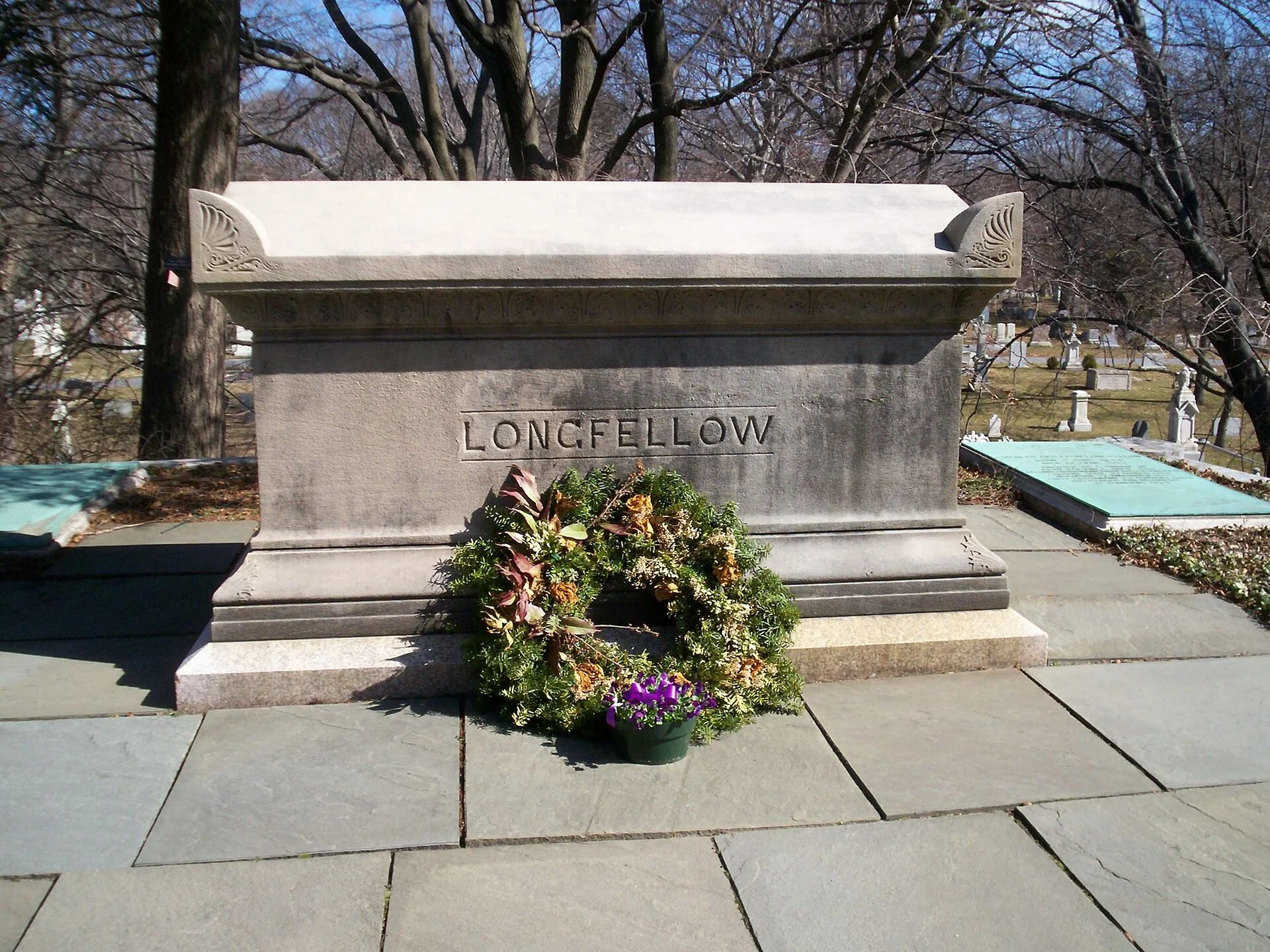
Henry Wadsworth Longfellow’s grave in glorious Mount Auburn Cemetery, which straddles Cambridge and Watertown, Mass.
With what a glory comes and goes the year!
The buds of spring, those beautiful harbingers
Of sunny skies and cloudless times, enjoy
Life’s newness, and earth’s garniture spread out;
And when the silver habit of the clouds
Comes down upon the autumn sun, and with
A sober gladness the old year takes up
His bright inheritance of golden fruits,
A pomp and pageant fill the splendid scene.
There is a beautiful spirit breathing now
Its mellow richness on the clustered trees,
And, from a beaker full of richest dyes,
Pouring new glory on the autumn woods,
And dipping in warm light the pillared clouds.
Morn on the mountain, like a summer bird,
Lifts up her purple wing, and in the vales
The gentle wind, a sweet and passionate wooer,
Kisses the blushing leaf, and stirs up life
Within the solemn woods of ash deep-crimsoned,
And silver beech, and maple yellow-leaved,
Where Autumn, like a faint old man, sits down
By the wayside a-weary. Through the trees
The golden robin moves; the purple finch,
That on wild cherry and red cedar feeds,
A winter bird, comes with its plaintive whistle,
And pecks by the witch-hazel, whilst aloud
From cottage roofs the warbling blue-bird sings;
And merrily, with oft-repeated stroke,
Sounds from the threshing-floor the busy flail.
O what a glory doth this world put on
For him who, with a fervent heart, goes forth
Under the bright and glorious sky, and looks
On duties well performed, and days well spent!
For him the wind, ay, and the yellow leaves
Shall have a voice, and give him eloquent teachings.
He shall so hear the solemn hymn, that Death
Has lifted up for all, that he shall go
To his long resting-place without a tear.
— “Autumn,’’ by Henry Wadsworth Longfellow (1807-1882), probably the best known New England poet of his time

The Bigelow Chapel at Mount Auburn Cemetery. It’s named after Jacob Bigelow (1787-1879), Boston/Cambridge-based physician, botanist and botanical illustrator and prime mover in the creation of the internationally known cemetery, where many New England notables are buried.

David Warsh: Of Nobel Prizes, government auctions and 'technocracy'

SOMERVILLE, Mass.
A handful of developments in research economics in the early 1980s created sufficient excitement to attract the attention of journalists. As the saying goes, there were sovereigns in the air.
Paul Krugman edited a conference volume on strategic trade policy built around new ideas about economies of scale. Thomas Sargent, in “The Ends of Four Big Inflations,” suggested that the Federal Reserve Board’s battle against inflation might be less costly than was commonly thought. Paul Romer began investigating the logic of policies that might stimulate economic growth. Fynn Kydland and Edward Prescott, having already reformulated the terms by which central banking was understood, set out in “Time to Build and Aggregate Fluctuations” to identify the driving forces behind business cycles.
And in 1982, an eight-page paper contributed by four economists who shared Stanford University connections appeared in The Journal of Economic Theory, “Rational Cooperation in the Finitely Repeated Prisoners’ Dilemma.” Interest in the evolution of cooperation had recently been stimulated by an influential paper by political scientist Robert Axelrod. The authors were concerned with the machinery by which reputations were built and preserved (or not!). Having submitted to the journal rival papers setting out ideas about the analysis of what soon would become known as sequential equilibrium, involving the application of Bayes’ rule, they were persuaded by the editor, Karl Shell, to prepare a short introduction setting out their common ground. They were quickly dubbed the Gang of Four.
Last week two members of the Gang of Four became the most recent of that cohort, most of them having begun their graduate studies in the 1970s, to be recognized by the Nobel Committee for the prize in economic sciences. Paul Milgrom and Robert Wilson were cited for their contributions to auction theory, whereupon a collective sigh of satisfaction could be heard among their friends and colleagues. Frustration at the Swedes’ failure to act had grown so great that Milgrom’s students had resolved that, while waiting, they could compile a Wikipedia compendium as a temporary substitute for the citation they hoped to read one day.
The Committee’s paper on the scientific background to the award told the story. Ronald Coase had advocated throughout the 1950s for government use of auctions to establish property rights for regulated public resources – such as broadcast spectrum and natural resources – oil, gas, minerals, timber, fish. As Committee Chairman Lars Werin put it in his presentation speech, “it took some time” for Coase’s insights to sink in. William Vickrey wrote down a pair of seminal papers describing a theory of auctions in 1961 and 1962 – then waited to share the 1996 prize with James Mirrlees for contributions to the analysis of “incentives under asymmetric information.”
Wilson, this year’s co-laureate, was learning game theory from Howard Raiffa at Harvard College when Vickrey was writing on auctions. When he turned in a paper on the subject at his next stop, the Harvard Business School, for an MBA, he received a failing grade because auctions were thought irrelevant to managerial decision-making. Stanford hired him a year after he obtained a doctor of business administration from HBS, and he has remained there ever since, playing a role second only to Kenneth Arrow in the integration of game theory and economics. Among Wilson’s students, Alvin Roth and Bengt Holmström were previously anointed by the Swedish Academy of Sciences.
Wilson had become interested in competitive bidding in auctions where asymmetric information among bidders was the rule. By the 1970s, he was advising governments on the design of auctions of offshore oil and gas leases, and bidders on appropriate strategies. In 1978 his student Milgrom completed a magisterial Ph.D. thesis detailing “the seven main results of auction theory”; he went on to play a role in many of the advances of the 1980s, including, with co-author and fellow Gangster John Roberts (“Predation, Reputation, and Entry Deterrence”), the reformation of theories of industrial organization and antitrust doctrine from which Jean Tirole emerged with a Nobel Prize. When Vickrey died, in 1996, it was to Milgrom that the Committee turned to deliver the ceremonial lecture commemorating him.
In August 1993, President Clinton signed legislation granting the Federal Communications Commission authority to auction electromagnetic spectrum licenses. FCC staff had been arguing for radio-spectrum auctions since 1983, when the FCC hired MIT-trained economist Evan Kwerel away from Yale. Ten years later the FCC hired Milgrom and Wilson to design a complicated auction. For background see Kwerel’s foreword to Putting Auction Theory to Work, Milgrom’s Churchill Lectures (Cambridge, 2004). Or read You Say You Want a Revolution: A Story of the Information Age (Yale, 2011), by FCC Chairman Reed Hundt, who had been Vice President Al Gore’s friend since high school. In 1994 Gore exuberantly announced “the greatest auction ever” and the cell-phone era commenced. Sylvia Nasar made the event the climax of A Beautiful Mind (Simon & Schuster, 1998), her prize-winning biography of economist John Nash, since it was Nash’s highly abstract work of 45 years before that had opened the door to auction theory and all the rest – for which he was finally on his way to Stockholm to receive, with two subsequent elaborators of his insights, a Nobel Prize.
The FCC auction and many subsequent others of greater size are proof enough that the technology works. More striking still was the speed with which Google adopted a variant known as a second price auction to permit the near-instantaneous sale of advertising on its search engine, based on the appearance of a keyword in the search. Auctions today are often all but invisible, but they govern an ever-increasing portion of modern life. And where auctions are not present, game theorists have devised countless other ways, most of them contracts, to arrange incentives to increase efficiency. Stimulated by John McMillan’s Reinventing the Bazaar: A Natural History of Markets (Norton, 2002), I set out a dozen years ago to learn more about the transformation of the old-fashioned economics of prices and quantities as the strategists introduced incentives of all sorts to the question. When the financial crisis of 2008 posed what seemed a different and much more intriguing problem, I veered off to pursue that instead. It turned out, of course, to be intimately related.
In the aftermath of last week, there was a widespread sense of jubilation. David Kreps, Wilson’s co-author in the Gang of Four (“Reputation and Imperfect Information”), who continues to work on the wellsprings of cooperation, said Wilson’s impact on the discipline “puts him in the company of giants such as Ken Arrow and Paul Samuelson: He is, as much as anyone, the founder of the School of Economic Theory as Engineering. Milgrom, along with laureates Jennifer Doudna (chemistry) and Reinhard Gentzel and Andre Ghez (both physics), will stream their lectures in December from the Swedish consulate in San Francisco.
Meanwhile, economist E. Glen Weyl kicked up a row over the summer when he asserted on the Web site ProMarket that a complex two-sided auction to reallocate spectrum from broadcasters to mobile communications companies had produced disappointing results. The design has produced hundreds of millions of dollars for private-equity firms, he said, but failed to reallocate as much spectrum as had been hoped, and left the U.S. at a disadvantage in a global competition to develop broadband Internet. Milgrom’s firm, Auctionomics, had been the principal designer; other close associates had been involved. Weyl called for greater transparency. Milgrom responded, in a guest post on Digitopoly, a Web site co-edited by a former student, Joshua Gans, and Weyl replied a couple of weeks later. Weyl, a former member of the economics department of the University of Chicago, now works for Microsoft as a political economist. He is the author, with Eric Posner, of Radical Markets: Uprooting Capitalism and Democracy for a Just Society (Princeton, 2018). Expect the argument about the perils of “technocracy” to continue.
Why so long a wait? Serendipity, vicissitudes, fads and fashion surely all played a part. But who could fail to notice that Goran Hansson, secretary general of the Royal Swedish Academy of Sciences, began his streamed remarks announcing the prize speaking several sentences in Swedish? Or that the long citation noted that Stockholm’s 1674 Auktionsverk may be the oldest surviving auction house in the world? Economics was no part of Alfred Nobel’s will, but the Academy committee that now prepares a prize in his memory seems intent on demonstrating to its audience, among others, that their Nobel program accords with the founder’s intent to recognize “discoveries and inventions of greatest benefit to all humankind.”
David Warsh, an economic historian and veteran columnist, is proprietor of Somerville-based economicprincipals.com, where this essay first ran.
Three 'scapes
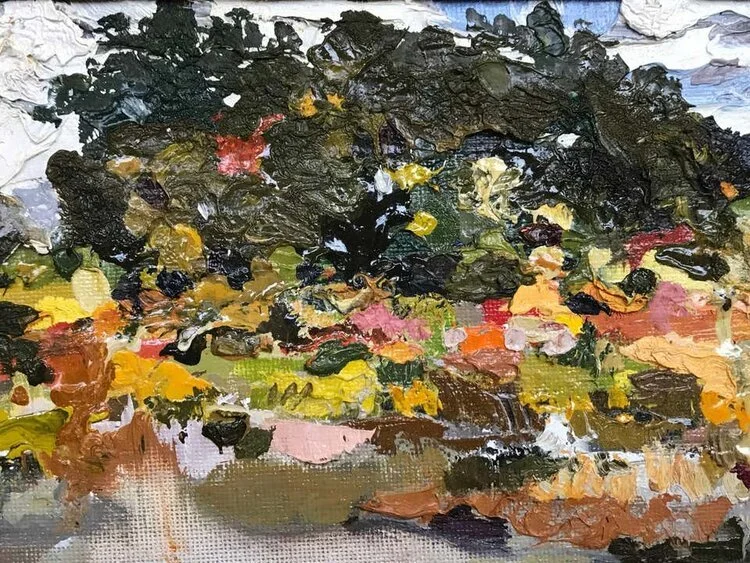
"Neponset Bay October," by Boston-area painter Joseph Fontinha, in the show “Personal Territories,’’ at Fountain Street Fine Art, Boston, through Nov. 2
The gallery says:
“{The late} Robert Hughes, the fearless art critic some are calling the greatest of our time, once said that ‘Landscape is to American painting what sex and psychoanalysis are to the American novel.’
“Artists in this exhibition focus on three themes that have occupied each of them for a while: the city, the distant landscape, and the lush garden. This collection explores how each theme is distinctly different, exploring emotional ranges of a wildly divergent temperament, while simultaneously unifying them through the language of paint.’’
Besides Mr. Fontinha, the artists in the show are: Jim Banks, Brenda Cirioni, John J. Daly, Catherine Gibbs, Nan Hass Feldman, Chris Plunkett and Marcia Wise.
See:
https://www.fsfaboston.com/