
In search of lost time

Something in the news from time to time brings back memories of, er, Rhode Island businessman Raymond L.S. Patriarca (1908-84).
From Robert Whitcomb’s “Digital Diary,’’ in GoLocal24.com
The complicated, and, I’m sure to many people, boring, if important, trial involving money-laundering charges against political operative Jeffrey Britt got me to watch a GoLocal video on the best known character in the case – Rhode Island House Speaker Nicholas Mattiello. The seedy situation centers on his 2016 campaign for re-election, which he very narrowly and controversially won.
As the video relates, Mr. Mattiello was friends with Joseph Bevilacqua Jr., the son of Joseph Bevilacqua, the late ousted state Supreme Court chief justice who was in bed with the Raymond Patriarca unit of the Mafia. Mr. Mattiello was also pals with Charles “The Ghost’’ Kennedy, another mobster. Not comforting information about someone said to be the most powerful person in his tiny state.
Hearing this took me back to the first time I lived in Rhode Island, in the late ‘ 70s, when the Patriarca mob, based in Providence, was still in force, and everybody seemed to be making mob jokes, some of which I had heard while, just before, as a resident of a Brooklyn neighborhood said to be a favorite of Mafia middle management.
So, as William Faulkner observed, “The past is never dead. It’s not even past.’’
Jeffrey Britt himself, now of course a resident of Florida, where people like him so often domicile themselves (a “sunny place for shady people’’), is a curious character, not least because of his bizarre muscle-bound appearance, which screams body building and, well, maybe some bio-chemical helpers.
Another interesting character in the case is Shawna Lawton, who briefly ran in the GOP primary race in the speaker’s rather conservative district in 2016 but was defeated by the very smart and interesting Steven Frias, who then narrowly lost to Mr. Mattiello that year. Ms. Lawton is another of those anti-vaxxer Republicans who defy science and in so doing put the health of the public at risk. I wish they would all move to, say, Baffin Island, with QAnon sidekicks.
To see the GoLocal movie, please hit this link.
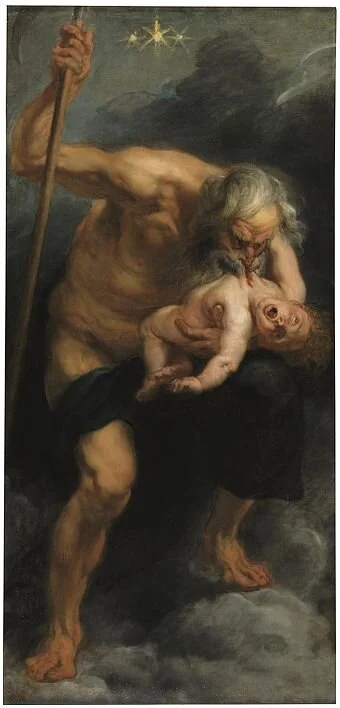
Don Pesci: Representative government crouched in fear
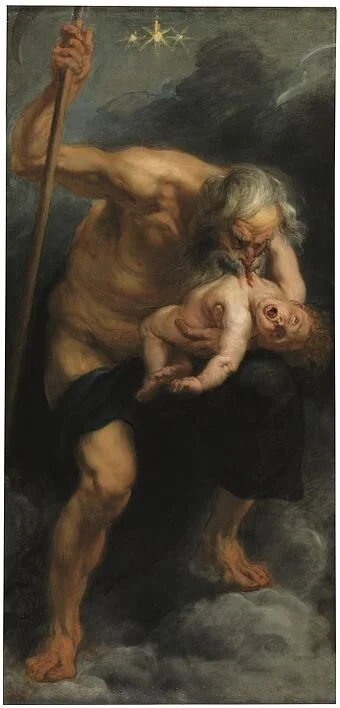
Painting by Peter Paul Rubens of Cronus devouring one of his children
VERNON, Conn.
The Hartford Courant paper points out the brutal irony:
“Connecticut has averaged 366 new cases a day over the past week or about 10.3 per 100,000 residents, just above the threshold at which states are added to the travel advisory. The advisory, which currently includes 38 states and territories, is updated each Tuesday in conjunction with New York and New Jersey. It requires travelers arriving from those states to either produce a negative coronavirus test result or quarantine for 14 days...
(Connecticut Gov. Ned) Lamont said …he’s considering a dramatic overhaul to the advisory, saying “It’d be a little ironic if we were on our own quarantine list.”
Connecticut’s list of quarantined states has grown by leaps and bounds, very likely because the parameters initially were set too low. The gods of irony will not be mocked. Cronus is now eating his own children.
It is nearly impossible to determine definitively who set the parameters, but we do know that Governor Lamont has been borrowing his Coronavirus defense system from New York Gov. Andrew Cuomo and New Jersey Gov. Phil Murphy.
In the absence of an advice-and-consent General Assembly whose Democrat leaders, Senate President Martin Looney and House Speaker Joe Arsimowicz, relish pretending that Connecticut’s greatest deliberative body had been sidelined by Coronavirus, Lamont has become the King George of Connecticut, wielding nearly absolute power, and the sharpest weapon in Lamont’s rhetorical arsenal has been – fear of Coronavirus.
The pandemic is not a governor festooned with plenary powers. It is a virus, and viruses cannot suspend the operations of government and businesses across the state. We are where we are because politicians have made the choices they have made.
Gone are the days when President Franklin Roosevelt sought to stiffen American spines, first in the face of the Great Depression and then of the oncoming World War II – by advising his countrymen, “… let me assert my firm belief that the only thing we have to fear is...fear itself.”
Americans rose to the occasion. The Great Depression receded, as most depressions and recessions will do in a vibrant free market economy. The United States later officially entered the war on Dec. 8, 1941, the day after Pearl Harbor -- more than two years after Nazi Germany attacked Poland, in 1939, beginning the war -- and saved Western Europe from the Nazi Hun. Much later during the so-called “Cold War,” beginning in 1946-47, Western Europe and the United States combined to save Western Civilization from the Marxist-Leninist-Stalinist beast. In 1987, President Ronald Reagan blew his horn, and the hated Berlin Wall soon came tumbling down, followed in due course by the dissolution of the Soviet satellites in Eastern Europe.
Since the Founders “brought forth on this continent a new nation, conceived in liberty,” in Lincoln’s often repeated words, the United States has survived colonial mismanagement – see Sam Adams on the point – an anti-colonialist revolution, various crippling recessions, a Civil War – which we thought, before Howard Zinn’s dyspeptic take on American history began to infiltrate public schools, buried slavery along with “the honored dead” at Gettysburg -- two World Wars, the prospect of nuclear annihilation, and many other disrupting disasters that we had collectively survived.
The government of Connecticut, the “Constitution State”, faced with Coronavirus, has simply shattered. And the merchants of fear among us are still merchandising fear. That irrational fear has all but destroyed scores of small businesses across the state, the prospect of state surpluses, sound state and municipal budgets, public hearings, trials in the remnant of the state’s judicial system, public education as we have known it ever since the General Assembly in 1849 established the first public higher-education institution in the state, now Central Connecticut State University -- and representative government.
There is not a single politician in Connecticut familiar with Aristotelian causality, the living root of most modern science, who would testify under oath that a virus, rather than cowardly politicians, is the efficient cause of all these problems. The Coronavirus fear, like Cronus of Greek legend, is now devouring its own children.
Roosevelt rallied the nation to stop hiding under the bed. But the Coronavirus governors, who through their negligence are responsible for the majority of nursing-home deaths associated with Coronavirus in their own states, want representative government to remain crouched in fear under the bed. They want no public hearings, no votes on gubernatorial dicta by a full General Assembly, no attacks by columnists on their own criminal delinquencies, no suits in a crippled court system, and no contrarian opinions in editorial pages. They will tolerate no effective opposition. And should minority Republicans in Connecticut engage in reasoned opposition, they will be denounced by everyone hiding under a bed of complicity with President Trump who, despite his glaring vices, still is not Hunter Biden’s dad.
Don Pesci is a columnist based in Vernon.
But a constitutional monarch

“King on Throne,’’ by Scot Borofsky, in his show “Gritty Streets to Green Mountains,’’ at the Bennington (Vermont) Museum through Dec. 31
The museum says:
”This exhibition illustrates the development of Borofsky's work over the last 40 years, ranging from early NYC street art, to his more recent paintings created in his Brattleboro (Vt.) studio, which incorporate an evolving language of complexly layered symbols and the gestural language of paint. ‘‘
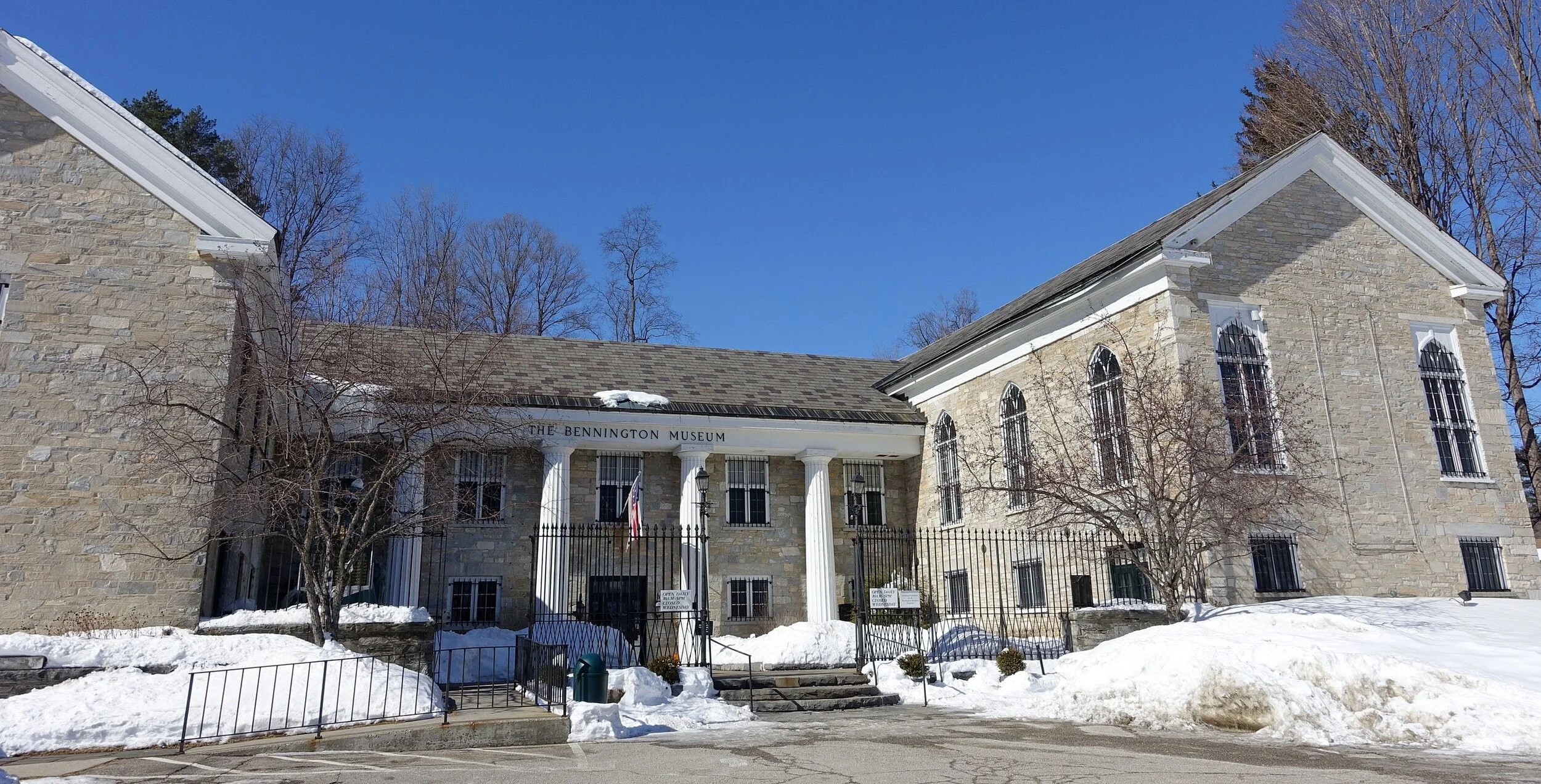
The remarkably large museum for a small town like Bennington. See: https://benningtonmuseum.org/
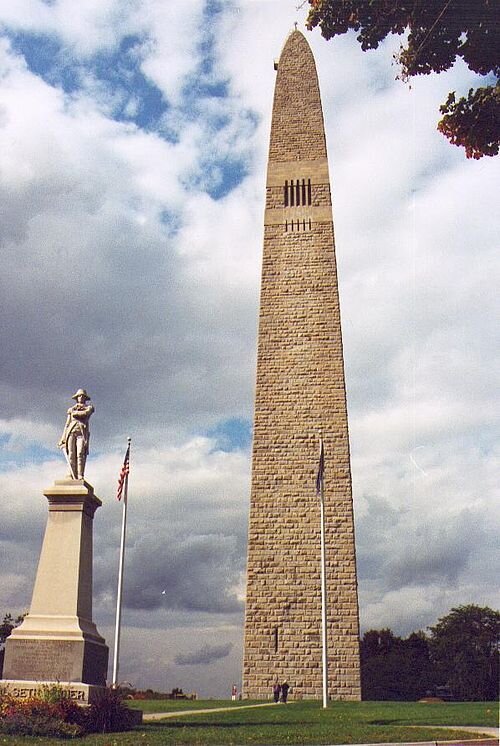
The Bennington Battle Monument, which commemorates the Aug. 16, 1777 American victory there in the Revolutionary War
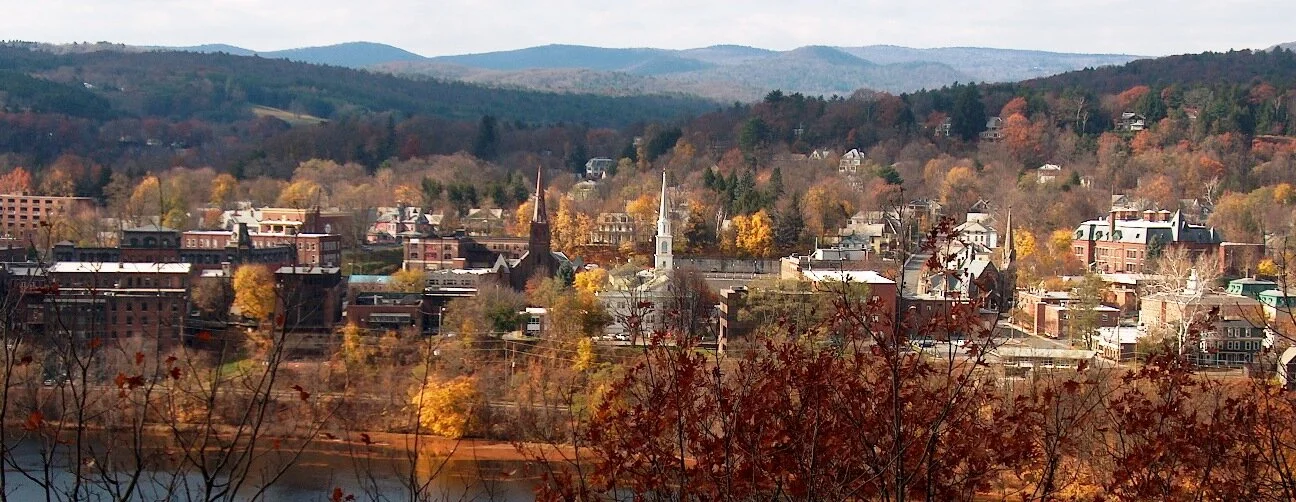
Downtown Brattleboro (where Mr. Borofsky has his studio) as seen from a walking trail across the Connecticut River, in New Hampshire. There are many miles of scenic trails in and around the town, where Rudyard Kipling lived for a time in the 1890s.
'Missed desires'

“This lonely afternoon of memories
And missed desires, while the wintry rain
(Unspeakable, the distance in the mind!)
Runs on the standing windows and away.’’
—From {Putting Up} “Storm Windows,’’ by Howard Nemerov (1920-1991). A Pulitzer Prize-winning poet, he taught at various colleges, including Bennington College, in Vermont.
It got better -- before the pandemic

The old John Hancock Tower and Boston skyline as it appeared in 1956, before the proliferation of skyscrapers in “The Hub’’.
“Boston is not a small New York … but is, rather, a specially organized small creature with its small-creature’s temperature, balance, and distribution of fat. In Boston there is an utter absence of that wild, electric beauty of New York, of the marvelous, excited rush of people in taxicabs at twilight, of the great avenues and streets, the restaurants, theaters, bars, hotels, delicatessans, shops. In Boston the night comes down an incredibly heavy, small-town finality. . . . There is a curious flimsiness and indifference in the commercial life of Boston. The restaurants are, charitably to be called mediocre; the famous sea food is only palatable when raw. . . . Downtown Boston at night is a dreary jungle of honky-tonks for sailors, dreary department-store windows, Loew’s movie houses, hillbilly bands, strippers, parking lots, undistinguished new buildings. . . . The merchandise in the Newbury Street shops is designed in a high fashion, elaborate, furred and sequined, but it is never seen anywhere. Perhaps it is for out-of-town use, like a traveling man’s mistress.’’
— Elizabeth Hardwick (1916-2007; critic, short story writer and novelist), in the December 1959 Harper’s Magazine
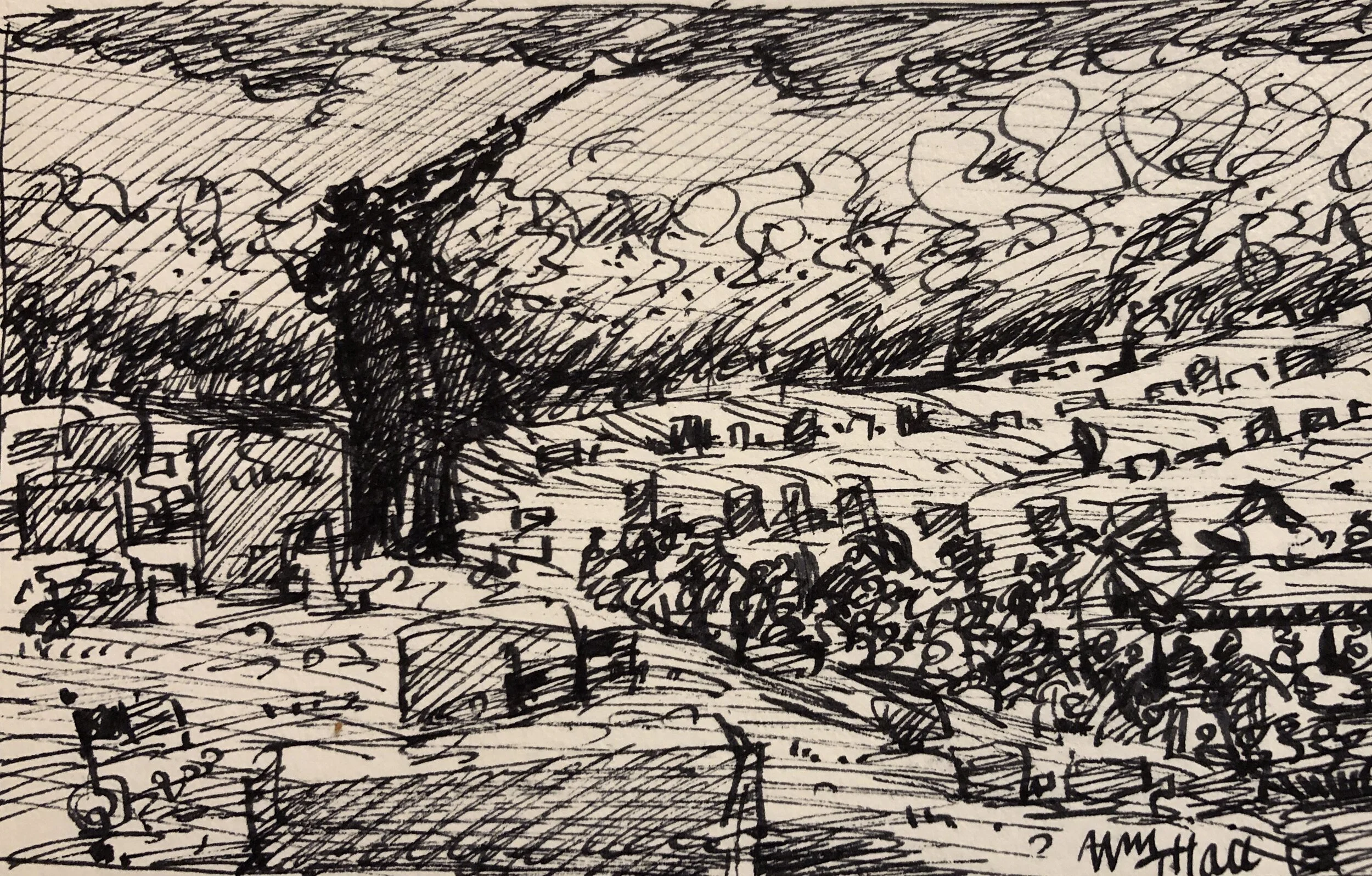
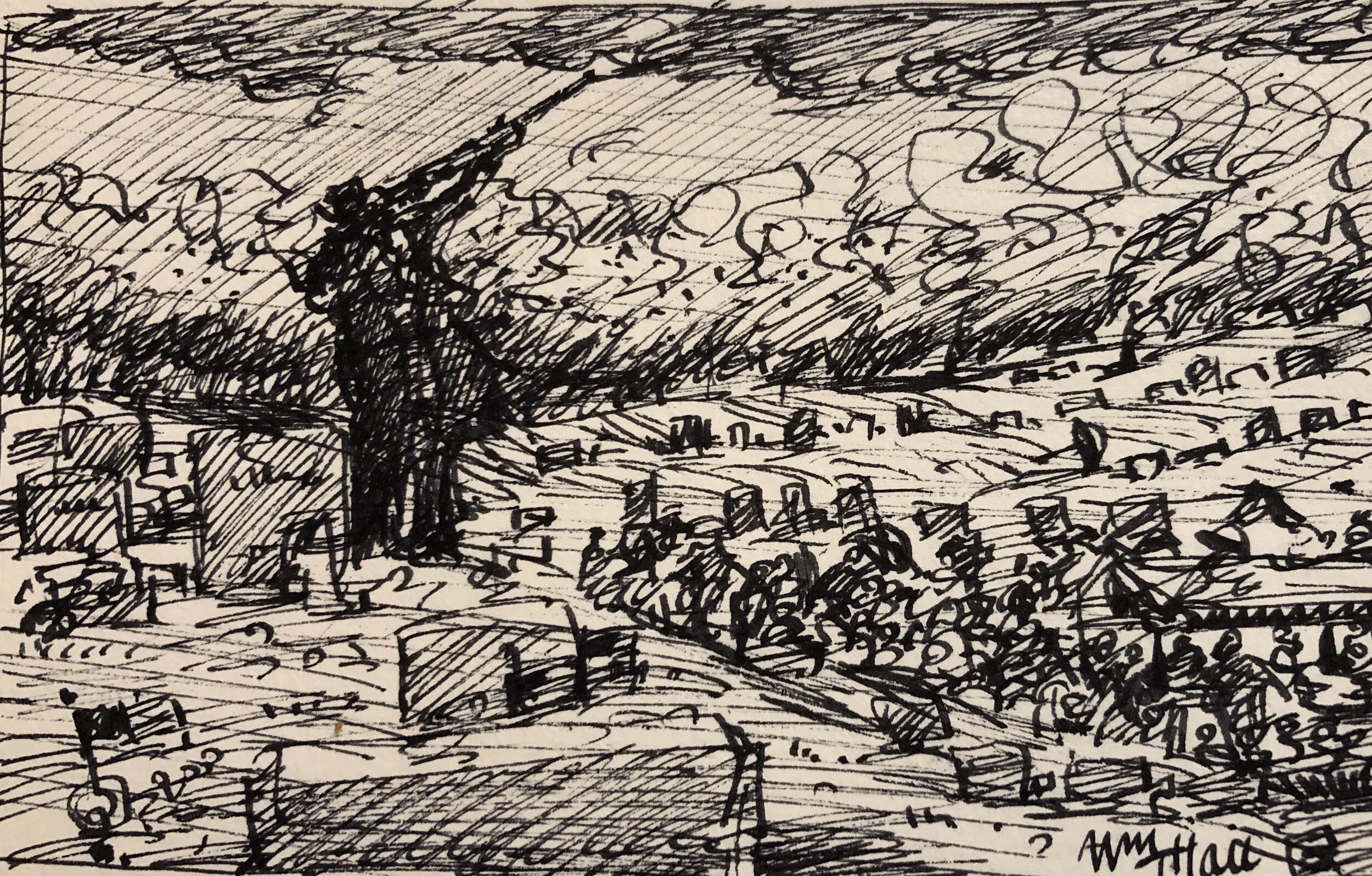
William T. Hall: On his island, one last time for my father
While watching the recent movie Midway, about the Battle of Midway and the tragedy of Pearl Harbor, I heard a sad familiar sound that reminded me of my father’s funeral. It was the sharp report of seven rifles being discharged all at once. It is unforgettable.
“BLAM”!
Then a slight pause...
Then again...
“BLAM”!
Then one last time...
“BLAM”!
Must we punctuate tragic moments with such a horrid sound?
The answer is...
Yes we must.
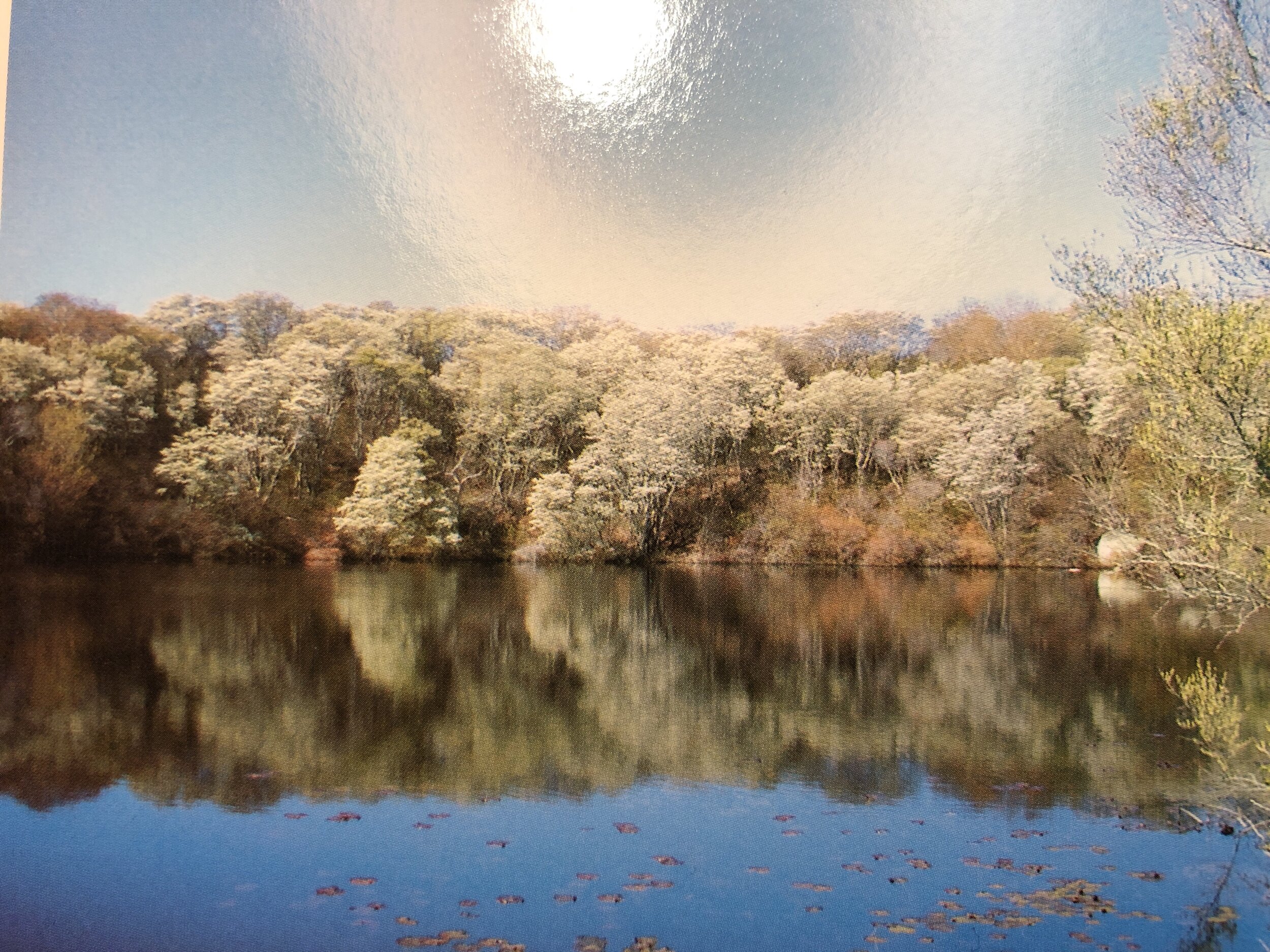
The shad in bloom
— Photo by Kevin Weaver
Preparations for a Memorial
My mother and I carefully picked a day in early May 2000 to inter my father, William Hall, in the cemetery on his ancestral home, Block Island. It was our best guess when the shad tree bloom would be in full array.
Until his last breath, at age 74, he had asserted that he’d not missed being on the island for “The Shad” since World War II.
It’s a spectacle of nature. It’s a moment in a living dream when large parts of the island look like swirls of white butterflies. It creates a cirrus-cloud wisp of magic and myth. Throw in some Hollywood-style ecclesiastical lighting and you’ve got the picture of my father’s romance with “The Shad”.
It was no matter to him that this heavenly show for the rest of the year could be easily described as just woods.
What Everyone Knows
A normal burial on Block Island is handled as a package deal.
The grieving party whose just-deceased relative (or friend) is “from away’’ agrees to a final price covering shipping the loved one in a hearse to the island on the ferry boat. The price includes the homey funeral service at the Harbor Baptist Church, the short procession to the burial site and the post-burial “coffee-klatch” back at the church.
Then after a few hours - and in the middle of hugging relatives and meeting new spouses of forgotten cousins -- starts the panicked reality of the late hour, and the dash to make the last boat back to the mainland. Luckily, the ferry docks are within sight of the church and the captains tend to wait for every last grieving straggler.
To avoid anonymity in death those Block Islanders who have drifted off the island need to be reintroduced to it so that they can be remembered before being forgotten up in the cemetery. Even the descendants of the original English settlers, named prominently on Settlers Rock, have to go through a process of re-emergence during a well-choreographed day-of-burial. It’s like reestablishing their original footprints in the snow after they have long been obliterated by a lifetime of snowstorms. To achieve island quasi-immorality it only takes this one day, with its own special down-homeyness.
Someone Special
So went my father’s last trip back to Block Island, there to be quietly eulogized as one of those island kids who for one reason or another fell into “Off-Islander“ status somewhere along the line.
Human time can be defined in waves. In my father’s case he would be counted among the World War II veterans, Pacific Theater, brand of survivors. At the funeral he would be praised for being a successful businessman, a good husband and a good father, but none of his fishermen relatives or old island cronies would be left to nostalgically tell mourners stories about “that kid” known as a star harpooner of swordfish.
My father had started commercial fishing in 1936, at 10 years old. That’s when he got permission from his father, Allen Hall, to climb the mast and sit on the cross tree of the Edrie L. From that perch, 24 feet above the deck, he was to try his hand at spotting swordfish on his Uncle Charlie’s boat. He excelled because of his excellent eyesight and precise directions given to the helm to find the fish. Soon he was recognized for his accuracy with a harpoon.
By 14 he was the youngest “boy” harpooning swordfish in the fleet and was earning a full share of any fish he spotted or harpooned. This minor local notoriety ended when he was drafted into the Army and shipped out to the Pacific.
That war took many islanders away from Block Island, some to pay the ultimate price of liberty and some to find their way to a more expansive future than could be hoped for on the island, where few returned to live. My father’s war experience did not scar him and he lived a fruitful life, including raising a family and prospering in another part of New England far away from the coast. Although he visited his island family often over the decades his relationship with the place became increasingly remote - and more that of a tourist.
The reality was that the family was thinning out. This hit him hard during the funeral of the oldest Hall elder on the island and it gave him a feeling of a fading heritage. Now more strangers were waiting on the dock meeting the ferry boats when not so long before there had been a receiving line of loving relatives and friends, each shaking his hand, hugging him and calling him by his childhood nickname, “Billy”.\
The island’s identity was shifting. My father was a realist and his life was changing with the times, which he accepted as inevitable. He just didn’t welcome the change with a joyful heart.
This was the man in the shiny hearse rolling off the ferry to return to the island he loved so much. He’d soon be back with his family and relatives for good.
A Good Life
At the funeral service we confirmed through loving remembrances that my father’s life had been by all accounts a good one. The funny tales softened the sorrow.
Everyone at the Harbor Church service agreed that we had all been blessed by his 74 years with us. Meanwhile, as we eulogized him, it became evident that something big was happening outside. There was something at the edge of our senses that suggested that there was a chance that this simple memorial for my father might turn into “A Perfect Block Island Funeral”. It might enter a world where bad was good.]
The first sharp clap of thunder boomed even before we saw the lightning. We realized that what we had sensed had been rolling thunder for some time. The stained-glass windows, organ music, prayers, songs and laughter had masked the storm that was now creeping up on us from the southeast side of the island.
The room was getting darker but it was 11 in the morning. As the wind whipped at a tin gutter somewhere on the roof, the pastor’s wife quietly tiptoed around the room clicking on a few floor lamps and wall lights. People watching her nudged each other quietly. Looking around the room we saw that the local mourners (from the island) were dressed in rain gear. They had rain hats stuffed in their pockets and waterproof footwear ready under their seats; one even had unbuckled galoshes on over his shoes.
In contrast, the mourners “from away” (non-islanders) looked unprepared in their comfortable spring sweaters and dresses. Luckily, they at least had designer-styled trench coats on the hooks in the coatroom. But rain hats, boots and umbrellas for a muddy gravesite ceremony were not evident anywhere in this crowd.
The second thunder clap brought everyone to attention and a slight whimper was heard. Flinching erupted in attendees with over-active startle reflexes. Those who seemed prepared for bad weather were rolling their eyes with wonder as if asking, “Don’t these people from away listen to their local weather reports”?
The weather had changed from undecided to absolutely bad. The modest stained-glass windows rattled with wind gusts and pelting rain. The warm sidelights that the pastor’s wife had switched on were soon augmented with the big overhead lights. Everyone was getting the message that it was going to be stormy at the gravesite.
The Road to Valhalla
No one is more aware of the changes in the island’s social make-up than those who consider themselves “Real Block Islanders”.
“Real” was defined generations ago as “born on Block Island” and of course eventually buried on Block Island. That was the perfect life’s arch of a true islander. Very few can claim that distinction any more.
Evolving medicine and more reliable ferry service have nullified the “island-born” stipulation. In 1926 my father was born in Newport and the next day started his life on Block Island as a “Real Block Islander”. In spite of being hospital-born he met the requirements then needed to be “Real”.
He was born prematurely and had to be kept warm for his first four weeks wrapped in moist towels perched on the edge of an open oven door. My grandmother’s kitchen became Block Island’s first premie ward. My father was attended by every mid-wife and aunt on the island and he soon became everyone’s community property. Thus began his neventful life.
By when I was born, in 1948 ( sadly not on the island), things had changed. It had become a tourist spot. A popular promotional motto was being targeted at people discovering Block Island for the first time. It went like this: “Block Island, come for the day and stay a lifetime.’’ The enthusiasm of first-time visitors on seeing the island’s beauty began to create a new social structure on the island. The newcomers, some of whom became summer residents, brought new ideas, new talents and new personal objectives, but no matter how extraordinary their efforts, they could not line up in that parade of Original, True and Real Islanders. They would never be on that path to immortality and obscurity that leads eventually to Block Island’s cemetery.
In spite of the obstacles to membership in this coveted club of Real Islanders those with the strongest desire for acceptance are still drawn to try to break into the line.
Any deceased islander with an army of mourners headed for the Harbor Church can cause quite a stir, especially when the forecast is for stormy weather and high seas.
When the shiny black hearse carrying my father’s remains crossed the gangplank onto island ground, the island’s grapevine heated up, leading to calls to the church for information.=
Meanwhile, the appearance of a large group of mourners not properly attired for the coming deluge meant that the person about to be buried was probably an “Off Islander,” but scuttlebutt had it that there would also be a rather large island contingent at all or part of the proceedings.
Source Number One
Besides the church, there were other sources of solid information.
Block Island cabdrivers meet every ferry from May 1 to the end of the following November. Only well-established islanders can obtain one of those coveted cab licenses, the possession of which is a channel for a wealth of information about what’s happening on the island. The parking area for the cabs is within plain view of the ferry landing. If you know one of these cabbies you can get first-hand, inside information about what is unfolding at the dock, as well as stuff from any dark corner of the island and the usual sketchy and juicy daily gossip.
I surmise that an inquiry from an island newbie to a cab driver about my father’s hearse might have resulted in a conversation like this:
“Hi, Ed, How you doin?’’
“Good.’
“Hey, who’s that they’re rolling off the boat in the hearse?’’
“Oh Yah, that’s Billy Hall. Yep. He grew to the Sou-East. In the house where Jacobs live now. ‘’
“Lots of well-wishers, eh? I guess he must’a been well known?’’
“Oh, Yah. Billy was a good man. Good family - all fishermen. His mother was a Milliken. Yep, we’re – cousins, I think?’’
“Whad he do for a livin?’’
“Not sure – he moved way af-ta th’war. (pause), but when he was young he could really stick a swordfish. Yessiree. Few better.”
“Oh...?’’ (so on and so on )
And at the Airport
Traditionally, additional information could be obtained at the Block Island Airport lunch counter. It was where the cabbies sipped coffee all day between fares and mingled with passengers waiting for their flights.
On days of big funerals, cabbies, counter girls and mourners from the island and off it exchanged hugs, jokes and news. It was a clearinghouse for information and gossip -- and pie. Everyone seemed related and soon you suddenly felt related to them also.
If newbies liked what they had heard about the deceased in the hub-bub at the lunch counter it would not be unreasonable for them to attend the funeral and go to the gravesite to see whom they might know there. In this way even a newbie might develop a fast, if remote, link with the mourners.
One point was understood. Newbies had to stay for the entire event, no matter how bad the weather. If you invested in saying goodbye to an old Block Islander you were in it for the full course, probably including the coffee-klatch after the burial. This could be important social collateral years later if the deceased name’s came up in conversation. If you had shown up to pay your respects, you could say:
“Yes. I know I was there!”
It was like attending a Viking funeral so you’d know the way to Valhalla.
When Bad Is Good
The wind blew hard and the pouring rain came at the mourners horizontally and from three directions at the gravesite. The lightning, thunder and rain were relentless. The oldest ladies sat in folding chairs under wet tarps and plastic drop cloths with grandchildren squeezed in between them.
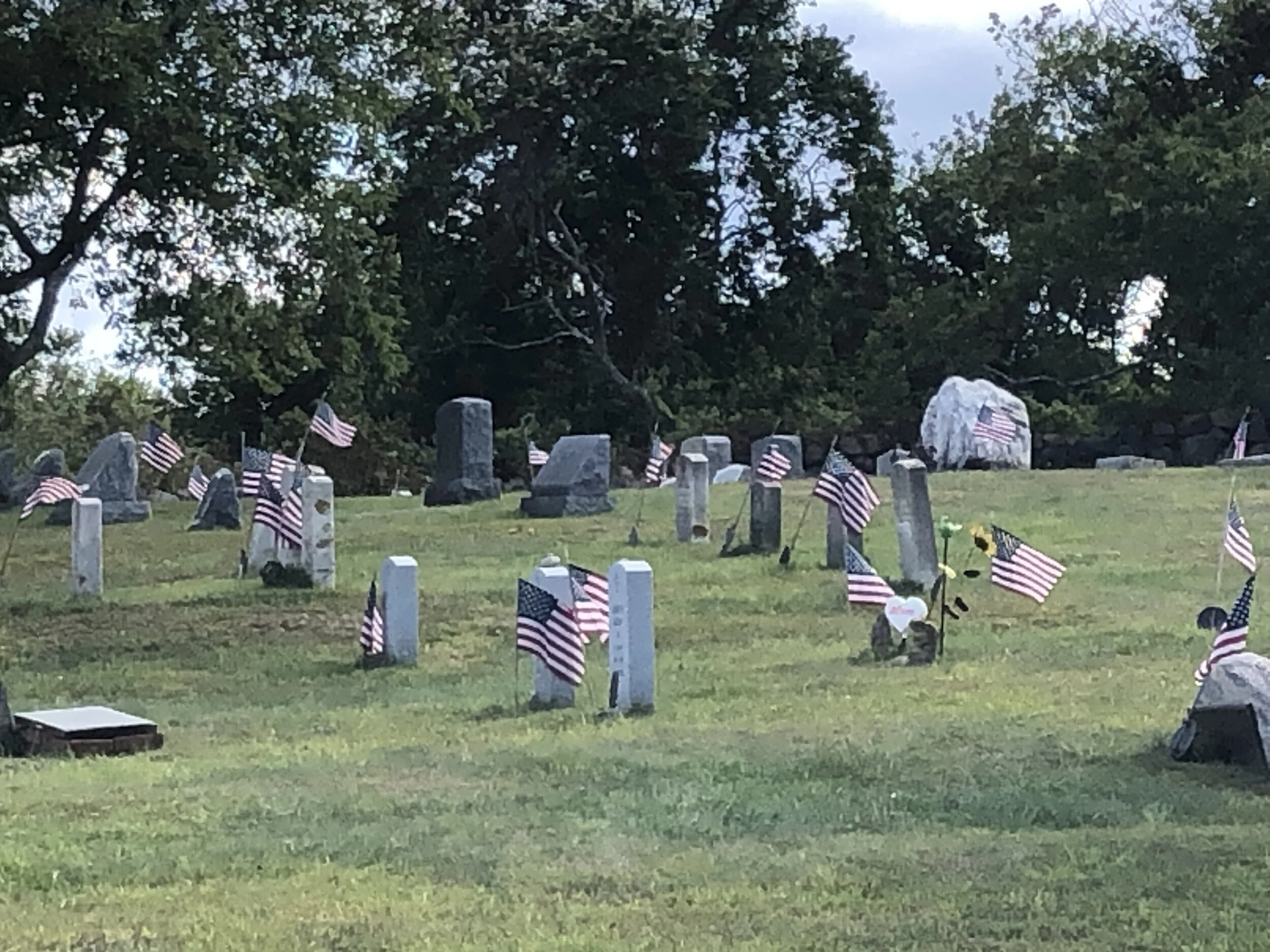
Things flew away never to be recovered, but no one left and the ceremony was not rushed. The general mood was sad, but with mourners’ sense of satisfaction that they were joining in a celebration of a life well lived. The hundreds of flags on the veterans’ graves all around snapped in the “Moments of Silence” requested by the pastor.
At the time of my father’s funeral many veterans were being laid to rest every day of the week all over America. Due to the large number of burials, it was nearly impossible to get an honor guard or an official bugler to attend individual funerals. I could not emotionally accept this situation but nor would I complain. My father would not have complained.
On Block Island we have one rule, “We take care of our own”.
Our cemetery is neutral ground, outside of the bounds of daily disputes. This hallowed ground is where we commune with the past and honor individuals whom we respect dearly no matter how long away -- or how recently arrived.
We made an arrangement to honor my father in a way he’d have enjoyed. In a gesture of respect to our family and to the many other veterans whose flags flapped together with his in the wind, a dear family friend and well known federal official provided us with the most memorable final note that my mother and I could have hoped for.
He was to be my father’s one-man honor guard.
Observing the usual safety measures, the honor guard loaded a blank shell into my father’s 12-gauge shotgun, left the mourners at the gravesite and walked slowly and ceremoniously to the top of a small rise.
We could see his hat fluttering and his coat whipping in the wind. His silhouette against the dark sky evoked heroism and the shad bloom around us. As he mounted the shotgun’s stock firmly to his shoulder we could see that his shooting glasses were being pelted by the rain. Time stood still for just a moment. We waited for the sound that gun would make -- one last time.
Blam!
The wind and the rain muffled the report.
White smoke hung in the air above the shooter, and then disappeared downwind into the white cloud of shad trees in the distance=
At my side my mother, inside father’s old raincoat, whispered:
“Perfect.”
William T. Hall is a painter, illustrator and writer based in New England, Florida and Michigan.
Sent by a wind from Cautantowwit

"{Indian summer} comes after the early frosts, when the wind is southwest, and the air is delightfully mild and sweet. The sky is then singularly transparent, pure and beautiful, and the fleecy clouds are bright with color. The Indians believed the season to be caused by a wind that was sent from the southwestern god Cautantowwit, who was regarded as superior to all other beings in benevolence and power, and the one to whom their souls went when the departed from the earthly body.''
-- By Sidney Perley, in Historic Storms of New England (1891)
Cautantowwit was a deity of the Narragansett Indians
Panorama of chaos, fear and joy

“Definitions Across All Spectrums,’’ by Norajean Ferris, at the 2020 Biennial of the Center for Maine Contemporary Arts, in Rockland, through next May 2
.
Where they were

White-tailed deer
“i see nothing over there
but a hollow in the long grass
like the places where deer have been lying,
and the only thing I hear
is shallow water maklng excuses to stone.’’
— From “Where the Deer Were,’’ by Kate Barnes (1932-2013). A Massachusetts native, she lived in the latter part of her life in Appleton, Maine. She served as Maine’s poet laureate.

Appleton is in red.
Ya gotta live there

Spring view of the Sherman, Conn., end of Candlewood Lake with Candlewood Mountain
“The country towns here in New England all bear a family resemblance to one another, but they also have individual characters that can be learned only by living in them.”
— Malcolm Cowley (1898-1989), in “Town Report 1942,’’ in The New Republic. He was an American editor, historian, poet and literary critic. He was a resident of the western Connecticut town of Sherman for the latter part of his life. The town was rural then but now is more exurban.

Llewellyn King: The right judge at the wrong time

WEST WARWICK, R.I.
It’s not a trial. But last week’s hearing before the Senate Judiciary Committee on the nomination of Amy Coney Barrett to the Supreme Court seemed like one.
This juror’s verdict: Guilty as charged in one liberal indictment and a toss-up in the other. Judge Barrett seems destined to vote to overturn Roe v. Wade. But on the Affordable Care Act, which is of more immediate concern to more Americans, she may parse her judgment and endorse the doctrine of selectivity.
Two big things about Barrett: Her opposition to abortion is, one concludes, founded in her devout Catholicism and in her experience among lawyers of the right, led by Justice Antonin Scalia, for whom she clerked.
The other thing about Barrett is that she has seven children, two adopted from Haiti. She used this before the committee as a shield, a defense, and a statement, which said by implication, “See, I’m human, empathetic, caring, and maternal.”
This is important. As Barrett, who almost certainly will be confirmed, matures on the court, her family may be a moderating force, softening her otherwise rigid conservative views. As her children grow and experience the vicissitudes of life, she is likely to trade some of her harsh doctrines for a more humane ambiguity.
Take former Vice President Dick Cheney and his wife, Lynne. Their conservatism, devotion to the right, was never in question. But when their daughter Mary came out as gay, their view of that part of the social-political landscape softened.
It has been declared throughout the struggle to confirm Barrett that somehow it is not nice to bring in her religion.
This juror avers: It is.
When the religion of a public servant, affects political decisions, it has ceased to be a private matter. We’ve come a long way from the days when President John F. Kennedy’s Catholicism was cited in his election. Anti-Catholicism was then alive and well in parts of the political spectrum. Kennedy remained a committed Catholic, but he didn’t bring it into his governance of the country. That was as it should be.
Going forward, as the United States gets more diverse and when we can contemplate a time when Hindus, Buddhists, Muslims and other believers will take their place in national life, it is more, not less, necessary to ensure that separation of church and state is adhered to in everything, especially the Supreme Court. Ergo, it can be argued that Barrett should recuse herself from Roe v. Wade. How much stature she would gain if she did! But it’s most unlikely.
If the Democrats romp home with the White House and both houses of Congress, they would be in a position to legislate at least a quick repair to the Affordable Care Act and to start the process of legalizing abortion by federal law, not constitutional interpretation. But it will continue to fuel the culture wars.
It is not certain how much the Democrats will gain in the election and, as a longtime observer of Washington, I don’t believe long term a Democratic sweep would be good. A bit of tension in Congress is a net benefit. So, the Barrett nomination and confirmation weighed heavy as we watched her parry the Democratic questioners.
Extenuating fact: The judge is much smarter, more personable, and more in charge of her facts than expected. She charmed. She is a power to be reckoned with. Many observers expected to get a candidate who would simply channel Scalia, her old mentor, and that we could know her mind from his writing -- the way we can predict the attitudes of Justice Clarence Thomas.
That, it became clear, is not to be the case.
The verdict of this juror then is: After a rocky start on two difficult issues, Barrett will grow to be a serious, thoughtful justice. Possibly, with time, even a humane one.
Llewellyn King is executive producer and host of White House Chronicle, on PBS. His email is llewellynking1@gmail.com and he’s based in Rhode Island and Washington, D.C.
Website: whchronicle.com
Seniors often excluded from COVID-19; forecasting outbreaks in counties hosting pro football games
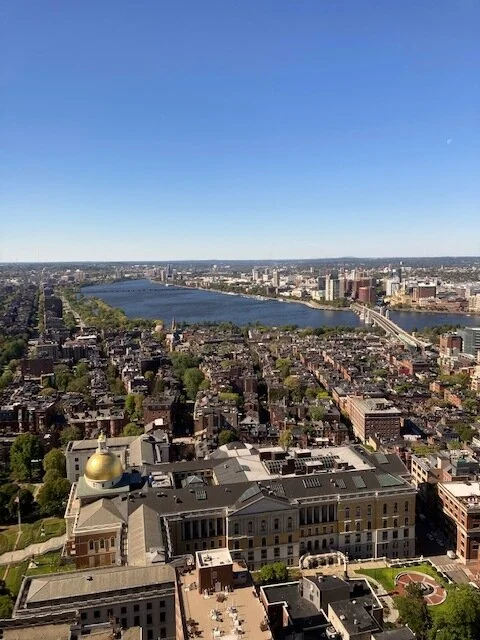
View from the 32 floor of One Beacon Street, Boston, with the dome of the State House at the left and Charles River Basin and Cambridge further out.
— Robert Whitcomb
The most recent COVID-19 roundup from The New England Council (newenglandcouncil.com):
UMass Study Finds that Seniors are Often Excluded From COVID-19 Trials – A University of Massachusetts Medical School affiliated study has found that seniors, who are often the most at risk for COVID-19, are excluded by more than half of COVID-19 clinical trials. The study made recommendations for future trials, in including more patients in this demographic. Read more here.
Harvard Medical School and Mass General Publish Study on Protective Antibodies – Researchers at Harvard Medical School and Massachusetts General Hospital have found that protective antibodies in patients who survive serious COVID-19 infections may provide longer protection against the virus. The study offers further insight into how long antibodies may remain in the system and provides recommendations for further antibody testing. Read more here.
Beth Israel Medical Center Launches Clinical Trial for Antiviral COVID-19 Treatment – Beth Israel Deaconess Medical Center has launched a new study on antiviral treatment for patients at home with COVID-19. The TREAT-NOW study is being conducted in tandem with Vanderbilt University and the University of Colorado to see if a well-known antiviral drug can help prevent or mitigate serious COVID-19 symptoms. Read more here.
New Tool Developed at Mass General Helps Predict Outbreaks in Counties that Host Pro Football Games – Researchers at Massachusetts General Hospital have expanded the scope of their COVID-19 Outbreak Detection Tool to incorporate NFL and NCAA football games as potential super-spreader events.
©2020 The New England Council
'More than the fruit'
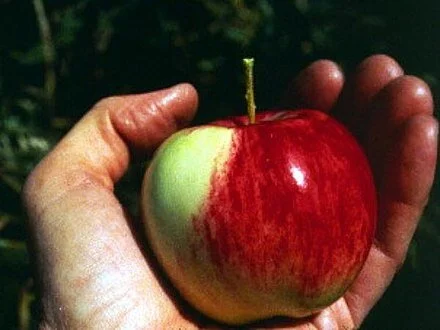
“Eat it; and you will taste more than the fruit:
The blossom, too,
The sun, the air, the darkness at the root,
The rain, the dew….’’
—From “The Crossed Apple,’’ by Louise Bogan (1897-1970). She was a native of Livermore Falls, Maine, where her father was a mill worker. She served as U.S. poet laureate.
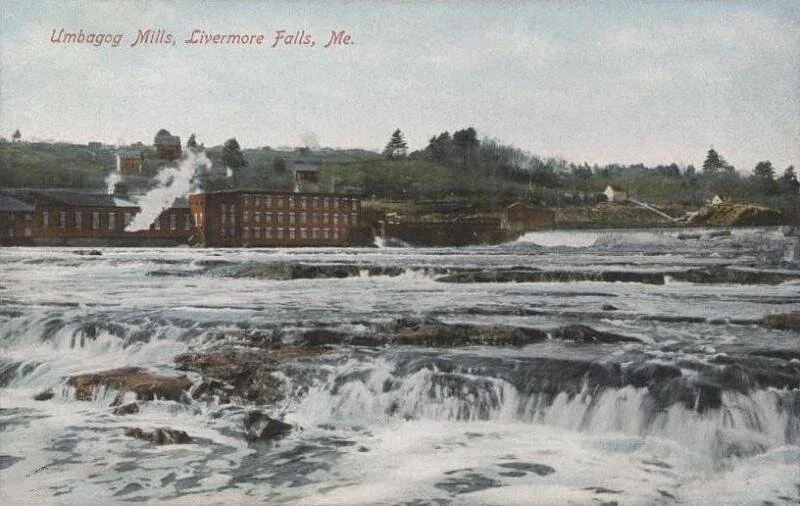
1909 postcard
'Journey through creation'
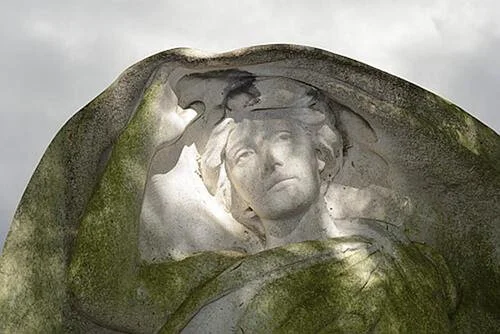
“Fossil 283, 2015” (archival pigment print),. by Boston-based Katherine Gulla, in her show “Passage,’’ at the Danforth Art Museum, at Framingham (Mass.) State University, through Feb. 28
Katherine Gulla's show is about her three series “Path,’’ “Falling’’ and “Fossil.’’ The museum says that these series represent, respectably, “the process, trials and remains of the artist's journey through creation. Her work is subtle and meditative, quietly reflecting nature's response to climate change and using it to bring forth feelings of absence and loss.’’
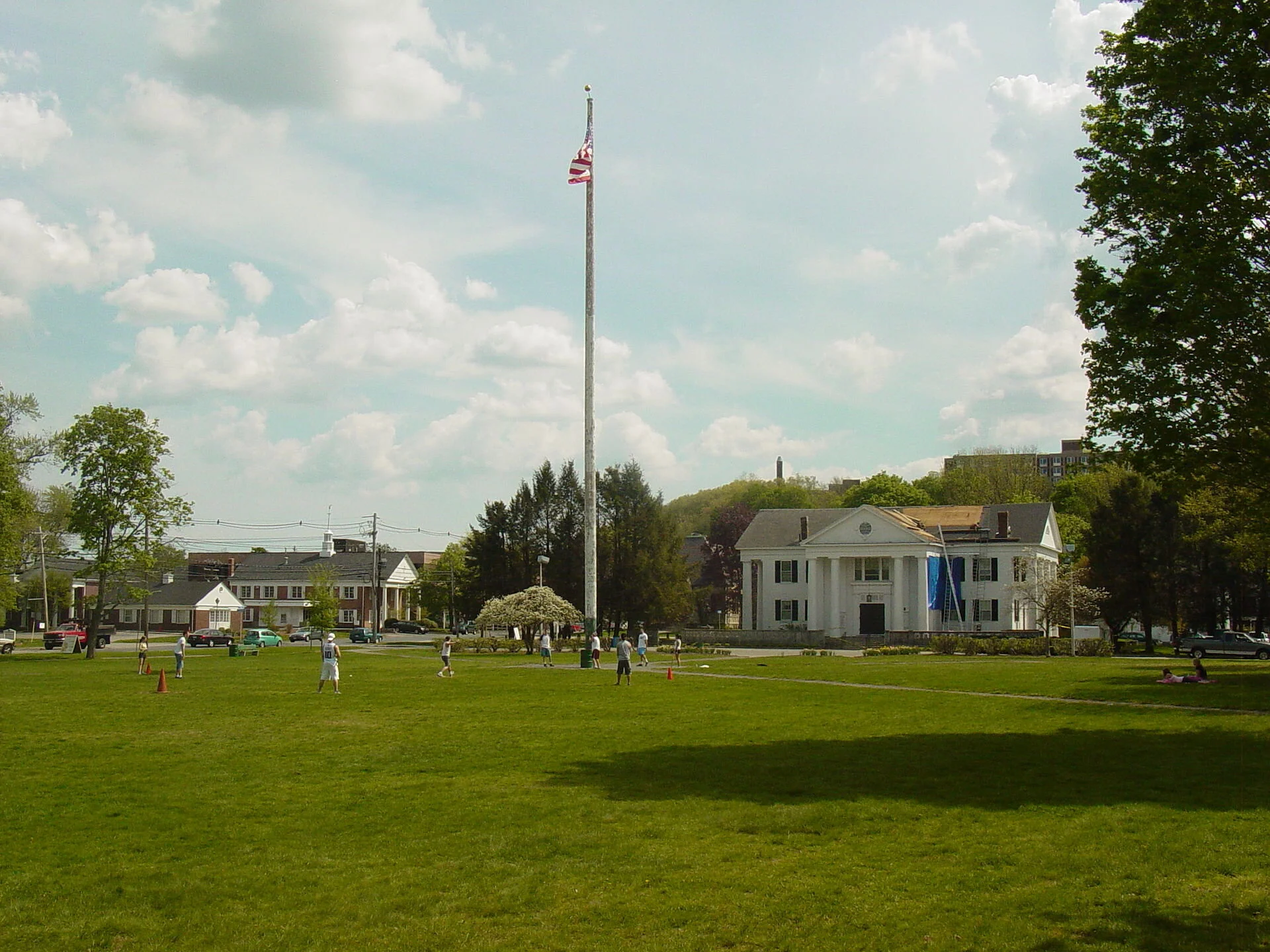
The Common in Framingham Center
Chris Powell: Conn. can do without higher education for a while; more Bridgeport bathos

Main quad at the University of Connecticut’s flagship campus, in Storrs
— Photo by Daderot
MANCHESTER, Conn
First the University of Connecticut asked state government for an emergency appropriation of more than $100 million. Now the state colleges and universities system, which operates the regional universities and community colleges, is asking for an emergency appropriation of $69 million. UConn's deficit arises largely from mismanagement of its Health Center. The regional universities and community colleges suffer most from falling enrollment.
Ordinarily institutions losing so much money would do more than wring their hands and seek bailouts. They would cut expenses, and since most higher education expenses are personnel, they would cut there. But since state government has been under Democratic administration for 10 years and state government employee union members constitute the party's army, their contract forbids layoffs and reductions in compensation.
So while the universities and colleges can turn off their electricity, heat, and internet service, they can't economize in the most practical and effective way. Even if they closed entirely they still would have to keep paying everyone, at least until the current contract expires.
So what is to be done about higher education's insolvency?
Legislators seem to have nothing to say about it, and they hardly meet anymore even though they still seek re-election next month. Gov. Ned Lamont has yet to offer any ideas, and he may be finding little glory in ruling by decree, since his work increasingly is just a matter of calculating deficits and seeking more federal bailouts. With the state's economy having shrunk by almost a third this year amid the virus epidemic, tax increases can't be seriously talked about until after the election, and even then it will be crazy talk. But the state employee union contract demonstrates Connecticut's infinite capacity for insanity in government.
Actually, while it wouldn't save on payroll right away, closing higher education indefinitely might be best.
For only a fraction of higher education produces any practical value to the state's economy, and while the rest of it theoretically can give students greater understanding and appreciation of life, it is deteriorating.
Most students admitted to the regional universities and community colleges already require remedial high school courses, having been advanced not by learning but mere social promotion. UConn has escaped the remediation scandal but still is being swamped by the political correctness sweeping higher education nationally.
There is less education, more indoctrination and political posturing, and more complaining about "systemic" racism to keep everyone in line with the indoctrination even as no one ever identifies the supposed racists or racist policies. Despite the prattle for "diversity" there is little political diversity among the faculty. People of all ancestries are welcome as long as they think the same. The idea of inviting a non-left-wing speaker sets off alarms.
The problem with education in Connecticut is not higher education but lower education, since most high school graduates fail to master basic high school work. This is worst in the cities. This is always presented as a money problem but decades of spending increases haven't changed anything, since it's a parenting problem.
Until higher education can find a purpose higher than subsidizing educators, Connecticut could do without it.
xxx
FOREVER CROOKED: Add the new corruption in Bridgeport to the long list of disturbing issues being ignored at the state Capitol. Last week the city's former police chief -- a close friend of Mayor Joe Ganim, Armando Perez -- joined former city personnel director David Dunn in pleading guilty to federal charges of rigging the chief's testing and hiring procedure.
The mayor already has served a long prison sentence for the corruption he committed during his first administration, and everyone understood that he wanted Perez to be chief during his second administration. So it is hard to imagine that the test rigging happened without the mayor's approval. But the state's political leaders, Democratic and Republican alike, have nothing to say about the matter.
After all, it's just Bridgeport. It's the state's largest city, but also its poorest, so who cares?
Ganim's spokeswoman says the guilty pleas "help bring closure to this matter." Closure on corruption in Bridgeport? That will be the day.
Chris Powell is a columnist for the Journal Inquirer, in Manchester.

Daniel Hunter: Things to do to thwart a Trump coup

Via OtherWords.org
Our president has openly said he might not respect the outcome of our election. Is it a sign of things to come, or just tough talk? Either way, it’s good to plan ahead.
I’m part of an effort called Choose Democracy, which is preparing people to stop a coup attempt — or prevent one altogether. These guidelines are drawn from the many countries that have experienced a coup since World War II.
*Don’t expect results on election night.
Many mail-in ballots may not be counted until days or weeks after Election Day.
Wayward state officials may try to exclude these ballots. We may even see governors or state legislatures try to send different results to the Electoral College than their voters chose.
As election results start coming in, the message needs to come through loud and clear: Count all the votes and honor the result.
*Call it a coup.
One reason to use the language of a coup is that people know it’s wrong.
We know it’s a coup if the government stops counting votes, declares a winner who didn’t get the most votes, or allows someone to stay in power who didn’t win the election. These are sensible red lines that people can grasp right away.
*Know that coups have been stopped by regular folks.
Most coup attempts have failed — especially when there is an active citizenry. The moments after a coup are moments for heroism amongst the general population. It’s how we make democracy real.
*Be ready to act quickly — and not alone.
People who stop coups rarely get a warning that one is coming. This time, we do. To start preparing, talk to at least five people who would go into the streets with you. Get yourself ready to act.
*Focus on widely shared democratic values.
Don’t just go out with a list of grievances against a vilified leader. Instead, exalt our widely shared core democratic values. This invites people who wouldn’t normally join movement causes into the process.
*Persuade people not to just go along.
In all the research on preventing coups, there’s one common theme: People stop doing what the coup plotters tell them to do. They refuse orders, go on strike, and close airports and shops until the coup ends.
*Commit to nonviolence.
The uncertain center has to be convinced that “we” represent stability and “the coup plotters” represent hostility to the democratic norms of elections and voting.
It’s a contest of who can be the most legitimate. Historically, whichever side resorts to violence the most tends to lose.
*Yes, a coup can happen in the United States.
Unfortunately, it can happen here. In 1898 in Wilmington, North Carolina, white racists organized a violent coup against newly elected Black officials, with white squads killing 30 to 300 people.
*Center in calm, not fear.
Fearful people are less likely to make good decisions. Breathe deeply. Play out scenarios, but don’t become captured by them. We’re doing this to prepare, just in case.
*Prepare to deter a coup before the election.
Get people into the mindset of taking action so they don’t freeze. Sign and circulate a pledge saying “If it comes to this bad thing, then I’ll act.” Here’s ours:
We will vote.
We will refuse to accept election results until all the votes are counted.
We will nonviolently take to the streets if a coup is attempted.
If we need to, we will shut down this country to protect the integrity of the democratic process.
You can sign the pledge at ChooseDemocracy.us. These public commitments ahead of time increase the political cost of attempting a coup — because the best way to stop a coup is to deter it.
Daniel Hunter is a trainer and organizer with Training for Change. .

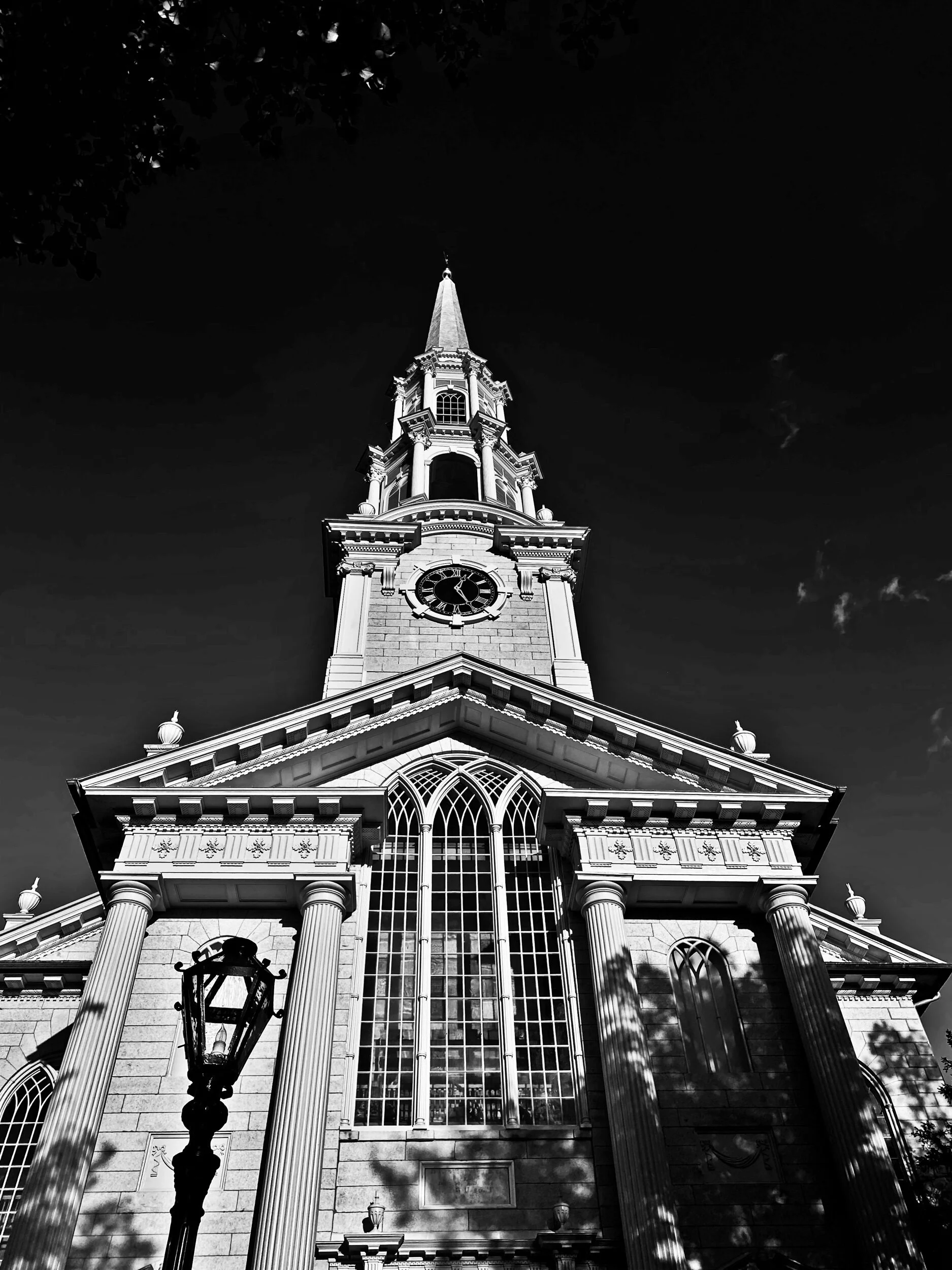
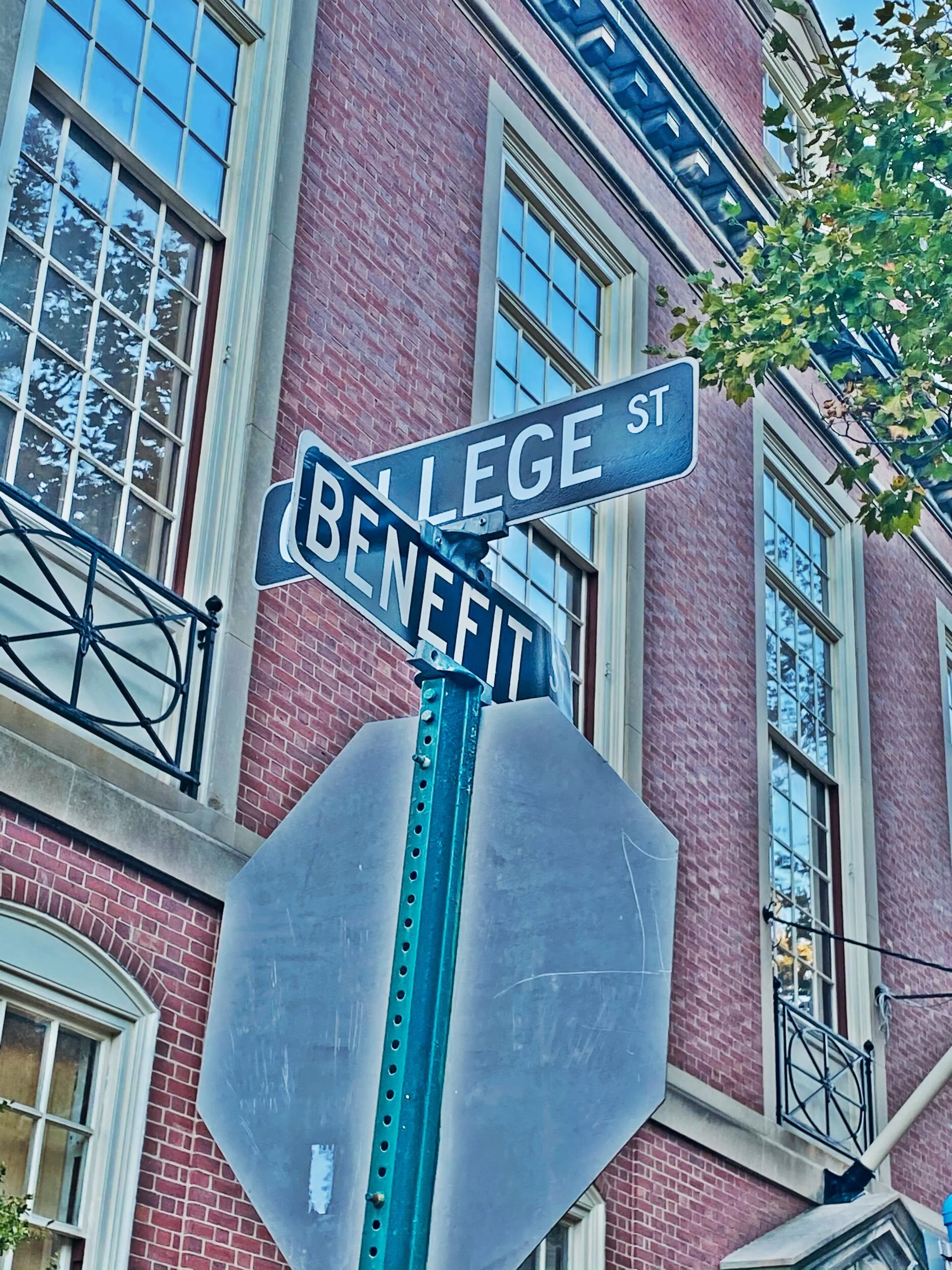
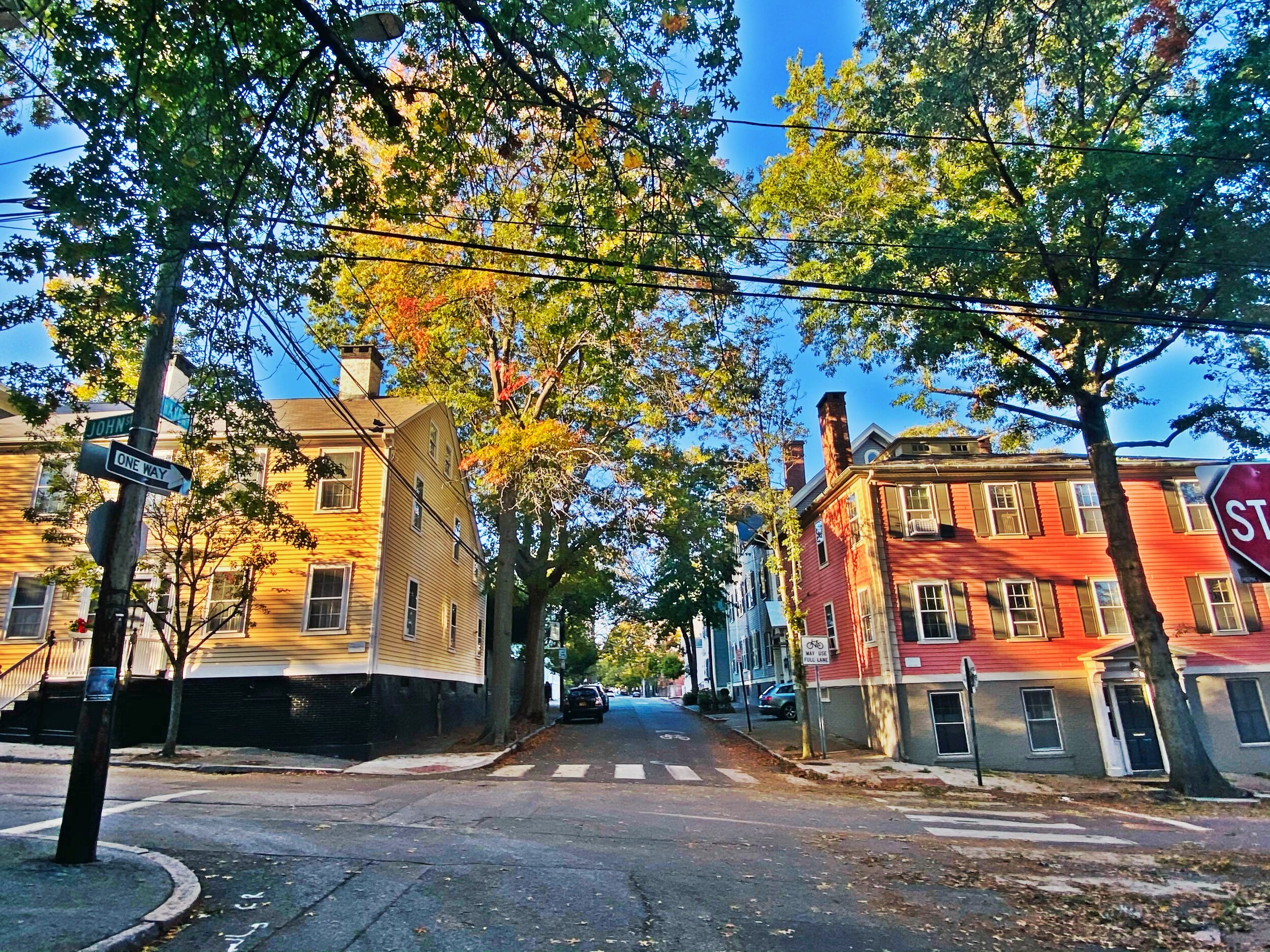
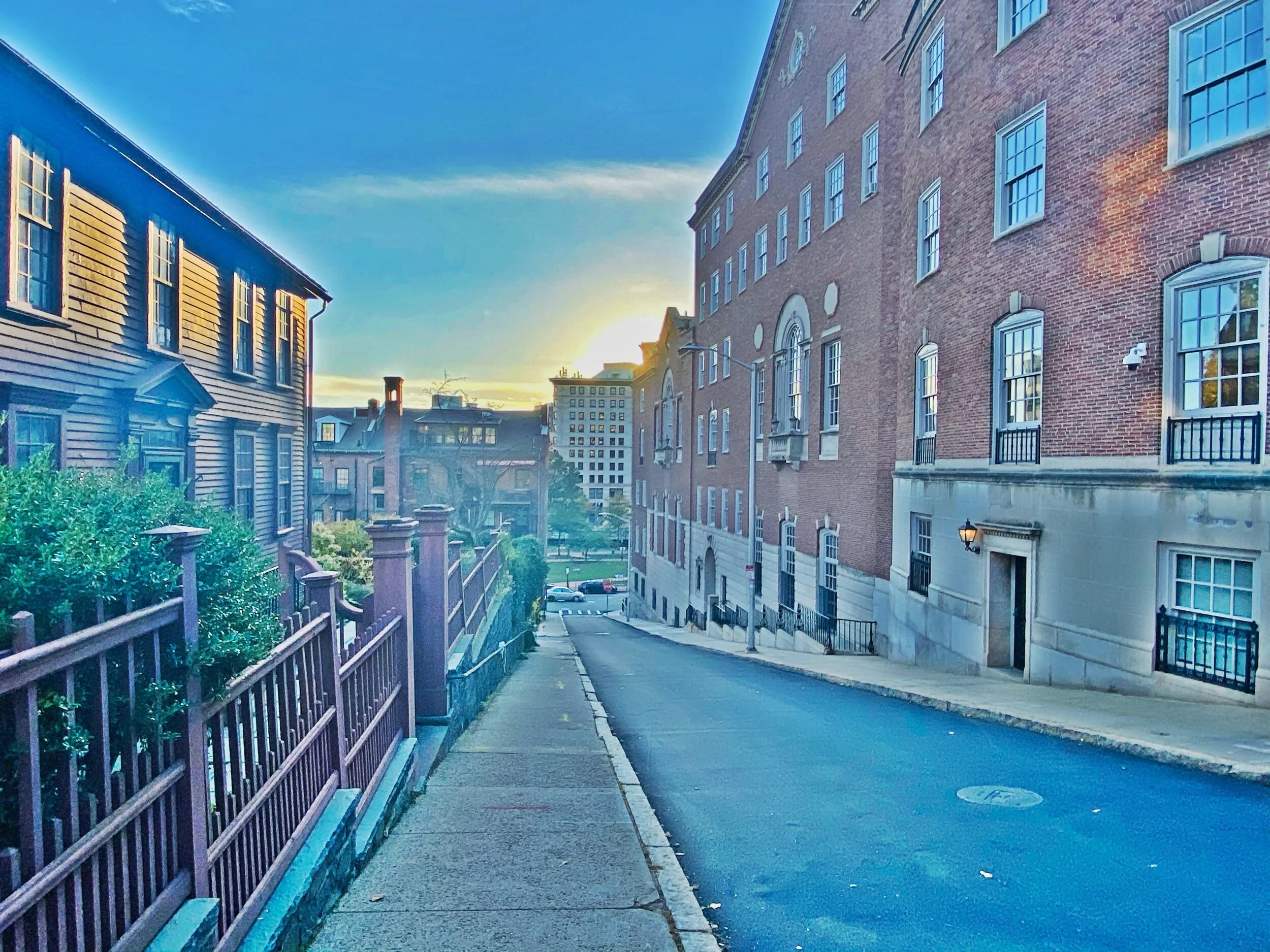
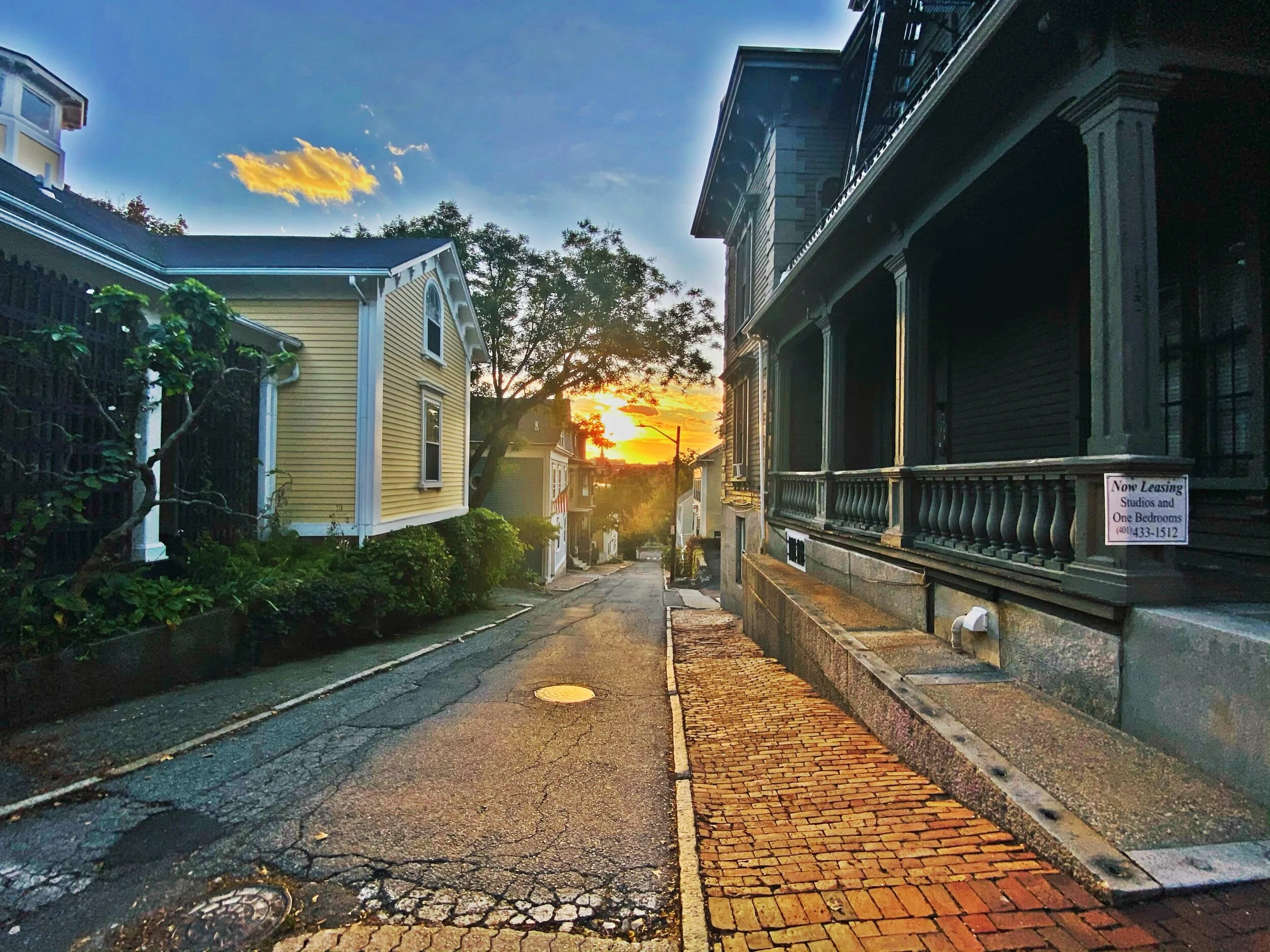
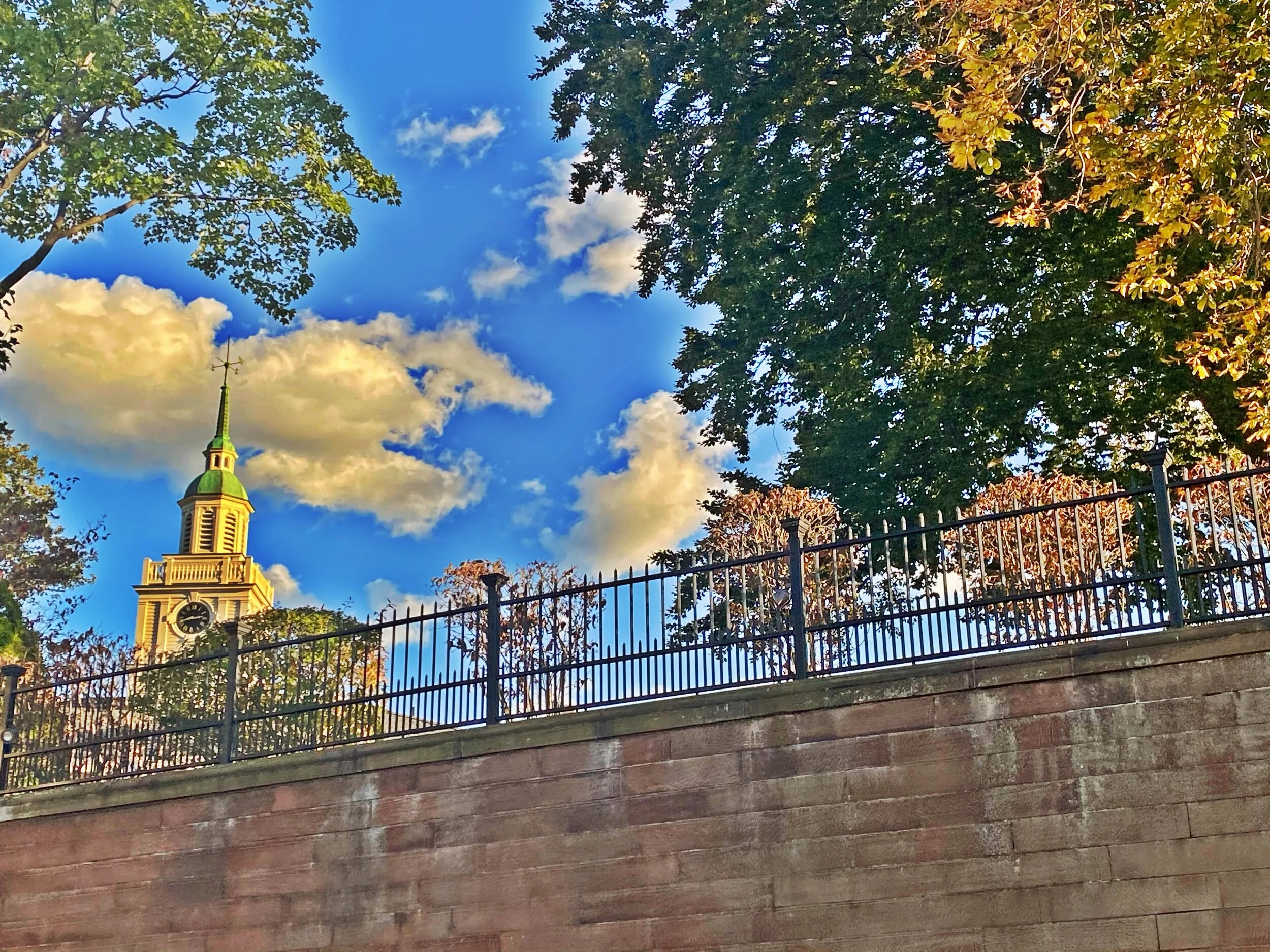
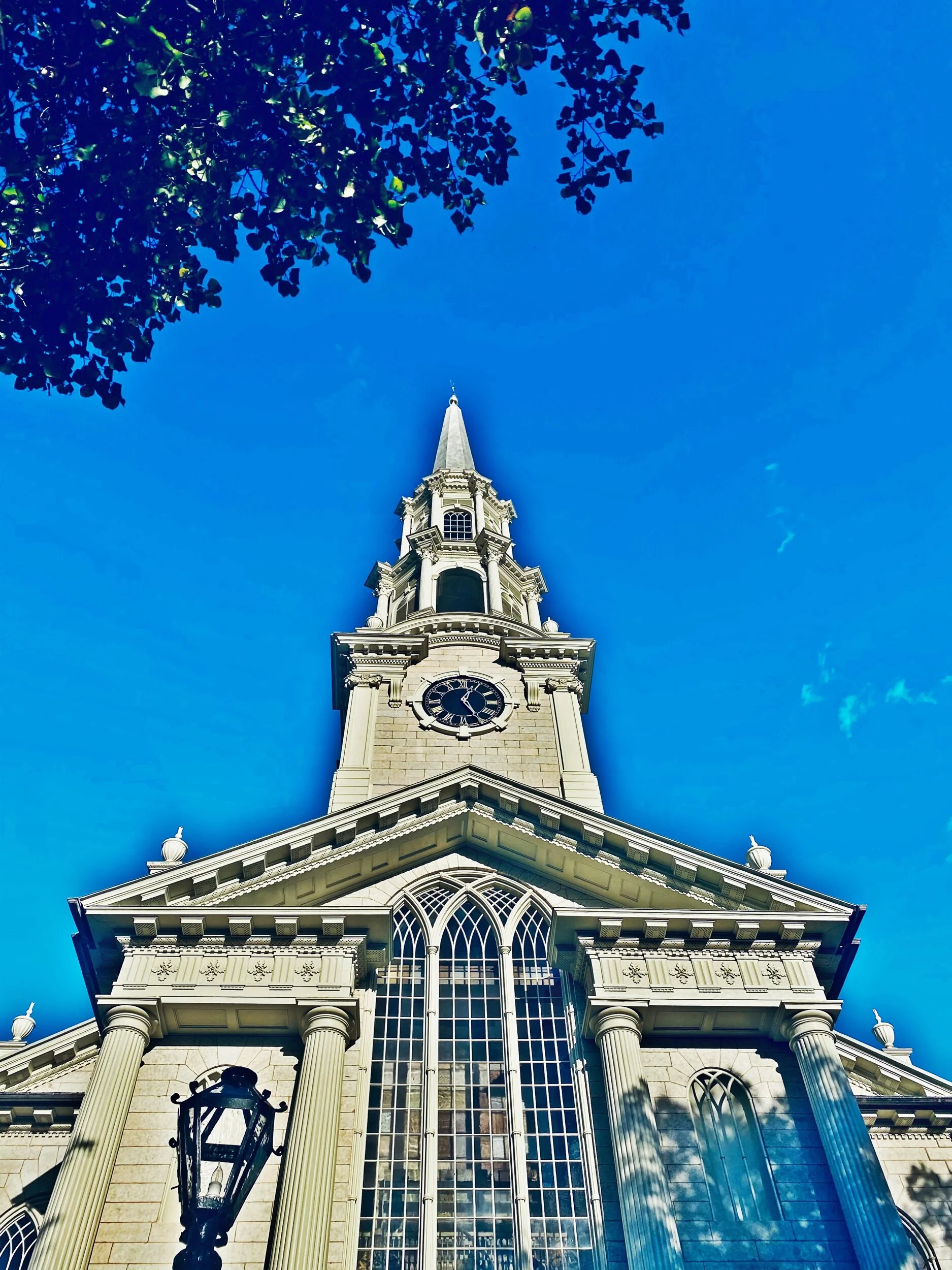
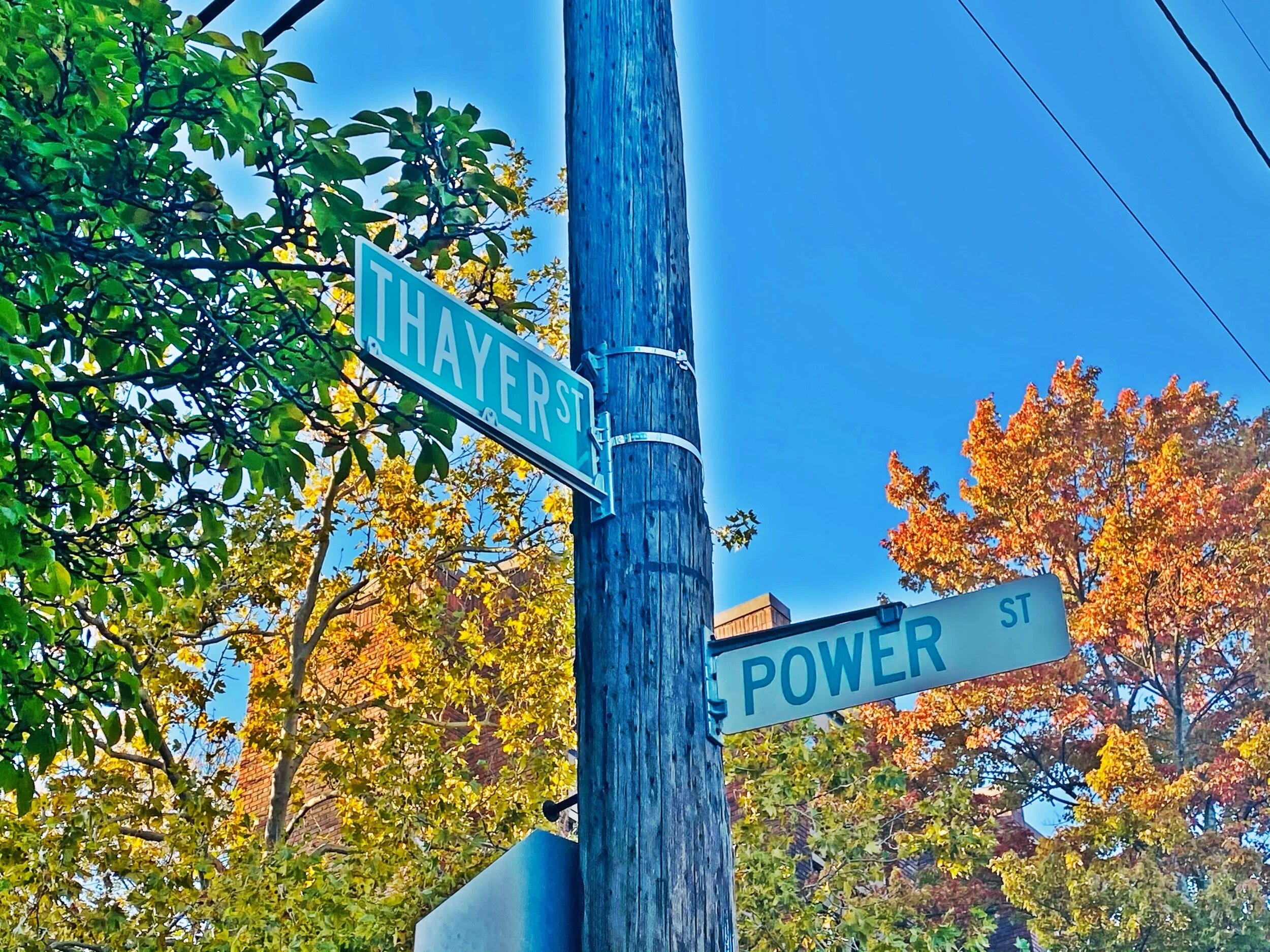
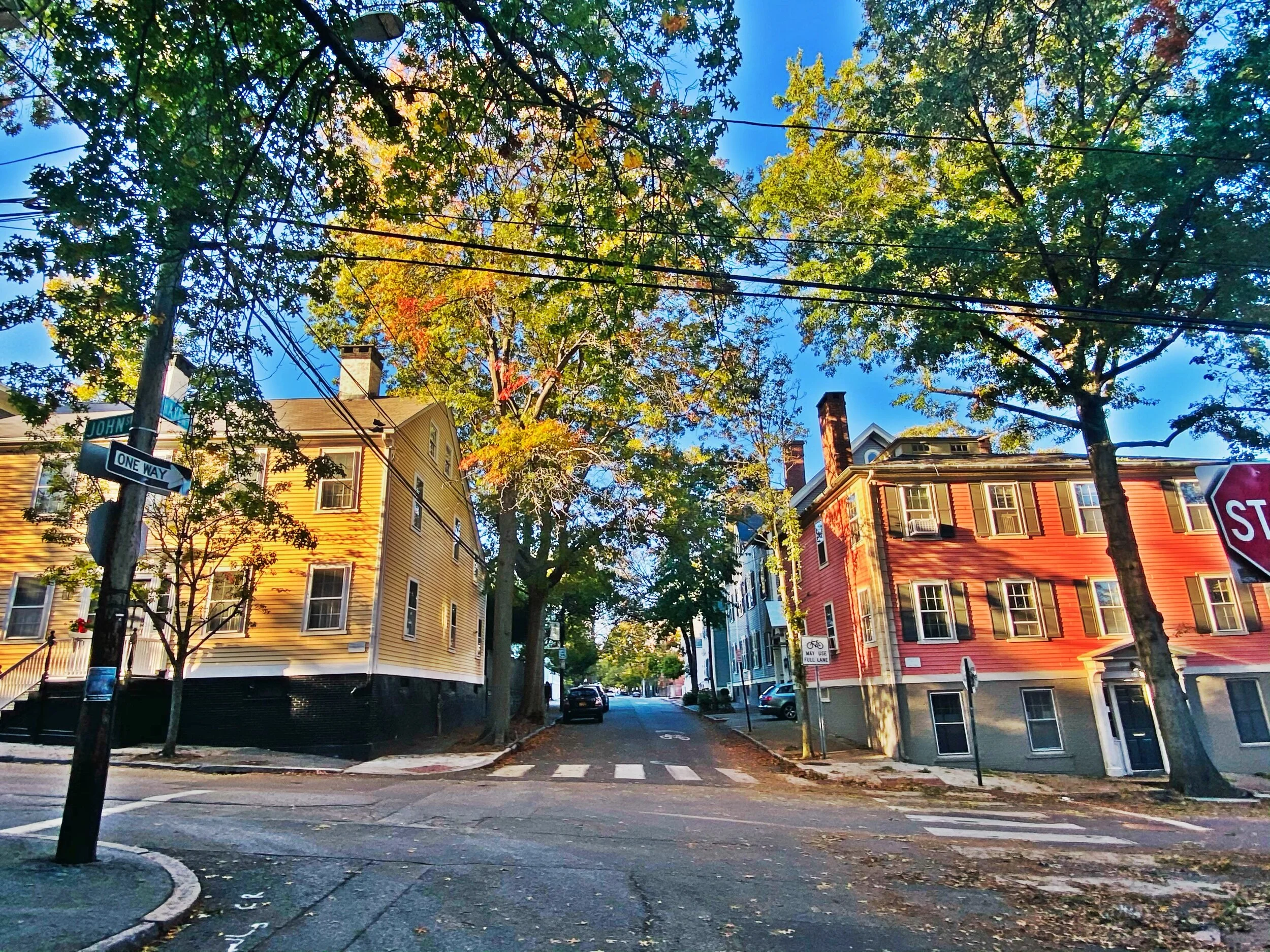
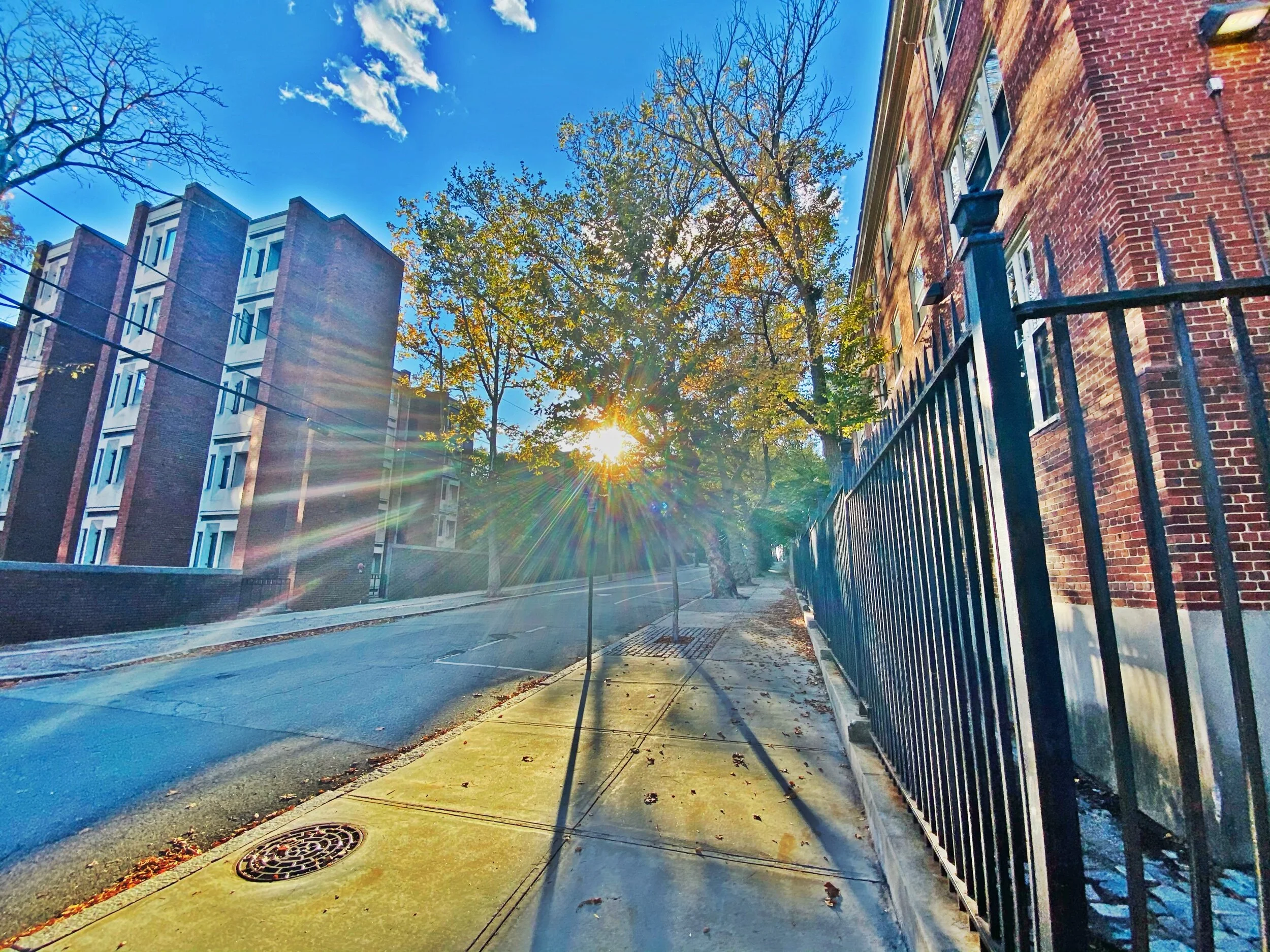
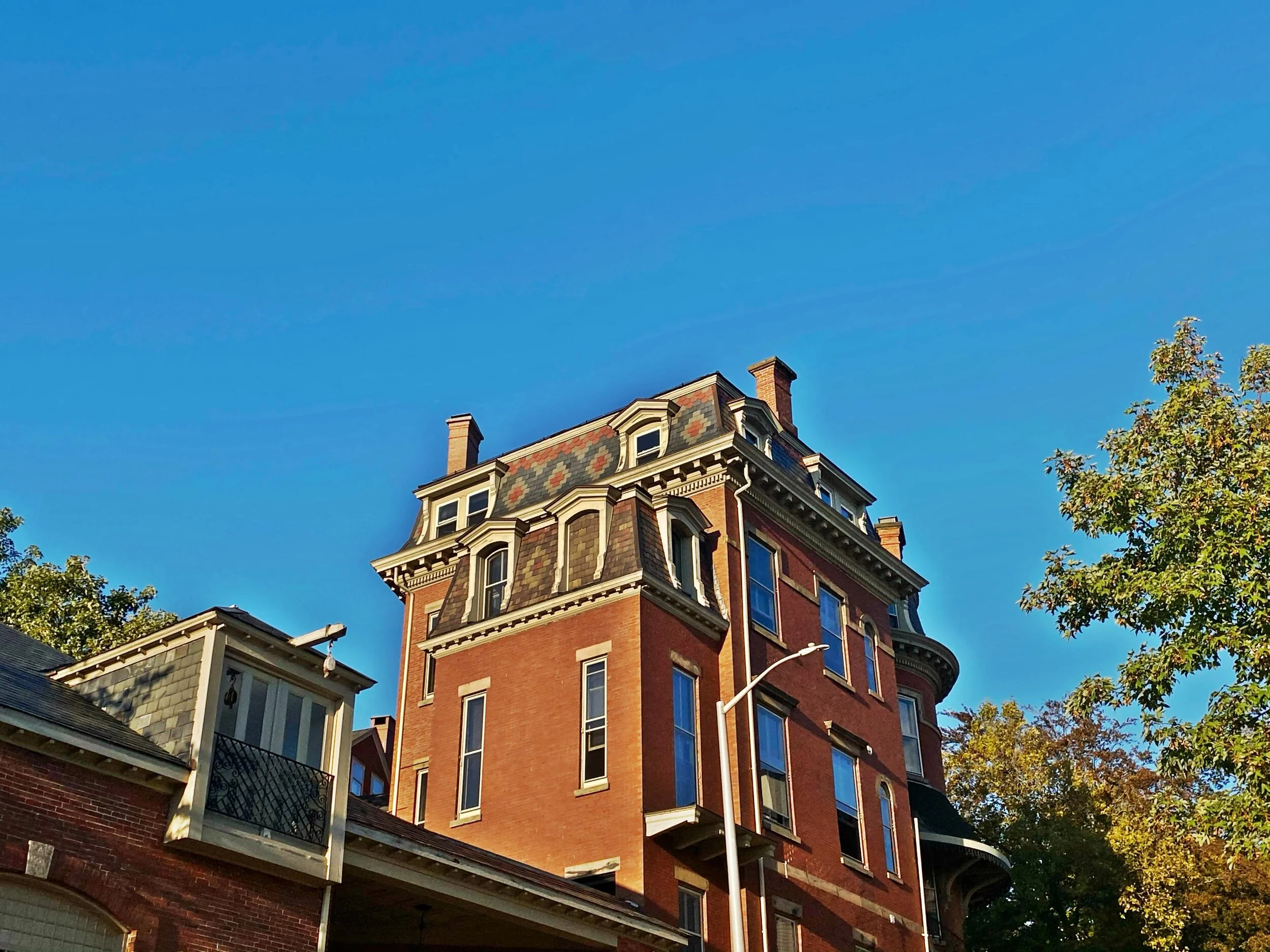
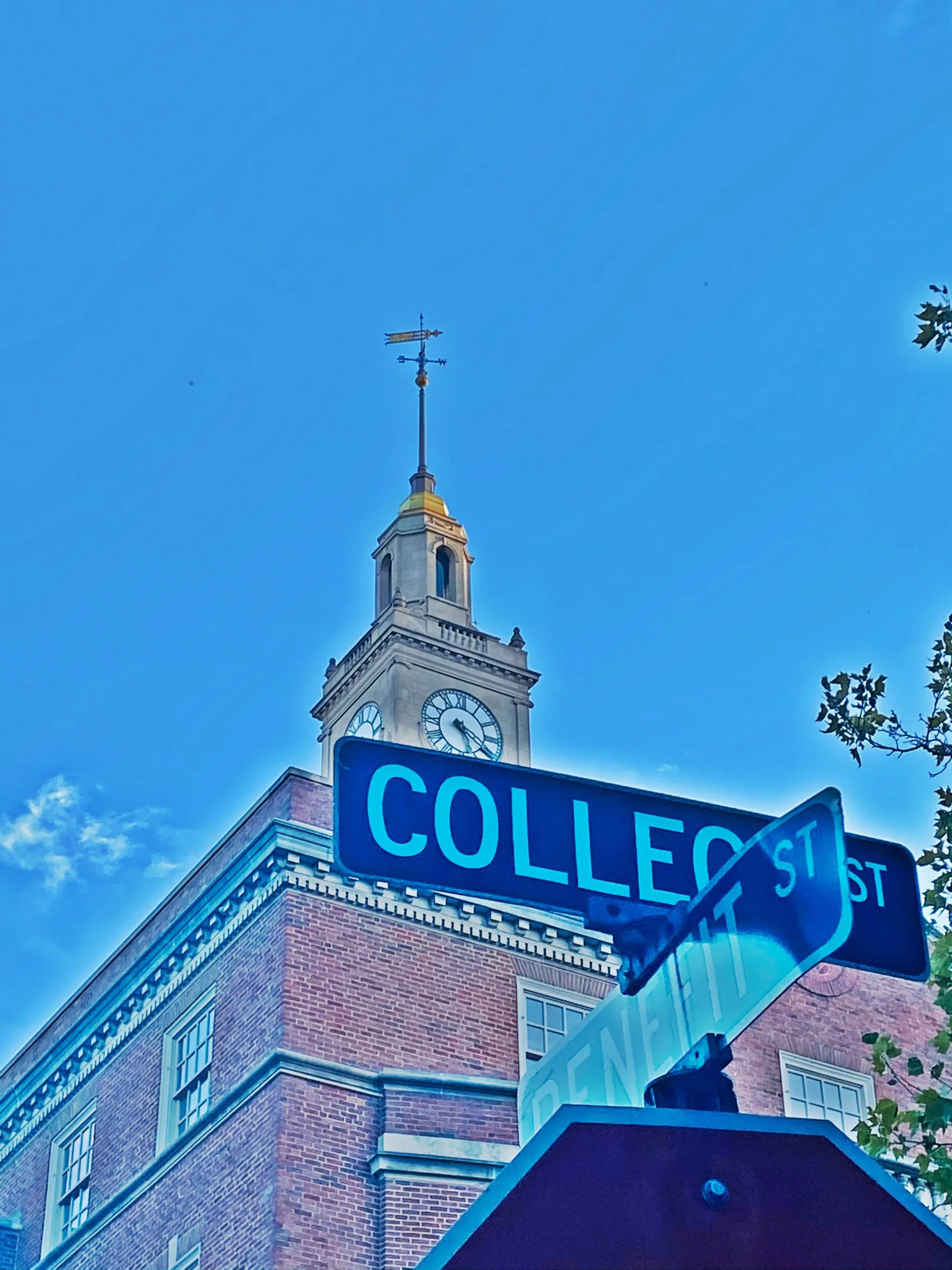
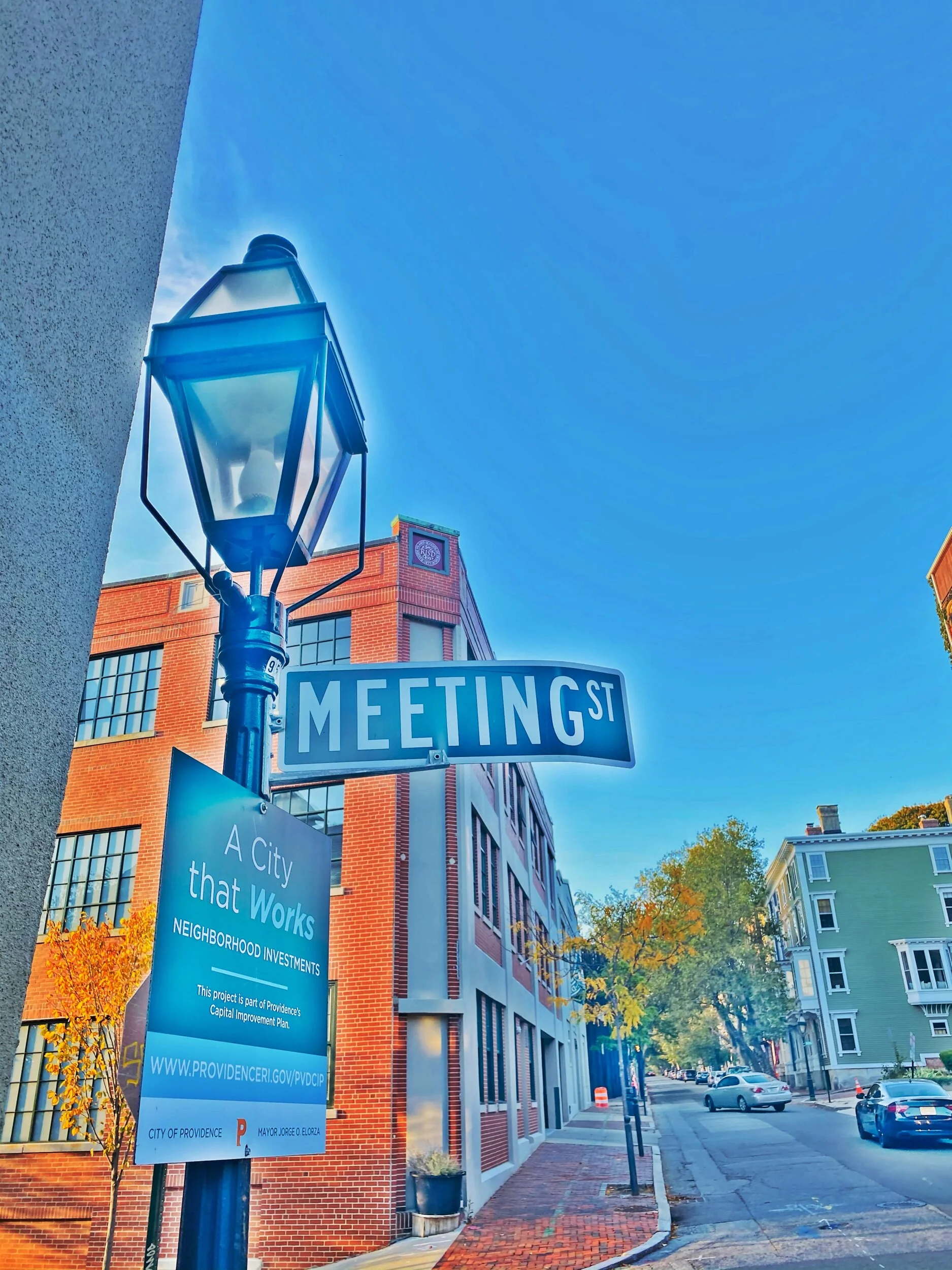
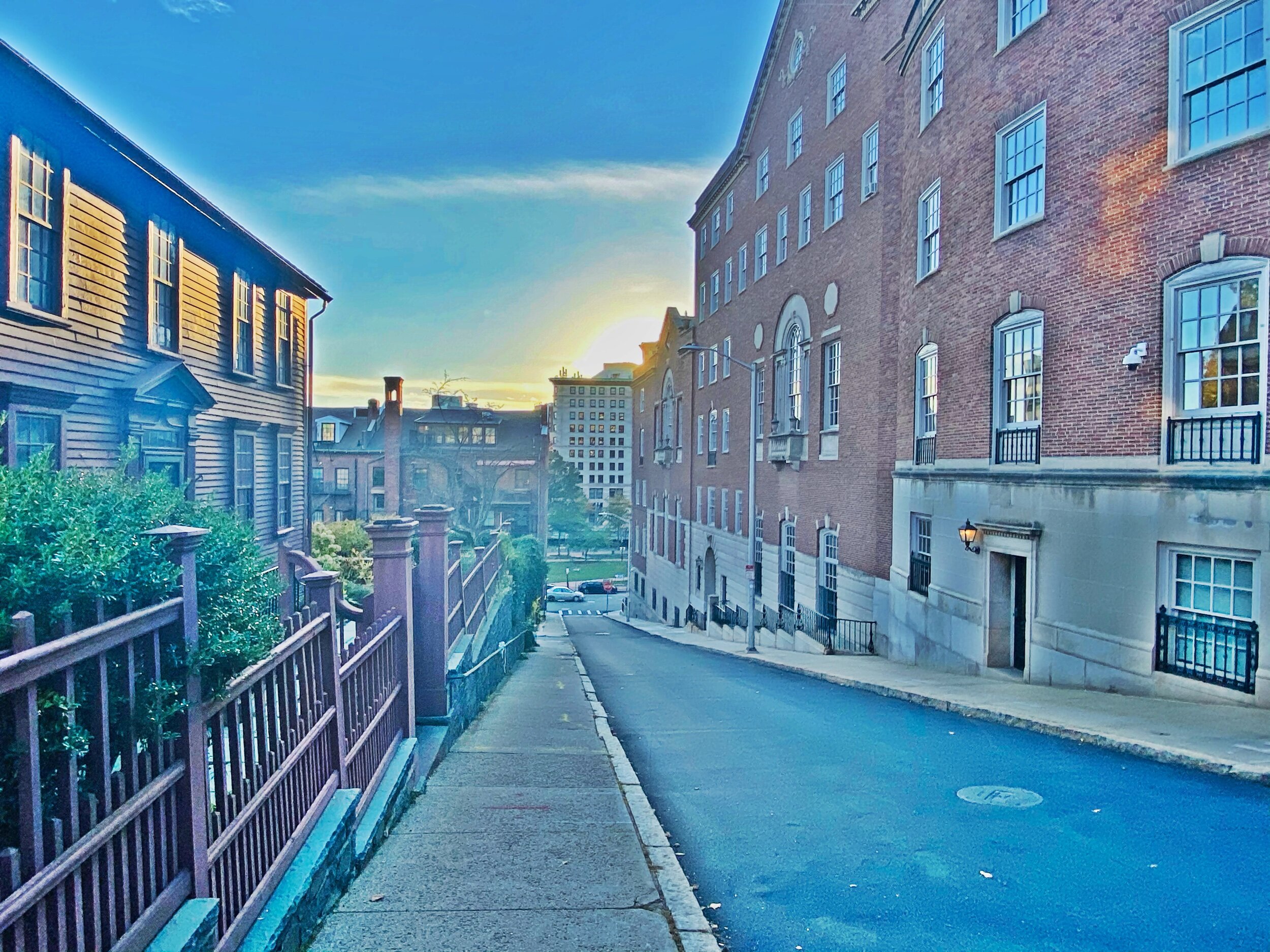
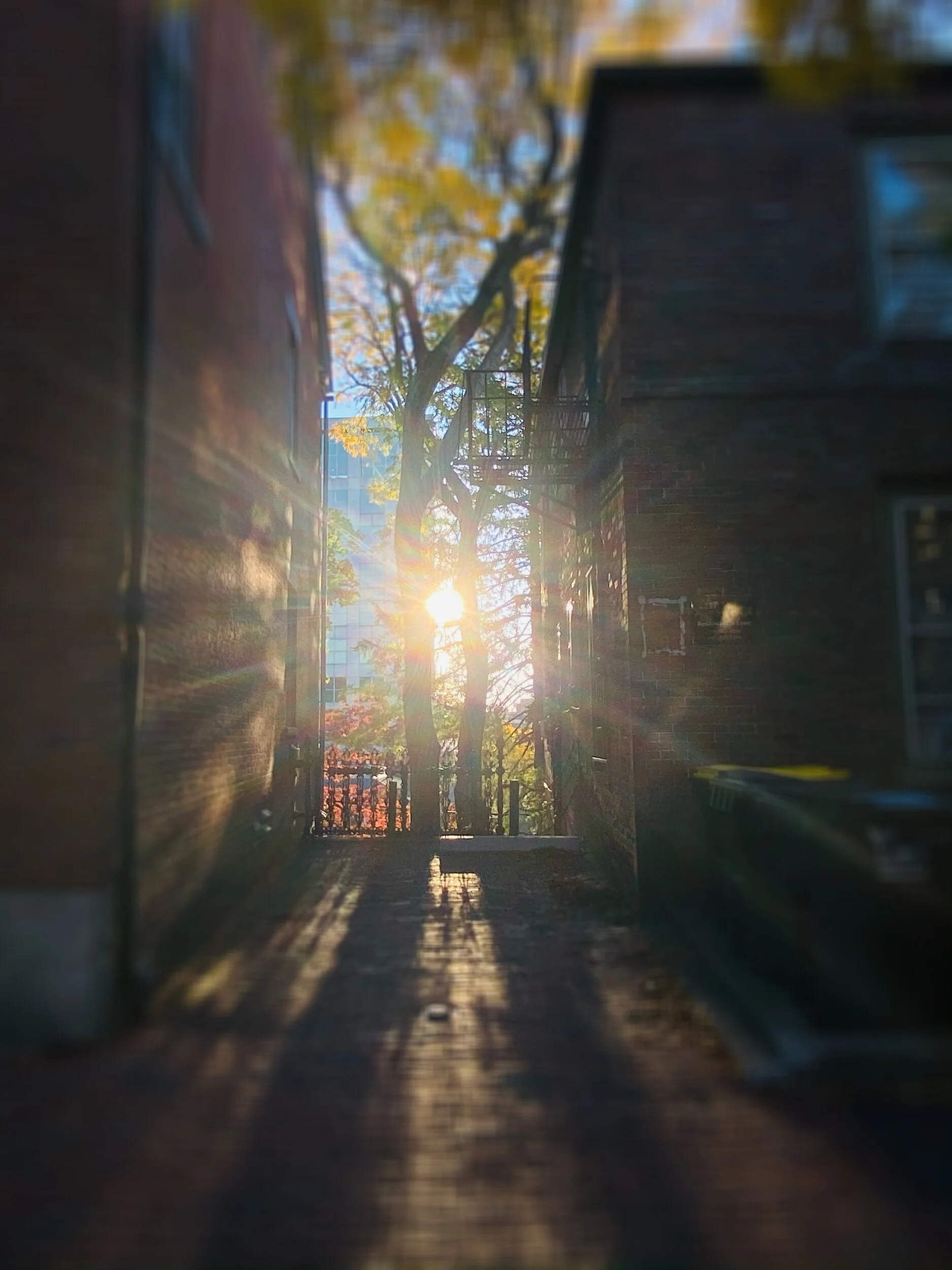
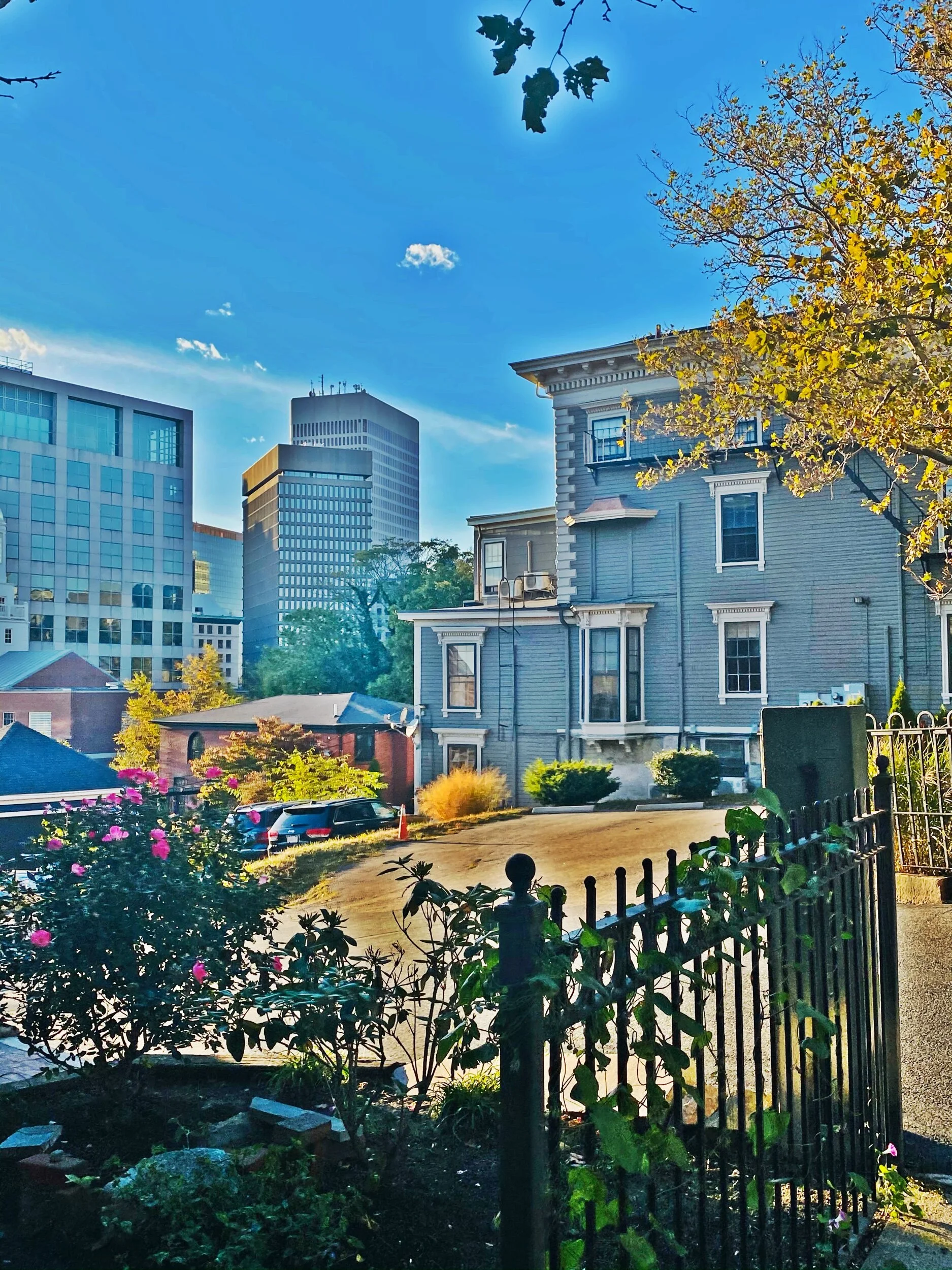
Providence’s College Hill on a beautiful fall day
Results of a stroll by New England Diary on Oct. 14
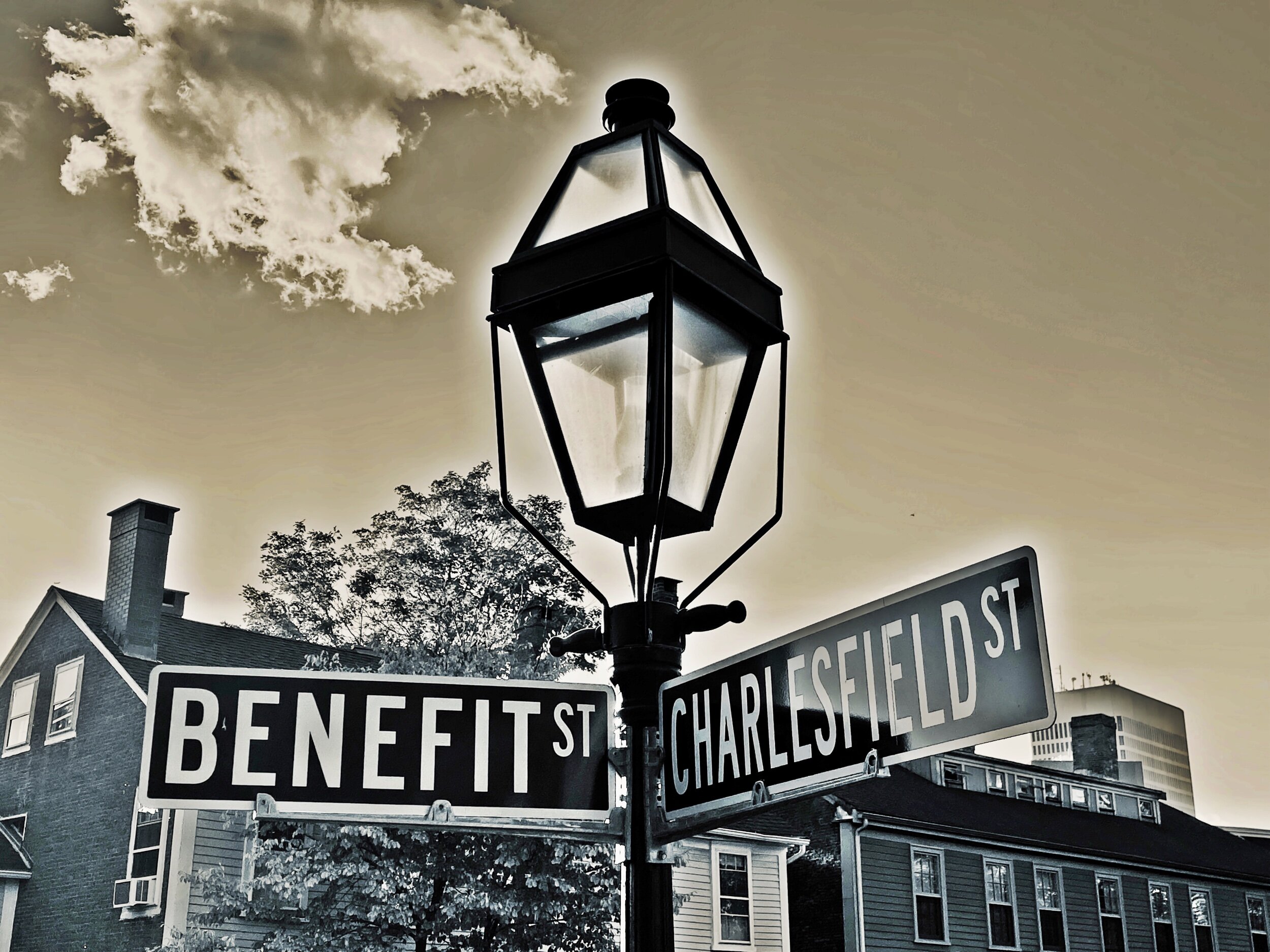
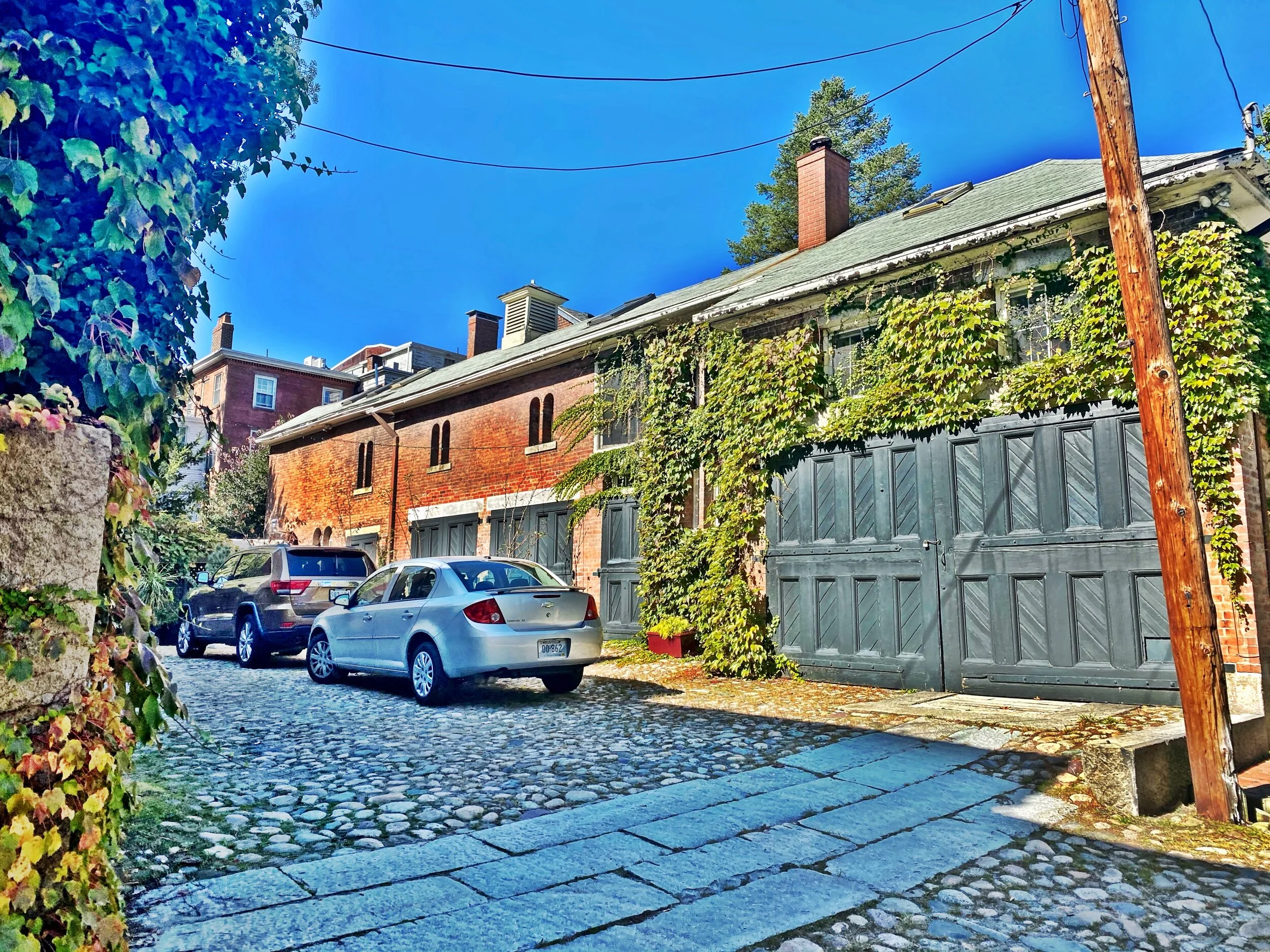
But creamed codfish?!
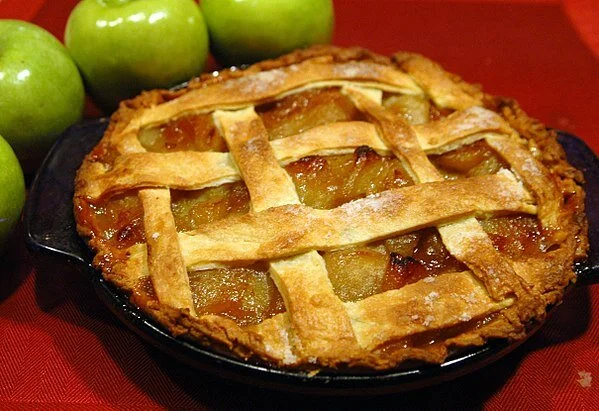
“When I was young in Vermont, there was a fine-looking man who lived across the street from us. His wife told us that in his whole life he had never missed having a piece of pie for breakfast each morning. We looked upon this fortunate creature with an awe that was not unmixed with envy, for the fine old New England breakfast had disappeared already from our table. Oatmeal, ham, creamed codfish, cornbread….yes, pie….’’
— From Favorite New England Recipes (1972), by Sara B.B. Stamm
And all’s right with the world

On Penobscot Bay
“Nautilus Island’s hermit
heiress still lives through winter in her Spartan cottage;
her sheep still graze above the sea.
Her son’s a bishop. Her farmer
is first selectman in our village,
she’s in her dotage.’’
— From “Skunk Hour,’’ by Robert Lowell (1917-1977). Nautilus Island, part of Brooksville, Maine, is a private estate in Penobscot Sound.
Seeking calm in the north

Mount Washington Hotel, with the eponymous mountain looming to the east
— Photo by rickpilot_2000
From Robert Whitcomb’s “Digital Diary” in GoLocal24.com
I had a few things to do in the White Mountains recently, most importantly, just trying to get away from life in megalopolis.
I wasn’t alone. On my way back to Rhode Island, on Saturday, Oct. 3, I saw vast herds of cars with out-of-state plates, especially Massachusetts ones, heading north. I suppose that many, perhaps most, of the travelers wanted to see this year’s fall foliage. But a simple desire to just get out of town in these COVID-claustrophobic times seems to have dramatically increased their numbers over previous years. It was bumper-to-bumper north-bound traffic on long stretches of Route 93 in the Granite State.
On the mountainous Kancamagus Highway, which connects the towns of Lincoln and Conway, there were long lines of parked cars near the scenic overlooks, though the weather was showery and drought had dimmed the foliage.
My main destination up there was the Appalachian Mountain Club’s lodge in Pinkham Notch, where I have happily stayed many times over the decades. (My most memorable time was as a reporter for the old Boston Herald Traveler in the winter of 1971, when I had to hang around there for several days to cover the drama of a couple of inexperienced climbers (allegedly stoned) lost high up on Mt. Washington in a storm; they were eventually rescued.)
On this visit, I ran into several examples of how COVID-19 has, well, made things less fun.
Some of the most pleasant parts of the complex – library, living room, etc. – are off-limits now. There were virtually no places in which to socialize, unless you stayed in the affinity group you arrived in and so were permitted to eat together. Singles were ordered to sit by themselves, preferably all alone at a long table, or at the end of one. And I missed the cheery Canadians, traditionally big patrons of the place and fun to eat and maybe practice some French with. The pandemic has cut us off from our northern (and better run than the U.S.) neighbor as it has from most other countries.
The most depressing thing, to me, came when a staffer announced the post-prandial entertainment – a film and/or slides (I’m not sure which) about Denali (aka Mt. McKinley) and Mt. Washington. Everyone who wanted to attend had to sign a waiver liberating the club from responsibility in the case of COVID infection. I demurred, not out of fear but out of sadness at the situation and went back to read some short stories by the masterful John O’Hara in my room, which had four bunks but just me.
Another anti-COVID move reminded me of TB asylums before the discovery of antibiotics: The windows in the halls were left wide open, presumably to dilute viruses. So the halls at night were in the 40s or upper 30s. The bunkrooms and individual bedrooms were, however, blessedly heated.
Most of the young staff were pleasant enough though a few were grouchy, probably because of stress. In any event, these are not the best times to go to such places. Wait until a vaccine, and hope the anti-vaxxers don’t ruin everything.
xxx
But I didn’t give up. Seeking another place devoted to “getting away from it all,’’ I drove around to the western side of the Presidential Range to check out the Mount Washington Hotel, in Bretton Woods. This astonishing resort, opened in 1902, in an era of grand mountain and seashore hotels, has always especially catered to the rich, though I saw plenty of people of more modest means there, too.
Its capacious verandas, palace-like halls, lounges, restaurants, bars and views of Mt. Washington, to the east, not to mention golf courses, swimming pools and other sybaritic allures, might make you want to be rich enough to live there – modestly, no more than a three-bedroom suite.
I bought a plastic-wrapped sandwich and a cup of coffee in one of the hotel’s sundries shops and took them out to consume on a veranda, with nap-inducing chairs, that looks toward Mt. Washington, whose upper reaches were obscured by clouds. Still, the view of the back of the vast Spanish Renaissance Revival establishment was a fine show in itself.
No wonder guests and staff seemed a lot cheerier than the folks at the Appalachian Mountain Club, with its spartan ways and situated in a deep, dark valley. Just the fact that there are plenty of places where you can sit on the verandas without wearing a mask raises spirits at the hotel. Or maybe you’re supposed to wear a mask out there but I saw plenty of unmolested people who weren’t.
The hotel guests were less well dressed than you might have expected in such a fancy place. It’s a blue-jeaned world. A hundred years ago you would have seen plenty of men in tails and dinner jackets.
Many, many famous people -- politicians, movie stars, etc., etc. -- have stayed at the hotel over the years. But historically the most important were those who participated in the Bretton Woods Conference, in July 1944, in which representatives of 44 allied nations met at the hotel to lay the foundation for restructuring and overseeing key parts of the world’s financial and monetary systems. The plan was to avoid the mistakes of the Versailles Conference, in 1919, which ended World War I, and the huge monetary and fiscal policy fiascos that followed, which helped cause and worsen the Great Depression, which in turn played a part in causing World War II.
The 1944 meeting created, most famously, the International Monetary Fund and the World Bank, helping to set in motion the longest period of growing prosperity in world history.
Sadly, the current regime in Washington has done its best to undermine the Bretton Woods institutions, opting instead for an intense nationalist/protectionist approach.
I peeked into the “Gold Room,” where the final documents were signed in 1944 on a beautiful round table.
There were lots of New York plates in the parking lots.
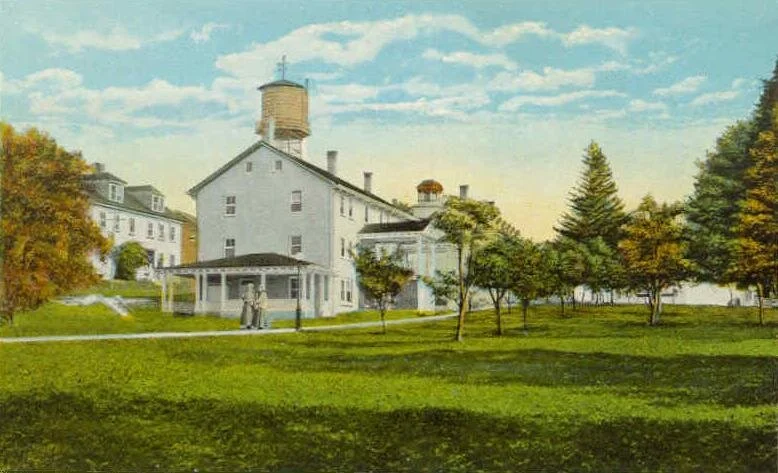
Canterbury Shaker Village in about 1920
Heading south, I dropped by another escape place: the Canterbury (N.H.) Shaker Village, a kind of Brigadoon. It was established, in 1792, by the Shakers, a Protestant sect whose members have waited and waited for the Second Coming of Christ, as a religious, residential and occupational refuge. Its 32 buildings, set in a bucolic landscape, evoke the Shakers’ mix of faith, hard work, humility, practicality and craftsmanship.
The Shakers have pretty much died out. One big reason: They practice celibacy – not a good business model for growth! In any case, there are things to admire in their communal living as well as in their care of the natural environment, their lovely architecture and furniture and even some surprising technological innovations, in machinery, etc. They could be remarkably forward-looking.
Visiting the Shaker Village is soothing. Take a guided tour, or stroll around by yourself, checking out such attractions as “The Bee House,’’ “The Syrup Shop’’ and “The Ministry Privy.’’ (Okay, I’m focusing on the stranger buildings.) You’ll feel better.