
More than basic black

“After the Storm” (acrylic on canvas), by Tim Forbes, in his show “NOIR: Works on Canvas & Paper,’’ at Lanoue Gallery, Boston, through Oct. 11. He’s based in Blue Rocks, Nova Scotia. (See below.) Hit these links:
lanouegallery.com
and
https://lanouegallery.com/artist/Tim_Forbes/biography/


Suresh Garimella: UVM's role in helping Vermont recover from COVID crisis

Named for U.S. Sen. Justin Smith Morrill, Morrill Hall at the University of Vermont was built in 1906-07 as the home of the UVM Agriculture Department and Agricultural Experiment Station.
Via The New England Journal of Higher Education, a service of The New England Board of Higher Education (nebhe.org)
BURL.INGTON, Vt.
Gracing the back wall of my office at the University of Vermont is an antique wooden desk that’s more than 150 years old. While it’s an undeniably handsome piece of 19th Century craftmanship, it serves much more than a decorative purpose.
As the desk of Vermont Sen. Justin Smith Morrill, the author of the Morrill Act of 1862, which established the country’s first land-grant universities, it is my lodestar, a vivid reminder of UVM’s status as one of the nation’s earliest land grants and of the solemn responsibilities that come with that designation.
Count me as a true believer in the land-grant mission and among its greatest fans. The first land grants, so called because the U.S. government donated federal land to each state to establish a university, were a brand new idea: higher education for everyday people focused on the practical subjects of agriculture and the mechanical arts, whose purpose was to improve the economic and cultural well being of the people in their state.
Why am I so passionate about UVM’s land-grant mission? Because Vermont, as much as any state in the nation, faces a series of daunting challenges—from population decline to stagnant economic growth—that a land-grant university like UVM is powerfully equipped to address.
In the middle of a pandemic that has rendered these challenges even more acute, there is another reason to believe in the land-grant mission. Land grants like UVM have a key role to play in helping their states recover economically from the ravages of COVID-19.
The economic impacts of the pandemic are indeed unprecedented. In the second quarter of 2020, the national economy shrank at an annualized rate of nearly one-third. Millions of jobs were lost in New England. And in Vermont, despite the state’s lowest-in-the-nation infection rate, unemployment in July was 8.3 percent, and the state has the highest budget deficit in its history.
How can land-grant universities help spur economic recovery in their states? In Vermont, we’re looking at bringing the power of the university to bear on these challenges in a number of ways.
We’ll take full advantage of one of UVM’s most important resources: our bright and capable students. In a post-COVID economy, employers—from tech firms to media companies to nonprofits—will be in dire need of eager-to-learn, dependable, qualified employees. To meet this need, we’ll significantly enhance our internship programs, so more students, beginning in their first year, can be exposed to career options in the state by interning with a Vermont employer. Just as important, we plan an active outreach and education campaign to employers, so they know how to connect with and engage our talented students.
We’ll harness the strength of another great university resource: the talents of our faculty, who last year brought over $180 million in research funding to the university. In the coming months, with support from our faculty, we will help businesses around the state apply for federal Small Business Innovation Research (SBIR) and Small Business Technology Transfer (STTR) grants, proven ways to help businesses grow.
We plan a concerted and sustained effort to attract our out-of-state alumni, a high percentage of whom are entrepreneurs, back to Vermont, a state they love, providing them with technical assistance so they can relocate their companies, envision new ways of working from home or start new businesses here.
We’ll mobilize the intellectual firepower of our faculty to help policymakers craft local and state programs that address socioeconomic challenges the state is facing, which hold back wellbeing and prosperity. In a survey of food insecurity in the state, for instance, faculty learned that some Vermont residents were stockpiling food and depriving those in need—a problem that informed policy can alleviate.
We’ll deploy the pedagogical and human development expertise of faculty in our College of Education and Social Services to help Vermont’s K-12 teachers better engage primary school students as they emerge from a remote learning environment and better understand how distance learning, enhanced internship and place-based learning opportunities can help keep college-bound high school students on track.
For many of these efforts, we’ll coordinate with UVM Extension. In an expansion of their traditional role, Extension faculty and staff will act as our on-the-ground implementation agents for community economic development.
As important as these programs are in spurring economic recovery, their impact would be muted without another initiative just funded by the state: UVM’s new Office of Engagement.
The office will function as the front door to the university, with staff who field inquiries from businesses and residents across the state, connecting them with appropriate resources and expertise at UVM.
While the university has a critical role to play in Vermont’s post-COVID recovery, its role in promoting the state’s well being stretches far beyond the current crisis.
Boosting the health, quality of life and prosperity of Vermont and Vermonters is one of the three core imperatives in the university’s recently released strategic vision, Amplifying Our Impact.
The strategic vision continues UVM’s long tradition of engagement with the state. During my tenure, we will become even more deeply engaged with issues of concern throughout Vermont.
The historic wooden desk I keep close by will continue to inspire me. With the help of this daily reminder, I will ensure that UVM’s land-grant mission—to help the state confront both our current challenges and those to come, shaping a bright future for all Vermonters—remains a top priority for Vermont’s university.
Suresh Garimella is president of the University of Vermont.

UVM seal
'Meant to be'

“When fall comes to New England
And the wind blows off the sea
Swallows fly in a perfect sky
And the world was meant to be.’’
— From song “When Fall Comes to New England,’’ by Cheryl Wheeler
'Summer people and lobsters'

Old Orchard Beach, Maine, long a favorite resort area for French Canadians, but not this year.
“As a child of Maine, he knew better than to learn to swim; the Maine water, in Wilbur Larch’s opinion, was for summer people and lobsters.’’
From John Irving’s Cider House Rules (1985)

Finally out of the house

“September smiled at her wonderful friends in all their colors and bright eyes and gentle ways. “You know, in Fairyland-Above they said that the underworld was full of devils and dragons. But it isn’t so at all! Folk are just folk, wherever you go, and it’s only a nasty sort of person who thinks a body’s a devil just because they come from another country and have different notions.”
― Catherynne M. Valente
Photo by Fiona Gerety, Wickenden Street, Providence, RI.
September 13, 2020
'The world itself'
“The most beautiful thing in the world is, of course, the world itself.’’
— Wallace Stevens (1879-1955), Hartford-based poet, lawyer and insurance executive
Mr. Stevens enjoyed wandering in Elizabeth Park. With more than a hundred acres of gardens, lawns, greenhouses and a pond, the park often appeared in his poems, including "The Plain Sense of Things," which includes the lines:
“Yet the absence of the imagination had
Itself to be imagined. The great pond,
The plain sense of it, without reflection, leaves,
mud, water like dirty glass, expressing silence…’’


— Photo by Ragesoss
The Rose Garden at Elizabeth Park in West Hartford, Conn., with a greenhouse in the background on the left. Part of the park is in Hartford.
Shall not perish from the Earth

New England clam chowder
“Alas, what crimes have been committed in the name of chowder! Dainty chintz-draped tea rooms, charity bazaars, church suppers, summer hotels, canning factories — all have shamelessly travestied one of America’s noblest institutions, yet while clams and onions last, the chowder shall not die.’’
— Louis P. Gouy, in The Gold Cook Book (1970)
Roll with the chaos

“What you find coming through” (gouache, India ink, walnut ink, soft pastel, coffee, colored pencil, graphite, watercolor, Rives BFK paper, acrylic ink and paint), by Max Van Pelt, in his show “Tendency,’’ at Cade Tompkins Projects, Providence, through Nov. 14.
'Dry shake of our steps'

“The Starry Night’’ (1889), by Vincent Van Gogh
“We walk tonight
in the valley of our bones.
Here no skin is stretched
on hollow wood,
no song except
the dry shake of our steps.’’
— From “The People Cannot Speak,’’ by T. Alan Broughton (1936-2013), American poet and pianist. He taught writing at the University of Vermont in 1966-2001.
The Devil's 'restraining machine'

“One of the earliest institutions in every New England community was a pair of stocks. The first public building was a meeting-house, but often before any house of God was builded, the Devil got his restraining machine.’’
— Alice Morse Earle (1851-1911), historian. Her writing focused on small sociological details and became invaluable for some 20th Century social historians. She wrote books on Colonial America (and especially New England ), such as Curious Punishments of Bygone Days.
Only by invitation

“House Party” (collage), by Betsy Silverman, at Edgewater Gallery, Middlebury, Vt.
Llewellyn King: 'Job retraining' can be an empty slogan without aptitude
Computer skills training
WEST WARWICK ,R.I.
When a vaccine for COVID-19 is as easily available as a flu shot, and when the public is comfortable getting it, it will be a time of victory -- Victory Virus. And it will be a time to begin building the new America.
Things will have changed. We won’t be going back to the future. Most visible will be the disappearance of a huge number of low-end jobs. No one knows how many but, sadly, we have a good idea where it will hurt most: among semi-skilled and unskilled workers.
They are those who don’t have college degrees and those who wouldn’t have qualified to enter college. Higher education isn’t for everyone, even if money wasn’t an issue. College is for those who can handle it, therefore benefiting.
It isn’t only the virus that is changing the employment picture but also the continuing technology revolution. Data is going to be king, according to Andres Carvallo, founder of CMG, the Austin-based technology consulting company, and a professor at Texas State University. Data, he argues, linked with the spreading fifth-generation telephone networks (5G) will delineate the future. Carvallo has pointed out that data from all sources have value, “even the homeless.”
Carvallo’s colleague on a weekly video broadcast about the digital future, entrepreneur John Butler, a University of Texas at Austin professor, believes that data and 5G will start to affect American business in a big way and new business plans will emerge, taking into account the increasing deployment of sensors and the ability of 5G to move huge quantities of data at the speed of light.
Carvallo explains, “If you’re moving data at the rate of 40 megabytes per second now, with 5G you’ll be able to move it at 1,000 megabytes per second.”
The technology revolution will continue apace, but will there be a place for those who aren’t embraced by it, like those who serve, clean, pack, unpack, and have been doing society’s housekeeping at the minimum wage or just above it?
Evidence is that they are already in sorry shape with a much higher rate of COVID-19 infections than the general population, and even in the best of times they have poorer health — an indictment of our health system.
The future of the neediest workers is imperiled, in the short term, because the jobs they have had and the jobs that have always been there for those on the lower ladders of employment are disappearing. A goodly chunk of these workers will be out of work for a long time.
Retraining is the solution that is advocated by those who aren’t caught in this low-level work vise. Retraining for most people is, to my mind, just a crock. It is a bromide handed down by the middle class to those below; a callow concept that doesn’t fit the bill. It soothes the well-heeled conscience.
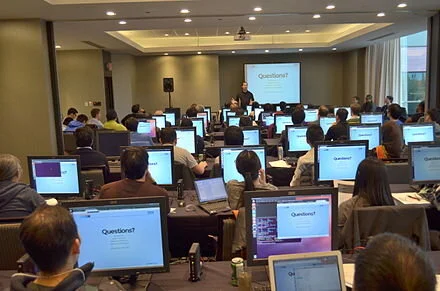
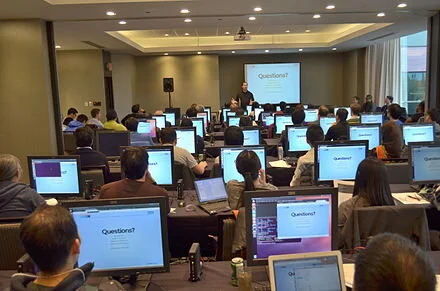
First, some people can’t grasp new concepts, particularly as they age. Are you really going to teach a middle-aged, short-order cook to navigate computer repair? That is not only impractical, it is cruel.
A further disadvantage is that the affected workers not only are going to be shut out of their traditional lines of employment, but they also carry an additional burden, another barrier to retraining: They almost exclusively are the products of shoddy public education, so there is very little to build on if you’re going to retrain. If you have marginal English most information technology work is going to be inaccessible; rudimentary math is another stumbling block.
Very smart people are candidates for retraining. The graduate schools see plenty of students who get multiple, disassociated degrees, like lawyers who have nuclear engineering degrees. I know a prominent head of surgery at a Boston hospital who has a degree in chemical engineering.
They are the polymaths, but they aren’t laboring for the minimum wage.
The loss of jobs due to COVID-19 comes at a time when technology, for the first time since the Newcomen engine kickstarted the Industrial Revolution in 1712, might be a job subtractor, not the multiplier it has been down through the ages.
Unemployment insurance is a stopgap but it also obscures the full extent of the skill void, the aptitude hurdle.
Llewellyn King is executive producer and host of White House Chronicle, on PBS. His e-mail address is llewellynking1@gmail.com and he’s based in Rhode Island and Washington, D.C.
Website: whchronicle.com
Phil Galewitz: ACA co-ops soon down to three, including one in Maine

New Mexico Health Connections’ decision to close at year’s end will leave just three of the 23 nonprofit health-insurance co-ops that sprang from the Affordable Care Act.
One co-op serves customers in Maine, another in Wisconsin, and the third operates in Idaho and Montana and will move into Wyoming next year. All made money in 2019 after having survived several rocky years, according to data filed with the National Association of Insurance Commissioners.
They are also all in line to receive tens of millions of dollars from the federal government under an April Supreme Court ruling that said the government inappropriately withheld billions from insurers meant to help cushion losses from 2014 through 2016, the first three years of the ACA marketplaces. While those payments were intended to help any insurers losing money, it was vitally important to the co-ops because they had the least financial backing.
Lauded as a way to boost competition among insurers and hold down prices on the Obamacare exchanges, the co-ops had more than 1 million people enrolled in 26 states at their peak in 2015. Today, they cover about 128,000 people, just 1% of the 11 million Obamacare enrollees who get coverage through the exchanges.
The nonprofit organizations were a last-minute addition to the 2010 health law to satisfy Democratic lawmakers who had failed to secure a public option health plan — one set up and run by the government — on the marketplaces. Congress provided $2 billion in startup loans. But nearly all the co-ops struggled to compete with established carriers, which already had more money and recognized brands.
State insurance officials and health experts are hopeful that the last three co-ops will survive.
“These are the three little miracles,” said Sabrina Corlette, a research professor and co-director of the Center on Health Insurance Reforms at Georgetown University, in Washington, D.C.
Maine Aided in Supreme Court Victory
The Maine co-op, Community Health Options, helped bring competition to the state’s market, which has had trouble at times attracting insurance carriers, said Eric Cioppa, who heads the state’s bureau of insurance.
“The plan has added a level of stability and has been a positive for Maine,” he said.
The co-op has about 28,000 members — down from about 75,000 in 2015 — and is building up its financial reserves, Cioppa said. Community Health Options is one of three insurers in the Obamacare marketplace in Maine, the minimum number experts say is needed to ensure vibrant competition.
Kevin Lewis, CEO of the plan, attributed its survival to several factors, including an initial profit in 2014, the year the ACA marketplaces opened, that put the plan on a secure footing before several years of losses. He also credited bringing most functions of the health plan in-house rather than contracting out, diversifying to sell plans to small and large employers, and securing lower rates from two health systems during a couple of difficult years.
Jay Gould, 60, a member who offers the plan to workers at his small grocery store in Clinton, has been happy with the plan. “They have great customer service, and it’s good to know when I am talking to someone that they are from Maine,” he said.
Central Aroostook Association, a Presque Isle nonprofit that helps children with intellectual disabilities, switched to the co-op last year to save 20% on its health premiums, said administrator Tammi Easler. Having a Maine insurer means any issues can be dealt with quickly, she said. “They are readily available, and I never have to wait on hold for an hour.”
The co-op, which made a $25 million profit each of the past two years, has proposed dropping its average premiums by about 14% in 2021, Lewis said.
Community Health was one of the lead plaintiffs in the case before the Supreme Court and expects to get $59 million in back payments from the settlement.
The federal decision to suspend those so-called risk corridor payments — designed to help health plans recover some of their losses — was one of the factors that caused many of the co-ops to fail, Corlette said. Republican critics of the ACA, however, blame poor management by the plans and lack of oversight by the Obama administration.
Insurers are in talks with the Trump administration about whether the $13 billion due the carriers must be added to their 2020 balance sheet or could be counted toward operations from prior years. This year, insurers are generally banking large profits since many people have delayed non-urgent care because of the COVID-19 pandemic. Since the ACA limits insurers’ profit margins, adding that federal windfall to this year’s ledger might mean many insurers would have to pay out most of the money to their consumers. If the money is applied to earlier years, the insurers could likely keep more of it to add to their reserves.
Too Much Competition in New Mexico
The Supreme Court ruling came too late for New Mexico Health Connections, which lost nearly $60 million from 2015 to 2017. The co-op would have received $43 million in overdue payments, but, in an effort to raise needed cash, it sold that debt to another insurer in 2017 for a much smaller amount.
Marlene Baca, CEO of the co-op, which made a $439,000 profit in 2019, said its goal of bringing competition into the market was achieved, since five other companies will be enrolling customers this fall for 2021. Yet, that competition eventually led to the plan’s decision to end operations, announced last month.
With only 14,000 members, it made no sense to continue operating due to high fixed administrative costs, she said. Her plan was also hurt by the slumping economy this year, which pushed many state residents out of work and made more than 3,000 members eligible for Medicaid, the state-federal health program for the poor.
“We did our very best,” Baca said, noting that her company is closing with enough money to pay its outstanding health claims. Many other co-ops that shuttered were closed out by their states and unable to meet all their debts to health providers, she said.
Montana’s Co-Op Is Expanding
The Mountain Health Co-Op, with about 32,000 members, has just two competitors in its home state of Montana and four in Idaho.
A big factor behind its survival was that the plan received a $15 million loan in 2016 from St. Luke’s Health System, Idaho’s largest hospital provider, said CEO Richard Miltenberger. Although he wasn’t working for the co-op at that time, Miltenberger said, it is his understanding that the hospital wanted to help maintain competition in that marketplace.
The co-op is expecting $57 million from the Supreme Court victory.
“We are in excellent shape,” Miltenberger said. The plan, which paid back the St. Luke’s loan and made a $15 million profit in 2019, added vision benefits this year and is offering a dental exam benefit for next year. It’s also providing most insulin and medications for asthma and chronic obstructive pulmonary disease to members without any copayment to help ensure compliance.
The insurer is moving into Wyoming for 2021, which will end the Blue Cross plan monopoly in that state’s Obamacare marketplace, he said.
Wisconsin’s Mystery Donor
Wisconsin’s Common Ground Healthcare Cooperative was on the verge of ending operations in 2016 when it received a lifesaving $30 million loan, said CEO Cathy Mahaffey. The insurer has refused to identify the benefactor other than to say it was not a person or company doing business with the plan.
In 2018, Common Ground was the only health plan in seven northeastern Wisconsin counties, she said. Today, the co-op has about 54,000 members and faces competition from two to five carriers in the 20 counties where it operates.
Common Ground, which recorded a $73 million profit last year, expects to receive about $95 million from the Supreme Court case victory.
Wisconsin’s decision not to expand Medicaid under the health law has benefited the co-op because people with incomes from 100% to 138% of the federal poverty level ($12,760 to $17,609 for an individual) are ineligible for Medicaid and must stay with marketplace plans for coverage. In states that expanded Medicaid, everyone with incomes under 138% of the poverty level is eligible.
Another factor was its decision in 2016 to eliminate the broad provider network offering and sell a plan offering only a narrow network of doctors and hospitals, allowing it to benefit from lower rates from its providers, according to Mahaffey.
“We are very strong financially,” she said.
Phil Galewitz is a Kaiser Health News reporter.
Don Pesci: Self-interview of a Republican columnist in a deep Blue State
The Connecticut seal. By the way, there are some very good vineyards in what used to be called “The Land {State} of Steady Habits’’.

VERNON, Conn.
Q: Reading over your blog, “Connecticut Commentary: Red Note From A Blue State”, I don’t see many “I’s”.
A: Modesty.
Q: No really, why?
A: Political commentators fall into two categories: those who write about themselves, and those who write about others and ideas. This last group tends to dispense with “I’s”.
Q: Well, we’ll see if we can remedy that lapse here. You have quoted Chris Powell, for many years both the managing editor and the editorial page editor of the Journal Inquirer, in Manchester, Conn. on his motivation. You said to him once – correct me if I’m wrong – that he had been writing opinion pieces longer than you, and you have been working in the commentary vineyard for more than 40 years. You complimented him. His opinion pieces were perceptive, well written and necessary, a tonic for what ails the state, you said. Yet, politicians at the state Capitol who decide Connecticut’s destiny did not appear to be paying much attention. So, you asked, what keeps him going. He flashed a smile and said, “Spite.” Does spite keep you going?
A: I doubt Powell ever bought the notion that political behavior swings on the writings of political commentators. His primary motivation is plain on the face of his opinion pieces, both editorials and op-ed commentary. He wants to set hard truths before the general public, hoping that not every citizen is motivated by spite or enclosed within a Berlin Wall of invincible ignorance. Off camera, so to speak, Powell has a quiet, infectious sense of humor. And a sense of humor is a sense of right proportion. He was joking. It’s possible that joking in the 21st Century will be a capital offense punishable by exile, as were serious crimes against the state in Roman and Greek times. In modern times, burning down buildings, liberating high-toned stores of merchandise, throwing Molotov cocktails at police buildings, are all okay; but we draw the line at making jokes. The Greek tyrant Creon feared Aristophanes as much as an invading army. One day, one of Creon’s factotums met Aristophanes in the street and asked him in a fury, “Don’t you take anything seriously?” Aristophanes answered, “Yes, I take comedy seriously.” Mark Twain also took comedy seriously, and his long suffering wife, Olivia Langdon Clemens, worked tirelessly to protect him from a public whipping. In "The Chronicle of Young Satan, Mysterious Stranger Manuscripts,” Twain has Satan say, “Against the assault of laughter, nothing can stand.”
Q: So, you are not spiteful then?
A: Spite, like humor, is salt, to be used always sparingly. I acknowledge that every sealed closet has some bones concealed in it. I can only say I don’t feel spiteful, though I do think spite can flower into gorgeous commentary. I’m thinking of Alexander Pope’s long poem, “The Dunciad”. We should love lovable things and hate hateful things. The record -- and it’s a long one; “Connecticut Commentary” contains to date about 3,141 separate pieces, nearly all submitted as columns to a host of Connecticut papers – I think will show that I’m interested in the public persona of politicians, the face they present to their constituents. I’m certainly not interested in delving into the private soul of, say, U.S. Sen. Dick Blumenthal, of this state, about whom I’ve written a great deal, much of it unpublished by Connecticut’s print media. It’s best to stay away from amateur psychology. Rummaging in private souls is very much like rummaging in attics – too many spider’s webs, hanks of hair, abandoned diaries, and moldy, old dolls.
Q: I’ve seen the Blumenthal cache. Much of it is well written, certainly publishable. And you’ve said that nearly all of that cache had been sent out to various Connecticut newspapers. Much of it never saw print. Why not?
A: Thanks for your labor of love. It’s a good question. I suppose much of it may have rubbed editorial fur the wrong way. Part of this is business. Smaller newspapers, as you know, have been swallowed up by journalistic leviathans. The larger chains have a stable of dependable writers they may draw from. The whole of New England is a left-of-center political theater and has been for a long while. The General Assembly in the state has been dominated by left-of-center Democrats for a few decades; all the constitutional offices in the state are manned by Democrats; there are no Republicans in the state’s U.S. congressional delegation; virtually all the justices of the state’s Supreme Court have been placed on the bench by highly progressive former Gov. Dannel Malloy. Larger cities in the state – Bridgeport, New Haven and Hartford – have been, some would say, mismanaged by Democrats for about a half century. And it is not news that the media do political business mostly with incumbents. So, while it is not at all excessive hyperbole to say that most of the state’s current difficulties may be laid squarely at the feet of immoderate Democrats, incumbents are, mostly for business reasons, lightly leashed.
Q: Why lightly leashed?
A: You cannot get water from a rock, and you cannot get printable news from non-incumbents. If the political state is largely progressive, the state media will follow suit.
Q: Why “immoderate” Democrats?
A: Because Connecticut Democrats are no longer moderate, no longer centrists, no longer “liberal” in the sense that President John Kennedy or justly celebrated Gov. Ella Grasso were liberal.
Q: You knew Grasso.
A: I did. She, her family and my father and his family, while occupying opposite ends of the political spectrum, were friends all their lives in the social and political petri-dish of Windsor Locks. During those times, friendship transcended politics. And politics itself was well mannered and soft spoken.
Q: Not now.
A: No longer.
Q: What changed?
A: Do you mean nationally or statewide?
Q: Both.
A: Nationally, the Huey-Long-like personality of President Trump has thrown the right-left national polarity into sharp relief, but this polarity preceded Trump by decades. When everyone, including the overarching, permanent political apparatus and a politicized media, has a dog in the fight, a permanent dog fight should surprise no one. Statewide, Connecticut has become, within a very short period of time, perhaps the most left-leaning state in the Northeast. The drift leftward here began long ago. It was “maverick” Republican Lowell Weicker who, first as senator then governor, took the road not taken by pervious governors when he forced through the General Assembly Connecticut’s income tax, a levy that has resulted in improvident spending, outsized budgets, preening politicians and a poorer proletariat.
Q: That was the turning point?
A: It was a crossing of the Rubicon by a small-minded man who had contemplated for years the destruction of his own state Republican Party, which Weicker had betrayed numerous times, that finally gave him the heave-ho. Without turning over the molding psychological dolls in Weicker’s attic, I think it is proper to conclude that the man was motivated principally by unalloyed malice, what aphorist-philosopher Friedrich Nietzsche would have called resentment, an awful curse. “Whoever fights monsters,” Nietzsche warned, “should see to it that in the process he does not become a monster.” I never heard Weicker toss off a laugh line that was not spiked with malice. I’m referring here only to the man’s public persona, you understand. In private, he may have been Henny Youngman, for all I know. In politics, it is the characters who determine the play. And in Connecticut, neatly all the characters who advance the play are progressives motivated chiefly by a rancid lust for power, very Nietzschean. Without will, you cannot secure your ends. But when the will becomes the end, it’s doomsday. Nietzsche never quite worked that into his calculations. But the great tyrants of the 20th century – Hitler, Stalin, Mao – did. Without God, Dostoyevsky said, “anything is possible” – even Weicker, the first of many of Connecticut’s “savior politicians.” The business of these savior politicians is to create the problems from which they pretend to save us.
Q: That seems a bit cynical.
A: Critical and descriptive, not cynical. The real cynics among us are those who believe positive knowledge is impossible. A perverse inability to see what lies right under your nose, George Orwell’s formulation, is the very definition of cynicism.
Q: Can you give us an example.
A: I think it is cynical to pretend not to notice the predictable effects of Gov. Ned Lamont’s shutdown of state businesses. Even a state legislator hiding under his bed, trembling in fear of Coronavirus, cannot fail to have noticed that a prolonged business shutdown would result in a diminution of state revenue; that the fatal failure of state government to provide adequate and targeted resources to nursing homes would result in needless deaths among people exposed to Coronavirus; that tax increases always transfer power and responsibility from citizens to the unelected administrative state, a descriptive rather than a cynical term; that a one-party state necessarily results in political oligarchy, which easily dispenses with representative government; that...
Q: Alright, alright, we don’t have all day here. Without being too cynical – excuse me, too descriptive – how do you see Connecticut’s future unfolding.
A: What was it Yogi Berra said – the future ain’t what it used to be? In a representative republic, we used to rely on the common sense of voters to turn out politicians who pursued public policies inimical to representative government and the public good, one of the reasons Grasso agitated against an income tax. One of Grasso’s biographers is Lt. Gov. Susan Bysiewicz, who argues that Grasso, a great governor, was wrong about the income tax. Well, Grasso was right about the income tax, and she was right for the right reasons. Weicker was right about the income tax when he said, during his gubernatorial campaign that instituting an income tax in the midst of a recession would be like pouring gas on a fire, and he was wrong when, as governor, he poured income tax gas on Connecticut’s recession. The progress from Grasso to Bysiewicz, from Grasso to former Gov. Dannel Malloy and Ned Lamont is a fool’s journey in the wrong direction. The false solutions and the consequent havoc lie right under our noses. And it is long past time for Connecticut’s media to realize that the whole purpose of journalism is to describe accurately, in Orwell’s words, “the thing that lies right under our noses.” So, given our recent past history, our one party state, our wall-eyed media, our seemingly indifferent citizens, our representative-shy, inoperative General Assembly, which has just decided to surrender even more of its constitutional and legislative responsibilities to an incompetent governor, I would say Connecticut’s future looks bleak.
Q: Just one more quibble before we go. You lament the want of common sense among voters. What made common sense a casualty of modern politics?
A: Both common sense and the conscience, an inseparable pair, have been surrounded and taken prisoner by wily politicians and a cowardly media. The founders of the republic feared, almost to a man that common sense – the moral imperative, the ethical genius that lies in all of us – could not survive immoral and ambitious politicians seeking to promote their own rather than the public good. We can only pray to God for the restoration of a moral order. God, Otto von Bismarck once said, favors drunkards, the poor and the United States of America. Pray he was right, because, except on their tongues, politicians in Connecticut, mostly pretending to be progressives, favor none of the above. And, once again, I am being descriptive here, not cynical.
Don Pesci is a columnist based in Vernon, Conn.
SHARE
SHARE
Comments
Popular posts from this blog
Moving on from the Kennedy dynasty
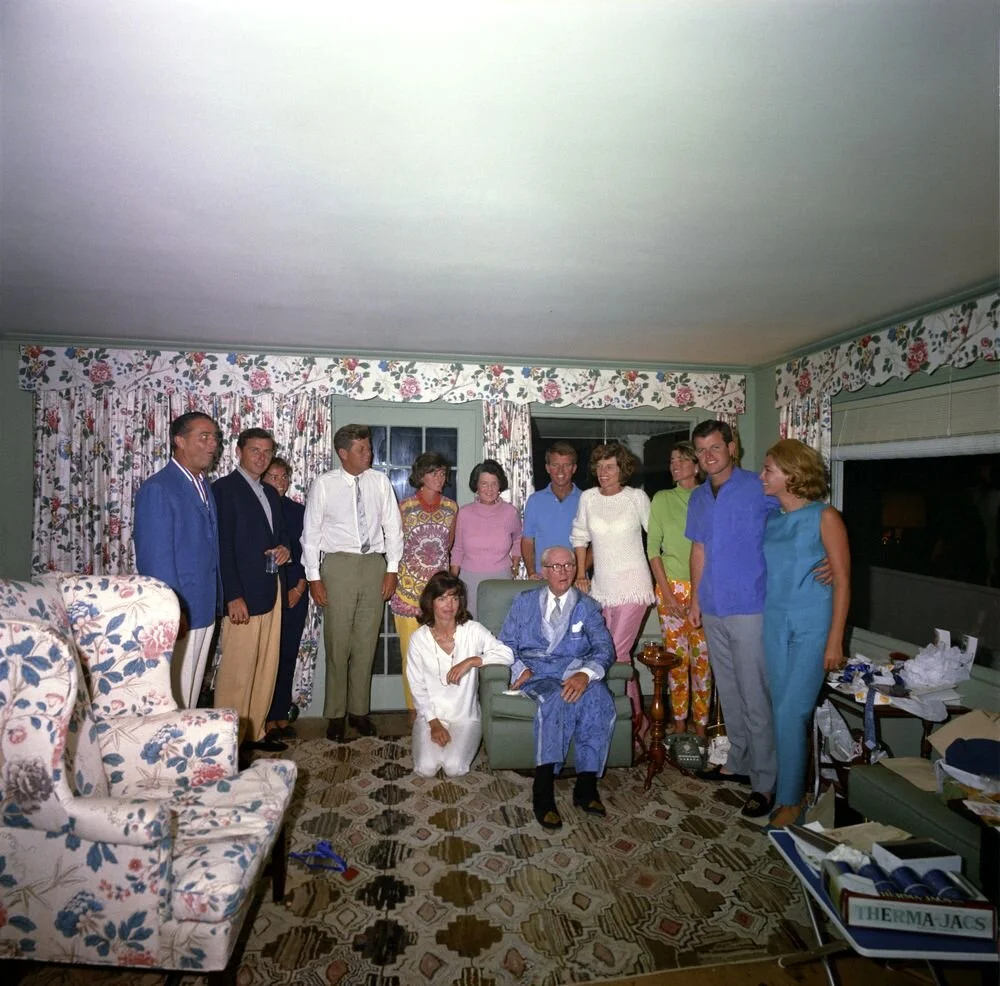
The Kennedy family, in its heyday, in September 1963, at its Hyannis Port, Mass., home base. Of course, John F. Kennedy, in white shirt, was assassinated only a few weeks later, on Nov. 22, 1963.
From Robert Whitcomb’s “Digital Diary,’’ in GoLocal24.com
The defeat of Congressman Joseph Kennedy in his attempt to unseat Sen Edward Markey, another liberal Democrat, has been cited as the end of a long era of Kennedy pre-eminence of Massachusetts. I don’t know about that – a week is an eternity of politics – but it was interesting. Consider that Senator Markey, who is 74 and looks at least that, defeated Mr. Kennedy, who is 39 and looks younger, in no small degree because Mr. Markey ran as the more “progressive’’ candidate and in doing so grabbed a lot of young voters for whom the Kennedy dynasty seems ancient history.
The latter didn’t experience the dynasty’s political heyday -- from the ‘50s until about 2000 – and the family “charisma’’ factor eluded them.
I don’t like political dynasties – they engender cults of personality and can suck the oxygen out of politics. The effort to create a Third World dictatorship kind of dynasty out of the Trump crime family is particularly scary.
Having said that, I’ve found the carrot-topped young Kennedy one of the best politicians to come out of that big gene pool. He’s honest, hard-working, self-disciplined, a stable family man, likeable and not arrogant. He’ll probably run again for high political office and win.
When I was growing up in Massachusetts, my family favored the sort of moderate Republicans now exemplified by the very popular and competent Gov. Charlie Baker – people such as Gov. John Volpe and Sen. Leverett Saltonstall -- and they often saw the Kennedys as ruthless and arrogant. Such Republicans were then common around America. But much of the party has since gone south and west and far right.

Deborah Danger: Estate planning for college students in the pandemic

“Death on the Pale Horse’’ (1865), by Gustave Dore

Entrance to the Grove Street Cemetery or Grove Street Burial Ground, in New Haven, Conn. It’s surrounded by the Yale University campus. The cemetery was founded in 1796 as the New Haven Burying Ground and incorporated in October 1797 to replace the crowded burial ground on the New Haven Green. Many notable Yale and New Haven luminaries are buried in the cemetery, including 14 Yale presidents.
From The New England Journal of Higher Education, a service of The New England Board of Higher Education (nebhe.org)
NEWTON, Mass.
Eleanor Roosevelt once said, “If life were predictable it would cease to be life, and be without flavor.”
Her words are excellent guideposts as New England colleges and universities navigate the unknowns of educating students during COVID-19. Despite the precautions that institutions are taking, on-campus teaching and research are not totally risk-free.
Neither, of course, is life itself.
As COVID-19 and the upcoming flu season pose new uncertainties, many faculty and administrators are brushing up against less comfortable topics, including extended illness, incapacity and death.
Over the past few weeks, up to 80 percent of the calls I have fielded were from educators and high school and college students wanting to put together estate plans, or update previous plans, as they return to the classroom. These included a 17-year-old high school student who drafted a plan and then signed it on his 18th birthday and two college freshmen who wanted these documents in place before heading to their new campuses.
My informal survey of potential clients finds that less than half have estate planning documents in place, and many who already have them in place discover that named agents have moved away or died, and previously proclaimed wishes no longer accurately reflect their current wishes. The educators and administrators who are taking action now have been spurred on by new “what if” scenarios (e.g., “If I am put on a ventilator and can’t make my wishes known, who will speak for me?” “If both my partner and I become ill, who will care for the children?”).
Estate plan elements
Estate planning is a way for individuals to ensure that: 1) their values and personal priorities will be known and honored, 2) their wishes for their family will be protected and 3) their assets will be available to provide for loved ones.
These plans include:
A will, which specifies who is to receive prized possessions and other assets when they die … including charities. It is also where they name guardians for their minor children.
A healthcare proxy, which specifies the person who can make healthcare decisions for them when they cannot. This document should be supplemented with a Health Insurance Portability and Accountability Release (HIPAA), so doctors can share their medical information with the proxy.
Revocable living trust … In most states, a will does not authorize the bypass of probate or the immediate distribution of assets upon a person’s death. The addition of a trust, in most cases, enables heirs to quickly receive what has been left to them. Naming trustees of the trust also provides protection against irresponsible spending by heirs, and premature spending by minor children.
A durable power of attorney, which grants a trusted spouse, partner, friend, relative or advisor the power to handle their finances and affairs if they become incapacitated.
Moreover, because of the nature of their work, professors should also think about:
Whether they need a literary executor (to oversee written works).
Ensuring the continuity and value preservation of “side hustles,” such as part-time teaching or tutoring gigs or running a blog or small company.
Ownership of intellectual property, such as patents, websites and creative works.
Getting personal
What about the softer and more human side of this process?
Estate planning is an opportunity to express very personal considerations about measures that should be taken to extend life, such as preferences about the use of ventilators and being artificially fed and hydrated. It’s also a way to direct a “legacy of love” and document who should give away and get possessions that have value and possessions that preserve memories. The clearer individuals are about these things, the easier it will be for their family, community and friends to honor their wishes rather than guess and argue over what they are.
For these reasons, individuals should be thoughtful and thorough, and make sure to work with a trusted advisor who can help them think through decisions about these challenging choices.
Once the conversations have been had, and estate planning documents are signed and notarized, the temptation is to close this chapter, but this is the time to share information with everyone who might require it. If one suddenly contracts a more serious case of COVID-19, it is important that every agent/decision-maker can act quickly and in synch with everyone else.
Individuals should share:
Healthcare proxies: Not only with the designated proxies, but also with each of their caregivers and specialists, their hospital of choice, employers (for Human Resource folders, so colleagues know who to call and which hospitals to request in the event of a sudden illness) and fitness centers (in the event of a heart attack, stroke or injury while working out).
Durable powers of attorney: In addition to the designated “agents,” others who would benefit from this information include banks, insurance providers, financial advisors, CPAs and college/university employers.
Will: At least one trusted person should know where the original will is kept, as this document must be filed with the court upon death (copies will not be considered valid).
Trusts: These instruments will set in motion a chain of other actions that need to be implemented in order for their full benefits to be realized; for example, all assets, including real estate, will need to be retitled in the name of the trustee.
Indeed, this is a good time to centralize all important documents in case of an emergency—from titles and deeds to birth and marriage certificates. For a checklist, click here.
COVID-19 is a wakeup call for all of us that life can instantly change. An estate plan offers a measure of control, enabling one to protect loved ones as they continue their educational work.
Deborah Danger is managing member of DangerLaw, LLC in Newton, Mass., which focuses on estate planning, post death administration, asset protection, family law, small business/entrepreneurship advising and collaborative law.
A green new seal

“Cercle Vert Olympique” ( painted wood, glass, powder pigment, motor), by Manuel Merida, at Heather Gaudio Fine Art, New Canaan, Conn. See: www.heathergaudiofineart.com

The famous Glass House, in New Canaan, designed by Modernist architect Philip Johnson as his residence and built in 1948-49.

Moreno Clock, on Elm Street, near Heather Gaudio, in New Canaan
Jim Hightower: A cult doesn't need a party platform
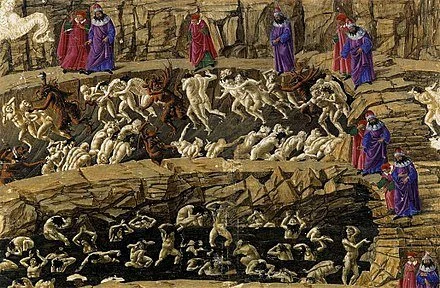
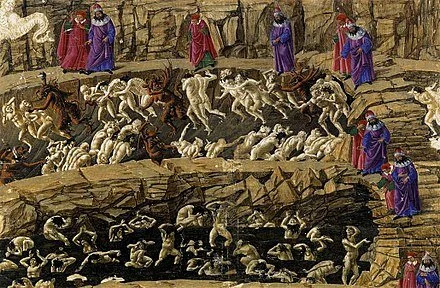
Botticelli illustration for Dante's “Inferno,’’ the first part of Dante’s “Divine Comedy,’’ shows insincere flatterers groveling in excrement in the second pit of the Eighth Circle of Hell.
Via OtherWords.org
With our national election looming, someone should put up “lost dog” signs in every neighborhood saying, “Missing: Republican Party Platform.”
Voters won’t find one though, for this so-called major political party has decided not to produce a specific statement of what it stands for this year, nor will it offer to voters an itemized set of policies its public officials would try to enact if elected.
Indeed, the GOP hierarchy is so disdainful of the electorate that it says the party will not present a platform until 2024 — four years after the election!
They even imposed their policy silence on their own grassroots delegates, decreeing that any attempt by them to adopt new platform proposals at the Republican National Convention would “be ruled out of order.”
Instead of a political party, the GOP of 2020 has become a pathetic puppet show of weakling officials and sycophantic subordinates being jerked around by the maniacal whims of a bloated ego with despotic fantasies. The once respectable Republican National Committee has meekly ceded its authority, duty, respect, and relevance to a single unhinged authoritarian.
In essence, they’re saying that the platform — and the party itself — is one word: Trump.
Whatever poppycock the Glorious Leader utters today, whomever he attacks tomorrow, whichever fantastical conspiracy he embraces next week, the GOP will applaud, bow, and in unison reply “Amen.” Sad.
Republican senators, governors, captains of industry, elders, and others who once had power, prominence, some prestige, and maybe even a little pride now meekly wear Trump’s collar and kowtow to his conceits, leaving an entire party with a sole operating principle: “What he said” — even when they can’t figure out what he’s actually saying, or why, or what it means for the U.S. and its people.
That’s not a party, it’s a national embarrassment.
Jim Hightower is a writer and speaker.
Hancock, Amazon team up on health-measurement device
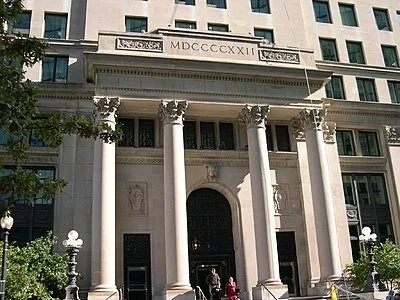
John Hancock Life Insurance Co.’s current headquarters, at 197 Clarendon St., built in 1922, and not to be confused with the glassy office tower at 200 Clarendon St. that’s still called the John Hancock Tower, was completed in 1976 and remains, at 60 stories, the tallest building in Boston.
From The New England Council (newenglandcouncil.com)
Boston-based John Hancock Life Insurance Co. has formed a partnership with Amazon on the tech giant’s recently unveiled Halo band, a wearable device that will track a variety of activities such as exercise and sleeping patterns.
John Hancock life-insurance policyholders will be able to earn rewards and premium discounts based on their use of the new technology. Use of the new technology is intended to help policyholders embrace healthier living habits. The insurer is not new to incorporating technology into its business model, and has existing partnerships with both Apple Inc. and Google parent company Alphabet Inc.
“Integrating Amazon Halo into our life insurance ownership experience will enable us to continue to transform the role our industry plays in our customers’ lives,” said Brooks Tingle, President and CEO of John Hancock Insurance in a press release. “At John Hancock, we believe a life insurance company is in a unique position to help customers live longer, healthier lives, and by integrating Amazon’s new health and wellness technology into our program, we can create a more meaningful, engaging and holistic experience for our customers.”
Read more from the Boston Business Journal.
Don't tell me you didn't see the sign!

“I hadn’t been in Vermont very long, but I’d been there long enough to know what any Vermonter worth his salt would think of {being on his property}. Trespassing on someone’s land was tantamount to breaking into his house.’’
— Donna Tartt (born 1963), novelist, in The Secret History (1992). She studied at Bennington College, in southern Vermont.