

Llewellyn King: Trying to sanitize history is vandalism
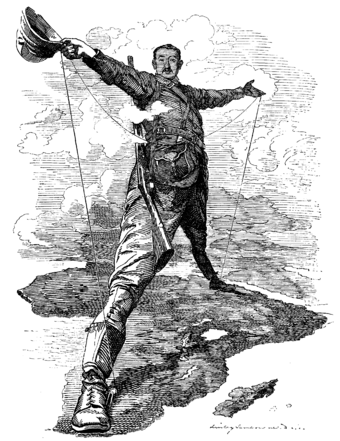
"The Rhodes Colossus" – cartoon by Edward Linley Sambourne, published in Punch after Cecil John Rhodes announced plans for a telegraph line from Cape Town to Cairo in 1892.
WEST WARWICK, R.I.
History is fragile. It needs to be handled with care. The trouble is that it is inevitably viewed through the prism of today, which can cast the good as bad and the bad as good.
That is why those who would edit it, sanitize it, or obscure it are, for the most part, vandals. It is in constant danger of being rewritten to accommodate current perceptions.
How has this worked? When Oscar Wilde was arrested on April 6, 1895 at the Cadogan Hotel, London, for “gross indecency” (homosexuality), he was widely denounced as a threat to everything of value and a danger to our morals. In New York, where several of his plays were packing in audiences, Wilde’s name was removed from the playbills, while the plays continued to run.
Today, those who would have him arrested would be arrested for hate speech. The prism has changed.
America’s great journalist H.L. Mencken has fallen into some disfavor because of notes in his private diaries which have been construed to be anti-Semitic and racist. But his genius is unassailable. If you doubt this, just read his work. Yet the National Press Club in Washington changed the name of its library to that of a minor benefactor because the great man in private diaries had entries which were construed to be anti-Semitic. You can find the offending sentences on the web and make your own decision about what he said to his diary in 1943.
A committee of the Council of the District of Columbia advanced a list of historical figures’ connections to slavery and oppression and recommended renaming dozens of public schools, parks and government buildings in the nation’s capital — including those named for George Washington, Thomas Jefferson and five other U.S. presidents. No one, it would seem, who drew breath at the time of the founding of the republic is safe from retrospective judgement and condemnation. Not even Benjamin Franklin, who told a Philadelphia matron that the Constitutional Convention had “given you a republic, if you can keep it.”
No historical figures, it would also seem, are safe from indictments leveled against them. Julius Caesar was a Roman imperialist. The French and the British should hate him. Should we therefore destroy statues of Caesar? Then we wouldn’t even know what he looked like.
English military and political leader Oliver Cromwell served as Lord Protector of the Commonwealth of England, Scotland and Ireland during the 1600s. But his actions in Ireland and Scotland were genocidal. He said of the luckless Irish at the Battle of Drogheda, “God made them as stubble to our swords.” Should his name and likeness be expunged from our public records? The Cromwell Road, one of the great thoroughfares of London would have to go. One shudders to think about the awfulness of Queen Victoria in this context.
History is dominated by great figures and they are a mixed lot. The new politically correct assessment of history extends into appending judgement of sex lives. Watch out John F. Kennedy, Martin Luther King Jr. and even Catherine the Great.
Sixty years ago, those who could’ve been censored and removed from public life would’ve included gays down through the centuries, from Alexander the Great to former Irish Prime Minister Leo Varadkar, who is also Muslim.
There is a lot of heavy lifting to be done if you’re going to measure the past against the values of the present.
This brings me to the difficult and contentious issue of the Confederacy and all those statues. Here, there is reason to respect the sensibilities of the African American community and at least remove statues to museums. The Confederate flag has become an in-your-face statement of white racism and shouldn’t be part of the celebration of Southern culture. These symbols aren’t yet confined to history’s grave but are part of a struggle that isn’t settled.
Oxford University has decided to remove a statue of Cecil John Rhodes, and there is a move to change the name of Rhodes Scholarships to something else. Mind you, not to give up the money that he gave for the scholarship, together with huge gifts to the university.
Rhodes was an imperialist. He wanted Britain to rule from Cape Town to Cairo, but he wasn't a monster. Ruthless in business, he introduced the first genuine open franchise to vote in Cape Colony when he was prime minister. His sending of a column of police – they weren’t soldiers – into Zimbabwe ended the genocidal war between the Matabele and the Shona. But a white colony run by whites for whites resulted.
For me, names and statues record history. They aren’t celebrations of wrongdoing. I would’ve liked to have seen a statue of Stalin, among the greatest monsters of the 20th Century, as he appeared to the Russian people. I think it is good when a small child asks in front of a statue, “Mom, who is that?”
History isn’t to be rewritten, but to be learned, otherwise we won’t know how we got here and what to avoid, as George Santayana pointed out.
Llewellyn King is executive producer and host of White House Chronicle, on PBS. His e-mail address is llewellynking1@gmail.com and he’s based in Rhode Island and Washington, D.C.
Website: whchronicle.com
Tracey L. Rogers: Being Black is very bad for your health in America
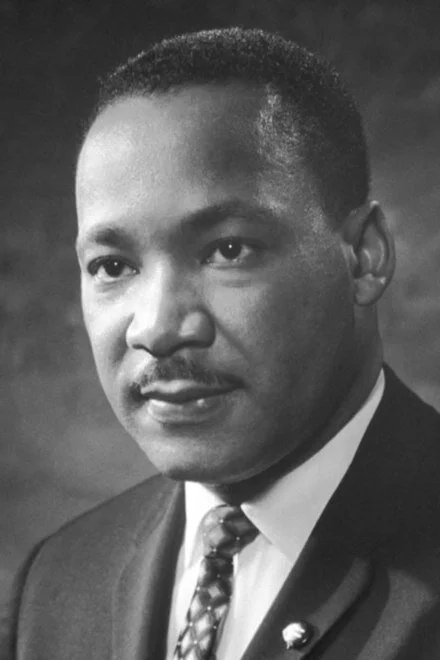
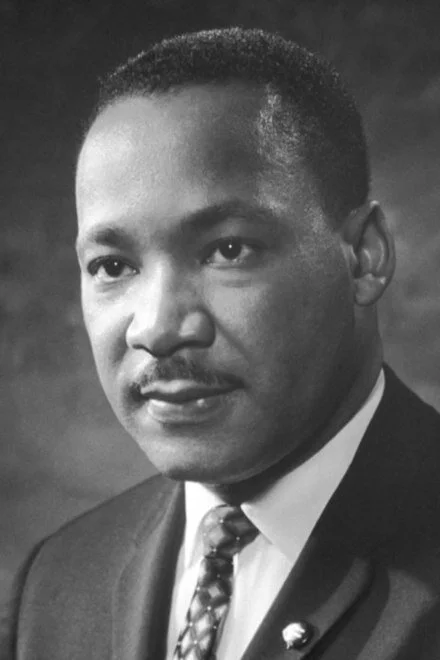
Martin Luther King Jr., ravaged by white racism
Via OtherWords.org
After Martin Luther King Jr. was assassinated, on April 4, 1968, his autopsy report revealed that at the young age of 39, he had “the heart of a 60-year-old.”
Doctors concluded that King’s heart had aged due to the stress and pressure endured throughout his 13-year civil-rights career.
A 13-year tribulation sounds more fitting. Along with the victories he won through his long career preaching while organizing marches, boycotts and sit-ins, King also suffered from severe bouts of depression, received multiple threats on his life and the safety of his family, and was repeatedly arrested.
In fact, near the end of his life, as reported in Time magazine, Dr. King “confronted the uncertainty of his moral vision. He had underestimated how deeply the belief that white people matter more than others was ingrained in the habits of American life.”
There’s a reason why novelist and activist James Baldwin said in 1961, “To be a Negro in this country and to be relatively conscious is to be in a state of rage almost all of the time,” a rage that weathers our bodies and psyches.
“It isn’t only what’s happening to you,” Baldwin explained. “It’s what’s happening all around you and all of the time in the face of the most extraordinary and criminal indifference, indifference of most white people in this country and their ignorance.”
As a Black woman and activist, I can say that my rage weathers me, too.
It can feel as subtle as the frustration I feel after receiving an e-mail from a white man accusing me of being a Marxist simply because I supported the Black Lives Matter movement (true story).
Or it can be as anguishing as the pain I feel simply thinking about Jacob Blake being shot in the back seven times at point-blank range by police in Kenosha, Wis.. Or the anger I feel about the president of the United States openly fomenting violence in the shooting’s aftermath, praising the 17-year-old white militia member who killed two protesters.
If Dr. King had the heart of a 60-year-old when he died, it’s easy to see how his fight for racial justice might have weathered him. But one might argue that its weathering began the moment he was born in the era of Jim Crow, just 64-years after the formal emancipation of enslaved people.
The all-around weathering of Black America is as big a part of our legacy as slavery, voting rights, and our commitment to freedom. It’s a weathering we experience every day, agitated by what’s been diagnosed as post-traumatic stress disorder (PTSD) passed on from generation to generation.
A few years ago, an article published in Teen Vogue explained how it was possible for Black people to inherit PTSD from our ancestors. It highlighted the “extensive research into epigenetics and the intergenerational transmission of trauma” by Dr. Rachel Yehuda, who found that “when people experience trauma, it changes their genes in a very specific and noticeable way.”
Sociologist Dr. Joy DeGruy coined the phrase “post-traumatic slave disorder” to describe the specific stress suffered by Black descendants of enslaved people, identifying the ways in which racialized trauma has had an emotional, physical, and psychological impact.
More recently, the Huffington Post reported that racial trauma increases the stress hormone cortisol in Black Americans, causing fatigue, depression and anxiety. Cities throughout the country have even issued declarations that racism is a public-health issue.
They’re right.
According to the Centers for Disease Control, many chronic illnesses are far more prevalent within the Black community. And there’s a growing consensus that these illnesses are a byproduct of everyday racism. “For Black people in particular,” said psychologist Dr. Lilian Comas-Diaz, “racial stress is something that happens throughout their life course.”
Whether it’s death by “weathering,” COVID-19, or inhumane policing, evidence shows that Black lives still don’t matter. And that’s why so many of us have taken to the streets — our hearts can’t take it anymore.
Tracey L. Rogers is an entrepreneur and activist in Philadelphia.
Dramatic dining in Newport

In a microburst, air moves in a downward motion until it hits ground level and then spreads outward in all directions. The wind regime in a microburst is opposite to that of a tornado.
From Robert Whitcomb’s “Digital Diary,’’ in GoLocal24.com
We witnessed a theatrical display of professionalism last Tuesday evening at the Reef Restaurant, on Newport Harbor, when out of not-very dark skies came a very brief but very violent storm of torrential rain and what seemed to be near-hurricane-force winds.
Most of the diners/drinkers, including us, were eating and drinking at the restaurant’s outside tables, with views of Newport Harbor and of giant yachts that evoked hedge funders and private-equity moguls, when the tempest hit. The four people in our party managed to get inside the restaurant ahead of most of the other guests; we were driven more by fear of being fried by lightning than getting wet. A few minutes before, our tall young waiter had promised that the storm, which we could see moving in from the west, wouldn’t bother us. One of our little group, a pilot, later explained that it was a microburst.
It was quite a scene as umbrellas, deck chairs, tables and potted palms went over.
What was most impressive, besides the drama of the storm itself, was how the waiters so calmly managed to get people quickly set up at tables inside, though they hadn’t time to rescue the food on the tables outside. Of course, social distancing was, er, incomplete in the brief chaos, and many who had fled inside had left their masks in the rain, some of which blew away and all of which were soaked.
Still, most of the guests seemed to enjoy the mayhem. I wonder how many got replacement meals and drinks.
xxx
The National Hurricane Center knows how to force fear. In alerting people in the northwest Gulf Coast to the menace of Hurricane Laura, it spoke of an “unsurvivable storm surge.’’
Winter looks better now
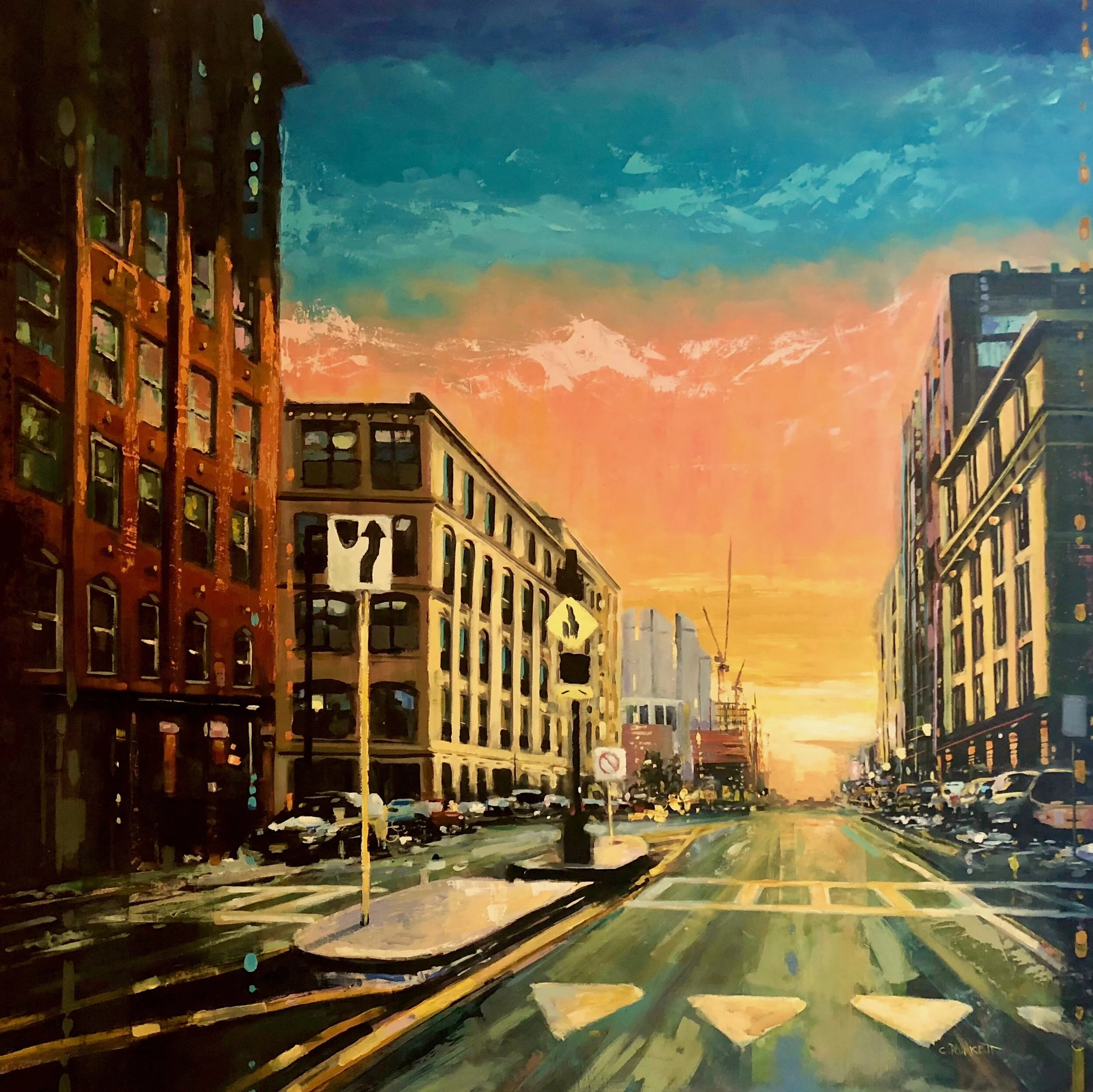
“Winter Sunrise Over Summer Street” (Boston) (oil on wood panel), by Chris Plunkett, in the group show “2020: Sharp Focus,’’ at Fountain Street Fine Art through Sept. 27.
See:
https://www.fsfaboston.com/
and
https://www.chrisplunkettstudios.com/carousel.php?galleryID=208528
Open summer, squeezed summer

— Photo by Dietmar Rabich
From Robert Whitcomb’s “Digital Diary,’’ in GoLocal24.com
We seem to remember the arc of summers much more than those of winters. I remember many individual summers with vividness; they were all so different. But I recall the summer of 1970 with particular sharpness. I had just graduated from college and, trying to decide whether I really wanted to go to graduate school, decided to take the summer off, helped by a few bucks I had saved up. I had had summer jobs since I was 14.
It was still in many ways the phenomenon called “The Sixties,’’ with sex, drugs and rock and roll, etc. Wide open. While I was mostly living in Greater Boston that summer, I spent a lot of time driving around the Northeast alone or with my girlfriend of the time seeing friends, hiking, fishing, going to parties, etc. It was my last extended stretch of free time up until, well, now. I had a VW Bug and felt pretty close to fancy free, jumping into the car at a moment’s notice for a road trip to the mountains, the Maine Coast or New York City, often driving off in the middle of the night.
I would have felt more guilty about “wasting time” like this except for some advice my father gave me around that time, which was to take some time off before truly adult duties came rushing it. He had done the same thing in the summer of 1939, right after his college graduation and after having had all-day summer jobs since his early teens; in having these jobs, he was lucky – it was, after, the Great Depression. That fall he went off to work for an industrial company, then came “The War’’ (as we always called it), marriage and five kids. He had few breaks until he died of a heart attack, in 1975.
In any event, I decided not to go to grad school that fall and instead went to work, in a business – a Boston newspaper -- with long and unpredictable hours. Grab the free time if you can.
A cool day in late August, breaking a heat wave, is enough to get you thinking of the brevity of summer and indeed of life.
A Squeezed Summer
Mobility is often associated with America, whether in pursuit of money or pleasure. So perhaps what many of us will most remember from this summer is its COVID-caused lack, what with states imposing draconian quarantine rules, transportation service cutbacks, and many places you’d otherwise visit closed for the duration, or forever. It’s been a tough summer to gain that brief sense of release that summer vacations well away from home bring. Lucky people at least have leafy neighborhoods to stroll in, preferably with water to look at
If a vaccine really does come along, the anti-vaxxers don’t ruin everything and the economy improves, will there be a surge of travel next year, or will a newly aroused fear of disease scare people away from travel, especially long-distance, for years, however strong their urge to get away?

Michael Tyre: Colleges must make physical campuses foster students' affinity

On the campus of Wellesley College, in Wellesley, Mass. It’s considered one of the loveliest campuses in America, which may help explain the high rate of alumnae donations to the women’s college.

Quinnipiac University’s Lender School of Business, with dome, with Sleeping Giant in background, in Hamden, Conn.
From The New England Journal of Higher Education, a service of The New England Board of Higher Education (nebhe.org)
The brand of a college or university is more than its logo or tagline. It’s an accumulation of experiences for students, staff, faculty, alumni and community members. Marketing is part of it, but every time someone sets foot on your campus, they are walking into your brand.
This fall, fewer students will be on campuses and they may be there with less frequency. COVID-19 won’t last forever, but in a way, this year is a glimpse into the online learning future that was coming with or without a pandemic. It’s more important than ever that the physical campus foster in students a strong affinity for the school to keep enrollment, retention and alumni engagement numbers high. Without a deep connection to the physical place, students may fall into a commoditized mentality, enrolling in online courses where the prices are lowest and not thinking of themselves as an Owl, Bobcat or Camel.
There are four areas on a campus that can be designed or used in expressing the institution’s brand: interior spaces, buildings, outdoor spaces and the environment surrounding the campus. Below are one or more well-executed examples from each category, one of which I was involved in directly.
Walking inside your values
One way to more affordably and quickly align the brand of a particular college or program with its physical space is to work within the walls you already have. My team at Amenta Emma Architects and I recently redesigned the interior of the Lender School of Business at Quinnipiac University, in Hamden,Conn., to bring it in line with the school’s refocused identity.
With a glass dome against the backdrop of Sleeping Giant State Park, the exterior is an iconic part of the university’s brand. However, the interior, with muted colors and dim lighting, hailed from a Wall Street era of student aspirations and university curriculum. As with many business schools, there has been a shift in emphasis toward innovation and entrepreneurship, and the interior of the Lender School of Business had yet to catch up. The goal of our update was not just to reset the tone to reflect the work being done there currently, but also to change student expectations about the qualities they will be developing in themselves in this space.
The transformation used exposed ceilings, light colors and transparent materials to energize the programming. Colors and furniture play a central role in creating an impression that is contemporary in the App Development Center. The Financial Trading Center was given a refresh by way of accent colors and lighter colors on the ceiling to create a brighter space. To accommodate a change in pedagogy toward active learning, three small, traditional classrooms were converted to two collaborative classrooms with technology integrated into custom furniture and reconfigurable writing surfaces. The school’s history meets its future in wood wall panels with a cutout pattern that creates a “digital” impression that’s at once warm and forward-looking.
Start with words, then build from there
In our redesign of the interior of the Lender School of Business, words like “innovation,” “entrepreneurship” and “collaboration” fueled the process. When colleges and universities begin thinking about adding or replacing buildings on campus, I recommend that they start with words.
While it’s tempting to begin picturing the actual building (“It should be three stories and we want lots of glass,” or something similar) start by asking how the building relates to your institutional values and mission. What does it need to say or express about the university or a particular college? How should the space feel? When students approach the building and enter it, what words should describe their first impression? What will students feel empowered to do in this space?
When I think of a university using a campus building to differentiate itself, I go all the way back to 1826. That’s the year the University of Virginia (UVA) completed construction of the Rotunda at the head of its lawn. It’s a beautiful building, but what makes it unique isn’t so much its appearance, but the simple fact that it houses a library as the focal point of the quad, where other campuses may position a student center or church. UVA describes the Rotunda as the “architectural and academic heart of the university’s community of scholars,” and from day one, that’s the word it has embodied: scholarship.
For a more recent example, look to the University Center at the New School, in New York City. Transparent, crystalline stairwells are exposed to the Manhattan streets and a sign set against a red background inside the building and visible through windows seems to suggest, “Things are different and exciting here.” This overtly contemporary building reflects the school’s dedication to academic freedom and intellectual inquiry and telegraphs that this is a home for progressive thinkers.
Living out your campus identity
The Low Steps and Plaza at Columbia University are remarkable for the variety of activities that take place there. This plaza hosts open markets, concerts and the occasional demonstration. Located in the center of campus, it is a natural gathering place for students, faculty, staff and alumni and is infused with history and campus culture.
Not every campus has a Low Plaza or Harvard Yard, but most have an outdoor space which can be leveraged to promote community and a shared sense of identity. Central outdoor spaces often focus on a particular element—such as a bridge, clock or statue. It can even be a big rock if that says something about who you are. Embellishments such as paving, planting, furniture, lighting and graphics can create central spaces on campus in areas that may be lacking or underused. Repeating these elements on multiple campuses can unify the brand message within an institution that spans many locations within a city or even around the world.
These spaces come to life when students feel empowered to make them their own through scheduled events as well as impromptu activities. You don’t always need a big plaza-type formal space; something as simple as a porch with moveable chairs can be a welcome contrast to all of the restrictions students have to contend with right now due to COVID-19. With the design of the Middlesex Community College Dining Pavilion in Middletown, Conn., Amenta Emma aimed to create a campus living room. Adirondack chairs and picnic tables line a protected porch overlooking a large lawn banked by forest. The space reflects the open character of the college with community members, students, faculty and staff using it for events, meetings or individual study.
Inviting environs
The brand experience of a campus doesn’t begin and end with the property line. Views and surroundings shape the brand as well. Savvy institutions lean on their environs as a differentiator.
The homepage of the Web site for College of the Atlantic, in Bar Harbor, Maine, doesn’t show the campus. Online visitors are greeted with images of the countryside and the water. The campus has some iconic and historic architecture, but the institution recognizes that its identity and brand are explicitly tied to the location. The college focuses on the relationship between humans and the environment. By underscoring that nature is part of its campus, College of the Atlantic aims to attract students who are a good fit for its programs.
In stark contrast to College of the Atlantic is New York University (NYU), a campus whose buildings are woven into the fabric of the city. It makes a statement about its brand and the type of student experience it offers simply with its location. For colleges and universities without an obvious natural or urban asset in their surroundings, simply being aware of lines of sight and making sure air conditioners don’t obscure a pleasant view, for instance, can enhance the experience of being on campus.
Unmasking your culture
This year, as administrators look for creative ways to foster a sense of community that may be eroded in the wake of the pandemic and associated social distancing, it may seem like the campus you have is the campus you have. That’s not necessarily the case. Here are a few short-term ideas on how New England colleges and universities can leverage their brands this fall to make sure the campus still feels like home for students.
Our research has shown that students like to see their own faces and those of their peers in imagery associated with their college. Since your students’ faces likely will be obscured by masks while on campus this year, why not make use of otherwise blank spaces in hallways or building exteriors to hang large wall graphics or banners showing the student experience and featuring real, current students?
The pandemic, and its focus on avoiding crowded, indoor spaces, provides something of a license to make unusual use of outdoor spaces. Can aspects of student life or academics move outside? Are there spaces where additional seating can be added to encourage outdoor studying or eating? Could something dramatic with landscaping be done this year that is new, facilitates additional outdoor activities, and celebrates the school culture? Can you add more outdoor programming in the winter months with heaters, bonfires or events that make use of snow?
While use of school colors and logos on campus can be effective in moderation, difficult times like these call for a greater show of unity, which can be temporary. Boldly repainting interior and exterior spaces in school colors can always be undone if it seems over-the-top when the masks come off.
Trying as this academic year is going to be, there’s no better time to sharpen your institution’s brand and explore how it can be expressed on your campus in the long and short term. This year has truly tested what it means to be a student and an institution of higher education. The fact that colleges and universities need a strong value proposition to retain students on the physical campus has never been clearer.
Michael Tyre is a principal at Amenta Emma Architects, with offices in Hartford, Boston and New York City.
'Heal better than men'

Photo by Tero Laakso
“Above the town
lie its mountains —
ravaged by over-
cutting:
dark growth,
and hard wood,
But the mountains are open
in their sleep and
aloofness.
They heal better
than men.’’
— From “The Town That Ends the Road,’’ by Theodore Enslin (1925-2011), a long-time resident of Milbridge, Maine

View of Maine’s Frenchman’s Bay and Bar Harbor from Cadillac Mountain
But watch for nails

“Pickup Sticks” (Pocasset, on Cape Cod) (archival print), by Bobby Baker. Copyright Bobby Baker Fine Art.
Jill Richardson: KKK's old rhetoric sounds like Trump's

From OtherWords.org
Rory McVeigh wrote The Rise of the Ku Klux Klan, a study of the KKK in the 1920s, in 2009 — long before Donald Trump became president. But it could almost be about Trump today.
In the 1920s, white, male, U.S.-born Protestants worried they were losing status, economic clout, and political power.
Catholic and Jewish immigrants from Eastern and Southern Europe were settling in large numbers in industrial cities, where they took unskilled, low-paid manufacturing jobs in large plants. Simultaneously, many African-Americans were moving north for industrial jobs. More women were working, too.
Many of the anxious white Protestants were skilled laborers or small business owners. Large companies, chain stores, and the Sears catalog were out-competing them throughout the country.
Feeling squeezed out by the changing economy, the KKK framed American jobs as the rightful property of what they called “100 percent Americans.” They wrapped themselves in the flag, claimed immigrants were stealing jobs, and attempted to deny African Americans any further mobility.
You’ve heard that “stealing our jobs” line before.
It was true that the structural changes from industrialization hurt many small businesses and skilled laborers in the 1920s, just as neoliberal globalization hurt many workers and their communities more recently.
Yet instead of confronting this economic system, hardline nativists then and now sought to preserve the livelihoods of white people by depriving everyone else — playing on the fears of white Americans to gain their support.
Here’s a sample comparison of 1920s KKK and Donald Trump quotes.
KKK: “Klansmen believe that the time is at least near when American citizenship must be protected by restricting franchise to men and women who are able through birth and education to understand Americanism.”
Donald Trump: “We’re looking at that very seriously, birthright citizenship, where you have a baby on our land, you walk over the border, have a baby — congratulations, the baby is now a U.S. citizen. … It’s frankly ridiculous.”
KKK: “Fifty thousand Mexicans have sneaked into the United States during the past few months and taken the jobs of Americans… All of the Mexicans are low type peons.”
Donald Trump: “When Mexico sends its people, they’re not sending their best. They’re not sending you. They’re sending people that have lots of problems, and they’re bringing those problems with us. They’re bringing drugs. They’re bringing crime. They’re rapists.”
KKK: “The negro was brought to America. He came as a slave. We are in honor and duty bound to promote his health and happiness. But he cannot be assimilated… Rushing into cities, he is retrograding rather than advancing.”
Donald Trump: “Nobody has done more for black people than I have.” But also: “The Suburban Housewives of America” should “no longer be bothered or financially hurt by having low income housing built in your neighborhood.”
McVeigh wrote, “Black men who dared to associate with white women, or who dared to challenge racial inequality in any of its dimensions, were immune from the Klan’s paternalistic protection.”
Donald Trump wrote, “Bring back the death penalty” for the Central Park 5, a group of five Black men falsely accused and imprisoned for assaulting a white jogger.
And, of course, when Black people protested police brutality, Trump threatened them with “vicious dogs” and tweeted: “LAW & ORDER!”
One hundred years apart, they are saying the same things. When I quizzed a friend on who said what, she said she could only tell them apart because the Klan’s grammar was better than Trump’s.
Job losses and other economic pains must be addressed, but we can fix these problems in a way that’s inclusive, not violent and divisive. Instead, white nationalists from the Klan to Trump glorify a past in which white men had more power than everyone else, casting themselves as protectors of white America against inferior “others.”
Jill Richardson is a sociologist.

Put on your reopening list
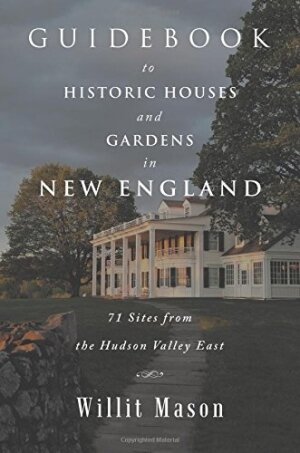
William (“Willit’’ ) Mason, M.D., has written has a delightful – and very handy -- book rich with photos and colorful anecdotes, called Guidebook to Historic Houses and Gardens in New England: 71 Sites from the Hudson Valley East (iUniverse, 240 pages. Paperback. $22.95). Oddly, given the cultural and historical richness of New England and the Hudson Valley, no one else has done a book quite like this before.
The blurb on the back of the book neatly summarizes his story.
“When Willit Mason retired in the summer of 2015, he and his wife decided to celebrate with a grand tour of the Berkshires and the Hudson Valley of New York.
While they intended to enjoy the area’s natural beauty, they also wanted to visit the numerous historic estates and gardens that lie along the Hudson River and the hills of the Berkshires.
But Mason could not find a guidebook highlighting the region’s houses and gardens, including their geographic context, strengths, and weaknesses. He had no way of knowing if one location offered a terrific horticultural experience with less historical value or vice versa.
Mason wrote this comprehensive guide of 71 historic New England houses and gardens to provide an overview of each site. Organized by region, it makes it easy to see as many historic houses and gardens in a limited time.
Filled with family histories, information on the architectural development of properties and overviews of gardens and their surroundings, this is a must-have guide for any New England traveler.’’
Dr. Mason noted of his tours: “Each visit has captured me in different ways, whether it be the scenic views, architecture of the houses, gardens and landscape architecture or collections of art. As we have learned from Downton Abbey, every house has its own personal story. And most of the original owners of the houses I visited in preparing the book have made significant contributions to American history.’’
To order a book, please go to www.willitmason.com
Resilient nature

From Linda Klein’s show “Nature Defiant,’’ at Bromfield Gallery, Boston, Sept. 4-27. She explains:
“The content of this exhibit continues the direction I began in my 2004 exhibit, ‘Excess,’ about which I wrote, ‘My paintings and drawings came out of a conscious awareness of my anxiety about where we are going in our world.’
“Unlike the anxiety that I expressed in that exhibit, this work is devoted to celebrating the resilience of nature and enacting nature’s desire to assert itself through forms that derive from nature itself and flourish in the human imagination as it creates the forms of things unknown. When I began this process, many months ago, no one could have predicted the pandemic that has caused us all to pause. I too sometimes forget that we share this world with many life forms, unseen or ignored, until they assert themselves and demand my attention.’’
See:
https://www.lindakleinart.com/
and:
bromfieldgallery.com
'Ungainly mounds'

“In September and October one never walks or drives through this Connecticut Valley without smiling at these ungainly mounds of squashes and pumpkins heaped in uneven, bulging pyramids on green grass, or against barnyard fences, or under bright trees, or before the doors of farmhouses.’’
— Mary Ellen Chase (1887-1973), in A Journey to Boston (novel, 1965). She was a prolific novelist and essayist who taught for many years at Smith College, in Northampton, Mass., in the Connecticut River Valley.

Don Pesci: Our dogs: 'A piece of God's grace'

VERNON, Conn.
Mark Twain, who said pretty much everything worth saying, said about dogs: “The more I learn about people, the more I like my dog.”
Twain, one of those lucky few in whom the virtue of humor was fully grown, told a stretcher or two in his day, but his humor was the iron fist of truth, always difficult for those of us who are not saints to bear, wrapped in appetizing comic chocolate, and so made easier to swallow.
He liked dogs and often compared them to people: “If you pick up a starving dog and make him prosperous, he will not bite you. This is the principal difference between a dog and a man.”
A modern progressive, full of rancor and social justice, might want to pause over that one. One of Twain’s dogs was named “Prosper” and, unlike the fire breathing, eat-the-rich, modern progressive, Twain had no quarrel with prosperity. A true child of the Gilded Age, which he named, Twain’s fervent hope for today was always that he would be prosperous tomorrow. Lucky for him, he lived, among other places, in Hartford, Connecticut, rather than, say, Nicolás Maduro’s Venezuela, an exploded post-Stalinist pipe dream.
But enough about politics.
Yesterday, we drove Titan, my wife Andrée’s Fidelco guide dog, to the Bolton Veterinary Hospital and had him “put down,” a modern locution intended to rob death of its sting. It does no such thing. Titan lived to be 13½ years old. Andree was deeply, deeply wounded, and grief silences the heart. You want to scream, and no sound issues from you; you want to weep, and your eyes are a parched desert. The choice was made for us by Titan’s afflictions: a condition in dogs very much like Lou Gehrig’s Disease in humans (degenerative myelopathy) and extreme vertigo (vestibular disease). Titan struggled with these disabilities for months, always bravely.
Titan came to us nearly 12½ ago where, bounding into the house, he met Jake, Andrée’s first guide dog, the handsomest black and tan German Shepherd in Connecticut, perhaps the world, full of years and happy to be retired.
Andrée: The world will become a true utopia when the tireless reformers so rearrange it that one is able to retire upon graduation from college.
Jake, like most German Shepherds, more or less prowled, always alert, head up, ears pointed, and ready to meet the bristling world on its own terms. Titan bounced, the perpetual youth, an irrepressible spring in his step. I wrote about Jake here. He is alive in our memories. Dogs, for reasons hinted above by Twain, are more easily remembered than people.
Andrée insists – and one can disagree with this imperishable truth only at the point of a sword – that Titan kept Jake in good order for two years, before he slipped from our grasp and went on his way to Heaven at age 14½. Twain again: “Heaven goes by favor. If it went by merit, you would stay out and your dog would go in.”
I’ve lost many things during what folk now call my “life’s journey” – my youth, the spring in my own step, my hair, my reputation, my patience, occasionally my sense of humor – but I can tell you, none of these losses compare with the loss of a dog, because a dog, especially a guide dog, is not just a dog. He is a piece of God’s grace dropped like Holy Water into Hell.
None of us lucky sighted people can know how life presents itself, most often with bared teeth, to those like my wife of 53 years, who was legally blind from birth. It’s a daily struggle. To be won, the day must first be conquered, and the struggle is exhausting. This she has done with great courage and grace all her life. But when Jake first came into her life, she was, for the first time in her life, truly and fully liberated.
Then Titan put a bounce in her step. His fur was not coarse but silken; his eyes were brown amber gemstones; if he could smile, his smile would wrestle the world to the ground. Everywhere he went – and he never left her side for a moment -- he drew gasps from people. Men especially were drawn to him.
Me: Hey, Andrée, if I just step out of the way, I’m sure you could do much better with Titan at your side – maybe pick up one of those white or black privileged hedge fund millionaires down there in Fairfield County.
Born in Fairfield County, Connecticut’s Gold Coast, Andrée was familiar with the breed.
Andrée: Hmmm. Let me sleep on it.
My love, nothing that the creative hand of God has touched is lost forever to nothingness. Love is the greatest of God’s many gifts to us, the most precious of his wonder working mysteries. And because you loved Titan, and his love to you was retuned a thousand fold -- he lives.
Don Pesci is a columnist who lives in Vernon.
E-mail: donpesci@att.net
Tikki Pang/Zhi Xiong Chen/Yap Seng Chong: A vision for past-pandemic medicine

SINGAPORE
When the COVID-19 pandemic finally ends, what will we have learned? Health-care professionals have done their best to cope with the unprecedented challenge posed by COVID-19, and in many cases their performance and conduct have been truly heroic. But there have been missteps, too, and training the next generation of physicians will require a new paradigm for medical education.
What additional skills will future physicians need to navigate the post-pandemic world? The answer lies in a more pragmatic, holistic, and realistic “world view’’ as to what constitutes good health based on the following three key concepts.
A Holistic and Integrated Systems View
For physicians of the future, the narrow view of clinical competence and the ability to diagnose and cure disease will not be enough. They must acquire a more integrated understanding of what constitutes good health, be reminded of the “humanity” in medicine, and affirm the principle that healthy lives include physical, mental, social and spiritual well-being.
This goal will require a more societal and “systems-based thinking’’ approach. Doctors will need to appreciate not only the influence of social determinants but also of rapidly evolving sectors beyond health. Importantly, in an age of unprecedented technological innovations in big data, artificial intelligence, and informatics, they will have to understand the invaluable role these drivers will play in future health improvement.
This first goal can be achieved through teaching innovations that restore humanity in medicine by, for example, highlighting the intersection between health and art. In addition, a greater awareness of the history of human health and medicine will lead to better decision-making. As George Santayana famously said, “Those who cannot remember the past are condemned to repeat it.”
The Importance of Inquiry and Thinking
The second concept derives from the current toxic environment of misinformation, falsehoods, pseudo-scientific “facts’’ and the outright denial of science itself. Future physicians must guard the sanctity of inquiry, critical thinking, and scientific evidence in guiding decision-making. Future physicians must also be “data savvy’’ and be able to tap into the detailed health data available at both the national and global levels.
In the larger context of how public policies impact society, future physicians must also be aware of the role and value of evidence in shaping such policies within the health sector and beyond. The need to have an inquiring mind was succinctly expressed by physicist Richard Feynman, who said, “I would rather have questions that can't be answered than answers that can't be questioned”.
The goal of developing an inquiring mind can be achieved, for example, by exposing students to the principles and foundations of the scientific method, paradigms of research, and by requiring student-driven research projects.]=
Solidarity among All Nations – Health Is Global
Beyond the shores of a small island like Singapore, and as eloquently expressed by Singapore diplomat Kishore Mahbubani, “coronavirus is telling us to be a citizen of our country, and our world. The disease has shaken the human species to the core, but we must grasp the metaphysical messages it is sending. To survive in the short term, we need national solidarity – but to survive in the long term, we need global solidarity”.
The third goal, therefore, in the training of future physicians is that they must become ‘’globally-minded leaders’’ contributing to the betterment of well being for humanity. They should be aware not just of matters related to “global health” but also of existential challenges in the much larger context of “planetary health.’’
This objective can be achieved by introducing relevant topics throughout the curriculum that go beyond traditional biomedical and clinical dimensions. These courses should include economics, development, business, history, politics, behavioral sciences, and ecology, among others.
A New Breed of Medical Educators
Finally, to achieve these crucial goals for the next generation of physicians, educators must adopt a similar attitude of humility. Defensive reactions to medical students’ questions are counter-productive. Instead, educators should exemplify the empathy expected of these future doctors and encourage them in their aspirations. Traditional didactic approaches should be replaced by project and group work led by the students themselves.
In the post-pandemic era, online teaching and hybrid classes are likely to become the norm. To keep students engaged, educators will need to employ new teaching methods, such as interactive tasks, breakout sessions, and thought experiments. The coming academic year will test educators’ humility, agility, and adaptability.
Indeed, the pandemic presents an opportunity to develop a new paradigm for medical education. It is no longer sufficient for physicians of the future to commit to the dictum of “first, do no harm”. They must embrace a broader mindset of “first, do good for humanity” – to value humility, inquiry and solidarity in order to help ensure the well being and survival of the human species.
Tikki Pang is a visiting professor; Zhi Xiong Chen is senior lecturer and assistant dean (Education), and Yap Seng Chong is a professor and the dean at the Yong Loo Lin School of Medicine, at the National University of Singapore.
David Warsh: Trump's stain is indelible, but....

SOMERVILLE, Mass.
Watching the GOP convention last week, I had the feeling that there were two versions of the Republican Party on the program. One was a personality cult built around Donald Trump and his children, The other professed to be an open, vibrant aggregation of all sorts of people sharing all kinds of concerns: foreign competition, immigration, religion, education, health care, military service, taxes, red tape.
The first party’s convention culminated in an extravaganza straight out of The Hunger Games, in which the coronavirus pandemic had happened long ago. The second convention resembled a non-alcoholic version of the Democratic Party. All that was missing was inequality and climate change.
If Trump loses the election in November, will he go away? Of course he won’t. his tweets will continue as he seeks to retain his hold, But the acknowledgment last week of the existence of that second congregation made it possible to believe that the Republican Party might regain possession of itself sooner than expected.
Certainly, that is not the conventional wisdom, “Whether Mr. Trump wins or loses in November, he now owns the Republicans,” wrote columnist Edward Luce in the Financial Times. “They are now prisoners of the Frankenstein they helped to create.” Ross Douthat, of The New York Times, wrote, “Even if he loses, his power will probably ebb only slowly, if at all.” The FT’s Demetri Sevastopulo notes that some Republicans warn that, even if he loses, there is nothing to prevent him from running again in 2024. In that case, asks an influential Trump critic, “Which Republican would be able to defeat him in a primary?”
That’s easy. For that ghost Republican a party seeking cross-over voters in a future election, the most attractive would be Nikki Haley, former governor of South Carolina, who was Trump’s ambassador to the United Nations. A point often missed about Trump’s 2016 insurgency is that many of his positions now appeal well beyond his vaunted “base.” An idiot-savant is a person who has a mental or learning disability but is extremely gifted in a particular way, such as the performing of feats of memory or calculation, Trump’s disability is characterological, but his political judgment has, in several instances, been acute, in both their popular appeal and their substance (though never their execution).
Thus tougher trade policy with China, more coherent immigration controls, prudent assessment of America’s foreign wars, realistic relations with Russia are broadly popular positions. Add a revenue-neutral carbon tax to the platform – that being a well-established Republican ambition, at least in policy circles – and the differences between the two parties would turn on their plans for social spending, tax equity and cultural inequities.
What happens next will depend on the margin in the November election. If Trump wins, or loses by a very narrow margin, all bets are off. If Joe Biden wins by a substantial margin, expect the maneuvering among Republicans to begin immediately. Whatever happens to the Senate in 2020, the key to the 2024 Presidential election may be what happens in the Senate elections of 2022, when 22 Republicans seats will be at risk, compared to those of a dozen Democrats. Would-be presidential candidates must wait to see what happens then.
Biden’s age would make him likely not to run for re-election. Vice President Kamala Harris vs. Nikki Haley would be a most interesting matchup in 2024, one that could go a long way toward restoring a degree of civility to American politics. As the 2016 primaries demonstrated, party machinery tends to swing behind whoever is thought to be capable of delivering a victory. Under certain circumstances, it is possible to imagine a GOP rostrum in 2024 featuring George W. Bush, Mitt Romney, Colin Powell, members of the Reagan, McCain and Cheney families — and no Trump anywhere in sight.
Can Trump be expunged from American politics? Deleted from the record? Of course the answer, again, is no. The stain is indelible. But with some luck, Donald J. Trump will be consigned to the chapter of history books in which he belongs, along with Joe McCarthy, Roy Cohn, Charles Lindbergh, Joseph P. Kennedy, Huey Long and sundry other anti-democracy people of the 20th Century. It is a pleasant thought, at least, for the last Monday in August.
David Warsh, an economic historian and a veteran columnist, is proprietor of Somerville-based economicprincipals.com, where this essay first appeared.

Chris Powell: Do we need these subs for anything but jobs?

USS Nautilus moored in Groton at the Submarine Force Museum
MANCHESTER, Conn.
Since it's not considered sensible to ask the barber if you need a haircut, how is it any more sensible to ask members of Congress from Connecticut if the country needs more attack and ballistic-missile submarines when many are made at Electric Boat in Groton?
Many years ago it was sometimes possible to find a member of Congress from Connecticut who opposed, at least nominally, one stupid imperial war or another, as long as ending the war would not reduce military contracting in the state. But not today. While all the members of Connecticut's congressional delegation are liberal Democrats, each seems indifferent to the prospect of another 20 years of war in Afghanistan, though most Connecticut residents might not be able to find the country on a map.
The big achievement of Joe Courtney's seven terms in the U.S. House from Connecticut's 2nd District, which includes Groton, has been his persuading the federal government to build two attack submarines a year. Courtney has been extremely conscientious about this. He got on the House Armed Services Committee and eventually obtained the chairmanship of its subcommittee on sea power, and he is expert in all the rationales for the United States to fill the oceans with subs built at EB.
The other day Courtney induced the navy secretary to visit the EB shipyard, in part to evaluate whether the company has the capacity to keep building two attack subs each year while starting to build the new generation of missile submarines, the current generation being 30 years old and replacing it having higher priority with the Defense Department than producing a second attack sub every year.
The military rationale for all these submarines might be more persuasive if the state's congressmen weren't also so easily persuaded to sustain the endless war in Afghanistan.
It also might be more persuasive if the federal government hadn't recently concluded amid the virus epidemic that money is infinite and so can be created out of nothing forever as a claim against not only this country's production but the whole world's as well, and without ever wrecking the currency and whatever is left of the market economy.
Not that Connecticut has much interest in the military rationale for the submarines -- or for the jet engines, helicopters, and other weapons of war manufactured in the state. In his official biography, Courtney himself ignores the military rationale for more subs, concentrating instead on the jobs they sustain in his district.
Connecticut might consider Courtney a hero even if he had persuaded the federal government to award EB the same value of contracts to make not submarines but obsolescences like typewriters and video-cassette recorders, which, after all, dropped from B-52s high above Afghanistan, might be more effective against the religious crazies below than any tactics now being used by U.S. forces there.
Of course Courtney and his colleagues in the Connecticut delegation might face some plausible competition for re-election if they ever questioned the military rationale for the products requisitioned here by the Defense Department. Can anyone elected on a state or district level dare to pursue a national interest above a local or special interest? Certainly not if his constituents cannot themselves distinguish between those interests.
Thus big government erodes the principles of nearly everyone in office if it doesn't make them hypocrites. Thirty years ago no one observing Courtney's work as a liberal state representative chairing the General Assembly's Human Services Committee would have guessed that he would go down in history for building the deadliest warships. But even liberal Democrats in Connecticut must serve the military-industrial complex above all, just as conservatives in the Midwest must pledge allegiance to farm subsidies, and politicians of every inclination must propitiate most of what's big enough -- if not the investment banks, then the government employee unions. Some manage to serve both the banks and the unions.
Does anybody in politics really believe in a public interest, believe in anything besides whatever favors his own advancement? And if anybody really did believe in a public interest and expressed some original thought and independence about it, would anyone vote for him?
Chris Powell is a columnist for the Journal Inquirer, in Manchester.

Lemonade from lemons

— Photo by AleSpa
From Robert Whitcomb’s “Digital Diary,’’ in GoLocal24.com
This might be the most significant news around here lately. Cambridge-based Synapse Energy Economics has done a study, commissioned by the State of Rhode Island, that concludes that new solar arrays on already-developed land such as parking lots and brownfields could power many, many Rhode Island homes. With malls and some free-standing big-box stores closing, there will be more and more such available space on abandoned parking lots. And of course there are plenty of flat roofs available. It beats chopping down more trees or building over old farm fields to make space for more rural solar farms.
To see/hear a video on this big business and environmental opportunity, please hit this link.
'Long has paled that sunny sky'

A boat, beneath a sunny sky
Lingering onward dreamily
In an evening of July—
Children three that nestle near,
Eager eye and willing ear,
Pleased a simple tale to hear—
Long has paled that sunny sky:
Echoes fade and memories die:
Autumn frosts have slain July.
Still she haunts me, phantomwise,
Alice moving under skies
Never seen by waking eyes.
Children yet, the tale to hear,
Eager eye and willing ear,
Lovingly shall nestle near.
In a Wonderland they lie,
Dreaming as the days go by,
Dreaming as the summers die:
Ever drifting down the stream—
Lingering in the golden gleam—
Life, what is it but a dream?
— “A Boat, Beneath a Sunny Sky,’’ by Lewis Carroll (1832-98), most famous for Alice’s Adventures in Wonderland
Climate 'ameliorated or deteriorated' by us

George Perkins Marsh when he was U.S. ambassador to Italy
The quote below is from an 1847 speech by George Perkins Marsh (1801-82), a native of Woodstock, Vt., to the Agricultural Society of Rutland County, Vermont. Marsh, a distinguished philologist, diplomat and naturalist, was the first modern thinker to theorize that man's activities influence climate (but never mentioning carbon dioxide). Some historians have labeled him the first American environmentalist.
"Man cannot at his pleasure command the rain and the sunshine, the wind and frost and snow, yet it is certain that climate itself has in many instances been gradually changed and ameliorated or deteriorated by human action. The draining of swamps and the clearing of forests perceptibly effect the evaporation from the earth, and of course the mean quantity of moisture suspended in the air. The same causes modify the electrical condition of the atmosphere and the power of the surface to reflect, absorb and radiate the rays of the sun, and consequently influence the distribution of light and heat, and the force and direction of the winds. Within narrow limits too, domestic fires and artificial structures create and diffuse increased warmth, to an extent that may effect vegetation. The mean temperature of London is a degree or two higher than that of the surrounding country, and Pallas believed, that the climate of even so thinly a peopled country as Russia was sensibly modified by similar causes."
Marsh is memorialized in, among other places, the Marsh-Billings-Rockefeller National Historical Park, in Woodstock. The park preserves the site where Frederick Billings established a managed forest and a progressive dairy farm. The name honors him and the other past owners of the property: George Perkins Marsh, Mary Montagu Billings French, Laurance Rockefeller and Mary French Rockefeller.

Carriage road in the the Marsh-Billings-Rockefeller National Historical Park.