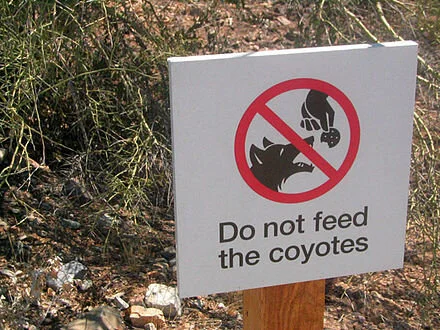
Grace Kelly: Waste management important in suppressing coyote population


From ecoRI News (ecori.org)
On a recent Friday afternoon, online viewers watched as Numi Mitchell, lead scientist for the Narragansett Bay Coyote Study (NBCS), held what looked like a large antenna in one hand and a beeping device in her other. An osprey cries overhead, and if it weren’t for the Providence Police Department’s Clydesdale horses in the paddock, you wouldn’t know that Mitchell was in Roger Williams Park.
“She’s here!” Mitchell said, as a particularly loud beep sounded.
She being a female coyote named Whinny, who is making her way through the park along with her three pups. Some other hot spots on Whinny’s travels include a trash-collection area in the park and the wind turbines near Save The Bay on Providence’s working waterfront.
The NBCS, which started in 2004, tracks local coyotes, like Whinny, in an effort to observe their movements and populations and to pinpoint unnatural food sources such as trash-disposal areas and farm-animal byproducts.
Coyotes are omnivores, eating a variety of food from berries to bunnies. But they are also opportunistic, and a dumpster can provide an easy meal with little effort.
In her 16 years studying Rhode Island’s coyote populations, Mitchell has found that the increase in the animal’s numbers can largely be attributed to people’s carelessness with food and their compulsion to feed wild animals.
Before coyotes arrived in Rhode Island and other areas along the East Coast, they were dwellers of the broad expanse of prairie in the country’s interior.
“They were originally from the Great Plains,” said Mary Gannon, wildlife outreach coordinator for the Rhode Island Department of Environmental Management’s Division Fish and Wildlife. “But when European settlers came [to New England], they cut down forests and killed a lot of the natural predators in our area.”
Some native predators that predated coyotes in Rhode Island and New England included the gray wolf, mountain lions, and bears. With these large predators gone, there was room for coyotes. They moved in.
“The coyotes expanded their territory to the north and south of the U.S.,” Gannon said.
She said they first arrived in Rhode Island in the 1960s and reached the Narragansett Bay islands in the mid-’90s. Soon after their arrival, the state’s coyote populations began to quickly increase, thanks to ample access to human-produced trash.
“Our tracking efforts started on the islands, particularly Aquidneck Island, which was seeing an explosion of coyotes,” Mitchell said. “We were trying to figure out why they were so abundant. And it’s the garbage that is subsidizing the coyote’s diet. It’s not the coyotes that are the problem; it’s people leaving trash outside.”
While hunting of coyotes is allowed, NBCS has maintained that it’s trash management that is the key to reducing coyote populations.
In 2018, NBCS received a $1.1 million federal grant to fund a five-year study of coyotes in Rhode Island, part of which includes food-removal experiments across the state. Mitchell noted that one of these efforts will be with a farmer in the Coventry village of Greene, whose animal waste and byproduct has attracted and fed coyotes in the area.
Back at the Providence police paddock, Mitchell and her crew try to coax Whinny out from her hiding place to offer a fleeting glance to online viewers. They hop the fence, and with a shaking camera and curious Clydesdales running over to get a piece of the action, it feels like a James Bond film.
Suddenly, they gasp at the sound of paws crunching delicately in the underbrush.
“She just ran by us,” whispered Gabrielle De Meillon, a technical staff assistant for DEM. Whinny is a pixelated streak of gray as she continues on her way to seek out trash and continue her journey through Providence.
Grace Kelly is an ecoRI News journalist.
Llewellyn King: Planting trees for health; data-mining sewage

Late 1800s “shotgun house’’ on South 5th St., in South Louisville, focus of a tree-planting program

Louisville Waterfront Park exhibits rolling hills, spacious lawns and walking paths in the downtown area.
WEST WARWICK
There is health in trees and a narrative in sewage. That is the double story coming out of the Christina Lee Brown Envirome Institute at the University of Louisville.
In Louisville, where the air quality ranks among the worst in Kentucky, the Envirome Institute is planting trees at a near manic pace, but it isn’t planning to wait years for the first payoff.
There is scientific purpose and a plan, and even the federal government is involved because, as Theodore “Ted” Smith, director of the institute’s Center for Healthy Air, Water and Soil, told me, the tree-planting project, called Green Heart, is also a fully-fledged clinical trial of the type normally used to assess the impact of medicines.
“Actually it’s a drug trial of sorts, except the drug is trees and bushes. You could go to clinicaltrials.gov, where all the clinical trials are listed, and under ‘drug,’ it says ‘trees,’ ” said Smith. “We’re taking very seriously the need to empirically demonstrate what the value of trees, bushes, greenery, nature is; what is the basis of the connection of exposure to green places and the improvement in human health.”
People living in four South Louisville neighborhoods where trees are being planted will be monitored against a control group in neighborhoods that aren’t being planted and surrounding Jefferson County. The project’s stated purpose is “testing if increasing green space in a neighborhood improves air quality and human health with the goal of developing a ‘greenprint’ for creating healthier neighborhoods.”
Aruni Bhatnagar, the institute’s director, told me that they chose to study the heart because cardiovascular disease is the leading cause of death. He said 8,000 to 10,000 trees are being planted in every available space in Louisville: open land, along roadways, and anywhere else that will support trees.
The trees are already of substantial size -- 15 feet to 20 feet high -- when they are transplanted in Louisville, which also has an urban-blight problem. They’re planting evergreen trees because they have year-round foliage, increasing their impact.
Smith said, “We’re very hopeful that we’ll be able to shed some light on just what are the benefits of trees. Maybe it’s cooling: There are a lot of people who are concerned about heat issues in cities. We’re concerned about pollution. As a research institute, we’ve had a long track record in working on exposure to pollutants. That is one of the functions trees perform for us.”
Like all scientific institutions, said Bhatnagar, the Envirome Institute felt it should swing into action to help with COVID-19. It is doing so with a program monitoring Louisville’s sewage to determine patterns of infection and to bring these to the attention of health authorities. The wastewater is sampled at 16 locations and analyzed in the institute’s own labs to find the COVID-19 penetration.
These samplings provide a schematic. Initially, researchers found higher infections in affluent parts of Louisville. But over time, infections spread to the city’s disadvantaged and low-income neighborhoods, where they increased dramatically.
Overall, according to Smith, the wastewater monitoring will lead to a comprehensive understanding of the health anatomy of Louisville, providing data that could have a big impact on the future health and well-being of the city and, if adopted as a general part of urban health analysis, much of the world. “There’s gold in those sewage pipes,” he quipped.
Louisville philanthropist Christina Lee Brown has been working with health activists across the world on a whole-health – physical, mental, economic, spiritual -- concept for living. In the quest for sustainable, livable, enjoyable environments, Brown works closely with Britain’s Prince Charles, who has similar goals and has invested heavily in this harmony.
“We encourage people to see the interconnected nature of all the forms of health and how they reinforce and support each other,” Brown said.
Trees are not just for climbing, and sewers are talkative.
Llewellyn King is executive producer and host of White House Chronicle, on PBS. His email is llewellynking1@gmail.com and he’s based in Rhode Island and Washington, D.C.
Linda Gasparello
Co-host and Producer
"White House Chronicle" on PBS
Mobile: (202) 441-2703
Website: whchronicle.com
'Stink of rot'

A fruit fly
“The whiskey stink of rot has settled
in the garden, and a burst of fruit flies rises
when I touch the dying tomato plants.’'
— From “September Tomatoes,’’ by Karina Borowicz, a poet based in Massachusetts’s Pioneer Valley
'Treacherously hidden'

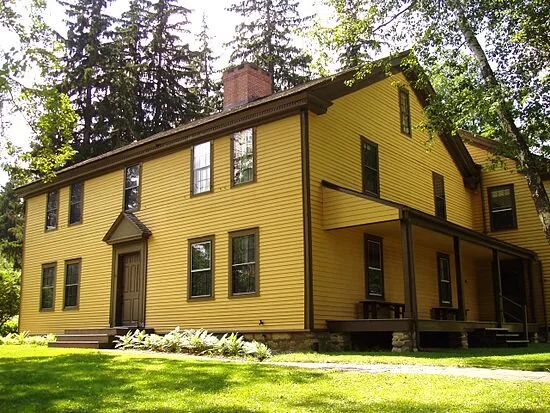
“Arrowhead,’’ also known as the “Herman Melville House,’’ is a historic house museum in Pittsfield, Mass., in The Berkshires. Herman Melville (1819-91) wrote some of his major work there: the novels Moby-Dick (1851) Pierre (dedicated to nearby Mt. Greylock), The Confidence-Man, and Israel Potter; The Piazza Tales (a short story collection named for Arrowhead's porch); and magazine stories such as "I and My Chimney". Melville loved to gaze out his window at Mt. Greylock, at 3,489 feet the highest mountain in The Berkshires. Its shape reminded him of a whale.
“Consider the subtleness of the sea; how its most dreaded creatures glide underwater, unapparent for the most part, and treacherously hidden beneath the loveliest tints of azure….Consider all this; and then turn to this green, gentle, and most docile earth; consider them both, the sea and the land; and do you not find a strange analogy to something in yourself?’’
— From Moby-Dick
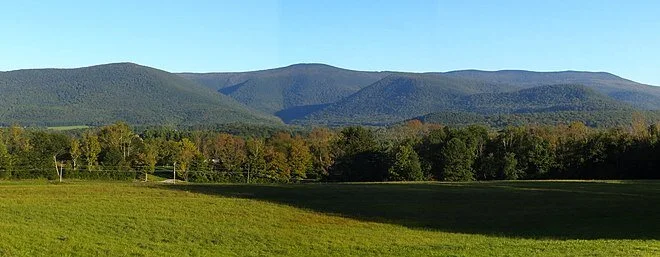
A view of the Mt. Greylock Range from South Williamstown (from the west). The Hopper, a glacial cirque, is centered below the summit.

'Breathing While Black'

“I can’t breathe’’ (acrylic and oil on canvas), by Saleh Lo, in the “Breathing While Black’’ show, at the Augusta Savage Gallery at the University of Massachusetts at Amherst, Sept. 1-Nov. 20.
Actually, GE's lights are still on

From Robert Whitcomb’s “Digital Diary,’’ in GoLocal24.com
Lights Out: Pride, Delusion, and the Fall of General Electric, by Thomas Gryta and Ted Mann, memorably describes how one of America’s oldest, biggest and most celebrated companies started taking wrong turns under its charismatic (and probably over-rated) CEO Jack Welch and his successor, Jeff Immelt, and ended up much less profitable, smaller and weaker.
This is superb corporate history, with the right mix of historical context and big picture stuff and anecdotes that add spice to the tale of very smart, but sometimes very wrongheaded and arrogant, execs making disastrous mistakes as well as, to be fair, achieving some surprising successes. Overpriced acquisitions and mountains of debt played a big role in the burgeoning woes of the conglomerate, along with dubious creative accounting, which some have alleged verged on fraud.
It’s a sort of a mystery story: How could such a huge and diversified company get into such trouble?
By the way, from all the negative news about GE in the investment community in the past couple of years you might not remember that it remains a very big company. Last year, GE was ranked among the Fortune 500 as America’s 21st-largest firm as measured by gross revenue.
New Englanders in particular will want to read about the very human reasons that the company moved its headquarters to Boston after many years in Fairfield, Conn.
Fragile borders

Still from video in Boston artist’s Bonnie Donohue’s Sept. 23-Oct. 18 show “A Thin Green Line.’’ at Kingston Gallery, Boston. The gallery says that the show is a “multimedia exploration of international borderlands created by military zones. Using drone footage, Augmented Reality, archival documentation, and interviews, Donohue exposes the social, political, and ecological fragility of these borders.’’
See:
kingstongallery.com
and
bonniedonohue.com
'New Englanders of the Year'

From The New England Council (newenglandcouncil.com):
The New England Council, the nation’s oldest regional business organization, will present its prestigious “New Englander of the Year” awards during its virtual 2020 Annual Celebration on Oct. 26, 2020. This year’s recipients are Marianne Harrison, president & CEO of John Hancock; MilliporeSigma; Udit Batra, incoming CEO of Waters Corporation; Ibram X. Kendi, Ph.D., founder and director of the Boston University Center for Antiracist Research, U.S. Rep. Jim McGovern (D-MA-2); and Samantha Power, former United States ambassador to the United Nations. More about the honorees.
The council traditionally presents the New Englander of the Year Awards each fall at its annual dinner in Boston, an event that has drawn over 1,700 guests from throughout the region in recent years. Because of the COVID-19 global public health crisis, the council will instead present the awards during a virtual program that will be streamed to registered guests at 4 p.m. on Monday, Oct. 26, and made available online following the program.
The 2020 Annual Celebration co-chairs are Pamela Everhart, senior vice president, Regional Public Affairs and Community Relations at Fidelity Investments and Amy Latimer, president of the TD Garden.
“This year’s honorees have each made valuable and meaningful contributions to addressing some of the biggest challenges facing our region and our nation in 2020,” said James T. Brett, president and CEO of the New England Council. “From combatting the COVID-19 pandemic and supporting our region’s and our nation’s recovery from the resulting economic downturn; to safeguarding human rights across the country and around the world; to fighting for foster diversity, inclusion, and equality in our communities and workplaces, each of these honorees has worked tirelessly to make New England a better place to live, work, and thrive. We are proud to call them New Englanders and look forward to celebrating their achievements with our members this fall.”
The “New Englander of the Year” awards are presented each year by The New England Council and honor residents or natives of the New England states for their commitment and contributions in their fields of work, as well as their leadership and impact on the New England region’s quality of life and economy. First presented in 1964, over the years the award has been presented to U.S. Secretary of Energy Ernest Moniz; U.S. Ambassador to Japan Caroline Kennedy Schlossberg; Senators Ted Kennedy, Jack Reed, Jeanne Shaheen, Kelly Ayotte, Susan Collins and John Kerry; Congressmen Richard Neal, Ed Markey, John Larson, and Barney Frank; and business leaders such as Abigail Johnson of Fidelity Investments, Robert Reynolds of Putnam Investments, Anne Finucane of Bank of America and many other respected government, business, and non-profit leaders.
The New England Council’s board of directors selected this year’s honorees based on their commitment to the community, distinguished careers and countless contributions to the region and the nation:
Marianne Harrison, president & CEO, John Hancock – Marianne Harrison is the President & CEO of John Hancock, the U.S. division of Toronto-based Manulife Financial Corporation and one of the largest life insurers and fastest growing asset managers in the U.S. She oversees all aspects of John Hancock’s operations, including providing a range of financial products to some 10 million Americans and managing close to $500 billion in assets. Prior to assuming her current role, Ms. Harrison served as president and chief executive Officer of Manulife Canada, the company’s Canadian division. As John Hancock’s first female CEO, she has made diversity of all types a priority at the company, and has worked to support and advance women in the predominantly-male financial services industry. Learn more.
Udit Batra, Ph.D., incoming CEO Waters Corporation; former CEO, MilliporeSigma – Udit Batra is the incoming president and CEO of Waters Corporation (NYSE: WAT), a leading specialty measurement company with operations in 35 countries and a long track record of outstanding innovation. With over two decades of global leadership experience in healthcare, Dr. Batra has led several transformations, built strong teams and has become a meaningful contributor to the prosperity and health of New England. Most recently, Dr. Batra led the formation of MilliporeSigma, the Life Science Business of Germany’s Merck KGaA, Darmstadt, Germany, with the largest merger in the life science tools industry in 2015. During that time, Dr. Batra and his team, oversaw a strategic and operational transformation of the business that drove sales growth and margin development, that remain the highest amongst integrated peers. He has championed science education especially for low-income students, developed and promoted women’s leadership, and has been a strong advocate for increasing diversity across the organizations he has led. Dr. Batra is the chairman of the Massachusetts High Tech Council and is a member of the board at both the Boston Chamber of Commerce and MassBio. Learn more.
MilliporeSigma – MilliporeSigma is the Life Science business of Merck KGaA, Darmstadt, Germany, a top three player in the global life sciences industry. The $8.1 billion Life Science business of Merck KGaA, Darmstadt, Germany operates as MilliporeSigma in the U.S. and Canada. MilliporeSigma employs some 22,000 employees worldwide, including approximately 2500 employees in the New England region. With a life science center in Burlington, MA, a significant site in Jaffrey, N.H., and 59 manufacturing sites worldwide, the company has a portfolio of more than 300,000 products focused on scientific discovery, biomanufacturing and testing services. Throughout 2020, MilliporeSigma has played a vital role in the response to the COVID-19 global pandemic, providing critical raw materials, technologies, and services to support the development of diagnostics, treatments and vaccines, including for more than 35 testing solutions, nearly 50 different vaccines, and 20 monoclonal antibody, plasma products and antivirals. Interim CEO Christos Ross will accept the award on the company’s behalf. Learn more.
Ibram X. Kendi , Ph.D., founder and director, Boston University Center for Antiracist Research – Ibram X. Kendi, Ph.D., is the Founder & Director of the Boston University Center for Antiracist Research, and also serves as the Andrew W. Mellon Professor in the Humanities. Dr. Kendi is an award-winning historian and a leading voice on antiracism. He is the author of three books, including recent New York Times bestseller How to be an Antiracist. His second book, Stamped from the Beginning: The Definitive History of Racist Ideas in America, won the 2016 National Book Award for Nonfiction, making him the youngest author to ever win that award. He has been named the Frances B. Cashin Fellow at the Radcliffe Institute for the Advanced Study at Harvard University for 2020-2021. Learn more.
The Honorable Jim McGovern, U.S. House of Representatives, Massachusetts’ 2nd Congressional District –U.S. Representative Jim McGovern was first elected to Congress in 1996, and is currently serving his 12th term representing Massachusetts’ 2nd Congressional District, which includes his hometown of Worcester and much of Worcester County and the Pioneer Valley. During the 116th Congress, House Speaker Nancy Pelosi named him the chairman of the powerful House Rules Committee, which determines what bills are considered on the House floor and sets the rules for debate. He is also a senior member of the House Agriculture Committee, where he has been one of America’s most outspoken advocates for combatting hunger and food insecurity. He also co-chairs the Tom Lantos Human Rights Commission and chairs the Congressional-Executive Commission on China, where has been a leader in the fight to protect human rights around the globe. Learn more.
The Honorable Samantha Power, United States ambassador to the United Nations, 2013-2017 – Appointed by President Barack Obama and confirmed by the U.S. Senate, Ambassador Samantha Power served as the 28th U.S. permanent representative to the United Nations, as well as a member of President Obama’s Cabinet, from 2013-2017. In this role, she was the public face of U.S. opposition to Russian aggression in Ukraine and Syria, negotiated the toughest sanctions in a generation against North Korea, lobbied to secure the release of political prisoners, helped build new international law to cripple ISIL’s financial networks, and supported President Obama’s response to the Ebola crisis. She is also the author of several books, including her 2019 memoir, The Education of an Idealist, which was a New York Times bestseller. She is currently a faculty member at the Harvard Kennedy School and Harvard Law School. Learn more.
The New England Council, the country’s oldest regional business organization, is an alliance of businesses, academic and health institutions, and public and private organizations throughout New England formed to promote economic growth and a high quality of life in the region. The council is dedicated to identifying and supporting federal public policies and articulating the voice of its membership regionally and nationally on important issues facing New England. The NEC is also committed to working with public and private sector leaders across the region and in Washington through educational programs and forums for information exchange. For more information, please visit: www.newenglandcouncil.com.
(ne
'That gale I well remember'
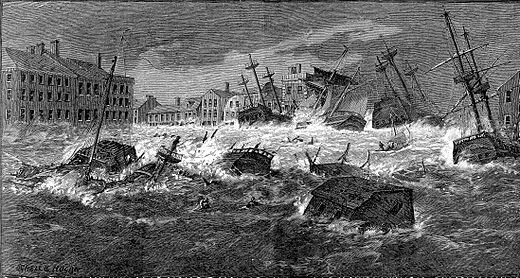
“The Great Gale” (hurricane) of Sept. 23, 1815 as it hit Providence, R.I. Oliver Wendell Holmes’s poem is about that memorable day.
I'm not a chicken; I have seen
Full many a chill September,
And though I was a youngster then,
That gale I well remember;
The day before, my kite-string snapped,
And I, my kite pursuing,
The wind whisked off my palm-leaf hat;
For me two storms were brewing!
It came as quarrels sometimes do,
When married folks get clashing;
There was a heavy sigh or two,
Before the fire was flashing,
A little stir among the clouds,
Before they rent asunder --
A little rocking of the trees,
And then came on the thunder.
Lord! how the ponds and rivers boiled!
They seemed like bursting craters!
And oaks lay scattered on the ground
As if they were p'taters
And all above was in a howl,
And all below a clatter,
The earth was like a frying-pan,
Or some such hissing matter.
It chanced to be our washing-day,
And all our things were drying;
The storm came roaring through the lines,
And set them all a flying;
I saw the shirts and petticoats
Go riding off like witches;
I lost, ah! bitterly I wept--
I lost my Sunday breeches!
I saw them straddling through the air,
Alas! too late to win them;
I saw them chase the clouds, as if
The devil had been in them;
They were my darlings and my pride,
My boyhood's only riches --
"Farewell, farewell," I faintly cried,--
"My breeches! O my breeches!"
That night I saw them in my dreams,
How changed from what I knew them!
The dews had steeped their faded threads,
The winds had whistled through them!
I saw the wide and ghastly rents
Where demon claws had torn them;
A hole was in their amplest part,
As if an imp had worn them.
I have had many happy years,
And tailors kind and clever,
But those young pantaloons have gone
Forever and forever!
And not till fate has cut the last
Of all my earthly stitches,
This aching heart shall cease to mourn
My loved, my long-lost breeches!
— “The September Gale,’’ by Oliver Wendell Holmes Sr. (1809-94), Boston-based physician, medical reformer, poet, essayist, polymath
James E. Varner: Trump tool DeJoy assaults Postal Service
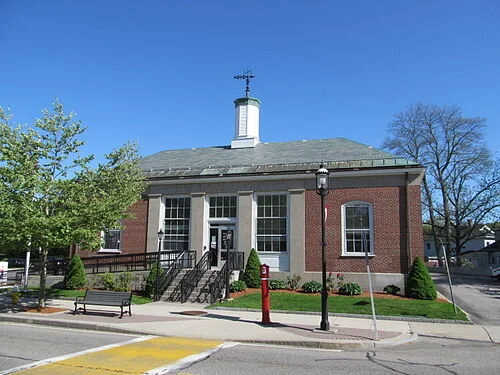
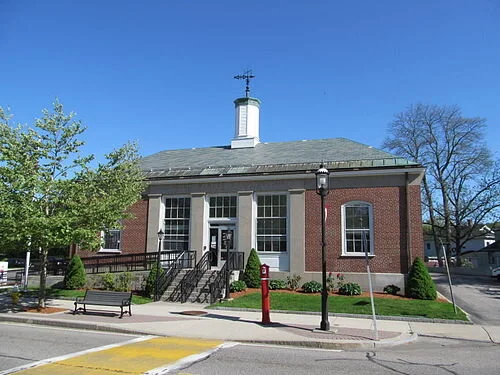
The U.S. Post Office in the old mill village of Whitinsville, Mass., part of the town of Northbridge. Like many attractive post offices, it was built as part of the New Deal’s Works Progress Administration. Opened in 1938, it’s a Colonial Revival masonry building, built of brick and cast stone, capped by a hip roof and cupola and with pilasters flanking the central entrance.
Via OtherWords.org
President Trump’s postmaster general, Louis DeJoy, recently testified before Congress about major slowdowns in mail delivery under his watch.
As a 20-year postal veteran, I had only one reaction: DeJoy needs to be Returned to Sender.
DeJoy, a Trump fundraiser who owns millions worth of stock in U.S. Postal Service competitors, has been on the job barely two months. But already, his changes have caused serious delays in delivery.
Ostensibly, these moves are cost-saving measures. But it doesn’t take a partisan cynic to understand how this kind of disruption could affect voting in November’s election. The president himself has said that he hopes as much.
Postal employees pride ourselves on a culture of never delaying the mail. Our unofficial mantra can best be summed up as, “Mail that comes in today, goes out today — no matter what.”
We are now being told to ignore that. If mail can’t get delivered or processed without overtime, it is supposed to sit and wait. That can mean big delays.
For example, letter carriers normally split up the route of a colleague who’s on vacation or out sick. These carriers each take a portion of the absent employee’s route after completing their own, often using a little bit of overtime. Now, that mail doesn’t get delivered until much later.
Then there’s the mail that arrives late in the day. Before, late arriving mail would often be processed for the next day’s delivery, even if that required the use of overtime. Today, that mail sits in the plant at least until the following evening. Mail arriving late on a Saturday or a holiday weekend could be delayed even longer.
In the plants, meanwhile, the short staffing of clerks means it takes longer to get all the mail through the sorting machines. To make matters worse, under orders from DeJoy, mail-processing equipment is also being scrapped.
Even though the processing takes longer, drivers aren’t allowed to wait on it. Postal truck drivers are being disciplined for missing their departure time even by a few minutes — even if they haven’t gotten all the mail they’re supposed to haul. In some cases, the trucks that leave are completely empty!
With package deliveries up by 50 percent during the pandemic, as the Institute for Policy Studies reports, large mail trucks operating between facilities are often already full. Imagine how much mail will get left behind when that’s combined with seasonal holiday mail, or a large number of absentee ballots.
Finally, DeJoy’s proposals to cut hours of operation at many smaller post offices — and the removal of many public mailboxes — will make it harder for the public to access postal services.
When you limit hours to 9 a.m. to 2 p.m. and close on Saturdays, you eliminate access for anybody working the day shift. Throw in mandatory closure for lunch breaks in the middle of the day, and it makes matters that much worse for our customers.
Postal workers have been doing their best to keep the nation’s mail and packages moving in these difficult and hazardous times. We don’t deserve these attacks.
DeJoy now says he’ll delay more changes until after the election, but he also had the nerve to tell Congress that he wouldn’t replace the 600 sorting machines he’d already removed.
Delaying more changes isn’t enough. Instead, Congress must approve crisis relief for USPS — and reverse DeJoy’s disastrous service cuts altogether.
James E. Varner is the director of Motor Vehicle Service at American Postal Workers Union Local 443 in Youngstown, Ohio. This op-ed was adapted from a letter published in the Warren Tribune-Chronicle.
As the crow doesn't fly

“Crooked Crow, ‘‘by Joe Chirchirillo, in the Bennington (Vt.) Museum’s North Bennington Outdoor Sculpture Show, wherein 20 sculptures from 18 regional artists are being displayed on the museum’s property in Old Bennington through Nov. 1
Bennington Museum is pleased to host an extension of the North Bennington Outdoor Sculpture Show, NBOSS at the Museum, where 20 sculptures from 18 regional artists will be displayed on our beautiful 10–acre property in Old Bennington, Vermont through November 1.
See:
benningtonmuseum.org
'Indignation meeting'
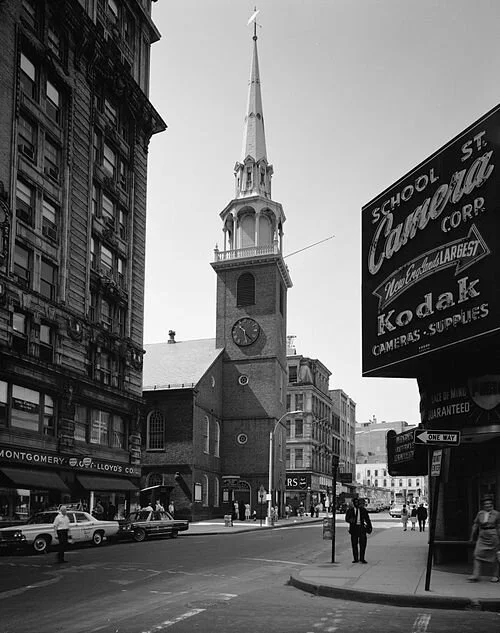
Old South Meeting House (built in 1779) back in 1968
“The next night an indignation meeting was held in Boston’s Old South Meeting House, a prime example of one of the most original and durable of New England colonial institutions: the church considered not only as a place of worship but as a court of law and a social center and the very hub of political life.’’
— Author and BBC commentator Alistair Cooke (1908-2004) on the response to the Boston Massacre (March 5, 1770) in America (1973)
Chris Powell: The hyper-hypocrisies of exclusionary zoning
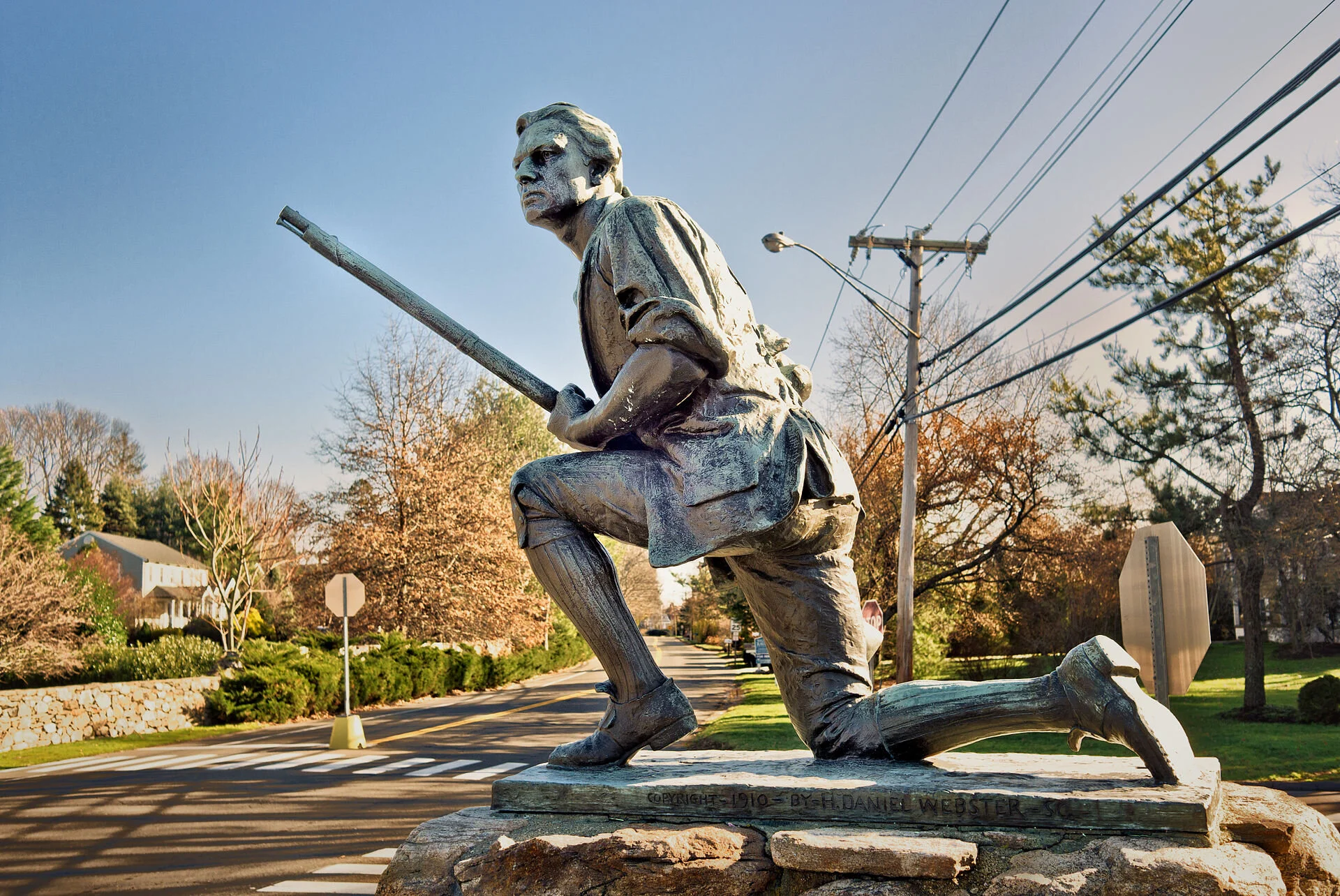
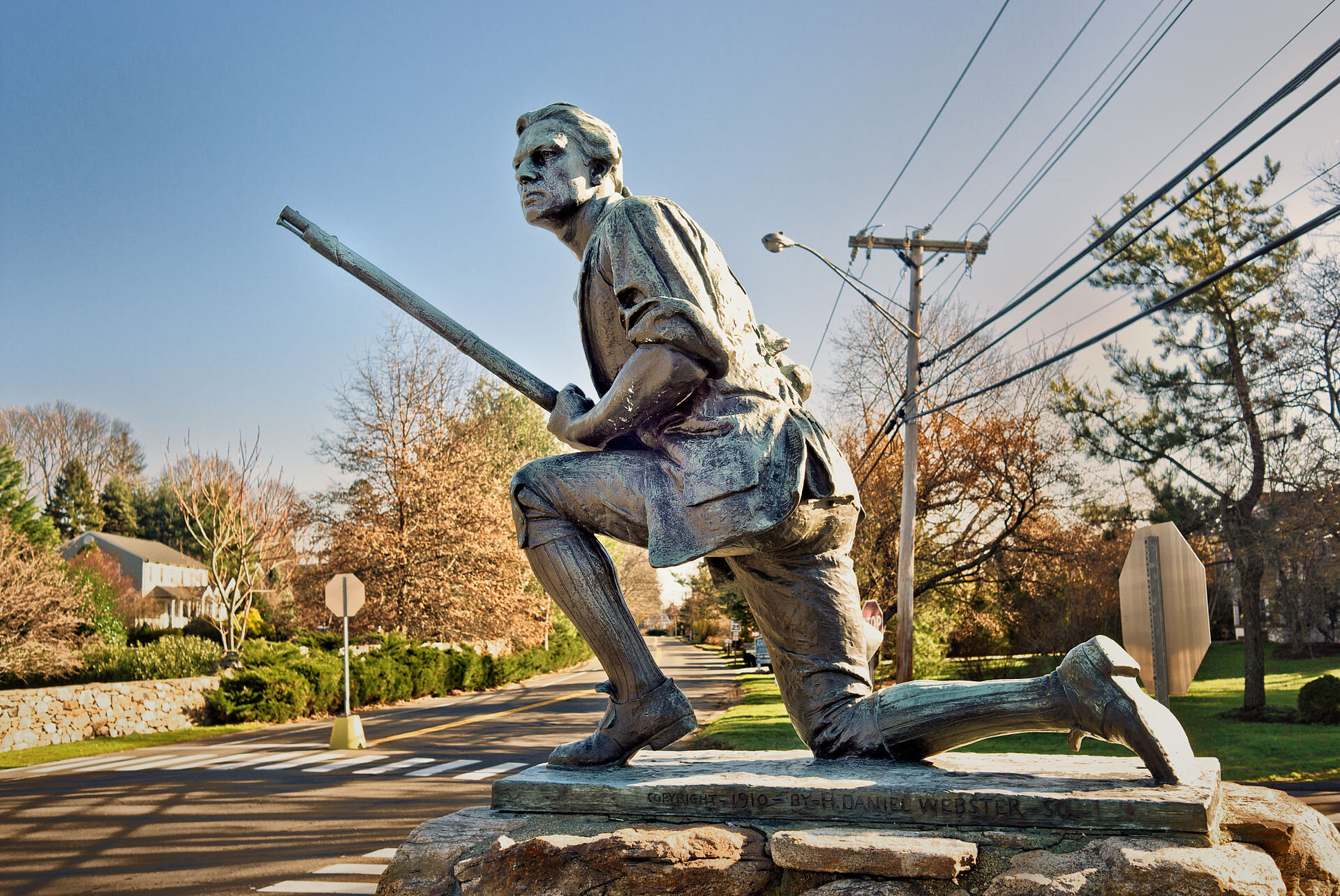
Minuteman Statue in the exclusive Compo Beach section of the rich Fairfield County, Conn., town of Westport
— Photo by WestportWiki
MANCHESTER, Conn.
Nearly everybody wants some peace and quiet at home, so naturally enough residential real estate is often about exclusivity. "Park-like setting" may be the most appealing part of advertisements for housing, followed closely by location in a successful school district.
Since only the rich can guarantee such housing for themselves with their own funds, buying not only the housing but also the park to go with it, municipalities have used zoning regulations to separate residential from industrial and commercial areas. There is nothing wrong with that. But as Connecticut knows only too well, municipalities also use zoning for exclusion -- to keep people out generally and the poor particularly, since the poor cost government more than they pay in taxes and are disproportionately disruptive.
While exclusive zoning goes too far, Connecticut long has failed to curtail its excesses, and so the suburbs are always producing hypocritical controversies about what should be only ordinary housing development. Such controversies recently broke out in Westport and Vernon.
In Westport a Superior Court judge has overturned the Planning and Zoning Commission's rejection of an 81-unit apartment complex that neighbors say will diminish safety in the neighborhood. The neighbors insist that they are not against less-expensive housing or more people from minority groups in town; they just don't want such housing near them, what with the extra traffic and all.
The argument is similar in Vernon, where neighbors petitioned against a plan to build 56 apartments on a street with both single-family and multifamily housing. Besides raising traffic and safety concerns, the neighbors contended that there is already too much multifamily housing in the area.
Too much multifamily housing for whom? There's not too much for people looking for housing in a state whose housing costs are already high and long have been pricing people out of many towns. Indeed, while homeowners celebrate rising property values, renters and people seeking to set up their own households don't, any more than homeowners celebrate rising prices for food and medical insurance. For housing is a necessity of life just as those other things are.
The more that is claimed by necessities from personal incomes, the less discretionary income people have and the more they are just surviving, not living.
The traffic argument against housing is always weak if not ridiculous, since of course there can be no new housing without traffic, and the housing in which the opponents of new housing live increased traffic itself.
People raise traffic concerns about housing only when they are already comfortably settled. Nobody thinks of himself as constituting too much traffic and nobody declines to move into an area because he will be increasing traffic for others.
Until the radical environmentalists take over and impose brutal population controls like China's, population and economic growth will continue to go hand in hand in the United States and require more housing. Connecticut can't achieve economic class and racial integration without it.
More housing in the suburbs isn't the only way of achieving economic class and racial integration. That also might be achieved by acknowledging the failure of Connecticut's welfare and urban policies to elevate the poor and members of racial minorities and improve the cities in which most of them live. Then the middle class might want to return.
But the interests that are invested in the failure of welfare and urban policy and the failure of the cities themselves remain too influential in state politics. If the cities were not perpetually poor -- essentially poverty factories operated by government and controlling the tens of thousands of votes cast by both the poor and the legions ministering to them at government expense -- Connecticut's majority political party would lose its decisive pluralities in state elections.
Government has much less patronage to bestow when the private sector is prosperous and people are well educated, skilled, and self-sufficient. As a political matter, that can't be allowed.
So for the time being Connecticut might do well just to reflect that it’s a good thing the Indians never had zoning. Otherwise there'd never have been any integration and there would be no one to lose money at their casinos.
Chris Powell is a columnist for the Journal Inquirer, in Manchester.
Too late!
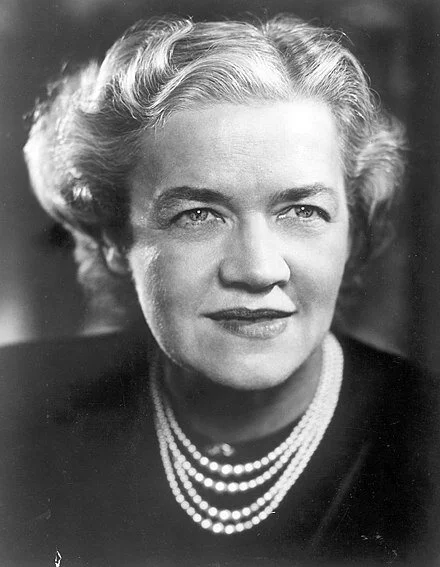
Margaret Chase Smith
“I do not want to see the Republican Party ride to political victory on the Four Horsemen of Calumny — fear, ignorance, bigotry and smear.’’
— Margaret Chase Smith (1897-1995). She was a moderate Republican U.S. congresswoman (1940-49) and U.S. senator (1949-73). She was the first woman to serve in both houses of Congress, and the first woman to represent Maine in either. She was born and died in Skowhegan.
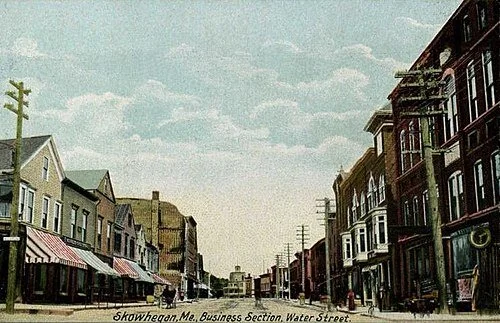
Downtown Skowhegan in 1906, in an era when the town, on the Kennebec River, was the site of numerous mills, along with occasional labor unrest.
Awesome acorn

The Maine Crafts Association is making available to see and buy online handmade craft objects made by hundreds of Maine artists. Purchases directly support Maine craft artists and the Maine Crafts Association.
Janine Weisman: States can grow their economies AND cut emissions

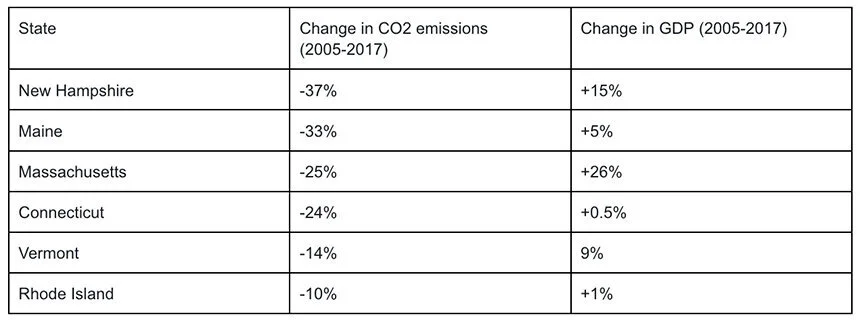
How New England’s six states have done in reducing climate emissions and growing the economy, according to data from a recent World Resources Institute report.
— Janine Weisman/ecoRI News
From ecoRI News (ecori.org)
All the New England states have cut their energy-related carbon emissions while growing their economies in the past two decades, according to a new analysis that offers proof that climate action can actually be a good return on investment.
For years, the narrative about low-carbon technologies such as wind and solar power was that their high costs and subsidies couldn’t compete with fossil fuels. But renewable-energy storage technologies have improved and dropped precipitously in price while jobs in this sector have been growing at a faster pace than overall employment. That has made low-carbon technologies competitive with conventional fossil fuels, which are heavily subsidized, and also good for the economy, according to the 66-page white paper released in July by the World Resources Institute (WRI).
“There’s a lot of myths that are out there about climate change and we wanted to debunk some of those myths,” said the paper’s co-author Joel Jaeger, a research associate in WRI’s Climate Program.
The rapid deployment of wind and solar power, a shift from coal to natural gas in the power sector, and progress in vehicle-emissions standards helped drive a 12 percent drop in U.S. carbon emissions from 2005 to 2018, during which the nation’s Gross domestic product (GDP) increased 25 percent, according to the organization’s research.
“This is not just a year here or there — this is sustained transformation of the world’s largest economy,” according to the report.
The Washington, D.C.-based global research nonprofit ranked 41 states and the District of Columbia that have decoupled their emissions from economic growth during the 12 years studied. The list covers states both large and small in all major geographical regions. Nine other states, however, saw their emissions grow over that period of time, though much slower than state GDP in most cases.
Rhode Island cut carbon emissions by 10 percent between 2005 and 2017 at the same time its GDP increased 1 percent, according to the report’s data.
Rhode Island ranked 37th, trailing the other five New England states. New Hampshire, which cut carbon emissions by 37 percent while growing its GDP 15 percent, led the region and ranked second in the nation after Maryland, according to the report.
Massachusetts ranked 12th nationwide with a 25 percent emissions decrease and a 26 percent increase in GDP. Connecticut in 16th place saw a 24 percent emissions decrease and a 0.5 percent increase in GDP.
“Rhode Island is in many ways one of the leaders on climate action, even though it doesn’t appear that way on this decoupling metric,” Jaeger said. He noted that the smallest state has the lowest per capita energy consumption.
“Decoupling is measuring progress,” he said. “Rhode Island, it’s actually harder for it to make progress because it was already on the leading edge of having lower emissions.”
Rhode Island is among the 25 states that joined the U.S. Climate Alliance to uphold the Paris Agreement goals of reducing greenhouse-gas emissions by at least 26 percent to 28 percent below 2005 levels by 2025. Participating states have grown their GDP per capita twice as fast and have reduced their emissions per capita faster than the rest of the country, according to the alliance’s 2019 annual report. Every New England state except New Hampshire is an alliance member.
If the WRI analysis had studied the decade from 2004 to 2014, Rhode Island would have been in the top 10, said Kenneth Payne, an energy and regional planning policy expert who served as head of the Rhode Island Office of Energy Resources from 2010 to 2011.
In 2004, the General Assembly enacted a Renewable Energy Standard (RES) initially set to achieve 16 percent renewable energy by 2019 and later updated in 2016 with a statewide target of 38.5 percent renewable energy by 2035. Then, in 2014, the Resilient Rhode Island Act set an aspirational goal of reducing the state’s climate emissions by 45 percent by 2035.
But the political mood has changed along with federal support, according to Payne.
“Maybe I would describe it as, ’Well we’ve done enough for now. Let’s see how it works,’” he said. “And that’s putting it generously.”
With its less carbon-intensive service economy and low manufacturing output, Rhode Island already has low emissions per capita, making it challenging to continue achieving significant reductions, according to University of Rhode Island assistant professor in environmental and natural resource economics Simona Trandafir. Other states with energy-intensive heavy industry have higher baseline emissions and significantly more decarbonization opportunities, she noted.
“Those states have begun to take the lowest hanging fruit and they’re making huge emissions reductions because they switched from coal to natural gas, which we’ve been free of coal for several years,” Trandafir said. “For us it’s really hard right now, because we’re already the best.”
There are, however, two significant areas where Rhode Island could improve when it comes to reducing climate emissions. The transportation sector accounts for about 40 percent of the state’s greenhouse-gas emissions. Heating homes and businesses generates about 30 percent of Rhode Island's carbon emissions. Getting individual motorists out of their vehicles by improving public transit and switching from high-polluting oil- and natural gas-fired furnaces and hot-water systems to heat pumps and carbon-neutral replacement fuels would go a long way to further curbing the state’s climate-changing emissions.
WRI cited Rhode Island and Massachusetts along with Illinois and Washington, D.C., for providing incentives for low- and moderate-income households to access community solar programs.
Janine Weisman is an EcoRI News contributor.
Wanderer for whales

“Wanderer,’’ probably rounding Cape Horn, coming from or going to whaling in the Pacific. Watercolor and gouache by William Hall.
Wanderer, last of New Bedford’s once glorious fleet of square-rigged whaling vessels, was built in a Mattapoisett shipyard and launched in 1878. It came to a sad end in 1924, when it grounded off Cuttyhunk in a storm.
Needing office esprit de corps
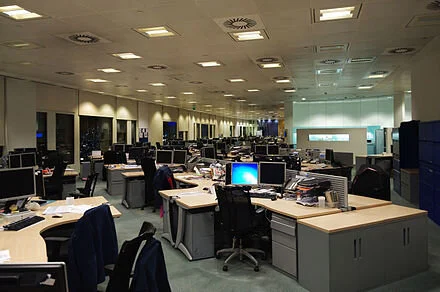
From Robert Whitcomb’s “Digital Diary,’’ in GoLocal24.com
The office you leave your home to go to work in will not die, and indeed will stage a comeback when the COVID crisis fades. Many kinds of work are much more productive when people can collaborate in the same physical space. Sharing space encourages idea-sharing and esprit de corps. The experience of the past few months has vividly shown the strengths and weaknesses of Zooming and Skyping job work.
Less stressful than Disney World
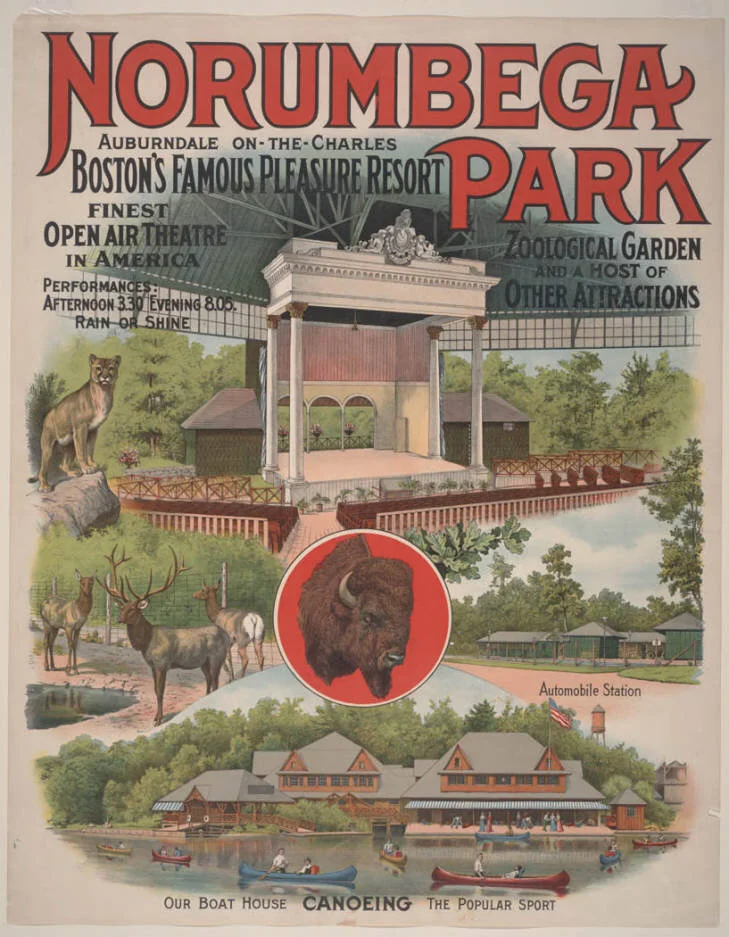
Norumbega Park, in the Newton, Mass., village of Auburndale, near (not in!) Boston, opened in 1897 and closed in 1963.