
Can ruin your beach day
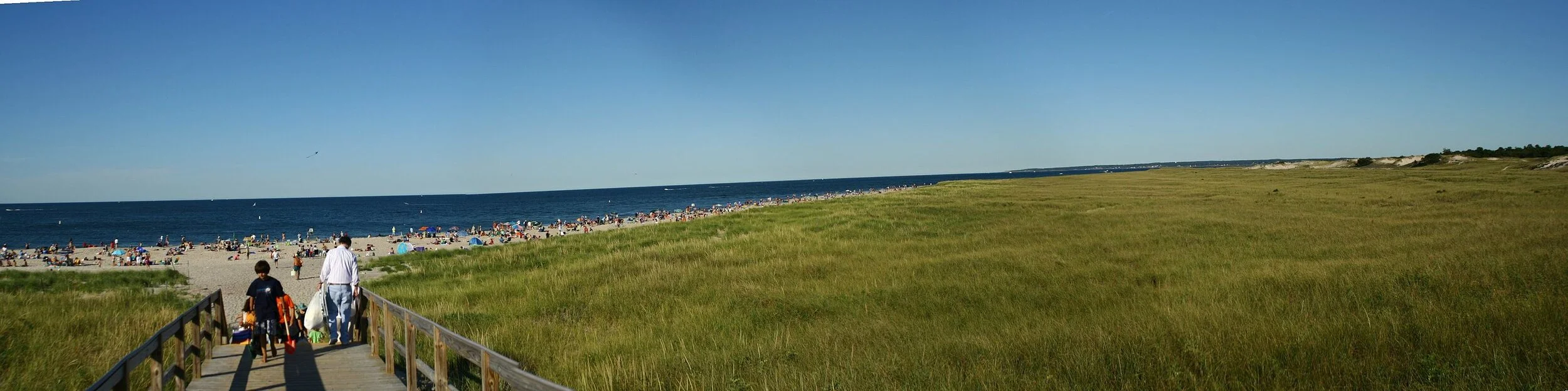
Heading for a picnic at Crane Beach, in Ipswich, Mass.
Photo by Thomas Steiner
“When faced with anything I loathe and fear
I try to grit my teeth and persevere,
But there’s one gritty thing I just can’t stand —
A sandwich that is halfway full of sand.’’
— From “Words Within Words,’’ by Richard Wilbur (1921-2017), New England-based poet
Subtropics move into New England

A Crepe myrtle. They’re moving into southern New England.

Japanese knotweed
From Robert Whitcomb’s “Digital Diary,’’ in GoLocal24.com
Because of Nantucket’s relative proximity to the Gulf Stream, people used to joke that you’d soon be able to grow palmettos there. Well, that might happen in the next couple of decades as man-made global warming accelerates.
I thought of that while reading an article in the July 27 New York Times entitled “Imagine Central Park as a Rainforest,’’ which described the proliferation of plants moving from the south into New York City, which, like Providence, the National Climate Assessment now places in the “humid subtropical zone,’’ a shift from its previous placement in the “humid continental zone.’’ The growing conditions are now similar to those in Maryland.
Such trees as crepe myrtles and magnolias have become common in New York City and southern New England, as are such invasive and warmth-loving plants as Japanese knotweed. I’ve noticed a host of new weeds cropping up in our little yard the past few years. Plants, including flowering trees, are blooming earlier and lawns tend to stay greener later in the fall. Unfortunately with the southern plants come southern insect pests that we must learn how to suppress without poisoning a lot of “good’’ plants and animals in the process. (By the way, I have found that cleaning vinegar (6 percent acidity) is a safe herbicide. Or you could stick with Roundup and give yourself cancer.)
None of this is to say that the “polar vortex’’ won’t briefly but memorably slam us in the winter from time to time, so it’s a little early to think we can put out palms year round. But the direction is clear.
So southern New England gardeners will have an increasingly exotic time of it.
Hit this link for The Times’s story.

'Nothing is isolated'

“Personalia’’ (oil on wood panel), by Mike Carroll, in his show “Hidden Forces at Play,’’ at Berta Walker Gallery, Provincetown, Aug. 15-Sept. 5. The gallery says: “Carroll paints stillness and subtle shifts in space in conversation. His multi-colored and ‘colored’ black and white paintings ‘embrace imperfection, impermanence and the passing of time.’ Mike Carroll's paintings reflect his sense that ‘nothing exists by itself independently of the rest. Everything is related to everything else; nothing is isolated, a philosophy of Buddhism’’’.
See:
https://galleryschoolhouse.com/mike-carroll/
http://www.bertawalkergallery.com/
David Warsh: Thoughts on the ‘failing New York Times’

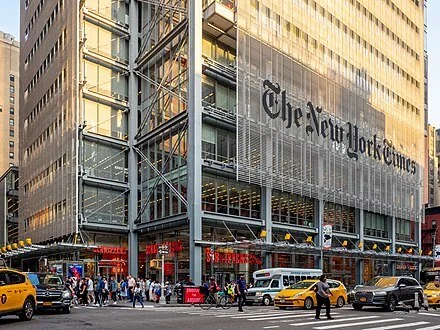
The New York Times Building at 620 Eighth Ave, New York
SOMERVILLE, Mass.
Very few chief executives leave office on as high a note as Mark Thompson, who announced last month that he would retire from The New York Times Co. at the end this month. Thomson took the job in 2012, amidst criticism for having failed to act decisively as director general of the BBC in the case of a long-time broadcast personality who had turned out to have been a long-time pedophile. But the NYT Co.’s board stuck by him, and in the nine years since Thompson has done for The New York Times what he had done previously for the BBC: transformed a stagnating legacy business into a thriving enterprise whose digital revenues are surging.
How? By signing up some 3 million digital subscribers at $15 a month – nine years without a price increase. A hike is finally in the works, Thompson told Ken Doctor of NiemanLab last year. Stand-alone Crossword and Cooking subscriptions add nearly a million more. The print edition of the Sunday Times, nearly 900,000, brings the total to 4.9 million. Meanwhile The Times is hoping so add another 5 million digital subscribers by 2025 at the higher rates.
Revenues were $2.1 billion the year before Thompson took over; they were 14 percent less last year, or $1.81 billion. Yet NYT Co.’s share price was $46.14 on Friday, up from $7.75 when he arrived. In those years The Times has added some 200 journalists to its payroll, bringing the newsroom total to around 1,700.
So much, then, for President Trump’s frequent references to “the failing New York Times.” Trump’s election and subsequent behavior have surely been the single biggest contributor to the growth in Times readership.
If there is a long-range risk to the company, it is that Thompson has thrown the tiller over too sharply. He told Jim Waterson, media editor of The Guardian, that success stemmed from shaking things up, hiring younger employees and adopting the attitudes of Silicon Valley: “Letting very young, junior people play with big dangerous things. It’s a long way from the way things are done in many newsrooms.”
The relationship between newspaper companies and their print editions was that of “the Titanic [to] an iceberg,” he continued. The New York Times would be one of the last print newspapers to go digital-only, Thompson told Waterson, but “it’s going to happen.”
Bancroft family heirs sold The Wall Street Journal to Rupert Murdoch’s News Corp. in 2007. Donald Graham sold The Washington Post to the family of Amazon founder Jeff Bezos in 2013. Pearson, the British conglomerate that had owned it since 1957, sold the Financial Times (and half of The Economist) to Nikkei, one of Japan’s oldest and largest media companies, in 2015. All three new owners have far deeper pockets than do the members of the Sulzberger family trust that controls The Times. All three companies sell subscriptions to their print editions for around half as much as the $1,200 annual rate of The Times.
Meredith Kopit Levien, the former Forbes magazine advertising executive who has been Thompson’s second-in-command for several years, will replace him in September. She urges Times journalists to stop referring to their employer as “the paper.” There is no similar term that rolls off the tongue to describe the thriving new digital media enterprises that are now part of the “mainstream media,” she acknowledges. They include giants Bloomberg and Reuters, such startups as Quartz, Vox and Axios, and such traditional broadcasters as the BBC or newspapers such as The Guardian.
Still, Levien told NiemanLab, “Something like three million people listen to The Daily [The Times‘s podcast] every day and something close to 5 million people open The Morning [an email version] every morning. [It’s] a newspaper in a different form.” What difference, if any, might the finite space budget of a printed newspaper page – the 240 square inches of a front page in particular – make to the various constituents of the world of mainstream news? That answer to that question will take many years to become clear.
Then again, maybe that $46 share price – more than 50 times last year’s earnings- per-share – means that The Times itself is half in play, expecting and fearing an offer from some computer-age mogul that could prove difficult for its controlling cousins to refuse. If so, Thompson won’t have been the first CEO to structure a company for sale via indirection. Either way, The Times today is anything but “failing.”
. xxx
Most economists who knew Harvard economist Emmanuel Farhi learned the cause of his death very quickly. But so painful was the death of the 41-year old theorist that it has yet to be recognized publicly as suicide anywhere but here. An extraordinarily sad business in any case, not susceptible to any easy explanation. That is what makes it so hard.
David Warsh, a veteran columnist and an economic historian, is proprietor of Somerville-based economicprincipals.com, where this column first ran.
Perfect for a year of Groundhog Days
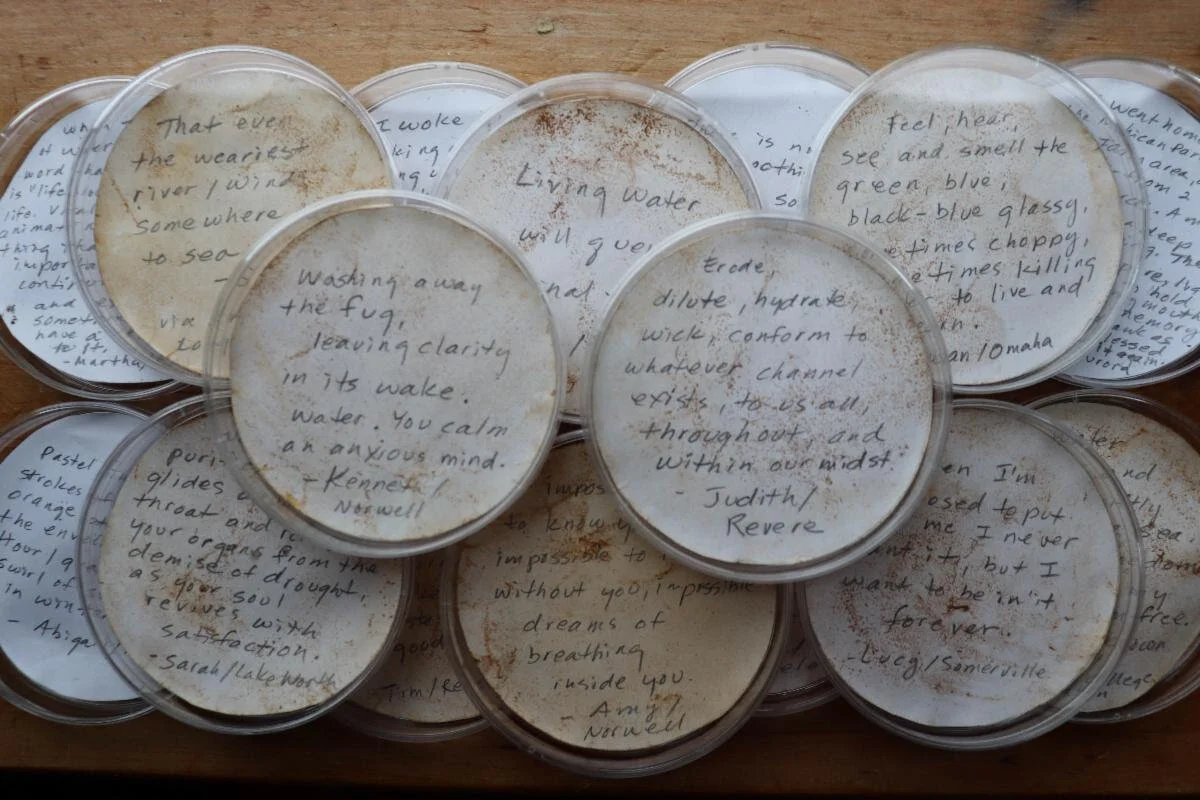
Work by Amy Kaczur in the group show “Repeat As Needed ,’’ at Kingston Gallery, Boston, through Aug. 23. The gallery says the show “presents questions explored through repetition. Each artist uses forms of reiteration to seek emergent variations that invite interpretation. Patterns, layering, movement, perspective, mark making, and color offer innovative visual solutions and the continued possibility of discovery.’’
See:
http://www.kingstongallery.com/
and:
www.amykaczur.com
Escaping the heat into high culture

Entrance to the museum, which is in St. Johnsbury, in Vermont’s “Northeast Kingdom.’’ The museum and the town are very interesting places.
“We climb the stone staircase
of the redstone Victorian building,
my father, my aunt, my husband carrying our baby,
escaping from the mid-July heat.
My mother is missing, dead one year.’’
— From “Fairbanks Museum and Planetarium,’’ by Jane Shore
Cold is good for you

“In the Boston area every summer there are a few days so unpleasant you feel like cursing everything in sight.’’
Haruki Murakami, Japanese writer and marathoner, in What I Talk About When I Talk About Running
xxx
“One reason a lot of use live here {in northern New England} is probably that surviving and flourishing in this climate is such a good, moral thing to do. It’s decadent to be warm all the time.’’
Willem Lange, in Tales from the Edge of the Woods
New Hampshire summer
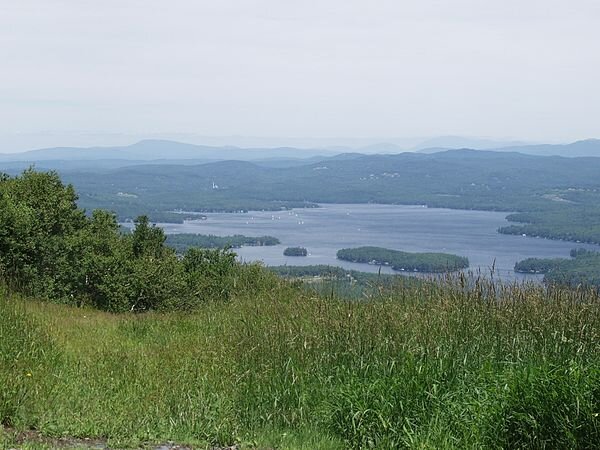
View of Lake Sunapee, in western New Hampshire
“….The mirth of dipping children as wakes of droning motorboats lap a lake.
Bluebirds have woven a love nest in a stilted, rough-hewn, wooden house.
By a stonewall wild berries grow swollen from green to a misty blue hue.
As we ride bikes beside a hayfield, we rouse the flight of a russet grouse….
We're in awe of honeyed summertime and the harmony of its resonance.’’
― From David B. Lentz’s Sonnets on the Common Man: New Hampshire Verse

Chris Powell: Corrosive, politically correct lawlessness on immigration
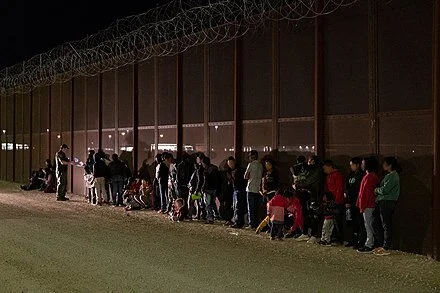
Illegal aliens at U.S. border
With his attempt to prevent the U.S. Census from counting illegal immigrants, President Trump has a fair point. Since the Census determines the decennial reapportionment of the U.S. House, its inclusion of illegal immigrants conveys greater representation on the areas in which they live even though they are not citizens, cannot vote, and shouldn't be there.
Counting illegal immigrants for reapportionment purposes creates a system like the one used during the era of slavery, when the U.S. Census credited states for three-fifths of their slave population even though slaves couldn't vote, transferring their political power to their enslavers. Slave states thereby gained advantage over free states in House representation.
Democrats in Connecticut and throughout the country want the census to count illegal immigrants because they concentrate in Democratic areas, which is why Republicans oppose counting them.
But fair as the president's point is, he's absolutely wrong on the law. For while the Constitution did not anticipate as much illegal immigration as the country has today, it requires that the Census count "the whole number of persons in each state, excluding Indians not taxed." The Constitution could have required counting only citizens, or counting everyone while excluding non-citizens from House district apportionment, but it didn't.
Maybe this was an oversight. But with the Fourth, Fifth, and Six Amendments in the Bill of Rights, the Constitution provides basic protections for citizens and non-citizens alike -- protections for "the people" and "persons," not just citizens
Since Trump is so wrong on the law here, states and cities are suing to block his order about the Census. Connecticut is one of the plaintiffs, brought into the case last week by state Atty. Gen. William Tong. But while Tong faulted the president for lawlessness, he overlooked the lawlessness right under his nose on the same issue.
For even as Connecticut joined the Census lawsuit, New Haven Mayor Justin Elicker announced that he is strengthening the city's protections for illegal immigrants, protections that forbid police and other city employees from cooperating with federal immigration authorities or asking people about their immigration status. While these policies are not themselves illegal like the president's census order, they are meant to obstruct and nullify federal immigration law, and they do.
Mayor Elicker said he wants New Haven to be a "welcoming city." That's a euphemism for admitting everyone no matter what, including fugitives from justice and foreigners who violate immigration law and even intend harm to the United States. New Haven's longstanding policy, reiterated by the mayor, is that anyone who breaks into the country and reaches New Haven should be above the law.
This is not just a policy of nullification, the practice of Southern secessionists before the Civil War and segregationist Southern governors who defied federal civil-rights law in the 1950s and '60s. It is also a policy of open borders and devaluation of citizenship, the dissolution of the country. Further, while the mayor is inviting more illegal immigrants to New Haven, his city is suffering an explosion of violent crime and social disintegration, with shootings and multiple drug overdoses practically every day along with the erosion of the school system.
Quite without more illegal immigrants, New Haven already can't take care of itself, and its legal residents may feel less welcome. The mayor's posturing about illegal immigrants doesn't improve life in the city. It's a politically correct distraction from decline.
Chris Powell is a columnist for the Journal Inquirer, in Manchester, Conn.

Llewellyn King: Using low radiation to fight inflammation in COVID-19, other ills
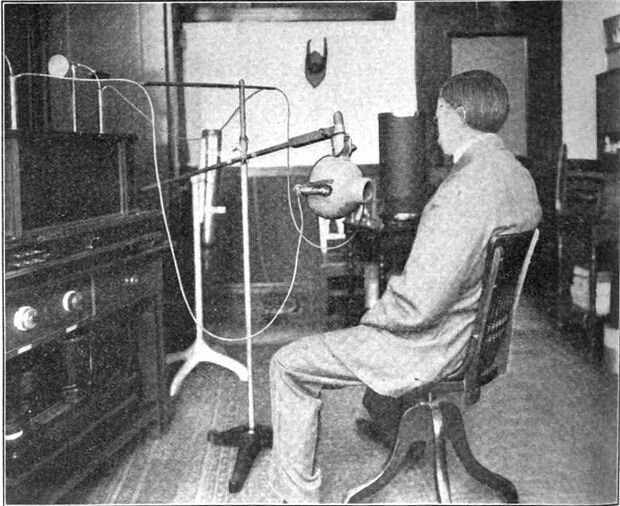
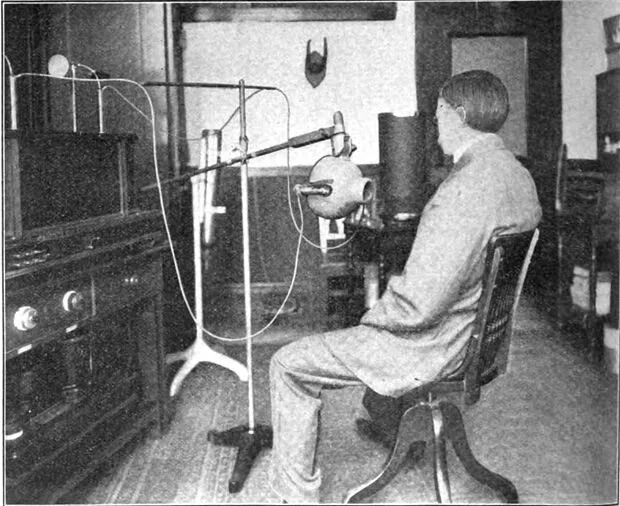
X-ray treatment of tuberculosis in 1910. Before the 1920s, the hazards of radiation were not understood, and it was used to treat a wide range of diseases.
A little boy was taken to the zoo in the New York City borough, where he was enthralled to ride Jalopy, a Galapagos tortoise. Jalopy became a favorite. But then one day the giant tortoise wasn’t there, and the little boy learned that she had cancer and had been taken to Arizona for radiation treatment.
“I had never heard of radiation,” said Dr. James S. Welsh, professor of radiation oncology at Loyola University Medical Center in Maywood, Ill. But his love of that tortoise was enough for him to devote his life to radiation therapy.
Now Welsh is in the vanguard of doctors who hope to save lives by using radiation as a therapy for patients with COVID-19 -- and possibly as a therapy for Alzheimer’s, arthritis and other diseases where inflammation plays a role.
Inflammation is present when the body’s immune system mobilizes to fight disease or injury. The problems come when the immune system, according Welsh and other doctors I have interviewed, goes “haywire.”
Radiation can’t cure COVID-19, Welsh explained, but it can be used to reduce the acute inflammation, known as cytokine storm. This causes a flooding of the lungs and is what kills most COVID-19 patients.
Using very low doses of radiation to fight respiratory inflammation isn’t new: It was how viral pneumonia was treated more than 75 years ago, before the perfecting of a battery of drugs which took over. Radiation was highly effective against viral pneumonia, with success rates recorded at 80 percent or better. Antibiotic drugs combined with growing public antipathy to radiation in all forms took it off the pneumonia therapy list.
But now it appears to be back-to-the-future time for radiation.
Welsh says that a patient about to enter acute respiratory distress syndrome (ARDS), which kills many COVID-19 patients, can be treated with low-dose radiation to clear the lungs. Afterward, the patient can return to the ward to get treatment with antiviral drugs. No ICU, no ventilator, no long-term scarring of the lungs.
“Radiation could be used with a drug like remdesevir or another drug, like steroids. But it is my opinion that radiation will prove superior to dexamethasone or other steroid medicines,” Welsh said in an interview with me on White House Chronicle, the PBS television program.
A few clinical trials of low-dose radiation therapy for COVID-19 have begun in the United States and six other countries, including Canada and the United Kingdom. “Although peer-reviewed results have yet to be published, preliminary data seem very encouraging, and certainly justify the siting of a proposed clinical trial here,” said Welsh, referring to the Hines Veterans Administration Hospital in Chicago, where he is the chief of radiation therapy. He hopes to launch a clinical trial there in weeks.
The radiation doses for COVID-19 treatment are extremely low. Welsh is planning to use .5 gray in his trial, but others use more, 1 gray or even 1.5 grays. Those are above X-ray doses, but well below cancer doses. Brain cancer and lung cancer patients get doses of 60 grays, with up to 80 grays for prostate cancer, Welsh said.
This doesn’t mean that there isn’t opposition.
Much of the concern over radiation is associated with the linear, no-threshold (LNT) model which posits that all radiation will have detrimental health effects even at minuscule levels, like normal background. This theory has been contested violently for decades by nuclear scientists, but it remains an undermining orthodoxy.
“Most people and physicians are not familiar with the potential application as an anti-inflammatory in infectious disease,” Welsh said.
Nonetheless, he believes that the future beckons. When I asked him about the use of radiation in other diseases where inflammation was a factor, particularly Alzheimer’s and arthritis, he responded, “A definitive ‘yes.’ ”
The beauty of radiation therapy, according Welsh and others I interviewed, is that about half the hospitals in the country have radiology departments and staff. Treatments for COVID-19 patients could begin almost immediately.
As to Jalopy, she died in 1983 at the age of 77. She was so popular over the 46 years she lived at the zoo that a bronze sculpture of a Galapagos tortoise was erected as a memorial.
And you might say, her memory radiates hope for the future.
Llewellyn King is executive producer and host of White House Chronicle, on PBS. His email is llewellynking1@gmail.com and he’s based in Rhode Island and Washington, D.C.
Chants in Copley Square
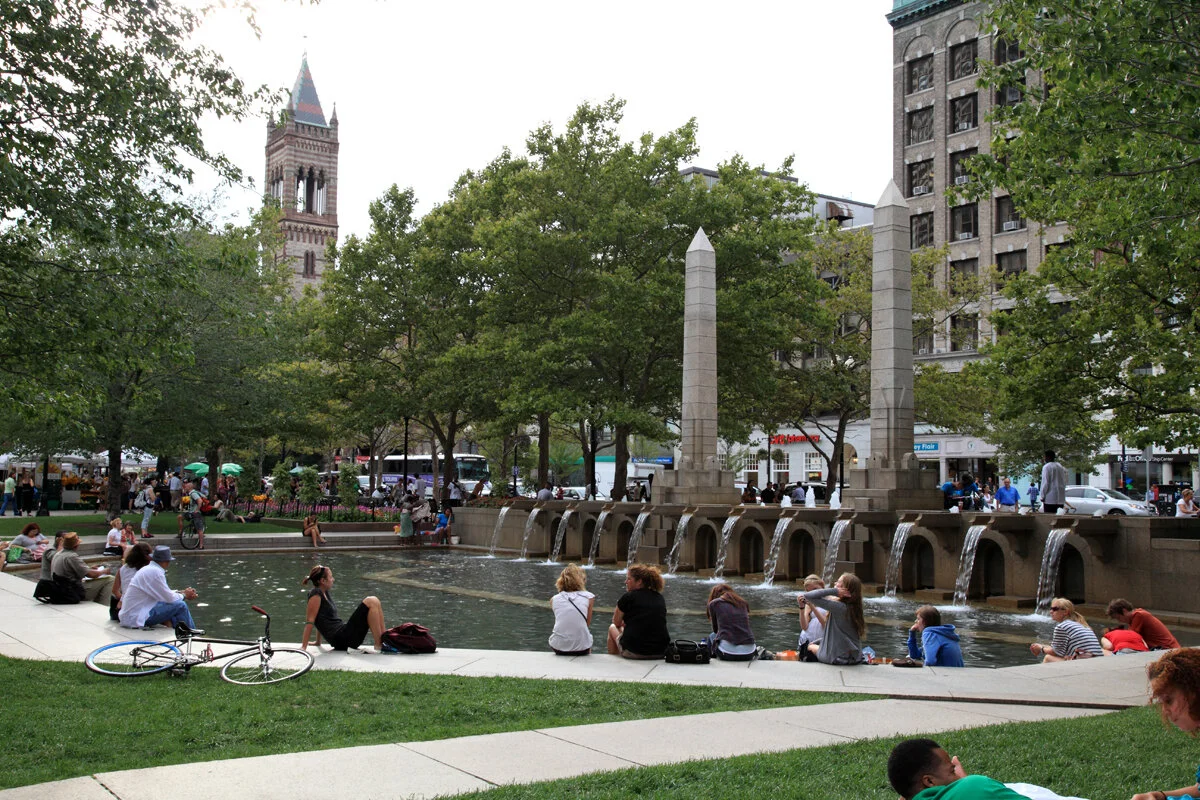
Copley Square fountain, with the Old South Church’s tower in distance, in a recent, pre-pandemic summer.
— Photo by Caroline Culler
“There’s a poem in Boston’s Copley Square
where protest chants
tear through the air
like sheets of rain,
where love of the many
swallows hatred of the few.’’
— From “In This Place (An American Lyric)’’, by Amanda Gorman
Police brutality
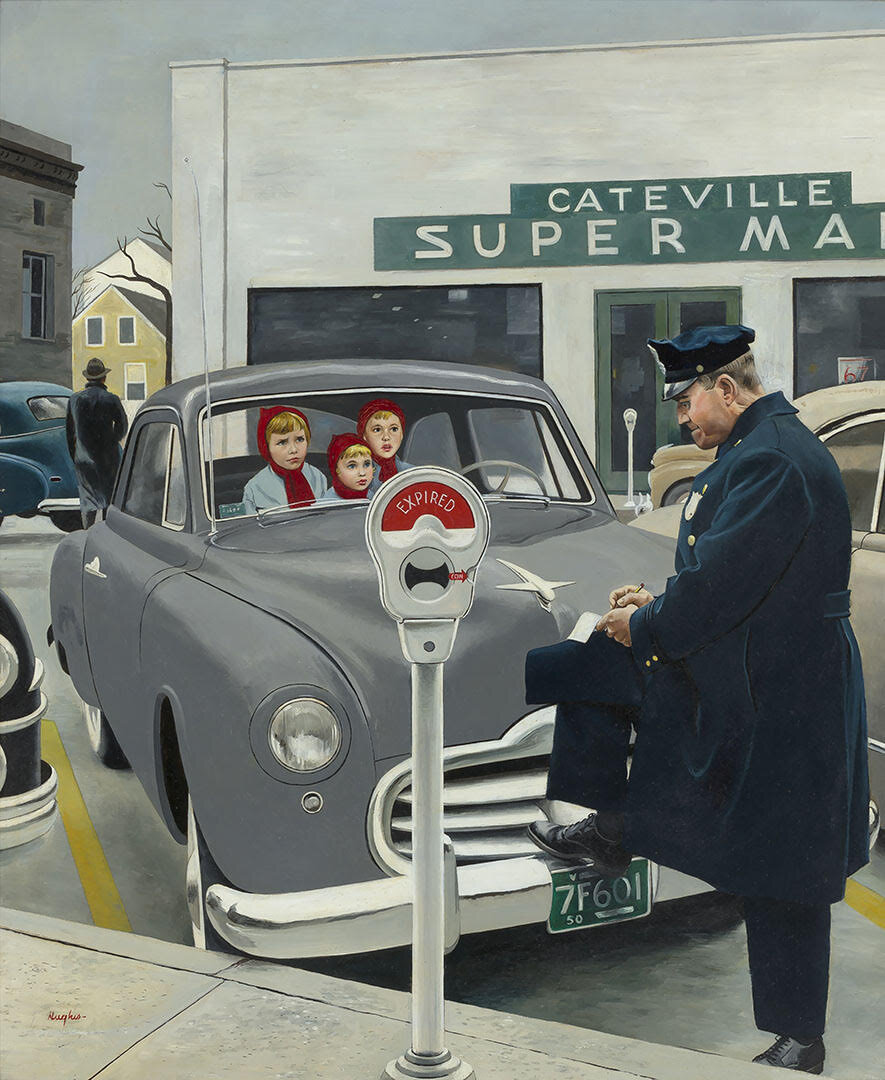
“Expired Meter’’ (oil on board) by George Hughes (1907-1990), at the National Museum of American Illustration, Newport
(c) 2020 National Museum of American Illustration, Newport, RI, and the American Illustrators Gallery, New York, NY
Mr. Hughes lived for the last part of his life in Arlington. Vt., between the Taconic Range and the southern Green Mountains, where one of his neighbors for some years was the far more famous illustrator Norman Rockwell, who eventually moved to Stockbridge, Mass., in the Berkshires.

Fog over the Battenkill River in West Arlington, Vt.

New England's COVID confusion

Maine Gov. Janet Mills
From Robert Whitcomb’s “Digital Diary,’’ in GoLocal24.com
Most of us are getting pretty claustrophobic these days and can’t travel long distances. But at least we New Englanders have plenty to see in our compact region – beautiful mountains and coasts, lovely lakes, innumerable historic sites, great food, bucolic empty COVIDized college campuses….
The biggest regional travel hurdle at this point: Maine Gov. Janet Mills fears people from Massachusetts and Rhode Island. Citing the high percentage of people from those two states who have tested positive for COVID-19, she has ordered that Rhode Islanders and Bay Staters must quarantine for two weeks or present proof of a recent negative virus test to be legally in the Pine Tree State. The effect is to discourage many, perhaps most, of these people from going to Maine – a big blow to its tourist industry, though many ignore the order, with some anxious “illegals’’ sneaking into the state via back roads from its deeply rural western side.
Vermont also has tough rules, but somewhat different – they want to know what county you come from, not just the state, in determining whether you need to quarantine.
Has there been a lot of sneaking across state lines? Complex times indeed. Maybe we need a special meeting of New England governors – three un-Trumpian Republicans, three garden-variety Democrats -- to sort out the confusion and come up with a truly regional plan. All the region’s governors are calm, competent and respectful of science. It’s curious that the most liberal part of the country has three GOP governors, though they would hardly be considered in the mainstream of the party, though New Hampshire’s Chris Sununu comes rather close.
Anyway:
Harvard’s Dr. Ashish Jha, incoming dean of Brown's School of Public Health, has famously praised Rhode Island Gov. Gina Raimondo’s tough response to the pandemic: "Rhode Island has done a fabulous job -- I would say one of the kind of standouts in the country, a model for how we should be doing this," Dr. Jha told WPRI TV. "If the rest of the country had done what Rhode Island has done, we'd been in a very different place as a nation." And yet Rhode Island testing data led Governor Mills to her rather draconian order. Without a unified and coordinated federal response to the pandemic, including how to conduct and promptly report test results and do speedy contact tracing, the policy confusions will continue as everybody tries to interpret the latest data, based on different states’ practices.
To read Dr. Jha’s remarks, please hit this link.
For a good review of America’s COVID-19 testing failures, please hit this Bloomberg link
The article notes:
“Test results, to be useful, should arrive in less than two days. If they take longer, opportunities to isolate infected people and trace their contacts with others wither, undermining broader containment efforts. So why can’t the wealthiest and most innovative country in the world have more rapid-fire testing during a pandemic?’’
A time and place for tweed

Put on before leaving your room at Yale.
{As a Yale freshman Calvin} Trillin showed up in New Haven {in 1953} in awe. “People looked like they had costumes on — tweedy sports coats, patches on the elbows. I’d never seen things like that.’’ And of course, he saw men’s costumes because the faculty was certainly a male bastion and so was the student body. In those days, Yale was not a study in diversity.’’
— From Lary Bloom, in “A Yale Education,’’ in the March 22, 1998 Hartford Courant.
Sophia Paslaski: Supreme Court just made the case for Medicare for All

From OtherWords.org
People of the menstruating persuasion: how dare you. The highest court in the land demands to know.
This July, the Supreme Court of the United States decided that President Trump, who does not have a uterus, was quite right to object to Obama-era rules under the Affordable Care Act that allowed Americans who do have uteri access to free birth control through their employer-provided health-insurance plans.
Specifically, NPR reports, the Supreme Court upheld a Trump administration rule that “would give broad exemptions from the birth control mandate to nonprofits and some for-profit companies that object to birth control on religious or moral grounds.”
Not just religious — “moral.”
So even if Jesus is cool with it, if you have personal “moral” quandaries with the people in your employ taking birth control, you’re free to cut your workers off from essential medications.
And I do mean absolutely essential. While some of us use ACA-covered birth control like “the pill” or an intrauterine device (IUD) as an optional measure to prevent pregnancy, many of us depend on it to treat hormonal conditions.
Birth-control medication is commonly used to help manage premenstrual syndrome and painful periods. Doctors prescribe it to control the growth of painful ovarian cysts that can lead to life-threatening complications if left untreated. It helps those with challenges like depression level out the hormonal fluctuations that can trigger cyclical mood changes around menstruation.
And for one in 10 of us, it is the best line of defense, short of surgery, against endometriosis, a debilitating condition that many struggle to manage without birth-control medication.
But perhaps that’s not the point.
Plenty of us have made this medical appeal before to no avail. Medicine doesn’t seem to matter to those employers who deem themselves religiously or morally opposed to “providing” birth control to their employees — as if employers are handing out pill packs at the reception desk like free swag at Comic Con.
Maybe, as always, this is about the medical-industrial complex.
In this country, where much health insurance is tied to employment, employers often take the position that they are “giving” their employees health care — and therefore, that they are entitled to some say over what that care entails.
That’s nonsense — but so is tying health care to employment in the first place.
Politicians who oppose Medicare for All like to cite the concerns of voters who, allegedly, love their employer-provided health insurance. But this court decision proves what most of us, I expect, already know: private health insurance isn’t all that great.
It doesn’t cover everything you need it to cover. It’s beholden to the whims of the employers who provide it. It’s expensive for the self-employed who purchase it on their own. It prioritizes profit over care, yet still never seems to get the billing done right.
As Sen. Elizabeth Warren said at a debate last year, “Let’s be clear: I’ve never actually met anybody who likes their health insurance company.”
So fine. Refuse to offer health-insurance plans that cover birth control, if you must. I’m not happy about it, especially as I write this an hour before an appointment with my OBGYN to talk about birth control and endometriosis.
But I won’t fight you either, because I think you’ve done my fighting for me — I can think of no better argument for Medicare for All than the freeing of the noble employer from the dreadful moral quandary of birth control.
Great job, team. Drinks are on Justice Brett Kavanaugh.
Sophia Paslaski is on the staff of the Institute for Policy Studies.
Unprofessional clamming
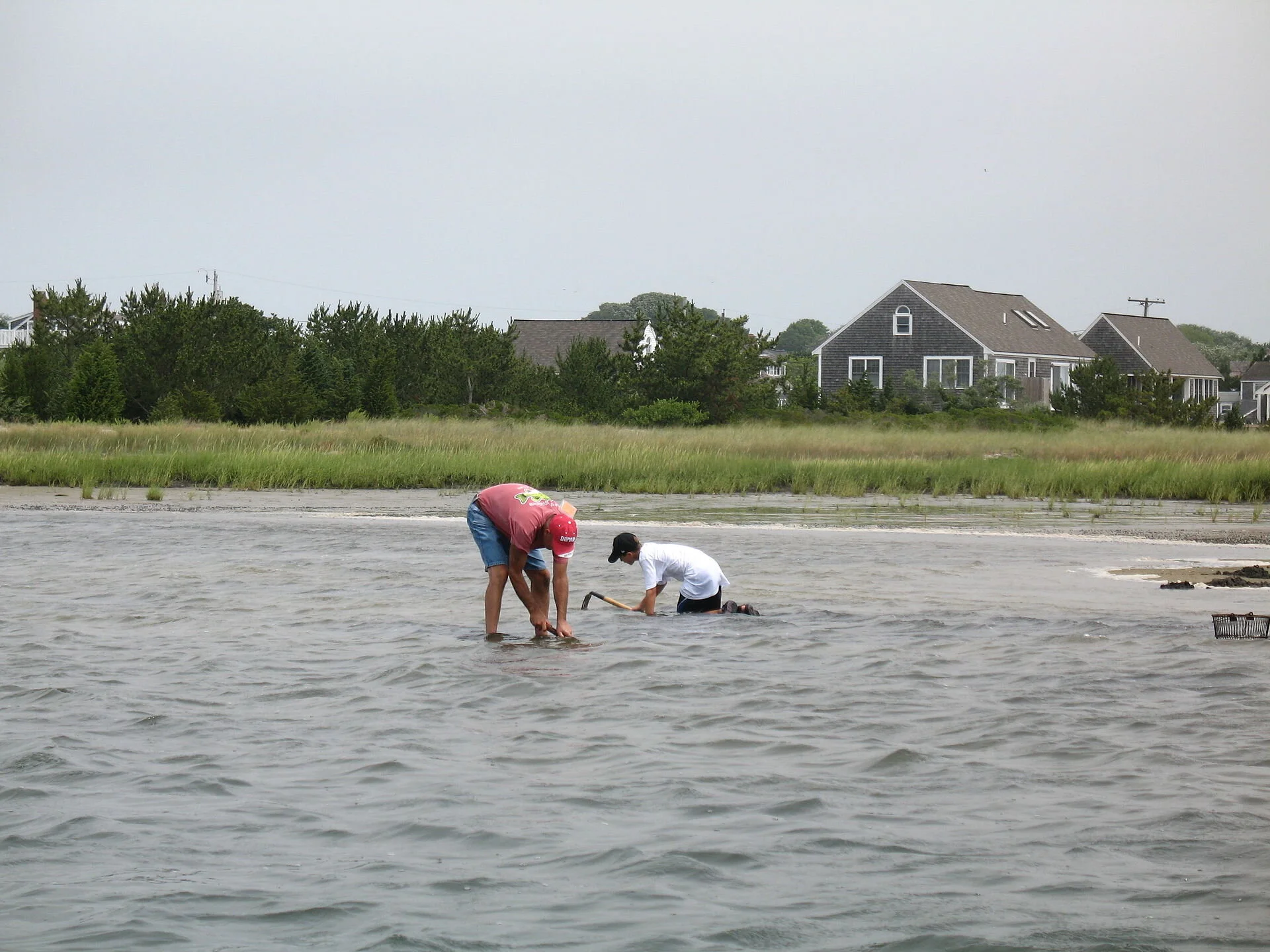
— Photo by Invertzoo
From Robert Whitcomb’s “Digital Diary,’’ in GoLocal24.com
In one part of my brain it’s endless summer, as I was reminded by Dr. Ed Iannuccilli’s recent column in GoLocal about crabbing as a kid on the Rhode Island shore. (Hit this link to read the doctor’s sweet essay: https://www.golocalprov.com/articles/dr.-ed-iannuccilli-crabbin-on-a-summer-evening)
My paternal grandparents lived in a gray-shingle house on West Falmouth Harbor, on the Cape side of Buzzards Bay. (The house has since been torn down and replaced by a monstrosity twice as high.) The harbor once had vast numbers of quahogs and more than a few oysters, too. We kids would wade out on the flats, collect the shellfish in a bag and bring them back to a stone dock, where we’d smash them to get at the meat, over which we’d squeeze a lemon, and eat right there. Very messy and unprofessional. This was before our father showed us how to open them with a special knife, which I don’t think I could do now. I fuzzily remember that he could do it with one hand, and with a cigarette dangling from his mouth.
On those seemingly open-ended days, a southwest wind was always blowing off Buzzards Bay, the air was always about 76 degrees, as was the water, and the haze turned into a purple fog in the late afternoon as the catboats and the bluefish and striped-bass seekers returned to the harbor from the usually choppy open bay.
A big oil spill in 1969 closed the harbor to legal shellfishing for decades. (Still, people, especially poor immigrants from Southeast Asia, would come clamming anyway and probably lied to the stores and restaurants about where their shellfish came from). But something good came from the disaster: West Falmouth Harbor became an internationally known place for research into the effects of oil spills and how to remediate them, in large part because the Marine Biological Laboratory was just down the road, in Woods Hole.
I’ll always remember the late ‘50s under a hazy sun as I dug into the sand to pull out a delectable quahog.
Fog in SoWa

“Luceombra’’ (Ink & gouache on cotton paper) by Sabrina Garrasi, at Lanoue Gallery, Boston. Hit this link.
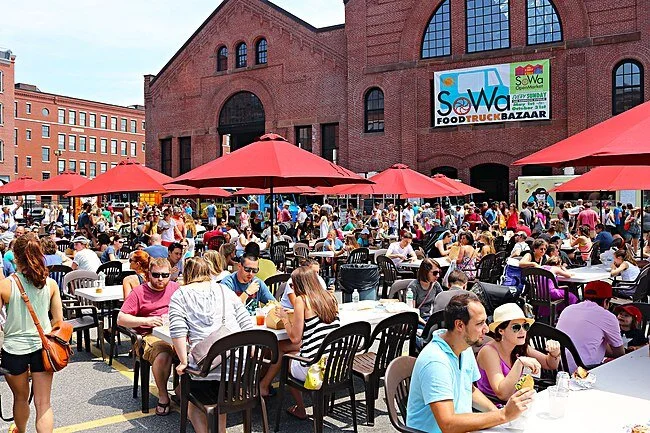
In SoWa in happier, pre-pandemic days
Lanoue Gallery is in The SoWa Art & Design District (South of Washington Street) in Boston’s South End. It’s a community of artist studios, contemporary-art galleries, boutiques, design showrooms and restaurants in what was once an area of neglected warehouses. It features the SoWa Open Market, the SoWa Vintage Market and a now-fashionable residential neighborhood.
'The opposite of today'
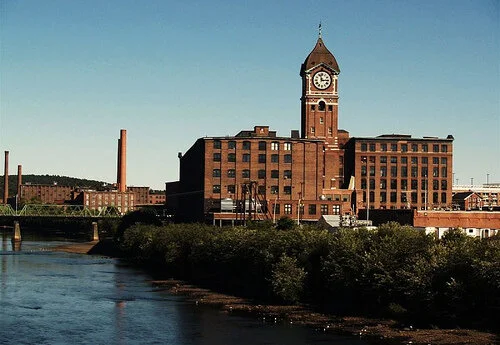
The Ayer Mill in Lawrence
“Don’t even try looking for him where he grew up
in Lawrence, Mass. The whole town is burning.
The remarkable thing about tomorrow is that everything is
the opposite of today. The shadow that now stalks you
becomes your confessor….’’
— From “No Fault Love,’’ by Richard Jackson