
A gray world

“At Stage Harbor, Chatham, Cape Cod” (archival pigment print), by Bobby Baker. Copyright Bobby Baker Fine Art.
Start rebuilding; battling bike bathos

WPA road project in the ‘30s
From Robert Whitcomb’s “Digital Diary,’’ in GoLocal24.com
The upside of disaster. The COVID-19-caused lack of traffic has let road and utility work, such as replacing century-old gas lines in Providence’s Federal Hill neighborhood, be done much faster than anyone could have anticipated a few months ago. Which is a reminder that fixing America’s decrepit infrastructure in a sort of WPA-style program would not only employ some of the people who have lost their jobs in our open-ended economic crisis; it would also make us more competitive over the long haul.
Bucking the Bike Bathos Redux
How to bring back rental-bike-and-scooter companies to Providence, firms that have left because of thefts and vandalism?
For one thing, JUMP, Lime and other “micro-mobility” companies must do what they failed to do before – properly staff their services for oversight, which they have tried to do on the cheap. For another, all these vehicles should be locked in racks between use, and in very open and visible places, so that the police are more likely to monitor them. And surveillance cameras should be installed wherever possible. And as I’ve written before, there should be more serious punishments for stealing and vandalizing these vehicles.
Finally, enforce the traffic laws for bike and scooter users for a change!! Stop riders from going the wrong way on one-way streets, running stop signs and red lights, and keep them in their lanes. Will it take a couple of these wild riders getting slammed by a car or truck, and maybe killed, to get the city’s attention and start enforcing the law?
xxx
Meanwhile, Providence, like many other towns and cities, has closed off blocks of streets to most vehicular traffic in response to the pandemic, turning them into walkways, which I guess many people like, especially now that warm weather is here and after months of COVID claustrophobia. But how is it working out for deliveries, especially now that Amazon is everywhere? How do people living along these closed-off streets (though they can come and go) like it? And will these closures cause traffic jams as more people start driving around on our mostly narrow streets as the pandemic controls are gradually lifted?
Trying to rebuild trust in public transport
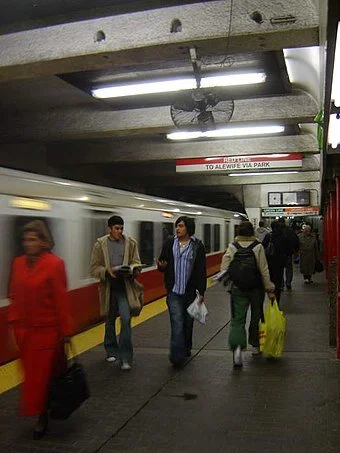
On an MBTA Red Line platform at Boston’s Downtown Crossing station
From The New England Council (newenglandcouncil.com):
“Keolis was highlighted in Intelligent Transport for its role in providing and operating public transport in 15 countries worldwide in the age of a pandemic.
“In New England, Keolis operates the MBTA’s Commuter Rail system, which serves eastern Massachusetts and parts of Rhode Island. In the interview, CEO Bernard Tabary discusses the effects of the pandemic on transport and what Keolis is doing to rebuild public trust in transport solutions and the future of transportation worldwide.’’
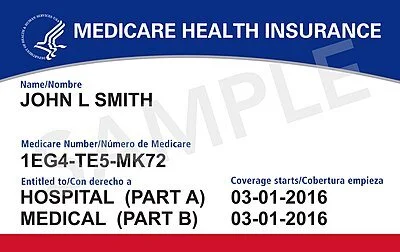
Victoria Knight: Anti-Trump claims on alleged Medicare cuts are mostly wrong
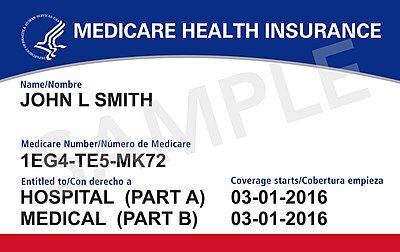
Priorities USA Action, a Democratic super PAC, announced a new digital and TV ad series criticizing President Donald Trump’s response to the coronavirus pandemic.
Among the ads is a 15-second spot, titled “Pause,” that alleges Trump is trying to cut Medicare during the global health emergency.
“Our lives are on pause. We’re worried about our health. So why is Trump still trying to cut our Medicare? $451 billion in cuts in the middle of a deadly pandemic. Trump is putting us at risk,” the commercial’s narrator says.
The PAC, which was formed in 2011 to support President Obama’s re-election campaign, has been tapped by Joe Biden, the presumptive Democratic presidential nominee, as his preferred choice among Democratic super PACS for big-donor giving.
This ad caught our attention for two reasons. First, the term “Medicare cuts” has long been volleyed between both Republicans and Democrats in Congress and the White House — and often has proven to be a powerful political tool.
Second, the connection between “cuts” to Medicare and the coronavirus pandemic was a new concept we wanted to explore.
We reached out to Priorities USA Action to ask for the basis of these statements.
Josh Schwerin, a PAC spokesperson, sent us links to news articles and confirmed that the “$451 billion in cuts” referred to Trump’s 2021 proposed budget for Medicare.
Asked to pinpoint where the $451 billion came from, Schwerin pointed us to a February ABC News article that said the president’s budget plan would “whack away at federal spending on health care over the next 10 years … including $451 billion less spent on Medicare.” He also sent us links to a February Washington Blade article and February press release from Rep. Jahana Hayes (D-Conn.) — both of which also cited that figure.
Cuts Or A Reduction In Spending Increases?
In fall 2010, a few months after the Affordable Care Act was enacted, Republicans aired midterm campaign ads attacking Democrats for “cutting” or “gutting” Medicare. The reason was the law included a $500 billion reduction in projected spending for Medicare over 10 years, which would be used to help fund the ACA.
The Obama administration said the reductions in spending would come from lowering payments to Medicare Advantage plans and providers and would not affect the level of care that Medicare beneficiaries received. They also said it would help make the Medicare system more financially stable.
Now, almost 10 years later, Democrats are using the same language to criticize the White House’s long-term plan for Medicare spending.
“‘Cuts’ is a term that has been thrown around for many years,” said Tricia Neuman, executive director of the Program on Medicare Policy at the Kaiser Family Foundation. “This is a semantic issue that often gets politicized, often in an election year.” (Kaiser Health News is an editorially independent program of the foundation.)
Neuman explained that what is being considered here is a reduction in the projected increase in spending over a certain period. This reduction is based on estimates of how much the government is projected to spend on programs — factoring in proposed policy changes — for the following 10 years, taking into account current levels of spending, assumptions about economic growth and trends in the use of Medicare coverage, said Neuman.
Trump’s 2021 budget blueprint for Medicare estimated that spending would increase each of the 10 years. But the estimate also suggested that the administration’s proposed policy changes would reduce the spending increase compared with estimates of what would be spent if the changes were not implemented.
“Let’s say Medicare spends $100 in 2020 and is projected to spend $200 in 2021,” Neuman said. “If the budget said we’re going to reduce the growth in spending by $25, that’s a reduction in an increase. But other people might call that a cut.”
SOURCES:
ABC News, “3 Things to Know About Trump’s Budget Plan for Medicare, Medicaid,” Feb. 11, 2020
Centers for Disease Control and Prevention, “First Travel-Related Case of 2019 Novel Coronavirus Detected in the United States,” Jan. 21, 2020
Centers for Disease Control and Prevention, “CDC Confirms 13th Case of 2019 Novel Coronavirus,” Feb. 10, 2020
Center on Budget and Policy Priorities, “Medicare in the 2021 Trump Budget,” Feb. 13, 2020
Committee for a Responsible Federal Budget, “The President’s Budget Saves Medicare $600 Billion While Reducing Out-of-Pocket Costs,” Feb. 10, 2020
Commonwealth Fund, “That $716 Billion Medicare Cut: One Number, Three Competing Visions,” Aug. 16, 2012
Congressional Budget Office, “Proposals Affecting Medicare — CBO’s Estimate of the President’s Fiscal Year 2021 Budget,” March 25, 2020
Rep. Jahana Hayes press release, “Rep Hayes Condemns Trump Administration’s Proposed Cuts to Health Care, Social Security, SNAP, and Education Funding,” Feb. 13, 2020
CNN, “February 10 Coronavirus News,” Feb. 10, 2020
Email exchange with Josh Schwerin, senior strategist and director of communications, Priorities USA, May 21, 2020
FactCheck.Org, “Competing Claims on Trump’s Budget and Seniors,” Feb. 18, 2020
The New York Times, “How the Coronavirus Pandemic Unfolded: a Timeline,” May 26, 2020
Office of Management and Budget, “A Budget for America’s Future,” Feb. 10, 2020
Phone interview with Marc Goldwein, senior policy director, Committee for a Responsible Federal Budget, May 22, 2020
Phone interview with Tricia Neuman, executive director of the Program on Medicare Policy, Kaiser Family Foundation, May 22, 2020
Phone interview with Joseph Antos, scholar in health care and retirement policy, American Enterprise Institute, May 21, 2020
Phone interview with Paul N. Van de Water, senior fellow, Center on Budget and Policy Priorities, May 22, 2020
PolitiFact, “‘Honest Ad’ Mostly Wrong About Trump, Taxes and Medicare,” July 26, 2019
PolitiFact, “Republican Exaggerations About Cutting Medicare,” Oct. 11, 2010
Priorities USA, “Pause – Medicare” ad, May 19, 2020
Priorities USA, “Priorities USA Action Launches New TV and Digital Ads Linking Coronavirus Devastation to Trump’s Failure to Lead on Response,” May 19, 2020
Speaker of the House Nancy Pelosi Newsroom, “Pelosi Statement on Trump Budget Summary,” Feb. 9, 2020
The Washington Blade, “Trump’s Budget Seeks Increased HIV Funds — But Housing, Global Programs Cut,” Feb. 12, 2020
The Wall Street Journal, “Biden Campaign Indicates Priorities USA Is Preferred Super PAC,” April 15, 2020
The Washington Post, “Democrats Engage in ‘Mediscare Spin’ on the Trump Budget,” March 15, 2019
The Washington Post, “What Trump Proposed in His 2021 Budget,” Feb. 10, 2020
World Health Organization, “Statement on the Second Meeting of the International Health Regulations (2005) Emergency Committee Regarding the Outbreak of Novel Coronavirus (2019-nCoV),” Jan. 30, 2020
World Health Organization, “WHO Announces COVID-19 Outbreak a Pandemic,” March 12, 2020
The Number Itself And What It Means
We reached out to the Department of Health and Human Services, which oversees Medicare, for its take on that $451 billion figure but have not heard back.
Marc Goldwein, senior policy director for the nonpartisan Committee for a Responsible Federal Budget, said the actual figure could be anywhere from $400 billion to $600 billion, depending on how calculations are done. His analysis relied on the executive branch’s Office of Management and Budget calculations and landed on a figure close to $505 billion. Other variables, such as “likely savings from drug price reform” — yet to be enacted — move it closer to $600 billion.
The left-leaning Center on Budget and Policy Priorities came up with a similar estimate: $501 billion. The Congressional Budget Office’s estimate, not including savings generated from proposed drug pricing reforms, was closer to $400 billion.
In all cases, though, the reductions in Medicare spending would be achieved through proposals such as lowering payments to providers and paying the same amount for the same health service offered in different settings.
Goldwein said these proposals for Medicare reform are largely bipartisan and “either mimic or build upon” those advanced during the Obama era. He also said that, in his organization’s view, the “cuts” are savings to the Medicare program and beneficiaries, who would see lower premiums and out-of-pocket medical costs.
The policy experts said it’s likely the reductions in spending wouldn’t directly affect the care that Medicare beneficiaries receive. But provider groups have complained that lower reimbursements might drive some doctors to leave Medicare. Hospitals have argued against the proposal for equalizing payments for similar services because they say their overhead expenses are higher than those of a doctor’s office or off-site clinic and their higher rates help finance other necessary services.
Timing Matters
The Priorities USA Action ad also alleges that Trump is trying to cut Medicare “in the middle of a deadly pandemic.” But the timeline of events doesn’t support this statement.
The White House released the 2021 budget proposal on Feb. 10 — well before the COVID-19 outbreak had become a part of our national consciousness.
The first domestic case of COVID-19 was announced by the Centers for Disease Control and Prevention on Jan. 21. The World Health Organization declared the outbreak of the novel coronavirus a “public health emergency of international concern” on Jan. 30.
On Feb. 10, the day the budget was released, the CDC put out a press release stating there were 13 cases of the disease in the U.S. CNN also published an article that day stating the vast majority of COVID-19 cases and deaths had occurred in China. Authorities didn’t announce the first U.S. death from COVID-19 until Feb. 29. The WHO declared a pandemic on March 11.
“These budget proposals were probably developed well before the pandemic hit the U.S. and hit it hard,” said Neuman. However, she added, “the administration hasn’t disavowed these proposals, but they also haven’t pushed them forward.”
Joseph Antos, a scholar in health care and retirement policy at the right-leaning American Enterprise Institute, said it was a “ridiculous statement to connect cutting Medicare spending to the COVID crisis.”
“The implication of the video that this is going on actively while we’re in the middle of this crisis, that’s dead wrong,” said Antos.
Our Ruling
The Priorities ad said Trump is trying to make $451 billion in Medicare cuts “in the middle of a deadly pandemic.”
This is an exaggerated attack, even before the pandemic is layered on top of it. The dollar figure itself is “in the ballpark” of what the policy proposals would generate in spending reductions, giving this ad a sliver of truth. However, in the Trump budget, the amount is spread over 10 years — important context that was omitted.
What’s in Trump’s budget proposal is not a direct cut to Medicare. Instead, Priorities uses the age-old political tactic — employed on both sides of the aisle — of holding up a reduction in projected spending growth as a “cut.”
Moreover, the ad leaves the impression that Trump is trying to whack Medicare for seniors at a time when panic is particularly high because of the coronavirus. But that connection to the pandemic is also misleading. The presidential budget was released weeks before most of the nation began to comprehend the threat of COVID-19.
The claim contains an element of truth but ignores critical facts and context that would give a different impression. We rate it Mostly False.
Victoria Knight: vknight@kff.org, @victoriaregisk
Wetland wonder

Connecticut salt marsh
“….Below,
the tall grasses strain in wind,
all thrill and glitter,
their white tips
lapping over. A towel
shudders and beats on the line….’’
— From “Sea-Meadow,’’ by Cynthia Huntington, a New Hampshire-based poet
‘What Maine was really like’

‘‘There were no curtains. Light saturated the immaculate rooms. In the kitchen was a wood-burning stove, an iron sink, gray-white walls, a basket of new peas. In lieu of electric lights, glass oil lamps were lined up, waiting for evening. ‘It looked like what Maine was really like, just as they found it,’ Wyeth remembers.’’
— Richard Meryman, on painter Andrew Wyeth’s (1917-2009) first visit to Maine, in 1939, in Andrew Wyeth: A Secret Life (1996)

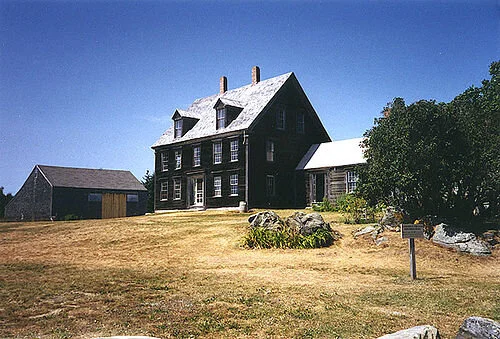
“Christina’s World’’ (tempera), set in Maine’s Midcoast and probably Wyeth’s most famous painting. He divided his time between his summer place in Cushing, on the Maine Coast, and Chadds Ford, in southeastern Pennsylvania. Below is the house portrayed in the painting.
Class of 2020 should seek internships to reduce long-term economic ‘scarring’

BOSTON
From The New England Journal of Higher Education, a service of The New England Board of Higher Education (nebhe.org)
2020 will forever be remembered as the year of COVID-19, the illness caused by a novel coronavirus. This year, the term “social distancing” became part of our vocabulary, and virtual proms and online commencement ceremonies became commonplace. According to Georgetown University Center on Education and the Workforce analysis of HIS Markit Forecast Summary of May 2020, on the economic front, 2020 is the year when the gross domestic product (GDP) is predicted to plunge and unemployment to rise to its highest level since the Great Depression.
Job postings as estimated by EMSI are down 32%, and more than 38 million Americans have filed for unemployment—so far, according to the U.S. Department of Labor. Every economic sector has been affected, although some have lost more jobs than others.
Notably, four sectors accounted for close to 70% of the jobs lost even though they account for just over half of the jobs in the economy. Leisure and hospitality, wholesale and retail trade, healthcare, and professional and business services make up 70% of job losses in April 2020, but those sectors had accounted for only 53% of jobs overall. Leisure and hospitality has been particularly hard hit, shouldering almost four times as many job losses compared to its size in the overall economy, according to Georgetown University analysis of government data.
Though leisure and hospitality is shouldering the heaviest burden of job losses, personal services (such as hair stylists, fitness trainers, and tour guides) also lost relatively higher fractions of jobs as well.
Although white-collar jobs in sectors such as professional and business services have been affected, the impact has been disproportionately higher in traditional blue-collar jobs—and according to some analysts, those jobs have been filled predominantly by women, in occupations such as waitresses, cashiers and sales. Lack of experience also make young workers more vulnerable any type of economic downturn and less likely to be employed in what little jobs remain.
The graduating class of 2020 will face a difficult job market, and the adversities will follow them for years. New graduates facing these types of jobs numbers will be subject to scarring—reduced lifetime incomes caused by entering the workforce during a downturn. Faced with the quandary of choosing between a subpar job or prolonged unemployment, new college grads should expect to earn up to 7% less for every 1% increase in the overall unemployment rate in the first few years.
The inertia of pay parity for the scarred class is likely to persist, with graduates still earning 2.5% lower than their peers who entered the workforce during rosier economic times, even 15 years later, according to past analysis by University of Rochester economist Lisa Kahn. Recent graduates fortunate enough to continue working in the internships they secured during the previous year will also see lower wages. The economic hardships faced by the graduating class of 2020 may even percolate down to the graduating class of 2021.
Georgetown University data analysis has shown that traditionally, recent graduates who could afford it weathered economic storms by going back to school and earning an additional credential, test-based license or certification. They figured extra credentials would give them a competitive edge when employers eventually resumed hiring.
COVID-19, however, has forced a reevaluation of that practice. The pandemic has caused chaos on college campuses, and many colleges have gone virtual, offering classes online, rather than in person. Good online connectivity has become necessary for matriculating, taking classes and graduating on time.
Previous researchers have shown as expected, the digital divide disproportionately affects low-income households. Geography also plays a role, with many areas receiving only spotty access to the Internet. Surprisingly, three times as many urban households lack access to broadband internet as rural households, according to recent data analysis on the topic. The seemingly simple solution of going to the local library for Internet access is not viable because of social distancing. Even with a strong Internet connection, however, the online format can be challenging and not necessarily compatible with nontraditional learning styles.
The experiences of the class of 2009, who graduated during the Great Recession—which, before COVID-19 was the worst recession since the Great Depression—are instructive. For them, internship opportunities were a big plus once the economy began recovering. Despite today’s challenges, upcoming graduates should consider taking similar opportunities to shore up their skills for what’s going to be an employer’s market for some time to come. If possible, they should consider holding off on taking jobs until good opportunities return.
Most economists, including a Georgetown analysis of HIS Markit predicts data, estimate a slow return over an 18-month to 36-month time frame. But like the pandemic itself, the timeline is unpredictable and shrouded in uncertainty. We do know, however, that jobs will return. The best bet for new graduates is to continue to prepare by accepting internships, adding credentials such as test-based industry certifications and utilizing informational interviews to tailor resumes, for when they arrive.
Nicole Smith is research professor and chief economist at the Georgetown University Center on Education and the Workforce.
More Posts from this Series
COVID-19 and the Gap Year by Neeta P. Fogg and Paul E. Harrington
My pre-screen life
From Robert Whitcomb’s “Digital Diary,’’ in GoLocal24.com
It’s expected that many more people, what with Zoom, Skype, etc., will be permanently working at home, as employers seek to reduce the danger of infectious disease they might be held responsible for and save a lot of money on real-estate costs.
There are some big drawbacks. Workers will have less idea of what’s going on in their enterprises: they’ll lose some of the ability of understand what their co-workers and bosses are up too; they’ll have fewer opportunities to develop friendships with, and learn from, their co-workers, and they’ll lose the advantages of in-person training.
Body language can speak volumes.
The post-World War II period to about 1990 was the great age of the American office. For much of that time, the economy was healthy, and many folks expected to have long-term work with the same employer.
All the offices I worked in had their social benefits. My first office job, for several summers, was at a shipping company overlooking Boston Harbor and Logan Airport. Much of the work was boring – e.g., filing multi-colored bills of lading – but it had its charms, too, such as talking with truckers at the loading docks, being sent on some errands in downtown Boston, which at that time didn’t look much different than it had in 1937, and going on a lunch boat.
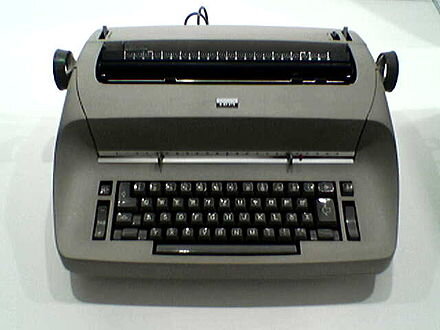
With the newish IBM Selectric typewriters clacking away in the background, I’d chat every hour or so with my office mates, who came from all over Greater Boston and had, for a little office, a remarkably wide range of backgrounds. Most of the men seemed to have served in World War II or the Korean War, and they’d tell me stories about it. The women would often talk about their children, of whom these mostly Irish-and- Italian-Americans, tended to have many, and what was going on in their parishes. But everyone would talk about the news, most of which they’d get from newspapers, which were strewn around the office.
I learned in that office whom to avoid and whom to seek guidance from. One of the latter was an older man, Mr. Gookin, who had had some managerial job at the parent company that didn’t work out and now was a sort of clerk. (Big companies then didn’t fire folks with the abandon they do now.) He took me under his wing. Once, someone, maybe in the cleaning staff, stole $45 I had stuck a drawer. I told Mr. Gookin, who responded: “You’ll lose a lot more than that in this life.’’
Whether in the crowded, smoke-filled and un-air-conditioned newsroom of the old Boston Record America, with its gruff and rumpled scandal-seekers but also with the courtly and natty writer Joe Purcell, who got me the job; the spacious newsroom of the doomed Boston Herald Traveler, which crazies off the streets would sometimes stagger into; the cool and austere newsroom, divided by cubicles, but with many funny people, of The Wall Street Journal, across the street from the doomed World Trade Center; the Art Deco offices of The Providence Journal, and the modernistic but claustrophobic and smoky home of the International Herald Tribune, with its train station-like collection of characters from around the world, there was much to be learned from the people in my office life. Such a range of personalities and backgrounds.
I think that the millions of people who now must work at home will miss a lot of life and learning working at home, though commuting is rarely much fun.
The future summer resort
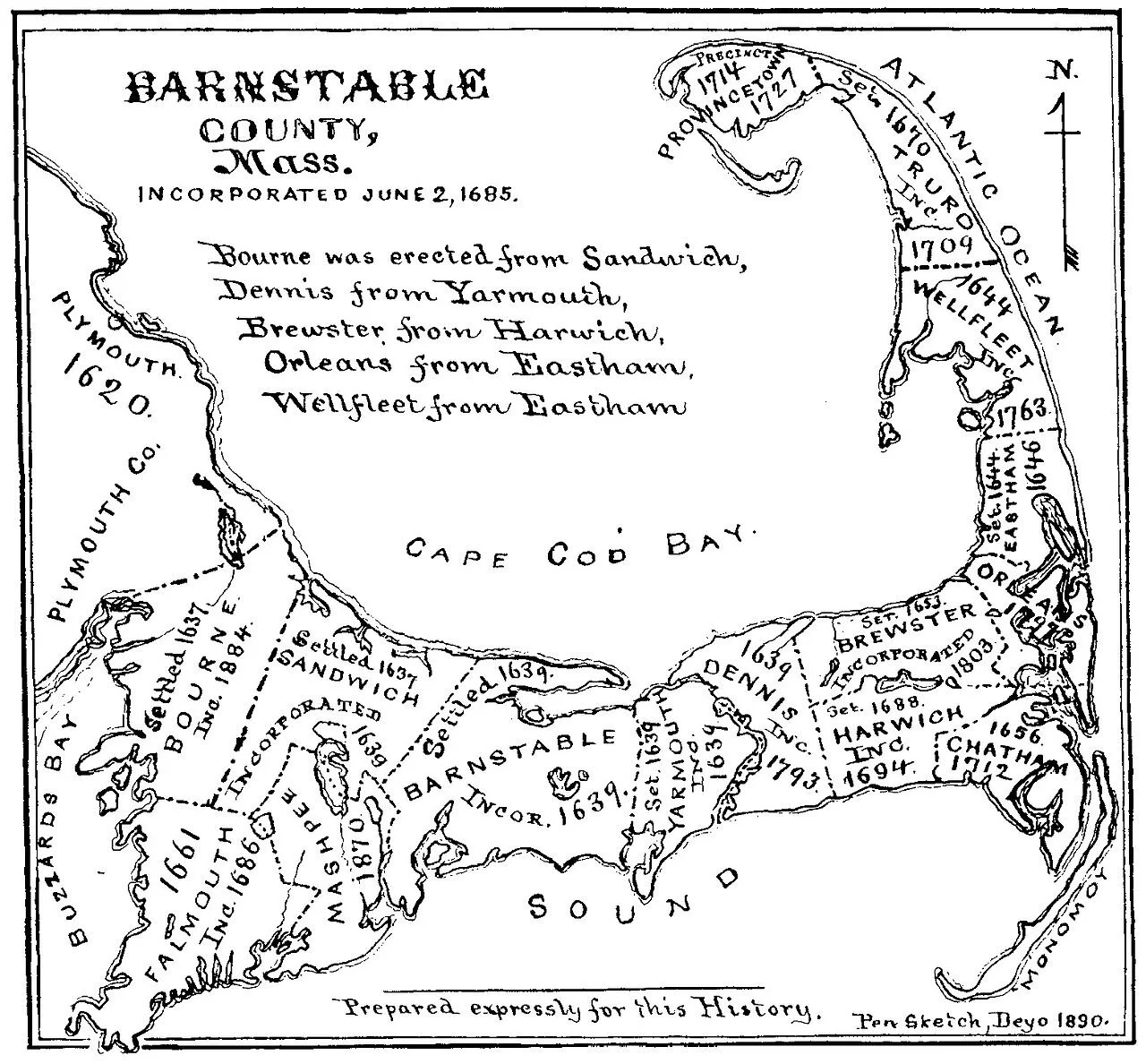
By 1890, the extension of frequent rail service to the Cape was turning the peninsula into a famous place to go in the summer. Many of the natives were ambivalent about this development.
“The time must come when this coast (Cape Cod) will be a place of resort for those New-Englanders who really wish to visit the sea-side. At present it is wholly unknown to the fashionable world, and probably it will never be agreeable to them. If it is merely a ten-pin alley, or a circular railway, or an ocean of mint-julep, that the visitor is in search of, — if he thinks more of the wine than the brine, as I suspect some do at Newport, — I trust that for a long time he will be disappointed here. But this shore will never be more attractive than it is now.”
― Henry David Thoreau, (1817-62) in Cape Cod
Blurred Boundaries

“Francoise” (color and silhouette, video still), by Melissa Shaak, in the group show (seen online) “The Boundaries Between,’’ at Fountain Street Fine Art, Boston, through June 7.
The gallery says:
“Through collaboration, documentation, and experimentation, artists Jim Banks, Joseph Fontinha, Georgina Lewis, A_Marcel, and Melissa Shaak blur boundaries between our physical and virtual domains. They are investigating longevity, beauty, and resilience; surveilling our behaviors, movements and identity; liberating our imagination by bringing fictional characters to life and immerse us in the digital realm.’’

Chris Powell: Whatever the pandemic, most prisoners are not good risks for release

MANCHESTER, Conn.
How high-minded and humane the clergy members and the civil-liberties union people sound as they clamor and sue for the release of all prisoners in Connecticut -- even murderers -- to protect them against the risk of virus contagion in their confined quarters. Hundreds of prisoners and prison staff members have gotten sick from the virus and seven prisoners have died.
But the complaint is nonsense. The state Correction Department already has released scores of prisoners who were near the end of their sentences, behaved well in prison, were considered good risks, and had family or friends to take them in. But even those prisoners will find it almost impossible to get jobs while the state's economy is so sharply curtailed. Unemployment creates bad temptations for parolees.
Most prisoners are not good risks. Most are not near the end of their sentences. Upon release many could not support themselves honestly even if the economy were operating normally. Most do not have housing and family waiting for them. And most still belong in prison.
For while Connecticut's justice system, like all justice systems, has gotten a few cases spectacularly wrong, convicting innocent men of serious crimes, for most people getting into prison in Connecticut requires career criminality. Indeed, the state is full of chronic offenders with 10, 20 or more serious convictions who still have been given little or no prison time and remain free despite their amply demonstrated incorrigibility.
Most released prisoners get in trouble with the law again within two years. While this is partly because they lack job skills and are released without a job and housing, this does not excuse the government for failing to protect society against them. People who cannot support themselves honestly or are so damaged psychologically that they cannot stop harming others must be locked up, epidemic or no virus.
While this should be obvious, it is hard to find any challenge to the sanctimony of the clergy and civil liberties union. But the other day an inhabitant of the real world, New Haven Police Chief Otoniel Reyes, provided a contrary view.
Chief Reyes told the city's Board of Alders that prisoners recently given early release because of the epidemic -- prisoners judged by the Correction Department to be the best risks -- are already causing trouble again in the city, reviving conflicts with old adversaries.
Some "are really violent and should not be coming out," Reyes told the board, adding that about 17 prisoners released early are now especially dangerous in New Haven again.
The chief said he wished that the Correction Department would consult with his department before releasing prisoners likely return to his city.
In a recent letter to Gov. Ned Lamont, 70 clergy members said releasing prisoners early to avoid virus contagion is "a profoundly moral and ethical issue" -- as if the health of prisoners should be the only consideration here. Consumed by sanctimony, the clergy members give no thought to the safety of others, not even in troubled cities like New Haven where serious crime is a daily occurrence.
This doesn't mean that all prisoners should be denied any chance of redemption. It means that anyone who works his way into prison in Connecticut is already a hard case and that health risks, inevitably high in prison anyway, are no reason to keep inflicting him on everyone else.
Chris Powell is a columnist for the Journal Inquirer, in Manchester, Conn.
A liberating wardrobe

She ate and drank the luscious treats--
Restraint had taken flight--
She knew that she was far from slim
And that her clothes were tight--
She bought some caftans, shawls, and capes
And now her spirit sings
Despite her girth--What liberty
A loosened wardrobe brings —
— Felicia Nimue Ackerman (a Providence poet and philosophy professor)

Left doors unlocked
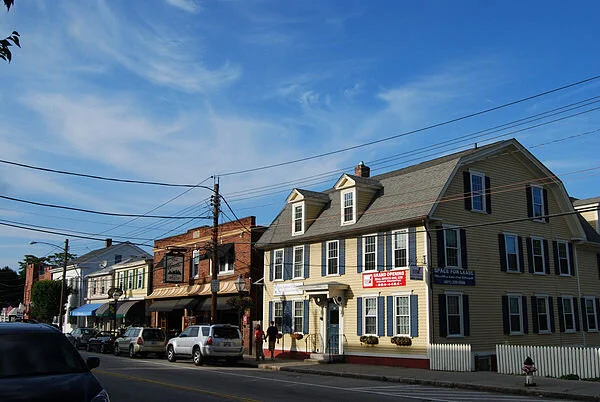
In the old-fashioned downtown of East Greenwich, R.I. on Narragansett Bay
“We moved around a bit when I was younger, but I grew up primarily in Rhode Island, in a beautiful seaside community called East Greenwich. It was a small town, and so safe that we rarely locked our doors at night.’’
— Michelle Gagnon, crime novelist
Giving the land a voice

Kent Falls, in the Litchfield Hills, foothills of the Berkshires
“New England waterfalls like this one {in Kent Falls State Park, Kent., Conn.}, with their white plumes spilling downward from step to step, remind one of the age and gentleness of New England mountains, and, where they flow, they give the land a voice….Even those less vast than the enormous cataracts of Niagara or Yosemite have their own prodigy and their own cadence — and if you listen carefully…you can hear the white voice of New England among the green.’’
From “New England Waterfall,’’ by novelist and critic Robie Macauley (1919-95, in Arthur Griffin’s New England.
Gone groping underground?

— Photo by J. Pinto
By June our brook’s run out of song and speed.
Sought for much after that, it will be found
Either to have gone groping underground
(And taken with it all the Hyla breed
That shouted in the mist a month ago,
Like ghost of sleigh-bells in a ghost of snow)—
Or flourished and come up in jewel-weed,
Weak foliage that is blown upon and bent
Even against the way its waters went.
Its bed is left a faded paper sheet
Of dead leaves stuck together by the heat—
A brook to none but who remember long.
This as it will be seen is other far
Than with brooks taken otherwhere in song.
We love the things we love for what they are.
— “Hyla Brook,’’ by Robert Frost
Llewellyn King: Pandemic will bring harvest of innovation

WEST WARWICK, R.I.
A plow breaks up the soil, turns it over. If seed is put down, that sprouts along with any other seed that happens to be there, weeds and other wild plants.
The new normal will be a plowed field where all sorts of innovations will spring forth. It will be a time of innovation, creativity and the growth of new products and ideas, as well as a few weeds (bad or greedily exploitive ideas).
Many who had what they believed to be steady jobs will become self-employed, dragooned by circumstance into the gig economy. And they will be the shock troops in an invasion of new inventions. At least that is my belief, and it is supported by empirical evidence that when there is turmoil, there is innovation.
Innovation has been on many lips since good things started to come out of Silicon Valley decades ago. The road to riches and to national predominance, it appeared, was through innovation. The rush was on. But it is one of those things, like happiness, that becomes harder to find the more you seek it.
Universities are busy designing courses in innovation. That is predictably opportunistic but probably futile. Imagine a professor teaching this basic innovation course: Quit your job, survive rejection, and work night and day on a hunch. Most people teaching are teaching because they are not risk-takers, and innovation is about risk-taking writ large.
Research, management and procedure are where the formal setting -- the university -- has its place. But none of the great innovators felt the need to study innovation, from Henry Ford and Thomas Edison to Steve Jobs and the reigning king of innovation, Elon Musk.
It is from desire and necessity that that innovation comes; before the venture capitalist has reached for a calculator, somewhere, somehow someone has been working on an idea.
The great challenge of innovation in times of adversity is not creativity but money. Many great ideas are stillborn because money is harder to raise at such times. Financiers are not as brave as innovators. Still a plethora of good things came out of the 1930s, from musical theater to the Polaroid camera. These days there is more mobility of thought and, therefore, there will be more innovation.
In recent years, innovation has come to mean something to do with computing but that is not an exclusive path.
Sometimes innovation is simply seeing a better idea. In 1969, Neil Armstrong walked on the moon. That was an achievement involving a lot of vision, drive, innovation and money. The next year, something huge happened that involved none of the consuming effort of the space program: Wheels were added to luggage.
In 1984, Lee Iacocca produced the minivan. It was a classic example of exaptation -- a term used in evolutionary biology to describe a trait that has been co-opted for a use other than the one for which natural selection has built it. That was true for the minivan: It was a regular van modified and repurposed.
Likewise, one of the few great, modern fortunes not associated with computers came from Greek yogurt. No invention there. The Greeks did that thousands of years ago. It was a good idea from a Turkish immigrant, Hamdi Ulukaya, founder and chief executive officer of Chobani.
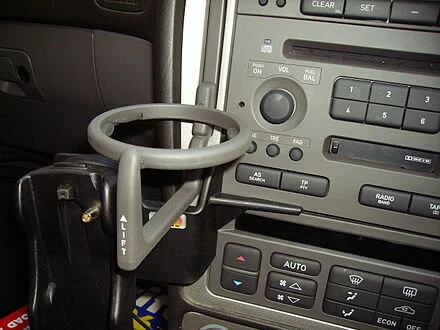
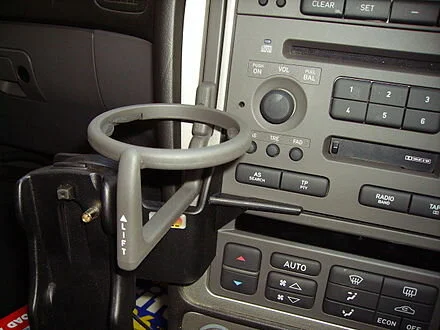
Good ideas are the simplest and most direct way to innovation. Take cupholders in cars. It is extraordinary but true that cupholders began when the convenience store chain 7-Eleven started selling plastic brackets that affixed to your window to hold coffee. In no time, car companies were marketing cars based on the number of built-in cupholders. Not in luxury cars, not in great carriages had so simple a feature been added. That, too, was innovation. Of course, another invention, the throw-away beverage cup, helped.
The lesson is you can innovate, create Uber or Airbnb, if you understand computers. But you can also look around, as with wheels on luggage, cupholders and Greek yogurt, and the true innovator will find products and services aplenty.
The message is, I believe, the true innovator looks around inside the box before venturing outside of it.
Tens of millions of Americans will be ferreting around seeking new and better ways to do things. Some will innovate in ways that will change things forever.
Llewellyn King is executive producer and host of White House Chronicle, on PBS. His email is llewellynking1@gmail.com and he’s based in Rhode Island and Washington, D.C.
MIT, Biogen team up to help students in underrepresented neighborhoods
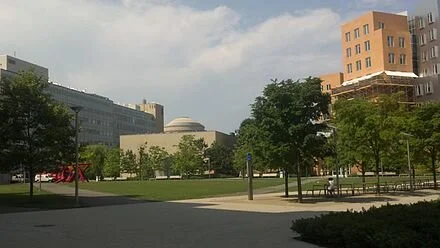
On main campus of MIT, Cambridge
From The New England Council (newenglandcouncil.com):
”Biogen, the international biotech company, and the Massachusetts Institute of Technology, both in Cambridge, have launched a new online learning program targeted at high school students in historically underrepresented communities. Students in the program will participate in lab simulations and mentorship opportunities for free in order to encourage them to pursue careers in science, technology, engineering, and math (STEM) fields.’’
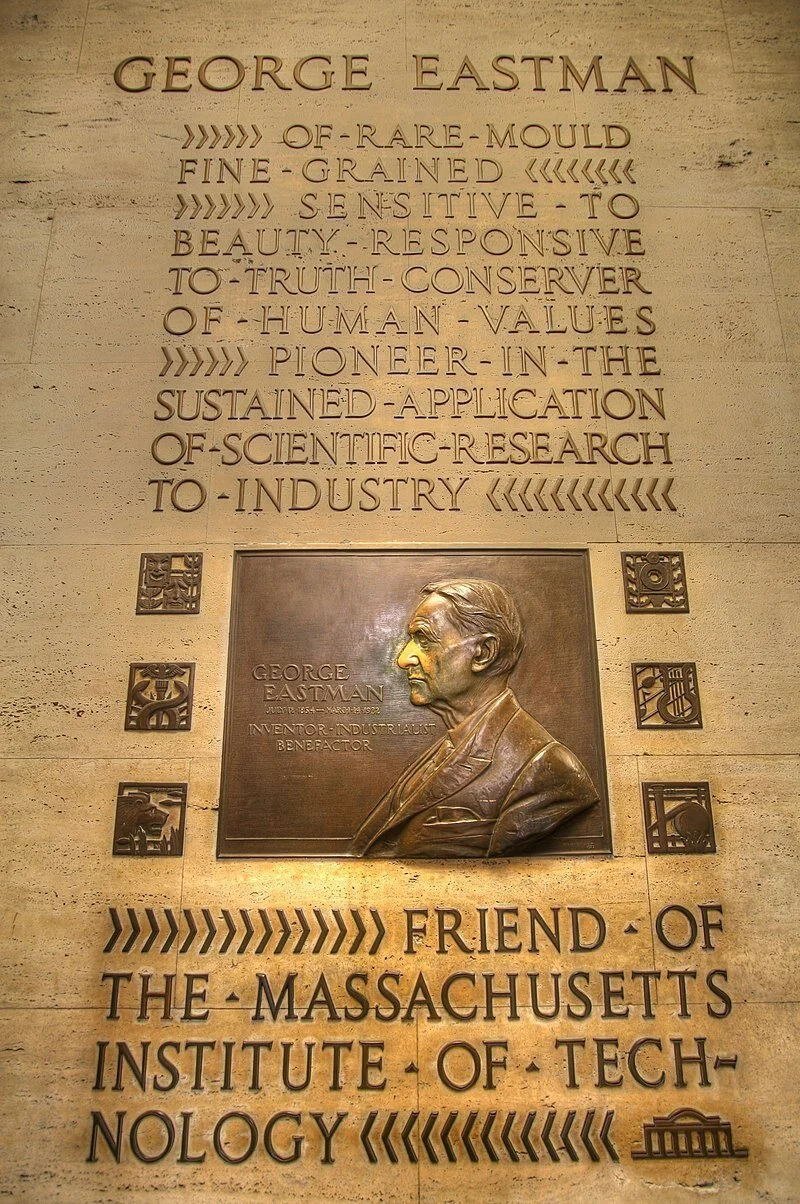
Plaque in MIT’s Building 6 honoring George Eastman, founder of Eastman Kodak, who was revealed as the anonymous "Mr. Smith" who helped maintain MIT's independence.
Bittersweet in jeans at Holy Cross

“1980 In My Calvins’’ ( recycled denim and thread), by Murphy Grady, in the College of the Holy Cross’s (in Worcester)2020 Senior Concentration Seminar Exhibition, moved online by COVID-19.
The exhibit is titled "énouement," chosen by the students to represent the bittersweet feeling of having arrived at the future and wishing to tell one's past self what that future would entail.
Waltz evenings and polka nights
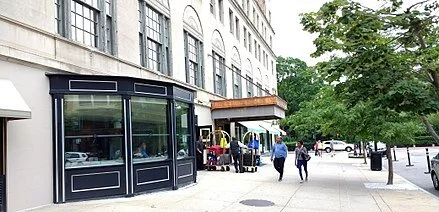
The Newbury Street side of The Newbury Boston, a landmark building across from the Public Garden. The hotel used to be called the Ritz-Carlton, which was opened in 1927 and, along with the Parker House, has long been considered one of New England’s most prestigious hotels.
“Gaining access to the inner sanctum of Yankee society was a vital aspiration for Joseph and Rose Kennedy, but by the 1970s these old longings had become anachronistic. To outsiders, the exclusive Brahmin waltz evenings at the Ritz {Hotel} in Boston became equivalent to the polka nights at the Polish clubs.’’
— Richard D. Brown, in Massachusetts: A History

The Public Garden, created in 1837, was the first public botanical garden in America.