
Vox clamantis in deserto






Global ambitions

“June Graduate” (1920, oil on canvas), by J.C. Leyendecker (1874-1951), Saturday Evening Post’s June 5, 1920 cover, at the National Museum of American Illustration, Newport, used with museum’s permission.
Before social distancing

“Dancing on Air” (acrylic), by Matthew Peake, in Galatea Fine Art’s online (pandemic) gallery. The explanatory text with this: “A bird's eye view of a stunning moment; this is an unusual view of a lively wedding dance. The energy is dizzying when looked upon from this point of view, but the joyous place in time is forever captured.’’
Matthew Peake, M.D., who lives in Rockingham, Vt., which is on the Connecticut River, was a primary-care physician in the Brattleboro, Vt., area for many years before becoming a full-time artist in 2006.
See:
and:
galateafineart.com
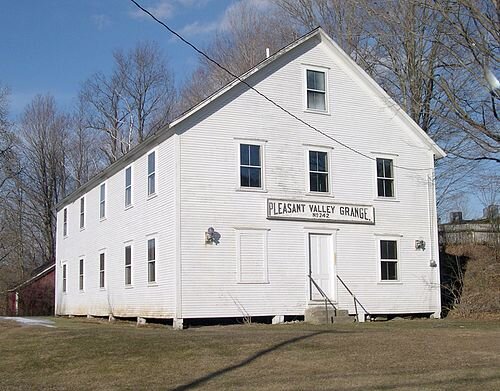
Pleasant Valley Grange Hall, next to the Rockingham Meeting House, in Rockingham, Vt.

Q&A on saving students money via OER
From The New England Journal of Higher Education, a service of The New England Board of Higher Education (NEBHE)
BOSTON
In the following Q&A, NEBHE Fellow for Open Education Lindsey Gumb asks Thomas College Provost Thomas Edwards about the Waterville, Maine, college’s plans to use a new grant from the Davis Education Foundation. The college’s focus on melding access and affordability through OER (Open Educational Resources) is especially relevant in the current shift to online learning at many campuses.

Founded in 1894, Thomas College offers undergraduate and graduate degrees in programs ranging from business, entrepreneurship and technology, to education, criminal justice and psychology.
Six in 10 students at the Waterville, Maine-based institution are “first-generation” college-goers who come from modest means. Thomas is a pioneer in so-called “job guarantees,” in which the college will make payments on federally subsidized student loans or provide tuition-free evening graduate courses for students who are unemployed at six months after graduation. Recently, Thomas added to its “employability” menu a master’s degree in cybersecurity, a co-curricular transcript that allows students to flaunt their leadership development, community service, internship and job shadow experience, and even a golf-readiness program given the student body’s relatively humble roots and how much career networking occurs on the links. Thomas President Laurie Lachance served as a member of NEBHE’s Commission on Higher Education & Employability and as a panelist on NEBHE’s 2019 roundtable on “The Future of Higher Education and the Economy: Lessons Learned from the Last Recession.”
In January 2018, Thomas College received a grant from the Davis Educational Foundation to redesign 30 courses over three years to help save students money on textbook costs—a well-documented and significant barrier to student success. To illustrate, a 2018 survey of Florida’s higher education institutions shows that 64% of students aren’t purchasing the required textbook for their courses because of the high cost, 43% are taking fewer courses, and 36% are earning a poor grade just because they were unable to afford the book. A 2018 study out of the University of Georgia by Colvard, Watson & Park additionally shows that OER goes beyond addressing affordability: OER enables increased learning and completion rates, while also addressing achievement gap concerns for historically underserved groups of students.
Here, Thomas Edwards, provost at Thomas College and member of NEBHE’s Open Education Advisory Committee, shares some insight into his institution’s progress with its Davis grant and how the results are increasing equitable attainment of a postsecondary education for Thomas students.
Gumb: The grant you received from the Davis Educational Foundation is helping Thomas College faculty convert 30 courses over three years using OER. What disciplines are represented in this mix? What does progress look like two years in?
Edwards: From the beginning, we recognized that there were two key goals of the Davis Educational Foundation grant. The first was student success, especially as it is tied to finances. We’ve been able to bring costs down dramatically for students—we had one course that went from a $253 textbook to no cost for students using OER. That’s a real savings for our students.
The second goal is pedagogical. Reworking a course to rely on OER is time-consuming but rewarding. It allows a faculty member to incorporate current materials and to design a course that mirrors the real-world environment: locating sources, analyzing data, communicating and working with real-time information.
To date, we’ve had faculty from across the disciplines participate: science, criminal justice, political science, education, economics, history, psychology, marketing, business finance and philosophy. We have been able to document thousands of dollars in savings to students. Students also report high satisfaction rates—91% indicate that they positively benefited from OER. Student performance as measured by grade distribution shows no statistically significant difference between OER and non-OER versions of the same course. It’s been a win-win across the board for students, faculty and the teaching and learning environment.
Gumb: Thomas College is regionally ranked #8 for social mobility by U.S News & World Report. How has OER played a role in positioning your institution for this achievement?
Edwards: We wanted to use OER to address both access and affordability. If a student can’t afford a book, if they add a course late, or if they have to wait until their financial aid comes in before they can purchase a text, they are already disadvantaged and potentially disengaged from a course. We don’t want them to fall behind.
We very intentionally focused the first courses that we redesigned on those entry-level courses that enroll higher numbers of students. We wanted to have an impact on student engagement and retention. Our success in social mobility is tied to our ability to help students make progress to their degrees.
We want students to be positioned for success. We want students and faculty to have the tools they need at their disposal from day one. That’s simply not the case when dealing with traditional texts. More than half of our students have reported that there have been times when they couldn’t afford the text. They also report that OER materials are more engaging than traditional textbooks. OER eliminates those barriers—motivational and financial. Students can focus on learning, faculty can focus on teaching … and the materials they need are right there for everyone to access.
Gumb: What kind of feedback have you received from your students?
Edwards: Students have embraced OER. Finances are one of the first things they notice. One student commented that “OER benefited my wallet.” But students also notice other aspects of course design. They comment that OER courses seem timelier and more relevant. They find OER courses to be more creative in presenting information. And here’s an interesting perspective: Students observe that because OER materials come from a variety of sources, they find less bias and subjectivity because the materials are more current and are updated more frequently. If we want our students to be information-literate, OER-based courses are one important way to get there.
Gumb: What has the faculty response looked like? Is participation mandatory, and if not, how are you incentivizing participation?
Edwards: Faculty response has also been very positive. Because we are talking about course redesign, we identified participation we wanted to encourage, but not mandate. We wanted to use the grant to demonstrate the benefits to both students and faculty and to encourage progress on both the financial and pedagogical fronts. The Davis Educational Foundation allowed us to provide an incentive through a stipend or a course release for faculty to work together on their redesign. Each semester, we have five slots open for faculty to propose a course. They work together as a cohort, sharing what works and what issues they are encountering.
Many people think that OER is about finding the right online version of a textbook, but it’s much more complex than that. The faculty workgroups spend their time discussing pedagogy and course design.
How do we encourage students to read critically? To engage? To interact? How do we structure assessment? What kinds of activities help build real learning? These are the conversations that bring other faculty into the mix, to encourage them to consider their own courses and how they might adapt. Our faculty report feeling more energized about their course revisions. They value the opportunity to work across disciplines and departments. And in the process, information and library services are integrated in more direct and meaningful ways with course design and delivery.
Gumb: OER are free for students, but they’re not free to create and maintain. How do you intend to address issues of sustainability when the grant money runs out?
Edwards: Sustainability is always a great question. We have engaged our librarian and Information Technology staff from the very beginning to work with the faculty, and they have now built up a great set of reference tools for anyone interested in adopting OER tools in their course design. We’ve involved our Faculty Development committee as well and highlighted at Faculty Senate meetings how OER can be effective for teaching and learning. We make the courses that have been redesigned available for others to adapt or adopt.
It’s ultimately about building into the campus culture a recognition that we need to continue to be conscious about the choices we make as a faculty and how those choices can impact student learning and student success.
Gumb: What advice do you have for senior leaders at independent institutions who might be just starting out with OER initiatives?
Edwards: Our focus from the very beginning was to be explicit about our goals: We wanted to define this opportunity as pedagogical as well as financial. We wanted to be clear that these concepts can and should go hand in hand.
Everyone across the campus can agree on the centrality of student success. Focus on success and focus on student learning. Use data effectively and make sure you can measure your success. We have had faculty at the front and center of the project design and it has worked extremely well. Faculty want their students to learn. OER can help.
In New England's greatest valley

Connecticut River Valley c. 1907, looking toward Orford, N.H. from Fairlee, Vt. Note the capacious open land, some of which was used by sheep farmers supplying the wool for textile mills in southern New England.
The light is always changing
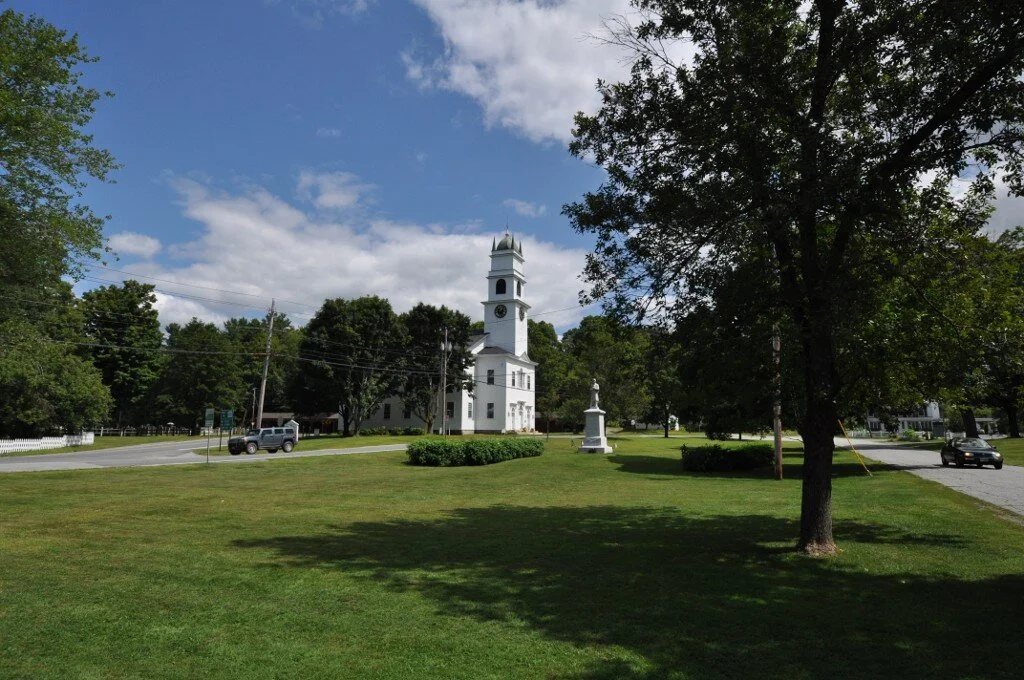
The common of Lyme, N.H.
— Photo by Magicpiano
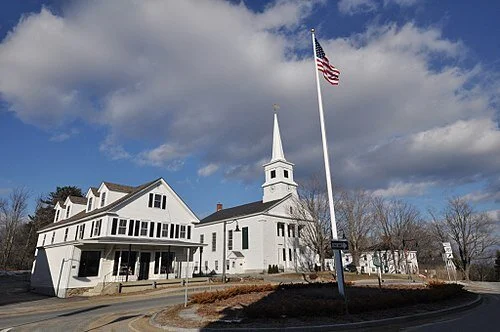
“Downtown’’ Dublin, N.H., the highest town in New England and the headquarters of Yankee Inc., which owns Yankee Magazine.
“I have lived in New Hampshire nearly forty years, and I am still discovering places and moments of beauty that surprise me. Sometimes it may be seeing the same setting — a country road, a hillside, a meadow — in a different light or in a different season.’’
— Mel Allen, editor of Yankee Magazine
Chris Powell: 'The indifference of the majority'

MANCHESTER, Conn.
How laughable that state legislators from both parties are starting to express annoyance with Connecticut Gov. Ned Lamont -- some about the pace of reopening commerce amid the virus epidemic, others about financial issues.
For the governor did not adjourn the General Assembly when he declared an emergency amid the epidemic and claimed the special powers allowed to him by state law. No, the legislature adjourned and scattered itself and has remained adjourned even as all sorts of "essential" workers remain on the job enduring close contact with others, from nursing home aides to supermarket employees to postal carriers.
If those workers can stay on the job, legislators should be able to do the same. Otherwise legislators proclaim themselves inessential.
In the unprecedented circumstances of the epidemic the governor will never be able to please everyone in his pursuit of public safety, and everyone remains free to complain about his executive orders. But unlike ordinary citizens, legislators are free not only to complain about government policy but also to do something about it. Legislation could restrict the governor's powers, undo his orders, and begin to cover the huge state budget deficit caused by the epidemic.
As long as they fail to reconvene, legislators who complain about the governor will only be posturing, not working.
xxx
Meanwhile Local 2001 of the Service Employees International Union, a state employee union, is preparing a publicity campaign to counter criticism that Connecticut's state employee pension system is too expensive and unaffordable amid the huge costs of the epidemic.
According to the union, the expense of the pension system is not even a fair issue. In a message to members seeking volunteers to write letters for publication in newspapers, the union says: "When you open up the paper all you see is a coordinated effort to distort the truth."
That's union-speak for people who dare to disagree with the union. They must be dishonest.
The SEIU message continues: "Are you willing to be involved in the upcoming elections? The state representatives and senators running locally are the ones who make decisions about your health care and pensions. Let's be a part of electing the right people, but we can do that only if you get involved."
Of course government employee union members have the same political rights as everyone else. But unlike everyone else, the unions use those rights nearly every day. They have lobbyists at the state Capitol and, as the SEIU notice suggests, their members staff most legislative campaigns for candidates nominated by the majority party. Their success rate in elections long has been high, for, as the journalist James Reston wrote long ago, the first rule of politics is the indifference of the majority.
So is the SEIU really worried that the damage to state government's finances may be great enough to threaten union control of the legislature and the governor's office?
Does the union really suspect that to restore state government's finances the governor might try to exact from the government class a sacrifice resembling the sacrifice the epidemic has exacted from the private sector?
Does the union really fear that the governor might feel bad that the incomes of government employees have been completely protected during the epidemic while tens of thousands of private-sector workers have lost their jobs and may face higher taxes anyway?
Could the majority in Connecticut actually be induced to care about this disparity and prove Reston wrong for once?
Chris Powell is a columnist for the Journal Inquirer, in Manchester.
You can be a writer too

Main reading room of the Boston Public Library, one of the world’s greatest libraries and research centers.
— Photo by Brian Johnson
“In the Boston Public Library on Boylston Street, where all the
bums come in stinking from the cold,
There was one who had a battered loose-leaf book he used to
scribble in for hours on end.’’
-- From “The Critic,’’ by C.K. Williams (1936-2015)

Cities broken but optimistic

“Broken Earth” (mixed media), by Susan Leskin, as seen in Galatea Fine Art’s (Boston) online gallery.
The text with it says: “There is an architectural component to this piece by Susan Leskin. Cities seem to grow out of a miasma of uncertainty. Bits and pieces take off and float away into a night becoming day. There is an optimism in this work reflected by the energetic candor of the composition.’’
See:
and:
galateafineart.com
Ducks for peace

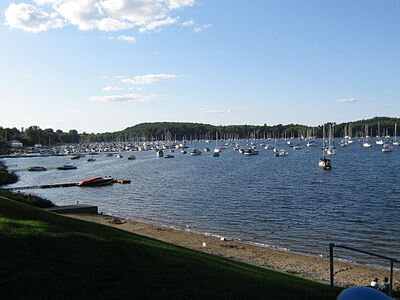
View of Malletts Bay (part of Lake Champlain) from Bayside Park near the center of Colchester. Vt., home of St. Michael’s College.
‘'Now she’s mesmerized by a duck & drake
teaching paddling, oblivious fledgling
how to play follow-the-leader.
A peace sign spreads in their wake.’’
From “A Wake on Lake Champlain,’’ by Greg Delanty, an Irish-born American poet who lives in Burlington, Vt., and teaches at nearby Michael’s College.
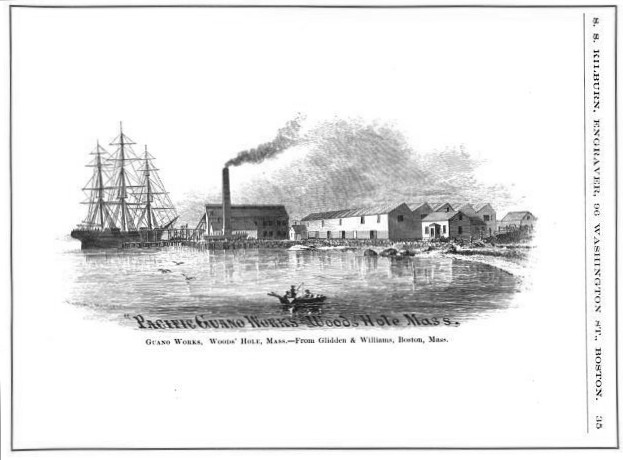
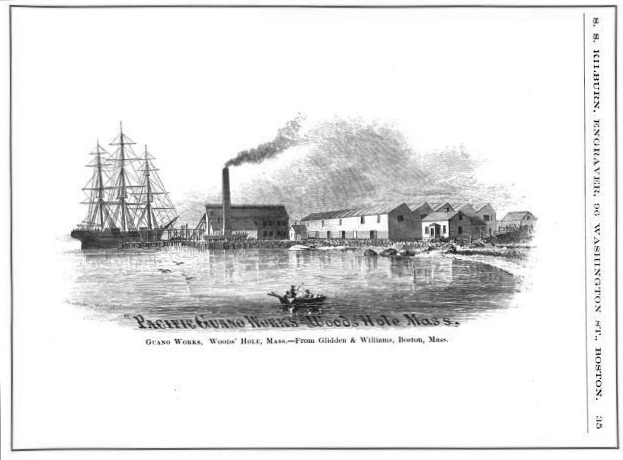
North Country nice; guano mogul?
From Robert Whitcomb’s “Digital Diary,’’ in GoLocal24.com
The three northern New England states – Vermont, New Hampshire and Maine – have had low rates of cases and deaths in the pandemic, especially Vermont. That’s partly because of their mostly rural and exurban character. But it’s also because of good state governance, strong civic sensibility and the stability of communities.
Creative Destruction 101
When seeing the decline of, say, the newspaper business, I think of the disappearance, or at least decline, of businesses my family were in after the Civil War: A great-grandfather’s company made ladies’ riding gloves; another was a partner in a company that shipped guano from South America to make fertilizer (!); other ancestors were in the Midwest iron ore and steel business; some built large wooden boats; one was a partner in a big department store selling stuff to the new rich of Minnesota, and some grew up on farms as recently as the late 19th Century. The economy marches on.
To 'reclaim the commons'

Land’s Sake Farm in Weston, Mass.
“We must rebuild functioning communities with closer ties to the land not just in nostalgic fantasy, not just in token preservation but in substantial daily practice. We must reclaim the commons.’’
Brian Donahue, in Reclaiming the Commons: Community Farms and Forests in a New England Town. The town is Weston, a very affluent suburb west of Boston.
Fred Schulte: Misappropriating Native American culture to scam health-insurance seekers
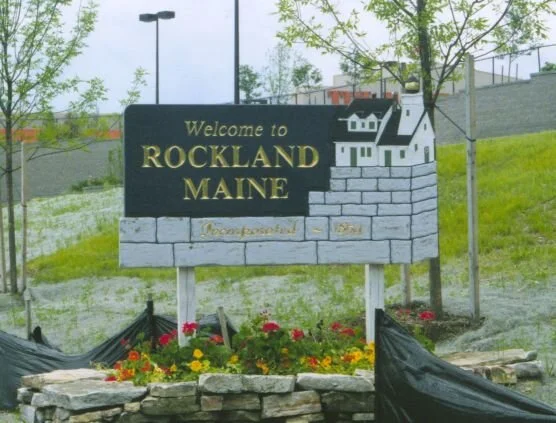
Rockland is on the MidCoast of Maine.
After paying more than $9,000 in premiums and fees over 13 months to O’NA HealthCare, Jill Goodridge says, she could not get O’NA to cover her family’s medical bills. Frustrated, the Rockland, Maine, resident complained to state regulators in summer 2018. “It almost seemed like we were just spending the premium money every month for really not much,” she says. (Shelby Knowles for KHN)
Jill Goodridge was shopping for affordable health insurance when a friend told her about O’NA HealthCare, a low-cost alternative to commercial insurance.
The self-described “health care cooperative” promised a shield against catastrophic claims. Its name suggested an affiliation with a Native American tribe — a theme that carried through on its Web site, where a feather floats from section to section.
The company promises 24/7 telemedicine and holistic dental care on its Web site. It says it provides more nontraditional options than “any other health care plan,” including coverage for essential oils, energy medicine and naturopathic care. All of that and conventional care, too.
It struck Goodridge as innovative. She signed up for a high-deductible plan, paying more than $9,000 in premiums and fees over 13 months, she said. Yet she could not get O’NA to cover her family’s medical bills. For example, O’NA applied only a small portion of more than $6,000 in hospital-related bills against her $10,000 deductible.
“It almost seemed like we were just spending the premium money every month for really not much,” said Goodridge, whose family runs a Rockland, Maine, restaurant that is temporarily shuttered because of the coronavirus pandemic.
A year-long investigation by the state insurance agency prompted by her complaint concluded she was right, uncovering a business scheme operating in the gray areas of insurance regulation and tribal law to appeal to patients looking to save money on health care.
Hers is a cautionary tale for anyone looking for cut-rate coverage at a time when the cost of commercial insurance is rising and a wide range of alternatives are on offer.
Tempting low premiums may mean skimpy coverage with huge out-of-pocket expenses.
“Health insurance is getting so expensive people are looking for other options,” Maine insurance Supt. Eric A. Cioppa said. “We tell everybody that if you do business over the Internet to call us first and make sure it’s licensed.”
O’NA stood out, with a polished Web site featuring its story of holistic health and sun-dappled photographs. The sales pitch: “We’re here to guide you to a new way for your mind, body, and soul.”
Goodridge felt led astray.
The company claimed Native American ties that would exempt it from state insurance regulations because of tribal sovereignty, which gives federally recognized tribes the authority to self-govern outside of state or federal law. O’NA claimed it did not have to adhere to federal insurance requirements, such as guaranteeing standard coverage or maintaining a designated level of funds in reserve to pay claims.
O’NA HealthCare appears to be the first insurer to claim that Native American status exempted it from oversight, according to the National Association of Insurance Commissioners.
The company advertised it was “comfortably nestled under a Native American tribal corporate umbrella” and “protected by the many rights and privileges that Native American Indians enjoy today.”
It sent its customers a “tribal membership ID & benefits card.” And it said it derived its status from an affiliation with the United Cherokee Nation-Aniyvwiya. That tribe is not one of the three federally recognized Cherokee tribes.
But the troubles with O’NA went deeper than that, Cioppa and his team discovered during a year-long investigation. Along with serious doubts that anyone involved with O’NA had valid Indigenous roots, there were financial irregularities, allegations of embezzlement and phony professional credentials.
“The more we found out,” Cioppa said, “the more we wanted to keep digging.”
There was much about Goodridge’s new coverage that seemed unorthodox to the investigators.
She paid a tribal membership fee of $165, which the company said was a tax-deductible contribution to an unspecified Native American tribe. In addition to traditional medicine, O’NA said, its members could seek care at “Native American Tribal Healing Centers” nationwide, though it did not identify the centers or their locations. Goodridge also paid a family premium of $751 a month for 13 months before canceling, according to her testimony before the Maine Bureau of Insurance.
Stranger still, investigators found that O’NA required physicians to pay $485 a year to join its network. Her doctor declined.
On top of that, Goodridge testified, the plan did not pay out when needed, including much of that $6,000-plus hospital bill.
It turned out, that was not uncommon for a company that describes its services as “low cost, high value.” According to a state inspection of O’NA’s unaudited books in fall 2019, the plan spent an “unusually low” amount of the $2.5 million it collected in premiums to cover customers’ medical bills — just 13% or less. Under federal law, most insurers spend 80% or more on benefits for subscribers.
“However low its prices may be, the value it delivers is even lower,” Cioppa wrote in his December order.
Cioppa told KHN that state investigators could not determine the full scope of the operation, partly because O’NA, which boasted an “open provider network across all 50 states,” refused to tell them how many members it had signed up nationwide. It covered only 27 people in Maine.
O’NA’s bookkeeping also turned out to be suspect. Maine investigators observed that in 2019 O’NA paid few medical bills and didn’t keep enough cash on hand to handle even a couple of catastrophic illness claims, a violation of state insurance regulations.
Ultimately, Cioppa ruled that O’NA had illegally operated an insurance company, falsely advertised its benefits and failed to set aside adequate reserves to pay claims.
O’NA’s CEO, L.J. Fay, said the company is working hard to overcome past mistakes, noting: “We plan to make everything right. That is the ultimate goal.”
But in the meantime, Cioppa has prohibited O’NA from selling policies in the state.
The People Behind O’NA
Over the years, Benjamin Zvenia has presented himself at various times as a doctor, a lawyer and a tribal judge. O’NA was described by the United Cherokee Nation-Aniyvwiya as Zvenia’s “brainchild,” according to the Maine insurance bureau order.
He has a paper trail of criminal and civil infractions dating to the early 1990s, government records show.
In a sworn statement filed in Maine, Zvenia said he was a member and “administrative tribal judge” of the Nottoway Tribal Community Meherrin Band of North Carolina. That tribe is not among the 573 recognized by the federal government.
Zvenia also told Maine officials he served on the board of directors of Tribal Active Management Services, O’NA HealthCare’s parent company, but had not been paid for his “voluntary” services and had no responsibility for day-to-day operations. In a sworn statement, Zvenia denied playing a major role in O’NA. He did not respond to repeated requests for comment for this story.
Zvenia, in fact, has a criminal conviction in Nevada for practicing medicine without a license, which prohibits him from overseeing an insurance company, according to Maine officials. He was sentenced to six years in prison, court records show.
In his statement, Zvenia wrote, “There was a crime, and I did the time. My previous history may be public information, but it is not part of my accomplishments today.”
Zvenia’s legal work also has drawn scrutiny. In March 1999, the Nevada Supreme Court removed him from a list of non-attorney arbitrators, citing his undisclosed criminal conviction. A State Bar of Nevada investigation found Zvenia had applied to practice in immigration court, claiming to hold a law license issued by the Supreme Court of the Federated States of Micronesia. But the state bar checked with Micronesia, and it could not verify his claims.
Zvenia also told a state bar investigator that he graduated from the Kensington College “School of Law” in California. The college said Zvenia had applied in June 1994 but “never completed enrollment,” according to an exhibit filed with the Nevada Supreme Court order.
Jill Goodridge took a chance on a nonprofit “health care cooperative” sold online by a Native American company called O’NA HealthCare. After paying more than $9,000 in premiums and fees over 13 months, Goodridge says, she could not get O’NA to cover her family’s medical bills. (Shelby Knowles for KHN)
A founder of O’NA HealthCare was Alan Boyer, a Utah musician who said he was a member of the Cherokee Nation. He was born in West Yorkshire, England, and emigrated to the U.S. in 1998, when he was nearly 40 years old.
Boyer was a founder of a British-style brass band in Utah but also dabbled in the holistic healing arts and naturopathic products before his death in December 2018 from cancer at age 59. In one promotional video for O’NA, Boyer, who spoke with a pronounced British accent, said the word O’NA means “new beginnings.”
“One of Alan’s greatest achievements in his later years was acceptance as a sovereign member of the great Cherokee Nation,” reads an online obituary entered into the record in the Maine proceeding.
Maine regulators had their doubts: “It does not appear from the record that any Native Americans have been involved at any time in the establishment, management or operation of O’NA,” reads the state order.
Lisa Hughes, the former CEO of O’NA and a resident of the Salt Lake City area, also raised Maine regulators’ eyebrows. Investigators found Hughes’ online résumé shows more than a decade of experience in rocket engineering and consulting work in Utah. She recently told Maine officials she had been hired at O’NA because of her prior experience in “systems development and cashflow analysis.”
In an affidavit and other legal filings filed in January, Hughes asserted she worked for O’NA for several years “with no or very reduced salary” before the company suspended her in July 2019 amid a corporate power struggle. The next month, O’NA sent her a letter from a law firm accusing her of embezzling $295,000, filings in the Maine investigation show.
In her affidavit, Hughes said O’NA concocted the embezzlement accusations “for purposes of smearing me and making me the scapegoat for O’NA’s legal formation and structure.”
Lessons Learned ― Or Not
In his December order, Cioppa gave the insurer until Jan. 21 to create a $100,000 fund to satisfy any outstanding medical claims. O’NA failed to do so, and now state officials are seeking a $450,000 penalty, though they aren’t optimistic about collecting it.
Today, O’NA has promised to reinvent itself as a “different type of insurance company,” according to CEO Fay. She said in an affidavit that it is anticipating a capital infusion of as much as $120 million and has $500,000 in reserves in a money market account in a Salt Lake City bank. She also indicated the company would file for a license to legally operate in Maine. So far, that has not happened.
Zvenia is still active online, offering professional and consulting services through Zvenia and Associates in Las Vegas, which says on its Web site that it is a “law firm guided by Benjamin Zvenia, Dr PH, JD.” The site posts a disclaimer: “All Nevada State legal matters are referred out; our lawyers & advocates are not licensed to practice Nevada State law.”
O’NA presents a new wrinkle in an ongoing conflict: The states regulate insurance but the internet allows for nationwide sales, leaving consumers basically on their own.
Goodridge, the Maine consumer who sparked the investigation, said in an interview that she holds little hope of getting any money back. But she has kept other Mainers from the same troubles.
Though O’NA health plans are still available in many states, its website notes that coverage is “not available in Maine.”
Fred Schulte is a Kaiser Health News reporter.
The gods of the hills and valleys

“Rather than fail I will retire with my hardy Green Mountains Boys to the desolate caverns of the mountains, and wage war with human nature at large.’’
xxx
“The gods of the valley are not the gods of the hills, and you shall understand it.’’
—- Ethan Allen (1737-1789), leader of the “Green Mountains Boys,’’ who fought the British in the Revolutionary War. He was the prime founder of Vermont, a politician, farmer, land speculator, philosopher, writer and lay theologian. He most famous military exploit was his role, along with Benedict Arnold, in the capture of Fort Ticonderoga in 1775.
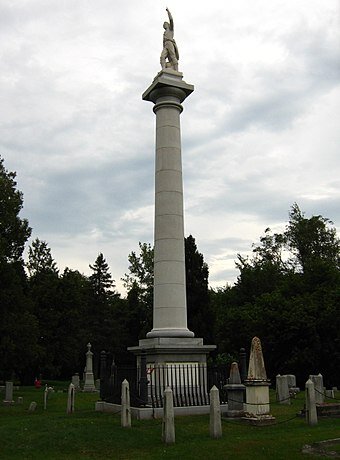
Ethen Allen’s resting place, in Green Mount Cemetery in Burlington, Vt.

Looking south over the Green Mountains from the summit of Mt. Mansfield, at 4,396 feet above sea level the highest mountain in the state.
It signals resilience
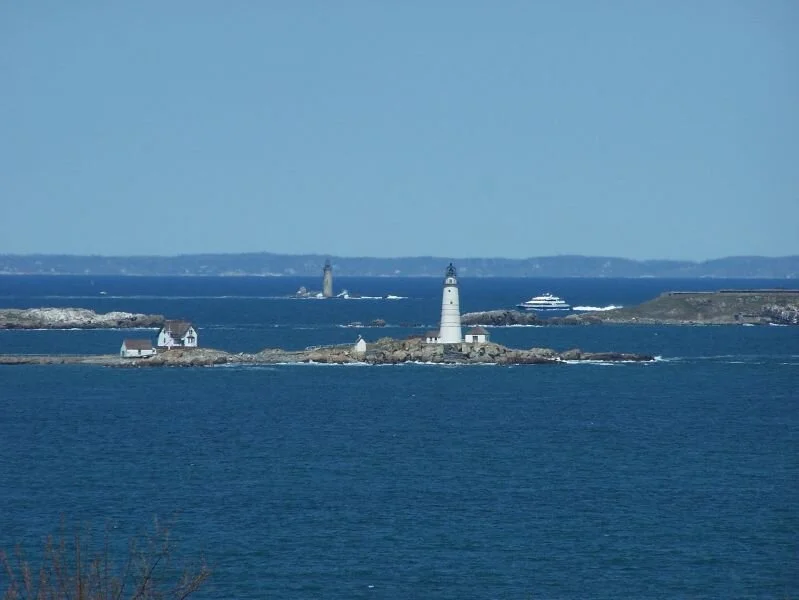
Boston Light with The Graves Light behind and a Provincetown ferry between them on the right.
— Photo by Stephen Gore
From Robert Whitcomb’s “Digital Diary,’’ in GoLocal24.com
Wanna buy a lighthouse? How about Boston Light, on Little Brewster Island, in Boston Harbor? The first version of the lighthouse went up in 1716 and the current one in 1783! Now the Feds want to find a “new steward’’ of the dramatically sited structure to take over and preserve the lighthouse.
Maybe the buyer will be somebody like philanthropist Bobby Segar, who bought Minot’s Light, about a mile off Scituate and Cohasset, Mass., in 2014.
The Boston Globe quoted Kathy Abbott, the CEO and president of Boston Harbor Now:
“This beloved National Historic Landmark is steeped in our country’s history dating to the American Revolution and is as relevant today as an icon of our strength and resilience. Continued public access to this historic American treasure is critical to the public’s ability to enjoy its beauty and history.” Indeed, the lighthouse’s endurance is a reminder that we’ve been through much, much worse times than now.
'Eaten far in Concord'
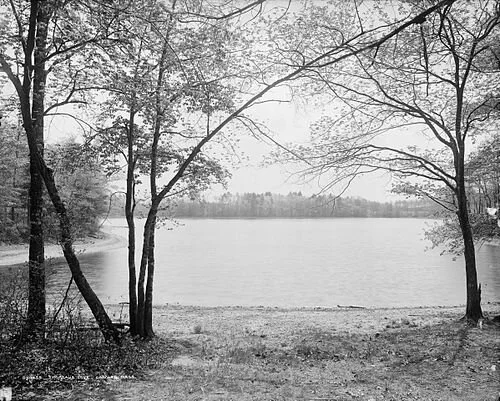
Walden Pond, in Concord, Mass., most famous for its association with Henry David Thoreau (1817–1862), whose two years living in a cabin on its shore provided the foundation for Walden; or, Life in the Woods.
Comestible, comprehensible.
Heaped up in digestible portions
Thoreau had eaten far in Concord
And still this knoll
With its floor of puce-colored leaves
under May’s green mist
feeds the visitor….’’
-- From “Walden Once More,’’ by Robert Siegel (1939-2012), American poet and novelist. He spent much of his life in his native Mideast but in his later years he lived in South Berwick, Maine
Reminders of connection

“Interior 45” (oil on wood panel ), by Carolyn Letvin, a Plainville, Mass., artist who’s showing her work in the Galatea Fine Arts (Boston) online gallery. This text went with it:
“The light splashes in. This interior has seen so many days. There are the remnants of coffee cups clinking, laughter as stories are being told; the chairs take on human characteristics, in conversation, holding the moments of daily life being experienced and cherished.’’
See:
and:
galateafineart.com

Annie Sherman: Expect warmer and wetter

From ecoRi News (ecori.org)
Did you notice that it snowed so little last winter that you barely shoveled, plus it never turned brutally cold? Or that the daffodils bloomed a few weeks earlier this spring? And that there were scores of jellyfish in April, while we typically don’t have to avoid them until summer?
While you might have relished the lack of shoveling and the premature blooms, these regional weather events weren’t random occurrences. They are ongoing evidence. Weather experts across the globe have been citing warmer weather and its consequences for decades, so the four straight warmer-than-normal months — December through March — in the Northeast shouldn’t come as a surprise.
Since 1998, the country has experienced the 10 warmest years on record, and seasonal snowfall from Washington, D.C., to Boston is 1-2 feet below average, according to the National Centers for Environmental Information at the National Oceanic and Atmospheric Administration (NOAA).
This year claimed the second-warmest January-February on record, marking the end of the second-warmest winter on record, trailing the 2016 high by only half a degree, according to NOAA. The average global land and ocean surface temperature for January-February was 2.09 degrees Fahrenheit higher than the 20th-century average of 53.8 degrees.
These numbers indicate a New England winter that was particularly warm for myriad reasons. While global warming tops the list of culprits, we also can blame an erratic jet stream that trapped cold air in the polar region, creating the frequent phenomenon called Arctic oscillation.
“When we have mild winter conditions, it’s driven by a positive phase due to the jet stream position — narrow, fast-moving air currents at 30,000 feet. Currents flow west to east circling the planet, so this winter the jet stream shifted north, trapping cold air in the high latitudes,” said Isaac Ginis, an oceanographer, hurricane expert and professor at the University of Rhode Island. “It was a warm winter everywhere. They brought in fake snow for Moscow’s new year celebrations. Ski resorts were closed in Asia. It was a very odd winter, but we have seen it before.”
A similar phenomenon causes many of our weather events, including cold, rainy springs and blistering-hot summers. Last summer, the jet stream wobbled again, trapping warm air here that led to an extended heat wave; while earlier this month, the jet stream pushed down a lobe of cold air, causing unusually brisk May nights.
This fluky weather, which is common to New England, can be influenced by global warming, Ginis said. Since the jet stream is maintained by temperature differences between the cooler polar vortex in the Arctic and warmer air masses to the south, the jet stream is stronger when this temperature difference is large, and it’s weaker when the variance is slight. Some studies suggest that the jet stream will become wavier, and we’ll have more frequent instances of colder winters and hotter summers. Though Ginis said the jet stream meanders all the time, it’s unusual for it to stay in the same place for months, as we saw this winter, and it’s doing so more frequently, which points to a greater climate shift.
“Although we still don’t fully understand the increased waviness of the jet stream that causes severe weather, it is likely to be associated with global warming,” Ginis said. “But this is the area of active research; computer models are still not very good at predicting longer-term changes in weather.”
Storm clouds on horizon
While NOAA reported that the Northeast was 3.8-4.1 degrees above normal this winter, it also reported one of the wettest winters, with 0.92 inches above average rain accumulation. April continued the wet trend, according to the Northeast Regional Climate Center at Cornell University. The National Weather Service has predicted above-normal precipitation and temperatures for April through June. So, while most of us in Rhode Island anticipate a chilly, damp spring, we hope for more than 12 days a month of clear skies.
“I didn’t think this spring would be this cold. And we were in a pattern that every two or three days we got rain. It’s good because it’s kept the reservoirs up, but Scituate Reservoir is full,” said Lenny Giuliano, state meteorologist and atmospheric scientist for the Rhode Island Department of Environmental Management. “My concern is when we get a three-inch-plus rain event. The Scituate Reservoir can handle an inch every three days, but if we get a whopper, it puts more water in the reservoir and they have to let more water out, which floods the Pawtuxet River. It’s not a very deep river, so it could flood low-lying neighborhoods.”
Giuliano has recorded the state’s weather impacts for 27 years, and advises Gov. Gina Raimondo for best practices during snow storms and hurricanes. He confirmed the NOAA reports that each decade since 1930, average temperatures have risen 0.3 degrees and precipitation has increased at a rate of nearly 1 inch. He warned that these small increments of warmer temperatures and additional precipitation might not be much if they occur just once, but they add up to shocking environmental shifts year over year.
“Temperatures are warming, and warm air can hold more moisture than cold air, so that means a warmer world is a wetter world,” Giuliano wrote in his annual climate report. “Rhode Island has already experienced increased rainfall and more frequent heavy precipitation events, with corresponding increases in river and stream flooding. Ocean water temperatures are warming, which can result in storms being stronger and more intense than they otherwise would be. Plus, sea level is rising, which means coastal flooding will occur more frequently and likely will be worse than otherwise would be the case for a given severity of storm. The combination of sea level rise and beach erosion dramatically increases the vulnerability along the coast, which translates into the potential for more damaging storm surge-driven coastal flooding; and development along the coastline places more property and people at risk.”
Janet Freedman is concerned also. As a coastal geologist for the Rhode Island Coastal Resources Management Council, she has evaluated coastal resiliency and flood mitigation, policy, and practice for more than two decades. While she isn’t an expert on jellyfish or Arctic oscillation, she understands quite well what can happen when we repeatedly get more weird weather than our coastal state can handle.
Though Rhode Island hasn’t experienced a really big storm yet this year, she said we are seeing more nuisance flooding, also called high-tide flooding, which happens when we get the type and frequency of precipitation that April brought — it rained every few days, accumulating to nearly 6 inches, which raised the Ocean State’s water table. And when we get a hurricane, she said, the rising sea will make the flood threat dire.
“We are seeing more and more frequent extreme high-tide events,” Freedman said. “We often have a predicted high tide, around a full or new moon, but it’ll actually be a foot or two higher, so low areas like Oakland Beach in Warwick or Market Street in Warren flood.”
Flooding through stormwater infrastructure is another issue, Freedman said. When the sea level is already high, it moves backwards through stormwater systems, so incoming rain has nowhere to go and backs up onto city streets.
“Right now, we’re seeing it several times a year, and we expect to see more,” she said.
The domino effect doesn’t stop there. The state is doing more testing to show how local marine species and waters are impacted by more frequent rainfall. Since so much of Rhode Island’s land is paved or covered by other impervious surfaces, all that water drains directly into Narragansett Bay, dumping contaminants such as fertilizers, petrochemicals, and pet waste into the state’s most important economic resource.
“When I was a kid, we had sprinkles. Now we get torrential downpours that cause flooding on local streets. That has a big impact on water quality,” said Dave Prescott, Save The Bay’s South County coastkeeper. “Bigger precipitation events wash more pollutants into the bay and salt ponds, which compromises the health of marine animals like oysters and flounder, but also our own health, because we swim and kayak all over the place.”
Sign of the times
During his daily rounds of the local watersheds in April, Prescott noticed blue crabs common in the Chesapeake Bay and scup from as far as South Carolina that have been invading local waters for years, while more tropical fish such as bigeyes, striped burrfish and filefish are more recent southern refugees.
Meanwhile, the bounteous lobsters that Prescott was accustomed to seeing in our usually cold waters are no longer in such plentiful supply. Seeing these species fluctuate is an alarming notion for Prescott, and if we continue with this warming trend, he said, we’ll see big swings of southern species making a permanent home here.
“All taken separately, it’s not much. But these small changes are connected. And that’s the piece that is a little troublesome,” he said. “Some of these storms hitting the Gulf of Mexico are so intense because the water is so warm. And then we have winters that are next to nothing, which leads to ticks and mosquitoes. To suppress the tick population, we need a cold winter with a heavy frost. In addition, they are already spraying Chapman Pond in Westerly for mosquitoes, and last year they sprayed everywhere for mosquitoes. It’s already an issue, and as it warms up, this will get worse.”
You might be wondering what flooding and ticks have to do with a warm winter and early daffodil blooms?
These experts say these issues are dependent on one another. Freedman said a rainy April and sea-level rise are connected. Giuliano said the rise in pesky insects are directly attributed to a warmer winter. Ginis said these changes can be due to a warming of the earth’s atmosphere.
So as global land and ocean surface temperatures continue to rise, the effects are more widespread than we might initially realize — from certain fish arriving earlier in the season to global warming-stimulated jet streams bringing warmer winters and more frequent and extreme rain storms that cause local flooding and erosion to skyrocketing tick and mosquito populations.
“Be aware of your surroundings, be aware that things are changing,” Prescott said. “The sun is coming out now but over the past two days we had 1.5 inches of rain. More rainfall means more runoff, means more potentially polluted water. Understand that our climate is changing, and there may be some positives, but there will be some negatives that can impact our lives.”
Annie Sherman is an eco RI News contributor.
'Great army' of trees
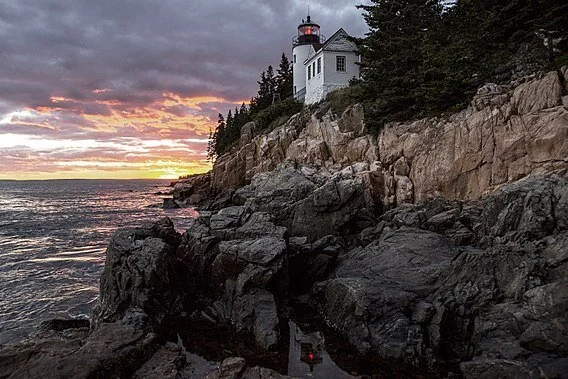
Bass Harbor Head Light in Acadia National Park, Maine.
“We were standing where there was a fine view of the harbor and its long stretches of shore all covered by the great army of the pointed firs, darkly cloaked and standing as if they waited to embark. As we looked seaward among the outer islands, the trees seemed to march seaward still, going steadily over the heights and down to the water’s edge.’’
-- Sarah Orne Jewett (1849-1905), in Country of the Pointed Firs, a novel, or more like a series of sketches, of life on the Maine Coast
Stones in charge
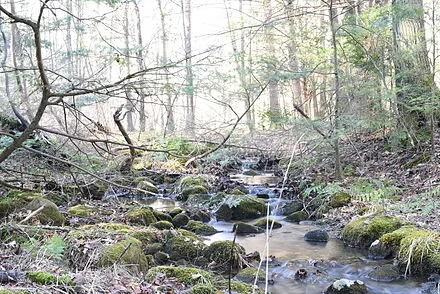
Brook in Southbury, Conn.
‘‘Fact that all this green is second growth…
This is of course New England now and even the brook
…Can never run clear of certain stones….’’
— From “One of Our Walks,’’ by John Hollander (1929-2013), Connecticut-based poet