Vox clamantis in deserto





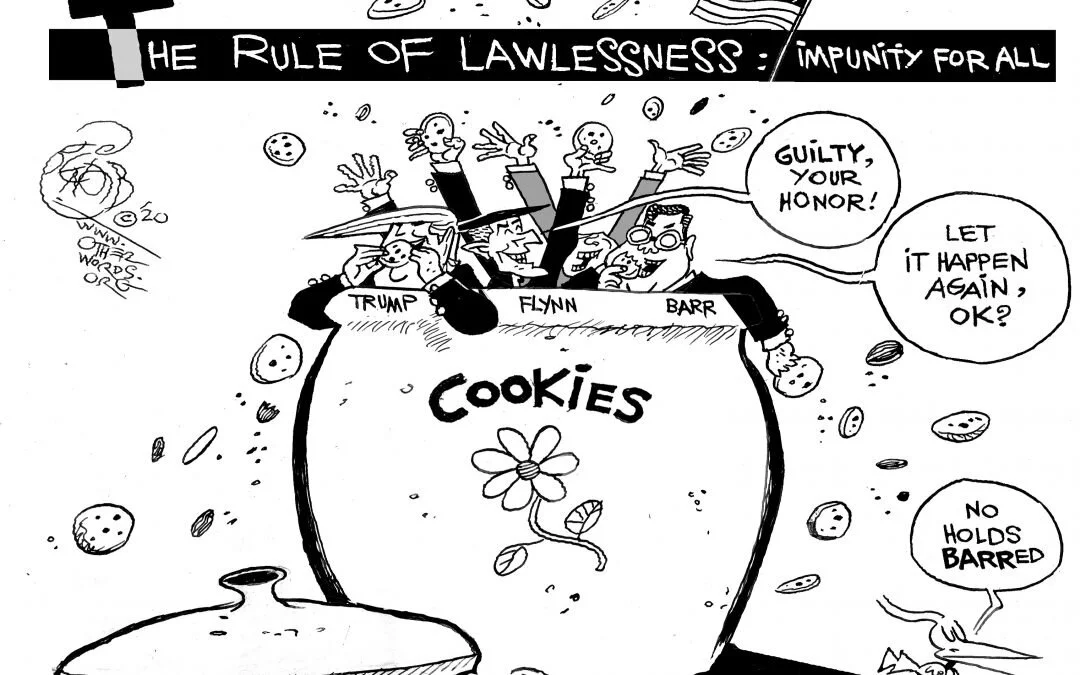
David Warsh: On Russia saga, what did the ambassador say?

Sergey Kislyak in December 2016, when he was Russian Ambassador to the U.S. and talking with Trump man Michael Flynn.
SOMERVILLE, Mass.
In a 2017 book, Because They Could: The Harvard Russia Scandal (and NATO Expansion) after Twenty-Five Years, I argued that the U.S. had unwisely bullied Russia for 25 years, chiefly by extending NATO to its borders. I was therefore sympathetic to Atty. Gen. William Barr’s assertion earlier this month that National Security Adviser-designate Michael Flynn had been within his rights in talking to the Russian ambassador five times on Dec. 29, 2016.
That was the day the Obama administration announced new sanctions in retaliation for Russian cyber meddling in the American election. Apparently Flynn urged Putin not to respond. Putin didn’t.
But that was before it became known that Flynn had been present at a Trump Tower meeting earlier in December at which Trump son-in-law Jared Kushner asked Russia’s ambassador about the possibility of setting up a secret communications channel using Russian diplomatic facilities, in an apparent attempt to shield their communications from monitoring by U.S. officials. It was before the U.S. Intelligence Community’s joint statement on the scope of Russian interference in the 2016 U.S. presidential election was released; before Flynn lied to Vice President Pence, denying he had discussed the sanctions; before Trump fired FBI Director James Comey; before the White House photo-session with Foreign Minister Sergei Lavrov and Ambassador Sergey Kislyak the next day; before Michael Cohen’s revelations of Trump’s Russian business dealings; before the extent of Trump associate Roger Stone’s connections with WikiLeaks founder Julian Assange were exposed; before the investigation of Trump’s Deutsche Bank holdings was paused; before Putin’s ambitious overture of a possible US-Russian anti-hacking treaty came to nought.
In “The Vindication of Michael Flynn,” editorialists at The Wall Street Journal stated that Barr’s motion to drop the government’s case against Flynn “further undermines the credibility of James Comey’s FBI, Special Counsel Robert Mueller, and the entire ‘Russia collusion’ investigation.” None of that seems right to me. Mueller delivered a credible investigation of the narrow point and found no explicit collusion. Instead it uncovered conflicts galore.
Trump’s conduct of Russia policy has been so inept that it almost seems fair that Attorney General Barr is attempting to give him a do-over – despite the damage Barr has been doing to long-standing Justice Department traditions. Barr’s life story is related here and here, His philosophical suppositions are clear, if unconvincing. A finished presentation of his argument awaits the submission of another invited reviewer’s re-examination of the entire Russia investigation.
The only thing that will vindicate Flynn – or fail to vindicate him – is the release of the transcripts of his conversations with Ambassador Kislyak. Although he has declined to do so before, U.S. District Court Judge Emmet Sullivan apparently has the power to require their disclosure.
Meanwhile, what about the problem of establishing an appropriate baseline for U.S.-Russian relations? It remains all jumbled up. The COVID-19 pandemic is hard in Russia, too. A realistic and proper reset awaits the pre-inaugural beginnings of the next administration.
David Warsh, an economic historian and a veteran columnist, is proprietor of Somerville-based economicprincipals.com, where this essay first appeared.
N.E. Council letter to congressional delegation on infrastructure needs
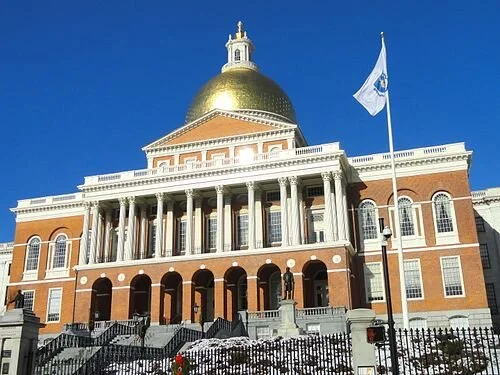
Massachusetts State House
BOSTON
May 5 letter from New England Council President and CEO James T. Brett to the New England congressional delegation:
On behalf of the New England Council, I would like to thank you and your staff for all that you have done in the face of this national emergency to help address the health effects and the economic impacts attributed to the coronavirus outbreak. Our region is fortunate to have such effective leaders advocating on our behalf during this unprecedented time. We are grateful for the relief and economic stimulus measures that have been included in the CARES Act, as well as in the interim supplemental funding measure that was passed just a couple of weeks ago.
This aid will go a long way toward supporting our region’s healthcare providers, as well as the many businesses across an array of industries that have been negatively affected by the coronavirus pandemic.
As Congress continues to work towards mitigating the immediate effects of the coronavirus outbreak, it is necessary to look to ways in which the House and Senate can help lessen the long-term economic implications of this national emergency, while building on your outstanding efforts to date. The New England Council believes that one way to help accomplish this goal is to pursue a job-creating, economy-boosting infrastructure package that addresses a variety of needs for all manner of business, health, education, energy and transportation sectors.
We are heartened that many in Congress share the view that a major infrastructure proposal should be considered, and the New England Council believes the following components should be included in whatever infrastructure package Congress puts together.
Roads & Bridges: The American Road and Transportation Builders Association (ARTBA) recently reported that in 2019, there were 1,513 structurally deficient bridges in New England out of 18,129 bridges. That’s roughly 8.4 percent of bridges in our region, where the national average of structurally deficient bridges is 7.5 percent. We also have a pressing need to fix our roadways to accommodate the increased traffic we’ve seen over the years, not just for carpools and individual drivers but to put roads in a condition that can incentivize bus-rapid-transit (BRT). A state of good repair keeps vehicle maintenance costs down, improves the flow of traffic, enhances safety, reduces gasoline usage, and helps the region attain air quality requirements.
Public Transit: A significant number of residents in our region count on transit to provide a safe, affordable and reliable means of commuting. For others, transit is their only or primary option to get from place to place. The CARES Act included substantial federal assistance for transit, however that funding will address losses attributed to the sudden disruption of daily transportation. When the nation emerges from this pandemic, Americans will still need to be able to count on transit systems. Besides addressing years of transit maintenance backlogs, an investment by Congress to bolster transit can help ensure greater access for commuters, decrease congestion on our roads and improve air quality.
Airports: The CARES Act provided $10 billion in federal assistance to our nation’s airports to meet current needs related to the coronavirus pandemic and the sudden loss of significant amounts of revenue. Pre-pandemic figures showed that airline travel (and thus, airport usage) was expected to proceed on an upward trajectory, but a potential slow recovery from the coronavirus may limit such growth for the foreseeable future. As such, additional considerations may have to be met in the months ahead should losses continue to mount throughout this sector of our economy.
Also, as growth returns to the industry as previously predicted, there will be a need for facility upgrades and new construction to accommodate millions of passengers each day. Ports: The CARES Act also addressed the status of the Harbor Maintenance Trust Fund (HMTF) to help ensure greater utilization of our ports. It is unclear, though, if there will be a requirement for further measures at this point to help increase harbor utilization.
However, as trade with existing partners resumes, and new economic relationships bring heightened activity to our shores, it will be necessary to have enhanced on-shore facility capabilities and channels that can accommodate the vessels that will bring those goods and allow for exports.
Drinking Water and Wastewater Upgrades: Water infrastructure needs across the region constantly demand attention, whether it is for drinking water systems or wastewater treatment facilities. Besides the need to meet new requirements for a growing region, our aging systems – some approaching or surpassing a century old – need replacing as well. Taken together, these needs add up to billions of dollars’ worth of critical expenditures throughout New England. As water quality is enhanced, it ensures health concerns are ameliorated, reduces storm runoff, and keeps our region’s waterways clear of pollution.
Broadband Access: A high priority for any infrastructure bill must include provisions to facilitate and expedite the deployment of broadband. This should include siting proposals that maximize the use of existing infrastructure to accelerate the private sector build-out of wireless 5G networks and funds to install additional infrastructure across the nation, particularly in some of the more remote locations in New England (including western Massachusetts and the northern border regions of Maine, New Hampshire and Vermont). Furthermore, telework, telehealth, and remote learning needs will only increase following the example set forth in this coronavirus pandemic further emphasizing the need for robust wireless and wired connectivity. Finally, any effort on broadband expansion should include all Americans.
Energy Systems: Energy reliability is one of the key requirements for our economy and for our overall way of life. Indeed, energy reliability is required “to make sure the lights stay on.” It is also essential to pursue cost beneficial grid modernization investments that will enable the grid to safely and reliably accommodate new clean energy resources that reduce greenhouse gas emissions. These distributed generation and distributed energy resources include electric vehicle charging stations that will enable a clean transportation revolution, affordable utility-scale solar power, energy storage facilities and technology, as well as offshore wind development.
Rail: Amtrak’s Northeast Corridor is a key component of interstate transportation between Boston, New York and Washington and locations in between. Maintaining this vital rail link helps to alleviate congestion on our roads and provides another transportation option to the traveling public. The Northeast Corridor received nearly $500 million in the CARES Act, however that will not cover the long-range requirements necessary to expand this crucial transportation link. Congress needs to provide the necessary maintenance to the rail infrastructure in our region as well as those regions that feed into New England. Moreover, Congress should give serious consideration to funding regional rail expansion to help relieve congestion, enhance air quality, and spark economic development beyond traditional hub centers.
Hospitals: If the coronavirus outbreak has demonstrated one thing, it is that hospitals must be considered as a part of our national infrastructure. While many of America’s big city hospitals are being stretched to their limits in this emergency, some communities in our nation have no (or limited) hospital resources at their disposal. A Congressional infrastructure package should give consideration to the inclusion of funds for the construction and renovation of hospitals to ensure we have the ability to adequately manage future potential health catastrophes in our cities and towns alike. Moreover, our nation’s veterans should receive ample consideration as hospital expansion progresses.
Pipeline Safety: The Pipeline Safety Act is past-due for reauthorization and supplemental funds to continue its programs will run out by the end of September. Members of the New England delegation, including those serving on the House Transportation and Infrastructure Committee and other committees, have advocated for the renewal of this law. In addition to establishing safety as paramount, we urge Congress to also consider aging pipeline replacement, security, and capacity concerns.
Education: A Congressional infrastructure package should include federal support for capital needs on public and private higher education campuses as well as for elementary and secondary schools. Such investment will be crucial to keeping our education infrastructure modern and able to accommodate students on updated campuses. Additionally, Congress should consider the inclusion of technology infrastructure, including audio and visual infrastructure in classrooms for remote video and participation, virtual desktop infrastructure, learning management systems, broadband, hardware and software, as well as tools that will assist students with disabilities.
Research: Support for our nation’s research infrastructure is necessary to cement our overall research capabilities and boost our competitiveness for years to come. We urge Congress to include such priorities as high-speed computation, easily accessible and large-scale research data repositories, laboratory and research working environments with greater resiliency to pandemics, and core facility upgrades to modernize shared instrumentation and equipment to increase research capabilities, services, and efficiency. Work at such research facilities would put American researchers at the cutting edge of developing cures and treatments for possible future pandemics.
To maximize federal investments in infrastructure, Congress should include in legislation incentives and programs to foster better adoption of digital technologies in the planning, design, construction management and operations of infrastructure. These technologies can help accelerate project delivery, reduce project costs, enhance construction safety, minimize waste and lead to more innovative and sustainable infrastructure for our nation.
Also, whether it’s new construction or necessary upgrades, climate resiliency must be a requisite consideration for project designers and managers alike. Further, it should be fundamental that any new or upgraded infrastructure component requires elements of cybersecurity protection as a core necessity. Additionally, for some state and local governments hit hard by coronavirus, it may be necessary for Congress to give flexibility when considering the economic abilities of non-federal partners to meet cost-sharing requirements on project awards. These are some of the infrastructure priorities that our members have identified, and in the weeks ahead, others may emerge that our members may wish to have addressed.
The Council may seek to reach out further should it become necessary or beneficial to discuss those with you. Both the House and the Senate have already put forth substantive infrastructure proposals, and we urge the members of both chambers to look towards those proposals as you work towards a compromise infrastructure bill; one that will create jobs, boost the economy, and meet existing and anticipated infrastructure needs. Many have dubbed such an effort as a “Marshall Plan for Infrastructure” and that is clearly what the United States can and should accomplish in the wake of this pandemic. Again, on behalf of our members, thank you for all your efforts to date to help combat this virus and help stabilize our region. .
Philip K. Howard: Misdiagnosing why America is a failed state
— Photo by Jblackst
NEW YORK
People want answers for what has gone wrong with America’s response to the COVID-19 pandemic—from lack of preparedness, to delays in containing the virus, to failing to ramp up testing capacity and the production of protective gear. But almost nowhere in the current discussion can one find a coherent vision for how to avoid the same problems next time or help restore a healthy democracy.
Bad leadership has been identified as a primary culprit. The “fish rots from the head,” as conservative columnist Matthew Purple puts it. There’s plenty to blame President Trump for, but stopping there, as, say, former New York Times critic Michiko Kakutani does, ignores many bureaucratic failures. Cass Sunstein gets closer to the mark by focusing on how red tape impedes timely choices, but even he sees the bureaucratic structures as fundamentally sound and simply in need of some culling.
Sunstein suggests that “it might be acceptable or sensible to tolerate a delay” in normal times, but not in a pandemic. Tech investor Marc Andreessen sees a lack of national willpower, an unwillingness to grab hold of problems and build anew. Prominent observers such as Francis Fukuyama, George Packer and Ezra Klein blame a broken political system and a divided culture; they offer little hope for redemption, even with new leadership.
All misdiagnose what caused government to fail here, and they confuse causes with what are more likely symptoms. Fukuyama rightly identifies a critical void in American political culture: the loss of a high “degree of trust that citizens have in their government,” which countries like Germany and South Korea enjoy. But why have Americans lost trust in their government?
No doubt, after this is all over, a report will catalog the errors and misjudgments that allowed COVID-19 to shut down America. The report will likely begin years back, when officials refused to heed warnings about pandemic planning. It will expose the wishful thinking of President Trump, who for almost two months said that the coronavirus was “totally under control.” Errors of judgment like these are inevitable, to some degree—they happened during Pearl Harbor and 9/11, too—and with luck, they will inform future planning. The light will then shine on the operating framework of modern government, revealing not mainly errors of judgment, or cultural divisions, but a tangle of red tape that causes failure. At every step, officials and public-health professionals were prevented from making vital choices by legal obstacles.
Andreessen is correct that Americans have lost the spirit to build, but that’s because we’re not allowed to build. A governing structure that takes upward of a decade to approve an infrastructure project and ranks 55th in World Bank assessments for “ease of starting a business” does not encourage individual and institutional initiative. Of course Americans don’t trust government—it gets in the way of their daily choices, even as it fails to meet many national needs.
Our response to the COVID-19 missteps should not be to wring our hands about our miserable political system, or about the cynicism and selfishness that have infected our culture. We should focus on why government fails in making daily choices. What many Americans see clearly—but most public intellectuals cannot see—is a system that prevents people from acting on their best judgment. By re-empowering officials to do what they think is right, we may also reinvigorate American culture and democracy.
The root cause of failed government is structural paralysis. What’s surprising about the tragic mishaps in dealing with COVID-19 is how unsurprising they were to the teachers, nurses, and local officials who are continually stymied by bureaucratic rules. A few years ago, a tree fell into a creek in Franklin Township, New Jersey, and caused flooding. A town official sent a backhoe to pull it out. But then someone, probably the town lawyer, pointed out that a permit was required to remove a natural object from a “Class C-1 Creek.” It took the town almost two weeks and $12,000 in legal fees to remove the tree.
In January, University of Washington epidemiologists were hot on the trail of COVID-19. Virologist Alex Greninger had begun developing a test soon after Chinese officials published the viral genome. But while the coronavirus was in a hurry, the Food and Drug Administration (FDA) was not. Greninger spent 100 hours filling out an application for an FDA “emergency-use authorization” (EUA) to deploy his test in-house. He submitted the application by email. Then he was told that the application was not complete until he mailed a hard copy to the FDA Document Control Center. After a few more days, FDA officials told Greninger that they would not approve his EUA until he verified that his test did not cross-react with other viruses in his lab, and until he agreed also to test for MERS and SARS. The Centers for Disease Control (CDC) then refused to release samples of SARS to Greninger because it’s too virulent. Greninger finally got samples of other viruses that satisfied the FDA. By the time they arrived, and his tests began, in early March, the outbreak was well on its way.
Regulatory tripwires continually hampered those dealing with the spreading virus. Hospitals learned that they couldn’t cope except by tossing out the rulebooks; other institutions weren’t so lucky. For example, after schools were shut down, needy students no longer had meals. Katie Wilson, executive director of the Urban School Food Alliance and a former Obama administration official, secured an agreement in principle to transfer federal meal funding to a program that provides meals during summer months. But red tape required a formal waiver from each state, which in turn required formal waivers from Washington. The bureaucratic instinct was relentless: school districts in Oregon were first required to “develop a plan as to how they are going to target the most-needy students.” Meantime, the children got no meals. New York Times columnist Bret Stephens, interviewing Wilson, summarized her plea to government: “Stop getting in the way.”
What’s needed to pull the tree out of the creek is no different than what’s needed to feed school kids: responsible people with the authority to act. They can be accountable for what they do and how well they do it, but they can’t succeed if they must continually pass through the eye of the bureaucratic needle.
Reformers are looking in the wrong direction. Electing new leaders won’t liberate Americans to take initiative. Nor is “deregulation” generally the solution for inept government; the free market won’t protect us against pandemics. The only solution is to replace the current operating system with a framework that empowers people again to take responsibility. We must reregulate, not deregulate.
American government rebuilt itself after the 1960s on the premise of avoiding human error by replacing human choice. That’s when we got the innovation of thousand-page rulebooks dictating the one-correct-way to do things. We mandated legal hearings for ordinary supervisory choices, such as maintaining order in classrooms or evaluating employees. We replaced human judgment with rules and objective proof. Finally, government would be pure—almost like a software program. Just follow the rules.
For 50 years, legislative and administrative law has piled up, causing public paralysis and private frustration. Almost no one has questioned why government prevents people from using their common sense. Conservatives misdiagnose the flaw as too much government; liberals resist any critique of public programs, assuming that any reform is a pretext for deregulation. In the recent Democratic presidential debates, no one asked how to make government work better.
Experts have it backward. Polarized politics, they say, causes public paralysis. While hyper-partisanship certainly paralyzes legislative activity, the bureaucratic idiocies that delayed everything from Covid-19 testing to school meals had nothing to do with politics. Paralysis of the public sector came first, leading to polarized politics. By the 1990s, broad public frustration with suffocating government fueled the rise of Newt Gingrich.
The growth of red tape made it hard to make anything work sensibly. Schools became anarchic; health-care bureaucracy caused costs to skyrocket; getting a permit could require a decade; and Big Brother was always hovering. Is your paperwork in order? Americans kept electing people who promised to fix it—the “Contract with America,” “Change we can believe in,” and “Drain the swamp”—but government was beyond the control of those elected to lead it. What happens when politicians give up on fixing things? They compete by pointing fingers—“It’s your fault!”—and resort to Manichean theories and identity-based villains. Public disempowerment breeds extremism.
A functioning democracy requires the bureaucratic machine to return to officials and citizens the authority needed to do their jobs. That necessitates a governing framework of goals and principles that re-empowers Americans to take responsibility for results. Giving officials, judges, and others the authority to act in accord with reasonable norms is what liberates everyone else to act sensibly. Students won’t learn unless the teacher maintains order in the classroom. New ideas by a teacher or parent go nowhere if the principal lacks the authority to act on them. To get a permit in timely fashion, the permitting official must have authority to decide how much review is needed. To enforce codes of civil discourse—and not allow a small group of students to bully everyone else—university administrators must have authority to sanction students who refuse to abide by the codes. To prevent judicial claims from becoming weapons of extortion, judges must have authority to determine their reasonableness. To contain a virulent virus, public-health officials must have authority to respond quickly.
Giving officials the needed authority does not require trust of any particular person. What’s needed is to trust the overall system and its hierarchy of accountability—as, for example, most Americans trust the protections and lines of accountability provided by the Constitution. There’s no detailed rule or objective proof that determines what represents an “unreasonable search and seizure” or “freedom of speech.” Those protections are nonetheless reliably applied by judges who, looking to guiding principles and precedent, make a ruling in each disputed situation.
The post-1960s bureaucratic state is built on flawed assumptions about human accomplishment. There is no “correct” way of meeting goals that can be dictated in advance. Nor can good judgment be proved by some objective standard or metric. Judgments can readily be second-guessed, as appellate courts review lower-court decisions, but the rightness of action almost always involves perception and values. That’s the best we can do.
The failure of modern government is not merely a matter of degree—of “too much red tape.” Its failure is inherent in the premise of trying to create an automatic framework that is superior to human choice and judgment. We thought we could input the facts and, as Czech playwright and statesman Vaclav Havel once parodied it, “a computer . . . will spit out a universal solution.” Trying to reprogram this massive, incoherent system is like putting new software onto a melted circuit board. Each new situation will layer new rules onto ones already short-circuiting.
Nothing much will work sensibly until we replace tangles of red tape with simpler, goal-oriented frameworks activated by human beings. This is a key lesson of the Covid-19 crisis. It’s time to reboot our governing system to let Americans take responsibility again.
Philip K. Howard, a lawyer, writer, photographer and New York City civic leader, is founder of Common Good. His latest book is Try Common Sense: Replacing the Failed Ideologies of Right and Left. This piece first ran in citylab.com
Stone life

“Behind the suburban development
in a boulder-strewn field
Where imagination animates
Erratic granitic herds
Of hippos half-submerged….
a man, like a ‘barber’….
mows the grass around
A knelling elephant of stone….’’
“Megaliths, ‘’ by Robert Chute, a Maine-based biologist and poet
Don Pesci: A hypochondriac uncle and credulous Nutmeggers

VERNON, Conn.
Every family should have at least one hypochondriac. Ours was an uncle who washed his hands multiple times before and after meals. He was fastidious about his silverware, examining it minutely for water stains and polishing it at table with his napkin, much to the annoyance of my mother, even thought the silverware was as spotless as a saint.
One Christmas, the dining room table crowded with family and friends, my mother, attempting to extract a roast from the oven, brushed her hand on the pan, yelped, and dropped the roast to the floor. It spun around like a top and came to a rest touching the radiator, which was not spotless. She shot me daggers and said in a pained whisper full of menace, “DON’T TELL ANYONE ABOUT THIS!”
I immediately fell in with her subterfuge. The roast was cleaned of a dust rat, purified, and bought to the table with no one the wiser. I remember wondering at the time how long the prohibition was to last, for I was yearning immediately to tell my brother and sister about the mishap, but only after the multitude had been fed. These things were meant to be shared with others. What a burden! I watched the uncle devour the meat and wondered whether he would drop dead at table or in the bathroom, after cleaning his hands for the fourth time.
The uncle died relatively young, despite the fact that most members of the family lived into deep codgerdom.
My grandfather on my mother’s side died at ninety-something, full of years, grappa and Toscano cigars, which he smoked Ammezzato.
A few years before he passed on, he had sucker-punched a younger man in the pub he used to frequent because the ill-mannered stranger had insulted a Polish friend of his while the two were playing at cards. The local police brought the unconscious stranger to the border of the town and advised him, when he woke from his nap, that should he return to town – ever – he would be arrested .
When the hypochondriac uncle passed away, my mother whispered decorously to me, “Guess the germs finally got him,” adding, “DON’T TELL ANYONE I SAID THAT!”
The uncle was an expert fisherman, and for years I wondered how he could bear to hook worms on his line, until my father told me he only used dry flies, beautiful, fetching, hand-crafted flies. Even so, he had to unhook the fish and drop it into his often-washed wicker basket, which he wore on his waist, like a gunslinger.
This fastidious uncle would have survived in good order the grosser inconveniences of Coronavirus – no hugging, no handshakes, washing hands frequently after touching polluted surfaces, especially plastic, where the deadly virus remains in attack mode for nearly a day, conversing at a safe distance, avoiding crowds, wearing facemasks, telecommuning with a doctor every time the hairs on the back of his neck prick up in fright, usually after listening to some doomsday-physician on 24/7 Coronavirus coverage networks – because he regarded his immediate environment as a familiar septic system of fatal germs.
To wake each morning was to be alert, focused on the micro-microcosm, to be always on one’s guard, rubbing the plate off the silverware.
To a certain extent, Coronavirus has made cowards of us all – also, hypochondriacs of us all. Normalcy, and the economy, too, have fled the pandemic, screeching and screaming. It will not return, the experts tell us, until the dragon has been slain. And, like a cat, the dragon has nine lives. The choices that lie before many of us now appear to be poverty or death. And, as Yogi Berra might have said, “The future ain’t what it used to be.”
Will we survive? Of course we will. But sociability will have received a blow to the solar plexus, and all of us will be unduly cautious, if not afflicted with hypochondria. In our distress, important distinctions will be lost.
Connecticut has just purchased an entire warehouse of what are called personal protective equipment (PPEs) to protect medical workers from Coronavirus, from Chinese Communists who were principally responsible for transporting Coronavirus from Wuhan to Western Europe. No medical gear has yet been found to protect medical workers from politicians.
If China were Big Pharma some ranter on the left by now would have accused Chinese banking magnates of producing a plague so that they might sell medical gowns and facemasks to credulous Nutmeggers in Connecticut. Shrewd Yankees in Connecticut were called Nutmeggers because they used to put wooden nutmegs in with their produce to gain extra coin from their purchasers. Clever Yankees!
Time is a stream, and no one steps in the same stream twice. Things change. We used to be able to depend on our politicians to steer us in the direction of beneficial change. We are just now emerging – one prays -- from the very first intentionally caused national recession in U.S. history.
When the Coronavirus plague has subsided, the question to which we should demand an honest and unambiguous – i.e. non-political -- answer is this: Have our politicians, assisted by medical “experts” and data-manipulators, been selling us a load of wooden nutmegs?
Don Pesci is Vernon-based columnist.

Automatic hand sanitizer
Opening up

“Connor Pond, Early Spring” (oil on canvas), by Yvonne Lamothe, via Galatea Fine Art online gallery. Connor Pond is in Ossipee, N.H. Ms. Lamothe lives in Massachusetts and New Hampshire.
See:
https://www.galateafineart.com/
and Ms. Lamothe’s site:
Llewellyn King: Group seeks cross-industry, multinational innovation in the COVID-19 battle

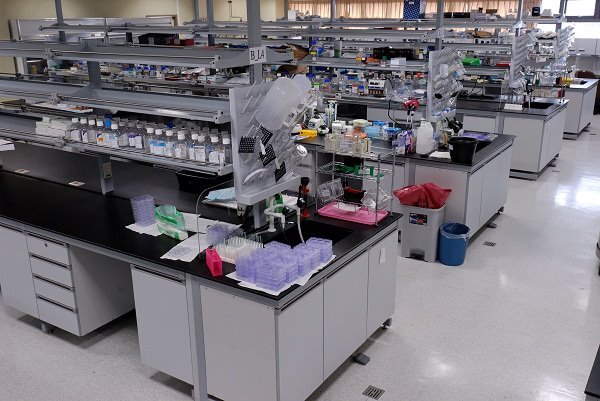
A medical laboratory run by the Graduate Institute of Cancer Biology of China Medical University (Taiwan)
— Photo by P5693852
WEST WARWICK, R.I.
A study envisioning how societies might address the complexities of the COVID-19 pandemic, undertaken by more than 70 leaders in innovation from around the world, is out.
It is the largest, nongovernmental study on the virus, and it paints a picture of a world recalibrated by it — with a heavy dependence on data in making people safer.
The study titled “Never Normal: A Call to Action to Address the New Realities Posed by COVID-19” is a clear-eyed look at the global future from the social pressure of prolonged separation — especially for young people — to stress in the food chain. The authorship is largely scientific and has been drawn from those who are charged with innovation in their work.
These authors, who plan to refine their suggestions and continue their work indefinitely, are banded together as the Cross-Industry Study Group. The group, whose members come from 12 countries (from the United States to Chile to Spain), owes its existence to one man: Omar Hatamleh, a scientist with NASA in Houston.
Hatamleh has been a chief innovation officer at the space agency. For the last four years, he has organized a conference on cross-industry innovation.
These conferences were very different than most industry conferences: They did not discuss money or policy. Instead, they concentrated on innovation in everything, from the future of buildings to how science is contributing to the creation of new video games, and how innovation is applied at the tech giants such as Google and Facebook.
They celebrated, as does Hatamleh, exaptation — using an invention for one thing for an unrelated thing, like a medicine for cancer being used for Parkinson’s disease.
Hatamleh, the prime mover of the “Never Normal” study, and his deputy in the group, Dimitris Bountolos, a Chilean innovation consultant and former airline executive, drew on the creative talent from these conferences to gather the cross-industry group members and execute the study.
The group met remotely — and will continue to meet — in an intense three-week period during which they developed thousands of suggestions and explored as many ideas.
Gradually, they reduced these to two pertinent sections: one that delineates the challenges and the other that identifies the scientific way forward, with an emphasis on data and transparency.
“Never Normal” predicts a W-shaped future where there are waves of COVID-19, reflecting governments’ policies and social reaction. It also says the structures for resolution need to be created by governments and shared between them, so that freedom of movement can be restored, and governments do not poach technology and supplies from each other.
The study says the best hope is that a proven vaccine comes in 12 to 24 months. It sees a great diminution in recreation — theaters and sports — as we know it. It predicts a digital future with intense social surveillance. It offers no panaceas, no silver bullets.
The study is emphatic about sanitation and looks at everything from new air-filtration technology for buildings to monitoring sewage to assess patterns of infection. The sewage does not need to have active virus particles to tell its tale, to show patterns, and to identify trends in infection.
The study sees a future where tracking is vital, using things like smart watches and sensors that are becoming ubiquitous with 5G telephone systems.
In one place, the study suggests that coughing can be identified by sensors and can direct authorities to potentially infected people who have not yet sought treatments. The study calls this “catching the cough.”
The study points to “air sterilization” as another innovative weapon in the COVID-19 fight.
The study states, “There are new nanotechnology-based on laser-induced graphene water filters that eliminate viruses and bacteria in water. This new concept engineered for air filtration could be used in air filters in heating, ventilation and air conditioning or integrated into face masks for a self-sterilizing effect.”
This technology, it says, has the potential to be combined with state-of-the-art air filtration such as HEPA filters.
Part of the significance of “Never Normal” is that it looks at the scientific contribution to stabilizing the world through a lens other than a purely medical one.
Its message: We need all the science we can get.
On Twitter: @llewellynking2
Llewellyn King is executive producer and host of White House Chronicle, on PBS. He is based in Rhode Island and Washington, D.C.
Anguish in Worcester

Worcester’s long-gone Brinley Hall, built in 1836-37, and where the speech referenced below was given. The first National Women’s Rights Convention was held there on Oct. 26 -27, 1850. 1,000 people from 11 states attended.

Abby Kelley Foster
“Man is wronged, not in London, New York, or Boston alone. Look around you here in Worcester, and see him sitting amidst the dust of his counting room, or behind the counter, his whole soul engaged in dollars and cents, until the Multiplication Table becomes his creed, his Pater noster, and his Decalogue. Society says, keep your daughters, like dolls, in the parlor; they must not do anything to aid in supporting the family. But a certain appearance in society must be maintained. You must keep up the style of the household. You are in fault if your wife do not uphold the condition to which she was bred in her father's house. I put this before men. If we could look under and within the broadcloth and the velvet, we should find as many breaking hearts, and as many sighs and groans, and as much of mental anguish, as we find in the parlor, as we find in the nursery of any house in Worcester. But woman is vain and frivolous, and man is ignorant; and therefore, he is what he is. Had his daughters, had his wife, been educated to feel their responsibilities, they would have taken their rights, and he would have been a happy and contented man, and would not have been reduced to the mere machine for calculating and getting money he now is.’’
From speech by women’s rights advocate and abolitionist Abby Kelley Foster at the first National Women’s Rights Convention.
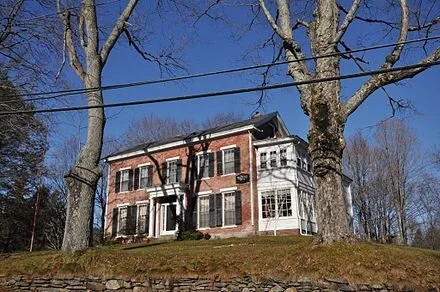
This was Mrs Foster’s surprisingly grand home in Worcester. It’s still a private residence.
The lure of Vermont roads

On the road in the Green Mountains. We sure hope that by next fall the open road will be much more available than now.
— Photo by Alana Cushman, a Killington, Vt., photographer. Hit this link.

A view of the North Ridge area of Killington Peak. Killington is mostly known for Killington Mountain Resort & Ski Area, the largest skl area in the East.

The downtown of tiny Killington, whose official full-time population was 811 in the last U.S. Census, in 2010. Of course, skiiers as well as autumn leaf peepers and other tourists can make for much higher transient populations on some days.
Getting to it in Gloucester
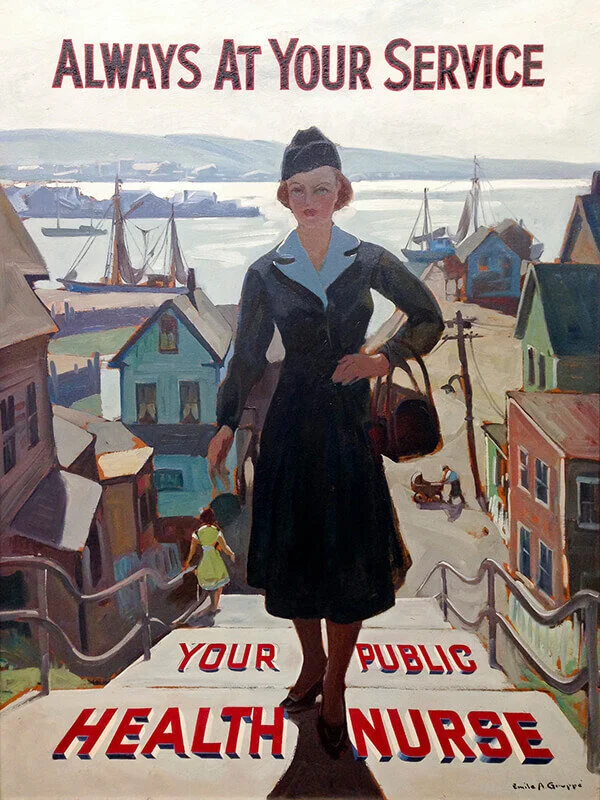
This painting, by Emile A. Gruppe (1896-1978), is owned by VNA Care and is now at the Cape Ann Museum, in Gloucester. It shows a young nurse standing at the top of the stairway that joins Friend and Main Streets in Gloucester.
Lip reading through transparent masks

Staffer at the Brigham wears the hospital’s new transparent mask
— Photo by Brigham and Women’s Hospital
Brigham and Women’s Hospital, in Boston, has made transparent face masks for workers to wear when caring for patients who are deaf, hard of hearing, or otherwise rely on lip reading.

Don't worry yet about 'murder hornets' in N.E., at least not yet

Asian giant hornet
— Photo from Washington State Department of Agriculture
From ecoRi News (ecori.org)
News of the arrival in North America of a non-native insect with the terrifying colloquial name of “murder hornet” has alarmed residents nationwide. But a University of Rhode Island entomologist said there is little reason for Rhode Islanders {and thus by implication New Englanders in general} to worry about them.
Two murder hornets, which are more appropriately called Asian giant hornets, were discovered in Washington State in December shortly after a nest was discovered in nearby British Columbia. Native to Japan, where they are responsible for about 50 human deaths annually, the 2-inch-long insects with orange heads and black eyes are best known for their foraging behavior of ripping the heads off honeybees and feeding the rest of the bees’ bodies to their young.
“Their reputation as murder hornets comes from the fact that they can kill a lot of honeybees in a very short period of time,” URI entomologist Lisa Tewksbury said. “The major concern about their arrival in North America is for the damage they could cause to commercial honeybees used for pollinating agricultural fields. They are capable of quickly destroying beehives.”
Tewksbury said the hornet’s sting isn’t any more toxic than that of the bees and hornets commonly found in New England, but because of their large size, Asian giant hornets can deliver a larger dose of toxin with each sting. They are a danger to humans only when stung multiple times, according to Tewksbury.
“But they’re not known to aggressively attack humans,” she said. “It only happens occasionally and randomly.”
Rhode Island is home to two hornets similar in size to the Asian giant hornet: the cicada killer wasps, which dig their nests in sandy or light soil in areas such as athletic fields and playgrounds, and the European hornet, a non-native species that has become naturalized in New England after its arrival here in the 1800s. Like the Asian giant hornet, they are among the largest wasp-like insects in the world.
Tewksbury said that it’s extremely unlikely that the Asian giant hornets in the Pacific Northwest are in Rhode Island or likely will be soon. The concern is that no one knows how the hornets made it to Washington.
“We don’t know the pathway it took to get to Washington, and since we don’t know, it’s difficult to know how to prevent further introductions into North America,” she said.
Although she noted that Rhode Islanders need not be concerned about murder hornets, she advises residents to keep their eyes out for any unusual insect they’ve never seen before, since non-native insects do occasionally arrive in the region.
If you spot an unusual insect, Tewksbury said, take a picture of it and report it to the Rhode Island Department of Environmental Management’s invasive species sighting form.
Keep 'em out of the woods, if possible; spend local; heroic New England Council

From Robert Whitcomb’s “Digital Diary,’’ in GoLocal24.com
It was good to hear that Rhode Island’s state Renewable Energy Fund has announced that solar-energy companies can apply for part of $1 million set aside to encourage the firms to install their projects on contaminated former industrial space instead of in forests (we need those trees to help fight global warming) and other undeveloped space. It’s a small but commendable start.
As I’ve often written, as much as is economically practical, solar companies ought to put their panels at such places as parking lots, rooftops, landfills, sand-and-gravel pits, etc. God knows that as COVID-19 accelerates the destruction of big box retailers and shopping malls surrounded by windswept parking lots there will be more and more space available for solar-energy farms! And the more of them, the less we must depend on fossil fuel from outside New England.
New England Council’s Fine Work
For near-daily updates on New England’s response to the pandemic look at the New England Council’s Web site – newenglandcouncil.com. It’s superb.
Keep Local Stores in Business
I drove by the Walmart in Providence last Tuesday afternoon. It looked as if you’d need at least 40 minutes waiting in line to get into that depressing establishment. I wish that more people would try to keep their money in our area by patronizing locally owned stores instead of the Arkansas-based behemoth, some of whose stores, by the way, have been COVID-19 hotspots, such as one in Worcester.
I suspect that pandemic-caused unemployment is freeing up time for many more people to shop during what had been their workdays at places like Walmart that offer cheap goods. (I’m an Ocean State Job Lot fan myself. Much friendlier and calmer than Walmart, though, of course less stuff.)
Old Sturbridge Village soldiers on (online) in the pandemic

View of the Center Village section of Old Sturbridge Village.
From The New England Council (newenglandcouncil.com):
“Old Sturbridge Village, in Sturbridge, Mass., was highlighted in the Worcester Business Journal for its transition to online programming in the wake of sudden closures. To continue interaction with visitors, Old Sturbridge Village has expanded its online offerings and educational materials. The museum now offers online lessons on playing 19th-Century board games, preparing a garden, and more. Read the article here.’’
Nice, but looking at something on a screen rather than in real life gets mighty tedious fast.
Old Sturbridge Village, New England’s largest living museum, tries to recreate life in rural New England as it was from the 1790s through 1830s. The 200-acre institution includes 59 antique buildings, three water-powered mills and a working farm. Costumed interpreters speaking in modern English help visitors understand 19th-Century life.

Playing a lawyer in the pre-Civil War law office at Old Sturbridge Village.
Photo by Alphanum3r1c
Negin Owliaei: Right-wingers, some rich folks quite all right with sacrificing the vulnerable
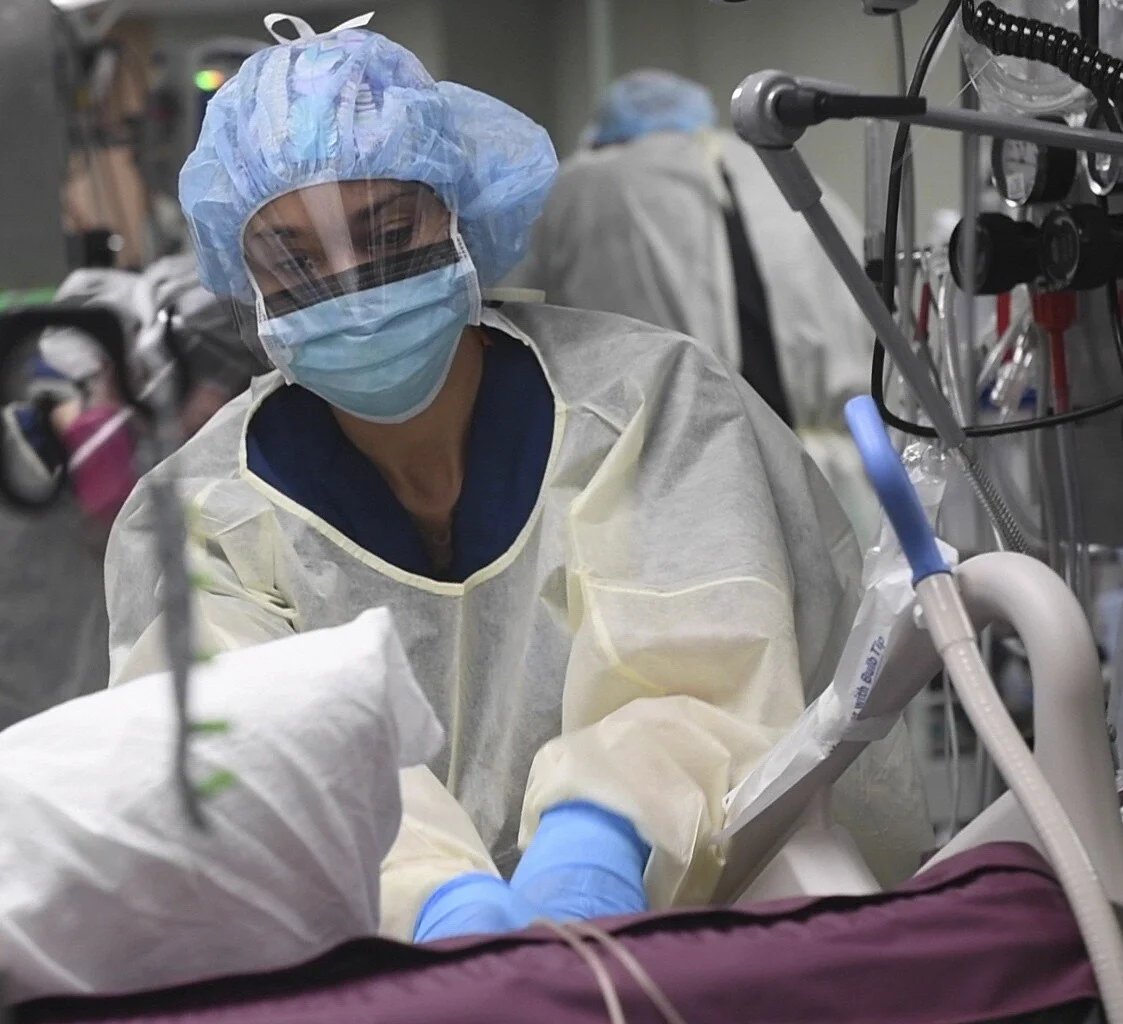
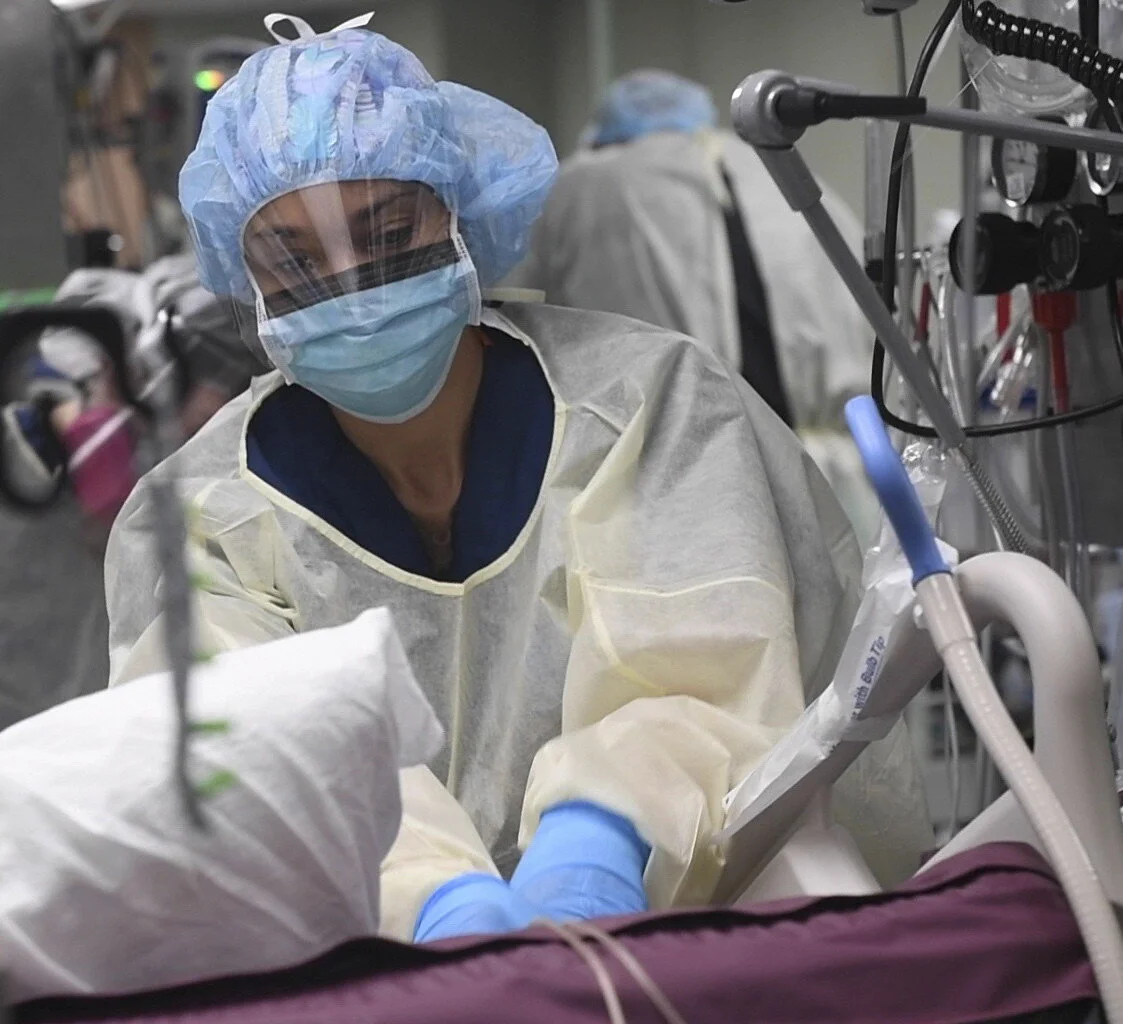
COVID-19 nurse.
From OtherWords.org
Every morning for the last two months, I’ve checked the news in my home state of Florida with growing concern.
First came the photos of unemployed people lining up to file for benefits in person, denied access to an overburdened system. Then came the news that only a tiny percentage of unemployment claims were paid out by late April.
Now, barber shops and nail salons are reopening, even as the state saw its deadliest week yet. Altogether, the news paints a horrifying picture of a government cruelly uninterested in protecting human life.
The overwhelming majority of Americans continue to support social distancing and stay-at-home orders. But right-wing forces across the country are demanding an end to life-saving lockdowns, cheered on by a White House well aware of how devastating the loss of life could be.
The government estimates a death count as high as 3,000 people a day. Despite those horrifying numbers, some states are encouraging employers to report workers who are afraid that returning to their jobs could amount to a death sentence, kicking them off unemployment.
As other countries have shown with far more grace, the alternative isn’t shutting down forever — it’s investing in testing and social safety nets.
Senegal, which has 50 ventilators for its population of 16 million, is building more through 3D printing, all while it trials a $1 testing kit. The world took note of South Korea’s quick and vigorous testing system. Countries across Europe have relied on existing social safety nets to prevent the mass layoffs we’ve seen here in the U.S.
Ghanaian President Nana Akufo-Addo provided necessary perspective: “We know how to bring the economy back to life,” he said. “What we do not know is how to bring people back to life.”
By contrast, the Trump administration’s callousness has become more evident than ever.
Experts have been sidelined in favor of fumbling volunteers from private-equity and venture-capital firms, who botched the procurement of medical supplies. And when Trump finally invoked the Defense Production Act, it was to force meatpacking workers — who are mostly Latinx and Black — to work through unsafe conditions at the very plants that have emerged as outbreak hotspots.
Indeed, those demographics may help explain the government’s willingness to risk lives.
It seems like no coincidence that the far-right pushback became stronger as evidence mounted showing the virus disproportionately killing already marginalized people of color, especially black Americans. And it was hard to miss the Nazi slogan prominently displayed at a “re-open” protest in Illinois, or the Confederate flags featured as far north as Wisconsin.
Government disregard for vulnerable lives is hardly new. Who can forget the New Orleans residents stranded on their rooftops after Hurricane Katrina? Or the disabled New Yorkers left stranded for days after Hurricane Sandy?
Every level of the U.S. government has shown, time and again, that the default setting is to leave the vulnerable behind. But Americans themselves are challenging that approach.
Workers at General Electric protested to switch production to ventilators, a move that could save jobs and lives. Teachers have promised more strikes if schools open against medical advice.
Nurses, in addition to treating the sick, have faced “re-open” protesters head on. And they’ve stood outside the White House, reading the names of their colleagues killed by government inaction and demanding more protections.
Add these actions to the wave of strikes and sickouts from essential workers across the country, and a clear picture emerges: The wealthy may be fine with sacrificing the vulnerable. But workers understand the sanctity of human life, and will fight for it.
Negin Owliaei is a researcher and co-editor of Inequality.org at the Institute for Policy Studies.
Sometimes that’s enough

Marcie Jan Bronstein, “Being Here” (watercolor on paper), by Marcie Jan Bronstein, a Belfast, Maine, painter.
Artscope says that "Bronstein's paintings evoke mindfulness and patience, qualities in short supply during this pandemic but ones we desperately need. Bronstein's intimate and emotional artwork can help us find or create these qualities in ourselves.’’
See: marciejbronstein.com.
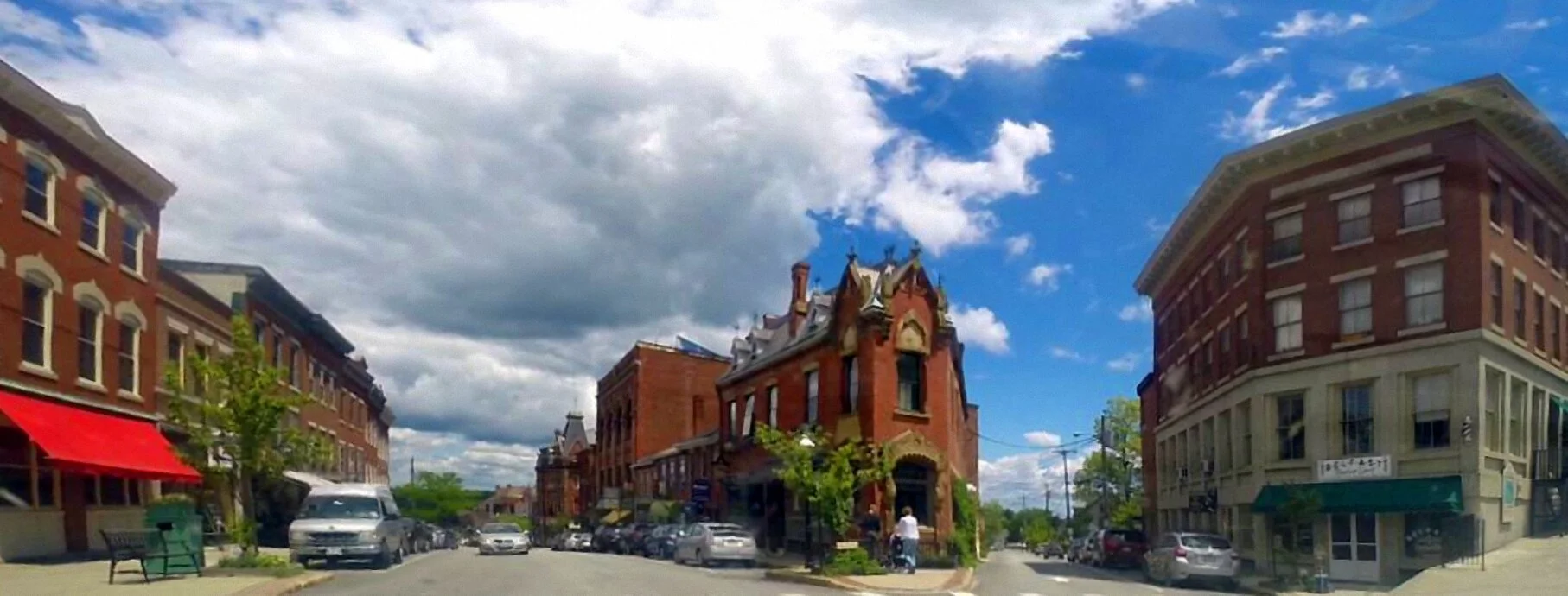
Downtown Belfast from Post Office Square. Belfast, on the Mid Maine Coast, is, among other things an old fishing and boat-building center. It has a rich. collection of historic buildings and draws many tourists and artists.
— Photo by Centpacrr
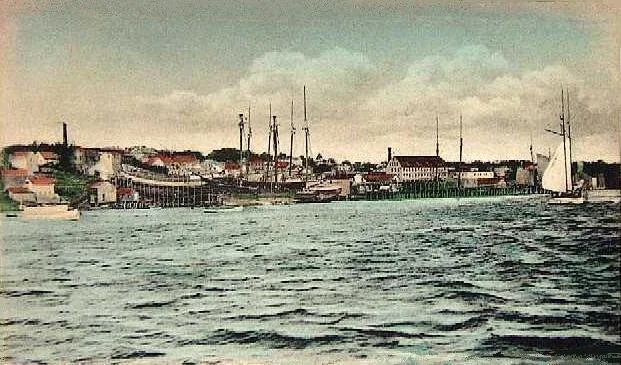
Belfast shipyards in 1905.
Neeta P. Fogg/Paul E. Harrington: What the job implosion means for New England
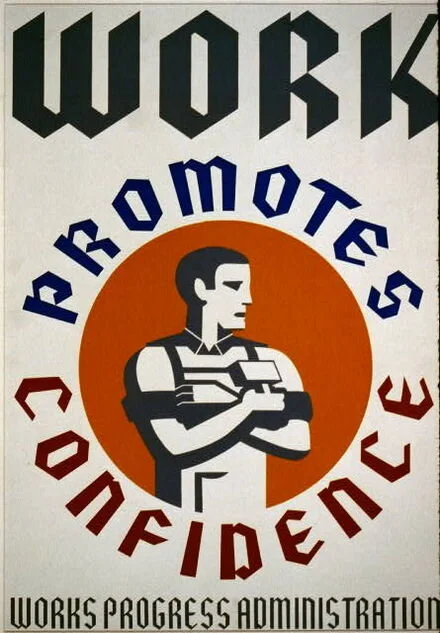
Poster from the New Deal, during The Great Depression.
From The New England Journal of Higher Education, a service of The New England Board of Higher Education (nebhe.org)
Friday, May 8, saw the release of the most disastrous monthly jobs report in American history. In its monthly Employment Situation released last Friday, the U.S. Bureau of Labor Statistics reported:
Payroll employment levels declined by 20.5 million between mid-March when the COVID-19 lockdowns began in earnest and mid-April—a decline that is more than two orders of magnitude greater than any previous monthly job loss in the U.S.
The number of officially unemployed persons rose to a staggering 23.1 million in the mid-April measure, a three-fold increase from 7.1 million unemployed persons in mid-March.
The number of Americans participating in the labor market fell by 6.4 million over the month, and the number of persons out of the labor force who said they wanted a job, but had quit looking, doubled over the month.
About 5 million more workers were forced to work part-time schedules involuntary by mid-April; a doubling of individuals working part-time involuntarily.
Average weekly earnings for private-sector workers rose from $977 to $1,026, attributable to a greater share of higher-wage workers among those who remain employed, as increasing numbers of low-wage and part-time workers have become unemployed, bearing the brunt of this downturn.
The proportion of individuals in the labor force who face some kind of labor market trouble, such as unemployment, involuntary part-time employment or marginal attachment to the labor force, rose from 8.7% in mid-March to 22.8% by mid-April.
In this piece, we try to examine three issues for higher-education institutions and students in New England. First, what is the magnitude of job losses in New England compared with the rest of the nation. Second, how have the shutdowns affected college graduates compared with those with fewer years of schooling, and what might this mean in the recovery. Third, what has been the impact of these losses on teens and young adults and what might that mean for decisions to continue in school.
New England job losses
The monthly business establishment survey conducted by the U.S. Bureau of Labor Statistics produces a measure of the total employment on business establishment payrolls in the week that includes the 12th of the month. Thus, the reported monthly employment measures are a snapshot of the number of jobs in the American economy at mid-month. The 20.5 million jobs lost between mid-March and mid-April, therefore, does not include the losses that occurred after the reference week of the business establishment survey; in the last two weeks of April and the beginning of May.
The lockdown began in mid-March and initial unemployment insurance (UI) claims over the next four weeks, through mid-April, totaled 21.8 million, suggesting a near 1:1 ratio of lost payroll jobs (20.5 million) and new UI claims filed (21.8 million). This is not surprising as individuals eligible for UI benefits must be laid off from a payroll job, and the payroll employment counts are benchmarked each year to state unemployment tax filings that count each tax payment on a social security account as a job. So, there is an inverse proportionate connection between trends in UI claims and payroll employment. During the three-week period between mid-April and the week ending May 2, an additional 11.4 million new UI claims were filed, suggesting that over that period, the country lost an additional 11.4 million jobs, bringing total job losses nationwide to about 33 million (seasonally adjusted) by the beginning of May.
In New England, the number of initial UI claims over the first seven weeks of the lockdown totaled 1.567 million (not seasonally adjusted). Total payroll employment in New England at the beginning of the lockdown was 7.52 million. The surge in initial UI claims and the inverse proportionate connection between UI claims and employment imply that payroll employment levels in the region declined by about 21% since the lockdown began; not far from the implied national employment decline of 20% of the pre-lockdown level of employment.
Most states in New England have similar implied levels of job losses measured with new UI claims as a share of pre-lockdown employment that are within a few percentage points of 20%. The exception is Rhode Island where more than 154,000 new UI claims were filed in the seven-week lockdown period, implying a 31% employment decline in the Ocean State.
These massive implied job losses mean dramatic declines in household incomes resulting in sharp reductions in the level of private consumption and investment. The demand for postsecondary education services is also expected to decline with these income losses. At the national level, the gross domestic product, a measure reflective of national income, in the second quarter of 2020 is expected to decline by a stunning and unprecedented annualized rate of more than one-third, according to research at the Federal Reserve Bank of Atlanta. Surveys of college-bound seniors about enrollment choices for the fall universally reflect worries about family income, according to polls of students conducted by the Art and Science Group, LLC, in March and April 2020.
College graduate employment
Every major industry in the U.S. posted substantial employment losses between mid-March and mid-April. However, job losses were especially concentrated in industries that employed workers with lower levels of educational attainment. Industries with large shares of professional technical and managerial occupations (“college labor market occupations”) had proportionally smaller employment declines.
Nationally, industries with large shares of employment in college labor market occupations, collectively lost about 3.7 million jobs between mid-March and mid-April, representing 6% of their pre-lockdown employment level. Industries that employ much higher shares of production, clerical and service workers saw their employment levels fall by about 16.4 million or 21% of their pre-lockdown employment level. These lower-skill and lower-wage industries accounted for about 80% of the overall employment decline in the U.S. between mid-March and Mid-April. Indeed, the leisure and hospitality industry saw employment decline by about 7.7 million, representing a 47% loss in one month. Eating and drinking establishments, hotels and amusement businesses sustained 40% of the nation’s total employment loss last month.
The disparate impacts of the lockdown across industries has meant that the employment declines among college graduates, although very large, have been much less severe than among people with fewer years of schooling. Employment among adult high school dropouts and graduates fell by 21% and 18%, respectively; a pace of loss that was 2.5 to 3 times greater than the 7% employment decline experienced by college graduates.
The structure of April unemployment rates by educational attainment is reflective of the relative insulation that college graduates have had to the economic effects of the lockdown. The unemployment rate of adult college graduates of 8.4% was equal to just half that of all adult labor force participants in the U.S. This inequality in unemployment rates is likely to persist for some time as the work activities of college graduates seem to allow more geographic and temporal flexibility, primarily through telecommunications systems, than do the work requirements of those employed outside of the college labor market.
Shrinking options for teens and young adults
The labor market for teens (16-19) and young adults (20-24) has collapsed in the past month. While employment levels fell by 13% for adults aged 25 or older, employment among younger people declined at more than double this pace. Employment among teens fell by nearly 1.6 million or 31% over the month, while employment among young adults declined by 3.4 million; a one-quarter reduction.
The employment rate of teens (share of teens with a job) plunged from 30% in mid-March to 21% in mid-April. The employment rates among young adults didn’t fare much better; declining from 64% to 48% between mid-March and mid-April.
Very large employment declines are typical of most labor market downturns, but the magnitude of these losses means that the option of work as a substitute for school has become much less viable for young people.
This also means that the foregone wages from working instead of going to school have fallen dramatically, implying that students will be giving up very little if they decide to go to school. The opportunity cost of college enrollment has been reduced to video chats in mom’s basement instead of employment and earnings.
Recovery in the teen and young adult labor market is likely to occur not months but years into the future. Unprecedented numbers of idle adult workers are anxious to get back to work, while young people remain at the bottom of the hiring queue. Therefore, until the large numbers of unemployed and underemployed adults, who are ahead in the hiring line-up, can get back to work, the employment outlook for teens and young adults remains especially poor.
We realize that this is a truly grim picture of the job market in New England and the nation. Those who believe that the economy should remain closed for an indefinite period—until we find a vaccine or even to the extreme of waiting until we eradicate the novel coronavirus—must understand the grim consequences of the choice to remain closed and the utter havoc it is unleashing on millions of households in New England and the U.S., as well as the irreparable harm that will be done to many of the businesses and institutions that employ them. We do not envy those who are charged with making difficult decisions about reopening, but the discussion above reveals some of extraordinary labor market costs associated with the shutdown strategy. College leadership around the region has begun to recognize this as indicated by a willingness in the last few weeks to undertake efforts to open more fully in the fall.
Decisions about reopening cannot be made solely on the widely varying measures of coronavirus spread. Many real, but unenumerated personal and social costs as well as explicit and implicit economic costs must be considered in the balance. Of particular importance is the unequal distribution of these economic and social costs that is, thus far, heavily weighted toward lower-income, poorly educated and racial and ethnic minority individuals and households.
Originally, when Dr. Anthony Fauci called for a 14-day shutdown in mid-March, the race against COVID-19 looked like a sprint with the reopening of the economy occurring all at once. The expectation was a V-shaped recovery from the coronavirus: a sharp decline and an equally sharp rebound. However, it has become increasingly clear that the race against the coronavirus is more akin to a marathon, and the economic activity at this point looks more like a modified letter L; with a sharp decline followed by a slow recovery.
We expect reopening of the economy to occur gradually and in fits and starts. As we learn more about the coronavirus, business and governments will adopt more refined policy responses to any additional coronavirus threats that occur during the reopening process. We expect reopening across most states to be designed to prioritize strict mitigation strategies to protect the elderly and at-risk populations and maintain many of the social-distancing efforts in play today. Businesses and government will develop and implement many creative measures to protect workers and consumers as they strive to establish a new normal of life-sustaining social and economic activity.
Neeta Fogg is research professor at the Center for Labor Markets and Policy at Drexel University. Paul Harrington is director of the center.
Wartime farming on Boston Common

Plowing up Boston Common before planting vegetables in a World War II “Victory Garden’’ during wartime rationing. I’ve been thinking of Victory Gardens lately as COVID-19-caused supply-chain problems lead many people to consider planting new gardens to supplement their food supplies.
— Robert Whitcomb
Brigham to screen Dorchester residents for food insecurity
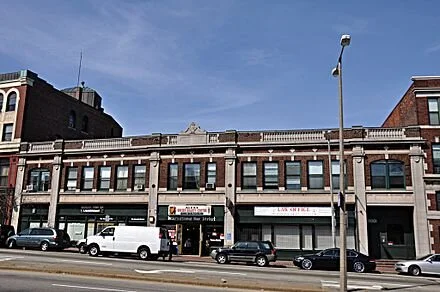
In the Uphams Corner section of Dorchester.
From The New England Council’s (newenglandcouncil.com) latest update on the response of the region’s organizations to COVID-19.
“Brigham and Women’s Offering Hunger Screening with COVID-19 Testing. Brigham Health—which includes Brigham and Women’s Hospital, will begin testing residents of Boston’s Dorchester neighborhood for COVID-19 and will also screen residents for food insecurity, as the pandemic is exacerbating existing food insecurity in the area. Brigham Health will also offer boxes of fresh food, protective equipment, and educational materials for residents. Boston.com reports.’’