

And we loved those little umbrellas!

Ah, those prices in the ‘50s! Bob Lee’s Islander was a very popular Boston restaurant back then.
Using eminent domain to drive folks from flood zones

Watch Hill Harbor, on the coast of southern Rhode Island, which is very vulnerable to flooding, especially in hurricanes
— Photo by Stephg82988
Adapted from Robert Whitcomb’s “Digital Diary,’’ in GoLocal24.com
The New York Times reports that the Trump administration is commendably letting the Army Corps of Engineers tell localities to use the threat of eminent domain to get people to move away from increasingly flood-prone areas or else lose federal flood-mitigation money.
This is part of a shift toward the Corps paying local governments to buy and demolish homes at clear risk of flooding.
The Corps, with the agreement of the administration, realizes that building sea walls, levees and other protections, such as ordering that houses be put on stilts– for which the Corps pays two-thirds of the cost and localities and states the rest – is very expensive and often have to be repeated. Better for safety, and the taxpayers, that people be forced from these places, which are increasingly inappropriate for buildings because of global warming’s effects. But people naturally love being along the water, so such threats get much pushback.
The barrier beaches of South County would be places where we could expect the Corps to get tough like this. Whatever Trump’s manmade-global-warming denials, it’s heartening that his administration is taking this unpopular but needed approach.
But what will they do about such urban flood-prone places as Boston’s Seaport District?
To read The Times’s story, please hit this link.

New England Council update on the response to COVID-19

Beth Israel Deaconess, in Boston, is teaming up with Johnson & Johnson to work on COVID-19 vaccine.
From The New England Council (newenglandcouncil.com):
BOSTON
“As our region and our nation continue to grapple with the Coronavirus Disease (COVID-19) pandemic, The New England Council has been heartened to learn of the incredible steps that so many of our member businesses and organizations are taking to address the crisis and its impact in our communities. If there is one thing that we have learned over the years, it is that in times of crisis, the New England business community never fails to step up to the plate and to draw on its knowledge and expertise to develop innovative strategies and solutions to address the problem at hand.
“And so, we will be using our blog as a platform to highlight some of the incredible work our members have undertaken to respond to the COVID-19 outbreak. Each day, we’ll post a round-up of updates on some of the initiatives underway among Council members throughout the region. We’ll also be sharing these updates via our social media, and encourage our members to share with us any information on their efforts so that we can be sure to include them in these daily round-ups.
“Check back here each day for new updates and you can follow us on Twitter @NECouncil, where we will post a link to the daily update, as well as individual stories.
“Here is the March 16, 2020 roundup:
Beth Israel Teams up with Johnson & Johnson on Novel Coronavirus Vaccine; Provides Glossary of Terms – Beth Israel Deaconess Medical Center (BIDMC) is partnering with the drug-producing branch of Johnson & Johnson (Janssen Pharmaceutical) to develop a potential vaccine for the new coronavirus. Using a common cold virus that delivers coronavirus antigens to stimulate an immune response, BIDMC hopes it will be successful in developing a vaccine for the virus. Read more in the Boston Globe.Also from BIDMC, Doctor Kathryn Stephenson of the Center for Virology and Vaccine Research provided a comprehensive glossary of terms used in describing the novel coronavirus.
Jackson Laboratory Becomes Crucial in Developing Treatments – Jackson Laboratory (JAX) in Bar Harbor, ME, has been “overwhelmed with requests” for mice that produce the protein that the virus is using to enter cells. Originally bred for SARS research, the mice born at Jackson Labs are in high demand, with around 50 labs from around the world ordering more than 3,000 mice for use in their efforts to combat COVID-19. Nature has more.
South Shore Health Provides Information on Exposure to the Virus – South Shore Health has been updating its patients on how those who have been exposed to the virus are notified and how they’re working to keep their patients and community healthy.
Boston Hospitals Prepare for COVID-19 – Boston hospitals—from Beth Israel to Massachusetts General to Tufts Medical Center—are training workers, readying rooms, monitoring supplies in preparation for the continued spread of the novel coronavirus. “We really have been preparing for an outbreak like this for the last five years or more,” one doctor said.
Sanofi Also Ramps up to Begin Testing Drug to Treat COVID-19 – Sanofi, along with Regeneron Pharmaceuticals, is testing whether or not drugs used for patients with immune disorders already on the market—such as their own arthritis drug—can be effective in treating the novel coronavirus.
Northeastern Lab Uses Location as a Case Study in American Response – At Northeastern University’s Emergent Epidemics Lab, researchers are using Boston’s unfortunate status as one of the major sites of novel coronavirus infection to begin early predictions on the scope of the virus’ spread and aid hospitals in estimating what supplies they’ll need as infections spread
“Have your own news you’d like us to highlight? Please email eheisig@newenglandcouncil.com with information.’’
It only looks contagious

Work by Kay Hartung — encaustic monotype, encaustic, pastel on panel on wood panel. This artist lives in Acton, Mass.
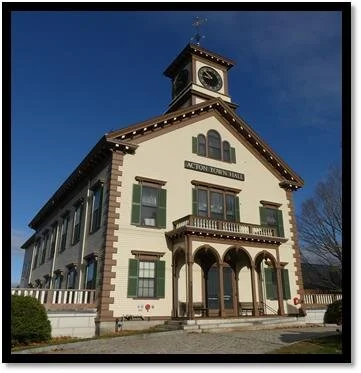
Acton Town Hall
Among the attractions of Acton, an affluent town northwest of Boston: The Discovery Museums, which are two separate science museums on the same site. The Children's Discovery Museum has exhibits for younger children, while the Science Discovery Museum focuses on older ones. The location is guarded by Bessie, the large dinosaur statue and museum mascot, in the front grounds.
Iron Work Farm: Settlement of South Acton; ‘'Iron Work Farm in Acton, Inc.'‘ is a non-profit, historical corporation that operates two historic houses: Jones Tavern and Faulkner House. Each is open to the public on the last Sunday of the month from May to October. The facilities are also open as part of the local Patriots' Day holiday observance each April (probably cancelled this year).
Hosmer House: This Revolutionary War-era home, owned and maintained by the Acton Historical Society, is typically open to the public on Patriots' Day, on Sept. 27 ('‘Crown Resistance Day’'), as well as on May 27 and June 24, from 2 to 4.

Children’s Discovery Museum, in Acton
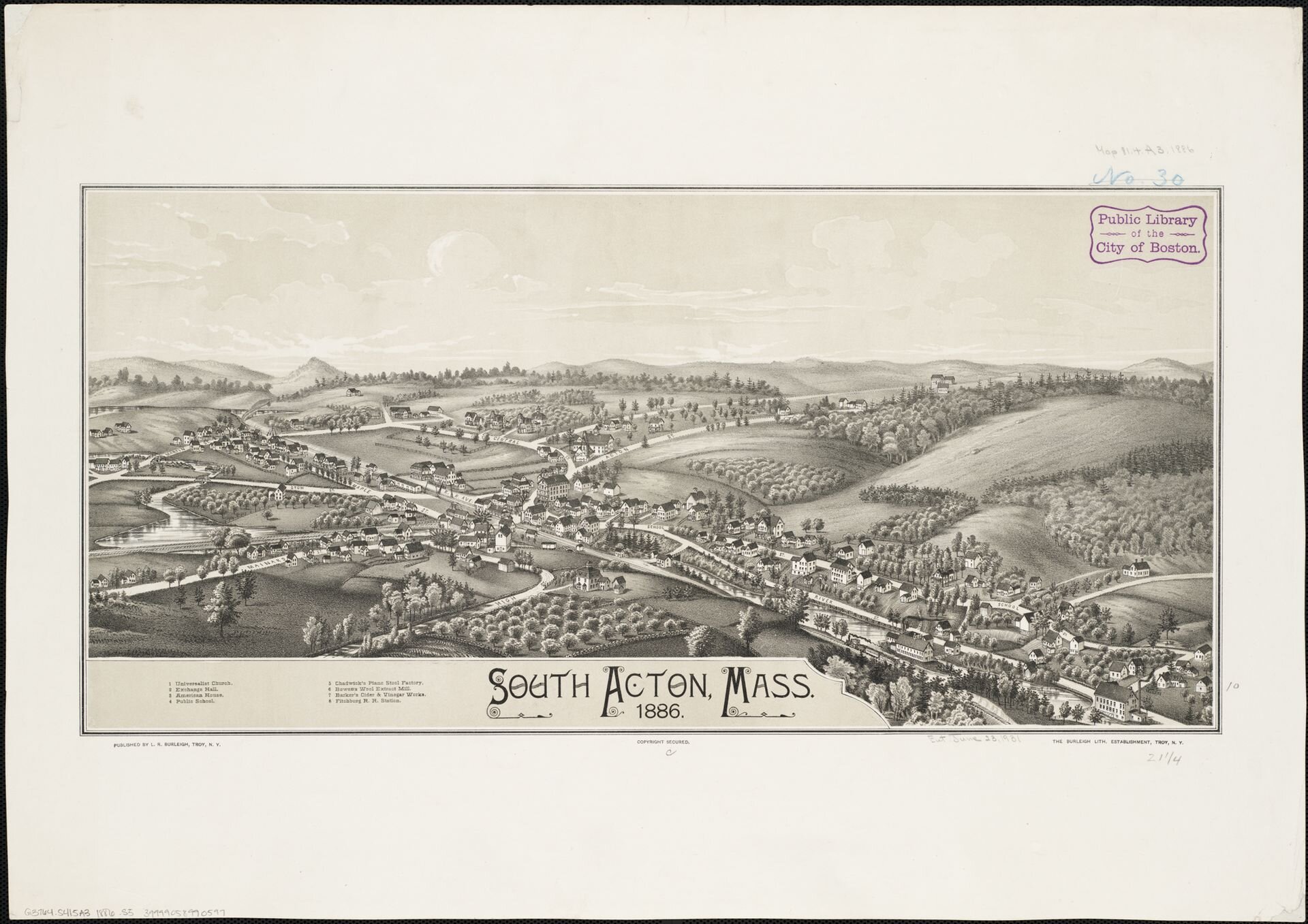
— Map by J.R. Burleigh
Green hell

“There are bogs and bogs but none to equal a Kennebec {Maine} spruce swamp. Whoever has walked in one will find the hot asphalt of Tophet {Hell} a pleasant lawn.’’
— From “Kennebec,’’ by Robert P. Tristram Coffin (1937)
'Grubs all day'

”….he screeches, this is my no-good, barren,
motel-infested spit of sand—on which
he neither toils or spins, but grubs all day
on webbed feet and clever back-hinged knees,
now skittishly sidestepping a gusty
piece of plastic blown against his legs,
hopping to get it off, now shaking it
once or twice to make sure it's worthless
before he turns his face to the wind,
letting it smooth those fine fractious feathers.’
— From “Gulls in the Wind,’’ by Betsy Sholl, a former Maine poet laureate
”…he screeches, this is my no-good, barren,
motel-infested spit of sand—on which
he neither toils or spins, but grubs all day
on webbed feet and clever back-hinged knees,
now skittishly sidestepping a gusty
piece of plastic blown against his legs,
hopping to get it off, now shaking it
once or twice to make sure it's worthless
before he turns his face to the wind,
letting it smooth those fine fractious feathers.’’
—From “Gulls in Wind, ‘‘ by Betsy Sholl
Can only be worn inside

“Intervisible,’’ installation (detail), (hand-dyed cotton batting, watercolor paper, thread, string), by Caroline Rufo, at Bromfield Gallery, Boston, through March 29.
Michael Zimmerman: Dying to protect Trump's ego

From OtherWords.org
My granddaughter’s school had planned a trip to Thailand.
Two things worried me. First, that she or her classmates might be exposed to or catch the coronavirus. Second, that if they did, President Trump would try his best to keep them from returning to the United States.
In my view, if any of them became sick, the first priority should be getting them home where they can have access to the best medical care. In Trump’s view, the first priority is to make things look good for him, no matter what happens to the people he’s stranded.
Therefore he fought having Americans who were stuck on the Grand Princess cruise ship off Japan return home to the United States. His concern? How the number of infected Americans would make him look. “I like the numbers being where they are,” he candidly (and shamelessly) explained.
National health professionals believe that COVID-19 is a serious threat. Every state that’s had an outbreak takes it seriously. So do cities, schools, event organizers, airlines, shipping companies, bus and train operators, museums, and businesses of all kinds — and not to mention the stock market.
Everyday life is changing across the country as millions of Americans adjust to the possible presence of the virus. But facing harsh realities isn’t in Trump’s skill set. “It’s going to all work out,” he assures us instead. “We have it under control. It’s going to be just fine.”
Indeed, he has gone so far as to call the coronavirus threat a “hoax.”
In Trump’s view, it’s all part of a great conspiracy to make him look bad. That real people might die if we fail to face the problem squarely — because no scientist believes COVID-19 is “under control” — doesn’t seem to count for much with him.
The idea that real scientists should guide our response to the pandemic is unacceptable to Trump, because who knows what they might say? Instead, he has made Vice President Mike Pence, a man with little experience in public health, the head of the coronavirus task force.
And consistent with Trump’s main priority — making sure that he looks good no matter what is really happening — U.S. government health officials and scientists have been barred from making public statements about the disease unless okayed by Pence’s office. This is called “controlling coronavirus messaging.”
In one recent instance of “controlled messaging,” the White House overruled a CDC recommendation that the elderly not fly on commercial airlines because of the virus. That would sound too much like there’s a crisis, and Trump is running for re-election on the assertion that everything is wonderful in our country, and it’s all thanks to him.\
Better that more seniors be put at risk of Covid-19 than that the virus be seen as a grave, unfolding danger.
Of course, this is not the only — and probably not the most serious example — of the lethal dangers flowing from Trump’s rejection of inconvenient science. That distinction rests with the other catastrophe Trump calls a “hoax,” climate change. But in either crisis, the worst is yet to come.
Perhaps my granddaughter’s school will cancel their trip. But Covid-19 is already here at home, and it’s not about to disappear just because Trump pretends everything will be “just fine.” She and all of us remain at risk wherever we may be.
Trump says that by April, “when it gets a little warmer,” the virus “miraculously goes away.” Waiting for a miracle when faced with a pandemic is not leadership — it’s insanity. But as long as Trump is in charge, praying for miracles might be the best we can hope for.
Mitchell Zimmerman is an attorney and author of Mississippi Reckoning, a thriller and historical novel about the death penalty and the civil rights movement.

The lack of ornamentation, or other breaks along the surface, on Boston’s 200 Clarendon Street (aka Hancock Tower) skyscraper here, the city’s tallest, is said to worsen the local wind-tunnel effect.
From Robert Whitcomb’s “Digital Diary,’’ in GoLocal24.com
What a nice feeling it is after a windy cold morning to feel the sun on your face after the wind drops off.
Boston is the windiest major city in the United States, partly because it’s on a stretch of ocean frequented by intense storms. The blasts sure hit you in the wind-tunnel effect in the mix of skyscrapers and much older buildings downtown, and in the growing but perhaps eventually imperiled-by-sea-level-rise Seaport District. Very off-putting. The wind-tunnel effect is serious enough that building codes and designs may have to be adjusted in downtown Boston. Architects and city planners are working on the problem. I love many skyscrapers but…
Call him provincial, but...

The Somerset Club, on Beacon Street, Boston, remains a center of Boston Brahmin life.
“Boston is a good place to live in, taken all in all. Probably the best place in this neurotic world, with the possible exception of London, although I am not even sure about this. At any rate, it is the only place I care to live in.
— From The Late George Apley, by John P. Marquand (1937). This novel in the form of a memoir is a satire of Boston Brahmin (WASP upper class) life in the first part of the 20th Century.

David Warsh: Why conservative Caldwell denounces 1964's Civil Rights Act

President Lyndon B. Johnson signs the Civil Rights Act of 1964. Among the guests behind him is Martin Luther King Jr.
— Photo by Cecil Stoughton
Presidential campaigns are built on webs of contingency. If Joe Biden’s candidacy had failed at some stage, Amy Kobuchar or Pete Buttigieg might have run the table against Bernie Sanders. Or Sanders might have run the table against one of them. Or Mike Bloomberg might have gained the Democratic Party’s nomination.
But U.S. Rep. James Clyburn’s speech endorsing Joe Biden before the South Carolina primary established a two-person race practically overnight and vaulted Biden into the lead. “I know Joe,” Clyburn said. “We know Joe. Most important, Joe knows us.” To better understand how 11 words could have been so powerful, I turned to The Age of Entitlement: America since the Sixties, by Christopher Caldwell (Simon and Schuster, 2020.)
Caldwell, a contributing editor to the Claremont Review of Books and an occasional opinion columnist for The New York Times, is one of a handful of authors I follow hoping to understand what has happened to the Republican Party. Myriad streams of opinion influence Republican position-taking, of course. I am interested mainly in those that can be described as revisionist history.
They don’t come much more revisionist than Caldwell. Globalization and technology have little do with the polarization of the present day, according to him. The vile mood stems instead from the passage of the Civil Rights Act of 1964.
What was intended to be “a transitional measure leading to a stable, racially mixed society,” metastasized into the template of a bill of rights for women, immigrants, LGBTs, the handicapped, the aged, and environmentalists, Caldwell says. Courts and bureaucracies have replaced democracy. The ideology of civil rights, relabeled human rights, hardened into a body of legislation and case law that today amounts to a second constitution, according to Caldwell, at odds with the version of 1788.
Those who lost most from the new rights-based identity politics were white men, he writes, because the new laws helped everybody but them. “They fell asleep thinking of themselves as the people who had built this country, and woke up to find themselves occupying the bottom rung of an official hierarchy of races.”
In this telling, the U.S. Constitution’s Fourteenth Amendment, with its guarantees of equal protection and due process under the law, was a bridge too far, passed in the wake of Abraham Lincoln’s assassination. The Thirteenth Amendment, abolishing slavery, would have been enough. The Supreme Court’s decision in Brown vs. Board of Education, in 1954, was a mistake, in that it “put certain public bodies under surveillance for racism.” Rosa Parks was not a weary seamstress looking for a place to sit down on a bus; she was trained agitator, an intellectual leader of the Montgomery, Ala., chapter of the NAACP, a soldier in what Harry Kalven Jr., a long-ago University of Chicago professor of law, described as “an almost military assault on the Constitution.” Robert Bork was “a towering figure in American legal philosophy” for expressing his misgivings about the constitutionality of civil rights legislation. And 1992 presidential candidate Pat Buchanan was a seer, for having run the first campaign against globalization. (For a fuller account of The Age of Entitlement, see Johnathan Rauch’s incisive review.)
Today, Caldwell concludes:
Democrats, loyal to the 1964 constitution, [cannot] acknowledge, (or even see) that they owed their ascendancy to a rollback of the basic constitutional freedoms [of association] Americans cherished most. Republicans, loyal to the-1964 constitution, [cannot] acknowledge (or even see) that the only way back to the free country their ideals was through the repeal of the civil rights laws.
It’s a coherent position, vigorously argued. Its resentment of elites of all sorts, real and imagined, is certainly the tacit position of President Trump. Surely it is a distillation of views opposition to which inspired Rep. Clyburn’s endorsement of Senaor Biden.
David Warsh, an economic historian and veteran columnist, is proprietor of Somerville-based economicprincipals.com, where this column first appeared.
Slicing out a season

There “used’’ to be a winter in New England,
This time of the year.
Pretty soon people will be complaining,
About getting any snow at all.
When Summer and Fall,
Seem to rush to connect with Spring.
— From “There Used to Be a Winter in New England,’’ by Lawrence S. Pertillar
Wards off viruses if you put over your face
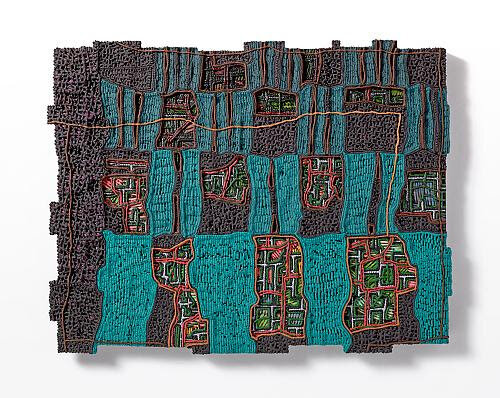
“Up, Over and Around” (acrylic medium, acrylic pigment, wood burning), by Erica Licea-Kane, in her show “Half Spaces,’’ at Kingston Gallery, Boston, through March 29.

Todd McLeish: Pandemics threaten amphibians, too

Green frogs
— Photo by Todd McLeish
From ecoRI News (ecori.org)
As frogs and salamanders emerge from winter hibernation and migrate to their breeding ponds, herpetologists throughout the region are paying close attention to the growing number of diseases threatening amphibians in the Northeast.
The most worrisome is an infectious fungal disease called chytridiomycosis, or chytrid, which has caused major die-offs of frog populations in the tropics and elsewhere and is blamed for numerous frog extinctions in Latin America.
According to University of Rhode Island herpetologist Nancy Karraker, chytrid grows on the skin of frogs, and when it’s found on their drink patch — a site on their belly where they absorb water into their bodies — the fungus makes it impossible for the frogs to regulate how much water they absorb, causing them to become desiccated and die.
“Chytrid has been found in multiple species of frogs in the Northeast, but we haven’t seen massive die-offs here,” said Karraker, a University of Rhode Island associate professor of natural resources science who has studied frogs around the world. “But that doesn’t mean that die-offs haven’t occurred, just that they haven’t been at the scale we’ve seen in South America. So we can’t say it’s not a problem here, and it certainly could become a serious problem.”
Some scientists believe that the disease originated in African clawed frogs, which were shipped around the world for use in human-pregnancy tests from the 1940s to the ’60s. Many of the frogs escaped from captivity and could easily have spread the disease to native frogs in many places. Other scientists believe the fungus was ubiquitous around the globe and that, initially, the only frogs that died were those with compromised immune systems.
“I don’t know where the greatest weight of support is for those ideas today,” Karraker said. “But maybe our frogs aren’t as susceptible because they’re not facing the kinds of stressors that may have impacted frogs in other places. Or it could be something to do with their natural history. We just don’t know, and that’s partly why I’m worried.”
In 2010, Antioch University New England graduate student Mandy Gaudreau, working in collaboration with Lou Perrotti, conservation director at Roger Williams Park Zoo, in Providence, swabbed 47 frogs and toads at 11 sites in Rhode Island and detected chytrid in 21 percent of the samples.
“What struck me about her results is that most of the ponds where she found chytrid were manmade ponds — farm ponds, retention ponds,” Perrotti said. “Why was it in those and not in the natural wetlands?”
He also wonders whether climate has an effect.=
“Frogs in Panama got wiped out. Costa Rica got wiped out. It seems like it’s worst at that certain temperature range,” Perrotti said. “Maybe our winters knock it back and keep it from becoming prevalent. Tropical frogs don’t have the seasonality that we have here.”
Chytrid, however, isn’t the only disease threatening amphibians and reptiles in the Northeast.
Scott Buchanan, a herpetologist at the Rhode Island Department of Environmental Management’s Division of Fish and Wildlife, is particularly concerned about ranavirus, an infectious disease that has caused die-offs of reptiles, amphibians, and fish in 20 states, including box turtles in the Northeast.
In frogs and toads, it especially affects the tadpole stage, causing skin hemorrhages, erratic swimming, buoyancy problems, and the inability to right themselves in the water.
“We know it’s here, it’s in our environment, but if and when it becomes active is hard to predict,” he said.
Buchanan is also tracking a fungal disease in snakes, a herpes virus in turtles, and chytrid in salamanders.
“Salamander chytrid has had devastating effects on salamanders in Europe over the last five to ten years, and it’s considered an eventuality that it will be brought into the U.S. one way or another and run through our salamanders,” he said. “The eastern U.S. is a global hot spot of salamander diversity, and a lot of research is going on now to determine how virulent it is, are particular species susceptible, and what are their natural defenses.”
“What’s notable for us,” Karraker said, “is that it’s usually really hard to change the rules for importing animals for the pet trade, but in 2016, legislation was passed that prevented the import of 201 species of salamanders to prevent the introduction of the disease into the U.S. That’s a landmark bit of legislation to protect our native species.”
Buchanan said it’s up to biologists and others working in area wetlands to follow strict protocols to prevent the spread of the diseases, such as regularly disinfecting their boots, equipment, and tools as they move from site to site around the region.
“We have to be vigilant about potentially transferring diseases from one wetland to another,” he said. “Because we move from one wetland to the next throughout the day and throughout the season, there’s real potential that we could move it around with us, and we often go to the most important sites and monitor the most sensitive species.
“It’s something we take really seriously. We know how quickly things can change here, we know disease pandemics can happen quickly, move around quickly, and cause devastating impacts on populations. And if it doesn’t wipe them out completely, it can take decades for them to recover.”
Todd McLeish, an ecoRI News writer, also runs a wildlife blog.

Tadpoles
Llewellyn King: Some of COVID-19's long-term effects on the body politic

A dark cloud is passing across the nation and the world. When it passes, how will we have changed? How will we react after this national jolt?
In Britain after World War II, there was a period, at the end of the 1940s and into the 1950s, of idealism and common purpose. It ushered in as its prime minister not Winston Churchill, who had won the war, but milquetoast Clement Atlee. One lasting and revered reform of the Atlee government was the introduction of the National Health Service.
In America there was a new confidence, aided by legislation like the GI Bill, which helped lead to the expansion and general contentment of the 1950s.
The tumultuous, jolting 1960s left us changed. Sex was considered an entitlement, the environment an ethic, civil rights a moral obligation, and women gained nominal equality. Reverence for institutions was out and all expertise was suspect. “Some things are too important to be left to the experts,” said the young people who had hated the Vietnam War.
In the 1970s, the revolutionaries of the 1960s were gradually absorbed into the bourgeoisie. Mostly, they seemed slightly embarrassed about who they had been and what they had done.
The killing of Martin Luther King Jr., in 1968, and the riots that followed, engulfing major cities from Baltimore to Los Angeles, looked momentarily like a national wake-up call that would unite the nation. Instead, we got a measurable jolt with increased white flight to the suburbs.
The energy crisis of 1973-75 also jolted the American body politic. Here was an external force that could not be internalized: The oil we needed could not be produced domestically. We were at the mercy of foreign powers, such as Saudi Arabia and Iran. All the raw materials we had needed up that point appeared to be domestic. Now we had joined the world community in a way frightening to us. Fortress America was breached.
We thought that crisis would change the way we lived. Amitai Etzioni, then a professor at Columbia, and a Wall Street Journal columnist, predicted that we would all have less of everything – and be just as happy, if not happier. We would all wear jeans as daily dress, ride bicycles and drive very small cars. Detroit-made some small cars -- and they were awful. But the move to smaller cars — no more land yachts with acres of chrome and fins — can be seen on the streets today. Something seminal had jolted us and spurred our engineers to do better.
Another jolt was 9/11: an attack of wartime proportions. It fed a new nationalism, an inward turn, with a profound distrust, even dislike for people of different cultures who want to come here from elsewhere. It stirred a somnolent patriotism.
Now, in the time of COVID-19, we are enduring another great national jolt which will have consequences in the decades ahead.
After this pandemic, it is a fair guess, we will be more inclined to believe the experts and to value medical science the same way we have worshiped computer technology. In addition, stock markets might come to be eclipsed by a more representative measure of the national well-being.
Particularly, the indifference we have felt to predictions of existential calamity may be taken way more seriously than before COVID-19. Predictions of disasters that did not happen, like the Y2K computer alarm, have lulled us into thinking bad things will not really happen: A fix would be found.
Now we are struggling with an assault that will be seminal in its impact, personally frightening and economically devastating. We cannot buy or fight our way out of the COVID-19 pandemic. An immunization is a year and half away. Will it work?
I would put at the top our list of existential threats climate change and cyberattack. Sea levels are rising, and coastal cities are under pressure. That will get worse. The security of the electric grid also is under a daily attack. Experts are and have been warning of the possibility of parts of the country being blacked out for long periods. A new bipartisan congressional cyberattack threat report has just been released.
Going forward, we dare not think it cannot happen here because it can. It is happening here now.
Llewellyn King is executive producer and host of White House Chronicle, on PBS. His email is llewellynking1@gmail.com and he’s based in Rhode Island and Washington, D.C.
The mixed legacy of the late GE czar Jack Welch

Jack Welch in 2012
From Robert Whitcomb’s “Digital Diary,’’ in GoLocal24.com
Jack Welch, a brilliant son of Salem, Mass., who never let anything get between him and a camera, has died at 84. He helped amplify the myth of the superman, imperialist CEO as he built up the vast conglomerate through acquisitions and divestitures (including of throngs of employees). His focus on “shareholder value’’ above all else, and enriching himself beyond all the dreams of avarice, was impressive, as was his charismatic showmanship. He made a lot of money for shareholders during his reign and they naturally loved him for it.=
But some of his big bets, especially in making GE more of a finance company than anything else, turned out very bad for the company in the long run, after he retired, in 2001. Indeed, more than a few of his decisions look in retrospect to have been dangerously unsustainable. But while he reigned, he reveled in a cult of personality, which gave him a monarchial lifestyle, including in retirement – paid for, of course, by his beloved shareholders, many of whom were unaware of his extreme compensation and privileges.
Some of the things he did were financially necessary, such as closing some not very profitable Rust Belt factories and moving the operations to cheap-labor countries. More problematic was that he cut funding for research and development in order to maximize short-term profits – bad for GE’s very long-term health and so bad for America. He also pushed back against public pressures to make the company clean up some of the horrific industrial pollution it caused.
“Neutron Jack” (so named because of his enthusiasm for firing people) could be amusingly hypocritical. For instance, in 2009, long after his retirement, he called “shareholder value” (above all else) a “dumb idea’’ and said that corporate executives’ “main constituencies are your employees, your customers and your product.’’ But during his 20-year reign at GE, its stock price took precedence above all else.
Still, I’ll miss his TV and other performances.=
A sentence in a New York Times editorial in 2001 summed up Welch’s work well:
“His legacy is not only a changed G.E., but a changed American corporate ethos, one that prizes nimbleness, speed and regeneration over older ideals like stability, loyalty and permanence.”
Jeff Spross, a writer for The Week, opined: “Focusing on shareholder value and stock market capitalization ultimately turns a company into an abstraction, its life sustained by financial flows that are less and less connected to the underlying fundamentals of the company — its workers, its resources, its infrastructure, the real needs it provides to the people it serves. When the good times end and the money dries up, what's left of the company may not be able to stand on its own.’’
Maybe, but in any case, now-Boston-based General Electric seems back on the road to long-term prosperity again.

Under new management, now-Boston-based GE is trying to recharge its finances.
Photo by Raysonho @ Open Grid Scheduler / Grid Engine


Chris Powell: Hartford (Rail) Line would work better if cities along it did, too

Hartford Line train in Hartford
Lauding the increase in passenger traffic in the first 18 months of the Springfield-Hartford-New Haven commuter railroad -- the Hartford Line -- Connecticut Gov. Ned Lamont remarked the other week that he found it "astounding" that central Connecticut had gone without a commuter railroad for so long.
While the increase in traffic indeed is encouraging -- the millionth passenger appears to have ridden the restored line around Thanksgiving -- the long lack of commuter rail service between Springfield and New Haven is really not astounding at all. Because of the automobile and the commitment of government to highways, commuter rail service became deeply unprofitable in the 1950s and died in central Connecticut after the bankruptcy of the New Haven Railroad, in 1961. Amtrak's interstate service on the route long has been infrequent and clunky.
Commuter rail service from New Haven to New York survived the New Haven's bankruptcy because New York and Connecticut state governments have operated it with big subsidies as part of the Metro-North Railroad system. Heavy rush-hour traffic on the highways from New Haven to New York keeps the train attractive there despite the rickety tracks and bridges. But highway traffic between Springfield and New Haven seldom is bad enough to induce people to get out of their cars to take buses or the new commuter trains.
For passengers the new Hartford Line service is great and inexpensive, just $8 per ride. The line will get better as more stations are built. But when the service began in June 2018 every passenger trip was being subsidized by state government in the fantastic amount of $59. That subsidy was entirely operating cost, not counting the $700 million spent rebuilding the line. Even now, with ridership increasing, the subsidy per passenger trip is still about $56. A bus ride for a parallel trip costs a fraction of that.
It will be a miracle if the Hartford Line's per-passenger subsidy can be reduced someday even to $40, since the area served lacks the necessary population density and workforce flow patterns and since another prerequisite of a successful commuter railroad isn't always available: frequent bus, taxi, or subway service at major destinations.
But the Hartford Line seems like a far more promising transportation project than another heavily subsidized recent project, the Hartford-New Britain bus highway, which added little to commuting options that were already available. The Hartford Line's reach and service area are far greater. In a state that chose to encourage economic growth instead of just to cannibalize itself to pay pensions to government employees, something like the Hartford Line would be a much greater asset for "transit-oriented development."
Further, of course, highways represent government subsidies just as the new commuter railroad does -- so much so that highways have been given their own revenue streams with special taxes on gasoline and tires. Where population density is high and highways are already crowded, shifting subsidies toward mass transit makes sense.
Maybe the best government could do to build ridership on the Hartford Line would be to improve the demographics and commerce of the cities along it -- Springfield, Hartford, Meriden, and New Haven -- something that should be done for its own sake, quite apart from the success of the new railroad.
Improving the demographics of those cities will require examining what in government policy is perpetuating instead of eradicating the poverty there and thus driving self-sufficient people away from "transit-oriented development."
Chris Powell is a columnist for the Journal Inquirer, in Manchester, Conn.
‘Nature and Abstraction’

“Uprising” (acrylic and mixed media on wood panel), by Philip Gerstein, in his joint show with Carolyn Newberger, “The Color of Seasons: Nature and Abstraction,’’ at Galatea Fine Art, Boston, April 1-26
The artists say:
“We approach nature from seemingly opposite directions, across the line that is supposed to divide abstraction from realism. Carolyn enters the forest with paints and watercolor notebook in her fanny pack and a folding stool on her back. She records in images and words the hidden treasures that she finds. In a studio, Philip finds form, rich texture, and emotive color as he creates vibrant abstract canvasses.
“Though the seasons of nature inspire both of us, Carolyn finds her inspiration within the living forest. Through distillation and interpretation she moves in her paintings from realism toward abstraction. For Philip, as form and color emerge, he finds nature revealed within, drawing inspiration from ancient Chinese landscape painting and the rich achievements of 20th century abstract painters.
“Both of us search until we find that living vibration, the pulse of life, clearly heard emanating from beneath the layers of paint before solidifying into form. Hung together in pairs, our paintings converge and contrast, evoking nature in its many interpretations -- and creating a vibrant dialogue of form, color and emotional impact’’
At Galatea Fine Art

“Everything is Interesting’’ (watercolor and pastel), by Carolyn Newberger.
As painters, we approach nature from seemingly opposite directions, across the line that is supposed to divide abstraction from realism. Carolyn enters the forest with paints and watercolor notebook in her fanny pack and a folding stool on her back. She records in images and words the hidden treasures that she finds. In a studio, Philip finds form, rich texture, and emotive color as he creates vibrant abstract canvasses.
Though the seasons of nature inspire both of us, Carolyn finds her inspiration within the living forest. Through distillation and interpretation she moves in her paintings from realism toward abstraction. For Philip, as form and color emerge, he finds nature revealed within, drawing inspiration from ancient Chinese landscape painting and the rich achievements of 20th century abstract painters.
Both of us search until we find that living vibration, the pulse of life, clearly heard emanating from beneath the layers of paint before solidifying into form. Hung together in pairs, our paintings converge and contrast, evoking nature in its many interpretations -- and creating a vibrant dialogue of form, color and emotional impact.

Miriam Feldblum/Jose Magana-Salgado: What N.E. colleges should to prepare for a Supreme Court decision on DACA

From The New England Journal of Higher Education, a service of The New England Board of Higher Education (nebhe.org).
Last November, the U.S. Supreme Court heard arguments on whether the administration could rescind Deferred Action for Childhood Arrivals (DACA), with the fate of over 650,000 DACA recipients in the balance. While a decision is expected by June 2020, colleges and universities—including New England institutions—can begin preparing now.
As of September 2019, New England is home to more than 10,000 DACA recipients, according to data from the U.S. Citizenship and Immigration Services. DACA is a renewable protection originally created under the Obama administration that lets undocumented immigrant youth live and work legally in the U.S.
Under federal law, DACA recipients cannot access federal financial aid, so most rely on a mix of private scholarships, state or institutional aid, personal savings and multiple jobs to afford a college education. New England is a hub of prestigious higher education institutions, but remains a mixed bag for college-bound undocumented students. Connecticut and Rhode Island opted to extend in-state tuition to all state residents regardless of immigration status, while Massachusetts and Maine extend in-state tuition only to DACA recipients. New Hampshire effectively bars undocumented students from in-state tuition and financial aid, though individual institutions (such as the private Southern New Hampshire University) offer scholarships for undocumented students or in-state tuition for DACA recipients, according to the uLEAD (University Leaders for Educational Access and Diversity) Network.
But we don’t have to wait for the worst-case scenario to support undocumented students. Nationally, approximately 98,000 undocumented students graduate from high school each year, the most recent graduating without access to DACA. Approximately 450,000 undocumented students with and without DACA are studying at colleges and universities across the country. With that in mind, here are five ways universities and states can help their DACA and undocumented students, before and after the Supreme Court decision:
Renew, renew, renew! Colleges should encourage DACA recipients to renew immediately if they have a year or less of their DACA status. While we do n0t know exactly how the program could be phased out, pending applications (e.g. those received by the government on the date of a decision) may still be processed if the Supreme Court allows the administration to end DACA. There are also resources available to help with the process and application fees.
Audit your internal and external financial aid policies regarding DACA and undocumented undergraduate and graduate students. Take a look at the eligibility criteria for your institution’s admissions, financial aid and tuition policies for DACA and undocumented students and, if needed, adjust them. Institutional policies should ensure that funding streams available to DACA recipients can be expanded to those without DACA. Delinking DACA from eligibility criteria lets institutions expand financial aid, admissions and tuition policies to both former DACA recipients and those who could not apply for DACA. While undocumented undergraduates have received considerable attention, it is crucial for institutions to also improve access, funding and support for undocumented graduate and professional students.
Weigh in on the state level and work to amend state tuition and aid policies. If your state policies are in any way tailored to DACA, explore how they can be expanded if DACA is ended so the same cohort of students continues to benefit. For example, the Massachusetts Department of Higher Education currently bases its in-state tuition rules around DACA recipients’ work permits, which they would lose along with DACA. States can adopt proxy measures, like length of residency, instead of immigration status to capture that same population.
Establish alternative options for income generation. Students will need to prepare for the possibility that they may lose their work permits and the ability to generate income. Schools can support students by directing them to non-employment-based internships and externships and creating or expanding fellowships and scholarships that also do not require work permits.
Both public and private institutions can develop non-employment-based funding through educational fellowship programs. An educational fellowship funds a student through a scholarship or stipend rather than through the employer. As long as the student is the “primary beneficiary” of the work relationship (the closely supervised work is closely related to learning goals), this is not considered an “employment relationship” by the U.S. Department of Labor.
Schools can also think outside the box and look for opportunities with cooperatives, self-employment and small businesses—lawful options that do not necessarily require employment authorization.
Connect students to campus resources. Connect DACA recipients to legal resources so they can see if they qualify for better forms of relief. Schools will have to invest in investigating and educating students, counselors and immigrant resource centers on alternative forms of income generation. Importantly, campuses should connect students to other forms of support, including mental and health services.
Finally, earlier this year the Presidents’ Alliance on Higher Education and Immigration convened stakeholders including higher ed presidents and chancellors, government relations experts and advocates to develop the Campus Checklist to Prepare for a Supreme Court DACA Decision, a synthesis of the top opportunities for campuses to prepare for a DACA decision. We encourage campuses to utilize it extensively.
Miriam Feldblum is executive director and Jose Magaña-Salgado is director of policy and communications at the Presidents’ Alliance on Higher Education and Immigration.