
Vox clamantis in deserto







To address affordable-housing issue, fix zoning
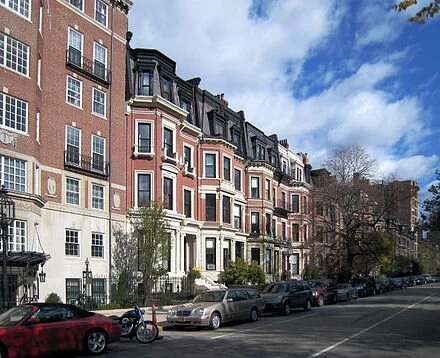
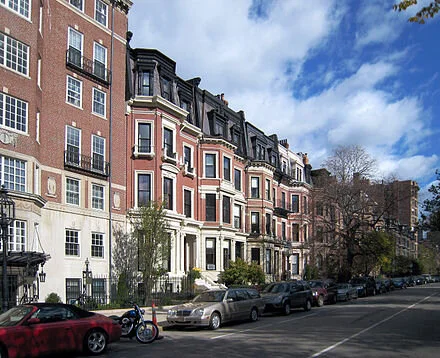
Unaffordable (except for the truly rich) housing on Commonwealth Avenue in Boston
From Robert Whitcomb’s “Digital Diary,’’ in GoLocal24.com
Officials in Rhode Island, Massachusetts and elsewhere are calling for a big push to expand that rather nebulous thing called “affordable housing.’’ Probably the most dramatic set of proposals in New England comes from Boston Mayor Marty Walsh, who presides over a city in the middle of a metro area whose tech, health-care and financial-services companies have brought great wealth but have also driven up further what have long been among America’s highest living costs.
Mr. Walsh has vowed to commit $500 million over five years to address the city’s affordable-housing crisis. That would necessitate, among other things, the sale of a parking garage and implementing a real-estate transfer tax.
The mayor is also pressing major companies and foundations to consider pooling some money — perhaps as much as $100 million — to help finance affordable housing in Boston. If this actually happens, Boston would apparently become the first East Coast city to do something like what’s happening on the West Coast, where tech companies are funding some big housing programs to address some of the cost challenges they created.
Still, isn’t having rich companies, with highly paid workers, better than having poor ones? As always, each success presents new problems.
Over the long run, the affordable-housing issue will be most effectively addressed through changes in zoning laws, especially in the suburbs, that have long discouraged mixed-used neighborhoods (commercial/residential) and multi-family housing. “Snob zoning,’’ which sets high per-residence minimum acreage, has, in particular, removed a lot of land from possible new-housing construction. But those who live on snob zoning lots have much more political clout than people searching for a place to live that they can afford. And zoning is mostly a local power.
Anyway, certain changes could dramatically increase the supply of less expensive housing, reducing the price pressure. That would include a slowing population growth, making housing more of a buyers’ market.
Warm memories; grow very old in Portland

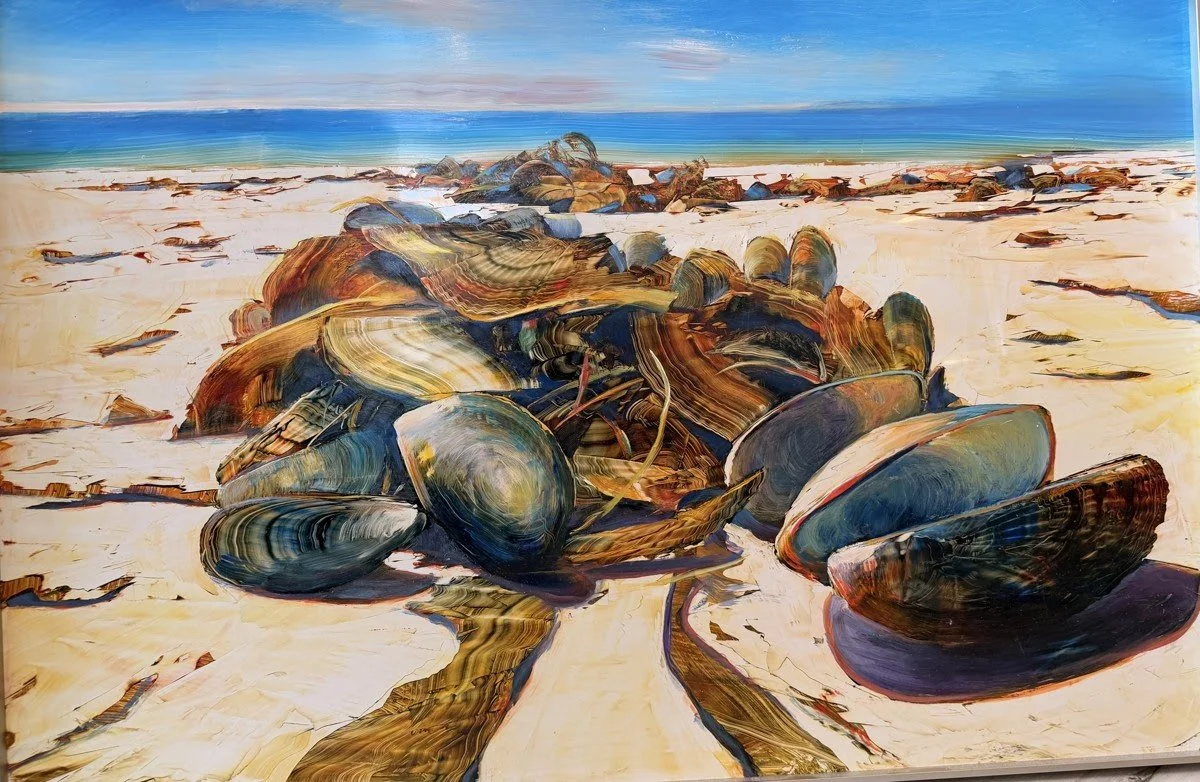
“That Summer Day’’ (encaustic and photo transfer), by Kimberly Curry
Ms. Curry says she uses her home state of Maine as her muse, as well as her travels around the world, and is inspired by the the beauty (and its opposites) in ordinary things.
Her style ranges from seascapes of Maine that capture a point in time to following a concept in a loose abstract way.
She lives in hip Portland, whose excellent health care, physical beauty, exciting working waterfront, famous food sector and strong cultural and educational resources for older people put it on Parade magazine’s list of seven places in America to “Live Here and Live to 100’’.
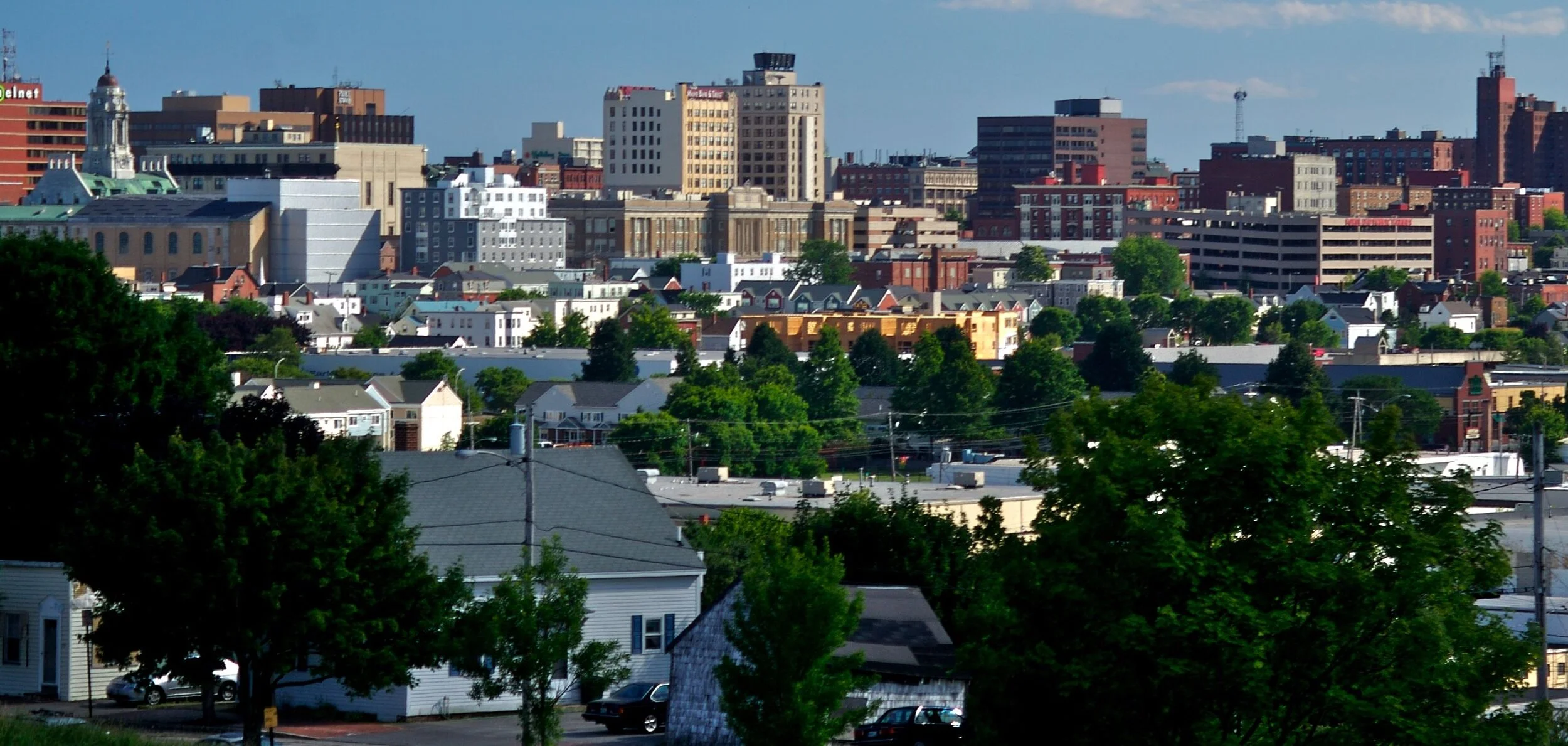
Downtown Portland
— Photo by Autocracy

Farmers market on Monument Square

Portland waterfront with warm-season cruise ships
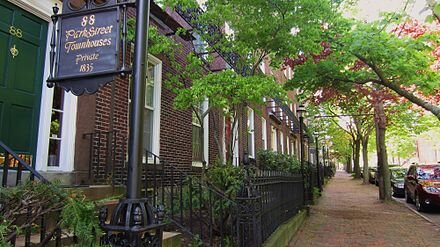
Old townhouses in Portland
'At a loss' on a winter's night

— Photo of frost patterns by Schnobby
All out of doors looked darkly in at him
Through the thin frost, almost in separate stars,
That gathers on the pane in empty rooms.
What kept his eyes from giving back the gaze
Was the lamp tilted near them in his hand.
What kept him from remembering what it was
That brought him to that creaking room was age.
He stood with barrels round him—at a loss.
And having scared the cellar under him
In clomping there, he scared it once again
In clomping off;—and scared the outer night,
Which has its sounds, familiar, like the roar
Of trees and crack of branches, common things,
But nothing so like beating on a box.
A light he was to no one but himself
Where now he sat, concerned with he knew what,
A quiet light, and then not even that.
He consigned to the moon, such as she was,
So late-arising, to the broken moon
As better than the sun in any case
For such a charge, his snow upon the roof,
His icicles along the wall to keep;
And slept. The log that shifted with a jolt
Once in the stove, disturbed him and he shifted,
And eased his heavy breathing, but still slept.
One aged man—one man—can’t keep a house,
A farm, a countryside, or if he can,
It’s thus he does it of a winter night.
“An Old Man’s Winter Night,’’ by Robert Frost (1874-1963), New England’s and probably America’s most famous poet. He lived in rural New Hampshire and Vermont for most of his life.

Chris Powell: Leave vaping to the vapers; 'the right to be forgotten'

Just when the country is realizing the futility of criminalizing marijuana, it is lapsing back into incoherence with campaigns, nationally and in Connecticut, to outlaw flavored "vaping" products.
Do people really think that smoking marijuana and chronic intoxication are better than inhaling flavored vapors? Science suggests that "vaping," risky as it may be, is less harmful than smoking tobacco and can help escape tobacco addiction.
Drug criminalization has done more damage than drugs themselves -- creating violent crime in a contraband trade, luring the undereducated into dangerous business, and burdening people with criminal records. Only drugs that can cause immediate death are worth criminalizing.
Tobacco smoking is being defeated without criminal law by publicity and taxes. Outlawing flavored "vaping" products promises only to create another contraband industry even as most people already know "vaping" can be harmful.
Indeed, if Connecticut wasn't full of convictions for drug possession and dealing, there wouldn't be clamor for the records-erasing, history-rewriting "clean slate" legislation that Gov. Ned Lamont has just endorsed in principle. The legislation would erase all sorts of convictions -- not just drug-related ones -- for people who go on to stay out of trouble for five years or so.
Erasing convictions for conduct that is decriminalized would not be so objectionable, since criminal law is sometimes unjust and unnecessary. Homosexual acts and adultery once were criminal offenses in Connecticut and now are considered none of government's business.
But blanket erasure of convictions for acts that remain criminal would diminish the deterrence of criminal law and the public's ability to protect itself with job applicants, tenants, contractors, and romantic partners. Blanket erasure also would diminish the advantage to offenders to stop offending, giving them not only second chances to achieve decent lives but also second chances to offend, their first offenses being concealed.
Besides, much of the burden borne by former offenders is not their criminal records at all but their lack of job skills when their sentences are discharged. Most people will give second chances to former offenders who can show that they want to go straight and that they have the skills to do so.
Crumbling from its loss of self-respect, the European Union has just established its own form of "clean slate" policy, a "right to be forgotten," requiring news organizations to suppress records of crimes and other disgraceful acts upon the request of the people involved. This doesn't make that misconduct any less disgraceful. Rather it minimizes disgrace, diminishing society's standards.
With its "right to be forgotten" Europe eventually may be asking, "Adolf who?" With "clean slate" legislation Connecticut eventually may be asking, "Fotis who?"
{Fotis Dulos, of New Canaan, has been charged with the murder of his missing wife, Jennifer Farber Dulos.}
Repealing statutes of limitations relieves accusers of their duty to come forward while evidence is fresh and available and justice more possible. Repeal also is grossly prejudicial to the accused, who will be tainted forever even if innocent. But these days discarding the ancient standards of justice is politically correct.
Chris Powell is a columnist for the Journal Inquirer, in Manchester, Conn.
Grace Kelly: 6 green resolutions for 2020

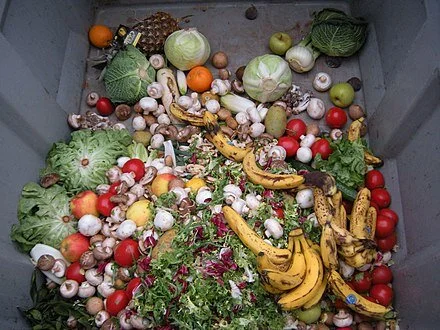
Fruit and vegetables in a dumpster
Last year is in the books, and, so far, 2020 has already proven to be a pivotal year when it comes to the climate crisis: devastating wildfires in Australia; the growing movement in Europe away from airplane travel; the pending presidential election here.
While pressuring companies and politicians to institute wide-ranging change is essential, it’s still important for us as consumers and citizens to make small changes in our own lives, and to show our commitment to addressing the problem.
According to a 2019 poll by The Washington Post and the Kaiser Family Foundation, 53 percent of adults say they have taken action to reduce their carbon footprint, and among those polled, the actions break down as such: 38 percent started to recycle; 37 percent try to drive less; 26 percent try to use less electricity at home; 17 percent said they drive a hybrid or more fuel-efficient car; 4 percent said they are reducing their meat consumption or cutting it out entirely.
There’s also been a trend of brands, companies, and celebrities (looking at you Jane Fonda!) pledging to be more sustainable in 2020, taking small steps toward a greener lifestyle and way of working.
As for me, as a newly minted environmental reporter, writing for ecoRI News has opened my eyes to some of my own lifestyle habits that need to change, from small things like remembering to bring my reusable bags to the grocery store to turning off the lights when I leave my apartment. But I offer six larger 2020 green resolutions that I will be working toward this year.
ecoRI News also put out a call on Instagram for reader 2020 green resolutions, and you provided some great answers, which are included at the end.
Here are my six green resolutions for 2020:
Reduce food waste. To say the United States wastes a lot of food is an understatement. According to the U.S. Department of Agriculture, we throw away 30 percent to 40 percent of our food supply, which equates to 133 billion pounds of food annually. To combat this, food media outlets like Bon Appétit are pledging to reduce their food waste, and local restaurants are turning to composting as a way to sustainably manage their food scraps. As an avid cook and kitchen experimenter who sometimes buys more than she can eat, I’ve made reducing food waste my big green resolution for this year.
Compost. Three of our Instagram followers told us composting was one of their green resolutions for 2020, and it’s easy to see why. Diverting food scrap from the landfill prevents it from rotting and producing methane, a greenhouse gas 30 times more potent than carbon dioxide. Plus, with new compost pickup services and businesses, it’s becoming more accessible.
Reduce use of single-use plastic. With 16 of Rhode Island’s 39 municipalities banning plastic shopping bags and with many nearby Massachusetts and Connecticut municipalities doing the same, the consumer push to ban the use of single-use plastics will continue into 2020. Numerous ecoRI News Instagram followers told us this was one of their green resolutions, and if remembering my reusable bags means running from the store back out to my car to grab them, I have no good excuse not to.
Eat less meat. With the burning of the Amazon forests last year to make way for pasture, and with top-three meat corporations — Tyson Foods, JBS S.A., and Cargill — emitting more greenhouse gases than the entire country of France in 2016, reducing our meat consumption is an important tool in combating the climate crisis. While the thought of going vegan might be intimidating, start by cutting out one or two meat-centric meals a week. It could give you the confidence to reduce your meat eating further. This is something I’ve been working on for the past few months, and one great blog I use for more vegetable-forward cooking inspiration is 101 Cookbooks. Also, shout out to your local libraries: They most definitely have vegetarian cookbooks on their shelves.
Buy old. Some 20,000 chemicals are used to make clothing, and according to the Environmental Protection Agency, 85 percent of said clothing ends up in a landfill or incinerator. To combat this, consider shopping secondhand; not only is it becoming more popular, with options like Savers and local thrift stores peddling both affordable and high-end finds, there’s something for every wardrobe. Also, if you’re going through your closet and looking to downsize, there’s a curbside clothing recycling program that will pick up your discarded items for free. And buying old doesn’t end with clothes. Purchasing refurbished electronics is an excellent way to prevent unnecessary waste. I scored a pair of noise-cancelling Sony headphones on Ebay for $56.
Get involved. As a millennial with college debt, rising rent costs, and a climate future that’s looking uncertain, I should care about what’s happening in local politics. But for my voting life, I’ve been admittedly lazy and uninformed when it comes to local elections, and that has to change. Luckily, the trend is the opposite of what I’ve been doing (or not doing). In the 2018 midterm elections, Gen Xers, Millennials, and Zoomers outvoted Baby Boomers and older generations by 2.1 million votes. This year I’m committing to not only voting, but also trying to attend public comment sessions as a concerned citizen. The climate crisis is an issue too big to sit back and do nothing.
Now, for some of our Instagram followers’ green resolutions
@Meejy_: Last year my partner and I decided to only buy local meat, and its going great!
@Hannanicoleknighton: compost; participate in a plastic clean up in my community; say no to single use as often as possible
@Cait_conquers: start purchasing mostly second hand instead of new when needed
@Marinaphyte: offset my oil bill by installing a wood stove! Save for an electric vehicle this year!
@Nicmore1220: Continue to reduce our waste! We have eliminated plastic wrap/Ziploc bags entirely; No more plastic straws either! Stainless/bamboo straws travel everywhere with us!
@Sweetfindvintage: Support more small, local business that are providing bulk and eco products!
@Allegrapedretti: Eat less meat! Use less plastic bags.
@Alexduryea: Fight for a green new deal (even more)
@Jaclynmsheridan: Use less water!!!
@Gloriousbig: Sign up for composting!
@Jocelyn.donald: starting to compost & shopping in bulk more often with my own containers
Grace Kelly is an ecoRI News journalist.
'Where the odometer stops'
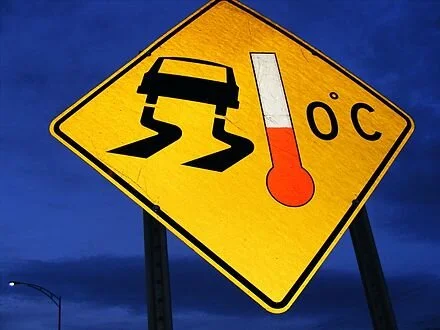
“Like the shrug of black ice
As the cold gets colder
Running next to the ditch
Off the soft shoulder
Where the odometer stops
And no one gets older….’’
— From ‘‘Harm’s Way,’’ by A.E. Stallings
Plant a forest first?

In Allston, Park Vale Avenue looking toward Brighton Avenue
From Robert Whitcomb’s “Digital Diary,’’ in GoLocal24.com
Joan Wickersham writes in The Boston Globe: “I remembered how, ten years ago, the great Italian architect Renzo Piano told me about a proposal he had made to the university, that they begin by planting trees, enough trees to turn this land {hundreds of acres in Boston’s Allston neighborhood} into an urban forest. The trees would have created a healthy natural ecosystem, with its own cooling and flood controls. My point is not to pick on Harvard’s current planning. The Allston land will eventually be filled with high-performance hard-working buildings.’’
“But I am wistful about that forest that never happened, which would have created an environment in which the buildings wouldn’t have had to work so hard. Piano’s visionary question was not just ‘What should we put on this land?’ but rather ‘What kind of land should this be?’”
An interesting idea – start a development with the vegetation and landscaping, then fit in the buildings.
To read Ms. Wickersham’s column, please hit this link.
Come swim with the sharks

"Great Barrier Reef" (archival pigment print), by Jane Paradise, at Galatea Fine Art, Boston, Feb. 5-March 1. She’s based in Provincetown
Fragile art, fragile planet

“Earth” (handbuilt colored porcelain, unglazed), by Cary Rapaport, at Bromfield Gallery, Boston, through Feb. 2
Llewellyn King: New York and London mayors' vacuous 'virtue signaling' on fossil fuel
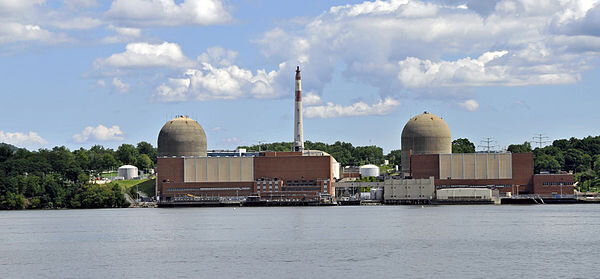
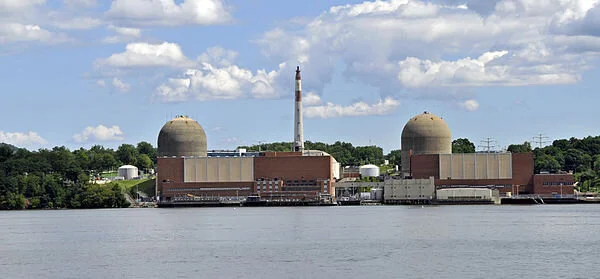
Indian Point Energy Center, a three-unit nuclear power plant station, in Buchanan, N.Y. New York City Mayor Bill de Blasio should fight to keep it open.
The mayors of the two greatest cities in the world, New York and London, combined on Jan. 6 to endorse folly. New York’s Bill de Blasio and London’s Sadiq Khan issued a combined call for all cities to follow their example and divest pension funds in fossil-fuel companies.
The plan is to force an end the burning of fossil fuels by pulling their pension funds out of fossil-fuel company investments. In another context, this was known as a starve-the-beast strategy.
In reality it was cheap politics: an example of what the British like to refer to as “signaling virtue.”
Putting pressure on the oil and gas companies that are the targets of their worships somehow is meant to force them to do what? To pack up, shutdown and “say ‘uncle’!”, leaving us without gasoline for cars, diesel for trucks or natural gas for electric generation, to say nothing of heating our homes and making meals?
The big woolly idea behind this and much of the Green New Deal, on which the mayors based their pronouncements, is that by punishing the oil and gas companies, they speed the arrival of carbon-free electricity and transportation. Their worships should work on congestion, affordable housing, homelessness and the other innumerable ills that plague cities, not the least New York and London.
As for de Blasio, he could do something efficacious for cleaning the air. He could fight to save the Indian Point Energy Center nuclear plant up the Hudson River, which has provided more than 20 percent of New York City’s electric power for decades with nary a smidgen of carbon being produced. Now it is to close and not a squeak from the clean-air mayor. Also, he could have spoken for other regional nuclear plants that have been closed in an untimely fashion.
Like many supporters of the Green New Deal, the two mayors are correctly worried about global warming. Their low-lying cities with tidal rivers are likely to suffer irreversible flooding within the decade. But they are closed-minded about the measures that can be taken to reverse global warming. They want clean electricity, but only if it is made in ways that are approved by the left of their parties -- the Democrats for de Blasio and Labor for Khan. They want only politically correct, clean air.
The mayors want electricity that is produced from the wind or the sun. In their dreams, to misquote Annie Oakley in the musical Annie Get Your Gun — they have the sun in the morning and the wind at night. If only. The wind blows irregularly and the sun, well we know when that shines.
Politicians are out of their depths and dangerous when they prescribe a solution not a destination. If a government, say that of the City of New York, declares that it wants more and more of the electricity generated in the city to be carbon-free, it should stick to that goal. It should not tell the market – and the industry -- which kinds of carbon-free electricity meet the goal.
The goal should be the aim, not the plays that will get the ball there.
Nuclear plants in the United States are failing because after deregulation of the electric utility industry in the 1990s, a market was established in which the lowest-priced electricity was always to be favored – neither social value nor consideration for the fact that this would favor a carbon fuel, natural gas, over highly regulated nuclear plants was considered.
The mayors did not mention -- as those who decide that the fossil companies are to blame are wont to do -- that there are technologies on the horizon to capture carbon before it gets into the air. This is known as carbon capture use and storage (CCUS).
Oddly a rah-rah, American Petroleum Institute event, which API does every January in Washington, staged after the mayors’ announcement, under the rubric of “America’s Energy Future,” didn’t play up carbon capture use and storage, although oil companies are leaders in the field. Instead, API dwelled on the virtues of oil and gas in everything thing from job growth to entrepreneurship to quality of life.
Science brought us the fracking boom, cheap solar cells, efficient windmills and it should be given a chance to solve the carbon problem, both with clean nuclear and with much cleaner fossil. The rest is posturing, even as we have just finished the hottest decade on history.
The worshipful mayors of New York and London should be panicked about saving their cities, not signaling their liberal credentials.
On Twitter: @llewellynking2
Llewellyn King is executive producer and host of White House Chronicle, on PBS. He’s based in Rhode Island and Washington, D.C.
'The ideal pursuit'
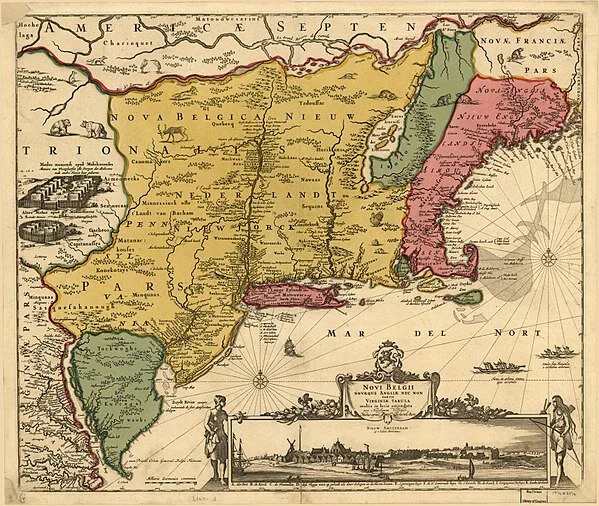
A 17th-Century map depicting New England as a coastal enclave extending from Cape Cod to New France
“History ... with its long, leisurely, gentlemanly labors, the books arriving by post, the cards to be kept and filed, the sections to be copied, the documents to be checked, is the ideal pursuit for the New England mind.’’
— Elizabeth Hardwick (1916-2007), celebrated novelist, short story writer and critic. From 1949 until their divorce, in 1972, she was married to Robert Lowell, the Pulitzer Prize‐winning poet from a prominent Boston Brahmin family.
Partners and GE team up in AI project

The word "robot" was coined by Karel Čapek in his 1921 play R.U.R., the title standing for "Rossum's Universal Robots"

The road to artificial intelligence: This ontology represents knowledge as a set of concepts within a domain and the relationships between those concepts.
From The New England Council (newenglandcouncil.com)
“Partners HealthCare and General Electric, both based in Boston, have announced that they are in the midst of obtaining FDA approval for deployment of their newly developed artificial intelligence (AI) to hospitals and health systems across the world. Partners and GE Healthcare have been partnering to develop the AI program for nearly three years.
“As a baseline, the health-care providers’ new platform seeks to couple data results from GE imaging equipment with electronic medical record inputs, and then use the AI to aid clinicians in making treatment decisions. The new technology’s approach differs from less accurate and overreaching ones currently on the market, using contextual data from imaging equipment and aiming to help clinicians make decisions, rather than making the decisions for them. In addition, the AI and its data would be a shared platform, allowing the system to improve itself by exploring a wider range of information. The software’s design gives all clinicians navigable access to patients’ medical records that can be utilized and acted upon in the midst of day-to-day work.
“‘What we are doing now is we’re actually taking the capabilities of these platforms, and you’re going to expose these to the external world, from our developer community perspective so that you know developers across the globe could use some of these features, and that cross-section that we have created, to rapidly develop applications,’ said Amit Phadnis, chief digital officer for GE Healthcare.’’
'Winter waterwings'
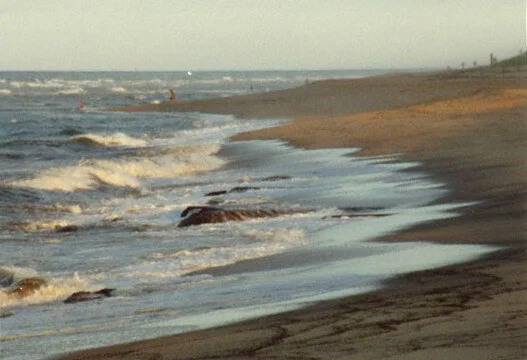
Beach on Outer Cape Cod
“The smell of snow, stinging in nostrils as the wind lifts it from a beach
Eve-shuttering, mixed with sand, or when snow lies under the street lamps and on all
And the air is emptied to an uplifting gassiness
That turns lungs to winter waterwings, buoying, and the bright white night
Freezes in sight a lapse of waves, balsamic, salty, unexpected:
Hours after swimming, sitting thinking biting at a hangnail
And the taste of the—to your eyes—invisible crystals irradiates the world…’’
— From “The Chrystal Lithium,’’ by James Schuyler (1923-1991)
Consuming beauty while extracting resources

“Melas Chasms Sunrise,’’ by Isabel Beavers, in the show “Golden Spike,’’ at Brookline (Mass.) Arts Center, through Jan. 31.
This is a three-person exhibition about the environment and climate change. A "golden spike" is presented as a signifier of the extreme man-made change in recent geologic record. Artists Beavers, Allison Gray and William Van Beckum explore the concept of "anthropocence," or the landscape as evidence of humanity's mark in time through models and other representations of landscapes from across history. "We simultaneously consume aesthetic beauty from landscapes, while treating them as sites of extraction and destruction," the artists say.

Overlooking Leverett Pond in Olmsted Park in Brookline
Here’s an edited version of a Wikipedia list of historic buildings in Brookline (Massachusetts’s largest town) that are open to the public:
The birthplace of John F. Kennedy stands in Brookline and is listed in the National Register of Historic Places. It is maintained by the National Park Service and is open to the public from May through September.
"Fairsted", the 100-year-old business headquarters and design office for renowned landscape architect Frederick Law Olmsted and the Olmsted Brothers firm, has been carefully preserved as the Frederick Law Olmsted National Historic Site, on 7 acres of landscaped grounds at 99 Warren St.
John Goddard House, an historic house at 235 Goddard Ave., was built in 1767 and added to the National Register of Historic Places in 1985.
Larz Anderson Park is in Brookline on the 64-acre estate once owned by Larz Anderson and Isabel Weld Perkins. The park contains the Larz Anderson Auto Museum, the oldest automobile collection in the country, as well as Putterham School, a one-room schoolhouse from colonial times.

At the PCFR: How can geo-engineering address global warming?

The Providence Committee on Foreign Relations’ (thepcfr.org; pcfremail@gmail.com) next dinner speaker, on Wednesday, Feb. 5, will be the internationally known science journalist, book author and coastal-erosion expert Cornelia Dean. With reference to sea-level rise caused by global warming, she’ll talk about geo-engineering -- the use of engineering techniques to alter Earth’s climate.
Some geo-engineering strategies are (relatively) uncontroversial, such as removing CO2 from the atmosphere. And some are controversial, such as seeding iron-poor ocean areas with iron to encourage plankton growth, the consequences of which are unknown and potentially unpleasant.
And consider the techniques known collectively as Solar Radiation Management. They include deliberate cloud-thinning, seeding the atmosphere with aerosols to make the planet more reflective, stationing mirrors in stationary orbit between Earth and the Sun, etc.
Cornelia Dean, a science writer and the former science editor of The New York Times, as well as a former deputy Washington Bureau chief of that paper, is well known for her knowledge of coastal-erosion issues as well as other scientific matters.
In her tenure running The Times’s science-news department, members of its staff won every major journalism prize as well as the Lasker Award for public service. She began her newspaper career at The Providence Journal. Her first book, Against the Tide: The Battle for America’s Beaches, was published in 1999 and was a New York Times Notable Book of the year. Her guide to researchers on communicating with the public, Am I Making Myself Clear?, was published in 2009. Her most recent (2017) book is Making Sense of Science: Separating Substance from Spin.
She has taught at Brown and Harvard and lectured in many other places, too
Please let us know if you're coming to the Feb 5. event by registering on our Web site, thepcfr.org, or emailing us at pcfremail@gmail.com. You may also call (401) 523-3957.
Joining the PCFR is simple and the dues very reasonable. Please check the organization’s Web site – thepcfr.org – email pcfremail@gmail.com and/or call (401) 523-3957 with any questions.
All dinners are held at the Hope Club, 6 Benevolent St., Providence. They begin with drinks at 6, dinner by about 6:40, the talk -- usually around 35-40 minutes – starts by dessert, followed by a Q&A. The evening, except for those who may want to repair to the Hope Club’s lovely bar for a nightcap, ends no later than 9 p.m.
xxx
And for the rest of the PCFR season, subject to the vagaries of weather, flu epidemics, cyberattacks and so on:
On March 18 comes Stephen Wellmeier, managing director of Poseidon Expeditions. He’ll talk about the future of adventure travel and especially about Antarctica, and its strange legal status.
xxx
News to come soon about an April 8 speaker, who will probably be an expert on the unrest in Hong Kong, and what it means for China and the world.
xxx
On Wednesday, April 29 comes Trita Parsi, founder and current president of the National Iranian American Council, author of Treacherous Alliance and A Single Roll of the Dice. He regularly writes articles and appears on TV to comment on foreign policy. He, of course, has a lot to say about U.S. Iranian relations.
xxx
On Wednesday, May 6, we’ll welcome Serenella Sferza, a political scientist and co-director of the program on Italy at MIT’s Center for International Studies, who will talk about the rise of right-wing populism and other developments in her native home of Italy.
She has taught at several U.S. and European universities, and published numerous articles on European politics. Serenella's an affiliate at the Harvard De Gunzburg Center for European Studies and holds the title of Cavaliere of the Ordine della Stella d'Italia conferred by decree of the President of the Republic for the preservation and promotion of national prestige abroad.
xxx
On Wednesday June 10, the speaker will be Dr. Elizabeth H. Prodromou, who directs the Initiative on Religion, Law, and Diplomacy, and is visiting associate professor of conflict resolution, at The Fletcher School of Law and Diplomacy at Tufts University. She titles her talk "God, Soft Power, and Geopolitics: Religion as a Tool for Conflict Prevention/Generation". She was originally scheduled for Dec. 5 but had to postpone because of illness.

She's got it easy

When Lili seeks affection,
She only has to purr.
She never never meets rejection.
Why can't I be like her?
— Felicia Nimue Ackerman

A cat sitting under a chair, on a mural in an Egyptian tomb dating to the 15th Century B.C.
City of cranks
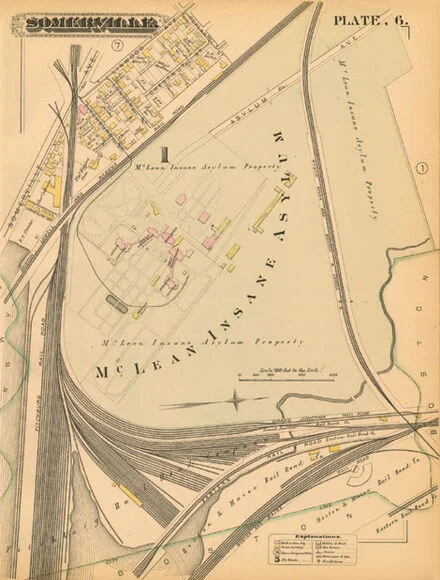
Map of the McLean Insane Asylum from an 1884 atlas of Somerville, Mass. The hospital trustees changed its name to McLean Hospital and moved to bucolic Belmont in 1895. It remains the leading psychiatric hospital in Greater Boston and indeed one of the most distinguished in the world.
“Boston runs to brains as well as to beans and brown bread. But she is cursed with an army of cranks whom nothing short of a straitjacket or a swamp-elm club will ever control.’’
— William Cowper Brann, in The Iconoclast, a Texas paper published in the 1890s.
Condos in an 1828 mall
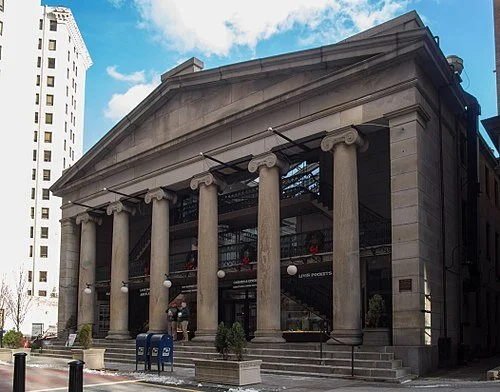
The Providence Arcade
From Robert Whitcomb’s “Digital Diary,’’ in GoLocal24.com
It says something about American’s changing demographics and housing sector that The Arcade, in downtown Providence, built in 1828 and often called “America’s First Mall’’ is going condo, including retail on its first floor and, even more interesting, the tiny apartments on its second and third floors. These units range from 225 to 800 square feet. I suppose that buying them will appeal to simplicity-seeking and/or crash-strapped folks under 40, many without cars, and to older single people. And people wait longer these days to marry, if they do at all, and delay having kids. Thus many don’t want or need much space.
These 48 “micro-lofts’’ will start at $130,000 to $140,000 each and the 20 spaces for shops at $125,000.
What a difference from the McMansions that have sprouted up in the past couple of decades!
Having these condos owned by their occupants should be a further stabilizing force in downtown Providence, unless, perhaps, a lot of the owners try to rent them out themselves, resulting in heavy turnover of occupants.
Please hit this link to read the GoLocal story on this.

The art of saving seeds

Installation view of the show SEED-O-MATIC at the Colby College Museum of Art, Waterville, Maine, through May 8.
The museum (remarkably large for a small , if well-endowed, college), explains that the artists Emma Dorothy Conley and Halley Roberts created the show in conjunction with the Center for Genomic Gastronomy (CGG), which is dedicated to researching, prototyping and inspiring a "more just, biodiverse, and beautiful food system". As large agrochemical companies buy out seed suppliers and patent their genetic information agricultural biodiversity and food sovereignty are threatened.
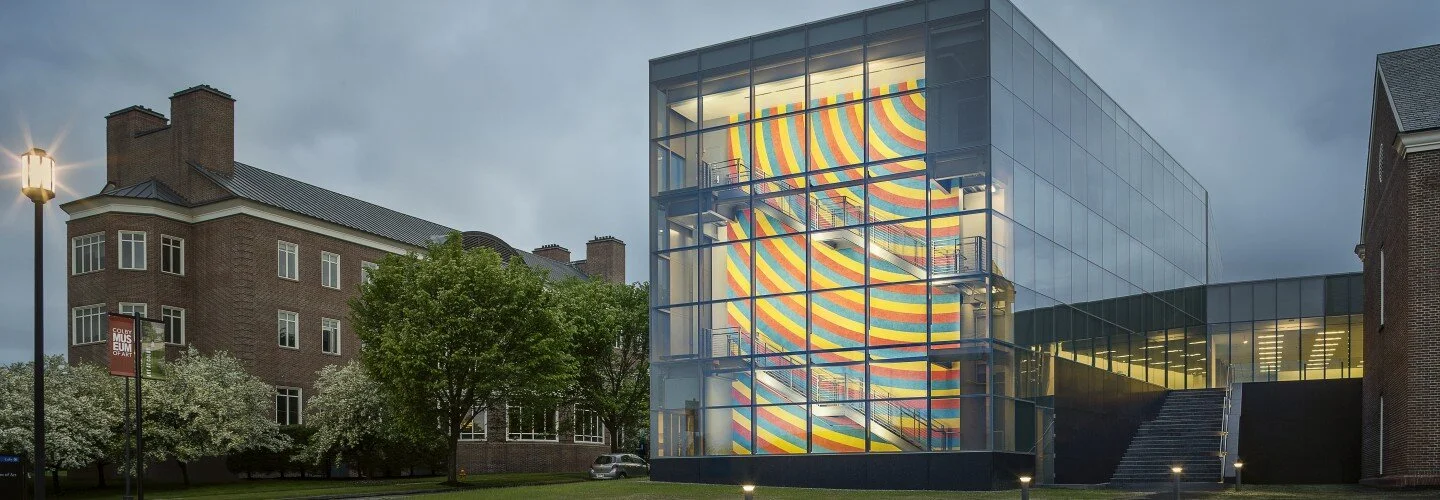
Colby College Museum of Art
Photo by Colby Mariam
Waterville used to be a bustling factory town; now it’s best known for Colby. A Wikipedia entry notes:
“The Kennebec River and Messalonskee Stream provided water power for mills, including several sawmills, a gristmill, a sash and blind factory, a furniture factory, and a shovel handle factory. There was also a carriage and sleigh factory, boot shop, brickyard, and tannery. On Sept. 27, 1849, the Androscoggin and Kennebec Railroad opened to Waterville. It would become part of the Maine Central Railroad, which in 1870 established locomotive and car repair shops in the thriving mill town….
‘‘The Ticonic Water Power & Manufacturing Company was formed in 1866 and soon built a dam across the Kennebec. After a change of ownership in 1873, the company began construction on what would become the Lockwood Manufacturing Company, a cotton textile plant. A second mill was added, and by 1900 the firm dominated the riverfront and employed 1,300 workers. …. The iron Waterville-Winslow Footbridge opened in 1901, as a means for Waterville residents to commute to Winslow for work in the Hollingsworth & Whitney Co. and Wyandotte Worsted Co. mills, but in less than a year was carried away by the highest river level since 1832. Rebuilt in 1903, it would be called the Two Cent Bridge because of its toll. In 1902, the Beaux-Arts style City Hall and Opera House designed by George Gilman Adams was dedicated. In 2002, the C.F. Hathaway Company, one of the last remaining factories in the United States producing high-end dress shirts, was purchased by Warren Buffett's Berkshire Hathaway company and was closed after over 160 years of operation in the city….
“In 1813, the Maine Literary and Theological Institution was established. It would be renamed Waterville College in 1821, then Colby College in 1867. Thomas College was established in 1894. The Latin School was founded in 1820 to prepare students to attend Colby and other colleges, and was subsequently named Waterville Academy, Waterville Classical Institute, and Coburn Classical Institute.’’
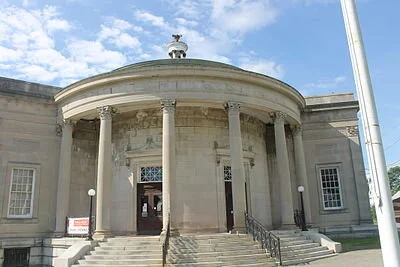
One Post Office Square, a multiple-use facility, in downtown Waterville
'Time in the woods'

“Old Growth” (encaustic monotype and origami assemblage), by Jeanne Borofsky
On the New England Wax Web site, Ms. Borofsky explains:
“Having grown up in the country I have always looked to nature to center myself – to restore balance to my mind and my world. I spend time in the woods or by the water letting the rhythms of the world become part of me. I create encaustic monotypes with patterns reminiscent of barks and leaves or water, and collage them onto panels, adding many bits of ephemera, both natural and not.
“My encaustic constructions (‘castles’) usually start with encaustic monotypes. There is a monotype mounted to the panel, and I add origami boxes folded mostly from more encaustic monotypes. I spend a lot of my time folding, which is a kind of meditation, and then more time constructing and adding stamps, maps, bits of asemic writing and other ephemera to create my own world. I have often felt the way Alexander Calder felt when he said, ‘I want to make things that are fun to look at, that have no propaganda value whatsoever.’
“Stamps, maps and electronic bits are ever present in my work, nothing seems complete without one or the other. Creatures abound, and sometimes they are the main focus of my attention.’’
Her bio:
Jeanne Borofsky, BFA, MFA, is internationally recognized, with paintings, prints and drawings in numerous museums and private collections. Born in New Hampshire, and now living in Groton, Mass., she has been a practicing artist for over 50 years. She has (and does) make art with watercolors, oils, encaustics, rubber stamps, collages and prints (traditional, photographic, encaustic & digital).