
Vox clamantis in deserto



At the PCFR: How can geo-engineering address global warming?

The Providence Committee on Foreign Relations’ (thepcfr.org; pcfremail@gmail.com) next dinner speaker, on Wednesday, Feb. 5, will be the internationally known science journalist, book author and coastal-erosion expert Cornelia Dean. With reference to sea-level rise caused by global warming, she’ll talk about geo-engineering -- the use of engineering techniques to alter Earth’s climate.
Some geo-engineering strategies are (relatively) uncontroversial, such as removing CO2 from the atmosphere. And some are controversial, such as seeding iron-poor ocean areas with iron to encourage plankton growth, the consequences of which are unknown and potentially unpleasant.
And consider the techniques known collectively as Solar Radiation Management. They include deliberate cloud-thinning, seeding the atmosphere with aerosols to make the planet more reflective, stationing mirrors in stationary orbit between Earth and the Sun, etc.
Cornelia Dean, a science writer and the former science editor of The New York Times, as well as a former deputy Washington Bureau chief of that paper, is well known for her knowledge of coastal-erosion issues as well as other scientific matters.
In her tenure running The Times’s science-news department, members of its staff won every major journalism prize as well as the Lasker Award for public service. She began her newspaper career at The Providence Journal. Her first book, Against the Tide: The Battle for America’s Beaches, was published in 1999 and was a New York Times Notable Book of the year. Her guide to researchers on communicating with the public, Am I Making Myself Clear?, was published in 2009. Her most recent (2017) book is Making Sense of Science: Separating Substance from Spin.
She has taught at Brown and Harvard and lectured in many other places, too
Please let us know if you're coming to the Feb 5. event by registering on our Web site, thepcfr.org, or emailing us at pcfremail@gmail.com. You may also call (401) 523-3957.
Joining the PCFR is simple and the dues very reasonable. Please check the organization’s Web site – thepcfr.org – email pcfremail@gmail.com and/or call (401) 523-3957 with any questions.
All dinners are held at the Hope Club, 6 Benevolent St., Providence. They begin with drinks at 6, dinner by about 6:40, the talk -- usually around 35-40 minutes – starts by dessert, followed by a Q&A. The evening, except for those who may want to repair to the Hope Club’s lovely bar for a nightcap, ends no later than 9 p.m.
xxx
And for the rest of the PCFR season, subject to the vagaries of weather, flu epidemics, cyberattacks and so on:
On March 18 comes Stephen Wellmeier, managing director of Poseidon Expeditions. He’ll talk about the future of adventure travel and especially about Antarctica, and its strange legal status.
xxx
News to come soon about an April 8 speaker, who will probably be an expert on the unrest in Hong Kong, and what it means for China and the world.
xxx
On Wednesday, April 29 comes Trita Parsi, founder and current president of the National Iranian American Council, author of Treacherous Alliance and A Single Roll of the Dice. He regularly writes articles and appears on TV to comment on foreign policy. He, of course, has a lot to say about U.S. Iranian relations.
xxx
On Wednesday, May 6, we’ll welcome Serenella Sferza, a political scientist and co-director of the program on Italy at MIT’s Center for International Studies, who will talk about the rise of right-wing populism and other developments in her native home of Italy.
She has taught at several U.S. and European universities, and published numerous articles on European politics. Serenella's an affiliate at the Harvard De Gunzburg Center for European Studies and holds the title of Cavaliere of the Ordine della Stella d'Italia conferred by decree of the President of the Republic for the preservation and promotion of national prestige abroad.
xxx
On Wednesday June 10, the speaker will be Dr. Elizabeth H. Prodromou, who directs the Initiative on Religion, Law, and Diplomacy, and is visiting associate professor of conflict resolution, at The Fletcher School of Law and Diplomacy at Tufts University. She titles her talk "God, Soft Power, and Geopolitics: Religion as a Tool for Conflict Prevention/Generation". She was originally scheduled for Dec. 5 but had to postpone because of illness.

She's got it easy

When Lili seeks affection,
She only has to purr.
She never never meets rejection.
Why can't I be like her?
— Felicia Nimue Ackerman

A cat sitting under a chair, on a mural in an Egyptian tomb dating to the 15th Century B.C.
City of cranks
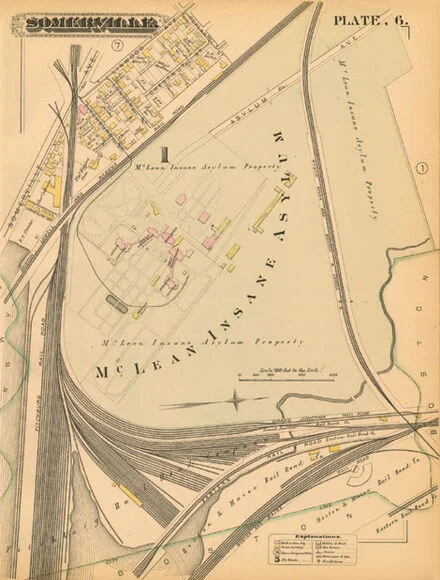
Map of the McLean Insane Asylum from an 1884 atlas of Somerville, Mass. The hospital trustees changed its name to McLean Hospital and moved to bucolic Belmont in 1895. It remains the leading psychiatric hospital in Greater Boston and indeed one of the most distinguished in the world.
“Boston runs to brains as well as to beans and brown bread. But she is cursed with an army of cranks whom nothing short of a straitjacket or a swamp-elm club will ever control.’’
— William Cowper Brann, in The Iconoclast, a Texas paper published in the 1890s.
Condos in an 1828 mall
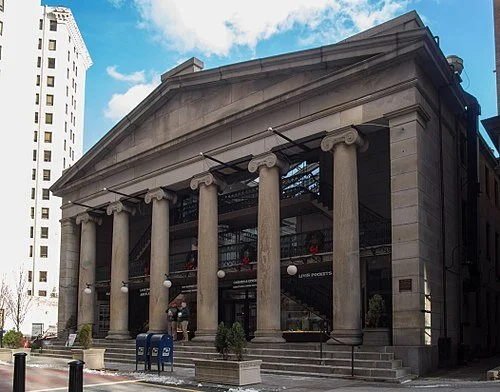
The Providence Arcade
From Robert Whitcomb’s “Digital Diary,’’ in GoLocal24.com
It says something about American’s changing demographics and housing sector that The Arcade, in downtown Providence, built in 1828 and often called “America’s First Mall’’ is going condo, including retail on its first floor and, even more interesting, the tiny apartments on its second and third floors. These units range from 225 to 800 square feet. I suppose that buying them will appeal to simplicity-seeking and/or crash-strapped folks under 40, many without cars, and to older single people. And people wait longer these days to marry, if they do at all, and delay having kids. Thus many don’t want or need much space.
These 48 “micro-lofts’’ will start at $130,000 to $140,000 each and the 20 spaces for shops at $125,000.
What a difference from the McMansions that have sprouted up in the past couple of decades!
Having these condos owned by their occupants should be a further stabilizing force in downtown Providence, unless, perhaps, a lot of the owners try to rent them out themselves, resulting in heavy turnover of occupants.
Please hit this link to read the GoLocal story on this.

The art of saving seeds

Installation view of the show SEED-O-MATIC at the Colby College Museum of Art, Waterville, Maine, through May 8.
The museum (remarkably large for a small , if well-endowed, college), explains that the artists Emma Dorothy Conley and Halley Roberts created the show in conjunction with the Center for Genomic Gastronomy (CGG), which is dedicated to researching, prototyping and inspiring a "more just, biodiverse, and beautiful food system". As large agrochemical companies buy out seed suppliers and patent their genetic information agricultural biodiversity and food sovereignty are threatened.
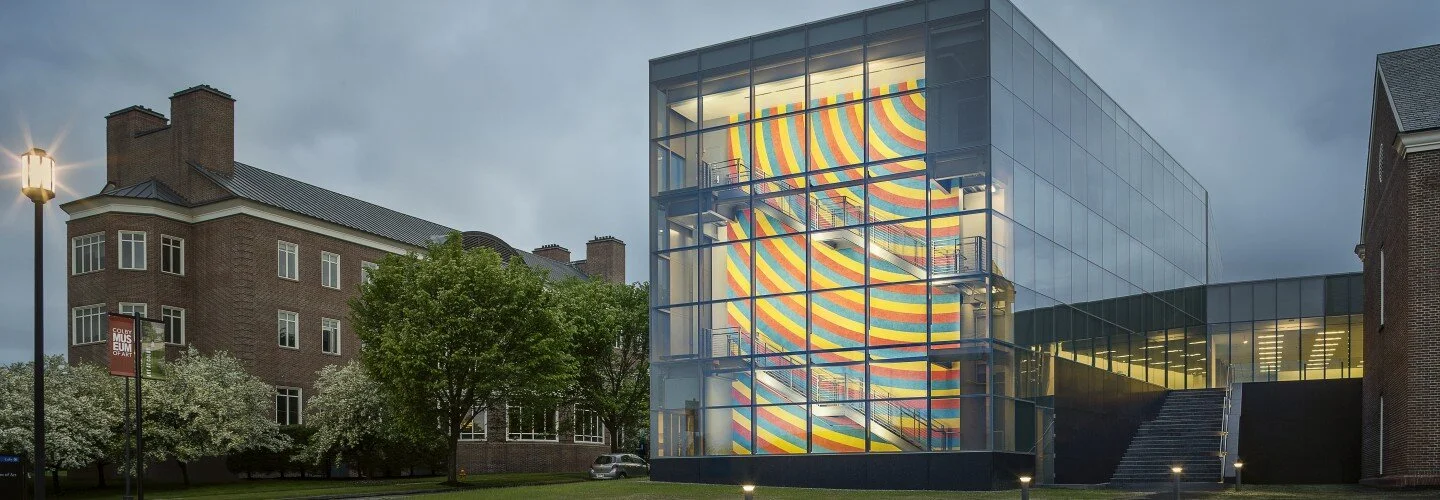
Colby College Museum of Art
Photo by Colby Mariam
Waterville used to be a bustling factory town; now it’s best known for Colby. A Wikipedia entry notes:
“The Kennebec River and Messalonskee Stream provided water power for mills, including several sawmills, a gristmill, a sash and blind factory, a furniture factory, and a shovel handle factory. There was also a carriage and sleigh factory, boot shop, brickyard, and tannery. On Sept. 27, 1849, the Androscoggin and Kennebec Railroad opened to Waterville. It would become part of the Maine Central Railroad, which in 1870 established locomotive and car repair shops in the thriving mill town….
‘‘The Ticonic Water Power & Manufacturing Company was formed in 1866 and soon built a dam across the Kennebec. After a change of ownership in 1873, the company began construction on what would become the Lockwood Manufacturing Company, a cotton textile plant. A second mill was added, and by 1900 the firm dominated the riverfront and employed 1,300 workers. …. The iron Waterville-Winslow Footbridge opened in 1901, as a means for Waterville residents to commute to Winslow for work in the Hollingsworth & Whitney Co. and Wyandotte Worsted Co. mills, but in less than a year was carried away by the highest river level since 1832. Rebuilt in 1903, it would be called the Two Cent Bridge because of its toll. In 1902, the Beaux-Arts style City Hall and Opera House designed by George Gilman Adams was dedicated. In 2002, the C.F. Hathaway Company, one of the last remaining factories in the United States producing high-end dress shirts, was purchased by Warren Buffett's Berkshire Hathaway company and was closed after over 160 years of operation in the city….
“In 1813, the Maine Literary and Theological Institution was established. It would be renamed Waterville College in 1821, then Colby College in 1867. Thomas College was established in 1894. The Latin School was founded in 1820 to prepare students to attend Colby and other colleges, and was subsequently named Waterville Academy, Waterville Classical Institute, and Coburn Classical Institute.’’
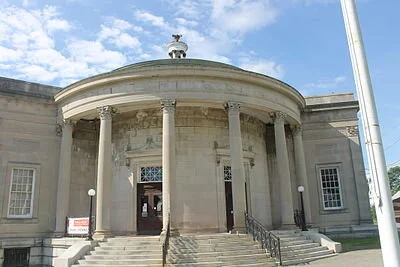
One Post Office Square, a multiple-use facility, in downtown Waterville
'Time in the woods'

“Old Growth” (encaustic monotype and origami assemblage), by Jeanne Borofsky
On the New England Wax Web site, Ms. Borofsky explains:
“Having grown up in the country I have always looked to nature to center myself – to restore balance to my mind and my world. I spend time in the woods or by the water letting the rhythms of the world become part of me. I create encaustic monotypes with patterns reminiscent of barks and leaves or water, and collage them onto panels, adding many bits of ephemera, both natural and not.
“My encaustic constructions (‘castles’) usually start with encaustic monotypes. There is a monotype mounted to the panel, and I add origami boxes folded mostly from more encaustic monotypes. I spend a lot of my time folding, which is a kind of meditation, and then more time constructing and adding stamps, maps, bits of asemic writing and other ephemera to create my own world. I have often felt the way Alexander Calder felt when he said, ‘I want to make things that are fun to look at, that have no propaganda value whatsoever.’
“Stamps, maps and electronic bits are ever present in my work, nothing seems complete without one or the other. Creatures abound, and sometimes they are the main focus of my attention.’’
Her bio:
Jeanne Borofsky, BFA, MFA, is internationally recognized, with paintings, prints and drawings in numerous museums and private collections. Born in New Hampshire, and now living in Groton, Mass., she has been a practicing artist for over 50 years. She has (and does) make art with watercolors, oils, encaustics, rubber stamps, collages and prints (traditional, photographic, encaustic & digital).
Lindsey Gumb: Leveraging Open Education

Source: Florida Virtual Campus (2019). 2019 Florida Virtual Campus Student Textbook & Course Materials Survey. Tallahassee, Fla.
From The New England Journal of Higher Education, a service of The New England Board of Higher Education (nebhe.org)
(Editor’s note: the author’s last name was misspelled in the headline in earlier editions; we regret the error.)
BOSTON
Late last September, I joined NEBHE as its Open Education Fellow to help build upon the grassroots efforts that have been underway for years in the Northeast aiming to lessen the burden that textbook costs place on higher education students and their families. Like so many of my colleagues doing this work day in and day out, I’m passionate about breaking down this very real barrier to student learning and success. Many people still have only a vague sense of “Open Education,” so I’d like to share some thoughts on what it is and why it matters.
I recently attended my third Open Education Global Conference in November 2019 at Politecnico di Milano in Milan, Italy. As always, I returned home from the conference, feeling inspired after engaging with colleagues from around the globe who are doing amazing things to make education more equitable and attainable for students.
The final conference keynote delivered by Cheryl-Ann Hodgkinson-Williams of the University of Cape Town in South Africa defined “open education” as an umbrella term that encompasses the products, practices and communities associated with this work. The common term that represents the products of Open Education is OER (Open Educational Resources).
OER has been defined by the William & Flora Hewlett Foundation as teaching, learning and research materials in any medium–digital or otherwise–that reside in the public domain or have been released under an open license that permits no-cost access, use, adaptation and redistribution by others with no or limited restrictions. OER include textbooks, ancillary material like quiz banks, lesson plans and syllabi, as well as full-course modules, multimedia such as video, audio and photographs, and any other intellectual property that can be protected by copyright. In short, OER can be simplified to Free + Permissions: free for the student to access and permission to partake in most if not all of the “5R” activities of reuse, revise, remix, redistribute and retain the resource at hand in perpetuity.
A learning resource may be low-cost or even free to the student, but not qualify as OER. For example, library-licensed content like e-books and scholarly journal articles are “free” for the student to access for a limited time, but those materials are still copyrighted, and in fact, are paid for by budgets supported by student tuition. This means that those resources are not actually free, and when students graduate, they lose digital access to these resources due to strict publisher agreements between the library and the publisher that stipulate only currently enrolled students be granted access. Traditional publishing is a business, after all.
Inclusive access
Another concept often conflated with OER is the “inclusive access” model. This is sweeping through our college bookstores today. Like OER, inclusive access models aim to ensure that all students have access to their learning materials on day one of class with the cost rolled into their tuition. Unlike with true OER, however, students lose access to these materials after the semester ends because of those copyright restrictions set by the publisher. Inclusive access models also strip students of their right under the “first sale doctrine” that so many took advantage of before the age of digital textbooks. This doctrine, codified at 17 U.S.C. § 109, states that an individual who knowingly purchases a legal copy of a copyrighted work (in this case, a textbook) from the copyright holder receives the right to sell it in the secondhand market. Single-semester access (like through the inclusive access model) doesn’t serve students who are taking courses in a sequence, studying for the GRE, changing careers, retaking a class or simply trying to be informed citizens throughout their lives, notes Nicole Finkbeiner, director of OpenStax at Rice University. True OER, in contrast, allow students to retain their learning content in perpetuity, serving students and learners of all ages and stages.
I often get asked: “Are the costs of textbooks really such a burden?” Yes, they are. Let’s take a closer look at the current landscape in higher ed that has educators rallying around openly licensed resources and their pedagogical benefits.
A 2018 survey of Florida’s higher education institutions showed that 64% of students aren’t purchasing the required textbook for their courses because of the high cost, 43% are taking fewer courses and 36% are earning a poor grade just because they were unable to afford the book.
A former student of mine who was a veteran was forced to wait six weeks until his stipend for books was distributed. That’s six weeks’ worth of readings, assignments, quizzes and exams for which he did not have his textbook to reference and help him prepare. Many might argue, “Just put the books on a credit card and pay it off later!” This simply isn’t an option for so many students who don’t have access to a credit card or don’t wish to take on more student debt. It’s also unrealistic for educators to determine if an assigned textbook is “affordable” or not for their students. What’s affordable for one student may be a burden for another, and it’s impossible to study from a book you can’t afford.
Academic hardships aren’t the only repercussions of expensive textbooks for our students. Many are forced to make tough decisions like skipping meals, falling behind on rent and other cost-of-living bills in order to afford their course materials. The staggering gap between state funding and tuition is putting an increasing burden on students and their families to come up with money to fund their education. While faculty have little to no control over tuition costs, they can exercise their academic freedom and elect to use OER to help alleviate the high cost of textbooks, which helps all students.
Saving students money on textbooks is critical. No student should have to decide between basic human needs like buying groceries or medications, paying rent and utility bills, going to the doctor or buying their textbooks. But we cannot pat ourselves on the back and stop at OER. My colleague on NEBHE’s Open Education Advisory Committee, Robin DeRosa at Plymouth State University in New Hampshire, put it best: “I don’t want to replace an expensive, static textbook with a free, static textbook.” She’s right. OER is not the end all be all solution, and we can’t stop there.
Not just a textbook case
Moreover, the work being done in OER extends far beyond advocating for free textbooks. Scholars and practitioners work together to continuously re-examine how to improve and build upon the existing successes, challenges and opportunities that accompany the products, practices and communities of Open Education.
Open Education has the potential to provide so many more pathways for engaged learning and innovative pedagogies, increase opportunities to intentionally build in UDL (Universal Design for Learning) practices that normalize accessibility, empower our students as content creators and contributors to the Knowledge Commons, and leverage equitable access to high-quality learning resources for all students, particularly historically marginalized groups.
Robin DeRosa and her students co-edited and published the Open Anthology of Earlier American Literature (with an open license, of course!) Students took on multiple tasks ranging from locating literature for inclusion, writing chapter introductions, and translating documents into modern English. While creating a free and openly licensed textbook for future students, DeRosa’s students also assumed the role of content creators and became published authors. The open license allows this student-created resource to be adapted and revised by other faculty and students, and interactive learning tools like Hypothes.is and H5P can be integrated into the textbook to remove that “static” element. (To view some other real examples of how educators are leveraging Open Education to encourage students take agency over their own learning experiences, I recommend checking out The Open Pedagogy Notebook, run by DeRosa and Rajiv Jhangiani, associate vice provost, open education at Kwantlen Polytechnic University in British Columbia.)
Deploying the products of Open Education, we have the potential to level the playing field and grant all students equitable access to high-quality, free postsecondary instructional materials.
Lindsey Gumb is an assistant professor and the scholarly communications librarian at Roger Williams University, in Bristol, R.I., where she has been leading OER adoption, revision and creation since 2016, focusing heavily on OER-enabled pedagogy collaborations with faculty. She co-chairs the Rhode Island Open Textbook Initiative Steering Committee. She was awarded a 2019-20 OER Research Fellowship to conduct research on undergraduate student awareness of copyright and fair use and open licensing as it pertains to their participation in OER-enabled pedagogy projects.
'A young Republican' in the back alley
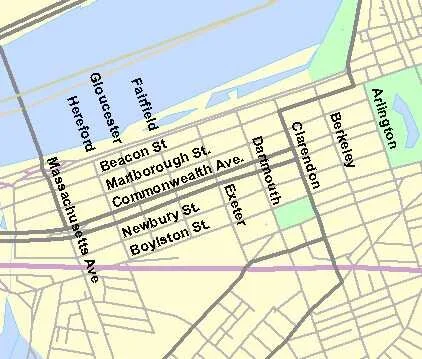
“Only teaching on Tuesdays, book-worming
in pajamas fresh from the washer each morning,
I hog a whole house on Boston’s
‘hardly passionate Marlborough Street,’
where even the man
scavenging filth in the back alley trash cans,
has two children, a beach wagon, a helpmate,
and is a ‘young Republican.”’
— From “Memories of West Street and Lepke,’’ by Robert Lowell (1917-77)
Lepke was Louis Buchalter, known as Lepke Buchalter, (1897 -March 4, 1944), an American mobster and head of the Mafia hit squad “Murder Inc.’’

Chris Powell: Of Conn's falling population and kids' mall brawls

1936 poster promoting planned housing as a method to deter juvenile delinquency, showing silhouettes of a child stealing a piece of fruit and the older child involved in armed robbery
Population growth may not be the perfect measure of a jurisdiction's success -- impoverished Bangladesh probably can do without any more people for a while -- but some conclusions may be drawn from what the U.S. Census Bureau reported about Connecticut last week. The state has lost population for six straight years.
Yes, this means that farmland preservation has become easier and might be removed from the state budget if it wasn't so popular for providing virtuous camouflage for preventing construction of less-expensive housing in the suburbs. But of course the decline in population signifies far more than that -- signifies Connecticut's declining attractiveness relative to the rest of the country.
If you want, blame it on winter weather here and air-conditioning that tempers summer down south. Connecticut's political regime will conclude, as it concludes from nearly everything else, that this decline in population means that the government, welfare, and politically correct classes still don't have enough influence on public policy.
But most people leaving the state are comfortably self-sufficient while many of those arriving are not, just as the jobs Connecticut has been losing have been higher-skilled and higher-paying while the jobs the state has been gaining are lower-skilled and lower-paying. These are clues for those daring to question policy.
Of course, as the governor says, Connecticut should continue to welcome immigrants. But it would be better if they were legal immigrants and if state government was more concerned about how it may be encouraging emigrants.
The state doesn't necessarily need more poor people, since the other week the Connecticut Data Collaborative reported that 11 percent of women in the state are living in poverty and that this percentage more than doubles in the state's cities.
While quantifying poverty as the collaborative has done is useful, it only confirms what is already known in general. So the data isn't what is most important here. What is most important is to find political leadership with the courage to ask why, despite all the appropriations and prattle about poverty, it persists and even grows, and not just among women.
So where is Connecticut's inquiry into poverty's causes and persistence? Where is state government's audit of its poverty policies?
Or is poverty now just a business that government feels obliged to sustain?
Also inviting official inquiry are the brawls involving young people that keep breaking out at Connecticut shopping malls. There were three more on the day after Christmas at malls in West Hartford, Milford and Trumbull.
The executive director of Citizens for Juvenile Justice, Leon Smith, offers the conventional explanation. "The lack of activities and services really comes into play when kids have nothing but down time," he told the Connecticut Hearst newspapers.
But these brawls are a recent phenomenon. From the beginning of time, even before there were video games, kids have complained that there is nothing for them to do -- that is, nothing except study and work. They used to manage to avoid boredom without rioting.
Some malls understand the problem better. They are excluding young people not accompanied by adults.
That is, the problem is neglectful parenting that views the malls as free babysitters, the same neglectful parenting that is the main cause of the social disintegration state government studiously overlooks.
Chris Powell is a columnist for the Journal Inquirer, in Manchester, Conn.
Sarah Anderson: Defense contractors and the joys of war profiteering
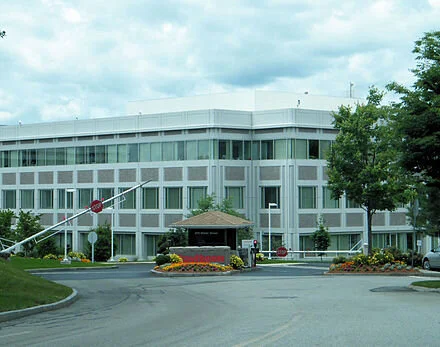
Raytheon headquarters, in Waltham, Mass.
From OtherWords.org
Experts predict as many as a million people could die if the current tensions lead to a full-blown war. Millions more would become refugees across the Middle East, while working families across the U.S. would bear the brunt of our casualties.
But there is one set of people who stand to benefit from the escalation of the conflict: CEOs of major U.S. military contractors.
This was evident in the immediate aftermath of the U.S. assassination of a top Iranian military official on January 2. As soon as the news reached financial markets, these companies’ share prices spiked.
Wall Street traders know that a war with Iran would mean more lucrative contracts for U.S. weapons makers. Since top executives get much of their compensation in the form of stock, they benefit personally when the value of their company’s stock goes up.
I took a look at the stock holdings of the CEOs at the top five Pentagon contractors (Lockheed Martin, Boeing, General Dynamics, Raytheon and Northrop Grumman).
Using the most recent available data, I calculated that these five executives held company stock worth approximately $319 million just before the U.S. drone strike that killed Iranian leader Qasem Soleimani. By the stock market’s closing bell the following day, the value of their combined shares had increased to $326 million.
War profiteering is nothing new. Back in 2006, during the height of the Iraq War, I analyzed CEO pay at the 34 corporations that were the top military contractors at that time. I found that their pay had jumped considerably after the September 11 attacks.
Between 2001 and 2005, military contractor CEO pay jumped 108 percent on average, compared to a 6 percent increase for their counterparts at other large U.S. companies.
Congress needs to take action to prevent a catastrophic war on Iran. De-escalating the current tensions is the most immediate priority.
But Congress must also take action to end war profiteering. In 2008, John McCain, then a Republican presidential candidate, proposed capping CEO pay at companies receiving financial bailouts. He argued that CEOs relying on taxpayer funds should not earn more than $400,000 — the salary of the U.S. president.
That commonsense notion should be extended to all companies that rely on massive taxpayer-funded contracts. Sen. Bernie Sanders, for instance, has a plan to deny federal contracts to companies that pay their CEOs excessively. He would set the CEO pay limit for major contractors at no more than 150 times the pay of the company’s typical worker.
Currently, the sky’s the limit for CEO pay at these companies — and the military contracting industry is a prime offender. The top five Pentagon contractors paid their top executives $22.5 million on average in 2018.
CEO pay restrictions should also apply to the leaders of privately held government contractors, which currently don’t even have to disclose the size of their top executives’ paychecks.
That’s the case for General Atomics, the manufacturer of the MQ-9 Reaper that carried out the assassination of Soleimani. Despite raking in $2.8 billion in taxpayer-funded contracts in 2018, the drone maker is allowed to keep executive compensation information secret.
We do know that General Atomics CEO Neal Blue has prospered quite a bit from taxpayer dollars. Forbes estimates his wealth at $4.1 billion
War is bad for nearly everyone. But as long as we allow the leaders of our privatized war economy to reap unlimited rewards, their profit motive for war in Iran — or anywhere — will persist.
Sarah Anderson directs the Global Economy Project at the Institute for Policy Studies and co-edits Inequality.org.
Another old writer gives up
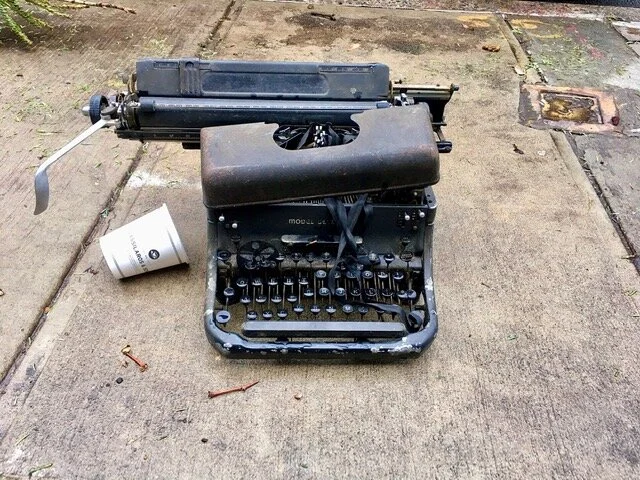
A sad scene on West 83rd Street in Manhattan
— Photo by Maryalice Huggins
Get together
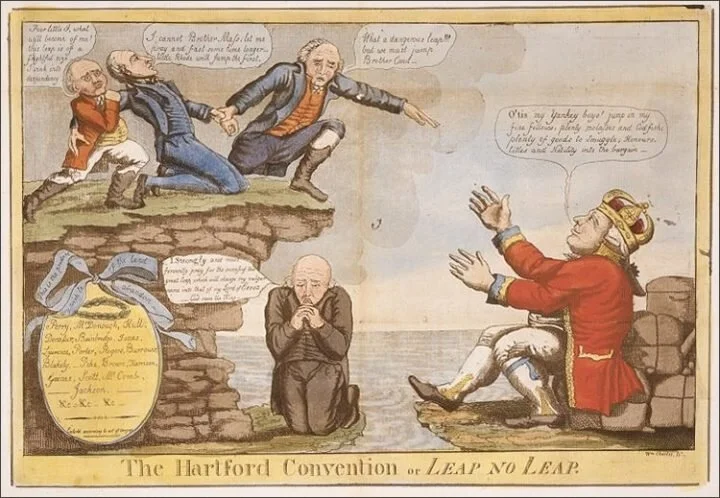
Political broadside about the Hartford Convention satirizing the Federalists’ deliberations and depicting Great Britain’s King George III promising resumed trade and "titles and Nobility into the bargain" as incentives to leap into his arms
From the White House Historical Association:
“The Massachusetts legislature released an invitation on October 5, 1814 for a convention of the New England states to meet in Hartford, Connecticut ‘to lay the foundation for a radical reform in the National compact.’ Angered by the destructive wartime loss of their trade {in the War of 1812} and fearing a British assault on Boston, New England governors had refused to adhere to President Madison's requests for militia forces. The governors wanted the soldiers close to home to deal with British raids along the coast or a potential attack on New England.
“The convention met at Hartford's Old Statehouse on December 15, 1814, with 26 delegates from five states present. James Madison and others had concerns the convention might be a first step toward separation from the Union or a separate New England peace with Great Britain.
“Although the Hartford Convention did not consider secession or a separate peace, Democratic-Republicans labeled it treasonous, and news of the U.S. victory at New Orleans and Treaty of Ghent rendered the convention's work powerless. Under a hail of derision and withering blasts of denunciation for its supposed disloyalty, the national Federalist Party, with its stronghold in New England, began to disintegrate.’’
From Robert Whitcomb’s “Digital Diary,’’ in GoLocal24.com
It still looks as if Rhode Island will lose a congressional seat as a result of the 2020 U.S. Census. This loss of political clout will make it all the more important that the state’s officials collaborate more closely with, particularly, Massachusetts and Connecticut, but also with Maine, New Hampshire and Vermont, to promote regional interests.

Garden-variety humor and bribery

The old Boston Garden, built in 1928 and torn down in in 1998, three years after its successor arena, TD Garden, was opened.
New England Diary editor Robert Whitcomb and two fellow reporters from the Boston Herald Traveler were each given $50 to take to a Bruins game in The Garden in 1971 with which to bribe the police there to let us in although the fire-code-approved crowd capacity had long been exceeded when we arrived. The air was blue with cigarette and cigar smoke.
The bribes worked and wrote a scandal story about it, but the publisher, fearing retribution, killed the story.

TD Garden. Now, if they’d only connect by train South and North Stations it would be a lot easier for some of us to get there. The arena is built right over North Station. and it houses the Sports Museum of New England.
“The old Boston Garden seats, some of which are placed here, were, as we remembered not much fun to sit in. The museum displays a sense of humor, by placing one seat behind a pole, symbolizing the 1,895 such seats.’’
— Jim Sullivan, on the Sports Museum of New England, in the April 11, 2002 Boston Globe article “Take Me Out To’’
Checkerboard crisis

The Hancock Tower, in Boston’s Back Bay, in 1974, showing the plywood over where many windows had popped out because of an engineering flaw in the window installation. The problem was obviously fixed and the building opened in 1976. The 62-story, 790-foot skyscraper remains the tallest building in New England.
The North Woods in wax

“Tree Variation #6 ‘‘ (encaustic on panel), by Helene Farrar. She is a member of New England Wax, which promotes the art of encaustic painting, which uses bee’s wax.
From her bio:
“Hélène Farrar has taught and worked in the visual arts for twenty years while actively exhibiting in commercial, nonprofit and university galleries in New England, New York City, Pennsylvania, Italy, and England. Farrar has a BA in Studio Art from the University of Maine and a Masters of Fine Art Degree in Interdisciplinary Arts from Goddard College in Vermont.
“Hélène currently owns and operates her own private art school in Maine out of her ‘Farmhouse’ studio, where she holds varied workshops and classes. Her paintings have most recently been accepted into curated exhibits at the Fuller Craft Museum, the Saco Museum, the University of New England Art Gallery, and Twiggs Gallery in New Hampshire.
“Farrar is represented by Archipelago Fine Arts in Rockland, and the Center for Maine Craft in West Gardiner. Her work as an educator has brought her across the state of Maine including the Haystack Mountain School of Craft. She taught at the 2019 International Encaustics Conference.’’
Looking at Iranian general's assassination in a very different light

In the Iranian parliament.
— Photo by Mahdi Sigari
Trita Parsi is founder and current president of the National Iranian American Council and author of Treacherous Alliance and A Single Roll of the Dice. He regularly writes articles and appears on TV to comment on foreign policy. He has comments below on the intensifying U.S.-Iran standoff.
He’ll, of course, have a lot to say about U.S. Iranian relations when he speaks to the Providence Committee on Foreign Relations (thepcfr.org) on April 29.
His comments on Jan. 5:
Much has happened in the past 24 hours. Below are the five most important developments of today following the assassination of Qassem Soleimani.
https://responsiblestatecraft.org/2020/01/05/trump-faces-swift-backlash-for-killing-soleimani-as-iraqi-parliament-votes-to-expel-u-s-troops/\
1. Iraqi prime minister says Soleimani was in Iraq for a mediation effort
Iraqi Prime Minister Adil Abdul-Mahdi has made some shocking revelations that put the assassination of Soleimani in a completely different light. He told the Iraqi parliament on Sunday that he “was supposed to meet Soleimani on the morning of the day he was killed, he came to deliver me a message from Iran responding to the message we delivered from Saudi to Iran.”
If this account is true, Trump — perhaps deliberately — acted to scuttle an effort to reduce tensions between Iran and Saudi Arabia
But it also shows that as the United States was signaling that it would not go to war with Iran — as Trump did earlier this summer — this compelled Saudi Arabia and the UAE to begin quiet negotiations with Iran to resolve their tension. As long as the Saudis and the Emiratis felt they could push the U.S. to go to war with Iran, they had no interest in diplomacy with Iran. The U.S.’s military protection of these countries essentially disincentivized them from pursuing peace.
In the past few months, under the impression that Trump had opted against war, they began careful diplomacy with Tehran. The U.S. should have welcomed this development. But the killing of Soleimani may have at the same time killed that effort and once again given Saudi Crown Prince Mohammed bin Salman and the Emiratis a license to continue recklessness and destabilization.
2. Soleimani’s death has unified Iran
Rather than being a blow to Iran, the assassination of Soleimani has fueled nationalist sentiments in Iran and unified the political elite as well as the country. The crowds of mourners in the cities where his casket has been taken were in the hundreds of thousands, if not millions.
Only a few months ago, there were widespread protests against the Iranian government, which were met with brutal force and repression. Now, Iranians are protesting alongside the government, not against it.
3. Iraqi Parliament voted to expel U.S. forces
The Iraqi parliament on Sunday voted to expel all U.S. military forces from Iraq, as a direct consequence of the Soleimani assassination. Iraqis have tried to walk a fine balance between the U.S. and Iran, but the assassination made that balance untenable. Iraqis don’t want their country to become the arena for a U.S.-Iran war, and the U.S. military presence made that risk all too likely.
While many will point out that this is a victory for Soleimani and Iran, it is also important to note that this is also what the American public wants. In fact, this is what Trump promised them he’d do.
The U.S. military presence in Iraq does not add to U.S. national security. Instead, it increases the threat of what would be a disastrous U.S.-Iran war. The U.S. does not need to have 5,000 troops in Iraq to assist in the fight against ISIS. Trump should welcome the vote and bring American military servicemen and women home to be with their families.
4. Pompeo’s absurd claim that war with Iran started with the nuclear deal
“This war kicked off when the JCPOA was entered into,” Secretary of State Mike Pompeo told CNN’s Jake Tapper on Sunday, referring to the Joint Comprehensive Plan of Action. This is an astonishing statement. In Pompeo’s view, the U.S. and the entire international community (save Israel, Saudi Arabia, and the UAE) entering an agreement to block Iran’s path to a nuclear bomb was tantamount to starting a war.
What threatens Pompeo is not war. It’s peace. He is doing everything he can to ensure that tensions with Iran don’t get resolved. For him, the “war” to start a war with Iran started when the U.S. embarked on a path of resolving its tensions with Iran.
5. Iran announces further reductions in its commitments to the JCPOA
Iran has announced the fifth reduction of its commitments to the JCPOA. This is not tantamount to Iran quitting the JCPOA, as it has left the door open to recommit itself to all of the restrictions of the nuclear agreement if the U.S. lifts sanctions on Iran. (Those sanctions, it should be mentioned, are a violation of the JCPOA as well as the United Nations Security Council Resolution that embodies the JCPOA). Nevertheless, this is a step that will further increase tensions.
Dissolving scallops

An Atlantic Bay scallop, photographed at the Marine Biological Laboratory, in Woods Hole, Mass.
— Photo by Rachael Norris and Marina Freudzon
From Robert Whitcomb’s “Digital Diary,’’ in GoLocal124.com
Ocean acidification caused by the man-made increase in atmospheric carbon dioxide may well mean that many more scallops than now will not make it beyond the larval stage, or if they do they’ll be small because the acidity dissolves shells. The fishing port of New Bedford hauls in hundreds of millions of dollars worth of scallops a year. Maybe its fishermen will become another source of lobbyists against American myopia about global warming.
To read more, please hit this link.
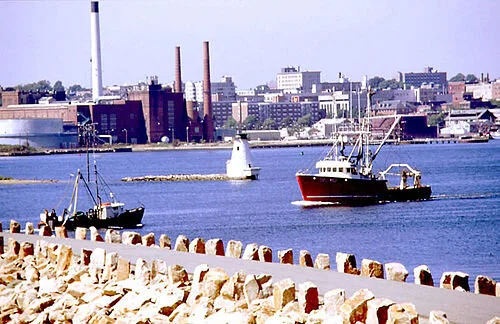
New Bedford Harbor: In the 19th Century New Bedford’s big “fishing’’ industry was whaling (though of course whales aren’t fish). Now the port’s biggest crop is scallops, most taken from Georges Bank.

'And the being lost'

“The liberal arts lie eastward of this shore.
Choppy the seas at first. Then the long swells
And the being lost. Oh, the centuries of salt
Till the surf booms and comes more land.’’
— From “The Seven Sleepers,’’ by Mark Van Doren (1894-1972), a once famous poet, teacher, critic and essayist. He lived much of his time in Cornwall, Conn., in the Litchfield Hills, a locale about which he often wrote.

In the Litchfield Hills
Pig pretty in pink

“Evolution of Form (This Little Piggy Went to Market)” (paper-mache clay, mediums), by Kathleen Volp, in Boston Sculptors Gallery’s “RING: Boston Sculptors Annual Member Show,’’ Jan. 29-Feb. 23.
Fishing for summer
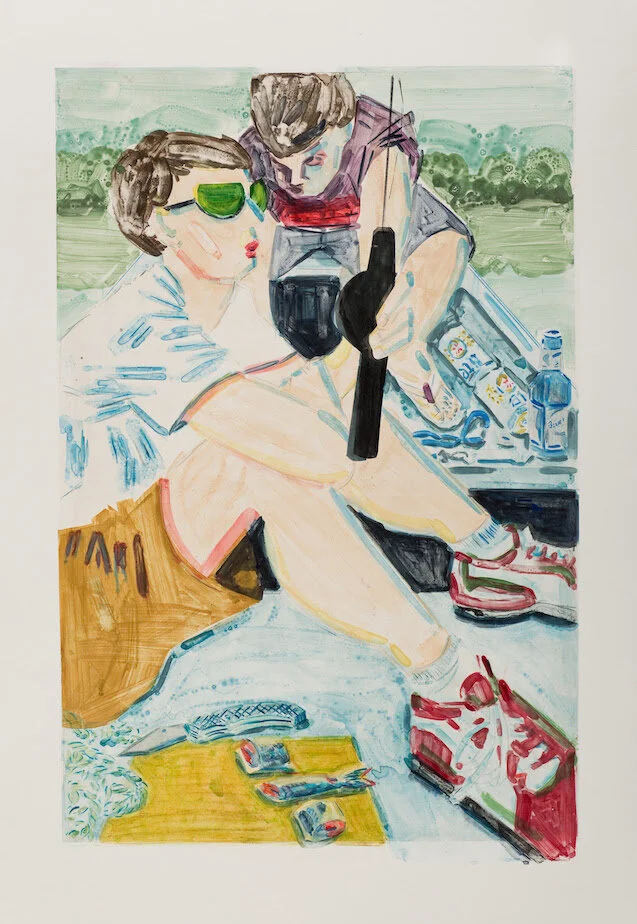
“Bait, Rope and Knife (The Duck Boat)’’ (watercolor monoprint), by Stella Ebner, in her show at Cade Tompkins Projects, Providence, through Jan. 23