Vox clamantis in deserto
Grace Kelly: The heavy side-effects of salting roads
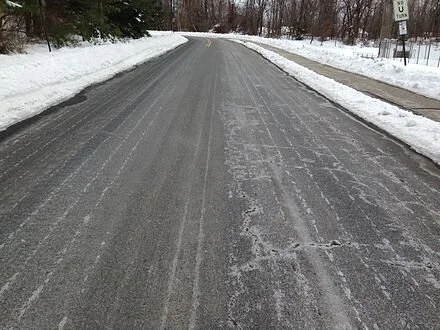
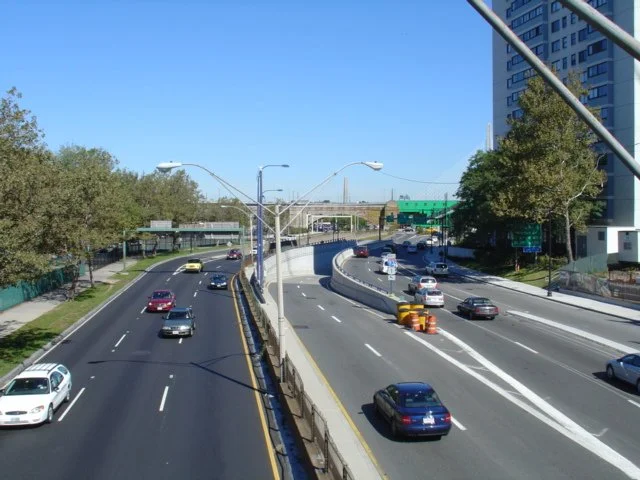
This road has been treated with salt brine.
From ecoRI News (ecori.org)
Winter is here, and with it the tried and true method for keeping roads from becoming slippery: salt.
Salting roads as a method of preventing ice from forming began in 1938 in New Hampshire and has become the go-to method for safe winter driving. It’s effective. According to a 1992 study from Marquette University, salting the roads reduced winter car accidents by 87 percent.
While it’s an effective method for safer winter driving, throwing tons of salt down comes with side effects. When cavalries of trucks start to season the roads, they also inadvertently contaminate freshwater wetlands.
“Road salt can travel up to 170 meters [558 feet] from the road across the landscape into wetlands like vernal pools,” said Nancy Karraker, an associate professor of wetland ecology and herpetology at the University of Rhode Island.
Karraker has been studying the impacts of road salt on vernal pools and freshwater wetlands for years and has concerns about salt’s effects on the invertebrates that make fresh water their home.
“Through experiments, I found that wood frogs’ eggs and their tadpoles were only affected at the highest salinity concentration, so they were a little bit more resilient,” she said. “But with the spotted salamanders, there was a significant decline in survival of both eggs and tadpoles with the average concentration of salt we were seeing at vernal pools near roads.”
And getting an average, or even high, concentration of salt in the water is easier to do than you might think.
“If you think about the head of a penny, if you cover half of the head of that penny with rock salt, dump that into a quart of water and stir it until it dissolves, that’s the salt concentration that is harmful to spotted salamanders,” Karraker said. “And if you completely cover the head of a penny and let a little bit spill over the side, and dump that in a quart of water, that’s the amount that harms wood frogs. So it’s a tiny amount of salt, it’s a very low concentration that impacts these animals.
Rhode Island doesn’t just use a pinch of salt to season its roads. From 2005 to 2013, Rhode Island roads received an average of 516 pounds of salt per lane mile annually, according to a 2014 report by the Rhode Island Department of Administration’s Division of Planning.
Nationwide, an estimated 10 million to 20 million tons of salt is dumped on roads annually — about 120 pounds for every American. Though many states, including Rhode Island, are turning to brine — a mixture of water and salt — instead of chunky crystals, for Karraker a salt by any other name still tastes as salty.
“A salt is a salt is a salt — it doesn’t matter if you’re talking about sodium chloride, magnesium chloride, potassium chloride, and brining just means that you’ve got a salt solution that’s been diluted a bit with water so you can spray it on the road so it acts more quickly to limit ice buildup.”
Karraker hopes that the state departments of environmental management and transportation will consider having “no salt” designations for roads that are near freshwater wetlands.
“You see these signs that say, ‘low road salt use’ near public drinking water sources and I wish they would do the same for biodiversity,” she said. “Why couldn’t we designate certain roads around our wildlife management areas as low road salt use areas to protect biodiversity? Why can’t we start to think about protecting biodiversity like we think about protecting our drinking water? I think it’s important.”
Thanks for this important and timely article. Don't forget about the impact of road salts on our groundwater! Just in case amphibians or infrastructure don't motivate us, this story eventually comes full circle through our wells, drinking water, and back to us. Our state needs a coherent database of wells contaminated with road salts! We also need to be exploring other solutions to safer winter driving....
Grace Kelly is an ecoRI News journalist.
'A mollusk of mist'
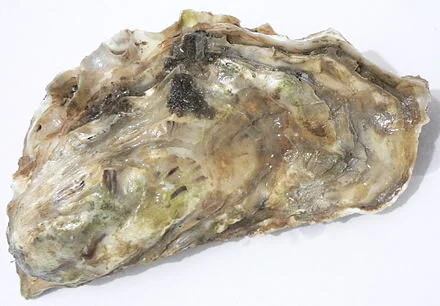
“The color of silence is the oyster's color
Between the lustres of deep night and dawn.
Earth turns to absence; the sole shape's the sleeping
Light — a mollusk of mist. Remote,
A sandspit hinges the valves of that soft monster
Yawning at Portugal. …’’
— From ”Earliness at the Cape,’’ by Babette Deutsch
At least it's quiet
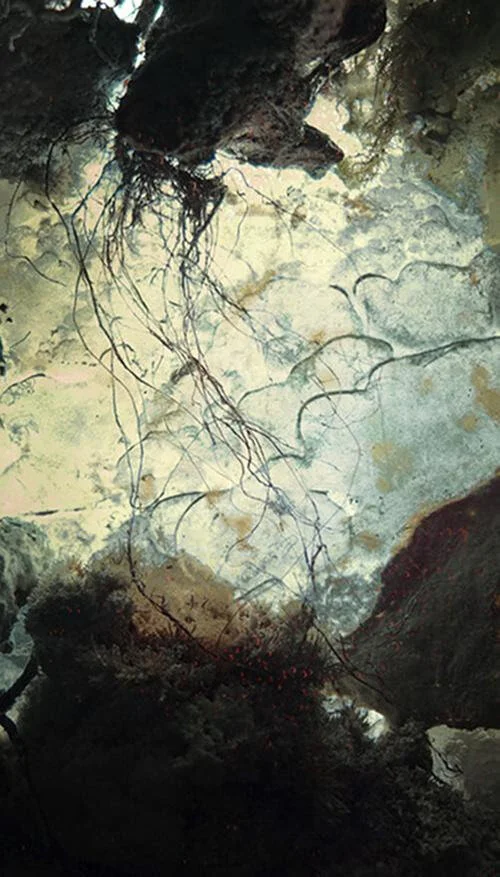
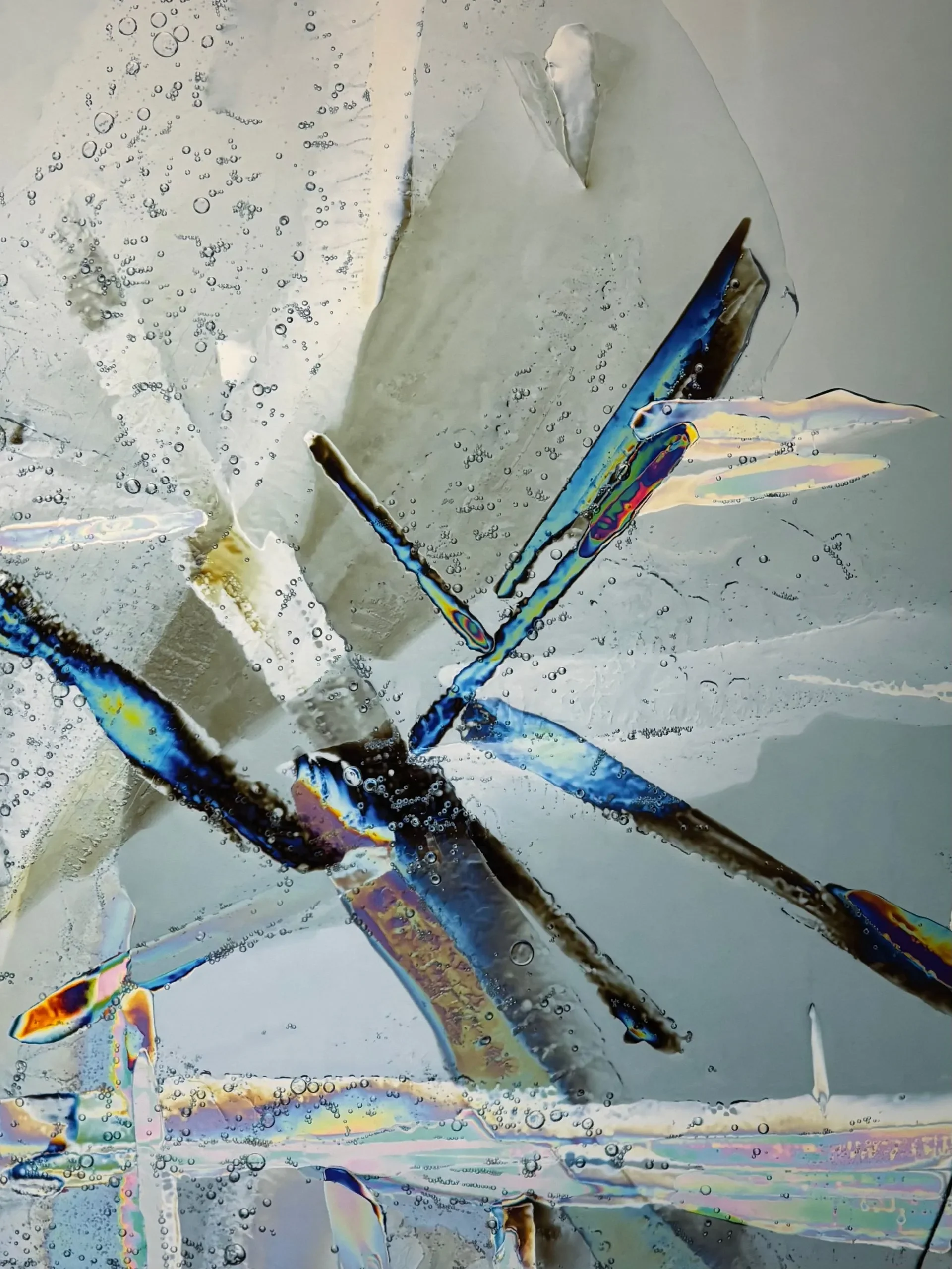
“Beneath the Ice” (archival inkjet print), by Nat Martin, in his show “Nat Martin - Studio Views,’’ at Kingston Gallery, Boston, Jan. 2-Feb. 2
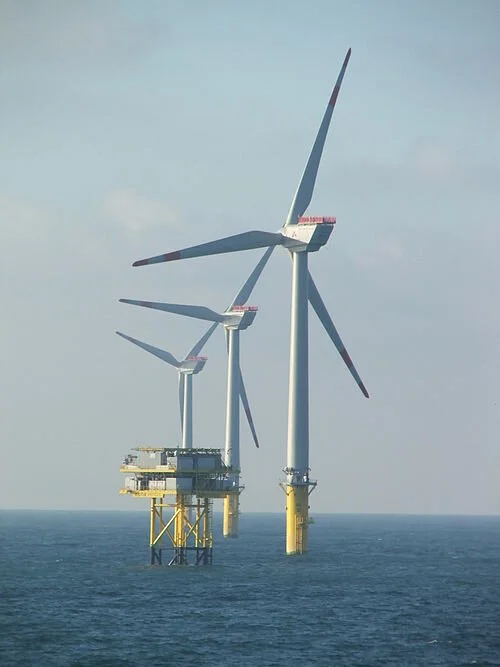
Eversource promises to become carbon-neutral by 2030
From The New England Council (newenglandcouncil.com):
“Eversource has pledged to become carbon-neutral within the next 10 years. Eversource, based in Hartford, and Boston, offers retail electricity, natural gas,and water to about 4 million customers in Connecticut, Massachusetts and New Hampshire.
“The company’s promise comes as a response to growing climate threats, such as heat waves and intensifying storms. Eversource has promised to take targeted steps across all departments and operations to reduce its overall corporate emissions. The plans include cutting energy use by improving the efficiency of its 69 facilities, reducing fleet emissions of its over 5,000 vehicles, lowering the greenhouse gas used in gas-insulated electric switch gear, and replacing bare steel and cast iron natural gas distribution lines to improve safety and eliminate methane leaks. If accomplished, the company would become the first investor-owned utility company to be carbon neutral.
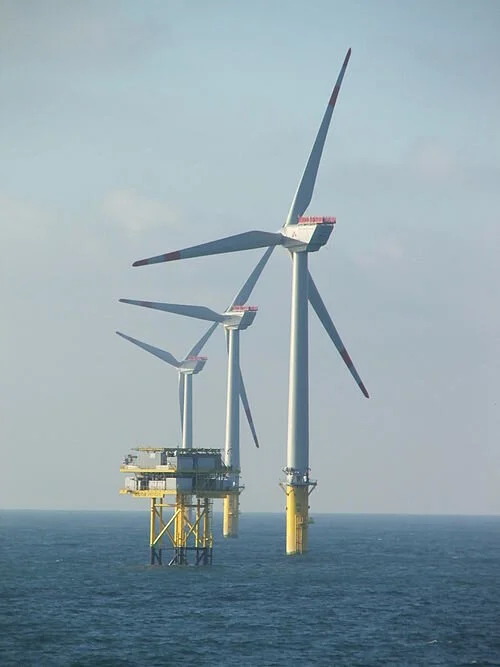
“In 2018, Eversource took its first steps to reduce its carbon emissions by divesting its remaining fossil generation facilities, partnering with, fellow NEC member, Orsted to build wind turbines off the coast of Massachusetts, and developing renewal energy stations and sources.
“As New England’s largest utility, we are proud to partner with our states and communities to achieve regional clean energy and carbon reduction goals,” said Eversource chairman, president and CEO Jim Judge. “Today, we are going one step further by setting a goal for our own operations to help demonstrate that carbon neutrality is achievable.”
The Council commends Eversource on this ambitious and important goal to reduce their carbon emissions.
At PCFR, novelist physician, coastal erosion, Antarctica, Iranian quandaries, Italian populism, God and geopolitics

The jumbled downtown of Monrovia, the capital of Liberia, where writer/public-health leader Michael Fine, M.D., worked
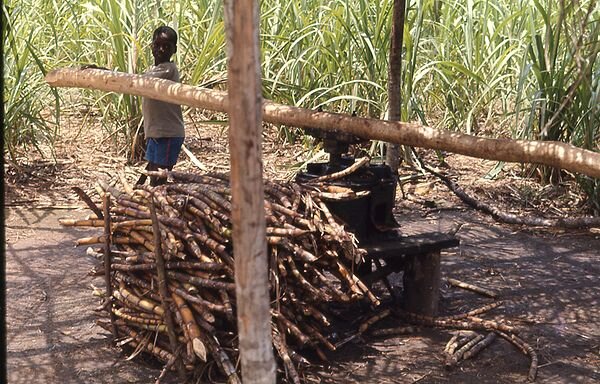
A Liberian boy cuts sugar cane
The next dinner of the Providence Committee on Foreign Relations (thepcfr.org; pcfremail@gmail.com) comes on Wednesday, Jan. 8, with Michael Fine, M.D., the speaker. He'll talk about his novel Abundance, set in West Africa, and the challenges of providing health care in the developing world. He’s also a short story writer and essayist.
Dr. Fine has been an advocate for communities, health-care reform and the care of under-served populations worldwide for 40 years. He is a former director of the Rhode Island Department of health.
His career as a community organizer and family physician has led him to some of the poorest places in the United States, as well as dangerous, war-ravaged communities in third-world countries. He is a former director of the Rhode Island Department of health.
Please let us know if you're coming to the Jan. 8 event by registering on our Web site, thepcfr.org, or emailing us at pcfremail@gmail.com. You may also call (401) 523-3957.
Please go to thepcfr.org, or email to pcfremail@gmail.com or call (401) 523-3957 for information on how to join the PCFR. (It’s very simple.)
xxx
And for the rest of the PCFR season, subject to the vagaries of weather, flu epidemics and so on:
On Wednesday, Feb. 5, we will welcome Cornelia Dean, book author, science writer and former science editor of The New York and internationally known expert on coastal conditions. She’ll talk how rising seas threaten coastal cities around the world and what they can do about it.
xxx
On March 18 comes Stephen Wellmeier, managing director of Poseidon Expeditions. He’ll talk about the future of adventure travel and especially about Antarctica, and its strange legal status.
xxx
News to come about an early-April speaker
xxx
On Wednesday, April 29, comes Trita Parsi, founder and current president of the National Iranian American Council, author of Treacherous Alliance and A Single Roll of the Dice. He regularly writes articles and appears on TV to comment on foreign policy. He, of course, has a lot to say about U.S. Iranian relations.
xxx
On Wednesday, May 6, we’ll welcome Serenella Sferza, a political scientist and co-director of the program on Italy at MIT’s Center for International Studies, who will talk about the rise of right-wing populism and other developments in her native home of Italy.
She has taught at several U.S. and European universities, and published numerous articles on European politics. Serenella's an affiliate at the Harvard De Gunzburg Center for European Studies and holds the title of Cavaliere of the Ordine della Stella d'Italia conferred by decree of the President of the Republic for the preservation and promotion of national prestige abroad.
xxx
On Wednesday, June 10, the speaker will be Dr. Elizabeth H. Prodromou, who directs the Initiative on Religion, Law, and Diplomacy, and is visiting associate professor of conflict resolution, at The Fletcher School of Law and Diplomacy at Tufts University. She titles her talk "God, Soft Power, and Geopolitics: Religion as a Tool for Conflict Prevention/Generation". She was originally scheduled for Dec. 5 but had to postpone because of illness.
'Levity and crime'

“Now at the turn of the year this coil of clay
Bites its own tail: a New Year starts to choke
On the old one's ragged end. I bite my tongue
As the end of me--of my rope of stuff and nonsense
(The nonsense held, it was the stuff that broke),
Of bones and light, of levity and crime,
Of reddish clay and hope--still bides its time.’’
— From “The Mad Potter,’’ by John Hollander (1929-2013), a celebrated poet, critic and Yale professor. He served as Connecticut’s poet laureate. He lived in Woodbrige.

Below Wepawaug Falls, in Woodbridge
Llewellyn King: The scary potential of cyberattacks on utilities make microgrids look better

In engineering there are credible and incredible failures. Nuclear-power plants were designed against what was believed to be a “maximum credible accident.” Then came Fukushima, incredible.
In early December, a report from the National Infrastructure Advisory Council (NIAC) raised the possibility that a huge electric failure, the result of a concerted cyberattack or other event, could knock out electric supply in large swathes of the country for an extended period, weeks even months. A failure with consequences which would have been beyond thinkable before the computer age.
The report, which comes from an advisory council whose mission is to inform the president, has a weight that a think-tank study, for example, would not have. Here, it is the voice of the energy establishment speaking.
I found in reading this report and talking to people in the industry and in academia, it is easy to predict the end of social order as we know it.
It is a painful mind game to try to think how long families could survive without electricity. First off, you would be hot or cold, every appliance in the home would not work. Even if you have a generator, in short order the fuel, natural gas or gasoline, would be gone. How much non-perishable food do you have? I suspect most families would be going hungry after a few days. I would. Cell phones would run down and stay down, and the networks would collapse.
We would be reduced to living like animals without the skills that are inherent to animals. In bad scenarios, families with guns would outlast families without – for a few days.
Survivalists would be proven right as they hung on, maybe for a few months, hunting for fresh food, hoping for clean water, and living off the non-perishable food they have stockpiled. Rumor would dominate as communications failed.
Electric utilities live in a world in which their realities are changing. Wildfires in California and Australia have pointed to a new liability for the companies: accidental ignition through falling lines, likely to get more serious as weather gets more aberrant and droughts become the normal in a time of climate change. That, together with cyberattack, puts them in a place of vulnerability they never anticipated.
Utilities are proud of their expertise – and justifiably so -- in responding to short-term outages, even major ones. They rush crews to the scene, and with military zeal get the lines up and the power flowing.
Then came Puerto Rico after hurricanes Irma and Maria, which gave an inkling of what happens when the grid fails: total devastation and maybe as many as 2,975 lives lost.
The NIAC report cites Puerto Rico and emphasizes cascading, blackouts as the grid begins to fail. As it is, utilities fend off daily cyberattacks, and every executive I have interviewed has emphasized that cyberattack is “what keeps me awake at night” – as Jacqueline Sargent, general manager and CEO of Austin Energy, told me recently.
The utility industry, often keen to be reassuring, was part of the preparation of the NIAC report. Scott Aaronson, point man in the industry’s trade organization the Edison Electric Institute, was involved in the report and has been raising the alarm in interviews since its release.
A new seriousness in the federal government, particularly in the Department of Homeland Security, the Department of Energy and the Pentagon, shows that the threat is real and credible. The White House has said nothing.
Changes not dictated by cyberattack defense, but which might aid it, are on the way. Small entities known as microgrids are cropping up. Think of the old utility model with central power stations as a city. The new one is a series of microgrids, more like villages, loosely connected and isolatable, and depending on local generation from solar and wind.
Also, the technology of defense against cyberattack is growing; There is a large cyber-defense industry. It is an escalating battle in which the defenses improve as the threat multiplies, a kind of cold war with weaponized computers.
In the new year, the invisible enemy will be engaged more than ever. But who knows what is enough? In the NIAC report, insiders have sounded the alarm about their own defenses. That is serious, credible.
On Twitter: @llewellynking2
Llewellyn King is executive producer and host of White House Chronicle, on PBS. He’s based in Rhode Island and Washington. D.C.
Watch the latest White House Chronicle:
The nation’s democracy crisis, with Joe Madison and Hedrick Smith
'Something fishy' in canal-city Lowell
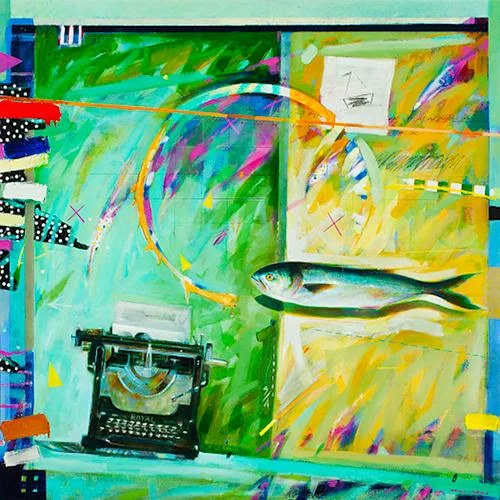
“Something Fishy’’ (acrylic), by Patrick McCay in the Whistler House Museum of Art’s (in Lowell, Mass.) members’ exhibition, which features art from members of the Lowell Art Association, the nation’s oldest incorporated art association. The Whistler House is the birthplace of famed painter and etcher James McNeill Whistler (1834-1903), probably best known for the painting nicknamed “Whistler’s Mother.’’
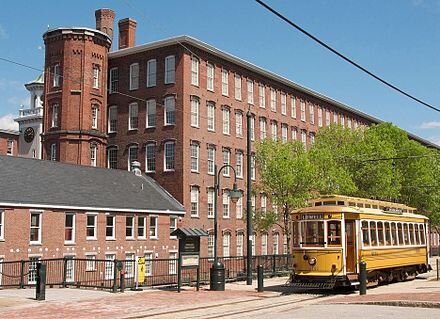
The Boott Cotton Mill Museum and Trolley, in the Lowell National Historical Park
Incorporated in 1826 to serve as a mill town, Lowell was named after Bostonian Francis Cabot Lowell, a major early figure in the American Industrial Revolution. The city soon became famous for its textile mills and other factories. Many of Lowell's historic but long closed manufacturing sites are now part of the Lowell National Historical Park, which is also well known for its canals, on which you can take tours by boat.
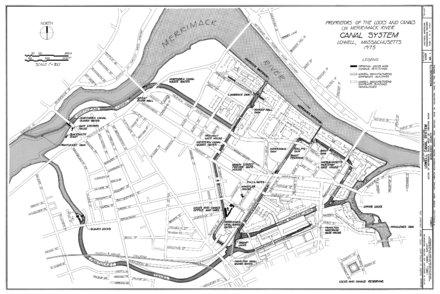
1975 map shows Lowell canals.
Electric holidays
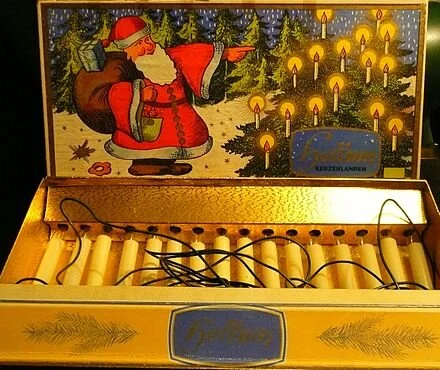
From Robert Whitcomb’s “Digital Diary,’’ in GoLocal24.com
The Christmas season reminds me of the seasonal extension cords lying everywhere in the house I grew up in -- to light the tree, the fake candles in all the windows, a huge Santa Claus face and other displays. The floors in some of the rooms looked as if small snakes were occupying the place. For years, we didn’t stint on these displays. Then, rather suddenly, they didn’t seem worth the trouble. There were some mild shocks along the way, but no one was electrocuted.
Duke of decoys in Shelburne
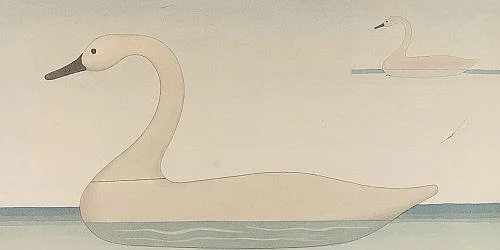
“Swan, Havre de Grace‘‘ ( 1950) (watercolor and ink on paper) by Joel D. Barber Collection of Shelburne Museum, gift of J. Watson, Jr., Harry H., and Samuel B. Webb, photography by Andy Duback, through Jan. 12 at the Shelburne Museum, Shelburne, Vt.
This exhibit focuses on the life and work of Mr. Barber, an architect, author, illustrator and decoy collector. This exhibit is the first of its kind about him, and is split into five sections according to the significant periods of his life and work.
Shelburne, one of northern New England’s richer towns, in part because of second homes and affluent retirees, is a suburb of Burlington and on Lake Champlain. Its major tourist attractions include Shelburne Museum, Shelburne Farms, Vermont Teddy Bear, Shelburne Vineyard and Fiddlehead Brewery. There’s a beach on the lake and a nature park.
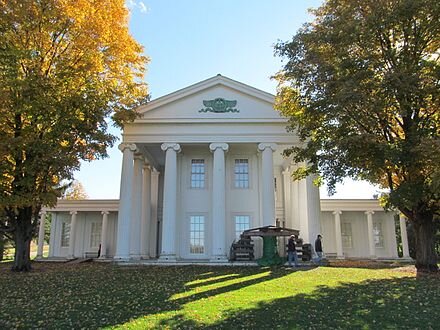
Electra Havemeyer Webb Memorial Building, home of the Shelburne Museum's European paintings collection. The Havemeyer fortune came from vast sugar-industry interests based in New York City.
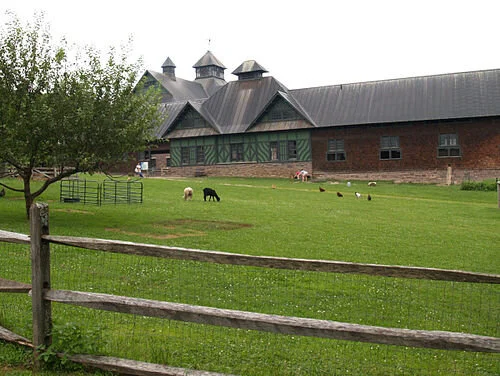
At Shelburne Farms, a nonprofit education center for sustainability that includes a 1,400- acre working farm — a National Historic Landmark — on the shores of Lake Champlain. The property an example of a Gilded Age "ornamental farm," developed in the late 19th Century with architecture by Robert Henderson Robertson and landscaping by Frederick Law Olmsted.
'A wingless angel'?
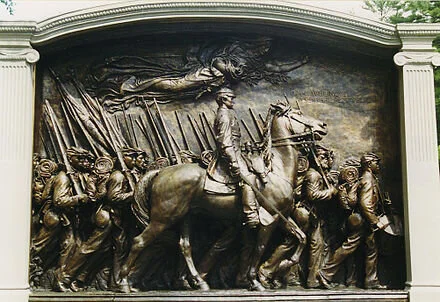
The Robert Gould Shaw Memorial, at Boston Common. A reproduction can be found at the Saint Gaudens National Historical Park, in Cornish, N.H. (the town in which the late famously reclusive writer J.D. Salinger lived for many years).
“….A month ago,
at Saint-Gaudens’s house, we ran from a startling downpour
into coincidence: under a loggia built
for performances on the lawn
hulked Shaw's monument, splendid
in its plaster maquette, the ramrod-straight colonel
high above his black troops. We crouched on wet gravel
and waited out the squall; the hieratic woman
-- a wingless angel? -- floating horizontally
above the soldiers, ‘‘
—- from “Demolition,’’ by Mark Doty
The Saint-Gaudens National Historical Park preserves the home, gardens and studios of Augustus Saint-Gaudens (1848–1907), one of America's most famous sculptors. The estate was his summer residence in 1885-1897, and then his permanent home from 1900 until his death. It was the center of the Cornish Art Colony. The estate includes two hiking trails. Original sculptures are on exhibit, along with reproductions of his masterpieces.
Allegedly, there were wild parties when Saint Gaudens was in residence.
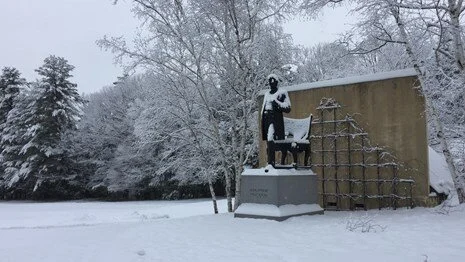
One of the statues at the park
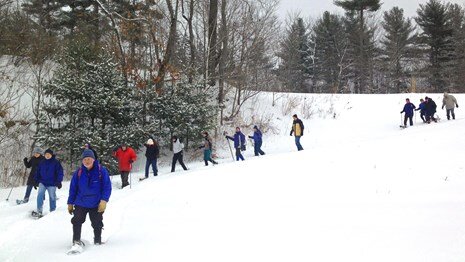
Skiing and snowshoeing at the park.
On Jan 4 10-11:30 a.m., follow a ranger at the park for a stroll through history around its grounds.
Holiday hallucination
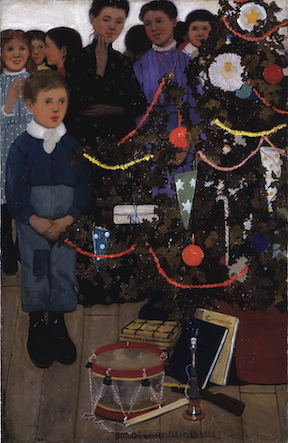
From Ethel Franklin Betts's “Little John’s Christmas’’ (1906) (oil on canvas), courtesy of the National Museum of American Illustration, Newport.
Frank Robinson: What we're left with
Note from Robert Whitcomb:
Every year at this time, a longtime friend of mine, Frank Robinson, an art historian, poet and essayist who used to run the art museums at the Rhode Island School of Design and Cornell University, sends a poem from his home in Ithaca, N.Y. Here’s this year’s:
Senior Moments, 111
(written from a senior community)
A notice in our auditorium:
“Dear Alzheimer’s Patients:
Please don’t talk during the concert.
It disturbs the other guests.’’
xxx
Of course we love our children —
without them,
we wouldn’t have our grandchildren.
xxx
The challenge here:
You’re nobody now,
but you can’t forget
you were somebody once.
xxx
Just in Case
Of course, I’ll go first,
but just in case,
please write a note
to your successor
(not replacement, no, never!)
a brief note explaining me.
xxx
Advertisement
MOURNERS FOR HIRE –
YOU DIE, WE CRY
a public service for every occasion,
every gender, every religion,
loud or soft,
and all you can eat at the wake.
xxx
Waiting for My Knee Replacement
A few helpful comments:
“It’s very painful – worse than a hip.”
“It’s a big deal.’’
“You’re walking so much better now,
you really don’t need an operation.’’
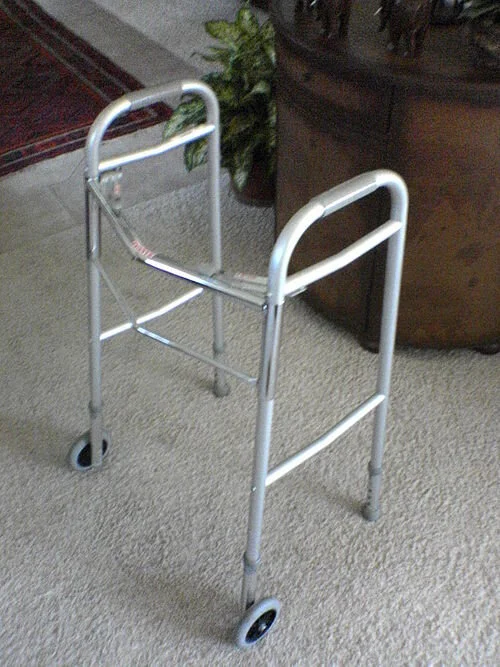
And then someone stole my walker –
or rather, walked away with it.
Even my cane clicks
every time I take a step.
Thank God
they operate tomorrow.
xxx
The Day After
People are so nice to me,
I must be very sick.
xxx
Here,
you’re out of step
If you’re perfectly healthy.
xxx
Each of us is known for our illness,
and each day,
we’re either better or worse or the same.
xxx
We grow smaller year by year.
They say it’s age,
But maybe, too,
it’s the way that time
keeps lopping off
our jobs, our homes, our friends.
We’re left with who we are,
nothing more, but nothing less.
xxx
We have so little time left,
we have all the time in the world.
xxx
My wish for everyone here –
a healthy life, an easy death,
and a lot of money left over.
Chris Powell: The question for the day after Christmas
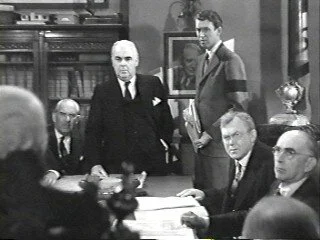
Scene from It’s a Wonderful Life
Frank Capra's 1946 film, It's a Wonderful Life, broadcast again on Christmas Eve at 8 by NBC television, is loved most for its personal message of discovery at Christmas: that its hero's life has been, unbeknownst to him, crucial to his family, friends, community, and even his country.
Such general encouragement may seem more needed than ever these days; indeed, this may be, sadly, the cause of the film's popularity. But It's a Wonderful Life may be more important still for its overlooked lesson in democratic economics, a lesson arising from the struggle for survival of a combination credit union and savings bank, the Bailey Building & Loan in the Everytown of Bedford Falls.
The Building & Loan's founder and chief executive, Peter Bailey, has died and its board of directors is deciding the institution's future. The richest man in town, Potter, a misanthropic banker, ruthless landlord, and board member, played by Lionel Barrymore, proposes dissolving the Building & Loan, and his callousness angers Bailey's elder son, George, played earnestly by Jimmy Stewart, who has been working as assistant to his father.
POTTER: Peter Bailey was not a businessman. That's what killed him. Oh, I don't mean any disrespect to him, God rest his soul. He was a man of high ideals -- so-called. But ideals without common sense can ruin this town. Now you take this loan here, to Ernie Bishop. You know, the fellow who sits around all day on his ... brains, in his taxi. I happen to know the bank turned down this loan. But he comes here, and we're building him a house worth $5,000. Why?
GEORGE BAILEY: Well, I handled that, Mr. Potter. You have all the papers there -- his salary, insurance. I can personally vouch for his character.
POTTER: A friend of yours.
BAILEY: Yes, sir.
POTTER: You see, if you shoot pool with some employee, you can come and borrow money. What does that get us? A discontented, lazy rabble instead of a thrifty working class. And all because a few starry-eyed dreamers like Peter Bailey stir them up and fill their heads with a lot of impossible ideas. Now I say. ...
BAILEY: Now hold on, Mr. Potter. Just a minute. Now you're right when you say my father was no businessman -- I know that. Why he ever started this cheap, penny-ante building-and-loan I'll never know. But neither you nor anyone else can say anything against his character, because his whole life was. ... Why, in the 25 years since he and Uncle Billy started this thing, he never thought of himself. Isn't that right, Uncle Billy? He didn't save enough money to send Harry to school, let alone me, but he did help a few people get out of your slums, Mr. Potter. Now what's wrong with that? Why, you're all businessmen here. Doesn't it make them better citizens? Doesn't it make them better customers? You said that ... what did you say a minute ago? "They have to wait and save their money before they even think of a decent home." Wait? Wait for what? Until their children grow up and leave them? Until they're so old and broken-down that they. ... Do you know how long it takes a working man to save $5,000? Just remember this, Mr. Potter: that this "rabble" you're talking about, they do most of the working and paying and living and dying in this community. Well, is it too much to have them work and pay and live and die in a couple of decent rooms and a bath? Anyway, my father didn't think so. ...
At the board's insistence, George Bailey takes over in his father's place to keep the Building & Loan going, and soon he forestalls a run on it, part of a general financial panic, by putting up the money he has saved for his honeymoon and by preaching to a mob of frightened depositors about how they should not withdraw their money but instead have faith in the institution, because their money isn't kept in cash in the safe but rather is invested in the houses, the mortgages, the very lives of their neighbors.
Of course, this is Capra's metaphor for politics and the world: that there is progress when everyone is given a chance, a little capital and credit, when people play by the rules, look out for each other, and don't take too much more than they need, and that selfishness is the ruin of everything.
Something like this -- more or less a policy of helping to make middle-class everyone who aspired to it and would indeed play by the rules, a policy of democratizing capital and credit -- made the United States the most prosperous country and the most successful in elevating the human condition.
But for a few decades now the price of obtaining and maintaining those "two decent rooms and a bath" and the middle-class life to go with it has risen as real wages have stagnated, taxes are levied in the name of certain services that have not really been rendered, a welfare system that has subsidized what somehow is not permitted to be called the antisocial behavior it is, and a plutocracy that has gained control of the economy and both major political parties.
There seem to be more people who, if too confused or demoralized to be dangerous, are still closer to being a "rabble" than the country saw even during the Great Depression.
Even at its best now Christmas is seldom more than an itinerant charity that, necessary as it may seem, tends to suppress the great political question of the day after Christmas, the question of how things can be organized to ensure that everyone has a good chance to earn his way in decency. But the great joy of Christmas is that the answer has been given, that we are not lost, that the country has been shown the way and can recover it -- that society can work for all, that it really can be a wonderful life if enough selfless people make it a political one.
Chris Powell is a columnist for the Journal Inquirer, in Manchester, Conn.
David Warsh: The Harvard Russia scandal, Ukraine and (treasonous?) Trump
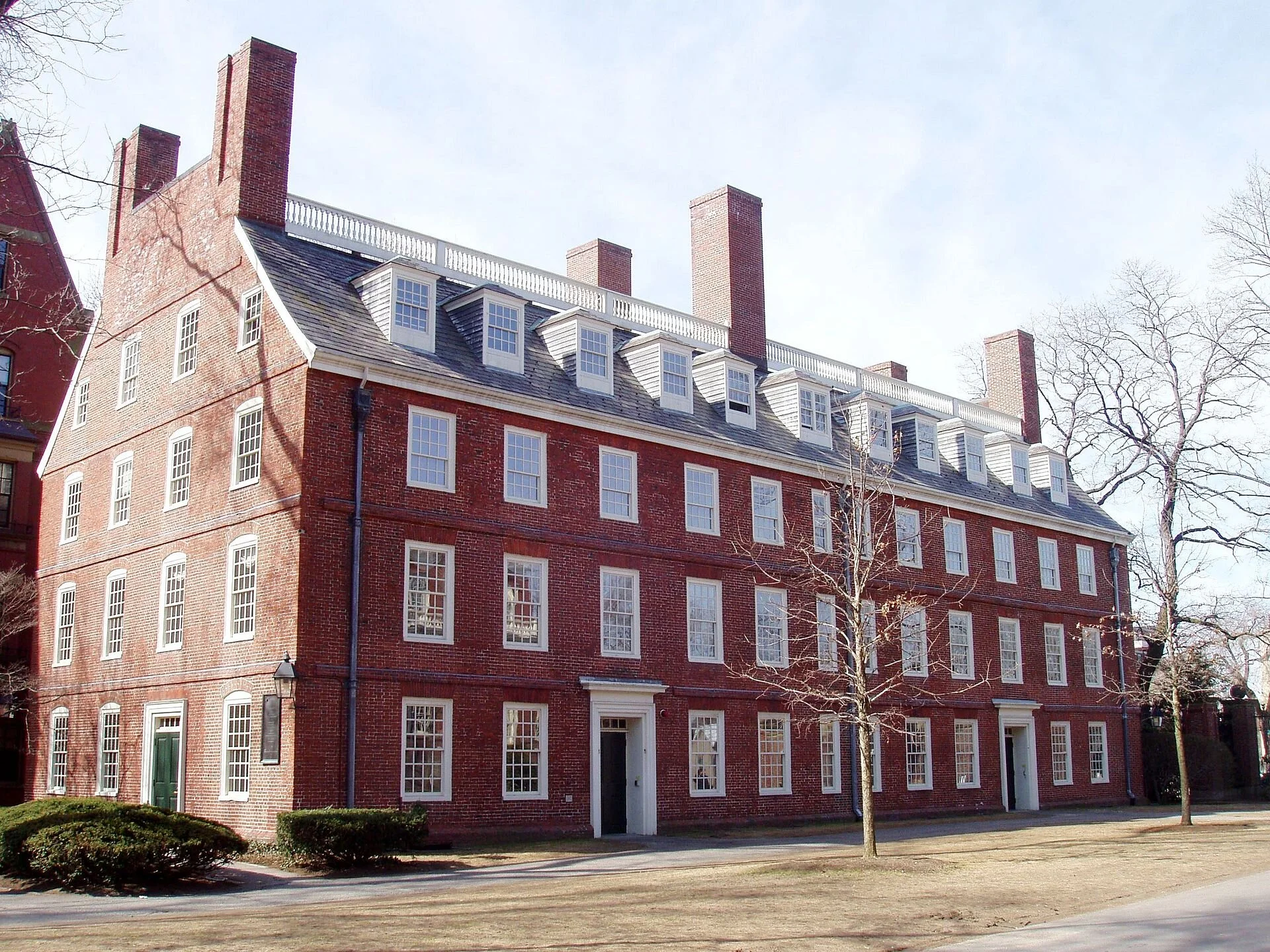
Massachusetts Hall (1720), Harvard’s oldest building
— Photo by Daderot
SOMERVILLE, Mass.
In the summer of 2015, at a time when Hillary Clinton was widely expected to become the next president, I began writing a book in hopes of getting well-informed citizens to think more deeply about U.S. relations with Russia since the end of the Cold War. The title I settled on – Because They Could: The Harvard Russia Scandal (and NATO Expansion) after Twenty-Five Years – signaled my dual purpose.
{Wikipedia summarized the Harvard Russia scandal thusly: “{Hedge funder} Nancy Zimmerman's investments in Russia made national headlines in 1997 when the USAID ended a $14 million grant to the Harvard Institute for International Development, headed by Zimmerman's husband {Russian-American economist Andrei Shleifer after he was accused of using the institute to help Zimmerman with her investments.’’}
Harvard economic Prof. Lawrence Summers had been obtuse at every stage of the Harvard Russia scandal, as Treasury secretary and as president of Harvard University. I sought to make it less likely that would return to a position of power in a Clinton administration. I hoped, too, to encourage a closer examination of origins of the war in Ukraine that had begun the year before, which, I argued, was the climax of NATO expansion intended to diminish Russian influence beyond its immediate borders. The book appeared in May 2017, four months after Donald J. Trump was inaugurated. Though I continued to write occasional columns about Russia, I put the book aside and turned to a project more important to me
All that came back to mind last Friday morning when The Washington Post published a landscape-altering story. The import of “Former White House officials say they feared Putin influenced the president’s views on Ukraine and 2016 campaign” will require weeks to sink in, as other news agencies seek to test and explore its significance.
According to the article, “senior aides” in the White House and administration suspected practically from the beginning that Russia had put the Ukraine theory bug in Trump’s year, especially after two private meetings with Putin, in Helsinki, in 2017, and Hamburg, in 2018. The American president apparently escalated his claims after each meeting that Ukraine, not Russia, was behind meddling in the 2016 election. U.S. intelligence agencies kept telling him that Russia was behind the interference; White House officials and others surmised that the President’s preoccupation with Ukraine was responsible for his oft-expressed mistrust of their conclusions. “One former senior White House official said that Trump even stated so at one point, saying he knew Ukraine was the real culprit ‘‘because Putin told me,’’ wrote reporters Shane Harris, Josh Dawsey, and Carol Leonnig.
The article traced origin of the Ukraine theory to then-campaign manager Manafort, who told his deputy Rick Gates in the summer of 2016 that Ukraine had been behind the Democratic National Committee hacks. The story was subsequently propagated by Rudy Giuliani, Trump’s personal attorney. Two weeks after Trump took office Putin asserted at a news conference in Budapest that the authorities in Kyiv had supported Hillary Clinton.
The article describes the diffusion of the belief that the California computer security firm hired by the Democratic National Committee to investigate the theft of its email had removed the DNC server to Ukraine. CrowdStrike was indeed cofounded by Dimitri Alperovitch, a Russian-born U.S. citizen, an expert in cybersecurity. Trump first mentioned CrowsdStrike publicly in April, 2017, describing it as “Ukrainian-based.”
The theory was amplified on social media after each private meeting with Putin. And Trump again mentioned the firm in the course of his July 25 phone conversation with Ukraine President Volodymyr Zelensky. After that became public, former Trump Homeland Security Adviser Tom Bossert told ABC news, “The DNC server and that conspiracy theory has got to go. If he continues to focus on that white whale, it’s going to bring him down.”
Why has Donald Trump been so sympathetic to Putin? As a former real estate developer, the president knew many Russians through dealings, some going back more than twenty years. Special Counsel Robert Mueller referred some of those matters to the U.S. attorney for the Southern District of New York for examination at a time when Trump is no longer president. But it is equally true, as Economic Principals has occasionally argued, that the president is intuitively in touch with the feelings of many Americans, and not just those who attend his rallies.
Long before EP and others more prominent began making the argument in the present day that the U.S. had bullied Russia in the course of NATO expansion. Trump had worked as much out for himself. More prominent like who? Keith Gessen, for instance, among those more familiar with the government of Russia; Stephen Walt, among those more familiar with the American foreign policy establishment. It is not hard to believe that many non-Trump voters might, in a broad-based political debate, share their views of American foreign policy during its twenty-five years as the world’s only superpower.
Confronted with expert evidence of attempted Russian tampering with the American election, Trump may have concluded that the argument that the former Soviet Union had some legitimate grievances against previous American administrations became difficult, probably impossible, to make. Or perhaps he didn’t even consider the matter. In any event, adopted the counter-story, apparently devised in Russia, and now thoroughly discredited, that Ukraine was to blame.
But what had happened to Putin? Up through his speech on the eve of the Russian annexation of the Crimean peninsula, the Russian president could pretty much be taken at his word. Since then he had frequently lied about matters large and small. Why? Here’s a surmise: Expecting Clinton to win, Putin authorized Russian interference as a means of expressing displeasure. When Trump won instead, Putin devised an old-fashioned Soviet-style disinformation campaign as defense. When the American president bought into his “friend” Putin’s story, Tump may very well have actually committed treason. If The Washington Post story holds up and gains altitude, it will make the Senate trial much more absorbing. We can only stay tuned.
. xxx
New on the EP bookshelf:
The Economics Book: From Xenophon to Cryptocurrency, 250 Milestones in the History of Economics, by Steven Medema (Sterling, 2019)
1931: Debt, Crisis, and the Rise of Hitler, by Tobias Straumann (Oxford, 2019
A Tale of Two Economies: Hong Kong, Cuba, and the Two Men Who Shaped Them, by Neil Monnery (Guliemus Ocamus & Co, 2019)
David Warsh, an economic historian, is proprietor of Somerville-based economicprincipals.com, where this piece first ran.
Flagging Boston Harbor
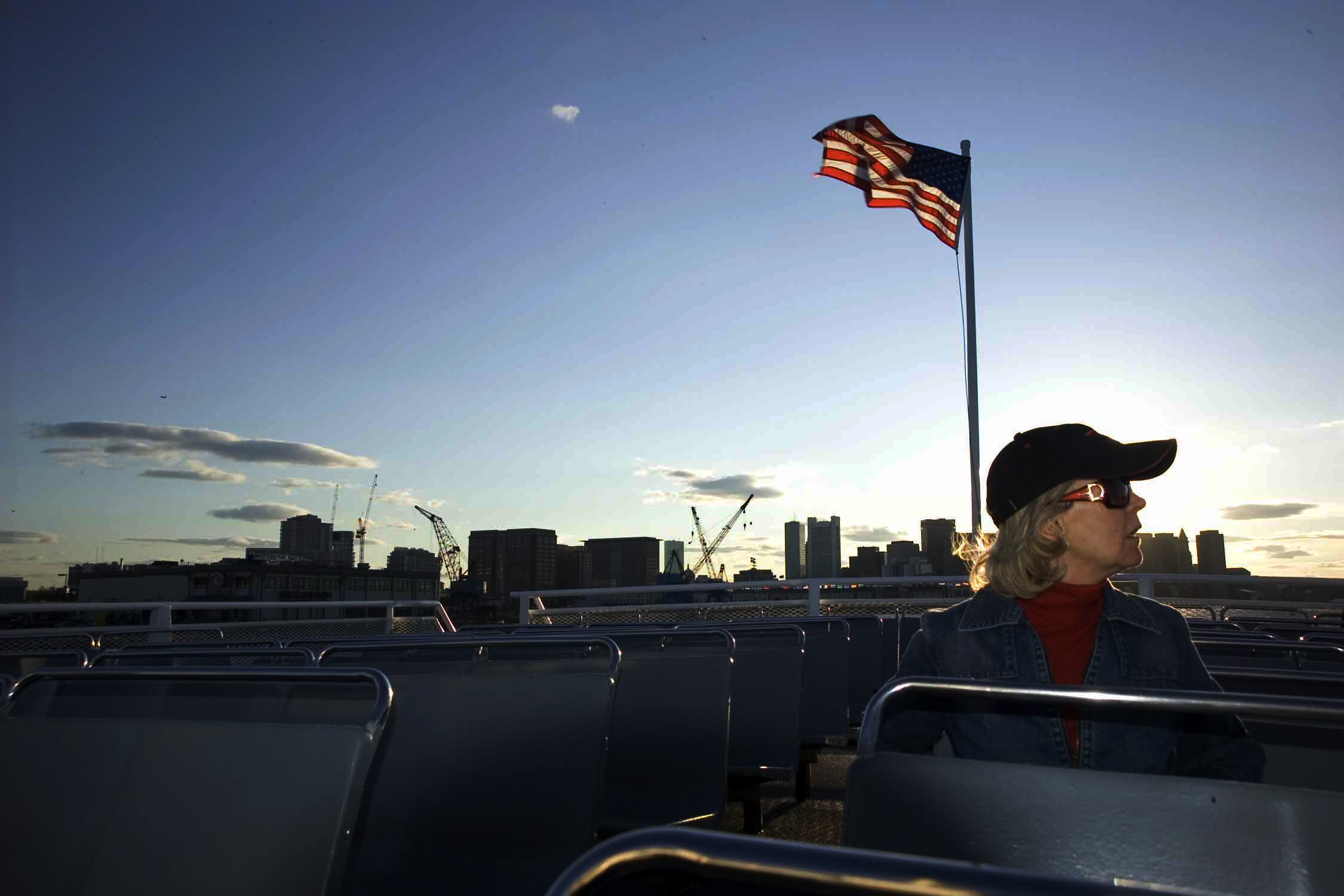
Kate Driesen on a Boston Harbor boat tour on a relatively warm winter’s day
— Photo by C. Davis Fogg
Don Pesci: My 1957 Christmas

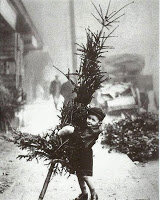
The author and his Boy Scout Christmas tree
VERNON, Conn.
The snow seemed deeper in those days because you had to shovel it in preparation for Christmas, when the guests would be coming. The Pertusi boys, John and Anthony, generally arrived early, full of smiles and hellos, and the winter of '57-’58 was obliging in our town of Windsor Locks, Conn. We hadn’t had much snow prior to Christmas.
There was always lots of glad-handing and, if I may say so, just plain glad-handling within our family because we were Italians, and Italians never really know a thing until they have handled it. Well, think of it: When you hug a person, you’re drawing him or her into your open heart. Now, this never presented a problem if the two huggers were male, though some people frown on that sort of thing. And for us, there was no problem hugging or bussing an aunt on the cheek, provided you were really happy to see her, which was nearly all the time. But we drew a line with female cousins. I won’t say we were stand-offish – not at all. But we were cautious.
In 1957, we were a dozen years on the other side of World War II, marching steadfastly towards prosperity. My twin sister and I were 14, she feeling like 18, that mystical age in which suddenly you became a grown-up and could do pretty much whatever you like, provided your dad approved. There was never a question of keeping secrets from him.
Christmas began with the arrival of the Pertusis by train, which deposited them at the old station on Main Street, shortly after my father bought a tree from the Boy Scouts, who always set up at the bottom of the intersection of South Main and Suffield Streets, a hop, skip and a jump from our house.
My twin sister, Donna, insists to this day that the Scouts sold the worst trees ever, perhaps a sleight exaggeration. Somehow I was under the impression that my father was averse to having strange trees and strangers in the house – plumbers particularly -- and his choice of trees may have been a way of grudgingly satisfying the wants of my mother, who was a stickler for tradition and propriety. In any case, our Christmas tree, even after it had been decorated, always seemed to want fullness.
Many years later, when I was as shorn of branches as those bygone trees, Donna circulated a picture of me embracing a Boy Scout tree before hauling it up the short incline to our house, painted at the time a forest green to compliment the two giant blue spruce trees that fronted 1 Suffield St. in Windsor Locks.
My mother, Rose, a practical woman, admired those spruce trees, which provided a barrier from prying eyes when we all gathered on the Pesci porch on spring and summer evenings, just as the sun was kissing the horizon.
Our house and porch was the Grand Central Station of our family. The back door -- the front door being reserved for less frequent visitors -- was a turnstile that admitted nearly every close and distant relative in town, as well as near and distant acquaintances of my father, such as the superintendent of the town dump. On occasion, the family, most especially my uncles Tommy and Charlie, went dump-picking, dragging home items, such as the shutters that still adorn the Suffield Street homestead, unappreciated by the owners who had deposited them in the dump, people who, as Oscar Wilde once said of the unsentimental cynics of his day, knew the price of everything and the value of nothing.
We should try to remember the people we love in their beauty and strength.
My mother’s kitchen was the site of many an evening poker gathering of raucous uncles and aunts. Getting the kids out of the way was an art rather than a science, and this always required a certain amount of misdirection. Poker days were scheduled for the weekends, usually on a Friday late at night when Don, Donna and Jim were abed.
My bedroom, shared with brother Jim until he was married and moved out of the house, was near enough to the kitchen so that, pressing my ear to the wall, I could hear, though never distinctly, the shouts of triumph and moans of despair piercing the slats and plaster as the poker game proceeded. To say the truth, Rose and Aunt Nellie, married to my uncle John, were better poker players than any of my uncles – Tommy, Charlie or John. A fourth uncle, Ray, was already tucked away in Long Island, New York, living the good life, along with his wife, Leatrice, who was partial to fox-fur, mink and Cadillacs.
The Christmas of 1957 was mild by New England standards. It was cold and gray, but the snow, a paltry 7 inches in December-January, was easily managed. We were used to the train hooting at night, when all our senses were alive to the surrounding sounds: cars, headed in the direction of Hartford or Springfield, passing on the main thoroughfare, Mr. Curtie’s mutt longing for the lost sun and barking in the distance, laughter coming from the kitchen, someone asking someone else “Pass the butter,” the someone else replying curtly, “Get it yourself.” On the table was a large pot of steamers, small dishes of melted butter, ashtrays filling with butt ends, and family familiars – the boys, Tommy, Johnnie and Charlie, and the girls, Rose, Dottie, Mary and Nellie – laughing, boasting, telling stories, cracking jokes, gleefully spreading doubtful rumors, all of them refusing to pass the butter, concentrating fiercely on their cards and trying to read in human faces who among them might win the hand.
My father had gone to bed early after having left near the table an alarm clock set at twelve PM, at the ringing of which everyone at table would be expected to go poof, like Cinderella at the stroke of midnight. The festivities usually concluded at one or two.
It was Friday the 20th, and Christmas Day was twinkling in all eyes. The kitchen was suffused with the odors of Christmas: traditional turkey with all the fixings, stuffing, cranberries, gravy the color of my father’s Sunday shoes, potatoes and turnips, greens and salad, wine red and white, fresh bread from the Italian bakery in Agawam or Hartford, Ann Bollea’s apple and mince pies. The small living room was bursting with laughter and conversations whispered and shouted. Such family gatherings were not rare, and everyone was there gathered around the table, elbow to elbow, but for the children, who were settled in the kitchen where we usually took our supper.
The turkey arrived, hefted by my father, who had left his alarm clock in his bedroom. When everyone had their fill, my mother, who had been watching the proceedings with the attention of a master sergeant, asked this or that feaster why they had not had seconds or, in the case of the gluttons, thirds.
My mother’s earlier injunction, “Now, there will be no talk of politics or religion at this table, at this time,” was generally widely disregarded.
Dwight Eisenhower had ascended to the presidency in 1953 and held that office until 1961. Pasting “I Like Ike” political posters over the bridge near Stony Brook was my introduction to politics. I believe my father had the first framed picture of Barry Goldwater in Connecticut. Barry and I shared a bedroom together, most likely because my mother – who grievously disappointed my father by voting for Senator Jack Kennedy over Richard Nixon for president in the 1960 – didn’t want a stranger glaring down on her in her bedroom. My father was a Republican in a town that was blanketed with Democrats, and these included many of my uncles, as well as Buzzy Bollea, my brother’s father-in-law. Quicksand, my mother knew, was everywhere. But the family managed to get along despite sharp political differences. Buzzy was a molecular Democrat, my father a molecular Republican, yet they were lifelong friends who admired each other for the best of reasons.
On the religious front, there were no atheists in the town and few publicly professed agnostics. My father and mother sent their children to St. Mary’s parochial school within shouting distance of our house. The Sisters of Saint Joseph were the teaching order that pulled us from first to eighth grade. My grandfather’s depreciation of the nuns was legendary. Whenever he saw a cluster of them proceeding from the school down Center Street during their frequent peregrinations, he would dive for cover into his house. But he was a man in whose brain superstition wrestled with rationality. One of those sisters taught me how to draw, and I will be forever grateful for her attentions.
Following the Christmas meal, the women floated into the kitchen, the table was cleaned, and the men, loosening their belts, retired to the living room to continue their confabulations. Someone was sure to fall asleep. Turkey has that effect on people. Somewhere around 11:00, nearly all the relatives departed to their own homes under a starless, cold, December sky. In the bedroom, the alarm clock would go off. Another Christmas had been tucked into bed.
In the morning, Mrs. Bianchi’s cock would crow and set off a riff of barking from Mr. Curtie’s old, nearly hairless, blond mutt.
Don Pesci is a Vernon-based columnist.
World within world
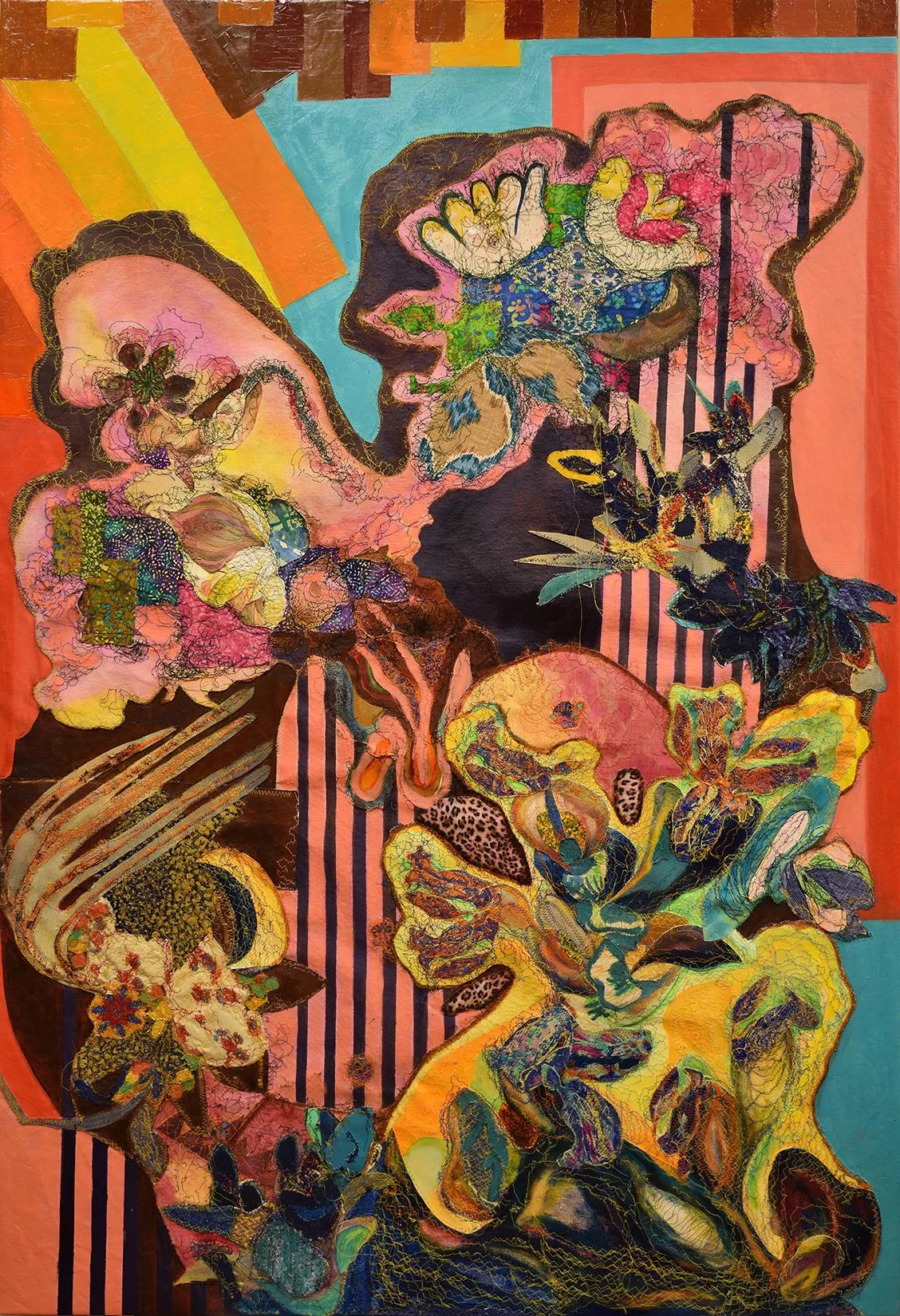
From On-Kyeong Seong’s show “Embedment,’’ at Kingston Gallery, Boston, Feb. 5-Feb. 29. The gallery says:
“Known for her sumptuous, colorful works, the pieces on view highlight her idiosyncratic artistic practice of sewing directly onto unstretched canvas. She is fascinated by our universe’s delicate balancing act of creating a human world within a biological one. Her mixed media paintings, with layers and textures created by the process of pushing the canvas through the sewing machine, demonstrate the changes and influences created by human intervention.’’
Should have waited for Rudolph

This illustration might be the first visual reference to Santa's sleigh being pulled by a reindeer. It appears in "Old Santeclaus with Much Delight", an 1821 illustrated children's poem published in New York.
“A dwarf invented reindeer on his own.
He was Santa’s favorite. He
hadn't known
they already existed.’’
— From Landis Everson’s (1926-2007) "Before Christmas"