
Vox clamantis in deserto






Catalyzed by imprisonment
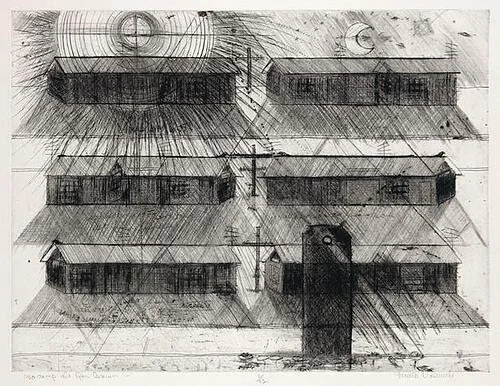
Munio Makuuchi. “Neo Camp ala Ron Brown” ( etching, drypoint, scraping and burnishing on warm white Arches paper), by the late Munio Makuuchi, in the show “Defiant Vision: Prints & Poetry,’’ at the Smith College Museum of Art , in Northampton, Mass., through Dec. 8 This work was purchased with the Elizabeth Halsey Dock {Smith College} Class of 1933 Fund. © The Estate of Munio Makuuchi.
The museum says that Munio Makuuchi, “born Howard Takahashi, was a Japanese-American artist and poet born in 1934. {He died in 2000.} He and his family were imprisoned in Minidoka Relocation Center, an internment camp, for three years during World War II, and this experience was a catalyst for his artistic vision

David Warsh: 'Technocrats vs. democrats?'

Flowchart of four phases (enrollment, allocation, intervention, follow-up, and data analysis) of a parallel randomized trial of two groups (in a controlled trial, one of the interventions serves as the control), modified from the CONSORT (Consolidated Standards of Reporting Trials) 2010 Statement.
—From Wikipedia
SOMERVILLE, Mass.
Ten years ago, Princeton University economist Angus Deaton used his Keynes Lecture to the British Academy to sound a note of caution about the new New Thing in development economics: the randomized controlled trial (RCT), or field experiment. He recounted the general frustration with the failure of traditional econometric methods to swiftly unlock the secrets of economic development (and with the inability of development agencies to learn more from their own experience). He surveyed the rising enthusiasm for RCTs as an alternative path to reliable knowledge without the traditional fuss.
He argued against the trend. “[E]xperiments have no special ability to produce more credible knowledge than other methods, and… actual experiments are frequently subject to practical problems that undermine any claims to statistical or epistemic superiority.” Citing a maxim of philosopher Nancy Cartwright, Deaton wrote,
Randomization is not a gold standard because “there is no gold standard,” Randomized controlled trials cannot automatically trump other evidence, they do not occupy any special place in some hierarchy of evidence, nor does it make sense to refer to them as “hard” while other methods are “soft”. These rhetorical devices are just that; a metaphor is not an argument.
More positively, Deaton continued,
I shall argue that the analysis of projects needs to be refocused towards the investigation of potentially generalizable mechanisms that explain why and in what contexts projects can be expected to work. The best of the experimental work in development economics already does so, because its practitioners are too talented to be bound by their own methodological prescriptions. Yet there would be much to be said for doing so more openly. I concur with the general message in [Ray] Pawson and [Nick] Tilley…, who argue that thirty years of project evaluation in sociology, education and criminology was largely unsuccessful because it focused on whether projects work instead of on why they work.
Nevertheless, the RCT movement continued to attract adherents, and researchers attracted more and for funding from the World Bank and like-minded foundations with an interest in ameliorating global poverty. Poor Economics A Radical Rethinking of the Way to Fight Global Poverty (Public Affairs, 2012), by Abhijit Banerjee and Esther Duflo, both of the Massachusetts Institute of Technology, imparted an impetus to the movement. Duflo’s 2017 Ely Lecture to the annual meeting of the American Economic Association, The Economist as Plumber, especially attracted interest. As economists seek to help governments design new policies and regulations, she argued,
[T]hey take on an added responsibility to engage with the details of policy making and, in doing so, to adopt the mindset of a plumber. Plumbers try to predict as well as possible what may work in the real world, mindful that tinkering and adjusting will be necessary since our models gives us very little theoretical guidance on what (and how) details will matter. Economists should seriously engage with plumbing, in the interest of both society and our discipline.
In 2015, awarding the Nobel Prize for economics, the Royal Swedish Academy of Sciences cited Deaton “for his analysis of consumption, poverty, and welfare.” Last month, they cited Banerjee, Duflo, and Michael Kremer, of Harvard University, “for their experimental approach to alleviating global poverty.”
Last week Deaton was back, with “Randomization in the tropics revisited: a theme and eleven variations,” a chapter prepared for Randomized Controlled Trials in the Field of Development: a Critical Perspective (Oxford, forthcoming), by Florent Bédécarrats, Isabelle Guérin and François Roubaud, Economic Principals tumbled to Deaton’s essay too late to do much more than read it and recommend it here. Many EP readers will wish to read it for themselves. Deaton is a remarkably clear and forceful writer.
This time the tenor was a little more personal.
Jean Drèze has provided an excellent discussion of the issues of going from evidence for policy. One of his examples is the provision of eggs to schoolchildren in India, a country where many children are inadequately nourished. An RCT could be used to establish that children provided with eggs come to school more often, learn more, and are better nourished. For many donors and RCT advocates, that would be enough to push for a “school eggs” policy. But policy depends on many other things; there is a powerful vegetarian lobby that will oppose it, there is a poultry industry that will lobby, and another group that will claim that their powdered eggs – or even their patented egg substitute – will do better still. Dealing with such questions is not the territory of the experimenters, but of politicians, and of the many others with expertise in policy administration. Social plumbing should be left to social plumbers, not experimental economists who have no special knowledge, and no legitimacy at all.
The argument – does it load the dice to call it technocrats vs. democrats? – promises to be long running, with attention soon to shift to Silicon Valley know-it-alls and the Gates Foundation. Banerjee and Duflo’s new book, Good Economics for Hard Times (Public Affairs) appears November 12. The next chapter will air Dec. 8, when this year’s laureates are scheduled to give their lectures in Stockholm – live-streamed, for those who care to watch.
. xxx
New on the Economic Principals bookshelf:
The Man Who Solved the Market: How Jim Simons Launched the Quant Revolution, by Gregory Zuckerman (Penguin)
David Warsh, an economic historian and veteran columnist, is proprietor of Somerville-based economicprincipals.com, where this column first ran.
]
Da
Exploding heads for explosive times
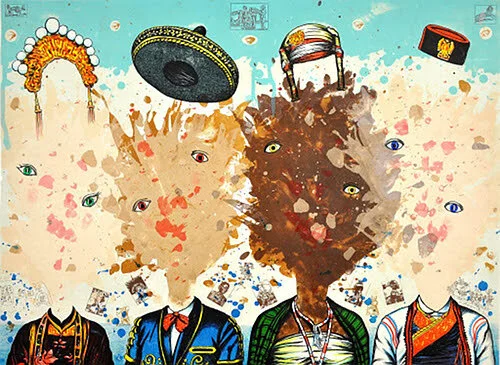
“Everyone is an Alienígeno,’’ by Enrique Chagoya, in the show “From the Head and the Heart,’’ at the Center for Contemporary Printmaking, Norwalk, Conn., through Nov. 10.
— Courtesy of Shark's Ink, Lyons, Colo.
— Photo credit: Bud Shark.
The show takes on a wide range of political and social topics. The pieces are recent creations representing artists’ views on various issues, including immigration, gun control, LGBTQ+ rights and others.
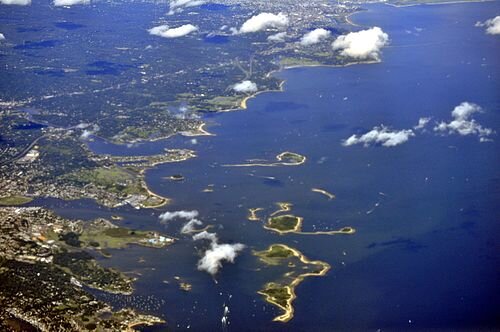
Aerial view of Norwalk, on Long Island. The richest folks tend to live near the water, in such sections as Rowayton. Norwalk is also headquarters for some big corporations and still has some manufacturing. It’s not entirely affluent: It has its share of poor neighborhoods, too.
Returning to Eagle Pond Farm

Wilmot Baptist Church
“The last red leaves fall to the ground
and frost has blackened the herbs and asters
that grew beside the porch. The air
is still and cool, and the withered grass
lies flat in the field. A nuthatch spirals
down the rough trunk of the tree.’’
— From “Back from the City,’’ by Jane Kenyon (1947-1995). She was New Hampshire’s poet laureate at the time of her death, from leukemia. She was the wife of poet Donald Hall (1928-1918), who was the U.S. poet laureate in 2006-07.
They lived at Eagle Pond Farm, his ancestral home in Wilmot, N.H.
From the Wikipedia article on Wilmot:
“Mt. Kearsarge, elevation 2,931 feet (893 m) above sea level, on the southeastern border, is the highest point in town. Winslow State Park, at the northern foot of the mountain, provides access by two hiking trails to the summit. The state park and the Winslow Trail are named after Captain John Winslow, the commander of the USS Kearsarge, which in June 1864 sank the CSS Alabama in the English Channel in a famous Civil War sea battle.
“The town is the home of Camps Kenwood and Evergreen, on Eagle Pond.’’
Editor’s Note: I used to look forward to seeing the impressive-looking (for its modest height) bulk of Mt. Kearsarge on my way between home, near Boston, and college, at Dartmouth, in Hanover, N.H.
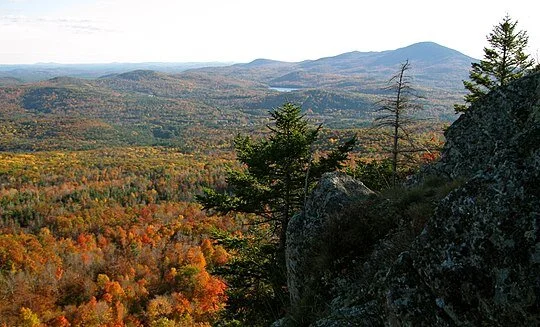
View of Mt. Kearsarge from The Bulkhead on Ragged Mountain. The summit of Kearsarge has remained bare since a 1796 forest fire.

Sam Pizzigati: How much 'inequality tax' are you paying?

In the Swiss Alps
From OtherWords.org
BOSTON
What’s the richest country?
That may seem like a simple question, but it’s not. According to the Global Wealth Report from banking giant Credit Suisse, it all depends on how we define “richest.”
If we mean the nation with the most total wealth, we have a clear No. 1: the United States. The 245 million U.S. adults hold a combined net worth of $106 trillion.
No other nation comes close. China ranks a distant second, with a mere $64 trillion, Japan even further back at $25 trillion.
But if we mean the nation with the most wealth per person, top billing goes to Switzerland. The average Swiss adult is sitting on a $565,000 personal nest-egg. Americans average $432,000, only good enough for second place.
So does Switzerland merit the title of the world’s wealthiest nation? Not necessarily.
The Swiss may sport the world’s highest average wealth, but that doesn’t automatically mean that their nation has the world’s richest average people.
We’re not playing word games here. We’re talking about the important distinction that statisticians draw between mean and median.
To calculate a national wealth mean — a simple average — researchers just divide total wealth by number of people. The problem? If some people have fantastically more wealth than other people, the resulting average will give a misleading picture about economic life as average people live it.
Medians can paint a more realistic picture. Statisticians calculate the median wealth of a nation by identifying the midpoint in the nation’s wealth distribution — that point at which half the nation’s population has more wealth and half less.
Medians, in other words, can tell us how much wealth ordinary people hold.
By this median measure, Switzerland holds up as a strikingly wealthy nation. The United States does not. Typical Swiss adults turn out to hold $228,000 in net worth, the most in the world. Typical Americans hold personal fortunes worth just $66,000.
Typical Canadians, with $107,000 per adult, have more wealth than that U.S. total. So do typical Taiwanese ($70,000), typical Brits ($97,000), and typical Australians ($181,000).
Overall, typical adults in 16 other developed nations have more wealth than we do here. Typical Japanese adults, for instance, hold $110,000 in personal wealth, a net worth considerably higher than the $66,000 Americans can claim.
Why do ordinary Americans have so little wealth when they live in a nation that has so much? In a word: inequality. Other nations have much more equal distributions of income and wealth than the United States.
Japan in particular stands out here. The new Credit Suisse 2019 Global Wealth Report notes that Japan “has a more equal wealth distribution than any other major country.” Japan’s richest 10 percent holds less than half their nation’s wealth, just 48 percent. In the United States, the top 10 percent hold nearly 76 percent, over three-quarters of national wealth.
How would typical Americans fare if we were as equal as Japan? If we succeeded at turning our economy around that way, the net worth of America’s most typical adults would triple, from $66,000 to $199,000.
In effect, the difference between those two totals amounts to an “inequality tax.”
By letting our rich grab an oversized share of the wealth all of us help create, we are taxing ourselves into economic insecurity. Other nations don’t tolerate greed grabs. Why should we?
Sam Pizzigati, based in Boston, co-edits Inequality.org for the Institute for Policy Studies. His latest book is The Case for a Maximum Wage.
HOW MUCH ‘INEQUALITY TAX’ ARE YOU PAYING?
If the U.S. were as equal as Japan, the average American’s wealth would triple. Inequality is like a tax on two-thirds of your income.
By Sam Pizzigati | October 29, 2019
Who is the world’s richest country?
That may seem like a simple question, but it’s not. According to the Global Wealth Report from banking giant Credit Suisse, it all depends on how we define “richest.”
If we mean the nation with the most total wealth, we have a clear No. 1: the United States. The 245 million U.S. adults hold a combined net worth of $106 trillion.
No other nation comes close. China ranks a distant second, with a mere $64 trillion, Japan even further back at $25 trillion.
But if we mean the nation with the most wealth per person, top billing goes to Switzerland. The average Swiss adult is sitting on a $565,000 personal nest-egg. Americans average $432,000, only good enough for second place.
So does Switzerland merit the title of the world’s wealthiest nation? Not necessarily.
The Swiss may sport the world’s highest average wealth, but that doesn’t automatically mean that their nation has the world’s richest average people.
We’re not playing word games here. We’re talking about the important distinction that statisticians draw between mean and median.
To calculate a national wealth mean — a simple average — researchers just divide total wealth by number of people. The problem? If some people have fantastically more wealth than other people, the resulting average will give a misleading picture about economic life as average people live it.
Medians can paint a more realistic picture. Statisticians calculate the median wealth of a nation by identifying the midpoint in the nation’s wealth distribution — that point at which half the nation’s population has more wealth and half less.
Medians, in other words, can tell us how much wealth ordinary people hold.
By this median measure, Switzerland holds up as a strikingly wealthy nation. The United States does not. Typical Swiss adults turn out to hold $228,000 in net worth, the most in the world. Typical Americans hold personal fortunes worth just $66,000.
Typical Canadians, with $107,000 per adult, have more wealth than that U.S. total. So do typical Taiwanese ($70,000), typical Brits ($97,000), and typical Australians ($181,000).
Overall, typical adults in 16 other developed nations have more wealth than we do here. Typical Japanese adults, for instance, hold $110,000 in personal wealth, a net worth considerably higher than the $66,000 Americans can claim.
Why do ordinary Americans have so little wealth when they live in a nation that has so much? In a word: inequality. Other nations have much more equal distributions of income and wealth than the United States.
Japan in particular stands out here. The new Credit Suisse 2019 Global Wealth Report notes that Japan “has a more equal wealth distribution than any other major country.” Japan’s richest 10 percent holds less than half their nation’s wealth, just 48 percent. In the United States, the top 10 percent hold nearly 76 percent, over three-quarters of national wealth.
How would typical Americans fare if we were as equal as Japan? If we succeeded at turning our economy around that way, the net worth of America’s most typical adults would triple, from $66,000 to $199,000.
In effect, the difference between those two totals amounts to an “inequality tax.”
By letting our rich grab an oversized share of the wealth all of us help create, we are taxing ourselves into economic insecurity. Other nations don’t tolerate greed grabs. Why should we?
Related Posts:
OtherWords commentaries are free to re-publish in print and online — all it takes is a simple attribution to OtherWords.org. To get a roundup of our work each Wednesday, sign up for our free weekly newsletter here.
Sam Pizzigati co-edits Inequality.org for the Institute for Policy Studies. His latest book is The Case for a Maximum Wage. This op-ed was distributed by OtherWords.org.
'Say it like it looks'
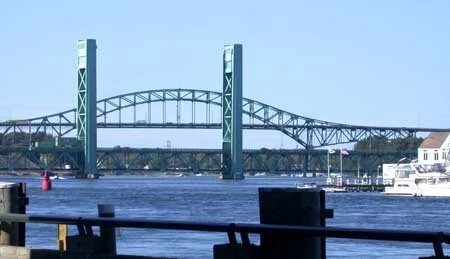
Piscataqua River from Portsmouth, N.H., with the former Sarah Mildred Long Bridge and the Piscataqua River Bridge (background).
"Winnipesaukee and Piscataqua:
“People new to the New Hampshire area come in contact with a ton of words they can’t pronounce. Here’s a hint, say it like it looks, if you get it wrong, a New Hampshirite is probably too nice to make fun of you for it and they’ll teach you how to say it correctly.''
-- Spencer McKee
Glamorous Newport nuptials in 'The New Gilded Age'
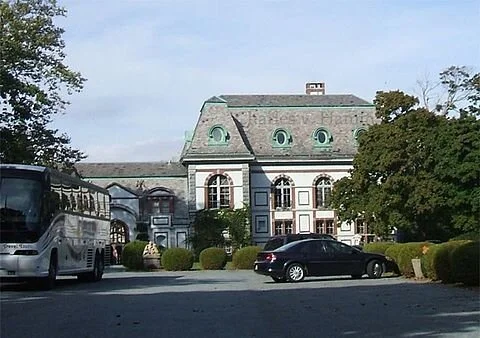
The east facade of Belcourt Castle. is a former summer cottage designed by the famed architect Richard Morris Hunt for Oliver Hazard Perry Belmont. Construction was begun in 1891 and finished in 1894 — during the Gilded Age. It’s on Bellevue Avenue, in Newport.
The term for this period (1870s to about 1900) was derived from writer Mark Twain's and Charles Dudley Warner's 1873 novel The Gilded Age: A Tale of Today, which satirized an era of serious social problems masked by a thin gold gilding. Many historians and economists call the period since the 1980s to today “The New Gilded Age’’ — a time of show-off wealth and ever more extreme income inequality.
From Robert Whitcomb’s “Digital Diary,’ in GoLocal24.com
I have no interest per se in the beautiful movie star Jennifer Lawrence and the man she married the other weekend in a big bash at Newport’s Belcourt Castle mansion, owned by none other than Carolyn Rafaelian, owner/empress of the junk-jewelry empire Alex and Ani. The groom was Cooke Maroney, who runs a high-end New York art gallery and seems to usually be unshaven – in what we used to call the “Yasser Arafat look,’’ after the unshaven face of the late Palestine Liberation Organization leader. But that such “glamorous’’ events keep happening in The City by the Sea, even in the off-season, is good news for Rhode Island’s economy. Keep ‘em coming.
How wonderful that we have Newport, our mini but spectacular international city, chock full of interesting stuff.
The 'cat prefers the rain to me'

TIME Magazine cover from March 2, 1925 featuring Amy Lowell.
The vine leaves against the brick walls of my house,
Are rusty and broken.
Dead leaves gather under the pine-trees,
The brittle boughs of lilac-bushes
Sweep against the stars.
And I sit under a lamp
Trying to write down the emptiness of my heart.
Even the cat will not stay with me,
But prefers the rain
Under the meagre shelter of a cellar window.
— “November,’’ by Amy Lowell (1874-1925), very eccentric, cigar-smoking Boston-based Imagist poet
To read how she helped save The Boston Athenaeum, please hit this link. (The article contains the error that she died in 1920.)

The formidable Boston Athenaeum
From hotel to dorm
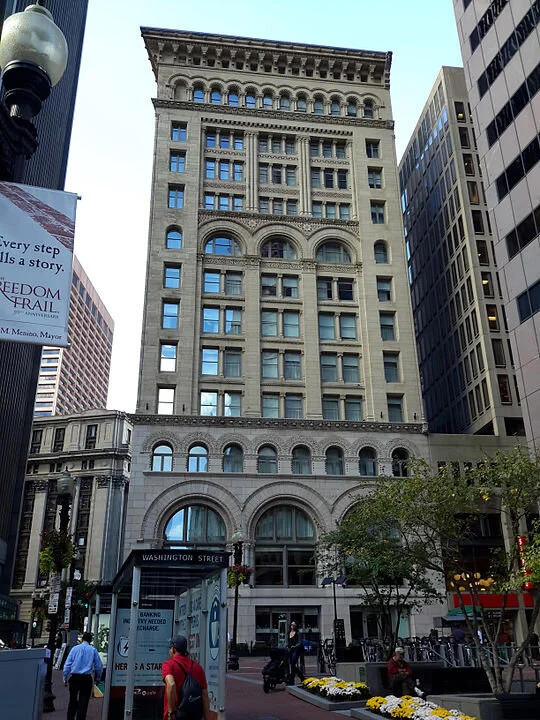
The Ames Building/Hotel, in downtown Boston. It was the tallest building in Boston from its completion, in 1893, until 1915, when the Custom House Tower was built. It’s considered to be Boston's first skyscraper. In 2007, the building was converted from office space to a luxury hotel.
From The New England Council (newenglandcouncil.com)
“Suffolk University has purchased the Ames Hotel in Downtown Boston with plans to turn it into a dormitory. The Boston-based university has a history of over 100 years in the city.
The university has shared its plans to turn the 114-room hotel property into student housing. Pending city approvals, Suffolk aims to open the dormitory in the fall of 2020. There has been a push from Mayor Marty Walsh’s administration to have universities build more student housing in an effort to keep students from occupying the city’s apartments. The hotel’s prime location and need for minimal renovation and construction made it a very attractive purchase for Suffolk. The university filed formal plans earlier this month with the Boston Planning & Development Agency to convert the building into a 266 to 280 bed dormitory.
“‘This is a great opportunity for Suffolk and an important investment in our future,’ said the university’s president, Marisa Kelly. “We look forward to working closely with the city and our neighbors as we move through the community process.”’
Art on the half shell

“Raw Bar’’ (acryllic on panel), by Del-Bourree Bach, in the “:Copley Masters Show,’’ at Copley Society of Art, Boston, through Nov. 7
The "Copley Masters" are those who have won a certain number of awards from the society over the years. Most of the works in this year's masters show are oil paintings, though there are also bronze sculpture and photography as well as watercolor, acrylic and encaustic paintings in the show. “Copley Masters Show “ is a part of Copley Society of Art's anniversary, celebrating 140 years of history.
For more information, visit copleysociety.org/copley-masters-show.
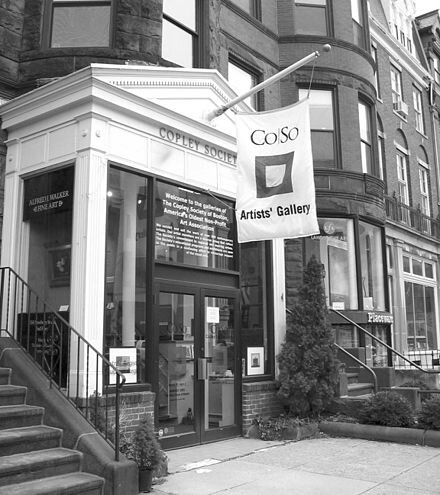
Copley Society of Art, at 158 Newbury St., in Boston’s Back Bay
Martha Bebinger: On a Concord, N.H., street, is it meth or a mental-health problem?
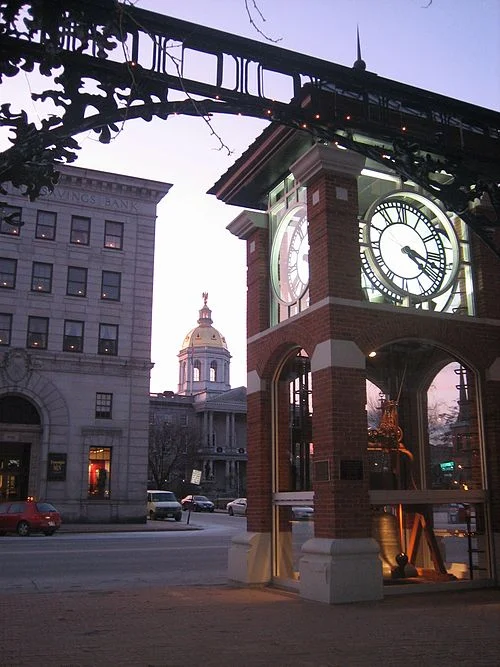
The New Hampshire State House as seen from Eagle Square, in downtown Concord
and WBUR
The dispatch call from the Concord, N.H., police department was brief. A woman returning to her truck spotted a man underneath. She confronted him. The man fled. Now the woman wanted a police officer to make sure her truck was OK.
“Here we go,” muttered Officer Brian Cregg as he stepped on the gas. In less than three minutes, he was driving across the back of a Walmart parking lot, looking for a man on the run.
“There he is,” said Cregg. The officer pulled to a stop and approached a man who fit the caller’s description. Cregg frisked the man, whose name was Kerry. NPR has agreed to use only Kerry’s first name because he may have serious mental health and substance use problems.
“Why were you lying on the ground under a truck?” Cregg demanded.
Kerry, head hanging, rocked back and forth, offering quiet one-line answers to Cregg’s questions. There’s a contest, Kerry said. The prize was a new pickup truck, and he just had to find the truck with a key hidden underneath. He said he had searched three so far.
“Kerry, did you take anything today?” Cregg asked. “You’re not acting right.”
“No, no,” said Kerry, shaking his head forcefully. “I’m just stressed out.”
Cregg watched Kerry, looking for signs — is this meth or a mental health problem? Over the past three or so years, as meth has surged in New Hampshire and across the U.S., it’s become hard to tell. Police in many areas of the country where meth has maintained a steady presence have more experience making an assessment, but in Concord and many parts of the Northeast, the onslaught of meth is new.
Concord police say they need to know whether they’re dealing with a mental-health issue or drugs — or both — because it can make a difference in determining the best response.
Concord may send six to eight officers to subdue someone darting through traffic who is high on meth. The calming techniques these officers learned during training for a mental-health crisis intervention don’t seem to work as well when someone is out of control on methamphetamine. Several officers are recovering from injuries sustained during meth-related calls
“Stay right there for me, all right?” Cregg told Kerry. “I like you too much — stay right there.”
Cregg walked a few steps away from Kerry to speak to one of two other officers called to the scene. It turned out this was the third time in the past few months that alarmed drivers had reported finding Kerry under their car. Cregg decided Kerry’s delusions were mental-health issues and didn’t call for more backup.
Kerry, now cuffed, climbed into the back of Cregg’s cruiser, and they headed for the station. Kerry’s suspected crime: prowling.
“Hey, uh, Kerry — man, you feel like you want to go up to the hospital to speak to somebody?” Cregg asked a version of this question four times.
“No, no,” Kerry said repeatedly, “I’ve been through that route years ago; don’t want to do it again.”
Kerry said later that getting stuck in a hospital emergency room — waiting days, maybe weeks for an opening in a psych treatment program — makes his anxiety much worse.
At the station, Cregg found something that changed his view of the day’s events.
“What is that, Kerry?” Cregg asked, pulling a tiny plastic bag of glistening white shards out of Kerry’s coin pocket. It appeared to be meth. “This explains a lot.”
Cregg said what he thought was psychotic behavior likely had more to do with meth.
But “on that call, they mimicked each other. I wasn’t able to tell at first,” Cregg said.
That may be because Kerry is one of the 9.2 million adults in the U.S. coping with both a mental-health problem and a substance-use disorder. In this particular case, not being able to tell what fueled Kerry’s delusions didn’t cause any problems for him or the police. Things never got out of hand. But Concord Police Chief Bradley Osgood said calls triggered by meth are often more challenging than this one.
“With somebody that’s high on methamphetamine, you want to treat them a little firmer and control them,” Osgood said, “because they often are very volatile and aggressive, and you just want to treat that hostility differently.”
With meth now accounting for 60% of drug seizures in Concord, police say they often default to that firmer approach. Some mental health advocates worry that may mean police are using too much force with their clients. Sam Cochran, a retired major in the Memphis Police Department who co-founded and now helps lead CIT International, a crisis intervention program that includes training for police, said officers aren’t making a diagnosis.
“The officer’s foremost [concern] is ‘How do I open up communications? How do I get compliance in order to accomplish safety?'” Cochran said.
There are visual signs of longer-term meth use that are less likely to show up among mental-health patients: skin wounds and scabs, rotting teeth, dilated pupils. But addiction medicine specialists agree it is difficult to determine what’s going on, at first glance, with someone who appears extremely agitated.
“The possession of methamphetamine may be a clue, but teasing out the acute effects of methamphetamine versus a long-standing mental illness may take a longer period of time,” said Dr. Melissa Weimer, an assistant professor of medicine at Yale School of Medicine. She noted that the effects of meth can last 72 hours or longer.
Surging meth use is relatively new in New England. On the police force, Cochran dealt for years with this issue of meth’s effects mimicking mental health issues. He said slowing things down and diffusing fear can work when dealing with people high on meth.
“But let’s be real, there are some individuals that are so sick,” Cochran said, that “officers find themselves having to act immediately to protect safety. Sometimes that may mean a hands-on approach.”
Cochran and another mental-health advocate, Dr. Margie Balfour, an associate professor of psychiatry at the University of Arizona, say the goal is to only use force as a last resort.
“And then, ideally,” Balfour said, “whether it’s meth or mental health or both … you’re going to be able to take that person to somewhere where they are going to get treatment — and not to jail.”
Balfour is also chief of quality and clinical innovation at Connections Health Solutions. The organization operates a network of psychiatric crisis centers in Arizona where, instead of making an arrest, police can drop off anyone 24 hours a day who is out of control on meth or who has a mental-health condition. Balfour said 20% of adults seen at Connections test positive for meth.
Kerry was due last week in a New Hampshire court where a judge could have ordered drug treatment or an evaluation. Kerry didn’t show up for that arraignment — but said he is trying to reschedule.
This story is part of a partnership that includes WBUR, NPR and Kaiser Health News.
Martha Bebinger, WBUR: marthab@wbur.org, @mbebinger

Llewellyn King: The long road to reducing fires sparked by utilities

California is burning. It was yesterday, it is today, and it will be tomorrow. The price in human life is enormous – in animal and plant life, too. The price in human suffering is gigantic, and the price in property damage is incalculable.
Even while unprecedented high Santa Ana winds are blowing devastation, electric utilities are looking for fixes that accord with the new realities brought about by global warming. Worse is yet to come, they fear.
In January the Edison Electric Institute, a Washington-based trade association, assembled a task force of electric utility CEOs to find solutions. The choices before them are not appealing.
The problem is California may be in the vanguard of fire-prone states, but it is not alone. Many states with heavy forest cover and long electric lines have reason to look to the future with apprehension. What amounts to a perfect fire storm in California could happen in states from Illinois to Louisiana, and from Virginia to Oregon.
Here are the options facing the electric utility CEOs:
Vegetation control. This is essential, as Rod Kuckro, a reporter for E&E News, points out. But vegetation control – simply cutting down trees near electric lines -- is easier said than done. Kuckro, an astute utilities journalist, says that Pacific Gas and Electric Company (PG&E), the utility that has borne the brunt of the blame and whose northern California service area is ground zero for fire, has 125,000 miles of power lines. These are threatened by millions of dead trees, plus the normal threat to power lines from falling trees, dead or alive.
Kuckro says the vegetation issue is complicated by a severe lack of manpower skilled in tree management. Trees must be cut and removed, or they will become fresh fuel for fires.
Surveillance technology. Long-term technology is going to be decisive. Utilities will need a great deal more real-time data about their lines. Line surveillance, always a utility priority, is becoming job number one, and they are looking to the digital frontier.
Surveillance by men on foot and horse gave way to men and women in helicopters and all-terrain vehicles. Now comes the age of drones and data.
Morgan O’Brien, CEO of Anterix, which offers secure broadband communications to utilities, says with broadband technology and judiciously placed sensors, “a utility control room could know about a falling line in 1.4 seconds.” Time enough to cut off the power and start a repair crew on its way.
But this kind of data solution will take time and, like all the solutions, money. This will be difficult for PG&E, which is already in bankruptcy because of fire claims from last year, and the year before.
Undergrounding. This sounds so reasonable, so logical. But in most places, it is not an option and not in earthquake-prone California. The cost of burying lines, where they can safely be buried on the PG&E system, is estimated to be as much as $3 million a mile for residential lines to $80 million a mile for high-voltage cables. It would take decades to bury even a few of its lines. And the cost is almost beyond contemplation.
Microgrids. These are often mentioned. These are autonomous entities usually serving a paper mill, a university, a shopping center or sometimes a whole community. Microgrids self-generate, mostly with gas or solar, and sell surplus power to the utilities; and, in some cases, they act as storage systems for their host utility. Their advantage in a fire-prone region is that they can be isolated from their host grid. Therefore, the lights stay on if the big grid is shut down prophylactically, explains Mike Byrnes, senior vice president of Veolia North America, an energy and environmental services company.
Recently Jacqueline Sargent, general manager of Austin Energy, told me that cybersecurity concerns keep her up at night. For many utility managers that threat is now joined by an existential threat from one of man’s oldest enemies: fire.
If you are the manager of a utility in a blue state, you might also worry whether the federal government will help in a fire disaster. To date, President Trump has let California burn: no federal declaration of a disaster and, accordingly, no federal disaster relief, no troops. Hell, not even a presidential flyover for beleaguered California.
This is not benign neglect. This is vengeful neglect. Remember Puerto Rico?
Llewellyn King is executive producer and host of White House Chronicle, on PBS. His email is llewellynking1@gmail.com and he’s based in Rhode Island and Washington, D.C.
Linda Gasparello
Co-host and Producer
"White House Chronicle" on PBS
\
Love your bats

Bat house
From Robert Whitcomb’s “Digital Diary,’’ in GoLocal24.com
Bats (often associated with Halloween and intimations of doom) are creatures that scare most people. And yet by eating many insects, they’re our allies. Bats are fascinating: With forearms that have evolved as wings, they’re the only mammals capable of sustained flight.
The deadly fungal disease called White Nose Syndrome has been killing off millions of them for more than a decade, very much including in New England. But scientists are finding signs of hope. Hit this link to read a fascinating WNPR article.
And for guidance on building a bat house (and cutting your local insect population), please hit this link.
'Labored Landscapes'

— Photo by Charles Sternaimolo
“Labored Landscapes (where hand meets ground)’’ (installation view), by Daniela Riviera, in her show at the Fitchburg (Mass.) Art Museum, through Jan. 12.
Left, “Donde el cielo toca la tierra #2” [“Where the Sky Touches the Earth #2”], 2019, oil on canvas, 12" x 30". Center: “Donde el cielo toca la tierra #1 “ {“Where the Sky Touches the Earth #1’’} 2019, oil on canvas, 12" x 20". Right: “Donde el cielo toca la tierra #3” [“Where the Sky Touches the Earth #3”] 2019, oil on canvas, 12" x 30".
The museum says:
{The show} “reflects on the relationship of labor, environment and cultural heritage. Explore innovative and immersive work that challenges traditional ideas of painting and drawing, as they relate to architecture and the viewer's body.’’
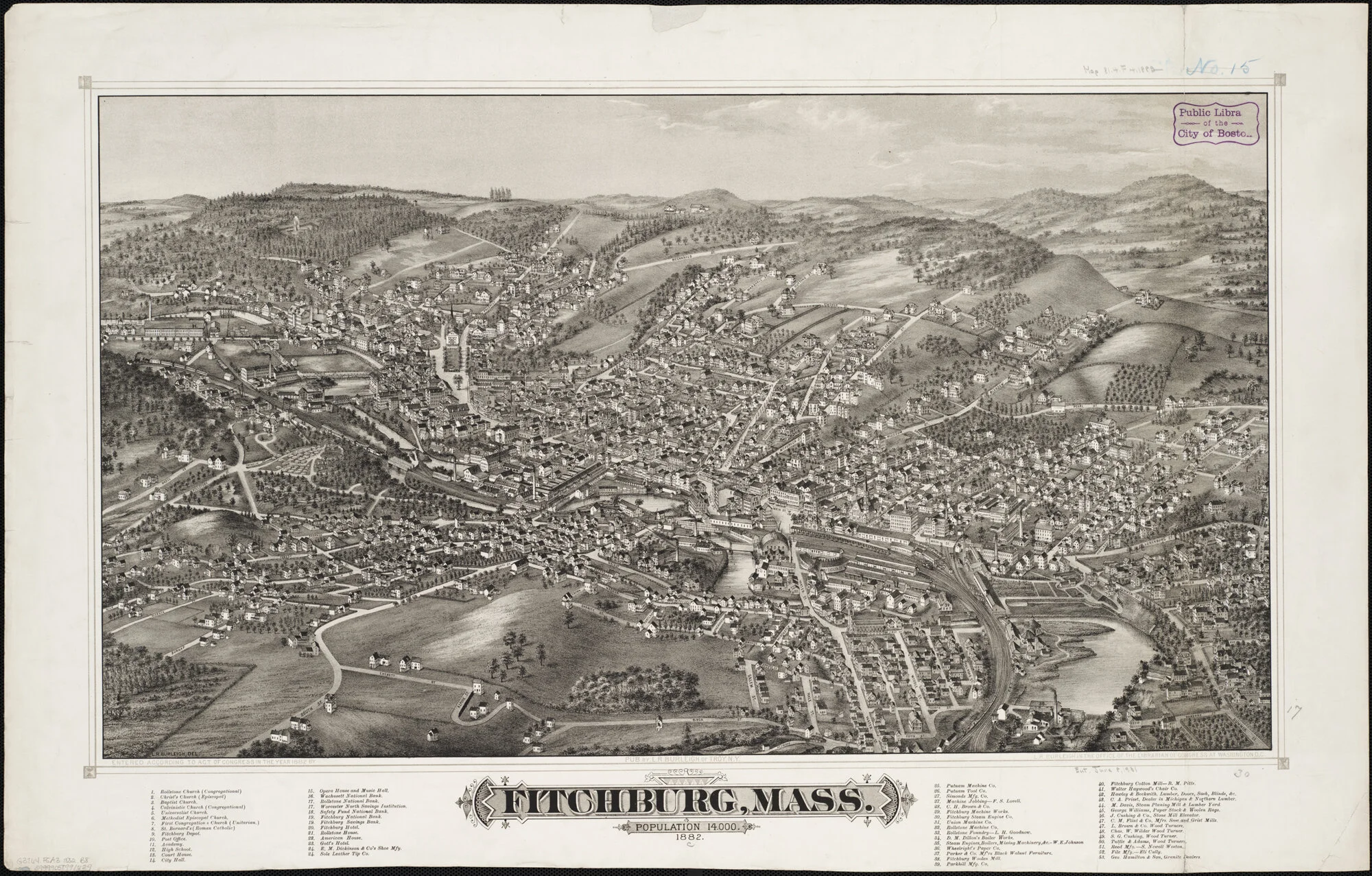
— Print of Fitchburg from 1882 by L.R. Burleigh with listing of landmarks
Fitchburg grew rapidly in the 19th Century as an industrial center, as did many New England communities. Importantly, the Nashua River runs through the city. Originally run by water power, large mills produced machines, tools, clothing, paper and firearms. The city is still known for its architecture, particularly in the Victorian style, built at the height of its mill town prosperity. A few examples: The Fay Club, the old North Worcester County Courthouse and the Bullock House.

'Depth and nostalgia'

”Field in Green’’ (oil on canvas) by Hannah Bureau’ in her show “Intersect,’’ opening in November at Edgewater Gallery, Boston. The gallery explains:
“Hannah Bureau's paintings lie at the intersection of landscape and abstraction. She is interested in creating space and distance that feels like the familiar world around us but is ambiguous, general, and abstracted. In Bureau's painted world she establishes visual plains and geometric shapes that intersect, overlap, pile-up, and ultimately create a sense of visual distance, depth and nostalgia.’’

Jill Richardson: California fires show why we need publicly owned utilities

Satellite view of Kincade Fire smoke in northern California on Oct. 24
Via OtherWords.org
Hundreds of thousands of Californians have been fleeing raging wildfires, while millions sit in the dark. And for-profit utilities may be to blame.
Pacific Gas & Electric — a private, for-profit utility in the state — has admitted that its equipment likely caused 10 wildfires this year alone. To avoid further damage, the utility has been shutting off its customers’ power when weather conditions cause increased fire danger.
Will this lower the risk of wildfires? Maybe. It will also leave blacked out hospitals choosing whether to refrigerate their vaccines or keep their medical records online.
As Vox environmental reporter David Roberts put it, giving customers a choice between blackouts or fires is a failure.
A popular theory says that businesses must be “efficient” in order to survive in a competitive marketplace. By contrast, the government — without such market pressure — is naturally “inefficient.”
But even in the best cases, for-profit utilities with state-sanctioned monopolies are not functioning in a competitive marketplace. And unlike public utilities, which simply have to cover the costs of operating, privatized utilities must generate something else: profits.
How do they do this? By cutting costs — including employee salaries and benefits, customer services, and equipment upgrades. In the case of PG&E, it’s meant failing to upgrade and maintain their aging infrastructure.
It would be one thing if PG&E’s grid used all of the latest, most up-to-date technology. But that’s not the case. Instead of making their grid more resilient, now they simply shut it off when the weather gets bad — and it may still be causing fires.
And if customers don’t like that, too bad. It’s a monopoly.
Prices and service aren’t the only things at stake. We also need to get power from sources that are reliable, safe, and environmentally clean.
A corporation with a profit incentive, which needs to provide shareholders with growth each quarter, may not invest in that. Upgrading and maintaining infrastructure cuts into profits, giving them a reason to sacrifice safety and eco-friendliness to cut costs.
Imagine a circumstance in which most consumers and businesses get their power from clean, rooftop solar panels.
Sounds great, but there’s a big problem for for-profit utilities: After the initial manufacturing and installation, there’s no profit in people getting their power from the sun.
It’s clean, it’s technologically sound, and yet it’s not available to most people. As long as private, for-profit corporations provide our power, cleaner solutions like rooftop solar will remain out of reach to many.
But what if we had publicly owned utilities?
The wildfires — and the climate crisis that’s making them worse — are public problems. The reliability of our power grid is a public need.
When we privatize our utilities, we limit the solutions we can choose from to those that are profitable to a corporation. We risk situations like the one we are in now, in which the public is suffering the consequences of decisions a private entity made to maximize its own profits.
The public interest, not private profit, should be priority No. 1. If there’s a silver lining to this mess with PG&E, it’s that more people will demand that
Jill Richardson, a sociologist, is a columnist for OtherWords.org.

Chris Powell: Stupidity and hypocrisy exceed racism at UConn
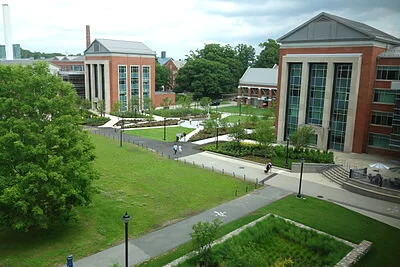
Main quad at the University of Connecticut’s flagship campus, in Storrs
Funny what gets people upset and what doesn't get them upset at the University of Connecticut these days.
A great scandal was contrived lately when two white students got drunk at a bar one night and, walking home across campus, played a game of shouting vulgar words to no one in particular. The vulgarities eventually included a racial slur that was heard by two people in a nearby apartment.
So scores of students marched and rallied in protest as if this disgraceful juvenility was not only a war crime but also representative of white students and university policy generally. Predictably cowed, the university's new president accused the two white drunks of doing "egregious harm." The two were tracked down and arrested on a charge of ...ridicule. They confessed and apologized.
Meanwhile, a member of the university's men's basketball team got drunk at a party, stole a car, sped off, crashed into a street sign and another car, and, when stopped by a police officer, smelled of liquor and ran away. He was tracked down and was charged with evading responsibility, interfering with an officer, driving too fast, and driving without a license. He, too, confessed and apologized. The woman whose car he stole decided not to complain.
But though the basketball player had damaged property and put lives at risk, no university official accused him of causing "egregious harm" and there were no protests and rallies about his misconduct. Instead his coach made excuses for him. He's black.
Yes, there may be some racism at UConn, as everywhere, but mostly there are stupidity, hypocrisy, and political correctness, and they afflict cowardly university administrators as much as politically opportunistic students.
xxx
Connecticut state government's primary purpose was revealed the other day by a Yankee Institute study of the gross insolvency of the state teacher pension system. The study reported that 22 percent of state revenue is used for funding pensions and medical insurance for retired state employees and municipal teachers, and that fully funding the pension and insurance systems would consume 35 percent.
The study recommended easing the teacher pension burden by encouraging private schools, whose staffs are paid less. But doing that would barely be noticed amid the deep hole into which Connecticut has fallen with its capitulation to the government employee unions.
Connecticut will be able to resume normal state government -- government whose purpose is serving the public, not its own employees -- only when it gets out of the pension business entirely, outlawing state-provided defined-benefit pensions and medical insurance for state and municipal government retirees. Even that remedy will take decades to produce results, since it could start only with new hires.
xxx
A spokeswoman for Connecticut Atty. Gen. William Tong confirmed last week that the attorney general will not intervene with antitrust law against the merger of People's United Bank and United Bank, whose operations overlap heavily. The attorney general concluded that the merger would not reduce competition enough to harm depositors or borrowers.
But competition levels provide lots of discretion for antitrust authorities, and the merger is likely to eliminate hundreds of jobs.
Oh, well -- at least the attorney general last week also appealed to the U.S. Department of Energy not to weaken energy-efficiency rules for dishwashers.
xxx
Chris Powell is a columnist for the Journal Inquirer, in Manchester, Conn.
Women and GOP governors

Rhode Island Gov. Gina Raimondo
From Robert Whitcomb’s “Digital Diary,’’ in GoLocal24.com
A recent poll showed that four of the 10 most unpopular governors are women, with Ms. Raimondo (who is very charming in person) the most disliked. How much of this is sexism, which played a role in Hillary Clinton’s loss in 2016, with its rhetoric of “that bitch,’’ etc.? Meanwhile, the two most popular governors are Massachusetts’s Charlie Baker and Maryland’s Larry Hogan, both Republicans in liberal states and known for their competence and integrity – all of which means that, unlike 50 years ago, they would not be qualified now to be GOP presidential candidates. Besides Mr. Baker, New England has two other very able GOP governors – Vermont’s Phil Scott (whom I’ve met) and New Hampshire’s Chris Sununu.
Many of the Republicans in Congress don’t actually do anything substantive (such as crafting legislation). They spend much of their time going on the likes of Fox “News’’ and denouncing such cooked up bogus ogres as the “Deep State’’ (meaning patriotic and often physically brave government officials, including diplomats, CIA officials and military officers, who might push back against the treason and other corruption of the Trump mob). And of course, as with most of their Democratic colleagues, they spend much of their time raising money from, and trying to please, their big donors – an activity that has intensified with the treasure trove of political money unleashed by the Citizens United Supreme Court ruling, in 2010 – one of the greatest producers of political corruption in American history.
But governors, for their part, have to actually govern in a real, fact-based world. The Republican Party on Capitol Hill is a cesspool of corruption. If there is a future for thoughtful center-right Republicanism it must come from the governors.