
Vox clamantis in deserto







Gift from the sea

Work by Susan Lyman in her Boston Sculptors Gallery show “Washashore,’’ Oct. 2 to Nov. 3. She creates art from driftwood.
'America's Best Social Critic' looks at academia, civil society and democracy

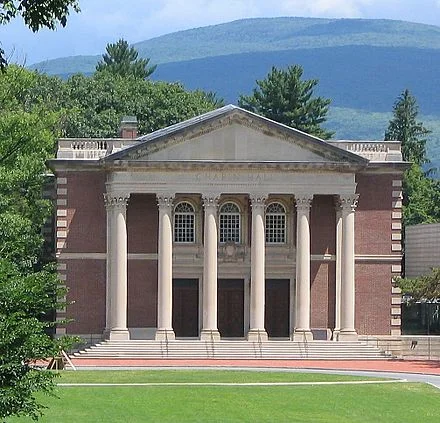
Chapin Hall, at Williams College, in Williamstown, Mass.
From The New England Journal of Higher Education, a service of The New England Board of Higher Education (nebhe.org)
“It’s time, as the phrase goes, to ‘take control of the narrative,’ or at least tell our story better than we have been doing—to convey how hard most faculty work, how modestly most are paid, how little job security they enjoy, and, most broadly, that higher education remains an indispensable public good in a democratic society.”
Andrew Delbanco is a professor of American Studies at Columbia University, author of several books, including 2012’s College: What It Was, Is, and Should Be, and president of the Teagle Foundation. His latest book, The War Before the War: Fugitive Slaves and the Struggle for America’s Soul from the Revolution to the Civil War, will come out in paperback in November. In the following Q&A, NEJHE Executive Editor John O. Harney asks Delbanco about the state of higher education and intellectual life today.
Harney: Among your many honors, Time Magazine several years ago called you “America’s Best Social Critic.” Are “social critic” and other kinds of “public intellectual” occupations missing from what we urge today’s college students to include among their aspirations?
Delbanco: I’ve been very lucky to be able to make a living by doing what I love—teaching, writing, speaking on issues that matter to me. I’m afraid that opportunities for all of the above are shrinking as academia, publishing and journalism are all going through severe economic turbulence. Still, there will always be young people determined to follow their passions. We need their voices more than ever, so let us hope they will find ways to be heard—in both traditional venues and through new media.
Harney: You’ve said the college classroom is a “rehearsal space” for democracy. Colleges should allow you to walk in with one point of view and walk out with another. How best to enhance that quality in an age of political correctness and backlashes against it?
Delbanco: I believe more than ever that under the guidance of sensitive teachers who know how to combine intellectual rigor with open inquiry, the classroom is more likely than social media or a public rally to foster civil discourse about charged issues. My guess is that relatively few classrooms fit the description promulgated by those who think academia is rife with intolerance and “political correctness.” The method practiced by good teachers since the beginning of time still works: Show passion for the material you are teaching and respect for the students to whom you are teaching it, and good things will follow—including civil debate about controversial questions to which there are no easy answers.
Harney: Teagle has supported NEBHE’s work to develop affordable options for community college students to attend an independent institution, develop and promote liberal arts transfer opportunities at independent colleges for community college graduates, and increase the number of community college transfer students who earn a bachelor’s degree at an independent institution. How does this fit with your worldview?
Delbanco: America’s community colleges are immensely important institutions. They are gateways for millions of first-generation, minority and “nontraditional” (that is, older students seeking marketable skills in a rapidly changing economy), who represent the future of our country. Yet community colleges are woefully underfunded, and often underappreciated by people for whom college means the pastoral residential campus offering amenities of which most community college students can only dream. Community colleges serve many constituencies who bring many different aspirations to their studies. Students who come out of community college with an associate degree are well-served by these institutions, as are others who attend not necessarily to obtain a degree but in order to gain a specific skill or perhaps a certificate signifying completion of a course or program. Still others hope to move on to a four-year institution to earn a bachelor’s degree. We owe it to them to support, encourage and help them realize their hopes by building bridges from two-year public to four-year private institutions. This will require improved advising, clearly articulated pathways, more rational portability of credits and generally better coordination among institutions with different structures and cultures. The Teagle Foundation wants to support these efforts, which are gaining momentum not only in New England but throughout the nation—in part because independent colleges, especially those that are less selective, are seeking new pipelines to fill seats in their classrooms.
Harney: What do you see as the future of collaboration between public and independent higher education institutions?
Delbanco: The future must include the kind of cooperation I just spoke about between two-year publics and four-year privates. But that is only one dimension of this question. For example, research universities (both private and public) must do a better job of preparing graduate students for teaching careers in public open-access institutions as well as in independent liberal arts colleges. We are in the midst of a full-fledged crisis of employment for Ph.D.’s, especially in the humanities, who are often unprepared for, and even unaware of, opportunities outside the kind of research universities that have trained them. In general, colleges and universities also must become more responsive to the needs of their local communities. I often find myself saying that there is really no such thing as a private college or university—in the sense that all institutions benefit from public subsidies in the form of tax exemption, tax-deductible donations and other forms of philanthropic support, as well as federal support for research and tuition-paying students. In short, taxpayers have a right to expect that the local college or university—whether public or “private”—will find ways to serve them as well as their own students, by engaging constructively with the public schools, for example. In this respect, community colleges are among the leaders of the higher education sector, while some of the best-endowed private universities are among the laggards.
Harney: You talked a bit about what used to be a cross subsidy from students who could afford college to those who couldn’t. Is that a reasonable system?
Delbanco: Well, I’ve suggested that the discounting system used by some institutions—those with “need-based” financial aid programs—might be thought of as a dash of socialism mixed into our capitalist system. By this I mean that differential pricing determined by the ability of families to pay is an outlier in a consumer society that generally sets prices by calculating what price the market will bear. Of course this analogy does not mean that discount pricing is always motivated by a “Robin Hood” impulse to take from the relatively rich in order to give to the relatively poor. For most private institutions, even those that are relatively well-endowed, discounting is necessary not only for reasons of equity or for the educational value of enrolling a class with some socioeconomic diversity, but also for the practical imperative of recruiting enough students who bring at least some tuition dollars with them. This complex system—where for one reason or another, the “sticker” price exceeds what many students actually pay—is under increasing stress and seems likely at some point to give way to something different. But I doubt that we will see fundamental change until and unless the federal government takes a larger role in financing higher education. Perhaps the current talk of universal “free” college—in some respects a regressive idea because it would increase subsidies without means-testing the beneficiaries—marks the start of a more serious discussion.
Harney: Public disinvestment is often viewed as a chief reason for rising college prices. Why is it so hard to argue for higher education funding?
Delbanco: Another complex question. Part of the answer is that the growing disparity between public resources and public obligations has squeezed the ability of state governments to maintain the subsidies on which public higher education depends (the left would cite such factors as the tax revolt that began in California in the 1970s and the privatization of services previously regarded as a public responsibility; the right would cite putatively excessive benefits granted to unionized public workers and the rising cost of Medicaid). But the distribution of resources is also partly a function of who makes the better arguments—and there is no doubt that public confidence in higher education has declined (even though competition has never been as fierce as it is now to gain admission to the most prestigious institutions). Unfortunately, we live in an age of sound-bites and platitudes disseminated by talk-show hosts and spread on social media—so while there are certainly ways in which higher education should strive to educate students better at lower cost, it’s hard to combat the perception that we are a wasteful, inefficient “industry” with little accountability. Much of this is a grotesque distortion. But overpaid presidents and coaches, admissions bribery scandals and stories of dissolute students don’t help. It’s time, as the phrase goes, to “take control of the narrative,” or at least tell our story better than we have been doing—to convey how hard most faculty work, how modestly most are paid, how little job security they enjoy, and, most broadly, that higher education remains an indispensable public good in a democratic society.
Harney: You’ve quoted Melville’s claim that a whale ship was his Yale and Harvard. What’s the application of that today?
Delbanco: Despite all our challenges, I still believe that college can be a place where students widen their horizons, learn to appreciate the wonder of the natural world and the complexity of the social world, and grow into a sense of human interconnectedness. Those are among the things that Melville learned by going to sea and opening himself to experiences he had never dreamt of on land.
Harney: You’ve mentioned the importance of “diversity.” How does the momentum toward online distance learning accommodate that?
Delbanco: I’m a “distance learning” skeptic—by which I don’t mean that there is no value in the efficient and economical delivery of information to students who cannot be personally present in a traditional classroom or who have reached a certain level of learning proficiency so they can make good use of online resources. But I worry that the new digital technologies may become another force for stratification: i.e., poor kids will be led toward the “virtual” classroom while rich kids will get the real deal. Of course it’s not that simple—and we should continue to experiment with new pedagogies and test their effectiveness, equity and potential value for cost control. But for now the evidence seems to suggest that the most vulnerable students, sometimes described as “unconfident learners,” need all the personal human attention they can get.
Casino cannibalization?

From Robert Whitcomb’s “Digital Diary,’’ in GoLocal24.com
The casino mania continues apace, with the latest scheme being a proposal to build a slots palace, and, incredibly, horse track, in Wareham, near the Bourne Bridge, the western road access to Cape Cod. If you think Cape traffic is bad now…. (I used to love horse tracks but not so much now that I know more about how some of the animals are treated.)
But wait! There’s more! A Chicago developer called Neil Bluhm continues to push for a casino in poor old Brockton, once “The Shoe Capital of the World’’; the Mashpee Wampanoag Indians still want to put up a casino in Taunton, once “The Silver City,’’ and the Aquinnah Wampanoag Indians continue to demand a gambling joint on Martha’s Vineyard near the famously colorful clay cliffs called Gay Head.
As our region continues to move toward casino cannibalization it looks like IGT, the gambling systems tech company, is a better, well, bet for Rhode Island than Twin River, more of whose suckers may decide to take their chances at the other nearby casinos to pop up. Of course, that’s already happening at the huge and glitzy Encore mega casino in the traditionally poor and gritty inner Boston suburb of Everett. Encore seems to have an especially potent allure for high rollers at its table games, and there are plenty of rich people in the region.
Still, I think a lot of the folks from southeastern New England flocking to Encore right now are going there mostly out of curiosity. When that fades, and winter weather arrives, making travel to Greater Boston even more unpleasant than it is now, I think that will fade a bit, even with such come-ons as the luxury bus service between Gillette Stadium and Encore.
Anyway, IGT, as an international tech company serving a wide customer base, would seem a sturdier reed for Rhode Island to lean on for economic development than one casino company – that is, if IGT actually stays in the Ocean State! Corporate promises about staying in localities and states that have offered companies assorted incentives such as tax breaks tend to evaporate remarkably often.
Meanwhile, we’ll see what the effects of online sports betting on casinos turn out to be….

Tim Faulkner: Searching for support for tidal and wave power
From ecoRI News (ecori.org)
Efforts to generate electricity from waves and tidal currents have slowed in southern New England, as offshore wind power takes a commanding lead in the renewable-energy portion of the so-called “blue economy.”
In recent years, tidal- and wave-energy programs at Brown University, University of Massachusetts atm Dartmouth and the University of Rhode Island have curtailed their research and commercial collaborations.
At Brown, the Leading Edge project has shifted from an academic and commercial venture to a school-based laboratory-research project. Engineering students designed oscillating hydrofoils that generate electricity from rectangular blades that lift and rotate in strong currents. Faculty leaders, however, have gone to other schools or are on sabbatical, thereby halting commercial partnerships.
The program was funded by the federal Advanced Research Projects Agency–Energy (APRA-E) program, which supports energy initiatives that private investors consider too risky.
Leading Edge partnered with Portsmouth, R.I.-based BluSource Energy Inc. to build and test underwater turbines in the Taunton River and at the Massachusetts Maritime Academy at the entrance of the Cape Cod Canal.
Tom Derecktor, CEO of BluSource, said the turbine succeeded in producing uninterrupted electricity, something wind and solar can’t promise. But he noted the challenges of scaling hydrokinetic power for commercial production. Large energy systems require open water or a river with a strong current, free from ship traffic and debris, conditions hard to find in the Northeast. Most currents with the desired speed of 4 knots or more are too far from population centers to host a permanent power system.
Still, Derekotor believes that tidal energy can achieve scale in other parts of the country.
“There’s a lot of potential there, but it requires a lot funding to take it to the next level,” he said.
Congress may help by increasing funding for the APRA-E program, but President Trump opposes the program and has tried, unsuccessfully, to eliminate its funding.
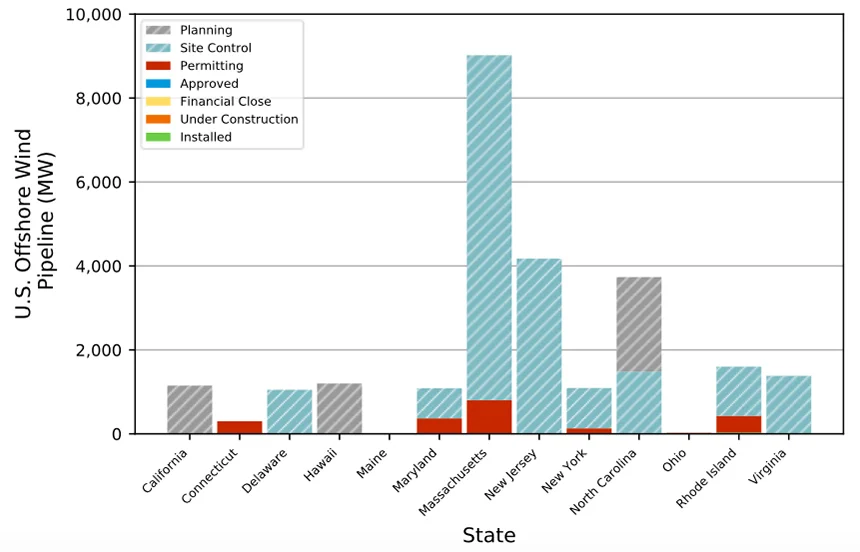
Offshore wind-energy development by state. (U.S. Department of Energy)
Meanwhile, offshore wind power is taking off, with some 25 gigawatts of projects proposed across the country, much of it in the Northeast, according to the Department of Energy. More then 10 gigawatts is planned for Massachusetts and Rhode Island waters, thanks to southern New England's large, windy, and relatively shallow offshore regions — all within range of millions of energy customers.
There is still hope for harnessing energy from currents and waves. In 2014, UMass-Dartmouth closed its Marine Renewable Energy Center, prompting the energy program to reorganize as the Marine Renewable Energy Collaborative (MRECo). The nonprofit switched from its academic initiative to focus on public outreach, promotion, and equipment testing.
MRECo’s executive director, John Miller, said there isn’t adequate financial support to make tidal and wave projects financially viable, especially as federal dollars have shifted to wave-energy testing on the West Coast, such as the PacWave project off the coast of Oregon.
“It’s a tough business,” Miller said. “The whole business is 10 to 15 years behind where offshore wind is.
Nevertheless, MRECo is testing a range of marine-industry products. The organization recently concluded a study that determined that current for the proposed Muskeget Channel tidal installation between Nantucket and Martha’s Vineyard lacks the velocity to support the latest tidal-energy systems.
In 2017, MRECo installed the Bourne Tidal Test Site (BTTS),. in the Cape Cod Canal. Miller noted that the $300,000 steel platform was a bargain to build compared to more elaborate facilities off the coast of Scotland and in the Bay of Fundy in Canada that cost $30 million apiece
Within a year, BTTS expects to test its first underwater turbine, a device for the start-up company Littoral Power Systems of Fall River, Mass. BTTS has hosted other marine equipment, including commercial fishing nets and soon will gather data for aquatic sensors that monitor microplastics and algae linked to toxic blooms.
MRECo is seeking $200,000 to upgrade the power and Internet capability of BTTS to accommodate testing of additional marine sensors and instruments.
At URI, the ocean-energy research labs and indoor wave tank have broadened their study areas to include the offshore wind industry.
Prof. M. Reza Hashemi said wave and tidal power are some of the oldest forms of energy but have yet to be proven commercially viable in New England, primarily because water currents aren’t strong enough.
“There is hope, but it needs a lot help,” Hashemi said.
Wave and tidal energy are more promising on the West Coast and in the United Kingdom, where the currents are much stronger, he said.
But local tidal- and wave-energy efforts haven’t stopped. The massive tides in the Gulf of Maine are drawing demonstration projects supported by research from URI and the University of New Hampshire, among others.
Hashemi also co-authored a textbook about wind, tidal, and wave energy. For now, he is conducting research on the impacts of hurricanes on wind turbines. But Hashemi and URI remain dedicated to hydrokinetic energy. The university recently received $148,000 from The Champlin Foundation for a new ocean-energy flume, a type of indoor wave tank designed for testing small-scale wave- and tidal-energy devices
“Wave and tidal energy are still at the early stages of development,” Hashemi said. “They are not yet at the commercial stage.
Tim Faulkner is an ecoRI News journalist.

In New Canaan: Bhutan and 'The Glass House'
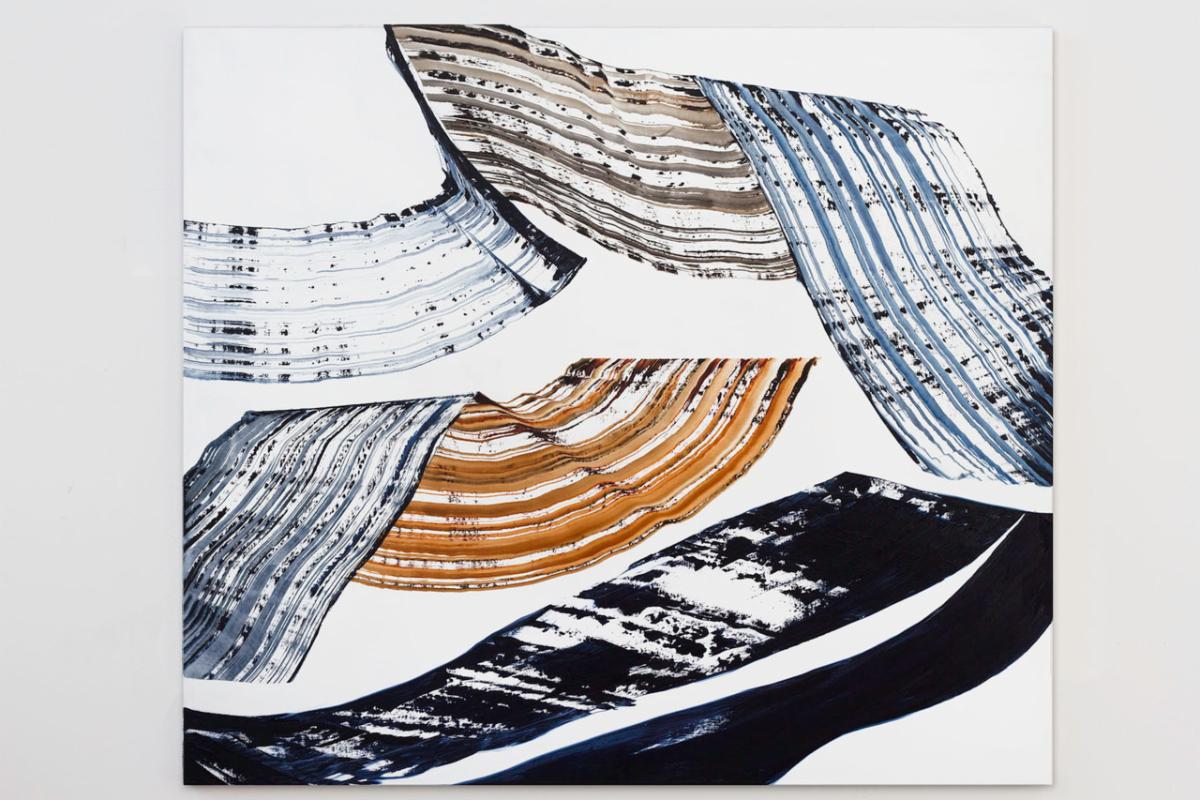
“Bhutan PF23’’ (oil on canvas), by Ricardo Mazal, in the joint show “Ricardo Mazal & Paul Bloch: Refined Abstractions,’’ at Heather Gaudio Fine Art, New Canaan, Conn., through Oct. 5.
The gallery says:
Ricardo Mazal 's interest in the anthropological practices of diverse global cultures, their spiritual rites, rituals and sacred places comes to the fore in his artistic expression. Through the use of photography, print-making, and the latest digital and video technology, Mazal achieves transformational perspectives and brings formal principles of composition into his work. Rigid blocks of color, flatness, folds, ribbons, stillness and texture have evolved over the span of decades to become the recognizable aesthetic for which he is known. The exhibition will feature paintings from the “Bhutan Abstractions’’ series, geometric and organic compositions that resulted from a family trip he took in 2014. Referencing Bhutanese prayer flags billowing in the wind, some of these paintings are flowing arabesques while others follow more hardline interplays of tone, color and texture, interrupted by visual hints of the region's snow-capped vertiginous strata.’’

The Moreno Clock, at the intersection of Elm Street and South Avenue in New Canaan.

Linda Gasparello: Uzbeks transforming Old Silk Road cities into smart cities

Design for Tashkent City
Tashkent, the capital of Uzbekistan, is undergoing a transformation at a pace and scale almost comparable to Samarkand in 1370, when the Turco-Mongol ruler Timur, or, Tamerlane, as he is known in the West, made it his capital.
On the one hand, Tamerlane was a brutal conqueror who razed ancient cities to the ground and put entire populations to the sword. The empire he founded in 1370 and ruled until his death in 1405 (probably of a mid-winter cold, caught while on his way to change the Ming Dynasty in China) stretched from Russia to India and from the Mediterranean Sea to Mongolia.
But on the other hand, Tamerlane was a brilliant constructor. One of his signature achievements was Samarkand, which he strove to make the most splendid city in Asia.
“It’s not hard to see why the author of the 1001 Nights had Scheherazade spin her tales from a palace in Samarkand: The city was on the Silk Road, alive with people from different lands; it was a wonderland of Islamic architecture and a great center of learning,” Srinath Perur wrote in The Guardian newspaper.

The Registan, in Samarkand
But no place in Samarkand represents all three aspects as well as the Registan, the main square, three sides of which stand a blur-of-blue-tiled madrasas (Islamic colleges). In 1888 George Curzon, world traveler and future viceroy of India, called it “the noblest public square in the world.”
While most of the edifices seen around the square were built after Tamerlane’s death, they couldn’t have been built without his sacking Islamic brother cities (including Baghdad, Damascus and Khiva) and his sparing their artisans and craftsmen, who he brought back to Samarkand.
In 1399, just a year after reducing Delhi to rubble because he thought the Muslim sultan was too tolerant of his Hindu subjects, Tamerlane was back to building his sumptuous capital. A caravan of 90 captured elephants was employed to carry stones from quarries to erect a great mosque, according to Ruy Gonzalez de Clavijo, an envoy the Spanish kingdom of Castile dispatched to Samarkand. The Europeans rather liked Tamerlane because he roughed up their neighborhood bully, the Ottoman Turks
Tamerlane returned from his military conquests -- estimated to have wiped out 5 percent of the world’s population -- with architectural inspiration and plunder that could finance his appetite for building in Samarkand and other cities.
One of his monuments bears the proverb, “If you want to know about us, examine our cities.’’
That proverb could be driving Shavkat Mirziyoyev, who succeeded Islam Karimov as Uzbek president in 2016. His smart city projects in Tashkent, Samarkand and Bukhara, so it seems, are aimed at rebranding Uzbekistan as a country interested in political reform, economic investment and good relations with the rest of the world.
Javlon Vakhabov, Uzbekistan’s youthful new ambassador in Washington, discussed one smart city project, Tashkent City, in some depth at a summit on smart cities and communities organized by Dentons, the world’s largest law firm.
Construction of Tashkent City, a $1.7-billion international business and financial hub in the heart of the capital, started in 2018. The design includes an industrial park, eight business centers, a shopping mall, restaurants and a cultural center, as well as residential apartments on a 173-acre site
“The aim of this project,” according to the government, “is to create an architectural complex in the center of Tashkent, implemented by embedding the latest trends in world architecture and the application of environmentally friendly and energy-saving, smart technologies.”
Vakhabov enthused that Tashkent City projects have already received millions of dollars in loans from the Asian Development Bank, the European Bank for Reconstruction and Development and the World Bank.
But he added, “Uzbekistan is a 3,000-year-old country. We have four UNESCO World Heritage cities. We have 4,000 sites that are highly protected by UNESCO. We need to be sensitive to these historical sites and adapt them to smart cities.”
“A mass movement of people from the countryside to the cities has created stresses on the environment and infrastructure,” he said. Ultimately smart cities can alleviate those stresses, using information and communication technology to improve efficiency, sustainability and citizen welfare.
Meantime, smart city projects have been stressing out people. There have been news reports about protests and court cases in Tashkent over traditional housing demolitions and evictions.
“As for the resettlement of people living in houses built by their forefathers, we need to create more favorable conditions for people persuaded to move to other communities,” Vakhabov said reassuringly.
Linda Gasparello is producer and co-host of White House Chronicle, on PBS. Her email is whchronicle@gmail.com.
\
Trying to save Aquidneck Island's open space

Windmill (built around 1810) at Prescott Farm, in Middletown, R.I.., on Aquidneck Island, which still has some countryside, or at least rural-looking exurbia.
From Robert Whitcomb’s “Digital Diary,’’ in GoLocal24.com
‘EcoRI News’s Frank Carini had a good story on Aug. 18 about how Aquidneck Island could run out of its currently unprotected open space by 2050, and not because of a big increase in population but because of sprawl development, whose ugliness is all too apparent on the roads leading to Newport. This still unbuilt-on space includes farmland (vineyards, sweet corn, etc.), woods and other open space. There’s still considerable inland natural beauty left on the island that many tourists who head for, say, Newport’s spectacular Ocean Drive don’t notice.
How to protect the island’s remaining natural beauty? Encourage zoning changes that favor housing density and compact commercial development instead of housing subdivisions and malls, strip or otherwise. (Presumably the continuing rise of Internet shopping will continue to undermine the business model of malls, with their asphalt parking lot acreage mostly empty and wasted when the stores are closed and whose hard surfaces add to local flooding and water pollution.)
Also needed is a much, much denser public transportation network that would reduce car dependence and the sprawl it fosters.
Remembering that Aquideck is an island, albeit a big one by Northeast standards, should remind people of its fragility. To read Mr. Carini’s piece, which includes graphics, please hit this link.

Frank Carini: Restoration plan for species hurt by 2003 Buzzards Bay oil spill

Common Loon
From ecoRI News (ecori.org)
State and federal environmental agencies have released a draft plan to help common loons and other birds in the wake of the 2003 Bouchard Barge No. 120 oil spill in Buzzards Bay, in both Rhode Island and Massachusetts waters.
The draft plan is available for public comment through Oct. 31. Written comments can be sent via email to molly_sperduto@fws.gov. The agencies are scheduled to hold an information meeting and webinar Sept. 12 at 1 p.m. at the Massachusetts Division of Fisheries and Wildlife office at 1 Rabbit Hill Rd, Westboro.
The plan is the first of two documents to address birds injured by the spill, both of which will be funded by a 2017 $13.3 million natural resource damages settlement from Bouchard Transportation Co. Inc. Of this total, $7.3 million is designated to plan, implement, oversee and monitor common loon restoration, while another $1 million will go toward other birds impacted by the spill. Another $5 million from the settlement will address injuries to common and roseate terns through a separate future plan
This plan describes the injuries resulting from the 98,000-gallon spill that oiled 100 miles of shoreline, including coastal habitats where birds feed, nest, and in some cases overwinter. An estimated 531 common loons and more than 500 other birds, including common eiders, black scoters, red-throated loons, grebes, cormorants, and gulls, were killed either through direct or indirect effects of the spill.
Common loons winter in large numbers in Buzzards Bay. Common eiders experienced the highest mortality of all other bird species, with 83 birds killed by the oiling. The ultimate goal of the damage assessment and restoration process is to replace, rehabilitate, or acquire the equivalent of injured natural resources and resource services lost because of the release of hazardous substances, at no cost to taxpayers.
“The trustees have carefully considered a number of options to restore birds killed by the 2003 oil spill, especially the common loons that are icons of our northern lakes,” said Tom Chapman, supervisor of the U.S. Fish & Wildlife Service’s New England office. “We invite people to learn about and provide feedback on these ideas, in hopes of soon starting restoration efforts benefiting birds throughout New England.”
The draft plan evaluates multiple restoration alternatives that were developed in coordination with loon and other bird experts. Based on factors to ensure successful restoration, as well as criteria established by federal regulations, the trustees recommend the following projects:
Release 63-84 common loon chicks from Maine and New York in historic Massachusetts breeding sites in Assawompset Pond Complex and the October Mountain Reservoir, in hopes of returning this species to more areas in the state ($3,185,000). In Massachusetts, common loons disappeared for decades until 1975, and have since primarily returned to breed in Quabbin and Wachusetts reservoirs, migrating offshore to winter.
Increase survival of nesting loons at breeding sites across New England ($3,185,000) through: creating artificial nesting sites on rafts that withstand fluctuating water levels and reduce disturbance from predators and people; adding signs and wardens to watch over nests to reduce disturbance; preserving land to protect breeding habitat; and reducing exposure to lead tackle through outreach and tackle exchange programs
The trustees’ preferred alternatives to restore other bird species are:
Permanently protect more than 300 acres of high-quality coastal habitats on Cuttyhunk Island off the coast of Massachusetts ($500,000).
Identify a similar habitat protection project in Rhode Island through a competitive grant process ($1,274,000)
Use signage, nest monitoring, and wardens to protect common eider nests in the Boston Harbor Islands and Cuttyhunk Island ($100,000).
Frank Carini is editor of ecoRI News.
Dangerous colors

“Cautionary Tale’’ (acrylic, oil and oilstick on paper), by Tracey Physioc Brockett, at the Augusta Savage Gallery, Amherst, Mass.
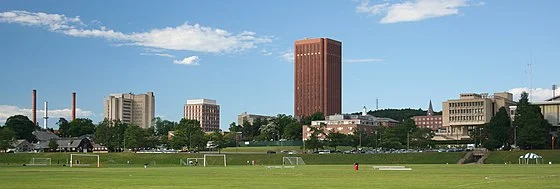
Campus of the University of Massachusetts at Amherst.

Mt. Norwottuck, straddlingh Granby and Amherst, in the Holyoke Range.
— Photo by Andy Anderson
Don Pesci: Anti-Muslim hatemongering or scholarly curiosity?

In early August, the Council on American Islamic Relations (CAIR) and the Southern Poverty Law Center (SPLC) jointly condemned E. Miles Prentice, the owner of the Single-A Connecticut Tigers, based in Norwich, Conn., and co-owner of the Double-A Midland (Texas) RockHounds. Prentice was assailed because of his association with the Center for Security Policy (CSP), a group, according to a story in the Norwich Bulletin, that has been identified by CAIR as an anti-Muslim hate group.
Immediately after the “hate” gauntlet had been thrown down, curious minds certainly wondered if the CFSP was indeed a Muslim hate group, which is to say a group that hates all Muslims because they are Muslims. In a story of this kind, it is important to know whether the CSP is inspired chiefly by hate or by something far less toxic -- scholarly curiosity: Is sharia law compatible with our constitutional and the common law? In addition, one would want to know whether Prentice himself hates Muslims simply because they are Muslims, or whether Prentice is being assailed because of his close association with the CSP, while he himself is free of the presumed taint of hatred. Prentice is chairman of the Center for Security Policy and appears to be far more interested in baseball than irrational hatred.
Unfortunately, none of these questions have been asked, still less answered, by those reporting on the matter. The charge of anti-Muslim hatred – like charges of racism and anti-Semitism – may be unanswerable in the absence of unambiguous definitions. No doubt racism, anti-Semitism and anti-Muslim hatred should be denounced from every pulpit in the nation, religious and secular, but the denunciations must be aimed at the thing itself, not an intimation of its shadow. And, in the absence of firm definitions, those who falsely charge others with hatred of Islam as such should be fervently denounced by men and women of good will much in the way Sen. Joe McCarthy was reviled when he sought to tag as Communists some people who were innocent of the charge. McCarthy did correctly identify some people as Communists, but he was painting with a very broad brush, and in some cases his manner of investigation proved insufficient.
In 1992, William F. Buckley Jr. brought out a book titled In Search of Anti-Semitism. The tightly reasoned book ran to 200 pages and Buckley appeared to have captured in its pages a proper context “to evaluate anti-Semitism and, at the same time, what is wrongfully thought of as anti-Semitic.” There is no such effort underway to narrowly define “Islamic hatred” in such a way that Prentice may be safely put behind its definitional bars. Neither Prentice nor the Center for Security Policy, founded in 2008.
Is it not possible that CAIR -- closely associated with the Muslim Brotherhood, a transnational Sunni Islamist organization founded in 1928 in Egypt by Islamic scholar and schoolteacher Hassan al-Banna, which itself is closely related to Hamas, a militant anti-Israeli terrorist organization -- may regard as hate what non-Muslim commentators in the United States choose to view as critical analysis?
The Council on American Islamic Relations should be wary of throwing stones from within glass houses. CSP is not an Islamic hate group. And if Prentice is to be judged an Islamic hater because of his association with a group found on the growing enemies list of the Southern Poverty Law Center, should not CAIR and the SPLC be judged according to the same standard applied in the case of Prentice? Prentice’ response to the charge that he is a hatemonger, not ventilated fully in news outlets that have carried the sensational charge, may be found here.
There is no reason to suppose that the members of CAIR should be familiar with Kant’s categorical imperative -- “Act as if the maxim of your action were to become by your will a universal law of nature." Or, to put the precept in Christian terms, do unto others as you would have them do unto you. That precept – that moral law – weighs heavily on the Christian conscience. But there is no reason to believe that violent jihadists, say, soiling their hands with the blood of innocent Christians, among others, think themselves under any obligation to submit to Kant’s moral law. Their submission is to Mohammed's precepts as expressed in the Koran, the hadiths and sharia law.
However, if you want to play ball in Dodd Stadium, Norwich, CT., USA, you’ll have to play by the rules. And the overarching rule is that there is a world of difference between proper scholarly activity, permitted under the U.S. Constitution’s First Amendment, and hate mongering of a kind that falls short of slitting the throats of those who disagree with you on nice theological questions.
Don Pesci is a columnist based in Vernon, Conn.
Last surf frolic of the season?

“Surf,’’ encaustic painting by Nancy Whitcomb. Don’t worry: Those pesky great white sharks avoid water less than five feet deep….
Miscellany

Honeybee swarm in the woods
From Robert Whitcomb’s “Digital Diary,’’ in GoLocal24.com
Eastern Equine Encephalitis, a rare but dangerous disease carried by mosquitoes, is popping up earlier than usual this year in southeastern New England because of our very warm and humid summer. So Massachusetts authorities have ordered spraying. Let’s hope they do it with as much precision as possible and don’t kill a lot of bees, which of course are essential for pollination, and which are already under a lot of environmental stress, much of it manmade.
xxx

Ferry docking area of downtown Block Island (town of New Shoreham.
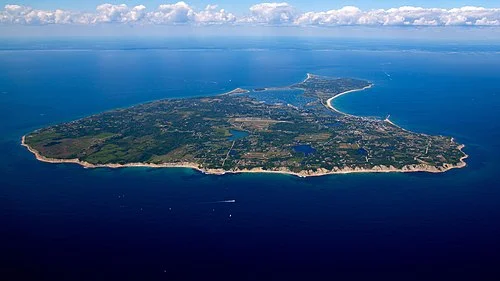
Looking north over the island.
Block Island includes a curious mix of very rich people who a decade or two ago would have been in the Hamptons but now have McMansions on the island and day trippers too many of whom seem more interested in getting drunk with their pals than in enjoying the little isle’s scenic grandeur.
Military history

Work by Michael Miller in the mixed-media group show “Unredacted,’’ at ReachArts, Swampscott, Mass., Sept. 7-Oc. 19.
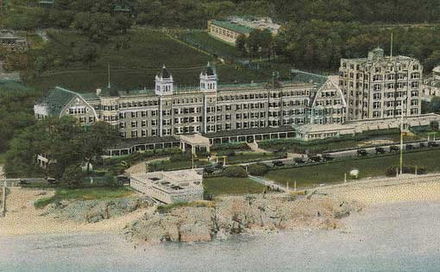
The former New Ocean House Hotel (circa 1920) on the Swampscott shore. Fire destroyed it in 1969.
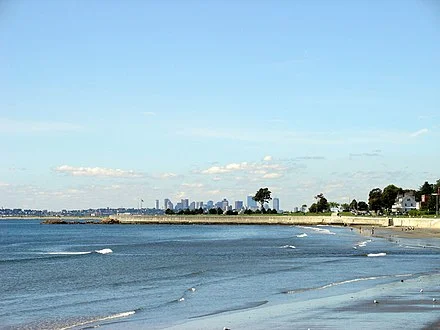
The Boston skyline from Swampscott.
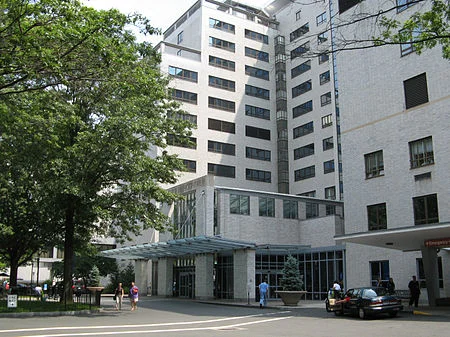
Rachel Bluth: Battling another surprise exorbitant medical bill
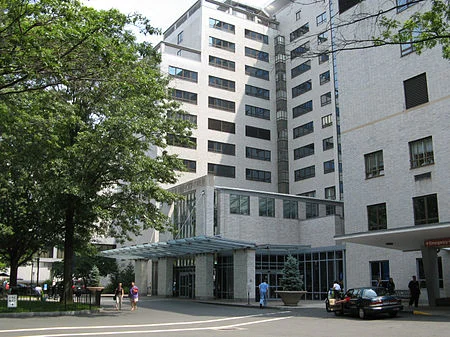
Main entrance of Hartford Hospital.
From a planning perspective, Wolfgang Balzer, of Wethersfield, Conn., is the perfect health-care consumer.
Balzer, an engineer, knew for several years he had a hernia that would need to be repaired, but it wasn’t an emergency, so he waited until the time was right.
The opportunity came in 2018 after his wife, Farren, had given birth to their second child in February. The couple had met their deductible early in the year and figured that would minimize out-of-pocket payments for Wolfgang’s surgery.
Before scheduling it, he called the hospital, the surgeon and the anesthesiologist to get estimates for how much the procedure would cost.
“We tried our best to weigh out our plan and figure out what the numbers were,” Wolfgang said.
The hospital told him that the normal billed rate was $10,333.16 but that Cigna, his insurer, had negotiated a discount to $6,995.56, meaning his 20% patient share would be $1,399.11. The surgeon’s office quoted a normal rate of $1,675, but the Cigna discounted rate was just $469, meaning his co-payment would be about $94. (Although the Balzers made four calls to the anesthesiologist’s office to get a quote, leaving voicemail, no one returned their calls.)
Estimates in hand, they budgeted for the money they would have to pay. Wolfgang proceeded with the surgery in November, and, medically, it went according to plan
Then the bill came.
The bill for Wolfgang’s surgery turned out to be $2,304.51, $800 higher than he and his wife, Farren, had budgeted for, based on the estimates. “That’s a huge hit,” Farren says.
Total Bill: The estimates the Balzers had painstakingly obtained were wildly off. The hospital’s bill was $16,314. After the insurer’s contracted discount was applied, the bill fell to $10,552, still 51% over the initial estimate. The contracted rate for the surgeon’s fee was $968, more than double the estimate. After Cigna’s payments, the Balzers were billed $2,304.51, much more than they’d budgeted for.
What Gives: “This is ending up costing us $800 more,” said Farren, 36. “For two working people with two children and full-time day care, that’s a huge hit.”
When the bill came on Christmas Eve, the Balzers called around, trying to figure out what went wrong with the initial estimate, only to get bounced from the hospital’s billing office to patient accounts and finally ending up speaking with the hospital’s “Integrity Department.”
They were told “a quote is only a quote and doesn’t take into consideration complications.” The Balzers pointed out there had been no complications in the outpatient procedure; Wolfgang went home the same day, a few hours after he woke up.
The couple appealed the bill. They called their insurer. They waited for collection notices to roll in.
Hospital estimates are often inaccurate and there is no legal obligation that they be correct, or even be issued in good faith. It’s not so in other industries. When you take out a mortgage, for instance, the lender’s estimate of origination charges has to be accurate by law; even closing fees — incurred many months later — cannot exceed the initial estimate by more than 10%. In construction or home remodeling, while estimates are not legal contracts, failure to live up to them can be a basis for liability or “a claim for negligent misrepresentation.”
In this case, Hartford Hospital produced an estimate for Balzer’s laparoscopic hernia repair, CPT (current procedural terminology) code 49650
Hope You’re Sitting Down: Hospital Charges $4,700 For A Fainting Spell JAN 28
The hospital ran the code through a computer program that produced an average of what others have paid. Cynthia Pugliese, Hartford HealthCare’s vice president of revenue cycle, said the hospital uses averages because more complicated cases may require additional supplies or services, which would add costs.
“Because it was new, perhaps the system doesn’t have enough cases to provide an accurate estimate,” Pugliese said. “We did not communicate effectively to him related to his estimate. It’s not our norm. We look at this experience and this event to learn from this.”
Efforts to make health care prices more transparent have not managed to bring down bills because the different charges and prices given are so often inscrutable or unreliable, said Dr. Ateev Mehrotra, an associate professor of health care policy and medicine at Harvard Medical School
“The charges on there don’t make any sense. All it does is, people get pissed off,” Mehrotra said. “The charge has no link to reality, so it doesn’t matter.”
Resolution: “Because I roll over more easily than my wife does, I’m of the mindset to pay it and get done with it,” Wolfgang said. “My wife says absolutely not.”
Investigating prices, dealing with billing departments and following up with their insurer was draining for the Balzers
“I’ve been tackling this since December,” Wolfgang said. “I’ve lost two or three days in terms of time.”
For the Balzers, there’s a happy ending. After a reporter made inquiries about the discrepancy between the estimate and the billed charges — six months after they got their first bill — Pugliese told them to forget it. Their bill would be an “administrative write-off,” they were told.
“They repeatedly apologized and ended up promising to adjust our bill to zero dollars,” Wolfgang wrote in an email.
Most patients aren’t as proactive as the Balzers in getting estimates for the cost of health care, and most wouldn’t know that the hospital, surgeon and anesthesiologist would each bill separately.
The Takeaway: It is a good idea to get an estimate in advance for health care if your condition is not an emergency. But it is important to know that an estimate can be way off — and your provider probably is not legally required to honor it.
Try to request an estimate that is “all-in” — including the entire set of services associated with your procedure or admission. If it’s not all-inclusive, the hospital should make clear which services are not being counted.
Having an estimate means you can make an argument with your provider and insurer that you shouldn’t be charged more than you expected. It could work.
Laws requiring some degree of accuracy in medical estimates would help. In a number of other countries, patients are entitled to accurate estimates if they are paying out-of-pocket.
Most patients aren’t as proactive as the Balzers, and most wouldn’t know that the hospital, surgeon and anesthesiologist would each bill separately. And most wouldn’t fight a bill that they could afford to pay.
The Balzers say they wouldn’t have changed their medical decision, even if they’d been given the right estimate at the beginning. It’s the principle they fought for here: “There’s no other consumer industry where this would be tolerated,” Farren wrote in an email.
Bill of the Month is a crowdsourced investigation by Kaiser Health News and NPR that dissects and explains medical bills. Do you have an interesting medical bill you want to share with us? Tell us about it!
Rachel Bluth is a journalist with Kaiser Health News.
Christine Owens: Democracy needs unions

1913 political cartoon showing organized labor marching towards progress, while a shortsighted employer tries to stop labor
Via OtherWords.org
Democratic rights in the workplace — including the right to form a union, and the power to speak up about workplace issues — go hand in hand with a democratic society. But for decades now, those rights have been under assault.
This Labor Day, it’s time we fight to restore them.
Make no mistake: By whittling away at workers’ right to a voice at work, right-wing corporate activists have also been able to curtail workers’ voices at the ballot box, too.
Unionized workers vote at higher rates than non-union workers. States that have adopted so-called “right to work” laws to undermine unions have seen a net decline in turnout.
That’s exactly why corporate lobbyists and their political cronies push such laws — it’s part of their strategy to weaken support for popular proposals that help working people, from higher minimum wages to stronger social insurance programs.
These efforts work hand in hand with voter suppression, gerrymandering, and other efforts to undermine voting rights — as well as with “carve-outs” to labor laws, which exclude categories of workers like farm and domestic workers. Together these abuses disenfranchise workers and lock in poverty wages.
We’ve seen what happens when huge corporations, and the politicians beholden to them, wield all the political power.
They roll back government oversight so companies can engage in dangerous — even deadly — workplace practices. They widen tax loopholes so that companies that operate in our backyards don’t contribute to the upkeep of our communities. And they make corporations “people” with democratic rights far greater than those of actual human beings.
Then they illegally retaliate against workers who try to join together for change. They threaten mass layoffs and the decimation of communities. From the moment a person is hired, she’s told she’s replaceable and compelled to sign away her rights, leaving her on her own against an all-powerful boss.
But increasingly, working people are fighting back
Around the nation, worker activists are urging lawmakers to prohibit employers from firing people in retaliation for trying to improve their own workplaces. They’re calling for an end to longstanding racist exclusions of caregivers and agricultural workers from labor protections. And, from poultry plants to commercial banks, they’re blowing the whistle on dangerous employer practices that hurt workers and consumers alike.
Working people are joining together to demand a more just economy in other ways, too
From Walmart workers walking off the job to protest guns sales following the El Paso massacre, to adjunct professors warning that poverty wages affect the quality in the classroom, workers are protecting our democracy.
When call center workers in Mississippi draw attention to low wages and high turnover in critical federal services, and employees of the furnishing company Wayfair walk out to protest the inhumane treatment of immigrants at the border, they’re reminding us of our civic responsibilities.
When teachers fill streets and statehouses to raise the specter of generational harm from underfunded schools, and museum employees lift the veil on pay inequality in arts institutions, they highlight the permanent damage to our country if worker voices are silenced.
Restoring worker power isn’t just about restoring the right to unionize. It’s about balancing one-sided corporate control with workplace democracy.
Labor Day and the Fourth of July may be separated by several weeks, but the values they embody are deeply intertwined. If we truly want justice, domestic tranquility, general welfare, and the blessings of liberty, we must allow democracy to flourish in the workplace as well as at the ballot box.
Christine Owens is executive director of the National Employment Law Project.

As union membership declined income inequality rose.
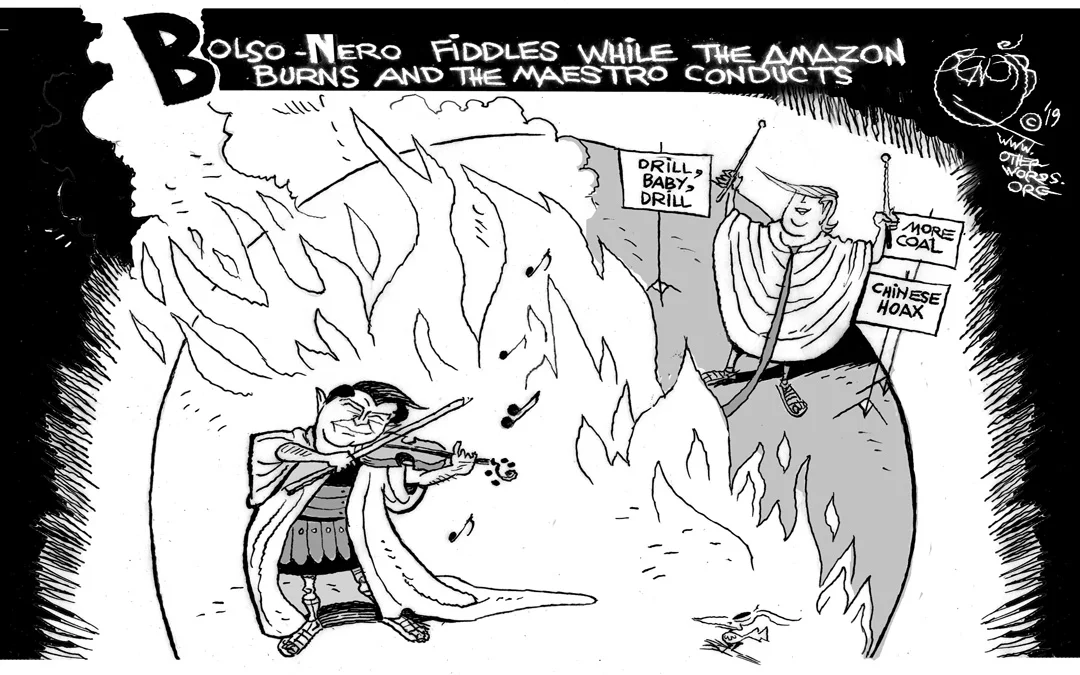
Thinking of the Amazon

“Moonlight Burning’’ (photograph), by Richard Alan Cohen, in a group show at Galatea Fine Art, Boston, through Sept. 1
Life on a wharf

Long Wharf in Boston, United States, 19th Century, jutting into Boston Harbor
From Robert Whitcomb’s “Digital Diary,’’ in GoLocal24.com
I’ve spent a lot of time on wharves, and I especially think of them in August, when their smells of salt water, fish, creosote, diesel and gasoline reach their greatest intensity. Standing there at the edge of water, maybe looking at the eelgrass wave in the water a few feet away, I think of how summer is waning as a back-door cold front replaces the sultry southwest wind with a salty breeze from the east that’s cool enough to remind me of fishing for smelt as a kid in October off the “floats’’ (wooden floating wharves) in the harbor near our house, using a bamboo pole and multiple hooks. (Smelts, by the way, are best fried in butter.) Or I remember the east wind coming off Boston Harbor and cooling off my summer work mates and me as we smoked on the loading platforms along the promiscuously polluted South Boston waterfront and I mulled the threats and opportunities involved in returning to college in a couple of weeks.
On the Cape’s West Falmouth Harbor, there’s a very old and small granite-block wharf in front of what used to be my paternal grandparents’ house, since torn down and replaced by a tall McMansion but, as the builder emphasized to angry neighbors, on the “same footprint.’’ The little wharf provided me with a couple of lessons in the passage of time:
Low tide now exposes sand and mud flats going right up to the front of the wharf (or “dock’’ as we called it, even though docks are more precisely the area between wharves).
So why was it built? It turns out that a little stream emptying into the harbor had silted up the water abutting the wharf. In the 19th Century the water in that part of the harbor (once famous for its shellfish, before a disastrous oil spill, in 1969) was much deeper. And the rather mysterious structure was apparently built to provide access for people coming in small boats to a fresh water spring a few feet up the slope from the wharf.
3 Boston hospitals partner to help low-income families with rent
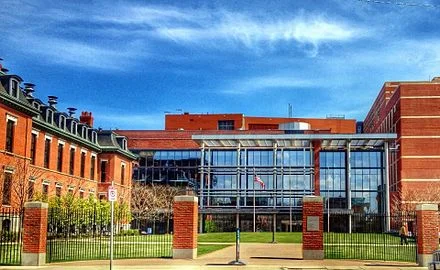
The Boston Medical Center’s Moakley Building
This is from The New England Council (newenglandcouncil.com):
BOSTON
“New England Council members Boston Children’s Hospital and Brigham & Women’s Hospital have partnered with Boston Medical Center (BMC) to launch a program to aid families struggling with rent. By joining forces on this initiative, the three major Boston hospitals are recognizing a substantive connection between stable housing and good health.
“Research conducted by BMC has shown that housing, alongside food and education, plays a critical role in an individual’s health and their health care costs. Children are especially vulnerable to health issues and developmental delays if they lack a stable housing situation. City officials found than over 4,600 eviction cases were filed in Boston Housing Court in 2016, the majority of which involved residents in subsidized housing. As rent continues to rise in Boston, the hospitals identified access to affordable, stable housing as a major concern for low income families and their health.
“The three hospitals plan to donate over $3 million over three years to fund housing programs and community grants. The first $1.5 million has be reserved for families behind on rent and at risk for eviction. Because of the hospitals’ financial commitment to this project, all three have also been granted state approval for construction plans at each of their campuses.
“‘The hospitals don’t think they’re going to fix the housing problem,’ said Dr. Shari Nethersole, executive director for community health at Boston’s Children’s. ‘We recognize this is a societal problem. We’re trying to help identify where we do have a role, where we can help.’
“The New England Council commends all three institutions for their commitment to support the health of low- income families.