
Vox clamantis in deserto






David Warsh: The future of the great U.S.-China trade decoupling
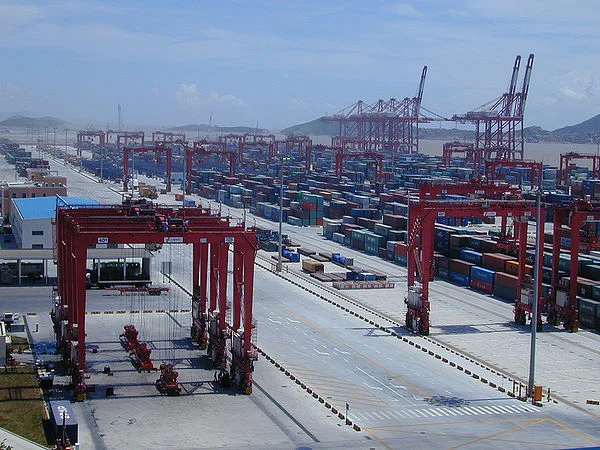
In the Port of Shanghai, the world’s biggest container port
James Kynge, Financial Times bureau chief in Bejing in 1998-2005, is among the China-watchers whom I have followed, especially since China Shakes the World: A Titan’s Rise and Troubled Future – and the Challenge for America appeared, in 2006. Today he operates a pair of proprietary research services for the FT.
So I was disheartened to see to see Kynge employ an ominous new term in an FT op-ed column on Friday, Aug. 23, “Righteous Anger Will Not Win a Trade War’’. President Trump thinks that the U.S. becomes stronger and China weaker as the trade war continues, Kynge wrote, but others see an opposite dynamic at work: “mounting losses for American corporations as the U.S. and Chinese economies decouple after nearly 40 years of engagement.”
Decoupling is so incipient as a term of art in international economics that Wikipedia offers no meaning more precise than “the ending, removal or reverse of coupling.” A decade ago, it implied nothing more ominous than buffering the business cycle (The Decoupling Debate). Former World Bank chief economist Paul Romer, no professional China-watcher but better connected than ever, since he shared a Nobel Prize in economics last year, returned from a trip there in June with something of a definition. The mood in China, at least in technology circles, was grim but determined, he told Bloomberg News.
“I think what they’ve decided is that the U.S .is not a reliable trading partner, and they can’t maintain their economy or their tech industry if it’s dependent on critical components from the United States. So I think they are on a trajectory now, that they’re not going to move off of, of becoming wholly self-sufficient in technology. Even if there’s a paper deal that covers over this trade war stuff, I think we’ve seen a permanent change in China’s approach…. There’s no question that they’re on a trajectory to become completely independent of the United States because they just can’t count on us anymore.’’
How long might it take to pretty fully disengage at the level of technological standards? More than five years, maybe ten, Romer guessed, citing Chinese estimates. For that length of time, Kynge reckons, U.S. high tech vendors would continue to suffer. American companies and their affiliates sell nine times more in China than their counterparts operating in the United States, according to one estimate he cited. Cisco and Qualcomm report being squeezed out of China markets, he says. HP, Dell, Microsoft, Amazon and Apples are considering pulling back.
The long-term competition for technological dominance worries Kynge more than the trade war. In many industries, he writes, China is thought to be already ahead. Among those he lists are high-speed rail, high-voltage transmission lines, renewables, new energy vehicles, digital payment systems, and 5G telecom technologies. And while there is no agreement about which nation possesses the more effective start-up culture, in university-based disciplines such as artificial intelligence, quantum computing, and biomedicine, in which the U.S. has been thought to have been well ahead, China is making rapid gains.
This decoupling of two nations that for 40 years gave grand demonstration of the benefits and, latterly, the costs, of trade is a bleak prospect. If there is a silver lining, it lies in the fact that rivalry often produces plenty of jobs along with the mortal risks that passionate competition entail. But if America is to do anything more than simply capitulate, it must find a leader and begin to move past the disastrous presidency of Donald Trump.
Friday’s shocking escalation, via Trump’s Tweets, brought that eventuality a little closer. The president is on the ropes. There is no sign of trade war fever beyond his base that might restore the confidence required for him to win a second term.
. xxx
New on the EP bookshelf: The Narrow Corridor: States, Societies, and the Fate of Liberty, by Daron Acemoglu and James A. Robinson (Random House, 2019).
The Triumph of Injustice: How the Rich Dodge Taxes and How to Make Them Pay, by Emmanuel Saez and Gabriel Zucman (Norton, 2019).
David Warsh, an economic historian, book author and veteran columnist, is proprietor of Somerville-based economicprincipals.com, where this essay first appeared.
Chris Powell: The Epstein scandal: 'No one that couldn't be bought'
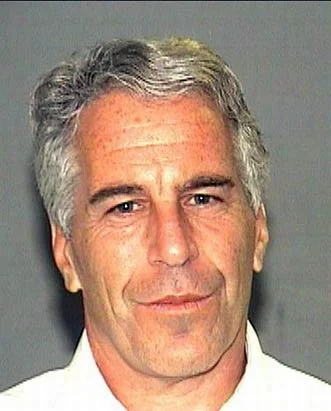
Jeffrey Epstein in a 2006 police mug shot
MANCHESTER, Conn.
Vile as financier Jeffrey Epstein seems to have been, many if not most of the girls he targeted were not quite the innocent victims being luridly portrayed by news organizations, not all if any of them really being "sex slaves."
To the contrary, while most of them were minors, under 18, they retained freedom of movement and repeatedly returned to Epstein, traveled with him, or went where he told them to go to be used by his friends. They knew what they were doing was prostitution, even if the law rightly holds that minors are not fully responsible for themselves.
Epstein's character is a settled matter, just as it is settled that money is power and power tends to corrupt. So it may be more illuminating to ask how so many teenage girls could escape the custody of their parents for so long to become the playthings of Epstein and his friends without inciting at least suspicion back home.
There seem to be two explanations. First is that some girls did not have much in the way of parents, so they were more vulnerable. Second is that there was a lot of money in it for them, for Epstein paid them well -- so well that many of his girls recruited others for him, and some even told the police that they loved him.
Having accepted such employment with Epstein, some of his girls now accuse him of ruining their lives and are levying claim to his estate. Others brought suit against him and then settled confidentially, choosing to take his money again without warning the world against him.
Epstein's most publicized accuser, Virginia Roberts Giuffre, now in her 30s, married, a mother, and living in Australia, has figured it out better than most news organizations. "Laughing the whole way through," Giuffre says, "Jeffrey thought it was absolutely brilliant how easily money seduced all walks of life -- nothing or no one that couldn't be bought."
Of course as the prototypical "sadder but wiser girl," Giuffre could apply her insight to herself most of all.
The corruptibility of human nature explains Epstein's success as a predator. Of course it does not excuse him. But it does invite reflection on the failure of society and the law to protect minors, and, really, the lack of interest in protecting them.
That children don't have parents is often the consequence of welfare and divorce policy.
Advertising and television sexualize children and bring the coarsest sex to the youngest audiences, especially those with negligent parents.
Even Epstein's friends and acquaintances who did not exploit his girls surely saw that something wrong was going on but did not report it. Long before he was elected president, one of those friends, Donald J. Trump, was quoted about Epstein's partiality to young women
Epstein was notorious a long time before he was prosecuted, and then his prosecution was so gentle that it has become a scandal in itself, suspected of having been meant to protect the most influential of his accomplices.
But lest people in Connecticut get too disdainful of Epstein and his circle, it should be remembered that had one of his underage playthings been impregnated, she could have been given another few hundred dollars in cash and been driven by limousine to any abortion clinic in the state, where nobody would have contacted her parents for approval or notified the police, state law concurring as much as Epstein in the concealment of statutory rape.
Chris Powell is a columnist for the Journal Inquirer, in Manchester.

William Morgan: Magnificent machine is Yankee ingenuity writ large

While my wife, Carolyn, was recently buying some wood at Sweet Lumber Company, in the Olneyville section of Providence, I noticed this photograph of a saw that cut shingles.
Who knew what a magnificent piece of machinery there was to render wooden shingles from logs?! It is hard not to be impressed by this no-nonsense beast, capable of severing a hand or an arm in an instant. It was made in Orange, Mass., sometime after 1889, the year of its patent.
Orange is in Franklin County, not far from Greenfield and Millers Falls and Turners Falls, serious 19th-Century mill towns, producing sewing machines, cutlery and a range of tools. While we associate manufacturing with cities such as Manchester, Lowell and Fall River, machine shops and watermills were found throughout western New England.
Beyond the cities of Springfield, Holyoke and Chicopee, there were a lot of factories in small rural towns. If there were a swiftly flowing stream, waterpower would power a mill of some kind
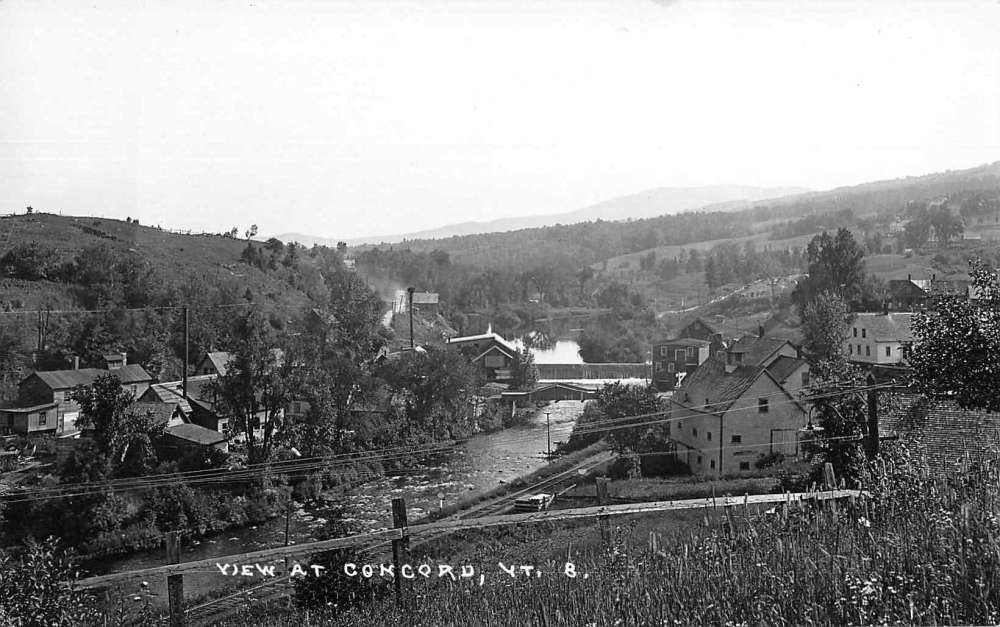
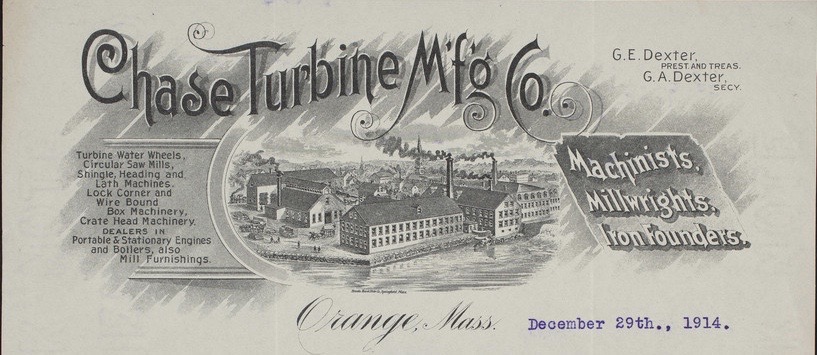
The Chase Turbine Manufacturing Company was founded around 1850 in Concord, Vt., up in that state’s “Northeast Kingdom.’’
The company went bust during the Civil War, but soon thereafter reconstituted itself in the more economically advantageous location of Orange. They made equipment for water wheels and the magnificent turbine shingle saw until the Great Depression.

The inscription on it says it all: “Built by the Chase Turbine M'F'G'. Co. Orange, Mass.’’ This is no wimpy Chinese-made throwaway tool from Home Depot, but something built to last – Yankee ingenuity writ large. In many a Vermont hollow, singles are no doubt still being cleaved from trees by these glorious machines.
William Morgan is a Providence-based architectural historian, photographer and essayist. He is the author of Yankee Modern and The Cape Cod Cottage, among other books.
BU starting online MBA program; but do we need more MBA's?

The unvirtual part of the BU business school, whose official name is the Questrom School of Business
This comes from The New England Council (newenglandcouncil.com):
“Boston University (BU) has announced plans to launch an online Master of Business Administration (MBA) program. The new program will have a total tuition cost of $24,00 and is set to launch in fall of 2020.
“Boston University will partner with online education platform edX to offer the low-cost online MBA worldwide. EdX, created by Harvard University and MIT, currently has over 21 million registered users who have enrolled in more than 75 million online courses. While BU has worked with edX for the past six years to offer low cost undergraduate ‘massive open online courses’ (MOOC’s), this is their first time offering a graduate degree. The MBA will be designed from the ground up and will incorporate content from BU’s Questrom School of Business alumni and international business partners.
“BU Provost Jean Morrison noted that by adding an affordable, high-quality, large enrollment online MBA, the university is continuing its mission to provide various iterations of MBA programs that are compatible with the unique aspects of all business learners. BU currently has six different MBA programs, including Full-Time MBA, Professional Evening MBA, Executive MBA, Health Sector MBA, Social Impact MBA and the MBA+ MS in Digital Innovation. Applications for the online program have opened for the fall 2020 semester.’’
“With an online MBA we’re seizing the initiative to offer a major degree for which we believe there is global demand,” said BU President Robert A. Brown. “Higher education must evolve in a fast changing world. We aim to lead in this evolution.”
A river realm
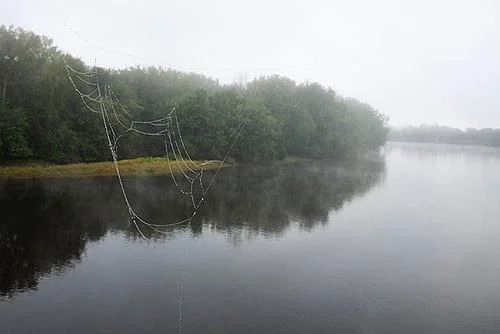
“Spider web, Rail Trail between Northampton and Hadley, Mass.’’ {on the Connecticut River} (archival digital print), by Mary Lang , in her show “Here, nowhere else,’’ at Kingston Gallery, Boston, Sept. 4-29.
She says of her show:
“Each one of these photographs could be a doorway into a separate realm. They are single perceptions, clear and vivid, like waking from a dream, finding yourself Here, nowhere else. Like the turning of a kaleidoscope, for a moment time stops, everything falls into place and I am part of the invisible pattern that holds the world together. Though standing on the earth, it still feels groundless. For so many years I photographed water as a way of exploring groundlessness. It turns out that photographing earth is groundless as well.
“The world is inundated with photographs; 100 million and counting are uploaded to Instagram every day, visual records of a place or a time, a vacation or a hike. These photographs are those as well, but what makes this one, and not that one, rise above so many others, to hang on the wall in a frame, is because captured within the photograph is a sense of presence, of this moment, here, nowhere else, an absorption into vastness that some would call magic.’’
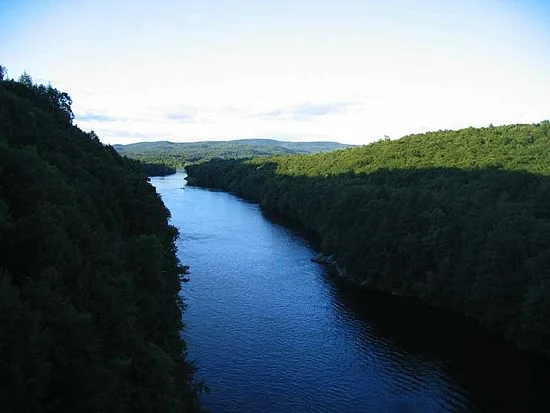
Looking north up the Connecticut River from the French King Bridge, at the Erving-Gill town line in western Massachusetts. Too many New Englanders don’t realize that the Connecticut is one of the world’s most beautiful rivers.
“If the river is as varied and beautiful as the Connecticut, you can merely look at it – in the long light of a sultry summer evening, under an angry winter sky, in the high color of autumn or the pastel shades of spring – and derive that sense of peace and uplift of the spirit that most men find in living water.’’
-- Roger Tory Peterson (1908-1996, artist and naturalist), in The Connecticut River, by Evan Hill (1972)

Todd McLeish: Rare Spring Salamanders like the hills

A Spring Salamander relaxing on some moss
Spring Salamanders are one of the giants of the salamander world, at least in the Northeast. They can grow to more than 8 inches long, and their diet often consists of other salamanders. But they are also quite rare in southern New England. They weren’t discovered in Rhode Island until the 1980s, and they still have only been found in a few locations in the northwest part of the state.
In Massachusetts, however, the tan or pinkish species with faint black spots was removed from the state’s list of rare species in 2006. Last month the Massachusetts Division of Fisheries and Wildlife (MassWildlife) launched a two-year survey to reassess the health of the state’s Spring Salamander populations amid concerns that the changing climate may be negatively impacting the cool streams where they live.
Jacob Kubel, a conservation scientist with MassWildlife’s Natural Heritage & Endangered Species Program, said Spring Salamanders have a long head with a square snout and external gills. He noted that the natural history of the species is somewhat unusual. After hatching in a stream, they live as larvae for three or four years before metamorphosing into adult salamanders.
“They can’t be in a stream that’s going to completely dry up in the summer, but they also do better in streams that don’t have fish that might eat them,” Kubel said. “That habitat isn’t extremely common, so the species isn’t extremely common.”
Spring Salamanders are primarily found in forested streams with seeps of cold groundwater in high-elevation, hilly terrain. They’ve been found at just four sites in Burrillville and Foster, R.I., but populations in Massachusetts have been located from the Berkshires to Worcester County. The species is listed as a state threatened species in Connecticut.
“The main objective of our survey is to do a quick assessment to make sure nothing has happened to our state population,” Kubel said. “If we can check off a great majority of historic sites and also find sites we didn’t know about previously, that tells us the status hasn’t taken a turn for the worse since delisting.
“The other component is that, as an agency, we need to be cognizant of climate change and its impacts on environmental resources. With Spring Salamanders being a cool-water, high-elevation species, it might be one of the first to show stress at the population level. They’re like the canary in the coal mine.”
Kubel and a team of volunteers are visiting locations where the salamander has been found in the past to document that the species hasn’t disappeared. Next year they will focus on finding new populations.
He said the results so far have been encouraging. But the work isn’t easy, and the success rate is pretty low.
“I was at a site last week where we didn’t have any historic records but I thought it was likely to be there, and I found quite a few — seven individuals — after turning over about 400 rocks,” he said. “But then I went to another stream nearby that I thought should have them, and I only found one after turning over 500 rocks.”
At the conclusion of the survey in 2020, Kubel will produce a report that makes recommendations about the conservation status of the Spring Salamander. The data will also be used as a baseline for comparative studies conducted in the future.
In addition to the survey, Kubel is also leading efforts to conduct genetic analyses of Blue Spotted and Jefferson salamanders, two rare species that look similar and are thought to hybridize, to clarify the geographic distribution of each.
No conservation activities have been undertaken in Rhode Island to study or monitor Spring Salamander populations, but recent land acquisitions have protected some of its habitat, according to Chris Raithel, a retired wildlife biologist with the Rhode Island Department of Environmental Management.
“There are only a handful of known localities for it, but Rhode Island seems to be at the edge of its range,” he said.
“These guys have very specific habitat requirements, so it could be that the combination of high gradient perennial streams with a low abundance of fish in a heavily forested area isn’t available in Rhode Island,” Kubel said.
The Rhode Island Wildlife Action Plan lists Spring Salamanders as a species of greatest conservation need.
Rhode Island resident and author Todd McLeish runs a wildlife blog.
An identity complication
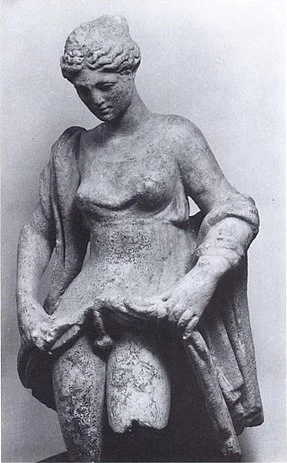
A statuette of Aphroditus in the anasyromenos pose. The ancient Greeks and Romans believed the pose had a magical power to ward off evil.
From Robert Whitcomb’s “Digital Diary,’’ in GoLocal24.comAn Identification Issue
“But there are more than five sexes and only demotic Greek seems to distinguish among them.”
― Lawrence Durrell, in The Alexandria Quartet
Rhode Island Gov. Gina Raimondo trendily wants her state to join others that will offer drivers’ licenses that don’t indicate the person’s sex. The change would let people put an “X’’ rather than a “M’’ or “F”
Of course, people are entitled to think of themselves as any sex they want and to have organs lopped off or created and to take hormones to change themselves into some sort of “gender’’ they weren’t at birth. But the fact is that, outside the very few cases of physical androgyny, people are physiologically either male or female. And for police and others in the justice system knowing the sex of individuals can be very useful, indeed sometimes essential. If these drivers undergo a sex-change operation, then fine, switch to one of the two sexes. But the “X’’ category will cause trouble.

The sub on the street

A captured Axis submarine is pulled down Tremont Street, in downtown Boston, in 1942 as part of a “Buy War Bonds’’ rally. President Trump would have loved this!
Thanks to our colleague David Jacobs of The Boston Guardian for forwarding this to us.
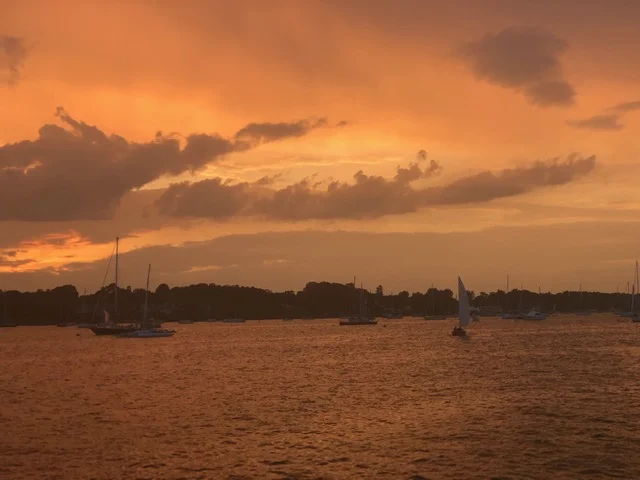
Nothing gold can stay
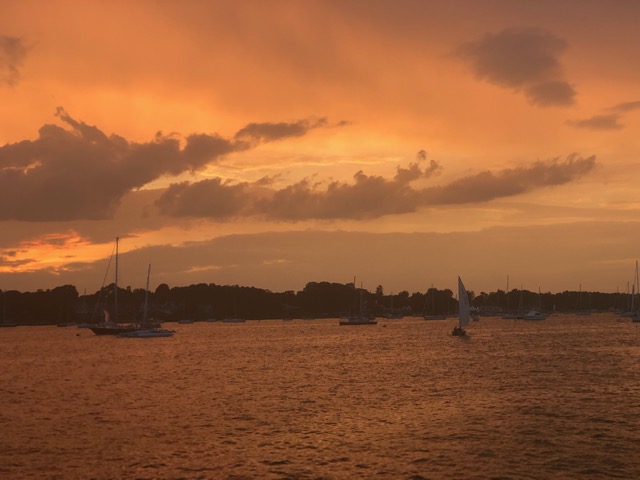
Aug. 23, Bristol (R.I.) Harbor: Late dusk in late summer
— Photo by Lydia Whitcomb

Around the world with the PCFR

Aug. 22, 2019
To members and friends of the Providence Committee on Foreign Relations (thepcfr.org). We hope that your summer is going well.
Below is the current list of our dinner speakers (at our venue, the Hope Club, in Providence) for our 2019-2020 season. (Suggestions welcome!) There will be refinements and outright changes in topics; we’re trying to remain somewhat flexible to respond to news and other events. (Just completed season speaker list is also below.)
Please email pcfremail@gmail.com with any questions. And check the Web site:
Thepcfr.org
For membership and other information
Our first scheduled speaker (there’s a remote chance there will be a September speaker; there are two speakers in October) comes
Wednesday, Oct, 2, with Jonathan Gage, who will talk about how coverage of such international economic stories as trade wars has changed over the years, in part because of new technology, and how that coverage itself changes events.
Mr. Gage has had a very distinguished career in publishing and international journalism. He has served as publisher and CEO of Institutional Investor magazine, as publisher of strategy+business magazine, as a director at Booz Allen Hamilton and Booz & Company, as enterprise editor for Bloomberg News and finance editor of the Paris-based International Herald Tribune (of sainted memory) and as a senior writer for the Boston Consulting Group.
He is a trustee, and former vice chairman, of the Carnegie Council for Ethics in International Affairs.
He has written or edited for such publications as The New York Times, The Washington Post, The Los Angeles Times, Newsweek and Psychology Today magazine.
xxx
On Wednesday, Oct. 23, comes Ambassador Patrick Duddy, who will talk about Venezuelan internal political and economic conditions and relations with the U.S., Cuba, Russia and other nations. Mr. Duddy, currently director of Duke University’s center for Latin American and Caribbean Studies, served as American ambassador to Venezuela during some of the George W. Bush and Obama administrations. The late President Hugo Chavez expelled him but eight months later he resumed his ambassadorship. He finished that assignment in 2010.
Before his ambassadorships, Mr. Duddy served as Deputy Assistant Secretary of State (DAS) for the Western Hemisphere, responsible for the Office of Economic Policy and Summit Coordination, which included the hemispheric energy portfolio, as well for the Offices of Brazil/ Southern Cone Affairs and of Caribbean Affairs. During his tenure as DAS, he played a lead role in coordinating U.S. support for the restoration of democracy in Haiti.
xxx
On Wednesday, Nov. 6, comes Tweed Roosevelt, president of the Theodore Roosevelt Association and great-grandson of that president. He’ll talk about how TR’s foreign policy, which was developed as the U.S. became truly a world power, affected subsequent presidents’ foreign policies. Mr., Roosevelt is also chairman of Roosevelt China Investments, a Boston firm.
In 1992, Mr. Roosevelt rafted down the 1,000-mile Rio Roosevelt in Brazil—a river previously explored by his great-grandfather in 1914 in the Roosevelt-Rondon Scientific Expedition and then called the Rio da Duvida, the River of Doubt. The former president almost died on that legendary and dangerous trip.
xxx\
On Thursday, Dec. 5, we’ll welcome Dr. Elizabeth H. Prodromou, who directs the Initiative on Religion, Law, and Diplomacy, and is visiting associate professor of conflict resolution, at The Fletcher School of Law and Diplomacy at Tufts University. She titles her talk "God, Soft Power, and Geopolitics: Religion as a Tool for Conflict Prevention/Generation".
Dr. Prodromou is also a non-resident senior fellow and co-chair of the Working Group on Christians and Religious Pluralism, at the Center for Religious Freedom at the Hudson Institute, and is also non-resident fellow at The Hedayah International Center of Excellence for Countering Violent Extremism, based in Abu Dhabi.
She is former vice chair and commissioner on the U.S. Commission on International Religious Freedom and was a member of the U.S. Secretary of State’s Religion & Foreign Policy Working Group. Her research focuses on geopolitics and religion, with particular focus on the intersection of religion, democracy, and security in the Middle East and Southeastern Europe. Her current research project focus on Orthodox Christianity and geopolitics, as well as on religion and migration in Greece.
xxx
On Wednesday, Jan. 8, comes Michael Fine, M.D., who will talk about his novel Abundance, set in West Africa, and the challenges of providing health care in the Developing World. He will speak on: “Plagues and Pestilence: What we learned (or didn't) from Ebola about Foreign Policy and International Collaboration in the face of epidemics and outbreaks’’
xxx
On Wednesday, Feb. 5, we will welcome as speaker PCFR member Cornelia Dean, book author, science writer and former science editor of The New York and internationally known expert on coastal conditions. She’ll talk how rising seas threaten coastal cities around the world and what they can do about it.
xxx
On Wednesday, March 18, comes Stephen Wellmeier, managing director of Poseidon Expeditions. He’ll talk about the future of adventure travel and especially about Antarctica, and its strange legal status.
xxx
On Wednesday, April 29, comes Trita Parsi, a native of Iran and founder and current president of the National Iranian American Council and author of Treacherous Alliance and A Single Roll of the Dice. He regularly writes articles and appears on TV to comment on foreign policy. He, of course, has a lot to say about U.S- Iranian relations and a lot more.
Mr. Parsi is a co-founder of a new think tank, financed by an unlikely partnership of the right wing Koch Brothers and the left-of-center George Soros. It’s called the Quincy Institute for Responsible Statecraft and dedicated to helping craft a new U.S. foreign policy that would be far less interventionist and put an end to America’s “endless foreign wars.’’
xxx
On Wednesday, May 6, we’ll welcome Serenella Sferza, a political scientist and co-director of the program on Italy at MIT’s Center for International Studies, who will talk about the rise of right-wing populism and other developments in her native land.
She has taught at several US and European universities, and published numerous articles on European politics. Serenella's an affiliate at the Harvard De Gunzburg Center for European Studies and holds the title of Cavaliere of the Ordine della Stella d'Italia conferred by decree of the President of the Republic for the preservation and promotion of national prestige abroad.
June: Keeping open for now but possibly something on China.
Speakers in the 2018-2019 season of the Providence Committee on Foreign Relations included:
Miguel Head, who spent the past decade as a senior adviser to the British Royal Family, on what it was like.
James Nealon, the former U.S. ambassador to Honduras and former assistant secretary of state, on the migrant crisis flowing onto our southern border.
Walter A. Berbrick, founding director of the Arctic Studies Group at the U.S. Naval War College, on “An Arctic Policy for the Ages: Strengthening American Interests at Home and Abroad
Phillip Martin, senior investigative reporter for WGBH News and a contributing reporter to Public Radio International’s The World, a co-production of WGBH, the BBC and PRI -- a program that he helped develop as a senior producer in 1995 – on the Indian caste system there and here.
Paulo Sotero, the director of the Wilson Center’s Brazil Institute on the future of that huge nation.
Historian Fred Zilian on the “Real Thucydides Trap,”—an alternate to Graham Allison’s—which threatens America’s leadership of the free world.
Dr. Teresa Chahine on international social entrepreneurship.
London-based Journalist and broadcaster Michael Goldfarb on Brexit.
Sarah C.M. Paine of the U.S. Naval War College on the “Geopolitics Underlying U.S. Foreign Policy.’’
Douglas Hsu, senior Taiwan diplomat, on tension and ties with Mainland, and Taiwan’s relations with the U.S.
Prof. James Green, a leading expert on Brazil, where he lived for eight years, and former president of the Brazilian Studies Association, on that nation’s new right-wing populist president.
Daphne Wysham: Bipartisan corruption for the fossil-fuel industry
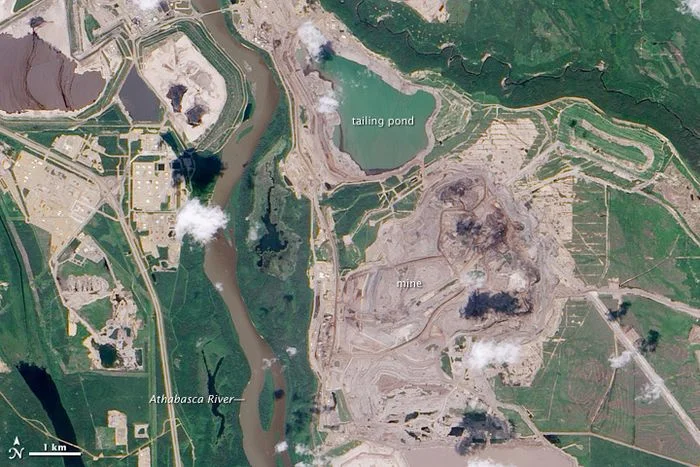
Mining operations in the Athabasca tar (aka oil) sands.
Via OtherWords.org
Burning fossil fuels boils our planet — that much is generally well known.
But often these fuels do serious damage before they ever get to market. They spill out of pipelines, poison groundwater, or explode on trains. Even when they don’t, building new pipelines and export terminals helps companies sell more fuel — often of the dirtiest variety, like tar sands — which threatens our planet.
That’s why strong grassroots movements have cropped up against transporting tar sands oil via the Keystone XL Pipeline and the TransMountain Pipeline.
With those pipelines still running into resistance, investors in Canada’s Athabasca tar sands region are scrambling to get their oil to market by any means necessary — including shipping crude oil by truck across the Canadian border, then transloading it to trains in North Dakota to get it to West Coast ports.
And as a new report produced by the Center for Sustainable Economy reveals, they’re getting some help from friends in high places.
The report examines two unlikely allies in this effort — former Obama administration Treasury Secretary Timothy Geithner and billionaire Trump campaign donor Richard A. Kayne. Their intertwined financial interests are going to absurd lengths to get tar sands crude to export terminals in Oregon.
They’re financing two proposed Oregon crude-oil terminals — one in the Port of Columbia County, owned by Global Partners, and the other in Portland, owned by Zenith Energy Management. Both terminals are situated in a region that is overdue for a major quake. The Zenith terminal in particular is situated in an earthquake subduction zone, putting it at special risk.
Kayne is a primary financier of both the Zenith and Global Partners operations sites. He’s also a major Republican Party campaign donor and closely aligned with the Koch brothers’ financial and political networks.
Significantly, he is also among the inner circle of super-wealthy donors contributing to President Trump’s legal fees, which have run more than $8 million since taking office — the highest of any president.
The other financier, former Treasury Secretary Geithner, is widely credited with playing a major role in the Wall Street bailout following the subprime mortgage crisis of 2008.
Geithner is now director of Warburg Pincus investment company, which created Zenith Energy to facilitate the flow of crude oil by rail to Portland. Warburg Pincus is deeply invested in the Bakken and tar sands region and, together with Global Partners is a leading donor to Democratic candidates at all political levels.
Kayne and Warburg Pincus share directorships and investments in corporations that extract crude oil from the Bakken Formation of North Dakota and tar sands crude from Canada’s Athabasca tar sands region. These investments further overlap at transloading stations owned by Global Partners in North Dakota.
Both terminals and their backers provide proof that tackling climate change means tackling corruption at the highest levels of our democracy, regardless of party affiliation.
As the pipeline protesters have shown, it’s possible to resist these destructive projects even when big money — and powerful people in Washington — are behind them.
And as the 2020 campaign gets underway, there’s a huge opening for candidates — from presidential candidates down to local port commissioners — to take a real stand for the planet, and refuse to take campaign contributions from these industries threatening our future.
Daphne Wysham directs the Sustainable Energy & Economy Network and the Climate Justice Program at the Center for Sustainable Economy.

Start sneezing!

From “Fielding: Goldenrod and an Exploration of Connections,” an upcoming show at University of Massachusetts at Amherst Museum of Contemporary Art, with the show to be open Sept. 11, 18, and 25 and Oct. 2 and 9, all from 10 a.m. to 5 p.m.
The museum says:
“‘Fielding’ uses the plant Goldenrod (L. solidago) as a lens through which to engage the Natural History Collections and the UMass community. The project looks at both human uses and history of the plant, its local history and current presence in the area, and its significance in the non-human sphere and ecology.’’
Logan in the '50s: Close parking and pew space

Seems to have been adequate parking close to the terminals at Logan International Airport in the late ‘50s! Note the chapel at the right. Perhaps such airport chapels were bigger then because the more dangerous aviation of the time pulled in more people to pray before takeoff, and to buy flight insurance.
Let behemoths bargain with behemoths
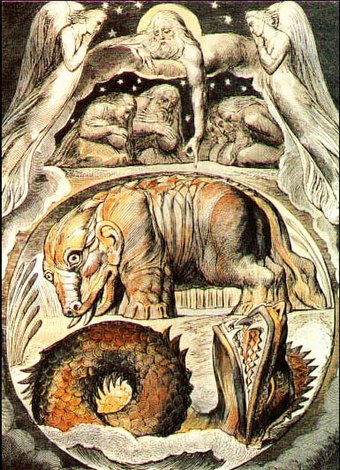
Behemoth and Leviathan, watercolor by William Blake from his Illustrations of the Book of Job.
From Robert Whitcomb’s “Digital Diary,’’ in GoLocal24.com
So consolidation of New England’s health-care biz continues apace. Two big Massachusetts-based health insurers – Harvard Pilgrim Health Care and Tufts Health Plan -- plan to merge. This follows Beth Israel Deaconess Medical Center and Lahey Hospital merging this year into the very big Beth Israel Lahey Health, and Rhode Island-based CVS taking over health insurer Aetna. And huge Partners HealthCare, the Boston-based hospital and physicians network group (Massachusetts General Hospital, etc.), made a run this year at taking over Rhode Island-based Care New England. And the latter outfit was in failed talks to merge with Lifespan, a merger that economics might still force – to be followed by that merged creature being eaten by a Boston group, producing a flock of golden parachutes for redundant executives?
The economics of the health-care business mean that there will be more such mergers. Big will get bigger. This may include Partners coming back to Rhode Island to try to gobble up Care New England or Lifespan or both. Or maybe Beth Israel Lahey Health will try to invade the Ocean State.
With the huge economic power – especially pricing power – and lobbying clout of the new insurance behemoths, state regulators will have their hands full trying to regulate them. Still, the merger, which would affect several million New England customers and their families, would create an entity with impressive bargaining weaponry to curb the very high prices enabled by the size and global prestige of the hospital behemoths. So let ‘em merge.
The past and future of young people in politics

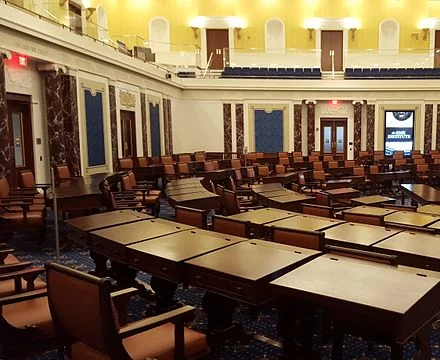
The replica of the U.S. Senate Chamber in the Edward M. Kennedy Institute. in Boston
In the following Q&A, New England Journal of Higher Education Executive Editor John O. Harney asks Mary K. Grant, president of the Edward M. Kennedy Institute for the United States Senate, about the institute’s work connecting postsecondary education to citizenship and upcoming elections.
(Last month, NEJHE posted a similar Q&A with Nancy Thomas, director of the Institute for Democracy & Higher Education at Tufts University’s Jonathan M. Tisch College of Civic Life.)
Harney: What did the 2016 and 2018 elections tell us about the state of youth engagement in American democracy?
Grant: We are seeing a resurgence of interest in civic engagement, activism and public service among young people. From 2014 to 2018, voter turnout among 18- to 29-year-olds increased by 79%, the largest increase among any group of voters.
The 2016 election was certainly a catalyst for galvanizing renewed interest. Since 2016, we have seen increases in people being more engaged in organizing platforms, messages and movements to motivate their peers and adults. The midterm elections brought a set of candidates who were the most diverse in our history, entering politics with urgency and not “waiting their turns” to run for office. One of the most encouraging findings was that those who felt most frustrated were more likely to vote.
While young-voter turnout in the 2018 election was historically high, it was still just 31% of those eligible to vote. Democracy depends on the voice of the people. And a functioning democracy depends on participation, particularly in polarized times. Senator Kennedy said “political differences may make us opponents, but should never make us enemies.” He envisioned the Edward M. Kennedy Institute as a venue for people from all backgrounds to engage in civil dialogue and find solutions with common ground.
As a nonpartisan, civic education organization, the institute’s goal is to educate and engage people in the complex issues facing our communities, nation and world. Since we opened four years ago, we have had more than 80,000 students come through our doors for the opportunity to not only learn how the U.S. government works, but also to understand what civic engagement looks like. All of us at the Kennedy Institute see how important it is to give young people a laboratory where they can truly practice making their voices heard and experience democracy; our lab just happens to be a full-scale replica of the United States Senate Chamber.
Harney: How else besides voting do you measure young people’s civic citizenship? Are there other appropriate measures of activism or political engagement?
Grant: Voter turnout is one measure, but civic engagement is needed every day. Defined broadly, activism and civic citizenship are difficult to measure. We engage in our local, state and national communities in so many ways.
Our team at the institute values reports like “Guardian of Democracy: The Civic Mission of Schools” that discuss how the challenge in the U.S. is not only a lack of civic knowledge, but also a lack of civic skills and dispositions. Civic skills include learning to deliberate, debate and find common ground in a framework of respectful discourse, and thinking critically and crafting persuasive arguments and shared solutions to challenging issues. Civic dispositions include modeling and experiencing fairness, considering the rights of others, the willingness to serve in public office, and the tendency to vote in local, state and national elections. To address the critical issues and make real social change, we need a better fundamental understanding of how our government works. And we need better skills for healthy, respectful debate
Harney: What are the key issues for young voters?
Grant: The post-Millennial generation is the most racially and ethnically diverse generation in our history. Only 52% identify as non-Hispanic whites. As they envision their future livelihoods in an increasingly automated workplace, they are concerned about climate change and how related food security may affect the sustainability of daily life and they are concerned about income inequality, student debt, gun violence, racial disparities, and being engaged and involved in their communities.
The institute’s polling data indicated that interests for 18-34-year-olds were reflective of society as a whole, but gun rights and gun control, education and the economy would be among the most important as they are deciding on congressional candidates in the next election.
Young people are focused on the complex global issues that concern us all but with added urgency. A Harvard Institute of Politics Youth Poll this spring found that 18-29-year-old voters do not believe that the baby boomer generation—especially elected officials—“care about people like them.” And, they expressed concern over the direction of the country.
Harney: Are there any relevant correlations between measures of citizenship and enrollment in specific courses or majors?
Grant: In a democracy, we need all majors. And more importantly, we need students and graduates to know how to work together. In a global economy, people in the sciences, business and engineering work right next to people in the fields of social sciences. I had the privilege of leading two of the finest public liberal arts college and universities in the country. I am a firm believer that regardless of disciplinary area, problem-solving requires us to ask questions, to be curious and open-minded, to think critically and creatively, incorporate a variety of viewpoints and work in partnership with others. We need to understand how you take an idea, move it along and make it into something that can improve the common good.
Harney: Are college students and faculty as “liberal” as “conservative” commentators make them out to be?
Grant: From my own work in higher education, I can say that there is diversity of perspectives and viewpoints on college campuses, which is encouraging and exciting. Liberals and conservatives are not unique in the ability to hold on quite strongly to their own viewpoints. Anyone who has ever witnessed a group of social and natural scientists discuss research methodologies can attest to that. We all need to learn how to listen to ideas other than our own
Harney: What are ways to encourage “blue-state” students to have an effect on “red-state” politics and vice versa?
Grant: Part of the country’s challenge in civil discourse is that we stop listening or we are listening for soundbites to which we overreact. One of the most important skills that we can develop is the ability to listen actively. It’s truly remarkable what can happen when students have an opportunity to get to know and work and learn with their peers across the country and around the world
What we’re finding in our programs is that people are hungering for conversation, even on difficult matters. It’s similar to the concept of creating spaces on college campuses where you can intentionally connect with people. This coming fall, we’re using an award that we earned from the Annenberg Public Policy Center of the University of Pennsylvania to pilot a program called “Civil Conversations.” The program is designed to help eighth through 12th grade teachers develop the skills necessary to lead productive classroom discussions on difficult public policy issues. We’re starting in Massachusetts and plan to expand to all the blue, red and purple states.
And for those coming to the institute, we convene diverse perspectives through daily educational and visitor programs where people can talk with and listen to others who might be troubled or curious about the same things you are. Our public conversation series and forums bring together government leaders with disparate ideologies and from different political parties who are collaborating on a common cause; we host special programs that offer insight into specific issues and challenges facing communities and civic leaders, and what change-makers are doing about it.
Harney: What role does social media play in shaping engagement and votes?
Grant: Social media have fundamentally changed not only how we get our information, but how we interact with each other. According to a Harvard Institute of Politics Youth Poll, more than 4-in-5 young Americans check their phone at least once per day for news related to politics and current events.
As social media reaches more future and eligible voters, and when civic education is lacking, those who depend on social media platforms are at risk of consuming inaccurate information. This underscores not only the need for robust civic education programs, but also those in media literacy.
Harney: How can colleges and universities work together to bolster democracy?
Grant: Anyone who spends time around young people or on a college campus feels their energy and can’t help but come away with a renewed sense of hope. Colleges can continue to work together and advocate for unfettered access to higher education for students in all areas of the country. More specifically, they can engage with organizations like Campus Compact, a national coalition of more than a thousand colleges and universities committed to building democracy through civic education and community development.
Harney: How will New England’s increased political representation of women and people of color affect real policy?
Grant: The increasingly diverse representation helps to broaden and deepen the range of perspectives, ideas and viewpoints that influence public policy. There is also a renewed energy that is generated and it encourages next generation leaders to get involved, run for office, work on campaigns and make a difference in their communities. The institute has held several Women in Leadership programming events that highlight the lack of gender equity and racial diversity in public office and provide opportunities for women to network and learn more about the challenges and the opportunities.
Harney: Do young voters show any particular interest in where candidates stand on “higher education issues” such as academic freedom?
Grant: Students may not be focused on “higher education issues,” per se, but they do have a lot to say about accessibility and affordability. This generation is saddled with an enormous amount of student loan debt. That is certainly one of their greatest concerns, particularly when it comes to the 2020 presidential race.
Academic freedom is important in making colleges and universities welcoming to the exchange of differing ideas, which is a bedrock of democracy. As a former university chancellor, I believe that it is essential to create an environment where we welcome a diversity of opinion. We need to model the ability to listen to and consider viewpoints that may be very different from our own. We need to show students that we can sit down with people who think differently, find common ground, and even respectfully disagree. That’s a key part of what the Edward M. Kennedy Institute is all about.
Investigating American identity

The gallery, part of the famous prep school in Exeter, N.H., says the show “features provocative works by Becky Alley and Melissa Vandenberg, who use common domestic items to explore themes of patriotism, war, and commemoration in our current cultural environment. Whether tongue-in-cheek, or an outright adverse critique, the artists focus on American identity, and our relationship to what we believe and why.’’
David Warsh: 35 years of chronicling complexity

SOMERVILLE, Mass.
In the summer of 1984, starting out as an economic journalist for The Boston Globe, I published The Idea of Economic Complexity (Viking). “Complexity,” I wrote, “is an idea on the tip of the modern tongue.”
About that much, at least, I was right.
My book was received with newspaperly courtesy by The New York Times, but it was soon eclipsed by three much more successful titles. Chaos: The Making of a New Science (Viking), by James Gleick, appeared in 1987. Complexity: The Emerging Science at the Edge of Order and Chaos (Simon & Schuster), by M. Mitchell Waldrop, and Complexity: Life at the Edge of Chaos (Macmillan), by Roger Lewin, both appeared in 1992. The reviewer for Science remarked that the latter read like the movie version of the former.
Gleick reported on the doings of a community of physicists, biologists and astronomers, including mathematician Benoit Mandelbrot, who were studying, among other things, “the butterfly effect.” Lewin and Waldrop both wrote mainly about W. Brian Arthur, of the Santa Fe Institute. I had pinned my hopes on Peter Albin, of the City University of New York, whose students hoped he would be the next Joseph Schumpeter.
When the famously pessimistic financial economist Hyman Minsky retired, Albin was chosen to replace him at the Levy Institute at Bard College, but he suffered a massive stroke before he could take the job. Duncan Foley, then of Barnard College, edited and introduced a volume of Albin’s papers: Barriers and Bounds to Rationality: Essays on Economic Complexity and Dynamics in Interactive Systems (Princeton, 1998). Arthur went on to win many awards and write a well-regarded book, The Nature of Technology: What It Is and How It Evolves (Free Press, 2011).
By then complexity had become a small industry, powered by a vigorous technology of agent-based modeling. Publisher John Wiley & Sons started a journal, Princeton University Press a series of titles, Ernst & Young opened a practice. Among the barons who came across my screen were John Holland, Scott Page, Robert Axelrod, Leigh Tesfatsion, Seth Lloyd, Alan Kirman, Blake LeBaron, J. Barkley Rosser Jr., and Eric Beinhocker, as well as three men who became good friends: Joel Moses, Yannis Ionnides, and David Colander. All extraordinary thinkers. I long ago went far off the chase.
Two of the most successful expositors of economic complexity were research partners, as least for a time: Ricardo Hausmann, of Harvard University’s Kennedy School of Government, and physicist César Hidalgo, of MIT’s Media Lab. They, too, worked with a gifted mathematician, Albert-László Barabási, of Northeastern University, to produce a highly technical paper; then, with colleagues, assembled an Atlas of Complexity: Mapping Paths to Prosperity (MIT, 2011), a data-visualization tool that continues to function online. Meanwhile, Hidalgo’s Why Information Grows: The Evolution of Order, from Atoms to Economies (Basic, 2015) remains an especially lucid account of humankind’s escape (so far) from the Second Law of Thermodynamics, but there is precious little economics in it. For the economics of international trade, see Gene Grossman and Elhanan Helpman.
That leaves economist Martin Shubik, surely the second most powerful mind among economists to have tackled the complexity problem (John von Neumann was first). Shubik pursued an overarching theory of money all his life, one in which money and financial institutions emerge naturally, instead of being given. In The Guidance of an Enterprise Economy (MIT, 2016), he considered that he and physicist Etic Smith had achieved it. Shubik died last year, at 92. His ideas about strict definitions of “minimal complexity” will take years to resurface in others’ hands.\
So what have I learned? That the word itself was clearly shorthand: complexity of what? One possible phenomenon is complexity of the division of labor, or the extent of aggregate specialization in an economic system.
I came close to saying as much in 1984. My book began:
“To be complex is to consist of two or more separable, analyzable parts, so the degree of complexity of an economy consists of the number of different kinds of jobs in the system and the manner of their organization and interdependence in firms, industries, and so forth. Economic complexity is reflected, crudely, in the Yellow Pages, by occupational dictionaries, and by standard industrial classification (SIC) codes. It can be measured by sophisticate modern techniques such as graph theory or automata theory. The whys and wherefores of complexity are not our subject here, however; it is with the idea itself that we are concerned. A high degree of complexity is what hits you in the face in a walk across New York City; it is what is missing in Dubuque, Iowa. A higher degree of specialization and interdependence – not merely more money or greater wealth – is what makes the world of 1984 so different from the world of 1939.’’
I was interested in specialization as a way of talking about why the prices of everyday goods and services were what they were apart from the quantity of money. I was writing towards the end of 40 years of steadily rising prices. I had become entranced by some painstaking work published 25 years before, by economists E.H. Phelps Brown and Sheila Hopkins. There were measurements of both the money cost of living in England and the purchasing power of workers’ wages over seven centuries. The price level exhibited a step-wise pattern, relentlessly up for a century, steady the next; purchasing power, a jagged but ultimately steady increase (sorry, only JSTOR subscription links).
“[W] hen (I wrote) we find the craftswomen who have been building Nuffield College in our own day earning a hundred fifty pennies in the time it took their forebears building Merton to earn one, the impulse to break through the veil of money becomes powerful: we are bound to ask, what sort of command over the things that builders buy did these pennies give from time to time?’’
It turned out the higher the money price, the more prosperous was the craftsman’s lot, at least in the long run, though sometimes after periods of immiseration lasting decades. That was much as Adam Smith led readers to expect in the first sentence of The Wealth of Nations: “The greatest improvement in the productive power of labor, and the greater part of the skill, dexterity, and judgement, with which it is directed, or applied, seems to have been the effects of the division of labor.” Today’s builders rely on a bewildering array of materials and machines to pursue their tasks, compared to those who built Merton College.
What interested me were intricate questions about the direction of causation. Had prices grown higher because the number of pennies had increased? Or had the supply of pennies grown to accommodate an increasing overall division of labor? To put it slightly differently, in those periods of “industrial revolution” – there had been at least two or three such events – had prices risen because the size of the market and the division of labor had grown, and the quantity of money along with them? Or was it the other way around?
Economists had no hope of answering questions like this, it seemed to me, because they had no good way of posing them. They were in the grip of the quantity theory of money, which at least since the time of the first European voyages to the West, has held that “the general level of prices” is proportional to the quantity of money in the system available to pay for those goods. This is, I thought, little more than an analogy with Boyle’s Law, one of the most striking early successes of the scientific revolution, which holds that the pressure and volume of a fixed amount of gas are inversely proportional. Release the contents from a steel cylinder into a balloon and the container expands. But it still contains no more gas than before. Something like that must have been in the mind of the first person who first spoke of “inflating” the currency. From there it was a short jump to the way that classical quantity theory relies on the principle of plenitude – the age-old assumption, inherited from Plato, that there can be nothing truly new under the sun, that the collection of goods of “general price level” were somehow fixed.
But I was no economist. My book found no traction. By then, however, I was hooked; and within a few years I had found my way to a circle of economists at whose center was Paul Romer, then a professor at the University of Rochester. Romer was in the process of putting the growth of knowledge at the center of economics, but that turns out not to be the whole story, just the beginning of it.
The Yellow Pages are all but gone, casualties of search advertising; other industries that supported themselves by assembling audiences have shrunk (newspapers, magazines, broadcast television). Still others have grown (Internet firms, Web vendors, producers of streaming content). Tens of thousands of jobs have been lost; hundreds of thousands of jobs have been created
I still have the feeling that the important changes in the global division of labor have something to do with the behavior of traditional macroeconomic variables. Romer once surmised that the way into the problem was via Gibson’s paradox – a strong and durable positive empirical correlation between interest rates and the general level of prices, where theory expected to find the reverse. Meanwhile, central bankers are fathoming the mysteries of the elusive Phillips Curve, the inverse relationship between unemployment and inflation.
Which brings me back to 1984. Also in that year, Michael Piore and Charles Sabel published The Second Industrial Divide: Possibilities for Prosperity (Basic). They found their new highly flexible manufacturing firms in northwestern and central Italy instead of Silicon Valley. Their entrepreneurs had ties to communist parties and the Catholic Church instead of liberation sympathies. But the idea was much the same: Computers would be the key to flexible specialization. For all the talk since about economic complexity, that is the book about the changing division of labor worth rereading.
David Warsh, a veteran columnist and an economic historian, is proprietor of Somerville-based economicprincipals.com, where this essay first ran.
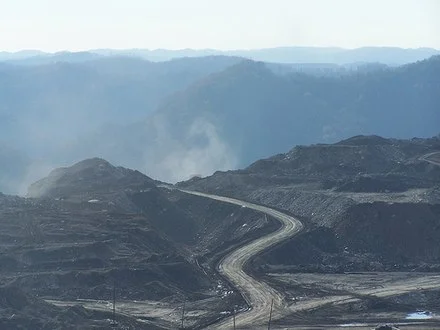
Attack by the coal kings?
Mining coal from a mountaintop in Appalachia
From Robert Whitcomb’s “Digital Diary,’’ in GoLocal24.com
At the last moment, just before a federal tax-credit deadline, the Trump regime has announced it will delay a final decision on approving the big Vineyard Wind offshore wind-turbine project for yet more “review’’ of the already studied nearly unto death project. The move means that the project will probably lose the tax credit in effect right now and require congressional and presidential approval to get it renewed – legislation that the coal industry’s most powerful servant, Senate Majority Leader Mitch McConnell, of coal-state Kentucky, might kill.
Does the sudden delay announcement come mostly because the Trumpists want to undermine competition with the fossil-fuel industry, which it’s in bed with, or to stick it to a Democratic part of the nation that would benefit from a big increase in locally created, and clean, energy, or because of complaints from some fishermen? (Wind-turbine towers actually tend to increase the number of fish in the areas where they go up by acting as reefs.)
The delay, or sabotage, might kill the project, by among other things, killing its financing. And it certainly means that the 80-megawatt project for south of Martha’s Vineyard can no longer start generating electricity for 200,000 electric customers (and many more people in those customers’ homes and businesses) by the end of 2021, as had been the plan.
The delay, typical of the interminable red tape and politicization that block other needed infrastructure work in America, will discourage similar windpower projects. Meanwhile, an irony is that the fishermen who oppose Vineyard Wind and similar projects meant to help wean us off fossil fuel are enabling, in their small way, such global-warming effects as hotter seas and ocean acidification that kill off some important fish species. In any event, America continues to be about the worst developed country in which to try to get big projects built. That’s one reason a lot of it’s starting to look like a Third World nation. And whatever happened to Trump’s big plans for infrastructure?
Meanwhile, for an alarming look, with graphics, at how global warming is changing America, please hit this link:
https://www.washingtonpost.com/graphics/2019/national/climate-environment/climate-change-america/
It shows that Rhode Island is a particularly hot spot.
Gerald Mallon: Devotion and death in Vietnam

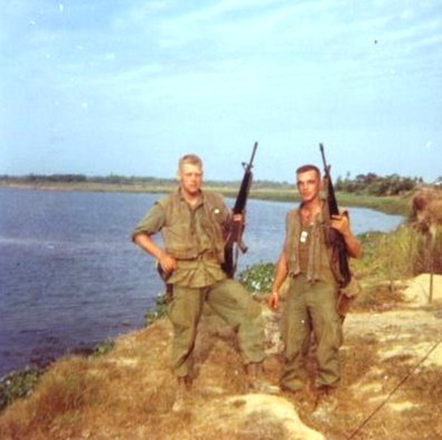
Mr. Mallon is at the left, with the M-16 and side arm. He wrote that the Marine at the right “had taken a couple of rounds in his pelvis and had his guts in a bag the next time we met, in St. Albans Naval Hospital (in New York). He weighed about 90 pounds and looked like a skeleton. I can't remember his name but he was eventually healed, gained some weight and was retired.’’

Mr. Mallon wrote: “The smoke is from napalm - this is the single most terrifying weapon I've ever witnessed. I was in Japan (106th Army Hospital Yokosuka) down the hall from the burn ward...that was almost unbearable to see and imagine the pain involved. No matter how f— up you were - there was always someone worse off.’’
I met Cpl. Richard Clark Abbate in early January 1968, when the 3rd Battalion, 27th Marines was formed at Camp Pendleton to be deployed to Vietnam. Richard, myself, L/Cpl. Richard Belcher and PFC Gary Trott constituted a gun team with the 1st Platoon of M “Mike” Company. As team leader, Richard was responsible and caring in executing his duties. He was older, married and had been in the Corps longer than any of us. As we served together, sharing the hardship of Vietnam, we came to like him as a friend and respect him as a leader.
On May 18, at 930 we were airlifted out by helicopter to join a battle that had developed as a result of a spoiling attack code-named Operation Allen Brook. On May 17 India Company had encountered strong enemy forces on Go Noi Island. It was not truly an island, but the monsoons would flood the Ky Lam, Thu Bon, Ba Ren, and Chiem Son rivers and isolate it. It was a staging area for elements of three Viet Cong (VC) battalions and a North Vietnamese Army (NVA) regiment building up for an attack on Da Nang. It took about 20 minutes to fly from Cau Ha Base Camp to Go Noi Island. Upon landing, we could hear explosions and see the tracers of rifle and machine-gun fire. Mortar rounds were coming in on our direct front. Our platoon commander told us to drop our extra gear, get down and move to the front. Enemy fire was relentless, hot and heavy. The Landing Zone (LZ) was in a defilade with a river at our back so we began to crawl to the “sound of the guns.” Our company was spread out in an area that was exposed and in front of a tree line with only paddy dikes, scrub and elephant grass for cover.
We advanced into a hail of rifle and machine-gun fire, rocket-propelled grenades and mortar fire from well-concealed bunkers, and we were pinned down by the withering fire from behind a paddy dike. The cacophony was intense and the adrenaline shock of combat surreal in its intensity. The gunfire and flying shrapnel a foot above ground were so concentrated that getting up and moving meant certain death. Marines lay in front of us – dead and dying. Despite repeated attempts, we made little headway against the enemy defenders fighting from the bunkers. Unable to advance or withdraw, we called for 105mm artillery and 81mm mortar fire on the enemy positions in the tree line. We swept supporting fire swept back and forth, with it landing within 50 yards of our lines.
Over the next several hours I fired back and forth, saturating the tree line. My M-60 machine gun began to smoke and developed a feed malfunction. We sent our ammo humper, Gary Trott, back to get more ammunition, water and another barrel for the gun. Abbate and Belcher covered me as I crawled forward to reach a critically wounded Marine, PFC Donald Byron Jones, about 15-20 yards to our right front. He had been shot through the chest and was lying on his back in an exposed position. I reached him, grabbed his ankle and rolling on my side tried repeatedly to drag him, but his utility belt with the canteens attached dug into the sand and I couldn't move him. Jones was turning blue and choking, his eyes staring blankly into oblivion. I got over him and used two fingers to clear his mouth so that he could breathe. That was when Richard appeared and began to take off the utility belt by kneeling over him between Jones’s legs. I looked at Richard, saying nothing, and began to apply a pressure bandage to Jones’s chest wound. Richard was about a foot or two away from me to my left side. I struggled to focus my attention on Jones, blocking out everything else.
It felt like a baseball bat slamming me when the bullet hit. It went through my right elbow, spinning me around, and lodging in my upper left arm. Blood seemed to explode from Richard’s face as he pitched forward. He died instantly. Disoriented, I lay there for the next hour or so talking to Jones, trying to reassure him as he slowly choked to death. I slowed the bleeding from my elbow by tying a makeshift tourniquet and putting two fingers into the gaping hole in my joint. I had blood on my chest from the wound in my left arm, and was breathing tentatively: I thought that I had been shot in the chest and feared that I would choke to death like Jones. I made the usual bargain with God to save me. Hearing the roar of jets, I looked over my right shoulder. Two planes flying parallel to our lines seemed to peel off as four canisters of napalm, tumbling wildly, hit the tree line and exploded in a huge fireball. The napalm was close enough that I felt its heat on my face. I could taste the acrid vomit in my mouth and feared that I might burn to death in the next pass, but the fire’s volume subsided.
Dazed and weak, I was grabbed by the shoulders, jerked to my feet and half dragged to the LZ. My wounds were bandaged, morphine administered, and I was led to a waiting Medivac. Before they could load me and another casualty they had to get rid of two dead Marines to make room. The crewmen lifted a poncho and two bodies rolled out like nothing special. It was over for them and it didn’t matter anymore. The helicopter lifted off and soon I arrived nauseated and shaking at a surgical unit in Da Nang – my ordeal over.
That day still echoes in my memory. I’ve reflected on the randomness of death and how lucky I’d been. After all, the bullet that killed Richard had passed within inches of my face, sparing me.
I’ve always felt deep regret for Richard’s death. I should have known that he would come to help me because that was the Marine and man he was. I often replay the events of that day, feeling the ache of having lost a friend. I wonder what life would have held in store for Richard and our other fallen comrades if they hadn’t died in Vietnam, and I feel a deep sadness when thinking of their stolen futures. I don’t know if there were worse places to be than where we fought, but I am proud to have been with “Mike” Company on that day. Every Marine in 3/27 still remembers the brothers we left behind. Richard was, and is, my brother and I miss him even now. He was one of the finer men among the Marines I have known. War is fearful, dirty and brutal but my life’s trajectory has been set by the experience…
“Through our great good fortune, in our youth are hearts were touched by fire.”
-- Oliver Wendell Holmes
In the fighting on Go Noi Island, the four companies of 3/27 lost 172 dead, with another 1,124 wounded in action. Richard Clark Abbate was one of six Marines from M Company killed in action on May 18, 1968. Enemy casualties during Operation Allen Brook were 1,017 killed and three captured. {how many wounded?} The battle at Go Noi Island remains one of most harrowing and sanguinary combat operations in Vietnam but it eliminated any direct threat to Da Nang.
“This is my commandment, that ye love one another as I have loved you. Greater love hath no man than this; that he lay down his life for his friends.”
-- John 15: 12-13
Gerald (Jerry) Mallon lives in Michigan. He arrived in Vietnam a private first class and was promoted to lance/corporal after being shot.
He’s a fellow member of an email group including New England Diary editor Robert Whitcomb.
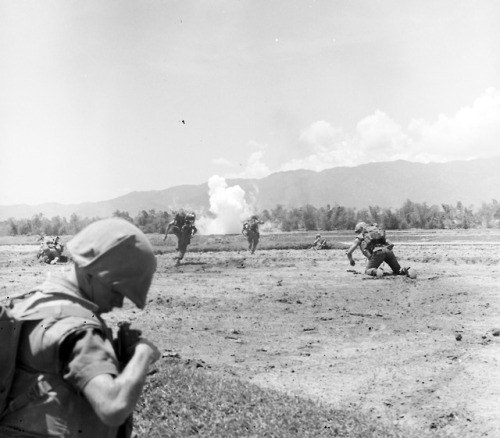
Open field fighting in Vietnam.
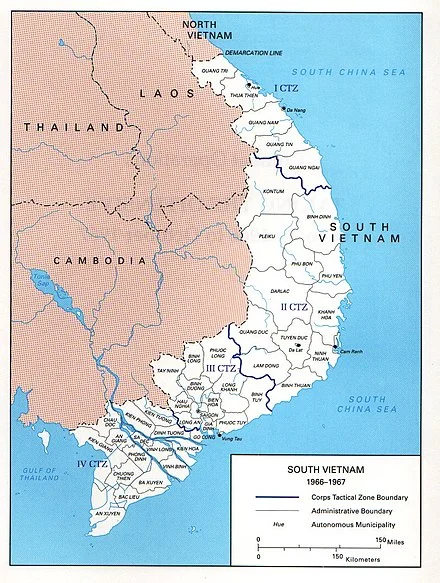
Da Nang, referenced in this essay, is on the ocean toward the upper right.