
Vox clamantis in deserto




David Warsh: Our two show-biz presidents
SOMERVILLE, Mass.
Over the course of 230 years, citizens of the United States have elected only two professional entertainers to the presidency: Ronald Reagan and Donald Trump. Both possessed an actor’s gifts: good looks; physical presence; a communicative face, in one man an infectious grin, in the other a much-photographed glower.
True, they took very different paths to the office. Reagan began as film actor, union president, and pitchman for General Electric Co. He turned to professional politician in his fifties, winning two terms as governor of California. Trump, a real estate developer and marketer, became a television personality in his fifties. Beginning in 2004, he played a puffed-up, airbrushed version of himself for 14 seasons on The Apprentice.
True, too, Reagan and Trump have left very different marks on the office. Reagan started out shakily, with Alexander Haig, Donald Regan, James Watts, and Ann Gorsuch, and wound up surrounded by good men, including Nichols Brady, James Baker and George Shultz. After being forced to fire National Security Adviser-designate Michael Flynn, Trump started out with some good men around him, Jim Mattis, H.R. McMaster, Rex Tillerson, and Gary Cohn surrounded by the likes of John Bolton and William Barr.
But the most important attribute they have in common is often overlooked. Their success as entertainers in an age of new media made them shrewd judges of what their respective audiences expected of them.(Reagan was host of a popular weekly drama series, General Electric Theater, from 1954 until 1962, and honed his speaking skills visiting company installations.) Reagan proved able to expand his base dramatically and became a transformational president (Barack Obama agrees.) Trump himself is apt to catastrophically fade, once deprived of his props. But the legacy of the campaign he ran in 2016 is likely to dominate politics for another 20 years.
I count three major issues in 2016 (leaving aside the hate-mongering of lock her her up): immigration, trade and foreign wars. Forging a new consensus on those issues will be an issue for several presidential cycles. For a sensible survey of the often irreconcilable rights and responsibilities of the three basic constituencies – the would-be migrants, the polity they seek to join and those who are being left behind – see Exodus: How Migration is Changing Our World (Oxford. 2013), by Paul Collier, a distinguished development economist. (I haven’t read Refuge: Rethinking Refugee Policy in a Changing World [Oxford, 2017].) Earlier Collier wrote the best-seller The Bottom Billion: Why the Poorest Countries Are Failing and What Can Be Done about It (Oxford, 2008).
For a somewhat sterner view, read The Great Escape: Health, Wealth, and the Origins of Inequality (Princeton, 2013), by Angus Deaton, a Nobel laureate in economics. Or wait for The Narrow Corridor: States, Societies, and the Fate of Liberty, by Daron Acemoglu and James Robinson, in September. Then ask yourself if you think the U.S. is substantially different from Canada and Australia, where so-called “merit systems” prevail for allocating immigrant positions. Trump proposed something of the sort last week, a plan prepared by his son-in-law and a principal adviser, Jared Kushner.
Similarly, global trade will resume, but the contest with China for dominance won’t go away. The bad feelings on both sides from having come to the brink of a long-lasting trade war will take many years to subside. No one, not even William Overholt, author of a series of prescient books about the sleeping giant, most recently China’s Crisis of Success, can confidently predict the path relations will take. They’ll develop against the backdrop of whatever U.S. Trade Rep. Robert Lighthizser and his Chinese counterpart manage to achieve.
As for foreign wars, Trump’s relative caution with respect to North Korea, Venezuela, and Iran gives the lie to his habitual braggadocio. Don’t expect future presidents to be any more willing to intervene abroad militarily. Read America’s War for the Greater Middle East: A Military History (Random House, 2017), by Andrew Bacevich, if you doubt it. Perhaps all will campaign on promises to repair America’s seriously damaged diplomatic and intelligence services.]
Ronald Reagan’s presidency offered a genuine buoyancy. Trump offers mainly jingoism, chicanery and abuse. But both men sensed that voters were nearing a turning point in the zig-zag of American history. Sooner or later, legitimate Republican conservatives will turn on their usurper and his enablers. But for the present, Trump’s GOP is the party of innovation, even if it means trying to recapture the past.
Whether or not Trump is re-elected depends mainly on whom the Democrats nominate to run against him, and how that candidate chooses to run. Never mind the evangelicals. He or she can win with only a small portion of Trump voters in a Democratic coalition. In contrast, Reagan won a second term by a landslide, 525 to 13 electoral votes.
David Warsh, an economic historian and veteran columnist, is proprietor of Somerville-based economicprincipals.com, where this essay first appeared.
'Deviled by stone'
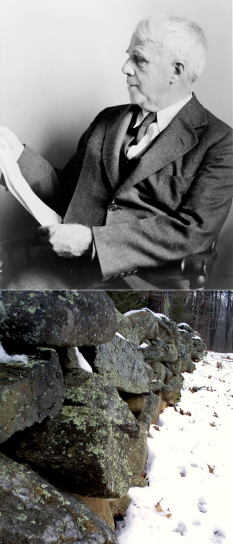
Robert Frost’s poetry gave New England’s stone walls an almost mythological significance. He wrote about this stone wall, on his farm in Derry, N.H., in his famous poem “Mending Wall.”
Credit: top: Library of Congress/New York World-Telegram & Sun Collection; bottom: CCA 3.0.
“Stone upon stone
this weathered wall of stone
was built by men deviled by stone'
from poor fields yielding mostly stone’’
— From “A Farm in the Green Mountains (Thinking of Robert Frost)’’, by Dave Etter
Manhood mania
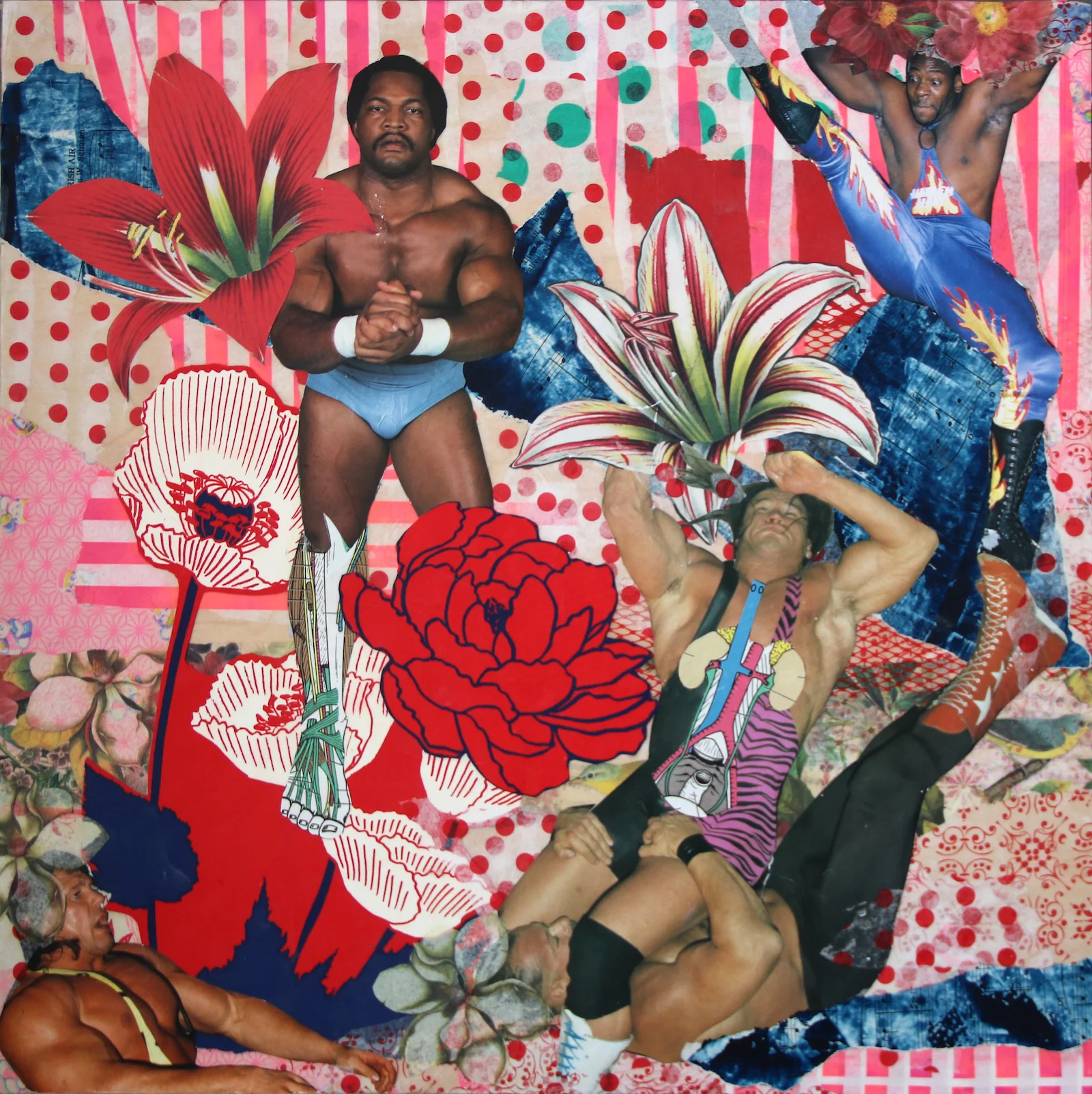
“Flowers of Manhood” (analog collage), by Angel Dean, in her show “Collect, Cut, Collage,’’ at the Providence Art Club, through May 31.

Tough love

“The Maine Coast,’’ by Winslow Homer
“New England has a harsh climate, a barren soil, a rough and stormy coast, and yet we love it, even with a love passing that of dwellers in more favored regions”
— Henry Cabot Lodge (1850-1924, Massachusetts senator and historian)
Alan MacLeod: In praise of some political 'purity tests'
Via OtherWords.org
The Democratic primaries are heating up. One notable feature of the race is the strong presence of progressive candidates — which has many in the establishment wing of the party worried.
Former president Obama, whose moderate vice president, Joe Biden, is now in the race, recently decried the alleged “purity tests” he saw on the left. Obama worried that an “obsessive” ideological fanaticism was setting the party up for failure.
Indeed, in the political world, the term “purity test” is largely used by the establishment to chastise and attack the left.
For instance, Senators Elizabeth Warren and Bernie Sanders have refused to accept corporate donations for their presidential campaigns. Many outlets — The Atlantic, Politico, The Hill — described these pledges as a new Democratic “purity test” to establish progressive credentials.
Hillary Clinton scorned the idea, claiming that “under [Sanders’] “definition, President Obama is not a progressive because he took donations from Wall Street!” (Some might argue that’s accurate, as Obama has described himself as a 1980s-style “moderate Republican.”)
Another key issue in the primaries is health care. A lack of health coverage kills around 45,000 Americans yearly, and hospital bills drive the large majority of bankruptcies in America. Many Democratic candidates, including Warren and Sanders, support a Medicare for All system in response.
Yet New York Times columnist Paul Krugman has cautioned Democrats not to “make health care a purity test,” warning that Democrats who don’t support a single-payer system could be characterized as industry “shills.”
Washington Post columnist Catherine Rampell was more scathing, attacking leftist “cranks” for supposedly embracing “empty slogans instead of evidence-based policy” on health care. (Never mind the evidence that Medicare for All would cover more Americans for less money.)
In contrast, attacks directed toward the left are seldom framed this way.
For example, Sanders appointed Briahna Joy Gray as his press secretary, who had previously declared she voted for the Green Party’s Jill Stein in 2016. Instead of this being seen as the party expanding its appeal to third-party voters, many party loyalists said it was proof that Bernie was not a “real Democrat”.
In other words, they tried to excommunicate an ally for being insufficiently orthodox — but no pundits called it a “purity test.”
Nor did they say that about the anger generated by the decision of such candidates as Sanders, Warren, Sen. Kamala Harris, and Beto O’Rourke not to attend the AIPAC conference. Nor about demands that the candidates embrace Trump’s regime change strategy in Venezuela lest they be accused of supporting a “dictator.”
Meanwhile, the left is told their preferred policies are either unrealistic or unpopular. “If Democrats want to destroy any chances of winning national office,” The Hill warns, “establishing purity tests is the quickest way to do it.”
But this is demonstrably not the case.
Seventy-five percent of Americans (and nearly two-thirds of Republicans) support Medicare for All. Three-quarters of Americans support higher taxes on the wealthy, while tuition-free public college is popular even among Tea Party supporters. One can make a strong case that these policies would attract rather than repel Trump voters.
This purity test trope is so blatantly used to defend anyone in power it sometimes stretches credulity to the breaking point.
In a Washington Post op-ed, Carolyn Dupont bemoaned the “rigid, self-righteous, and blind” progressives who criticized Virginia Gov. Ralph Northam for wearing blackface as a young man. The column unbelievably compared this censure to the guillotines of the French Revolution.
When you hear the phrase “purity test,” be on the alert. The phrase is code for powerful people being pressured in ways they don’t like — and is often a shield against legitimate criticism.
Alan MacLeod is a member of the Glasgow University Media Group. A longer version of this commentary appeared at FAIR.org.
The essential monster of Central Falls
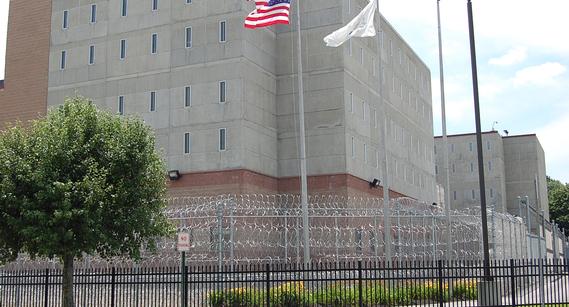
The Wyatt Detention Center, in Central Falls, R.I.
I can see why many of the good people of Central Falls don’t like having the privately run Wyatt Detention Center in their heavily Hispanic city, especially since the jail has controversially housed some illegal aliens from South of Border. But the tiny and impoverished city needs the tax revenue from the facility, which employs some locals.
Perhaps when the ballyhooed new passenger train station/bus hub opens in 2022 in Pawtucket, making the two cities more accessible to people from Greater Boston seeking more affordable housing, and boosting local small businesses, tiny Central Falls will gain enough new tax revenue to offset the closure of Wyatt. The new transit center will connect riders to Boston and Providence and some Massachusetts communities in-between, as well as to T.F. Green Airport's InterLink and Wickford Junction. It might gradually transform Central Falls.
And would the looming prison be torn down, or could the relatively new structure (opened in 1993) be used for, say, some manufacturing and/or distribution functions? A high-security luxury hotel?
Chris Powell: Vaccination objections are not really religious
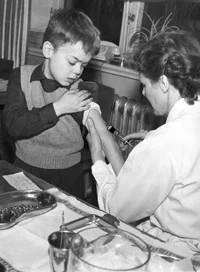
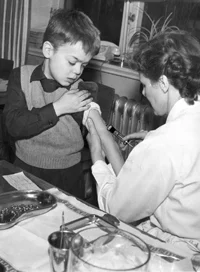
Freedom of religion is freedom of belief and expression. It is not the freedom to do anything one pleases, though lately claims of religious freedom are being used to rationalize more craziness in Connecticut -- the resurgence of dangerous diseases arising from the failure to vaccinate schoolchildren.
That craziness marked a Connecticut General Assembly hearing the other day on whether the religious exemption should be removed from the state's vaccination law, now that the exemption is being claimed much too often.
One woman shrieked that her child would be vaccinated only "over my dead body." But the issue was not her death but the risk of premature death to her child and others.
Defenders of the exemption carried signs reading "My child, my choice," as if state government doesn't spend nearly a billion dollars each year for the care and rehabilitation of children damaged by their parents' terrible choices. No decent society can let children become the mere property of parents.
Another woman said, "God made my body perfect." Really? Has she never had a toothache? She well might reflect on why she never had polio, from whose scourge millions have been saved in the last 60 years thanks to the vaccines devised by Doctors Salk and Sabin.
Objections to vaccination may be based on conscience, personal preference, misapprehension, or ignorance, but to call them religious exaggerates them. At least no organized religion forbids vaccination, not even Christian Science, whose practice has been to submit to vaccination where required by law. Those claiming religious motives make no theological argument.
Indeed, state law doesn't require vaccination for children generally, only for those attending public schools, where risk of contagion is greatest. The parents who were so indignant at the hearing don't have to interpose themselves between their children and the state. Instead they can home-school their kids or enroll them in a private school indifferent to contagion.
People who want to pursue absolute liberty, including liberty to risk the health of children, can try living in the jungle. To enjoy the benefits of society, liberty must respect a few of society's rules. While society lately is being intimidated out of its self-respect, on this point it better hold fast. The religious exemption should go.
xxx
TWO FREE CAR THEFTS: Society isn't demonstrating much self-respect with legislation advancing in the General Assembly that purports to address the epidemic of car thefts and joyriding by juveniles.
Under the bill juveniles would not be subject to detention until they had committed their third car theft. While the kids are on their car-theft spree the courts are to provide them with more of the social services that long have failed to deter them, as police lately have reported the arrests of some youngsters for car thefts just days after their arrest and release for previous car thefts.
Now the law formally will tell the kids that their first two car thefts are free. That may be fewer felonies than some kids are already getting away with, but the principle is awful all the same.
The bill also authorizes a study of the causes of the youthful car-theft epidemic, as if nobody knows that it correlates closely with the child neglect and fatherlessness perpetuated by the welfare system.
But since that correlation cannot yet be openly discussed, people will just have to keep their cars locked. The law won't be protecting them any time soon.
Chris Powell is a columnist for the Journal Inquirer, in Manchester, Connecticut.
ReplyReply allForward
Exercise is so debilitating

“Trail Town USA’’ (oil on canvas), by Danielle Klebes, in a group at the Southern Vermont Arts Center, Manchester, Vt. May 250-July 14.
Yes, creative
Bless the Rhode Island chapter of the American Civil Liberties Union for suing in federal court a really ridiculous state Division of Taxation stance that a special sales-tax exemption for the works of published authors in the state applies only to fiction writers because, the division asserts, nonfiction isn’t “creative and original.’’ (The division also favors work by musicians and such visual artists as painters and sculptors.)
Of course, historians and other nonfiction writers, even including some journalists writing news and commentary articles, must often be highly original and creative in coming up with topics, and in crafting engaging narratives combining analyses and syntheses -- all with the aim of drawing and holding readers. There is artistry in this.
The ACLU’s argument is that the Division of Taxation’s distinction violates the First Amendment guarantees of freedom of speech and the press. I don’t know about that but I do know it’s grossly unfair and illogical. Whether authors in general should get preferential sales-tax treatment is another issue. It reminds me a bit of when I worked for the old International Herald Tribune, technically a French company, we journalists had 25 percent lopped off our French income tax in what was in effect a government subsidy to encourage the practice of journalism; it was partly in reaction to the censorship during the Nazi occupation of France.
Safe space at 'PRIED"

“Nancy Bol’’ (low-fire clay, terra sigillata, low-fire glaze and decals), by Larry Buller, in the show “PRIED,’’ at the Society of Arts + Crafts, Boston, through June 30. June is Gay Pride Month. The society says: "PRIED celebrates and recognizes the individuals who create works that may or may not be made based around the image of a queer person, just as any other maker is not limited to creating works about their own identity. In essence, PRIED is both a safe space and creative platform for its artists, and a space that unapologetically challenges the viewer's expectations.’’
Larry Buller, Nancy Boi, 2016, low-fire clay, terra sigillata, low-fire glaze and decals.
Society of Arts + Crafts is now showing PRIED through June 30. Curated by Izzy Berdan and Dave J. Bermingham, PRIED is a celebration of LGBTQ+ artists and their work. June is Pride Month, and that means something different for everyone in the LGBTQ+ community, from validation to hedonism to the questioning of queerness and sexuality themselves. On the other hand, not all the artwork in PRIED is hinged on that queerness. As Society of Arts + Crafts explains, "PRIED celebrates and recognizes the individuals who create works that may or may not be made based around the image of a queer person, just as any other maker is not limited to creating works about their own identity." In essence, PRIED is both a safe space and creative platform for its artists, and a space that unapologetically challenges the viewer's expectations. As Society of Arts + Crafts asks, "If one pries the closet doors open, are they willing to come to terms with all of the skeletons. . .and maybe the glitter?" Society of Arts + Crafts is located at 100 Pier 4, Suite 200 in Boston, Massachusetts and is open Tuesday–Saturday 10:00 a.m.𔃄:00 p.m., Thursday 10:00 a.m.𔃇:00 p.m. andSunday 11:00 a.m.𔃃:00 p.m. For more information, please visit societyofcrafts.org/current-exhibition/pried.
UMass Dartmouth, Air National Guard to partner in cybersecurity

Entrance to Joint Base Cape Cod, in Bourne, Mass.
— Photo by Ktr101
From The New England Council (newenglandcouncil.com)
The University of Massachusetts at Dartmouth has announced that it will partner with the Air National Guard to develop education and workforce training in cybersecurity for students and personnel at Joint Base Cape Cod.
This partnership with bring the 102nd Intelligence Wing staff and UMass Dartmouth faculty together to develop cybersecurity programs, certificates, and concentrations for undergraduate and graduate students. Additionally, UMass Dartmouth will provide educational programs for the unit’s cybersecurity professionals.
UMass Dartmouth Chancellor Robert E. Johnson commented, “We are excited to work with the 102nd Intelligence Wing to strengthen the cybersecurity of our nation. UMass Dartmouth is fully committed to making sure our men and women serving in the armed services are future ready with the skillset and mindset to support the sanctity and security of the American dream.”
Josh Hoxie: Debunking myths about class and race
From OtherWords.org
I don’t get that much hate mail — except when I write about race.
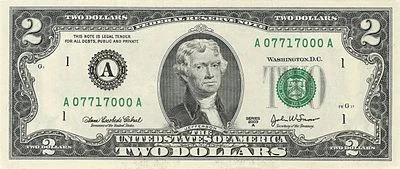
This spring I co-authored a report called “Ten Solutions to Bridge the Racial Wealth Divide.” My coauthors and I found that the median white family today owns 41 times more wealth than the median black family and 22 times more wealth than the median Latinx family.
To fix it, we proposed new public programs, changes to the tax code, and a commission to study reparations for slavery, among other things.
The floodgates opened. My inbox, along with many comment sections at news outlets and on social media, overflowed with angry objections. Most of these blamed the wealth divide on poor individual decision making by people of color.
Are black families 41 times worse at decision making than white families? No — that’s a racist falsehood.
In fact, here are the three most common racist falsehoods I heard about the wealth divide — with data to explain why they’re wrong. Feel free to bust this out at your next family get-together.
Falsehood No. 1: Black and Latinx families have less money because they’re led by single parents.
Nope. A 2017 study from Demos and the Institute on Assets and Social Policy showed that single-parent white families have twice as much wealth as two-parent black and Latinx families.
In other words, raising kids in a two-parent household doesn’t close the racial wealth divide.
Falsehood No. 2: Black people are poor because they’re less educated.
Hard no. A 2015 study titled “Umbrellas Don’t Make It Rain” found that black families led by college graduates “have about 33 percent less wealth than white families whose heads dropped out of high school.”
In fact, according to that 2017 Demos study, “The median white adult who attended college has 7.2 times more wealth than the median black adult who attended college and 3.9 times more wealth than the median Latino adult who attended college.”
In other words, higher education doesn’t close the racial wealth divide.
Falsehood No.3: Black people don’t work or are bad with money.
Definitely not. Demos found that white families actually spend more and save less than black families with the same income. Yet white families have way more wealth than black families with the same income.
The Umbrellas adds that “white families with a head that is unemployed have nearly twice the median wealth of black families with a head that is working full-time.”
In other words, not even income alone can close the racial wealth divide.
So if these arguments are all false, what’s really going on here?
The simplest answer is a history of oppression and inherited advantage. The impacts of slavery, sharecropping, Jim Crow, white capping, red lining, mass incarceration, and predatory subprime lending, among many other things, are still very much with us.
Many white children, by contrast, start life with a more robust safety net of family wealth. It may be as small as getting a few hundred bucks from their parents when they really need it, or as big as a few hundred thousand for things like college, weddings, or their first home.
Addressing these problems is a lot harder than blaming oppressed people for their hardship. But if we’re going to address racial disparities in this country, we must heed James Baldwin’s challenge that “nothing can be changed until it is faced.”
It’s not individual behavior that drives the racial wealth divide — it’s a system that many folks pretend doesn’t exist.
Josh Hoxie directs the Project on Taxation and Opportunity at the Institute for Policy Studies.
'Gansett on the bay

From Robert Whitcomb’s “Digital Diary,’’ in GoLocal24.com
News that Narragansett Brewery will open a brewery in Providence’s Fox Point section next year was very cheery news indeed. For one thing, Narragansett Beer is a storied local name going back to the 1880’s. For another, it’s always a good sign when a company wants to make something around here. Manufacturing jobs tend to pay more than service ones, and that a popular consumer product will be made in Providence, and in a highly visible location at the head of Narragansett Bay, is good PR for the city and the state.
I assume, from a company picture, that Narragansett plans to have an outdoor beer garden with shared picnic tables, at the site, serving local food, which could become a summer tourist destination.
Let’s hope for colorful signage at the brewery, to attract attention from drivers on Route 195.
Wood breaking against the Maine coast

Work by Wade Kavanaugh and Stephen B. Nguyen in their show in the Ellis Beauregard Fellowship Exhibition at the Center for Maine Contemporary Arts, Rockland, Maine, through June 16. The gallery says: ”Kavanaugh and Nguyen have collaborated in their art for more than a decade, and have become known for their inventive and immersive installations. For this exhibition, they use wood to mimic the coast of Maine and create a turbulent ocean breaking against the shore. The wooden waves look as though they may crash down and soak the viewer at any moment, and they keep the viewer immersed in the exhibition even as they stay dry.’’
Rockland is a major art center, anchored by the Farnsworth Museum of Art, as well as a fishing port.
The gallery says:
”Kavanaugh and Nguyen have collaborated in their art for more than a decade, and have become known for their inventive and immersive installations. For this exhibition, they use wood to mimic the coast of Maine and create a turbulent ocean breaking against the shore. The wooden waves look as though they may crash down and soak the viewer at any moment, and they keep the viewer immersed in the exhibition even as they stay dry.’’
Rockland is a major art center, anchored by the Farnsworth Museum of Art, as well as a fishing port.
Llewellyn King: The treasure of urban walkability
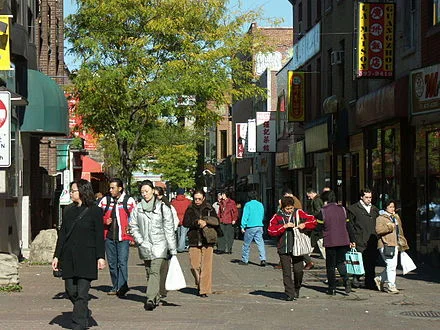
Walkers on Gauchetière Street, in Montreal
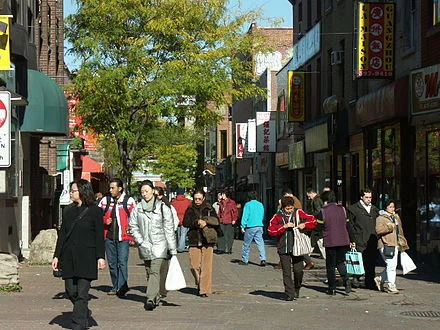
A new generation of urbanites and people who would like to the move from the cul de sac life in the suburbs to downtowns are seeking neighborhoods where they can walk to shops, theaters, restaurants and to see their friends.
Realtors across America are finding they can get a premium for neighborhoods where residents can walk to just about everything.
Studies show that retailers can expect much more business, sometimes as much as 80 percent more, if they have more, regular foot traffic.
Walking, to its proponents, means living lighter on the earth with less pollution, better health, a sense of close community and an air of enlightenment. Neighborhoods like Dupont Circle, in Washington D.C. and Brooklyn Heights, in New York City, are adding walkability to the list of their virtues. But it is a phenomenon being experienced across the country and the world.
London Mayor Sadiq Khan wants to make London the most walkable city in the world, which may be news to those who already think it is a pretty good place for a stroll. But his plans go far beyond tourists marching around the sights or trying to get to Buckingham Palace from their hotel.
Khan seeks an organic change that links walking, cycling and public transport together in a unified way of getting around without cars. He has appointed a commissioner for walking and cycling, Will Norman, to oversee the new London mobility.
American cities are responding to the walkability imperative with initiatives of their own, driven by changing values and concepts.
To me, it seems like a giant back-to-the-future movement where the virtues now claimed for walkability are really the virtues of village life.
So, whether it is in San Diego or Baltimore, a new desire to abandon the car for the street is changing the way we live and what we think is the good life.
It is a part of a large urban adjustment that is underway; although the purists might want to see it as having no technological component beyond the new soles on shoes.
You cannot, as London has found, simply push walking without regard to cycling. And you cannot, as cities from coast to coast have done, put in bike lanes and permit those pesky scooters without regard to their impact on pedestrians.
More: Bikes themselves are changing dramatically. The cost of electric-assist bikes has tumbled from many thousands of dollars to around $1,000. Around Seattle, there are bike paths that call for one to be extremely athletic, as I recall.
Walkability, as an urban concept, reflects not only a new sensibility to the environment, but also a desire to regain a sense of the cosmopolitan life. Increasingly, as the malls are failing, we are deprived of the collective living experience.
The growth of the suburbs increased dependence on cars and bifurcated social life into business friends (lunch friends) and neighborhood friends (cookout friends).
Going forward, as the walkability ethic takes hold and more entrepreneurs see its potential, we will see walking communities clustered around transport centers, like subway stops; and, most likely, more short-distance commuting options, such as the light rail operating in Baltimore and San Diego.
Over the decades, I have been watching efforts to have people live where they work with planned communities like Reston, Va., outside Washington D.C. I once lived in Reston and that part of the plan never quite worked for it. People still commute to work, sometimes great distances, but with walkability as an urban goal, this trend may finally reverse.
What we do not need, in my view, is too much social engineering, which may be about to engulf London under its socialist mayor.
Bernard Shaw, the playwright, said of H.G. Wells, the author and a fellow socialist, that Wells would cut down the trees to build metal sunshades. That is the danger if walkability gets politicized and mandated. Walkability needs gentle footfalls, not imperatives.
Llewellyn King is executive producer and host of White House Chronicle, on PBS. His email is llewellynking1@gmail.com.
Some fashion fetishes

“Are you saying yes to the dress?’’ (mixed media), by Jemison Faust, in her show at the Bromfield Gallery, Boston, through June 2, with fetishistic sculptures inspired by fashion “reality’’ shows.
Woosox's Polar Park as high-tech center

From Robert Whitcomb’s “Digital Diary,’’ in GoLocal24.com
I predict that after a couple of years of curiosity and excitement, attendance will fall at Polar Park, the new baseball stadium to be built as the home of what is now (sigh) called the Pawtucket Red Sox. Polar Park (after Worcester-based Polar Beverages) is supposed to open in 2021. Eventually there may be considerable loyal buyers’ remorse for the big tax breaks and other publicly financed incentives being given to the group of very rich men who are moving the team. And how popular will baseball in general be in a decade? Whatever, I wish them well.
Anyway, however the Boston Red Sox farm team does in Worcester, something of long-term value may come out of the project:
Worcester Polytechnic Institute and the PawSox will partner to improve ballpark technology. This will include having WPI students working on such projects as mobile apps for ordering food, technology to ease parking and special seating for those with sensory challenges.
WPI’s president, Laurie Leshin, said: “As Worcester’s hometown technological university, WPI shares the club’s vision and opportunity for Polar Park: to create a versatile regional sports venue that combines a traditional ballpark environment with modern, smart, and connect amenities.”
So however successful the park turns out to be as a business, technological applications, some of them utterly unanticipated, might come out of the park that can be used to improve things at other large entertainment venues. Think of the surprising electronics and medical advances that came out of the U.S. space program in the ‘60s.

Charles Desmond/Thomas C. Jorling/Kier Wachterhauser: How Harvard and other rich institutions can help save our planet

Via The New England Journal of Higher Education, a service of The New England Board of Higher Education (nebhe.org)
Nonprofit institutions with large endowments have been facing challenges from various stakeholders contesting the management of their investment portfolios. While these challenges are most commonly associated with institutions of higher education, pension funds and private foundations will increasingly face similar challenges regarding how the management of their endowments affects socially important policies. Together, these endowments represent hundreds of billions of dollars, and the market power they possess is very substantial.
In the case of higher education, students, faculty and some alumni are pressing these institutions to divest of their holdings in fossil fuel-based companies. These include coal, petroleum and, in some cases, natural gas companies. This advocacy is based upon an overall societal objective to decarbonize our energy system in order to hold greenhouse gas emissions at levels believed to be necessary to prevent an increase in global temperatures above 1.5°C. For above this level, there is widespread consensus in the scientific community that the climate will change in ways that will threaten the ability of the life-supporting biosphere to sustain the human population, which that will grow to something on the order of 10 billion by 2050. The threats from climate change are wide-ranging, from droughts and extreme storms to sea level rise and ocean acidification to migration of infectious diseases and rapid species extinction.
The challenge of climate change is real and the nonprofit institutions that manage vast portfolios must examine how their substantial investments affect the social, economic and environmental well-being of the human community. Simply put, the trustees of these major nonprofit endowments must examine the contribution to human well-being they make with the explicit choices in the composition of their portfolios.
Certainly divesting in carbon-based corporations is one avenue to consider. It is, however, our proposal that a positive investment strategy is a much more effective way to drive the message that climate change is real and requires action by nonprofit organizations who sit on large amounts of capital.
Thus, we propose, as a start, that nonprofit organizations with endowments greater than $1 billion commit to investing 10% of their endowment in corporations whose primary business activity is building and operating alternative energy systems based upon the endless supply of the sun’s energy and the wind. These alternative energy systems would include photovoltaic electric generation and associated energy storage technology, especially batteries.
The power of this investment strategy is immense. Consider the impact of a 10% investment from 100 institutions with endowments greater than a billion. At a minimum, this would produce $10 billion. Harvard alone would produce more than $4 billion. Investments of this scale would take this nation a long way toward decarbonization. More specifically, these investments would replace fossil fuel generation of electricity with the concomitant result that portfolio managers would cease to make any investments in fossil fuel companies. Thus, the proposed strategy would also accomplish the objectives of divestment.
And these investments are competitive. Investments in wind and solar projects are now returning 6% to 10%, which is fully in line with the range of investment objectives that trustees of nonprofits instruct portfolio managers to achieve.
Climate change represents a serious threat to the well-being of the human community. Leaders of nonprofit organizations cannot in good conscience watch this threat unfold as if it is someone else’s responsibility. It is also our hope that the managers of nonprofit funds in this country will set the example for all to follow, regardless of industry. It is the responsibility of all of us.
If you are managing massive amounts of capital and can achieve competitive rates of return by investing in alternative energy technologies that will help protect the life-supporting biosphere, the choice appears clear: Act Now!
Charles Desmond is CEO of Inversant, the largest parent-centered children’s saving account initiative in Massachusetts. He is past chair of the Massachusetts Board of Higher Education and was a higher education policy adviser to former Gov. Deval Patrick. Since 2011, he has served as a NEBHE senior fellow. Thomas C. Jorling is former CEO of the ecosystem nonprofit NEON Inc., former VP for Environmental Affairs at International Paper Co., former commissioner of the New York State Department of Environmental Conservation, and former professor and director of the Center for Environmental Studies at Williams College. Kier Wachterhauser is a partner at the law firm of Murphy, Hesse, Toomey & Lehane, LLP, in Quincy, Mass., where he specializes in labor and employment law, legal compliance and governance, and litigation.
David Warsh: A way to change tech giants' behavior?
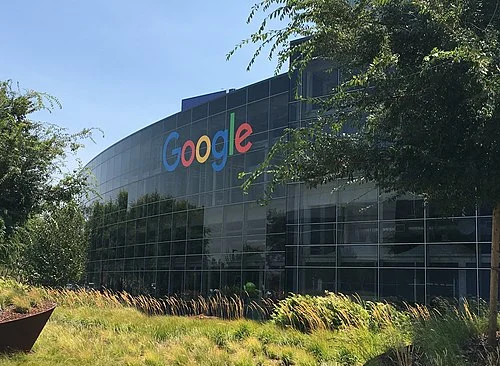
Google headquarters, in Mountain View, California
SOMERVILLE, Mass.
“What is so rare as a day in June,’’ as New England poet James Russell Lowell wrote, or, for that matter, in May, in Somerville, Massachusetts? A genuinely powerful intellect, that’s what. Enough to elicit a weekly instead of a walk.
The most interesting thing I saw last week was A Tax to Fix Big Tech, an op-ed by economist Paul Romer in The New York Times, proposing a progressive tax on corporate revenues from sales of search advertising. “Putting a levy on targeted ad revenue would give Facebook and Google a real incentive to change their dangerous business models,” he wrote.
About those dangerous business models, Romer had little to say except that
It is the job of government to prevent a tragedy of the commons. That includes the commons of shared values and norms on which democracy depends. The dominant digital platform companies, including Facebook and Google, make their profits using business models that erode this commons. They have created a haven for dangerous misinformation and hate speech that has undermined trust in democratic institutions. And it is troubling when so much information is controlled by so few companies.
What is the best way to protect and restore this public commons? Most of the proposals to change platform companies rely on either antitrust law or regulatory action. I propose a different solution. Instead of banning the current business model – in which platform companies harvest user information to sell targeted digital ads – new legislation could establish a tax that would encourage platform companies to shift toward a healthier, more traditional model.
He relied for a foil on Sen. Elizabeth Warren’s proposals to break up big tech companies, using antitrust statutes or regulation. He wrote, “Existing antitrust law in the United States addresses mainly the harm from price gouging, not the other kinds of harm caused by these platforms, such as stifling innovation and undermining the institutions of democracy.” And regulators and judges can be captured by clever lawyers and patient corporate lobbyists. (Nothing here about the legislators who would enact and monitor the tax statutes and laws.)
There are several advantages to using tax legislation as a strategy, according to Romer. The tax he had in mind could apply to revenue from sales of targeted digital ads, the core businesses of Facebook, Google and other firms that make money monitoring users’ searches. “At the federal level, Congress could add it as a surcharge to the corporate income tax. At the state level, a legislature could adopt it as a type of sales tax on the revenue a company collects for displaying ads to residents of the state.” Such a tax could be progressive, creating an impediment to growth through acquisition, and an incentive to periodic spin-offs, and thus greater competition. He added several FAQS the next day on his Web site about various tax aspects.
There was, alas, very little speculation about the new ad-free subscription models that might emerge as a means of avoiding taxes on targeted ad revenue, except to say that subscribers would be mindful of the privacy they obtained by avoiding the ever-more sophisticated surveillance of their habits by traditional search services, and subscription companies “could succeed the old-fashioned way: by delivering a service that is worth more than it costs.”
Along with countless others, I share Senator Warren and Nobel-laureate Romer’s sense that Facebook and Google and other big Internet firms have become highly undesirable corporate citizens in their current gigantic and highly profitable ad-supported form. Surely newspapers are among the “institutions of democracy” that would be strengthened by some governmental reshaping of advertising markets.
Those with long memories will recall that, as a professor at Stanford University’s Graduate School of Business, Romer was the government’s expert in the remedy phase of the Justice Department’s successful (to that point) antitrust complaint against Microsoft Corp. His recommendation was to break the company into two competing firms – one selling its Windows operating systems, the other marketing software applications (including its highly profitable Office suite). The remedy was headed for implementation, until an appellate court sent the case back to a different judge. The election of George W. Bush mooted the issue; the Justice Department withdrew its complaint: a salutary victory against big business slipped away.
Romer had left research by then to start an online learning company. In 2007 he quit Stanford altogether to work as a policy entrepreneur – a natural enough path for the son of a former governor of Colorado who had harbored national ambitions. Romer spent several years advocating for “charter cities,” tax-favored enterprise zone in developing nations whose governance was to be somehow outsourced to independent authorities. Two attempts failed on the eve of what would have been their creation. In 2010, he joined New York University’s Stern School of Business as a University Professor and for a time, director of NYU’s Marron Institute of Urban Management.
In October 2016 he signed on as chief economist of the World Bank, with hopes of transforming its large and well-funded research department. Fifteen months later, he resigned, after a series of controversies with staff. By then he had come perilously close to gadfly status as a critic of macroeconomics. He could speak so freely, he explained, “because I am no longer an academic. I am a practitioner, by which I mean that I want to put useful knowledge to work. I care little about whether I ever publish again in leading economics journals or receive any professional honor because neither will be of much help to me in achieving my goals.”
The Nobel award last year, jointly with William Nordhaus, “for integrating technological innovations into long-run macroeconomic analysis,” rescued Romer from that limbo by certifying his stature. He married the same day he received the prize. Since then, Romer has offered advice to incoming Word Bank President David Malpass, in an op-ed in the Financial Times (outsource the bank’s research function and concentrate on infrastructure planning and financial diplomacy instead), and, last week, the op-ed in the Times
Op-eds are only slightly better than TED talks. But, as noted, really good ideas are rare. This one may be profound. It deserves plenty of further study.
David Warsh, an economic historian and veteran columnist, is proprietor of Somerville-based economicprincipals.com, where this column first ran.