
Vox clamantis in deserto
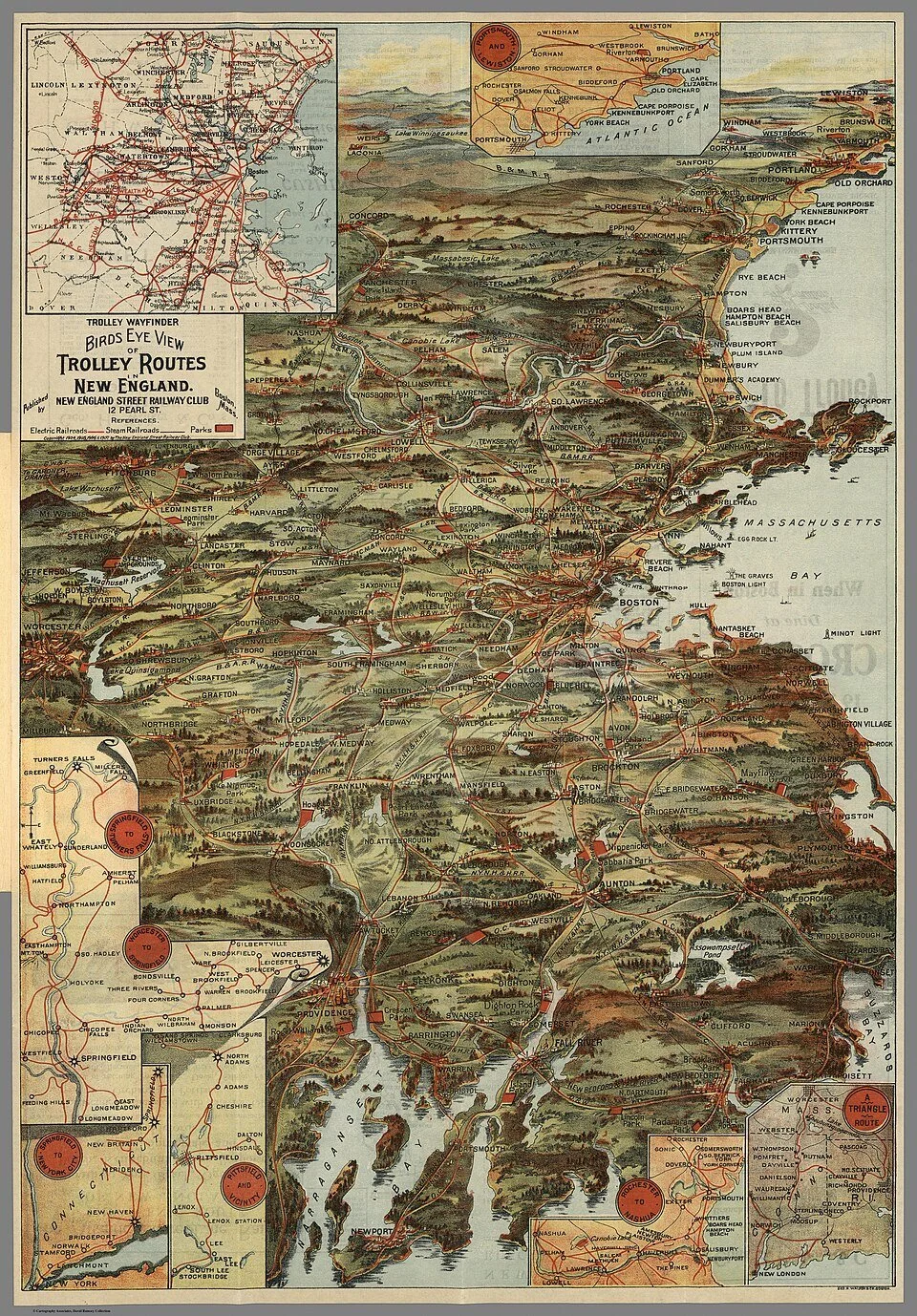



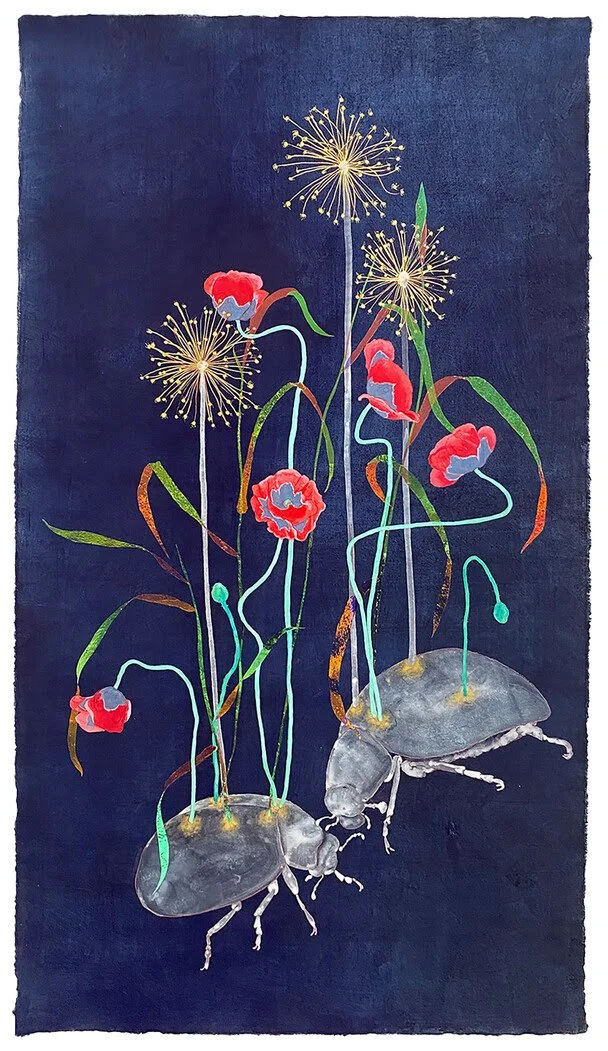
'So Eden sank to grief'
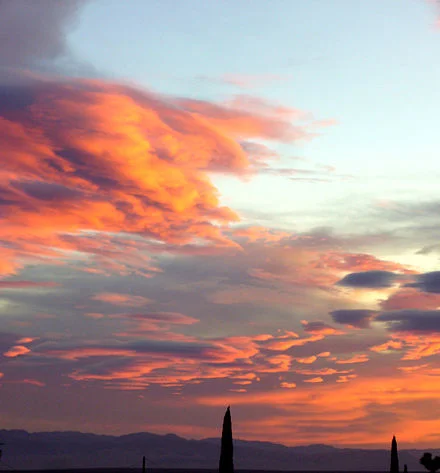
Nature’s first green is gold,
Her hardest hue to hold.
Her early leaf’s a flower;
But only so an hour.
Then leaf subsides to leaf.
So Eden sank to grief,
So dawn goes down to day.
Nothing gold can stay.
— “Nothing Gold Can Stay,’’ by Robert Frost
People's pier at Rocky Point

Rendering of Rocky Point pier.
From Robert Whitcomb’s “Digital Diary,’’ in GoLocal24.com
The Rhode Island Department of Environmental Management hopes that work on the new, 280-foot-long T-shaped pier at Rocky Point, in Warwick, scheduled to start within a few weeks, will be finished by year’s end. Too bad it won’t be ready for this summer, but the fact that it will be there soon is heartening. Long piers are potent magnets for people (and fish) and this one, with its shade structure, benches, railings and solar-powered lights, will be a more powerful one than most. That the new pier will provide easy access to saltwater fishing only 10 miles from downtown Providence will be a big draw, including out-of-state tourists.
I sure wish that there were more such public amenities, especially when the rich monopolize so much of the shoreline. Bring back the WPA!
Fun or fatal?
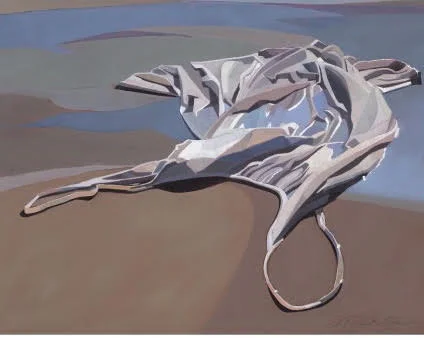
‘Incoming Tide’’ (oil on panel), by Lori Mehta, in the group show “Making a Splash,’’ at Edgewater Gallery, Boston.

'Deep roots and old loyalties'

Colorized photo of Wiscasset’s green in 1910.
“Many small towns I know in Maine are as tight-knit and interdependent as those I associate with rural communities in India or China; with deep roots and old loyalties, skeptical of authority, they are proud and inflexibly territorial.’’
— Paul Theroux, novelist and travel writer
Not affordable housing
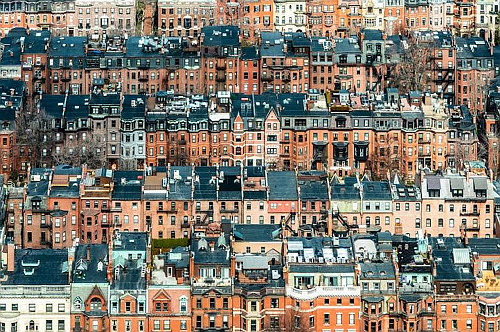
“Back Bay,’’ by photographer Roger Palframan, in his show “City Visions,’’ at Copley Society of Art, Boston, through June 15.
Roger Palframan works in Boston but is from Britain. The society says that his most recent work, such as that in “City Visions,’’ focuses on “organized environments and the unexpected patterns and rhythms they produce. He utilizes shape, form and line to reveal detail and texture and create striking images.’’ His photographs “depict tight clusters of buildings, evoking the crowded feeling of city life while revealing the man-made beauty of each scene.’’
South Coast Rail will expand 'Greater Boston'
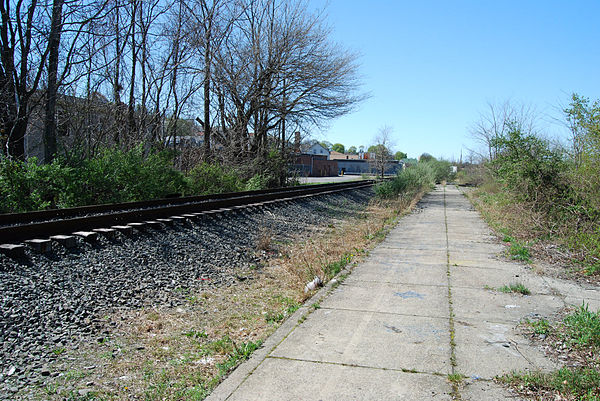
It’s hard to believe, but this is where the Fall River train station will be built.
Adapted from Robert Whitcomb’s “Digital Diary,’’ in GoLocal24.com
The best news for southeastern New England in a long while comes from Massachusetts Gov. Charlie Baker, who, fulfilling a campaign promise, is dedicating more than $1 billion in state bond revenue to the long-delayed extension of MBTA service to Fall River, New Bedford and Taunton. The plan is to have the project, called South Coast Rail, completed by late 2023. Taunton, Fall River and New Bedford are the only Massachusetts cities within 50 miles of Boston that don’t have commuter rail access to Boston.
The extension will make it easier for southeastern Massachusetts and eastern Rhode Island to share in the wealth and economic development of Greater Boston while making southeastern Massachusetts’s housing, whose costs are generally much lower than Boston’s and its suburbs’, more accessible to commuters. (And Rhode Islanders in Tiverton, Little Compton, on Aquidneck Island and Bristol may find it easier to take the train to Boston from Fall River than from Providence.)
In the long run, South Coast Rail will help make southeastern New England more prosperous, help restrain traffic congestion and reduce car traffic’s strain on the environment.
In any case, much needs to be done to get more people off the roads. Consider that a MassINC Polling Group recent survey of 1,200 Bay State registered voters found that 67 percent say that they’ve left work earlier or later to avoid Greater Boston’s traffic crush. Sixty-three percent describe themselves as angry /frustrated about the delays on the roads and the MBTA. The pollsters found:
"Among those with commutes longer than 45 minutes, about half (51%) have thought about changing jobs; 30% have considered leaving their area altogether.’’ The booming Metro Boston economy, fueled by technology, health care, finance and higher education, has kept the jobless rate low (latest: 3 percent) but eventually traffic congestion might cause many to leave the area. The best answer is more and better commuter rail service.
Please hit this link to learn more.
Gloria Oladipo: The biggest threat to free speech on American campuses
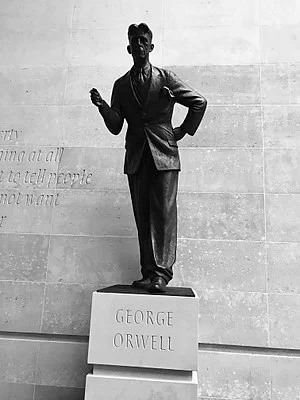
Statue of George Orwell outside BBC headquarters, in London. Orwell said:
"If liberty means anything at all, it means the right to tell people what they do not want to hear” — words from Orwell's proposed preface to his dystopian novel Animal Farm .
uaVia OtherWords.org
The school year may be winding to a close, but the tired argument about “attacks on free speech” on college campuses is alive as ever.
According to Donald Trump, liberal universities like Berkeley are allowing conservative students to be “assaulted” for sharing their beliefs on campus. To combat such violations, Trump signed an executive order requiring colleges to “protect free speech” or risk losing federal education funding.
I’m delighted to alert Trump and all those with similar concerns that free speech on campus, on both sides of the political aisle, is doing just fine — to a point.
College campuses, now more than ever, are home to a variety of organizations with differing political views: pro-Democratic and pro-Republican organizations, Students for Justice in Palestine and Students Supporting Israel, as well as other organizations with conflicting viewpoints.
More specifically, college campuses are fairly accommodating spaces for conservative students.
To date, no campus has banned any form of Trump paraphernalia, nor has any college persecuted a student for wearing pro-Trump symbols. College campuses routinely host conservative speakers: Cornell hosted Dick Cheney, while the University of Baltimore had Betsy DeVos speak at its commencement ceremony, among other examples.
Outside organizations actively use their influence to make sure that conservative students have their perspectives represented. Many conservative organizations are well funded by Republican politicians and wealthy Republican families.
Additionally, conservative news outlets such as Breitbart and the National Review regularly publish articles demonizing universities they say aren’t doing enough to protect their version of “free speech,” which appears to mean shielding campus conservatives from any kind of criticism or protest.
When the president and other conservatives talk about the precarious state of free speech, they’re often referring to efforts to stop hateful speech on campuses.
They’re angry that Milo Yiannopoulos wasn’t allowed to speak at Berkeley when he was planning to out undocumented students, putting them at risk of deportation. They’re angry that a student organization from Cornell University canceled conservative speaker Jannique Stewart because of her blatant homophobia.
College campuses have always been willing to host dialogue, even when it’s difficult. However, the president’s and other conservatives’ demand that outside speakers be permitted to freely antagonize the most marginalized students on their own college campuses shows a complete disregard for the safety and humanity of students.
So is free speech in jeopardy? Yes, but not in the way that conservatives traditionally conceive it.
Contrary to the usual story, many leftists within universities are persecuted for their beliefs. Lisa Durden, a black professor formerly at Essex County College, in New Jersey, was fired after defending a black-only Black Lives Matter event on Fox News. Jim Stump, a former professor at Bethel College, in Indiana ,was fired for defending evolution compared to the university’s predominantly creationist beliefs.
Trump’s executive order itself — and the outside intimidation that conservative publications exert on students — represents an actual attack free speech. Student groups, often made up of people of color and other marginalized demographics, are constantly demonized for organizing to stop hate in their communities. While conservative students speak freely, those in opposition to homophobes and racists are silenced.
Free speech, including hateful speech, has consequences — including freely spoken responses of anger and protest from others. Students shouldn’t be expected to be idle in response to hate speech.
Instead of shaming and censoring progressive students, more should be done to protect those who protest, fighting against hate and for their own humanity.
Gloria Oladipo is a Black woman sophomore at Cornell University and a permanent resident of Chicago.
Llewellyn King: The Green New Deal is political theater
Not since Newt Gingrich, Dick Armey and The Heritage Foundation cooked up the Contract with America in 1994, has there been such a clever piece of political stagecraft as the Green New Deal.
But whereas the Gingrich plan was able to make its way untrammeled through the congressional election and, in many of its goals, into law, the Green New Deal is by its nature more political theater than legislative agenda.
The Green New Deal is a crummy document, featuring many old and failed ideas from the past — stretching back to the 19th century. But as a banner, it is effective; as a call to arms, it works.
What its Republican critics have wrong is that in cleaving to the White House line on global warming, they underestimate the degree of real alarm which aberrant weather, more severe hurricanes, rising sea levels and daily reports of catastrophic ice melts in the Arctic and Antarctic will engender.
A television video of a starving polar bear, whose sea ice habitat is under threat from climate change, has an incalculable effect on public alarm. But that bear and the bad news of rising water in Miami, Norfolk, Va., and San Francisco cannot be denied and will be present at the balloting in 2020.
The Green New Deal document is too broad, too idealistic and too weakly drafted to be taken seriously as legislation. But as propaganda, it is brilliant.
As presented by the Democratic House-Senate duo of Rep. Alexandria Ocasio-Cortez, of New York, and Sen. Ed Markey, of Massachusetts, it is more than an environmental wish list. It is a far-left social and environmental game plan. It is a call to reorder, reengineer and convert our society from what we drive to what we eat. It delves into the crypt of failed socialist ideas and brings out the cadavers, like the one of a living, guaranteed wage.
Sadly, the Green New Deal will hang some of these old, failed ideas around the necks of many of the Democratic presidential hopefuls -- at least five have uncritically endorsed it.
Recently, I went to hear one of those contenders, Rep. Tulsi Gabbard, of Hawaii. In a few words, she impressed me; then, in a few more, she appalled me.
As someone who has served two deployments in the Middle East, as an enlisted woman and as an officer, Gabbard has something to say about foreign policy: She says no more wasteful foreign wars. But as an environmental champion, she has swallowed whole the weary fictions of the left.
Gabbard determines all electricity should be generated by renewables, defined as solar and wind. For good measure she throws in a denunciation of nuclear power, concentrating on the abandoned San Onofre plant, between Los Angeles and San Diego. To make her point, she says that the waste would last for 500,000 years, which should get a sharp rebuke from scientists.
Nuclear, she should be told, is progressive. It is science at the beginning of its age of discovery with new products and ideas swirling around as they have not since the 1950s. Small, factory-built reactors with various new technologies are being readied for market. The Holy Grail of nuclear fusion is closer than ever.
The science of carbon capture and storage, she should also be told, is evolving.
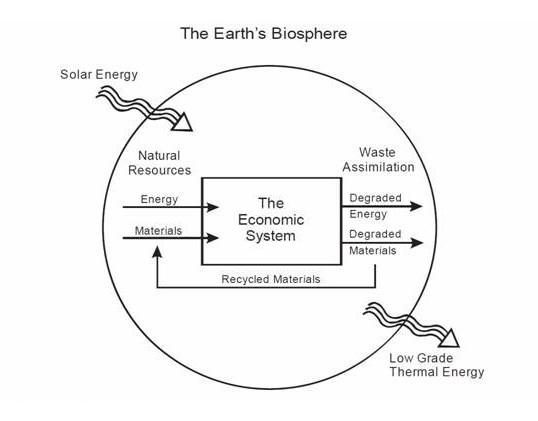
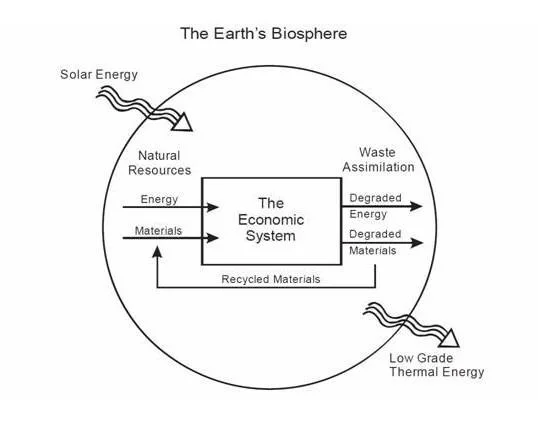
The green world needs to know that wind and solar are limited in that they cannot produce more power than they reap. Solar is confined by the amount of sun that falls on a given collector, wind by the amount of ambient breeze blowing though one windmill. That is guaranteed by the second law of thermodynamics.
Nonetheless, the message of the framing-word green in the Green New Deal is a clear call to arms. The rest of it should be put down to Ocasio-Cortez’s youth and inexperience and Markey’s foggy hopes.
But that does not mean that the next election will not, to rephrase a Clinton slogan, hinge on “It’s the climate, stupid.” The Green New Deal makes a nifty bumper sticker.
Llewellyn King is executive producer and host of White House Chronicle, on PBS. His email is llewellynking1@gmail.com.
'Some Assembly Needed'
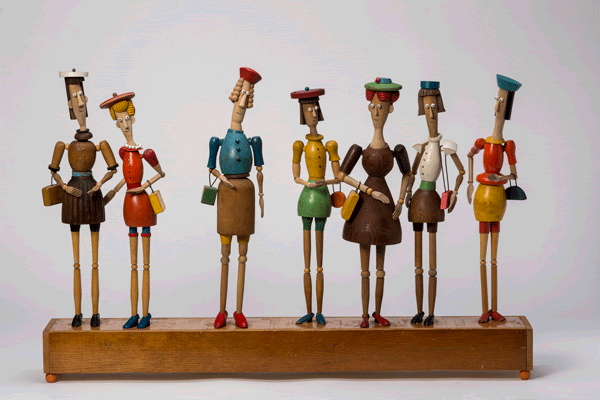
“7 Ladies’’ (bowling pins, furniture spindles, handles, wooden beads, drum sticks, darning eggs, wooden combs), by Michael Stasiuk, in the group show “Some Assembly Needed,’’ at the Art Complex Museum, Duxbury, Mass. through Sept. 1. The other artists in the show are: Martin Ulman, Michael Ulman, Donna Rhae Marder, Lisa Kokin, Yuri Tozuka, John McQueen, Tom Deininger, Leo Sewell, Aaron Kramer and Jee Hye Kwon.
Jessicah Pierre: 'Baby bonds': A revolutionary way to close the racial wealth divide

— Photo by RealtOn12
Via OtherWords.org
The gap between America’s ultra-wealthy and the rest of us is growing dramatically as wealth continues to concentrate at the top at the expense of the rest of us. One major symptom of this economic rift is the racial wealth divide, which is greater today than it was nearly four decades ago.
The median Black family today owns $3,600 — just 2 percent of the $147,000 of wealth the median white family owns. At the extreme top, the Forbes 400 richest Americans own more wealth than all Black households, plus a quarter of Latinx households, combined.
When analyzing the racial wealth divide, it’s important to note that this is a systemic issue — a result of policies, not individual behavior.
Darrick Hamilton, the executive director of the Kirwan Institute for the Study of Race and Ethnicity at Ohio State, emphasizes that the key ingredient of how successful you’ll be in America isn’t how hard you work individually — it’s how wealthy your family is.
For instance, the racial wealth gap continues to grow despite rising rates of Black employment and education. These other things simply can’t make up for enormous, systemic disparities in family wealth.
Hamilton’s proposed solution? “Baby bonds.”
Baby bonds are federally managed accounts set up at birth for children and endowed by the government with assets that will grow over time. Neither the child nor their parents would be able to access these funds until the child reaches adulthood, at which point they could use the money to get an education, purchase a home, or start a business.
Baby bonds could play an essential role in balancing the historical injustices that created the racial wealth divide.
One recent study shows a baby bond program has the potential to reduce the current black-white wealth divide more than tenfold. Another shows that had a baby bond program been initiated 40 years ago, the Latinx-white wealth divide would be closed by now — and the black-white wealth divide would have shrunk by 82 percent.
Baby bonds are an essential, universal, race-conscious program to provide everyone with an opportunity to start life off secure, irrespective of their race and the financial position in which they’re born.
And they’re just one of 10 bold solutions offered in a new Institute for Policy Studies report on closing the racial wealth divide, which counts Hamilton among its coauthors.
“Large scale policy change,” it concludes, “is the most promising path to addressing the racial wealth divide and many asset poor whites as well.” The report also recommends solutions ranging from Medicare for All and higher taxes on the wealthy to setting up a congressional committee to study reparations.
Just like all other issues of inequality in America, the racial wealth divide is a structural problem that requires structural solutions. In order to create economic prosperity for every American, we must start with taking bold action to close the racial wealth divide once and for all.
Jessicah Pierre is the inequality media specialist at the Institute for Policy Studies.

Don Pesci: Humpty Dumpty's answer to a progressive's confusion

Humpty Dumpty and Alice. From Through the Looking-Glass. Illustration by John Tenniel
Connecticut State Rep. Josh Elliot, a progressive Democrat from Hamden, views the state budget as “a moral document that can be used to create a more equitable and fair society,” The Hartford Courant tells us. The paper quotes Elliot on the point: “Are you taking an economic frame and saying ‘what can we do to grow GDP at all costs?’ … Or are you taking a moral and ethical frame and saying ‘what can we do to build up a just society?’ And I think those two questions are at loggerheads right now.”
There is a welter of confusion here. The point that Elliot appears to be making is that progressives like himself view the economy as having a moral dimension lost to free-marketers, i.e., redundantly rich capitalists concerned only – note the devil word “only” -- with growing the Gross Domestic Product (GDP). It would not be possible in Elliot’s view for a free-marketer such as, say, Fredrick Hayek, author of The Road To Serfdom -- a ruthless attack against the collectivist ethos that informs socialism, communism, progressivism and fascism -- to be a moralist.
In The Constitution Of Liberty, Hayek identifies one indispensable “moral rule for collective action… The most important among the principles of this kind that we have developed is individual freedom, which it is most appropriate to regard as a moral principle of political action. Like all moral principles, it demands that it be accepted as a value in itself, as a principle that must be respected without our asking whether the consequences in the particular instance will be beneficial.”
This is how a true moral philosopher addresses morality. In Elliot’s progressive universe Hayek’s overriding moral principle of political action – the sustenance of individual liberty – is subservient to his own undisclosed overriding moral principle, which is antagonistic to the liberty of the subject. Under the progressive scheme of things, individual liberty is sacrificed on the altar of an “equitable and fair society” created without regard to real-world circumstances by modernist super-moralists like Elliot, who know better than the little people who participate in a free market what services and goods should be provided to them. To Elliot, the liberty of the subject celebrated by moral philosophers such as Hayek is immoral.
Elliot’s framing permits only two possibilities: an economic frame that allows only the growth of products “at all costs” and an economic frame, moral and ethical, that is concerned primarily with building up a “just society.” There is no via media in Elliot’s view. His is a stark and merciless either-or: either an immoral free market society or an ethical progressive-socialist society. In Communist governments, the governed are not permitted to choose between the two.
Progressivism is the shadow of socialism, which is why so many progressives here in the United States, still a free market country, support the candidacy for president of Bernie Sanders, running for the Democratic presidential nomination but a socialist wolf in wolf’s clothing. Progressivism differs from socialism only in degree, not in kind. And, of course, socialism historically has been the nursery bed of both communism and fascism. Mussolini and Hitler both were socialists before they became fascists, and Stalin embraced the Marxism of the Communist Manifesto because he correctly recognized a visionary Communist scheme of “property ownership by the proletariat” as a perfection of socialism. There is another reason as well: Only under a Communist government is the ruling elite powerful enough to suppress the liberty of the people, which Hayek and other classical liberals such as Adam Smith characterized as the indispensable “moral rule of collective action.”
Communists, socialists and progressives – three peas in the same liberty denying pod – care little for the real-world consequences of their theoretical utopias.
When Alice objects to Humpty Dumpty’s use of words to signify opposing meanings, he offers her a lesson in tyrannical government. Humpty Dumpty has misused the word “glory” to signify “a nice knock-down argument.”
Alice protests, “But ‘glory’ doesn't mean ‘a nice knock-down argument.’"
Humpty Dumpty snarls scornfully, “When I use a word, it means just what I choose it to mean -- neither more nor less.'
“The question is,” said Alice, “whether you can make words mean so many different things.”
“The question is,” said Humpty Dumpty, “which is to be master -- that's all.”
Elliot may make the word “moral” mean whatever he wishes it to mean. After all, Democrats are now masters of Connecticut governance; they hold commanding positions in General Assembly, the state’s constitutional offices, and the governor’s office as well. And nearly half of the Democrat ruling majority is composed of quasi socialist progressives like Elliot. Still, the real meanings of words are stubborn things.
According to a Yankee Institute piece published in May of 2018, “The Tax Foundation’s annual ranking of states based on state and local income tax collection placed Connecticut second in the nation, trailing only New York, for the most money collected per resident. Connecticut collected $2,279 per person through both local and state income taxes. Massachusetts ranked fourth and Rhode Island 20th. The national average per capita tax rate was $1,144, meaning Connecticut has almost doubled the average tax burden.” Is there a connection between the loss of assets – salaries are assets too – and the loss of liberty?
Depressing figures such as these will increase under Governor Ned Lamont’s recent revenue expansions. In what sense is it “moral” for Connecticut’s government to increase the burden of taxation further, when we know that excessive taxation, a great deal of which is used to enhance the salaries of tax-consuming public employees, tends to drive to other states both Connecticut’s rich and middle class taxpayers, thus depriving those in need of dwindling tax resources?
Indeed, in what sense is it moral to support a government now engaged in encouraging infanticide? Connecticut is contiguous to New York, which now winks at infanticide; and, one may be certain that socially progressive governments – New York and Connecticut – sooner or later will swap their social-justice DNA, without mentioning the outsized proportion of African American women obtaining abortions relative to white women. The Centers for Disease Control and Prevention’s 2016 report points out that black babies made up a whopping 35 percent of the total abortions reported in 2013, although blacks represent only 13 percent of the U.S. population.
Moral? To what cleverly invented Decalogue do progressives point to justify such a disparity in abortion between black and white women?
Don Pesci is a Vernon, Conn.-based essayist.
Beach bathos

“Abandoned, Truro MA’’ (lambda print), by Eleanor Steinadler, in a group photography show at Galatea Fine Art, Boston, May 1-June 2.
Looking for the old routes

“Old Souvenir in Transit’’ (encaustic), by Nancy Spears Whitcomb
'Down to the Puritan marrow'
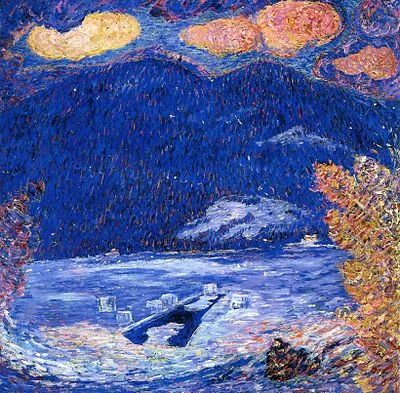
“The Ice Hole’’, by Maine painter and writer Marsden Hartley (1877-1943)
When the world turns completely upside down
You say we’ll emigrate to the Eastern Shore
Aboard a river-boat from Baltimore;
We’ll live among wild peach trees, miles from town,
You’ll wear a coonskin cap, and I a gown
Homespun, dyed butternut’s dark gold color.
Lost, like your lotus-eating ancestor,
We’ll swim in milk and honey till we drown.
The winter will be short, the summer long,
The autumn amber-hued, sunny and hot,
Tasting of cider and of scuppernong;
All seasons sweet, but autumn best of all.
The squirrels in their silver fur will fall
Like falling leaves, like fruit, before your shot.
2
The autumn frosts will lie upon the grass
Like bloom on grapes of purple-brown and gold.
The misted early mornings will be cold;
The little puddles will be roofed with glass.
The sun, which burns from copper into brass,
Melts these at noon, and makes the boys unfold
Their knitted mufflers; full as they can hold
Fat pockets dribble chestnuts as they pass.
Peaches grow wild, and pigs can live in clover;
A barrel of salted herrings lasts a year;
The spring begins before the winter’s over.
By February you may find the skins
Of garter snakes and water moccasins
Dwindled and harsh, dead-white and cloudy-clear.
3
When April pours the colors of a shell
Upon the hills, when every little creek
Is shot with silver from the Chesapeake
In shoals new-minted by the ocean swell,
When strawberries go begging, and the sleek
Blue plums lie open to the blackbird’s beak,
We shall live well — we shall live very well.
The months between the cherries and the peaches
Are brimming cornucopias which spill
Fruits red and purple, sombre-bloomed and black;
Then, down rich fields and frosty river beaches
We’ll trample bright persimmons, while you kill
Bronze partridge, speckled quail, and canvasback.
4
Down to the Puritan marrow of my bones
There’s something in this richness that I hate.
I love the look, austere, immaculate,
Of landscapes drawn in pearly monotones.
There’s something in my very blood that owns
Bare hills, cold silver on a sky of slate,
A thread of water, churned to milky spate
Streaming through slanted pastures fenced with stones.
I love those skies, thin blue or snowy gray,
Those fields sparse-planted, rendering meagre sheaves;
That spring, briefer than apple-blossom’s breath,
Summer, so much too beautiful to stay,
Swift autumn, like a bonfire of leaves,
And sleepy winter, like the sleep of death.
— “Wild Peaches,’’ by Elinor Wylie (1885-1928), a sometime resident of Connecticut
First delicacy of spring

Fiddlehead ferns
“Fiddle ferns (aka fiddlehead ferns}, if you know where to find them, are the first delicacy of spring {in New England}, appearing even before asparagus. Plunge them briefly in rapidly boiling water, and serve with butter, salt, and if you like, lemon juice. Chopped almonds may be added, or the ferns may be served on hot buttered toast.’’
— Sara B.B. Stamm, in Favorite New England Recipes (1972)
Chris Powell: New Haven's biggest problem

New Haven.
Anyone who fears for manufacturing in Connecticut should visit New Haven, where it seems that half the indignation in the country is produced.
The outrage of the moment is what may be a case of mistaken identity last week in which police officers from Hamden and Yale University shot at a car they stopped on Dixwell Avenue in New Haven because it fit the description of a car said to be involved in an attempted armed robbery a mile away in Hamden. A passenger in the car was wounded but no evidence linking the car or its occupants to the robbery has been found. The state's attorney's office and the state police have taken over the investigation.
Horrible as such a mistake by the police here would be, cases of mistaken identity in police work happen all the time and some have far worse results. Some are caused by the negligence of officers, others by devastating coincidence. This one may have been compounded by the officers' lack of judgment if not trigger-happiness.
But because the occupants of the stopped car are black, the protests in New Haven presume without evidence that the incident was part of a nationwide police scheme to murder black people. "No justice, no peace, no racist police," the protesters chant, though the Hamden officer in the incident is black himself and first worked as an officer in New Haven, where he was trained.
The protesters, many of them students at Yale, want the officers fired and prosecuted immediately, before any investigation. That reflects the university's political correctness. They also want the university police disarmed and suburban officers forbidden to pursue criminal suspects into New Haven.
So much for the mandatory regionalism advocated by New Haven Sen. Martin M. Looney. But the rest of the New Haven area might be glad to have less to do with the city if its miserable demographics were not producing so much of the region's crime. Over the weekend prior to the incident on Dixwell Avenue four people were injured in three shootings in New Haven, and even as protesters were chanting away at another rally last Thursday night, a riot broke out at a street party elsewhere in the city, one teenager getting shot and another injured by flying glass.
Of course there were no protests of that violence, since it was typical for New Haven, nor any expressions of sympathy for those assigned by government to protect society against the anarchy of city life. In this respect New Haven is not much worse than Hartford or Bridgeport.
Connecticut does not hold its police to account as well as it should but it has been improving. There are mechanisms for accountability and some recognition that officers in all towns represent the state as a whole. So if Connecticut is really to be a state, the pursuit of violent felons cannot stop at town lines.
So why, despite their worsening demographics, are Connecticut's cities not only largely walled off politically but, as the protests in New Haven show, trying to wall themselves off from due process of law and even law itself? For neither can Connecticut be a state if law in the cities is only a polite fiction.
Chris Powell is a columnist for the Journal Inquirer in Manchester, Conn.
Molecules in the sun

The cement pond on the Cohasset, Mass., common.
“I lay on the lush green of the Commons watching you traipse through
the knee-deep
water of a cement pond, splashing and kicking
each molecule of water momentarily suspended….’’
— From “Many Little Suns,’’ by Renuka Raghavan
That New Hampshire squirrel

“All the time we were there, you could see that dead squirrel right out in plain sight. Whenever anyone mentions New Hampshire, that squirrel is always what I think of. I bet I’ve thought about that squirrel a million times.”
―Connecticut-based novelist Wally Lamb in I Know This Much Is True
Before the storm?

“Morning Calm #2 (30 x 20 limited edition AluminaArte print) taken in Harwich, on Cape Cod, by Bobby Baker. Copyright Bobby Baker Fine Art.