
Vox clamantis in deserto





Karen Gross: About those 'certificates of failure'
From The New England Journal of Higher Education, a service of The New England Board of Higher Education (nebhe.org)
The news is filled with stories about the admissions scandals at elite colleges and universities. And recently, some of the wrongdoers have pled guilty and await punishment. Apparently, prosecutors are seeking jail time. Apart from jail time, I have already suggested approaches to punishment that involve fines that go into a cy pres fund to be redistributed to small non-elite colleges and their students. Ironically (or not), the fake charity to which these parents “donated” was intended to serve low-income kids. Hey, make that really happen … and legally.
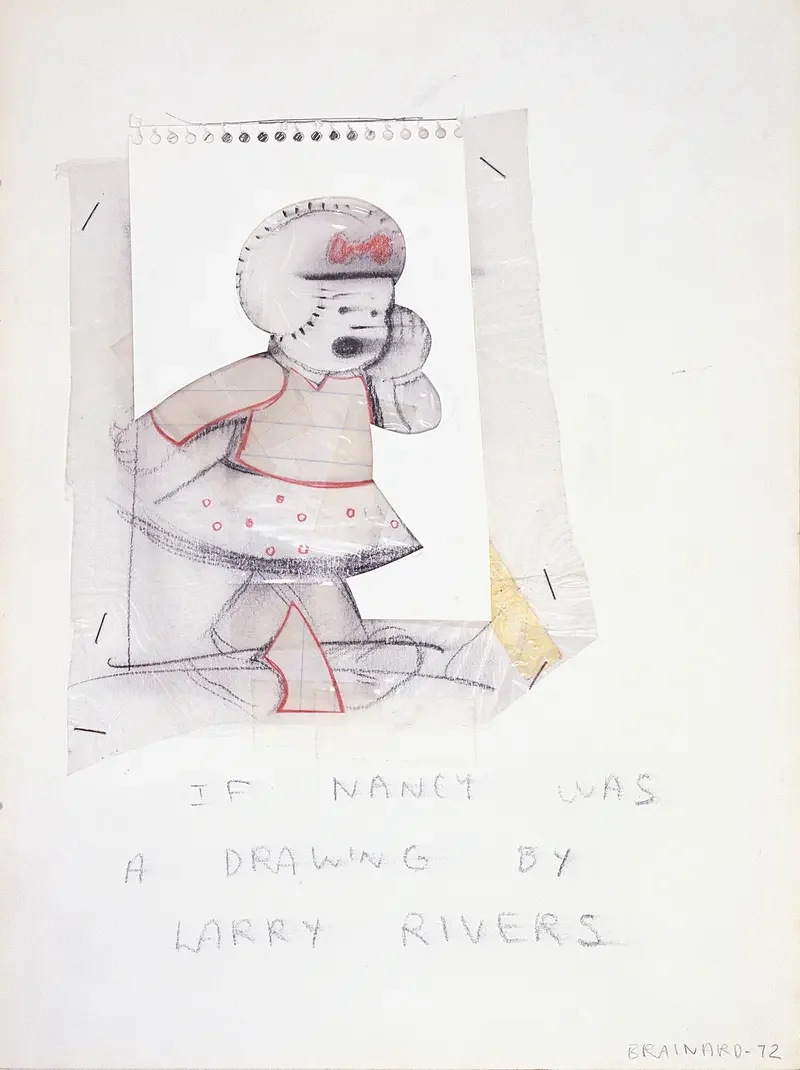
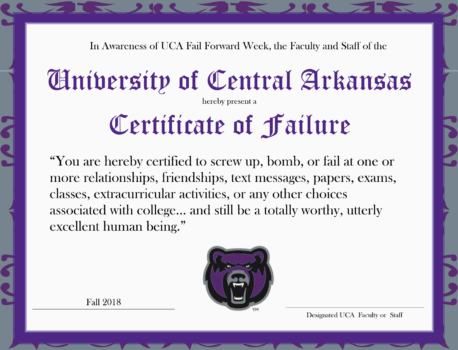
At the same time, there have been articles about the competitiveness of elite colleges and universities and the need to provide courses or partial courses or seminars in failure. The idea is legitimizing failure; it happens to everyone after all. But, since some college students have never experienced failure (see above), the colleges need to include instruction on how to fail. And some even provide “certificates of failure’’ at the beginning or end of the courses. (See image above.)
One of the pre-course certificates is issued, I am embarrassed to say, by my alma mater, Smith College. It is provided before the seminar begins with the suggestion that it be displayed proudly. The certificate provides, in part,
“You are hereby authorized to screw up, bomb or fail at one or more relationships, hookups, friendships, texts, exams, extracurriculars or any other choices associated with college … and still be a totally worthy, utterly excellent human.”
Apparently, students (at least those cited in the article about this in the New York Times) are delighted to hang these words in their dorm room. A recent article in The Washington Post shared similar initiatives, with some institutions replacing the word “failure” with “grit training” or “resiliency education,” although the certificates awarded for failure were noted.
I have no idea who invented this idea of certificates of failure for college students. Was it a psychology professor or a student-life professional or some consultant? Was it an expert in parent-child development? Answer that question, please.
From my perspective, this whole “accept” failure movement strikes me as what we term in other contexts “a first world problem.” In other words, learning about and dealing with failure is a problem for some students attending some elite colleges in America, where they suddenly get a low grade or struggle for the first time in their academic and personal lives.
From my experience in education, spanning early childhood education through adult education, I see the opposite experience among low-income, first-generation, minority, ethnically diverse and immigrant students. Many of these students experience failure early and often. In their schools, they are often, directly or indirectly, signaled: “You can’t make it.” Some are deprived access to gifted programs or AP courses. Surely they are not getting the level of tutoring that the wealthy can afford. There are assumptions, acknowledged or not, as to who progresses and where in education—from elementary school programs to elite public selective high schools to elite colleges (or any college actually). Just peruse the Pell Grant numbers of enrolled students at elite colleges (although the numbers are increasing).
I can’t count the number of students at Southern Vermont College (SVC), which is sadly failing now under current leadership and set to close unless miraculously saved (something for which I have been fighting), who said to me “I was told I was not college material.” Talk about not needing a certificate of failure. And many of the students we accepted back then at SVC had profiles that would have suggested that college was not in their future, let alone graduation. Indeed, the SVC Mountaineer Scholar Program, remarkable in so many respects though undermined of late sadly through mission drift at SVC, aimed to enroll students most thought would “never make it” in higher education. Some had projected graduation rates of under 9%; they too graduated.
There are many reasons that students have failed along the educational pipeline. Poor schools, poor teachers, fiscally underfunded schools, lack of parental support (or other adult support), cultural expectations and norms including few or no individuals believing in success. If you want to see this, view the movie Raising Bertie or the movie STEP. Surrounded by failure of every sort from food scarcity to parental absence, incarceration and addiction to homelessness, many of today’s college students have not experienced success. They have lived lives filled with failures.
These students don’t need lessons in failure; they need lessons in success and their capacity—remarkable capacity—to succeed.
I would add that trauma, a topic about which I have been writing regularly, has been a large contributor to low student expectations and misunderstanding of student capacities. Indeed, we know that trauma has many cognitive effects on student learning, and it is often mistaken for other student shortcomings—when actually the students did not ask for the trauma and had no choice in being on the receiving end. Children who have been traumatized and are not in trauma-sensitive environments with tools to defuse the autonomic nervous system can feel the effects for a lifetime. Trauma’s aftermath can make you feel like a failure when you are anything but. You are a survivor. But trauma and its impacts don’t disappear. Reflect on the recent suicides a year after Parkland and several years after Sandy Hook. Tragic.
Most of us don’t need certificates of failure. We have failed. We have experienced lowered expectations. We know what it is like not to succeed and to watch others around us fail with regularity.
The focus on “certificates of failure” makes me ill actually. It applies to such a narrow segment of college students. Why is it that we can’t pay more attention to the vast majority of students and put our time, our energy, our money and our focus on their successes—hard-fought successes—in a world that dealt them failure? Yet again, we focus all our attention in the media and elsewhere on the elite as if that is all that matters and as if that is somehow representative of the vast majority of the population.
So, with the elite parents bribing and certificates of failure to offset lots of success and soft shells in some children raised to always feel good, let’s shift gears immediately. Let’s help non-elite colleges and students across the educational landscape for whom failure has been a constant companion. We don’t need a certificate of failure. It is evident in lives being lived. Instead, we need folks who believe in our success.
Karen Gross is senior counsel with Finn Partners, former president of Southern Vermont College and author of Breakaway Learners: Strategies for Post-Secondary Success with At-Risk Students.
'Keeping History Above Water'

Hunter House (built in 1748), in Newport’s Point neighborhood, which is endangered by rising sea levels.
From Robert Whitcomb’s “Digital Diary,’’ in GoLocal24.com
Many people along the southern New England coast and beyond will want to follow the work of a consortium called Keeping History Above Water that addresses the threat to low-lying historic neighborhoods from the rising seas associated with global warming. Newport’s Point neighborhood, with its wealth of 18th Century structures, is a prime example of a place in peril. It might become very own Atlantis soon enough.
The group describes itself:
“Keeping History Above Water began as a simple idea for a conference to be hosted by the Newport Restoration Foundation in Newport, Rhode Island in the spring of 2016…. Keeping History Above Water has expanded to include a variety of activities related to climate and cultural heritage across Rhode Island and around the world. Annual conferences, hosted in vulnerable regions across the country, are a centerpiece of Keeping History Above Water.’’
Its next conferences will be in St. Augustine, Fla., May 5-8, and Nantucket, June 26-28.
Here’s the organization’s Web site.
It comes and it goes

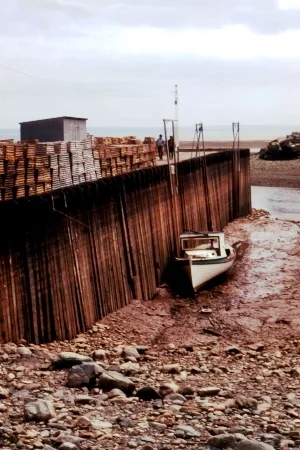
The tide rises, the tide falls,
The twilight darkens, the curlew calls;
Along the sea-sands damp and brown
The traveller hastens toward the town,
And the tide rises, the tide falls.
Darkness settles on roofs and walls,
But the sea, the sea in darkness calls;
The little waves, with their soft, white hands,
Efface the footprints in the sands,
And the tide rises, the tide falls.
The morning breaks; the steeds in their stalls
Stamp and neigh, as the hostler calls;
The day returns, but nevermore
Returns the traveller to the shore,
And the tide rises, the tide falls.
“The Tide Rises, the Tide Falls,’’ by Henry Wadsworth Longfellow (1807-1882). In his time, Longfellow was by far the best known New England poet.
A 'finished place'

The Boston Athenaeum, built in 1847
“New England is a finished place. Its destiny is that of Florence or Venice, not Milan while the American empire careens onward toward its unpredicted end. . . . It is the first American section to be finished to achieve stability in the conditions of its life. It is the first old civilization, the first permanent civilization in America.’’
— Bernard DeVoto (1897-1955), historian and essayist

Tour some of New England's great houses and gardens with this book

William (“Willit’’ ) Mason, M.D., has written has a delightful – and very handy -- book rich with photos and colorful anecdotes, called Guidebook to Historic Houses and Gardens in New England: 71 Sites from the Hudson Valley East (iUniverse, 240 pages. Paperback. $22.95). Oddly, given the cultural and historical richness of New England and the Hudson Valley, no one else has done a book quite like this before.
The blurb on the back of the book neatly summarizes his story.
“When Willit Mason retired in the summer of 2015, he and his wife decided to celebrate with a grand tour of the Berkshires and the Hudson Valley of New York.
While they intended to enjoy the area’s natural beauty, they also wanted to visit the numerous historic estates and gardens that lie along the Hudson River and the hills of the Berkshires.
But Mason could not find a guidebook highlighting the region’s houses and gardens, including their geographic context, strengths, and weaknesses. He had no way of knowing if one location offered a terrific horticultural experience with less historical value or vice versa.
Mason wrote this comprehensive guide of 71 historic New England houses and gardens to provide an overview of each site. Organized by region, it makes it easy to see as many historic houses and gardens in a limited time.
Filled with family histories, information on the architectural development of properties and overviews of gardens and their surroundings, this is a must-have guide for any New England traveler.’’
Dr. Mason noted of his tours: “Each visit has captured me in different ways, whether it be the scenic views, architecture of the houses, gardens and landscape architecture or collections of art. As we have learned from Downton Abbey, every house has its own personal story. And most of the original owners of the houses I visited in preparing the book have made significant contributions to American history.’’
To order a book, please go to www.willitmason.com
Visions from illness
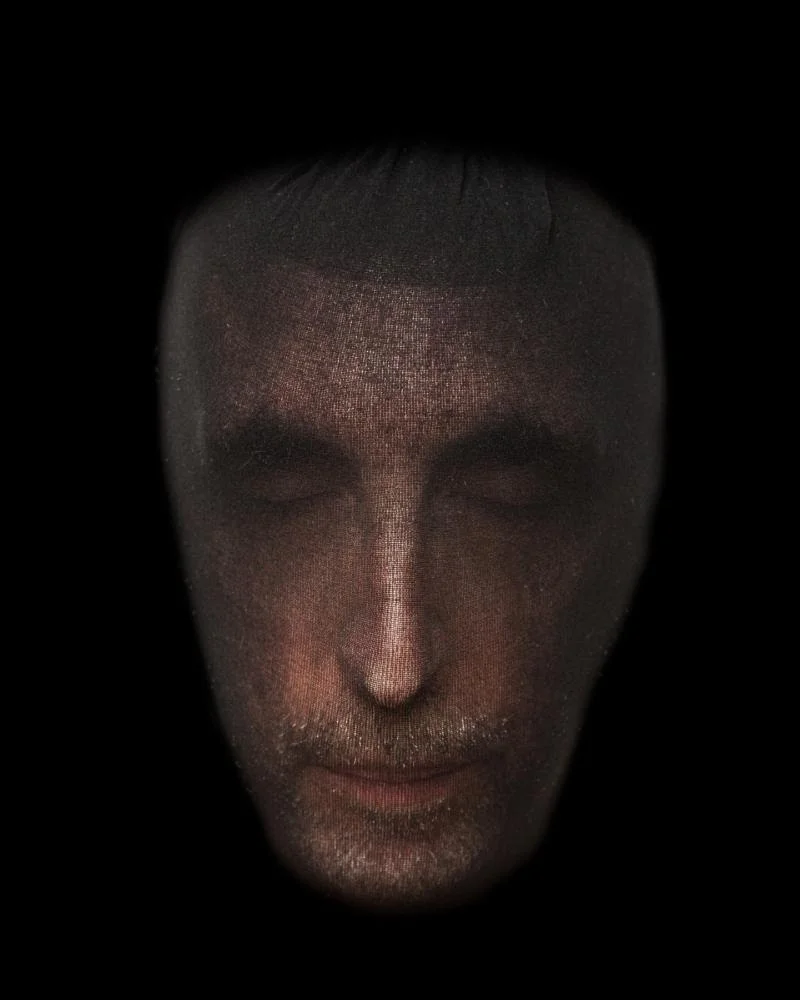
“Face Object #1 ‘‘ (archival inkjet print from digital photo), by David Weinberg, in the show “If You Could See What I See,’’ by Louise and David Weinberg, at Galatea Fine Art, Boston, May 1-June 2. The gallery says that the pictures in the show were produced during Louise Weinberg’s 15-year struggle with a rare neurologic disease that shares some features with Parkinson’s Disease. This illness and side-effects of medications have affected both her physical abilities and her mental state, “producing vivid hallucinations and altered perception’’.
Galatea says that through discussion with Louise, David Weinberg has produced photographic images that “attempt to depict the visions that Louise experiences. Louise has arranged fragments cut from her drawings and paintings into collages that spring from her unconscious. The works arise from the many degrees of cognitive changes stimulated by the medications treating the neurological illness.’’

Llewellyn King: Information technology has been far from the civic boon hoped for

A 20-year-old fax machine
When the current age of communication started (pick your time, but I think it was when we started sending print by telephone in the form of a fax), it was thought that dictators would fall, and democracy would be reinvigorated.
The first big disappointment was Saudi Arabia. When the Saudis began to get uncensored news and information, it was believed that the grip of the royal family and its extreme religious allies would be loosened. It did not happen. Instead, Saudi Arabia was spurred to use its oil wealth to push conservative Islam around the globe, especially in places where it was present but could be radicalized, including Pakistan and Bangladesh. They poured their money into madrassas -- religious schools -- that preached the Wahhabism, a strict and puritanical interpretation of Sunni Islam.
When Iran, a majority Shia country, was under the dictatorial thumb of the Shah, it was thought that the Iranians, a sophisticated people with an ancient and proud history, would be liberalized by the flow of Western, secular ideas. These ideas came into the country through the presence of visitors and contractors, and a liking for movies and television.
Fax transmission was important in the spread of ideas in Iran. But the faxes that had the biggest effect were not those preaching democracy but those coming from an old Shia cleric living in exile in a village outside Paris, Ayatollah Ruhollah Khomeini. He used the fax to push the Islamic Revolution, which turned out to be a much worse tyranny than the Shah’s
People ask me why, when the mainstream media daily points up President Trump’s failures and transgressions, his supporters are unmoved, disdaining what is being revealed in favor of what they want to believe. They believe in Trump and they believe in his courtiers at Fox News Channel and on talk radio.
People do not react to raw information but, rather, to information that sits well with them for other reasons: what they are predisposed to believe.
Rupert Murdoch, the boss of Fox News, has had a genius, a real genius, for corralling those who felt ignored by society. He did it in Britain with his hugely successful tabloid newspaper, The Sun, and he has done it here with Fox News. In Britain and in the United States, he found and exploited a nativism that both countries had forgotten they had.
Fox News did not invent Trump; instead, the shoe fit. In Britain, The Sun did not invent Brexit. But when it came along, The Sun was ready to lead the charge -- and it did.
How we react to the news depends on our involvement with it in tertiary ways. If you were already convinced of British exceptionalism, you would move toward the hostility to Europe expressed in The Sun. If you think immigrants take jobs, speak strange languages and are usurping our Americanism, you will be gung-ho for Trump’s southern border wall.
In the 1990s you could find, and I did, from Nicaragua to Zimbabwe, old-line Communists lamenting the fall of the Soviet Union. They argued that it had not been given a chance. These people really believed that all that was wanted was more of what did not work.
If you are a Trump supporter, you are genuinely amazed that the mainstream media cannot see that what he is doing is great. Democrats and renegade Republicans, such as columnist George Will, can find nothing, absolutely nothing, good in the Trump presidency.
People, including AOL founder Steve Case, talked idealistically about the Internet in the days when it was getting going as the great, new democratic tool; a boon to global democracy. Wrong. If anything, it stirred up a destructive nationalism.
Information, I have noticed as a journalist who has worked on three continents, does not necessarily shape political opinion.
Political opinion tends to find the media that agree with it, not the other way. But after the two have mated, media can inflame its public partner. Good for two-party rivalry, but not for elucidation.
Llewellyn King is executive producer and host of White House Chronicle, on PBS. His email is llewellynking1@gmail.com. He’s based in Rhode Island and Washington. D.C.
'Elite' schools should boycott US News college rankings
Boycott US News Ranking Racket
From Robert Whitcomb’s “Digital Diary,’’ in GoLocal24.com
The US News & World Report college-rankings system is one reason that the already intense American race for admission to “elite colleges’’ has gotten so much worse in the past few decades and helped lead to the current college-admissions scandals. And yet all institutions, even the ones lumped together as, for example, members of the Ivy League, are so different that comparing them is the old apples-to-oranges problem.
The nation’s most famous universities would help cool this corrupting status race by refusing to cooperate with US News– stop sending them data, etc. Boycott US News! The Ivy League, MIT, the University of Chicago, Duke, the most prestigious state universities, etc., have the gravitas and power to help stem these college-admissions scandals. They can and should do what they can to weaken the power of US News’s lucrative and crooked rating business.
In Dublin: Art, astronomy, Yankee Inc., peace confabs, Twain, etc.

“Close Call’’ (assemblage), by Robert Hauser, in his current show at the Putnam Gallery at the Dublin School, Dublin. N.H.
The gallery says that Mr. Hauser is an artist and conservator “who works in assemblage and the Gestalt Theory. In this show, he explores the history of developments and discoveries in astronomy. Each work is based on a single concept and reflects his engagement with ideas, cultural responses and personal connections to knowledge. Each piece is not a statement but an opportunity for association and development of a narrative by the viewer with both the work and the ideas that inspired it.’’
Dublin, long a weekend and vacation refuge for wealthy Bostonians, New Yorkers and Philadelphians, is also known as the highest town in New England; headquarters of Yankee Inc. which publishes The Old Farmer’s Almanac and Yankee magazine; an estate, with a mansion, called Beech Hill Farm that later became a famous “drying out spa’’ for alcoholics (some of them celebrities) and is now a private estate again, and the two Dublin Peace Conferences, held at the Morse Farm in 1945 and 1965, out of which grew the United World Federalists.

Not usually bustling downtown Dublin
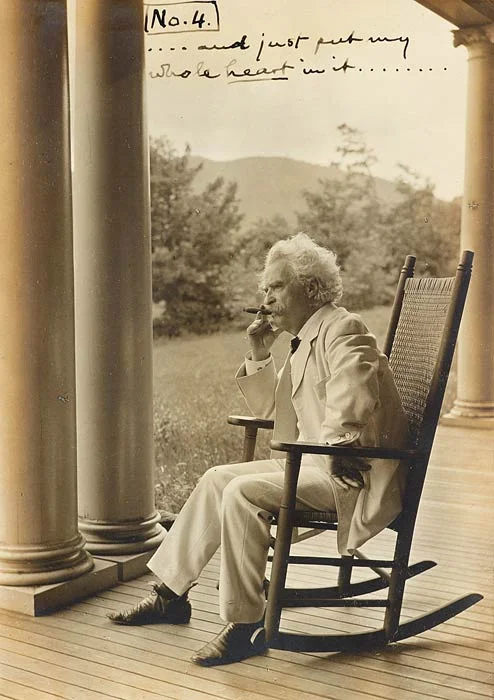
Mark Twain spent two summers in Dublin, and pronounced it his favorite place in the world. Here he is at Dublin’s Mountain View Farm, which he rented in 1906.
Don't trust April

Postcard drawing of the New Milford Public Library, built in 1897-1898, as it appeared c. 1905.
“Rebellion shook an ancient dust,
and bones, bleached dry of rottenness,
Said: Heart, be bitter still, nor trust
The earth, the sky, in their bright dress.’’
— From “April Mortality,’’ by Leonie Adams (1899-1988). She spent her later years in New Milford, Conn.
Genetically engineered American Chestnut Trees
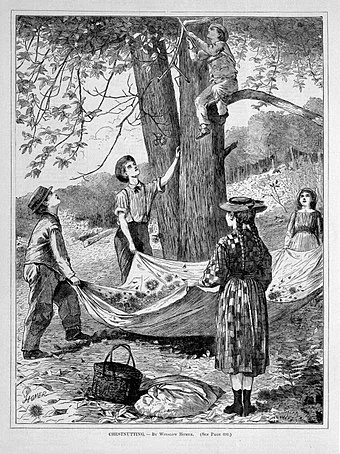
“Chesnutting’’ (wood engraving) , by Winslow Homer (1836-1910).
From Robert Whitcomb’s “Digital Diary,’’ in GoLocal24.com
A March 31 story in GoLocal headlined “Battle Over Chestnuts: Genetic Engineering Prompts American Chestnut Foundation Resignations’’ discussed a debate in that organization over its support of planting American Chestnut Trees that have been genetically engineered by inserting a wheat gene into the chestnuts. In the 20th Century, a blight from China killed most of these once very common trees; they were virtually extinct by 1950, though I remember a still-beautiful one in my home town in the 50s. (Don’t confuse these trees with the also beautiful Horse Chestnut Tree, by the way.)
To help save the American Chestnut, arborists started using a technique (not the one above) called backcross breeding, in which one or a few genes controlling a specific trait of a species are transferred from one genetic line into a second. This has helped lead to a renaissance of the trees in some places.
Foes of the controversial genetic-engineering plan note that there are no long-term studies of the impacts of this sort of thing on forests, wildlife pollinators or humans. So why not avoid the wheat-gene tool, at least for a while? Of course, some jurisdictions will allow it, and the effects will spread in the wild. But pushing back seems honorable given the uncertainty around genetic modification in the wild.
Now if we could bring back the American Elm to its full glory!

American chestnut field trial sapling from the American Chestnut Cooperators Foundation
— Photo by Jaknouse
The eloquence of silence
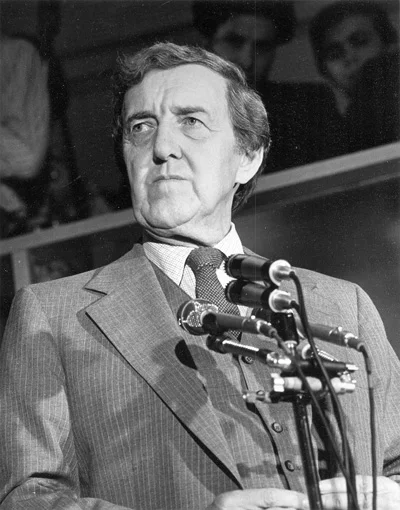
Edmund Muskie
“In Maine we have a saying that there's no point in speaking unless you can improve on silence.’’
— Edmund Muskie (1914-96), served as Maine governor and U.S. senator, as President Carter second secretary of state and as Hubert Humphrey’s vice-presidential running mate in 1968.
Avoiding expensive sins

First Seal of the Massachusetts Bay Colony.
“The New Englander leaves New England / to flaunt his drab person
Before Latin decors / and Asiatic back-drops.
Wearies. / Returns to life, — life tried for a little while.
A poor sort of thing / (filling the stomach; emptying the bowels;
Bothering to speak to friends on the street; / filling the stomach again;
Dancing, drinking, whoring) / forms the tissue of this fabric.-
(Marriage; society; business; charity; - / Life, and life refused.)
The New Englander appraises sins, / and finds them beyond his means, and hoards
Likewise, he seldom spends his goodness / on someone ignoble as he,
But, to make an occasion, he proves himself / that he is equally ignoble.
Then he breaks his fast! / Then he ends his thirsting!
He censors the Judge. / He passes judgment on the Censor. / No language is left.
His lone faculty, Condemnation, -condemned. / Nothing is left to say.
Proclaim an Armistice. / Through Existence, livid, void, / let silence flood.’’
— From “Come Over and Help Us,’’ by John Brooks Wheelwright
“The first seal of Massachusetts Bay Colony showed a nude American Indian with a bush covering his groin. Like the current seal, he held in his hand an arrow pointed down. A scroll came out over his mouth with the words "Come over and help us", emphasizing the missionary and commercial intentions of the original colonists.’’ — Wikipedia
Always good advice

“Leave No Trace,’’ (acrylic and gold metal leaf on canvas), by Pauline Lim, in the Brickbottom Artists Association’s (Somerville, Mass.) annual members’ exhibition, April 18-May 18.
Chris Powell: So what if they have contempt for Trump; licensing cats in Conn.
Do journalists need protection from President Trump and his supporters? Connecticut U.S. Sen. Richard Blumenthal professes to think so.
With two other Democratic members of Congress. New Jersey Sen. Bob Menendez and California Rep. Eric Swalwell, Blumenthal has introduced what they call the Journalist Protection Act, which would make it a federal crime for "to intentionally cause bodily injury to a journalist affecting interstate or foreign commerce in the course of reporting or in a manner designed to intimidate him or her from newsgathering for a media organization."
Trump certainly is heaping contempt on news organizations, if no more than many news organizations are heaping contempt on him. For purposes of the law it hardly matters who is right, for each side is free to express contempt and even lie about the other short of the very limited actionable forms of libel. While this worsens political polarization and may help people rationalize political violence, there is no need for the Journalist Protection Act. The proposal is just another dreary episode of the political posturing that turns government into a big charade.
Journalists reporting sensitive matters have always been vulnerable to retaliation, but there is no epidemic of assaults on journalists in the United States.
Enacting federal law to criminalize what is already against state law everywhere, as ordinary assault is, would be needed only if a state was refusing to provide equal protection of the law, as segregationist states long failed to protect black people, condoning beatings and lynchings. But there is no evidence that the basic criminal law in any state has been so corrupted by the country's bitter politics that equal protection is in danger.
Besides, constitutional guarantees of free speech and press do not belong exclusively to people making a living from journalism. To the contrary, the right of free expression belongs to [ITALICS] everyone, [END ITALICS] so journalism is not a profession but everyone's [ITALICS] right. [END ITALICS] Journalists neither need nor deserve special protection because [ITALICS] anyone [END ITALICS] can be a journalist at any time. Since the invention of paper and then movable type, journalism always has been relatively easy to attempt, and now, thanks to the internet, everyone can instantly become a journalist with a potentially worldwide audience.
If enacted the Journalist Protection Act will provide no real protection to anyone, but then it's not meant to. It's meant only to remind the Trump haters in Trump-hating states that the bill's sponsors still hate Trump too. They could have said as much in a press release and avoided the expense of drafting legislation.
xxx

PREYING ON PETS: As if it's not enough to impose tolls on Connecticut's highways and eliminate a score of sales tax exemptions, legislation has been introduced in the General Assembly to license cats and charge $15 to anyone who adopts a cat or dog from a municipal shelter.
Yes, municipal shelters cost a little money but people who adopt the orphaned creatures save municipal government the expense of caring for them or euthanizing them. The cats-and-dogs bill should be tabled at least until, say, the salary of the president of the University of Connecticut is capped at the salary of the president of the United States, $400,000 a year, and state and municipal employees are no longer paid to stay home on Columbus Day while taxpayers drag themselves to work.
Chris Powell is a columnist for the Journal Inquirer, in Manchester, Connecticut.

Don Pesci: On the decline of political rhetoric; reaffirm subsidiarity
FDR nemesis Clare Booth Luce, famous wit.
VERNON, Conn.
One of my college professors – let’s call him Stringfellow – spoke in long, flowing sentences, each of which might easily have been parsed into sparkling separate mini-poems. He liked Faulkner, disliked Hemingway, and tolerated Tennessee Williams for two reasons. Williams consciously structured some of his plays on classical Greek models – compare Suddenly Last Summer ]with Euripides’s The Bacchae – and Tennessee, he thought, was a name one could conjure with, as Wallace Stevens did adeptly in "Anecdote of the Jar," the first line of which runs, “I placed a jar in Tennessee/ And round it was, upon a hill …”
One day, a student asked Stringfellow – this would have been in the middle 60’s – “When do you plan to join the 20th Century?’ to which Stringfellow replied, “It would be a very wicked thing to wish to be a part of the 20th Century.”
The 20th Century, one of the bloodiest and confused epochs in U.S. history, left us 19 years ago last January.
The professor, students of history will notice, had a point. The century opened with World War 1, followed by World War II, followed by the Korean War, followed by the Vietnam War. And somewhere in there, we heard the Soviet Union crack and crumble, a cause of great rejoicing for nearly everyone but some few academics and willfully perverse journalists.
Every epoch has its dark side, its bloody mysteries. And it is by no means certain that succeeding generations will necessarily improve on their predecessors. In what sense is Atsuro Riley’s poem “The Skillet” an improvement on Alexander Pope’s “Epilogue to the Satires?”
Riley: “Of orange stove-eye (right front) and hawkhooked
pot-hook, overhung. Of (vaporous) supper-hour and
-hurlstorm…”
Pope: “Yes, I am proud; I must be proud to see
Men not afraid of God afraid of me.”
Good writing will be quotable and memorable. Though new, the twittering 21st Century already is eminently forgettable.
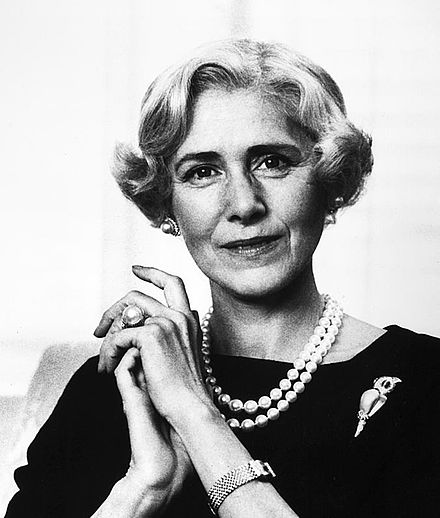
And the same holds true of men and women. When Franklin Roosevelt, campaigning against his tormentor, U.S. Rep. Clare Boothe Luce, of Connecticut, accused Luce of being a "a sharp-tongued glamour girl of forty,” the congresswoman from Fairfield County instantly retorted that Roosevelt was "the only American president who ever lied us into a war because he did not have the political courage to lead us into it." Luce died in 1987, but it is a fair bet she would have considered the tweets of most 21st Century politicians menacingly dumb and forgettable.
True, quotable Churchills are rare in human history, but most modern politicians do not even aspire to the quotability of, say, Adlai Stevenson: “Flattery is all right so long as you don't inhale.”
Pope: “Averse alike to flatter, or offend;/ Not free from faults, nor yet too vain to mend.”
Intelligent, “woke” thought, up until the 21st Century, roundly condemned the flatterers; but this was before flatterers found they could make a dishonorable but highly remunerative living as political consultants and communication directors for political campaigns. Now the disease is everywhere, tolerable only to those who do not inhale.
Stevenson: “The idea that you can merchandise candidates for high office like breakfast cereal - that you can gather votes like box tops - is, I think, the ultimate indignity to the democratic process.”
Stevenson understood the radical difference between sound political policies and what he and politicians before him understood to be disruptive enthusiasms, i.e., campaign slogans parading as realpolitik. “Some people approach every problem with an open mouth,” said Stevenson, a word-perfect picture of U.S. Rep. Alexandria Ocasio-Cortez’s New Green Deal scheme, the latest enthusiasm among Connecticut’s progressive, all-Democratic congressional delegation.
Most voters in the state are affronted by the notion that if they like their cars, they can’t keep them; if they like their houses, they can’t keep them; if they dislike windmills spoiling their scenery, they must have them; if they prefer their town governments to decide the fate of their schools and their communities, this option must not be available to them. These sensible, unbewitched people prefer more democratic solutions to thorny problems, such as: if they do not like their politicians, they should be able to get rid of them pronto!
A restoration of small “r” republican government must entail a reaffirmation of the doctrine of subsidiarity, which holds that political units closest to those affected by political decisions should prevail in making the decisions: fathers and mothers should decide the fate of their families; owners of businesses should decide the fate of their commercial enterprises; neighbors should decide the fate of their neighbors, towns should decide the fate of their municipalities; and both state and nation should busy themselves with facilitating small “r” republican government.
As to whether Connecticut is progressing or regressing politically, consider the following quote that, like a geyser of authoritarian presumption, issued from Connecticut’s progressive Speaker of the State House of Representatives, his Excellency Joe Aresimowicz. Responding to a non-binding resolution disapproving of tolls issued by towns and cities, Aresimowicz condemned such disapproval as “moronic,” an arrogant piece of anti-republican political sniping that could not even survive long as a tweet. “I used the harsh word moronic and I meant it," said Aresimowicz, who later unmeant it.
For the future, here is a useful political rule of thumb: If what you are saying is not edifying, memorable, honorable or quotable – shut up.
Don Pesci is an essayist based in Vernon.
Naked in a new world
![]](https://images.squarespace-cdn.com/content/v1/561446cce4b094b629347f8d/1554673973435-8GG1LS1D2OF8WHBBFE95/440px-Zaubernuss.jpg)
]
“All along the road the reddish
purplish, forked, upstanding, twiggy
stuff of bushes and small trees
with dead, brown leaves under them
leafless vines-
“Lifeless in appearance, sluggish
dazed spring approaches-
“They enter the new world naked,
cold, uncertain of all
save that they enter….’’
- From “Spring and All,’’ by William Carlos Williams
Who are we?

“Myron/Meyer: Erie’’ (archival inkjet print), by Larry Volk, in his April show at Bromfield Gallery, Boston. He engages in photographic explorations of identity.
Chuck Collins: America needs a 'plutocracy prevention' program
Via OtherWords.org
BOSTON
The U.S. is suffering from excessive wealth disorder.
This isn’t your parents’ inequality influenza, but a more virulent strain of extreme disparities of income, wealth, and opportunity.
Just 400 billionaires have as much wealth as nearly two-thirds of American households combined. And just three individuals — Jeff Bezos, Warren Buffet and Bill Gates — have as much wealth as half of all U.S. households put together.
Since the economic meltdown of 2008, the lion’s share of income and wealth growth hasn’t gone just to the top 1 percent — it’s gone to the richest one-tenth of 1 percent. This 0.1 percent includes households with annual incomes starting at $2.2 million and wealth over $20 million.
This group has been the big winner of the last few decades. Its share of national income rose from 6 percent in 1995 to 11 percent in 2015. But their biggest gains are in wealth, increasing their share from 7 percent in 1978 to over 21 percent today.
That’s 210 times their share of the population.
When you have over $20 million, you’ve easily taken care of all your needs and those of the next generation of your family. You’re living in comfort, probably with multiple homes, and don’t want for anything.
It’s at this point we see the telltale signs of excessive wealth disorder. Despite being already comfortable beyond measure, segments of this 0.1 percent will often invest their wealth to rig the political rules to get even more wealth and power.
They contribute the legal maximum donations to politicians and then do an end run around campaign finance laws to siphon even larger sums through “dark money” SuperPACs, using corporate entities that don’t have to disclose donors.
When this donor class demands tax cuts, their political puppets kick into overdrive to deliver the goods.
The 0.1 percenters create charitable foundations that become extensions of their own power and privilege. They undermine the health of the nonprofit sector by controlling a growing share of the charitable giving pie.
They deploy their wealth to help their kids get into elite colleges, both through donations and, as we’ve seen recently, outright bribery.
It’s clear the rest of society needs to intervene. Excessive wealth disorder is wrecking life for the rest of us.
What can we do? We need to put forward a “plutocracy prevention program” — public policies to reduce the power of this top 0.1 percent group.
Some presidential candidates are stepping forward with bold ideas. Senator Elizabeth Warren’s wealth tax idea is a courageous step in this direction. She’s proposed a 2 percent annual tax on wealth over $50 million, with a 3 percent rate on wealth over $1 billion.
Progressive Democrats have proposed raising the top marginal tax rate to 70 percent on households with incomes over $10 million. Senators Kamala Harris and Bernie Sanders both have proposals to make the estate tax more progressive and slow the accumulation of dynastic wealth.
Polls show widespread popular support for these proposals. All of them face steep sledding in a Congress beholden to the top 0.1 percent donor class.
One first step might be a proposal that exclusively targets the 0.1 percent class. How about a 10 percent income surtax on incomes over $2 million, including capital gains?
That’s not as steep as a 70 percent marginal rate, but it would move us in the right direction. It would raise substantial revenue — an estimated $70 billion a year and $750 billion over the next decade — from those with the greatest capacity to pay.
Bringing such a proposal to a vote would require lawmakers to make a clear choice: Are you with the vast majority of voters who believe the super-rich should pay more? Or are you carrying water for the richest 0.1 percent?
Chuck Collins, who is based in Boston, directs the Program on Inequality at the Institute for Policy Studies.

Chris Powell: Hartford mayor's brilliant fiscal overloading; will extortionist ex-mayor return?
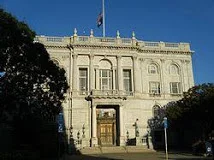
Hartford’s Beaux-Arts City Hall.
Hartford could do worse than give Luke Bronin another term as mayor, as those who live outside the capital city may realize from former Mayor Eddie Perez's candidacy to return to City Hall.
A decade ago Perez got caught taking kickbacks from a city contractor and was convicted in state court of bribery by extortion. In case anyone had forgotten this, just a few weeks ago Superior Court Judge Cesar A. Noble revoked Perez's city pension. Perez's misconduct, the judge wrote, was "severe" and had caused people to lose confidence in the honesty and integrity of elected officials.
The judge may have overstated expectations of honesty and integrity in government, but at least Bronin seems to have run a clean administration, insofar as it can be done in Hartford. In any case he has performed a spectacular and lasting service to the city. That is, Bronin helped former Gov. Dannel P. Malloy snooker the General Assembly into passing legislation transferring to the state the city's more than $500 million in bonded debt, a measure legislators said they understood to be doing no more than giving the city $40 million in emergency aid. It may have been the Brink's Job of Connecticut politics.
The state's assumption of Hartford's debt will be worth millions of dollars to the city in interest payments every year, tens of millions over time. Of course this will cost state taxpayers the same amount. Governor Lamont's "debt diet" won't help; the damage has been done.
Will Bronin's re-election campaign tout the debt transfer? The mayor's boasting about it may not make friends for the city, but the people who were snookered can't vote there. While by seeking concessions Bronin has alienated the unions representing city government's employees, the debt transfer will save the city far more than concessions ever would. Somebody in Hartford should be grateful for that.
Perez isn't Bronin's only challenger but he is the best known and the only Hispanic in the race, which may mean something to voters if corruption doesn't. Like politics in Bridgeport, politics in Hartford is so grubby and grasping that city voters may consider corruption merely incidental, as voters in Bridgeport did when they re-elected Joe Ganim as mayor four years ago despite his conviction for bribery and extortion and his long imprisonment.
Ganim and Perez are Democrats and it already has been fun to watch Connecticut's Democratic leaders dance around an extortionist's return to power in the state's largest city. Imagine the awkwardness that might ensue if the capital city vindicated another extortionist.
But power will help the Democrats get over it, leaving the challenge to those remaining in the state who would prefer preserving some standards in public life.
That is, what does it say about the last half century of urban policy in Connecticut that city voters have such low aspirations or are so indifferent to integrity in government?
Could Eddie Perez's return to Hartford City Hall shock anyone in authority into suspecting that the state's urban policy doesn't work, that it just impoverishes, degrades, breeds dependence on government, and nurtures corruption? Could Perez's return even shock anyone in authority into suspecting that urban policy \ does work because it is meant to do those things, since they are so lucrative in politics?
Chris Powell is a columnist for the Journal Inquirer, in Manchester, Conn.