
Vox clamantis in deserto




To the Sailing Capital

From Robert Whitcomb’s “Digital Diary, in GoLocal24.com
‘This is as it should be: The National Sailing Hall of Fame will move from Annapolis, Md., to Newport, where the institution will be housed in the Thames Street Armory Building, most of which will be owned by the Hall of Fame. The city will retain ownership of the Newport Maritime Center in the basement but the retail operations in the old building will have to go.
As a major international sailing and yachting center, the former long-time base of the America’s Cup races, one of the two homes of the New York Yacht Club and a storied port dating back to the 17th Century, Newport should have always been the home of the Sailing Hall of Fame. And, after all, the City by the Sea is on the, well, breezy sea, and not, like Annapolis, on the inner reaches of fetid Chesapeake Bay, much of which is virtually inland.
The city will retain ownership of the Newport Maritime Center in the basement.
So now Newport will have two major Halls of Fame, with the National Sailing Hall of Fame joining the International Tennis Hall of Fame - institutions honoring two sports traditionally associated with wealth in a city with a long romance with great private riches.

David Warsh: On the failure of markets
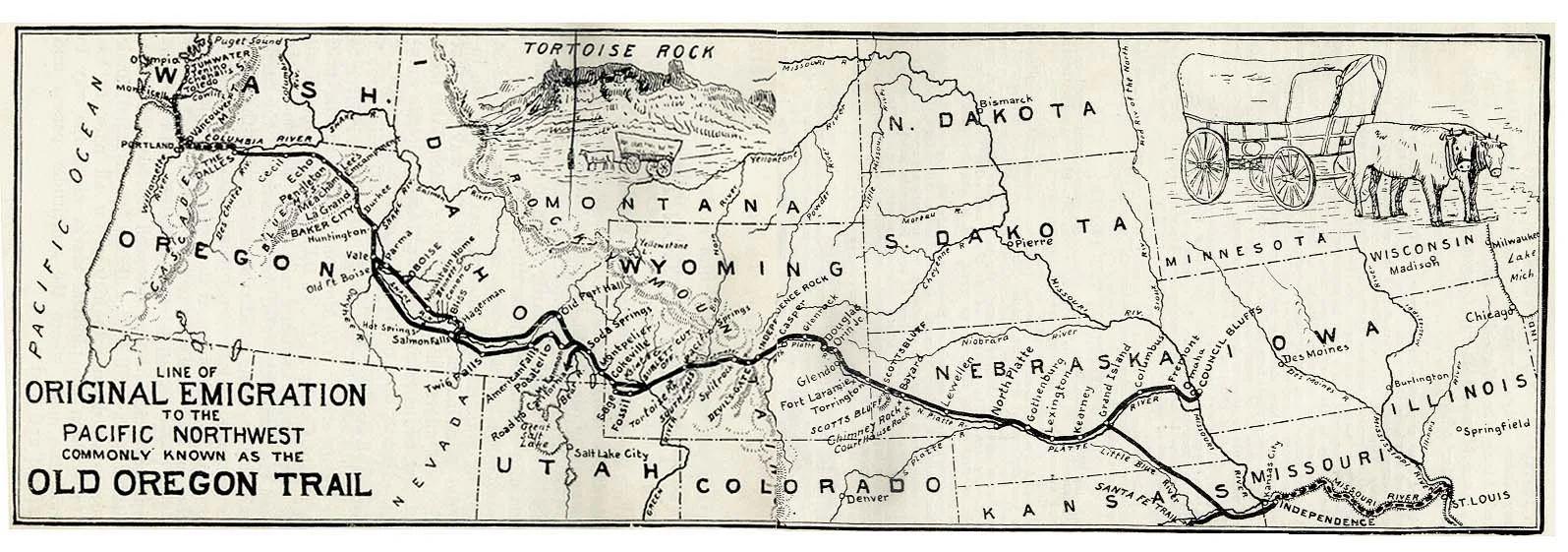
Note Independence near the border with Kansas.
As especially interesting place to visit is Independence, Mo., 250 miles up the Missouri River from the Mississippi. It was nothing more than a river bank in 1804, when the Lewis and Clark expedition stopped overnight to pick wild plums, apples and raspberries. Mormons began to settle in the little frontier town in 1831, and by 1840, you could stand by the gate of the marshalling yard and contemplate the junction of all three main wagon routes to the west: the Oregon Trail, the California Trail and the Santa Fe Trail.
Something of the sort may have been in the back of the minds of the Nobel Committee when they designated William Nordhaus and Paul Romer recipients of the 2018 Swedish Central Bank Prize for Economic Sciences in Memory of Alfred Nobel. By unexpectedly linking the two, each of whom could have been cited separately, the Scandinavians got people thinking and writing about subjects not yet well-connected in the popular mind. Nordhaus is an environmental economist. Romer is a theorist of economic growth.
The link that the prize awarders emphasized was the researchers’ shared concern with the failure of markets to deliver desired results. These are known as externalities, the effect that certain kinds of transactions have on persons who were not involved in the deal. These so-called “market failures” may be negative, as with greenhouse-gas emissions that adversely affect the global climate, or they may be positive, as with the knowledge spillovers that occur when technological know-how is widely shared.
Nordhaus has built models with extensive links to physical science models to gauge the social costs of atmospheric pollution. Romer has deepened and broadened the argument for policies in support of education, for the sharing of intellectual property, and for thoughtful zoning. Much the best discussion of the ins and outs of the laureates’ work that I have seen is by Kevin Ryan, a professor at the University of Toronto’s Rotman School of Management.
I wrote about some part of this story many years ago in Knowledge and the Wealth of Nations: A Story of Economic Discovery (Norton, 2006). Over the next couple of months I thought I might scatter half a dozen weeklies updating the story as best I can in light of the 2018 prize. It will be a welcome alternative to hashing over the election news.
The single most important message of the shared work is to show how modern mixed-market economies can cope with the exigencies of continued economic growth without a lot of regulation. Carbon taxes, on the one hand, government support for long-term research and development of green technologies on the other, can limit the damage to the Earth that is already in train, and, eventually, even roll back some of the enormous quantity of carbon dioxide that pell-mell growth over two centuries has dumped in the atmosphere.
True, the way ahead is more fraught with peril than were those trails to the Pacific Ocean. But humankind’s inventiveness has grown. What is lacking, so far, is cohesion.
David Warsh, an economic historian and veteran columnist, is proprietor of Somerville, Mass.-based economicprincipals.com, where this essay first ran.
Chris Powell: Obsession with ancestry suggests emptiness inside
Lost in the family tree.,
Why is there such growing fascination with ancestry? Not everyone can trade on it for professional and political advancement as Massachusetts Sen. Elizabeth Warren has been doing, falsely claiming association with an oppressed ethnic group, Native Americans.
Expecting to triumph in her feud with President Trump, Warren the other day publicized her DNA test results as if they vindicated her opportunism. But the test showed she was no more Native American than the typical Connecticut casino Indian -- that is, only distantly related by blood and not at all by upbringing, culture, and experience, which are infinitely more important in forming character. Upbringing, culture, and experience may be relevant to a political candidacy because of their influence on character, but nobody needs a DNA test to discover them, since they are only what someone has lived through.
Apparently that's not enough for many people these days. They seem to believe the advertising that DNA testing will tell them who they really are, though their DNA may be completely different from their upbringing, culture, and experience. This fascination implies a certain emptiness in the psyche.
Maybe the grass is always greener not only next door but also with another ethnic group or life. At least when people imagine past lives, there are always more ancient Egyptian princesses than sweating slaves getting whipped for not moving the bricks up the ramp of the pyramid fast enough. This longing may be human nature, but the only sure thing about ancestry is that, as the old saying goes, if you track yours back far enough you'll find a horse thief.
xxx
COMMUTERS ALREADY PAY: Fending off a call from the Connecticut state Senate's Republican leader, Len Fasano, of North Haven, for an audit of New Haven city government, Mayor Toni Harp last week only confirmed that an audit might be useful.
Harp, a Democrat, suggested that Fasano, who represents suburban towns, has no business questioning city government's operations. But the mayor added that she would consider an audit if Fasano supported imposing a 2 percent tax on the incomes of suburban residents who work in the city and use its infrastructure.
Harp's dodge was pathetic. For state government already reimburses New Haven and other cities up to half their budgets, and most of this reimbursement is drawn from income taxes on suburban residents. Most suburbs don't receive anything close to such financial support from state government. So suburbanites already are paying what is in effect a commuter tax.
That's why even though they don't always realize it, suburban residents have a powerful interest in the efficiency and integrity of city government throughout the state. Resenting that interest, Mayor Harp has dared state taxpayers to reduce their subsidy to New Haven until her attitude and accountability improve.
xxx
SYMPATHY FOR THE DEVIL: The Democratic nominee for governor, Ned Lamont, has given reporters a look at his tax return, which shows that he is fabulously rich. The Republican nominee, Bob Stefanowski, has not yet disclosed his return but has spent enough of his own money on his campaign to establish that he is at least wealthy enough to live in Madison. Unaffiliated candidate Oz Griebel's return shows he is financially comfortable if not a plutocrat like his rivals.
So all three could do something more fun than running for governor in hard times and thus seeking to become the most hated person in the state, as the next governor will become. Despite their posturing, dissembling, and evasion, a little sympathy may be in order.
Chris Powell is a columnist for the Journal Inquirer, in Manchester, Conn.
Regulating electric scooters

From Robert Whitcomb’s “Digital Diary,’’ in GoLocal24.com
As electric bikes and scooters become more common in Providence and other cities, municipal officials should follow what’s happening in San Francisco, where the city’s Municipal Transportation Agency has designated two scooter companies – Skip and Scoot -- to start a pilot regulated scooter system in the very hilly and congested city.
One big issue: Keeping parked scooters off sidewalks by trying to ensure that they’re attached to existing bike-locking gear. People get cranky when they see abandoned electric scooters and bikes just lying around, sometimes blocking sidewalks and even streets. Cities and personal-transportation companies such as Skip and Scoot need hot lines that people can call to report abandoned bikes and scooters.
Other questions for cities and states: What should be the extent of dedicated personal-vehicle- lane networks? Who should regulate these vehicles? The state or communities? Should helmets be mandatory?
The arrival of these small electric vehicles is good news for cities seeking to limit car congestion and the pollution that cars cause. But much needs to be done to systemize their use to maximize their efficiency and safety.
To read more about what they’re doing in San Francisco, please hit this link.
A Puritan prince
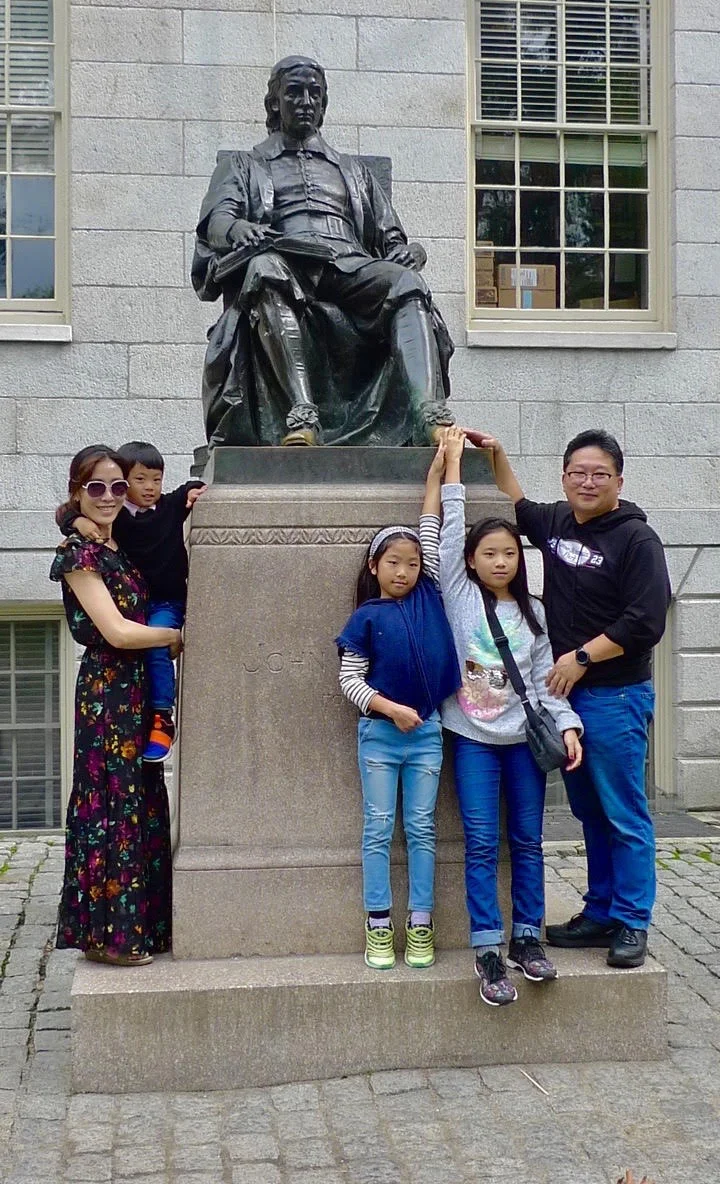
Family at the statute of Harvard benefactor John Harvard (1607-1638) in Harvard Yard.
— Photo by William Morgan
Wait till next year!

"For the second year in a row
I’ve let things go, neglected the golden
Platter-size leaves the maples discarded
All through golden October, that layered themselves
To a four weeks’ deepness, the days and long nights of October
Dense with the soft undertones of their falling.''
-- From "Raking the Leaves,'' by John Engels (1931-2007), a Vermont poet.
'Inflexibly territorial'

The harbor of Cutler, Maine, in late fall. The tiny town is way Downeast.
“Many small towns I know in Maine are as tight-knit and interdependent as those I associate with rural communities in India or China; with deep roots and old loyalties, skeptical of authority, they are proud and inflexibly territorial.’’
— Novelist and travel writer Paul Theroux
Affirmative action for the affluent!
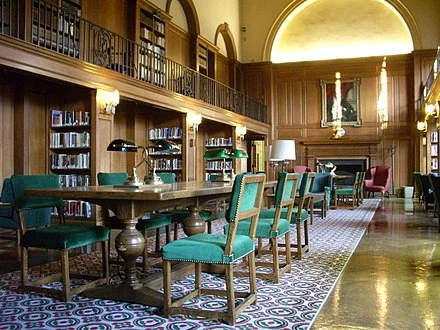
Tower Room in the Baker Memorial Library at Dartmouth College.
From Robert Whitcomb’s “Digital Diary,’’ in GoLocal24.com
“Americans are the only people in the world known to me whose status anxiety prompts them to advertise their college and university affiliations on the rear window of their automobiles.’’
-- The late Paul Fussell
The federal government is suing Harvard as part of the Trump administration’s drive against affirmative action in college admissions (and elsewhere). Its angle is to assert that Asian-Americans, many of whom have very strong high-school records, should be admitted in higher percentages. What is left unspoken is that the Trump plan is also meant to help white applicants, who, at least in part because they tend to come from more privileged backgrounds than African-Americans and Hispanics, also tend to have better high-school records.
I think that the Feds should bug out of the college-admissions controversy. All elite colleges, including all eight Ivy League schools, use a wide variety of criteria to try to make sure that their undergraduate student bodies have at least a vague resemblance to the population of the nation that these schools have served very well. Indeed, the schools are jewels of American culture, having helped to produce much cultural, technological and financial wealth. Consider the scientific breakthroughs in the institutions’ labs.
Anyway, despite the schools’ efforts at affirmative action, students from affluent backgrounds (overwhelmingly white) dominate these schools because of the economic, educational and social advantages (including better public and private schools) they’ve grown up with. Students must be careful to pick the right parents! If the administration wins, the colleges will be even more skewed to the rich. Such skewing is what helped Jared Kushner get into Harvard despite a mediocre high-school record. Daddy wrote a check to America’s oldest college for $2.5 million. And Donald Trump’s transfer to the University of Pennsylvania from Fordham was lubricated by his father’s wealth.
As this Bloomberg story reported:
“A Harvard dean was thrilled. The undergraduate college had just admitted the offspring of some wealthy donors, and now the money was expected to pour into the university.
"’I am simply thrilled about all the folks you were able to admit,’ David Ellwood, then the dean of {Harvard’s} John F. Kennedy School of Government, wrote to {Harvard College} Dean William Fitzsimmons on June 11, 2014. ‘All big wins. [Name redacted] has already committed to building and building. [Name redacted] and [name redacted] committed major money for fellowships -- before the decisions (from you) and are all likely to be prominent in the future. Most importantly, I think these will be superb additions to the class."
There will always be affirmative action for the rich, even at Harvard, with a $39 billion endowment.
Oh, well: Not all the big donors’ gifts go to putting up grandiose buildings with their names plastered on them and endowed professors’ chairs, also with donors’ names plastered on them. Some goes to fellowships and scholarships.
To read more, please hit this link.
Llewellyn King: Around the world, fearfully/hopefully walking toward a border

The start of the border fence in the state of New Mexico—just west of El Paso, Texas.
If you want to come to the United States illegally, the worst point of entry is along the southern border. If the U.S. Border Patrol doesn’t get you, the gangs that prey on the hapless might; if not, you have a good chance of dying of heat prostration and lack of food and water in the desert.
The smart ones, the conniving illegals, aren’t the destitute walking in blazing heat for a rendezvous with Border Patrol agents and then lord knows what, but those who fly in with student visas, tourist visas and other travel documents and disappear into the shadows.
The people in what is loosely called a “caravan” now walking toward the border have been failed by the societies that bore them. They live in fear of murder, fear of repeated rape and other violence and fear of starvation. They live in their own circle of hell.
But they aren’t alone. There are many millions more in the failed and failing states, war-ravaged and drought-plagued, in Africa and the Middle East, trying to find a new home. Their exodus is a trickle today but will be a torrent tomorrow and a flood later.
The hopeless are on the march and they threaten to engulf some nations, like tiny Malta, an island in the Mediterranean and a European Union member state.
Europe is struggling with a flood of desperate people who cross the Mediterranean from North Africa in overloaded rafts and boats, risking drowning to reach Malta, Greece or Italy: places where they hope for food, shelter and safety.
Illegal immigration is a global problem. No country has a solution and no country deals well with it.
There are wars and insurgencies in Africa and the Middle East: Consider just the Democratic Republic of the Congo and South Sudan.
Of Africa’s 54 countries, none has anything like enough jobs for its population –its growing population. Even rich South Africa has a growing population and shrinking economic activity. Add to the failed or under-performing economies drought and climate change and you can imagine new surges in migration -- surges so large they could overwhelm the target countries.
In the Middle East, new refugees are created daily. Eleven million are on the brink of famine in war-engulfed Yemen, and Syria continues to generate refugees at a stupendous rate.
Thirty-five years ago, I was at France’s Ministry for Europe and Foreign Affairs, known colloquially as the Quai d’Orsay for its address. My briefer said, “If we don’t solve the problem of poverty, we’ll get three imports we don’t want: drugs, terrorism and people.”
The world hasn’t solved the poverty problem and it’s gotten the three things it doesn’t want.
There is no grand solution at hand, but there are small things that can be done. For us, the first might be to stop worsening conditions in the countries that are generating the flows of people toward the border. Two things would help: Don’t cut off foreign aid, exacerbating economic conditions, and don’t cut off the flow of expatriate earnings that is so important in those countries. In other words, stop the deportations.
People who are here illegally and hold jobs would hold better jobs if their status was legalized. One solution would be time-limited work permits: not citizenship, work permits.
This is advocated by the Immigrant Tax Inquiry Group, which adds an appealing twist. The Malibu, Calif.-based group recommends that illegals should pay a special tax on their wages with an equivalent tax paid by the employer. The purpose of the tax is to alleviate the local impact of immigrants on schools, policing, courts and health care.
Considering the global problem, we have a small, manageable one. The caravan of people walking through Mexico have a bigger problem: They’re inflaming Americans and endangering their own lives -- some deaths have been reported.
But if I were destitute and feared for my life in Central America, I’d likely be headed for the border, feeling I was doing something, even something hopeless.
Llewellyn King is executive producer and host of White House Chronicle, on PBS. His email is llewellynking1@gmail.com. He is based in Rhode Island and Washington, D.C.
'That's what we do' in Vermont

“For much of America, the all-American values depicted in Norman Rockwell's classic illustrations are idealistic. For those of us from Vermont, they're realistic. That's what we do’’
— U.S. Sen. Bernie Sanders (I-Vt.)
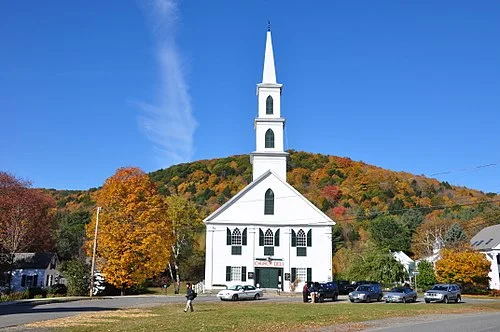
In Newfane, Vt.
Wind pays off

Deepwater Wind’s Block Island Wind Farm.
From Robert Whitcomb’s “Digital Diary,’’ in GoLocal24.com
The Danish energy company Orsted’s purchase of Providence-based Deepwater Wind from D.E. Shaw & Co., an investment company, for $510 million certainly testifies to the growing value of wind power, especially in the reliably wind-rich area off southern New England. Congratulations to the Deepwater Wind folks for their visionary and complicated risk-taking -- economically, technologically, politically and regulatorily.
I noted that the companies said that, Deepwater, now a subsidiary, would be based in Providence and in Boston; the latter city is where Orsted’s North American operations are based. But I predict that soon the Providence office will be closed and everything will be run from Boston (and Denmark). As a PR move in acquisitions, companies often assert that much important stuff will remain in the home town of the acquired entity. But the savings and efficiencies from consolidation almost always trump such sweet ideas sooner rather than later.
If anything, Newport, not Providence, might be the best town for a second headquarters: It’s closer to planned big wind farms south of New England. And Aquidneck Island, like Greater Providence, has lots of engineers.
By the way, wind turbines, though far, far better than burning fossil fuel, can raise air temperatures in wind-farm areas by half a degree or more by interrupting wind flows, say recent studies. All energy production has downsides. Consider, for example, that solar arrays require a lot of space, which leads to clearing woodlands in some places. Abandoned big-box store parking lots and landfills are among the best sites, besides rooftops, of course.
Tradition and transformation in N.E., higher education
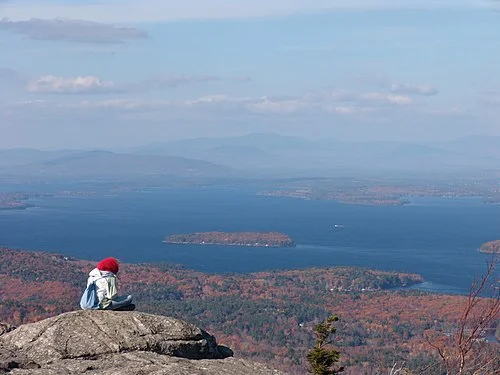
Lake Winnipesaukee, from the top of Mt. Major.
From the New England Board of Higher Education (nebhe.org)
NEBHE convened its Annual Fall Board Meeting near Lake Winnipesaukee, in New Hampshire, in September on the overarching themes of “Tradition, Transition and Transformation: Sustaining New England’s Higher Education Industry and Advantage.”
Over two days, NEBHE delegates explored the impact of changing demography, declining enrollments and opportunities for “demand cultivation” and strategies to sustain higher education’s financial sustainability in the region.
NEBHE has examined these issues in recent years as part of its Higher Education Innovation Challenge (HEIC). These challenges continue to come into sharper focus, as state and federal investment in higher education lags, public perceptions of higher ed change, and enrollment projections increase the focus at many higher education institutions on financial sustainability and new ways of doing business. Many institutions are considering opportunities with new student segments, including adults, and international students (the latter made more challenging by the current climate of global politics and immigration). Other institutions are exploring new program models such as shortened time to degrees, badges and other credentials.
At Winnipesaukee, delegates focused on opportunity. They charged NEBHE with supporting regional efforts to provide data on nontraditional, underserved, immigrant, adult students in New England, and developing a clearinghouse of best practices and policies to drive enrollment and completion. They called on NEBHE to develop strategies to engage with PK-12, including career and technical education, to reduce barriers to matriculation, specifically in urban and rural areas via early college, dual enrollment and college readiness initiatives. NEBHE delegates also urged examining the return on investment (ROI) of postsecondary credentials to adult students and the institutions serving them.
NEBHE staff developed various short documents to inform the board's discussion, including "Projecting Higher Education Supply and Demand." This report examines the projected decline in high school graduates and its impact on higher education enrollment.
During a session focused on "Policy, Regulation and Accreditation," attendees spoke of pursuing shared marketing and recruitment strategies to support growth in demand and participation in postsecondary education in the region. Among the favored options: expanded use of credit for prior learning to bolster student markets and improved transfer of prior credits and other credentials. Delegates also endorsed engaging employers and policymakers to review student debt forgiveness policies and expanding targeted student aid programs (and 529 plans) to retain college-going students who are currently being tempted away from New England by less expensive institutions, especially in the South.
Other key recommendations that emerged from the discussions included: increase the minimum wage (which one presenter noted as the past year's most important policy move enhancing college-going and completion for working learners) and explore paid work and internship options for adult students.
The NEBHE delegates also urged development of new models of cost savings across institutions and sectors, including Open Education Resources (OER) and additional strategic alliances to support the shared provision of academic and other activities among multiple institutions.
NEBHE delegates continued their review of a “Call to Action,” which cites the need for new models to address challenges and opportunities facing the New England higher education sector. After a productive group drafting process, delegates agreed to revisit such a communique for sharing with stakeholders in education, business, policy and other relevant sectors.
A meeting of NEBHE's Legislative Advisory Committee (LAC) focused on higher education cost drivers, as well as issues ranging from funding early childhood education to addressing teacher shortages to free college plans to ensuring civility in the halls of government in an age of term limits.
NEBHE also took the opportunity to present Excellence Awards to former New Hampshire Director of Higher Education and University System of New Hampshire (USNH) Chancellor Edward MacKay and Nashua Community College President Lucille Jordan. MacKay and Jordan were joined by a large group of invited guests, including a notable number of presidents and leaders of New Hampshire’s public and independent higher education institutions.

Judith Graham: Tons of patients' data but hard for them to get at
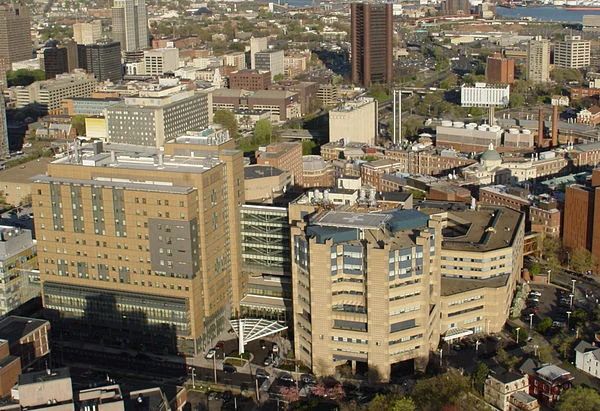
Yale New Haven Hospital, the main clinical teaching facility of the Yale Medical School.
By JUDITH GRAHAM
Medical records can be hard for patients to get, even in this digital information age. But they shouldn’t be: Federal law guarantees that people have a right to see and obtain a copy of their medical records.
New evidence of barriers to exercising this right comes from a study of 83 leading hospitals by researchers at Yale University. Late last year, researchers collected forms that patients use to request records from each hospital. Then, researchers called the hospitals and asked how to get records, the cost of doing so, how long it would take, the format in which information would be sent and whether the entire record would be available.
Researchers didn’t disclose they were conducting an academic study; instead, they posed as a relative asking questions on behalf of a grandmother who needed her records before seeking a second opinion. Family members make such requests on behalf of older relatives every day.
Hospitals’ answers were inconsistent: In many cases, the information on forms didn’t match what researchers were told on the phone. Sometimes their answers violated federal or state legal requirements.
Notably, only 53 percent of hospitals’ forms indicated patients could get their complete records. This right was acknowledged in all the phone calls. Forty-three percent of hospital forms didn’t disclose the estimated cost of obtaining records, as required. In phone calls, all but one hospital disclosed costs, but 59 percent cited a higher-than-government-recommended fee for electronic records.
“The unfortunate truth is that the system doesn’t give patients reliable or consistent responses. And some people who work in medical records departments appear to be ignorant of the law and the rights that patients have,” said Dr. Harlan Krumholz, co-author of the study and professor of medicine, epidemiology and public health at the Yale University School of Medicine.
Under a groundbreaking law, the Health Insurance Portability and Accountability Act of 1996 (HIPAA), patients have a right to get some or all of their medical records upon request. (Psychotherapy notes can be excluded.) Hospitals, medical clinics, physician practices, pharmacies and health insurers are required to make this information available within 30 days (sometimes a 30-day extension can be granted), at a reasonable cost and in the format that patients request (for instance, paper copy, fax, electronic copy or CD), if possible.
Research suggests that reviewing medical records can be beneficial. People are more likely to follow treatment recommendations, remember what happened at medical visits and feel engaged in their care when they have access to this information, studies indicate..
But HIPAA requirements are often misunderstood. Jacqueline O’Doherty, a geriatric care manager with Health Care Connect LLC, of Califon, N.J., encountered this last month when she tried to see records for an 80-year-old client who was being transferred from a hospital to a nearby rehabilitation facility after suffering acute respiratory distress.
Although the older woman had signed a form appointing O’Doherty as a “designated representative” — a status that should have allowed O’Doherty access to her clients’ records — a hospital nurse refused to let O’Doherty check the client’s lab results, medication list and discharge summary. It was only when an infectious-disease doctor intervened, citing the need for continuity of care, that O’Doherty was able to review her client’s records.
“It really depends on the institution, what they will and won’t let you do,” O’Doherty said.
After receiving a large volume of complaints about records’ cost and accessibility, the Office for Civil Rights of the U.S. Department of Health and Human Services, issued new guidelines in January 2016. For electronic records, the guidelines prohibit per-page charges and recommend a maximum cost of $6.50 for consumers. They also clarify patients’ right to have records sent to third parties, including family members or professionals advocating on their behalf.
Despite these protections, the forms used to request records aren’t standardized and can be confusing. Often it’s not clear what is being offered. “As a person who works in the health care system, even I had trouble understanding the forms and what I could request based on the options listed,” said Carolyn Lye, a medical and law student at Yale who did much of the legwork for the new study.
Problems may be even more common at physician practices, which often don’t have medical records departments. When GetMyHealthData, a campaign to expand access to digital health information, asked consumers about their experience, people described poorly informed or unhelpful staff, high fees, long waits and frustrating bureaucratic processes, among other barriers.
“People are being told ‘No I can’t give this to you’” because office staff, nurses and doctors “don’t know what they can or cannot do,” said Pamela Lane, vice president of policy and government relations for the American Health Information Management Association.
Electronic patient portals don’t solve the problem yet: Most contain limited information and don’t currently include a way for patients to request records such as the notes physicians take during patient visits. “We’re slowly moving in that direction, but we’re not there yet,” said Catherine DesRoches, executive director of OpenNotes, an organization devoted to making doctors’ and nurses’ notes more readily available to patients.
The government is making improved electronic access to medical records a priority through its new MyHealthEData Initiative, announced earlier this year. Full details of the initiative are not yet available. But Seema Verma, administrator of the Centers for Medicare & Medicaid Services, has repeatedly called for people with Medicare coverage to have better access to their records. In an unusual move, she spoke out on Twitter about the Yale study, calling its findings “not acceptable.”
What can people do if they encounter problems like those documented by the Yale researchers?
If your hospital or doctor’s office declines to make your records available, print out materials about your rights and use them to advocate on your behalf. “Tell staff, ‘I’m entitled to a copy of my records: This is my legal right, as explained here,’” Lane said.
A good resource is a model medical records release form created by the American Health Information Management Association last year, which people can copy and bring with them to help make their case, Lane said. A summary of your right to share medical information with family, friends or other authorized third parties can be found here.
To familiarize yourself with your overall rights, see this “Guide to Getting & Using Your Health Records” published by the government’s Office of the National Coordinator for Health Information Technology. And take a look at the “Get Your Data” section of the GetMyHealthData website, which includes a clear summary of your rights, how to request your medical records, and troubleshooting suggestions if you encounter obstacles. A helpful two-page summary is available here.
The eternal question

“Untitled” (letter press), by Sofie Hodara, in her joint show with Martha Rettig, “In Pursuit of Happiness,’’ at Bromfield Gallery, Boston, through Oct. 28.
Ambiguous 'promised land'

Mt Wachusett, in central Massachusetts, and at 2006 feet high the highest point in the state east of the Connecticut. River.
“Ephraim Cross drives up the trail
From Worcester. Hepsibah goes pale
At sumac feathers in the pines.
….Pine to birch
The hills change color. In the west
Wachusett humps a stubborn crest.
Ephraim takes the promised land,
Earth, rock and rubble, in his hand.’’
— From the “1750’’ part of “The Farm,’’ by Archibald MacLeish (1892-1992)
Wachusett is a monadnock: a single mountain on a relatively flat landscape. The word monadnock comes from a similarly isolated mountain, Mt. Monadnock, in southern New Hampshire.
Wachusett is a popular hiking and skiing destination, in part because it’s so near to cities. An automobile road, open spring to fall, ascends to the summit. Views from the top include Mt. Monadnock to the north, Mt. Greylock to the west, southern Vermont to the northwest, and Boston to the east.
Massachusetts's three traditional 'social estates'
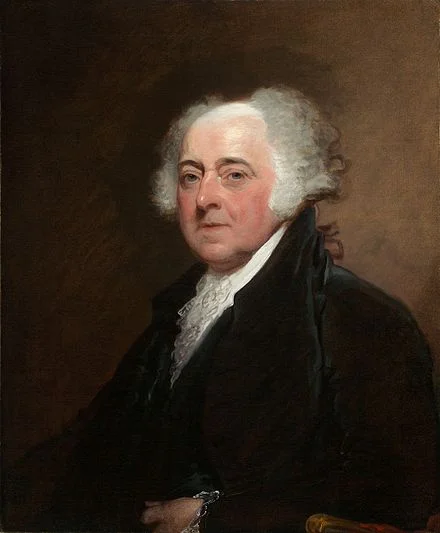
John Adams, in an 1815 painting by Gilbert Stuart.
[The Massachusetts constitution] was [John Adams’s] attempt to justify that structure by the traditional notion of social estates - that the executive represented the monarchical estate, the senate the aristocratic estate, and the house of representatives the estate of the people.
— Brown University historian Gordon S. Wood
Matriarchal in Mass. gallery

“March of the Matriarchs’’ (wood sculptures), by Donna Dodson, in her current show, until Nov. 4, at Boston Sculptors Gallery.
This is Ms. Dodson’s latest series of mysterious animal-human hybrid wood sculptures, this one featuring a sculpture group configured as a chess set.
Dodson cites the genesis of her chess set in five ‘‘mermaids’’ she created in 2016, inspired by ship-prow carvings. She told the gallery: “I wanted to do more with the series, so I set myself the challenge of making an entire chess set.” This idea, the gallery says, let her to build on the “concept of sculptures that interact directly with each other, while reflecting on the interactions among species that have nothing to do with us humans.’’
She read books about chess, noting, “The original chess set was composed of king, general, and male military figures….The queen arrived at a time when powerful queens reigned in England, Russia and Spain.” “{M}y set is maternal—I am thinking about family matriarchies, the realm of power in women's lives, how women wield power and the bonds between women in families.”
Malloy to teach at Boston College Law School

Connecticut Gov. Dannel Malloy.
Comings and goings in New England Higher Education, as compiled by John O. Harney, executive editor of The New England Journal of Higher Education, part of The New England Board of Higher Education (nebhe.org).
When his eight years as governor of Connecticut endS in January 2019, Dannel P. Malloy will serve as a visiting law professor at Boston College, his alma mater. Malloy announced he would not seek reelection in 2018. He wrote for NEJHE on The Future of Higher Education in Connecticut and was a key speaker at NEBHE’s New England Works Summit on Bridging Higher Education and the Workforce.
Former New Hampshire Bankers Association President Christiana Thornton became president and CEO of the New Hampshire Higher Education Assistance Foundation (NHHEAF), succeeding René A. Drouin, who announced his retirement last spring after 40 years with NHHEAF.
Kevin O’Sullivan will step down as president and CEO of the nonprofit Massachusetts Biomedical Initiatives, which has launched dozens of life science businesses in Central Massachusetts. He will be succeeded by Jon Weaver, the organization’s chief operating officer.
Babson College tapped entrepreneurship specialist and former Graduate School Dean Mark P. Rice, to return to Babson as provost and professor of entrepreneurship after seven years in various roles at Worcester Polytechnic Institute.
Tiffany L. Steinwert, dean of religious and spiritual life at Wellesley College, was named dean for religious life at Stanford University.
Fall River and New Bedford -- so near and yet so far
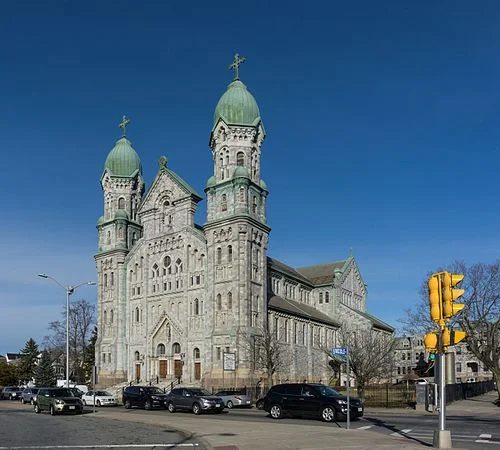
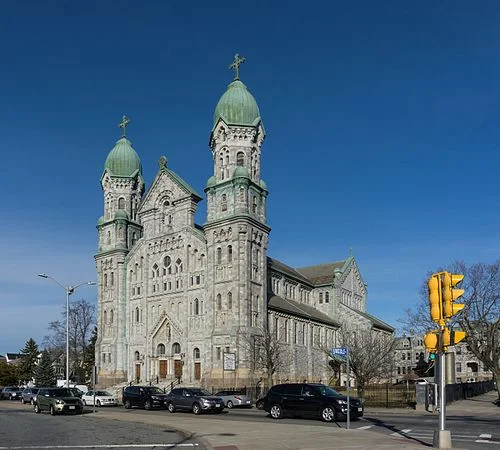
St. Anne’s Church in Fall River.
From Robert Whitcomb’s “Digital Diary,’’ in GoLocal24.com
The planned Nov. 25 closing of spectacular St. Anne’s Church, dedicated in 1906 and probably Fall River’s best known building (besides its much-disliked Brutalist city hall, which hangs over Route 195), is a reminder of the decline of churches and other institutions that were in varying degrees ethnically as well as well religiously based. These congregations, in their heydays, did much more than carry out their official religious missions. They also became social-welfare institutions, providing not only spiritual and psychological sustenance but also food and even shelter in tough times.
St. Anne’s was a French-Canadian parish, serving the many thousands of Quebecois who moved to Fall River and other New England textile- and shoe-making towns starting in the 19th Century – a migration that hit its peak in the World War I boom years. French-Canadian architect Napoléon Bourassa designed the church, with its dramatic bell towers.
Now many of the devout have died and many parishioners have long since dispersed to the suburbs or elsewhere. The priest-abuse scandals and the long decline in affiliation with organized religion in the Northeast also help explain the woes of St. Anne’s.
The church has serious physical problems, and would require millions of dollars in repairs, which apparently can’t be raised; the parish is no longer populous and committed enough to fund the work. Bishop Edgar da Cunha, who runs the Diocese of Fall River, announced that parishioners are invited to join a new “Catholic Community of Central Fall River,’’ which sounds pretty vague and diffuse.
It’s been another bad stretch for the Spindle City. Its mayor, Jasiel F. Correia II, 26, has been indicted by a federal grand jury on fraud and tax charges. This hard-charging and glitzy materialist was elected when he was 23. That means that he was far too inexperienced to run a town or city, let alone one as big as Fall River, which has a population of about 87,000. They should raise the minimum age for mayors to 30.
Over four years, beginning in 2013, U.S. Atty. Andrew E. Lelling said, Correia persuaded seven people to invest $363,690 in a startup called SnoOwl, yet another phone app.
The Feds allege that the mayor, who proclaims his innocence, illegally diverted more than $230,000 of that money. He is said to have spent the money on his mayoral campaign, travel, adult entertainment, designer clothes, jewelry, credit-card and student-loan payments, casinos and a 2011 Mercedes-Benz C300 all-wheel-drive sport sedan. This makes it sound as if he had serious lifestyle ambitions of the sort modeled by the Emperor of the Oval Office.
Fall River and New Bedford are often lumped together. After all, they’re both old textile-mill towns a mere 14 miles apart. But at least in the past few decades, New Bedford, with about 95,000 people, has generally had much abler and more visionary mayors than Fall River, most notably the current chief executive, John Mitchell, and former Mayor John Bullard.
The Whaling City has rebuilt its downtown around a cobblestoned National Historical Park and the University of Massachusetts at Dartmouth’s College of Visual and Performing Arts. Meanwhile, its big scallop fleet has prospered, bulk shipping has increased, and it has become a center for the wind-power industry. Of course, New Bedford was always much more of a port than Fall River. And a good number of urban pioneers (aka gentrifiers) have moved to New Bedford in the past few years, many drawn to its beautiful old houses, loft spaces and “romantic’’ (if gritty) waterfront.
While Fall River has lured an Amazon fulfillment center, a new Justice Center and SouthCoast Marketplace, it is way behind New Bedford as a happening place. That seems unlikely to change anytime soon.
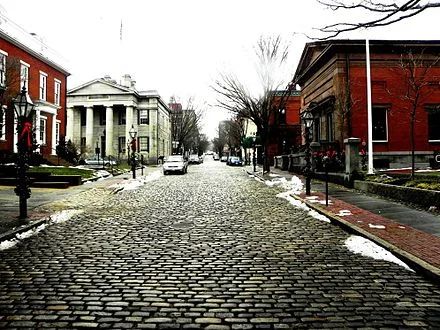
William Street, in the historic heart of New Bedford.
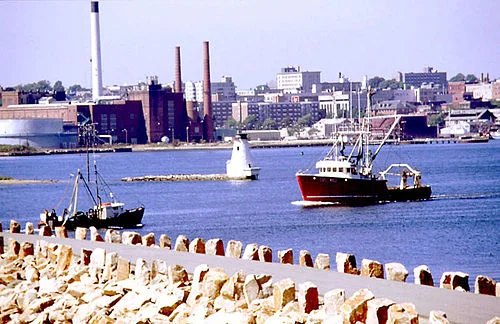
New Bedford Harbor.