
Vox clamantis in deserto


America's social recession

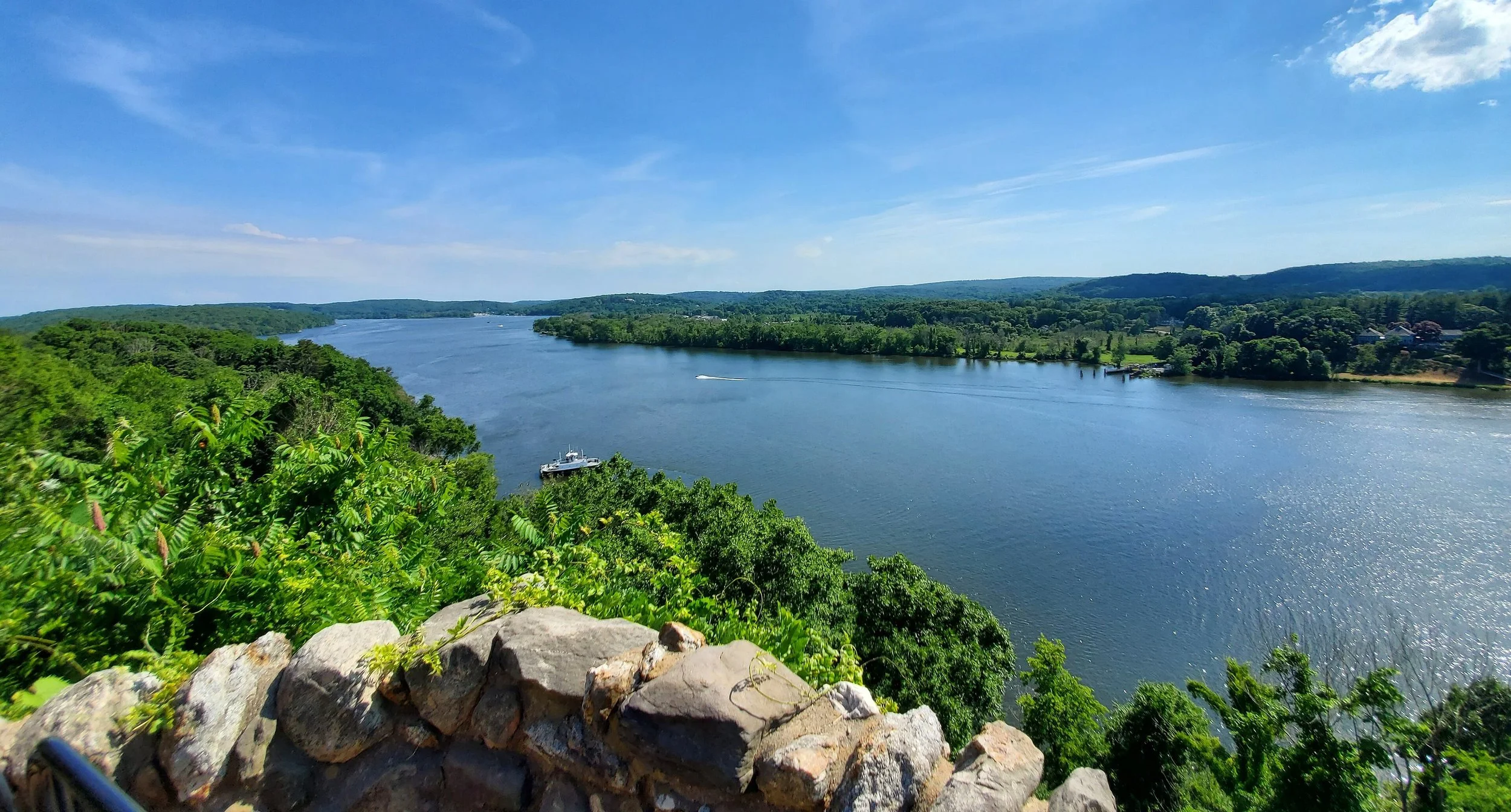
In Camden, N.J.
From Robert Whitcomb’s “Digital Diary,’’ in GoLocal24.com
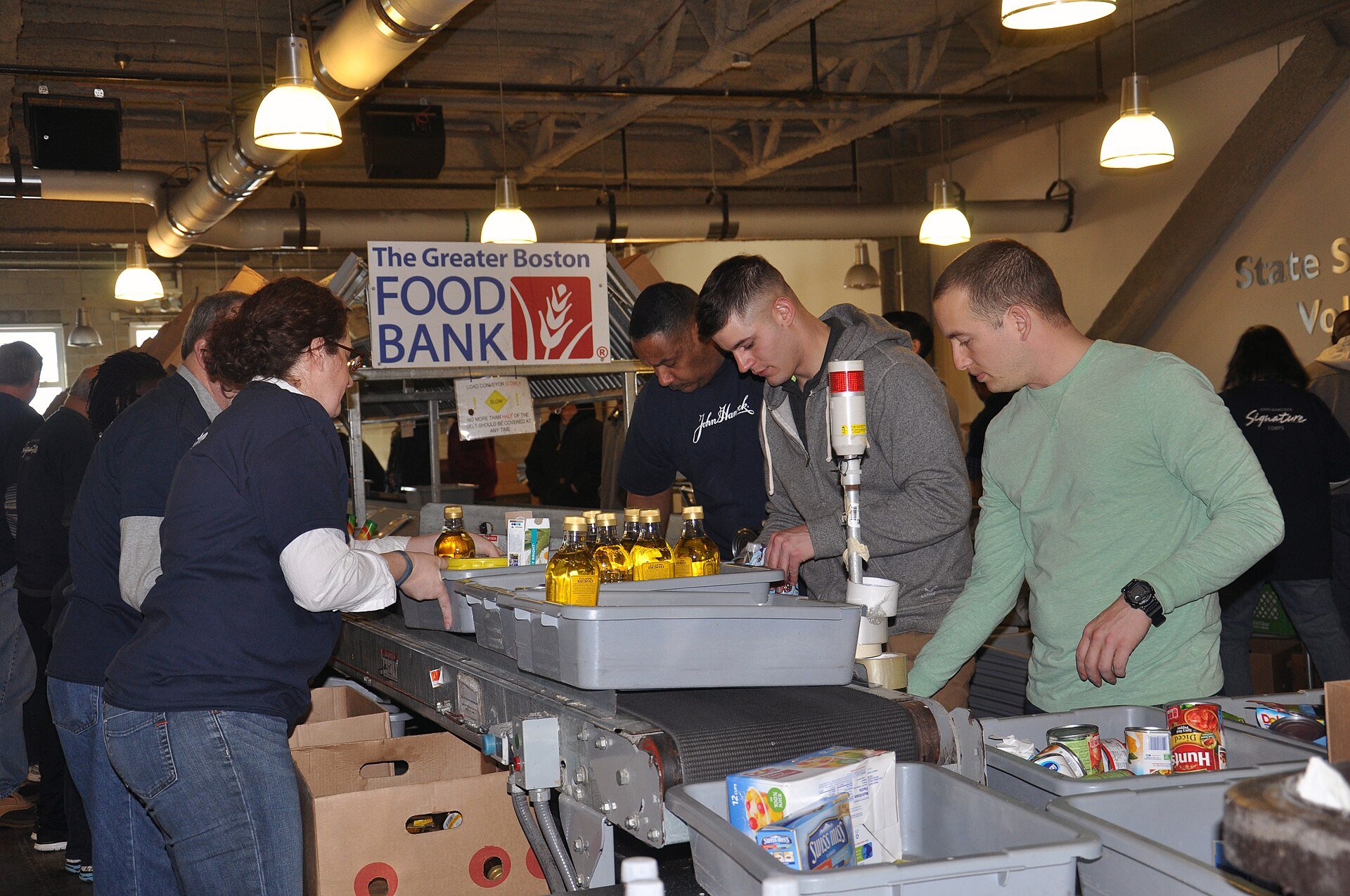
Michael Porter, a professor at the Harvard Business School, had a disturbing column in The Boston Globe the other day headlined “America Traded One Recession for a Far More Serious One,’’ instigated by the 10th anniversary of the Crash of 2008. He cited something called the Social Progress Index. Among his observations:
“Despite being among the wealthiest nations, the United States ranks 25th overall on social progress, behind all our peers in the Group of Seven. In important areas, the United States ranks even lower: We are 61st on secondary school enrollment and 88th on homicide rates. Despite spending more per capita than any other nation on earth on health care, we achieve just 62th on maternal mortality, 40th on child mortality, 47th on premature deaths from noncommunicable diseases, and 35th on life expectancy at age 60.’’
“In equality of political influence among lower socioeconomic groups, we rank 65th.’’
“Americans’ overall health and wellness is way below other advanced countries, and quality of life and economic opportunity for many is diminished.’’
To read Professor Porter’s essay, please hit this link.
'Lost & Found' in Middletown, R.I.
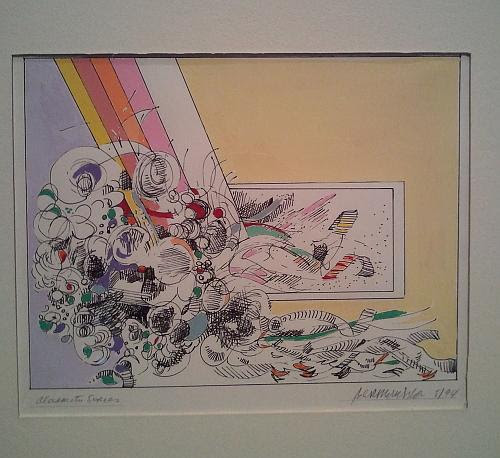
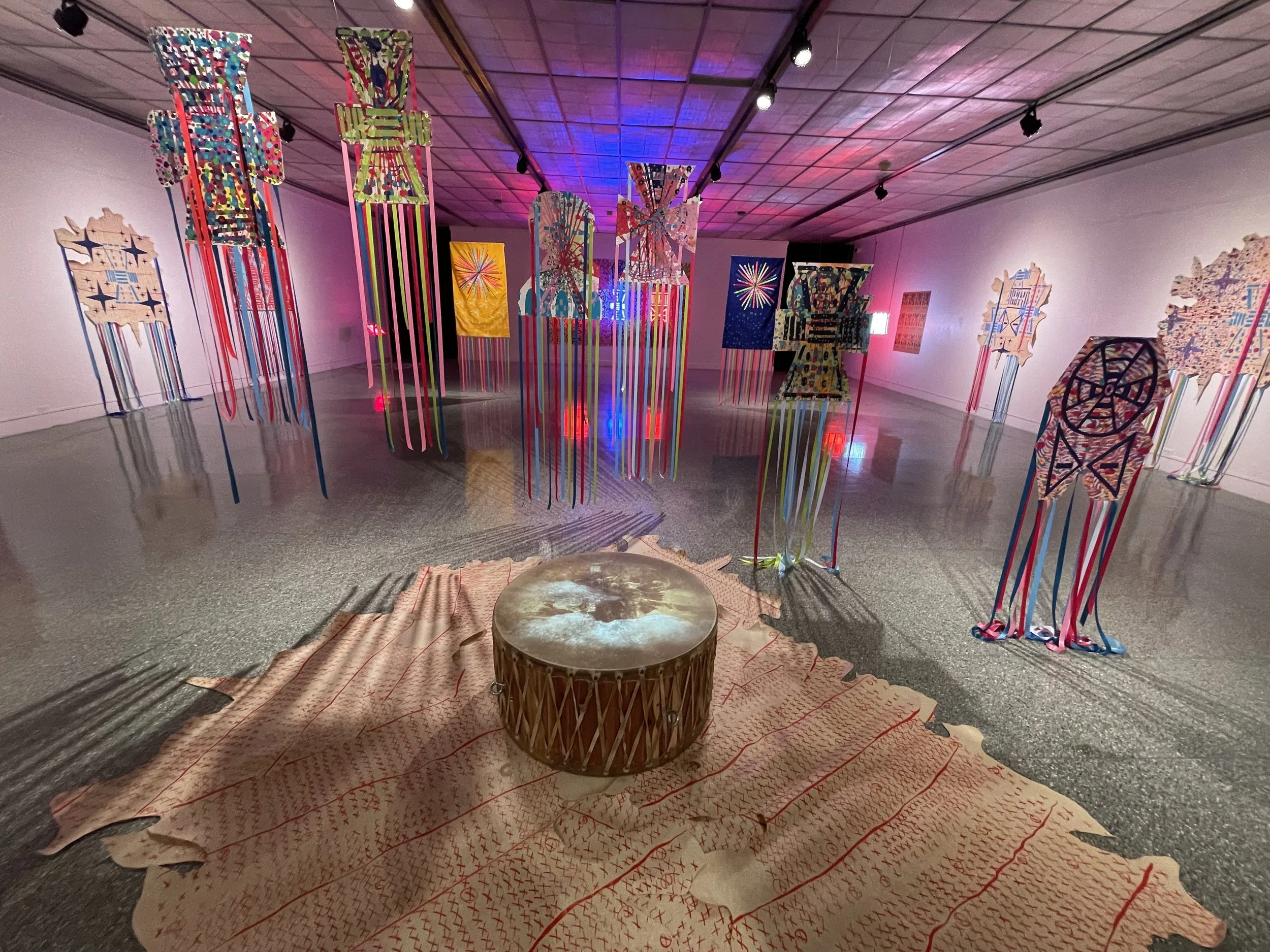
From “Alexameta Series’’ (pen and gouache), by the famous surrealist painter Ben Katz (1934-2012), in his joint show with sculptor R.L. Stetson entitled “Lost & Found — Reclamation and Celebration,’’ at DeBlois Gallery, Middletown, R.I.
Middletown, to the immediate north of Newport, is known for, among other things, a large number of Navy-connected people because of the big naval facilities in Newport, some beautiful beaches, an elite boarding school called St. George’s School recently made infamous by sex scandals, some rather pretty vestigial countryside and some of New England’s ugliest shopping strips.
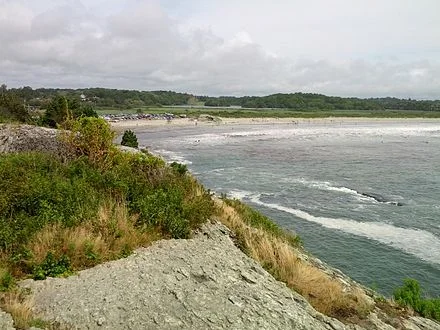
Second Beach, in Middletown.
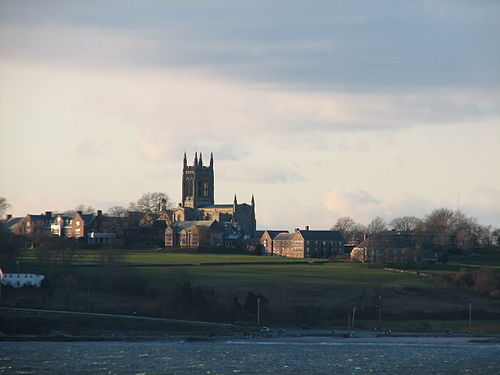
St. George’s School.
Chemical weapon in the endless romance war

“Mesmerized’’ (collage on shaped panel with resin), by Robert Mars, in the group show
”Text Messages,’’ at Lanoue Gallery, Boston, through Oct. 14.
A very unusual antique table
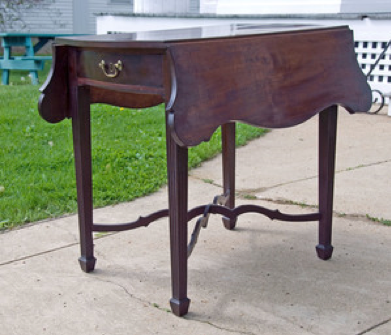
Jennifer Lacker, a Connecticut-based antique-furniture and restorer, sent along this note:
Arthur Liverant, a third-generation antique dealer at Nathan Liverant and Sons, in Colchester, Conn., is presenting the Fowler-Brown family Pembroke table, which has been held by the family since its creation, sometime before 1791.
Benjamin Fowler (1739-1818), a prosperous merchant in Wickford, R.I., is believed to have commissioned Peleg Weeden (1772-1839), a silversmith who worked in Richmond, R.I., and later Wickford, to make the table. The piece, made of beautiful mahogany, combines many details copied from Thomas Chippendale’s Gentleman and Cabinetmaker’s Director (1754) in a highly unusual form.
The dropleaf edges are shaped in porringer corners; the straight legs with cuff feet are stop fluted but at the top of the leg; the lower cross stretchers are a series of undulating curves. This combination of features by a highly skilled craftsman is very unusual in American furniture.
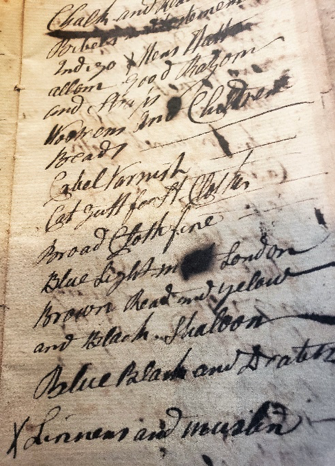
The table has been included in Yale University Art Gallery’s epic online database of Rhode Island antique furniture for some time. See rifa.art.yale.edu. Now it needs a new home. The heirs prefer a museum that would honor its Rhode Island background. Also for sale is a large collection of family documents. (See photo below.) If a museum doesn’t acquire this this beautiful example of furniture artistry, a private collector might scoop it up.
In 2 old cities, the triumph of hope over experience

“View of Springfield, Massachusetts, on the Connecticut River’’ (oil on canvas), circa 1840-45, by Thomas Chambers, as seen at the Springfield Metropolitan Museum of Art. .
From Robert Whitcomb’s “Digital Diary,’’ in GoLocal24.com
I wonder what lower-income people in Worcester think of U.S. Census data that show that the median income for Worcester households fell nearly 6 percent last year even as plans were being solidified by the city to spend a fortune to help build a baseball stadium for the bunch of very rich businessmen who own the Pawtucket Red Sox. Given the record of Minor and Major League stadiums built over the last couple of decades, it seems unlikely that the “Woosox’’ stadium will make things better for the city’s poorer residents.
Worcester’s unemployment rate is only about 5 percent but many of those jobs, as around America, pay poorly and/or are part-time. Indeed, the very low official U.S. unemployment rate masks the fact that many people have dropped out of the workforce because of low wages that don’t keep up with inflation.
A large factory being built in the city would be far better news than a facility, like a baseball stadium, employing only a couple of dozen full-time jobs, if that. Hard to believe now that the city was once sort of the Pittsburgh of New England!
In other parts of the bread-and-circuses industry, we have the newly opened MGM casino in Springfield, Mass. Despite the hoopla, this facility, which will drain money from the region to send to investors, isn’t doing that well.
Consider that the slot-machine take at this full-service (table games, slots and “resort hotel”) scam is about the same as at the much less promoted and all-slots Plainridge Park, in Plainville. Will the commonwealth encourage more cannibalization of this sector by permitting yet another casino to open?
A frenzied fall
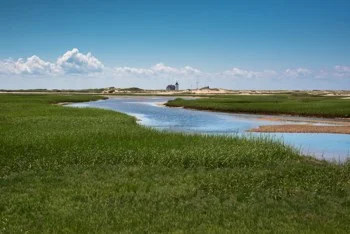
Hatches Harbor marshes on Cape Cod Bay.
‘’….Wellfleet stayed
Remarkable that fall. And so did we.
Confessions, confidences kept us up
Half the night….
Yet who could forget those wet, bucolic rides,
Drunk dances on the beach, the bonfires,
The sandy lobsters not quite fit to eat?
Well, there were other falls to come as bad,
But I still see us on a screened-in porch,
Dumbly determined to discover when
The tide turned and the bay sank back in mud.’’
-- From “Shorelines,’’ by Howard Moss
Adversity makes them glow
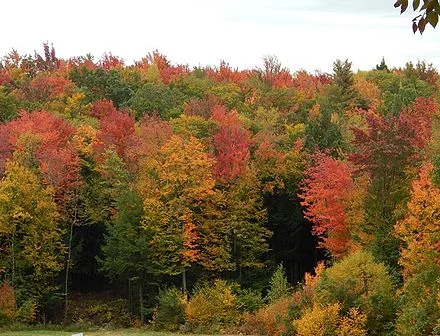
Swamp maples in early fall.
“New Englanders are like the pasture slopes
Behind their barns. You put them down as sober,
And then one day you’ll wake up, and you find them
Red and golden maples of October.
It takes adversity or coming close
To trouble and hard times to make them glow,
Then they really flower as swamp maples
Flower on the edge of frost and snow.’’
From “New Englanders Are Maples,’’ by Robert P.T. Coffin (1892-1955)
Burning New England
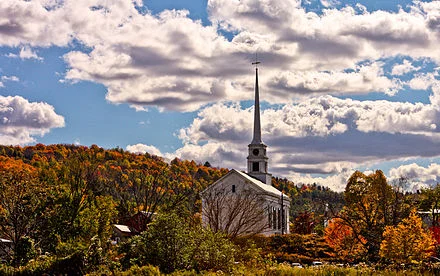
In affluent Stowe, Vermont, one of America’s first ski-resort towns (because of Mt. Mansfield) and a place with many spiffy weekend and summer places, too.
“They {New England villages} are best seen when frost has cleared the air, when every raked pediment and corner post glistens in sharp rectilinearity, when the sugar maples have caught fire and the whole skyline burns red and yellow and brazing orange. Scattered across the northeastern corner of the United States, they are one of the great sights of the Western World – red buildings to house the cattle, white ones to hold the spirit, and trees like the spirit itself abroad on the countryside.’’
— From Jane Langton’s essay, “New England Classic,’’ in Arthur Griffin’s New England: The Four Seasons.
Purple prose about red foliage

“For anyone who lives in the oak-and-maple area of New England, there is a perennial temptation to plunge into a purple sea of adjectives about October.’’
— Hal Borland (1900-1978), nature writer
Frank Clemente: House GOP pushes through another deficit-exploding tax cut for the rich
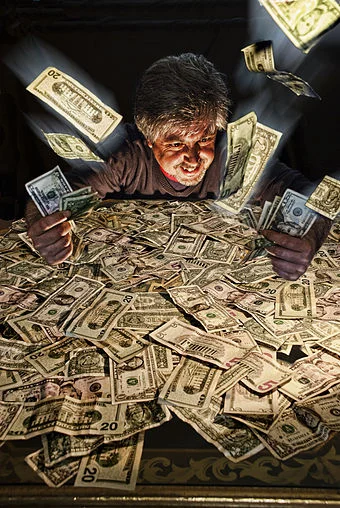
“Avarice,’’ by Jesus Solana.
From OtherWords.org
While Americans were transfixed by Senate hearings over Brett Kavanaugh’s alleged sexual assaults, House Republicans quietly passed another enormous tax handout for the wealthiest Americans.
Round one of this giveaway cost $2 trillion. Round two is even bigger — it would explode the deficit by more than $3 trillion. And once again, it’s largely a giveaway to the wealthiest Americans — and could mean devastating service cuts for ordinary people.
President Trump claimed the first tax plan would be “rocket fuel” for the economy, but there’s no evidence it’s done anything to improve the economic wellbeing of working families.
The centerpiece of the first plan was a massive tax cut for corporations. The corporate tax rate was reduced by 40 percent, plus a $400 billion tax break for multinational corporations on their trillions in accumulated offshore profits.
So it’s not surprising corporate profits leaped by over 16 percent in the second quarter of this year compared to the same three months last year — the best showing in six years. Meanwhile corporate tax payments are on schedule to come in $120 billion lower than in 2017.
But corporations aren’t sharing their winnings.
Trump guaranteed working families a $4,000 raise if corporate taxes were cut. Yet average real wages have been stagnant for the past year. Only 4 percent of American workers have gotten any kind of payout related to the corporate tax cuts, and most of those have been one-time bonuses, not permanent raises.
There’s no sign tax cuts have spurred hiring. Job growth under President Trump is merely a continuation of six years of job growth under President Obama — and Obama created more jobs in his last 19 months than Trump has in his first 19 months.
Cutting business taxes was supposed to cause an explosion of investment. Yet business investment has increased at a slower rate this year than at several periods during the Obama recovery.
Instead of investing in workers or equipment, companies are mostly buying back their own stock, a maneuver that artificially inflates the share price and rewards CEOs and wealthy investors. Corporations have announced $733 billion worth of stock buybacks since the Trump-GOP tax law was enacted — 103 times more than the $7 billion workers have gotten in bonuses and raises.
For the money McDonald’s spent on stock buybacks, it could’ve given every one of its 2 million employees that $4,000 raisePresident Trump promised them. But they didn’t.
The economic miracle envisaged by the tax plan’s backers hasn’t materialized. But the dire consequences predicted by the plan’s opponents certainly have. To cover the deficits created by their own tax cuts, Republicans want to cut trillions of dollars from essential public services.
Despite promising never to touch Medicare or Medicaid, President Trump is seeking $1.3 trillion in cuts to those programs and to the Affordable Care Act (ACA). The House GOP wants to cut a total of $5 trillion, including $2 trillion from health care. Trump and House Republicans would also slash funding for students in school and college, among many other service cuts.
Round two of the Trump-GOP tax cuts would only repeat the same destructive pattern: huge handouts to the rich, huge deficits, and huge service cuts for working families. The big difference is that the budget hole created would be much deeper this time, making the resulting cuts to services that much more severe.
No wonder they did it while Americans were distracted.
The sane policy would be to repeal the existing tax cuts for the wealthy and corporations and use the money raised to strengthen Medicare, Medicaid, and other essential services the American people rely on.
Frank Clemente is the executive director of Americans for Tax Fairness.
Pop-ups for Wayland Square?
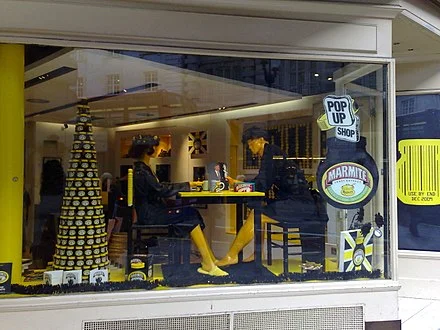
A pop-up store in London.
From Robert Whitcomb’s “Digital Diary,’’ in GoLocal24.com
The Internet, and especially the increasingly monopolistic Amazon, are eroding much of the traditional bricks and mortar stores. But, as I learned from my silver jewelry-making daughter in New York City, “pop-up stores’’ – short-term retail outlets in rental storefronts -- provide new ways of showing and selling stuff.
They speak to the desire of many, perhaps most customers to touch, see and even smell goods in a real place. For that matter, even Amazon is opening brick-and-mortar stores.
Local zoning regulations may have to be changed in some places to encourage the creation of pop-up stores, which sure are better than vacant storefronts. I think that these outlets would do best in already busy upscale shopping streets, such as Bellevue Avenue, in Newport, Newbury Street, in Boston, and Thayer Street and Wayland Square, on the East Side of Providence. Such temporary outlets would seem particularly handy for test-showing new products.
Surreal landscapes
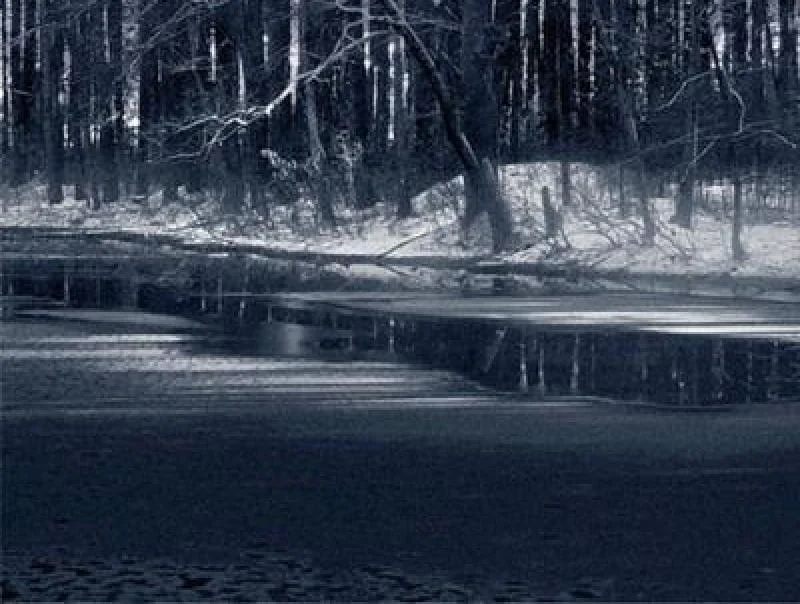
From photographer Nat Martin’s show “Nat Martin: New Landscapes,’’ at the Kingston Gallery, Boston, through Oct. 28. The gallery describes his “photographic journey through real and augmented landscape, characterized by virtual experimentation and the inspiration of historical photography along with alternative processes. … As he developed this current series of constructed landscapes, Martin revisited his older landscape photographs as if they were found imagery. He employed a wide range of imaging techniques to reinvent the landscapes, bending the shots towards their opposite mood and creating surreal effects. Day becomes night, heat changes to snow, and visible film grain gives images stylized, painterly effects.’’
'Last leaf'
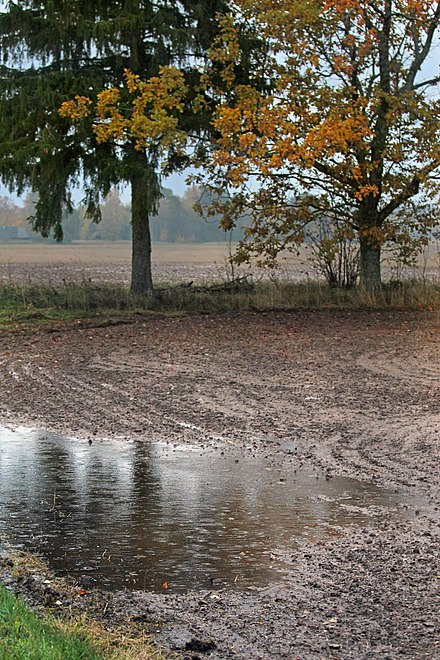
“All day the fitful rain
Had wrought new traceries,
New quirks, new love-knots, down the pane.
And what do I see beyond
That fluctuating gray
But a world that seems to be God-abandoned –
Last leaf, rain soaked, from my high
Birch falling, the spruce wrapped in thought,
And the mountain dissolving rain-gray to gray sky.’’
— From “Vermont Ballad: Change of Season,’’ by Robert Penn Warren (1905-1989), who had a house in Stratton, Vt.
Llewellyn King: Do you want an algorithm telling you what to read?

— Photo by Florian Plag
WEST WARWICK, R.I.
Old friends from The Washington Post in the 1970s write to me, agonizing over where journalism is headed.
There is no shortage of news or need for news, but there is a desperate need to find new platforms to carry it forward.
There are three existential crises facing the news trade:
· How to finance newspapers.
· How to deal with the power of the technological behemoths, such as Google.
· How to keep a flow of talent into the business while it sorts itself out.
Journalism has always been financed through a kind of subsidy provided by advertising. It has worked well enough, and sometimes enormously well. No one saw a day when the advertising would flee to a cheaper delivery system: the Internet. But it did.
There were intimations of the vulnerability of the setup. Originally, afternoon newspapers were dominant: Go off work, go home and read the paper before bed. H.L. Mencken warned that morning newspapers, such as his Baltimore Sun, would perish.
Instead of Mencken’s prophecy, the playing field tipped the other way. Morning newspapers survived and, one by one, the afternoons failed across the country and the world. Television was the culprit.
In magazines, the television slaughter was more terrible and more complete. Great institutions, keepers of the culture, were swept away: Life, Look, Collier’s and, saddest of all, The Saturday Evening Post. What had been citadels of power and wealth were toppled, not just in America but worldwide: Picture Post in Britain and Outspan in South Africa. All gone.
Newspapers and magazines are embracing the electronic future by becoming electronic platforms, old dogs doing new tricks. Also, the consumer is carrying much more of the cost of production. Newspapers selling for over $2? Unheard of a short while ago.
I was part of discussions in The Washington Post, where we turned down a cover price increase of a nickel, to 15 cents. “The public’s right to know,” it was reasoned, outplayed our financial gain. We were, so to speak, rich enough and could not see that changing.
Still there is no clear way ahead as to how to finance the new reality for newspapers. Some -- the big ones -- will prosper behind paywalls, but most are still looking for a solution. There is talk of subsidies, and there are pure Web platforms that seek contributions: journalism as charity case.
There are hints as to the future here with paywalls and reader contributions, but these alone do not suggest a robust new business model.
The second existential threat is the new delivery systems. If Facebook and Google are to censure content – say, hate speech -- they have moved the whole journalist enterprise to a new and dangerous place: The global behemoths deciding what should and should not be read.
Do you want a faceless algorithm deciding what you can read?
To me this is the greatest threat to journalism and the democracies it protects. Other ways exist, and new ones could be developed, such as libel laws and penalties for criminal mischief.
The great Internet companies should remain what they are in reality: common carriers. If they become censors, freedom of the media is at stake. Virtuous censorship is still censorship and that is, by definition, without virtue.
Finally wages in journalism, except for a few employed by the television networks (themselves seeing the beginning of the end of the monopolies), are at a low point. Freelancing is worse off.
If improvement do not occur, the best minds coming out of the colleges will not go into journalism, they will go elsewhere, often law. Going forward journalism will not solve its problems without a decent flow of talent, and public will not be served either.
I can speak to this. hreporting, and though they had studied it, they would go into law. They did not fancy a life of poverty. Their gain, our serious loss.
Llewellyn King, based in Rhode Island and Washington, D.C., is executive producer and host of White House Chronicle on PBS. His email is llewellynking1@gmail.com.
Fishing lessons from Maine

Lobster boat off Portland, Maine.

Maine lobster traps ready to be taken on board in 1928.
From Robert Whitcomb’s “Digital Diary,’’ in GoLocal24.com
Lobster Coast: Rebels, Rusticators, and the Struggle for a Forgotten Frontier, by Colin Woodard, is a history of the storied Maine Coast in which the ups and downs of the fishing industry in the Pine Tree State have played a big part.
The book is a deeply researched, reported and colorful narrative. It may also be of particular interest to New Englanders now in light of the overdue restrictions just imposed on the herring fishery. There are many lessons to be gained from a study of the management and non-management of fish species in the spectacular protein factory known as the Gulf of Maine. Overfishing has led to the Maine Coast having only one major commercial species left – lobsters. Catches of such formerly lucrative species as cod, haddock and halibut are a fraction of what they were a few decades ago.
All too often fishermen blame “natural cycles’’ for fishing stocks that are collapsing because of extreme overfishing. Modern fishing techniques, including fish-finding electronic devices and bigger, better nets and boats, have had devastating impacts. Overfishing of such species as herring that are essential food for the survival of larger fish can be particularly damaging to fishing ecology.
So it was muted good news that federal regulators decided to slash catch limits by 55 percent and impose buffer zones where no commercial herring fishing would be allowed. However, many scientists think that the whole herring fishery off New England should be shut down for a while in order to save it.
“The population is stressed, and we really need to start building resiliency,” Erica Fuller, senior lawyer with the Conservation Law Foundation, told the council.
Rarely does any economic interest group eschew short-term profit for long-term gain. People will almost always take the money and run. (An apparent exception is Maine’s lobstermen’s remarkably cooperative and voluntary efforts in recent years to save that fishery.) Strong measures can do wonders in saving species, as in the case of striped bass, whose revival owes much to the late Rhode Island Sen. John H. Chafee’s push for research and regulation to save the sportfish from extinction off the East Coast.
'Excitement before the fall'

“Ghost of a Dream: counting flowers on the wall’’ (used playing cards from Trump Plaza and the Miccosukee Nation casinos on panel), by Lauren Was and Adam Eckstrom, in the show “I’ll be with you when the deal goes down,’’ at Standard Space, Sharon, Conn., Oct. 6-Nov. 4.
The gallery says: “The exhibition pieces are made entirely from old playing cards once used in American casinos with Optical Art-like designs that create intense, repetitive patterns. These patterns are an abstract recreation of the excitement and anticipation felt by the brain when hoping to win a round of gambling. The cards carry with them a history of losses and broken dreams, even as they make up pieces that demonstrate the excitement before the fall.’’
Chris Powell: 'Look who's talking'
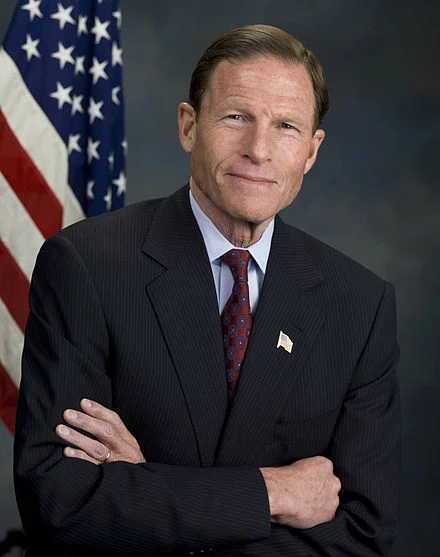
Sen. Richard Blumenthal (D.-Conn.)
Some people are lucky in their friends while some, like Connecticut Sen. Richard Blumenthal, are even luckier in their enemies.
No one could be luckier than Blumenthal to have President Trump as an enemy. For in denouncing Blumenthal the other day for the senator's opposition to Judge Brett Kavanaugh's nomination to the Supreme Court, the president managed to change the subject from Blumenthal's posturing and hypocrisy to his own recklessness.
Blumenthal, the president said, lied about serving with the Marines in Vietnam. Not only that, the president said, but the senator had described himself as a war hero who had distinguished himself at Da Nang.
Huh? Yes, many years ago Blumenthal sometimes falsely asserted or implied that he had served in Vietnam. He actually spent the war years stateside in the Marine Reserves and the only campaign he participated in was for Toys for Tots. But he does not seem ever to have claimed any heroism. Trump made that part up as much as Blumenthal made up his service in Vietnam.
Confronted with documentation of his false claims of Vietnam service as he ran for the Senate in 2010, Blumenthal acknowledged that he repeatedly had "misspoken" -- Democratese for "lied." He apologized and got away with it, in part because his Republican opponent, Linda McMahon, wasn't a war hero either but just a rich dilettante who had made her money from what was more or less pornography.
So with his wild exaggeration about Blumenthal, Trump, whose only Vietnam-era campaign was against the bone spurs that got him out of the draft, neutered what otherwise might have been fair comment about the senator.
Trump is Trump and criticism of his character can get tedious. Anyone who is not already distressed by it probably never will be.
But Blumenthal remains largely respected, especially in Connecticut, so there still may be value in evaluating his character. His participation in the Senate Judiciary Committee's hearing on Kavanaugh last week suggested that Blumenthal might benefit from more self-awareness and less self-regard.
Piling on Kavanaugh with the other Democratic senators trying to undermine the nominee's credibility, Blumenthal seemed to forget his own shortcomings. He asked if Kavanaugh knew a legal maxim in Latin, "Falsus in uno, falsus in omnibus," or "False in one thing, false in everything." Kavanaugh was not yet as riled up as he would become under questioning about his partiality for beer, so he let Blumenthal's Latinized insult pass.
But some people watching the hearing on television grasped the irony of Blumenthal's questioning anyone else's honesty. Soon someone produced a photograph of U.S. soldiers plodding through a rice paddy in Vietnam, with Blumenthal's face superimposed on the soldier in front. The caption: "False in one thing, false in everything."
The photo was merrily distributed throughout the country.
Of course, most of Connecticut's news organizations took Blumenthal's side against Trump's mockery, as if there aren't always plenty of news organizations reminding the country of the president's indifference to truth. Once again Blumenthal is getting off easy back home.
So if only Kavanaugh had taken a little less law (and beer) and a little more Latin at Yale. Then he might have responded to Blumenthal's "Falsus in uno, falsus in omnibus" with a telling rejoinder: Respice quis loquentes suus.
That is: Look who's talking.
Chris Powell is a columnist for the Journal Inquirer, in Manchester, Conn.
John O. Harney: Some interesting New England facts and figures

From The New England Board of Higher Education (nebhe.org) as compiled by its executive editor, John O. Harney:
“From time to time, we revive the collection of facts and figures called ‘Data Connection’ that we had published quarterly for nearly 20 years in the print editions of The New England Journal of Higher Education (formerly Connection).
The latest ...
Inflation-adjusted increase in household incomes for the bottom quarter of Maine workers between 2016 and 2017 after the state's voter-approved minimum wage increase: 10%, according to the Maine Center for Economic Policy.
Reduction in number of Maine children living in poverty between 2016 and 2017 after the minimum wage increase: 10,000 according to the Maine Center for Economic Policy.
Percentage of respondents to the University of New Hampshire Carsey School of Public Policy's Upper Valley Child Care Survey who reported that child care is necessary in order for them to work: 96%. (The Upper {Connecticut River} Valley includes Orange and Windsor Counties in Vermont and Grafton and Sullivan Counties in New Hampshire.)
Number of children under age 5 in the Upper Valley Census who live in fully employed families (two working parents if they live with two and one working parent if they live with one): 7,300, according to the Carsey School of Public Policy.
Number of licensed slots available for children in this age group: 4,995, according to the Carsey School of Public Policy.
Number of reported hate crimes per 100,000 people in 2016 in Massachusetts: 5.9. (Data reported to the FBI from agencies—reportedly the highest rate of any state, but also drawn from more agencies than some states, including 70 communities, several colleges and the MBTA.)
U.S. ranks of Massachusetts, Vermont and Connecticut among "healthiest" U.S. states, according to United Health Foundation: 1, 3, 5 America's Health Rankings, according to the United Health Foundation.
U.S. rank of South Burlington. Vt., among WalletHub's 2018’s Best & Worst Cities for People with Disabilities, based on 31 indicators of disability-friendliness, ranging from wheelchair-accessible facilities per capita to rate of workers with disabilities to quality of public hospital system: 2 ,according to WalletHub
U.S. rank of New Haven, Conn.: 182, according to WalletHub.
Todd McLeish: Warming water may be factor in lobster shell disease in southern New England
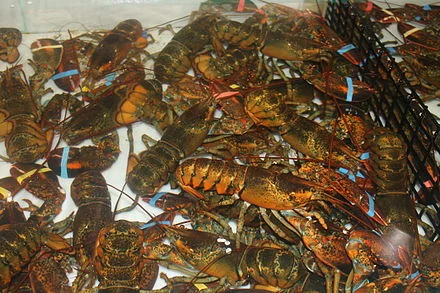
Despite more than 20 years of declining lobster populations in southern New England and extensive studies of the shell disease that is a major factor in their decline, scientists are still struggling to provide definitive answers to help restore hope to those working in the local lobster fishery.
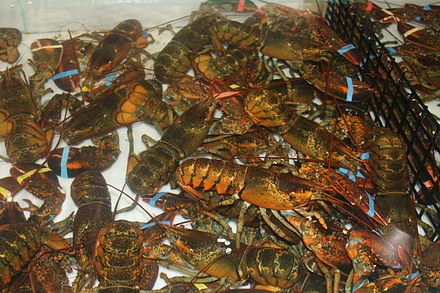
A new study of lobsters along the eastern Connecticut coast has found that the disease is linked to warming water temperatures, while progress is slow in efforts to identify probiotics to counteract the disease and to better understand why so many lobsters are blind.
“Epizootic shell disease first appeared around 1996 and became quite prevalent around 1999, and it continues to be prevalent,” said Maya Groner, who conducted the Connecticut study as a post-doctoral researcher at the Virginia Institute of Marine Science. “It’s been a challenge to figure out what the pathogen associated with the disease is. The best evidence suggests it may be a suite of bacteria that chews away at the carapace, but that suite of bacteria changes over the course of the disease.”
Her study found that the increased prevalence of the disease stems from warmer water temperatures that induce the lobsters to molt their shells earlier than usual.
Using data on 200,000 lobsters collected over 37 years in Waterford, Conn., as part of biological monitoring near the Millstone Nuclear Power Station, Groner found that about 80 percent of male lobsters have the disease during warm years, with females contracting the disease at a slightly lower rate.
“Molting their shell resets their health,” she said. “If they don’t molt, there’s no way they can recover. But now that they’re molting earlier in the spring, the molt happens before they’re even challenged with the disease.”
From ecoRI News (ecori.org)
The earlier molt allows the disease to progress longer than if the lobsters molted in summer, as they typically do.
Groner found that for every 1.8-degree increase in the average temperature of the bottom water in May, lobsters molted about six days earlier. In early-molting years, disease prevalence doubled by September.
“It’s very consistent with trends we’ve seen with other marine diseases,” Groner said. “Organisms at the southern part of their range — like lobsters in Long Island Sound — are limited by temperature. They’re at their thermal tolerance limit. So as temperatures increase, they’re becoming stressed and less able to cope with diseases.”
University of Rhode Island fisheries researcher Kathy Castro has been studying lobsters for more than two decades, and she decided to look for a solution to help lobsters recover from the disease even though the precise cause of the disease is still uncertain. She is collaborating with URI colleagues who are studying probiotics on oysters.
“Why can’t we identify good bacteria that normally occur on lobsters, take the bad bacteria off, and repopulate their shells with good bacteria?” she wondered. “In essence, the idea works, but we don’t know what’s the right bacteria, how do we treat the lobsters, how often, and how to do it in a reasonable time frame.”
In a laboratory setting, Castro’s URI colleagues David Nelson and David Rowley isolated probiotics from healthy lobsters and tested them against what they believe may be the “bad bacteria.” The strategy looked promising. Initial trials on adult lobsters were positive as well. But it may not be practical.
“Our initial idea was that lobstermen could treat the lobsters on their boat,” Castro said. “But it’s hard to do; you have to do it in a lab. Maybe we still haven’t identified the right probiotic. And are we even working with the right pathogens?”
While that work is continuing, Castro is investigating why about half of the lobsters she has tested are functionally blind.
“That’s a more concerning issue to me than shell disease,” she said. “My question is, is it related to shell disease. The lobster’s endocrine control system is located in their eye stalk, so if a lobster is blind, is it molting incorrectly, and is that contributing to the disease.”
Castro said a colleague in Virginia thinks the cause of the blindness may be manganese, a neurotoxin that harms optic nerves and is released from sediments under low-oxygen conditions. But studies are just now under way.
“In my mind, it has to be related to shell disease. That’s my gut feeling,” Castro said.
One of the challenges to finding the answers has been inadequate research funding, Castro said, so much of the research is being done piecemeal.
“I really wish there was something fundamentally easy that we could do to solve all these problems,” she said. “That would be my greatest dream. But I know it takes time. And as much as we know about lobsters, there’s a lot more we don’t know.”
Rhode Island resident and author Todd McLeish runs a wildlife blog.
Slow, slow, October!

Wild grapes, which are found in southern and central New England.
— Photo by Sten Porse
“O hushed October morning mild,
Thy leaves have ripened to the fall;
Tomorrow’s wind, if it be wild,
Should waste them all.
The crows above the forest call;
Tomorrow they may form and go.
O hushed October morning mild,
Begin the hours of this day slow.
Make the day seem to us less brief.
Hearts not averse to being beguiled,
Beguile us in the way you know.
Release one leaf at break of day;
At noon release another leaf;
One from our trees, one far away.
Retard the sun with gentle mist;
Enchant the land with amethyst.
Slow, slow!
For the grapes’ sake, if they were all,
Whose leaves already are burnt with frost,
Whose clustered fruit must else be lost—
For the grapes’ sake along the wall.’’
“October,’’ by Robert Frost