
Vox clamantis in deserto



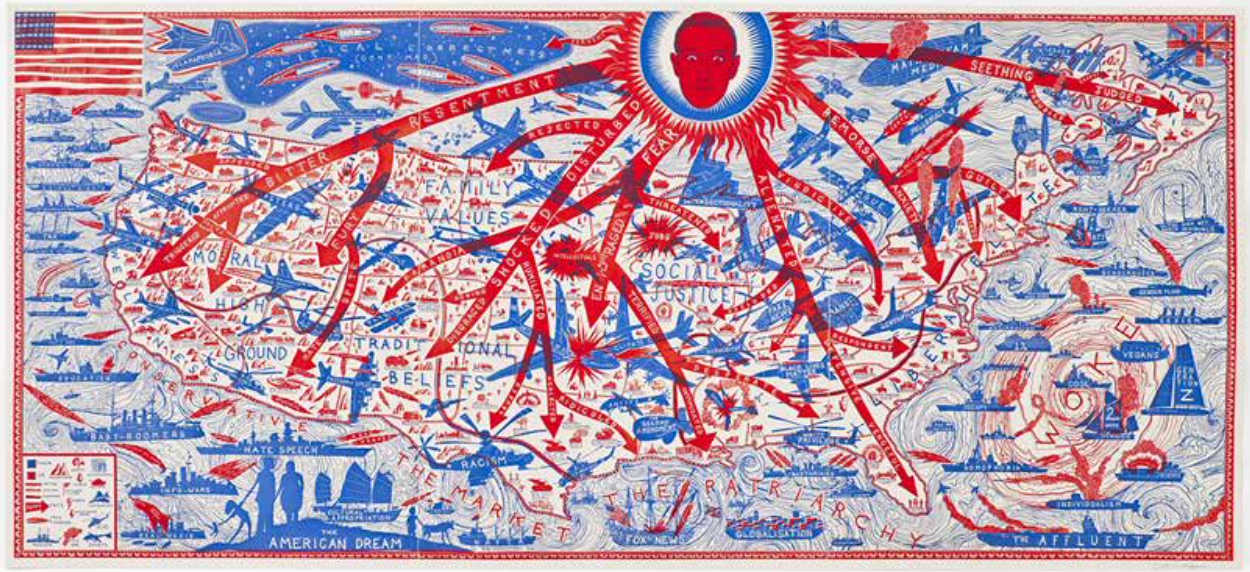
Insane but all too common

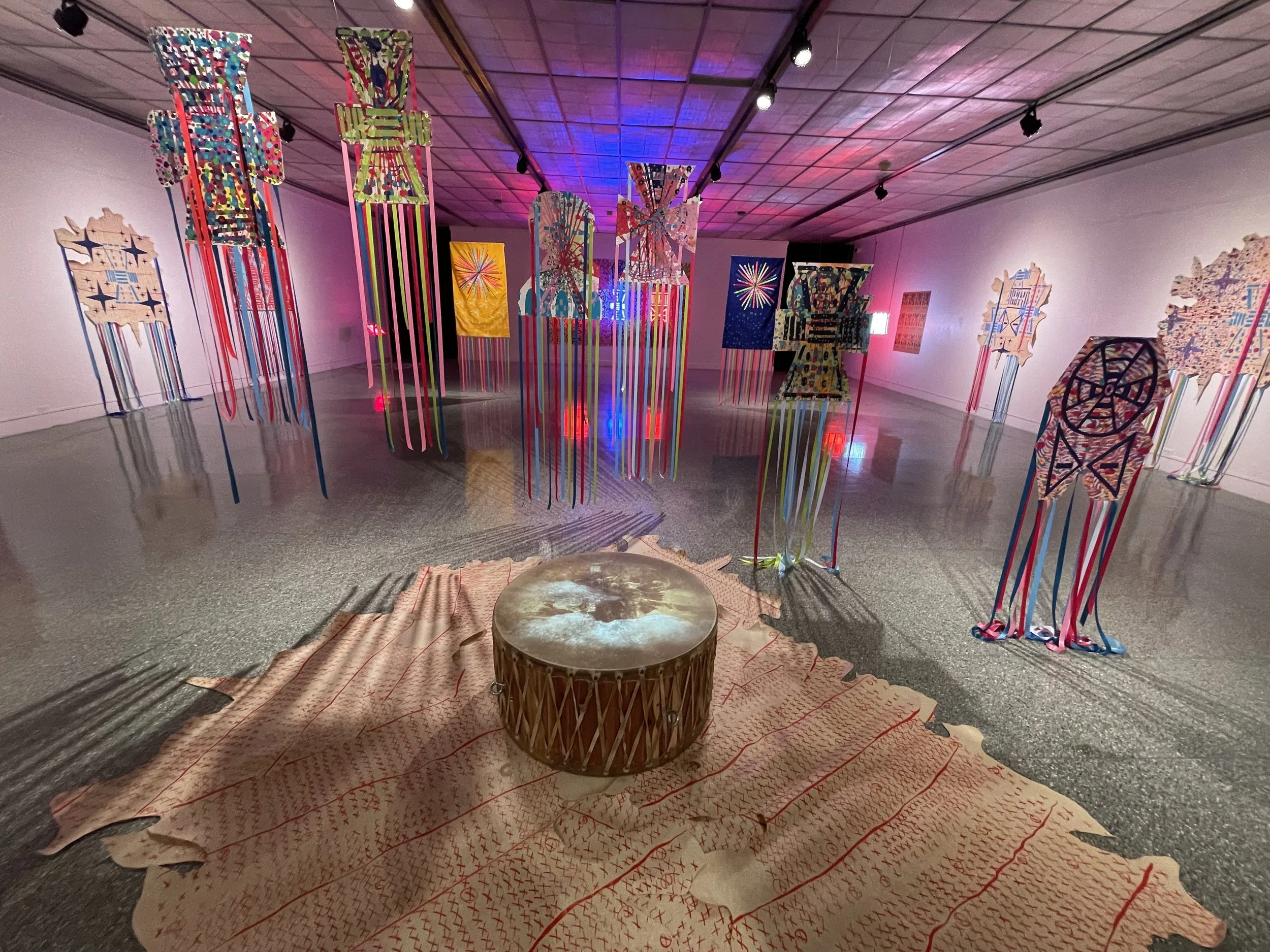
Work by Gordon D. Chase in his “The Insanity of Violence’’ show at the Carney Gallery at Regis College. Regis is a Catholic college situated on an old estate in the rich Boston suburb of Weston.
The role of grasshoppers in salt-marsh ecosystems

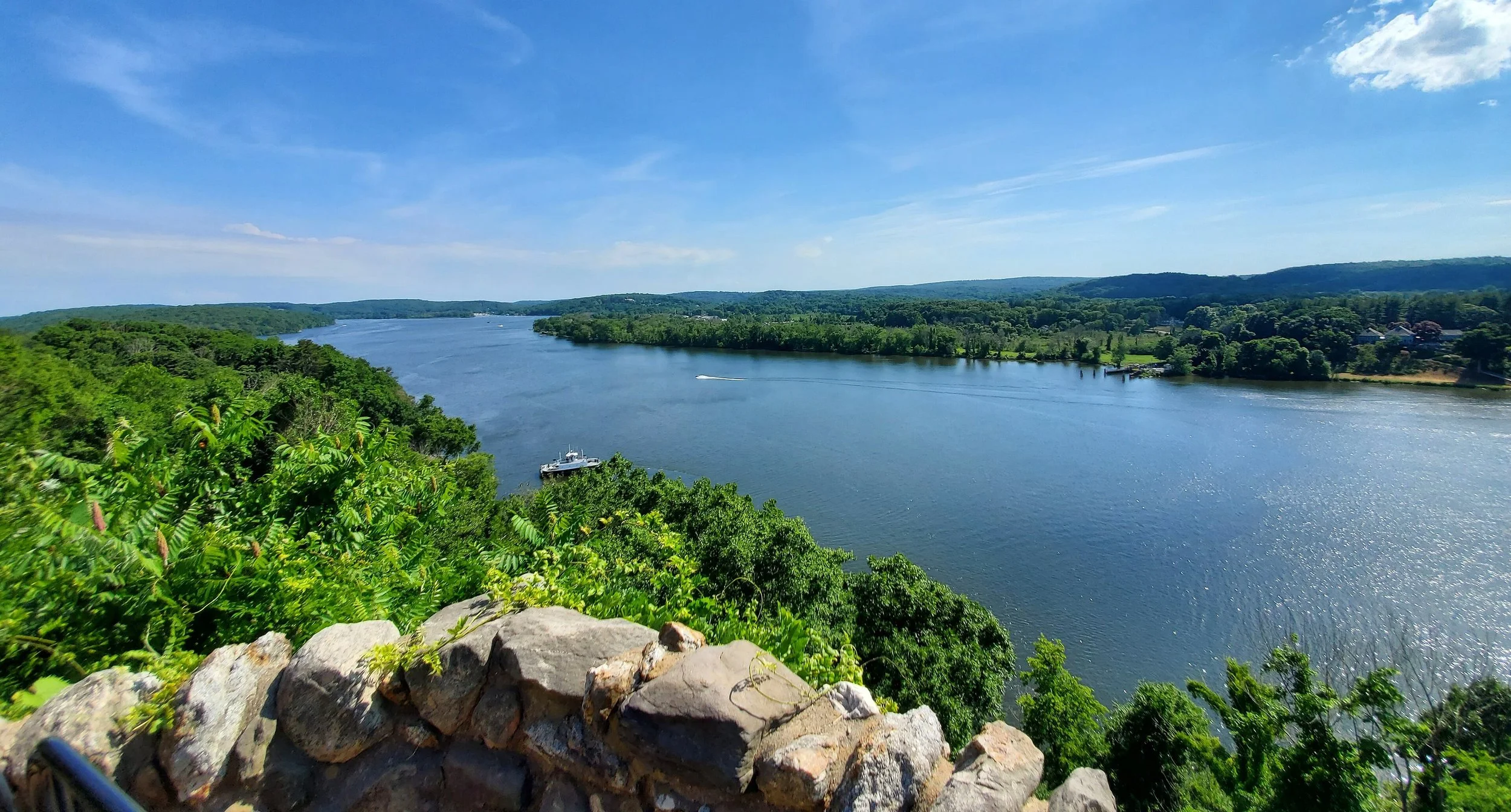
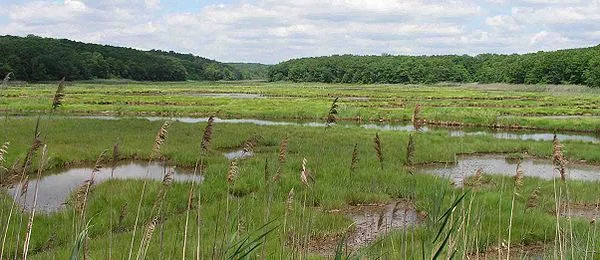
Salt marsh along the Connecticut shore of Long Island Sound.

American grasshopper.
From ecoRI News (ecori.org)
KINGSTON, R.I.
As efforts are being undertaken to protect salt marshes — and the threatened salt marsh sparrow — from the rising sea, scientists may be ignoring an unexpectedly important player in this environmental drama: grasshoppers.
According to Becky Gumbrewicz, a University of Rhode Island senior who studied insects at three salt marshes in the Ocean State this summer, grasshoppers and their close relatives constitute the greatest insect biomass per individual on salt marshes in the region, and they are probably an important food source for the sparrows. But as dredged sand and mud are deposited on some marshes to raise their elevation to combat sea-level rise, grasshoppers may get lost in the mix.
“We’re curious about how adding that layer of dredged material to the marsh is going to affect the insect populations, like the grasshoppers, that could possibly be buried,” said Gumbrewicz, a resident of Oxford, Conn., who is majoring in environmental science and management. “We’re trying to get an idea of how to balance combating sea-level rise to preserve the salt marshes and benefit the sparrow but also figure out how the insects are impacted and may need to be supported.”
Working in collaboration with URI Prof. Steven Alm and the Rhode Island Natural History Survey, Gumbrewicz collected insects at three salt marshes: one inland undisturbed site on the Narrow River; one undisturbed coastal marsh on Ninigret Pond, and a disturbed site on Ninigret Pond that is undergoing restoration by adding a layer of dredged material to raise its elevation. Among the mass of flies, crickets, spiders, moths, and beetles she collected were large numbers of grasshoppers.
“We found most of the grasshoppers near the upland woody vegetation, which is where we think they might be laying their eggs,” Gumbrewicz said. “So if we were to suggest a way to improve salt marsh restoration efforts, it would be to plant more woody vegetation.”
In addition to her field studies, she also kept grasshoppers in a cage with marsh grasses and other upland vegetation to see where the insects lay their eggs.
“We’re still going over our data and finalizing our numbers, but hopefully with what we’ve collected so far we can make a strong suggestion for further research to be done and possibly revise some of the strategies used in marsh restoration,” she said.
Gumbrewicz’s research was funded by the Rhode Island Coastal Resources Management Council through a contract with the Natural History Survey. It was also supported by the URI Coastal Fellows program, an initiative designed to involve undergraduate students in addressing current environmental problems. Now in its 22nd year, it’s based at URI’s College of the Environment and Life Sciences. Students are paired with a mentor and research staff to help them gain skills relevant to their academic major and future occupations.
“There hasn’t been a lot of research about how raising salt marshes affects insects; it’s usually been about plants or larger organisms,” Gumbrewicz said. “So the project has opened my mind to lots of new ideas.”
The funny people of Plymouth, New Hampshire

Sunset beyond the Plymouth Walmart. See the wind turbines on the ridge line.
”There's such an odd, eclectic group of people that make up the town of Plymouth, New Hampshire. I don't think I could avoid not coming out of there with a pretty good sense of humor.’’
— Eliza Coupe, actress and comedian
Plymouth is on the edge of the White Mountains and has long been a summer resort area, with such facilities as the late lamented Hotel Pemigewasset, whose latest version was demolished in the 1950s, to be replaced by the hideous scene at the bottom of this entry.
The hotel may be best known as being the place where famed writer Nathaniel Hawthorne died. Hawthorne had been in poor health, so in the spring of 1864 he took a trip to the White Mountains with his friend and Bowdoin College classmate, former President Franklin Pierce, to recuperate. He expired there on May 19, 1864.
Plymouth also hosts Plymouth State University and has a surprisingly large number of artists and visual artists.
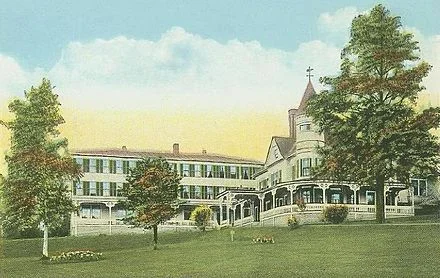
Hotel Pemigewasset in 1922

Fields of gold

“You can see the goldenrod, that most tenacious and pernicious and beauteous of all New England flora, bowing away from the wind like a great and silent congregation.’’
— novelist Stephen King
David Warsh: In the Panic of 2008, Bush did the right things
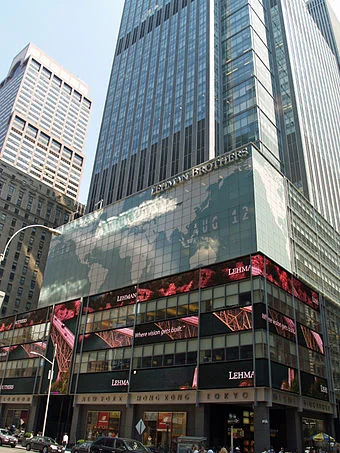
Headquarters of doomed Lehman Brothers.
SOMERVILLE, Mass.
At a time when the antipathy between Republicans and Democrats is at a fever pitch, it is worth recalling the desperate events 10 years ago when America’s center held together very well after the collapse of Lehman Brothers precipitated a financial panic, the first in many decades, that seemed to come out of nowhere to threaten a depression even worse than that of the 1930s. The White House put its full support behind the Federal Reserve Board’s role as lender of last resort. Congressional leadership of both parties reluctantly backed the president.
Two attempts were required to persuade the House to authorize the Treasury Department’s $700 billion supplement to the Fed’s own funds. The second succeeded, the measure passed, and U.S. leadership galvanized the central banks of the United Kingdom, the European Union, Canada, Sweden, Switzerland and Japan in a coordinated monetary easing.
In late September, 2008, 12 of the 13 most important U.S. financial firms had been at the brink of failure, Federal Reserve Chairman Ben Bernanke later told the Financial Crisis Inquiry Commission. By mid-October the unbridled fear had given way to full-alert wariness. Much of the credit for stemming the panic belongs to George W. Bush, who put the full force of his presidency behind the effort, before stepping out of the way of the presidential-election campaigns. (His wise choices weren’t obvious at the time.)
Instead of horrific gridlock, the U.S. economy sank into a deep recession.
A persistent itch remains to blame the crisis on the Bush administration, at least in some quarters. After all, Bernanke, Treasury Secretary Henry Paulson and New York Federal Reserve Bank President Timothy Geithner were hired during his watch, Geithner (by the New York Fed) in 2003, Paulson and Bernanke in 2006. Two books arguing against the heroic interpretation of their performance of the roles have appeared recently.
The Fed and Lehman Brothers: Setting the Record Straight on a Financial Disaster (Cambridge), by Laurence Ball, of Johns Hopkins University, argues that Bernanke and Geithner had the authority to save the troubled investment bank whose failure initiated the panic and that the central bankers were bullied by Paulson out of doing so. A Crisis of Beliefs: Investor Psychology and Financial Fragility (Princeton), by Nicola Gennaioli, of Bocconi University, and Andrei Shleifer, of Harvard University, claims that the Lehman failure should have been no surprise, that policy beforehand should have been more aggressive, and that the systemic run on the banking system was unpredictable was mostly a myth. (Shleifer, unfortunately, didn’t predict it.)
Neither interpretation is likely to stand up to professional scrutiny. The first-person accounts of the policy-makers – Bernanke (The Courage to Act), Paulson (On the Brink) and Geithner (Stress Test) – and the wealth of supporting material that has grown up around them are likely to remain the primary narrative of the crisis.
Today another crisis of great magnitude threatens, this one involving the U.S. Supreme Court. Once again former President Bush is involved, this time as a key supporter – as of last Thursday – of nominee Appeals Court Judge Brett Kavanaugh
It was Bush who hired Kavanaugh into the White House as an assistant counsel in 2001, who promoted him to staff secretary in 2003. (Those who followed the tribulations of Rob Porter, former staff secretary to President Trump, will know something of the close bond that develops between a president and the supervisor of his decision-making queue.) Bush presided over the marriage of his long-time personal secretary Ashley Estes to Kavanaugh in 2004, then two years later nominated his fellow Yale alum to the federal appellate court bench.
Bush last week reiterated his support of Kavanaugh after the testimony of Christine Blasey Ford, having earlier told Politico, “Laura and I have known and respected Brett Kavanaugh for decades, and we stand by our comments the night Judge Kavanaugh was nominated.” On that occasion he had said, “He is a fine husband, father, and friend – and a man of the highest integrity. He will make a superb justice of the Supreme Court of the United States.”
Then came the dramatic news that the Federal Bureau of Investigation would spend an additional week digging deeper into the nominee’s past. Meanwhile, the significance of Judge Kavanaugh’s partisan and untrustworthy testimony last week will continue to sink in. It won’t get any easier for the former president to maintain his support.
Probably no opinions outside the Senate, public or private, matter more to the fate of his nomination than those of George and Laura Bush. The Republican Party is in disarray. If it still has a leader, it is Bush.
David Warsh is a Somerville-based columnist and economic historian, as well as proprietor of economicprincipals.com, where this column first appeared.
PCFR: Arab social entrepreneurs; two paths to Brexit; geopolitics and U.S. Foreign policy

View of mosque in downtown Beirut. Below, Beirut, on the Mediterranean.
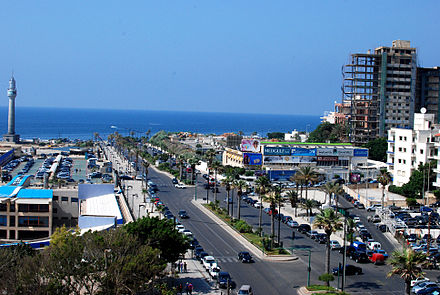
The next three speakers at the Providence Committee on Foreign Relations. (Please see thepcfr.org for membership and other information. Email: pcfremail@gmail.com)
Wednesday, October 3
Social Entrepreneurship with Dr. Teresa Chahine, Harvard
6:00, The Hope Club, 6 Benevolent Street, Providence
Dr. Teresa Chahine is the author of Introduction to Social Entrepreneurship, based on her course at Harvard. She is the Innovation Adviser at Alfanar Venture Philanthropy, which she helped launch in her home country of Lebanon. Alfanar provides tailored financing and technical support to social enterprises serving marginalized populations in the Arab world.
Dr. Chahine divides her time between Beirut and Boston, where she leads the social entrepreneurship program at the Center for Health and the Global Environment at the Harvard T.H. Chan School of Public Health.
Wednesday, October 17
Two Paths to Brexit: Michael Goldfarb
6:00, The Hope Club, 6 Benevolent Street, Providence
On the eve of an EU summit where the bloc's chief Brexit negotiator, Michel Barnier, hopes to present a draft treaty for Britain's withdrawal from the EU former NPR correspondent, Michael Goldfarb, who covered the creation of the euro and the border free Europe, looks at the details of the deal: the rights of millions of British and European citizens now living in what have become "foreign" countries, how to keep the Irish border fully open, maintaining supply chains, and the time frame for transition.
It is also possible talks will have collapsed. In that case, Goldfarb will explain the likely impact on UK, Europe and global economy of a no-deal Brexit.
Michael Goldfarb is an author, journalist and broadcaster. He has written for The Guardian, The New York Times and The Washington Post but is best known for his work in public radio. Throughout the 1990’s, as NPR’s London Correspondent and then Bureau Chief, he covered conflicts and conflict resolution from Northern Ireland to Bosnia to Iraq for NPR.
Thursday, November 8
Geopolitics Underlying U.S. Foreign Policy
Sarah C. M. Paine
6:00, The Hope Club, 6 Benevolent Street, Providence
Sarah C. Paine is a professor of strategy and policy at the U.S. Naval War College. She has written or co-edited several books on naval policy and related affairs, and subjects of particular interest to the United States Navy or Defense. Other works she has authored concern the political and military history of East Asia, particularly China, during the modern era. She is the author of the 2012 award-winning book, Wars for Asia 1911–1949.
It's all reusable

“Busted Statues” (mixed media), by Linda Leslie Brown, in her show “Plastiglomerate,’’ at Kingston Gallery, Boston, Oct. 3-28.
Chris Powell: Income-tax fantasies; a colonial-era hero or mass murderer?
Connecticut Republican gubernatorial candidate Bob Stefanowski’s objective of eliminating the state income tax is ridiculous but not for the reason commonly offered -- that the tax produces half state government’s revenue and cutting spending that much never would be practical, not even over the eight years of Stefanowski’s "plan."
Instead Stefanowski’s "plan" is ridiculous because the Democrats probably will retain the state House of Representatives in the coming election and well might recover a clear majority in the Senate, now tied at 18. Any budget will require the General Assembly’s approval and no house controlled by Democrats will ever agree to even modest spending cuts.
A Democratic majority in just one house would let Stefanowski off the hook -- along with Republican legislators, who may be glad if they stay in the minority and thus avoid responsibility for closing next year’s projected state budget deficit of more than $4 billion.
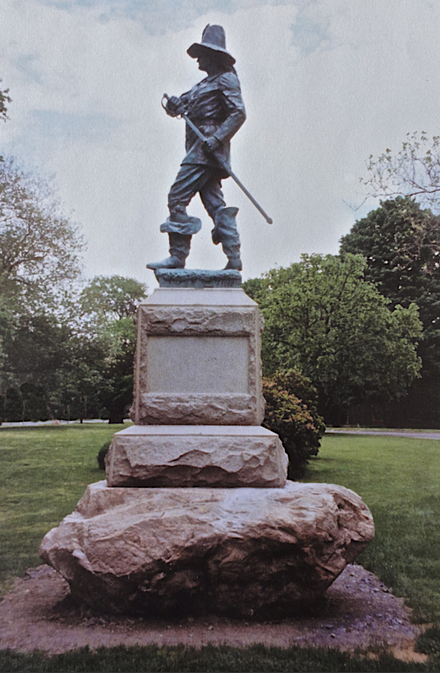
Statue of Captain John Mason in Windsor, Conn. Below, the plaque with it.
— Photo by MoonWaterMan
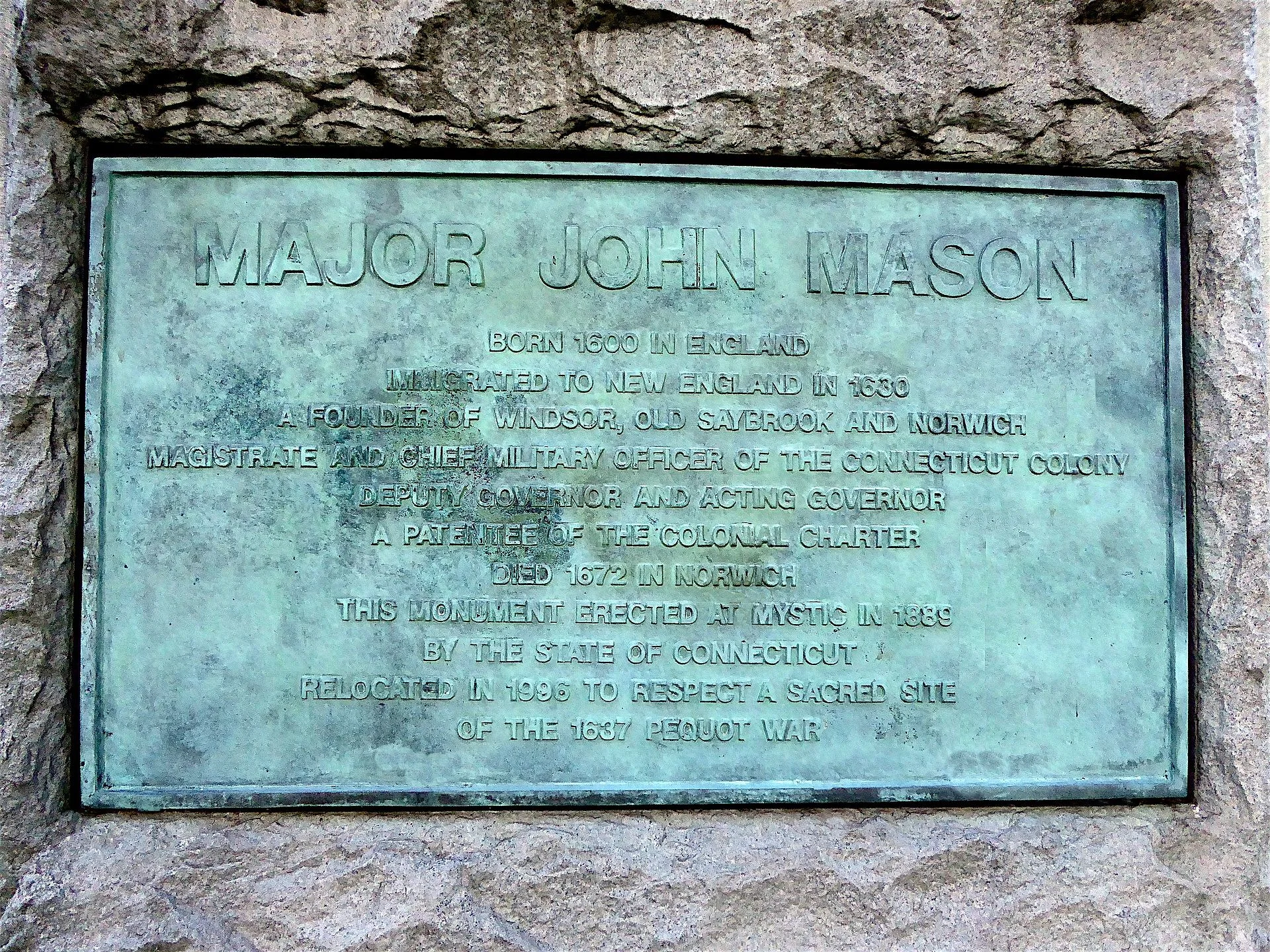
Students from Central Connecticut State University visited a park in Windsor the other day to contemplate the statue of a hometown hero of sorts, Captain John Mason, a founder of the Connecticut colony and leader of what might be called the European tribe in the Pequot War in 1637. Mason was in command when most of the Pequots, including women and children, were slaughtered by gunshot and fire in their fort in Groton, a genocide celebrated then but not so much now.
Two decades ago Mason’s statue was moved from Groton to Windsor to end celebration of the massacre and diminish its memory.
How far political revisionism should go with monuments is always a fair question. Leaders of the late Southern Confederacy are increasingly out of favor, but even George Washington owned slaves and fought in a war against Indian tribes. For the time being, Washington’s sins remain forgiven, overtaken by his immense service to his country.
So what is to be done with Mason? Whether his statue stays or goes somewhere else, like a museum, it is important to put him in the context of his time. Standards were primitive four centuries ago -- not just for the European colonists, who generally regarded the aboriginals as savages, but also for the Indians. Everyone was tribal.
Indeed, Europeans living in Massachusetts were actually invited to settle in Connecticut because of Indian tribal rivalry and war here. The Pequots, whose name meant "destroyers," were not native to the area, having come from what is now upstate New York, and they preyed on less combative tribes who imagined the Europeans as allies. Such an alliance between the Europeans and the Mohegan tribe indeed exterminated the Pequots. While today the two tribes, reconstituted, are partners in the casino business, back then they were as cutthroat to each other as the Europeans and the Pequots were to each other.
Connecticut has plenty of history to celebrate and less to regret than some states. But Mason would not have a statue except for the massacre of the Pequots. The statue’s placement in the park in Windsor implies that he is still officially regarded as a hero. Since Mason is buried in a cemetery in Norwich, a city he helped found, his statue might better be moved to his grave, where people could regard it without any official suggestion of heroism.
Chris Powell is a columnist for the Journal Inquirer in Manchester, Conn.
'A little closer to heaven'

The Ayer Mill, in Lawrence.
“It is a long time since I flapped my wings,
a long time since I stood on the roof of my house
in Lawrence, Mass., or Michael’s in No. Andover,
a little whiskey in one hand, the past slipping
through the other, a little closer to the heaven
of dreams, letting the autumn wing, or the spring
wind, or maybe just the invisible breath of some
woman lift me up….’’
-- From “The Angels of 1912 and 1972,’’ by Richard Jackson
Wake up and dream

“Echo of emptiness: play of wakefulness 13” (encaustic, shellac, paint marker and resin on panel), by Barry Margolin, in his show “Play of Wakefulness,’' Oct. 3-28 at Galatea Fine Art, Boston.
Explosive infrastructure

From Robert Whitcomb's "Digital Diary,'' in GoLocal24.com
The recent explosions and fires north of Boston were reminders of how dangerous natural gas can be, especially if pipes carrying it are old and corroded and gas is being sent at excessive pressures, in this disaster. Perhaps as battery storage improves, electricity from non-volatile energy from regional solar, wind and other nonpolluting sources will replace fossil fuel (all of which comes from outside the region) for virtually all residential and commercial uses, also making us less vulnerable to giant utilities for whom profit and stock price might trump public safety.
For now, we can only hope that the gas-line part of America’s crumbling infrastructure gets some fast upgrades.
'Wide of the way'

“And so the day drops by, the horizon draws
The fading sun and we stand struck in grief,
Failing to find our haven of relief,
Wide of the way, nor sure to turn or pause,
And weep to view how fast the splendor wanes
And scarcely heed that yet some share remains
Of the red afterlight, some time to mark,
Some space between the sundown and the dark;
But not for him those golden calms succeed
Who while the day is high and glory reigns
Sees it go by, as the dim pampas plain,
Hoary with salt and gray with bitter weed,
Sees the vault blacken, feels the dark wind strain,
Hears the dry thunder roll, and knows no rain.’’
“And So the Day Drops By,’’ by Frederick Goddard Tuckerman (1821-1873), a poet, lawyer and scientist who spent most of his adult life in Greenfield, Mass.

“In the Berkshires,’’ painted by George Inness in 1850.
William Morgan: Finding treasure of Downeast Doric
SEDGWICK, Maine
(New photos by William Morgan)
This small village on the Blue Hill Peninsula seems like so many towns along the rocky coast of Maine. Hardy souls who settled here mostly made a living from the sea – fishing and shipbuilding -- along with some quarrying of the granite ledges. Brooklin, next to Sedgwick, is where the famed essayist and children’s book author E.B. White wrote and set much of his writing there, perhaps most famously Charlotte’s Web.

Sedgwick in 1909.
In a land of many small Congregational houses of worship, what sets Sedgwick apart is its very handsome Baptist church. Earle Shettleworth, longtime director of the Maine Historic Preservation Commission, who knows more about the architecture of the Pine Tree State than anyone else, declares the Sedgwick church to be the finest example of the Greek Revival style in the state.
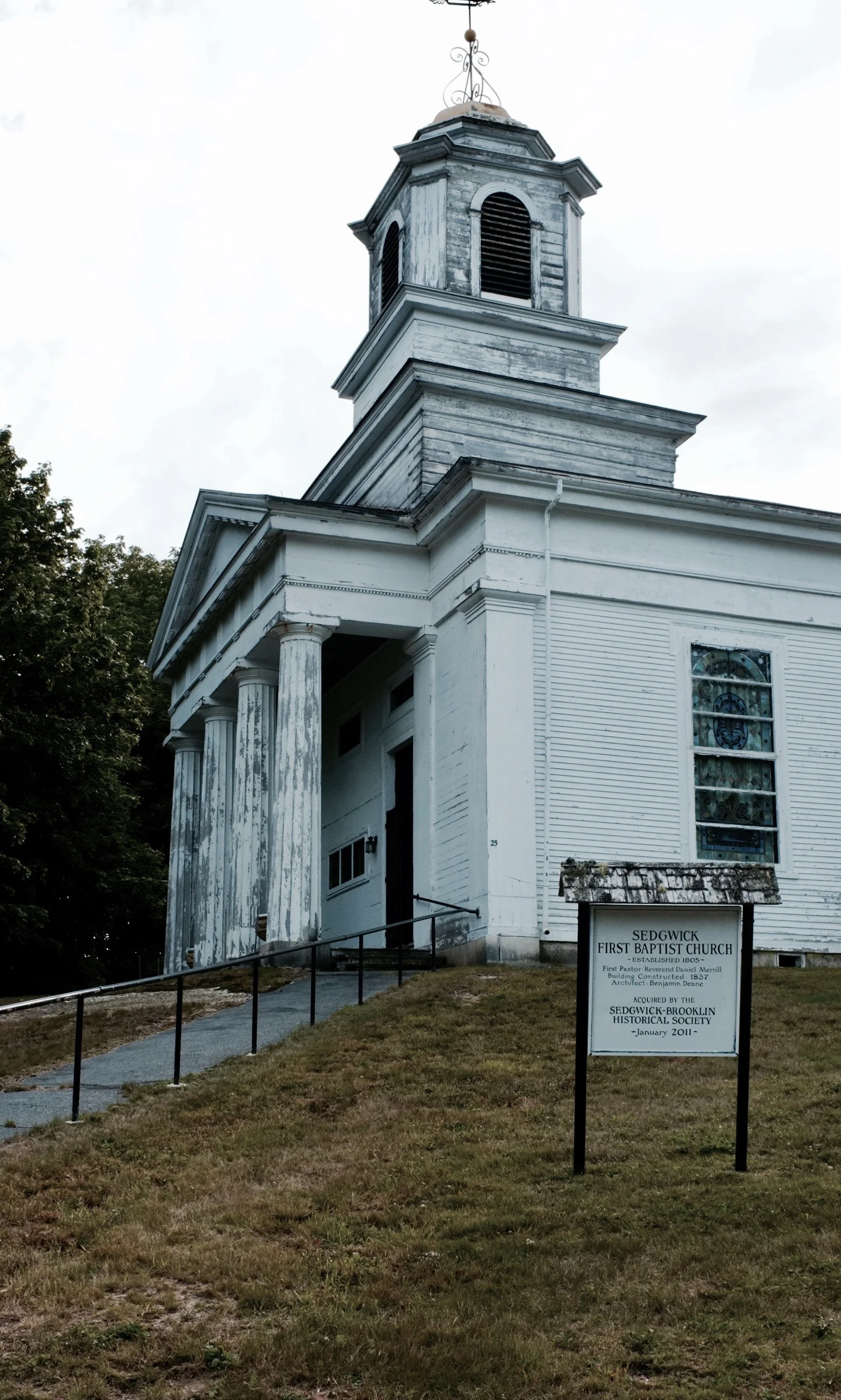
Superlatives aside, the Sedgwick church is both magnificent and a surprise. Situated above the village, First Baptist has a commanding presence, with its Doric portico, temple form and three-stage cupola.
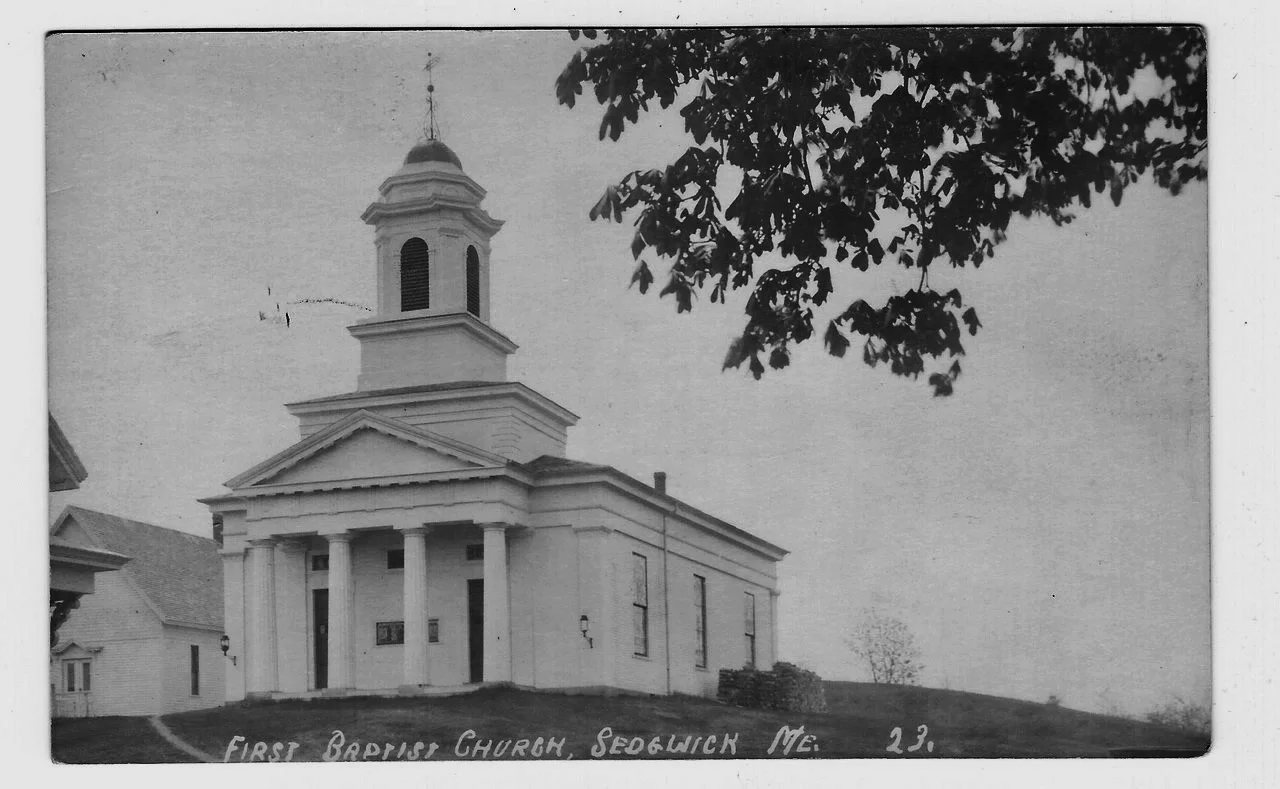
Sedgwick Baptists broke away from the Congregationalists in 1805, most of the congregation with them. This building was built in 1837 at the height of the national craze for architecture putatively inspired by the ancient Greeks. The architect was Benjamin S. Deane from Bangor; the builder was Thomas Lord from nearby Surry.
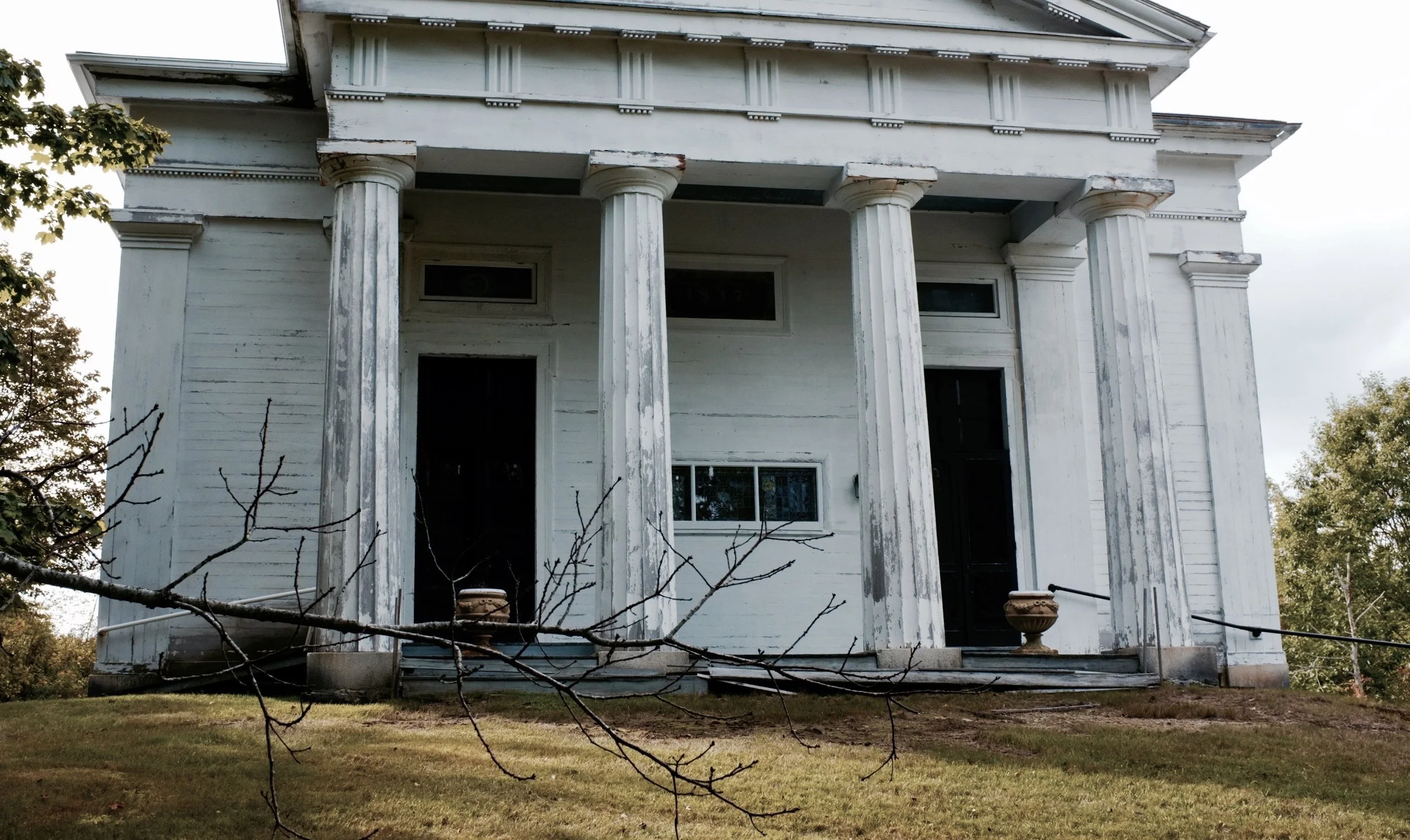
Deane was a successful architect of other churches, houses and even a courthouse in eastern Maine. Like many country builders in 19th Century New England, Deane's architectural sophistication came from books, most especially the builder's guides published by Boston architect Asher Benjamin.
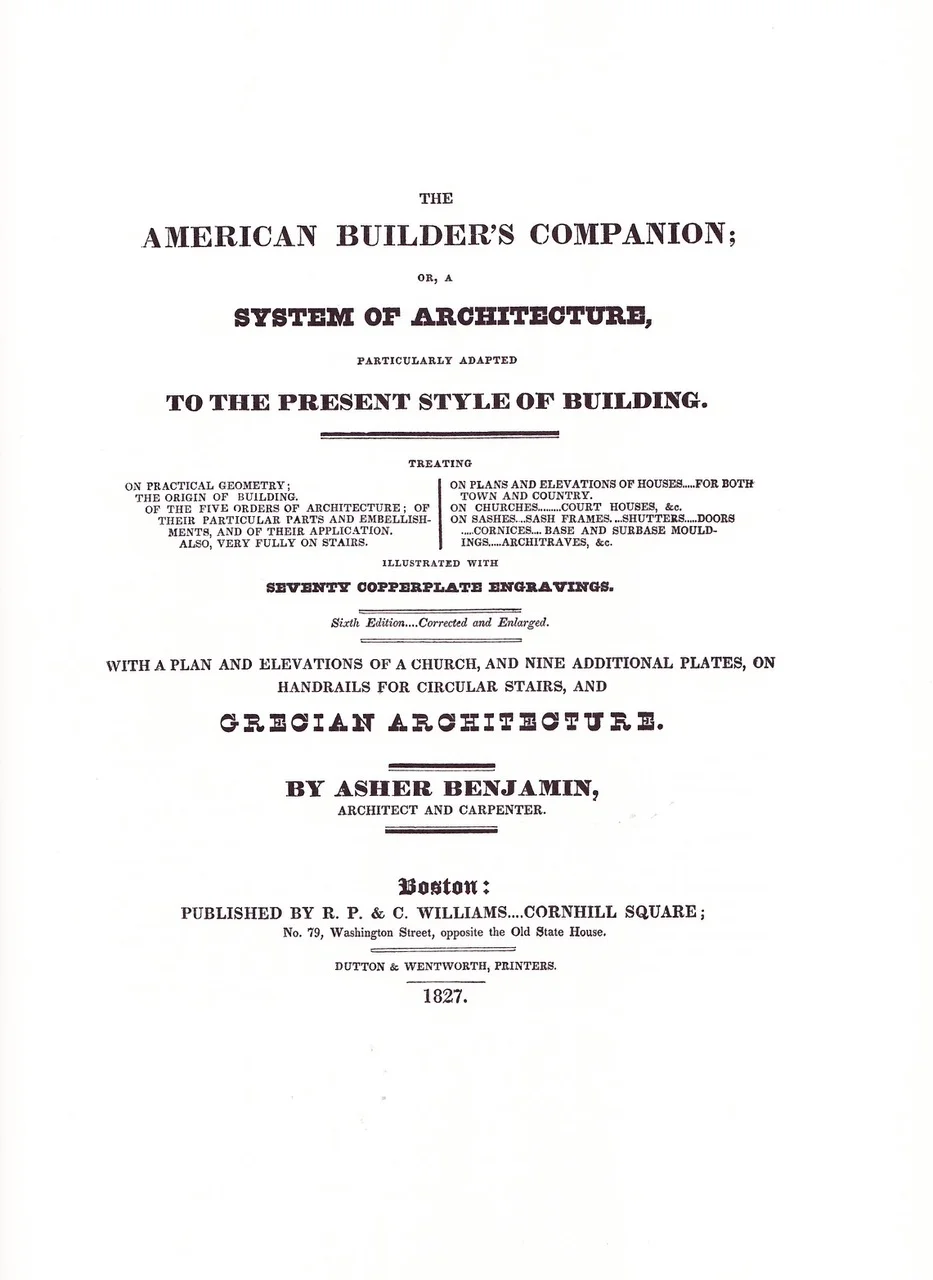
Benjamin's hugely popular how-to books did much to spread the high styles of Boston to New England's rural backwaters. The sixth edition of his American Builder's Companion added templates for Greek details, in addition to the Late Georgian that predominated in the earlier editions.

Plate showing the Doric order from The American Builder's Companion.
Benjamin's Greek orders were clearly 'borrowed' from earlier European books on the
subject. The Doric was the simplest order and thus the easiest for rural carpenter architects to fashion, especially in wood.
The cupola, however, is not Greek Revival, but rather a late Georgian form from one of Benjamin's own buildings, the West Meeting House, in Boston. Yet, this kind of mix-and-match without too much regard to historical purity was typical of American architecture.
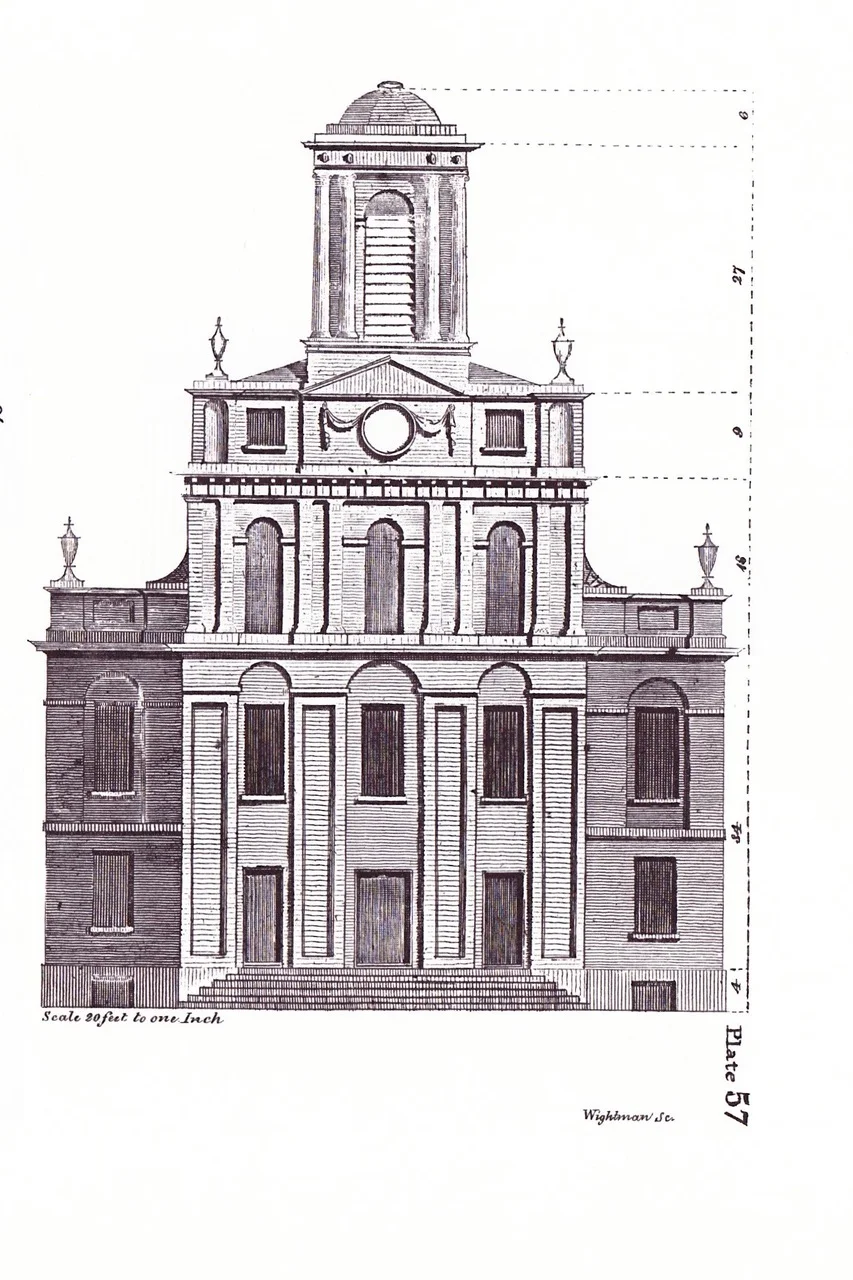
Asher Benjamin’s West Meeting House, Boston. The church is in late Georgia, of Federal, style. This is the likely source for the Sedgwick cupola.
The interior is pretty similar to a lot of Protestant preaching boxes, with pews that could be from any Maine church of the early 19th Century. The tabernacle frame around the organ is, however, Greek.
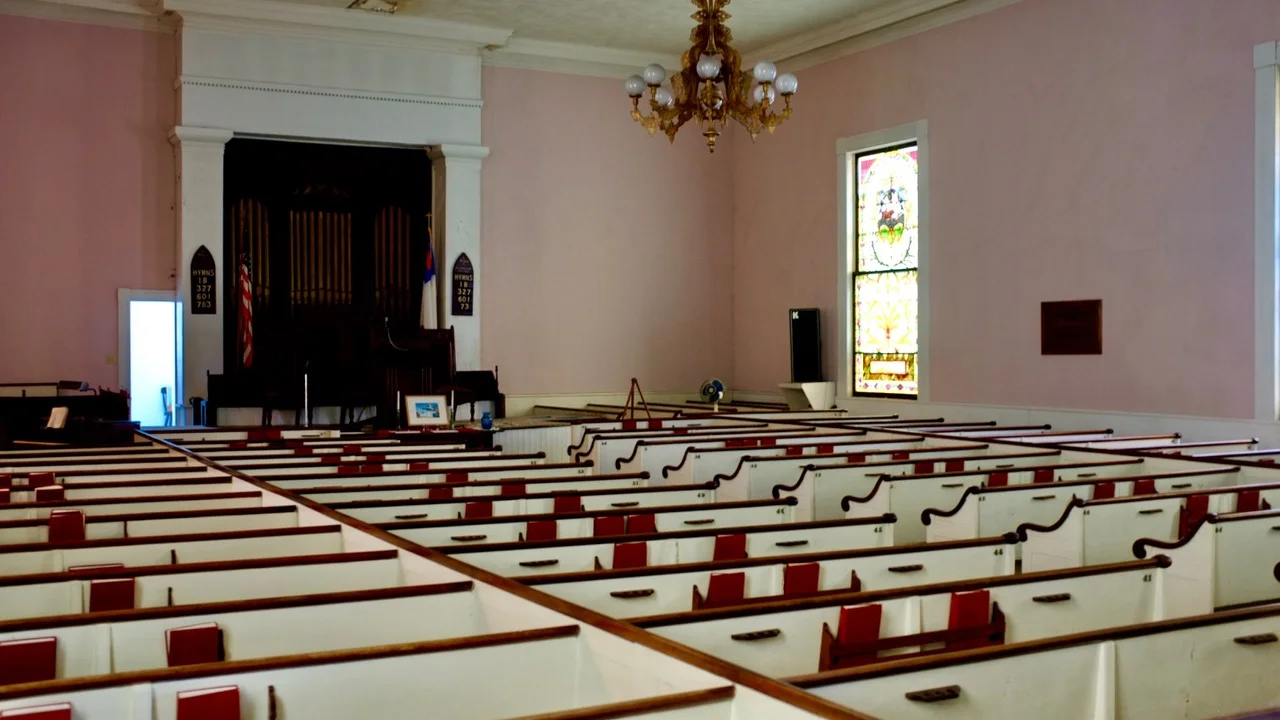
Stained glass windows in the opalescent manner of the great glass artists John La Farge and Louis Comfort Tiffany were installed at the turn of the 20th Century. Alas, were these not run-of-the-mill copies, their sale might have contributed heartily to the $400,000 needed to restore the church.

Sedgwick's Baptists became pretty thin on the ground. By the congregation's 200th anniversary, in 2005, fewer than a handful of people came to celebrate. A few years later it was sold to an adoring fan who is trying to stabilize the church, searching for money to fix it up, and seeking to find an appropriate nonprofit group that would run the church as a community center.

William Morgan, based in Providence, wrote his Columbia University master's thesis on Alexander Parris, a New England Greek Revival architect. He contributed the introduction to the Dover reprint of Asher Benjamin's American Builder's Companion, and is the author of American Country Churches, among other books.
PCFR: Arab social entrepreneurs; future of Brexit; U.S. geopolitics

Fall speakers at the Providence Committee on Foreign Relations. (Please see thepcfr.org for membership and other information.)
Wednesday, October 3
Social Entrepreneurship Abroad with Dr. Teresa Chahine, Harvard
6:00, The Hope Club, 6 Benevolent Street, Providence
Dr. Teresa Chahine is the author of Introduction to Social Entrepreneurship, based on her course at Harvard. She is the Innovation Advisor at Alfanar Venture Philanthropy, which she helped launch in her home country of Lebanon. Alfanar provides tailored financing and technical support to social enterprises serving marginalized populations in the Arab world.
Dr. Chahine divides her time between Beirut and Boston, where she leads the social entrepreneurship program at the Center for Health and the Global Environment, Harvard T.H. Chan School of Public Health.
Wednesday, October 17
Two Paths to Brexit: Michael Goldfarb
6:00, The Hope Club, 6 Benevolent Street, Providence
On the eve of an EU summit where the bloc's chief Brexit negotiator, Michel Barnier, hopes to present a draft treaty for Britain's withdrawal from the EU former NPR correspondent, Michael Goldfarb, who covered the creation of the euro and the border free Europe, looks at the details of the deal: the rights of millions of British and European citizens now living in what have become "foreign" countries, how to keep the Irish border fully open, maintaining supply chains, and the time frame for transition.
It is also possible talks will have collapsed. In that case, Goldfarb will explain the likely impact on UK, Europe and global economy of a no-deal Brexit.
Michael Goldfarb is an author, journalist and broadcaster. He has written for The Guardian, The New York Times and The Washington Post but is best known for his work in public radio. Throughout the 1990’s, as NPR’s London Correspondent and then Bureau Chief, he covered conflicts and conflict resolution from Northern Ireland to Bosnia to Iraq for NPR.
Thursday, November 8
Geopolitics Underlying US Foreign Policy
Sarah C. M. Paine
6:00, The Hope Club, 6 Benevolent Street, Providence
Sarah C. Paine is a professor of strategy and policy at the U.S. Naval War College located in Newport, Rhode Island. She has written or co-edited several books on naval policy and related affairs, and subjects of particular interest to the United States Navy or Defense. Other works she has authored concern the political and military history of East Asia, particularly China, during the modern era. She is the author of the 2012 award-winning book, Wars for Asia 1911–1949.
'Here is best'

Looking north from the French King Bridge at the Erving-Gill town line in western Massachusetts.
“Where the heart is, there the muses, there the gods sojourn, and not in any geography of fame. Massachusetts, Connecticut River, and Boston Bay, you think paltry places, and the ear loves names of foreign and classic topography. But here we are; and, if we tarry a little, we may come to learn that here is best. See to it, only, that thyself is here; and art and nature, hope and fate, friends, angels, and the Supreme Being, shall not absent from the chamber where thou sittest.’’
— Ralph Waldo Emerson
Different values then

To die is gain,’ a virgin’s tombstone said;
“That was New England, too, in another age
That put a higher price on maidenhead
If brought in dead; now on your turning page
The lines blaze with a constant life, displayed
As in the maple’s cold and fiery shade.’’
— From “For Robert Frost, in the Autumn, in Vermont,’’ by Howard Nemerov

Chris Powell: Abortion and the Kavanaugh-Ford hysteria
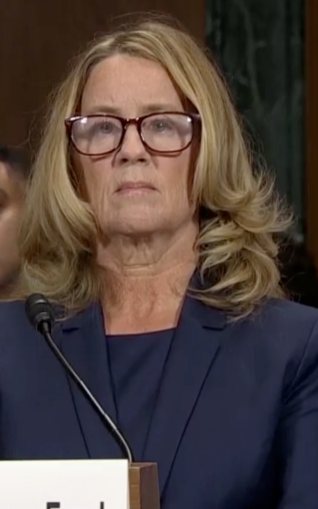
Christine Blasey Ford in her appearance before the Senate Judiciary Committee.
MANCHESTER, Conn.
According to Connecticut Sen. Richard Blumenthal, Supreme Court nominee Brett Kavanaugh's primary accuser, Christine Blasey Ford, has no reason to lie by claiming that Kavanaugh sexually assaulted her 36 or so years ago when they were in high school. But by making her accusation so late -- not just decades after the supposed incident but years after Kavanaugh was nominated as a federal judge and only upon his nomination to the Supreme Court -- Blasey Ford has entered politics, and everyone in politics has reason to lie or exaggerate.
Of course, this doesn't mean that Blasey Ford is lying or exaggerating. Any accusation of sexual misbehavior against a teenage boy is plausible. This means only that whatever may have happened decades ago did not bother Blasey Ford enough to complain about it until it could be used to stop Kavanaugh's appointment to the Supreme Court. As she is a liberal Democrat while Kavanaugh is a conservative Republican presumed to be skeptical of the court's precedent in the abortion case of Roe v. Wade, Blasey Ford well could be doubly bothered.
This follows the pattern set by Anita Hill's accusation of sexual harassment against Clarence Thomas upon his nomination to the Supreme Court, in 1991. Hill had worked for Thomas at two federal agencies in Washington and followed him from one agency to the other so she could continue working for him even after the supposed harassment began. For years after she left government employment, Hill maintained cordial relations with Thomas, even seeking and receiving help from him. Hill did not complain about Thomas until liberals opposed him for the Supreme Court out of fear that, as a conservative Republican, he would tilt the court against abortion rights.
Of course this didn't make Hill a liar or exaggerator either. But it put her into politics too and thus gave her reason to lie or exaggerate, just as Blasey Ford entered politics by joining the opposition to Kavanaugh only when abortion rights were again in question. Blasey Ford has even said that if Kavanaugh were confirmed she would have to move to New Zealand. Only her politics would require that.
But far from handicapping her, Hill's belated accusation against Thomas made her a celebrity and won her a career as a law professor and liberal heroine. Blasey Ford can expect something similar.
By contrast, Kavanaugh, like Thomas, can expect only to be forever suspected as some sort of sex criminal. Maybe Kavanaugh will deserve it -- as long as the country has resolved that youthful misbehavior can never be forgiven no matter how long ago it happened and that people who haven't grown up by age 17 can never grow up. If so, Connecticut should eliminate secrecy for its juvenile courts and all the probationary gimmicks that erase convictions in adult court.
The hysteria over the accusations against Kavanaugh has destroyed all standards of politics and journalism and is threatening to destroy legal standards. To prevent another conservative vote on the Supreme Court, the most defamatory and unsupported allegations, along with hearsay and rumor, once barred by the old rules of fairness and libel are being sensationally published and broadcast by news organizations in their crazed search for anyone who can disparage the nominee's character as it might have been 36 years ago.
This is being done by institutions that had no trouble excusing the contemporaneous sexual misbehavior in office, of Ted Kennedy, Chris Dodd, and Bill Clinton, all Democrats who, perhaps not surprisingly, were sure that the Bill of Rights covered abortion.
Chris Powell is a columnist for the Journal Inquirer, in Manchester, Conn.
Water into rivers faster

Flood damage in Winsted, Conn., in August 1955 after former Hurricane Diane came through.
From Robert Whitcomb’s “Digital Diary’’ in GoLocal24.com
With more than 30 inches of rain in some places, the flooding in North Carolina would have been awful even if so much land hadn’t been paved over for parking lots in our car-dependent culture. But, as we have discovered in New England in big rainstorms, it certainly makes things worse as storm water isn’t permitted to be absorbed into the soil but instead rushes off into streams, often carrying oil and other pollutants from impervious surfaces.
Catastrophic rain events seem to be increasing with global warming. Public- and private-sector planners need to make more of an effort to replace, wherever possible, asphalt and concrete parking surfaces with porous ones, such as paving stones set in sand.
Meanwhile, the Trump regime will make things worse as it takes steps to make it easier for developers to fill in more water-absorbing wetlands. (See comments on deregulation below.) And of course it’s promoting a massive increase in the drilling and mining for fossil fuel, whose global-warming effects include more intense fresh and saltwater flooding.
Meanwhile, readers might want to hear this dramatic Rhode Island Public Radio piece about the 1938 hurricane that ravaged New England and on how vulnerable we still are around here. To hear it, please hit this link.
Pushing N.E. innovation in financial technology

Boston’s Financial District.
This is from The New England Council (newenglandcouncil.com)
“On Oct. 26, The New England Council will present ‘New England Innovates: Leading the Way in FinTech.’ The event, hosted by NEC member Bank of America at Its Boston office, is the fourth in the council’s “New England Innovates” series, which aims to highlight how New England businesses and organizations are leading the way in the innovation economy, and to promote an ongoing dialogue in the region about how we maintain our reputation as a global innovation hub.
The event will feature keynote remarks from Craig Phillips, counselor to the Treasury secretary and co-author of the department’s recent report on financial technology. Following Mr. Phillips’s remarks, a panel of council members will discuss their own fintech initiatives and discuss the challenges and opportunities associated with this rapidly evolving sector.
Panelists confirmed to date include:
Jay Biancamano – managing director, digital product development, State Street Corp.
Steve Leschuck – vice president, new products, Liberty Mutual
George Marootian – executive vice president, head of technology, Natixis Investment Managers’’
For more information, email: gdoherty@newenglandcouncil.com
Private moments, public spaces
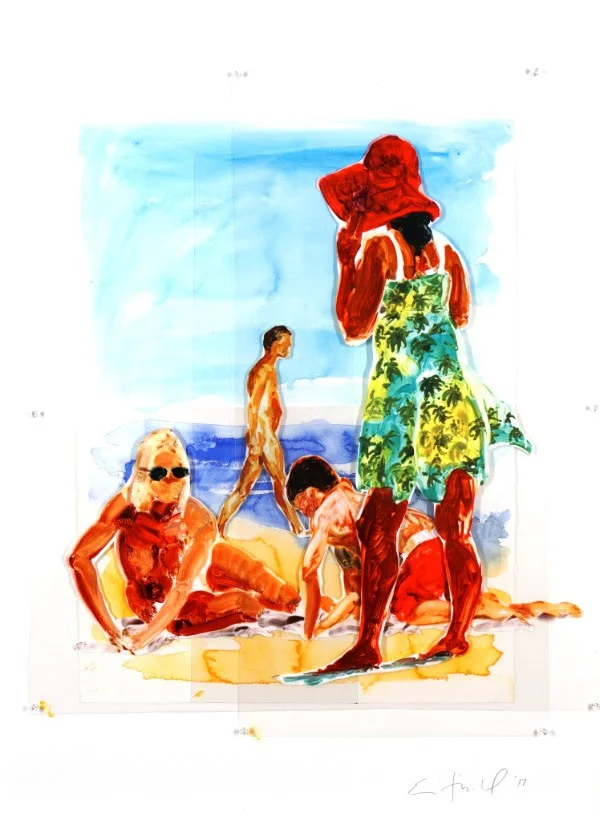
“Two Woman and Boy’’ (pinned Mylar collage), by Eric Fischl, in his current show “Eric Fischl: Recent Work,’’ at the Adelson Galleries, Boston.
Adelson says: “Our newest exhibition features a collection of Fischl’s most recent prints, paintings and sculptures that explore private moments in public spaces. Using Mylar collage, glass sculpture and poured resin, our collection of pieces invite the viewer to a dialog about transparency and the human image spanning among two and three dimensions. Through a variety of increasingly modern techniques, his recent works are a fine-tuned, energetic and thought provoking evolution to his early works.’’