
Vox clamantis in deserto


Fishing lessons from Maine

Lobster boat off Portland, Maine.

Maine lobster traps ready to be taken on board in 1928.
From Robert Whitcomb’s “Digital Diary,’’ in GoLocal24.com
Lobster Coast: Rebels, Rusticators, and the Struggle for a Forgotten Frontier, by Colin Woodard, is a history of the storied Maine Coast in which the ups and downs of the fishing industry in the Pine Tree State have played a big part.
The book is a deeply researched, reported and colorful narrative. It may also be of particular interest to New Englanders now in light of the overdue restrictions just imposed on the herring fishery. There are many lessons to be gained from a study of the management and non-management of fish species in the spectacular protein factory known as the Gulf of Maine. Overfishing has led to the Maine Coast having only one major commercial species left – lobsters. Catches of such formerly lucrative species as cod, haddock and halibut are a fraction of what they were a few decades ago.
All too often fishermen blame “natural cycles’’ for fishing stocks that are collapsing because of extreme overfishing. Modern fishing techniques, including fish-finding electronic devices and bigger, better nets and boats, have had devastating impacts. Overfishing of such species as herring that are essential food for the survival of larger fish can be particularly damaging to fishing ecology.
So it was muted good news that federal regulators decided to slash catch limits by 55 percent and impose buffer zones where no commercial herring fishing would be allowed. However, many scientists think that the whole herring fishery off New England should be shut down for a while in order to save it.
“The population is stressed, and we really need to start building resiliency,” Erica Fuller, senior lawyer with the Conservation Law Foundation, told the council.
Rarely does any economic interest group eschew short-term profit for long-term gain. People will almost always take the money and run. (An apparent exception is Maine’s lobstermen’s remarkably cooperative and voluntary efforts in recent years to save that fishery.) Strong measures can do wonders in saving species, as in the case of striped bass, whose revival owes much to the late Rhode Island Sen. John H. Chafee’s push for research and regulation to save the sportfish from extinction off the East Coast.
'Excitement before the fall'
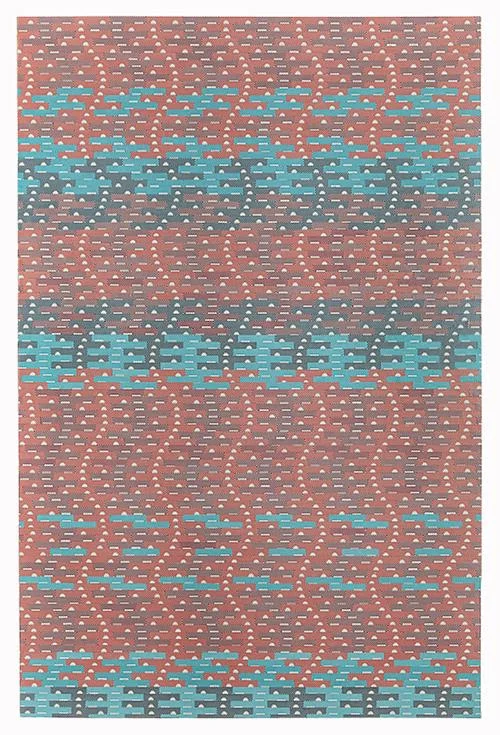
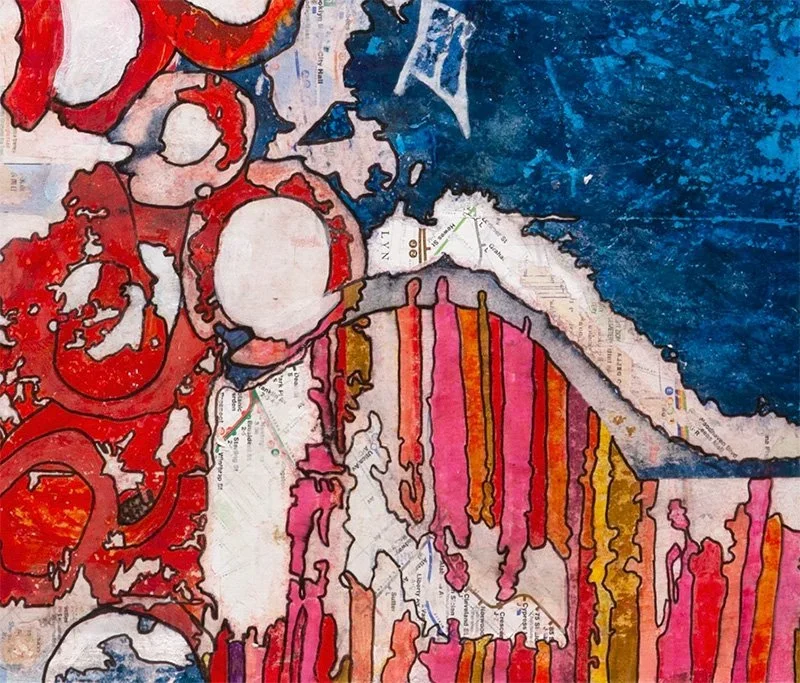
“Ghost of a Dream: counting flowers on the wall’’ (used playing cards from Trump Plaza and the Miccosukee Nation casinos on panel), by Lauren Was and Adam Eckstrom, in the show “I’ll be with you when the deal goes down,’’ at Standard Space, Sharon, Conn., Oct. 6-Nov. 4.
The gallery says: “The exhibition pieces are made entirely from old playing cards once used in American casinos with Optical Art-like designs that create intense, repetitive patterns. These patterns are an abstract recreation of the excitement and anticipation felt by the brain when hoping to win a round of gambling. The cards carry with them a history of losses and broken dreams, even as they make up pieces that demonstrate the excitement before the fall.’’
Chris Powell: 'Look who's talking'
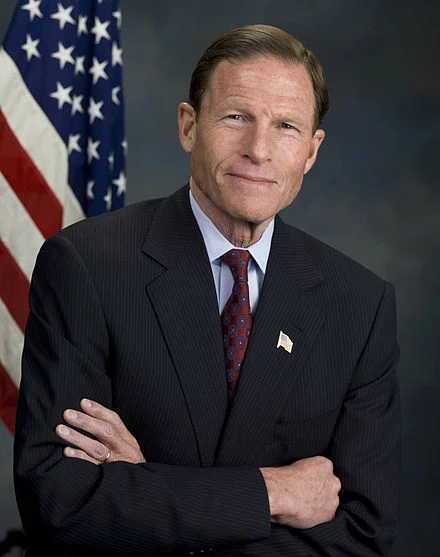
Sen. Richard Blumenthal (D.-Conn.)
Some people are lucky in their friends while some, like Connecticut Sen. Richard Blumenthal, are even luckier in their enemies.
No one could be luckier than Blumenthal to have President Trump as an enemy. For in denouncing Blumenthal the other day for the senator's opposition to Judge Brett Kavanaugh's nomination to the Supreme Court, the president managed to change the subject from Blumenthal's posturing and hypocrisy to his own recklessness.
Blumenthal, the president said, lied about serving with the Marines in Vietnam. Not only that, the president said, but the senator had described himself as a war hero who had distinguished himself at Da Nang.
Huh? Yes, many years ago Blumenthal sometimes falsely asserted or implied that he had served in Vietnam. He actually spent the war years stateside in the Marine Reserves and the only campaign he participated in was for Toys for Tots. But he does not seem ever to have claimed any heroism. Trump made that part up as much as Blumenthal made up his service in Vietnam.
Confronted with documentation of his false claims of Vietnam service as he ran for the Senate in 2010, Blumenthal acknowledged that he repeatedly had "misspoken" -- Democratese for "lied." He apologized and got away with it, in part because his Republican opponent, Linda McMahon, wasn't a war hero either but just a rich dilettante who had made her money from what was more or less pornography.
So with his wild exaggeration about Blumenthal, Trump, whose only Vietnam-era campaign was against the bone spurs that got him out of the draft, neutered what otherwise might have been fair comment about the senator.
Trump is Trump and criticism of his character can get tedious. Anyone who is not already distressed by it probably never will be.
But Blumenthal remains largely respected, especially in Connecticut, so there still may be value in evaluating his character. His participation in the Senate Judiciary Committee's hearing on Kavanaugh last week suggested that Blumenthal might benefit from more self-awareness and less self-regard.
Piling on Kavanaugh with the other Democratic senators trying to undermine the nominee's credibility, Blumenthal seemed to forget his own shortcomings. He asked if Kavanaugh knew a legal maxim in Latin, "Falsus in uno, falsus in omnibus," or "False in one thing, false in everything." Kavanaugh was not yet as riled up as he would become under questioning about his partiality for beer, so he let Blumenthal's Latinized insult pass.
But some people watching the hearing on television grasped the irony of Blumenthal's questioning anyone else's honesty. Soon someone produced a photograph of U.S. soldiers plodding through a rice paddy in Vietnam, with Blumenthal's face superimposed on the soldier in front. The caption: "False in one thing, false in everything."
The photo was merrily distributed throughout the country.
Of course, most of Connecticut's news organizations took Blumenthal's side against Trump's mockery, as if there aren't always plenty of news organizations reminding the country of the president's indifference to truth. Once again Blumenthal is getting off easy back home.
So if only Kavanaugh had taken a little less law (and beer) and a little more Latin at Yale. Then he might have responded to Blumenthal's "Falsus in uno, falsus in omnibus" with a telling rejoinder: Respice quis loquentes suus.
That is: Look who's talking.
Chris Powell is a columnist for the Journal Inquirer, in Manchester, Conn.
John O. Harney: Some interesting New England facts and figures

From The New England Board of Higher Education (nebhe.org) as compiled by its executive editor, John O. Harney:
“From time to time, we revive the collection of facts and figures called ‘Data Connection’ that we had published quarterly for nearly 20 years in the print editions of The New England Journal of Higher Education (formerly Connection).
The latest ...
Inflation-adjusted increase in household incomes for the bottom quarter of Maine workers between 2016 and 2017 after the state's voter-approved minimum wage increase: 10%, according to the Maine Center for Economic Policy.
Reduction in number of Maine children living in poverty between 2016 and 2017 after the minimum wage increase: 10,000 according to the Maine Center for Economic Policy.
Percentage of respondents to the University of New Hampshire Carsey School of Public Policy's Upper Valley Child Care Survey who reported that child care is necessary in order for them to work: 96%. (The Upper {Connecticut River} Valley includes Orange and Windsor Counties in Vermont and Grafton and Sullivan Counties in New Hampshire.)
Number of children under age 5 in the Upper Valley Census who live in fully employed families (two working parents if they live with two and one working parent if they live with one): 7,300, according to the Carsey School of Public Policy.
Number of licensed slots available for children in this age group: 4,995, according to the Carsey School of Public Policy.
Number of reported hate crimes per 100,000 people in 2016 in Massachusetts: 5.9. (Data reported to the FBI from agencies—reportedly the highest rate of any state, but also drawn from more agencies than some states, including 70 communities, several colleges and the MBTA.)
U.S. ranks of Massachusetts, Vermont and Connecticut among "healthiest" U.S. states, according to United Health Foundation: 1, 3, 5 America's Health Rankings, according to the United Health Foundation.
U.S. rank of South Burlington. Vt., among WalletHub's 2018’s Best & Worst Cities for People with Disabilities, based on 31 indicators of disability-friendliness, ranging from wheelchair-accessible facilities per capita to rate of workers with disabilities to quality of public hospital system: 2 ,according to WalletHub
U.S. rank of New Haven, Conn.: 182, according to WalletHub.
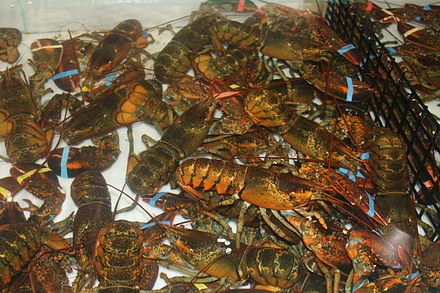
Todd McLeish: Warming water may be factor in lobster shell disease in southern New England
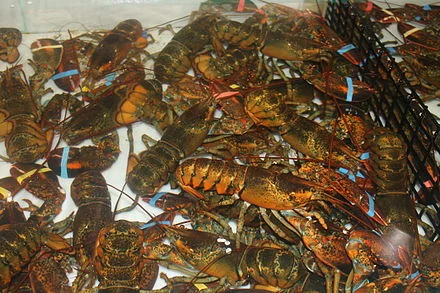
Despite more than 20 years of declining lobster populations in southern New England and extensive studies of the shell disease that is a major factor in their decline, scientists are still struggling to provide definitive answers to help restore hope to those working in the local lobster fishery.
A new study of lobsters along the eastern Connecticut coast has found that the disease is linked to warming water temperatures, while progress is slow in efforts to identify probiotics to counteract the disease and to better understand why so many lobsters are blind.
“Epizootic shell disease first appeared around 1996 and became quite prevalent around 1999, and it continues to be prevalent,” said Maya Groner, who conducted the Connecticut study as a post-doctoral researcher at the Virginia Institute of Marine Science. “It’s been a challenge to figure out what the pathogen associated with the disease is. The best evidence suggests it may be a suite of bacteria that chews away at the carapace, but that suite of bacteria changes over the course of the disease.”
Her study found that the increased prevalence of the disease stems from warmer water temperatures that induce the lobsters to molt their shells earlier than usual.
Using data on 200,000 lobsters collected over 37 years in Waterford, Conn., as part of biological monitoring near the Millstone Nuclear Power Station, Groner found that about 80 percent of male lobsters have the disease during warm years, with females contracting the disease at a slightly lower rate.
“Molting their shell resets their health,” she said. “If they don’t molt, there’s no way they can recover. But now that they’re molting earlier in the spring, the molt happens before they’re even challenged with the disease.”
From ecoRI News (ecori.org)
The earlier molt allows the disease to progress longer than if the lobsters molted in summer, as they typically do.
Groner found that for every 1.8-degree increase in the average temperature of the bottom water in May, lobsters molted about six days earlier. In early-molting years, disease prevalence doubled by September.
“It’s very consistent with trends we’ve seen with other marine diseases,” Groner said. “Organisms at the southern part of their range — like lobsters in Long Island Sound — are limited by temperature. They’re at their thermal tolerance limit. So as temperatures increase, they’re becoming stressed and less able to cope with diseases.”
University of Rhode Island fisheries researcher Kathy Castro has been studying lobsters for more than two decades, and she decided to look for a solution to help lobsters recover from the disease even though the precise cause of the disease is still uncertain. She is collaborating with URI colleagues who are studying probiotics on oysters.
“Why can’t we identify good bacteria that normally occur on lobsters, take the bad bacteria off, and repopulate their shells with good bacteria?” she wondered. “In essence, the idea works, but we don’t know what’s the right bacteria, how do we treat the lobsters, how often, and how to do it in a reasonable time frame.”
In a laboratory setting, Castro’s URI colleagues David Nelson and David Rowley isolated probiotics from healthy lobsters and tested them against what they believe may be the “bad bacteria.” The strategy looked promising. Initial trials on adult lobsters were positive as well. But it may not be practical.
“Our initial idea was that lobstermen could treat the lobsters on their boat,” Castro said. “But it’s hard to do; you have to do it in a lab. Maybe we still haven’t identified the right probiotic. And are we even working with the right pathogens?”
While that work is continuing, Castro is investigating why about half of the lobsters she has tested are functionally blind.
“That’s a more concerning issue to me than shell disease,” she said. “My question is, is it related to shell disease. The lobster’s endocrine control system is located in their eye stalk, so if a lobster is blind, is it molting incorrectly, and is that contributing to the disease.”
Castro said a colleague in Virginia thinks the cause of the blindness may be manganese, a neurotoxin that harms optic nerves and is released from sediments under low-oxygen conditions. But studies are just now under way.
“In my mind, it has to be related to shell disease. That’s my gut feeling,” Castro said.
One of the challenges to finding the answers has been inadequate research funding, Castro said, so much of the research is being done piecemeal.
“I really wish there was something fundamentally easy that we could do to solve all these problems,” she said. “That would be my greatest dream. But I know it takes time. And as much as we know about lobsters, there’s a lot more we don’t know.”
Rhode Island resident and author Todd McLeish runs a wildlife blog.
Slow, slow, October!

Wild grapes, which are found in southern and central New England.
— Photo by Sten Porse
“O hushed October morning mild,
Thy leaves have ripened to the fall;
Tomorrow’s wind, if it be wild,
Should waste them all.
The crows above the forest call;
Tomorrow they may form and go.
O hushed October morning mild,
Begin the hours of this day slow.
Make the day seem to us less brief.
Hearts not averse to being beguiled,
Beguile us in the way you know.
Release one leaf at break of day;
At noon release another leaf;
One from our trees, one far away.
Retard the sun with gentle mist;
Enchant the land with amethyst.
Slow, slow!
For the grapes’ sake, if they were all,
Whose leaves already are burnt with frost,
Whose clustered fruit must else be lost—
For the grapes’ sake along the wall.’’
“October,’’ by Robert Frost
Insane but all too common

Work by Gordon D. Chase in his “The Insanity of Violence’’ show at the Carney Gallery at Regis College. Regis is a Catholic college situated on an old estate in the rich Boston suburb of Weston.
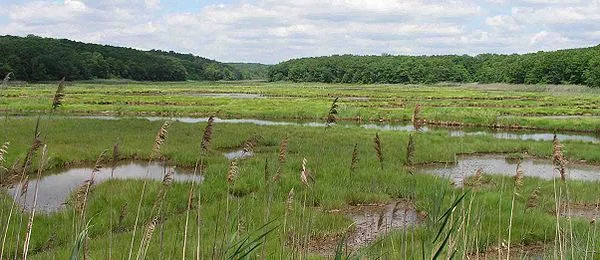
The role of grasshoppers in salt-marsh ecosystems

Salt marsh along the Connecticut shore of Long Island Sound.
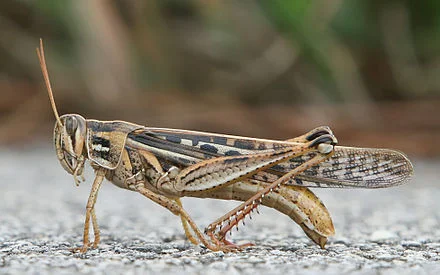
American grasshopper.
From ecoRI News (ecori.org)
KINGSTON, R.I.
As efforts are being undertaken to protect salt marshes — and the threatened salt marsh sparrow — from the rising sea, scientists may be ignoring an unexpectedly important player in this environmental drama: grasshoppers.
According to Becky Gumbrewicz, a University of Rhode Island senior who studied insects at three salt marshes in the Ocean State this summer, grasshoppers and their close relatives constitute the greatest insect biomass per individual on salt marshes in the region, and they are probably an important food source for the sparrows. But as dredged sand and mud are deposited on some marshes to raise their elevation to combat sea-level rise, grasshoppers may get lost in the mix.
“We’re curious about how adding that layer of dredged material to the marsh is going to affect the insect populations, like the grasshoppers, that could possibly be buried,” said Gumbrewicz, a resident of Oxford, Conn., who is majoring in environmental science and management. “We’re trying to get an idea of how to balance combating sea-level rise to preserve the salt marshes and benefit the sparrow but also figure out how the insects are impacted and may need to be supported.”
Working in collaboration with URI Prof. Steven Alm and the Rhode Island Natural History Survey, Gumbrewicz collected insects at three salt marshes: one inland undisturbed site on the Narrow River; one undisturbed coastal marsh on Ninigret Pond, and a disturbed site on Ninigret Pond that is undergoing restoration by adding a layer of dredged material to raise its elevation. Among the mass of flies, crickets, spiders, moths, and beetles she collected were large numbers of grasshoppers.
“We found most of the grasshoppers near the upland woody vegetation, which is where we think they might be laying their eggs,” Gumbrewicz said. “So if we were to suggest a way to improve salt marsh restoration efforts, it would be to plant more woody vegetation.”
In addition to her field studies, she also kept grasshoppers in a cage with marsh grasses and other upland vegetation to see where the insects lay their eggs.
“We’re still going over our data and finalizing our numbers, but hopefully with what we’ve collected so far we can make a strong suggestion for further research to be done and possibly revise some of the strategies used in marsh restoration,” she said.
Gumbrewicz’s research was funded by the Rhode Island Coastal Resources Management Council through a contract with the Natural History Survey. It was also supported by the URI Coastal Fellows program, an initiative designed to involve undergraduate students in addressing current environmental problems. Now in its 22nd year, it’s based at URI’s College of the Environment and Life Sciences. Students are paired with a mentor and research staff to help them gain skills relevant to their academic major and future occupations.
“There hasn’t been a lot of research about how raising salt marshes affects insects; it’s usually been about plants or larger organisms,” Gumbrewicz said. “So the project has opened my mind to lots of new ideas.”
The funny people of Plymouth, New Hampshire

Sunset beyond the Plymouth Walmart. See the wind turbines on the ridge line.
”There's such an odd, eclectic group of people that make up the town of Plymouth, New Hampshire. I don't think I could avoid not coming out of there with a pretty good sense of humor.’’
— Eliza Coupe, actress and comedian
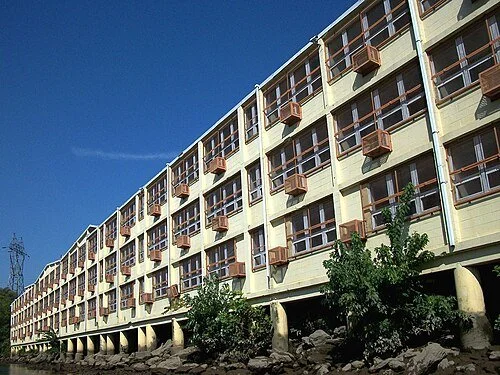
Plymouth is on the edge of the White Mountains and has long been a summer resort area, with such facilities as the late lamented Hotel Pemigewasset, whose latest version was demolished in the 1950s, to be replaced by the hideous scene at the bottom of this entry.
The hotel may be best known as being the place where famed writer Nathaniel Hawthorne died. Hawthorne had been in poor health, so in the spring of 1864 he took a trip to the White Mountains with his friend and Bowdoin College classmate, former President Franklin Pierce, to recuperate. He expired there on May 19, 1864.
Plymouth also hosts Plymouth State University and has a surprisingly large number of artists and visual artists.
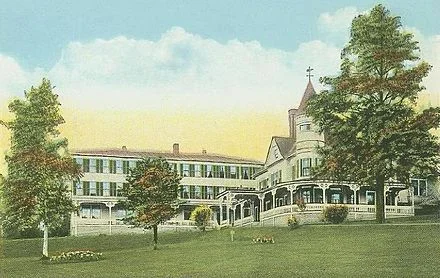
Hotel Pemigewasset in 1922

Fields of gold

“You can see the goldenrod, that most tenacious and pernicious and beauteous of all New England flora, bowing away from the wind like a great and silent congregation.’’
— novelist Stephen King
David Warsh: In the Panic of 2008, Bush did the right things
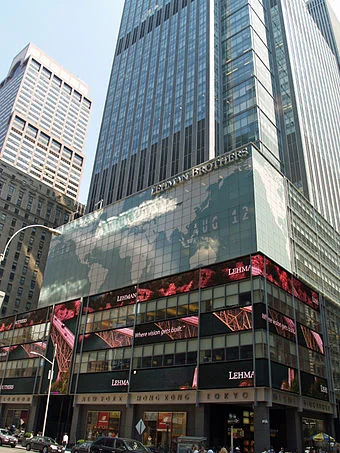
Headquarters of doomed Lehman Brothers.
SOMERVILLE, Mass.
At a time when the antipathy between Republicans and Democrats is at a fever pitch, it is worth recalling the desperate events 10 years ago when America’s center held together very well after the collapse of Lehman Brothers precipitated a financial panic, the first in many decades, that seemed to come out of nowhere to threaten a depression even worse than that of the 1930s. The White House put its full support behind the Federal Reserve Board’s role as lender of last resort. Congressional leadership of both parties reluctantly backed the president.
Two attempts were required to persuade the House to authorize the Treasury Department’s $700 billion supplement to the Fed’s own funds. The second succeeded, the measure passed, and U.S. leadership galvanized the central banks of the United Kingdom, the European Union, Canada, Sweden, Switzerland and Japan in a coordinated monetary easing.
In late September, 2008, 12 of the 13 most important U.S. financial firms had been at the brink of failure, Federal Reserve Chairman Ben Bernanke later told the Financial Crisis Inquiry Commission. By mid-October the unbridled fear had given way to full-alert wariness. Much of the credit for stemming the panic belongs to George W. Bush, who put the full force of his presidency behind the effort, before stepping out of the way of the presidential-election campaigns. (His wise choices weren’t obvious at the time.)
Instead of horrific gridlock, the U.S. economy sank into a deep recession.
A persistent itch remains to blame the crisis on the Bush administration, at least in some quarters. After all, Bernanke, Treasury Secretary Henry Paulson and New York Federal Reserve Bank President Timothy Geithner were hired during his watch, Geithner (by the New York Fed) in 2003, Paulson and Bernanke in 2006. Two books arguing against the heroic interpretation of their performance of the roles have appeared recently.
The Fed and Lehman Brothers: Setting the Record Straight on a Financial Disaster (Cambridge), by Laurence Ball, of Johns Hopkins University, argues that Bernanke and Geithner had the authority to save the troubled investment bank whose failure initiated the panic and that the central bankers were bullied by Paulson out of doing so. A Crisis of Beliefs: Investor Psychology and Financial Fragility (Princeton), by Nicola Gennaioli, of Bocconi University, and Andrei Shleifer, of Harvard University, claims that the Lehman failure should have been no surprise, that policy beforehand should have been more aggressive, and that the systemic run on the banking system was unpredictable was mostly a myth. (Shleifer, unfortunately, didn’t predict it.)
Neither interpretation is likely to stand up to professional scrutiny. The first-person accounts of the policy-makers – Bernanke (The Courage to Act), Paulson (On the Brink) and Geithner (Stress Test) – and the wealth of supporting material that has grown up around them are likely to remain the primary narrative of the crisis.
Today another crisis of great magnitude threatens, this one involving the U.S. Supreme Court. Once again former President Bush is involved, this time as a key supporter – as of last Thursday – of nominee Appeals Court Judge Brett Kavanaugh
It was Bush who hired Kavanaugh into the White House as an assistant counsel in 2001, who promoted him to staff secretary in 2003. (Those who followed the tribulations of Rob Porter, former staff secretary to President Trump, will know something of the close bond that develops between a president and the supervisor of his decision-making queue.) Bush presided over the marriage of his long-time personal secretary Ashley Estes to Kavanaugh in 2004, then two years later nominated his fellow Yale alum to the federal appellate court bench.
Bush last week reiterated his support of Kavanaugh after the testimony of Christine Blasey Ford, having earlier told Politico, “Laura and I have known and respected Brett Kavanaugh for decades, and we stand by our comments the night Judge Kavanaugh was nominated.” On that occasion he had said, “He is a fine husband, father, and friend – and a man of the highest integrity. He will make a superb justice of the Supreme Court of the United States.”
Then came the dramatic news that the Federal Bureau of Investigation would spend an additional week digging deeper into the nominee’s past. Meanwhile, the significance of Judge Kavanaugh’s partisan and untrustworthy testimony last week will continue to sink in. It won’t get any easier for the former president to maintain his support.
Probably no opinions outside the Senate, public or private, matter more to the fate of his nomination than those of George and Laura Bush. The Republican Party is in disarray. If it still has a leader, it is Bush.
David Warsh is a Somerville-based columnist and economic historian, as well as proprietor of economicprincipals.com, where this column first appeared.
PCFR: Arab social entrepreneurs; two paths to Brexit; geopolitics and U.S. Foreign policy

View of mosque in downtown Beirut. Below, Beirut, on the Mediterranean.
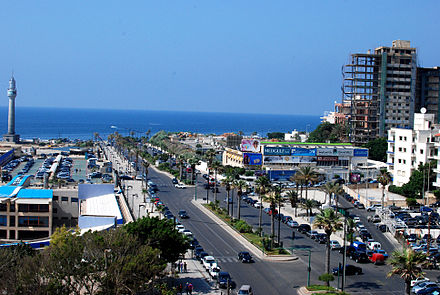
The next three speakers at the Providence Committee on Foreign Relations. (Please see thepcfr.org for membership and other information. Email: pcfremail@gmail.com)
Wednesday, October 3
Social Entrepreneurship with Dr. Teresa Chahine, Harvard
6:00, The Hope Club, 6 Benevolent Street, Providence
Dr. Teresa Chahine is the author of Introduction to Social Entrepreneurship, based on her course at Harvard. She is the Innovation Adviser at Alfanar Venture Philanthropy, which she helped launch in her home country of Lebanon. Alfanar provides tailored financing and technical support to social enterprises serving marginalized populations in the Arab world.
Dr. Chahine divides her time between Beirut and Boston, where she leads the social entrepreneurship program at the Center for Health and the Global Environment at the Harvard T.H. Chan School of Public Health.
Wednesday, October 17
Two Paths to Brexit: Michael Goldfarb
6:00, The Hope Club, 6 Benevolent Street, Providence
On the eve of an EU summit where the bloc's chief Brexit negotiator, Michel Barnier, hopes to present a draft treaty for Britain's withdrawal from the EU former NPR correspondent, Michael Goldfarb, who covered the creation of the euro and the border free Europe, looks at the details of the deal: the rights of millions of British and European citizens now living in what have become "foreign" countries, how to keep the Irish border fully open, maintaining supply chains, and the time frame for transition.
It is also possible talks will have collapsed. In that case, Goldfarb will explain the likely impact on UK, Europe and global economy of a no-deal Brexit.
Michael Goldfarb is an author, journalist and broadcaster. He has written for The Guardian, The New York Times and The Washington Post but is best known for his work in public radio. Throughout the 1990’s, as NPR’s London Correspondent and then Bureau Chief, he covered conflicts and conflict resolution from Northern Ireland to Bosnia to Iraq for NPR.
Thursday, November 8
Geopolitics Underlying U.S. Foreign Policy
Sarah C. M. Paine
6:00, The Hope Club, 6 Benevolent Street, Providence
Sarah C. Paine is a professor of strategy and policy at the U.S. Naval War College. She has written or co-edited several books on naval policy and related affairs, and subjects of particular interest to the United States Navy or Defense. Other works she has authored concern the political and military history of East Asia, particularly China, during the modern era. She is the author of the 2012 award-winning book, Wars for Asia 1911–1949.
It's all reusable

“Busted Statues” (mixed media), by Linda Leslie Brown, in her show “Plastiglomerate,’’ at Kingston Gallery, Boston, Oct. 3-28.
Chris Powell: Income-tax fantasies; a colonial-era hero or mass murderer?
Connecticut Republican gubernatorial candidate Bob Stefanowski’s objective of eliminating the state income tax is ridiculous but not for the reason commonly offered -- that the tax produces half state government’s revenue and cutting spending that much never would be practical, not even over the eight years of Stefanowski’s "plan."
Instead Stefanowski’s "plan" is ridiculous because the Democrats probably will retain the state House of Representatives in the coming election and well might recover a clear majority in the Senate, now tied at 18. Any budget will require the General Assembly’s approval and no house controlled by Democrats will ever agree to even modest spending cuts.
A Democratic majority in just one house would let Stefanowski off the hook -- along with Republican legislators, who may be glad if they stay in the minority and thus avoid responsibility for closing next year’s projected state budget deficit of more than $4 billion.
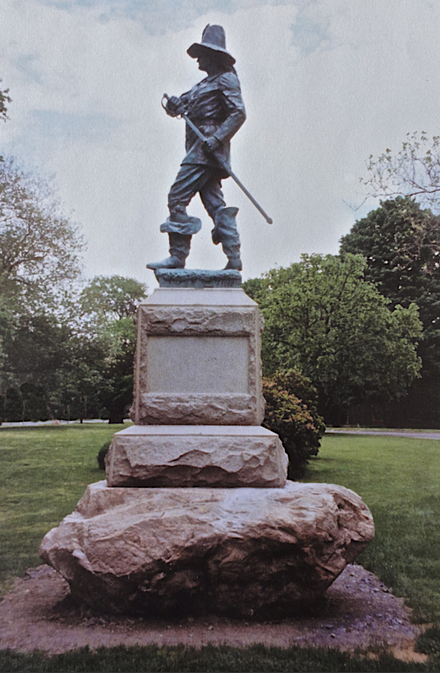
Statue of Captain John Mason in Windsor, Conn. Below, the plaque with it.
— Photo by MoonWaterMan
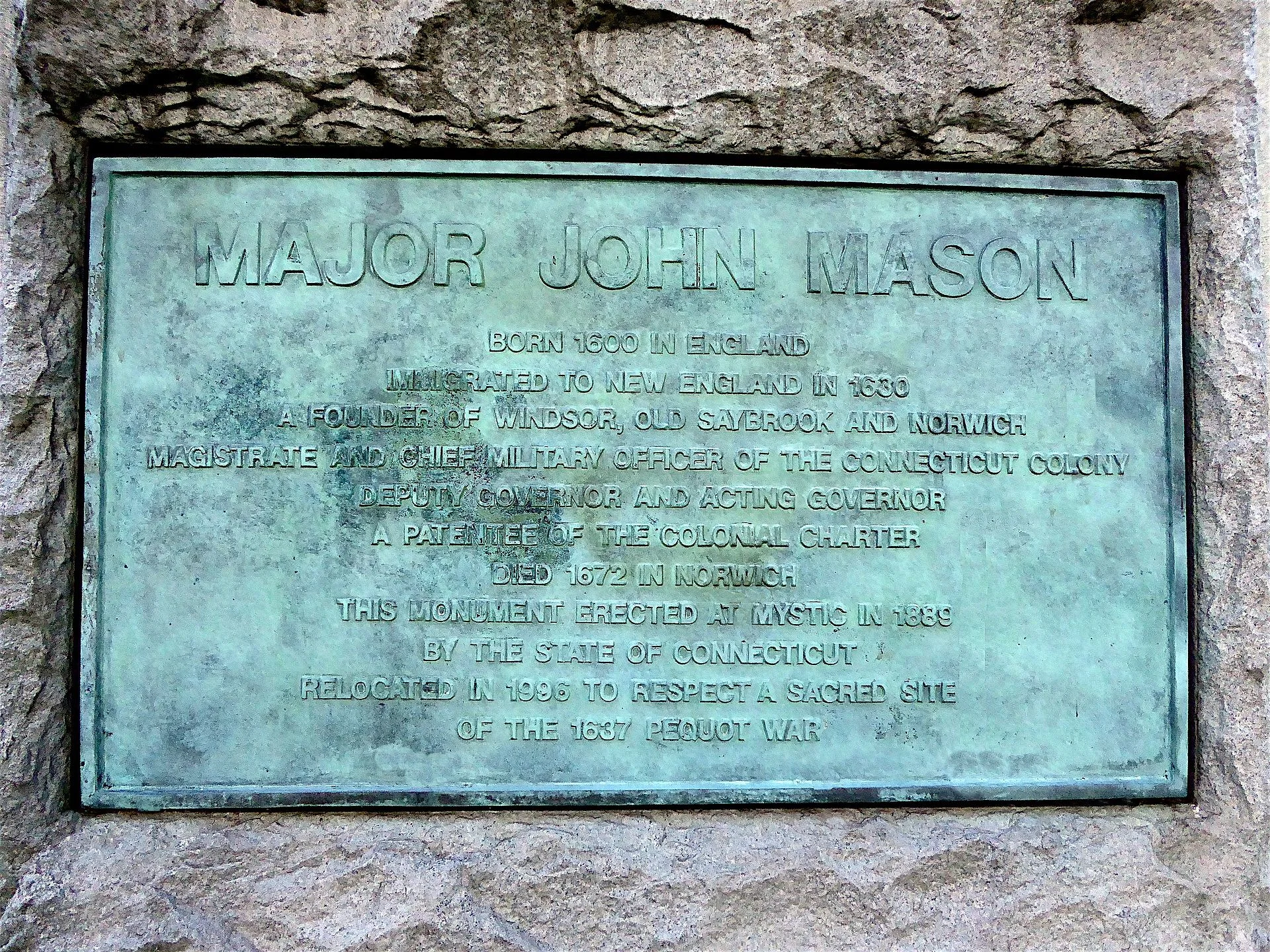
Students from Central Connecticut State University visited a park in Windsor the other day to contemplate the statue of a hometown hero of sorts, Captain John Mason, a founder of the Connecticut colony and leader of what might be called the European tribe in the Pequot War in 1637. Mason was in command when most of the Pequots, including women and children, were slaughtered by gunshot and fire in their fort in Groton, a genocide celebrated then but not so much now.
Two decades ago Mason’s statue was moved from Groton to Windsor to end celebration of the massacre and diminish its memory.
How far political revisionism should go with monuments is always a fair question. Leaders of the late Southern Confederacy are increasingly out of favor, but even George Washington owned slaves and fought in a war against Indian tribes. For the time being, Washington’s sins remain forgiven, overtaken by his immense service to his country.
So what is to be done with Mason? Whether his statue stays or goes somewhere else, like a museum, it is important to put him in the context of his time. Standards were primitive four centuries ago -- not just for the European colonists, who generally regarded the aboriginals as savages, but also for the Indians. Everyone was tribal.
Indeed, Europeans living in Massachusetts were actually invited to settle in Connecticut because of Indian tribal rivalry and war here. The Pequots, whose name meant "destroyers," were not native to the area, having come from what is now upstate New York, and they preyed on less combative tribes who imagined the Europeans as allies. Such an alliance between the Europeans and the Mohegan tribe indeed exterminated the Pequots. While today the two tribes, reconstituted, are partners in the casino business, back then they were as cutthroat to each other as the Europeans and the Pequots were to each other.
Connecticut has plenty of history to celebrate and less to regret than some states. But Mason would not have a statue except for the massacre of the Pequots. The statue’s placement in the park in Windsor implies that he is still officially regarded as a hero. Since Mason is buried in a cemetery in Norwich, a city he helped found, his statue might better be moved to his grave, where people could regard it without any official suggestion of heroism.
Chris Powell is a columnist for the Journal Inquirer in Manchester, Conn.
'A little closer to heaven'

The Ayer Mill, in Lawrence.
“It is a long time since I flapped my wings,
a long time since I stood on the roof of my house
in Lawrence, Mass., or Michael’s in No. Andover,
a little whiskey in one hand, the past slipping
through the other, a little closer to the heaven
of dreams, letting the autumn wing, or the spring
wind, or maybe just the invisible breath of some
woman lift me up….’’
-- From “The Angels of 1912 and 1972,’’ by Richard Jackson
Wake up and dream
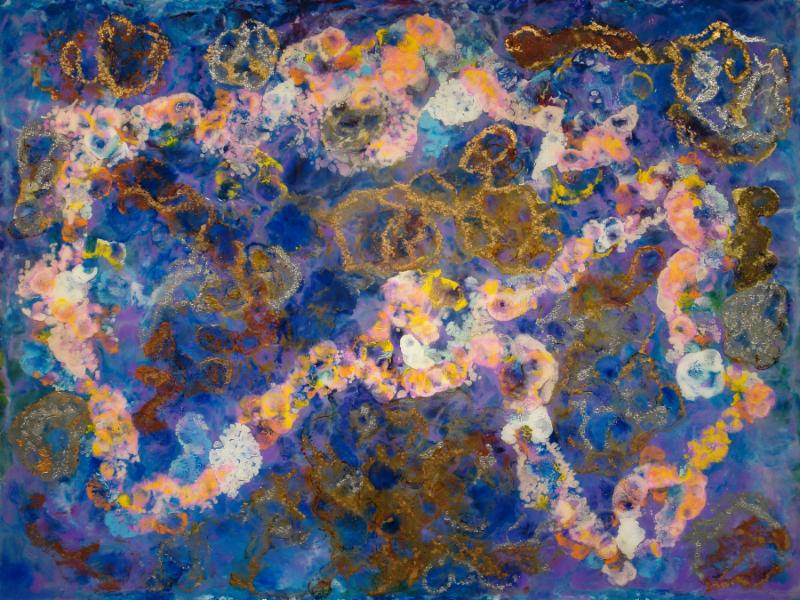
“Echo of emptiness: play of wakefulness 13” (encaustic, shellac, paint marker and resin on panel), by Barry Margolin, in his show “Play of Wakefulness,’' Oct. 3-28 at Galatea Fine Art, Boston.
Explosive infrastructure

From Robert Whitcomb's "Digital Diary,'' in GoLocal24.com
The recent explosions and fires north of Boston were reminders of how dangerous natural gas can be, especially if pipes carrying it are old and corroded and gas is being sent at excessive pressures, in this disaster. Perhaps as battery storage improves, electricity from non-volatile energy from regional solar, wind and other nonpolluting sources will replace fossil fuel (all of which comes from outside the region) for virtually all residential and commercial uses, also making us less vulnerable to giant utilities for whom profit and stock price might trump public safety.
For now, we can only hope that the gas-line part of America’s crumbling infrastructure gets some fast upgrades.
'Wide of the way'

“And so the day drops by, the horizon draws
The fading sun and we stand struck in grief,
Failing to find our haven of relief,
Wide of the way, nor sure to turn or pause,
And weep to view how fast the splendor wanes
And scarcely heed that yet some share remains
Of the red afterlight, some time to mark,
Some space between the sundown and the dark;
But not for him those golden calms succeed
Who while the day is high and glory reigns
Sees it go by, as the dim pampas plain,
Hoary with salt and gray with bitter weed,
Sees the vault blacken, feels the dark wind strain,
Hears the dry thunder roll, and knows no rain.’’
“And So the Day Drops By,’’ by Frederick Goddard Tuckerman (1821-1873), a poet, lawyer and scientist who spent most of his adult life in Greenfield, Mass.

“In the Berkshires,’’ painted by George Inness in 1850.
William Morgan: Finding treasure of Downeast Doric
SEDGWICK, Maine
(New photos by William Morgan)
This small village on the Blue Hill Peninsula seems like so many towns along the rocky coast of Maine. Hardy souls who settled here mostly made a living from the sea – fishing and shipbuilding -- along with some quarrying of the granite ledges. Brooklin, next to Sedgwick, is where the famed essayist and children’s book author E.B. White wrote and set much of his writing there, perhaps most famously Charlotte’s Web.

Sedgwick in 1909.
In a land of many small Congregational houses of worship, what sets Sedgwick apart is its very handsome Baptist church. Earle Shettleworth, longtime director of the Maine Historic Preservation Commission, who knows more about the architecture of the Pine Tree State than anyone else, declares the Sedgwick church to be the finest example of the Greek Revival style in the state.
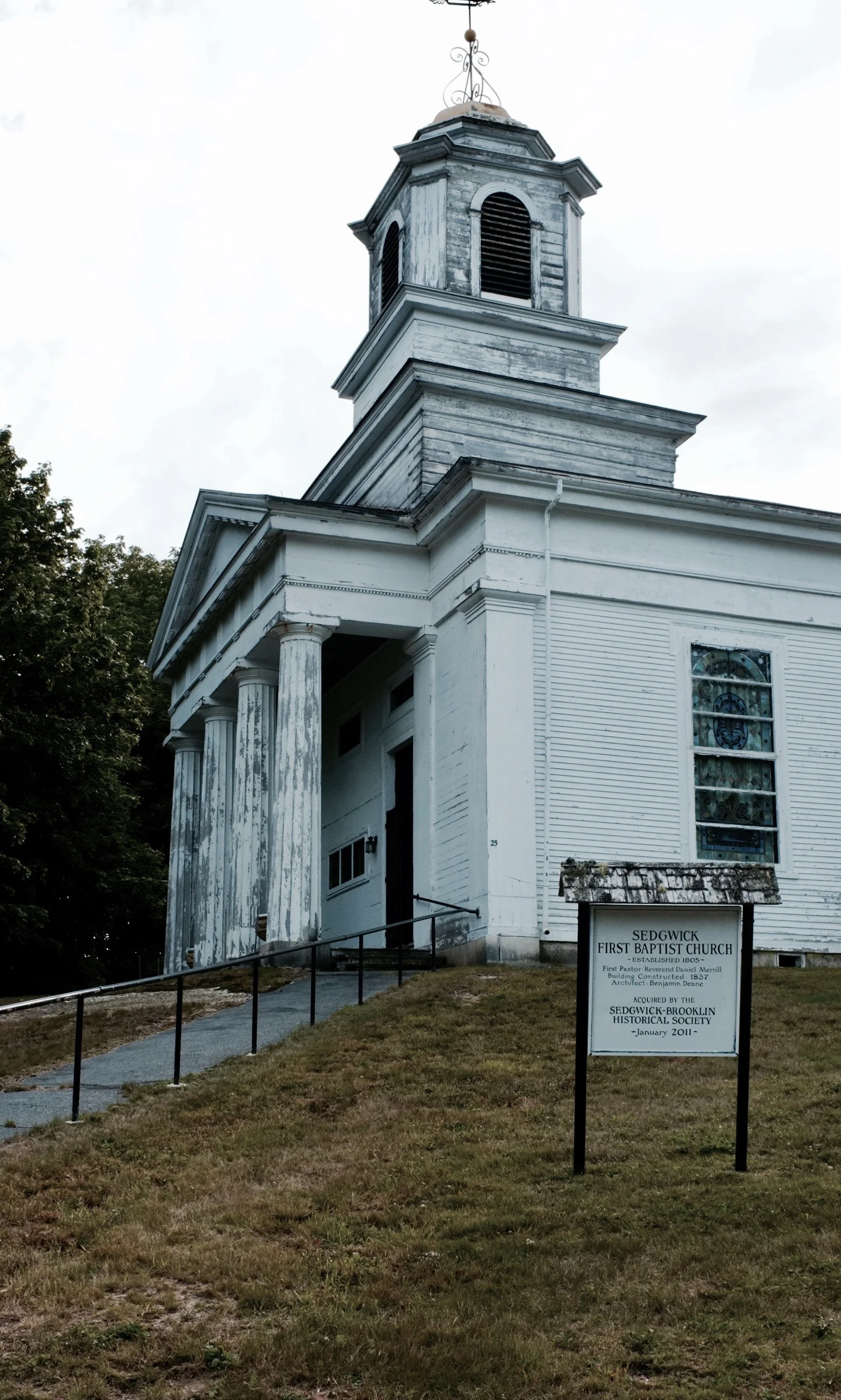
Superlatives aside, the Sedgwick church is both magnificent and a surprise. Situated above the village, First Baptist has a commanding presence, with its Doric portico, temple form and three-stage cupola.
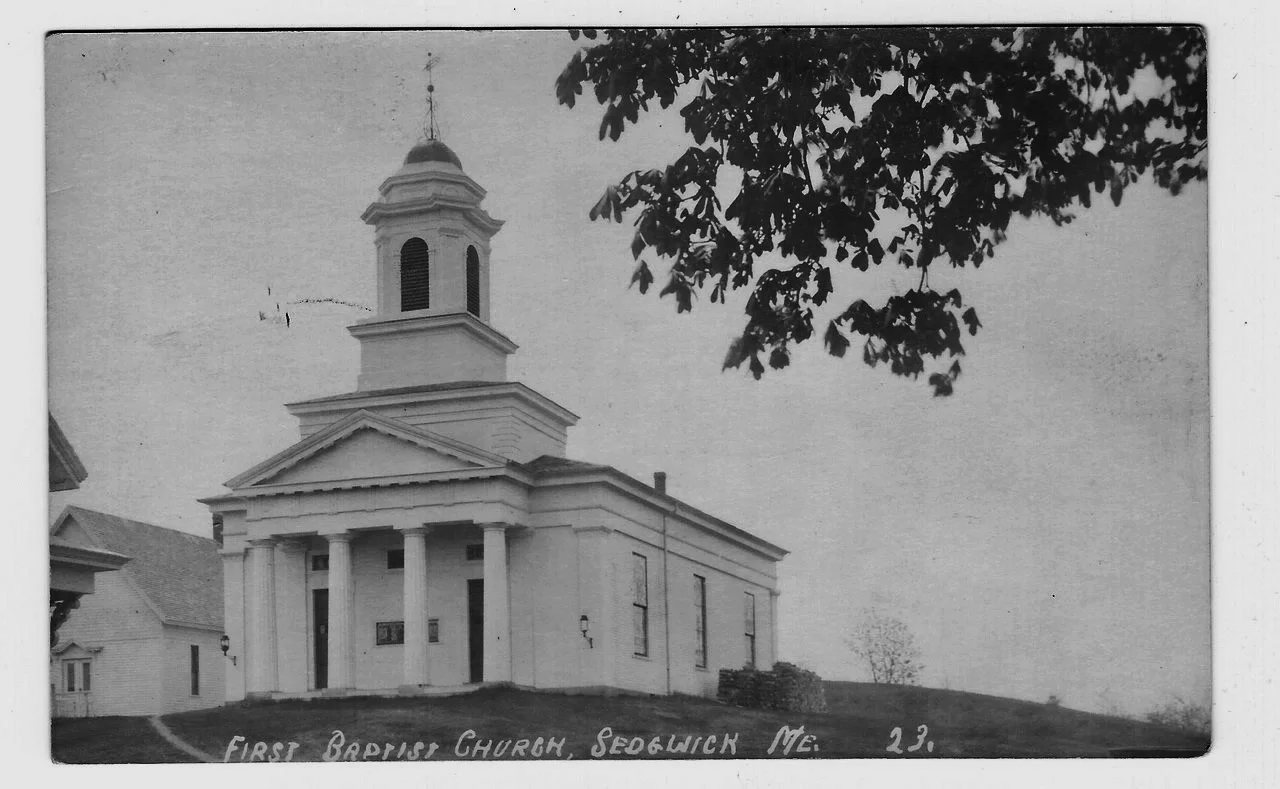
Sedgwick Baptists broke away from the Congregationalists in 1805, most of the congregation with them. This building was built in 1837 at the height of the national craze for architecture putatively inspired by the ancient Greeks. The architect was Benjamin S. Deane from Bangor; the builder was Thomas Lord from nearby Surry.
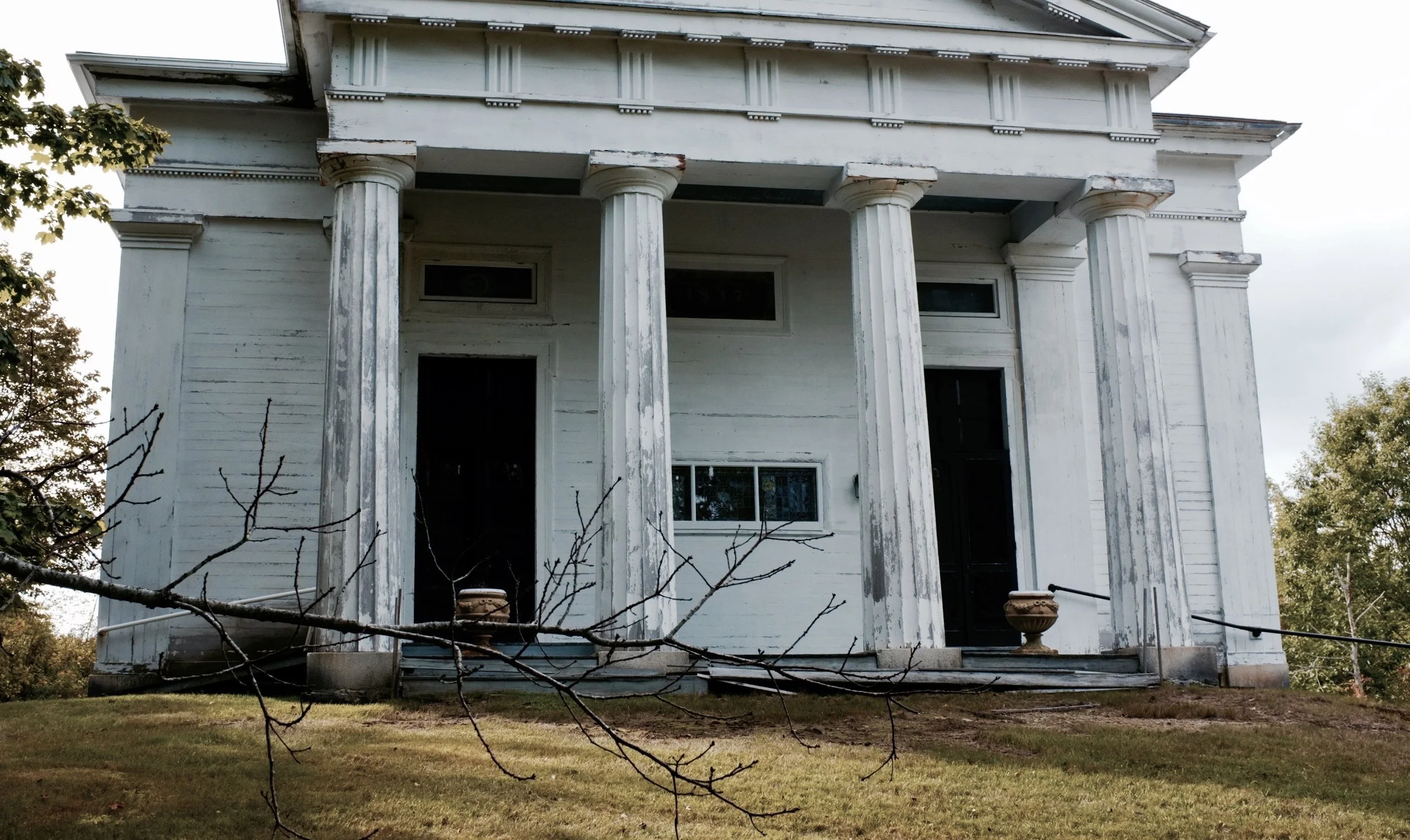
Deane was a successful architect of other churches, houses and even a courthouse in eastern Maine. Like many country builders in 19th Century New England, Deane's architectural sophistication came from books, most especially the builder's guides published by Boston architect Asher Benjamin.

Benjamin's hugely popular how-to books did much to spread the high styles of Boston to New England's rural backwaters. The sixth edition of his American Builder's Companion added templates for Greek details, in addition to the Late Georgian that predominated in the earlier editions.

Plate showing the Doric order from The American Builder's Companion.
Benjamin's Greek orders were clearly 'borrowed' from earlier European books on the
subject. The Doric was the simplest order and thus the easiest for rural carpenter architects to fashion, especially in wood.
The cupola, however, is not Greek Revival, but rather a late Georgian form from one of Benjamin's own buildings, the West Meeting House, in Boston. Yet, this kind of mix-and-match without too much regard to historical purity was typical of American architecture.
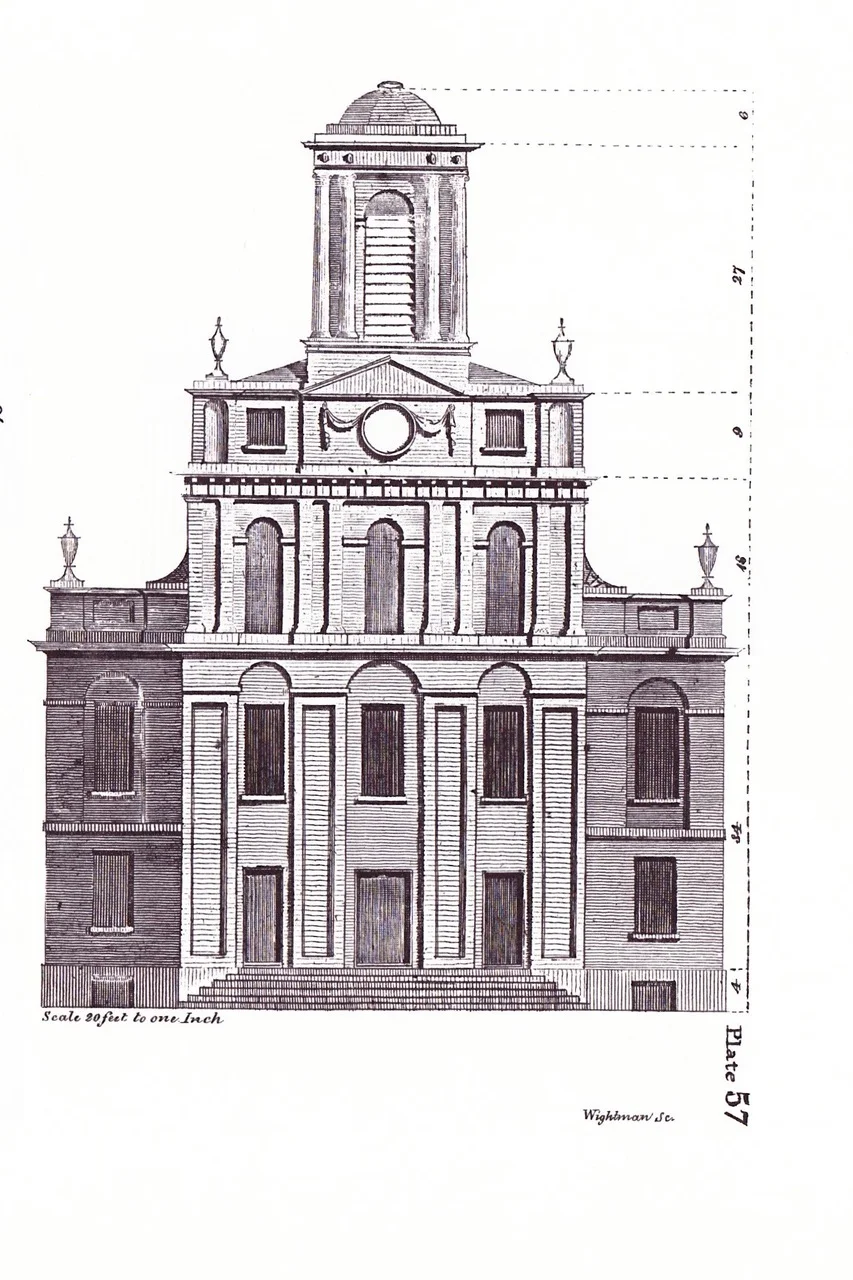
Asher Benjamin’s West Meeting House, Boston. The church is in late Georgia, of Federal, style. This is the likely source for the Sedgwick cupola.
The interior is pretty similar to a lot of Protestant preaching boxes, with pews that could be from any Maine church of the early 19th Century. The tabernacle frame around the organ is, however, Greek.
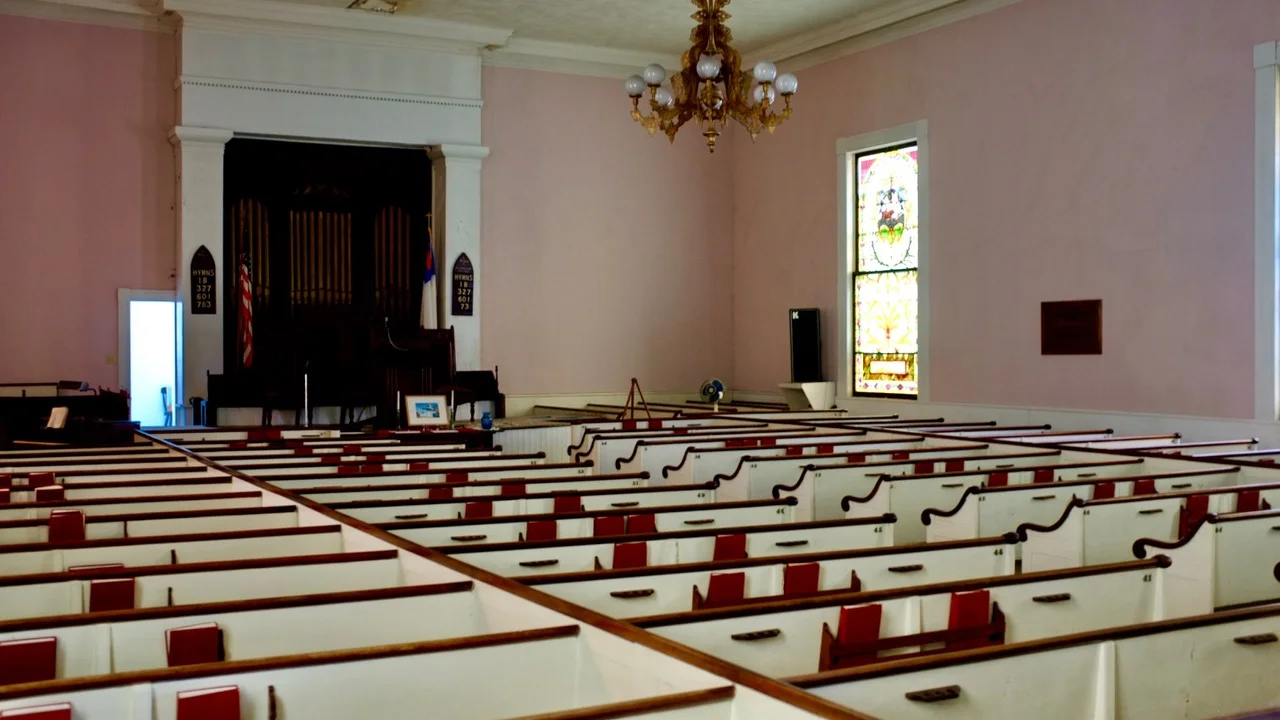
Stained glass windows in the opalescent manner of the great glass artists John La Farge and Louis Comfort Tiffany were installed at the turn of the 20th Century. Alas, were these not run-of-the-mill copies, their sale might have contributed heartily to the $400,000 needed to restore the church.

Sedgwick's Baptists became pretty thin on the ground. By the congregation's 200th anniversary, in 2005, fewer than a handful of people came to celebrate. A few years later it was sold to an adoring fan who is trying to stabilize the church, searching for money to fix it up, and seeking to find an appropriate nonprofit group that would run the church as a community center.

William Morgan, based in Providence, wrote his Columbia University master's thesis on Alexander Parris, a New England Greek Revival architect. He contributed the introduction to the Dover reprint of Asher Benjamin's American Builder's Companion, and is the author of American Country Churches, among other books.
PCFR: Arab social entrepreneurs; future of Brexit; U.S. geopolitics

Fall speakers at the Providence Committee on Foreign Relations. (Please see thepcfr.org for membership and other information.)
Wednesday, October 3
Social Entrepreneurship Abroad with Dr. Teresa Chahine, Harvard
6:00, The Hope Club, 6 Benevolent Street, Providence
Dr. Teresa Chahine is the author of Introduction to Social Entrepreneurship, based on her course at Harvard. She is the Innovation Advisor at Alfanar Venture Philanthropy, which she helped launch in her home country of Lebanon. Alfanar provides tailored financing and technical support to social enterprises serving marginalized populations in the Arab world.
Dr. Chahine divides her time between Beirut and Boston, where she leads the social entrepreneurship program at the Center for Health and the Global Environment, Harvard T.H. Chan School of Public Health.
Wednesday, October 17
Two Paths to Brexit: Michael Goldfarb
6:00, The Hope Club, 6 Benevolent Street, Providence
On the eve of an EU summit where the bloc's chief Brexit negotiator, Michel Barnier, hopes to present a draft treaty for Britain's withdrawal from the EU former NPR correspondent, Michael Goldfarb, who covered the creation of the euro and the border free Europe, looks at the details of the deal: the rights of millions of British and European citizens now living in what have become "foreign" countries, how to keep the Irish border fully open, maintaining supply chains, and the time frame for transition.
It is also possible talks will have collapsed. In that case, Goldfarb will explain the likely impact on UK, Europe and global economy of a no-deal Brexit.
Michael Goldfarb is an author, journalist and broadcaster. He has written for The Guardian, The New York Times and The Washington Post but is best known for his work in public radio. Throughout the 1990’s, as NPR’s London Correspondent and then Bureau Chief, he covered conflicts and conflict resolution from Northern Ireland to Bosnia to Iraq for NPR.
Thursday, November 8
Geopolitics Underlying US Foreign Policy
Sarah C. M. Paine
6:00, The Hope Club, 6 Benevolent Street, Providence
Sarah C. Paine is a professor of strategy and policy at the U.S. Naval War College located in Newport, Rhode Island. She has written or co-edited several books on naval policy and related affairs, and subjects of particular interest to the United States Navy or Defense. Other works she has authored concern the political and military history of East Asia, particularly China, during the modern era. She is the author of the 2012 award-winning book, Wars for Asia 1911–1949.