
Vox clamantis in deserto









'Here is best'

Looking north from the French King Bridge at the Erving-Gill town line in western Massachusetts.
“Where the heart is, there the muses, there the gods sojourn, and not in any geography of fame. Massachusetts, Connecticut River, and Boston Bay, you think paltry places, and the ear loves names of foreign and classic topography. But here we are; and, if we tarry a little, we may come to learn that here is best. See to it, only, that thyself is here; and art and nature, hope and fate, friends, angels, and the Supreme Being, shall not absent from the chamber where thou sittest.’’
— Ralph Waldo Emerson
Different values then

To die is gain,’ a virgin’s tombstone said;
“That was New England, too, in another age
That put a higher price on maidenhead
If brought in dead; now on your turning page
The lines blaze with a constant life, displayed
As in the maple’s cold and fiery shade.’’
— From “For Robert Frost, in the Autumn, in Vermont,’’ by Howard Nemerov

Chris Powell: Abortion and the Kavanaugh-Ford hysteria
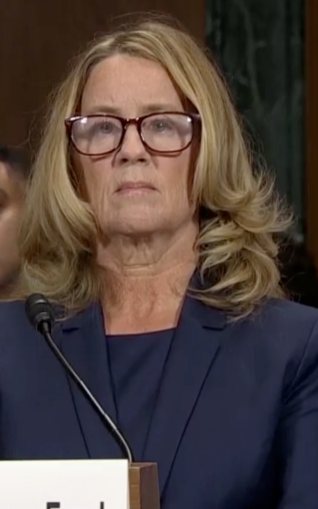
Christine Blasey Ford in her appearance before the Senate Judiciary Committee.
MANCHESTER, Conn.
According to Connecticut Sen. Richard Blumenthal, Supreme Court nominee Brett Kavanaugh's primary accuser, Christine Blasey Ford, has no reason to lie by claiming that Kavanaugh sexually assaulted her 36 or so years ago when they were in high school. But by making her accusation so late -- not just decades after the supposed incident but years after Kavanaugh was nominated as a federal judge and only upon his nomination to the Supreme Court -- Blasey Ford has entered politics, and everyone in politics has reason to lie or exaggerate.
Of course, this doesn't mean that Blasey Ford is lying or exaggerating. Any accusation of sexual misbehavior against a teenage boy is plausible. This means only that whatever may have happened decades ago did not bother Blasey Ford enough to complain about it until it could be used to stop Kavanaugh's appointment to the Supreme Court. As she is a liberal Democrat while Kavanaugh is a conservative Republican presumed to be skeptical of the court's precedent in the abortion case of Roe v. Wade, Blasey Ford well could be doubly bothered.
This follows the pattern set by Anita Hill's accusation of sexual harassment against Clarence Thomas upon his nomination to the Supreme Court, in 1991. Hill had worked for Thomas at two federal agencies in Washington and followed him from one agency to the other so she could continue working for him even after the supposed harassment began. For years after she left government employment, Hill maintained cordial relations with Thomas, even seeking and receiving help from him. Hill did not complain about Thomas until liberals opposed him for the Supreme Court out of fear that, as a conservative Republican, he would tilt the court against abortion rights.
Of course this didn't make Hill a liar or exaggerator either. But it put her into politics too and thus gave her reason to lie or exaggerate, just as Blasey Ford entered politics by joining the opposition to Kavanaugh only when abortion rights were again in question. Blasey Ford has even said that if Kavanaugh were confirmed she would have to move to New Zealand. Only her politics would require that.
But far from handicapping her, Hill's belated accusation against Thomas made her a celebrity and won her a career as a law professor and liberal heroine. Blasey Ford can expect something similar.
By contrast, Kavanaugh, like Thomas, can expect only to be forever suspected as some sort of sex criminal. Maybe Kavanaugh will deserve it -- as long as the country has resolved that youthful misbehavior can never be forgiven no matter how long ago it happened and that people who haven't grown up by age 17 can never grow up. If so, Connecticut should eliminate secrecy for its juvenile courts and all the probationary gimmicks that erase convictions in adult court.
The hysteria over the accusations against Kavanaugh has destroyed all standards of politics and journalism and is threatening to destroy legal standards. To prevent another conservative vote on the Supreme Court, the most defamatory and unsupported allegations, along with hearsay and rumor, once barred by the old rules of fairness and libel are being sensationally published and broadcast by news organizations in their crazed search for anyone who can disparage the nominee's character as it might have been 36 years ago.
This is being done by institutions that had no trouble excusing the contemporaneous sexual misbehavior in office, of Ted Kennedy, Chris Dodd, and Bill Clinton, all Democrats who, perhaps not surprisingly, were sure that the Bill of Rights covered abortion.
Chris Powell is a columnist for the Journal Inquirer, in Manchester, Conn.
Water into rivers faster

Flood damage in Winsted, Conn., in August 1955 after former Hurricane Diane came through.
From Robert Whitcomb’s “Digital Diary’’ in GoLocal24.com
With more than 30 inches of rain in some places, the flooding in North Carolina would have been awful even if so much land hadn’t been paved over for parking lots in our car-dependent culture. But, as we have discovered in New England in big rainstorms, it certainly makes things worse as storm water isn’t permitted to be absorbed into the soil but instead rushes off into streams, often carrying oil and other pollutants from impervious surfaces.
Catastrophic rain events seem to be increasing with global warming. Public- and private-sector planners need to make more of an effort to replace, wherever possible, asphalt and concrete parking surfaces with porous ones, such as paving stones set in sand.
Meanwhile, the Trump regime will make things worse as it takes steps to make it easier for developers to fill in more water-absorbing wetlands. (See comments on deregulation below.) And of course it’s promoting a massive increase in the drilling and mining for fossil fuel, whose global-warming effects include more intense fresh and saltwater flooding.
Meanwhile, readers might want to hear this dramatic Rhode Island Public Radio piece about the 1938 hurricane that ravaged New England and on how vulnerable we still are around here. To hear it, please hit this link.
Pushing N.E. innovation in financial technology

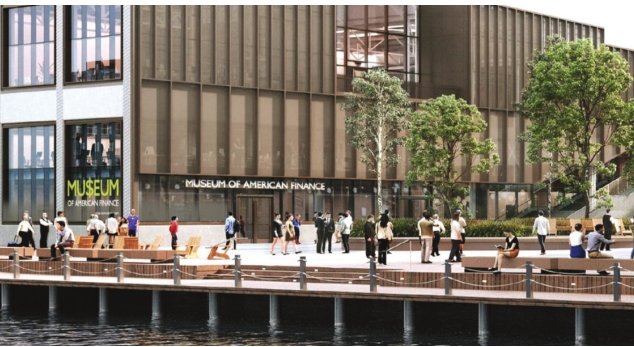
Boston’s Financial District.
This is from The New England Council (newenglandcouncil.com)
“On Oct. 26, The New England Council will present ‘New England Innovates: Leading the Way in FinTech.’ The event, hosted by NEC member Bank of America at Its Boston office, is the fourth in the council’s “New England Innovates” series, which aims to highlight how New England businesses and organizations are leading the way in the innovation economy, and to promote an ongoing dialogue in the region about how we maintain our reputation as a global innovation hub.
The event will feature keynote remarks from Craig Phillips, counselor to the Treasury secretary and co-author of the department’s recent report on financial technology. Following Mr. Phillips’s remarks, a panel of council members will discuss their own fintech initiatives and discuss the challenges and opportunities associated with this rapidly evolving sector.
Panelists confirmed to date include:
Jay Biancamano – managing director, digital product development, State Street Corp.
Steve Leschuck – vice president, new products, Liberty Mutual
George Marootian – executive vice president, head of technology, Natixis Investment Managers’’
For more information, email: gdoherty@newenglandcouncil.com
Private moments, public spaces

“Two Woman and Boy’’ (pinned Mylar collage), by Eric Fischl, in his current show “Eric Fischl: Recent Work,’’ at the Adelson Galleries, Boston.
Adelson says: “Our newest exhibition features a collection of Fischl’s most recent prints, paintings and sculptures that explore private moments in public spaces. Using Mylar collage, glass sculpture and poured resin, our collection of pieces invite the viewer to a dialog about transparency and the human image spanning among two and three dimensions. Through a variety of increasingly modern techniques, his recent works are a fine-tuned, energetic and thought provoking evolution to his early works.’’
New England's passion for record-keeping

The American Antiquarian Society building, in Worcester, where many old New England documents can be found.
“The starting point for the new history, both in Europe and America, has been the record of births, marriages, and deaths, which most literate societies preserve in one form or another. In colonial America, surviving records of this kind - as of every other kind - are most abundant for New England.’’
—- The late historian Edmund Morgan
Llewellyn King: Develop a skilled trade to start a small business
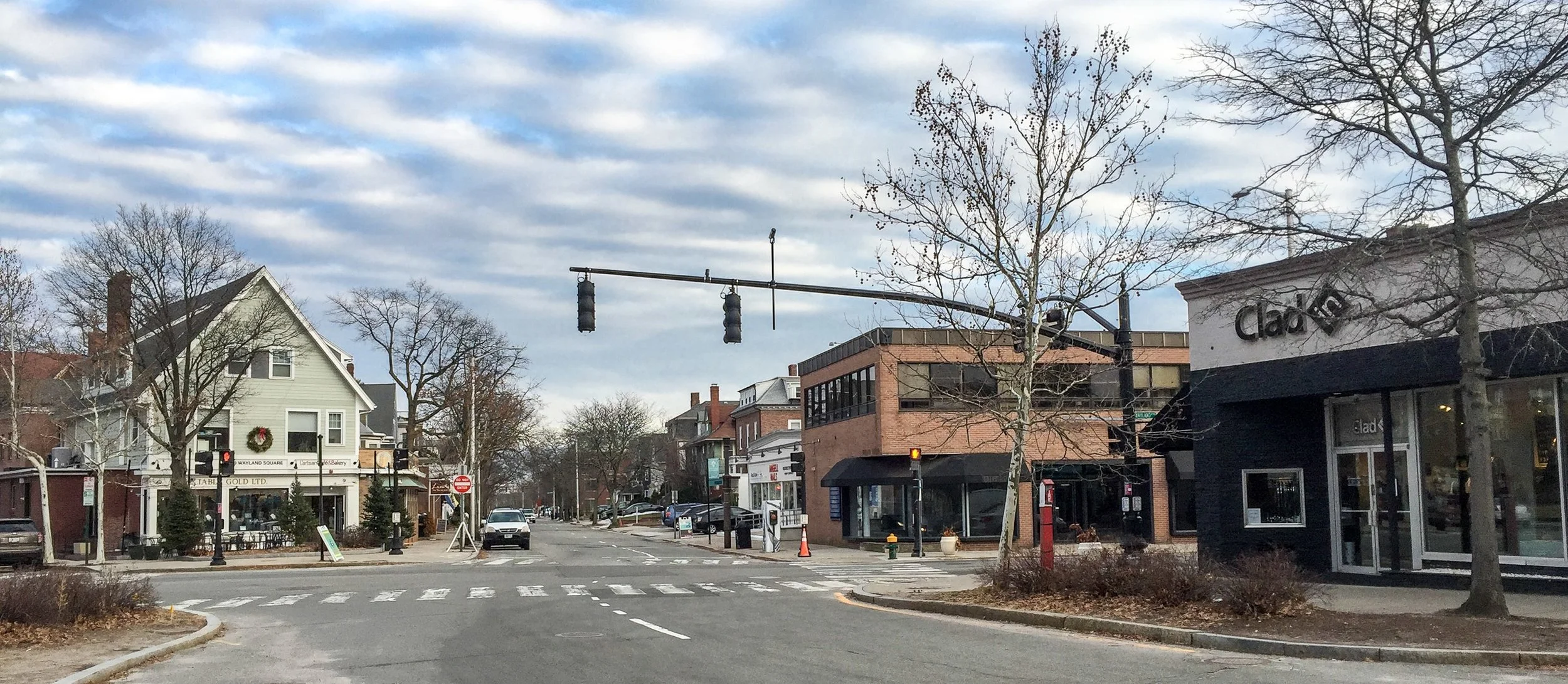
Wayland Square, an neighborhood with many small businesses, in Providence.
WEST WARWICK, R.I.
I love little business. I say “little business” because “small business," like "family farm," has suffered politicization to a point of abstraction. Even the Small Business Administration doesn’t have a precise definition for small business. They define it either by revenue or by number of employees -- and that can range up to a whopping 1,500 in some industries. I begin at five or more.
Politicians love small business and applaud it, but do they care? They listen acutely to big business through its lobbyists, who crowd Capitol Hill in Washington, D.C. and every state capital.
If you’re stitching the cloth in a tailor’s shop and you have a problem with government, just stitch away because nobody is listening. Size does matter, alas.
Yet little business is the vital regenerator of the economy. It’s the fresh oxygen supply which keeps the economy fed with work and ideas.
For me, little businesses begin with moms-and-pops. They could be anything from a computer repair shop to a bowling alley, from a plumbing company to a bakery, from a convenience store to an optician, and from a service station to a painting contractor.
If the business is, say, a drycleaner which uses chemicals, or anything else that discharges into the air or water, government will be all over it. But Bryan Mason, owner of Apollo Consulting Group, based in Newport, R.I., says there are plenty of problems for small businesses that don’t involve government.
“One of the big issues for the small business with, say, 50 employees, is that the owner-operator doesn’t know how to price his or her product or how to market it. You can’t undercut the big chains, so you have to offer real value and real quality,” says Mason.
As to strategy, Mason cites a bowling alley he advised. The bowling alley sold time on the lanes in two-hour blocks. The result was that patrons were keen to get their money’s worth by bowling for the whole period and not stopping to chat and, vitally important, not spending money at the concession stand on drinks and food.
Mason had them remove the time limit on the lanes, and profitability went up. Like cinemas, the money was in the concessions.
Little business — I owned and operated a newsletter-publishing company with 20 employees for over 30 years — is usually in direct relationship to the skill of the founder. A woman who worked in a florist may start her own shop, or an auto mechanic might start a service station. A construction worker might start a house-renovation business, and a stone mason might set out to chisel and sell headstones.
Herein is a unique challenge for our society. It’s the artisans and people with skills who start businesses: a gardener, a landscaping service; a short-order cook, a food truck; and a hairdresser, a salon.
Left out of this progression are many liberal arts graduates who have skills that are suited to big organizations like schools, hospitals, government departments and giant corporations. You can’t start a sociology shop, a history wholesaler or a political science emporium.
If you have the itch to be self-employed, you might want to get a hands-on trade.
Some colleges are now sensitive to this need and are adding a practical course. I’ve been especially impressed with a little college in Charleston, S.C., the American College of the Building Arts, in which students take traditional liberal arts courses and spend two-and-a-half days each week in apprentice labs, learning one of six areas of craft specialization: architectural carpentry, architectural stone, forged architectural ironwork, masonry, plasterwork and timber framing.
The college aims to graduate “educated artisans,” but what they get is entrepreneurs: approximately one-third of their graduates have started businesses based on their artisanal training,
Owning a business is a fundamental part of the American Dream, and the quickest way to do it is to market a skill which you already have from dog walking to jewelry making, from furniture hauling to well drilling.
Steve Jobs, who grew his little business to enormousness, said, “Don’t be afraid, you can do it.”
Llewellyn King, based in Rhode Island and Washington, D.C., is executive producer and host of White House Chronicle, on PBS. His email is llewellynking1@gmail.com.
Cheshire now and in memory

“As Fire to the Sun no,. 2 2018,’’ by Pete Hocking, in the show “To Look and Look Again,’’ at the Chazan Gallery at the Wheeler School, Providence, through Oct. 13. The two-person show (Hocking and Sam Allerton Green) focuses on the artists’ perception of time and space. Hocking’s work depicts landscapes from his childhood home in Cheshire, Conn. He melds the current landscape with his childhood memories of the town.

Roaring Brook Falls, in Cheshire, as seen in late October.

The First Congregational Church in Cheshire.
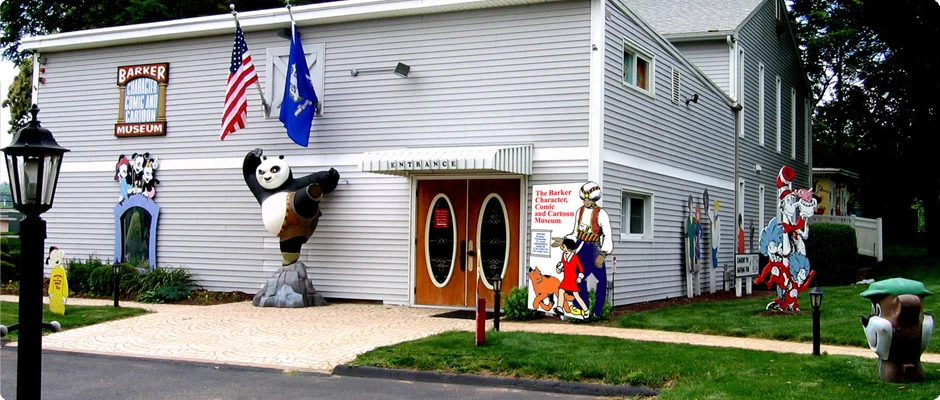
The Barker Character, Comic and Cartoon Museum, in Cheshire.
While Cheshire has around 30,000 residents, and is close to New Haven, there remains something approaching countryside in parts of this exurban/suburban town. Sadly, it is best known for the horrific murders that took place there on July 23, 2007, when Jennifer Hawke-Petit and her two daughters were raped and murdered, and her husband, Dr. William Petit, was severely injured, during a home invasion.
The murders, Steven Hayes and Joshua Komisarjevsky, are serving life sentences.
Cheshire hosts the Barker Character, Comic and Cartoon Museum, with its large collection of memorabilia, novelties and such ephemera as lunch boxes and Pez dispensers bearing the likenesses of characters from television, cartoons and comics.
There’s also a Cold War fallout shelter near an AT&T cell tower. What with Putin, Kim and Xi, perhaps it should be renovated.
Gritty and gorgeous New Bedford

Looking over old houses and factories toward New Bedford Harbor.
— Photo by Gerrydincher
New Bedford Confidential
From Robert Whitcomb’s “Digital Diary,’’ in GoLocal24.com
Down at the Docks (Pantheon), by Rory Nugent, is an unvarnished look at, by turns, gritty and beautiful New Bedford and particularly the hard and often disorderly lives of fishermen there. Drug smuggling and other crime, organized and otherwise, the history of the industry that made the city famous – whaling – the city’s resilient romantic aspects amidst its decay as its textile industry imploded – it’s all in the book.
As Nugent notes, New Bedford is no longer exactly what Herman Melville, author of Moby Dick, called “the dearest place to live in, in all New England,’’ but it ain’t boring. Read the book and then go check out the Whaling Museum, the port and some great 19th Century mansions.


Lobsters and rock
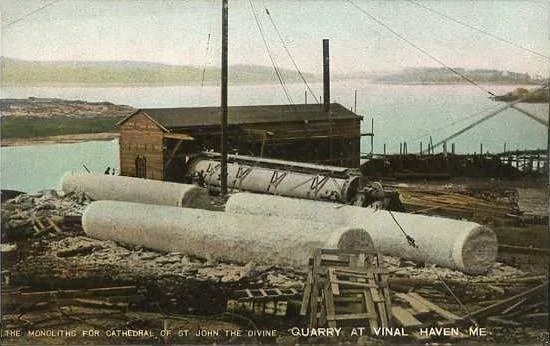
In Vinalhaven, Maine, columns quarried for the Cathedral of St. John the Divine, in New York (installation completed in 1904). Many large and small buildings were made from granite quarried on the Maine Coast.
“It was a Maine lobster town –
each morning boatloads of hands
pushed off for granite
quarries on the islands,
and left dozens of bleak
white frame houses stuck
like oyster shells
On a hill of rock….’’
-- From “Water,’’ by Robert Lowell
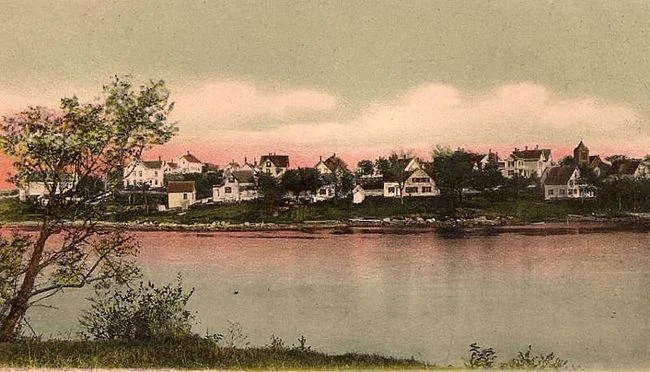
Colorized photo of the East Side of Vinalhaven in 1905.
Beauty and restraint in Newfane

The Windham County Court House, in Newfane, Vt.
— Photo by Daderot
“The glory of Newfane {Vermont} is in the architecture. The inn, the Grange Hall, the church, are all excellent and beautifully related to each other. And in the center is the {Windham County} court house, a superbly proportioned reminder of a {Christopher} Wren church….Lesser communities would have one inhabitant who would proclaim his personality by painting his house yellow with green trim. With us, none does. The beauty of Newfane comes also from the beauty of its citizens.’’
-- From “Small That Is indeed Beautiful,’’ an essay by the late economist and writer John Kenneth Galbraith in Arthur Griffin’s New England: The Four Seasons (1980). Mr. Galbraith, a Harvard professor, summered in Newfane.
'Autumn people'
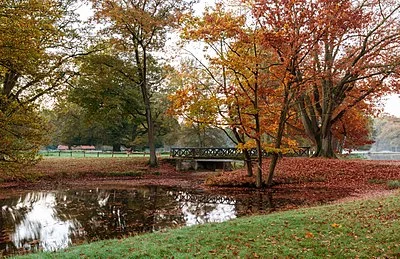
“That country where it is always turning late in the year. That country where the hills are fog and the rivers are mist; where noons go quickly, dusks and twilights linger, and midnights stay. That country composed in the main of cellars, sub-cellars, coal-bins, closets, attics, and pantries faced away from the sun. That country whose people are autumn people, thinking only autumn thoughts. Whose people passing at night on the empty walks sound like rain.”
― Ray Bradbury
Faking it as a teacher
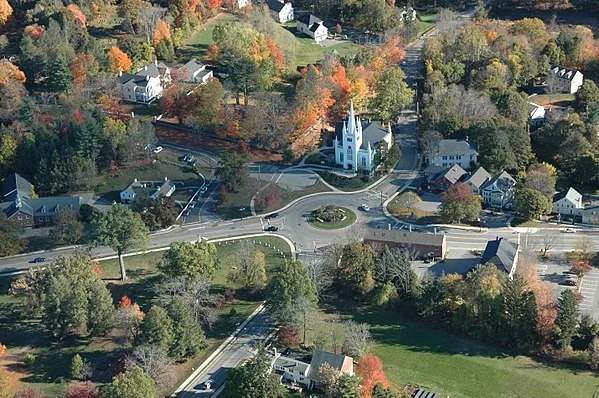
The Old Center of North Andover, Mass.
Adapted from Robert Whitcomb’s “Digital Diary,’’ in GoLocal24.com
Fifty years ago, in 1968, I spent the fall teaching in public high school in North Andover, Mass., in a program called A Better Chance, in which poor kids, minority and white, from the South and elsewhere lived in a kind of group home, presided over by a teacher and spouse, in towns with good public and/or private schools. I learned a lot that fall, which I remember as notably windy and wet. One lesson was that a firm, er, loud, voice in a class with 30 kids can to some degree offset the vulnerability of someone, like me, of small stature teaching restless and sometimes rowdy teens many of whom were bigger than me. And that you need eyes behind your head. Performance art.
I assume that teaching in that high school was tougher than teaching in the Brooks School, an elite boarding school in the same town, where there were rarely more than 10 students in a classroom — and most were very well behaved.
Making space for spring

Migration Reflection II (oil on canvas), by Pamela R. Tarbell, at the current “Fall Art Exhibit,’’ at Mill Brook Gallery and Sculpture Garden, Concord, N.H.
''Nature’s first green is gold,
Her hardest hue to hold.
Her early leaf’s a flower;
But only so an hour.
Then leaf subsides to leaf.
So Eden sank to grief,
So dawn goes down to day.
Nothing gold can stay.'
-- "Nothing Gold Can Stay'', by Robert Frost
Henrik Totterman: What would higher education look like if it were run by IKEA?
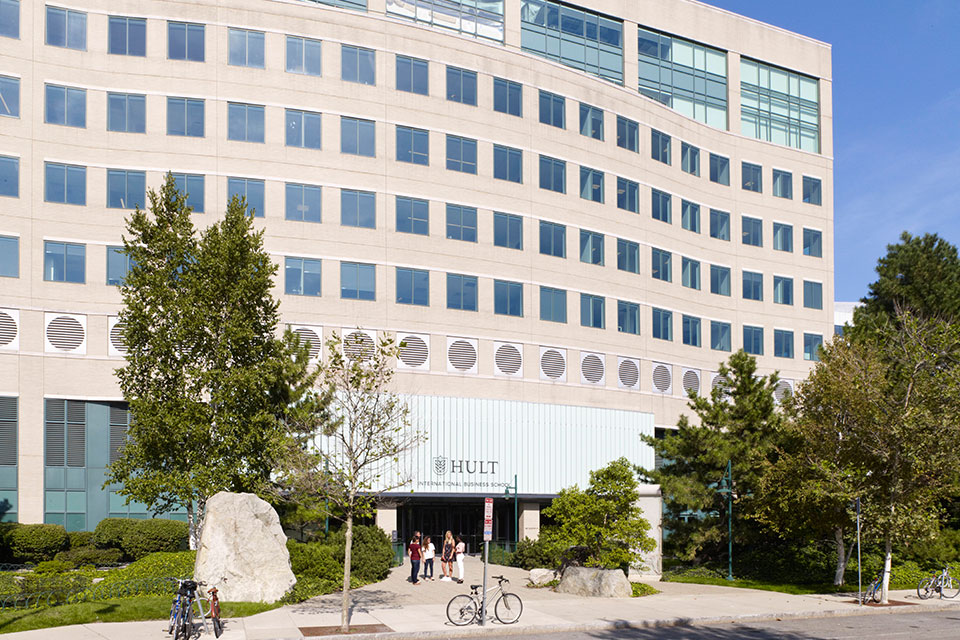
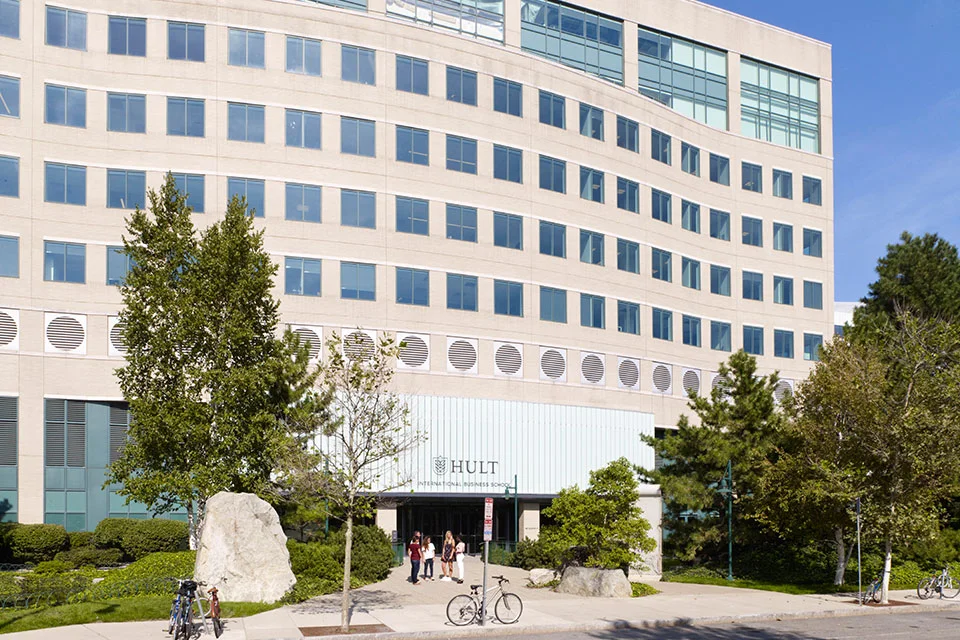
Hult International Business School’s U.S. facility, in Cambridge. The school also has operations in San Francisco, London, Dubai and Shanghai.
From the New England Board of Higher Education (nebhe.org)
As a professor of entrepreneurship and management, who received his master’s and doctoral degrees in northern Europe, I often come to think of IKEA as one of the most mission- and value-driven examples of disrupting an industry and the way people live globally today.
Most of us have experienced the “mile-long IKEA walk” through the second floor furniture haven, to end up with a pyramid of meatballs on the plate in the store restaurant. Once culinarily satisfied, our journey has continued toward the increasingly automated cashiers, where consumers line up to pay for tightly packed furniture boxes and an amazing range of household accessories. Before exiting the building, we have routinely visited the IKEA food store to buy some Nordic delicacies and sweets. We do this primarily to bribe ourselves through the inevitable struggle of IKEA furniture assembly using the magic hexagon key, leading us toward the ultimate satisfaction of Nordic design interiors.
So the question is, what if anything, can higher education learn from a Swedish furniture manufacturer?
International higher education is facing increasing competition and pressure from new market entrants, who are introducing disruptive models of delivering more affordable education on scale. Higher education is definitely more than ever at a crossroads in terms of securing its future existence, which is why it becomes essential for academic leaders to benchmark and recalibrate their strategies, operational models and academic programs for survival and long-term relevance.
Higher education is often criticized for high tuition prices, outdated curriculum design and poorly scalable delivery formats. Typically, institutions operate in a regulated regional setting with voluntary international quality controls through self-governance, peer-assessment and university rankings. Despite all the hype around globalization of higher education, most institutions remain fairly small or at least regional with few examples of a true global reach.
Interestingly, IKEA has built its global presence in a complex and regulated market by addressing challenges similar to those higher education institutions are facing today. To support its success, IKEA’s corporate values build on offering decent quality for an affordable price, enabled by efficient logistics, strict quality and process control, and engaging strongly the target audience in delivering the brand promise. IKEA relies on extensive quality testing, and always aims to scale and increase efficiencies over time. This is done to reduce the price for the consumer, without scarifying the user experience.
In contrast to many higher education institutions, the IKEA journey is a unique experience that feeds creative minds, enables problem scoping and culminates in the collection and enrichment of core essentials and beyond. The educational journey across universities, schools and programs increasingly resemble one another. This is at least partially due to the ease of global benchmarking and the influence of international accreditations, government regulations and rankings that standardize the norms of education.
The IKEA customer is typically equipped with a curious mindset and a willingness to engage socially in constructing the journey, with enough guidance and ease of access to make it worthwhile and part of their lives. Where IKEA has succeeded in bringing costs down through operations on scale, in favor of their customers, very few institutions of higher education are actively engaged in a paradigm shift to reconfigure their operations to reach more favorable terms for their students and alumni.
Similar to higher education, the IKEA experience builds on a feeling of belonging—a social gathering of likeminded people. This enriching experience ensures that there is something for everyone, both in terms of education and building a network. However, in contrast, IKEA focuses especially on price-quality conscious young urban people, who typically appreciate affordability, functionality and flexibility to support their lifestyle and careers.
As with traditional higher education, the physical building space and printed product catalogs remain key for IKEA's success. Peculiarly, as for most higher education institutions, the online presence came late to IKEA and has only gradually increased over time. The challenge for higher education is twofold: how to build virtual social and career networks, while ensuring that engagement in the educational journey remains at the core. In many countries, faculty have strong academic freedom, but struggle with intellectual property-related issues in terms of course content ownership. On the flip side, higher education is currently defining the future in an increasingly digitalized educational space, without proper curriculum oversight and means for controlling content quality.
Here is how faculty and leaders in higher education can build on the values of IKEA to ensure their future prosperity:
In general, institutions should be more ambitious in driving tuition prices and costs down, while embracing academic quality and operations excellence in terms of resource allocation, service delivery and measuring outcomes.
Avoid offering one-size fits all pedagogy, and instead introduce real-world, problem-based learning. The modern form of problem-based learning starts from a real-world issue that needs to be addressed, in this case by students. In some European programs, learning is primarily based on students signing up for research/client consulting projects, and faculty then facilitate rather than lecture the learning. One such example is Academic Business Consulting, an incorporated company solely operated by graduates at Hanken School of Economics, as part of their capstone project.
Create unique study paths by allowing students to take detours from the norm; a good example is Northeastern University's cooperative-education program, which allows students to satisfy their educational desires by working for an extended time in a practical business context with strong academic ties.
In addition to small and exclusive classroom experiences, design learning activities with reach, access and scalability in mind, like Harvard University Extension School’s HELIX learning pedagogy. HELIX implies that a faculty member teaches simultaneously students in a class and online.
Institutions should emphasize unique educational approaches, true to their mission and values, like Hult International Business School offering a global, responsive and practical education in line with the ambition of being the most relevant business school.
Another example from Hult is topping the core educational experience with electives teaching essential tools and practices, along with offering lifelong learning opportunities through complimentary electives and innovative ways of aligning scholarly activities with the educational mission.
Finally, higher education would benefit from more transparency and objectivity in the way educational outcomes are measured. For instance, a company like Linkedin has comprehensive and fairly accurate data to compare the quality of incoming students and the impact of received education on alumni, in terms of career progression and importantly depth and breadth of their professional networks.
Henrik Totterman is professor of practice, entrepreneurship and management at Hult International Business School, a member of the teaching faculty at Harvard Extension School, and president of LeadX3M LLC.
Spinning blades of offshore wind turbines found to create little noise
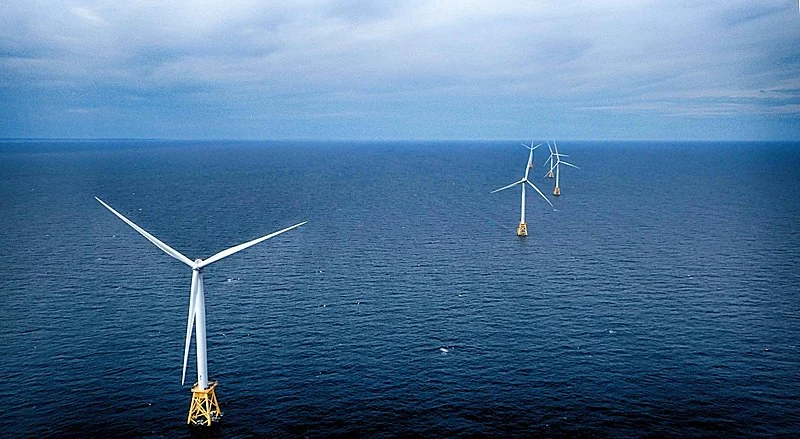
Block Island Wind Farm.
From eco RI News (ecori.org)
New research lead by the University of Rhode Island has concluded that offshore wind facilities produce minimal noise above and in the water while the blades are spinning. But the noise and vibrations from building them are a concern.
The research, funded through the Bureau of Ocean Energy Management, began with the construction of Deepwater Wind’s Block Island Wind Farm in September 2015. It continued when the five turbines began spinning in late 2016.
Through acoustic monitoring, James Miller, URI professor of ocean engineering and an expert on ocean sound propagation, found that the sound from the turbines was barely detectable underwater.
“You have to be very close to hear it. As far as we can see, it’s having no effect on the environment, and much less than shipping noise,” Miller said.
Working with a team of specialists from Woods Hole Oceanographic Institution, Marine Acoustics Inc. of Newport, and others, Miller heard ships, whales, wind, and fish. But noise measurements 50 meters from the turbines was hardly audible. Above the waterline, the swish of blades was barely heard, according to Miller.
The noise was monitored using hydrophones in the water and geophones, which measure the vibration of the seabed, on the seafloor.
The vibrations from the pile driving of the turbine’s support structure is a bigger unknown. Miller said the vibrations on the seabed had a surprising intensity that may harm bottom-dwelling organisms such as flounder and lobsters, which have a huge economic value in the state.
“Fish probably can’t hear the noise from the turbine operations, but there’s no doubt that they could hear the pile driving,” Miller said. “And the levels are high enough that we’re concerned.”
To minimize the aquatic impacts, the pile driving started with minimal sound to allow marine life to move away. Pile driving was also prohibited between Nov. 1 and May 1 to protect migrating North Atlantic right whales, which are critically endangered. The pile driving was also limited to daytime so that spotters could search for nearby whales.
This kind of monitoring will continue once construction starts on other Deepwater Wind offshore wind farms such as the Skipjack Wind Farm, off the coast of Ocean City, Md. Additional research will be conducted in the federal offshore wind energy area between Massachusetts and Rhode Island.
In addition to the acoustic impacts, the researchers looked at the impacts of offshore wind facility construction and operations on fishing, habitats and seabed scaring and healing. Studies will eventually be published from that research.
URI expects to study and provide data for the nearly 1,000 offshore wind turbines that have been proposed for installation in the waters between Massachusetts to Georgia in the coming years.
“We’ve become the national experts, which has added to Rhode Island’s reputation as the Ocean State,” Miller said.
REITs are a major force in region's economy

Part of the Assembly Row development in Somerville owned by a Real Estate Investment Trust.
This from The New England Council (newenglandcouncil.com):
The New England Council, the nation’s oldest regional business organization, has released a new report, ‘The Economic Impact of REITs in New England’. The report, developed with economic data and content compiled by Nareit, details the various ways that Real Estate Investment Trusts (REITs) are contributing to the New England economy, ranging from employment, to assets, to community revitalization.
REITs (Real Estate Investment Trust) own, operate or finance income-producing real estate. Modeled after mutual funds, REITs provide all investors the chance to own an interest in valuable real estate, present the opportunity to access dividend-based income and total returns, and help communities grow, thrive and revitalize.
Across the six New England states, REIT-owned properties include everything from commercial properties like office buildings, shopping centers, hotels, data centers, and recreational and entertainment facilities; residential properties such as apartment complexes and rental homes; as well as consumer and commercial storage facilities, over 3,000 telecom towers and nearly one million acres of timberland. In total, there are over 13,000 REIT-owned properties in New England, which represent $94 billion in gross assets, and support over 100,000 jobs.
‘From apartment complexes to office buildings, telecom towers to data storage facilities, REITs are all around us in New England,’ said James T. Brett, president and CEO of The New England Council. ‘As this report details, these businesses are having a tremendous impact on our region’s economy, ranging from community revitalization to supporting tens of thousands of jobs thought the six New England states. We hope that this report will provide stakeholders and policy makers with a better understanding of the role these companies play in our region’s economic well being.’
‘By investing in our communications infrastructure, American Tower is pleased to help bring connectivity to New Englanders which is now essential to all aspects of our work, education, health care and play,’ said Jim Taiclet, Chairman, president and CEO of American Tower Corp.
‘We are proud to call Boston home and to support the New England economy with 20 facilities and more than 800 employees across the six New England states, including our global headquarters,’ said William L. Meaney, president and CEO, Iron Mountain Inc.
The report draws upon data from Nareit’s December 2017 study ‘Economic contribution of REITs in the United States…’. The New England Council report supplements the data for the six New England states with profiles of some of the REITs operating in the region, including New England Council members American Tower Corporation and Iron Mountain—both headquartered in Boston — as well as Boston Properties’ 888 Boylston St. in Boston; Federal Realty’s Assembly Row in Somerville, Mass.; Weyerhaeuser’s timberlands in Maine; Ventas Inc.’s South Street Landing in Providence, and EPR Properties’ various recreational properties throughout New England.